 by Tom Gurney
Tom Gurney BSc (Hons) is an art history expert with over 20 years experience
Published on June 19, 2020 / Updated on November 17, 2026
Email: tomgurney1@gmail.com / Phone: +44 7429 011000
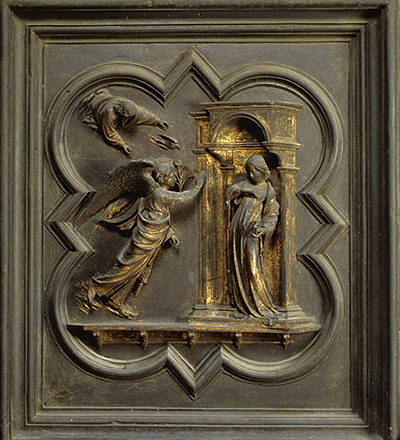
Gabriel’s raised fingertips line up with the edge of a pier. A little further to the right, Mary draws her hand across her breast. Both have raised their right hand, but the angel reaches towards the woman he addresses, while her fingers turn back towards her own body. The pier rises between the two gestures. In Lorenzo Ghiberti’s Annunciation, the width of that upright gives substance to the interval between hearing a greeting and knowing what it means. [1] [2]
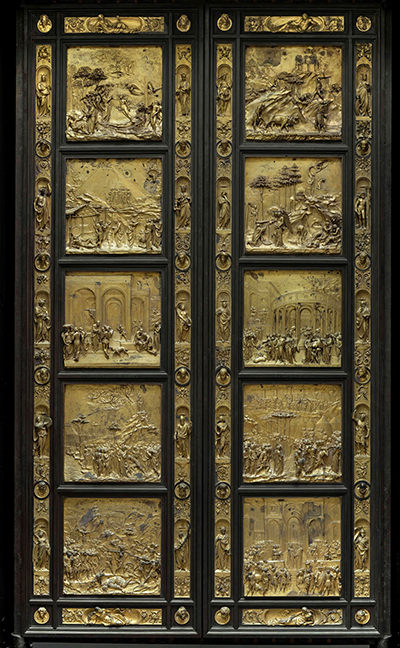
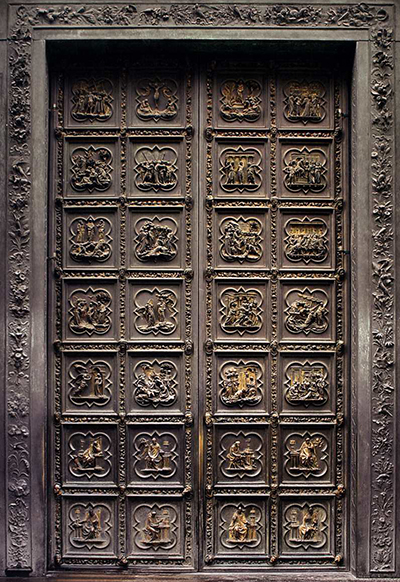
The gilded bronze relief opens the series of scenes from the life of Christ on the Florence Baptistery’s North Doors, made by Ghiberti and his workshop between 1403 and 1424. Look to the outer column of the left leaf, in the third row from the bottom. The turbaned head above and to the right, in the frame around the scene, is identified as Ghiberti’s self-portrait. The Museo dell’Opera del Duomo displays the original door in its Sala del Paradiso. [1] [3] [4] [5] [6]
The Opera’s catalogue places the relief in a group that Richard Krautheimer thought might date from about 1403–07. His reconstruction uses similarities of style, so the date is less certain than the panel’s place in the story. The commission records cited by the Opera call for Ghiberti to work on figures himself. They tell us what the patrons expected of him without specifying when this panel was cast or how he and his assistants divided the work on it. [1] [3]
Contents
- A floor for a visitor in flight
- What Mary hears
- Another Annunciation at a Florentine doorway
- From ledge to hillside
- The panel that tested the replica
A floor for a visitor in flight
Start below the figures, at the gilded horizontal ledge. Small brackets project from its front, with ornament in the panels between them. The ledge runs beneath both figures and stops inside the four-lobed border, leaving dark bronze visible below its supports. Mary’s hem reaches the base of her recess. At the other end Gabriel’s feet hang just above the ledge, on forms the Opera identifies as clouds. The straight top gives the eye a common level from which to judge the gap between Gabriel’s feet and the surface bearing Mary’s weight. [1] [2]
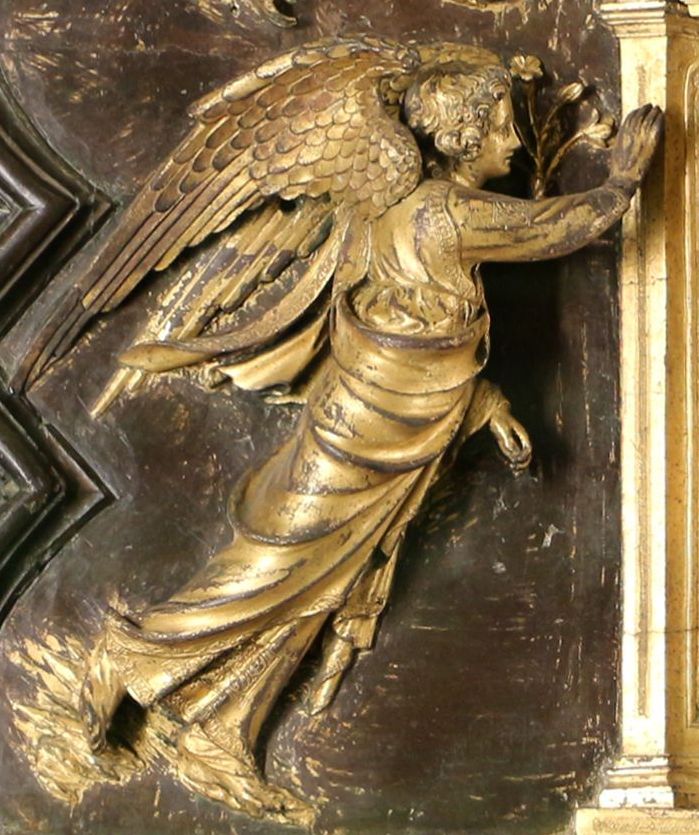
The angel’s body rises from low on the left. Follow the upper wing from its rounded shoulder to the long flight feathers pointing back towards the frame. The folds of the robe curl around his waist and then stream behind his legs. His face is already in profile towards Mary, and his forearm carries the approach still further, almost horizontally, into the upright of the doorway. At the end of that movement the fingers gather close together. The gilded flower heads beside his face belong to a lily, which the Opera identifies with Mary’s virginity. The thin stem is easy to miss between the much heavier forms of the arm and the pier. [1] [2]
Look across the top of the ledge on Mary’s side and a second, shorter base steps up under the building. The projecting mouldings turn a corner, and the shadow under the round arch makes its underside visible. Behind Mary’s head there is a wall; through the dark field around Gabriel’s wing there is no corresponding enclosure. The upright his hand approaches belongs to a structure with a back and a side, even though the whole thing fits inside the quatrefoil. The same platform can serve as the floor of a room on one side and give a sense of open air on the other. [1] [2]
Look closely at the Annunciation
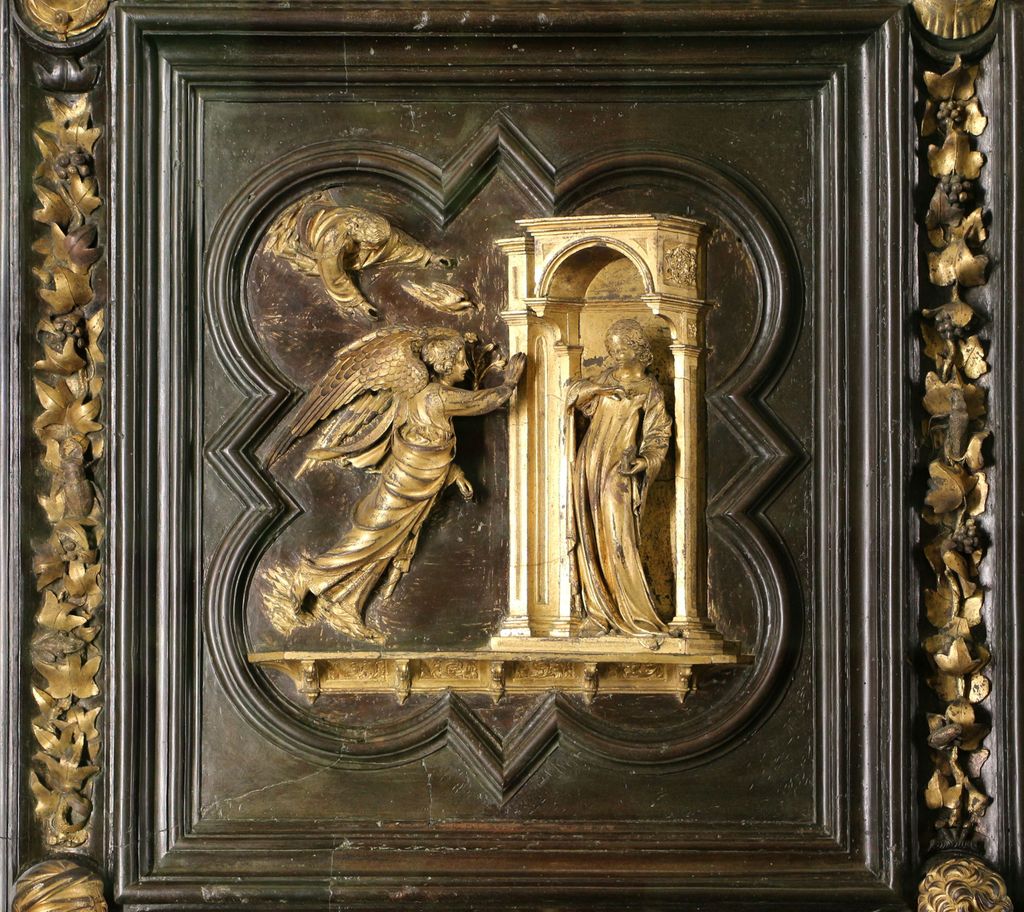
1. Gabriel enters
Gabriel bends into the space before the threshold. His outstretched hand reaches towards the column.
2. Mary at the threshold
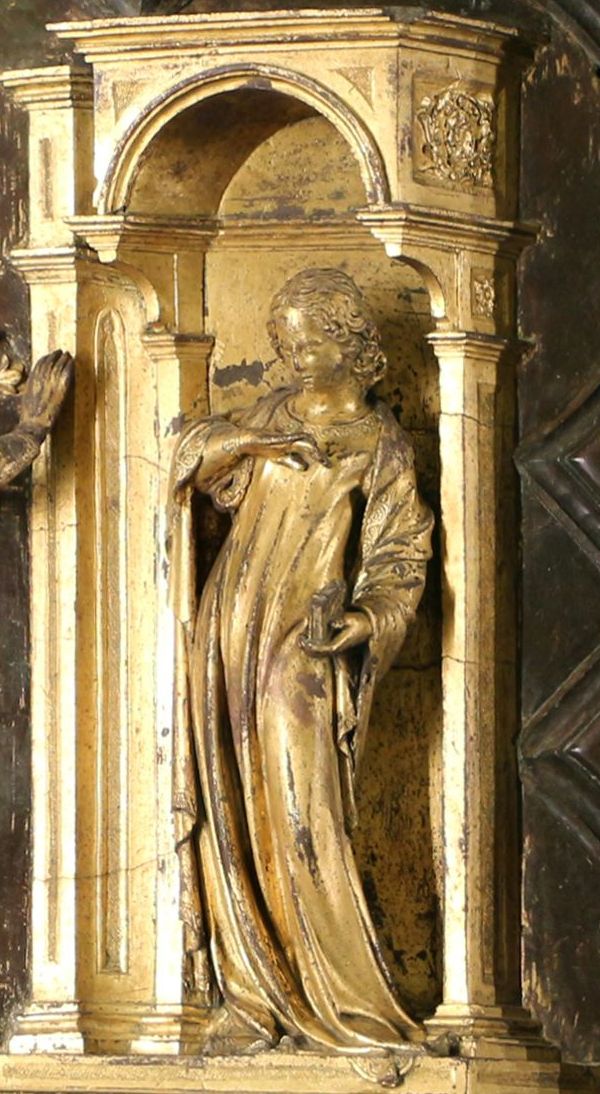
Mary turns within the doorway. The upright columns frame her and show where Gabriel’s forward movement stops.
3. The narrow floor
A projecting ledge gives the two figures a shared floor above the dark bronze field.
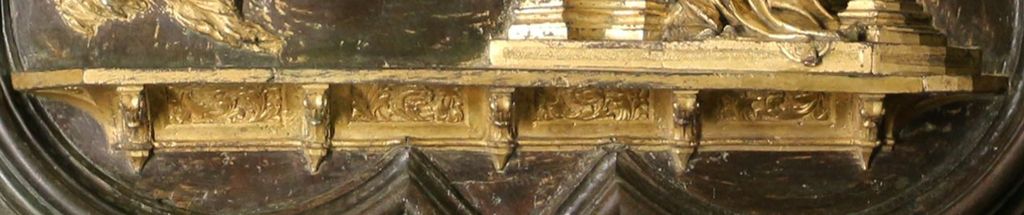
Photograph by Sailko. Source image. CC BY 3.0. Resized for the overview and cropped for detail.
What Mary hears
Mary stands with her head turned towards Gabriel and her body curving away. The straight mouldings make that turn easier to see. Her elbow comes forward from her side, but the hand stays close to her collar. Lower down, she still holds the little volume the Opera identifies as a prayer book. Its compact shape interrupts the long folds at her hip. The book lets us imagine the room a moment before he arrived, when Mary’s attention was somewhere else. [1] [2]
In Luke 1:26–38, Gabriel is sent to Nazareth and greets Mary. She is troubled and considers what his greeting might mean. He tells her that she will bear a son named Jesus; she asks how that can happen and, after his answer about the Holy Spirit, gives her assent. The Opera reads the lifted arm as a recoil. Mary’s face, already turned towards the speaker, makes it possible to see listening and withdrawal together. Luke distinguishes those successive responses in words. The bronze can suggest how quickly one follows another without fixing the raised hand to a single line of the dialogue. [1] [2] [7]
There is another arrival above Gabriel. In the upper-left curve the Opera identifies God the Father leaning out and sending the dove of the Holy Spirit towards Mary. The bird is the compact form angled down to the right, between the Father’s hands and the architecture. Its descent gives direction to what Gabriel describes in Luke. The book, lily and visible dove have no equivalents as objects in that passage. In the bronze, each occupies a different part of the scene: the book stays against Mary’s body, the flower comes with Gabriel, and the bird crosses the space above him. [1] [2] [7]
Another Annunciation at a Florentine doorway
The cathedral across from the Baptistery had its own sculpted Annunciation. The Opera attributes the two white marble figures to Giovanni di Ambrogio and associates their making with work on the Porta della Mandorla in the 1390s. The figures were initially inside the cathedral at the Trinity altar; the scientific catalogue places them in the portal’s lunette by April 1414. Their setting above an actual entrance makes them a close Florentine comparison for Ghiberti’s miniature doorway on a door. [8] [9] [10]
The marble Gabriel stands, inclines towards Mary and raises his right hand. His left originally held a lily, and sockets in his back show where wings were attached. Mary turns her head towards him, lifts her right palm and keeps a book in her left hand. The catalogue records restored fingers on both statues, so the overall turn and the lift of the arms make a surer comparison than the angle of any finger.
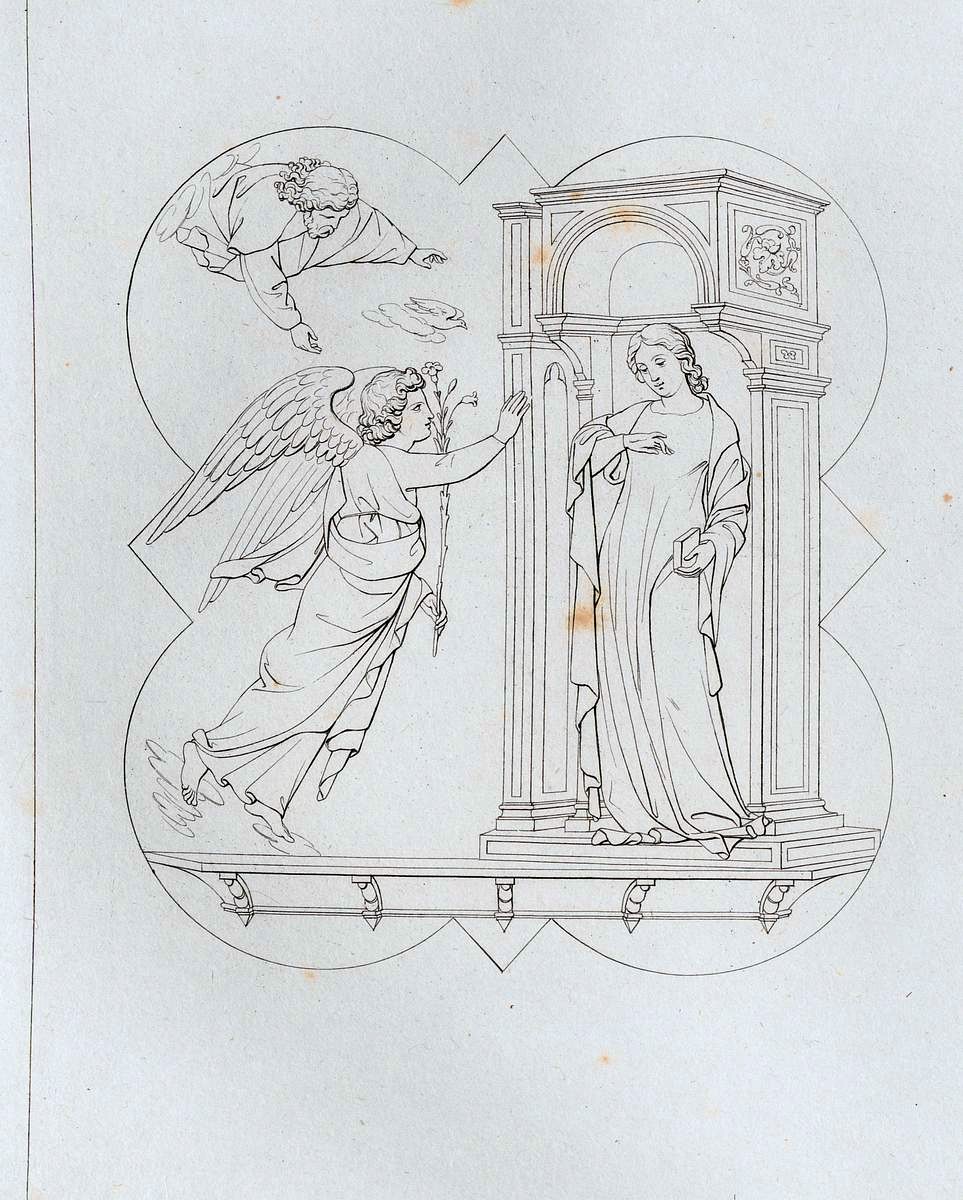
In the bronze Gabriel’s flight extends the approach, while Mary’s forearm crosses her body. In the portal the greeting passed between two separately carved figures set in real space. On the panel the projecting pier gives that interval an edge, and the ledge runs without a break beneath it. [1] [2] [9] [10]
From ledge to hillside
The Nativity sits immediately to the right. The two panels share the four-lobed outline, but the ground changes abruptly. The straight ledge gives way to a diagonal shelf of rock. In the neighbouring relief an angel’s announcement to the shepherds takes place apart from Mary and the child, with the rise of the ground dividing the two groups. Going from one panel to the next, the eye moves from a speaker and a listener brought almost within reach of each other to a message sent out across an open hillside. [2] [3] [4] [11] [12]
The panel that tested the replica
The Annunciation also had a part in determining how the copy at the Baptistery would be made. P. Tiziana Caudullo describes it as the trial panel for the entire process. The team recorded the original with a laser scanner, which could capture its shape without taking a mould from the bronze. A photograph published by Frilli, a participant in the project, shows the scanner set up at the relief. The scan data were assembled into a digital model from which the team could produce a full-size prototype. The prototype supplied the surface for a silicone mould, which in turn was used in making the bronze by lost-wax casting. [13] [14]
Making a cast was only half the test. The team scanned the new bronze and overlaid those data on the first scan to check how closely the surfaces corresponded. Caudullo reproduces part of the comparison report; the test gave the commissioners evidence about both the correspondence and the time needed to do the work before they decided to proceed with the rest of the door. A close photograph lets us follow the fall of light along the pier and the brackets, whereas the scan comparison checked how closely the cast reproduced the shapes that make those shadows. The published account illustrates that check without supplying a measured profile of the ledge. [2] [13]
The original had a separate treatment history. The panel catalogue records work by the Bearzi workshop in 1946–48 and an entry for the Opificio delle Pietre Dure in 2013. The Opera reported the completion of the North Door’s restoration in 2015. Conservator Stefania Agnoletti explains that the team adapted expertise from the Gates of Paradise to the needs of the North Door. At the Baptistery the replica still lets a viewer find the encounter at the beginning of the story, just to the left of the Nativity. In the museum it is the original surface that catches the light on the narrow pier between the two hands. [1] [3] [4] [5] [15] [16] [17]
Lorenzo Ghiberti in context
Sacrifice of Isaac
1401 competitionNorth Doors
1403–1424St John the Baptist
c. 1414–1416St Matthew
1419–1422Gates of Paradise
1425–1452St Stephen
c. 1427–1429Lorenzo Ghiberti sculpture directory
Discussion
Ghiberti rewards slow looking: relief, gilding, narrative structure, workshop practice and conservation evidence can all change how a work is read.
Join the Conversation
Have an observation about Annunciation, a source to add, or a comparison that sharpens the reading? Share it below.
References
- Opera di Santa Maria del Fiore, Annunciazione, Porta Nord del Battistero, object record 4256, inventory 931.1. View source.
- Sailko, Photograph of the original North Door Annunciation relief, Wikimedia Commons. View source.
- Opera di Santa Maria del Fiore, Porta Nord del Battistero, object record 3618. View source.
- Yair Haklai, Photograph of the original North Door in the Museo dell’Opera del Duomo, Wikimedia Commons. View source.
- Opera di Santa Maria del Fiore, Lorenzo Ghiberti, Porta Nord del Battistero, museum gallery entry. View source.
- Amy R. Bloch and Daniel M. Zolli, Introduction to Making and Unmaking Sculpture in Fifteenth-Century Italy, p. 14, fig. 9. View source.
- United States Conference of Catholic Bishops, Luke 1, verses 26–38. View source.
- Opera di Santa Maria del Fiore, Annunciation attributed to Giovanni di Ambrogio, museum gallery entry. View source.
- Opera di Santa Maria del Fiore, Gruppo dell’Annunciazione – Angelo Annunciante, object record 642. View source.
- Opera di Santa Maria del Fiore, Gruppo dell’Annunciazione – Vergine annunciata, object record 644. View source.
- Opera di Santa Maria del Fiore, Natività di Gesù, Porta Nord del Battistero, object record 4260. View source.
- Sailko, Photograph of the original North Door Nativity relief, Wikimedia Commons. View source.
- P. Tiziana Caudullo, ‘Scansione laser 3D: tecnologia al servizio della tutela dei beni culturali’, Archeomatica, nos. 3–4 (December 2020), pp. 6–9, especially p. 7 and fig. 2. View source.
- Frilli Gallery, The Baptistry, North Door project account and photograph of the Annunciation scan. View source.
- Opera di Santa Maria del Fiore, The Northern Door of the Baptistery, restoration report, September 2015. View source.
- Stefania Agnoletti, ‘Facing a huge conservation project: the three bronze doors of the Baptistery of Florence’, IPERION HS case-study abstract, 2019, printed p. 25. View source.
- Opera di Santa Maria del Fiore, The North Door replica, installation account, 2016. View source.