 by Tom Gurney
Tom Gurney BSc (Hons) is an art history expert with over 20 years experience
Published on June 19, 2020 / Updated on November 17, 2026
Email: tomgurney1@gmail.com / Phone: +44 7429 011000
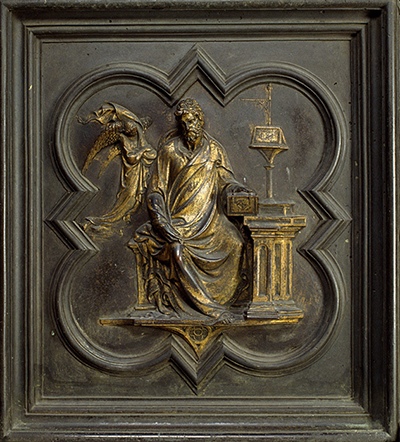
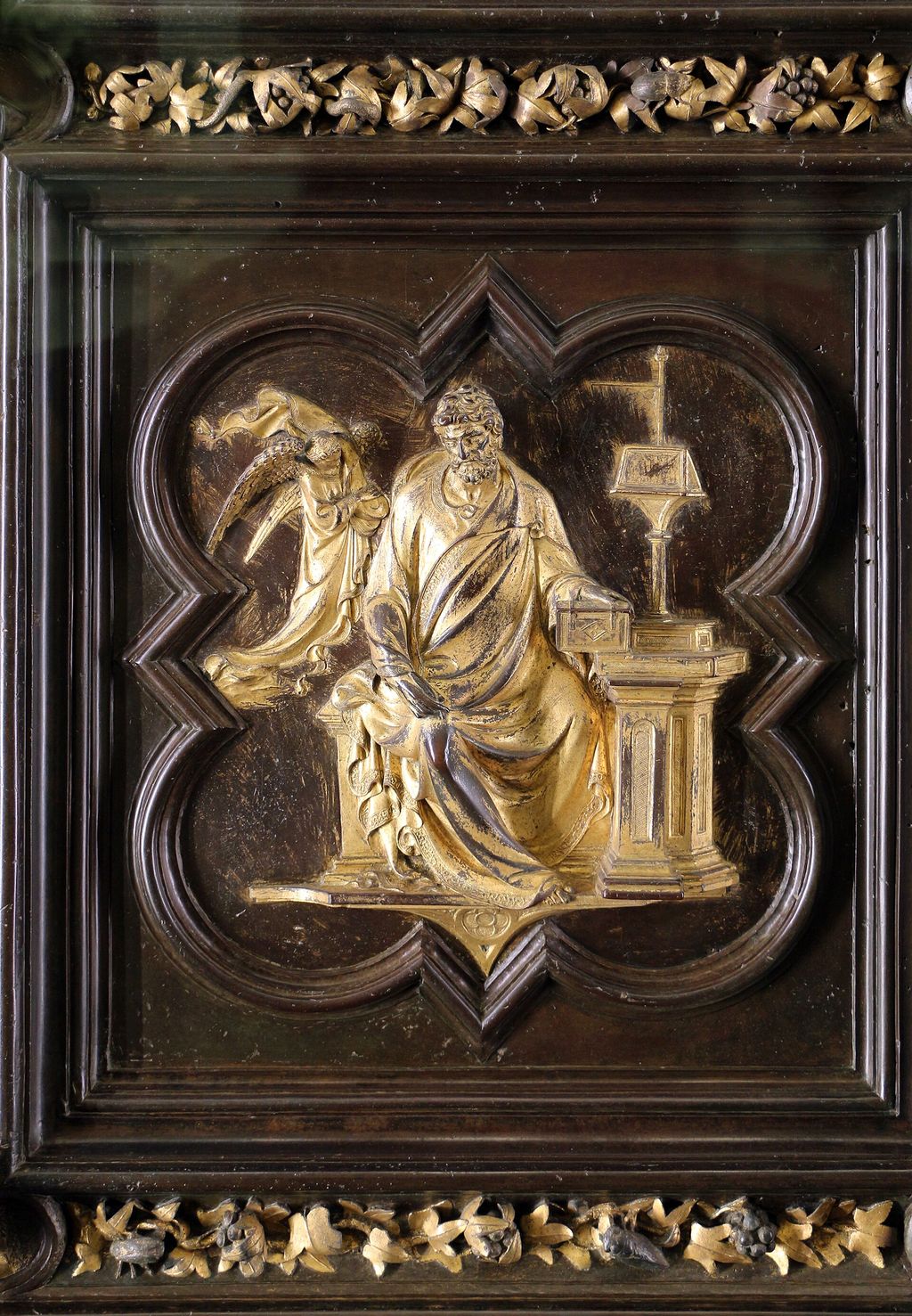
Matthew holds a pen low against his lap and rests his other hand on a closed book. A diamond decorates the cover, which faces out from Lorenzo Ghiberti’s gilded bronze relief on the North Door of the Florence Baptistery. Matthew himself turns towards the winged figure leaning in on the opposite side. The book and pen identify a writer, while the turn of his head gives the small encounter with his companion much of its force. [1] [2]
Contents
- The book beneath Matthew’s hand
- The winged figure beside Matthew
- The four writers across the door
- From Gospel page to bronze door
- The open Gospel at Orsanmichele
The book beneath Matthew’s hand
The four-lobed frame gives the desk and the winged man room on either side of Matthew’s broadly frontal figure. On the viewer’s right, his left hand meets the top of a rectangular volume propped on the desk. Close up, the main diamond on the cover sits amid finer diagonal lines. Behind the book, a narrow upright rises to a small sloping face. The desk below is a much heavier form, set on the same ledge as the seat. The difference in scale makes the upright easy to miss against the dark ground of the bronze. [1] [2]
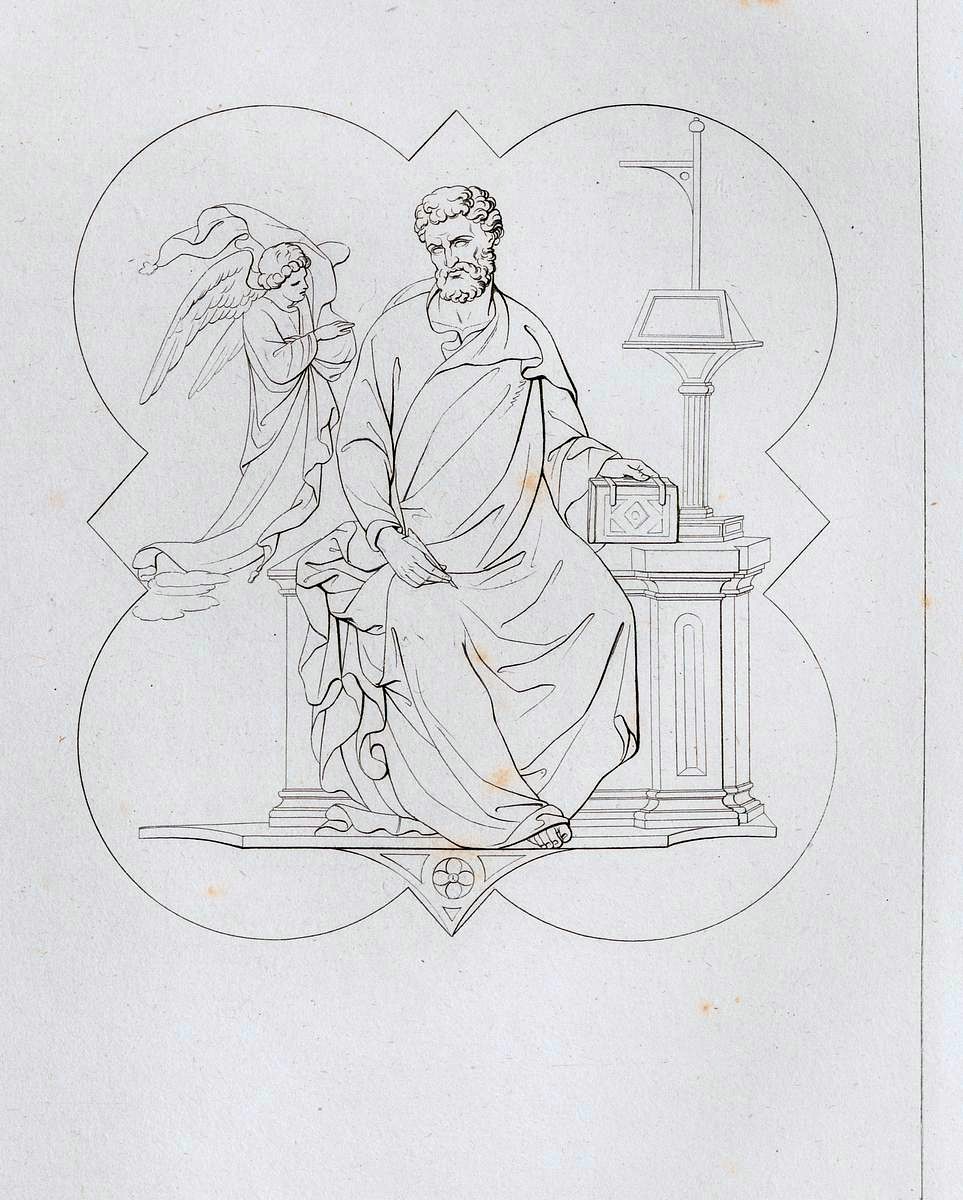
The 1821 engraving makes the two levels particularly easy to distinguish. There is a clear interval between the diamond-bearing cover and the small bordered surface above it. On Mark’s raised stand elsewhere on the door, an open volume is recognisable by its two facing pages. Matthew’s upper fitting has the appearance of a single plane, and the engraving gives little indication of what that surface represents. The lower book is easier to place. Matthew’s hand meets it at desk height, and its pattern draws attention to the cover where the fingers come to rest. [1] [2] [3] [4]
The winged figure beside Matthew
At the viewer’s left, the winged man inclines towards Matthew, with feathers and loose cloth spreading into the lobe beside the Evangelist’s shoulder. Bertha Friedmann read the scene as an image of inspiration in 1913. That reading takes its cue from the companion’s approach and the writer’s turn. The pen remains near the knee while the two faces are brought close together. The pose leaves room for a sense of attention without fixing a particular instant in the work of writing. [1] [2] [5]
The winged man also identifies Matthew within the group of four Evangelist symbols known as the Tetramorph. The Opera del Duomo catalogue relates the human figure to the Incarnation and to the opening of Matthew’s Gospel, which traces Jesus’s ancestry through David and Abraham. The neighbouring Nativity panel lies directly above Matthew. Read vertically, the door places the writer associated with that genealogy beneath a scene of the birth that follows it in his Gospel. [1] [6] [7] [8]
The four writers across the door
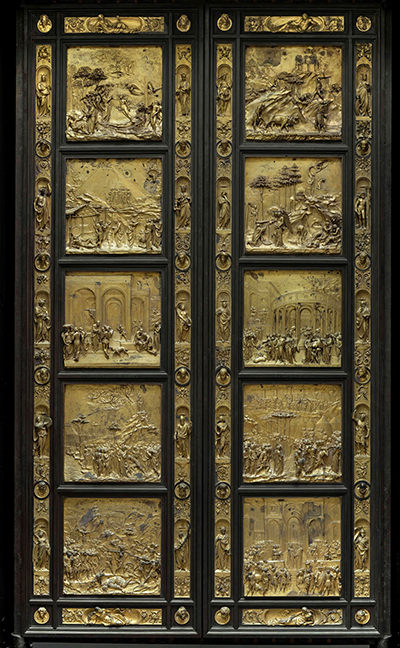
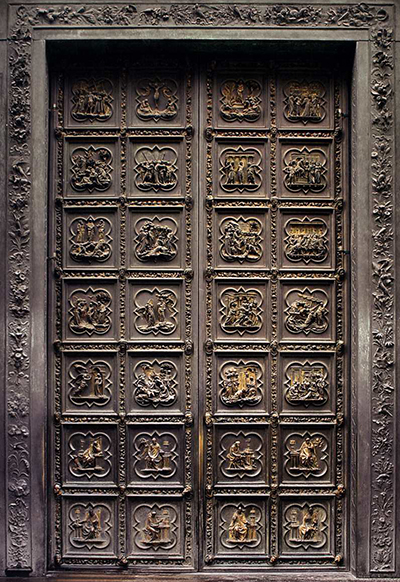
Matthew is second from the left, above Jerome, on the inner side of the left leaf. The Evangelist row runs John, Matthew, Luke and Mark between the Church Fathers below and the life of Christ above. The Opera dates the door as a whole to 1403–24 and reports Richard Krautheimer’s stylistic grouping of the four writers in a phase from around 1407 to 1413–15. A replica occupies the Baptistery doorway. The Museo dell’Opera del Duomo presents the original door with all four writers in place. [1] [6] [8] [9]
Friedmann also noticed how closely the lower drapery of Matthew and John resembles one another. On the paired engraving and in the bronze, a broad fold sweeps from each lap towards the ledge. Matthew’s sweep brings the eye towards the base of the desk, and the diagonal across his chest returns it to the arm extended towards the book. John’s eagle interrupts the folds near the opposite end of the ledge. Higher up, John props his chin on his hand and his open book lies at the chair arm. The similar fall of cloth gives the two seated bodies a kinship that makes the difference in their gestures more evident. [2] [3] [5] [10] [11]
Across the join, Luke uses his lap for a scroll while one hand attends to the open book on his desk. At the end of the row, Mark extends his writing hand towards a lower volume, with an open spread high above it. Reading across the row brings Matthew’s particular arrangement into focus. His lap carries the lowered hand and pen, while his extended arm joins the figure to a single clearly defined book. [1] [2] [4] [12] [13] [14]
From Gospel page to bronze door
Medieval Gospel books often pictured their authors. In a ninth-century leaf from the Freising Gospels, Matthew sits in classical drapery, with his pen poised by an open book on an animal-shaped lectern and his face turned towards his winged companion. The leaf gives an earlier example of the elements Ghiberti brings together. In the relief, the distance between the lowered pen and the closed book gives more room to the movement of Matthew’s head and the approach of his companion. [1] [2] [15] [16]
A portrait in a Gospel book can introduce the text that follows. On the North Door, the four authors sit side by side and the episodes they record extend above them. The repeated books make the row recognisable from a distance. The diamond and Matthew’s resting hand reward a closer look, once the shut volume can be picked out against the furniture. [1] [2] [6] [8] [15] [16]
The open Gospel at Orsanmichele
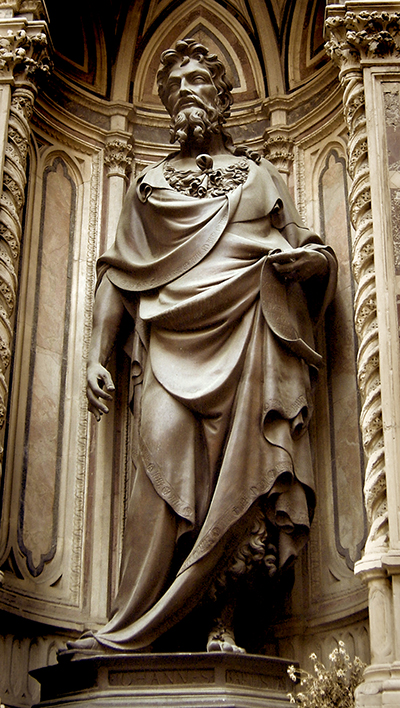
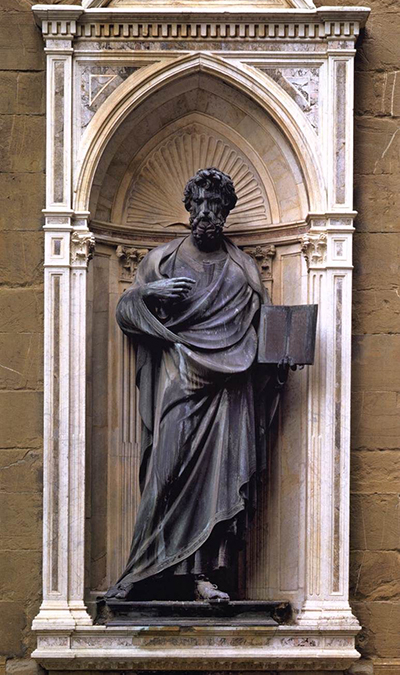
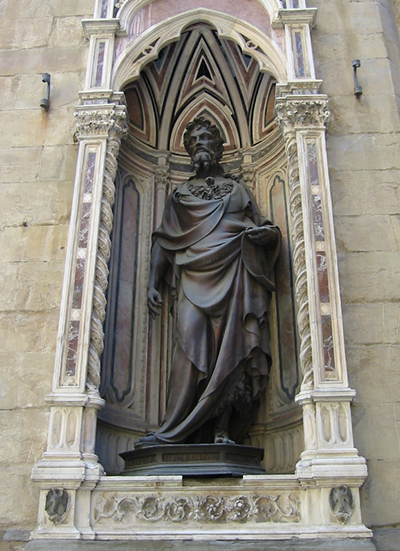
Ghiberti made the standing bronze Saint Matthew for the Arte del Cambio, the guild of bankers and money changers. The national catalogue draws on the guild’s Libro del pilastro to date manufacture to 1419–22 and installation to 1423. The date 1420 is on the lower hem of the mantle, where an inscription also names the guild. The catalogue suggests that the year refers to the wax model. [17] [18]
A spiral staircase inside the pier limited the depth of the niche. The statue projects in front of that shallow recess, with its left hand supporting the open Gospel beside the chest and the other hand raised. The replica in the original niche shows how far forward the book sits and how the pages face towards people looking up from the street. The original, now indoors at the Museo di Orsanmichele, brings the same spread into closer view. [17] [19] [20] [21]
The restoration of the statue revealed silver inlaid into the bronze to form the Gospel letters and the saint’s name on the base. Annamaria Giusti also records traces of gold leaf along the inscribed border of the mantle. The Gospel and the guild’s inscription belong to different surfaces. Matthew holds the Gospel out at chest height, while the guild’s name and date follow the garment lower down. At the Baptistery the diamond on the closed cover catches the eye at the point where the writer’s hand meets the desk. At Orsanmichele the lettering is part of what the raised book displays. [1] [2] [17] [18] [19] [21]
Lorenzo Ghiberti in context
Sacrifice of Isaac
1401 competitionNorth Doors
1403–1424St John the Baptist
c. 1414–1416St Matthew
1419–1422Gates of Paradise
1425–1452St Stephen
c. 1427–1429Lorenzo Ghiberti sculpture directory
Discussion
Ghiberti rewards slow looking: relief, gilding, narrative structure, workshop practice and conservation evidence can all change how a work is read.
Join the Conversation
Have an observation about Matthew, a source to add, or a comparison that sharpens the reading? Share it below.
References
- Opera di Santa Maria del Fiore, San Matteo Evangelista, Porta Nord del Battistero, object record 4283. View source.
- Sailko, photograph of Matthew’s relief on the original North Door. View source.
- Vincenzo Gozzini and Giovanni Paolo Lasinio, Le tre porte del Battistero di San Giovanni di Firenze, paired engravings XXIII–XXIV, 1821. View source.
- Sailko, photograph of Mark’s relief on the original North Door. View source.
- Bertha Friedmann, Ghibertis Verhältnis zur Gothik und Renaissance, 1913, p. 28. View source.
- Opera di Santa Maria del Fiore, Porta Nord del Battistero, object record 3618. View source.
- United States Conference of Catholic Bishops, Matthew, chapter 1. View source.
- Yair Haklai, photograph of the original North Door in the Museo dell’Opera del Duomo. View source.
- Opera di Santa Maria del Fiore, Renaissance clonation: the North Door replica. View source.
- Opera di Santa Maria del Fiore, San Giovanni Evangelista, Porta Nord del Battistero, object record 4281. View source.
- Sailko, photograph of John’s relief on the original North Door. View source.
- Opera di Santa Maria del Fiore, San Luca Evangelista, Porta Nord del Battistero, object record 4368. View source.
- Sailko, photograph of Luke’s relief on the original North Door. View source.
- Opera di Santa Maria del Fiore, San Marco Evangelista, Porta Nord del Battistero, object record 4399. View source.
- J. Paul Getty Museum, In the Beginning Was the Word: Medieval Gospel Illumination. View source.
- The Walters Art Museum, Leaf from the Freising Gospels: Portrait of the Evangelist Matthew, W.4.33V. View source.
- Italian Ministry of Culture, San Matteo Evangelista, national catalogue record 0900291897. View source.
- Annamaria Giusti, La statua del San Matteo di Lorenzo Ghiberti, restoration report in Amici Opificio Friends, October 2005. View source.
- Elisa Marianini, photograph of the original Saint Matthew inside the Museo di Orsanmichele. View source.
- Musei del Bargello, Orsanmichele, museum and exterior copies. View source.
- Yair Haklai, photograph of the Saint Matthew replica in the original Orsanmichele niche. View source.