 by Tom Gurney
Tom Gurney BSc (Hons) is an art history expert with over 20 years experience
Published on June 19, 2020 / Updated on November 17, 2026
Email: tomgurney1@gmail.com / Phone: +44 7429 011000
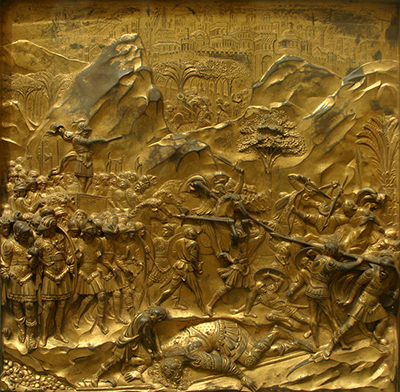
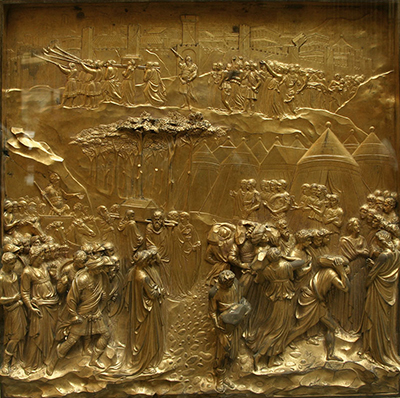
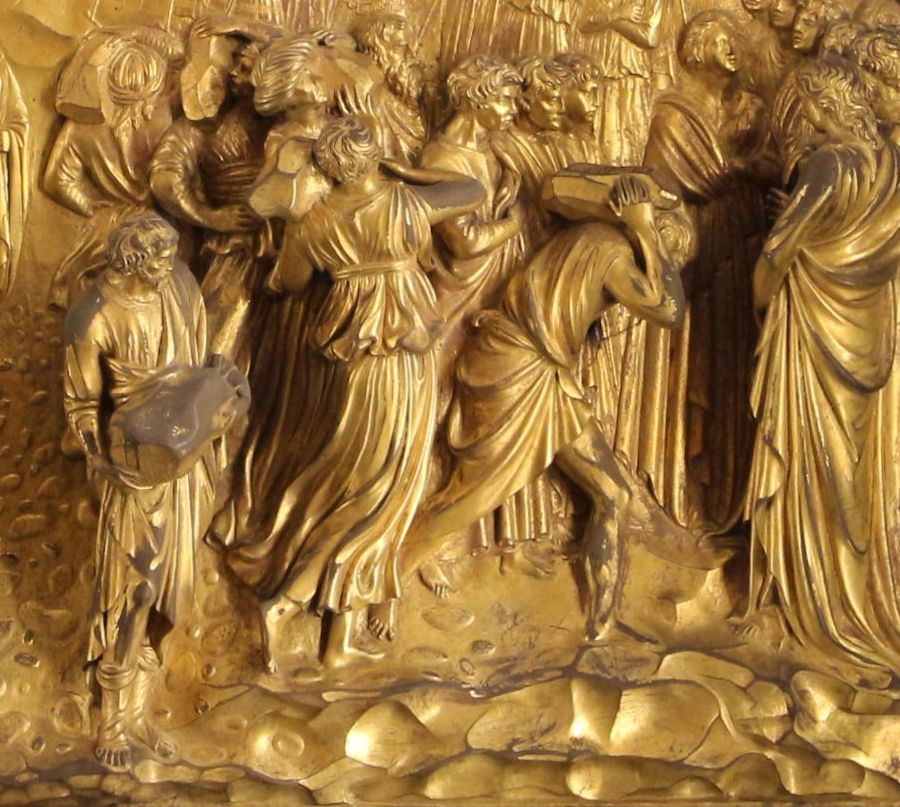
At the foot of Lorenzo Ghiberti’s relief, a man lowers his head over the stone he is carrying. Its broad face sits against his hip, and both hands help to hold it there. Near the top of the panel, part of a tower tilts away from the wall of Jericho. The rock looks heavy enough to slow a man down; the masonry looks thin enough to peel away. Between them the Ark of the Covenant appears twice, first at the River Jordan and then in the procession around the city. Finding the chest in both places makes it easier to see how much happens before the walls come down. [1] [2]
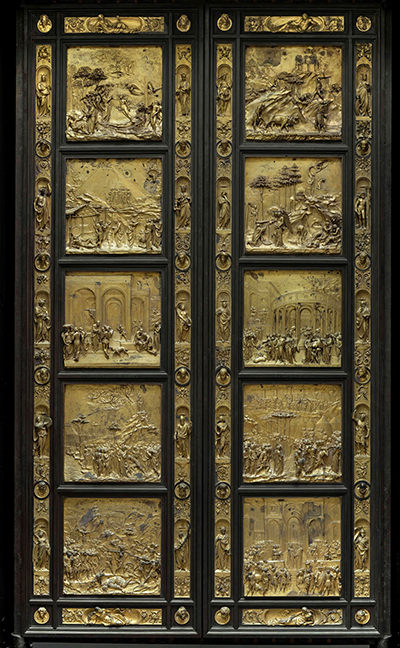
The Opera del Duomo catalogues the relief as Stories of Joshua. Made of cast bronze, chased and gilded, it is 80 centimetres tall and 79 across. Look four rows down on the right leaf of the Gates of Paradise to find its place opposite Moses and the Ten Commandments. Ghiberti and his workshop made the doors in 1425–52. The original is in Florence’s Museo dell’Opera del Duomo; a copy stands at the east entrance of the Baptistery. [1] [3]
Contents
- The chest on the poles
- Stones for the next generation
- A procession at the walls
- What survives the crossing
- The bronze behind the walls
The chest on the poles
Start below the grove of trees, just left of centre. The rectangular chest has a pitched lid and rides on poles held at shoulder height. One bearded bearer faces out; beside him another man turns in profile. The poles carry a strong horizontal line through the group, above the heads of people nearer the lower edge. The opening in the ground begins just beneath the bearers. Follow it down and it broadens into a bed of small hollows and rounded stones, with larger rocks lining the base of the relief. The channel is easiest to see where the two groups part: a few centimetres of exposed bronze make room for a river crossing. [1] [2]
In Joshua 3 the people are told to follow the Ark at a distance. It shows them the way across unfamiliar ground. When the priests enter the swollen Jordan, the water stops upstream; the bearers stay on dry ground in the channel until the people have passed. The close grouping in the bronze leaves little room for the long interval prescribed in scripture. Instead, the rise of the chest above the surrounding heads makes it visible from further down the panel, and the gap beneath it lets the eye travel between the banks. The chest marks both the direction of travel and the place where the bearers must stop. [1] [2] [4]
On the left, horse heads emerge from behind the leading figures. The armoured man above them is Joshua, according to the Opera catalogue. He stands in a chariot with a staff in one hand, extending his free hand towards the crossing. The vehicle gives him height without making his figure larger than the people in front of him. It is Ghiberti’s addition to this episode.
Amy R. Bloch also connects its first appearance in the door cycle to a chronology of inventions: Isidore of Seville placed the invention of the chariot by the Trojan Erichthonius in the period associated with Joshua. On that reading, a detail that helps us pick out the leader also places biblical history alongside the history of human inventions. [1] [2] [4] [5]
Look closely at the stories of Joshua
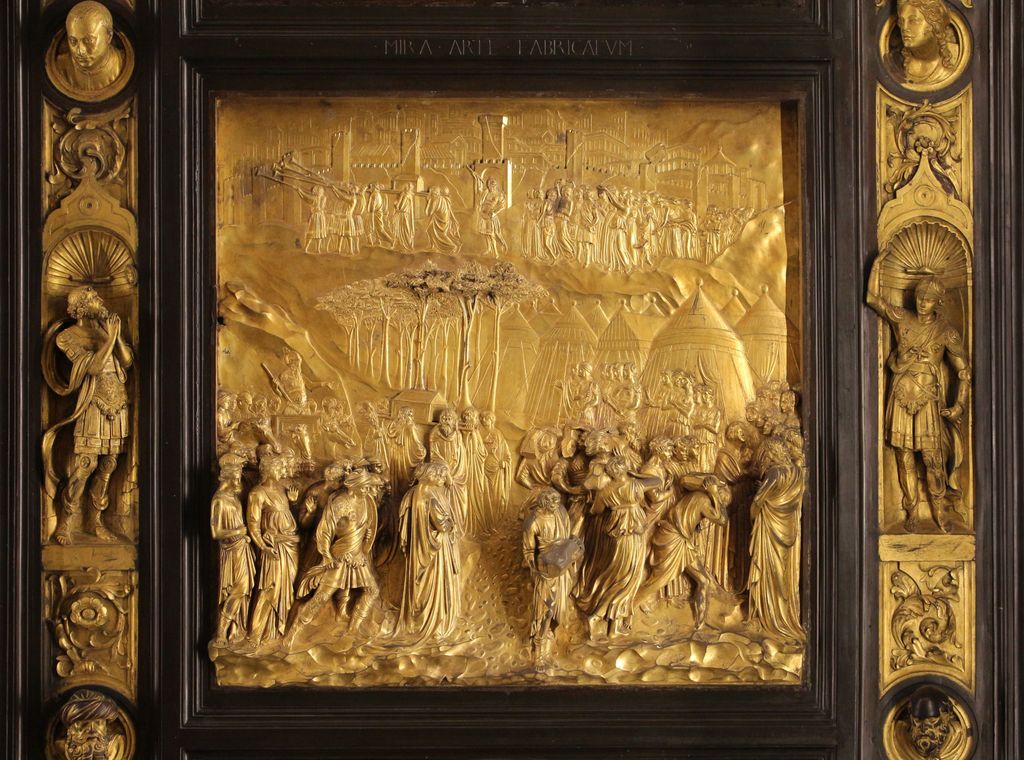
1. The crossing and the Ark
The Ark rises above the people who carry it into the crossing. The stippled river opens a route through the crowd.
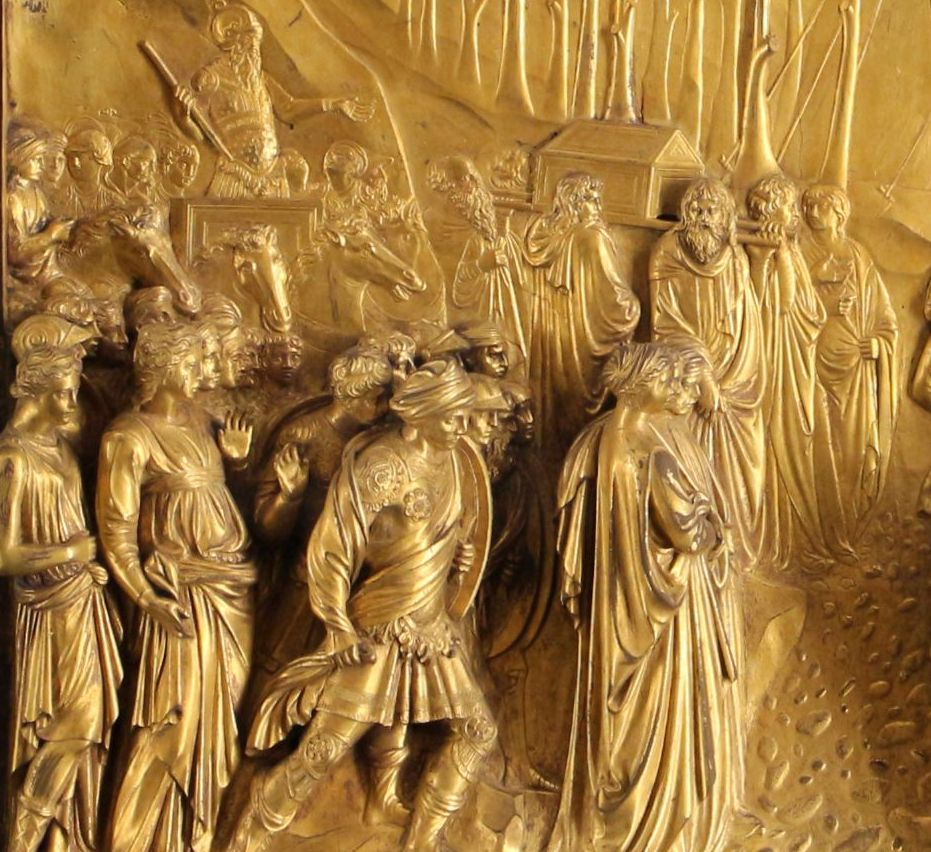
2. The stones in the foreground
The closest figures bend under the weight of stones, which the story sets up as a memorial of the crossing.
3. Jericho and the trumpets
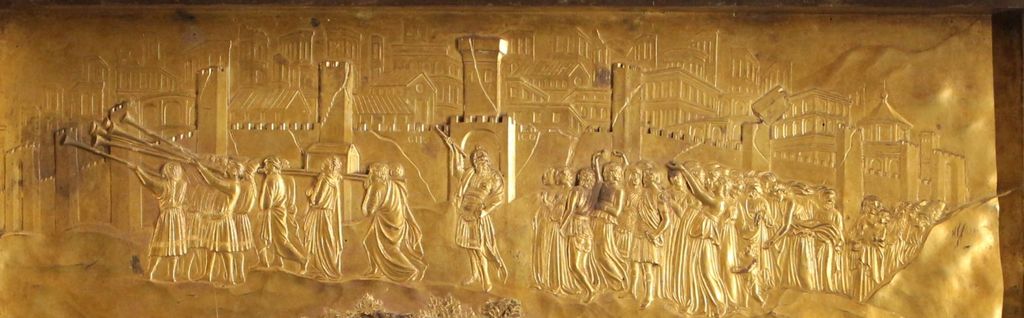
At the left of this detail, the trumpets project in parallel above the marchers. Jericho’s walls and towers are cut much more shallowly into the bronze behind them.
Photograph by Sailko. Source image. CC BY 3.0. Resized for the overview and cropped for detail.
Stones for the next generation
Look to the right of the channel, where the ground rises towards the camp. The first man holds a rough stone low against his hip. His lowered gaze follows the edge of the load, and the stone projects across folds that hang almost straight below it. Above him a second carrier turns his back to us. His raised elbow sticks out to the right as he steadies the block by his shoulder. Further right a third man pitches forward under a longer stone. His fingers curl over its edge, his head drops beneath it and a bare leg takes a long step. The stones have different shapes, and each body makes a different accommodation for its load. [1] [2] [6]
Direction matters as much as weight. The hip-borne stone is offered almost broadside to our view, while the turned carrier gives us his back and leads our eye into the group. The man taking the long step is already moving towards its edge. Several heads behind them turn sideways or look into the crowd rather than following a single line of sight. The changing angles of shoulders and faces make it possible to pick out individuals even where their bodies overlap. The Opera identifies women watching in front of the tents. Their presence gives the carriers somewhere to arrive and makes this bank a place of meeting. [1] [2] [6]
Joshua 4 explains why these burdens are worth carrying. Twelve men, one from each tribe, take stones from where the priests stood. The chapter also mentions stones set in the riverbed itself; it is at Gilgal that Joshua sets up those brought out of the Jordan. The memorial is meant to prompt a question from children so that the crossing can be told to them. Ghiberti gives the carrying enough space for us to see the size and shape of individual stones before they become part of a monument. Their place of origin remains in view beside them. [1] [2] [7]
The camp gives the story a pause. Above the carriers, the largest canopy opens below a conical roof; the uprights of smaller shelters further back mingle with the trunks. Ghiberti himself specifies twelve tents in his Commentarii. Alessandro Merlo and Gaia Lavoratti distinguish ten circular tents and two rectangular ones, so the total comes from looking beyond the most conspicuous peaked roofs. Twelve echoes the number of tribes and of stones in the biblical account. At Gilgal the people observe Passover and eat the produce of the land. The strip of tents and trees between the river and Jericho gives that interval its own place in a panel where the two miracles are visible at once. [2] [7] [8] [9] [10]
A procession at the walls
Find the long trumpets raised towards the left. Just behind them is a second chest with a pitched lid, small enough to miss if you have not already found the Ark at the Jordan. At the right, the file of people comes into view from behind a rise and thickens as it reaches the gate. The turn of the line gives an impression of a circuit without showing the far side of the city. At the Jordan the Ark’s bearers have to stand still so that others can pass; here the chest keeps its place in a moving procession. [1] [2] [4] [11]
Joshua 6 sets out a circuit once a day for six days, with seven priests sounding ram’s horns ahead of the Ark, and seven circuits on the seventh day. At Joshua’s signal the people shout and the wall falls. Ghiberti gives the players straight trumpets and makes the collapse visible while they are still blowing. Look behind them for the battlements running towards the gate.
The Opera records the faint incised letters GER and ICO on either side of it. Near the centre a diagonal break runs across a tower; further right a piece of masonry is visibly out of line with the wall below. The chapter continues with the killing of the inhabitants, the sparing of Rahab and her household and the burning of Jericho. The visible action stops at the breaking of the defences. [1] [2] [11] [12]
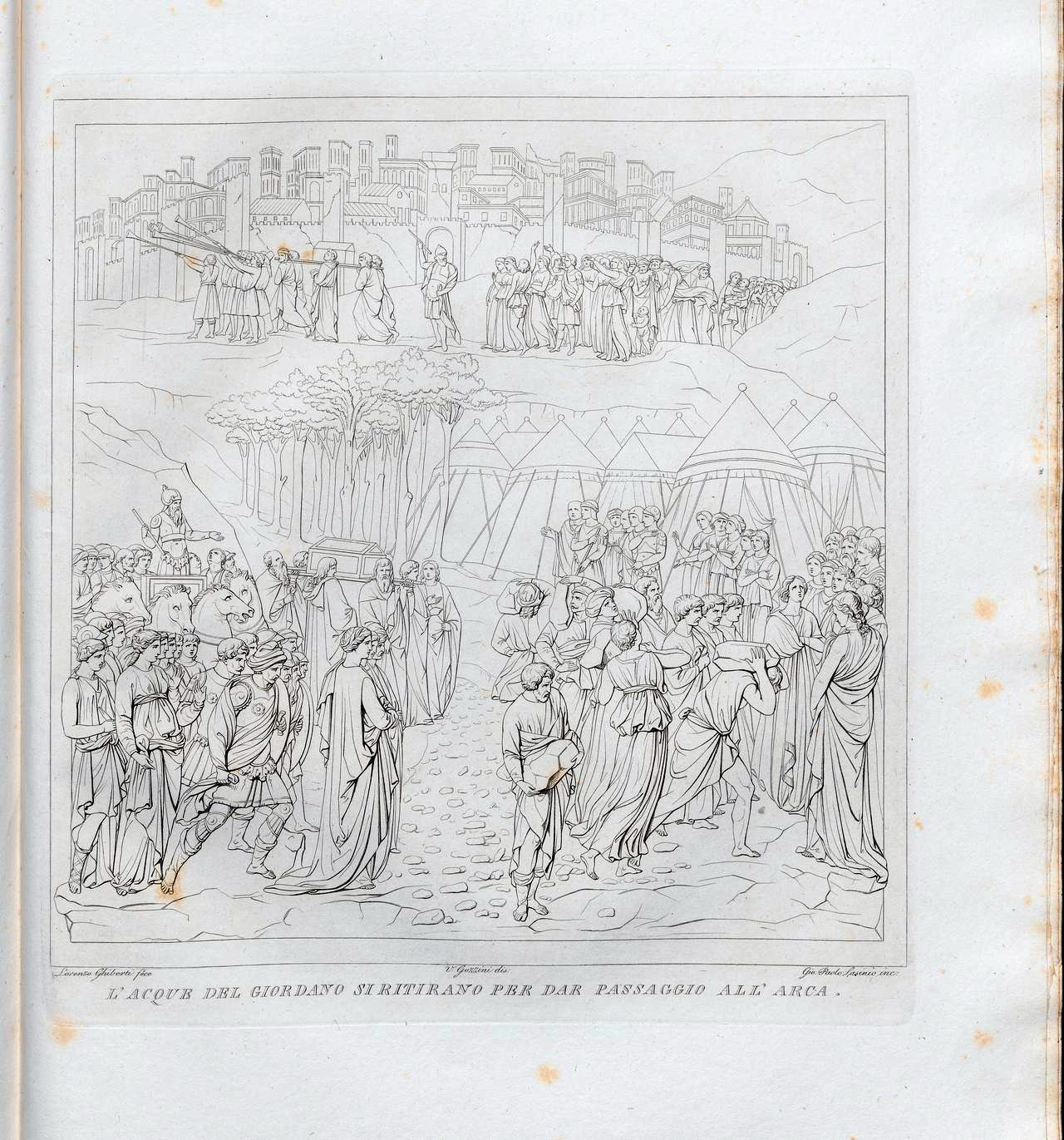
In his own account Ghiberti names the Jordan, the tents, the trumpet circuit and the fall and taking of the city after seven days. The stones and the two appearances of the Ark are details a viewer has to recover from the bronze. The names of the Madrid plaster show how differently the scene can be remembered. The Real Academia de Bellas Artes de San Fernando calls its 1771 cast La toma de Jericó, the taking of Jericho. The earlier inventory entry reproduced in its catalogue describes the plaster by the carrying of the Ark. Each name picks out a different action, although both apply to a cast of the same relief. [1] [2] [8] [13]
What survives the crossing
Giorgio Vasari noticed how the relief grows shallower from the foreground towards the city and the country beyond. Scott Nethersole points out what this does to the two kinds of stone. The river rocks are among the most solidly projecting forms, while some of the lines that define the fortified city are little more than incisions. In the foreground the edges of the rocks catch light and the hollows between them hold shadow.
At Jericho, bright patches of reflected light can make parts of the wall hard to follow even before the line reaches a break. Bloch reads the building and destruction in the panel in relation to Ghiberti’s interest in the vulnerability of works of art. Here the difference between building up the bronze and barely marking its surface gives that vulnerability a visible form. [2] [5] [12] [14]
The relative size of the episodes also matters for a door made for a baptistery. In their commentary, Nethersole and Ben Quash connect the prominence of the Jordan to the Christian reading of the crossing as a prefiguration of baptism. Gwynne Ann Dilbeck gives that association a local setting.
In her study of the Florentine Holy Saturday rites, she relates the imagery to baptisms celebrated at the Easter vigil and notes that one of the readings describes the commissioning of Joshua as Moses’ successor. That reading supplies a link with the leader and the Ark without recounting the crossing itself. The surviving directions she discusses describe a procession to the font without specifying which entrance was used. The connection helps explain what the subject could evoke in this building. [1] [3] [12] [15]
The bronze behind the walls
The fissures in Jericho belong to the picture. A different set of marks tells us how the picture was cast. Salvatore Siano, Piero Bertelli, Marcello Miccio and Ferdinando Marinelli assembled six radiographs of the Joshua panel into one image. They found large casting pores concentrated in the upper part of the relief. In their judgement the distribution rules out a mould lying flat during the pour. The radiographs alone do not show whether the mould stood quite vertical or whether the figures were right way up or inverted. [2] [16]
On the reverse, chisel cuts and torn junctions show where a branching network of channels met the body of the panel. Molten metal passed between the channels and the main cavity; the marks survived the removal of surplus metal after casting. In the researchers’ diagram the contact points are picked out in white, so the layout can be read even though much of the network is gone. The radiographs reveal voids within the bronze, while the cuts record work done on its back. Neither supplies the fractures that make the little city appear to give way. [2] [16]
The Opera records chemical and laser cleaning in the 1990–2012 conservation campaign. What we can follow on the gilded face today is an arrangement of depth and light: the solid projection of a stone still being carried, the narrow line of the chest’s poles and, much further back in the story, the fine strokes that show a tower losing its footing. The river stones are promised a future in the story because people will ask what they mean. Jericho’s worked masonry, drawn so lightly in the distance, has already begun to fall. [1] [2] [7] [12]
Lorenzo Ghiberti in context
Sacrifice of Isaac
1401 competitionNorth Doors
1403–1424St John the Baptist
c. 1414–1416St Matthew
1419–1422Gates of Paradise
1425–1452St Stephen
c. 1427–1429Lorenzo Ghiberti sculpture directory
Discussion
Ghiberti rewards slow looking: relief, gilding, narrative structure, workshop practice and conservation evidence can all change how a work is read.
Join the Conversation
Have an observation about Joshua and the Fall of Jeric, a source to add, or a comparison that sharpens the reading? Share it below.
References
- Opera di Santa Maria del Fiore, Formella con Storie di Giosuè, object record 2850. View source.
- Sailko, Photograph of the original Joshua relief in the Museo dell’Opera del Duomo, Wikimedia Commons. View source.
- Opera di Santa Maria del Fiore, Porta del Paradiso, object record 1320. View source.
- United States Conference of Catholic Bishops, Joshua 3, verses 2–17. View source.
- Amy R. Bloch, Introduction to Lorenzo Ghiberti’s Gates of Paradise, Cambridge University Press, 2016, printed p. 8. View source.
- Amy R. Bloch, List of Figures in Lorenzo Ghiberti’s Gates of Paradise, Cambridge University Press, 2016, figs 211–13 and 228. View source.
- United States Conference of Catholic Bishops, Joshua 4, verses 1–9 and 15–24. View source.
- Lorenzo Ghiberti, I commentarii, ed. Julius von Schlosser, vol. I, 1912, p. 50, Warburg Institute digital facsimile. View source.
- Alessandro Merlo and Gaia Lavoratti, ‘The Representation of Vernacular Architecture in the Gates of Paradise by Lorenzo Ghiberti’, Heritage 7 (2024), section 3.3 and fig. 14. View source.
- United States Conference of Catholic Bishops, Joshua 5, verses 8–12. View source.
- Joshua 6, King James Version, verses 2–25. View source.
- Scott Nethersole and Ben Quash, ‘Gossamer Walls’ and ‘Metamorphosis of a Massacre’, The Battle of Jericho, The Visual Commentary on Scripture. View source.
- Real Academia de Bellas Artes de San Fernando, Puerta del Paraíso. La toma de Jericó, inventory V-289, including the 1804–14 inventory transcription. View source.
- Giorgio Vasari, ‘Lorenzo Ghiberti’, Le vite, 1568, passage on the Joshua panel. View source.
- Gwynne Ann Dilbeck, Opening the Gates of Paradise: Function and the Iconographical Program of Ghiberti’s Bronze Door, PhD dissertation, University of Iowa, 2011, pp. 90–95 and 152–55. View source.
- Salvatore Siano, Piero Bertelli, Marcello Miccio and Ferdinando Marinelli, ‘Studio sulla tecnica di fusione dei rilievi della Porta del Paradiso’, section 4, figs 5–6. View source.