 by Tom Gurney
Tom Gurney BSc (Hons) is an art history expert with over 20 years experience
Published on July 10, 2026 / Updated on November 17, 2026
Email: tomgurney1@gmail.com / Phone: +44 7429 011000
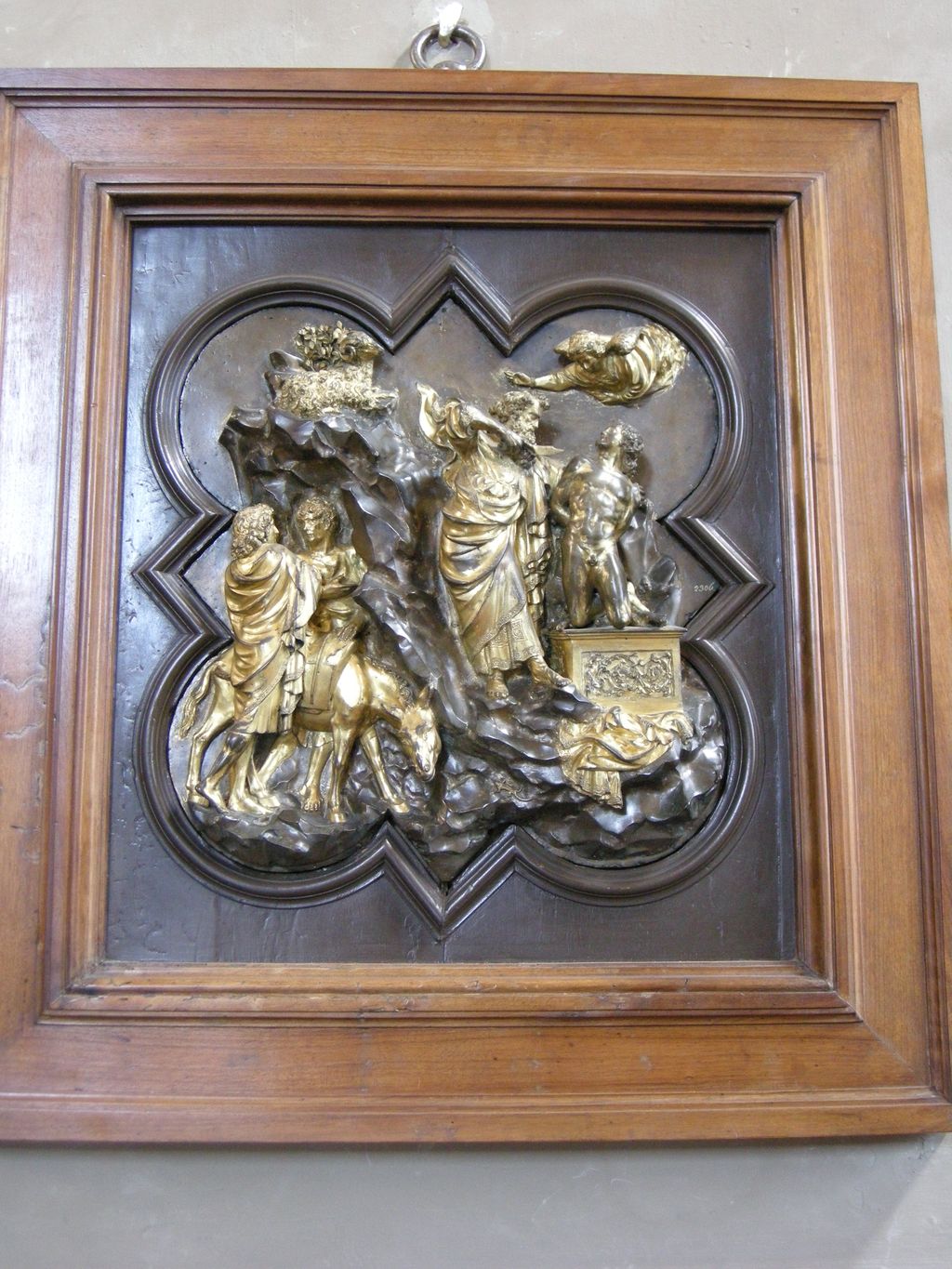
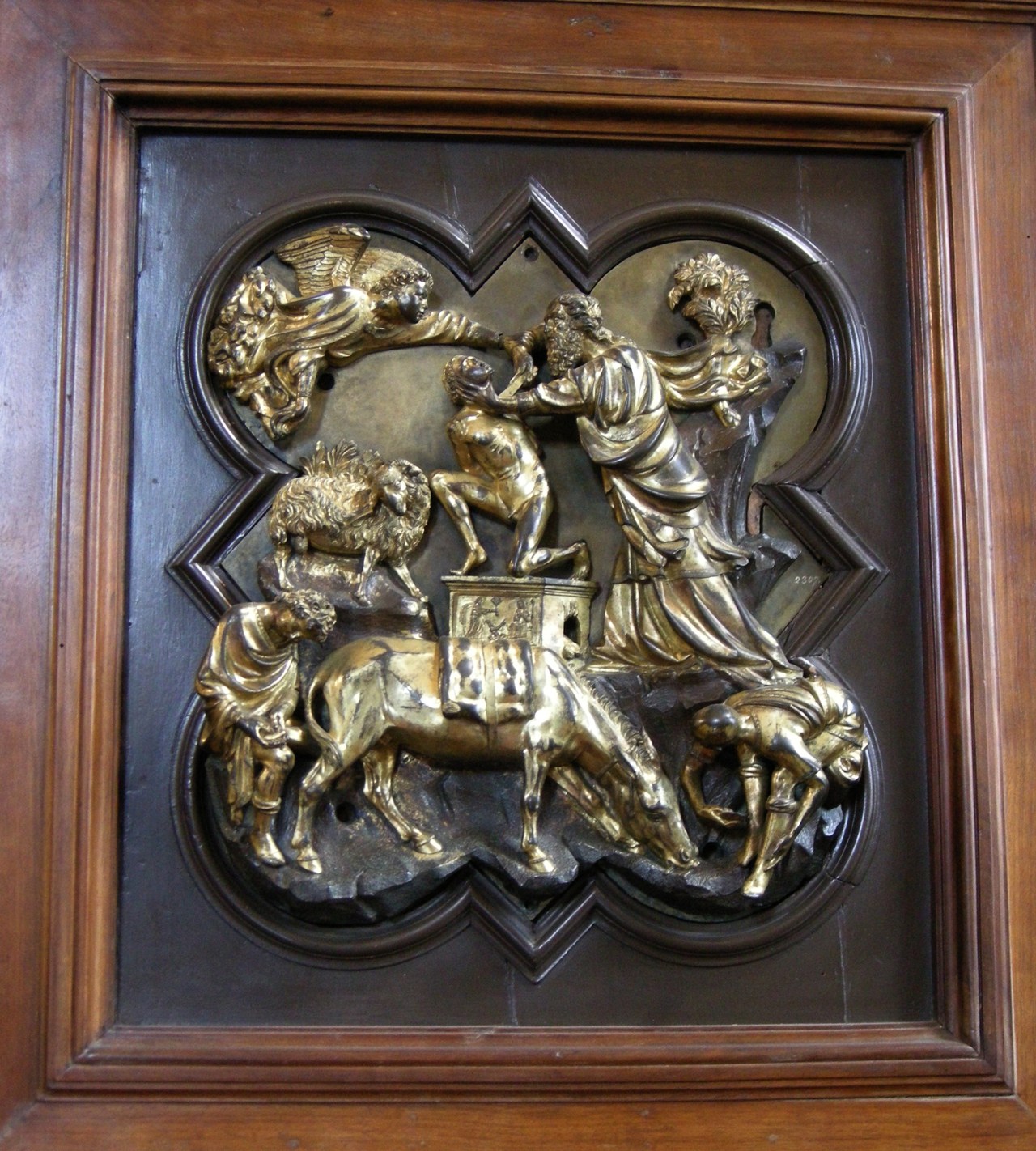
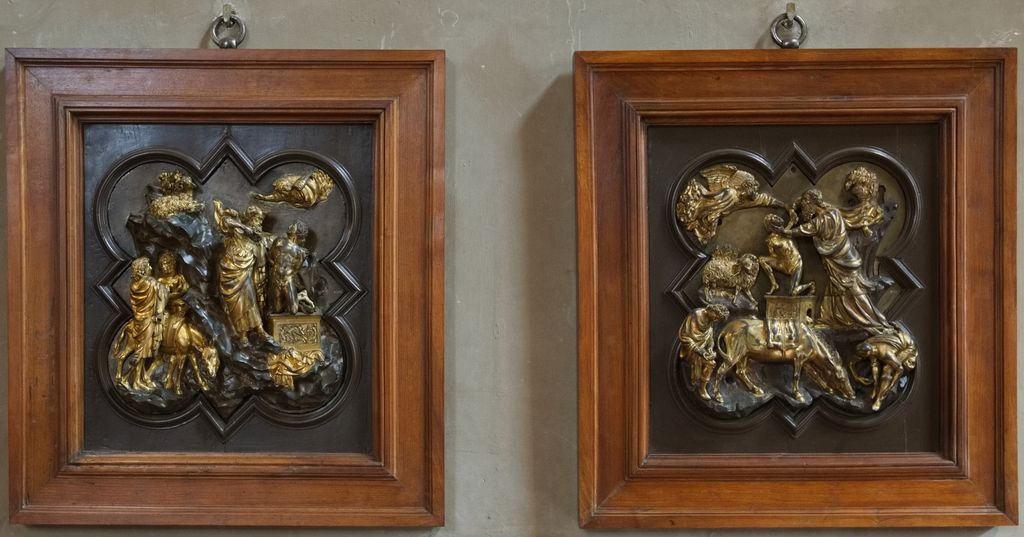
A hand reaches across a patch of bare bronze in Lorenzo Ghiberti’s Sacrifice of Isaac. It belongs to the angel who has come to save the boy kneeling on the altar. There is still a gap between the angel’s hand and Abraham. In Filippo Brunelleschi’s relief of the same subject, the angel has already caught Abraham by the wrist. At the Museo Nazionale del Bargello in Florence, which houses both competition entries, that small interval is one of the most revealing things to look for. Each sculptor had to make a voice from heaven intelligible in bronze. One gave it room to travel. The other gave it a grip. [1] [2] [3] [4] [5]
The Arte di Calimala, Florence’s cloth merchants’ guild, called the competition in 1401 for the second bronze door of the Baptistery of San Giovanni. Both surviving trials are catalogued under 1401. They are partly gilded and share the quatrefoil format, with four rounded lobes and points between them. The Bargello inventory distinguishes Ghiberti’s panel as Bronzi 203 and Brunelleschi’s as Bronzi 209. The national catalogue gives Ghiberti’s height and width as 45 × 38 cm, while the 2013 Springtime of the Renaissance exhibition checklist gives 44 × 38 × 10.5 cm. The same checklist gives Brunelleschi’s panel as 41.5 × 39.5 × 9 cm. [1] [2] [6]
Contents
- How the warning crosses Ghiberti’s panel
- How Brunelleschi brings the figures together
- What the bronze reveals about the trial
- The award and the stories told about it
- How the two panels came together again
How the warning crosses Ghiberti’s panel
In Genesis 22, Abraham leaves his two servants with the donkey and goes on with Isaac to the place God has indicated. He binds his son, lays him on the altar and takes up the knife. The angel calls to him from heaven. Only after hearing the command to spare Isaac does Abraham see the ram caught in a thicket and sacrifice it in his son’s place.
Both bronzes show the servants, the animal they are minding and the ram together with the scene at the altar. The Bargello catalogue entries report John Pope-Hennessy’s suggestion that the number of figures and the inclusion of the servants in the foreground were probably prescribed. The figures recur in both versions, even where their placement and gestures diverge. [1] [2] [4] [7]
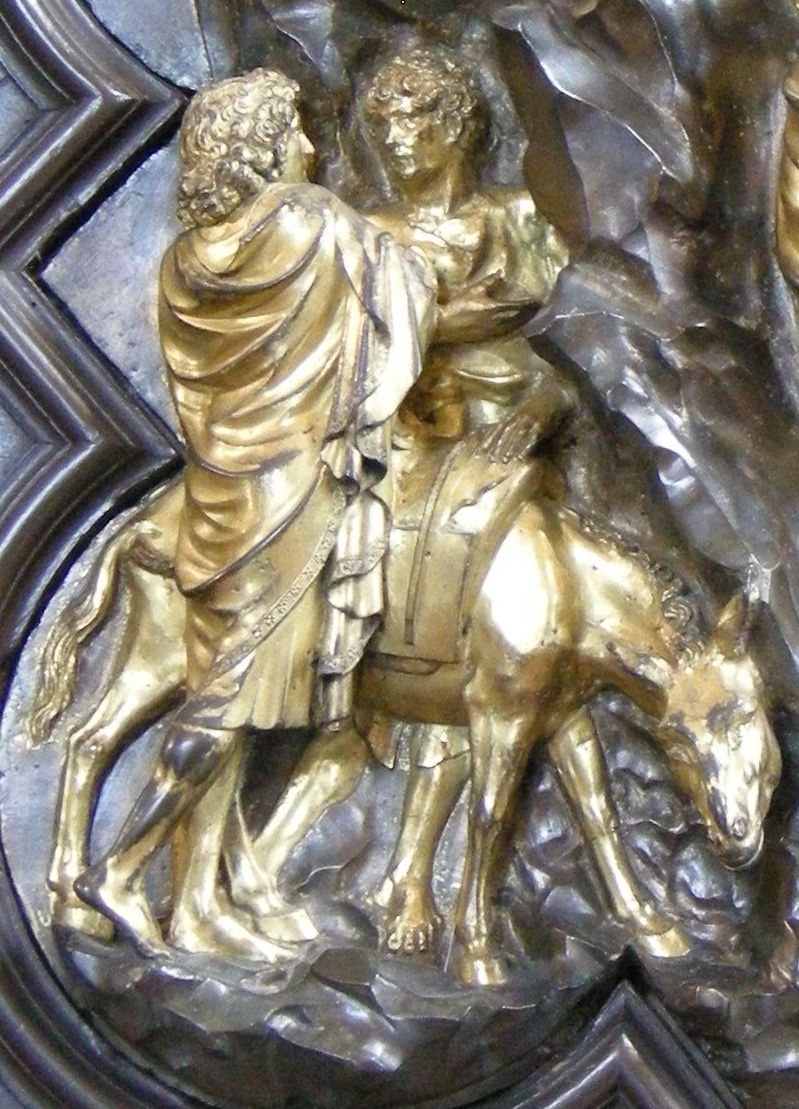
Begin at the bottom left of Ghiberti’s panel. One servant presents his back, with the hem of his cloak falling across the donkey’s flank. The other faces him and rests a hand against the animal’s load. The donkey lowers its head towards the ground. Their attention stays within the group. Above them a ledge juts out, catches the light along its broken edges and forms a shelter over the men. Follow the rock down towards the centre and it becomes the ground under Abraham’s feet. The rock gives the men and Abraham a common footing and screens the waiting group from the altar. [4] [5]
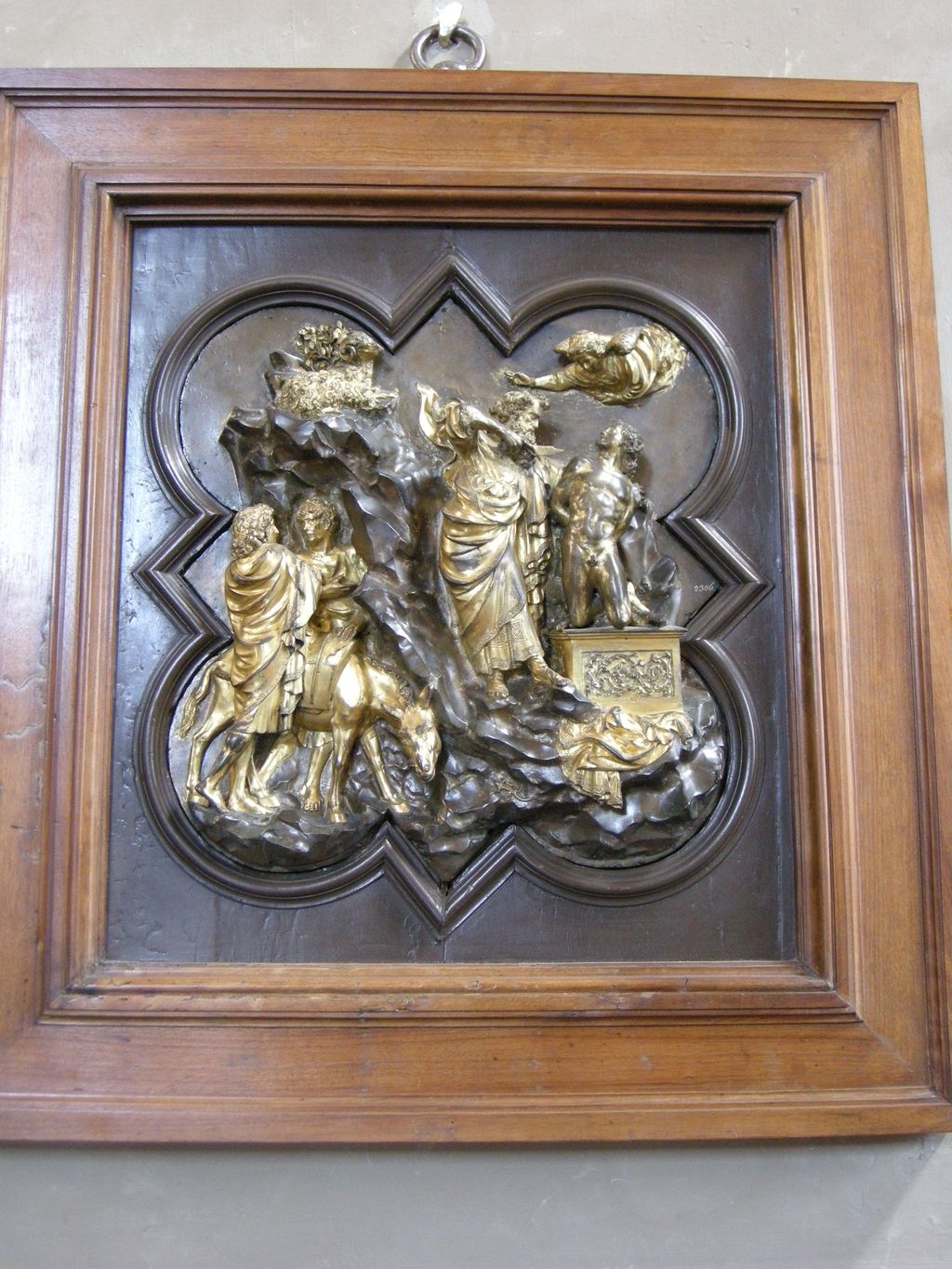
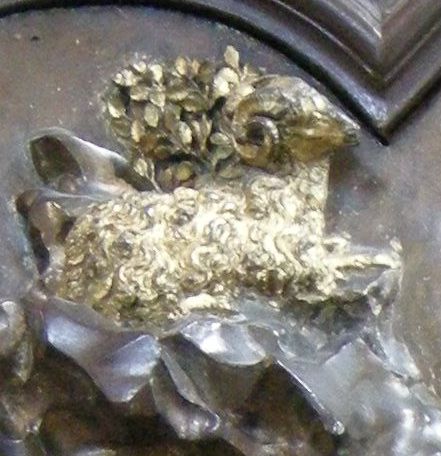
The ram lies high on the left, with tight curls of fleece and a horn that rolls back beside the leaves. It is easy to pick out against the darker rock. Across from it, the angel’s body appears compressed, its folds gathered behind the arm that reaches towards Abraham. A little of the flat ground remains visible under the hand. Follow the gesture into that gap and it leads across the top of the scene towards the ram. Genesis lets Abraham hear the warning and then discover the animal. Ghiberti gives the viewer both pieces of information at once while leaving Abraham on the point of receiving the first. [4] [5] [7]
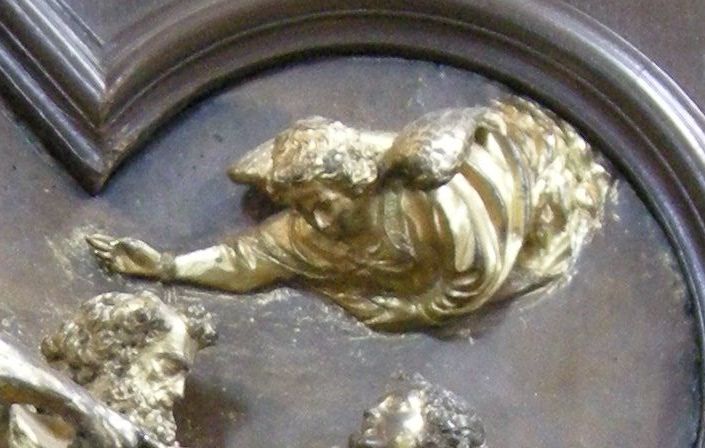
Isaac’s body supplies another direction of movement. Both knees bear on the altar, his arms draw back, and his chest turns out towards us while his face lifts towards Abraham. Beneath the boy, the squared lip of the altar and the shallow scroll of foliage on its face make a firm base for that turn. Ghiberti treats flesh, carved ornament and torn rock as quite different surfaces within a few inches.
The national catalogue relates Isaac’s muscular torso to antique sculptures of centaurs. The Uffizi’s Gaddi Torso is a comparison for the way the chest twists above the waist. The Uffizi documents the marble in the Gaddi collection at the time of its purchase in 1778. The resemblance suggests a way to look at Isaac’s turn; it cannot establish that Ghiberti saw this particular marble. [1] [5] [8]
The national catalogue draws attention to a small creature in the rock below Abraham. Ilaria Ciseri identifies it as a lizard or salamander and suggests that it might evoke the protective power of faith. Its scale leaves room for another response. An eye drawn up to the gilded altar by the sweep of Abraham’s clothing can come back down and discover something alive on what had seemed to be bare stone. [1] [5]
Look closely at the competition relief
1. The angel arrives
The angel enters from the upper right. Its outstretched arm points towards Abraham, while the folds trail behind the movement.
2. Isaac and the altar
Isaac kneels with his chest turned out towards the viewer. A band of foliage decorates the altar beneath him.
3. The ram on the ridge
The ram is high on the left, above the figures who wait below. It gives the eye a second point to find after the angel’s arrival.
4. The attendants and donkey
Two attendants and a donkey occupy the lower left. The rocky outcrop divides their space from Abraham and Isaac.
Photograph by Francesco Bini. Source image. CC BY-SA 4.0. Resized for the overview and cropped for detail.
How Brunelleschi brings the figures together
Brunelleschi plants Abraham to the right of the altar and sends the angel in from the upper left. The angel’s arm crosses the open ground and ends at Abraham’s wrist. Abraham’s other hand meets Isaac at the neck, where the boy’s head is tipped sharply back. Below that knot of hands and faces, one of Isaac’s knees is raised and his torso bends away from his father. Abraham’s cloak sweeps in the opposite direction. Each turn makes the shape of the next one easier to read. Brunelleschi has translated the command in Genesis into a physical act and made the rescue visible at the very point of danger. [2] [4] [7]
The donkey’s body spans the bottom of the scene. Its back sits almost directly under the straight lip of the altar, and its lowered muzzle approaches the servant folded over at the right. At the left the second servant raises a foot and bends to tend it. The Bargello catalogue relates the pose and gesture to the ancient Spinario, the boy removing a thorn, while noting Krautheimer’s reservation about a direct borrowing.
The 2013 exhibition placed a Roman version of that figure near the bronzes. Ghiberti’s most prominent antique comparison draws attention to the body of the boy being offered. Brunelleschi’s falls on somebody occupied with the discomfort of a foot. The servant’s absorbed attention gives the struggle above him an everyday measure. [1] [2] [4] [6]
The two altars also reward a close comparison. Ghiberti gives his the winding ornament of a frieze. Brunelleschi puts a much smaller scene on the front of his. The catalogue records that Adolfo Venturi read it as the Annunciation, while Alessandro Parronchi saw the announcement to Sarah. The latter would place the promise of Isaac’s birth immediately beneath the threatened loss of his life. The national catalogue also records Cristina Acidini’s proposal of a scene with Dioscorides and Hippocrates. The subject remains open. [2] [4] [5]
What the bronze reveals about the trial
The Bargello records describe a single casting for Ghiberti and an assembly of sections on a base plate for Brunelleschi. The metal analysis published by Salvatore Siano and Juri Agresti gives the distinction more precision. Brunelleschi cast a flat backing and attached independently cast relief components. Ghiberti cast most of the panel in one operation and added metal in further casting operations.
From the front, the difference is easier to understand by looking at a place where a figure meets its surroundings. Ghiberti’s rock runs continuously beneath the figures and down through the field. In Brunelleschi’s panel the angel projects clearly against a flat area that can be read right up to the arm. These are effects of the finished designs, and the surviving metal gives a separate line of evidence for how the designs were made. [1] [2] [4] [5] [9]
The same study makes sense of a detail in Ghiberti’s account. He remembers each competitor receiving four pieces of ottone, or brass. The catalogue calls both works bronze, the conventional term for the sculptures. The results reported by Siano and Agresti for the two panels, obtained by atomic absorption spectroscopy, show substantial zinc and very little tin in the sampled metal, consistent with the use of brass. There is evidence from the back as well as from the metal. Sonia Mugnaini and colleagues examined two small residues from the reverse of Ghiberti’s panel, remnants of the earthy material used in casting. Those grey residues survive behind a surface whose most conspicuous features are the smooth metal and gilding. [1] [2] [9] [10] [11]
Richard Krautheimer reported weights of 18.5 kg for Ghiberti’s relief and 25.5 kg for Brunelleschi’s. He used the difference to suggest how much more metal a full set of panels made by Brunelleschi’s method might have required. Seven kilos is a practical difference in a single trial. Over an entire door it raises questions about the volume of metal the guild would have to buy and the weight the completed leaves would have to carry. Krautheimer’s calculation depends on repeating the methods of the trial across the door. The trial weights cannot tell us what the judges valued or what the two designs would have cost at full scale. Ghiberti’s broader casting practice can be traced through the doors themselves. [9] [10] [12] [13]
The award and the stories told about it
Ghiberti recalls in his Commentarii that the competitors had a year to make the same subject. He lists six rivals, including Brunelleschi and Jacopo della Quercia, and claims a unanimous verdict, invoking thirty-four judges and written endorsement. The Life of Brunelleschi attributed to Antonio Manetti gives the judges a different conclusion: faced with two entries they could not rank and a commission of considerable size and cost, they proposed sharing the work. Brunelleschi, in this telling, refused unless he had sole charge. Vasari’s 1568 life of Brunelleschi makes him and Donatello recommend Ghiberti to the consuls, turning a lost commission into a story about generosity between artists. [10] [13] [14]
An extract from the Calimala’s Libro Grande records the decision to entrust the bronze door to Ghiberti, naming him as a goldsmith. The editors place the entry under 1402 and note that Karl Frey dated it to 1403. The decision can be distinguished from the agreement of 23 November 1403, which the Opera del Duomo records in the names of Ghiberti and Bartolo di Michele, and from the agreement of 1407 in Ghiberti’s name alone. They establish who took on the work. None of these records settles whether the judges agreed from the outset or whether a partnership with Brunelleschi was ever proposed. [10] [13] [15] [16]
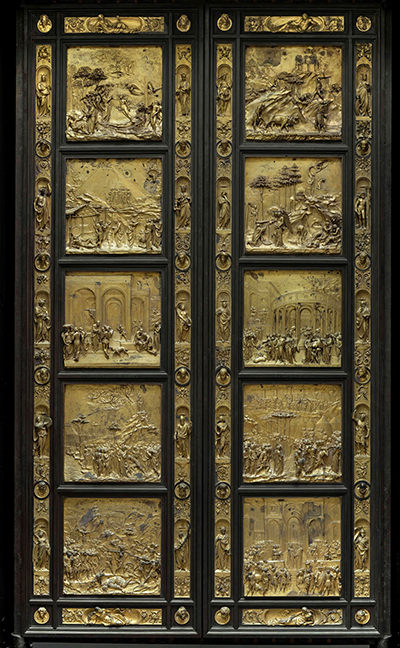
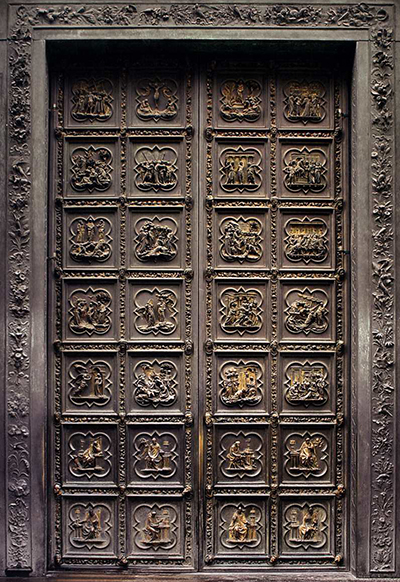
The guild made a separate decision about the trial itself. As recorded in a published extract from its records, it chose New Testament scenes for the commissioned door and reserved Ghiberti’s Isaac relief for another door, should that door tell Old Testament stories. Winning the commission and securing a place for the panel were therefore different outcomes. The North Doors still use the four-lobed compartments in which the sculptors had been tested, but the life of Christ takes the place of the Genesis story. The reservation explains why the panel could still have a purpose once its subject had ceased to fit the door. [6] [16] [17] [18]
The same extract records gold used for the panel. Giovanni Poggi prints the note under 5 June 1407; Fabian Jonietz proposes that the gilding took place in 1402 or 1403. The account places the expense on record without fixing when the gold was applied. That expense helps explain the status of the surviving bronze: an object the guild had invested in and retained after the trial. [17] [18]
How the two panels came together again
Manetti locates Ghiberti’s panel in the Calimala’s audience chamber, and Vasari in 1568 says it could still be seen there. In the guild’s own premises, the surviving trial remained visible to the people who commissioned the doors and to those who had business with them. Brunelleschi’s relief entered a different setting. Vasari reports a gift to Cosimo de’ Medici and describes the panel in the altarpiece of the Old Sacristy of San Lorenzo.
Jonietz identifies it more specifically as a tabernacle door and dates the altar to 1419; that reconstruction goes beyond Vasari’s account. The two settings allowed for different encounters with the same subject: a demonstration of skill kept by a patron, and a relief seen as part of a chapel altar. The accounts do not fix the date either relief first went on view. [1] [2] [14] [18]
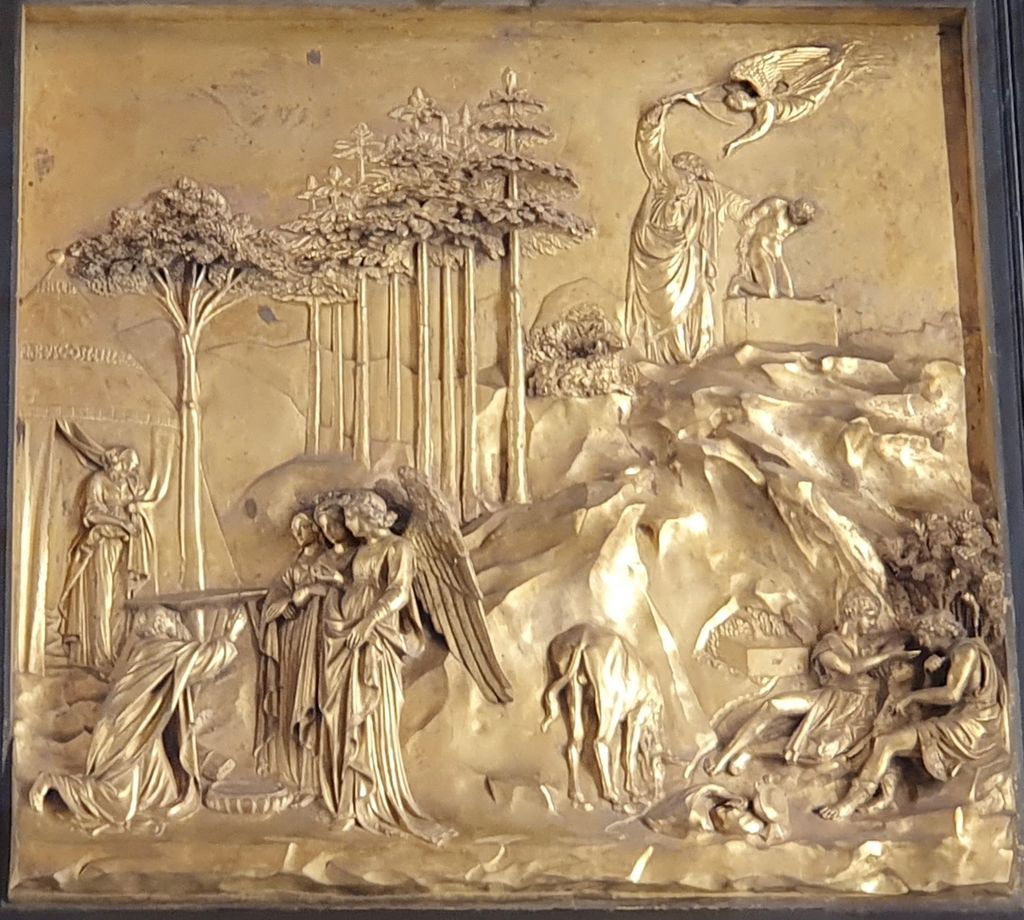
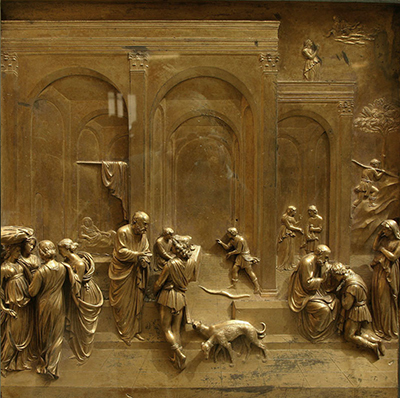
Ghiberti did eventually revisit the sacrifice for the Gates of Paradise. His Abraham and Isaac is a separate, square bronze that includes Abraham receiving his visitors as well as the scene on the mountain. The later relief gives the angel the physical contact withheld in Ghiberti’s trial: the Opera del Duomo describes it taking Abraham by the wrist. The trial itself passed into the grand-ducal collections, as did Brunelleschi’s panel. Both went through the Uffizi before reaching the Bargello. There, with the bronzes side by side, the gesture that stops at a wrist and the one that stops short of it are close enough to compare in a single glance. [1] [2] [3] [4] [18] [19]
Lorenzo Ghiberti in context
Sacrifice of Isaac
1401 competitionNorth Doors
1403–1424St John the Baptist
c. 1414–1416St Matthew
1419–1422Gates of Paradise
1425–1452St Stephen
c. 1427–1429Lorenzo Ghiberti sculpture directory
Lead photograph by Francesco Bini. Source image. CC BY-SA 4.0. Resized for display.
Discussion
Ghiberti rewards slow looking: relief, gilding, narrative structure, workshop practice and conservation evidence can all change how a work is read.
Join the Conversation
Have an observation about Sacrifice of Isaac, a source to add, or a comparison that sharpens the reading? Share it below.
References
- Ministero della Cultura and Museo Nazionale del Bargello, Ghiberti’s Sacrificio di Isacco, national catalogue 0900287017. Indexed catalogue record. View source 1. View source 2.
- Ministero della Cultura and Museo Nazionale del Bargello, Brunelleschi’s Sacrificio di Isacco, national catalogue 0900287016. Indexed catalogue record and Ministry linked-data record and full catalogue printout. View source 1. View source 2. View source 3. View source 4.
- Musei del Bargello, “Donatello and the Dawn of Renaissance”. View source.
- MenkinAlRire, photograph of the two Bargello reliefs, CC BY-SA 4.0. View source.
- Francesco Bini, photograph of Ghiberti’s Bargello relief, CC BY-SA 4.0. View source.
- Fondazione Palazzo Strozzi and exhibition partners, The Springtime of the Renaissance, exhibition press kit, 2013, checklist nos. 2.01–2.04. View source.
- Genesis 22:1–13, New American Bible, Revised Edition. View source.
- Gallerie degli Uffizi, Gaddi Torso. View source.
- Salvatore Siano and Juri Agresti, “Archaeometallurgical characterisation of Donatello’s Florentine copper alloy masterpieces using portable laser-induced plasma spectroscopy and traditional techniques”, Studies in Conservation 60, supplement 1 (2015), especially table 3 and pp. S115–S116. View source.
- Lorenzo Ghiberti, I commentarii, ed. Julius von Schlosser, vol. I (Berlin, 1912), second commentary, pp. 45–46. View source.
- Sonia Mugnaini et al., “Casting cores used to craft large bronze masterpieces of the Florentine Renaissance and Mannerism”, Journal of Archaeological Science 47 (2014), pp. 85–98, especially tables 1–2 and fig. 1. View source.
- Richard Krautheimer, “The Contest for the Baptistery Door”, in Isabelle Hyman (ed.), Brunelleschi in Perspective, 1974, especially pp. 54–55. View source.
- Antonio di Tuccio Manetti (attributed), The Life of Brunelleschi, ed. Howard Saalman, trans. Catherine Enggass (Pennsylvania State University Press, 1970), pp. 47–51. View source.
- Giorgio Vasari, “Filippo Brunelleschi”, Le vite de’ più eccellenti pittori, scultori e architettori, 1568 edition; see also the life of Lorenzo Ghiberti for the Calimala setting. View source 1. View source 2.
- Richard Krautheimer with Trude Krautheimer-Hess, Lorenzo Ghiberti, vol. II, transcript doc. 1 and digest no. 4; the entry is from Libro Grande Calimala C, c. 255, via Archivio di Stato di Firenze, Strozz. LI, 1, f. 2. View source.
- Opera di Santa Maria del Fiore, “Porta Nord del Battistero”, scientific catalogue record 3618. View source.
- Giovanni Poggi, “La ripulitura delle porte del Battistero fiorentino”, Bollettino d’Arte 33 (1948), p. 244 and n. 5, transcribing the guild extract also printed by Karl Frey, pp. 356–57, no. 8. View source.
- Fabian Jonietz, “The Burden of Success in Quattrocento Sculpture: Lorenzo Ghiberti, Mino da Fiesole, Donatello”, in Synagonism: Theory and Practice in Early Modern Art (Brill, 2024), pp. 242–43 and nn. 30–31. Author’s copy. View source 1. View source 2.
- Opera di Santa Maria del Fiore, “Formella con Storie di Abramo”, scientific catalogue record 1324. View source.