 by Tom Gurney
Tom Gurney BSc (Hons) is an art history expert with over 20 years experience
Published on June 19, 2020 / Updated on November 17, 2026
Email: tomgurney1@gmail.com / Phone: +44 7429 011000
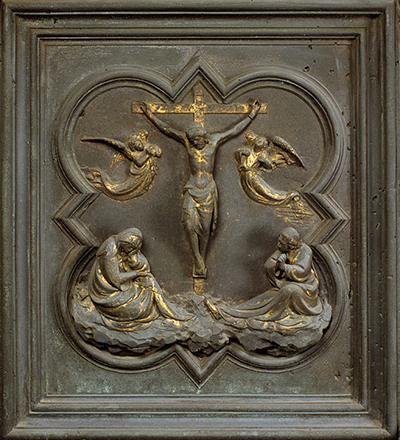
Mary’s cheek rests in the palm of her hand. Across the foot of the cross, John holds both hands together beneath his chin. In Lorenzo Ghiberti’s gilded bronze relief for the North Door of the Florence Baptistery, the two figures sit on the same shelf of rock. Mary inclines her head into the fold of her mantle, while John lifts his face towards Christ. Their robes spread towards each other along the ground. Higher up, there is enough space between each witness and the cross for the turn of a head or the bend of an arm to be seen on its own. [1] [2]
Contents
- The weight on the upright
- Two ways of remaining at the cross
- The witnesses in the Gospel and at Orvieto
- The mourners in the air
- The panel at the top of the door
The weight on the upright
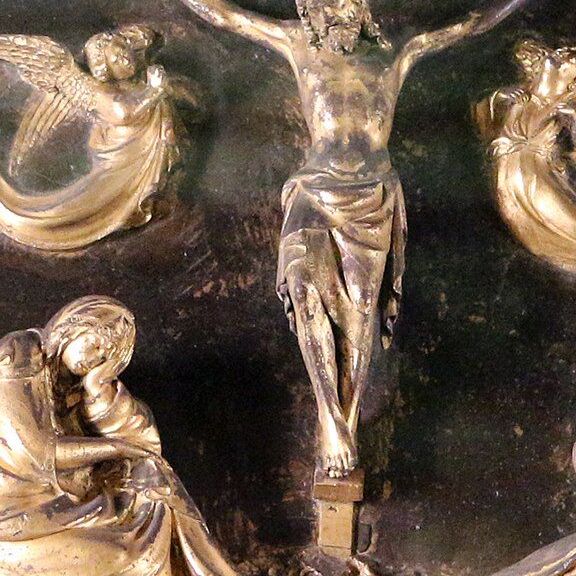
The crossbar gives the eye a level from which to measure the pull of Christ’s body. From the hands, both arms slope down towards the shoulders, opening a gap between the arms and the bar. The head drops towards the shoulder on the viewer’s right, interrupting the line that runs from the top of the post through the chest. Below the waist, a fold of the loincloth crosses the hips before the cloth falls beside the legs. The body narrows towards the feet and the straight face of the post comes back into view beneath them. [2]
The Opera catalogue describes the figure as a Christus patiens, the suffering Christ, and links the treatment of the body to the Giottesque tradition. Giotto’s painted crucifix at Santa Maria Novella offers a Florentine example of how the weight of a body can be felt through its suspension. In Ghiberti’s bronze, the small departures from the lines of the timber do much of that work. The chest faces out, catching the light, while the inclined head brings the face down towards one shoulder. A viewer can follow the upright almost the full height of the panel and see precisely where the body departs from it. [1] [2] [3]
Look closely at the Crucifixion
1. Christ on the cross
The cross holds the vertical axis of the relief as the surrounding figures turn towards it.
2. An angel at the left
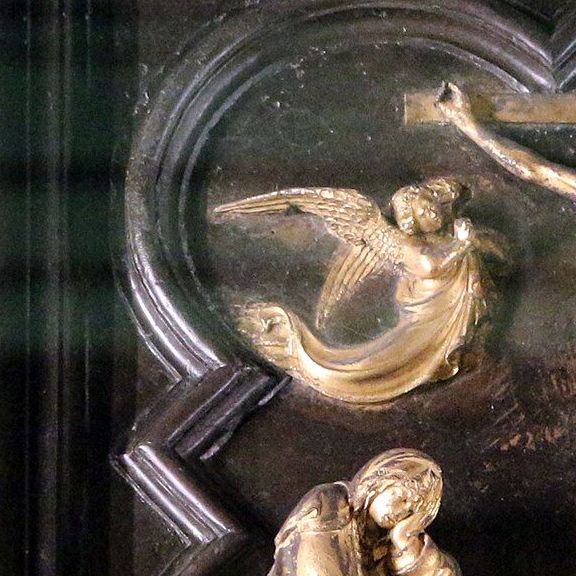
The airborne figure fills the space alongside the crossbar, above the witnesses on the ground.
3. A witness below the cross
The seated figure fills the lower left lobe. The folds of the robe hold the figure against the curved frame.
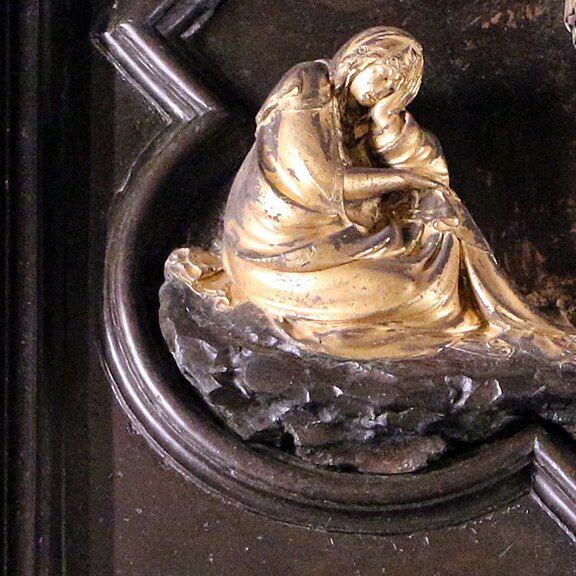
Photograph by Sailko. Source image. CC BY 3.0. Resized for the overview and cropped for detail.
Two ways of remaining at the cross
Mary’s bent arm brings her hand up inside the curve of her shoulder. Her other forearm lies across her lap, its hand near her knee. The folds broaden below that arm and spread along the ledge, giving the seated body a wide base. John’s raised knee lifts his robe into steeper folds. Above it, his elbows draw in and his joined hands rise into the space in front of his chest. His profile remains visible above the clasp. The two figures occupy comparable patches of ground, but Mary draws her gesture into the shelter of her body, while John’s hands and face stand out against the field behind him. [1] [2]
The Opera catalogue reads John’s clasp as prayer. Friedmann sees him wringing his hands in despair and describes Mary as absorbed in grief, her gaze fixed. Vasari had already credited the seated figures with a force of feeling that de Vere’s translation renders as sorrow and wrath. Friedmann’s reading invites the eye to see movement in John’s grip, while the catalogue’s directs attention to the hands held close and the face turned towards Christ. The bronze gives those readings the same compact gesture. Mary’s cheek, held in place by her palm, provides a point of stillness beside it. [1] [2] [4] [5]
The witnesses in the Gospel and at Orvieto
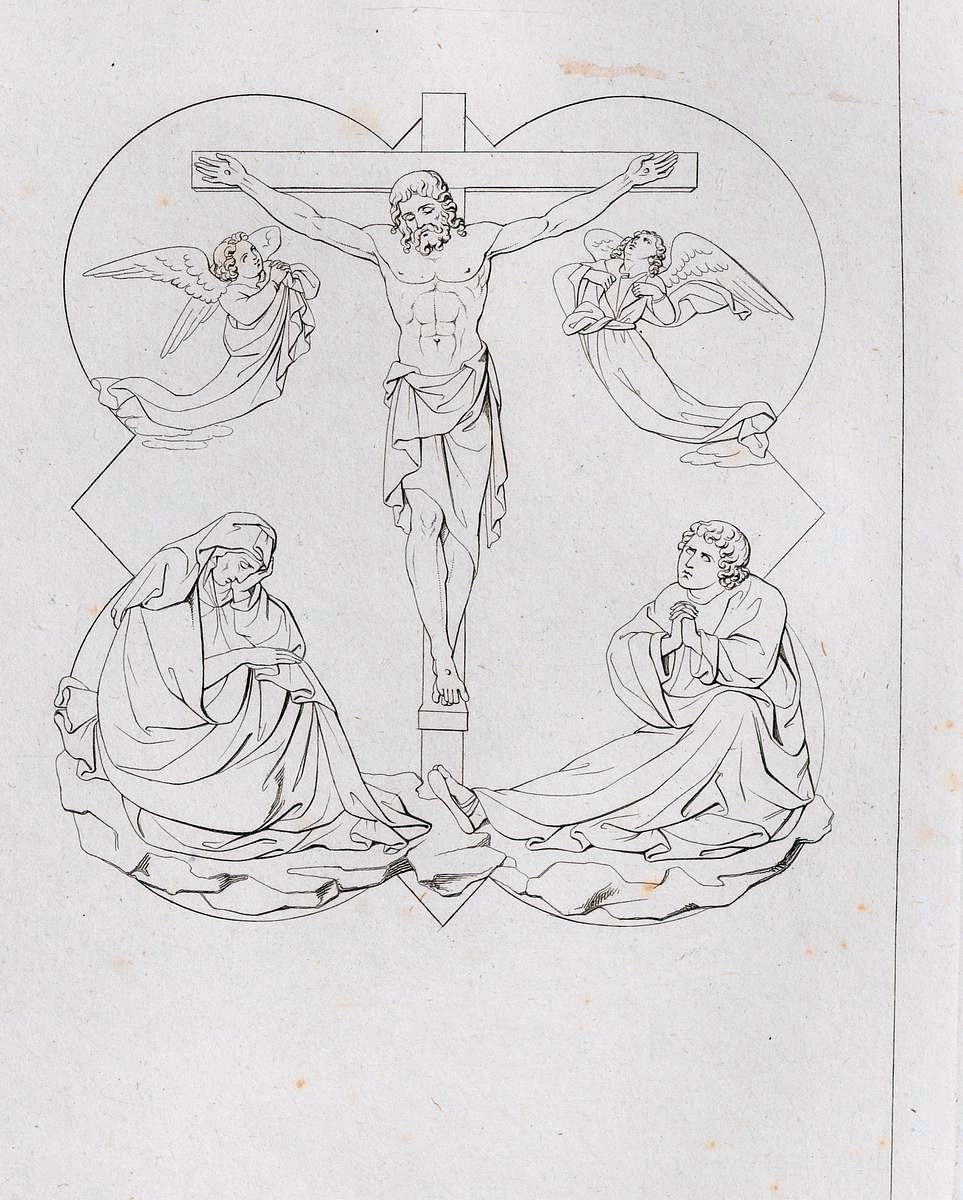
The commentary accompanying the 1821 engraving reads the pair through the moment when Christ entrusts his mother and his beloved disciple to each other. It then praises the depth of grief in the seated figures’ faces and attitudes. In John’s Gospel, Jesus’s mother stands near the cross with other women, and the disciple remains unnamed. The passage explains why a reader might hear those words in the scene. The seated bodies and the direction of John’s gaze give the relief a way to sustain attention beyond any one line of speech. Luke’s account offers a sense of how much has been left outside the frame, from the other men being crucified to the acquaintances watching at a distance. [1] [2] [6] [7] [8]
Friedmann proposed a Crucifixion on the façade of Orvieto Cathedral as a parallel for the isolation of the two mourners. She limited the proposed connection to their grouping and found Ghiberti’s Christ more symmetrical and less heavily suspended than the Orvieto figure she described. The cathedral’s Opera identifies the third façade pier with the life of Christ and presents the façade as the work of several hands over time. Friedmann’s attribution to Giovanni Pisano belongs to her account, and the route of any influence remains uncertain. Her comparison draws attention to what happens when two witnesses have the ground to themselves. Their poses can be read across the width of the scene without another body intervening between them and the post. [2] [4] [9]
The mourners in the air
The angel above Mary extends a wing towards the edge of the upper lobe. Its robe dips and curls up at the outer end. Across the cross, the other angel’s wing rises behind its head and the hem swings out towards the frame. The Opera describes both angels as weeping. Their gathered gestures sit inside long curves of cloth and feathers, leaving the two bodies suspended over the rocky shelf that supports Mary and John. [1] [2]
On plate XX of the 1821 publication, the lines of the cross and Christ’s arms diverge as they do in the bronze. The angel above Mary ends in a curl of cloth, with a bare strip of paper beneath it before the first line of her mantle. The interval above John is tighter in the photograph, where the gold of the hem comes close to the gold of his hair. The engraved contours help the eye distinguish the two forms there. In the museum photograph, the open intervals read chiefly as dark bronze, so the contrast of the gilded figures reinforces a division already visible in outline. [2] [10]
The panel at the top of the door
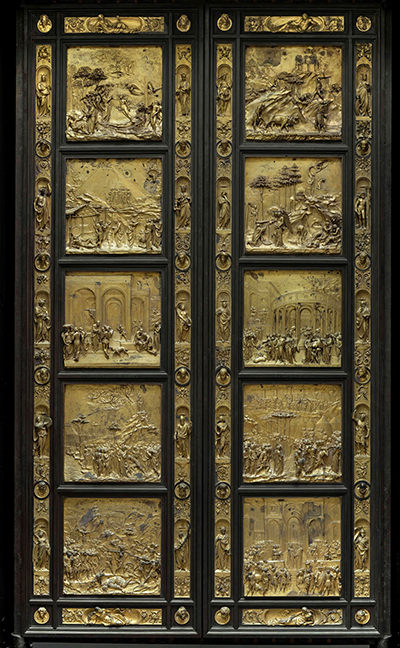
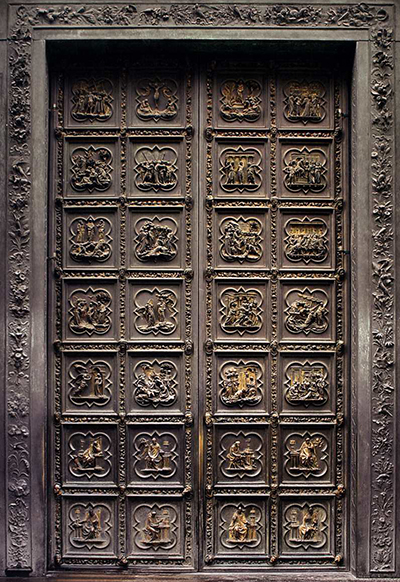
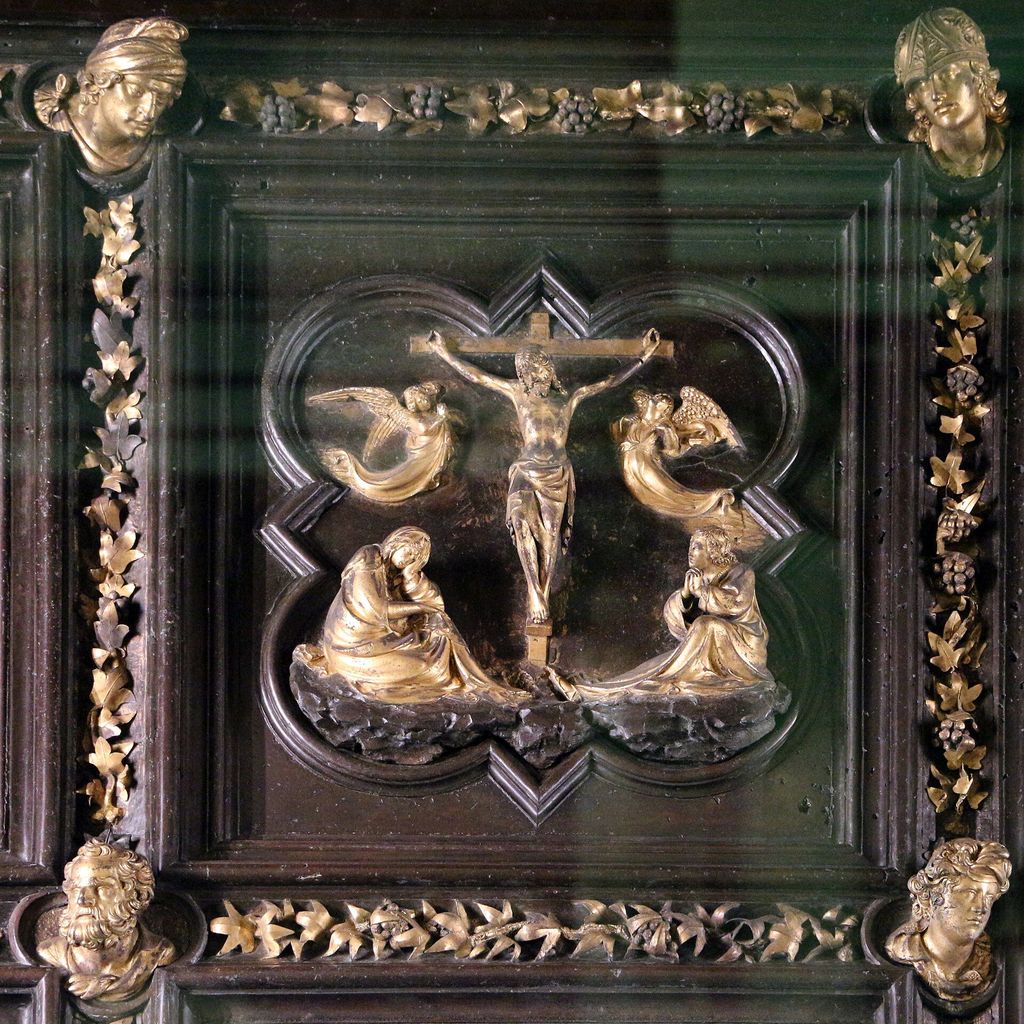
The Crucifixion sits next to the join on the upper row of the left leaf. On its left, the cross in the Way to Calvary runs diagonally through a crowd. Here the upright holds the middle of a scene with room around each figure. Across the join, the Resurrection again raises Christ above figures close to the ground. The Opera records a door campaign of 1403–24. Its catalogue also gives Richard Krautheimer’s stylistic dating for the Crucifixion, from about 1407 to 1413 or 1415. In that proposed sequence the adjoining Way to Calvary belongs to a later phase of work. [1] [2] [11] [12] [13] [14]
The Opificio delle Pietre Dure completed treatment in 2015. The original now faces visitors in the Museo dell’Opera del Duomo’s Sala del Paradiso. A replica was installed at the Baptistery in January 2016. The Opera’s restoration account distinguishes the gilded relief work from the dark bronze ground. In the view of the complete door, the two witnesses register first as separate patches of gold at the foot of the cross. The closer view gives those patches their different centres, one at the palm supporting Mary’s face and the other at John’s hands beneath his lifted chin. [1] [2] [12] [15] [16]
Lorenzo Ghiberti in context
Sacrifice of Isaac
1401 competitionNorth Doors
1403–1424St John the Baptist
c. 1414–1416St Matthew
1419–1422Gates of Paradise
1425–1452St Stephen
c. 1427–1429Lorenzo Ghiberti sculpture directory
Discussion
Ghiberti rewards slow looking: relief, gilding, narrative structure, workshop practice and conservation evidence can all change how a work is read.
Join the Conversation
Have an observation about Crucifixion, a source to add, or a comparison that sharpens the reading? Share it below.
References
- Opera di Santa Maria del Fiore, scientific catalogue, Crocifissione, Porta Nord del Battistero, record 3899. View source.
- Sailko, Crocifissione, photograph of the original relief, Wikimedia Commons. View source.
- Opera per Santa Maria Novella, The Crucifix by Giotto. View source.
- Friedmann, Ghibertis Verhältnis zur Gothik und Renaissance, pp. 26 and 59. View source.
- Giorgio Vasari, Life of Lorenzo Ghiberti, trans. Gaston du C. de Vere, p. 150. View source.
- Le tre porte del Battistero di San Giovanni di Firenze (1821), commentary to plate XX, p. 10, ETH Library. View source.
- United States Conference of Catholic Bishops, John 19, verses 25–27. View source.
- United States Conference of Catholic Bishops, Luke 23, verses 32–49. View source.
- Opera del Duomo di Orvieto, The façade, section on the bas-reliefs. View source.
- Vincenzo Gozzini and Giovanni Paolo Lasinio, Cristo è crocifisso, plate XX at right, in Le tre porte del Battistero di San Giovanni di Firenze (1821), ETH Library. View source.
- Opera di Santa Maria del Fiore, scientific catalogue, Porta Nord del Battistero, record 3618. View source.
- Yair Haklai, photograph of the complete original North Door in the Museo dell’Opera del Duomo, Wikimedia Commons. View source.
- Sailko, Andata al Calvario, photograph of the original relief, Wikimedia Commons. View source.
- Sailko, Resurrezione, photograph of the original relief, Wikimedia Commons. View source.
- Opera di Santa Maria del Fiore, The Northern Door of the Baptistery, 9 September 2015. View source.
- Opera di Santa Maria del Fiore, Renaissance clonation: the North Door replica, 4 August 2016. View source.