 by Tom Gurney
Tom Gurney BSc (Hons) is an art history expert with over 20 years experience
Published on July 10, 2026 / Updated on November 17, 2026
Email: tomgurney1@gmail.com / Phone: +44 7429 011000
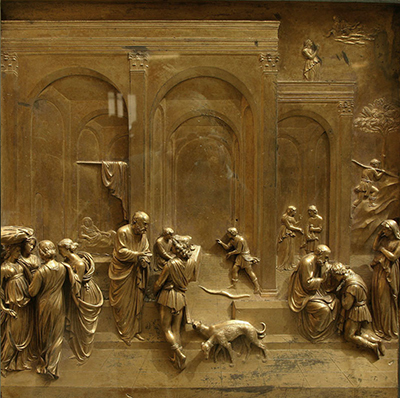
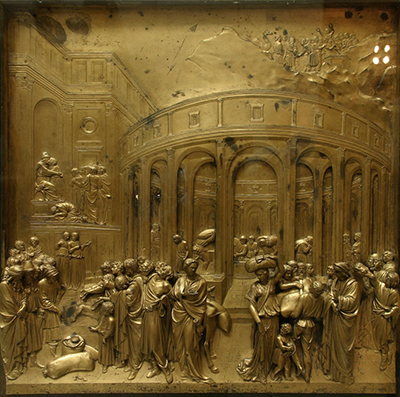
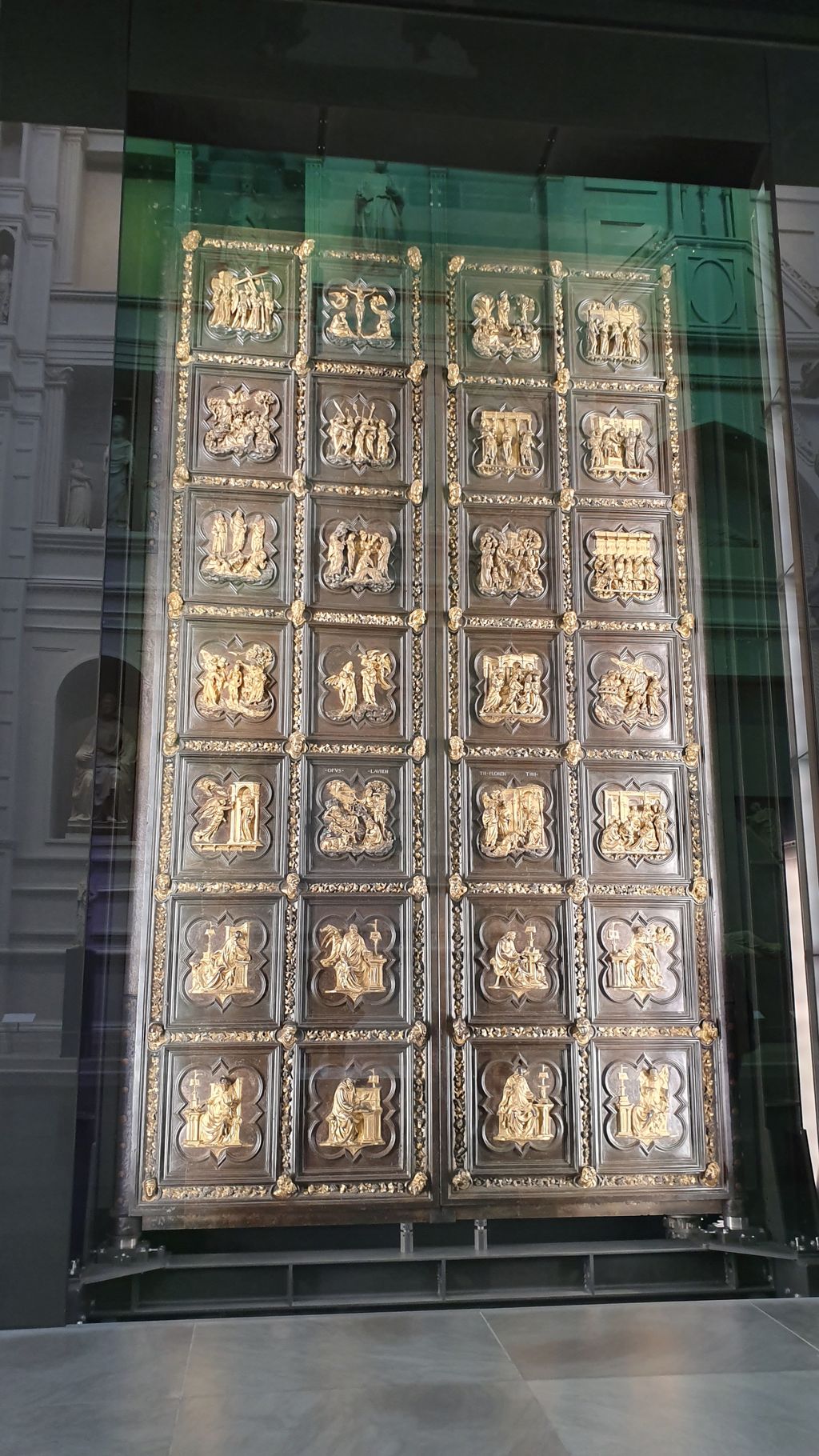
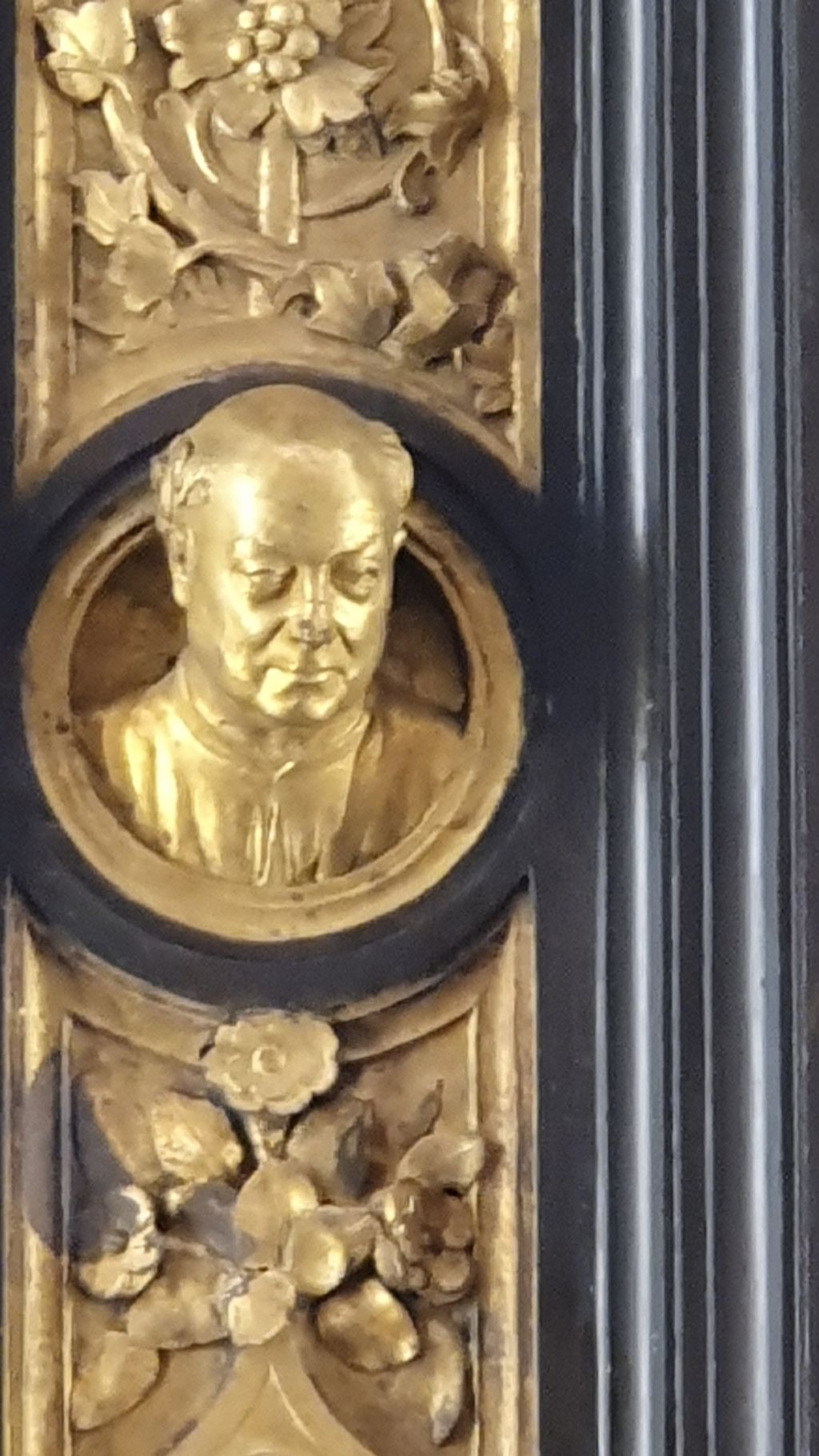
Two fragments of a signature sit above adjoining scenes on the Baptistery North Doors. The first begins above the Nativity, and the rest runs across the top of the Adoration of the Magi. In a close photograph of the Adoration, the letters sit on a dark field above the gilded figures. Leaves and clusters of berries fill the narrow border beside them. The inscription names Lorenzo of Florence. The surviving accounts pick up the work at points the inscription passes over, from advances to assistants to the casting of the frames that hold the reliefs. [1] [2] [3] [4]
Contents
- What Calimala bought
- Where the workshop called in specialists
- The bronze and its setting at Orsanmichele
- Siena and the work in Giuliano’s hands
- From the second door to the next generation
- What could travel without a worker
What Calimala bought
The merchants’ guild known as the Arte di Calimala made its first contract for the door on 23 November 1403. Ghiberti signed alongside the goldsmith Bartolo di Michele, who stood as guarantor. The guild called for three finished reliefs a year. Both that agreement and its replacement of 1 June 1407 reserved work on figures, trees and similar details for Lorenzo’s own hand. The national catalogue’s account of the revised terms specifies wax modelling and the careful tooling of cast details such as hair and nude flesh. These provisions gave the guild a claim on Ghiberti’s time at two points in the making of a relief, as its forms were modelled and as its surface was worked in metal. [1] [4]
The initial pace of delivery proved difficult to sustain. Calimala made the 1407 agreement with Ghiberti alone, restricted his freedom to take other work without the consuls’ consent and left him to choose his assistants. Carlo La Bella also records a requirement to report workshop activity daily. The guild’s purchase of torches for nineteen workers gives some sense of the resources absorbed by the work and may point to work after dark. It is a record of provision for one group of workers. The published accounts give differing totals for the enlarged shop. [1] [4] [5]
The Opera catalogue locates both agreements in the Strozzi papers in the State Archive of Florence. Giovanni Poggi explains how part of the record came down to us. In the seventeenth century Carlo Strozzi compiled extracts from the Calimala archive, part of which was destroyed in the following century. The Opera’s references place the agreements at folio 79 and folios 79–79v respectively.
Poggi checked Karl Frey’s printed texts against those extracts. One entry reproduced by Richard Krautheimer and Trude Krautheimer-Hess identifies Giuliano di Ser Andrea as a pupil of Lorenzo di Bartoluccio in 1405, citing a particular folio of the guild’s ledger. The wording gives Giuliano a place in the workshop at the beginning of a relationship that can be traced into the Siena correspondence two decades later. [1] [6] [7] [8]
The national catalogue lists Giuliano among the recipients of advances between 1404 and 1407, alongside Bandino di Stefano, Bernardo di Piero Ciuffagni and the young Donatello. Those entries connect named workers to the commission. La Bella, drawing on Frey, identifies Paolo Uccello as a garzone, or junior workshop worker, after the new agreement. The national catalogue is more tentative about his apprenticeship. The entries and their published summaries establish involvement more securely than they establish anyone’s hand in a particular relief. [4] [5] [7]
Where the workshop called in specialists
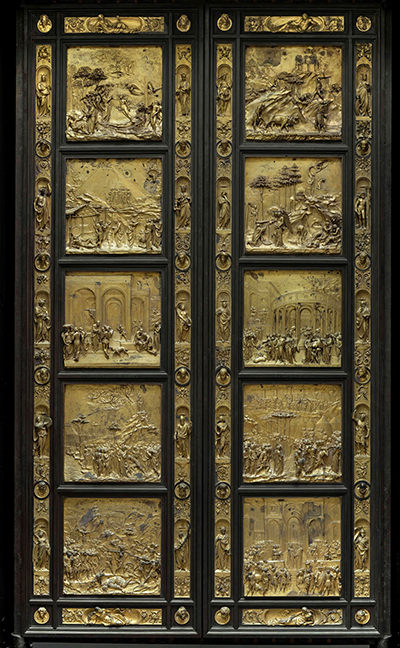
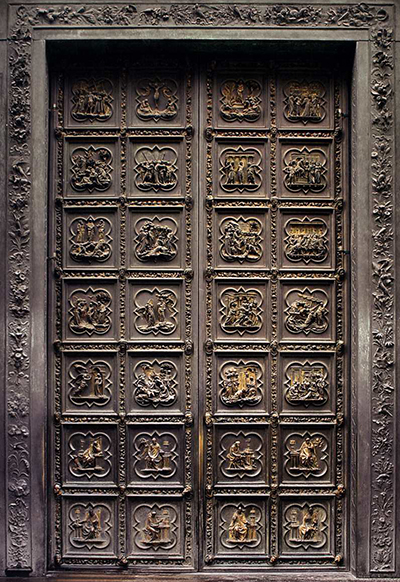
The borders around the North Door reliefs join up across each leaf, and projecting heads mark their intersections. Beneath the visual continuity lay a separate casting job. A record from the court of the Mercanzia, published by Luca Boschetto, names three founders from Burgundy, recorded by the notary as Domenico di Diveth, Iacop Ghaglieth and Nicolos Andrat. On 3 February 1422 they acknowledged that the frames had fallen short of what they had agreed to deliver.
They undertook to recast and put them right and to stay in Florence until the job was finished. They also agreed to accept the price set by Palla Strozzi and Niccolò di Luca di Feo, two men charged by Calimala with overseeing the door. Boschetto places the failed attempt around the turn of 1421–22 and infers that the frames were complete by March 1423. [1] [9] [10]
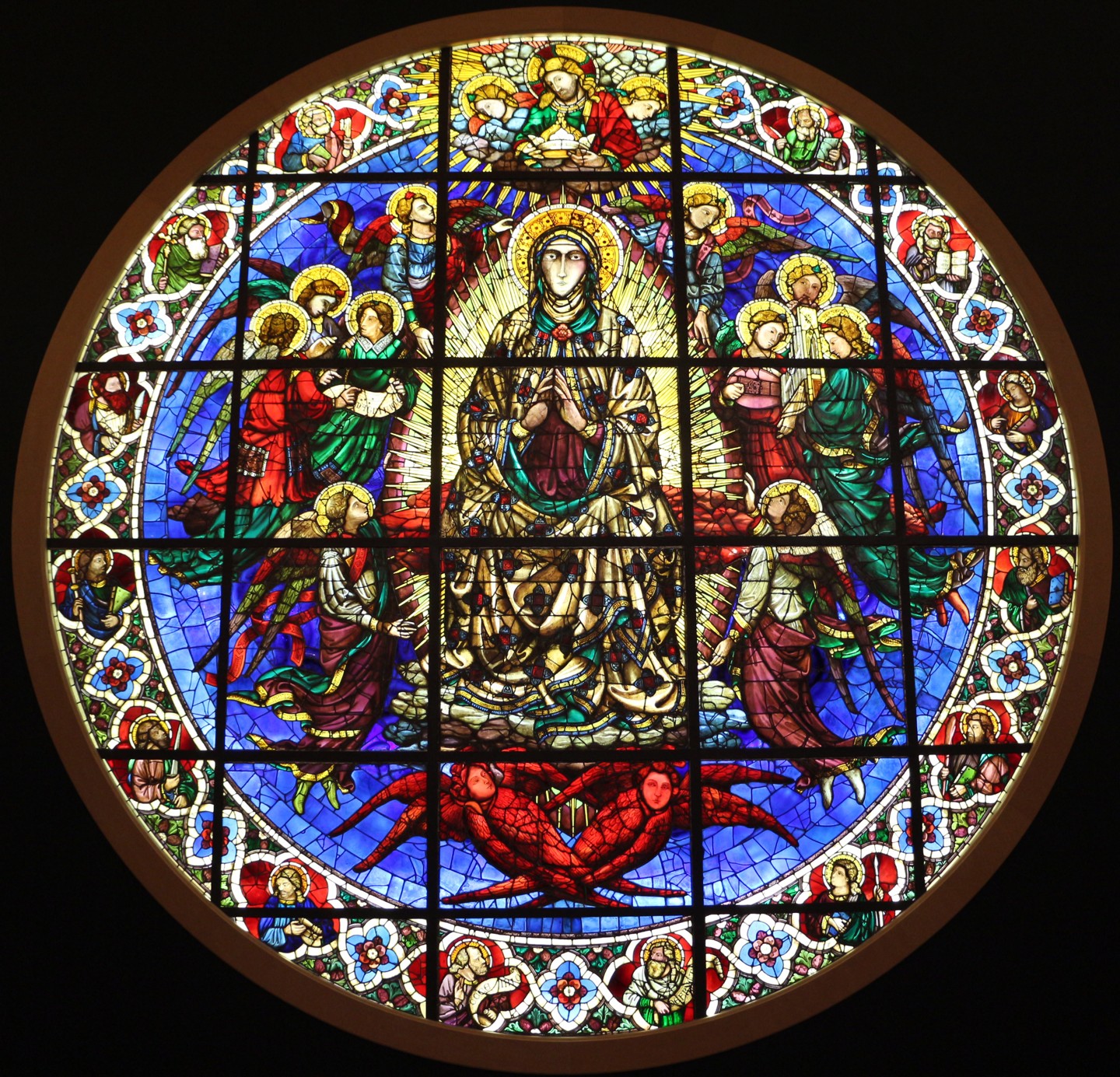
A different allocation of work appears in a resolution of the cathedral Opera on 4 April 1424. It assigned two circular windows near the large window above the main entrance to Fra Bernardino, a Dominican of Santa Maria Novella. One was to show Joachim expelled from the Temple and the other the death and burial of the Virgin. Lorenzo was to design the windows and their scenes, with discretion over how to compose and adorn them. Bernardino was to make them. The resolution records how the cathedral expected a design to pass between two practitioners and specifies the subject each opening was to carry. Its terms concern those two Marian windows. [11]
The bronze and its setting at Orsanmichele
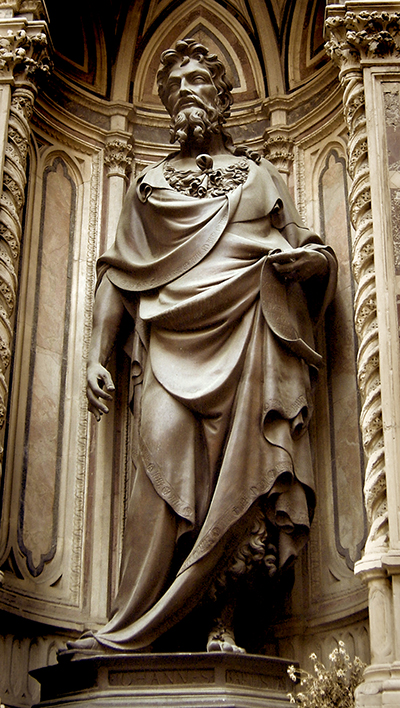
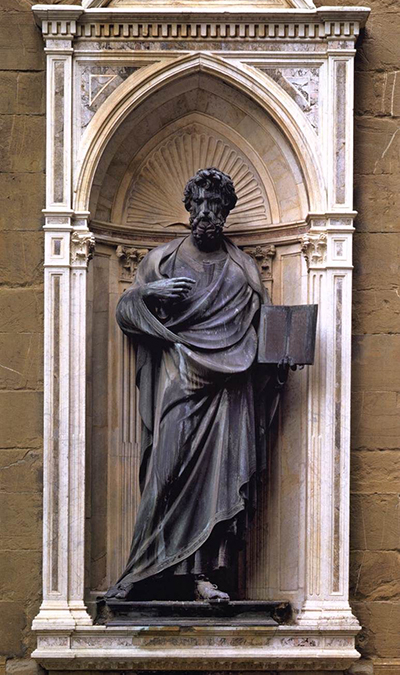
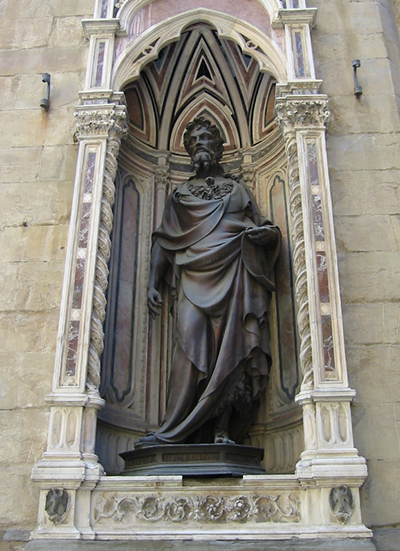
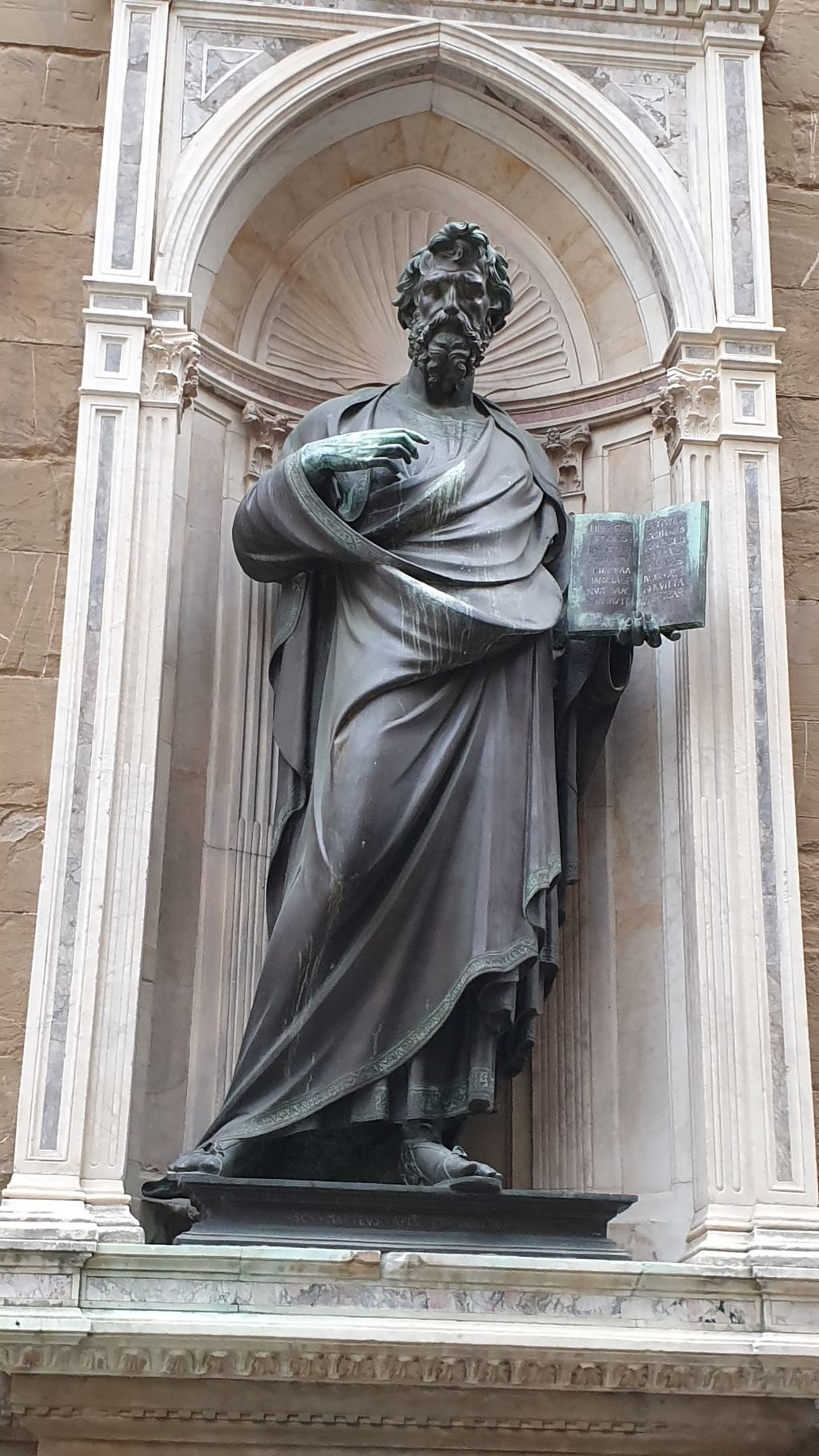
In May 1422 the money changers’ guild decided that Jacopo di Corso and Giovanni di Niccolò, two stoneworkers in partnership, should make the tabernacle for St Matthew to Ghiberti’s design. Filippo Baldinucci’s digest of the guild ledger records the promise of 75 gold florins and a slab of marble. In the street, where a copy now stands in the niche, the ribs of the stone shell radiate behind Matthew’s head and the book projects between the supports. Those relationships were part of the work involved in giving the bronze a setting. The entry records who was engaged to realise that setting and what the guild promised them for it. [12] [13] [14]
Siena and the work in Giuliano’s hands
On 21 May 1417 the cathedral Opera in Siena commissioned two of the six reliefs for its Baptistery font from Ghiberti. The agreement provided for the first relief to be examined before and after gilding, after which the officials would set the price for both panels. The contract allowed ten months for the first relief and another ten for the second, counted from its predecessor’s completion, inspection and valuation. The second was to match the standard of the first and improve on it if possible. The Opera promised an immediate advance of a hundred gold florins to get work under way, giving Ghiberti funds for materials before the final price was known. [8] [15]
The timetable soon gave way to a series of promises. In a letter dated 10 March 1424 in Vittorio Lusini’s edition, Ghiberti explained that an epidemic had intervened, he had gone to Venice and his workers had dispersed. He reported that the panels were nearly finished and told the official to expect the work by the end of June. The letter is the master’s explanation to a patron pressing for delivery. The official’s agent had already seen the reliefs in the shop, so the letter supplemented a visit with a new timetable. [8]
On 16 April 1425 Ghiberti wrote to the Sienese goldsmith Giovanni di Turino, who had offered to help clean one of the reliefs if needed. Ghiberti said both were close to completion. One was in Giuliano di Ser Andrea’s hands and the other in his own, and he expected both to be finished by the time he had promised the cathedral official.
In the same letter he complained of repeated injuries from former associates and declared his intention to govern his shop without a partnership. He named no one in that complaint. Ghiberti’s account puts that declaration alongside an immediate example of delegation. The man the Florentine ledger had once called his pupil now had one of the two Siena reliefs in his charge. [7] [8]
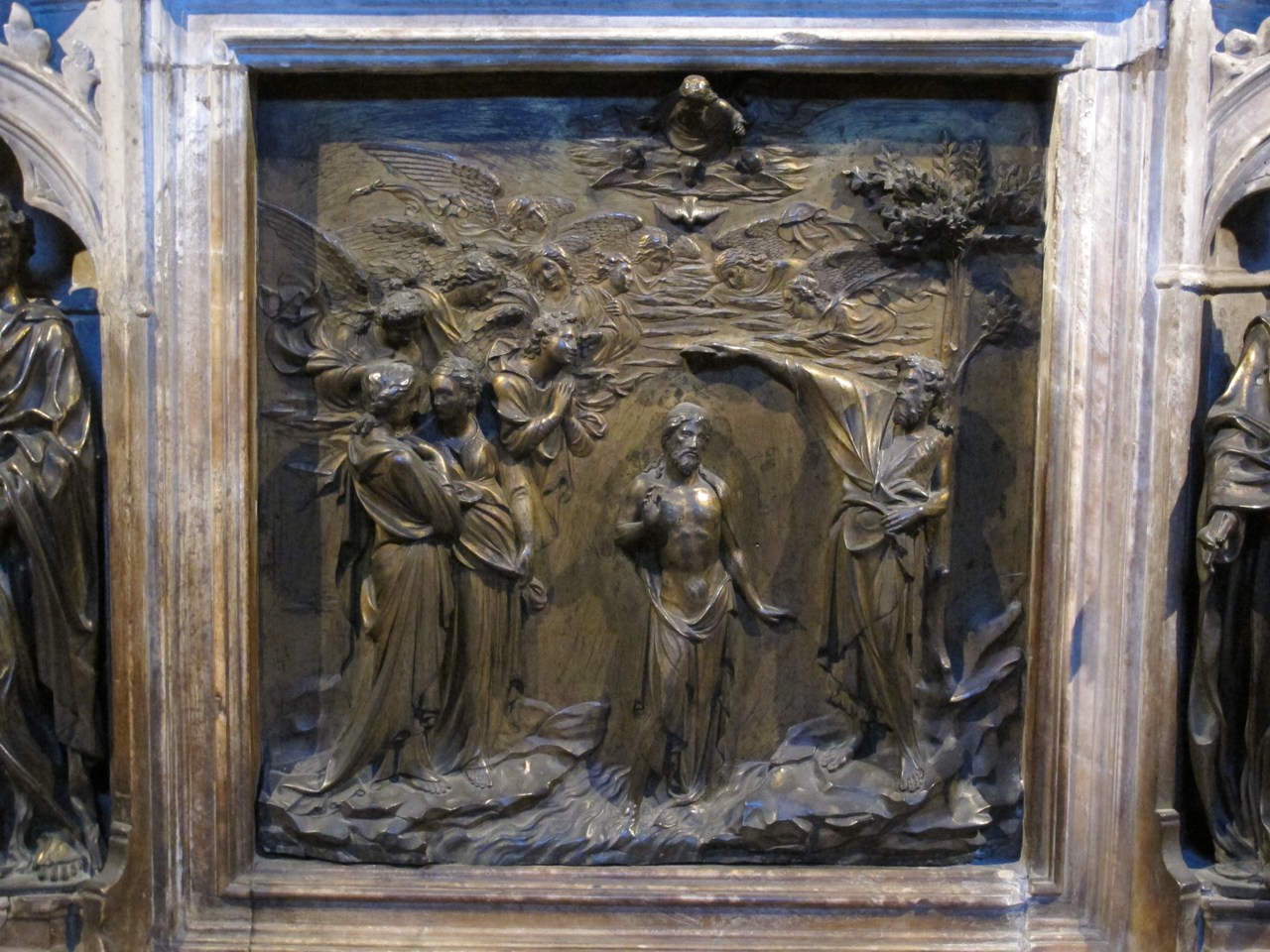
The correspondence also shows the patron making decisions as unfinished work moved between the cities. In August 1425 Ghiberti asked Siena to send the Baptism of Christ back so that he could finish it. He said he had almost finished the other relief, asked where the officials wanted the panels gilded and undertook to follow their decision. By 12 May 1427 he reported that gilding had begun on the Baptism and that gilding was all the other relief still needed.
At the end of May he said one was gilded and asked for as much gold again to complete the second. He also reported borrowing nearly two hundred florins to meet his needs and finish the work. Siena’s right to see a relief at successive stages went alongside decisions about where those stages would take place and the supply of material to carry them out. [8]
In the Commentarii Ghiberti included both bronze reliefs in the account of his work. Modern credits for the second scene, the Arrest of John the Baptist, vary. Nirit Ben-Aryeh Debby credits it to Giuliano, while Maria Baruffetti and colleagues give both men credit in their restoration report. The April letter gives neither panel a subject and describes who had each one in hand at that stage. The division of modelling and finishing between the two men remains open. [8] [16] [17] [18]
From the second door to the next generation
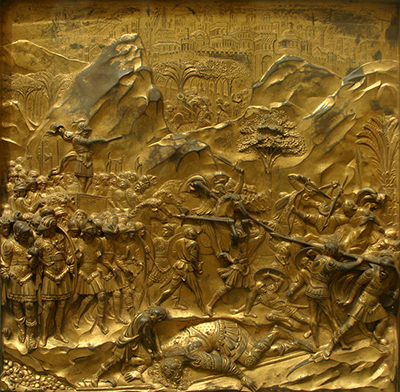
For the Gates of Paradise, the Opera records Benozzo Gozzoli’s participation by 1444 and notes numerous payments to assistants in 1448–49. Its catalogue also reports Maria Grazia Ciardi Dupré Dal Poggetto’s attribution of work on the Stories of David to Benozzo. His dated presence belongs to the history of the commission. Locating that work in the David relief is a judgement about a surviving object. The dates for the late workforce are particularly valuable because the earlier documents have yielded differing accounts of how many of the narrative reliefs were already cast or finished by the early 1440s. [19] [20]
Dora Liscia Bemporad dates the goldsmith Bernardo Cennini’s entry into Ghiberti’s workshop to 2 April 1448 and records a payment of fifteen florins. Her study also follows two appointments at the Florentine mint. Michelozzo received the appointment to cut dies in March 1448, and Cennini succeeded him in September. The two men’s work at the mint gives her a way to read a curious group of traces on the door. Its frame carries impressions of punches, including figures of John the Baptist and arms of mint officials whose terms can be placed in time. The marks are on the back of the door, where Liscia Bemporad could compare several variants of the same saint. [21]
Liscia Bemporad compares one group of impressions with the Baptist on the florin in use during Michelozzo’s tenure. Among the arms impressed on the frame she identifies those of Carlo di Zenobio da Diacceto, a mint official during Michelozzo’s last term. She treats that detail as evidence in favour of two makers. She proposes that another group, with fuller arms and faces turned further from the frontal pose, may be Cennini’s work.
She also considers whether Cennini could have made the impressions using punches already in use under Michelozzo. An impression can survive the transfer of a tool from one worker to another. Even a dated appointment at the mint and a dated entry into Ghiberti’s shop leave room for more than one account of who made a particular mark. [21]
The gilding records identify a different task directly. On 2 April 1452 Calimala assigned Lorenzo and his son Vittorio the gilding of the door. The entry published by Poggi specifies a hundred florins for their labour and skill, with the guild meeting the other expenses. Vittorio subsequently completed the ornamental surround for the south portal, where the earlier doors were by Andrea Pisano. The two commissions show him carrying experience of a Baptistery door into a related piece of work for the same building. [6] [19] [22]
What could travel without a worker
The Opera catalogue compares the Adoration of the Magi from Castel di Sangro in Abruzzo with the corresponding scene on the North Door. It suggests that someone who had worked on the Florence door might have moved to Abruzzo. It also proposes that the goldsmith Nicola da Guardiagrele could have brought drawings from Florence for a local artist to use. Both suggestions start from a resemblance between the reliefs. The second makes it possible to account for that resemblance even if the people who had worked on the door stayed in Florence. The catalogue leaves the route of transmission open. [3] [23]
In the nineteenth century Auguste Rodin could study the Baptistery doors as finished works. The Musée Rodin traces his early plan for the Gates of Hell to the scheme of separate compartments he studied in Ghiberti’s doors. He eventually adopted a structure closer to a Gothic portal. In this case the influence can be placed at a specific moment in the work. Ghiberti’s compartments gave Rodin a way to arrange the scenes while he was still deciding what shape the portal would take. [24]
Lorenzo Ghiberti sculpture directory
Discussion
Ghiberti rewards slow looking: relief, gilding, narrative structure, workshop practice and conservation evidence can all change how a work is read.
Join the Conversation
Have an observation about Workshop Influence, a source to add, or a comparison that sharpens the reading? Share it below.
References
- Opera di Santa Maria del Fiore, Porta Nord del Battistero, including the archival locations for the agreements of 1403 and 1407. View source.
- Sailko, Nativity, original North Door, detail photograph. View source.
- Sailko, Adoration of the Magi, original North Door, detail photograph. View source.
- ICCD, Porta Nord, national catalogue record 0900281432-0, especially pp. 3–4. View source.
- Carlo La Bella, ‘Ghiberti, Lorenzo’, Dizionario Biografico degli Italiani, vol. 53 (2000). View source.
- Giovanni Poggi, ‘La ripulitura delle porte del Battistero fiorentino’, p. 244. View source.
- Richard Krautheimer with Trude Krautheimer-Hess, Lorenzo Ghiberti, vol. II, ‘Transcript of Documents’, doc. 2, from the Calimala Libro Grande F, c. 171. View source.
- Vittorio Lusini, Il San Giovanni di Siena e i suoi restauri (1901), appendix nos. 3 and 5–11, pp. 96–103. Searchable transcription. View source 1. View source 2.
- Yair Haklai, original North Door in the Museo dell’Opera del Duomo, photograph. View source.
- Luca Boschetto, ‘Ghiberti e i tre “compari”. Un nuovo documento sulla fusione dei telai della seconda porta del Battistero’, Mitteilungen des Kunsthistorischen Institutes in Florenz 53 (2009), pp. 145–149, especially the transcription of Mercanzia 4352, cc. 373v–374r. View source.
- Archivio dell’Opera di Santa Maria del Fiore, resolution of 4 April 1424, AOSMF II 1 84, c. 12v, digital transcription o0201084.012vb, corresponding to Poggi (1909), no. 549. View source.
- Filippo Baldinucci, Notizie de’ professori del disegno, ‘Lorenzo Ghiberti’, pp. 10–11, quoting and digesting the Cambio’s Libro del Pilastro. View source.
- Musei del Bargello, Orsanmichele, museum and exterior copies. View source.
- Yair Haklai, exterior replica of St Matthew in the original Orsanmichele niche, photograph. View source.
- Opera della Metropolitana di Siena, Baptistry of San Giovanni, the baptismal font. View source.
- Lorenzo Ghiberti, I commentarii, ed. Julius von Schlosser, vol. I (1912), p. 47. View source.
- Nirit Ben-Aryeh Debby, ‘Saint Bernardino of Siena and Art: Preaching and Baptism in Tuscany’, The Catholic Historical Review 107, no. 2 (2021), p. 187. View source.
- Maria Baruffetti et al., ‘The restoration of the amalgam gilded bronze elements from the Baptismal Font of Siena’, in Lasers in the Conservation of Artworks XIII (2024), pp. 245–246. View source.
- Opera di Santa Maria del Fiore, Porta del Paradiso, historical and critical notes. View source.
- Catalogo Generale dei Beni Culturali, Gates of Paradise, component record 0900230039-1, historical and critical notes. View source.
- Dora Liscia Bemporad, ‘Nel cantiere del Ghiberti. Un concorso singolare’, pp. 68–70. Alternate copy. View source 1. View source 2.
- Opera di Santa Maria del Fiore, Vittorio Ghiberti, frame of the South Door. View source.
- Opera di Santa Maria del Fiore, Adorazione dei Re Magi di Castel di Sangro, historical and critical notes. View source.
- Musée Rodin, Meudon, The Gates of Hell. View source.