 by Tom Gurney
Tom Gurney BSc (Hons) is an art history expert with over 20 years experience
Published on June 19, 2020 / Updated on November 17, 2026
Email: tomgurney1@gmail.com / Phone: +44 7429 011000
At the centre of Lorenzo Ghiberti’s Gates of Paradise, two bronze faces look out from the frame. Behind them, in the square to the left, men and women pass through a succession of arches. In the square to the right, figures carrying sacks pass in front of a circular building. A shoulder in either scene can stand well clear of the bronze behind it. Farther inside the picture an edge scarcely rises from the surface, yet it can mark the far end of a building. The heads in the frame bring the eye forward again, to the surface of a pair of doors taller than the rooms in many houses. [1] [2] [3]
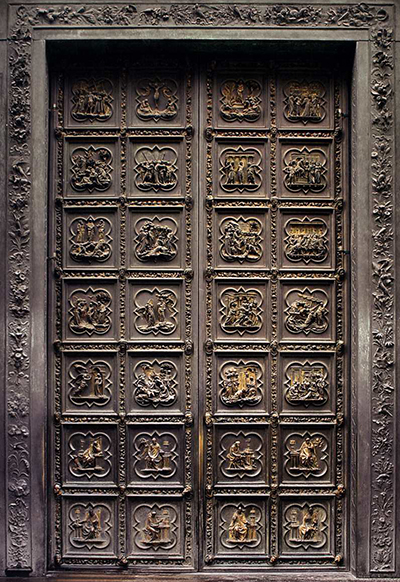
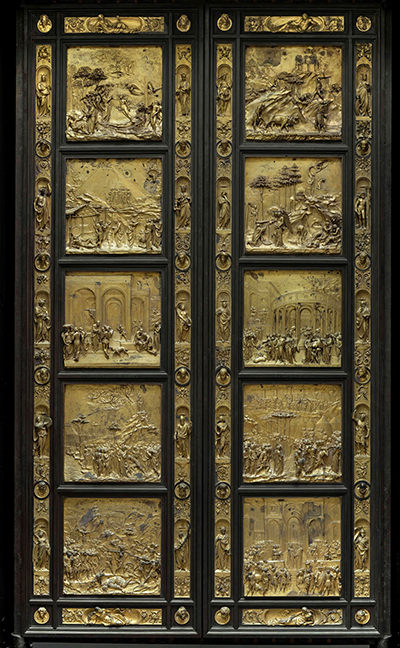
Ghiberti and his workshop made the gilt bronze doors between 1425 and 1452 for the Baptistery of San Giovanni in Florence. The two leaves, about 5.2 metres high, went into the entrance facing the cathedral. Each carries five roughly square reliefs. The sequence crosses the seam from left to right at every level, then begins again one step down. Opening the leaves interrupted that sequence and made the pictures into the sides of a passage. [1] [2]
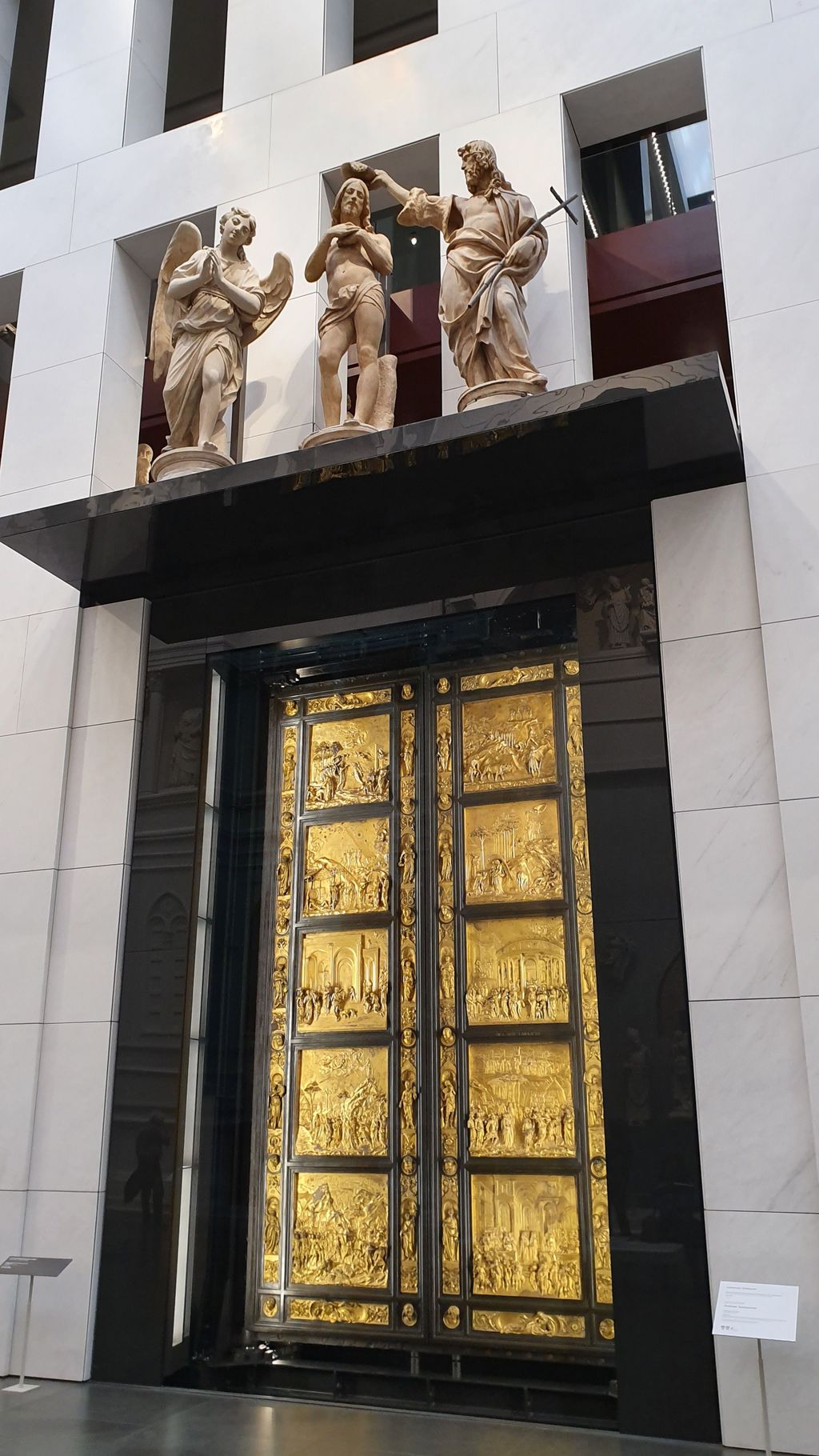
A bronze copy now occupies that doorway. The original front is in the Sala del Paradiso at the Museo dell’Opera del Duomo, where the scenes can be examined together and the surviving gilding is protected behind glass. From the square, it is easier to see how high the opening stories were above a person approaching on foot and how the bronze surround met the marble facing of the building. [1] [2] [4]
Contents
- A new design for an existing doorway
- From twenty-eight compartments to ten narrative fields
- What took twenty-seven years
- How the workshop made the doors
- Reading across the leaves
- Relief, space and close looking
- Relief, gold and the work of the frame
- Programme and invention
- Why are they called the Gates of Paradise?
- What the flood revealed
- Gold, corrosion and restoration
A new design for an existing doorway
The Arte di Calimala, the merchants’ guild responsible for the Baptistery commission, sought advice about subjects in 1424. Leonardo Bruni proposed twenty Old Testament scenes and eight prophets. A letter from Ambrogio Traversari to Niccolò Niccoli in June identifies Bruni’s involvement. The twenty-eight places in the proposal would have been familiar from the earlier Baptistery doors. [1] [5]
Bruni’s proposal makes better evidence for the choices facing the guild than for an approved and subsequently abandoned design. In his letter to the deputies he was concerned that the designer understand the stories well enough to represent the people, actions and meanings they called for. This was practical advice about what viewers could make of a scene, as well as a humanist’s claim for informed reading. Twenty scenes and eight prophets would also have kept a clear numerical distinction between biblical action and its prophetic witnesses.
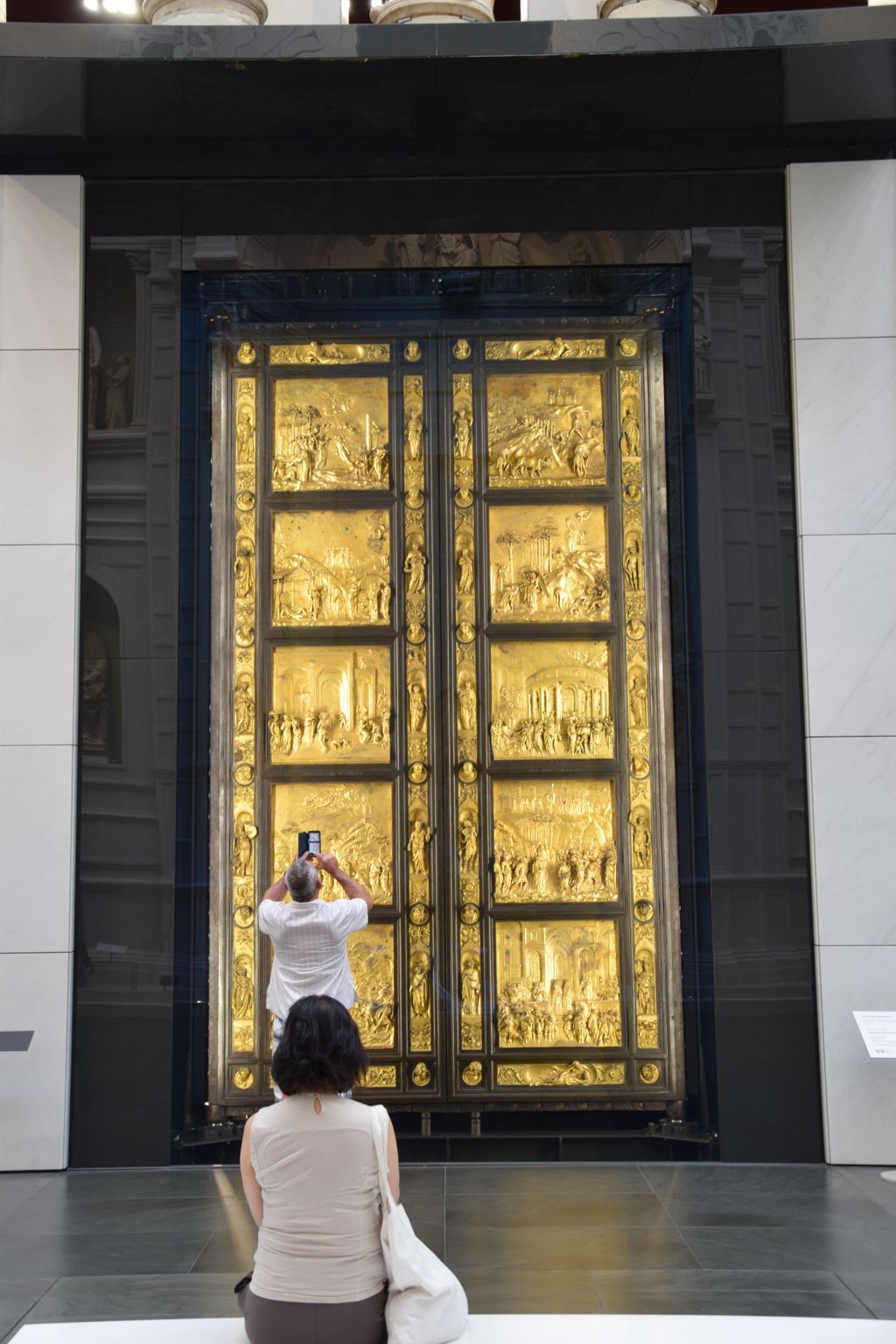
On the finished front the distinction is spatial. The histories fill ten large fields, while the figures around them occupy narrow bands and small openings. Some of the subject matter Bruni envisaged survives within the finished squares. His proposed judgement of Solomon gives way to Solomon’s reception of the Queen of Sheba. In a cycle whose bottom right corner has the force of an ending, that is a substantial change. [1] [5]
The commission is dated 2 January 1425. By the time Ghiberti wrote about it in the Commentarii, he could look back on the finished design and describe a grant of latitude from the patrons. He recalls making ten squares and giving them rich compositions. The account is especially valuable because he goes on to name what he put in the pictures, including incidents modern viewers might miss.
It is also an account in which the sculptor explains his own decisions and achievements. The grant of latitude has no surviving equivalent in a detailed instruction assigning each subject, and Bruni’s letter precedes the agreement. Bloch treats the surviving evidence as compatible with both extensive artistic freedom and consultation. The documents leave the negotiations between proposal and finished design largely out of sight. [5] [6]
The destination has a similar gap. Bloch reconstructs the likely initial expectation from the available openings in 1425. Ghiberti’s first pair occupied the prominent east side and the other existing doors occupied the south, leaving the north as a plausible destination for the commission. In July 1452 the Calimala consuls chose the cathedral-facing entrance for the finished work on the grounds of its beauty.
Ghiberti’s first pair then moved to the north. The July decision records what the guild did when it could judge the work it had commissioned. The earlier expectation is a deduction from the building and the then disposition of the doors. The association with the east that seems inseparable from the work today was secured at the end of its making. [1] [5]
Look closely at the Gates of Paradise
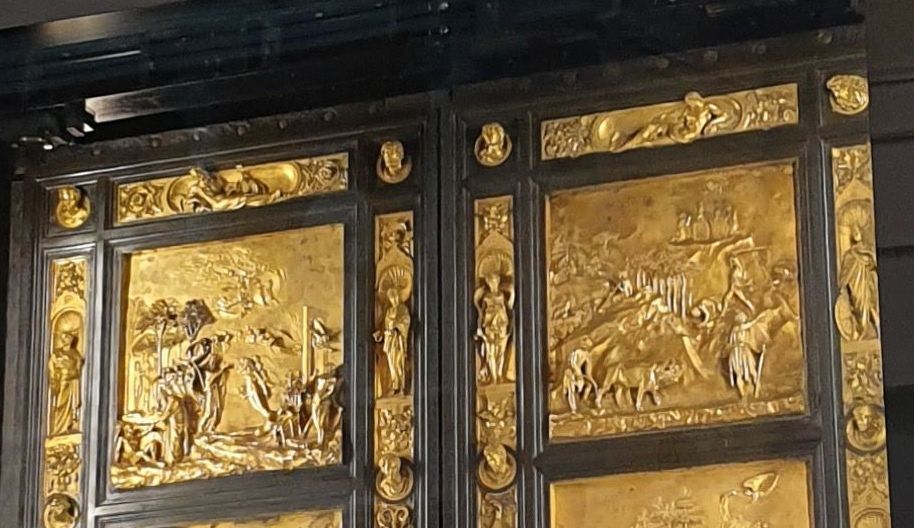
1. Creation and the first family
Adam and Eve occupy the upper left. Across the seam, Cain and Abel continue the story of the first family.
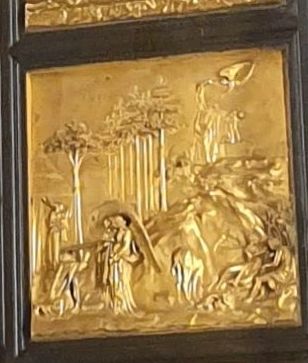
2. Stories of Abraham
The encounter with the visitors occupies the foreground. The sacrifice appears higher on the mountain.
3. Isaac, Esau and Jacob
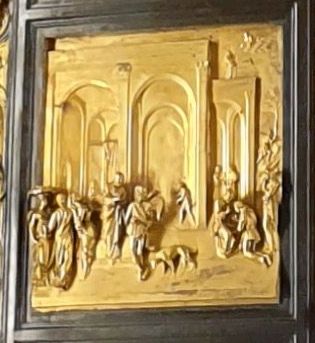
An arcade gives several episodes separate places within the same square.
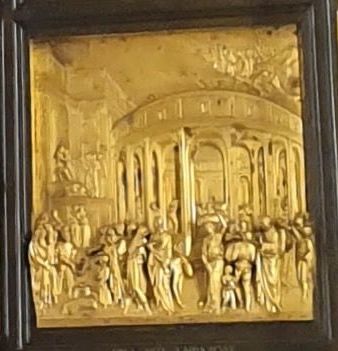
4. Joseph and his brothers
Follow the recessed architecture and the densely modelled figures near the lower edge.
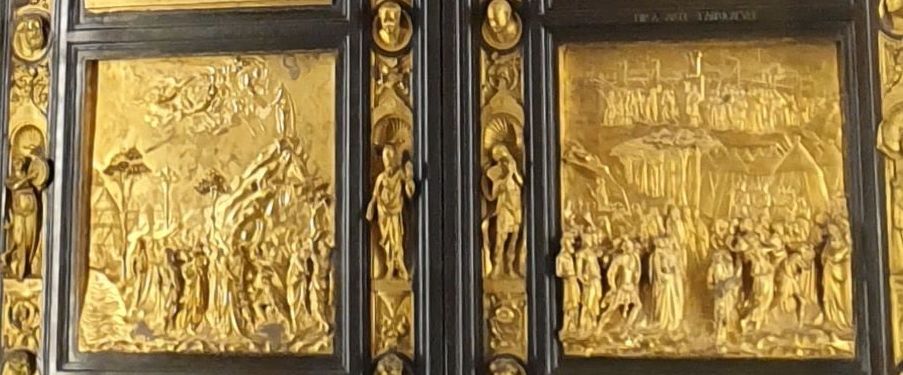
5. Moses and Joshua
At this level the stories of Sinai and Jericho are neighbours. Their landscapes place the central events at different heights.
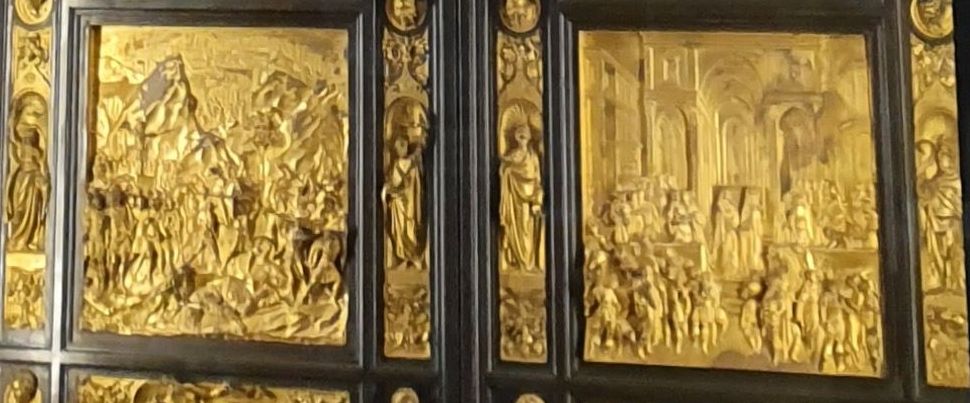
6. David and Solomon
The bottom register places battle and the meeting of two rulers side by side.
7. Figures along the seam
Small heads and standing figures bridge the intervals between the narrative squares.

Photograph by Yair Haklai. Source image. CC BY-SA 4.0. Resized for the overview and cropped for detail.
From twenty-eight compartments to ten narrative fields
The earlier North Doors give an immediate sense of the change. In their four-lobed frames, a group has to contend with edges that narrow and open up again, and the field around one event closes before another begins. Each large square on the later doors has a continuous upper edge, enough width for buildings to extend sideways and enough height for action to be carried far into the distance.
The squares can also contain incidents in which the same person appears more than once. A tree, a ridge or a line of columns can separate one appearance from another while leaving both within a common terrain. There is scope even for the interval between events to acquire a material presence, as empty ground or as a passage that still seems traversable. [1] [3] [5]
The identical boundaries give equal standing to fields organised on quite different principles. The mountain in the Moses relief can dwarf the human beings at its summit because the border gives that field as much weight in the grid as Joshua’s busy crossing next to it. [1] [12] [13]
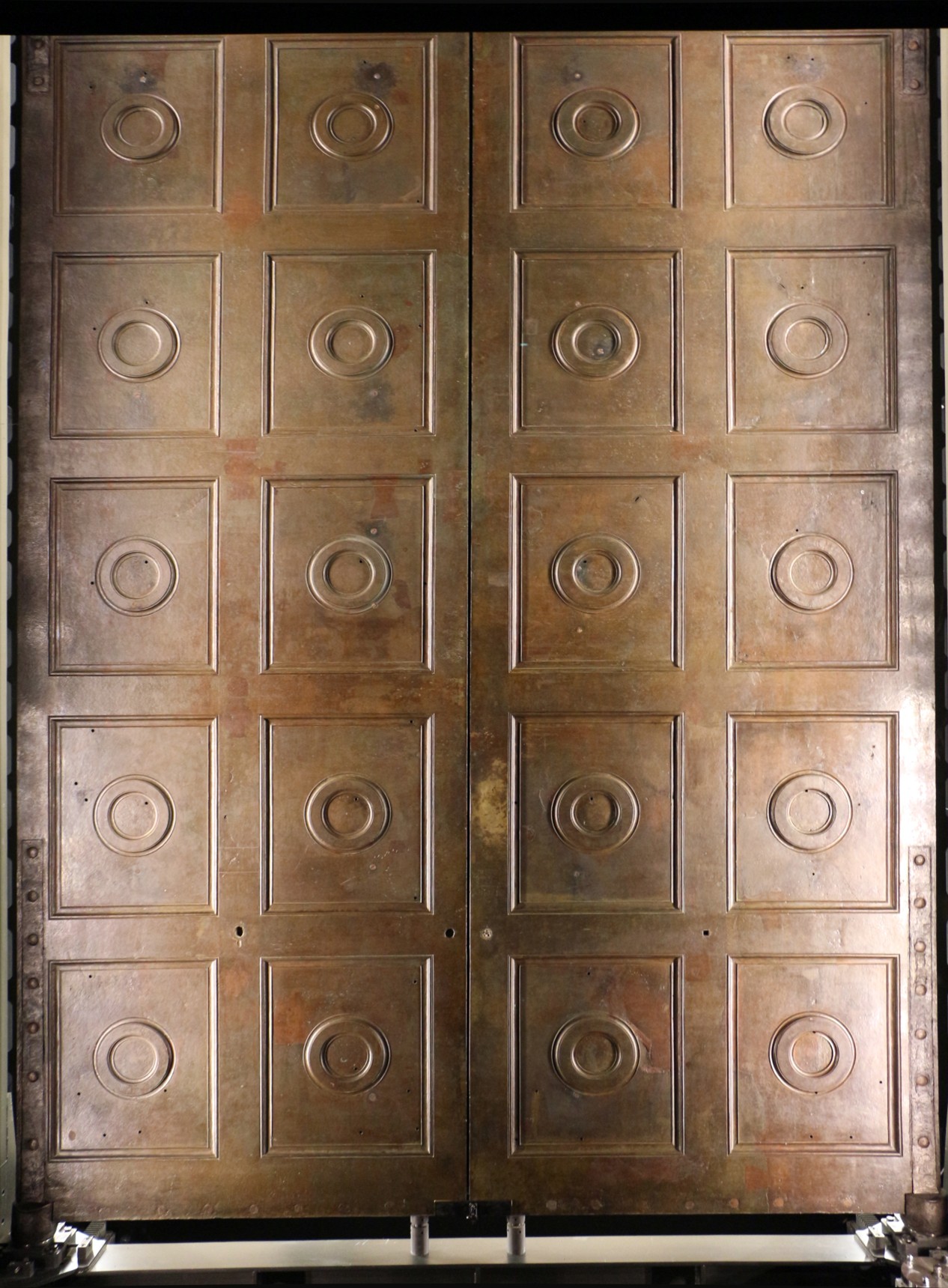
The other face of the object preserves an instructive part of the older geometry. The reverse again has twenty-eight compartments, now forming a bronze pattern on the side that faced the interior. Dora Liscia Bemporad identifies impressions made with the punches used to make Florentine coin dies. The marks include the lily, parts of the figure of John the Baptist and the arms of officers of the mint. Three sets of arms can be matched to successive terms of office in 1448 and 1449. The latest leads Liscia Bemporad to place the stamping itself around the beginning of April 1449.
Here the things that carry the chronology are small impressions, seen from the other side of the leaves and tied to the dating of the dies. Their evidence concerns a late stage of the doors as physical structures. The geometry of the reverse also shows the extent to which the change to ten squares concerned the public face. It was possible to give a space to biblical narrative on one surface and divide the same height and breadth quite differently on the other. [1] [4] [22]
The Gates of Paradise in a historical photograph
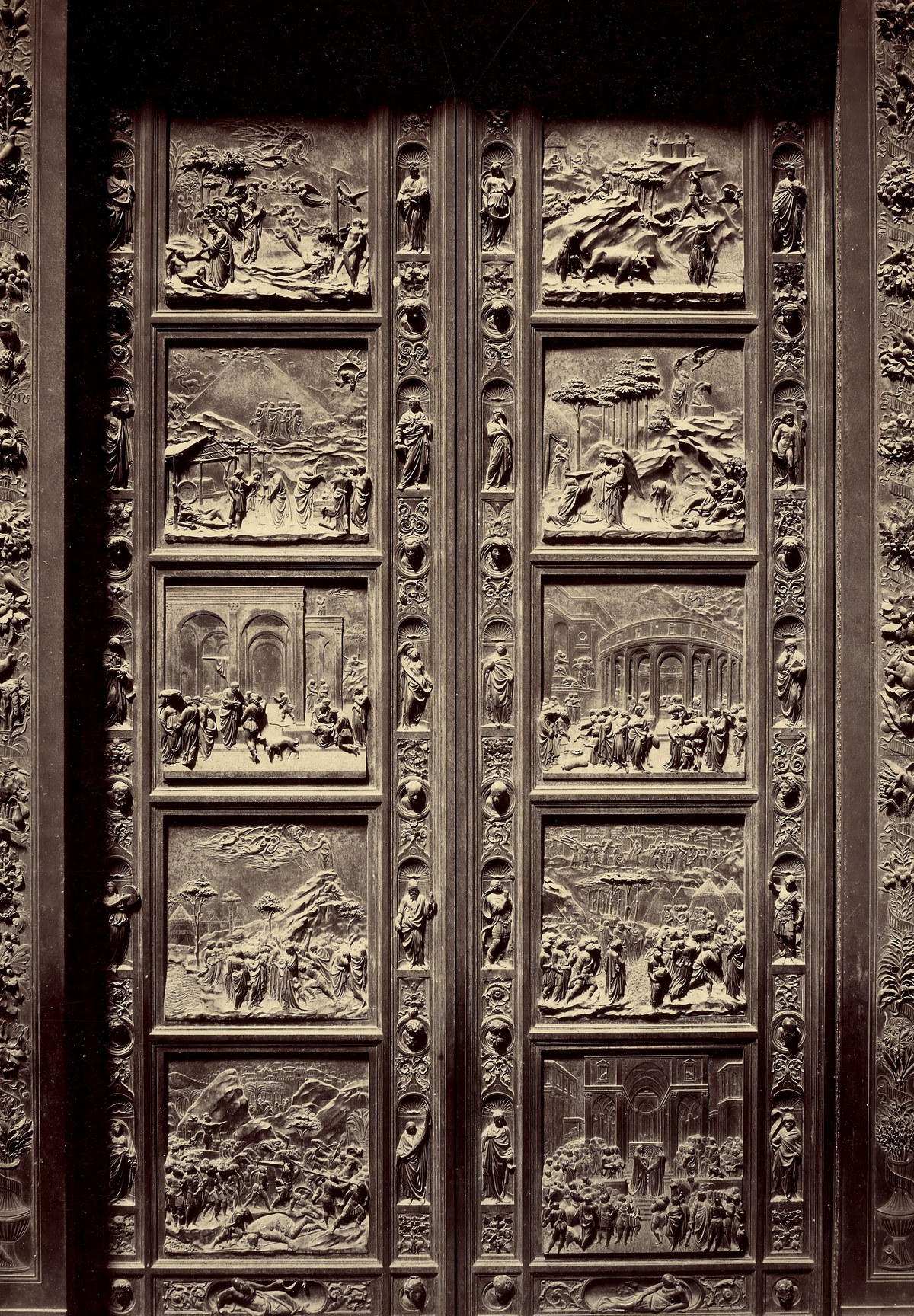
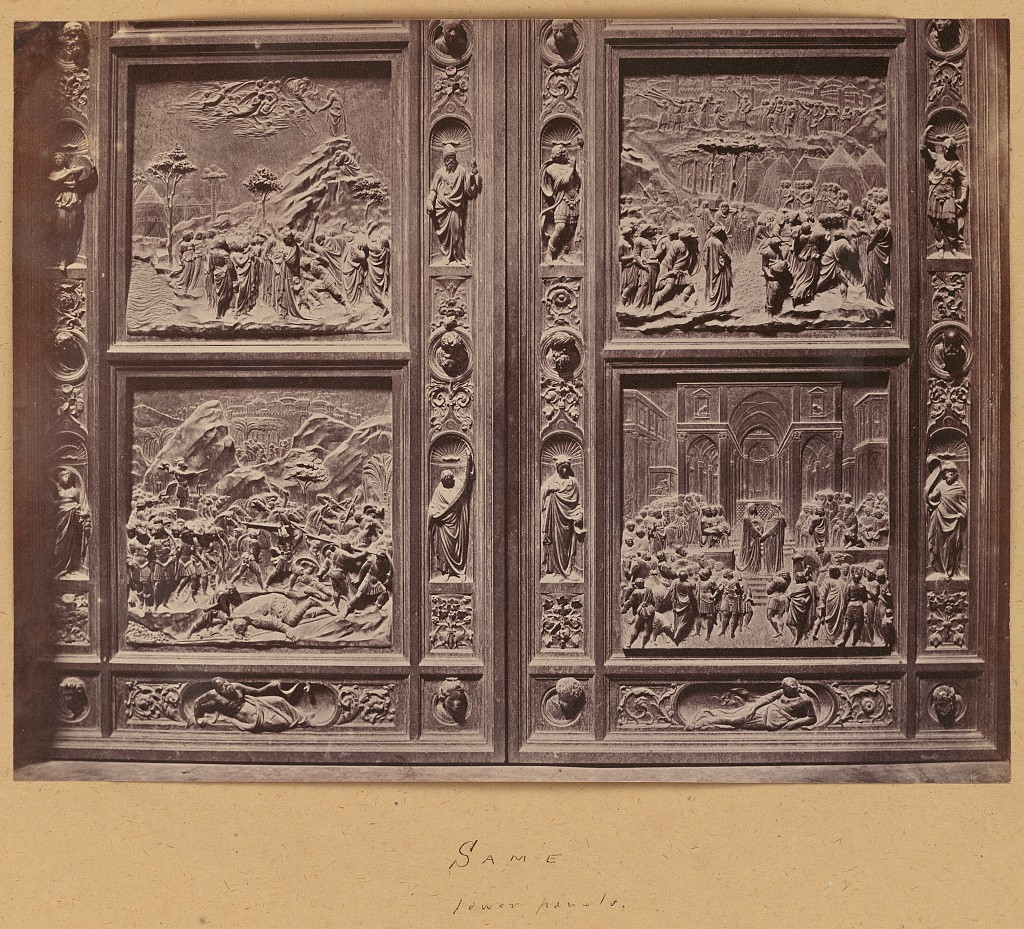
This historic full-door photograph makes it possible to compare the ten narrative panels with the surrounding figures, heads, animals and plants. The numbered details move from individual stories to the door’s larger sculptural structure.
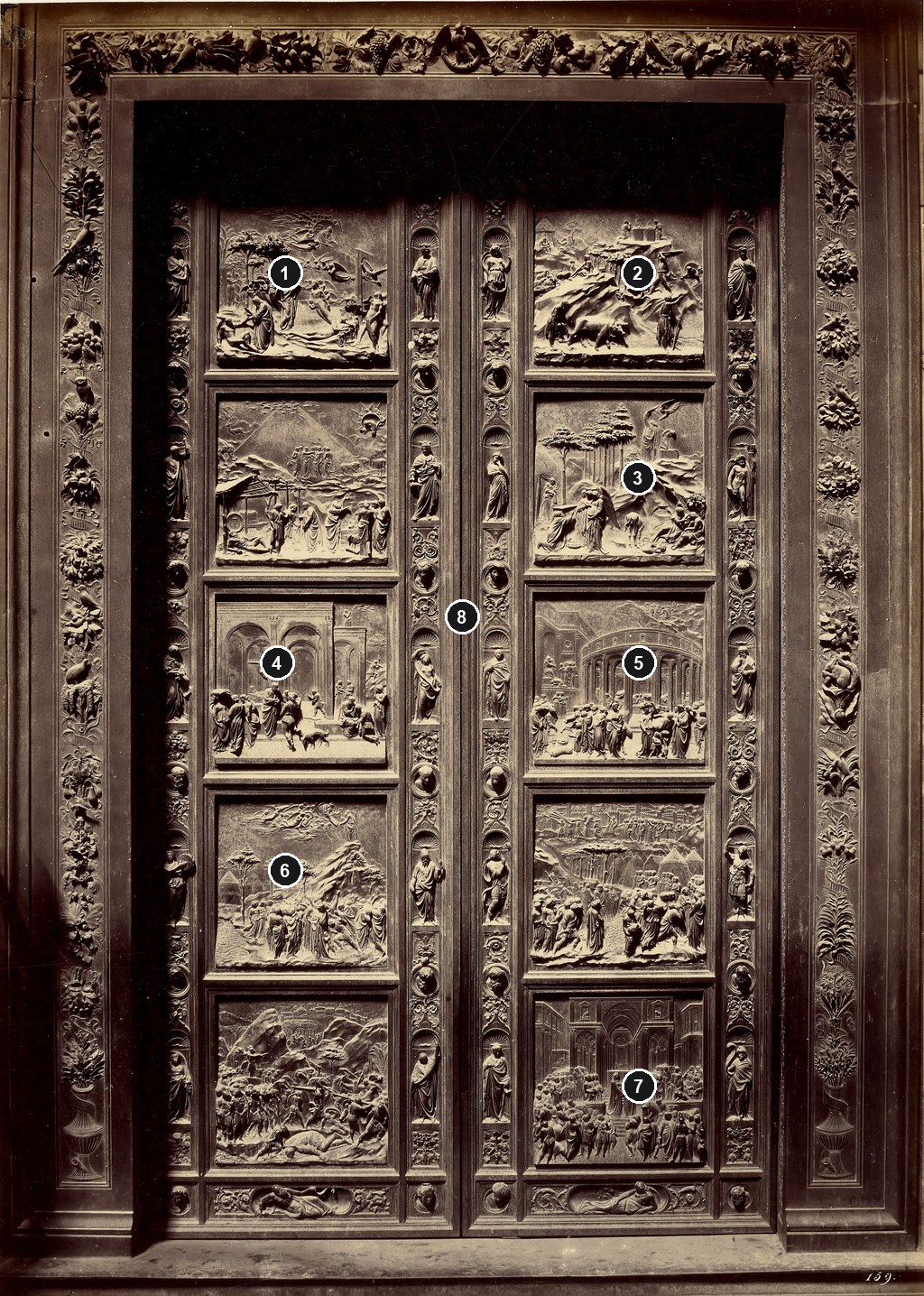
8 DETAILS to Notice
Creation, Fall and Expulsion
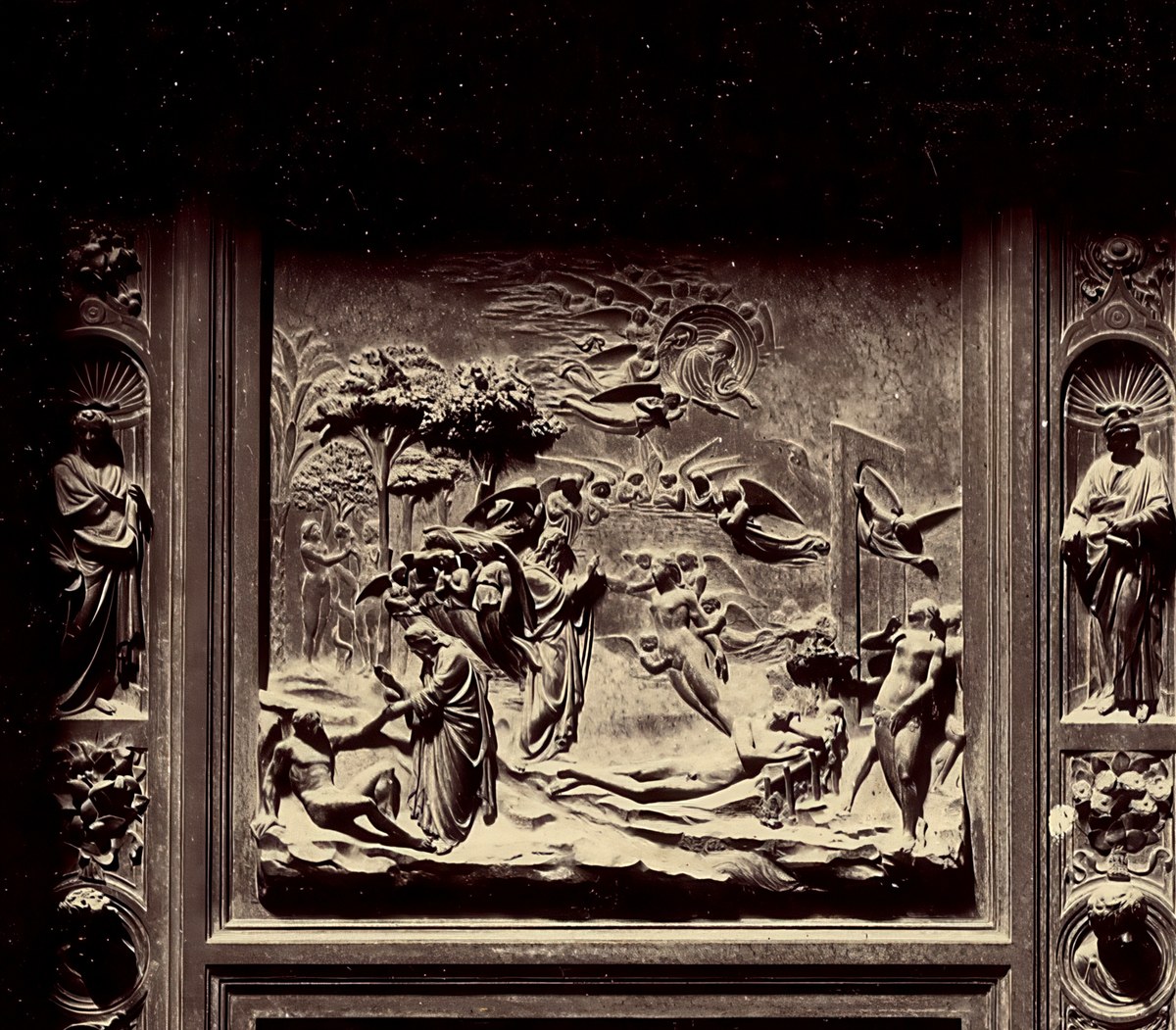
The upper-left panel compresses the creation of Adam and Eve, the Fall and expulsion into one continuous field. [1]
Cain and Abel
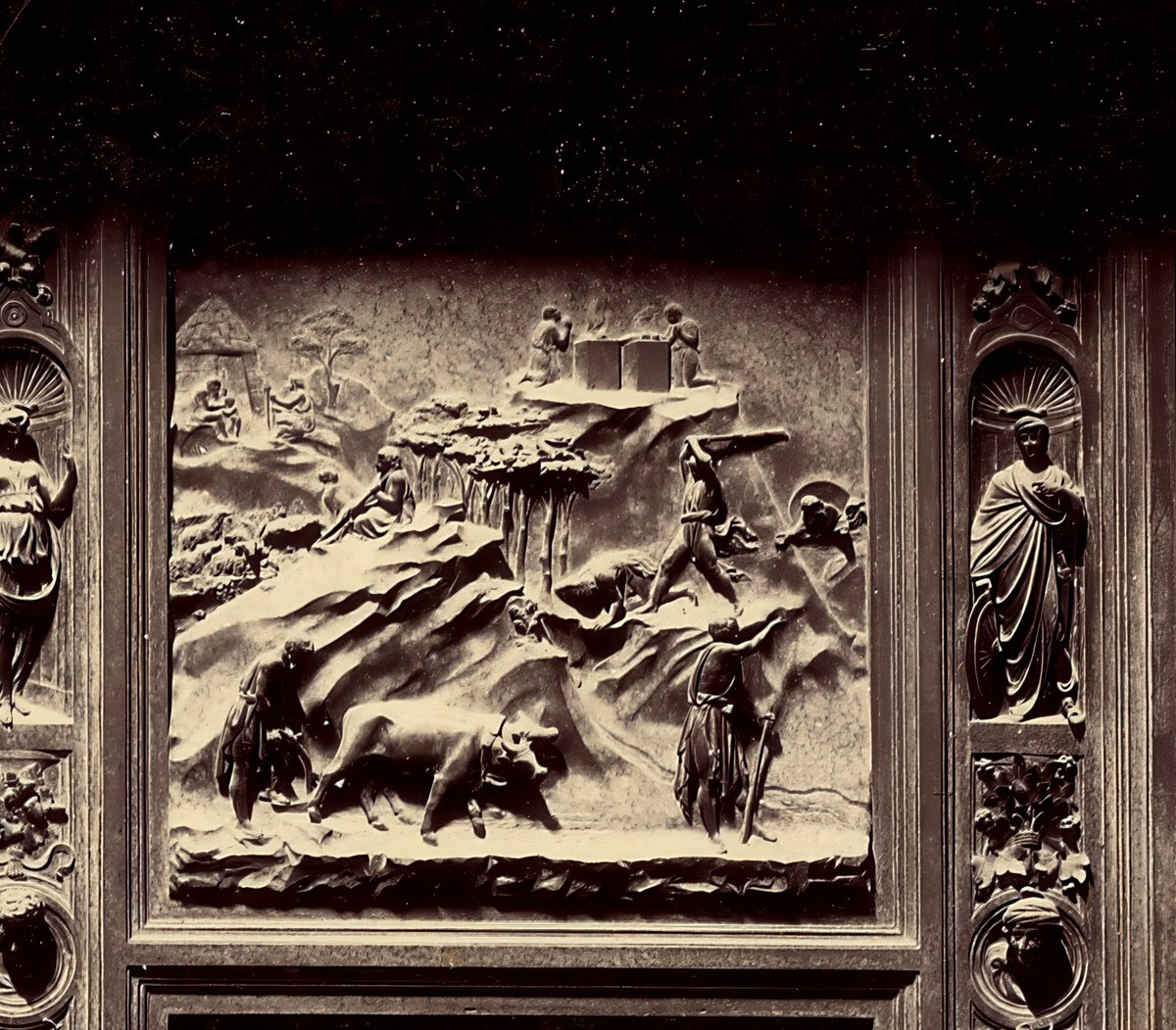
The upper-right panel uses landscape and changing relief to separate episodes from the story of Cain and Abel. [1]
Abraham and Isaac
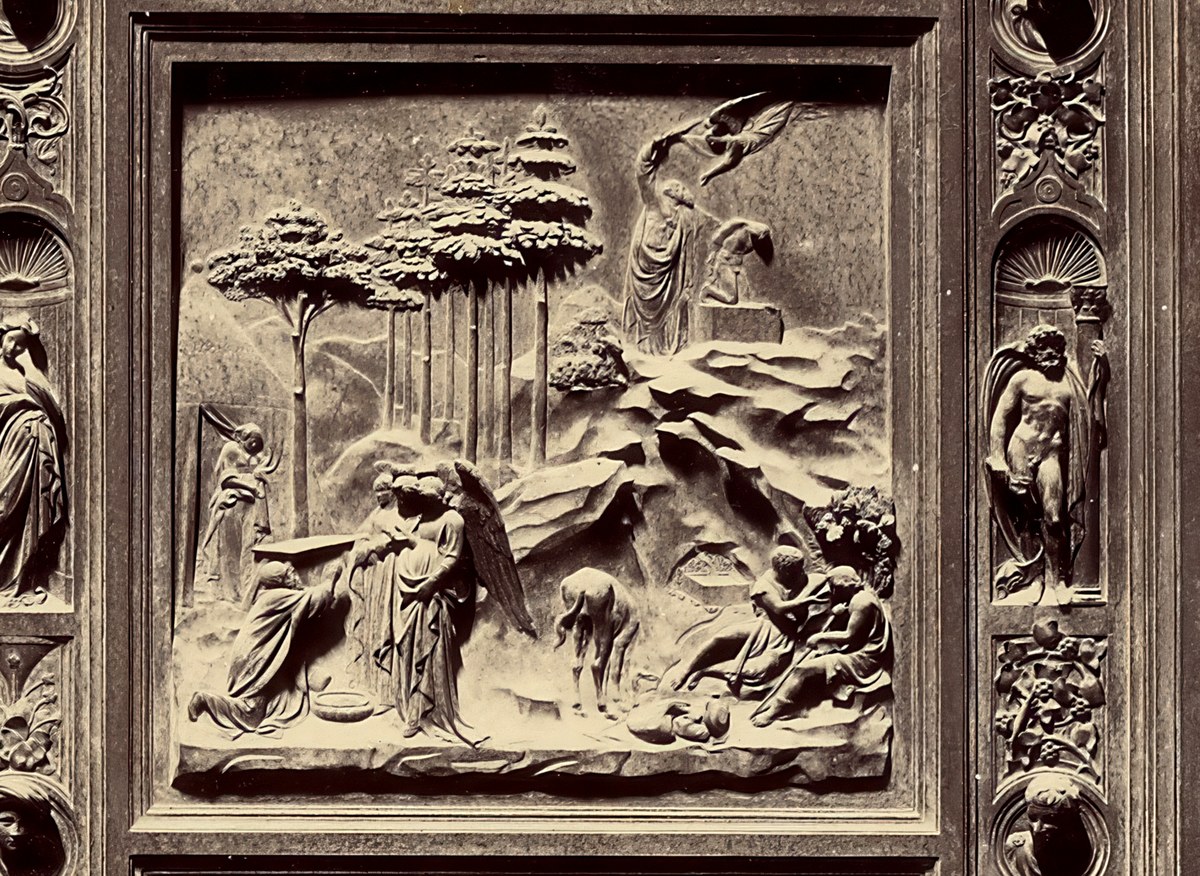
The Abraham panel distributes successive moments through rocky terrain rather than enclosing them in separate frames.
Isaac, Esau and Jacob
Architecture, foreground groups and distant encounters allow several moments from Isaac’s family story to coexist.
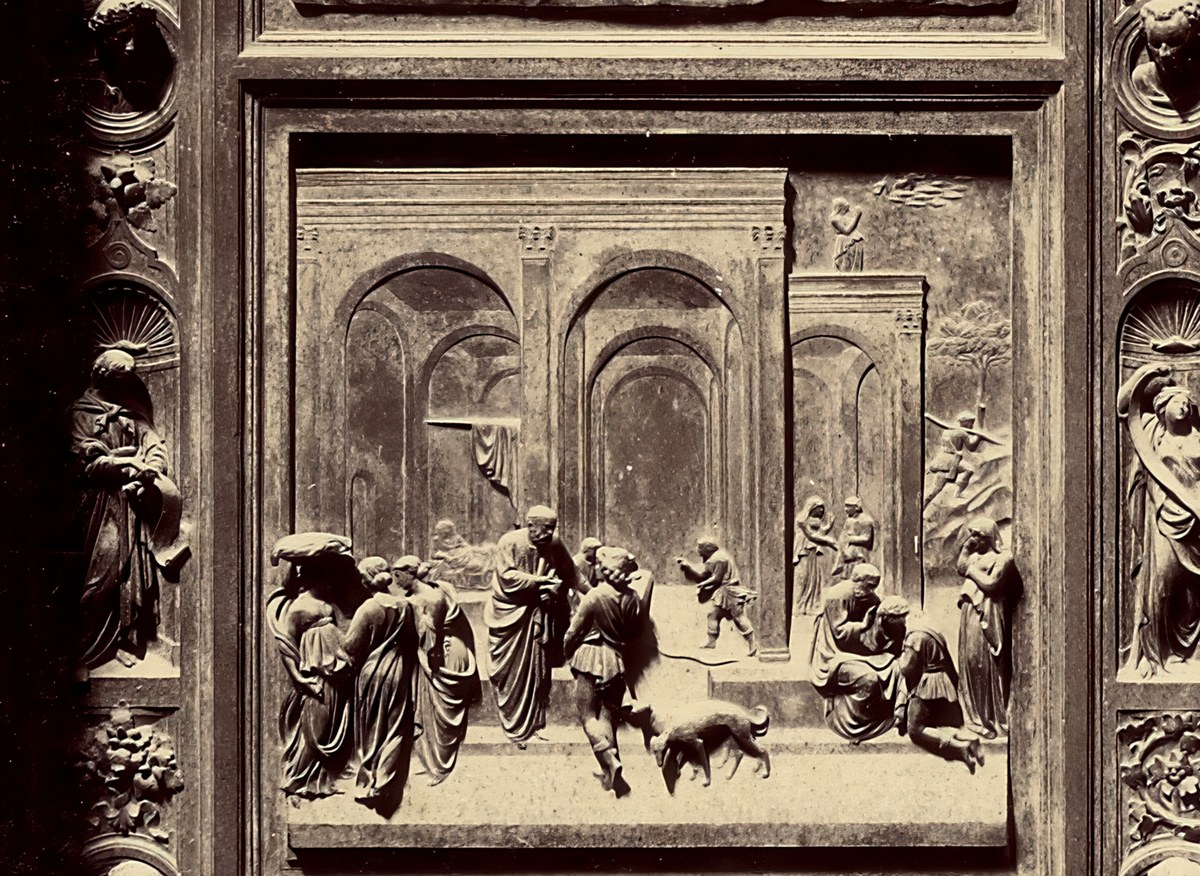
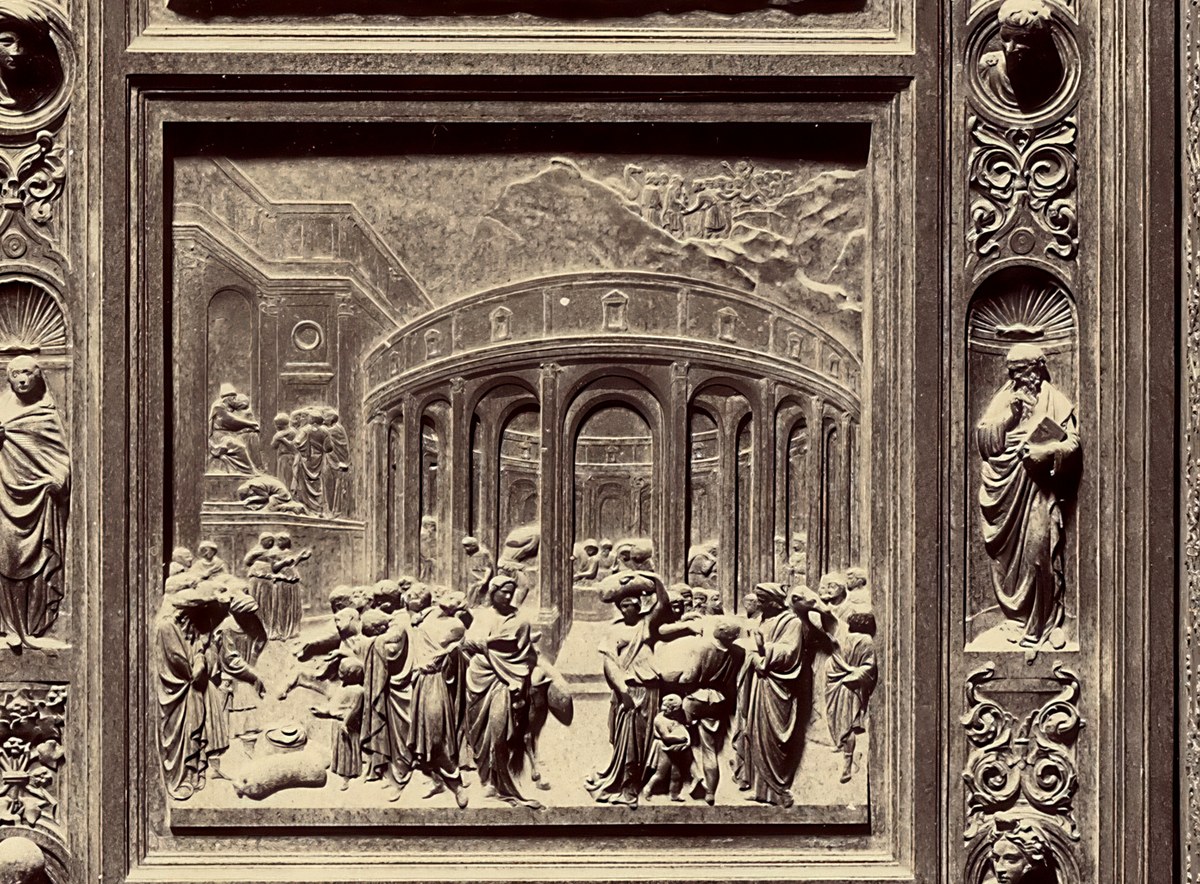
Joseph
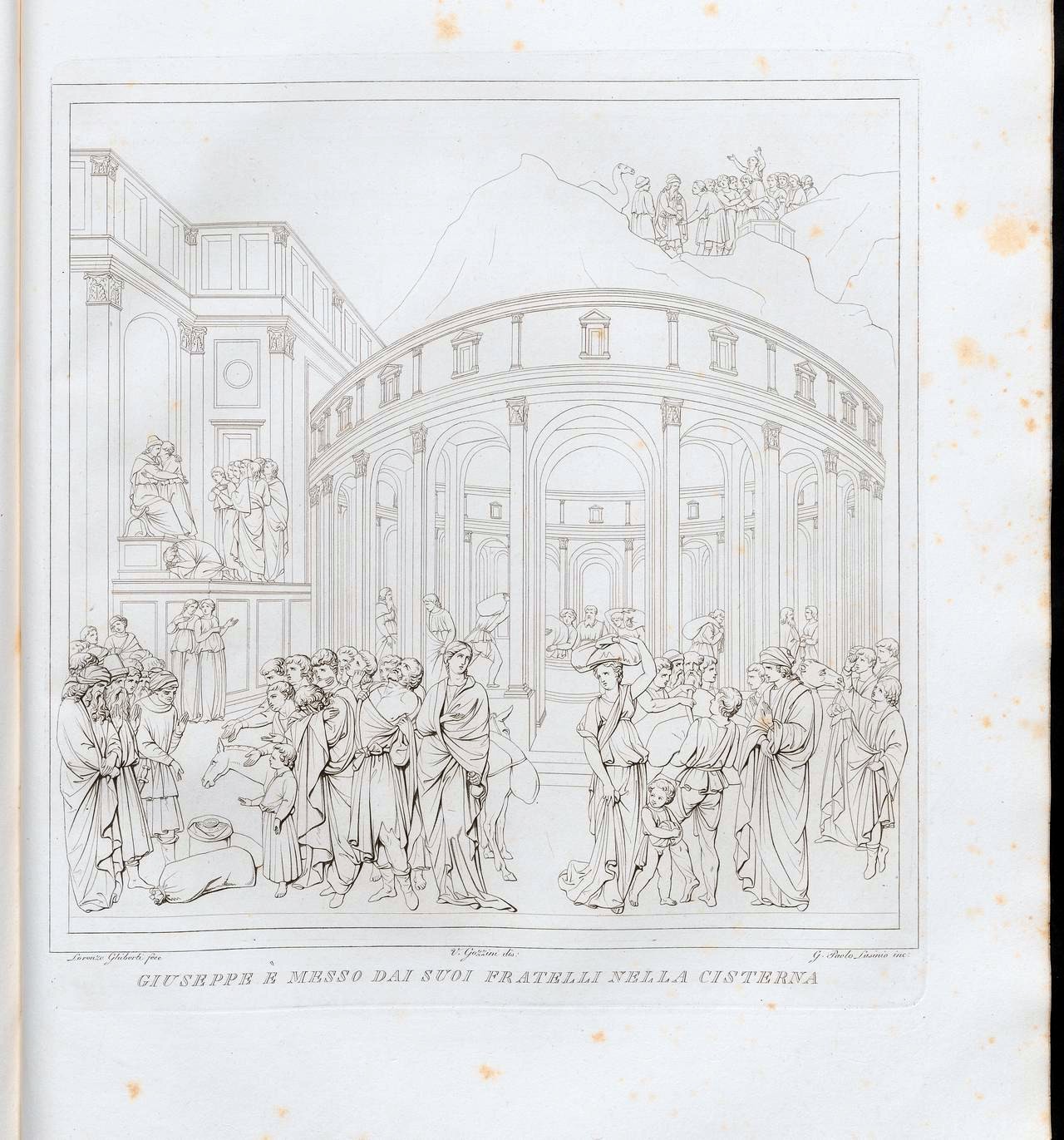
The circular architecture in the Joseph panel organizes a dense sequence of recognition, judgment and reconciliation.
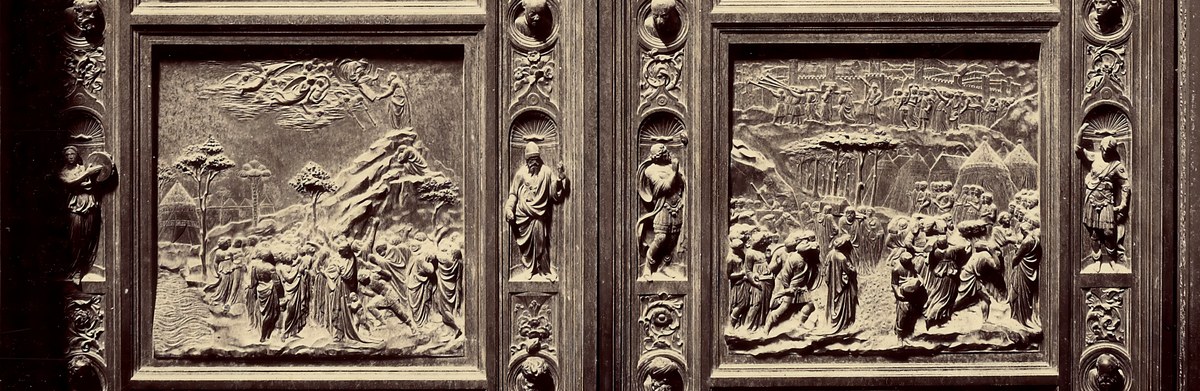
Moses and Joshua
The middle-lower panels show how mountain, crowd and architecture create different kinds of large-scale public action.
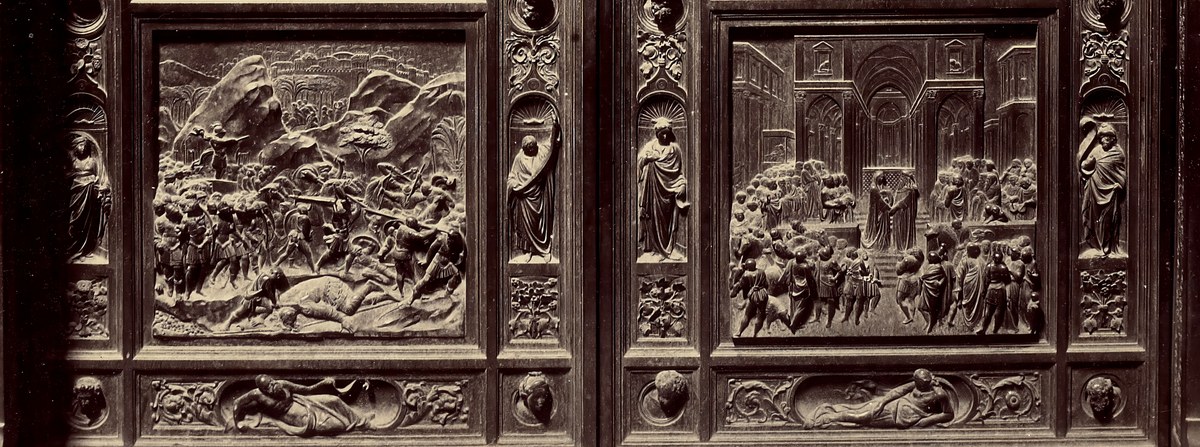
David and Solomon
The final panels move from battle and kingship to the ordered ceremonial meeting of Solomon and the Queen of Sheba.
Figures, heads and botanical frame
Prophets, heads, animals and plants make the frame an active sculptural programme rather than a neutral border. [1]
What took twenty-seven years
A fire destroyed much of the Calimala archive in the eighteenth century. The seventeenth-century copies and summaries made by Carlo Strozzi help recover the order of work, with much firmer dates for some operations than for others. April 1437 is unusually well documented. According to Bloch’s reading of the documents, the workshop by then had cast the ten principal reliefs and twenty-four strips of framing ornament. There were ten large bronze pictures in existence, together with much of the decoration that would surround them.
They were still a long way from being a pair of doors that could be hung, opened and shut. The strips and the pictures needed surfaces brought to a finish, as well as something strong enough to hold them. The structural leaves, produced in a separate campaign that Bloch places in 1439–49, had recesses to receive the pieces. The visible distinction between square and surround also had a practical basis in how these separate objects were supported. [1] [5] [17]
Chasing, the tool work carried out after casting, can restore a contour or refine the features of a face. In Ghiberti’s shallow relief even a slight loss of definition would make a fold or expression difficult to pick out. A casting date tells us when the bronze form existed. The chasing records track when its details were being made legible. [3] [5] [17]
In July 1439 Cain and Abel, Moses, and Isaac and his sons were finished or close to finished in their chasing in Bloch’s account. Work had begun on Joseph and Solomon. In a chronological list of the Bible stories, Joseph comes six panels in and Solomon comes last. On the workshop benches they could be at comparable stages at a particular date. The Opera’s summary describes finishing as nearing its end in July 1439 and then records six completed squares in 1444.
Bloch gives four unfinished in 1443 and has the reliefs ready by 1447. The July entries specifying the state of individual pieces supply a more precise reading of what was getting done at that moment. They place finished, nearly finished and recently begun work in the same shop. The later reports give the point at which the group could pass from one operation to the next. [1] [5]
How the workshop made the doors
The staffing changed as the work changed. Michelozzo was involved early, left in 1425 and returned in 1437. His return belongs to a phase when substantial work on the cast surfaces lay ahead. Benozzo Gozzoli is documented on the project in the 1440s, with Bloch placing his involvement in 1444–47 and suggesting that he probably assisted in chasing. Vittorio Ghiberti’s involvement is particularly clear in the later work.
The guild’s accounts explain how several parts of the ensemble could be in progress at once. They give a firmer basis for understanding the organisation of labour than for assigning an expressive head in one crowd or the figure of David to a named assistant. The Opera records an attribution of a hand in the David relief to Benozzo as part of its history of scholarship. The documented employment and the attribution are two pieces of evidence with different force. [1] [5]
While work on the pictures advanced, work on the threshold and the surrounding architectural members went on separately. The guild requested more metal from Flanders in 1445, which the Opera tentatively connects with work on the outer ornament, modelled later in the decade. A door could be structurally complete and still need its gold.
The Opera’s account treats the work as complete apart from gilding in spring 1452 and records that Lorenzo and Vittorio undertook to gild it, with the gilding finished in June. The opening into which it was to go was settled the following month. The length of the commission includes the difficult fitting together of large structural castings and much smaller pieces, the finish of the assembled surfaces and a decision about where the result should be seen. [1] [5]
The panel at the start of the sequence is often taken to be the earliest, but the production chronology is less settled. Bloch reports Richard Krautheimer’s reconstruction, which began with Adam and Eve around 1429 and put the final four fields around 1435–37, and Francesco Caglioti’s suggestion that work on the reliefs might have begun as early as 1427. A different line of inquiry opened when Marco Ferretti and Salvatore Siano examined the backs of five panels with portable X-ray fluorescence. The Moses relief stood out in the measured composition, including its antimony.
They suggested it might be the earliest among the examples they studied. The two sequences concern different kinds of evidence. A reconstruction from design and archival evidence asks when the sculptor could have conceived and worked out a composition. An inference from alloys asks when a casting might have been made relative to others. The metal can supply a historical clue about changes in the materials used by the workshop, with the strength of that inference depending on how those materials were acquired and used. Half the reliefs were outside the survey. [5] [18]
The reverse of Joshua preserves evidence unavailable to someone looking at the front. Ferretti and Siano distinguish areas of repair from a central plug whose metal differs from the main casting. They propose that a hole made late in production allowed the heavy panel to be suspended while the workshop tested its fit in the leaf. This reading offers a possible explanation for an otherwise inconspicuous feature concealed in assembly. [13] [18]
Reading across the leaves
The top register puts the creation of human life beside the first killing in Genesis. In the left square, the Creation of Adam is at the viewer’s left, Eve rises near the centre, the temptation is farther back on the left, and the expulsion is at the right. The large foreground figures give the eye the main points of arrival. Adam’s body in the first encounter has the weight of a body just coming to life.
As Eve rises, the angles of the angels’ bodies and the disposition of their arms make her movement perceptible across a field in which she appears again in smaller form. By the time the couple leave the garden, the human figures have been brought forward in scale and physical relief again. The departure has the weight of something happening to bodies we have just seen take shape. [3] [6] [7]
Ghiberti counts four incidents in the Eden square. The count is borne out by the finished image, though one incident may be much easier to pick out than another, depending on where one is standing. The catalogue’s description of the creation of Adam can also be confusing about the side. The overall photograph and the Art Institute’s exhibition material place it at the viewer’s left.
That orientation lets the far smaller scene of the temptation be read against the larger figure of the awakened Adam on the same side. The fact that the temptation is set back makes it possible to give its consequences greater spatial and bodily emphasis at the other edge. A person revisiting the panel can move from consequence to cause by looking back across the terrain. [3] [6] [7]
Across the seam, the settlement of the first family and the work of its sons occupy land that has to be made productive. A hut, animals and distinctions between animal husbandry and cultivation give shape to the existence that follows expulsion. The family group at the left includes small children whom Ghiberti remembers in his account of the relief. Their small scale and proximity make the scene read first as a household.
To follow the lives of the brothers one has to look away from that group, through the landscape to the flock and ploughing, up to the offerings and across to the violence and its aftermath. The offerings are recognisably the products of different work. When Cain and Abel turn to God, they bring with them the things by which the workshop has already made their occupations legible. [6] [8]
The scales of the divine encounters change across the seam. At the left, God giving life to Adam is a conspicuous foreground action. At the right, the divine inquiry must be picked out after spotting the larger episode of the killing. Ghiberti’s description keeps that exchange in view alongside the scene of violence. [6] [7] [8]
The second register sets a conspicuous piece of geometry against a break in the rock. In Noah’s square the ark dominates the distance. Its straight sides and tapering form remain recognisable through the density of people and animals around it, and the marked measurements insist that this great object is constructed. Ghiberti describes the animals coming out, which fits a sequence in which the sacrifice after deliverance can be seen in the same landscape.
The catalogue’s subject list calls the animal scene an embarkation. At the scale of the complete doors, the strongest immediate evidence is the concentration of animals and people by the opening. The direction assigned to the movement matters for whether the relief leads us from impending disaster to safety or dwells on what happens after the waters have fallen. The maker’s own enumeration favours the latter. [6] [9]
The sacrifice directs attention towards an act of thanks. The reclining Noah by the vine draws it down to the reactions of his sons, whose different positions make a private exposure visible. The emphatic geometry of the ark can be grasped from below the doors. The conduct that follows survival needs a slower reading. [6] [9]
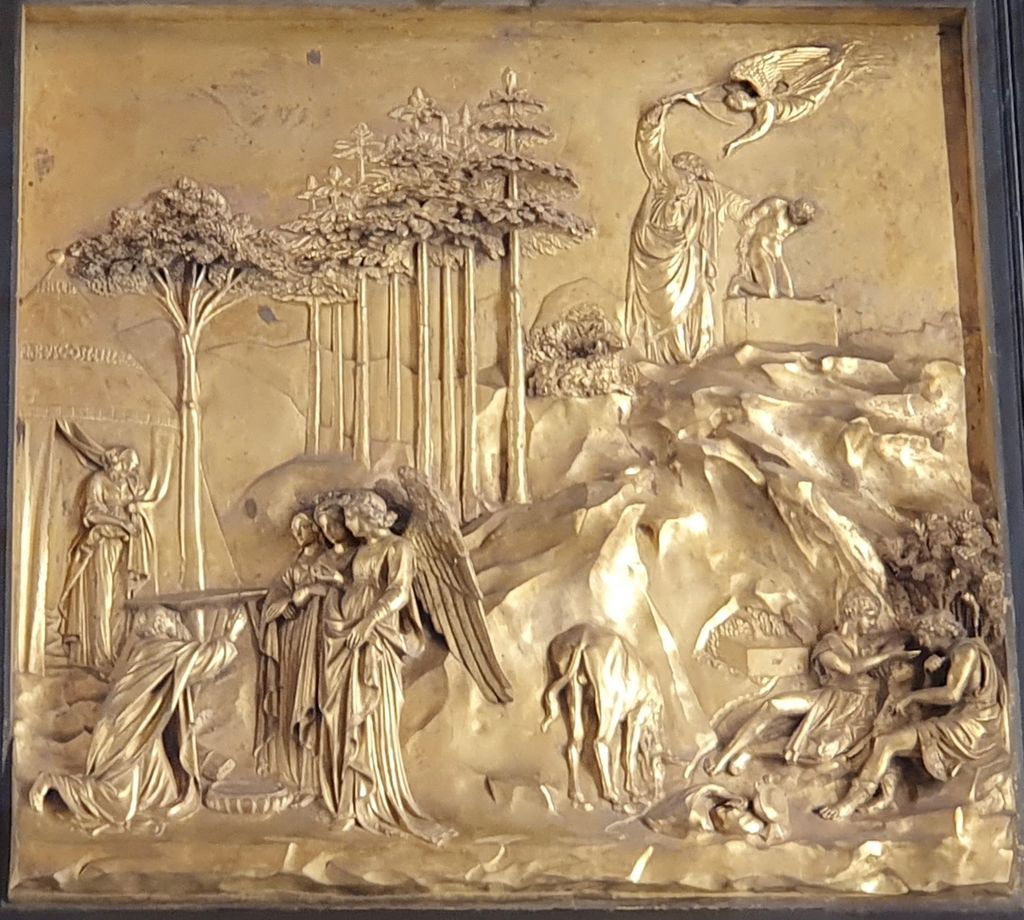
In Abraham’s relief the nearer encounter is the visit of the three figures whom Abraham greets, towards the lower left. The sacrifice of Isaac takes place farther back and higher on the right. The abrupt fold in the rock interrupts a direct passage between the two incidents. The attendants and the foreshortened donkey help establish an interval between the approach and the sacrifice. When the eye reaches Isaac, the small group at the altar demands attention through the convergence of the bodies and the angel’s grasp of Abraham’s wrist. The decisive touch occupies very little of the total surface. Its effectiveness depends in part on the patient work of recognising where people are and where their progress stops. [6] [10] [16]
Fabian Jonietz compares this solution with Ghiberti’s earlier Sacrifice of Isaac for the competition. The ram is carried over with a recognisable pose. The altar is changed and the angel’s physical intervention gives the gesture a different emphasis. In the older piece the sacrifice furnished the subject for a single framed composition. In the square it has become one outcome of a much longer history, which the earlier welcome to the visitors helps to bring to mind.
Jonietz also proposes a connection between the boldly shortened donkey and Pliny’s account of Pausias’s painting of a sacrificial ox. The analogy is a way to understand what an educated viewer might admire in the display of foreshortening. The visual relationship between the two versions of the ram can be tested directly on the surviving works. [10] [16]
Relief, space and close looking
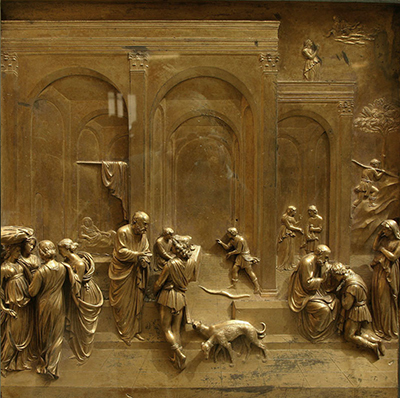
In the middle register, architecture takes over much of the work done by paths and rocks above. In Isaac with Esau and Jacob, rows of arches and lines in the pavement are an invitation to follow recession. The doors and openings give the setting thickness. It seems possible to turn and go behind a pier or to step down to the place where dogs wait.
The sequence of bays also gives names and ages to figures who would be hard to connect by their appearance alone. Birth is staged within the architecture. The instruction to hunt and the bestowal of the blessing occupy their own positions, with activity continuing outside. An eye moving through the building can trace the family’s dealings without once leaving the square. [3] [6] [11]
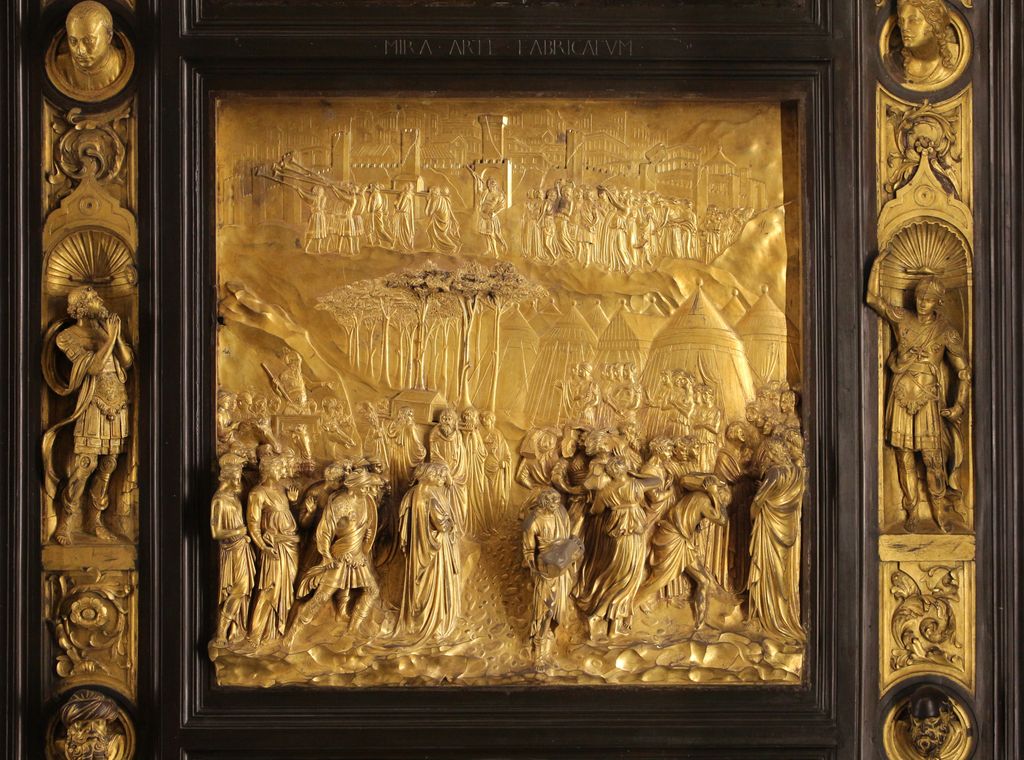
The curves of the arches remain legible in the shallow distance, while a fold or knee actually projects into the air at the front. The design uses both kinds of depth to hold the blessing near the viewer and leave other stages of the story visible through the bays. A reaching hand pulls the eye back from the recessions of the pavement to the moment on which the family’s future depends. Bloch notes Ghiberti’s interest in the medieval writer Alhazen’s discussion of how soft light reveals fine carving. In the Isaac panel, the strongest foreground shadows continue to mark bodies even when a change in the angle of light makes a shallow seam in the architecture harder to pick out. [3] [5] [11]
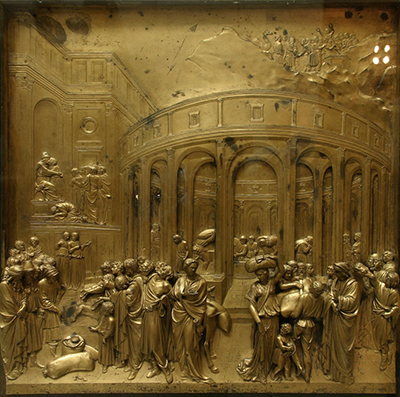
The Joseph relief beside it arranges a large crowd around a circular structure. The building’s sweep admits movement around its edge. The open ground at the front has space for the carrying of sacks and for encounters for which the traffic in grain provides the occasion. In the distance the pit places the sale of Joseph at some remove from the room given to its consequences.
The story begins in a space small enough to be passed over on a first look. The episode of the planted vessel and the recognition of the brothers emerge from the life of a community already in motion. Once the small early scene has been located, the later distributions of grain and power become legible as a reversal. [3] [6] [19]
Put the two compositions together and a difference emerges in how they ask the viewer to recognise a relationship. In Isaac’s household the blessing depends upon a vulnerable older man taking the person in front of him for his other son. In Joseph the power belongs to the brother whom the others fail to recognise.
Both stories involve looking and handling, and the metal gives weight to people drawing near each other against settings that can make whole groups appear very far away. It is possible to follow the family resemblance between the stories across the seam while still taking direction from very different ground plans. One setting draws the eye down an arcade, the other between and around people doing business in front of a storehouse. [11] [19]
In the fourth register the encounter on Sinai happens high in the Moses panel. The emphasis at the top is produced by the mountain and by the relatively open area around the small figures. Rocks establish steepness without promising the accessible route that steps and pavement provide in the Isaac relief. Down below, the gathering spreads over a much greater apparent width and has numerous turns of head and body.
The lawgiving is a scene that concerns everyone gathered below, yet the position of the figures keeps most of them at a remove. The tents, ridges and smaller incidents extend the view beyond the immediate assembly. From in front of the door the mountain is visible before one can tell exactly what is happening at its summit. [6] [12]
In the Joshua relief, the action that makes passage possible can be followed among the figures. The Ark is borne across the Jordan, and stones taken from the river are to become a memorial. Look at the physical effort of carrying and at the turns of the people following it. The bronze makes room for the act that gives the crossing a remembered form, then for the camp and the movement towards Jericho.
The distant gate has the split inscription identifying the city. The lettering, small enough to require a closer view than the outline of the walls, gives a name to the place that has gathered so much of the composition’s pressure. The upper town is positioned to draw the eye onwards from the crowded crossing rather than to halt attention with a single isolated event. [6] [13]
Across this register a physical object conveys what the two stories have in common. There are tablets high on Sinai and there are stones close to the bodies that carry them across the Jordan. The tablets belong to an encounter concentrated at a distance from the people. The stones connect the place where the crossing takes place to a future act of remembering it. Joshua’s distant action involves the fall of a city, while the people in depth in Moses witness the signs attending the giving of the law. Both compositions take advantage of a height available all the way across the square. Their high ground does quite different things to a viewer’s sense of who can reach the principal action. [6] [12] [13]
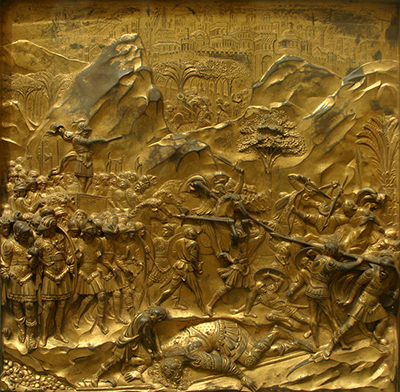
The last register exchanges the rising ground and military momentum of David and Goliath for a meeting concentrated near the central axis of an imposing building. Ghiberti shows David using Goliath’s sword after the decisive blow. The fallen figure makes a broad base for the smaller figure’s action. Around them the military story spreads into lines of movement, with ranks and armour legible well beyond the scene of the duel.
A city stands rather high in the field. The distance between David’s body and the mass of people around him allows the viewer to see how one act changes the movement of a whole army. A walled town and the details of dress need only be familiar enough to bring that movement into a credible world. Naming a particular place from resemblance alone would add more than the bronze establishes. [3] [6] [14]
In Solomon and the Queen of Sheba, the centre of the crowd is defined by the two approaching figures. The near groups rise towards them and the strong architectural axis gives their meeting an address within the space. The large building also reduces the visible sky to an interval between constructed forms. The rulers are granted a prominence very different from that of David, since the directions of approach and the design of the building have already indicated where a formal act will occur. David’s importance has to be discovered amid scattered actions. Solomon’s is established by the disposition of the whole company, even before an individual gesture has been identified. [14] [15]
From this final encounter the eye can travel diagonally back to Eden, where a great part of the field is open and spiritual beings descend into the territory of bodies and plants. In Solomon’s square, the building governs how the bodies come into relation. [1] [7] [15]
Relief, gold and the work of the frame
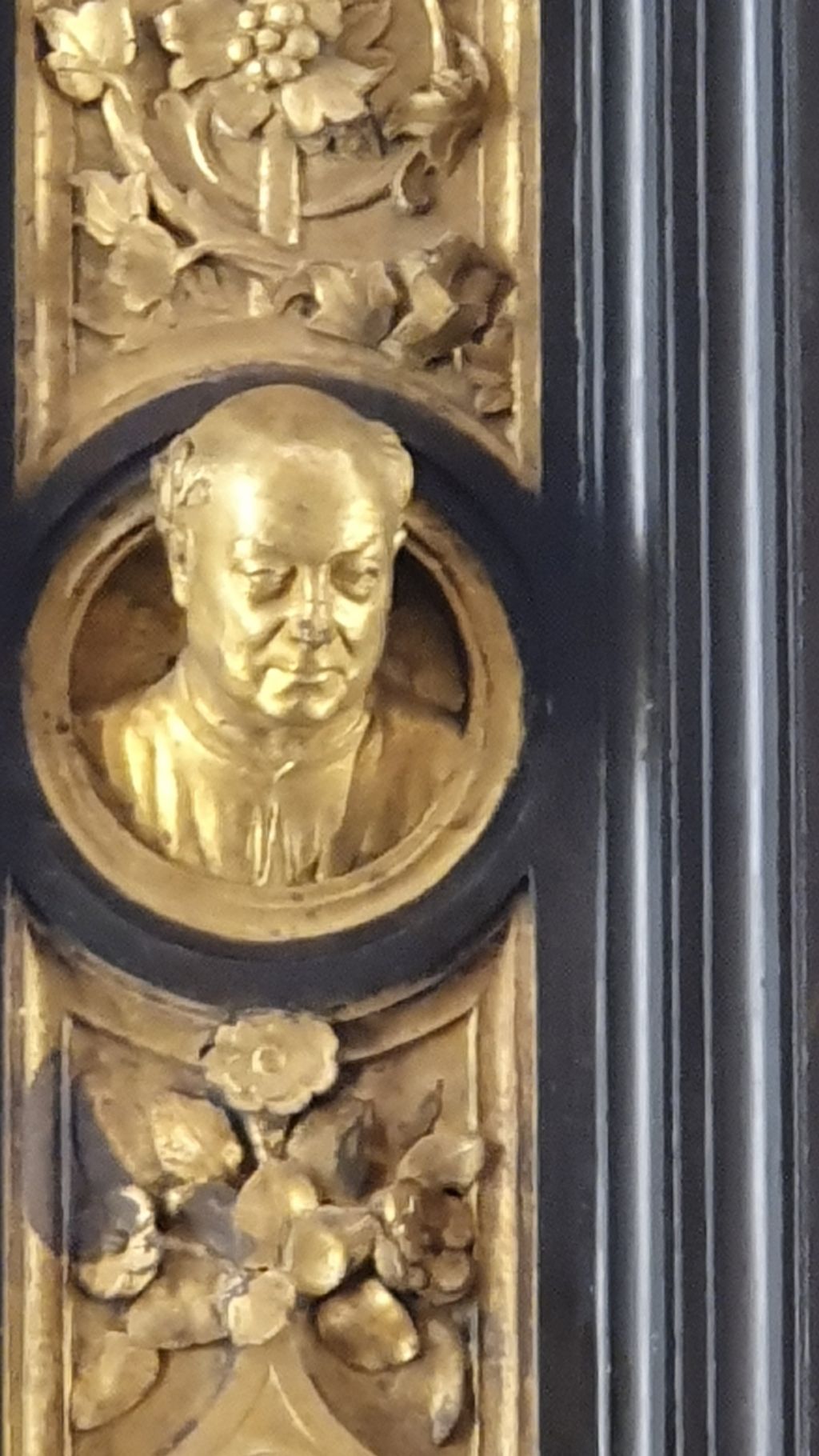
The projecting heads make a different demand on the eye from the clusters of faces inside the squares. A head inside a scene can be rendered thinly enough to imply a particular place behind other people. The heads in the round openings appear to push out over the mouldings. They meet the public light of the doorway at regular intervals and have clear edges even when their faces are too high to read.
The prophets and biblical figures in the upright niches often have bodies whose drapery and pose direct the eye along the height of the leaves. On the horizontal members the figures lie more nearly along the line of the frame. The sculptor makes the surrounding bodies conform to the directions that define the squares. [1] [2] [6]
Ghiberti describes twenty-four figures and twenty-four heads in the frieze. Giusti and Matteini use twenty-four for the separate framing pieces around the panels and also speak of forty-eight elements when they tally the niches and roundels. Bloch gives twenty-four decorative strips in the early casting tally and discusses the small busts as a further group. The repetition of these numbers reflects the way the decoration was built up. A strip is a physical piece, a niche a place for a body and a roundel a place for a head. The strips allow the sequence to be carried around the doors, and the figures and heads determine the rhythm perceived when the parts have been fitted together. [1] [5] [6] [17]
The catalogue identifies the faces of Lorenzo and Vittorio Ghiberti near the centre of the doors. Their position within the series gives them something of the force of an encounter at the outer edge of the narratives. They share the projecting scale and the round setting of surrounding heads. One can see them as portraits without making every neighbouring head into the portrait of a person known to the workshop.
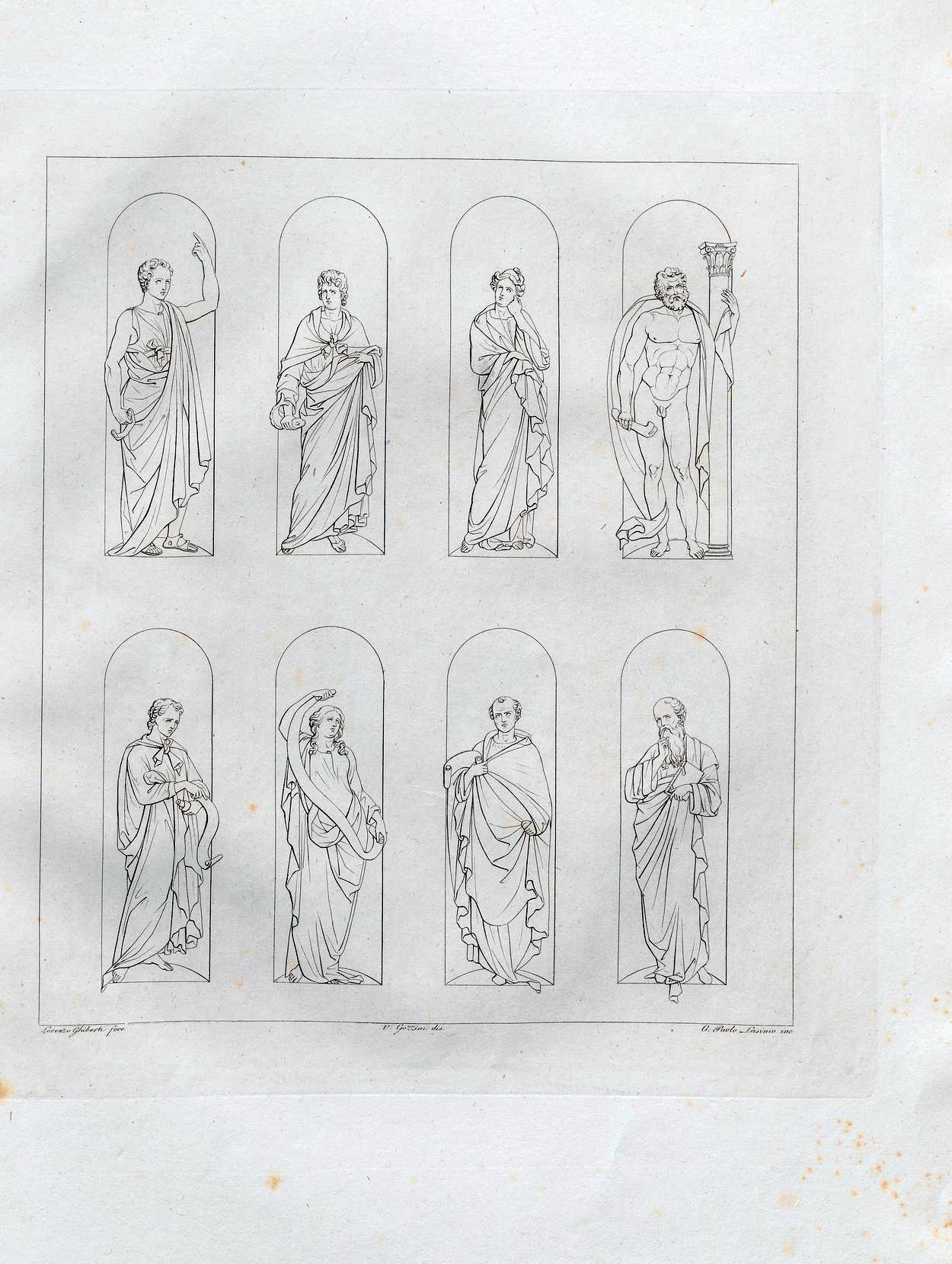
The frame also contains biblical figures, prophets and sibyls, whose presence extends the histories towards a Christian expectation of what would follow. The distinction between a specific portrait identity and a more general identification as a prophetic figure matters here, where an individualised expression can make even an unidentified head seem like a likeness. [1] [2] [5] [6]
The Opera’s scientific catalogue records the signature across both leaves at the division between the second and third registers. The Latin names Lorenzo di Cione of the Ghiberti and praises the skill of the making. It occupies the recurring architectural line between the pictures rather than entering their imaginary space. With the leaves closed, the maker’s name and the claim for the workmanship can be read across the interruption caused by the seam.
The written record of the Calimala’s involvement takes another form. While the signature names the maker in the finished work, the surviving accounts and deliberation identify who authorised the commission and chose its public setting. Identifying Vittorio near the middle gives visible presence to a member of the workshop whose role is also documented towards the end of the work. [1] [2] [5]
Look past the inner frame and the ornament changes again. Plants spread up the jambs and across the lintel. The animals and birds among the branches require the longer surface of the surround, which remains in place when the leaves move. On the working portal the threshold completes this distinction between the fixed entry and the hinged leaves. The eye meets the border at a distance.
The foot crosses the threshold at close quarters, and the person passing through turns away from the surfaces that were visible on approach. Ghiberti describes outer foliage, birds and small animals as well as decoration on the inner jambs and at the threshold. His account takes in parts a modern reproduction of the ten scenes can crop away. [1] [2] [6]
The Opera displays the reverse separately in the Galleria delle Sculture. Moving from one museum room to the other takes the viewer from the ten narrative fields to the older pattern of twenty-eight, recovering a second face that a photograph of the front leaves out. In the Baptistery, this was the side seen by those already inside the Baptistery. [2] [4]
Programme and invention
Ghiberti explains how forms scarcely raised from the ground can appear to have depth at a distance. He points to the diminution of figures as a means of giving an impression of nature on a plane. This helps account for how scores of figures can be crowded into some squares without losing the effect of a space large enough to contain them. [5] [6]
The Opera catalogue reads the descent from the top register as a Christian movement from the Fall towards the possibility of restoration. The downward motion is associated with immersion in baptism. Lower down, the sky is much less apparent in the architectural setting of Solomon’s meeting than it is among the angels over Eden. The presence of the divine takes a different visible form as the cycle approaches its end.
The catalogue also groups the first nine scenes into three sets, with the royal encounter as a conclusion. That order crosses the door’s actual registers. Its division after Noah falls between the left and right hand square in the second row. Following the theology and following the geometry can therefore involve different kinds of grouping even when the sequence of subjects is agreed. [1] [7] [9] [15]
The power of a baptismal reading is clearest where the setting, the direction of reading and actions in the pictures support each other. Noah’s passage through the Flood and Joshua’s crossing of the Jordan both lend themselves to such a reading. But even the flood relief gives considerable space to the awkward story of a father exposed in front of his sons, just as the river panel dwells on a community preserving a memory by carrying stones.
The framing figures can be seen as heirs to the practice of setting prophets alongside biblical events whose Christian significance was yet to be understood. The leaves can at the same time be read as a work in which small episodes have visual consequences of their own. A baptismal reading is especially persuasive as a way the finished doors could be understood at a baptismal entrance. The placement decision in 1452 leaves room for that meaning to have been intensified by the site. [1] [5] [6] [9] [13]
A stronger historical claim would identify a particular adviser and source for the choices. Bloch describes how Edgar Wind used patristic parallels to explain parts of the doors, and how Krautheimer associated the programme with Ambrose and suggested the intervention of Ambrogio Traversari. Traversari’s letter shows him taking an interest in the commission at the time Bruni was consulted. The humanist’s ties to Ghiberti make the possibility of counsel plausible.
To establish the further claim, one would need to connect particular choices in the finished reliefs to something that could have been proposed while they were taking shape. A correspondence between a Church Father’s interpretation and a detail in the bronze supplies a point of comparison, whose value depends partly on whether it is a distinctive connection or one shared across a great deal of Christian commentary. [1] [5]
Frederick Hartt’s association of the programme with the Summa of Antoninus gives the problem of chronology a sharper edge. The text brings together a striking number of the relevant Old Testament subjects. In the chronology discussed by Bloch it postdates the casting of the reliefs, making the completed text difficult to use as a source for decisions already embodied in bronze. Its grouping can still offer a historical comparison for the way episodes were connected in fifteenth-century Florence. The distinction allows points of contact to be considered alongside other kinds of evidence, such as the details Bruni names in 1424 or the workshop’s reuse of a figure from the competition relief. [1] [5] [16]
The Council of Florence offers a similar test for a reading at the level of one panel. The Opera relates the meeting between Solomon and the Queen of Sheba to the 1439 attempt at reunion between the Eastern and Western Churches. A ruler welcomes a guest who arrives with a retinue. The assembly is staged in grand architecture and the encounter is given the last position in the sequence. All these features make it possible to see why the biblical subject could acquire civic resonance when the door was installed.
Yet the documented casting milestone is earlier than the council, even though the chasing record shows unfinished work in 1439. The difference is material. Tool work could determine the character of a face or a surface long after the casting, but a claim that the very choice of subject commemorated the council would require evidence that reconciles that timing with the form of the cast relief. A proposed likeness of an individual delegate would need evidence about the face itself. [1] [5] [15]
Why are they called the Gates of Paradise?
The Opificio connects the name with the entrance and the passage of those about to be baptised. In Vasari’s later account, Michelangelo judged the doors worthy of the gates of Paradise. One tradition attaches the name to the use of a doorway, the other preserves it as the verdict of a sculptor looking at the finished work. [1] [2] [20]
What the flood revealed
When the doors were taken down for safekeeping in the Second World War, their surface was already in need of attention. The post-war campaign led by the founder Bruno Bearzi with Giulio Poggi and a committee had to address what long exposure and earlier cleaning had left behind. The sources date different parts of that intervention between 1946 and the return of the doors to the Baptistery in 1948. The moulds taken in that period eventually served a purpose that went well beyond documentation. Several decades later the existing moulds made it possible to substitute an entire set of leaves without taking a fresh impression from surfaces that had become increasingly fragile. [1] [17] [20]
The Arno flood of 1966 forced the doors open and six of the ten panels came out of their settings. The bronze pictures survived their fall with relatively limited direct damage and could be fitted back. They were secured through the leaves from behind. The panels that had stayed in their places retained fixings from the original assembly and proved harder to detach.
The contrast became important when close examination and cleaning began. A panel that could be freed by undoing a repair was a different practical proposition from one whose original fixings and corroded edges bound it into the door. The conservation project had to deal with the things that were holding the pictures in place as well as with the instability of the pictures themselves. [17] [20]
The detached bronzes gave conservators access to surfaces normally concealed in the assembly. With modern diagnostic work gathering pace around 1979, the Joseph panel could be examined on both faces and studied as a piece of cast metal with a particularly complex surface. What a viewer saw as a darkened area could include a hard outer deposit and damage extending underneath the gold.
Minute pits and blisters could mean that an apparently continuous gilded face was already partly separated from sound bronze. Cleaning intended principally to restore the look of gold could put surviving gilding at risk. The problem was to preserve the stable material that still supported the gold in places while removing deposits and less stable products where possible. The conservators understood these changes as the result of a much longer history than the impact of the water in 1966. [17] [20]
Gold, corrosion and restoration
The original gold was applied in an amalgam. Heating left gold on the metal, where it followed the smallest rises and cuts. A ridge in the bronze can survive where its finish has changed, and gold can survive where its support has altered. Changes in the surface particularly affect the shallowest details of the reliefs, since there is little shadow to make their edges visible. [3] [17] [20]
The treatment initially developed on Joseph used a solution of Rochelle salt that could act selectively on certain products of corrosion while leaving the more stable oxides that carried much of the surviving gilding. Detaching a panel provided the access required for this kind of cleaning and thorough rinsing. Treating ornament or a field in place raised different problems. Liquid and dissolved matter could reach joints and hidden gaps from which they would be hard to remove.
The Opificio tested and employed laser cleaning, giving the conservators another means of reaching areas for which liquid treatment was difficult. The completed project involved removing all ten reliefs and some of the framing strips on the left leaf, and then reassembling the ensemble. This outcome also sets a limit on how the interim report can be used. Its description of what was still attached records a problem the project eventually solved. [17] [20]
The cleaned Joseph panel also supplied evidence about how quickly the new appearance could change. Giusti and Matteini report that after about seven months a green veil began to appear. A coating could impair the appearance of the gilding, and the team opted for a dry nitrogen enclosure. Cleaning had made much more of the original surface visible, but its future condition also depended on limiting further change in the environment around it. The installed display brought both leaves back into relation and allowed them to be seen as a composition again. The glass case is part of the conservation outcome, since it allows the surfaces to be viewed together under conditions that were impossible to maintain at an exterior doorway. [17] [20]
The Baptistery received the bronze replacement in 1990 as the original moved into conservation. The substitute drew on the post-war moulds, but the gilding was applied by a different method. The copy preserves the size and spacing of the reliefs, the meeting of the decorated leaves and the distance from which they were made to be seen. Conservation of the original was completed in 2012. Three of its reliefs, Adam and Eve, Isaac with Esau and Jacob, and David and Goliath, had already been exhibited with frame elements in 2007. The exhibitions gave close access to work on a few selected panels. Reassembly returned those passages to the very different surroundings of their five-register sequence. [1] [2] [20] [21]
In the square, the height makes it easier to grasp why a pyramid or a mountain could establish a scene before individual faces could be read. In the museum, follow the reach of a hand in the middle register and then look outwards to a head at the seam. The hand belongs to a story whose earlier and later moments occupy other places in depth. The head belongs to the line of ornament that people went between when the doors opened. [1] [2] [3]
Lorenzo Ghiberti in context
Sacrifice of Isaac
1401 competitionNorth Doors
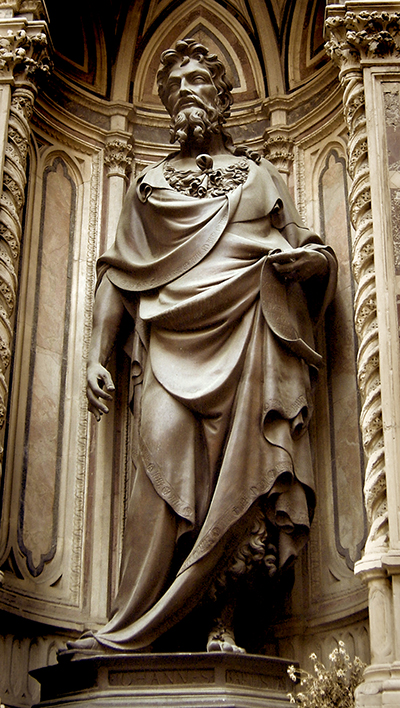
1403–1424St John the Baptist
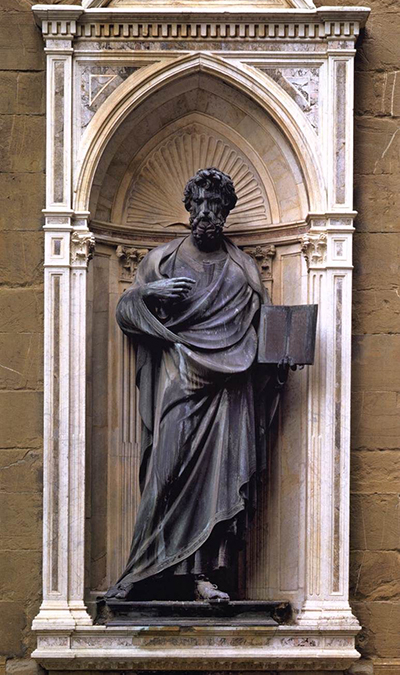
c. 1414–1416St Matthew
1419–1422Gates of Paradise
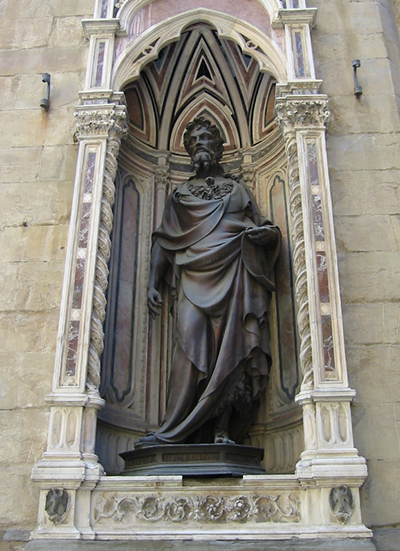
1425–1452St Stephen
c. 1427–1429Lorenzo Ghiberti sculpture directory
Discussion
Ghiberti rewards slow looking: relief, gilding, narrative structure, workshop practice and conservation evidence can all change how a work is read.
Join the Conversation
Have an observation about Gates of Paradise, a source to add, or a comparison that sharpens the reading? Share it below.
References
- Opera di Santa Maria del Fiore, “Porta del Paradiso”, scientific catalogue 1320, inventory 905, especially “Iscrizioni”, “Descrizione”, “Notizie storico critiche” and “Relazione iconografico religiosa”. View source.
- Opera di Santa Maria del Fiore, “Lorenzo Ghiberti, Gate of Paradise”, Sala del Paradiso, museum record 8622, description and photographs. View source.
- Art Institute of Chicago, The Gates of Paradise: Lorenzo Ghiberti’s Renaissance Masterpiece, exhibition themes, 2007, “The Gates of Paradise Panels—Content and Style” and “Making the Gates of Paradise”. View source.
- Opera di Santa Maria del Fiore, “Lorenzo Ghiberti, Back of the Gate of Paradise”, Galleria delle Sculture, museum record 9254. View source.
- Amy R. Bloch, Lorenzo Ghiberti’s Gates of Paradise: Humanism, History, and Artistic Philosophy in the Italian Renaissance, introduction, Cambridge University Press, 2016, pp. 3–6 and 8–10. View source.
- Lorenzo Ghiberti, I commentarii, ed. Julius von Schlosser, vol. I, 1912, §22, pp. 48–50 (PDF pp. 64–66). View source.
- Opera di Santa Maria del Fiore, “Formella con Creazione di Adamo ed Eva e Cacciata dal Paradiso Terrestre”, scientific catalogue 1332, description and photographs. View source.
- Opera di Santa Maria del Fiore, “Formella con Storie dei Progenitori e di Caino e Abele”, scientific catalogue 1330, description and photographs. View source.
- Opera di Santa Maria del Fiore, “Formella con Storie di Noè”, scientific catalogue 1326, subject list, description and photographs. View source.
- Opera di Santa Maria del Fiore, “Formella con Storie di Abramo”, scientific catalogue 1324, description and photographs. View source.
- Opera di Santa Maria del Fiore, “Formella con Storie di Isacco, Esaù e Giacobbe”, scientific catalogue 2779, description and photographs. View source.
- Opera di Santa Maria del Fiore, “Formella con Storie di Mosè”, scientific catalogue 2839, description and photographs. View source.
- Opera di Santa Maria del Fiore, “Formella con Storie di Giosuè”, scientific catalogue 2850, inscription, description and photographs. View source.
- Opera di Santa Maria del Fiore, “Formella con Storie di Davide”, scientific catalogue 2854, description and photographs. View source.
- Opera di Santa Maria del Fiore, “Formella con Incontro tra Salomone e la regina di Saba”, scientific catalogue 2941, description, photographs and historical discussion. View source.
- Fabian Jonietz, “The Burden of Success in Quattrocento Sculpture: Lorenzo Ghiberti, Mino da Fiesole, Donatello”, Brill, 2024, pp. 235–243, figs. 6.1–6.4. View source.
- Annamaria Giusti and Mauro Matteini, “The Gilded Bronze Paradise Doors by Ghiberti in the Florence Baptistery: Scientific Investigation and Problems of Restoration”, in Metallrestaurierung, 1998, pp. 47–51. View source.
- M. Ferretti and S. Siano, “The gilded bronze panels of the Porta del Paradiso by Lorenzo Ghiberti: non-destructive analyses using X-ray fluorescence”, Applied Physics A 90, 2008, pp. 97–100, table 1 and figs. 1–4. Full-text copy. View source 1. View source 2.
- Opera di Santa Maria del Fiore, “Formella con Storie di Giuseppe”, scientific catalogue 2798, description and photographs. View source.
- Opificio delle Pietre Dure, “Lorenzo Ghiberti, Porta detta ‘del Paradiso’, 1425–1452”, conservation project GR 8117, technical profile, condition, restoration and display. View source.
- Metropolitan Museum of Art, The Gates of Paradise: Lorenzo Ghiberti’s Renaissance Masterpiece, exhibition record, 2007–08, list of panels and framing elements. View source.
- Dora Liscia Bemporad, “Un concorso singolare”, in Nel cantiere del Ghiberti, pp. 65–71, especially pp. 66–70, figs. 2–5. View source.