 by Tom Gurney
Tom Gurney BSc (Hons) is an art history expert with over 20 years experience
Published on June 19, 2020 / Updated on November 17, 2026
Email: tomgurney1@gmail.com / Phone: +44 7429 011000
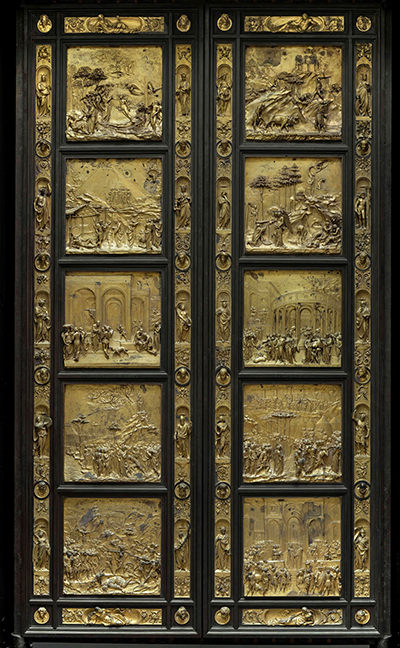
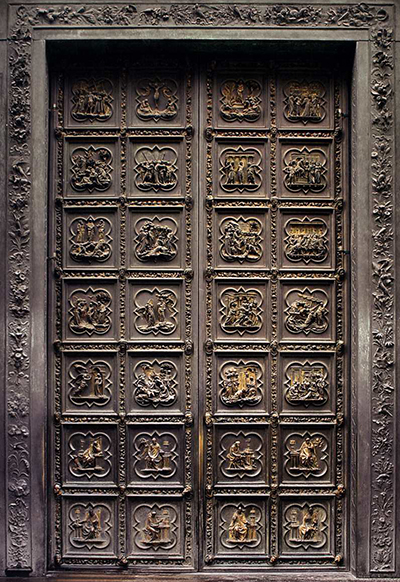
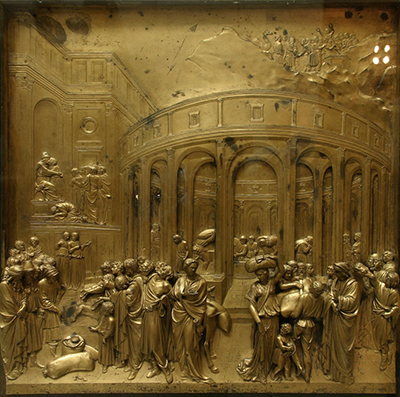
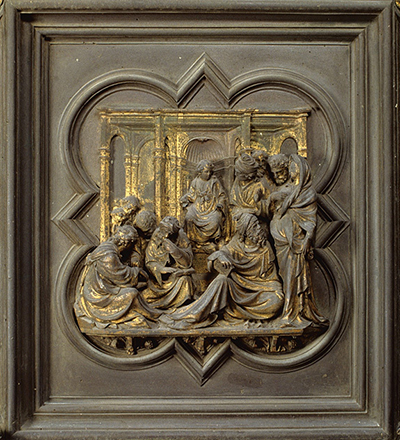
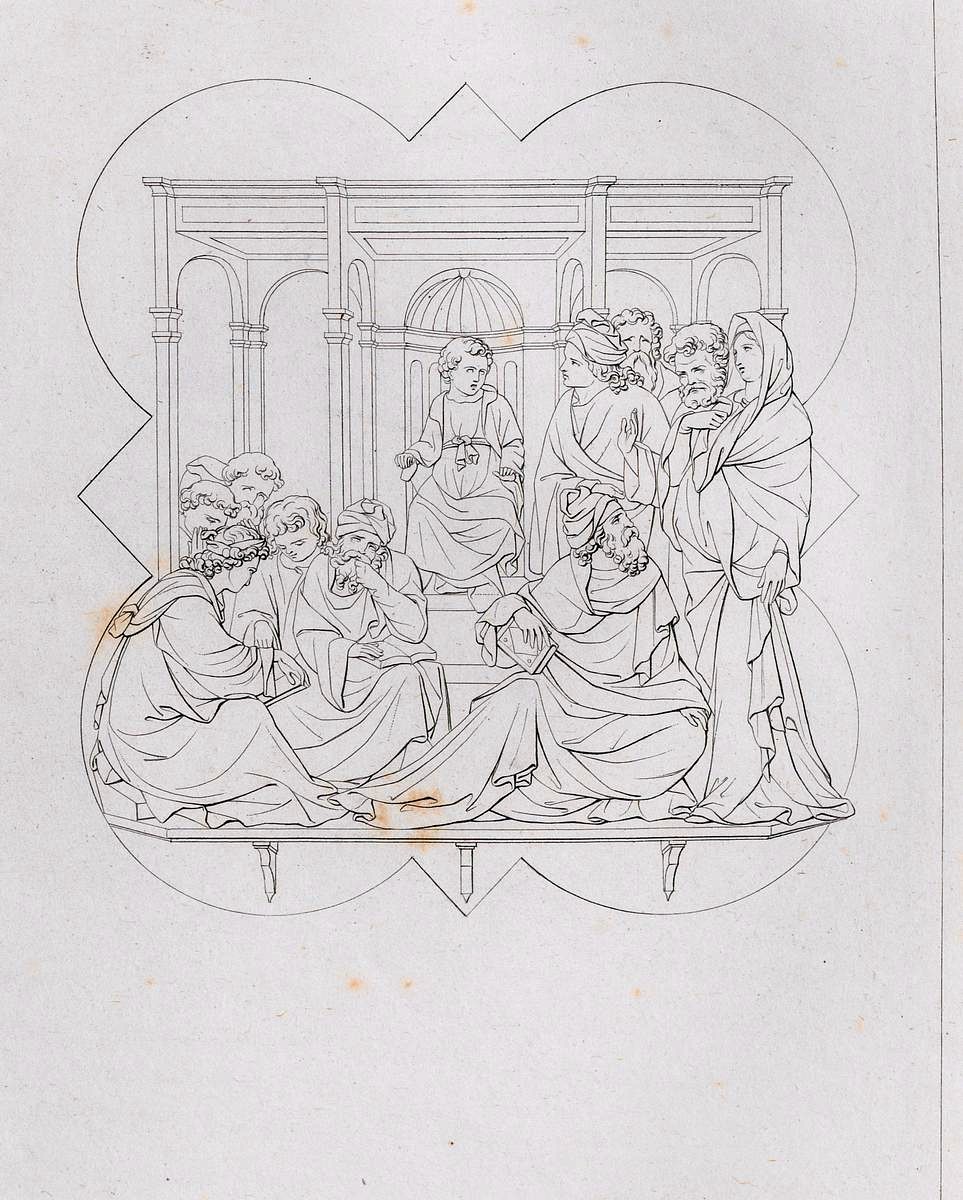
The seated man at the lower right turns towards Mary so sharply that his face comes into profile while his knees still point across the gathering. Behind her, Joseph inclines his head. The turn joins the discovery of the boy Jesus to the discussion already under way. Lorenzo Ghiberti made the gilded bronze relief for the North Door of the Florence Baptistery, a commission documented from 1403 to 1424. For this panel the Opera del Duomo records Richard Krautheimer’s proposed phase after 1407 and before 1415. The original door is displayed in the Museo dell’Opera del Duomo’s Sala del Paradiso. A replica stands at the Baptistery’s north entrance. [1] [2] [3] [4]
Contents
- A question in the Temple
- The interruption at the right
- A room open to the viewer
- Hands in Ghiberti and Dürer
- Two visits to the Temple
- The two meanings of “Doctors”
A question in the Temple
In Luke’s account, Jesus is twelve when he travels to Jerusalem with his parents for Passover. He stays behind when they set out for home. They look for him among relatives and acquaintances, return to Jerusalem and find him in the Temple after three days. There he sits among the teachers, listens to them and asks questions. Luke records the astonishment provoked by his understanding and his answers. In the bronze, the short flight of steps and the elevated chair give the boy a position of authority from which he can take part in the exchange. [1] [2] [5]
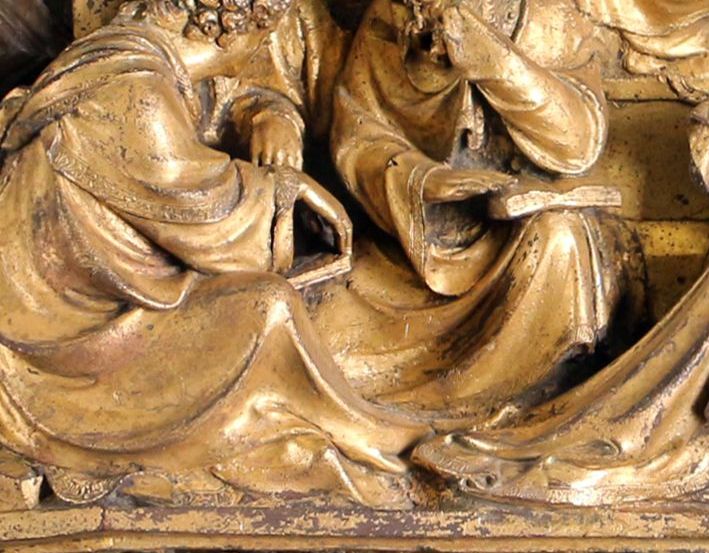
Jesus holds both hands low, with a space between them, and turns his face slightly towards the figures on the viewer’s right. The listeners around him are harder to take in at a glance. Near the centre of the foreground a man lowers his gaze, resting his face on one hand with a book across his knee. His pose suggests a pause.
His neighbour on the left leans forward, making the group tighten around the foot of the steps. Higher up to the right, a man in a wrapped headdress lifts a hand near his chest. The different heights and directions of the hands let the eye move from one participant to another. The bronze makes room for several responses to the boy’s words. [1] [2] [5]
Look closely at Christ among the Doctors
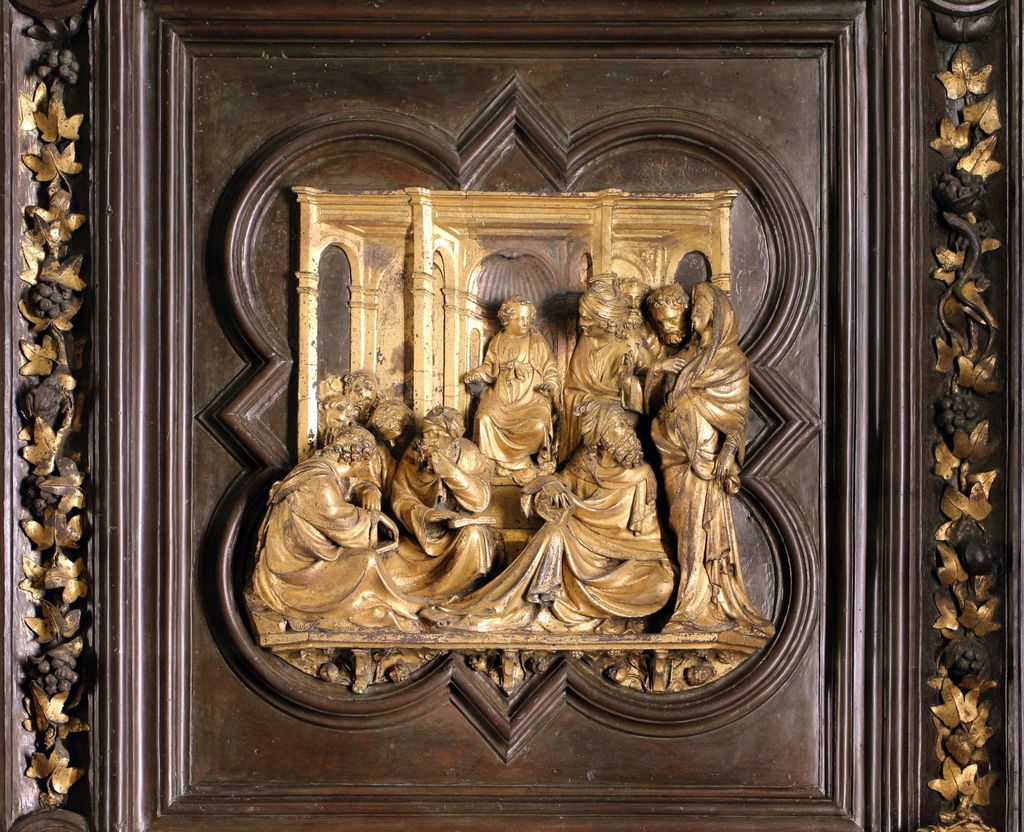
1. Christ among the listeners
The youthful figure occupies the centre of the discussion.
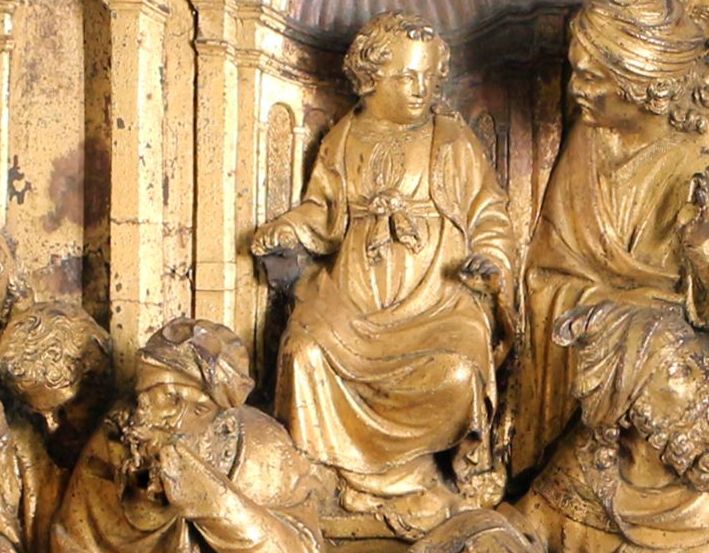
2. The seated listeners
The seated adults turn and raise their hands. Their varied poses give the discussion a visible rhythm.
3. The temple interior
Tall uprights and arched openings provide a shallow setting behind the group.
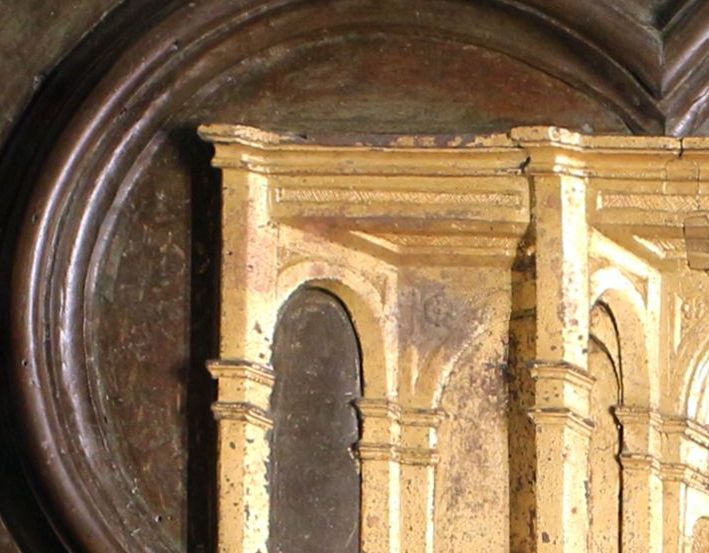
Photograph by Sailko. Source image. CC BY 3.0. Resized for the overview and cropped for detail.
The interruption at the right
Mary and Joseph come upon a discussion that still occupies the room. Heads cluster tightly around theirs, but Mary’s robe makes a continuous line almost to the floor. That long contour distinguishes her from the seated bodies and marks where the gathering opens to the arrivals. The nearest seated teacher remains on the platform with his companions as he turns his head towards her. His body still belongs to one exchange while his face acknowledges the next. In Luke the change is audible. Mary asks why Jesus has put his parents through such a search. He answers by invoking his Father, and his parents do not understand his reply. [1] [2] [5]
Vasari saw joy in the parents’ discovery and admiring attention in the teachers. The Opera catalogue reads hesitation and surprise in Mary and Joseph’s approach. Luke names the parents’ astonishment and gives Mary a question born of anxiety. Her proximity to the seated man makes the interruption legible, while the boy’s position on the steps keeps the earlier conversation in view. The two directions of attention can carry the shift in Luke’s story from one exchange to the next. [1] [2] [5] [6]
A room open to the viewer
A continuous cornice gathers the arches into one building. On the left, where fewer figures obscure the supports, successive uprights lead the eye in from the exposed corner. At the centre the ribbed, shell-like recess gives Christ’s head a surround of its own. The steps beneath the chair repeat that emphasis lower down, where foreground shoulders and knees partly hide the space around him. The viewer can follow the architecture from the roofline to the boy’s seat and then pick up the discussion through the figures sitting below it. [1] [2]
Livia Lupi illustrates the compact architectural settings of the North Door with this panel. The rectangular building fills much of the upper field. Dark intervals remain between its cornice and the curves of the frame, so the roofline reads clearly even where heads crowd the openings underneath. The robes take up the curves below, but the straight lip of the platform holds the group together.
Small supports are visible under that lip where the lower lobes allow more space. With the room open at the front, the viewer can see both the floor where Mary stands and the higher level where Jesus sits. That change of level gives the boy prominence while leaving his mother close enough for the finding to unfold within the same room. [1] [2] [7]
Hands in Ghiberti and Dürer
In Albrecht Dürer’s 1506 Jesus Among the Doctors, six half-length figures press around the boy against a scarcely visible background. Two pairs of hands occupy the opening between their bodies. Mar Borobia, writing for the Museo Nacional Thyssen-Bornemisza, reads Christ’s fingers as counting out his arguments. The raised fingers of the man beside him come close to the boy’s hands, so that their exchange has a centre of its own beneath the faces. [8]
Ghiberti leaves a gap between Christ’s hands and the gestures of the surrounding men. To follow the exchange in the bronze, the eye moves down from the boy’s face past the folds at his knees and the steps to the seated listeners. The book across one lap and the hand resting at a cheek spread the signs of attention across the platform. Dürer also brings a book into the foreground, but its open pages sit below the central encounter between the hands.
The relief gives particular weight to a gesture at its edge, where the listener turns from the chair towards Mary. Dürer keeps the space around the boy occupied by his interlocutors. The close framing gives the painted fingers nearly as much prominence as the faces. In the relief, the turn is visible from shoulders to knees. The line of the teacher’s back and the spread of his robe carry the movement down to the platform. The space Ghiberti gives the whole body lets one figure take part in both exchanges. [1] [2] [8]
Two visits to the Temple
The east sector of the Baptistery vault’s mosaic cycle of Christ opens with the Presentation in the Temple. Luke places that visit in Jesus’ infancy. His parents bring him to Jerusalem to present him to the Lord. Simeon takes the child in his arms and blesses God, and Anna speaks about the child to those awaiting Jerusalem’s redemption. In the later Passover episode, Jesus has stayed in Jerusalem of his own accord. By the time his parents arrive in the room, he is seated among people who have been listening to him speak. The boy in the chair, the seated teachers and the parents entering at the edge identify the visit that closes the door’s childhood sequence. [1] [2] [3] [5] [9]
The two cycles also give the visits different places in the story. In the vault, the Presentation leads into Joseph’s dream and the Flight into Egypt, all within the same sector. The North Door follows the Adoration of the Magi with the discussion in the Temple. In that last childhood panel the witness to Jesus has shifted from the visitors who come to honour him to the teachers who hear his answers. The next row of narrative panels begins with his Baptism. [3] [5] [9]
The two meanings of “Doctors”
Seen across the whole North Door, the Temple relief occupies the outer right of the third row from the bottom, above Mark the Evangelist. The row of Evangelists separates the childhood scenes from four individual portraits along the base. The learned men around Jesus are the Jewish teachers of Luke’s account. The Doctors of the Church along the base are Augustine, Jerome, Gregory the Great and Ambrose, Christian authorities whose writings helped articulate Church doctrine. [3] [5] [10]
The door gives each Church Doctor a compartment of his own, with room for the seated figure and the furniture associated with reading or writing. In the Temple panel, books and seats have to share a single compartment with the other signs of conversation. The teacher’s book near the foot of the steps belongs to a man we see in the act of listening. Two rows below, a seated figure with a book can command an entire frame. The change in scale from an individual figure to a gathering makes two kinds of learning visible on the same door. [2] [3] [6] [10]
Lorenzo Ghiberti in context
Sacrifice of Isaac
1401 competitionNorth Doors
1403–1424St John the Baptist
c. 1414–1416St Matthew
1419–1422Gates of Paradise
1425–1452St Stephen
c. 1427–1429Lorenzo Ghiberti sculpture directory
Discussion
Ghiberti rewards slow looking: relief, gilding, narrative structure, workshop practice and conservation evidence can all change how a work is read.
Join the Conversation
Have an observation about Christ among the Doctors, a source to add, or a comparison that sharpens the reading? Share it below.
References
- Opera di Santa Maria del Fiore, scientific catalogue, Disputa di Gesù con i dottori nel Tempio, Porta Nord del Battistero, inventory 931.4. View source.
- Sailko, photograph of the original Christ among the Doctors relief in the Museo dell’Opera del Duomo. View source.
- Opera di Santa Maria del Fiore, scientific catalogue, Porta Nord del Battistero, inventory 931. View source.
- Opera di Santa Maria del Fiore, “Renaissance clonation: the North Door replica”. View source.
- United States Conference of Catholic Bishops, Luke 2:22–38, 41–52 and notes, New American Bible, Revised Edition. View source.
- Giorgio Vasari, “Lorenzo Ghiberti”, Lives of the Most Excellent Painters, Sculptors, and Architects, English text on Wikisource. View source.
- Livia Lupi, “Brick and Mortar, Paint and Metal: Architecture and Craft in Renaissance Florence and Beyond”, Architectural Histories 11 (2023), pp. 21–24 and fig. 18. View source.
- Mar Borobia, Museo Nacional Thyssen-Bornemisza, Albrecht Dürer, Jesus Among the Doctors, 1506, inventory 134. View source.
- Opera di Santa Maria del Fiore, Mosaico con Storie di Cristo (quinto registro), east sector, scene 7. View source.
- Yair Haklai, photograph of the original North Door in the Museo dell’Opera del Duomo. View source.