 by Tom Gurney
Tom Gurney BSc (Hons) is an art history expert with over 20 years experience
Published on June 19, 2020 / Updated on November 17, 2026
Email: tomgurney1@gmail.com / Phone: +44 7429 011000
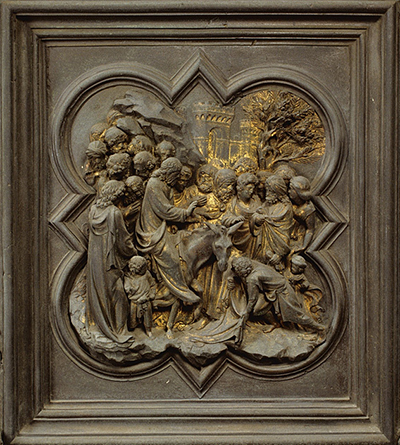
Two lines meet on the road in Lorenzo Ghiberti’s Entry into Jerusalem. The donkey’s neck slopes out from beneath Christ, bringing the animal’s head down towards the middle of the relief. From the right, a man bends and draws a garment towards the same spot. Behind the man is the crowd, and above the crowd there is just enough room for a gate. In this gilded bronze relief on the Florence Baptistery’s North Door, Jerusalem first makes itself known through the people who come out to receive Christ. The road is where they show him what sort of welcome they have brought. [1] [2]
Contents
- The road beneath the colt
- Garments and branches
- A city that comes forward
- The welcome beside the door’s seam
- Receiving a king
The road beneath the colt
Start with the man’s bare feet at the right and follow the slope of his back. His head drops below those of the standing crowd, and his hand reaches down to a gathering of cloth. The folds open out on the uneven shelf of rock, running back towards the centre. With so many feet already on that shelf, the garment picks out a short stretch of road that the crowd would otherwise almost conceal. Its position makes the next stage of the journey imaginable. The man is still bent over his work as the rider approaches the ground he has prepared. [2]
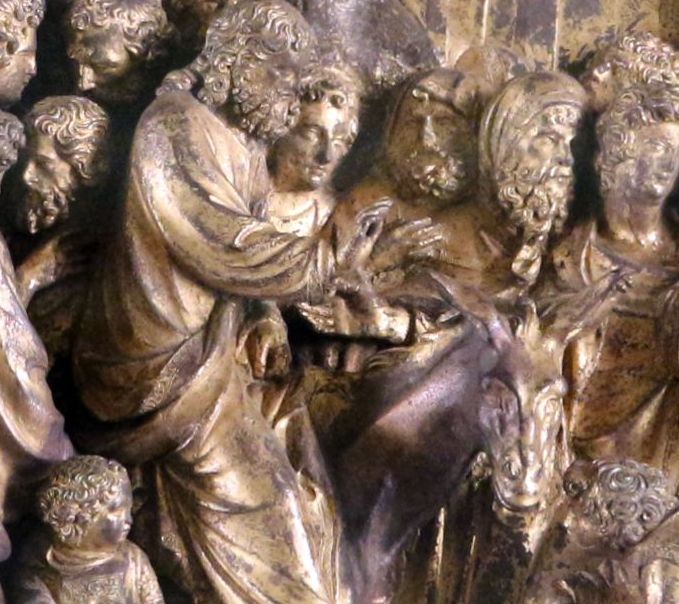
The animal gives that approach an oblique direction. Its neck emerges from beside the fall of Christ’s robe, and its head turns outward enough for the viewer to see the narrow muzzle beneath the long ears. In Giovanni Paolo Lasinio’s engraving after Vincenzo Gozzini, the turn is particularly easy to follow. The outlines carry the eye from the ears down to the muzzle and then to the folds on the road. Christ can face the people at the right while his mount’s turn opens a little space below their hands. With much of the animal hidden, those few visible features do most of the work of showing how the rider moves into the reception. [2] [3]
One donkey is clearly discernible. Matthew brings both a donkey and her colt into the story, while Mark and Luke specify a colt that has never been ridden. John introduces a young donkey and brings the mount into his citation of prophecy. The ears and muzzle give the animal its identity in the relief. Its youth and the circumstances in which it was brought to Christ come from the accounts.
At the height of the ears, Christ’s hand emerges from his sleeve in a blessing-like gesture, with an open palm reaching from the crowd just beneath it. The engraving clarifies the small interval between the hands. The answering palm suggests acknowledgement, even though the crowd makes it difficult to follow the arm back to an individual. [2] [3] [4] [5] [6] [7]
Look closely at the Entry into Jerusalem
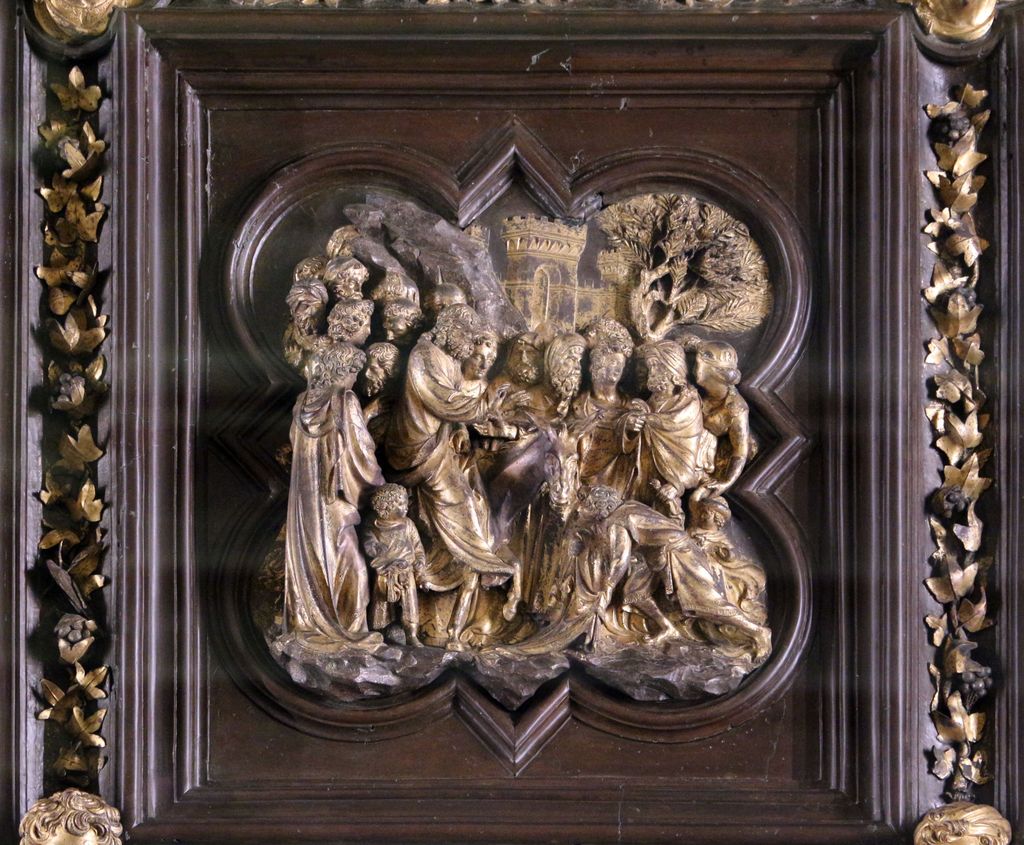
1. The rider at the centre
Christ and the mount occupy the narrow interval between the arriving figures and the people who come to meet them.
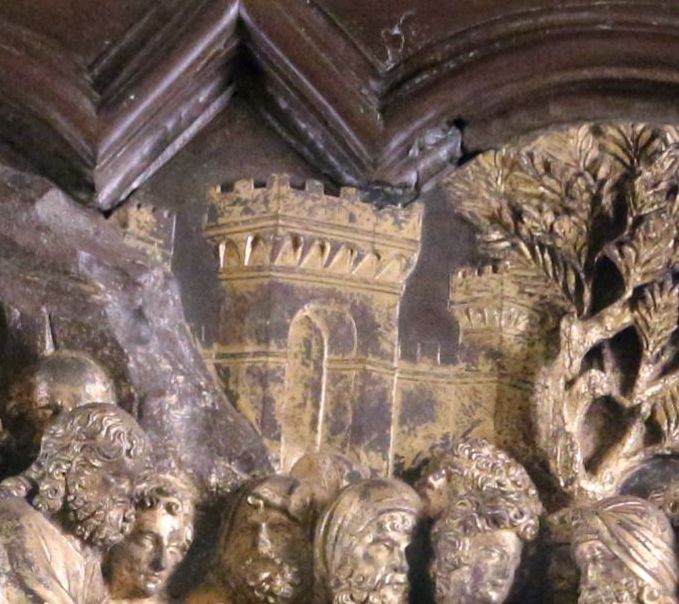
2. The city beyond the crowd
Buildings rise above the massed heads. Their scale sets the crowd close to the viewer.
3. The gesture of welcome
A crouching figure at the right brings the movement down from the height of the crowd to the road.
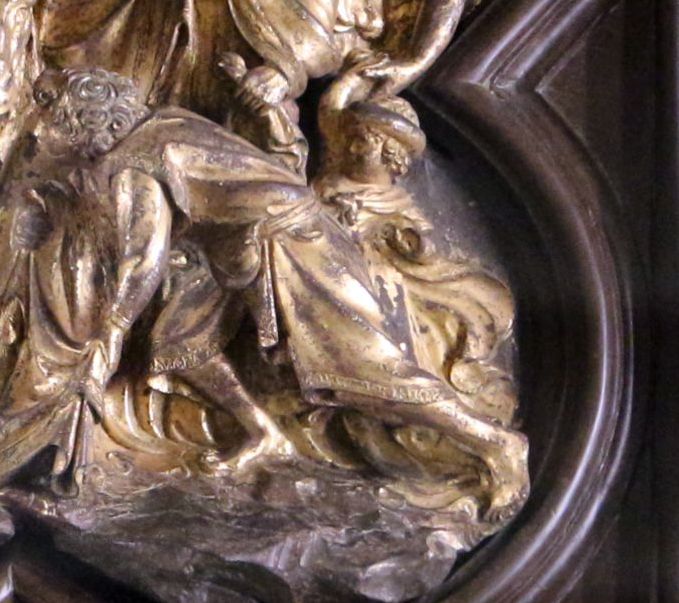
Photograph by Sailko. Source image. CC BY 3.0. Resized for the overview and cropped for detail.
Garments and branches
The low gesture on the road has a counterpart higher up. At the right of the colt, a standing figure gathers folds at chest height, while the bending man has drawn his cloth below the animal’s head. Lasinio’s lines help distinguish the two actions where bodies and fabrics overlap in the photograph. At the other side of the colt, near Christ’s hanging drapery, the print also gives a small upright figure a clearer outline. Its size makes a difference to the rhythm of the group even with its age and identity open. It brings a standing body down into the part of the panel occupied on the opposite side by the crouching man. [2] [3]
The garments have clear counterparts in Matthew, Mark and Luke. The greenery varies from account to account. Matthew has branches cut from trees, Mark has leafy branches cut in the fields, and Luke’s description of the welcome gives the spreading of cloaks and the praise of the disciples. John names palms and says that the crowd goes out to meet Jesus. In the bronze a trunk rises behind the receivers into a spreading canopy. Its course is distinct from the cloth at chest height and the garment that trails across the road. A detached palm or olive bough is much harder to isolate in either the photograph or the line print. [2] [3] [4] [5] [6] [7]
Giorgio Vasari describes the people throwing down garments, olive branches and palms, and the commentary accompanying the 1821 engraving also supplies both kinds of foliage. The commentary brings together the city asking who has arrived, the acclamation in Luke and the festival crowd in John. Read beside the image, these accounts show how readily a description of the scene can gather up details from the wider story. The two acts of handling cloth can be followed from a figure’s hands into the folds. The olive and palm descriptions leave open which form, if any, a viewer could trace in the same way to a particular person. [2] [3] [4] [6] [7] [8] [9]
A city that comes forward
On the left, heads rise along the rock in overlapping tiers. A tall follower seen from behind gives the group an edge, his robe dropping towards the ground while his turned head draws attention back into the company. The people at the right make a more level band. Their heads turn at different angles, and the space between the parties is narrow enough that the hands near Christ are easier to distinguish than the two groups as a whole. A short climb from those hands brings the eye to the tall, rounded opening in the crenellated gate tower. The lower wall continues to the right, where the foliage takes over. [2] [10]
The rock and the foreground bodies project strongly, while the small gateway sits in much shallower relief. Its base disappears behind the heads. Within the narrow space between the rising rock and the tree, changes in scale and projection give the procession a destination set well behind the meeting. The arch can be read as Jerusalem’s gate because of the episode it serves. Its main work within the composition is to put the crowd outside the wall, where the people have already closed the distance between the city and the rider. [1] [2] [10]
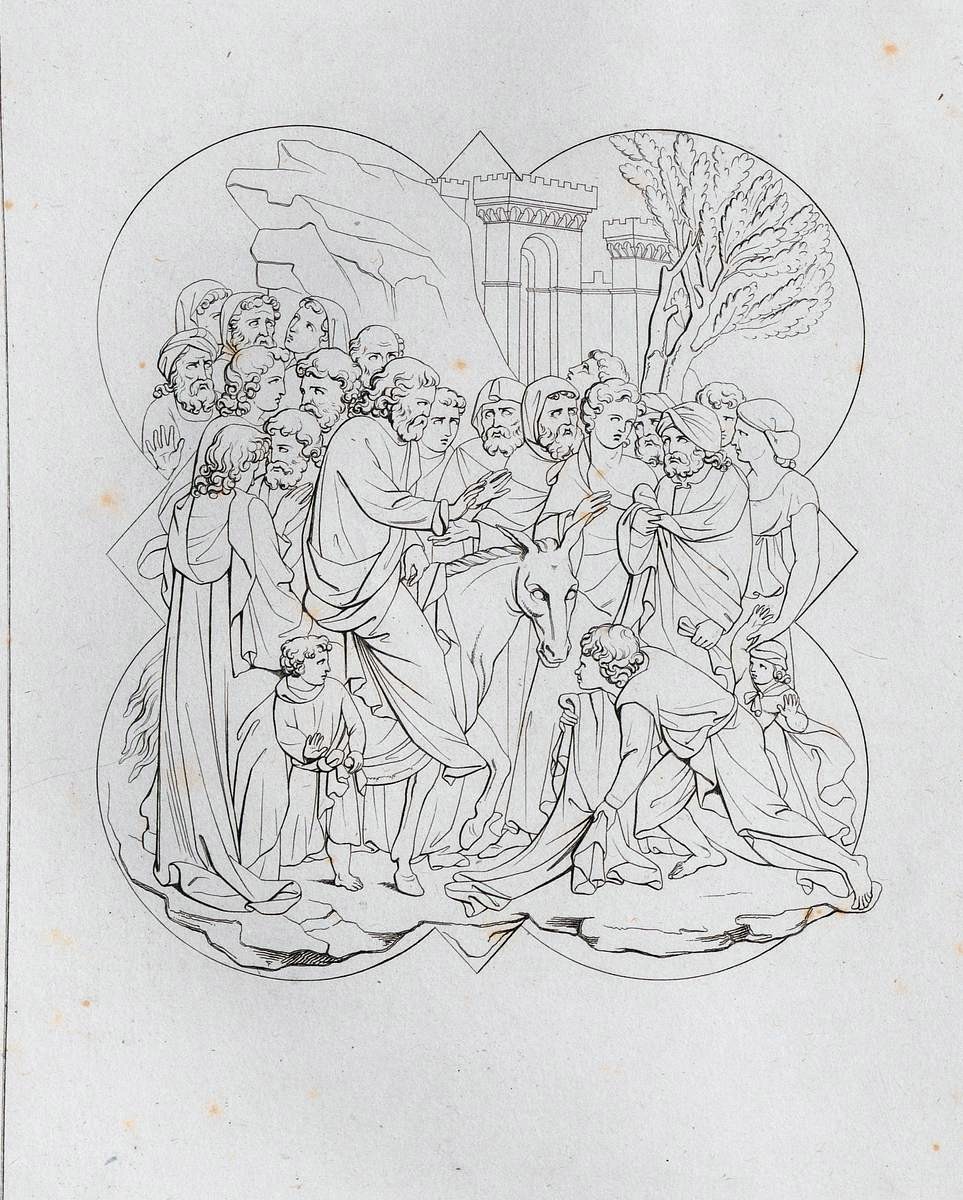
The Alinari photograph takes in the Entry and the Last Supper on the same leaf, with the frame ornament still visible. In that view the foliage around the bronze field belongs to the door as a whole, while the tree behind the crowd has its own trunk and place in the episode. Lasinio’s plate removes the surrounding door ornament and pairs the Entry with the Supper in outline. The omission lets the gestures and silhouettes stand out. The photograph gives back the framed compartments and shows how near the little gate is to the boundary of its scene. Within that boundary Ghiberti gives the walled city a fraction of the space he gives its people. [2] [3] [10]
The welcome beside the door’s seam
The relief is fifth from the bottom, on the inner side of the right leaf. The Raising of Lazarus is directly across the seam, and the Last Supper is beside the Entry on the same leaf. John makes the first of these relationships particularly close. The people who were with Jesus when he raised Lazarus testify to what happened, and word of the sign draws a crowd to meet him. The door lets the eye follow a similar movement, from those present at an event in Bethany to a public gathering outside Jerusalem. Across the next frame, the company is already at table. The Opera’s catalogue places the beginning of the Passion at that meal. [1] [7] [10] [11]
Dillian Gordon’s reconstruction of Duccio’s Maestà gives the same passage from Lazarus to the Entry a different physical course. Lazarus closes the ministry sequence on the back predella, the lower band of panels, and the eye moves up to the Entry at the beginning of the Passion cycle. On the North Door the eye crosses the join between the leaves and then moves sideways again to reach the meal. The comparison concerns where the welcome falls in a sequence. It opens the Passion in Gordon’s reconstruction, while on Ghiberti’s door the public welcome leads straight to the meal that the Opera identifies as the opening of the Passion. [1] [11] [12]
Receiving a king
The Opera reads the Entry as a manifestation of Christ’s kingship. Matthew and John both bring the donkey into the story through the prophecy of a king’s arrival, and John has the crowd acclaim Jesus as king of Israel. In Zechariah, the humble king riding a donkey is followed by the disappearance of chariots, war horses and the war bow. That pairing gives the choice of mount a particular force. In Ghiberti’s relief the signs of honour gather around the long-eared animal’s lowered head. A person bends down to spread fabric for it to pass over, while those standing come close enough to meet the rider’s hand. [1] [2] [4] [7] [13]
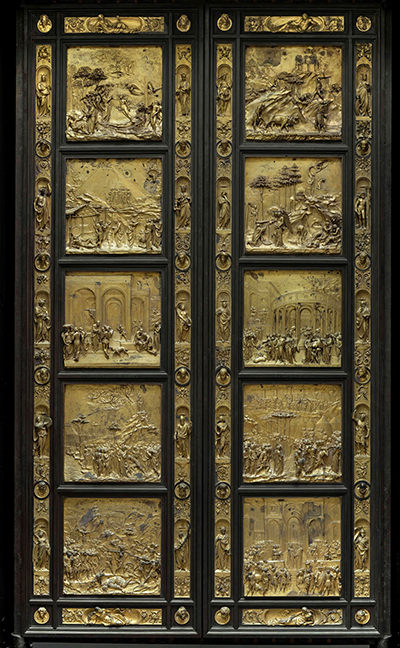
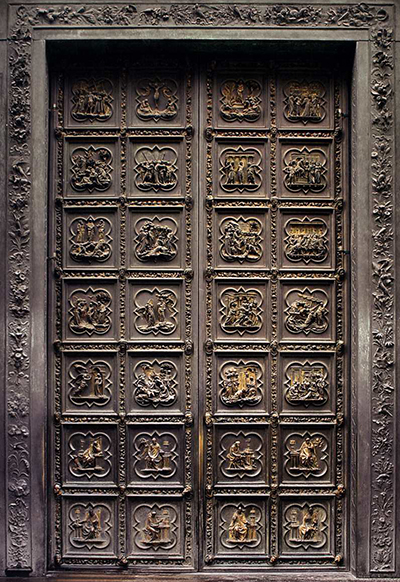
The documented door commission ran from 1403 to 1424. The Opera’s catalogue, summarising Richard Krautheimer’s stylistic sequence, places the relief around 1415–20 within that campaign. The original door first stood at the Baptistery’s east entrance and moved north in 1452. A replica now fills the north entrance. To see the original, visit the Museo dell’Opera del Duomo’s Sala del Paradiso. On the assembled original the gate is still visible above the heads, but the clearest sign of the welcome lies below them, where the garment reaches towards the colt. [1] [2] [11] [14] [15]
Lorenzo Ghiberti in context
Sacrifice of Isaac
1401 competitionNorth Doors
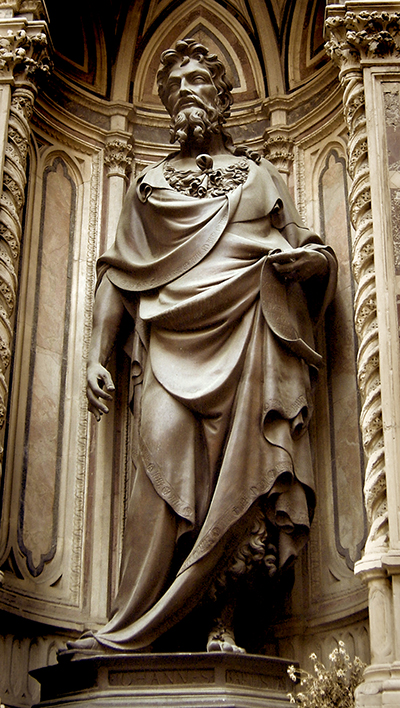
1403–1424St John the Baptist
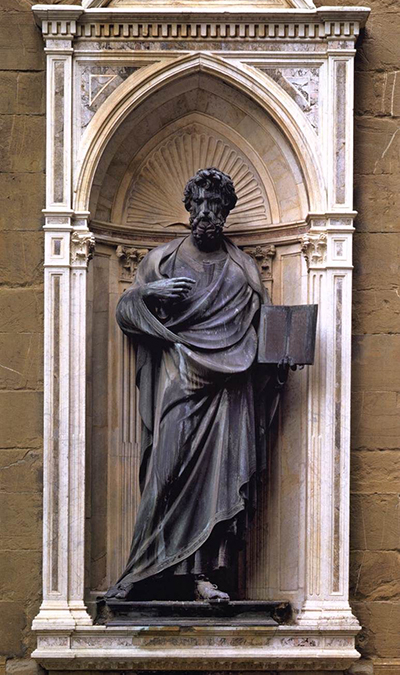
c. 1414–1416St Matthew
1419–1422Gates of Paradise
1425–1452St Stephen
c. 1427–1429Lorenzo Ghiberti sculpture directory
Discussion
Ghiberti rewards slow looking: relief, gilding, narrative structure, workshop practice and conservation evidence can all change how a work is read.
Join the Conversation
Have an observation about Entry into Jerusalem, a source to add, or a comparison that sharpens the reading? Share it below.
References
- Opera di Santa Maria del Fiore, scientific catalogue, Porta Nord del Battistero. View source.
- Sailko, detail photograph of the original Entry into Jerusalem relief, Wikimedia Commons. View source.
- Vincenzo Gozzini and Giovanni Paolo Lasinio, Seconda porta, scene XIII at left, Le tre porte del Battistero di San Giovanni a Firenze, 1821, ETH-Bibliothek Zürich, Rar 9941. View source.
- Matthew 21:1–11, New Revised Standard Version Updated Edition. View source.
- Mark 11:1–10, United States Conference of Catholic Bishops. View source.
- Luke 19:28–40, United States Conference of Catholic Bishops. View source.
- John 12:12–19, United States Conference of Catholic Bishops. View source.
- Giorgio Vasari, Vita di Lorenzo Ghiberti, 1568 edition, Accademia della Crusca and Fondazione Memofonte. View source.
- Commentary on plate XIII, Seconda porta, p. 7, Le tre porte del Battistero di San Giovanni a Firenze, 1821, ETH-Bibliothek Zürich, Rar 9941. View source.
- Fratelli Alinari, photograph of the Entry into Jerusalem and the Last Supper, RI 12178, Civico Archivio Fotografico, Milan. View source.
- Yair Haklai, photograph of the original North Door on museum display, Wikimedia Commons. View source.
- Dillian Gordon, Maestà Predella Panels, pp. 174–76, National Gallery, 2011. View source.
- Zechariah 9:9–10, United States Conference of Catholic Bishops. View source.
- Opera di Santa Maria del Fiore, North Door of the Baptistery, museum display record. View source.
- Opera di Santa Maria del Fiore, Renaissance clonation: the North Door replica. View source.