


 by Tom Gurney
Tom Gurney BSc (Hons) is an art history expert with over 20 years experience
Published on June 19, 2020 / Updated on November 29, 2026
Email: tomgurney1@gmail.com / Phone: +44 7429 011000
Prints: Introduction
A print of Paolo Uccello’s Battle of San Romano can show a commander on a pale horse, a rider tipping out of his saddle or a troop beginning to charge. All three are scenes from the same battle, painted on separate panels. The label on a reproduction may give the same short title for any of them. Before choosing a size or frame, match the image to the painting you want. Uccello often carries the action into the far corners of a picture, so the edges are worth checking too. [1] [2] [3]
At a Glance
- San Romano panel widthsLondon 320 cm, Florence 323 cm, Paris 317 cm
- The Hunt in the Forest73.3 × 177 cm, about 2.4 times as wide as it is high
- London Saint George and the Dragon55.6 × 74.2 cm, National Gallery NG6294
Contents
- Three pictures of the Battle of San Romano
- The long view in The Hunt in the Forest
- A closer view of Saint George and the Dragon
- Choosing a size, surface and frame
- Historical prints and drawings
Three pictures of the Battle of San Romano
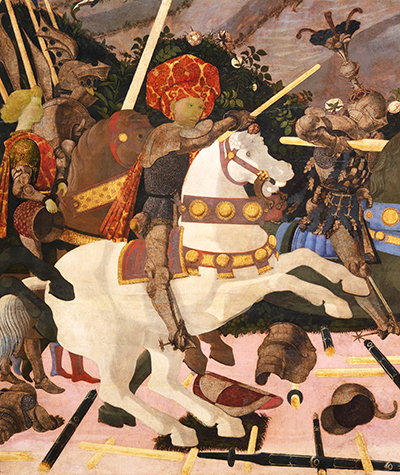
In the London panel, Niccolò da Tolentino rides a pale horse and raises his baton. His elaborate red and gold headgear makes him easy to pick out even in a small print. Below, broken lances and a fallen soldier lead the eye back into the action. A close crop of Tolentino can bring the patterns on his hat and the harness into view. The full image keeps the trumpeters on the left, the lances in the foreground and the people and animals on the hills behind the soldiers. Look for National Gallery inventory number NG583. The gallery’s shop uses that number for its reproduction. The painting measures 182 × 320 cm. [1] [4]
The Uffizi panel takes you into the fighting. Bernardino della Ciarda is knocked from his horse as the weapons of the opposing groups meet. In detail, the tangle of lances can seem almost abstract. At full width, the different inclinations of the weapons help separate the two groups. Lower down, the horses and men foreshortened on the ground make the fighting feel close to the viewer. A crop across the middle can keep the moment of impact while losing the bodies below it and the impression of forces pressing in from the sides. The Uffizi records the painted panel, inventory 1890 n. 479, as 182 × 323 cm, and locates Uccello’s signature at the lower left, another detail easily lost under a mount. [2]
In the Louvre panel, Micheletto Attendolo da Cotignola rides the black horse near the middle. The upright lances over the group at the right give way to angled shafts on the left. Follow those angles all the way across and the cavalry appears to gather itself and begin moving. A detail of the commander shows his face and turning horse more clearly. The full panel lets you see the movement pass from one group of riders to the next. Look for Louvre inventory MI 469, which measures 182 × 317 cm. [3] [5]
At a printed image width of 60 cm, each of the three San Romano panels would be about 34 cm high if reproduced in full and in proportion. Matching the heights of the images is another way to display them side by side, leaving their small differences in width visible. Line up the painted areas and measure the gaps between the outer frames before deciding how much wall space the set needs. The museum images show the panels in their surviving shapes. Technical examination records changes to the panels’ contours, including trimming and the addition of pieces of wood. Keeping the whole current composition preserves what the camera can record today. [1] [2] [3] [5]
Compare compositions for prints
The long view in The Hunt in the Forest
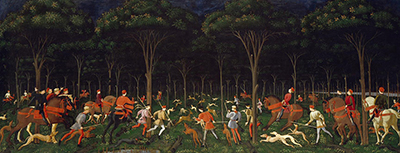
In The Hunt in the Forest, red garments and pale hounds give the eye a way into the dark forest. At the edges, figures and dogs enter from either side. Near the centre, they get smaller, and the lines of the spears and fallen timber help draw the eye between the tree trunks. The Ashmolean’s account of Uccello’s perspective grid explains why the outside groups matter. They give the viewer a starting point for the recession towards the centre. A detail of the hounds can make a lively image on its own. A full-width reproduction gives the hunt room to disappear into the trees. [6]
The Ashmolean records a panel measuring 73.3 × 177 cm. The image is roughly 2.4 times as wide as it is high. At 60 cm wide, the whole picture occupies just under 25 cm of height. To fill a 60 × 40 cm opening from edge to edge at the painting’s proportions, the image would need to start nearly 97 cm wide. Cutting it centrally to fit would remove about 19 cm of that enlarged image from each end. A wider frame or a mount cut for the actual image shape keeps the riders, trees and open spaces that give the picture its pace. The Ashmolean describes the work as a spalliera painting, made for viewing around shoulder height, possibly as part of furniture or panelling. You can try the reproduction low enough to follow its small figures comfortably from a seat. [6]
A closer view of Saint George and the Dragon
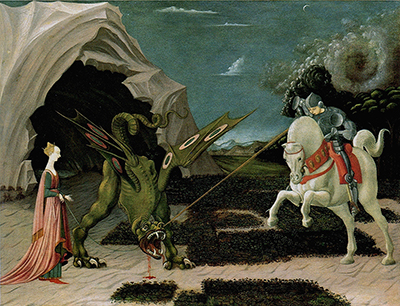
The London Saint George and the Dragon has a more compact outline. It is oil on canvas and measures 55.6 × 74.2 cm, very nearly a 4:3 rectangle. It could fill an image area around 45 × 60 cm without appreciable trimming. The rider’s lance leads into the dragon’s head, while the princess holds a fine lead running back to its neck. The National Gallery identifies that lead as her belt. Look for it in a preview, along with the angled patches of ground and the spiral cloud behind the horse. At a smaller size, the horse and dragon are still easy to pick out. The belt and the princess at the left edge can disappear into a dark image or a tight crop, changing how you read her part in the story. The gallery identifies both the painting and its own reproduction with NG6294. [7] [8]
Choosing a size, surface and frame
Check the size of the image itself, then ask how much paper, mount and frame surround it. A large frame can hold a surprisingly small picture. With a stretched canvas, check whether the edges of the picture wrap around the sides and how much of the composition stays on the front. Bleed is the area carried beyond a trim edge so that there is colour right up to the cut. Compare the preview with the museum image and leave enough space inside the frame or mount for the details you want to keep. For a paper print behind glazing, a window mount or spacer can keep the sheet from touching the glazing. [4] [8] [9]
Uccello’s surfaces also affect what a reproduction can show. Technical examination found silver leaf and dark modelling over it on armour in the London battle panel. The Uffizi likewise describes extensive metal leaf on armour and harness. The Ashmolean records traces of gold on the Hunt and describes how flecks in the trees would have caught candlelight. An ordinary colour print reproduces the light and dark recorded in a photograph of the painting. Its light areas stay in place as you move across the room. The National Gallery’s technical study shows darkened red paint in the London charger’s harness and identifies green pigment over a black underlayer in both the Paris panel and the Hunt. Compare the print preview with the collection image before treating a darker passage as a printing fault. Before choosing a finish for the Hunt, look for separation between the tree trunks and the dark spaces behind them. In the battle scenes, look for differences between adjacent plates of armour and between the metal and the horses’ coats. A reflection from a window can make those distinctions hard to see. Try the intended spot at the time of day you usually use the room. [1] [2] [5] [6]
Historical prints and drawings
Uccello is also the subject of a small woodcut in the Rijksmuseum, which credits the printmaker Cristoforo Coriolano. It comes from an edition of Giorgio Vasari’s Lives. The museum records a version with a different border in the 1568 edition. The portrait shows how a later book presented the artist to readers, and his name identifies the sitter. For a work on paper recorded under Uccello’s own name, see the Uffizi’s Mazzocchio in prospettiva, GDS 1757 A, a perspective drawing made with stylus, pen and ink. A modern wall print can reproduce a drawing or a painting, while a woodcut impression comes from inking a carved block. The maker, subject and medium fields in a collection record tell you which kind of object you are looking at. [10] [11]
Artworks directory
Browse paintings, drawings, stained-glass designs and other objects connected with Uccello. Cycles and their surviving components may have separate entries. The collection or catalogue’s wording is retained where a date, attribution or subject is debated.
| Name | Date | Medium, attribution and collection |
|---|---|---|
| Niccolò da Tolentino at the Battle of San Romano · London | Probably c.1438–40 | Tempera and oil on wood, with metallic decoration · National Gallery Catalogue. |
| Bernardino della Carda Unhorsed · Florence | c.1435–40 | Tempera on panel · Uffizi Galleries Catalogue. |
| The Counterattack of Micheletto da Cotignola · Paris | 1450–75 in the Louvre catalogue | Tempera (possibly) on wood · Musée du Louvre Catalogue. |
| The Hunt in the Forest | c.1465–70 | Tempera and oil with traces of gold on panel · Ashmolean Catalogue. |
| Saint George and the Dragon · London | c.1470 | Oil on canvas · National Gallery Catalogue. |
| Saint George Slaying the Dragon · Melbourne | c.1430 | Oil, tempera and silver leaf on wood · National Gallery of Victoria Catalogue. |
| Saint George and the Dragon · Paris | 1430–35 in the museum catalogue | Painted wood panel · Musée Jacquemart-André Catalogue. |
| Equestrian Monument to John Hawkwood | 1436 | Transferred wall painting · Florence Cathedral Catalogue. |
| Study for the John Hawkwood Monument | 1436 | Study on prepared paper · Uffizi Catalogue. |
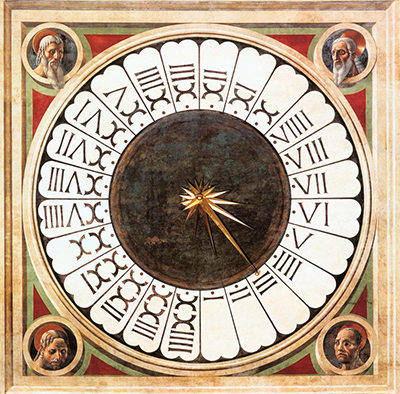
| Monumental Clock Face | 1443 | Painted dial · Florence Cathedral Catalogue. |
| Resurrection of Christ | 1443–44 | Stained glass · Uccello design · Florence Cathedral Catalogue. |
| Nativity | 1440s | Stained glass · Uccello design · Florence Cathedral Catalogue. |
| Creation of the Animals and Creation of Adam | Third to fourth decade of the 15th century | Detached fresco · Green Cloister, Santa Maria Novella Catalogue. |
| Creation of Eve and the Fall | Third to fourth decade of the 15th century | Detached fresco · Green Cloister, Santa Maria Novella Catalogue. |
| Flood and Recession of the Waters | 15th century; dating debated | Detached fresco · Green Cloister, Santa Maria Novella Catalogue. |
| Sacrifice and Drunkenness of Noah | 15th century; dating debated | Detached fresco · Green Cloister, Santa Maria Novella Catalogue. |
| Stories of the Virgin and Saint Stephen · Assunta Chapel | 1430s, with later completion | Fresco cycle · Paolo Uccello and Andrea di Giusto · Prato Cathedral Catalogue. |
| Blessed Jacopone da Todi | 1436 in the diocesan museum | Detached fresco · Museo dell’Opera del Duomo, Prato Catalogue. |
| Adoration of the Child · Bologna | 1430s; inscription incomplete | Detached fresco · San Martino Maggiore, Bologna Catalogue. |
| Adoration of the Christ Child · Karlsruhe | c.1436 | Painted panel · Attribution to Uccello · Staatliche Kunsthalle Karlsruhe Catalogue. |
| Annunciation · Oxford | Early 15th century | Tempera and gilding on panel · Ashmolean Catalogue. |
| Allegory of Monastic Life (Thebaid) | c.1460–65 | Tempera on canvas · Galleria dell’Accademia, Florence Catalogue. |
| Miracle of the Profaned Host | 1467–68 | Tempera on wood · Galleria Nazionale delle Marche, Urbino Catalogue. |
| Triumphal Entry into Rome of Titus and Vespasian(?) | c.1430–35 | Tempera, gold and silver on panel · Yale University Art Gallery Catalogue. |
| Crucifixion with the Virgin and Saints | c.1460–65 | Painted panel · Museo Nacional Thyssen-Bornemisza Catalogue. |
| The Crucifixion · Met triptych | Probably mid-1450s | Tempera on wood with gold ground · Metropolitan Museum of Art Catalogue. |
| Perspective Study of a Chalice | 1450–75 | Pen, ink and stylus on paper · Attributed to Uccello · Uffizi Catalogue. |
| Study of a Mazzocchio | 15th century | Perspective study · Attributed to Uccello · Uffizi Catalogue. |
| Mazzocchio Seen in Perspective | Uncertain | Drawing · Attribution debated · Musée du Louvre Catalogue. |
| Head of a Man in Profile | 15th century | Pen, ink and wash · Musée du Louvre Catalogue. |
| Five Masters of the Florentine Renaissance | 1500–50 | Oil on wood · Anonymous Florentine school · Musée du Louvre Catalogue. |
| Madonna and Child from the Del Beccuto House | 15th century | Detached fresco · Museo di San Marco, Florence Catalogue. |
| Man of Sorrows with the Virgin and Saint John · Avane Predella | 15th century | Predella · Museo di San Marco, Florence Catalogue. |
| Calling of Saint Paul the Hermit · San Miniato | After 1447 to c.1454 in state catalogue | Sinopia · Attributed to Uccello or collaborator Catalogue. |
| The host changes hands · Urbino predella, scene 1 | 1467–68 | Tempera on wood · Component of DE 231 · Galleria Nazionale delle Marche Catalogue. |
| The figures at the door · Urbino predella, scene 2 | 1467–68 | Tempera on wood · Component of DE 231 · Galleria Nazionale delle Marche Catalogue. |
| The procession approaches the altar · Urbino predella, scene 3 | 1467–68 | Tempera on wood · Component of DE 231 · Galleria Nazionale delle Marche Catalogue. |
| The condemned woman and the ladders · Urbino predella, scene 4 | 1467–68 | Tempera on wood · Component of DE 231 · Galleria Nazionale delle Marche Catalogue. |
| Persecution of the family · Urbino predella, scene 5 | 1467–68 | Tempera on wood · Component of DE 231 · Galleria Nazionale delle Marche Catalogue. |
| Angels and demons at the bier · Urbino predella, scene 6 | 1467–68 | Tempera on wood · Component of DE 231 · Galleria Nazionale delle Marche Catalogue. |
| Birth of the Virgin · Prato Cathedral | 1430s; dating debated | Fresco · Assunta Chapel, Prato Cathedral Catalogue. |
| Presentation of the Virgin · Prato Cathedral | 1430s; dating debated | Fresco · Assunta Chapel, Prato Cathedral Catalogue. |
Discussion
Look again at the images and ideas explored in Prints. These editorial prompts invite your observations.
Reader Insights
If you could hang just one San Romano panel, would you choose the London approach, the clash in Florence or the Louvre counterattack, and which detail would you want visible across the room?
Looking at the full Hunt in the Forest and then at a detail of its hounds, where does your eye go first in each version?
Join the Conversation
Share a detail, comparison or question about Prints below.
References
- The National Gallery, London, Niccolò Mauruzi da Tolentino at the Battle of San Romano, NG583, collection record and image. View source.
- Gallerie degli Uffizi, Battaglia di San Romano, inv. 1890 n. 479, collection record and image. View source.
- Musée du Louvre, La Bataille de San Romano : la contre-attaque de Micheletto Attendolo da Cotignola, MI 469, collection record and images. View source.
- The National Gallery Shop, Paolo Uccello, The Battle of San Romano Print, NG583, reproduction listing. View source.
- Ashok Roy and Dillian Gordon, Uccello’s Battle of San Romano, National Gallery Technical Bulletin 22, 2001, pp. 4–17. View source.
- Ashmolean Museum, The Hunt in the Forest by Uccello, WA1850.31, collection feature and images. View source.
- The National Gallery, London, Saint George and the Dragon, NG6294, collection record and image. View source.
- The National Gallery Shop, Paolo Uccello, Saint George and the Dragon Print, NG6294, reproduction listing. View source.
- Canadian Conservation Institute, Framing Works of Art on Paper, CCI Notes 11/9. View source.
- Rijksmuseum, Portret van Paolo Uccello, Cristoforo Coriolano, RP-P-2022-4271, collection record. View source.
- Gallerie degli Uffizi, Opere inamovibili, entry for Mazzocchio in prospettiva, GDS 1757 A. View source.
More PAOLO UCCELLO Artworks

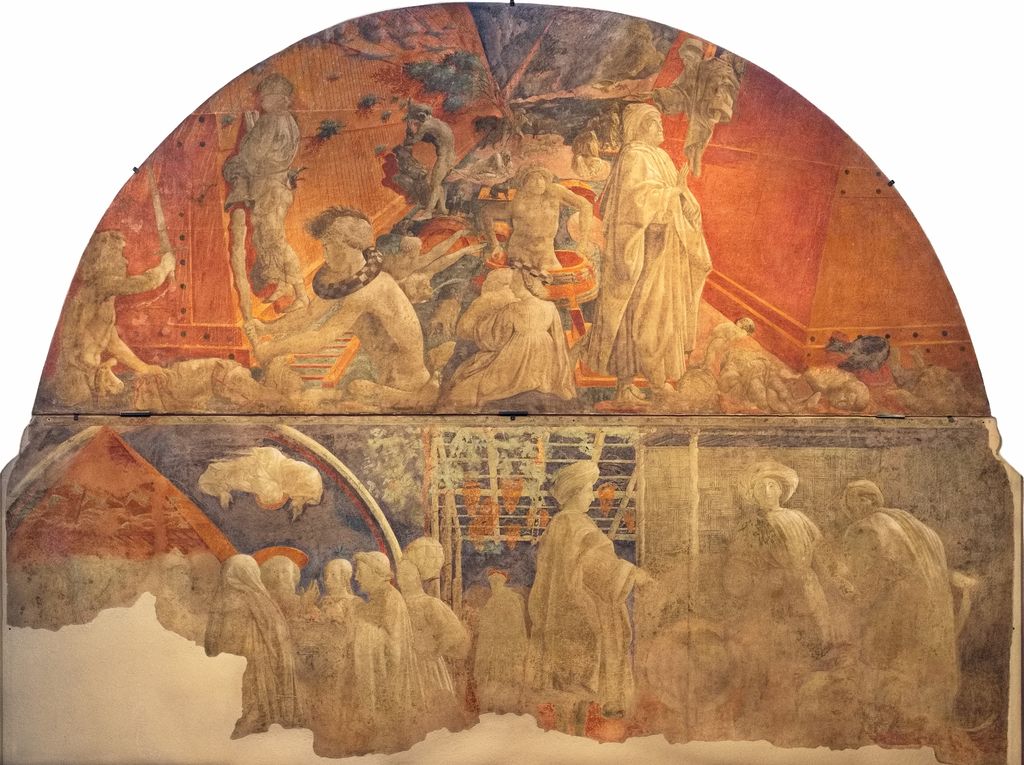
Noah and the Flood
The Flood and Recession of the Waters above the lower episodes from Noah’s story, Santa Maria Novella. Photograph by Armin Kleiner. Image source. CC BY-SA 4.0. Resized for the web. This derivative is available under the same licence.
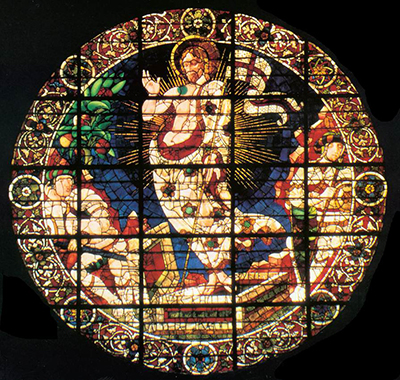
The Resurrection of Christ Stained Glass Window
The Resurrection window in Florence Cathedral, designed by Paolo Uccello and made by Bernardo di Francesco. Photograph by Sailko. Image source. CC BY 3.0. Resized for the web.