


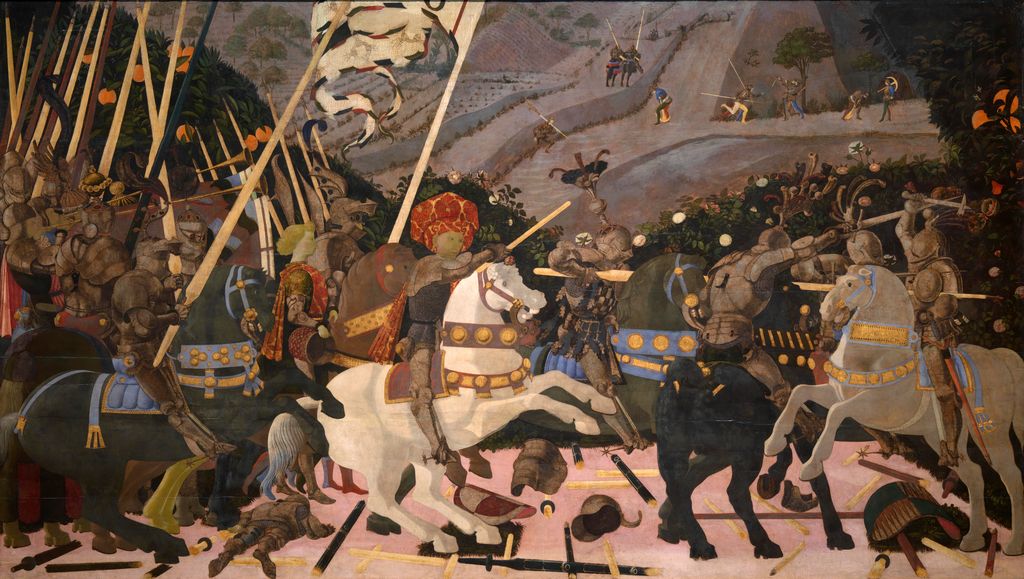
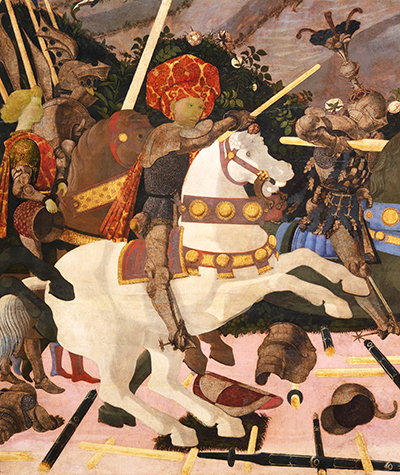
Niccolò da Tolentino rides a white horse in the London San Romano panel, National Gallery NG583. Image source. Public domain.
 by Tom Gurney
Tom Gurney BSc (Hons) is an art history expert with over 20 years experience
Email: tomgurney1@gmail.com / Phone: +44 7429 011000
Perspective: Introduction
A broken lance in Paolo Uccello’s Battle of San Romano can do the work of a line on a tiled floor. Follow its shaft past a horse’s hoof and it sends your eye into the picture. Look further up and a flowering hedge blocks the way. In The Hunt in the Forest, the hunters’ spears lead towards a clearing so narrow and dark that it almost disappears. The two paintings ask the eye to do something similar, then give it very different places to go. [1] [2]
Uccello used perspective to make things seem near or far, but depth was only part of what he could do with it. In Florence Cathedral he made a painted stone base appear to jut into the aisle while keeping the horse and rider above it clearly visible in profile. In the Green Cloister of Santa Maria Novella, he sent the sides of a wooden ark plunging into the distance to set two moments of the Flood beside each other. Following the painted lines is a way to see how these pictures are put together and how they guide us through an event. [3] [4]
At a Glance
- Planning the HuntInfrared examination revealed charcoal lines for a central recession
- Two angles in HawkwoodThe sarcophagus is seen from below and the horse and rider nearer their own level
- Two ark views in the FloodOpposed lines lead into adjacent moments of the story
Contents
- How to follow the lines
- The Battle of San Romano and the broken lances
- The Hunt in the Forest and a grid under the trees
- John Hawkwood from the cathedral aisle
- The Flood and two views of the ark
- Two landscapes for Saint George
- The chalice, the headdress and the line on paper
How to follow the lines
Begin with two edges that would run parallel in the world of the picture, such as the sides of a straight road. If they travel away from you, their painted extensions may meet at a vanishing point. For level ground and a level view, the meeting point is at eye level, even when the painted skyline is hidden by trees or hills. Edges that run in a different direction may converge elsewhere. A pair of crossing spears can draw the eye to a figure simply because of how they are arranged. To use their intersection as evidence of a perspective construction, you would first need a reason to think the spears were meant to lie parallel in the scene. [5] [6]
Other cues work with or alongside those lines. A tree can hide half a horse and make it immediately obvious which is nearer. Two comparable figures painted at different sizes can suggest a difference in distance. Foreshortening makes a limb, body or other form appear compressed when it points towards or away from the viewer. These cues answer different questions. A small figure could be comfortably far away, while a foreshortened figure can be large and close to the very edge of the picture. [5] [7]
Early fifteenth-century Florence offered Uccello several ways to think about this. Filippo Brunelleschi’s painted demonstrations are known through his biographer Antonio Manetti’s account. Leon Battista Alberti described a procedure for constructing a receding pavement in his treatise On Painting, written in Latin in 1435 and in Italian in 1436. Alberti’s pavement gives us a model for how a pictorial space can be constructed from a fixed eye level. A match between a few painted edges and a diagram still leaves open the question of how the painter actually worked. [6] [8]
The Battle of San Romano and the broken lances
In the London battle panel, look under the white horse carrying Niccolò da Tolentino. Some discarded lances lie almost across the picture. Others angle upwards into it. Try following an oblique shaft with your eye, then glance across to the armoured knight on the ground. The knight’s body has been compressed along its length, pulling a human figure into the same receding strip as the scattered weapons. The Japanese graphic scholar Kiyoo Koyama read these foreground devices as suggesting one-point recession. The green barrier of the hedge above them is a useful stopping place for that reading. Beyond it, tiny figures, sloping fields and paths give the eye a fresh set of distances. [1] [9]
The different scales make the cavalry feel almost within reach. They also keep the men and horses from dissolving into the details of the landscape. Massimo Becattini, whose diagram Dillian Gordon discusses in the National Gallery catalogue, identified a principal convergence in London and another towards the right. He related the main point’s height to the corresponding point in the Uffizi panel. Try the same exercise there, then turn to the Louvre counterattack. In Florence, the sharply turned horses interrupt the sweep of the lances against a hilly backdrop. In Paris, the eye moves through the packed ranks and raised weapons without a comparable stretch of countryside. Becattini’s analysis gives the Paris panel a different main point and further convergences of its own. The Uffizi suggests that some of the angles of the bodies make sense if the panels were viewed from below. The Louvre records changes to its panel’s original shape to suit a new setting. The first arrangement remains open, while the physical changes to the panels support a later London, Florence, Paris sequence. [1] [9] [10] [11]
The London panel also preserves marks of how it was made. Examination found a fluid dark preliminary drawing and lines cut into the prepared surface or the soft paint. One lance beneath a black horse at the right has sharply scored edges and a tip left without its silver. A nearby incised circle was never carried through into paint. Such details record particular decisions with a precision that an overlay of converging lances cannot supply. They also explain why a reconstruction based on the painted surface describes only one stage of the work. [1]
The Hunt in the Forest and a grid under the trees
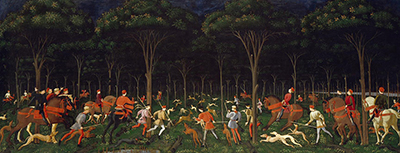
Start at the pale hounds at the lower right of The Hunt in the Forest. Follow their rush between the trunks towards the much smaller forms at the centre. Then go back and follow a spear or the edge of a fallen branch. The trees slip in front of the moving groups and the spaces between the trunks narrow towards the centre, so each newly visible hound seems to belong a little further in. Near the front, upright trunks divide the wide panel into a rhythm you can scan from side to side. The repeated forms lead into the woods and give the eye places to pause across the surface. At lower left a still pool holds the eye near the foreground. Further back on the right, a blue watercourse takes a direction of its own. [2] [5] [12]
The Ashmolean reports that infrared examination during conservation revealed charcoal lines marking out the horizon, a central axis and receding lines on either side of a central vanishing point. The forest conceals these aids in a different way from a painted tiled floor, where the framework can remain visible as the pattern of the pavement. The Ashmolean identifies the wide panel as a spalliera, a furnishing picture made for a domestic setting and probably seen at roughly shoulder height. Imagine meeting its centre at close to eye level and then having to scan sideways to take in the two approaches to the chase. The precise room and installation remain unknown. Conservators also observed lines scored into both the prepared ground and the paint. Those incisions and the charcoal visible in infrared record different ways of marking the panel. [2] [5] [13]
Richard Talbot went a step further in a geometric reconstruction. He reports Martin Kemp and Ann Massing’s observation that the height of a horse and rider at a given distance corresponds to the width between the principal receding lines at that depth. Try imagining that narrowing gap as a measuring stick. As it gets smaller, a mounted figure can be made smaller with it. Talbot proposed that a geometry derived from the square could explain these relationships and also account for the clusters of activity across the panorama. An earlier analysis had treated some of those clusters as evidence for three separate perspective spaces. Talbot’s model shows how a single underlying construction could accommodate them. The infrared evidence establishes the principal charcoal lines, while the more elaborate geometry remains his reconstruction. [8]
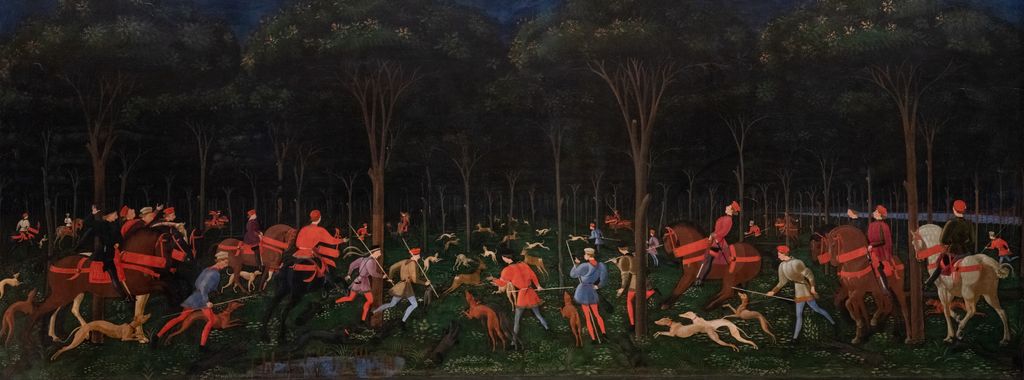
The Hunt in the Forest, Ashmolean Museum WA1850.31. Image source. CC0 / Public domain.
John Hawkwood from the cathedral aisle
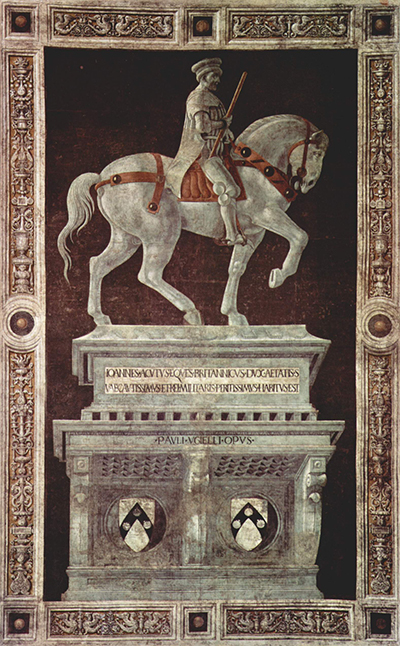
In the Funerary Monument to Sir John Hawkwood, begin under the front of the painted sarcophagus. The underside of the platform and the angled ledges suggest a heavy object projecting over your head. Raise your eyes to the horse. Its long flank and the captain’s upright profile are presented much more nearly at their own level, where their silhouettes can be read across the church. The Opera del Duomo describes the distinct viewpoints. The effect is easy to appreciate if you imagine continuing the lower angle upwards. You would see much more of the underside of the horse and have a less clear view of the rider and his baton. [3] [14]
Hans-Ernst Mittig extended the lines of the base in a reconstruction and argued that the original mounting was higher. His projection experiment suggested that the distinction between the advancing base and the comparatively detached figures would have been more pronounced at the proposed height. That is a historical interpretation of the installation. Eiichi Saitō compared the choices in Hawkwood with the separately adjusted views in Masaccio’s Trinity, where the painted architecture and the figures pose their own problems of visibility. Both comparisons help explain what an artist could gain by giving different parts of a picture different treatment. The commission documents order changes to Hawkwood’s horse and rider, but do not give a precise geometric reason for the revision. [14] [15] [16]
There is a grid on the Uffizi’s working drawing for the monument, inventory 31 F. Lorenza Melli examined the sheet and identified adjustments to the rider, horse and angle of the sarcophagus. Hugh Hudson discusses her finding that the grid served to enlarge the design. The distinction from the Oxford panel is worth making. Hawkwood’s small study was divided into squares so that its forms could be carried to a larger surface. The main receding lines under the Hunt help establish the positions and apparent scale of forms within the scene. Both practices turn a problem into something the painter can measure. [5] [16] [17]
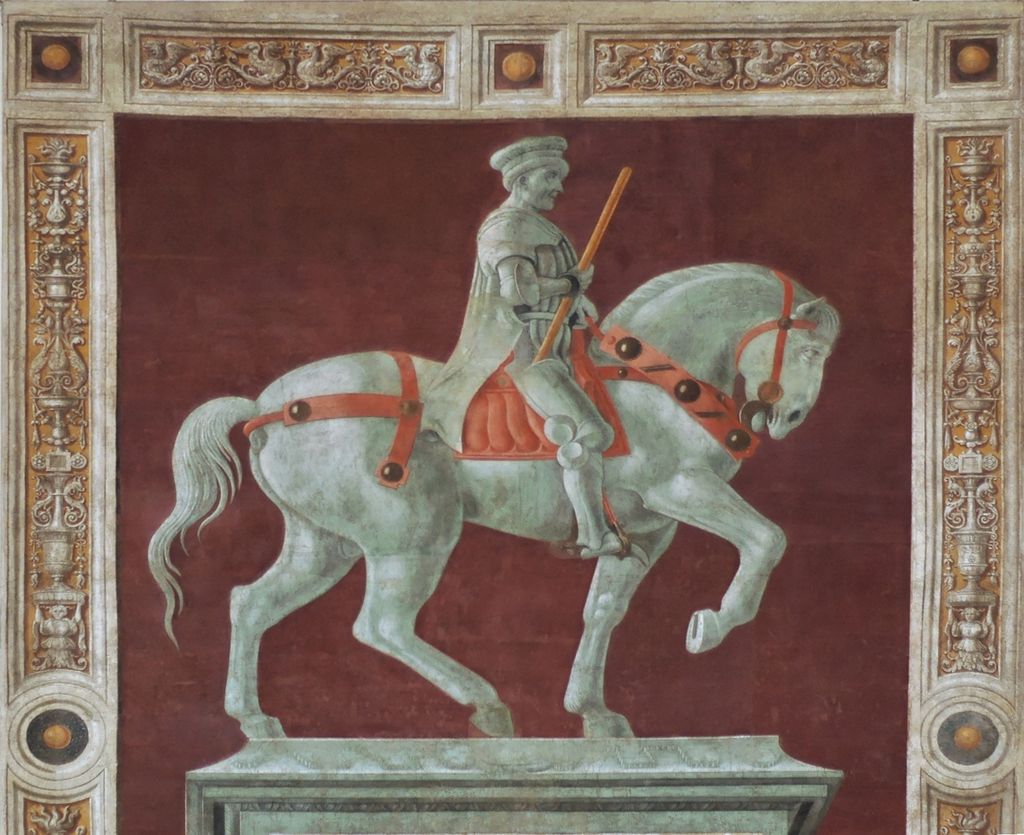
The rider and horse in Uccello’s monument to John Hawkwood, above the painted sarcophagus. Image source. Public domain.
The Flood and two views of the ark
In the Flood and Recession of the Waters, the Green Cloister lunette at Santa Maria Novella, sight along the upper edge of the huge timber side at the left. Its narrowing shape leads towards the distant storm. Now follow the timber form on the right back towards the middle. Between the opposed diagonals is a crowded space where people struggle for a footing or try to stay clear of the water. The repeated ark shape also marks the story’s passage through time. The left side shows the catastrophe unfolding, while on the right Noah reaches out towards the returning dove. Giovanni Giura dated the lunette to around 1439. Michela Ramadori placed it around 1447–48 and described the two crossed recessions. The reading of the painted directions does not depend on settling that chronology. [4] [18]
Now bring your eye back to the middle distance and look for the small areas of ground amid the figures and debris. Their overlaps sometimes tell you more about who is in front than an ark edge does. One man to the left wears a mazzocchio around his neck. The body in profile, the turning ring and the long timber wall demonstrate three different ways of giving volume and direction to forms in the same passage. The lunette’s diagonals can make the viewer feel almost among the people in the water. The suggestion follows from the visible composition, without requiring an exact reconstruction of the painter’s ground plan. [4] [18]
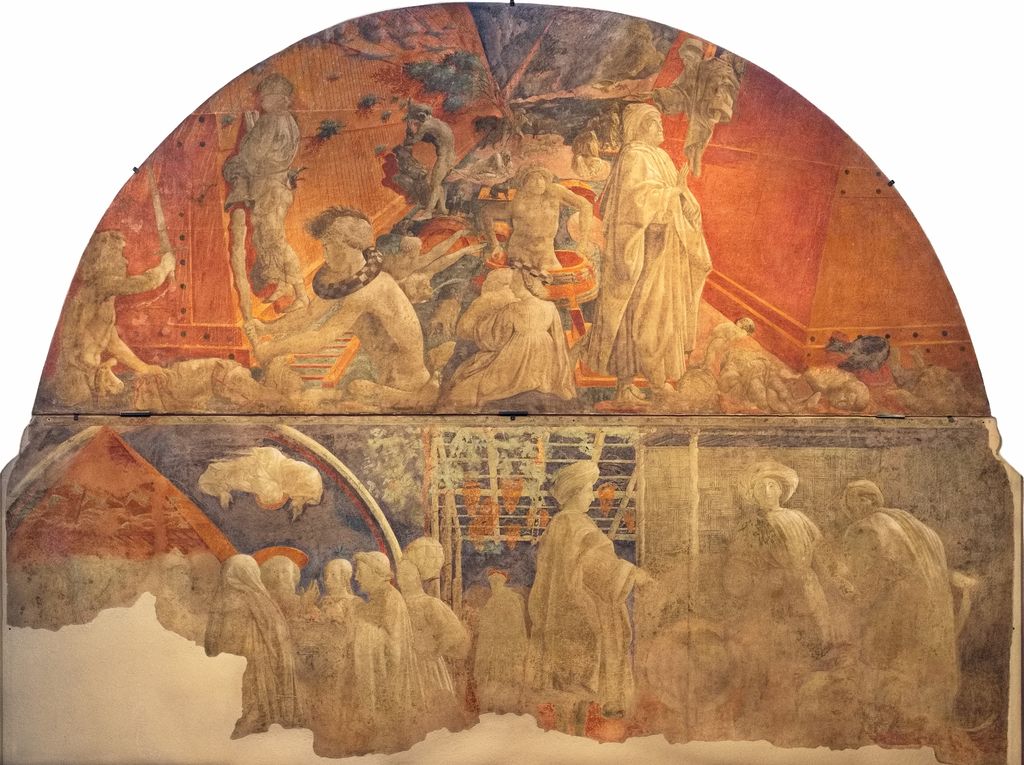
The Flood and Recession of the Waters above the lower episodes from Noah’s story, Santa Maria Novella. Photograph by Armin Kleiner. Image source. CC BY-SA 4.0. Resized for the web. This derivative is available under the same licence.
Two landscapes for Saint George
The Paris Saint George and the Dragon gives another reason to follow a scene in parts. A conspicuous rock and cave separate two glimpses of country. Follow the track and the patterned fields back on the side with the fortified settlement. Then cross the rocky divide and continue into the other landscape. The Musée Jacquemart-André points to distinct background views and vanishing points on either side. The Palazzo Cini exhibition also describes the change of angle from one part of the landscape to the other. The separation allows us to look deep into the background twice within one encounter between knight and dragon. [19] [20]
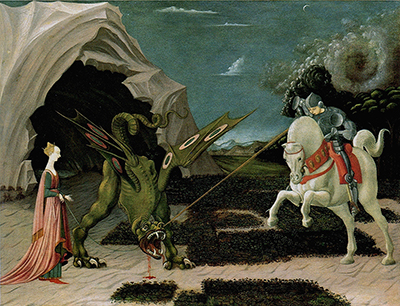
In the London Saint George, compare the directions of the green patches with the upward slant of the rectangular foreground stones. Then follow the knight’s lance towards the dragon and look back above the horse at the turning cloud. The National Gallery draws attention to the relationship between the twisted cloud and the cave. The cave pulls the eye into a dark opening, while the cloud draws it back up to the right. Examination found that the cave outline and lance changed during the making of the London canvas. It also revealed a separate curved shape below the drawing of the princess, possibly part of an earlier design. These findings record changes to the London canvas, where the painted directions are as varied as the ones we can see in the Paris panel. [19] [21] [22]
The chalice, the headdress and the line on paper
The drawings associated with Uccello let us follow some of the same decisions on the scale of a hand. In the Uffizi chalice, inventory 1758 A, look for the small opening at the top and then follow the lines down through the narrowing stem. Lines from the far side of the vessel are still visible across those that describe its nearer face. Each ring helps locate the next one. The 2013 Palazzo Strozzi exhibition listed both this sheet and a study of a mazzocchio, Uffizi 1757 A, as attributed to Uccello. The Museo Galileo’s exhibition record also gives Piero della Francesca as a possible author of the chalice. [23] [24]
The Louvre’s separate Mazzocchio vu en perspective, INV 1970, shows the rigid ring of a man’s headdress as a series of flat facets. Follow the upper edge from the near rim around the opening. Changing widths and patches of shade tell you where each face turns. The catalogue records an attribution to Uccello himself, a proposal for his workshop and a past reading as a later derivation. Thomas Bohl describes the attribution as uncertain and notes a possible connection with wood inlay, a craft in which the ability to depict a complicated solid had a practical use. The Hawkwood study is tied to a particular commission by its subject and by its relationship to the mural. The chalice and headdress show what craftspeople could work out on paper even while their individual authorship remains open. [16] [17] [23] [25]
Giorgio Vasari’s sixteenth-century life helped make Uccello famous as the painter who stayed up late studying perspective. It is a memorable story, recorded many decades after the artist’s death. The works preserve evidence that is more varied. In the Hunt, a measured recession draws a throng of figures into one passage through the forest. At San Romano, fragments of geometry are dispersed across a battlefield. At Hawkwood’s tomb and in the Flood, a shift of viewpoint gives the viewer a position from which to read a figure or experience the action. The next time a painted edge sends your eye into the distance, follow it and see what happens when it meets the edge of another object. [1] [3] [5] [18] [26]
Artworks directory
Browse paintings, drawings, stained-glass designs and other objects connected with Uccello. Cycles and their surviving components may have separate entries. The collection or catalogue’s wording is retained where a date, attribution or subject is debated.
| Name | Date | Medium, attribution and collection |
|---|---|---|
| Niccolò da Tolentino at the Battle of San Romano · London | Probably c.1438–40 | Tempera and oil on wood, with metallic decoration · National Gallery Catalogue. |
| Bernardino della Carda Unhorsed · Florence | c.1435–40 | Tempera on panel · Uffizi Galleries Catalogue. |
| The Counterattack of Micheletto da Cotignola · Paris | 1450–75 in the Louvre catalogue | Tempera (possibly) on wood · Musée du Louvre Catalogue. |
| The Hunt in the Forest | c.1465–70 | Tempera and oil with traces of gold on panel · Ashmolean Catalogue. |
| Saint George and the Dragon · London | c.1470 | Oil on canvas · National Gallery Catalogue. |
| Saint George Slaying the Dragon · Melbourne | c.1430 | Oil, tempera and silver leaf on wood · National Gallery of Victoria Catalogue. |
| Saint George and the Dragon · Paris | 1430–35 in the museum catalogue | Painted wood panel · Musée Jacquemart-André Catalogue. |
| Equestrian Monument to John Hawkwood | 1436 | Transferred wall painting · Florence Cathedral Catalogue. |
| Study for the John Hawkwood Monument | 1436 | Study on prepared paper · Uffizi Catalogue. |
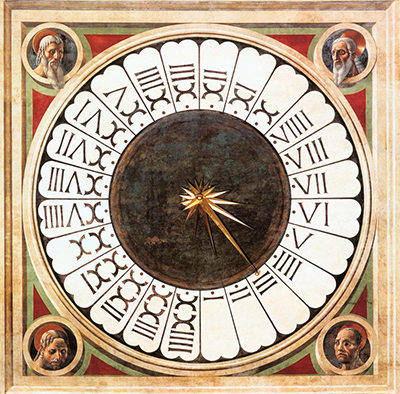
| Monumental Clock Face | 1443 | Painted dial · Florence Cathedral Catalogue. |
| Resurrection of Christ | 1443–44 | Stained glass · Uccello design · Florence Cathedral Catalogue. |
| Nativity | 1440s | Stained glass · Uccello design · Florence Cathedral Catalogue. |
| Creation of the Animals and Creation of Adam | Third to fourth decade of the 15th century | Detached fresco · Green Cloister, Santa Maria Novella Catalogue. |
| Creation of Eve and the Fall | Third to fourth decade of the 15th century | Detached fresco · Green Cloister, Santa Maria Novella Catalogue. |
| Flood and Recession of the Waters | 15th century; dating debated | Detached fresco · Green Cloister, Santa Maria Novella Catalogue. |
| Sacrifice and Drunkenness of Noah | 15th century; dating debated | Detached fresco · Green Cloister, Santa Maria Novella Catalogue. |
| Stories of the Virgin and Saint Stephen · Assunta Chapel | 1430s, with later completion | Fresco cycle · Paolo Uccello and Andrea di Giusto · Prato Cathedral Catalogue. |
| Blessed Jacopone da Todi | 1436 in the diocesan museum | Detached fresco · Museo dell’Opera del Duomo, Prato Catalogue. |
| Adoration of the Child · Bologna | 1430s; inscription incomplete | Detached fresco · San Martino Maggiore, Bologna Catalogue. |
| Adoration of the Christ Child · Karlsruhe | c.1436 | Painted panel · Attribution to Uccello · Staatliche Kunsthalle Karlsruhe Catalogue. |
| Annunciation · Oxford | Early 15th century | Tempera and gilding on panel · Ashmolean Catalogue. |
| Allegory of Monastic Life (Thebaid) | c.1460–65 | Tempera on canvas · Galleria dell’Accademia, Florence Catalogue. |
| Miracle of the Profaned Host | 1467–68 | Tempera on wood · Galleria Nazionale delle Marche, Urbino Catalogue. |
| Triumphal Entry into Rome of Titus and Vespasian(?) | c.1430–35 | Tempera, gold and silver on panel · Yale University Art Gallery Catalogue. |
| Crucifixion with the Virgin and Saints | c.1460–65 | Painted panel · Museo Nacional Thyssen-Bornemisza Catalogue. |
| The Crucifixion · Met triptych | Probably mid-1450s | Tempera on wood with gold ground · Metropolitan Museum of Art Catalogue. |
| Perspective Study of a Chalice | 1450–75 | Pen, ink and stylus on paper · Attributed to Uccello · Uffizi Catalogue. |
| Study of a Mazzocchio | 15th century | Perspective study · Attributed to Uccello · Uffizi Catalogue. |
| Mazzocchio Seen in Perspective | Uncertain | Drawing · Attribution debated · Musée du Louvre Catalogue. |
| Head of a Man in Profile | 15th century | Pen, ink and wash · Musée du Louvre Catalogue. |
| Five Masters of the Florentine Renaissance | 1500–50 | Oil on wood · Anonymous Florentine school · Musée du Louvre Catalogue. |
| Madonna and Child from the Del Beccuto House | 15th century | Detached fresco · Museo di San Marco, Florence Catalogue. |
| Man of Sorrows with the Virgin and Saint John · Avane Predella | 15th century | Predella · Museo di San Marco, Florence Catalogue. |
| Calling of Saint Paul the Hermit · San Miniato | After 1447 to c.1454 in state catalogue | Sinopia · Attributed to Uccello or collaborator Catalogue. |
| The host changes hands · Urbino predella, scene 1 | 1467–68 | Tempera on wood · Component of DE 231 · Galleria Nazionale delle Marche Catalogue. |
| The figures at the door · Urbino predella, scene 2 | 1467–68 | Tempera on wood · Component of DE 231 · Galleria Nazionale delle Marche Catalogue. |
| The procession approaches the altar · Urbino predella, scene 3 | 1467–68 | Tempera on wood · Component of DE 231 · Galleria Nazionale delle Marche Catalogue. |
| The condemned woman and the ladders · Urbino predella, scene 4 | 1467–68 | Tempera on wood · Component of DE 231 · Galleria Nazionale delle Marche Catalogue. |
| Persecution of the family · Urbino predella, scene 5 | 1467–68 | Tempera on wood · Component of DE 231 · Galleria Nazionale delle Marche Catalogue. |
| Angels and demons at the bier · Urbino predella, scene 6 | 1467–68 | Tempera on wood · Component of DE 231 · Galleria Nazionale delle Marche Catalogue. |
| Birth of the Virgin · Prato Cathedral | 1430s; dating debated | Fresco · Assunta Chapel, Prato Cathedral Catalogue. |
| Presentation of the Virgin · Prato Cathedral | 1430s; dating debated | Fresco · Assunta Chapel, Prato Cathedral Catalogue. |
Discussion
Look again at the images and ideas explored in Perspective. These editorial prompts invite your observations.
Reader Insights
Compare the open ground beneath the horses in London’s Battle of San Romano with the path into the Hunt. Which object first gives you a sense of depth in each painting, and which object interrupts it?
If Uccello had painted Hawkwood’s horse from the same low angle as the sarcophagus, which details of the commander and his mount would become harder to read from the aisle?
Join the Conversation
Share a detail, comparison or question about Perspective below.
References
- Dillian Gordon. The Battle of San Romano, NG583, in The Fifteenth Century Italian Paintings, vol. 1, 2003. Sections “Condition and technique” and “Composition and sequence”, including line analysis by Massimo Becattini. View source.
- Ashmolean Museum. The Hunt in the Forest, WA1850.31. Collection feature, dimensions, display context and detail photographs. View source.
- Opera di Santa Maria del Fiore. Paolo Uccello, Monumento a Giovanni Acuto. Object history, pictorial viewpoints and commission. View source.
- Giovanni Giura. “La seconda età della pittura in Santa Maria Novella”, 2016, especially pp. 130–139 and figs. 47–53. Green Cloister, chronology and composition. View source.
- Ashmolean Museum Education Department. Focus on Perspective in Art, pp. 1–3. Perspective terminology, the Oxford panel’s charcoal layout and the watercourse. View source.
- Leon Battista Alberti. On Painting, book I. English translation by John R. Spencer, revised edition, 1966. The picture plane, centric point and pavement construction. View source.
- Yukihiro Nomura. “身体の遠近法―ジョットからミケランジェロまで” [The perspective of the body, from Giotto to Michelangelo], pp. 84–86. Foreshortening in Uccello and other early Italian painters. View source.
- Richard Talbot. “Speculations on the Origins of Linear Perspective”, Nexus Network Journal 5, no. 1, 2003, part III, figs. 23–24 and “Brunelleschi’s painted panels”. View source.
- Kiyoo Koyama. “ウッチェロと透視図法” [Uccello and Perspective], 1985 annual meeting abstract, Journal of Graphic Science of Japan 19, no. 2, p. 46. Receding forms in the battle paintings and The Hunt. View source.
- Gallerie degli Uffizi. Battle of San Romano, inv. 1890 n. 479. Object record, foreshortened figures and implied viewpoint from below. View source.
- Musée du Louvre. La Bataille de San Romano, MI 469. The counterattack led by Micheletto Attendolo da Cotignola and the altered shape of its panel. View source.
- Diego Suárez Quevedo. “En los inicios del Renacimiento. La cúpula brunelleschiana y reflexiones sobre Paolo Uccello”, Anales de Historia del Arte 25, 2015, pp. 100–101. Identification of the water features and composition in The Hunt. View source.
- Ashok Roy and Dillian Gordon. “Uccello’s ‘Battle of San Romano’”, National Gallery Technical Bulletin 22, 2001, pp. 6–7 and 11–12. Comparison of incisions in the Oxford and London panels, citing the conservation examination of the Hunt. View source.
- Hans-Ernst Mittig. “Uccellos Hawkwood-Fresko: Platz und Wirkung”, Mitteilungen des Kunsthistorischen Institutes in Florenz 14, no. 2, 1969, pp. 235–239. Mounting position and reconstruction of the lower viewpoint. View source.
- Eiichi Saitō. “ジョン・ホークウッド騎馬像におけるウッチェロの革新性” [Uccello’s innovations in the equestrian monument to John Hawkwood], pp. 31–38. The comparison with Masaccio and Castagno. View source.
- Hugh Hudson. “The Politics of War: Paolo Uccello’s Equestrian Monument for Sir John Hawkwood in the Cathedral of Florence”, Parergon 23, no. 2, 2006, pp. 17–21 and appendix. Cathedral commission and the evidence of the working design. View source.
- Lorenza Melli. “Nuove indagini sui disegni di Paolo Uccello agli Uffizi: disegno sottostante, tecnica, funzione”, Mitteilungen des Kunsthistorischen Institutes in Florenz 42, no. 1, 1998, especially pp. 1–15. Technical examination of 31 F, its revision and its grid. View source.
- Michela Ramadori. “Tra racconto biblico e cronaca di un evento naturale nella Firenze del XV secolo: il Diluvio Universale dipinto da Paolo Uccello nel Chiostro Verde di Santa Maria Novella”, especially pp. 245–248. The ark views, figures in the lunette and proposed chronology. View source.
- Musée Jacquemart-André. Saint George and the Dragon. Object record and description of the division of the landscape around the cave. View source.
- Fondazione Giorgio Cini. A Guest at the Palace | Saint George and the Dragon by Paolo Uccello, 2021. The 2021 loan of the Jacquemart-André panel and its landscape construction. View source.
- Jill Dunkerton and Ashok Roy. “Uccello’s Saint George and the Dragon: Technical Evidence Re-evaluated”, National Gallery Technical Bulletin 19, 1998, pp. 26–30. Infrared examination and changes to the London painting. View source.
- National Gallery, London. Saint George and the Dragon, NG6294, “In-depth”. Painting, spatial cues and the cave and cloud. View source.
- Palazzo Strozzi. La Primavera del Rinascimento: La scultura e le arti a Firenze 1400–1460, 2013, checklist entries 7.10–7.11. Uffizi 1758 A and 1757 A. View source.
- Museo Galileo. I Medici e le scienze, exhibition record for Studio per un calice, 1758 A. View source.
- Musée du Louvre. Mazzocchio vu en perspective, INV 1970, recto. Material, subject and attribution history, with Thomas Bohl’s 2023 catalogue commentary. View source.
- Giorgio Vasari. Le vite de’ più eccellenti pittori, scultori e architettori, 1550, “Paulo Uccello”. The early biography and the anecdote about studying perspective at night. View source.
More PAOLO UCCELLO Artworks

Noah and the Flood
The Flood and Recession of the Waters above the lower episodes from Noah’s story, Santa Maria Novella. Photograph by Armin Kleiner. Image source. CC BY-SA 4.0. Resized for the web. This derivative is available under the same licence.
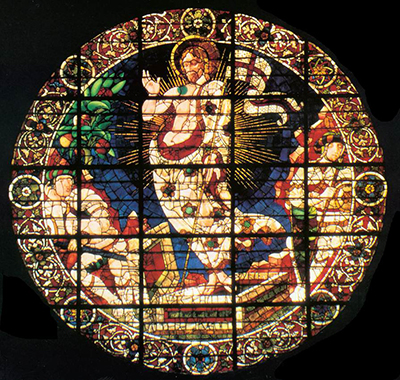
The Resurrection of Christ Stained Glass Window
The Resurrection window in Florence Cathedral, designed by Paolo Uccello and made by Bernardo di Francesco. Photograph by Sailko. Image source. CC BY 3.0. Resized for the web.