



 by Tom Gurney
Tom Gurney BSc (Hons) is an art history expert with over 20 years experience
Published on June 19, 2020 / Updated on November 29, 2026
Email: tomgurney1@gmail.com / Phone: +44 7429 011000
The Triumphal Entry into Rome of Titus and Vespasian(?): Introduction
Two commanders ride towards one another across a long wooden panel. One carries a baton and the other raises a sword. Between them, horses and oxen turn into the hills, where the parade breaks into small glimpses of wheels, riders and foot soldiers. High above the two commanders is the gate of a walled city. Yale University Art Gallery dates this work by Paolo Uccello to about 1430–35 and calls it The Triumphal Entry into Rome of Titus and Vespasian(?). The city is plausibly Rome and the double triumph has an ancient precedent. The question mark keeps open which triumph Uccello painted. The panel itself gives a firmer answer to another question. There is a keyhole at the top, where someone once unlocked a chest. [1] [2]
At a Glance
- DateAbout 1430–35
- Medium and dimensionsTempera, gold and silver on panel. Painted surface 41.5 × 127.1 cm
- CollectionYale University Art Gallery, New Haven, accession 2015.17.1
Contents
- Two parades for one city
- Rome in the painting and in the ancient sources
- The lock and the painted surface
- How the design and the attribution travelled
- Annotated details
Two parades for one city
At the left, pale horses draw a chariot with a young, fair-haired commander under a canopy. The arch of the canopy gives his seated figure a space of its own, even as the red clothes and restless profiles of the people below keep the procession moving. Kanter's catalogue entry picks out the letters spelling ROMA in pearl decoration on the pages’ hats. Ahead of the commander, a cart carries three bearded prisoners and a gilded, winged figure that resembles Eros. In the photograph, the wheel of that cart is one of the clearest circles in the painting. The wide back of the ox in front of it soon gives way to the narrower view of a horse turning into the scene. Those changes in the animals’ stance do as much as the winding road to take us towards the gate. [1] [2]
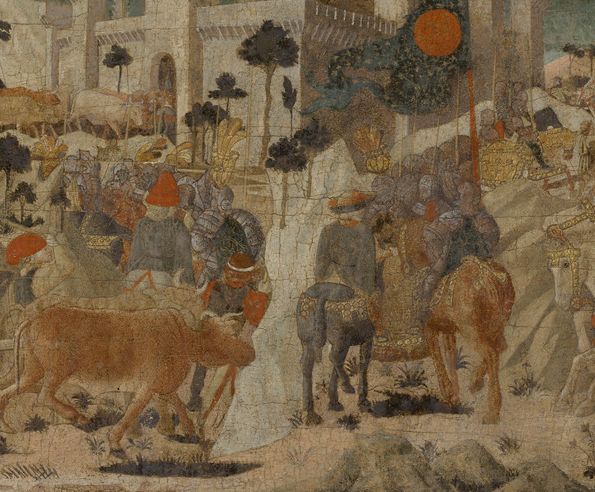
At the right, the sword is lifted above a ring of captives at the base of the second throne. A foot attendant bends near the chariot, his red legs standing out against the pale ground. Beyond him, a dark standard with an orange-red disc rises above the mounted party. Its roundel remains clear at a distance, though any device within it is now illegible. Look from the bright circle back down the pole to the crowded horses, then across to the turn of the other procession. The two sides of the panel rhyme without repeating every action. Riders in the centre present their backs and flanks at angles, while the teams of horses at the edges establish the movement across the front. The commanders are still large enough to pick out as the rest of the spectacle disappears in pieces between the hills. [1] [2]
The point where the two parades seem to meet is a turning place. One can follow the light ground towards the city in stages, past the overlapping riders, the banks on either side of the track and the smaller figures near the walls. Several riders and carts emerge only long enough to give the eye the next stretch of road. The battlements and towers have their own depth, especially where a line of wall bends behind a tree. Uccello uses the width of the chest front to give each commander a public entrance, then makes the small upper part of the picture wide enough, in imagination, for both parties to pass through. [1] [2]
Rome in the painting and in the ancient sources
The proposed subject is the triumph celebrated by Vespasian and his son Titus in Rome in 71 CE, a year after Titus took Jerusalem and the Second Temple was destroyed. Vespasian had begun the campaign against the revolt in Judaea under Nero. Josephus describes the Roman Senate voting separate triumphs and the father and son choosing to celebrate together. He places Domitian, Vespasian's younger son, alongside them on horseback. The two prominent chariots in the picture offer a reason to think of the Flavian triumph. A sword, a baton and the bearing of the men who hold them leave the names of the painted commanders open. [2] [3] [4]
Josephus gives the ritual a human cost that is easy to miss among the curving lines and shimmering clothes. Prisoners appeared as part of the display of Roman victory. Among the objects seized from the Temple were the golden table and the seven-branched lampstand. The menorah is conspicuous on the relief inside the surviving Arch of Titus, a monument raised after Titus’s death under Domitian. On the opposite relief, Titus rides in a four-horse chariot, crowned by a winged Victory. Uccello gives his chariots canopied seats, dresses the riders in armour familiar to a fifteenth-century viewer and puts a gold figure resembling a pagan god on a wagon with captives. The spoils in the painting lack the identifying details that Josephus and the relief give the Temple treasures. The gate and the pyramid belong to a painted evocation of Rome. The panel leaves their relationship to individual ancient monuments open. [2] [3] [4] [5]
Annotated Details from The Triumphal Entry into Rome of Titus and Vespasian(?)
The numbered points identify visible features discussed in this article. Return from each detail to the numbered overview. The Triumphal Entry into Rome of Titus and Vespasian(?), Yale University Art Gallery 2015.17.1. Image source. Public domain.
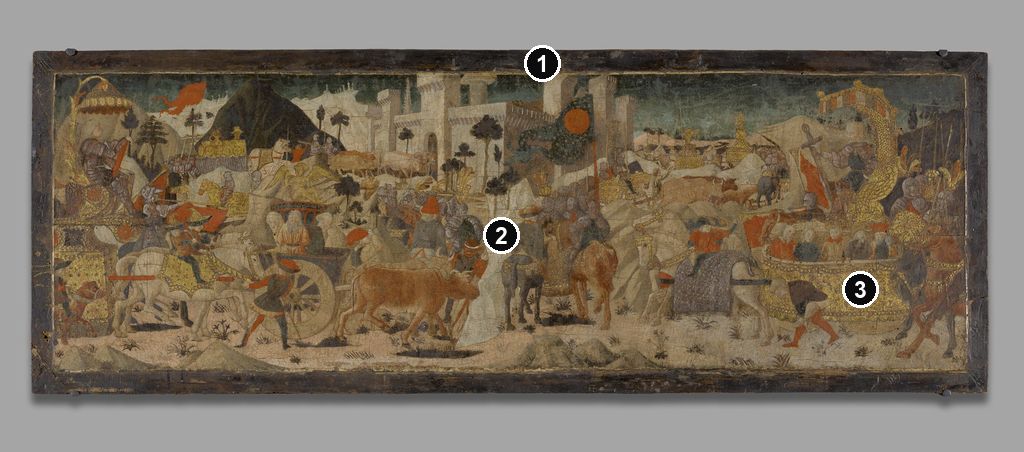
Details from THE TRIUMPHAL ENTRY INTO ROME OF TITUS AND VESPASIAN(?)
Compare the cropped details with the source images above. Notice how their colours, shapes and positions contribute to the larger compositions.
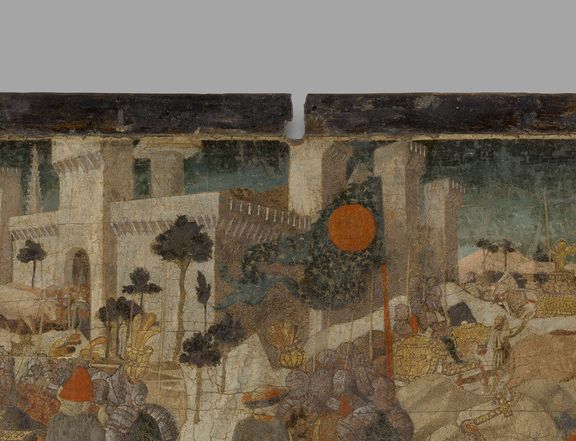
The recess on the upper edge
The cut in the top edge is physical evidence connected with a former lock. It interrupts the border above the procession.
The central gateway and moving procession
A pale opening and descending road organize groups of animals and attendants. The crowd is arranged across the wide surface rather than around a single figure.
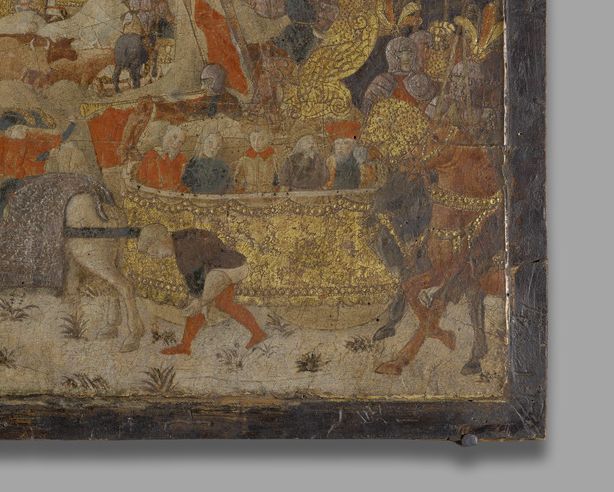
Gilding and the chariot
The figures at the right overlap a decorated chariot. Concentrated gilded surfaces and splashes of bright paint punctuate the procession.
The lock and the painted surface
Yale's painted surface measures 41.5 by 127.1 centimetres. The panel itself is larger, with a dark border outside the image. The support consists of two broad poplar planks whose join slants gently across the scene. At the top is a recess about 7.5 centimetres wide where the lock fitted into the thickness of the wood. A keyhole goes through the face, and the surrounding area has a heavier concentration of small losses. The narrow raised edge of the paint and the angled cuts at the corners record the positions of former mouldings. The corner marks suggest that the scene survives substantially at its original width, with lateral extensions, possibly for coats of arms, a remaining possibility. [1] [2]
All these features help place the painting on the front of a cassone, a storage chest of a kind often commissioned for weddings. Marriage chests could carry detailed stories, with carpentry and hardware as much a part of the commission as painting and gilding. The Met's chest with the Conquest of Trebizond gives a sense of how a broad narrative panel could sit in a piece of furniture. A later Florentine pair discussed by Scott Nethersole set a battle and the triumph of Scipio on wedding chests, evidence that displays of ancient military success had a place in marriage furnishings. Yale's panel gives us the structure and wear of such an object, while the first owner, occasion and room remain unknown. Even The Hunt in the Forest, whose long shape invites comparison, has a different proposed place in the room. The Ashmolean understands it as a spalliera, a painted panel viewed at shoulder height, possibly mounted above a chest or set into room panelling. [2] [6] [7] [8]
The tempera, gold and silver survive unevenly. Yale's examination found old retouching in the sky, where exposed preparation and discoloured repairs interrupt the change of blue above the horizon. Most of the silver ornament on the armour and horse trappings received a later coating. A helmet near the right edge escaped that treatment. Its worn surface, where the original modelling still shows, gives some idea of the fineness the metallic passages once had. Even now, the gold around the chariot at the right helps pick out its outline from the crammed procession. [1] [2]
How the design and the attribution travelled
Laurence Kanter proposed the attribution to Uccello when the panel appeared at Christie's in Milan in November 2011, and Everett Fahy supported it. Richard L. Feigen acquired the work in 2011 and gave it to Yale. The gallery's 2015 acquisitions bulletin records it as about 1430, under the title without a question mark. Yale's later catalogue and current collection record refine the dating to about 1430–35 and signal doubt about the subject explicitly. The attribution rests on how the work is painted. Kanter points to the carefully shortened canopy ribs and helmet plumes turning in space, the angles of the walls and the turn of the horses and oxen. He finds a counterpart to the pyramid's plant-like trim in Uccello's frescoes at Prato Cathedral. The odd mount partly cut off at the left edge has a counterpart among the creatures in the Green Cloister's Creation. The shifting planes of light and dark on the animals also recall the Sir John Hawkwood monument and the Battle of San Romano. [1] [2] [9]
The Yale design was copied closely in a panel formerly in the Williams-Wynn collection, which Kanter assigns to the workshop of Apollonio di Giovanni and Marco del Buono. The Zeri photo archive files the same copy under Romulus and Titus Tatius and records another attribution, to Lo Scheggia. A close comparison shows how the copy preserves the principal incidents while simplifying the recession and changing the skyline. Kanter sees a dependence close enough to suggest that the copyist had access to the original. Two other versions reuse selected passages. A panel formerly in the Gunther-Facasanu collection reverses the sword-bearing commander’s group and moves the unusual little rider in from the edge. A chest front attributed to Lo Scheggia at Écouen turns the facing leaders into the Roman Romulus and the Sabine king Titus Tatius. There, Hersilia receives their batons in a gesture of reconciliation. The attendant bending to tend to his legwear survives the change of story. Kanter suggests a drawing could have conveyed details of this kind between workshops. The shared figures make the connection visible. The differences show how easily a way of picturing two leaders coming together could suit a different episode in Rome's past. That adaptability matters for the Yale panel's place in Uccello's career. In Kanter's reconstruction of the painter's work on furniture, most of the surviving examples date from after 1460. This one is unusually early. Its reuse suggests it may have offered Florentine workshops a model for putting scenes from Roman history on a chest. [2] [10] [11]
Artworks directory
Browse paintings, drawings, stained-glass designs and other objects connected with Uccello. Cycles and their surviving components may have separate entries. The collection or catalogue’s wording is retained where a date, attribution or subject is debated.
| Name | Date | Medium, attribution and collection |
|---|---|---|
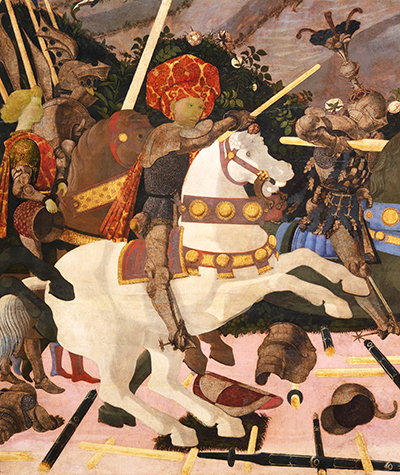
| Niccolò da Tolentino at the Battle of San Romano · London | Probably c.1438–40 | Tempera and oil on wood, with metallic decoration · National Gallery Catalogue. |
| Bernardino della Carda Unhorsed · Florence | c.1435–40 | Tempera on panel · Uffizi Galleries Catalogue. |
| The Counterattack of Micheletto da Cotignola · Paris | 1450–75 in the Louvre catalogue | Tempera (possibly) on wood · Musée du Louvre Catalogue. |
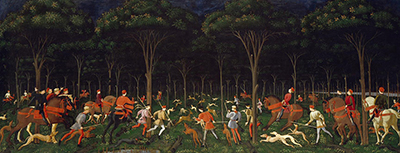
| The Hunt in the Forest | c.1465–70 | Tempera and oil with traces of gold on panel · Ashmolean Catalogue. |
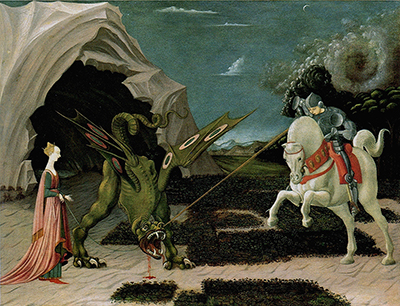
| Saint George and the Dragon · London | c.1470 | Oil on canvas · National Gallery Catalogue. |
| Saint George Slaying the Dragon · Melbourne | c.1430 | Oil, tempera and silver leaf on wood · National Gallery of Victoria Catalogue. |
| Saint George and the Dragon · Paris | 1430–35 in the museum catalogue | Painted wood panel · Musée Jacquemart-André Catalogue. |
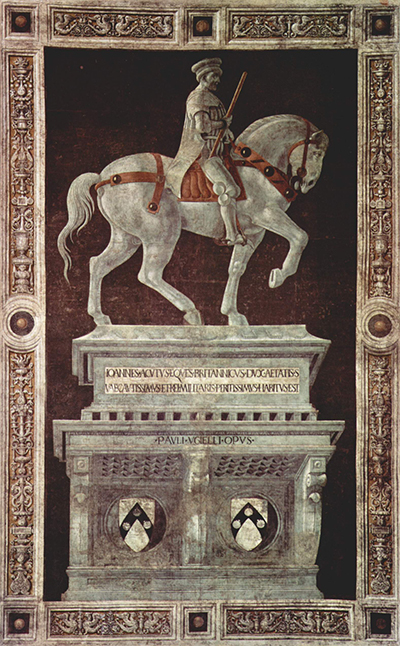
| Equestrian Monument to John Hawkwood | 1436 | Transferred wall painting · Florence Cathedral Catalogue. |
| Study for the John Hawkwood Monument | 1436 | Study on prepared paper · Uffizi Catalogue. |
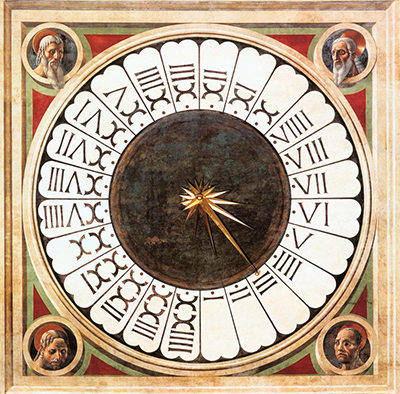
| Monumental Clock Face | 1443 | Painted dial · Florence Cathedral Catalogue. |
| Resurrection of Christ | 1443–44 | Stained glass · Uccello design · Florence Cathedral Catalogue. |
| Nativity | 1440s | Stained glass · Uccello design · Florence Cathedral Catalogue. |
| Creation of the Animals and Creation of Adam | Third to fourth decade of the 15th century | Detached fresco · Green Cloister, Santa Maria Novella Catalogue. |
| Creation of Eve and the Fall | Third to fourth decade of the 15th century | Detached fresco · Green Cloister, Santa Maria Novella Catalogue. |
| Flood and Recession of the Waters | 15th century; dating debated | Detached fresco · Green Cloister, Santa Maria Novella Catalogue. |
| Sacrifice and Drunkenness of Noah | 15th century; dating debated | Detached fresco · Green Cloister, Santa Maria Novella Catalogue. |
| Stories of the Virgin and Saint Stephen · Assunta Chapel | 1430s, with later completion | Fresco cycle · Paolo Uccello and Andrea di Giusto · Prato Cathedral Catalogue. |
| Blessed Jacopone da Todi | 1436 in the diocesan museum | Detached fresco · Museo dell’Opera del Duomo, Prato Catalogue. |
| Adoration of the Child · Bologna | 1430s; inscription incomplete | Detached fresco · San Martino Maggiore, Bologna Catalogue. |
| Adoration of the Christ Child · Karlsruhe | c.1436 | Painted panel · Attribution to Uccello · Staatliche Kunsthalle Karlsruhe Catalogue. |
| Annunciation · Oxford | Early 15th century | Tempera and gilding on panel · Ashmolean Catalogue. |
| Allegory of Monastic Life (Thebaid) | c.1460–65 | Tempera on canvas · Galleria dell’Accademia, Florence Catalogue. |
| Miracle of the Profaned Host | 1467–68 | Tempera on wood · Galleria Nazionale delle Marche, Urbino Catalogue. |
| Triumphal Entry into Rome of Titus and Vespasian(?) | c.1430–35 | Tempera, gold and silver on panel · Yale University Art Gallery Catalogue. |
| Crucifixion with the Virgin and Saints | c.1460–65 | Painted panel · Museo Nacional Thyssen-Bornemisza Catalogue. |
| The Crucifixion · Met triptych | Probably mid-1450s | Tempera on wood with gold ground · Metropolitan Museum of Art Catalogue. |
| Perspective Study of a Chalice | 1450–75 | Pen, ink and stylus on paper · Attributed to Uccello · Uffizi Catalogue. |
| Study of a Mazzocchio | 15th century | Perspective study · Attributed to Uccello · Uffizi Catalogue. |
| Mazzocchio Seen in Perspective | Uncertain | Drawing · Attribution debated · Musée du Louvre Catalogue. |
| Head of a Man in Profile | 15th century | Pen, ink and wash · Musée du Louvre Catalogue. |
| Five Masters of the Florentine Renaissance | 1500–50 | Oil on wood · Anonymous Florentine school · Musée du Louvre Catalogue. |
| Madonna and Child from the Del Beccuto House | 15th century | Detached fresco · Museo di San Marco, Florence Catalogue. |
| Man of Sorrows with the Virgin and Saint John · Avane Predella | 15th century | Predella · Museo di San Marco, Florence Catalogue. |
| Calling of Saint Paul the Hermit · San Miniato | After 1447 to c.1454 in state catalogue | Sinopia · Attributed to Uccello or collaborator Catalogue. |
| The host changes hands · Urbino predella, scene 1 | 1467–68 | Tempera on wood · Component of DE 231 · Galleria Nazionale delle Marche Catalogue. |
| The figures at the door · Urbino predella, scene 2 | 1467–68 | Tempera on wood · Component of DE 231 · Galleria Nazionale delle Marche Catalogue. |
| The procession approaches the altar · Urbino predella, scene 3 | 1467–68 | Tempera on wood · Component of DE 231 · Galleria Nazionale delle Marche Catalogue. |
| The condemned woman and the ladders · Urbino predella, scene 4 | 1467–68 | Tempera on wood · Component of DE 231 · Galleria Nazionale delle Marche Catalogue. |
| Persecution of the family · Urbino predella, scene 5 | 1467–68 | Tempera on wood · Component of DE 231 · Galleria Nazionale delle Marche Catalogue. |
| Angels and demons at the bier · Urbino predella, scene 6 | 1467–68 | Tempera on wood · Component of DE 231 · Galleria Nazionale delle Marche Catalogue. |
| Birth of the Virgin · Prato Cathedral | 1430s; dating debated | Fresco · Assunta Chapel, Prato Cathedral Catalogue. |
| Presentation of the Virgin · Prato Cathedral | 1430s; dating debated | Fresco · Assunta Chapel, Prato Cathedral Catalogue. |
Discussion
Look again at the images and ideas explored in The Triumphal Entry into Rome of Titus and Vespasian(?). These editorial prompts invite your observations.
Reader Insights
As you follow each parade towards the city, which detail most clearly tells you that the procession has turned away from you?
How does knowing the picture was on the front of a chest change the way you notice its details?
Join the Conversation
Share a detail, comparison or question about The Triumphal Entry into Rome of Titus and Vespasian(?) below.
References
- Yale University Art Gallery, The Triumphal Entry into Rome of Titus and Vespasian(?), accession 2015.17.1. View source.
- Laurence Kanter, Paolo Uccello, The Triumphal Entry into Rome of Titus and Vespasian(?), no. 93 in Laurence Kanter and Pia Palladino, Italian Paintings at the Yale University Art Gallery, vol. 2, 2023, with condition report and figs. 1–3. View source.
- Flavius Josephus, The Jewish War, book 7, especially §§123–157, translated by William Whiston, Perseus Digital Library. View source.
- Luuk Huitink, Between Triumph and Tragedy: Josephus, Bellum Judaicum 7.121–157, in Irene J. F. de Jong and Miguel John Versluys, eds., Reading Greek and Hellenistic-Roman Spolia, Brill, 2023, pp. 215–237. View source.
- Parco archeologico del Colosseo, Arch of Titus. View source.
- The Metropolitan Museum of Art, Cassone with painted front panel depicting the Conquest of Trebizond, accession 14.39, and notes on the chest's assembly and attribution. View source.
- Scott Nethersole, Armeggerie, wedding chests and battles in fifteenth-century Florence, Renaissance Studies 32, no. 2, 2018, pp. 282–304. View source.
- Ashmolean Museum, The Hunt in the Forest by Uccello, WA1850.31. View source.
- Yale University Art Gallery, Acquisitions, July 1, 2014–June 30, 2015, 2015 bulletin, p. 30. View source.
- Fondazione Federico Zeri, Entrata trionfale di Romolo e Tito Tazio a Roma, photo archive entry 13818. View source.
- Musée national de la Renaissance, La Réconciliation de Romulus et de Titus Tatius, interpretive label for Cl. 7509, Écouen, no. 6. View source.
More PAOLO UCCELLO Artworks

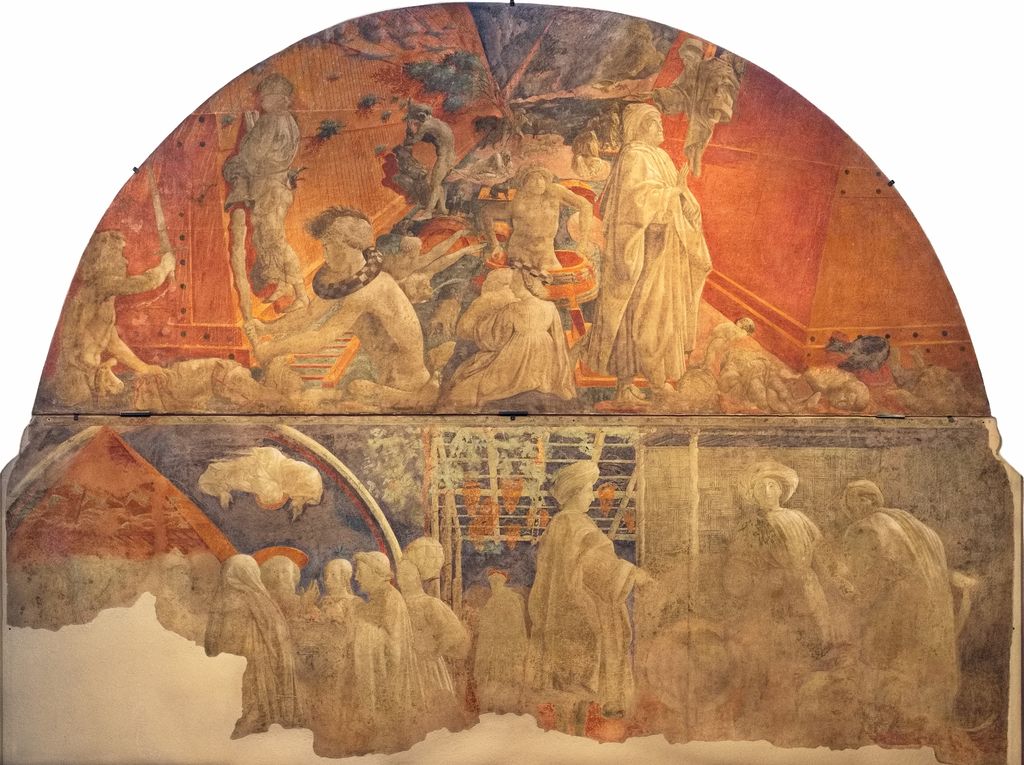
Noah and the Flood
The Flood and Recession of the Waters above the lower episodes from Noah’s story, Santa Maria Novella. Photograph by Armin Kleiner. Image source. CC BY-SA 4.0. Resized for the web. This derivative is available under the same licence.
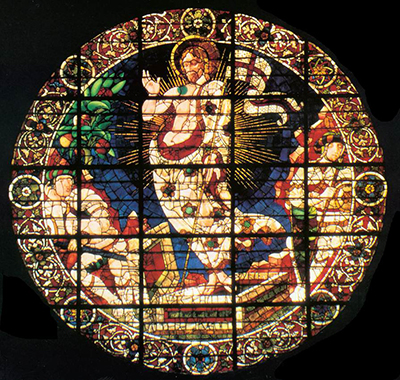
The Resurrection of Christ Stained Glass Window
The Resurrection window in Florence Cathedral, designed by Paolo Uccello and made by Bernardo di Francesco. Photograph by Sailko. Image source. CC BY 3.0. Resized for the web.