


 by Tom Gurney
Tom Gurney BSc (Hons) is an art history expert with over 20 years experience
Published on June 19, 2020 / Updated on November 29, 2026
Email: tomgurney1@gmail.com / Phone: +44 7429 011000
Funerary Monument to Sir John Hawkwood: Introduction
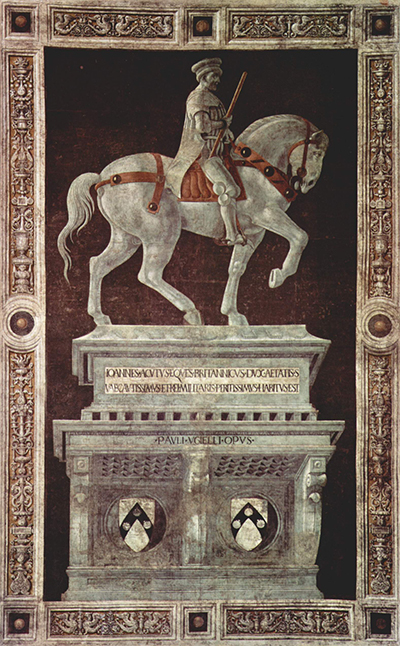
From the floor of Florence Cathedral, the first thing that seems to jut out of Paolo Uccello’s fresco is the underside of a tomb. Follow the dark brackets up to the sarcophagus and the eye has to change its angle. The rider and horse are almost in profile, as if their statue had been turned to give someone in the nave a clear view. Two lifted hooves hang against the red field. The horse seems to balance close to the front edge. Uccello painted this vast memorial to the English commander Sir John Hawkwood in 1436. The Opera di Santa Maria del Fiore lists it at about 8.55 metres high and 5.27 metres wide, on the wall of the third bay of the cathedral’s left aisle from the entrance. [1] [2]
At a Glance
- Date1436
- MediumFresco transferred to canvas
- LocationFlorence Cathedral, third bay of the left aisle
This work across Paolo Uccello’s career
Battle of San Romano
Probably c.1438–40 · GordonResurrection glass
1443–44The Hunt in the Forest
c.1465–70The Urbino predella
1467–68Saint George and the Dragon · London
About 1470Contents
- A monument that seems to project from the wall
- Why Florence remembered an English captain
- The commission and the horse painted twice
- What the Uffizi sheet reveals
- What the two inscriptions say
- The companion monument and the life of the surface
- Annotated details
A monument that seems to project from the wall
The dark faces of the brackets make the ledge look thick enough to bear weight. Between them are Hawkwood’s shields, each with a dark chevron and three pale shells. The long face of the sarcophagus carries his epitaph. Above it, Uccello picks out the swell of the horse’s shoulder, the edge of its bridle and the folds of the rider’s clothing in green-earth tones against red. The Opera describes the shading as responding to the actual light in the nave. That continuity helps the painted architecture look as if it belongs to the building. Small details make the fiction especially persuasive. Hugh Hudson draws attention to the narrow ribbons trailing across the sarcophagus and the strands of the horse’s tail, details far finer than a sculptor could easily produce in stone. [1] [2] [3]
The sarcophagus and the equestrian group use separate viewpoints. The box is seen from below, with its receding surfaces visible. Farther up, where a spectator standing at the same spot would see the horse from a steeper angle, Uccello gives it the long, readable lines of a side view. The captain’s raised baton, uncovered face, large hat and sheathed sword are easy to pick out from below. That separation does two jobs. The sarcophagus appears to hang high on the cathedral wall, and the rider’s gesture remains intelligible across the nave. Eiichi Saitō compares the resulting compromise with the different freedoms that Masaccio allowed himself in the Trinity at Santa Maria Novella. Uccello’s other experiments with perspective show how much the choice of viewpoint depended on what he wanted a figure or a setting to do. [1] [3] [4]
Florence Cathedral already offered a model for the form of the monument. The fourteenth-century memorial to the commander Piero Farnese combined a painted marble sarcophagus with an equestrian figure above it, described by the Opera as made of wood. The sarcophagus survives in the Opera del Duomo Museum. Hudson also compares Uccello’s tomb chest with the one Donatello and Michelozzo made for Baldassare Cossa in the Florence Baptistery. The apparent substance of the horse and rider is harder to pin down. Eve Borsook entertained a reference to bronze, while Wendy Wegener pointed to the continuous green of the horse, chest and base, and to details picked out in red and black. The continuity of colour also lets the viewer read the horse and its architecture together from a distance. [1] [3]
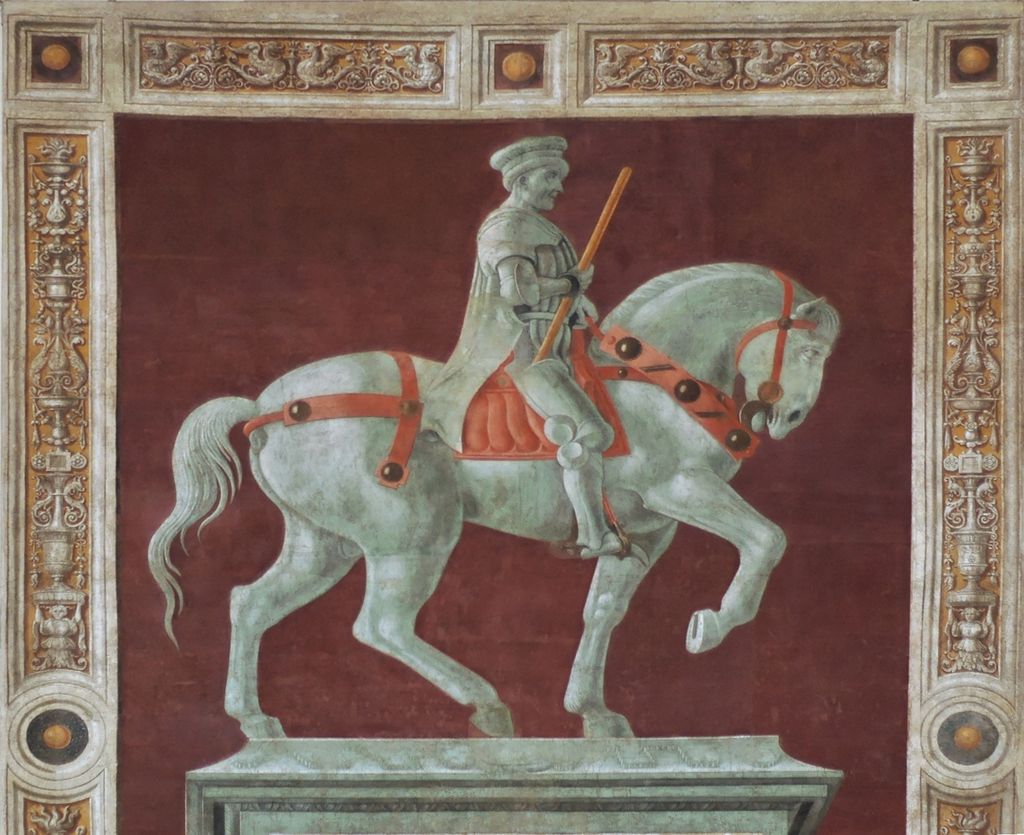
The rider and horse in Uccello’s monument to John Hawkwood, above the painted sarcophagus. Image source. Public domain.
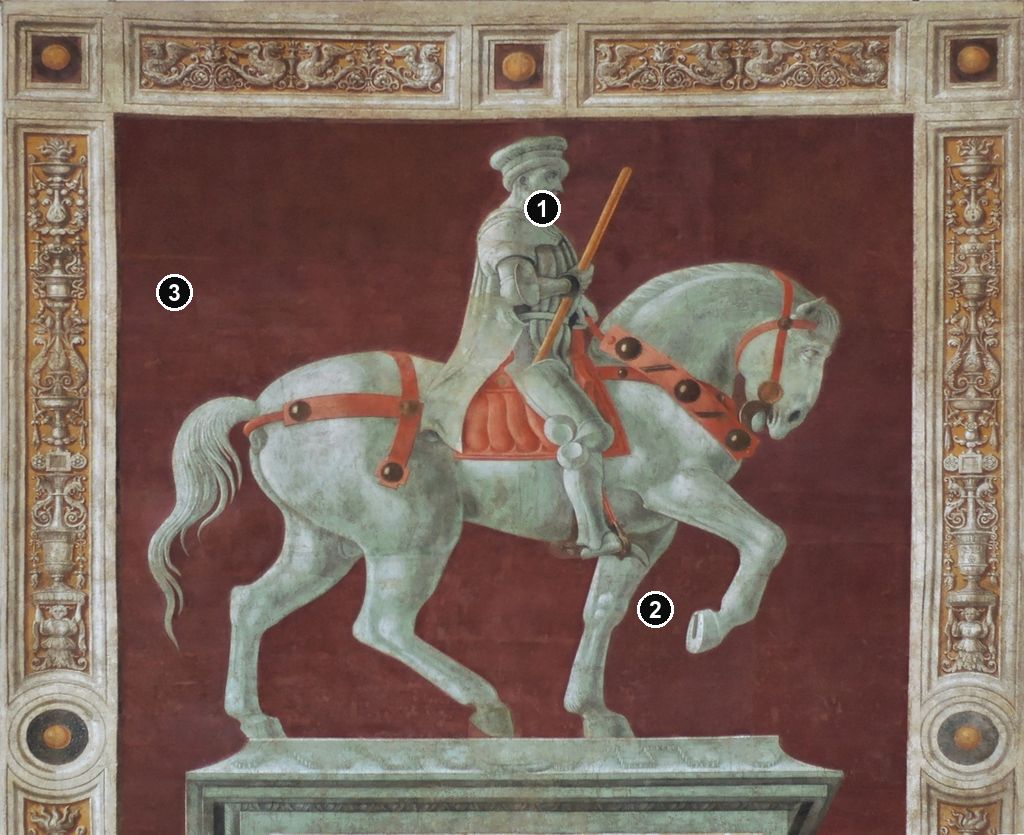
Annotated Details from Funerary Monument to Sir John Hawkwood
The numbered points identify visible features discussed in this article. Return from each detail to the numbered overview. The rider and horse in Uccello’s monument to John Hawkwood, above the painted sarcophagus. Image source. Public domain.
Details from FUNERARY MONUMENT TO SIR JOHN HAWKWOOD
Compare the cropped details with the source images above. Notice how their colours, shapes and positions contribute to the larger compositions.
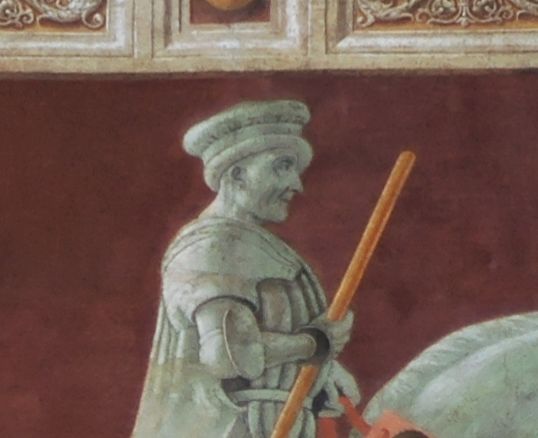
The captain’s face and baton
Hawkwood looks ahead and raises his baton. The baton’s angle breaks the otherwise upright line of his body.
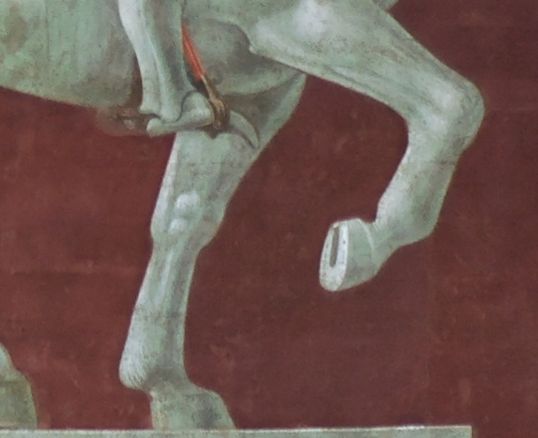
Pale legs, angled hooves
The horse stands above the painted sarcophagus. A raised forehoof turns in profile while the planted foreleg braces the pale body over the ledge.
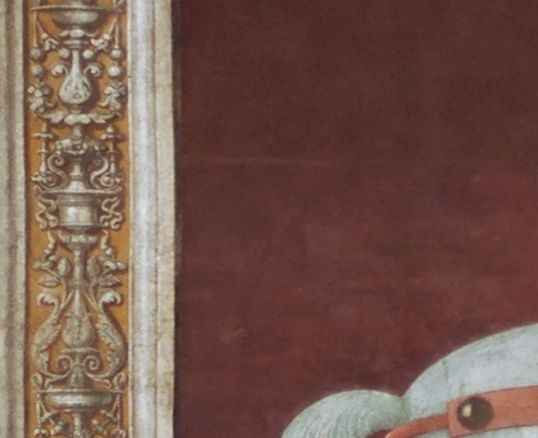
Frame and painted background
The ornamental border now encloses the horse and the red field. Its band of decoration belongs to the monument’s later framing history.
Why Florence remembered an English captain
The Florentines called Hawkwood Giovanni Acuto. He came from Sible Hedingham in Essex and fought in France before earning a living as a condottiere, a captain hired under contract, in Italy. His relationship with Florence changed sharply over his career. He had threatened the city in the service of Pisa in the 1360s. He also worked for the Visconti of Milan and in 1377 married Donnina, a daughter of Bernabò Visconti. By the early 1390s the Florentines were employing him against Gian Galeazzo Visconti, offering generous pay and citizenship for him and his male descendants. Hudson points out that Hawkwood’s value to Florence lay as much in preserving its position as in winning battles. His successful withdrawal across the Oglio became one of the exploits for which he was remembered. [3] [5]
In 1393 the Florentine government proposed a marble monument while Hawkwood was still alive. He died in Florence in March 1394 and received a public funeral, with a procession from the Piazza della Signoria and burial in the cathedral. Richard II subsequently asked for his remains. Florence consented, and the Opera’s account has the remains going back to England. The historian William Caferro distinguishes permission to move them from proof that the move took place. There is a memorial to Hawkwood in the parish church at Sible Hedingham as well. Uccello’s fresco is a cenotaph, a commemorative monument with a painted sarcophagus. The question of where Hawkwood’s remains ended up belongs to the history of his burial. [1] [3] [5]
Agnolo Gaddi and Giuliano d’Arrigo, known as Pesello, painted an earlier memorial in the cathedral in 1395. In July 1433 the Opera, the body charged with administering the cathedral works, advertised for designs for a new monument. The earlier fresco may have deteriorated or seemed out of place amid the cathedral renovations. Hudson also sees a civic motive. The competition came amid dissatisfaction with Florence’s recent war against Lucca, when honouring a commander remembered for his prudence would have had a pointed contemporary appeal. Supporters of the Albizzi were influential at the Opera in 1433. By the time the commission went to Uccello, Cosimo de’ Medici had returned from exile and the membership had shifted. The fact that the project survived that change helps explain why Hudson reads it through the overlapping interests of the city and the cathedral administration. [3] [6]
The commission and the horse painted twice
The cathedral records pick up the project again on 18 May 1436 with an order to repaint the figure. On 26 May the Opera authorised the monument in line with instructions from the councils of the Popolo and Commune of Florence. Four days later it hired Paolo Uccello to paint Hawkwood in green earth where the earlier figure had stood. The civic order and the painter’s contract were two separate decisions, and the colour was specified from the start. On 28 June the officials, acting with their master of works, decided to have the part representing the horse and rider erased. On 6 July they ordered the group painted again. The surviving record makes their dissatisfaction plain and leaves its precise cause open. [3] [6] [7]
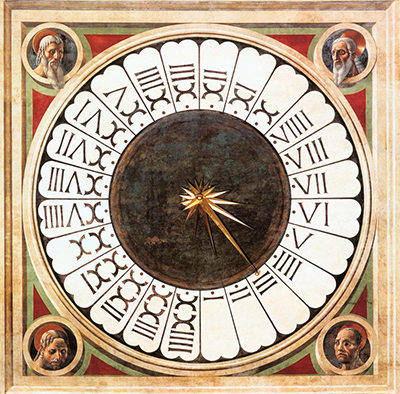
Several officials changed during those weeks. Neri di Gino Capponi joined in June. He had helped direct the war against Lucca and had clashed with Rinaldo degli Albizzi over its conduct before drawing closer to the Medici. Hudson suggests that Capponi may have supported a less overtly martial image. The chronology makes that possible, but the records assign him no personal instruction to the artist. The Opera later brought Uccello back to paint the cathedral clock face and commissioned designs for its stained glass, including the Resurrection. In Hudson’s reading, these commissions and their own adjustments make the Hawkwood revision part of a continuing working relationship. [3]
The revised monument was substantially finished for the blessing of Brunelleschi’s dome on 30 August. On 31 August two recently appointed officials, Francesco Strozzi and Simone Bonacorsi, valued Uccello’s work, and he was paid that day. The Opera’s restoration account records an additional 64 lire for the labour of painting the horse and rider twice. On 17 December the Opera ordered a further change, this time to the inscription, under the direction of Bartolomeo Fortini. The surviving order leaves open both the wording replaced in December and the identity of the painter who put the new words on the wall. [3] [7]
What the Uffizi sheet reveals
The small working design, Uffizi inventory 31 F, shows a horse and rider above a sarcophagus. The Uffizi records lead white and a grid drawn with a stylus on prepared paper, with a question mark against the identification of the drawing medium as silverpoint. X-rays of the sheet helped Lorenza Melli work out how the paper had been cut and reassembled. Ultraviolet photography helped recover an earlier design under the visible image. The captain first wore armour from head to foot. In the revision he appears shorter, his legs sit less far forward, and a captain’s hat and cloth garments take the place of some of the armour. Uccello altered the reins and the position of a rear hoof and gave the sarcophagus a steeper view from below. The revised lines on this sheet bring us closer to the picture made for the cathedral. They offer a way to imagine the first design without assuming it survives intact beneath the mural. [3] [8] [9]
The squares on the paper are about 25.5 millimetres across. By comparing the outlines at the same scale, Melli calculated that the design was enlarged about 10.7 times. Anna Luce Sicurezza reported corresponding grid traces on the mural, including near Hawkwood’s knee. There is room for disagreement about individual marks. Melli interpreted a much-discussed vertical line through the centre as a joint in the nineteenth-century support. She also suggested that parts of the first group could have been painted over on dry plaster, despite the order to erase the figure. The paper records revisions quite securely. The method used to rework the wall is less certain. The drawings survey places this working study alongside sheets with different purposes and histories of attribution. [3] [8] [9] [10]
What the two inscriptions say
On the painted base, PAVLI VGIELLI OPVS identifies the work as Uccello’s. The longer inscription on the sarcophagus names Hawkwood as a British knight and praises him as an exceptionally prudent commander and an expert in war. The difference is visible in the lettering as well as the content. Paul Stiff finds the signature’s antique forms more convincing than those of the longer text. He suggests the narrow letters of the epitaph could help keep them tall enough to read from below. Outi Merisalo describes the inscription’s comparatively regular, serifed capitals as part of a developing Florentine practice of lettering in the antique manner on stone, metal and fresco. [2] [11] [12]
Stiff traces the praise of Hawkwood to an ancient inscription for Quintus Fabius Maximus discovered at Arezzo. Fabius was celebrated in time for wearing down Hannibal through delay and restraint. The choice of model gave a familiar form of civic praise a strong claim about the qualities Florence valued in a commander. Hudson connects that claim with the horse’s measured pace. Vasari later took exception to the pair of raised legs, while some specialists have read the position as an amble. The pose may have invited a comparison with the famous deliberation of Fabius. The allusion in the Latin is much more secure than any reading of the horse’s gait as a deliberate emblem. [3] [11]
The companion monument and the life of the surface
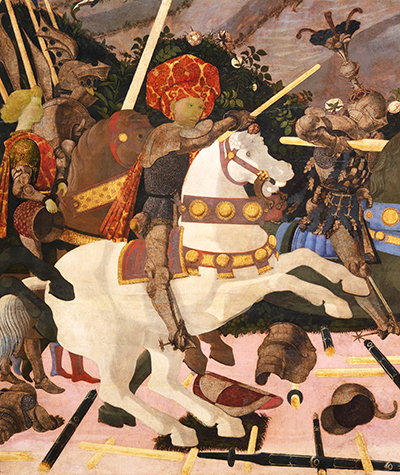
Andrea del Castagno’s Monument to Niccolò da Tolentino, completed in 1456, occupies its own bay beside Uccello’s. The commission expressly called for a memorial modelled on Hawkwood’s. Castagno retained the high sarcophagus and mounted captain, adding small shield bearers, richer colour and ornament, and a more markedly foreshortened horse and rider. Niccolò is also the commander Uccello placed at the head of the Florentine cavalry in the London panel of the Battle of San Romano. In the cathedral he belongs to Castagno’s separate fresco. Comparing the two at their actual height brings out how much Uccello’s side view preserves the unbroken line from the horse’s head through the raised baton and back to the tail. [4] [7] [13]
The elaborate painted border of the Hawkwood monument belongs to a later phase. Its candelabra and fantastic creatures are associated with Lorenzo di Credi’s documented restoration of 1524. The Opera credits him with the border. Hudson notes that the frame’s authorship is unrecorded and that its style is consistent with his work. The two frescoes were refreshed in 1688. In 1842 Giovanni Rizzoli detached them from the wall and transferred them to canvas. Antonio Marini carried out extensive restoration and they went on display on the entrance wall, where they remained until the mid-1940s. In the 1950s Dino Dini removed some earlier retouching and mounted the paintings on rigid supports. Daniela Dini treated them again in 2000. [1] [3] [7] [13]
The paintings returned to the north aisle in the twentieth century. Hans-Ernst Mittig used descriptions of the cathedral to identify the strip of wall where Hawkwood originally hung. He estimated that the picture had once been roughly a person’s height higher by extending the receding edges of the painted base to their meeting point. On the reinstalled work, those lines met at about floor level. The original mounting height is undocumented, but the experiment suggests just how much the impression of a ledge projecting into the aisle depends on the height of the picture. [14]
The Opera’s joint conservation campaign began in late May 2022 and the paintings were visible without scaffolding again from 17 December. The works were in fairly good condition but a film of dust and pollution had dulled both surfaces. Daniela Dini’s team removed superficial dust with soft brushes, cleaned more ingrained deposits with deionised water through Japanese paper, and made small adjustments to the tone of losses while preserving as much of the previous retouching as possible. The work made the surviving contrasts more legible. The dark brackets, pale modelling and red field are worth looking at again from below, where Uccello devised them to work together. [7]
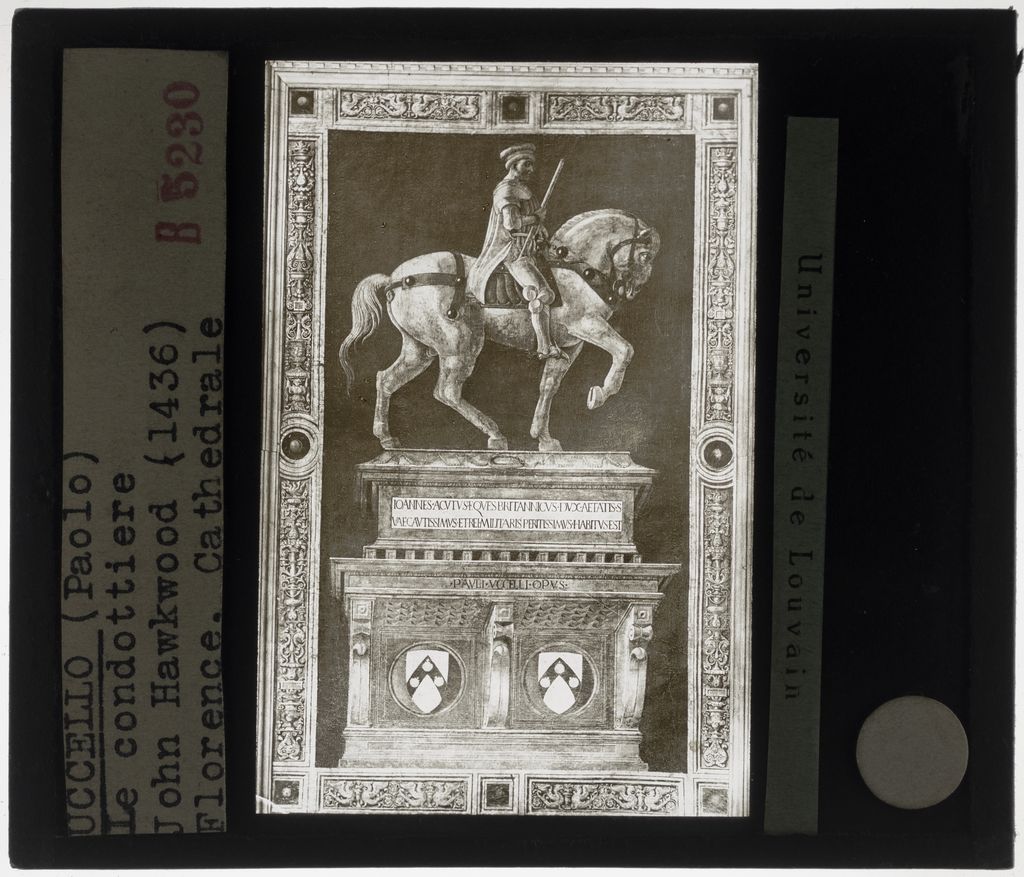
An archival photograph of the complete Hawkwood monument, including the painted frame, on its original photographic mount. Image source. Public domain.
Artworks directory
Browse paintings, drawings, stained-glass designs and other objects connected with Uccello. Cycles and their surviving components may have separate entries. The collection or catalogue’s wording is retained where a date, attribution or subject is debated.
| Name | Date | Medium, attribution and collection |
|---|---|---|
| Niccolò da Tolentino at the Battle of San Romano · London | Probably c.1438–40 | Tempera and oil on wood, with metallic decoration · National Gallery Catalogue. |
| Bernardino della Carda Unhorsed · Florence | c.1435–40 | Tempera on panel · Uffizi Galleries Catalogue. |
| The Counterattack of Micheletto da Cotignola · Paris | 1450–75 in the Louvre catalogue | Tempera (possibly) on wood · Musée du Louvre Catalogue. |
| The Hunt in the Forest | c.1465–70 | Tempera and oil with traces of gold on panel · Ashmolean Catalogue. |
| Saint George and the Dragon · London | c.1470 | Oil on canvas · National Gallery Catalogue. |
| Saint George Slaying the Dragon · Melbourne | c.1430 | Oil, tempera and silver leaf on wood · National Gallery of Victoria Catalogue. |
| Saint George and the Dragon · Paris | 1430–35 in the museum catalogue | Painted wood panel · Musée Jacquemart-André Catalogue. |
| Equestrian Monument to John Hawkwood | 1436 | Transferred wall painting · Florence Cathedral Catalogue. |
| Study for the John Hawkwood Monument | 1436 | Study on prepared paper · Uffizi Catalogue. |
| Monumental Clock Face | 1443 | Painted dial · Florence Cathedral Catalogue. |
| Resurrection of Christ | 1443–44 | Stained glass · Uccello design · Florence Cathedral Catalogue. |
| Nativity | 1440s | Stained glass · Uccello design · Florence Cathedral Catalogue. |
| Creation of the Animals and Creation of Adam | Third to fourth decade of the 15th century | Detached fresco · Green Cloister, Santa Maria Novella Catalogue. |
| Creation of Eve and the Fall | Third to fourth decade of the 15th century | Detached fresco · Green Cloister, Santa Maria Novella Catalogue. |
| Flood and Recession of the Waters | 15th century; dating debated | Detached fresco · Green Cloister, Santa Maria Novella Catalogue. |
| Sacrifice and Drunkenness of Noah | 15th century; dating debated | Detached fresco · Green Cloister, Santa Maria Novella Catalogue. |
| Stories of the Virgin and Saint Stephen · Assunta Chapel | 1430s, with later completion | Fresco cycle · Paolo Uccello and Andrea di Giusto · Prato Cathedral Catalogue. |
| Blessed Jacopone da Todi | 1436 in the diocesan museum | Detached fresco · Museo dell’Opera del Duomo, Prato Catalogue. |
| Adoration of the Child · Bologna | 1430s; inscription incomplete | Detached fresco · San Martino Maggiore, Bologna Catalogue. |
| Adoration of the Christ Child · Karlsruhe | c.1436 | Painted panel · Attribution to Uccello · Staatliche Kunsthalle Karlsruhe Catalogue. |
| Annunciation · Oxford | Early 15th century | Tempera and gilding on panel · Ashmolean Catalogue. |
| Allegory of Monastic Life (Thebaid) | c.1460–65 | Tempera on canvas · Galleria dell’Accademia, Florence Catalogue. |
| Miracle of the Profaned Host | 1467–68 | Tempera on wood · Galleria Nazionale delle Marche, Urbino Catalogue. |
| Triumphal Entry into Rome of Titus and Vespasian(?) | c.1430–35 | Tempera, gold and silver on panel · Yale University Art Gallery Catalogue. |
| Crucifixion with the Virgin and Saints | c.1460–65 | Painted panel · Museo Nacional Thyssen-Bornemisza Catalogue. |
| The Crucifixion · Met triptych | Probably mid-1450s | Tempera on wood with gold ground · Metropolitan Museum of Art Catalogue. |
| Perspective Study of a Chalice | 1450–75 | Pen, ink and stylus on paper · Attributed to Uccello · Uffizi Catalogue. |
| Study of a Mazzocchio | 15th century | Perspective study · Attributed to Uccello · Uffizi Catalogue. |
| Mazzocchio Seen in Perspective | Uncertain | Drawing · Attribution debated · Musée du Louvre Catalogue. |
| Head of a Man in Profile | 15th century | Pen, ink and wash · Musée du Louvre Catalogue. |
| Five Masters of the Florentine Renaissance | 1500–50 | Oil on wood · Anonymous Florentine school · Musée du Louvre Catalogue. |
| Madonna and Child from the Del Beccuto House | 15th century | Detached fresco · Museo di San Marco, Florence Catalogue. |
| Man of Sorrows with the Virgin and Saint John · Avane Predella | 15th century | Predella · Museo di San Marco, Florence Catalogue. |
| Calling of Saint Paul the Hermit · San Miniato | After 1447 to c.1454 in state catalogue | Sinopia · Attributed to Uccello or collaborator Catalogue. |
| The host changes hands · Urbino predella, scene 1 | 1467–68 | Tempera on wood · Component of DE 231 · Galleria Nazionale delle Marche Catalogue. |
| The figures at the door · Urbino predella, scene 2 | 1467–68 | Tempera on wood · Component of DE 231 · Galleria Nazionale delle Marche Catalogue. |
| The procession approaches the altar · Urbino predella, scene 3 | 1467–68 | Tempera on wood · Component of DE 231 · Galleria Nazionale delle Marche Catalogue. |
| The condemned woman and the ladders · Urbino predella, scene 4 | 1467–68 | Tempera on wood · Component of DE 231 · Galleria Nazionale delle Marche Catalogue. |
| Persecution of the family · Urbino predella, scene 5 | 1467–68 | Tempera on wood · Component of DE 231 · Galleria Nazionale delle Marche Catalogue. |
| Angels and demons at the bier · Urbino predella, scene 6 | 1467–68 | Tempera on wood · Component of DE 231 · Galleria Nazionale delle Marche Catalogue. |
| Birth of the Virgin · Prato Cathedral | 1430s; dating debated | Fresco · Assunta Chapel, Prato Cathedral Catalogue. |
| Presentation of the Virgin · Prato Cathedral | 1430s; dating debated | Fresco · Assunta Chapel, Prato Cathedral Catalogue. |
Discussion
Look again at the images and ideas explored in Funerary Monument to Sir John Hawkwood. These editorial prompts invite your observations.
Reader Insights
How does your impression of Hawkwood change as you look up from the brackets and sarcophagus to the horse and rider?
Hawkwood’s epitaph praises prudence, while his raised baton marks him as a commander. Which details of the horse’s pace and the rider’s posture seem to convey restraint?
Join the Conversation
Share a detail, comparison or question about Funerary Monument to Sir John Hawkwood below.
References
- Opera di Santa Maria del Fiore. Paolo Uccello, Monumento a Giovanni Acuto, cathedral object entry. View source.
- Opera di Santa Maria del Fiore. Monumento a Giovanni Acuto, scientific catalogue entry 7030, inscriptions and heraldry. View source.
- Hugh Hudson. “The Politics of War: Paolo Uccello’s Equestrian Monument for Sir John Hawkwood in the Cathedral of Florence.” Parergon 23, no. 2, 2006, pp. 1–28 and appendix. View source.
- Eiichi Saitō. “ジョン・ホークウッド騎馬像におけるウッチェロの革新性” [Uccello’s innovations in the equestrian monument to John Hawkwood], pp. 31–38, especially pp. 35–37. View source.
- William Caferro. “Hawkwood, John (Giovanni Acuto).” Dizionario Biografico degli Italiani, vol. 61, 2004. View source.
- Opera di Santa Maria del Fiore and Max Planck Institute for the History of Science. Gli anni della Cupola, register II.2.1, deliberations of 18, 26 and 30 May, 28 June and 6 July 1436. View source.
- Opera di Santa Maria del Fiore. “The restoration of the two legendary leaders of Paolo Uccello and Andrea del Castagno in the Cathedral of Florence has been completed,” 5 December 2022. View source.
- Gallerie degli Uffizi. Opere inamovibili, entry for Studio per l’affresco col monumento equestre a Giovanni Acuto, inv. 31 F. View source.
- Lorenza Melli. “Nuove indagini sui disegni di Paolo Uccello agli Uffizi: disegno sottostante, tecnica, funzione.” Mitteilungen des Kunsthistorischen Institutes in Florenz 42, no. 1, 1998, especially pp. 1–15 and figs. 5, 8, 9 and 13. View source.
- Anna Luce Sicurezza. “Procedure disegnative nella pittura murale di primo Quattrocento.” Materiali e tecniche nella pittura murale del Quattrocento, vol. I, ENEA, especially n. 45. View source.
- Paul Stiff. “Brunelleschi’s epitaph and the design of public letters in fifteenth-century Florence.” Typography papers 6, 2005, pp. 66–114, especially pp. 95–96 and fig. 59. View source.
- Outi Merisalo. “Lettering the Might: Remarks on the Palaeography of the Inscriptions on the Fifteenth-century Medici Tombs in the Basilica of S. Lorenzo.” Nordic Journal of Renaissance Studies 21, 2023, especially p. 12 and fig. 4. View source.
- Opera di Santa Maria del Fiore. Andrea del Castagno, Monumento a Niccolò da Tolentino, cathedral object entry. View source.
- Hans-Ernst Mittig. “Uccellos Hawkwood-Fresko: Platz und Wirkung.” Mitteilungen des Kunsthistorischen Institutes in Florenz 14, no. 2, 1969, pp. 235–239. View source.
More PAOLO UCCELLO Artworks

Noah and the Flood
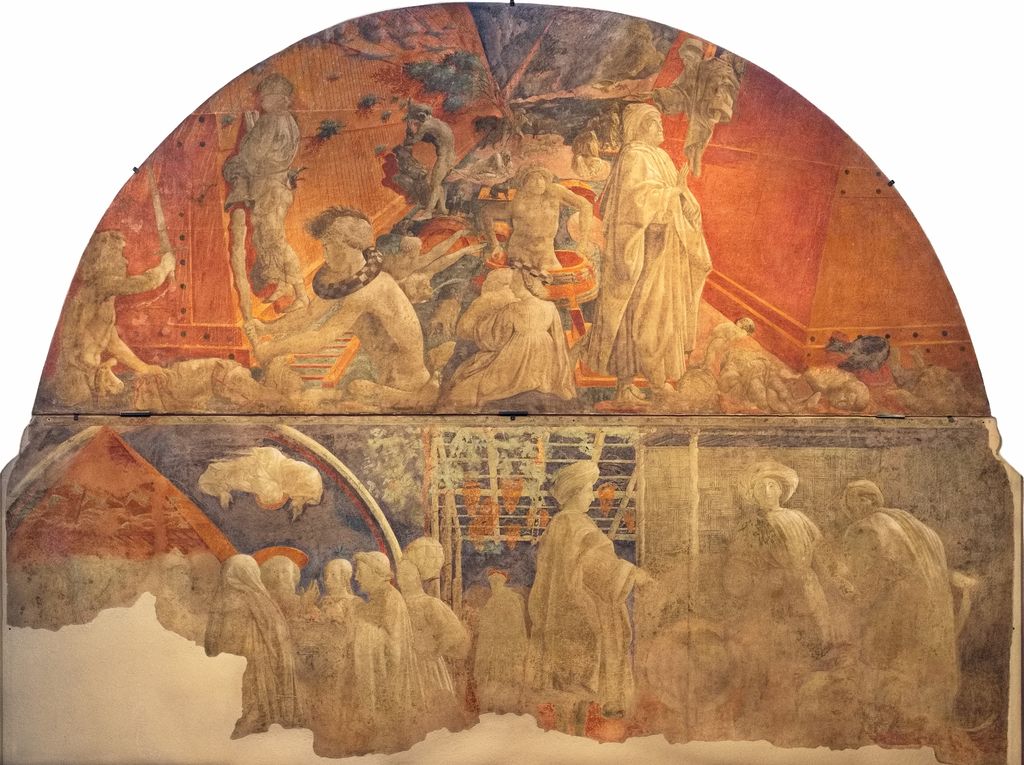
The Flood and Recession of the Waters above the lower episodes from Noah’s story, Santa Maria Novella. Photograph by Armin Kleiner. Image source. CC BY-SA 4.0. Resized for the web. This derivative is available under the same licence.
The Resurrection of Christ Stained Glass Window
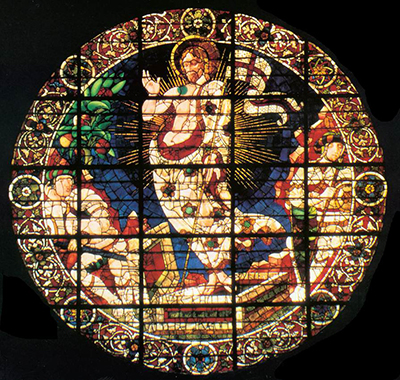
The Resurrection window in Florence Cathedral, designed by Paolo Uccello and made by Bernardo di Francesco. Photograph by Sailko. Image source. CC BY 3.0. Resized for the web.