


 by Tom Gurney
Tom Gurney BSc (Hons) is an art history expert with over 20 years experience
Published on June 19, 2020 / Updated on November 29, 2026
Email: tomgurney1@gmail.com / Phone: +44 7429 011000
Five Masters of the Florentine Renaissance: Introduction
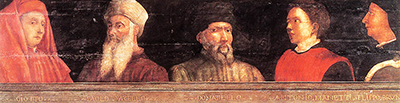
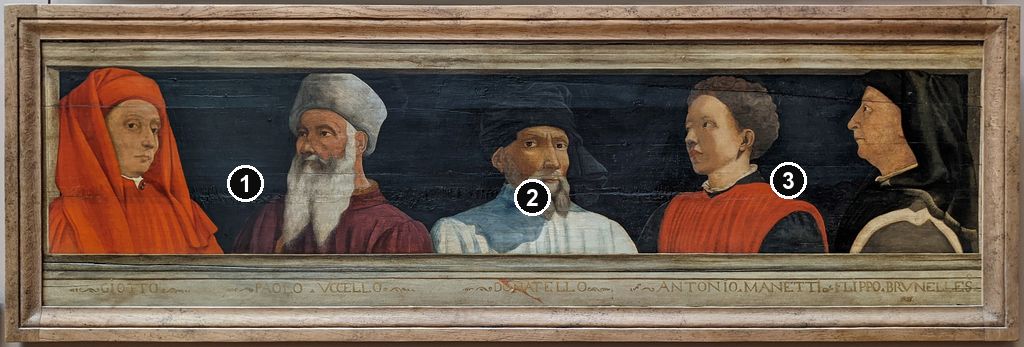
Donatello stands at the centre of a row of five men, his pale blue garment catching the light against a nearly black background. To his left, Paolo Uccello’s long white beard divides in two over his purple robe. To his right, a young-looking Antonio Manetti turns his head towards the middle of the group. At either end are two of the most famous names in Florentine art, Giotto and Filippo Brunelleschi. The Louvre dates this oil painting on wood to the first half of the sixteenth century. It was long attributed to Uccello, but the museum now catalogues it as the work of an anonymous Florentine painter. [1] [2]
At a Glance
- Maker and dateAnonymous Florentine painter, 1500–1550
- Medium and dimensionsOil on wood, 66 × 210 cm
- CollectionMusée du Louvre, Paris, INV 267 / LP 6905
Contents
- Five faces in a single row
- The Antonio Manetti in red
- The panel Vasari described
- Remembering the makers of Florence
- From a supposed self-portrait to an anonymous painting
- Annotated details
Five faces in a single row
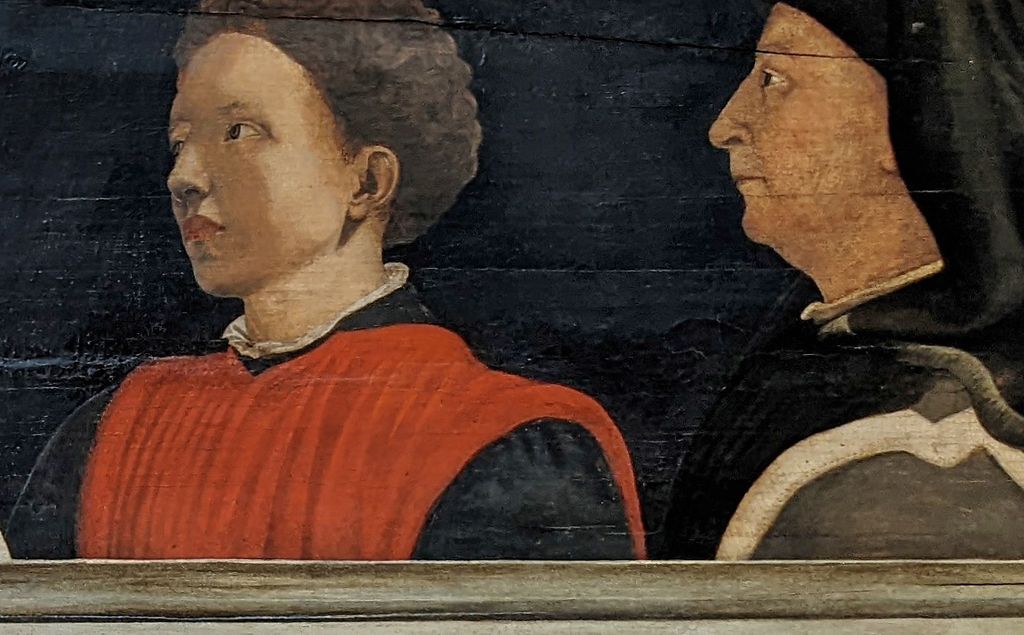
At 66 centimetres high and 210 wide, the panel is more than three times as wide as it is tall. The upper part of the picture barely clears the caps. At the bottom, one straight edge cuts across all five busts. Look along that edge and the men seem to stand at the same level. Move up to their faces and the easy regularity breaks. Giotto turns inwards in his orange-red hood, sending a glance towards us. Uccello looks left. Donatello shows more of his face and meets our gaze directly. Manetti turns towards Donatello, showing one cheek in full, and at the far right Brunelleschi’s nose and chin make an unbroken profile against the dark. [1]
The colours help hold these different poses together. Giotto’s hood makes a large, bright shape at one end, and Manetti’s red garment picks up some of its warmth across the picture. The pale cap and beard of Uccello lead to the light on Donatello’s chest. At the right, Brunelleschi’s black head covering nearly merges with the background, but a pale curve outlines his shoulder. With no hands or tools in view, the turns of the heads do much of the work of distinguishing one man from another. The shallow appearance of the space makes each face especially easy to pick out. [1] [2]
The names run in capitals on the narrow painted strip below the busts. The last reads in abbreviated form as Filippo Brunelleschi. The Institut national d’histoire de l’art (INHA) transcribes all five names in the order in which they appear. Scholars have treated the inscriptions as later additions, so there is a distinction between the names attached to the faces and the sources a painter might have used for them. Art historian Jenő Lányi, for instance, proposed that the head labelled Giotto might ultimately derive from a lost self-portrait by Masaccio. That conjecture shows how far a model for a face and the identity it came to carry can diverge. The Louvre’s dating places the finished group after the lives of the men it commemorates. [1] [2] [3] [4]
The Antonio Manetti in red
Manetti looks younger than the men beside him. His short, uncovered hair makes him particularly easy to spot between the darker head coverings of Donatello and Brunelleschi. His inscription gives the first name Antonio, but two Florentines have been proposed for the likeness. Giuliano Tanturli identifies him with Antonio di Tuccio Manetti, who wrote a life of Brunelleschi. That Manetti copied texts on astronomy and other learned subjects from a young age. He also wrote about Brunelleschi’s experiments with perspective, one reason the idea of a writer with mathematical interests standing with these particular artists has appealed to readers. [2] [4] [5]
Lányi proposed a different Antonio, the woodworker and architect Antonio di Manetto Ciaccheri. Dario Donetti takes up that identification in his study of the Sangallo family. Ciaccheri made models for the cathedral works and later helped carry forward Brunelleschi’s project for the lantern. His presence would give the group another direct connection to the building of Florence Cathedral. The inscription can accommodate either name. A further complication is that Giorgio Vasari used Antonio in one account of a similar group and Giovanni in another. Neither the youthful face nor Vasari’s wording settles which Antonio the Louvre picture represents. [3] [5] [6] [7] [8]
Annotated Details from Five Masters of the Florentine Renaissance
The numbered points identify visible features discussed in this article. Return from each detail to the numbered overview. Five Masters of the Florentine Renaissance, anonymous Florentine school, Musée du Louvre INV 267. Image source. CC0 / Public domain.
Details from FIVE MASTERS OF THE FLORENTINE RENAISSANCE
Compare the cropped details with the source images above. Notice how their colours, shapes and positions contribute to the larger compositions.
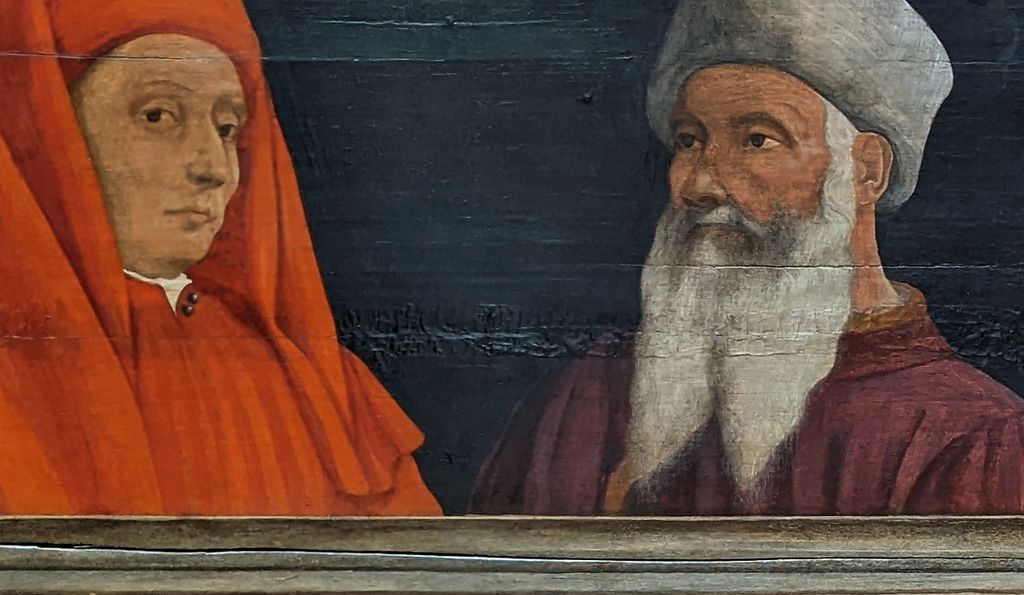
Giotto and Uccello
The two faces occupy adjacent fields, with strong differences in headwear and facial hair. The formal presentation encourages comparison across the row.
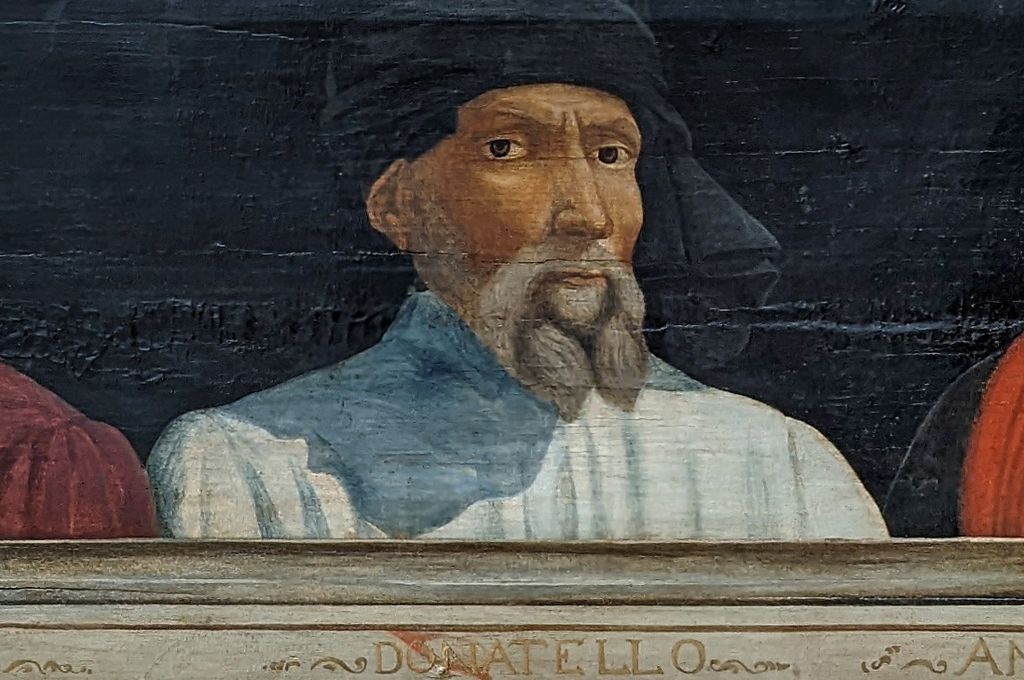
Donatello in the centre
The frontal presentation stands between faces turned to different degrees. The clothes and the angle of the eyes set this likeness apart.
Manetti and Brunelleschi
Look at the orientation of the two heads on the right. The final profile closes a row in which the figures face in more than one direction.
The panel Vasari described
In the first edition of his Lives, published in 1550, Vasari placed a panel of five portraits in the Florentine house of the architect Giuliano da Sangallo and described it as Masaccio’s work. Giotto stood for the beginnings of painting, Donatello for sculpture and Brunelleschi for architecture. Uccello represented perspective and the painting of animals, and Antonio Manetti represented mathematics. Vasari saw the choice of heads as a declaration of whose work had advanced the arts. His account explains the company of names even though the painted figures carry no objects to tell us their occupations. [7]
In his 1568 life of Uccello, Vasari gave the story a more personal turn. He said that Uccello painted the five men on a long panel and kept it in his house to preserve their memory. In this account the image of Uccello was a self-portrait, and Manetti, whom Vasari called Giovanni, was a friend with whom the painter discussed Euclid. The order in which Vasari named the men also differed from the order of the portraits in Paris. The accounts make the resemblance between the two panels worth taking seriously, especially given the uncommon combination of names. INHA describes the object in Vasari’s text as comparable to the Louvre painting. The stories alone leave the identification open. [1] [2] [7] [8]
Donetti and Duncan Bull have linked the Louvre painting to an eighteenth-century Strozzi inventory entry. It describes a long wooden picture intended for display above a door, with five heads thought to represent the men responsible for Florence Cathedral. It is an intriguing lead about how such a long panel may have been used and understood. The description fits its format and the subjects’ ties to the cathedral. The original commission and setting remain uncertain. [3]
Remembering the makers of Florence
In Florence Cathedral itself, portraits commemorate both the men who built it and the people whose work filled it. After Brunelleschi died in 1446, the cathedral authorities commissioned a monument from his adopted son and pupil Andrea Cavalcanti, known as Buggiano. A marble likeness sits within a circular surround above an epitaph by the humanist Carlo Marsuppini. The cathedral suggests that Buggiano may have drawn on a death mask as well as his own memory. The monument became a model for Benedetto da Maiano’s memorial to Giotto, commissioned by Lorenzo de’ Medici around 1490. Giotto appears at work on a mosaic of Christ, with words by Angelo Poliziano below. In one case the sculptor had known his subject. In the other, Florence was fashioning an image of an artist who had died more than a century earlier. [9] [10] [11]
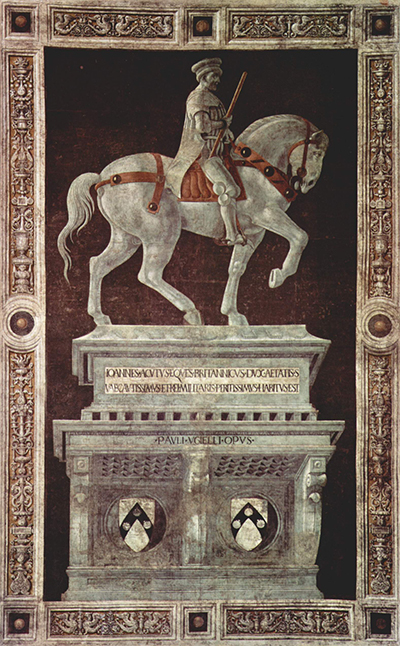
Uccello’s own work belongs to that tradition of public commemoration. His Funerary Monument to Sir John Hawkwood turns paint on a cathedral wall into the likeness of an equestrian monument. Donatello’s tie to the building is visible in his marble singing gallery, whose dancing children once looked down from above a sacristy. If the fourth face is Ciaccheri’s, it brings a maker of architectural models into the company of these better-known figures. If it is Antonio di Tuccio, it gives a place to someone who helped preserve Brunelleschi’s achievements in writing. Either reading helps explain why the unassuming figure in red changes the meaning of the group. [3] [5] [6] [12] [13]
A version of the group portrait at the Fitzwilliam Museum in Cambridge shows how easily the company could be revised. The smaller painting on canvas, attributed to Francesco Salviati, keeps Giotto, Donatello and Brunelleschi and brings in Michelangelo and Raphael. Donetti also connects four of the likenesses in the Louvre panel to woodcut portraits in the 1568 Lives and to the frieze of artists in Vasari’s Florentine house. The long row could be adapted for a new painting, and the individual heads could be used on their own. Uccello’s forked beard, for example, remains easy to recognise in the printed portrait that heads his biography. [3] [14] [15]
From a supposed self-portrait to an anonymous painting
The Louvre bought the panel at the Stevens sale in March 1847, where it was listed as Uccello. An early twentieth-century guide by Paul G. Konody and Maurice W. Brockwell still presented it under his name and quoted Vasari to explain the five figures. The number 1272 in that guide was an old catalogue number. The Louvre now identifies the work as INV 267, also LP 6905. France’s Joconde record preserves earlier attributions and records John Pope-Hennessy’s suggestion that a fifteenth-century work associated with Uccello’s art may have been repainted. Other proposals, discussed by Donetti, place the painting itself on either side of 1500. They give a sense of how closely the panel’s date has been debated, even as the possibility of older models for the heads remains open. [1] [3] [16] [17]
The older attribution gave Uccello a familiar face. In 1929 the poet Philippe Soupault opened his book on the painter with a reproduction of the bearded figure, presented as a self-portrait. Art historian Tessel M. Bauduin has also proposed that the panel helped inspire Antonin Artaud’s 1926 essay Uccello, le Poil, in which hair becomes a way to imagine the artist’s preoccupation with line. A face that had been painted to recall the past took on a new life in an account of the painter’s mind. [18]
The Louvre has included the panel in Renaissance at Louvre-Lens and in Figure d’artiste, an exhibition about the changing image of the artist. The museum lists it in the Salon Carré, where visitors can also see works by Giotto and Uccello, including Uccello’s Battle of San Romano panel. The pairing lets us see their work and then see how a later painter pictured the men who made it. [1] [19] [20]
Artworks directory
Browse paintings, drawings, stained-glass designs and other objects connected with Uccello. Cycles and their surviving components may have separate entries. The collection or catalogue’s wording is retained where a date, attribution or subject is debated.
| Name | Date | Medium, attribution and collection |
|---|---|---|
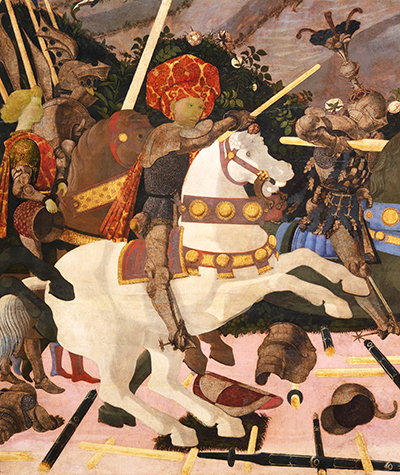
| Niccolò da Tolentino at the Battle of San Romano · London | Probably c.1438–40 | Tempera and oil on wood, with metallic decoration · National Gallery Catalogue. |
| Bernardino della Carda Unhorsed · Florence | c.1435–40 | Tempera on panel · Uffizi Galleries Catalogue. |
| The Counterattack of Micheletto da Cotignola · Paris | 1450–75 in the Louvre catalogue | Tempera (possibly) on wood · Musée du Louvre Catalogue. |
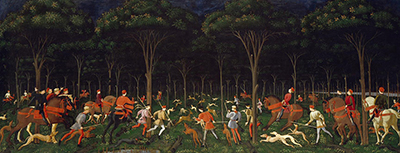
| The Hunt in the Forest | c.1465–70 | Tempera and oil with traces of gold on panel · Ashmolean Catalogue. |
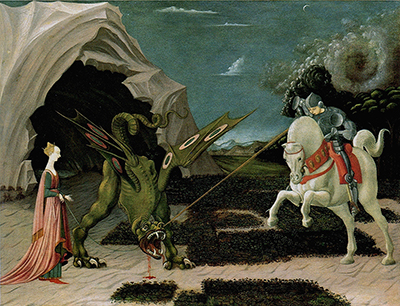
| Saint George and the Dragon · London | c.1470 | Oil on canvas · National Gallery Catalogue. |
| Saint George Slaying the Dragon · Melbourne | c.1430 | Oil, tempera and silver leaf on wood · National Gallery of Victoria Catalogue. |
| Saint George and the Dragon · Paris | 1430–35 in the museum catalogue | Painted wood panel · Musée Jacquemart-André Catalogue. |
| Equestrian Monument to John Hawkwood | 1436 | Transferred wall painting · Florence Cathedral Catalogue. |
| Study for the John Hawkwood Monument | 1436 | Study on prepared paper · Uffizi Catalogue. |
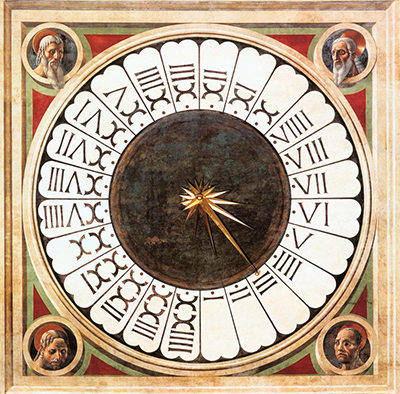
| Monumental Clock Face | 1443 | Painted dial · Florence Cathedral Catalogue. |
| Resurrection of Christ | 1443–44 | Stained glass · Uccello design · Florence Cathedral Catalogue. |
| Nativity | 1440s | Stained glass · Uccello design · Florence Cathedral Catalogue. |
| Creation of the Animals and Creation of Adam | Third to fourth decade of the 15th century | Detached fresco · Green Cloister, Santa Maria Novella Catalogue. |
| Creation of Eve and the Fall | Third to fourth decade of the 15th century | Detached fresco · Green Cloister, Santa Maria Novella Catalogue. |
| Flood and Recession of the Waters | 15th century; dating debated | Detached fresco · Green Cloister, Santa Maria Novella Catalogue. |
| Sacrifice and Drunkenness of Noah | 15th century; dating debated | Detached fresco · Green Cloister, Santa Maria Novella Catalogue. |
| Stories of the Virgin and Saint Stephen · Assunta Chapel | 1430s, with later completion | Fresco cycle · Paolo Uccello and Andrea di Giusto · Prato Cathedral Catalogue. |
| Blessed Jacopone da Todi | 1436 in the diocesan museum | Detached fresco · Museo dell’Opera del Duomo, Prato Catalogue. |
| Adoration of the Child · Bologna | 1430s; inscription incomplete | Detached fresco · San Martino Maggiore, Bologna Catalogue. |
| Adoration of the Christ Child · Karlsruhe | c.1436 | Painted panel · Attribution to Uccello · Staatliche Kunsthalle Karlsruhe Catalogue. |
| Annunciation · Oxford | Early 15th century | Tempera and gilding on panel · Ashmolean Catalogue. |
| Allegory of Monastic Life (Thebaid) | c.1460–65 | Tempera on canvas · Galleria dell’Accademia, Florence Catalogue. |
| Miracle of the Profaned Host | 1467–68 | Tempera on wood · Galleria Nazionale delle Marche, Urbino Catalogue. |
| Triumphal Entry into Rome of Titus and Vespasian(?) | c.1430–35 | Tempera, gold and silver on panel · Yale University Art Gallery Catalogue. |
| Crucifixion with the Virgin and Saints | c.1460–65 | Painted panel · Museo Nacional Thyssen-Bornemisza Catalogue. |
| The Crucifixion · Met triptych | Probably mid-1450s | Tempera on wood with gold ground · Metropolitan Museum of Art Catalogue. |
| Perspective Study of a Chalice | 1450–75 | Pen, ink and stylus on paper · Attributed to Uccello · Uffizi Catalogue. |
| Study of a Mazzocchio | 15th century | Perspective study · Attributed to Uccello · Uffizi Catalogue. |
| Mazzocchio Seen in Perspective | Uncertain | Drawing · Attribution debated · Musée du Louvre Catalogue. |
| Head of a Man in Profile | 15th century | Pen, ink and wash · Musée du Louvre Catalogue. |
| Five Masters of the Florentine Renaissance | 1500–50 | Oil on wood · Anonymous Florentine school · Musée du Louvre Catalogue. |
| Madonna and Child from the Del Beccuto House | 15th century | Detached fresco · Museo di San Marco, Florence Catalogue. |
| Man of Sorrows with the Virgin and Saint John · Avane Predella | 15th century | Predella · Museo di San Marco, Florence Catalogue. |
| Calling of Saint Paul the Hermit · San Miniato | After 1447 to c.1454 in state catalogue | Sinopia · Attributed to Uccello or collaborator Catalogue. |
| The host changes hands · Urbino predella, scene 1 | 1467–68 | Tempera on wood · Component of DE 231 · Galleria Nazionale delle Marche Catalogue. |
| The figures at the door · Urbino predella, scene 2 | 1467–68 | Tempera on wood · Component of DE 231 · Galleria Nazionale delle Marche Catalogue. |
| The procession approaches the altar · Urbino predella, scene 3 | 1467–68 | Tempera on wood · Component of DE 231 · Galleria Nazionale delle Marche Catalogue. |
| The condemned woman and the ladders · Urbino predella, scene 4 | 1467–68 | Tempera on wood · Component of DE 231 · Galleria Nazionale delle Marche Catalogue. |
| Persecution of the family · Urbino predella, scene 5 | 1467–68 | Tempera on wood · Component of DE 231 · Galleria Nazionale delle Marche Catalogue. |
| Angels and demons at the bier · Urbino predella, scene 6 | 1467–68 | Tempera on wood · Component of DE 231 · Galleria Nazionale delle Marche Catalogue. |
| Birth of the Virgin · Prato Cathedral | 1430s; dating debated | Fresco · Assunta Chapel, Prato Cathedral Catalogue. |
| Presentation of the Virgin · Prato Cathedral | 1430s; dating debated | Fresco · Assunta Chapel, Prato Cathedral Catalogue. |
Discussion
Look again at the images and ideas explored in Five Masters of the Florentine Renaissance. These editorial prompts invite your observations.
Reader Insights
How does Donatello’s direct gaze affect the way you read the other four men as a group?
What changes when the Cambridge version replaces Uccello and Manetti with Michelangelo and Raphael?
Join the Conversation
Share a detail, comparison or question about Five Masters of the Florentine Renaissance below.
References
- Musée du Louvre, Cinq maîtres de la Renaissance florentine : Giotto, Uccello, Donatello, Manetti, Brunelleschi, inv. INV 267 / LP 6905, collection record and photographs,. View source.
- Institut national d’histoire de l’art, Cinq maîtres de la Renaissance florentine : Giotto, Uccello, Donatello, Manetti, Brunelleschi, RETIF record,. View source.
- Dario Donetti, Francesco da Sangallo e l’identità dell’architettura toscana, 2020, chapter IV, especially pp. 93–95 and notes 36–42,. View source.
- Metapictor, Universität Innsbruck, La Sagra, research entry on Masaccio’s lost fresco and Jenő Lányi’s comparison with the Louvre panel,. View source.
- Giuliano Tanturli, Manetti, Antonio, Dizionario Biografico degli Italiani, vol. 68, 2007,. View source.
- Isabelle Hyman, Ciaccheri, Antonio, Dizionario Biografico degli Italiani, vol. 25, 1981,. View source.
- Giorgio Vasari, “Masaccio,” in Le vite de’ più eccellenti architetti, pittori, et scultori italiani, Florence, 1550,. View source.
- Giorgio Vasari, “Paulo Uccello,” in Le vite de’ più eccellenti pittori, scultori, et architettori, Florence, 1568, p. 273,. View source.
- Opera di Santa Maria del Fiore, Il Buggiano, Monumento funebre a Filippo Brunelleschi,. View source.
- Opera di Santa Maria del Fiore, Monumento funebre di Giotto di Bondone,. View source.
- Alexander Nagel, “Authorship and image-making in the monument to Giotto in Florence Cathedral,” RES: Anthropology and Aesthetics, nos. 53/54, 2008, pp. 143–151,. View source.
- Opera di Santa Maria del Fiore, La città e la sacralità, on monuments to illustrious figures in the cathedral,. View source.
- Opera di Santa Maria del Fiore, Donatello, Cantoria,. View source.
- The Fitzwilliam Museum, Portraits of five artists, Giotto, Donatello, Michelangelo, Raphael and Brunelleschi, inv. 1162,. View source.
- Metapictor, Universität Innsbruck, Uccello, Paolo, research entry comparing the Louvre likeness and the Vasari woodcut,. View source.
- Paul G. Konody and Maurice W. Brockwell, The Louvre: Fifty Plates in Colour, “The Early Renaissance,”. View source.
- Ministère de la Culture, Cinq maîtres de la Renaissance florentine, Joconde record 000PE027424,. View source.
- Tessel M. Bauduin, “Paolo Uccello in French Surrealism: Doubling Antonin Artaud,” RIHA Journal, 0296, 2023, especially paragraphs 21–24,. View source.
- Musée du Louvre, Figure d’artiste, exhibition overview,. View source.
- Musée du Louvre, Le Salon par excellence, guide to the Salon Carré,. View source.
More PAOLO UCCELLO Artworks

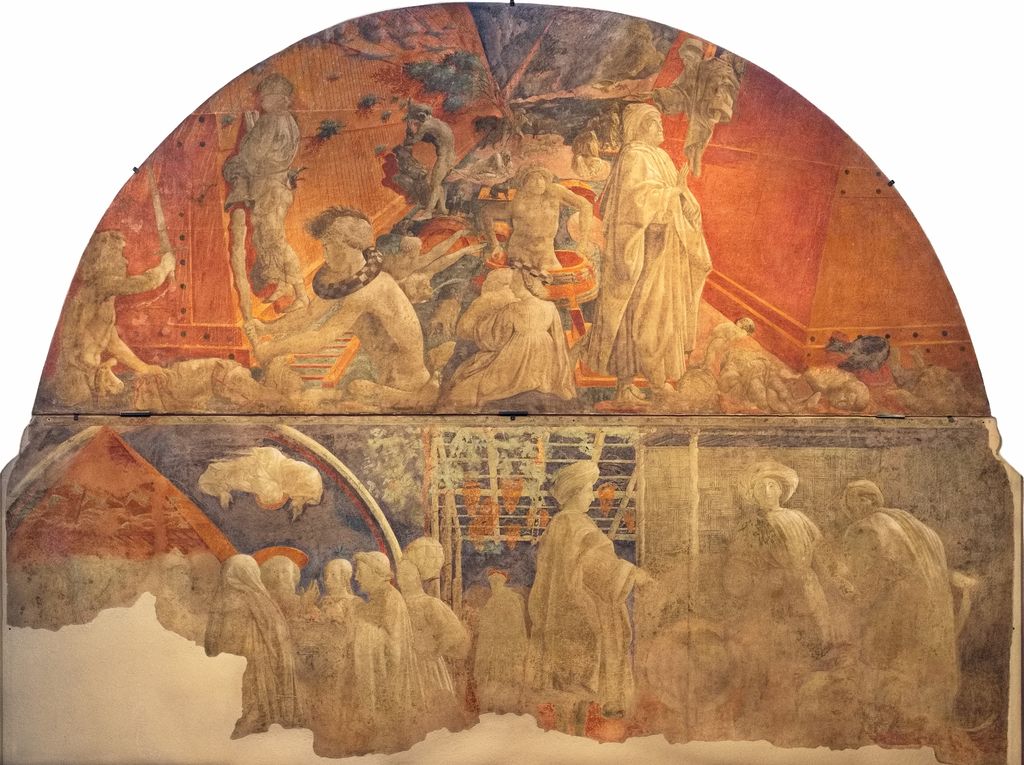
Noah and the Flood
The Flood and Recession of the Waters above the lower episodes from Noah’s story, Santa Maria Novella. Photograph by Armin Kleiner. Image source. CC BY-SA 4.0. Resized for the web. This derivative is available under the same licence.
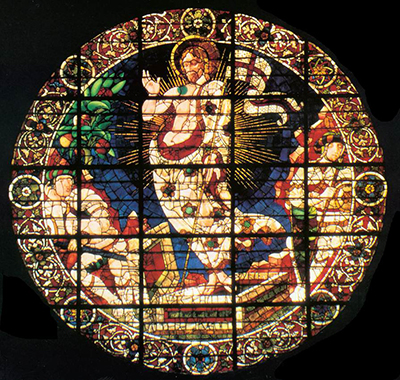
The Resurrection of Christ Stained Glass Window
The Resurrection window in Florence Cathedral, designed by Paolo Uccello and made by Bernardo di Francesco. Photograph by Sailko. Image source. CC BY 3.0. Resized for the web.