


 by Tom Gurney
Tom Gurney BSc (Hons) is an art history expert with over 20 years experience
Published on June 19, 2020 / Updated on November 29, 2026
Email: tomgurney1@gmail.com / Phone: +44 7429 011000
Niccolò da Tolentino at San Romano: Introduction
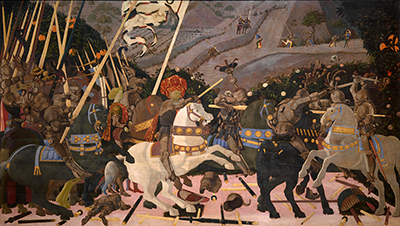
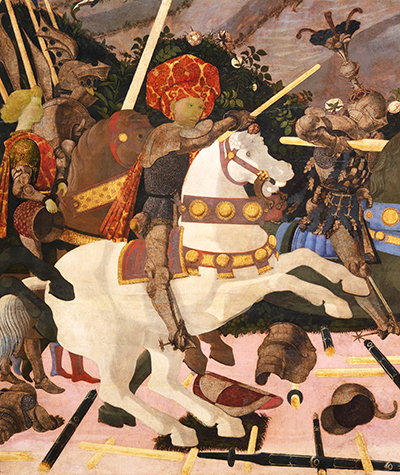
Niccolò da Tolentino lifts his baton as his white charger rises above a scatter of broken lances. Red and gold pick him out from the ranks of armoured men. The cavalry enters from the left, but the discarded lances lead the eye in a different direction, away from the front edge of the picture and into the painted field. These competing directions animate Paolo Uccello’s London panel of the Battle of San Romano, a work over three metres wide that the National Gallery dates probably to about 1438–40. It commemorates a Florentine victory on 1 June 1432 in the war against Lucca and its allies Siena and Milan. [1] [2]
The painting was once taller, and the armour that now reads mostly as dark grey once caught the light on actual silver leaf. Its current shape and surface preserve traces of several distinct events, from the decisions Uccello made while laying out the figures to changes made when the panel was fitted to a new room. Looking at it as both a battle scene and a worked piece of wood helps explain the peculiar combination of stillness and motion in front of us. [2] [3]
At a Glance
- PaintedProbably about 1438–40
- CollectionNational Gallery, London (NG583)
- Dimensions182 × 320 cm
Contents
- The commander and his cavalry
- The broken lances, the fallen knight and the hedge
- From the first drawing to the silver armour
- The altered outline and surface
- From Florence to the National Gallery
- The London panel in the sequence
- Annotated details
The commander and his cavalry
Follow the line of trumpeters at the left towards the horsemen. The repeated instruments announce the advance, while the diagonals of the raised lances carry it across the panel. Niccolò appears a little left of centre, in profile, with his face exposed. His page rides near him in matching colours and carries his helmet, a type known as a barbuta. That small division of roles lets Uccello show a recognisable commander and include the conspicuous equipment that marks his rank. The pattern of pomegranates on Niccolò’s gold hat is incised and picked out with red glaze. The pattern remains legible even where it crosses changes in the shape of the hat. [1] [2]
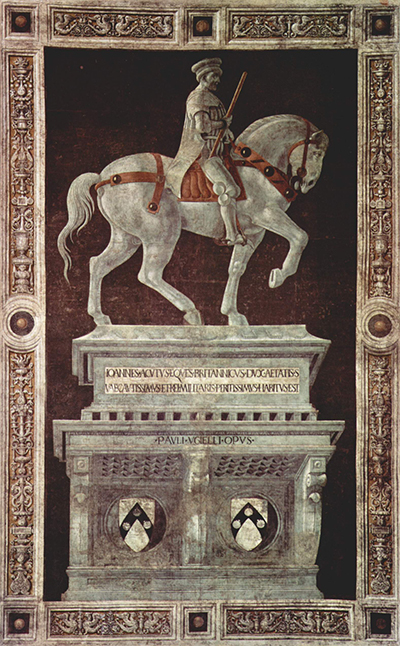
The Florentine government honoured Niccolò in June 1433 with a ceremony that included a speech by the humanist Leonardo Bruni and the presentation of a commander’s baton, rich clothing for man and horse, and an ornamented helmet. The painted finery may recall those honours. In that reading Uccello has brought the public celebration of Niccolò into the battle itself. He holds the commander so clearly in profile that the white horse and its rider can be read together, like the silhouette of a civic equestrian monument. Andrea del Castagno’s 1456 fresco of Niccolò in Florence Cathedral belongs to the same tradition. It was commissioned as a companion to Uccello’s monument to Sir John Hawkwood. [1] [2] [4]
The heraldry helps establish who belongs where. The black design on Niccolò’s white standard has been identified as his personal device, a form of Solomon’s knot. The present top edge cuts through the standard, leaving too little of another device to identify it securely. A red cross on a white banner marks Florence. The rider near Niccolò in the wavy black-and-white surcoat is possibly the Florentine ally Micheletto Attendolo da Cotignola. The suggested identification rests on the association of the wave pattern with the Sforza and on accounts of his part in the battle. A fallen shield has likewise been associated with the Sienese Petrucci, although the colours complicate the comparison. The surviving devices carry historical information at different levels of certainty. [1] [2]
At the right, where the Florentine advance meets resistance, three riders close around a knight on a pale horse. Gordon reads this compact group as a passage that a fifteenth-century viewer familiar with tournaments could have recognised. The riders’ conspicuous crests belong to the visual world of the tourney, while the plate armour has close period counterparts. The armoured knight behind the page wears an armet, a close-fitting helmet with a hinged visor. A surviving armet in the Metropolitan Museum of Art, probably made in Milan around 1440, provides a comparison for the profile and assembly of such a helmet. It is easy to understand why arms specialists Lionello Boccia and Karen Watts took the armour seriously as evidence for the date. The straps across back plates and the fastenings on the fallen knight’s thigh plates show the equipment working around bodies seen from awkward angles. [2] [5]
The broken lances, the fallen knight and the hedge
In the pale pink foreground, some of the shattered lances lead diagonally back into the scene, while others run more nearly across the width of the panel. The gaps in this broken grid give the eye enough intervals to sense the ground beneath the horses. Small patches of grass and discarded pieces of armour break up the lines. In a tiled interior the pattern could have come from the architecture. Here Uccello builds it out of the debris of the action. The regularity of the placement makes the violence readable across a room. [1] [2]
The armoured man lying at the lower left is the clearest test of how this perspective works. Gordon describes him as a dead knight. His body occupies very little painted height for a figure extending along the ground, so the way the plates and joints overlap does much of the work of suggesting length in depth. His shoulders are larger than his feet, a reversal the National Gallery points out when comparing his orientation with the directions established by the lances. The body still reads as a body in space. It has its own projection, distinct from the way a long straight shaft appears on the same field. The catalogue supplies no personal identification for the knight. [1] [2]
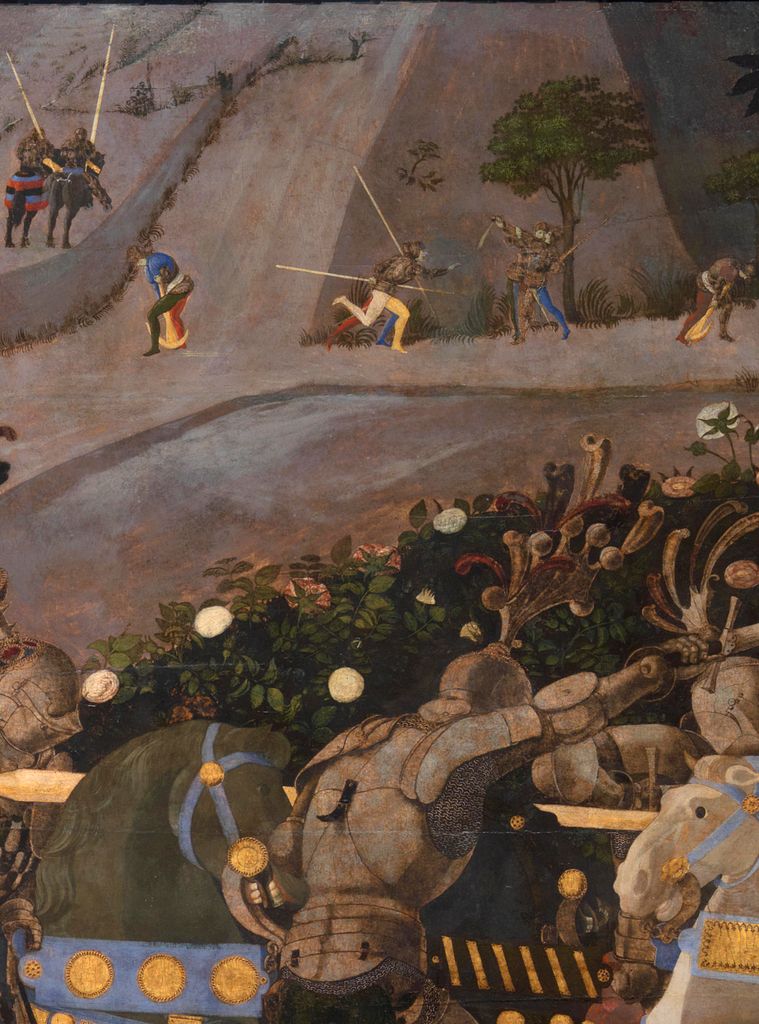
The hedge stops the foreground lines. Its roses, oranges and pomegranates make a high belt of colour behind the mounted figures. Above it, the eye picks up a second space of sloping agricultural ground. Small figures on foot and mounted men move there, and the scale has changed abruptly. The mounted figures may represent messengers sent for help, an identification that depends on connecting a distant detail with accounts of the battle. Petra Pertici, whose research Gordon discusses, related the low foreground and the hills to Maso degli Albizzi’s account and to the shape of the battlefield. The setting can evoke a specific terrain while functioning as a broad decorative pattern within the picture. [1] [2]
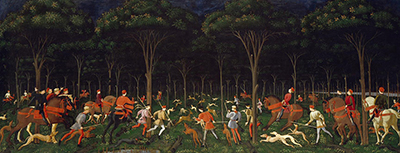
The hedge keeps the cavalry legible against a continuous backdrop. It also leaves the eye without an obvious horizon at the end of the broken lances. The graphic scholar Kiyoo Koyama saw the lances and fallen soldier as suggesting a space in one-point perspective. Massimo Becattini’s analysis, reproduced in Gordon’s catalogue, proposes a principal vanishing point and another recession towards the right. The diagram is a reconstruction made by reading the painted directions. The technical examination documents a different kind of evidence, the actual lines Uccello drew or scored into the surface. Put those two kinds of evidence together and the panel becomes an example of how a painter could organise several passages of depth across a wide field. The guide to Uccello’s perspective compares this construction with the more continuous recession of the Hunt in the Forest. [1] [2] [3] [6]
Annotated Details from Niccolò da Tolentino at San Romano
The numbered points identify visible features discussed in this article. Return from each detail to the numbered overview. Niccolò da Tolentino rides a white horse in the London San Romano panel, National Gallery NG583. Image source. Public domain.
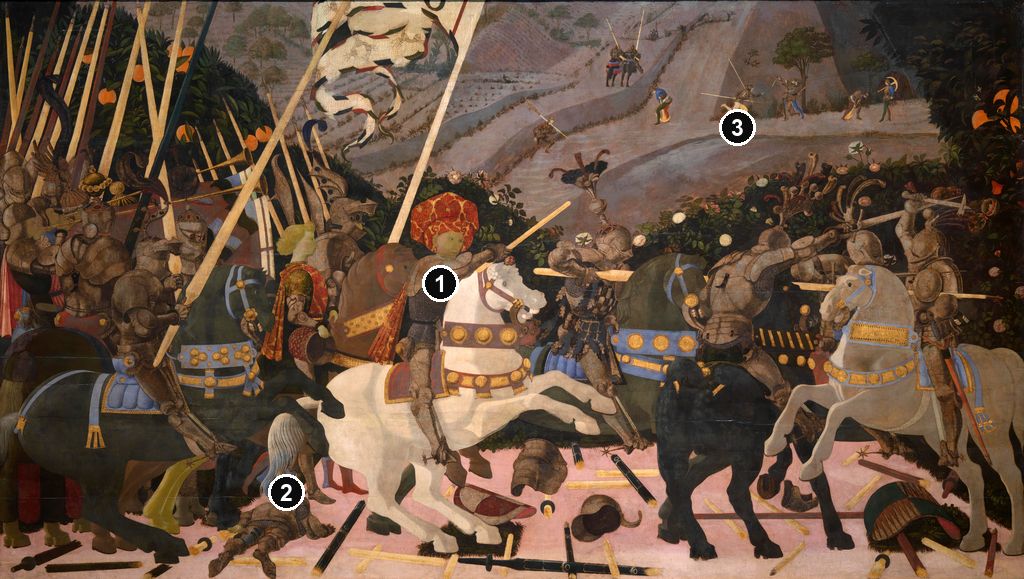
Details from NICCOLÒ DA TOLENTINO AT SAN ROMANO
Compare the cropped details with the source images above. Notice how their colours, shapes and positions contribute to the larger compositions.
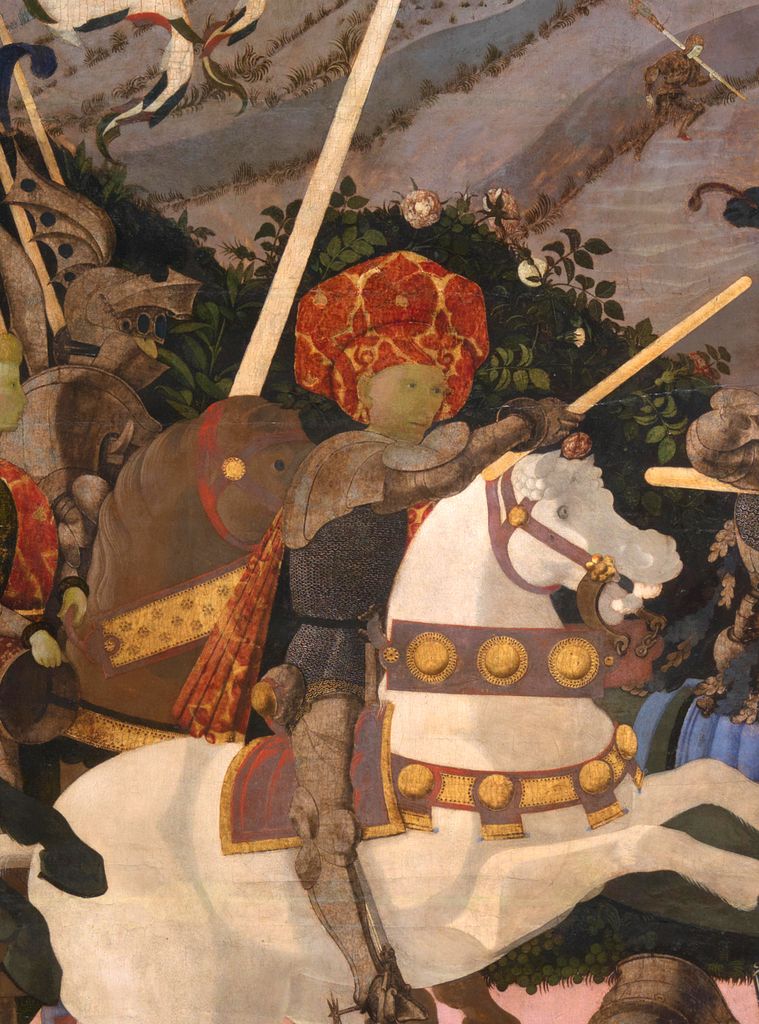
The red headgear and white horse
Niccolò’s headgear rises above the angled neck of the white horse. The decorated bridle leads the eye back toward his hand and the pale lance behind him.
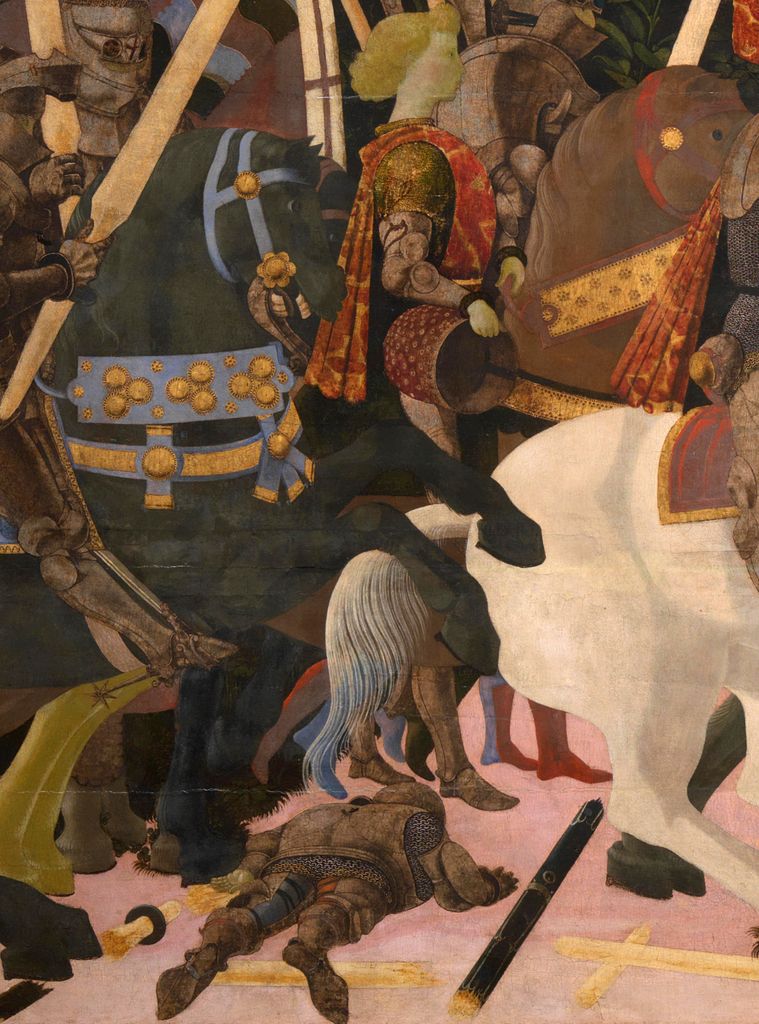
The fallen figure and broken weapons
A fallen figure lies among scattered lance shafts. Their angled lines suggest depth in the shallow foreground, where the horses’ legs overlap them.
The hedge and distant hunt
Small figures and riders appear beyond the hedge. Their scale opens up a distant view across the press of the foreground cavalry.
From the first drawing to the silver armour
The panel now measures 182 by 320 centimetres. Its poplar boards were joined edge to edge, with the grain running horizontally. The exact count is difficult to establish through the splits and repairs, though the X-radiograph suggests about eight. Four broad canvas strips were laid vertically across the face. They reinforced the wood beneath a substantial ground of gesso, a smooth white preparation that could take both thin tempera paint and metal leaf. The ground itself has layers. Roy and Gordon identified two coarser coats under a fine gypsum surface on the original panel. An X-ray lets us see aspects of this construction at the scale of the whole object, while a tiny cross-section can show the order in which material was laid on. [2] [3]
Dark fluid drawing on the ground established parts of the design. Look beneath the white horse, where the visible legs of men in coloured hose differ from some of the outlines below the paint. Uccello also cut lines into the surface, sometimes as guides for edges bordering leaf. Compass points remain visible at the centres of some bridle roundels. There is even an incised circle near the fallen knight that never became a painted object. A broken lance beneath the black horse at the right retains a drawn and painted tip that lacks the silver finishing applied to comparable points elsewhere. These passages record decisions made as the artist worked on the panel. [2] [3]
Much of the armour was made with silver leaf over bole, a fine reddish clay. Uccello could shade the bright surface with a dark glaze, so that a cuirass would register as a rounded piece of metal. On Niccolò’s leg the glaze preserves fingerprints, traces of how its tone was adjusted while it was workable. Gold was used for details such as the harnesses and trumpets. Punch marks and thin glazes vary how the gold reflects light, so that an instrument or a saddle ornament can remain distinct within a succession of glittering details. [2] [3]
Muriel Vervat’s comparative work on the three Battle panels puts these observations in context. Her article reproduces a cross-section from the London armour sample NG583 S55, with a thin silver layer between the coloured clay and a black surface glaze. In the same study, the photograph illustrating a fingerprint on a knight over a reddish horse comes from the Uffizi panel. Vervat identified a broadly similar technique of laying and modelling the leaf across the three works, as well as parallels in the use of incisions. The evidence for any one detail still belongs to the panel and sample on which it was found. [7]
The altered outline and surface
There are two different clues to how the London painting fitted into a room. The curved joins and cutouts in the upper corners suggest an arched top shaped around architectural projections, probably corbels beneath a vault. Lower down, X-rays reveal traces of iron fixings, with surface damage recording a third. The holes left in the back were plugged, probably when the wood was planed. Gordon proposes that these fixings held the heavy panel against the wall, with its weight supported below. The remaining wood establishes much of the logic of the installation. The exact profile of the lost top and the architecture that surrounded it remain conjectural. [2] [3]
When the upper part of the arch was cut across, pieces of prepared poplar were fitted into the curved upper corners to make a rectangle. Their seams are visible in the X-radiograph. The junction at the left appears in a detail alongside one of the surviving iron fittings. Paint samples supply a second way to tell the passages apart. Roy and Gordon found a walnut-oil component in the egg-bound foliage of the main panel and linseed oil with egg in the additions. The corner greens contain artificial malachite where the original greens are based on verdigris, and the orange fruit on both uses red lead. Someone made a close visual match using a somewhat different set of materials. The catalogue connects this fifteenth-century reshaping with the likely transfer to Lorenzo de’ Medici’s palace around 1484. A blue sky that once covered some of the hill landscape was a still later intervention, possibly sixteenth-century. It was removed in the 1960s treatment. The cut edge takes off part of the standard and the upper landscape. Any reconstruction of the original skyline or the amount of open sky is necessarily approximate. [2] [3]
The dark coating on silver accounts for part of the difference between the panel’s present complexion and its earlier brightness. Some passages also retain intentional dark modelling on the leaf, and silver and its coloured glazes survive unevenly. Separately, vermilion has darkened in passages such as the horse harnesses, and copper-based glazes have darkened in the foliage. Past cleaning wore away modelling on the grey horses and the faces of the commander, page and trumpeters, while some of the gilding and its original shading are well preserved. The actual leaves, pigment samples and better-preserved details give a sense of the shifts in reflection and colour Uccello sought. They permit only a partial reconstruction of what a viewer would have seen in the fifteenth century. [2] [3]
From Florence to the National Gallery
Archival findings by Francesco Caglioti place the three paintings in Bartolini Salimbeni possession in 1480. He proposed that Lionardo Bartolini Salimbeni, who had held office on the Florentine council administering the war against Lucca, commissioned them around the time of his second marriage in 1438. The three appear in Lorenzo’s room at the Medici palace in the 1492 inventory. In 1495 Lionardo’s son Damiano claimed that Lorenzo’s agent had removed the paintings against his wishes. The archive puts the likely date around 1484, although the Uffizi’s collection account describes a sale by the heirs. The installation in Lorenzo’s room and the earlier Bartolini Salimbeni ownership rest on firmer evidence than the exact circumstances of the commission and transfer. [2] [8]
The London picture was back in the Florentine grand-ducal wardrobe by 1787 after work by the restorer Carlo Magni. It was reportedly acquired from the Giraldi collection in 1844 by the dealers Lombardi and Baldi, who certainly had it by 1848. The National Gallery bought it from them in 1857. Its back had already been planed and stiffened with six thick vertical walnut battens by the time it arrived. The precise occasion for thinning the wood is unrecorded in the catalogue. Restraining the horizontal boards in this way had consequences as the wood moved with changes in atmospheric conditions. Joins opened, boards split and areas of ground and paint loosened. The Gallery made repairs in 1931 and removed the constraining battens in 1960, when it rejoined the split wood and secured loose paint. [2] [3]
The National Gallery’s Review of the Bicentenary Year 2024–25 records the completion of the London panel’s latest treatment. It also describes the renewed impetus to research between London, the Uffizi and the Louvre. The Uffizi announced a display of all three panels for Magnifico 1492 at the Pitti Palace, scheduled for 3 December 2026 to 1 March 2027. [9] [10]
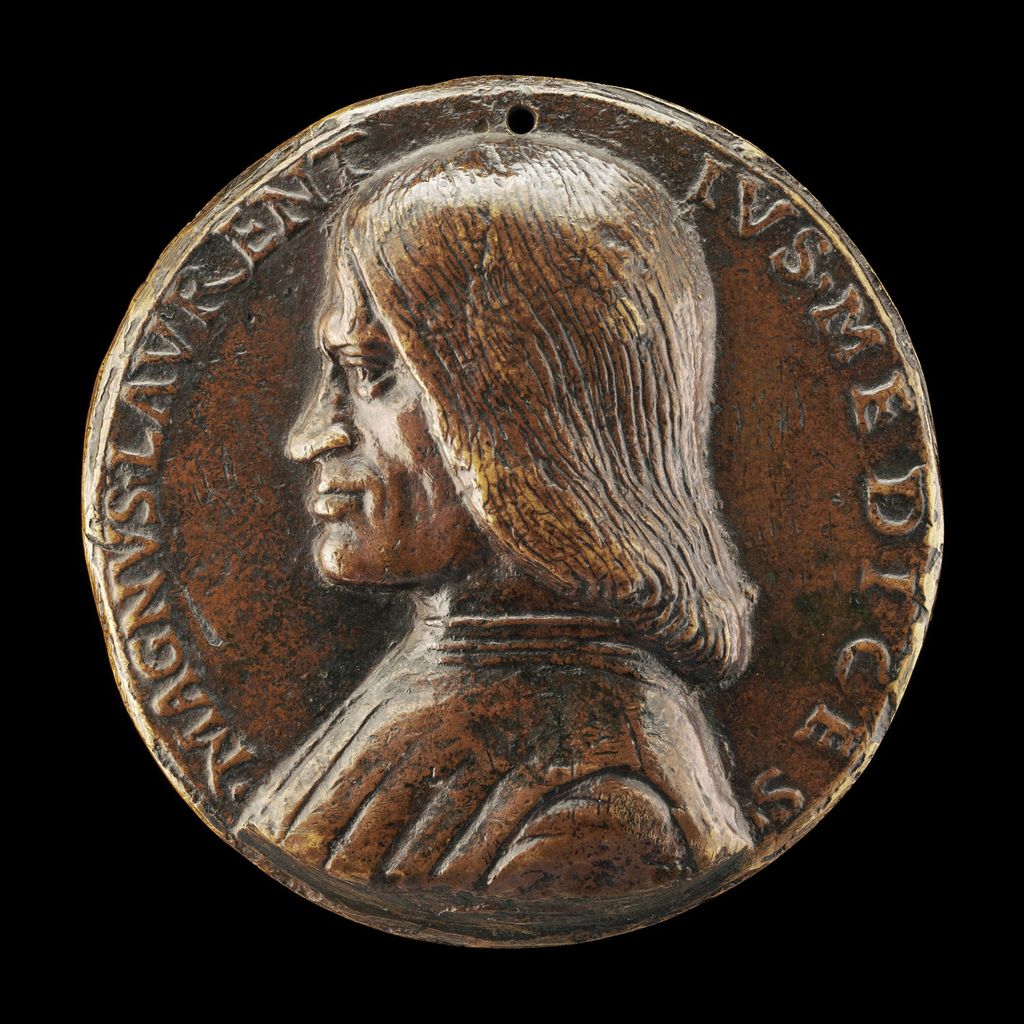
Niccolò Fiorentino’s medal of Lorenzo de’ Medici, who had all three San Romano panels installed in the family palace. Image source. Public domain.
The London panel in the sequence
The London panel usually opens the three-part Battle of San Romano. The Uffizi panel centres on the unhorsing traditionally associated with Bernardino della Ciarda. The Louvre panel shows Micheletto Attendolo’s counterattack. The shape of the surviving corner cuts supports the usual London–Florence–Paris sequence, as does the continuity of the foliage and hills between London and Florence. The exact arrangement of the three in the Bartolini Salimbeni room remains open. [2] [8] [11]
Hannah Baader reads the paintings as successive changes in the fortunes of the combat and draws attention to Uccello’s choice to leave the final achievement of victory implicit. In London the charge is still under way. The commander’s baton, the stands of raised lances and the foreground pattern give that unsettled moment the composure of a ceremony. Follow the field upward from the fallen knight to Niccolò to see how much of the battle Uccello leaves unresolved even as he presents its leader as the man in command. [2] [12]
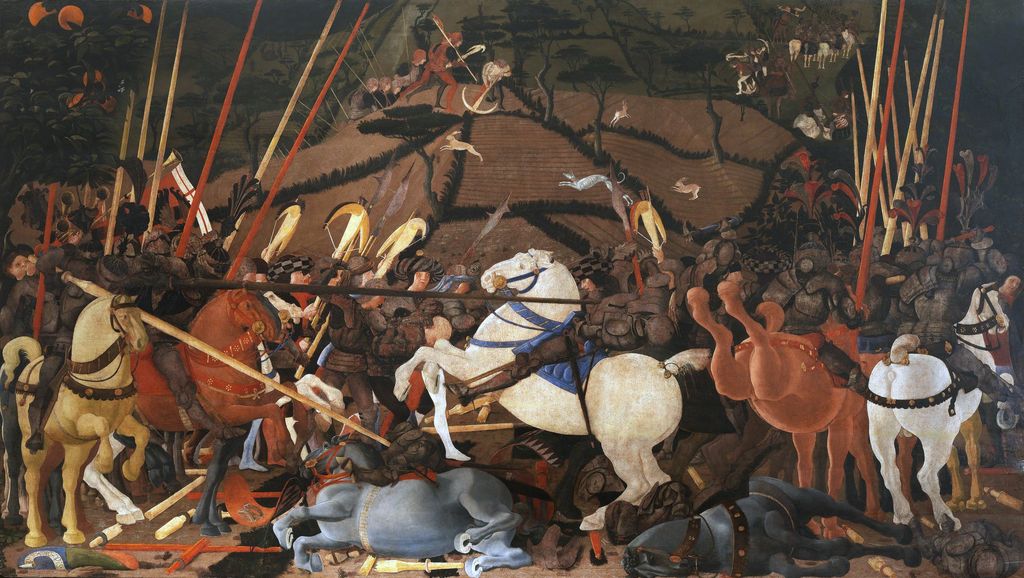
The Florence San Romano panel, with the fall of Bernardino della Carda at the centre. Image source. Public domain.
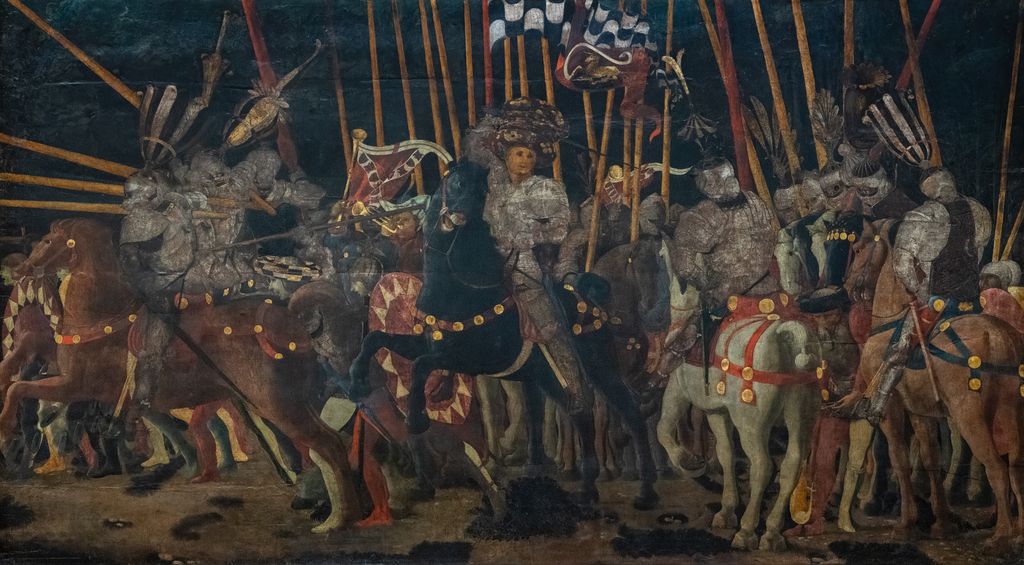
The Paris San Romano panel, Musée du Louvre MI 469, with Micheletto da Cotignola leading the counterattack. Image source. CC0 / Public domain.
Artworks directory
Browse paintings, drawings, stained-glass designs and other objects connected with Uccello. Cycles and their surviving components may have separate entries. The collection or catalogue’s wording is retained where a date, attribution or subject is debated.
| Name | Date | Medium, attribution and collection |
|---|---|---|
| Niccolò da Tolentino at the Battle of San Romano · London | Probably c.1438–40 | Tempera and oil on wood, with metallic decoration · National Gallery Catalogue. |
| Bernardino della Carda Unhorsed · Florence | c.1435–40 | Tempera on panel · Uffizi Galleries Catalogue. |
| The Counterattack of Micheletto da Cotignola · Paris | 1450–75 in the Louvre catalogue | Tempera (possibly) on wood · Musée du Louvre Catalogue. |
| The Hunt in the Forest | c.1465–70 | Tempera and oil with traces of gold on panel · Ashmolean Catalogue. |
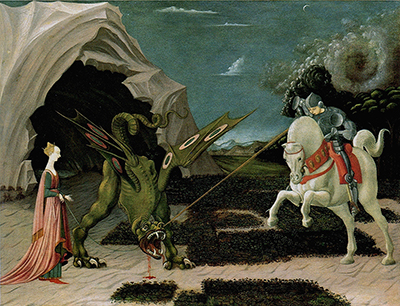
| Saint George and the Dragon · London | c.1470 | Oil on canvas · National Gallery Catalogue. |
| Saint George Slaying the Dragon · Melbourne | c.1430 | Oil, tempera and silver leaf on wood · National Gallery of Victoria Catalogue. |
| Saint George and the Dragon · Paris | 1430–35 in the museum catalogue | Painted wood panel · Musée Jacquemart-André Catalogue. |
| Equestrian Monument to John Hawkwood | 1436 | Transferred wall painting · Florence Cathedral Catalogue. |
| Study for the John Hawkwood Monument | 1436 | Study on prepared paper · Uffizi Catalogue. |
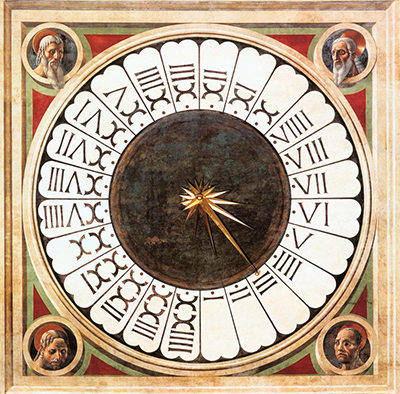
| Monumental Clock Face | 1443 | Painted dial · Florence Cathedral Catalogue. |
| Resurrection of Christ | 1443–44 | Stained glass · Uccello design · Florence Cathedral Catalogue. |
| Nativity | 1440s | Stained glass · Uccello design · Florence Cathedral Catalogue. |
| Creation of the Animals and Creation of Adam | Third to fourth decade of the 15th century | Detached fresco · Green Cloister, Santa Maria Novella Catalogue. |
| Creation of Eve and the Fall | Third to fourth decade of the 15th century | Detached fresco · Green Cloister, Santa Maria Novella Catalogue. |
| Flood and Recession of the Waters | 15th century; dating debated | Detached fresco · Green Cloister, Santa Maria Novella Catalogue. |
| Sacrifice and Drunkenness of Noah | 15th century; dating debated | Detached fresco · Green Cloister, Santa Maria Novella Catalogue. |
| Stories of the Virgin and Saint Stephen · Assunta Chapel | 1430s, with later completion | Fresco cycle · Paolo Uccello and Andrea di Giusto · Prato Cathedral Catalogue. |
| Blessed Jacopone da Todi | 1436 in the diocesan museum | Detached fresco · Museo dell’Opera del Duomo, Prato Catalogue. |
| Adoration of the Child · Bologna | 1430s; inscription incomplete | Detached fresco · San Martino Maggiore, Bologna Catalogue. |
| Adoration of the Christ Child · Karlsruhe | c.1436 | Painted panel · Attribution to Uccello · Staatliche Kunsthalle Karlsruhe Catalogue. |
| Annunciation · Oxford | Early 15th century | Tempera and gilding on panel · Ashmolean Catalogue. |
| Allegory of Monastic Life (Thebaid) | c.1460–65 | Tempera on canvas · Galleria dell’Accademia, Florence Catalogue. |
| Miracle of the Profaned Host | 1467–68 | Tempera on wood · Galleria Nazionale delle Marche, Urbino Catalogue. |
| Triumphal Entry into Rome of Titus and Vespasian(?) | c.1430–35 | Tempera, gold and silver on panel · Yale University Art Gallery Catalogue. |
| Crucifixion with the Virgin and Saints | c.1460–65 | Painted panel · Museo Nacional Thyssen-Bornemisza Catalogue. |
| The Crucifixion · Met triptych | Probably mid-1450s | Tempera on wood with gold ground · Metropolitan Museum of Art Catalogue. |
| Perspective Study of a Chalice | 1450–75 | Pen, ink and stylus on paper · Attributed to Uccello · Uffizi Catalogue. |
| Study of a Mazzocchio | 15th century | Perspective study · Attributed to Uccello · Uffizi Catalogue. |
| Mazzocchio Seen in Perspective | Uncertain | Drawing · Attribution debated · Musée du Louvre Catalogue. |
| Head of a Man in Profile | 15th century | Pen, ink and wash · Musée du Louvre Catalogue. |
| Five Masters of the Florentine Renaissance | 1500–50 | Oil on wood · Anonymous Florentine school · Musée du Louvre Catalogue. |
| Madonna and Child from the Del Beccuto House | 15th century | Detached fresco · Museo di San Marco, Florence Catalogue. |
| Man of Sorrows with the Virgin and Saint John · Avane Predella | 15th century | Predella · Museo di San Marco, Florence Catalogue. |
| Calling of Saint Paul the Hermit · San Miniato | After 1447 to c.1454 in state catalogue | Sinopia · Attributed to Uccello or collaborator Catalogue. |
| The host changes hands · Urbino predella, scene 1 | 1467–68 | Tempera on wood · Component of DE 231 · Galleria Nazionale delle Marche Catalogue. |
| The figures at the door · Urbino predella, scene 2 | 1467–68 | Tempera on wood · Component of DE 231 · Galleria Nazionale delle Marche Catalogue. |
| The procession approaches the altar · Urbino predella, scene 3 | 1467–68 | Tempera on wood · Component of DE 231 · Galleria Nazionale delle Marche Catalogue. |
| The condemned woman and the ladders · Urbino predella, scene 4 | 1467–68 | Tempera on wood · Component of DE 231 · Galleria Nazionale delle Marche Catalogue. |
| Persecution of the family · Urbino predella, scene 5 | 1467–68 | Tempera on wood · Component of DE 231 · Galleria Nazionale delle Marche Catalogue. |
| Angels and demons at the bier · Urbino predella, scene 6 | 1467–68 | Tempera on wood · Component of DE 231 · Galleria Nazionale delle Marche Catalogue. |
| Birth of the Virgin · Prato Cathedral | 1430s; dating debated | Fresco · Assunta Chapel, Prato Cathedral Catalogue. |
| Presentation of the Virgin · Prato Cathedral | 1430s; dating debated | Fresco · Assunta Chapel, Prato Cathedral Catalogue. |
Discussion
Look again at the images and ideas explored in Niccolò da Tolentino at San Romano. These editorial prompts invite your observations.
Reader Insights
How does your reading of Niccolò’s command change when you start with the fallen knight instead of the rider on the white horse?
What does the hedge do to the sense of depth created by the broken lances in the foreground?
Join the Conversation
Share a detail, comparison or question about Niccolò da Tolentino at San Romano below.
References
- National Gallery, London. The Battle of San Romano, NG583. Collection entry, in-depth interpretation and audio-description transcript. View source.
- Dillian Gordon. “The Battle of San Romano.” The Fifteenth Century Italian Paintings, vol. I, 2003, NG583 catalogue entry. View source.
- Ashok Roy and Dillian Gordon. “Uccello’s ‘Battle of San Romano’.” National Gallery Technical Bulletin 22, 2001, pp. 4–17. View source.
- Opera di Santa Maria del Fiore. Andrea del Castagno, Monument of Niccolò da Tolentino, Florence Cathedral, work completed in 1456. View source.
- Metropolitan Museum of Art. Armet, object 42.50.2, stamped LIONARDO, probably Milan, ca. 1440. View source.
- Kiyoo Koyama. “Uccello and Perspective” (ウッチェロと透視図法). Japanese Society for Graphic Science annual meeting abstract, Journal of Graphic Science of Japan 19, no. 2, 1985, p. 46. View source.
- Muriel Vervat. “An ARCHLAB project: researches on the painting technique of the three panels of the Battle of San Romano by Paolo Uccello.” Technè 43, 2016, pp. 110–113. View source.
- Gallerie degli Uffizi. Battaglia di San Romano, official Italian collection entry for the Florence panel. View source.
- National Gallery, London. Review of the Bicentenary Year 2024–25, p. 48, “Conservation.” View source.
- Gallerie degli Uffizi. “Tickets now online for ‘Magnifico 1492’, the major exhibition dedicated to the collection of Lorenzo the Magnificent.” Exhibition announcement, 2 November 2026. View source.
- Musée du Louvre. La Bataille de San Romano : la contre-attaque de Micheletto Attendolo da Cotignola, MI 469. View source.
- Hannah Baader. “Aufprall, Schock, Geschichte. Paolo Uccellos ‘Schlacht von San Romano’.” In Uwe Fleckner, ed., Bilder machen Geschichte, 2014, pp. 53–71 and 468–470. View source.
More PAOLO UCCELLO Artworks

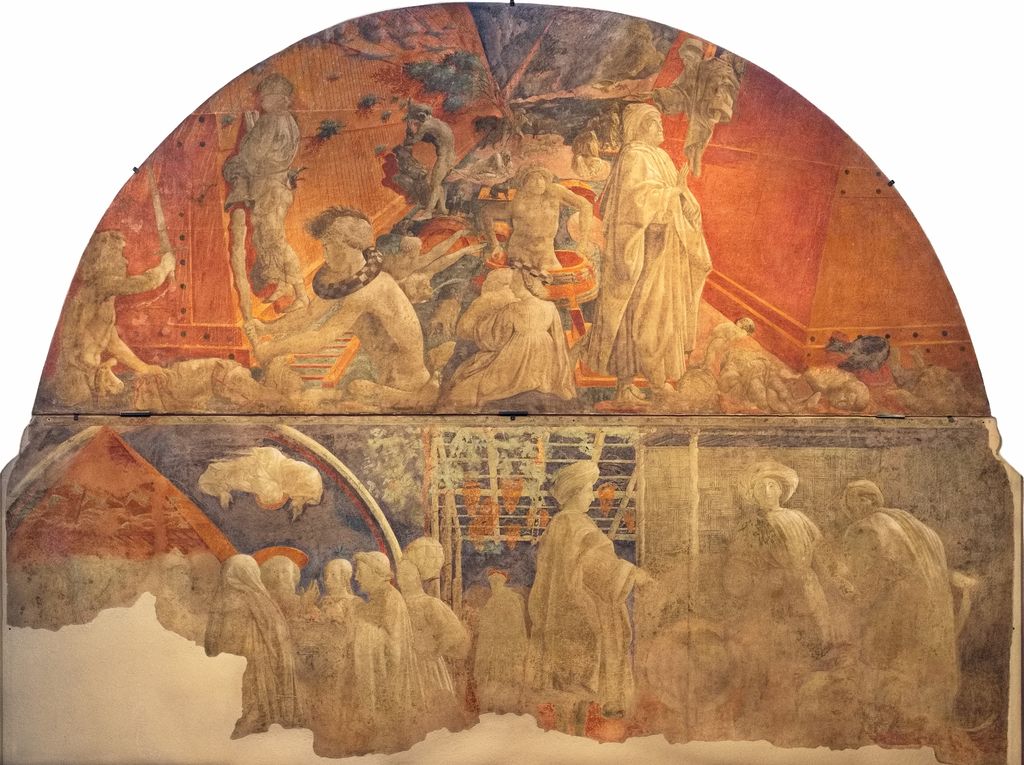
Noah and the Flood
The Flood and Recession of the Waters above the lower episodes from Noah’s story, Santa Maria Novella. Photograph by Armin Kleiner. Image source. CC BY-SA 4.0. Resized for the web. This derivative is available under the same licence.
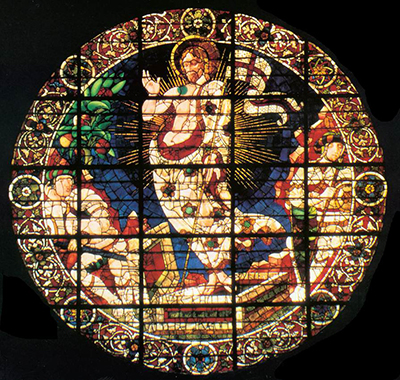
The Resurrection of Christ Stained Glass Window
The Resurrection window in Florence Cathedral, designed by Paolo Uccello and made by Bernardo di Francesco. Photograph by Sailko. Image source. CC BY 3.0. Resized for the web.