


 by Tom Gurney
Tom Gurney BSc (Hons) is an art history expert with over 20 years experience
Published on June 19, 2020 / Updated on November 29, 2026
Email: tomgurney1@gmail.com / Phone: +44 7429 011000
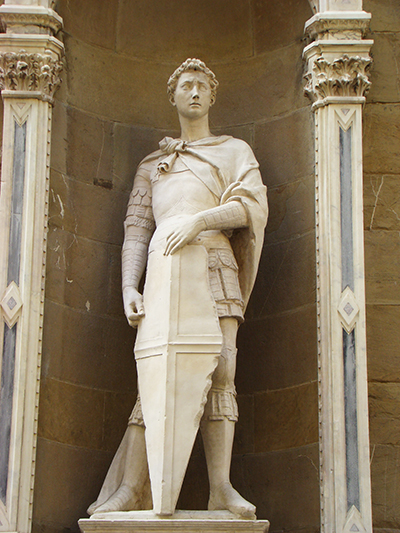
Donatello’s Saint George stands behind a shield nearly as wide as his stance. His feet are firmly planted. His face has already turned toward something beyond the edge of his niche. The encounter comes into view below him, in a marble relief where George rides at a dragon while a princess waits beside a portico. The standing figure and the scene beneath it were made for the armourers and swordmakers of Florence, who displayed their patron saint on the outside of Orsanmichele. Both original marbles are now at the Museo Nazionale del Bargello, where the relief still sits beneath the statue. [1] [2]
The statue dates to about 1415–17 and measures 204 centimetres high, or 220 with its base, according to the 2022 exhibition catalogue. The relief is only 39 centimetres high and 120 wide. Those proportions give some idea of the contrast a person in the street would have experienced. The saint’s eyes and the cross on his shield catch the eye from a distance. To follow the story below, and especially to see where its landscape ends, you have to come closer. [1] [3]
The armourers and their corner of Florence
At Orsanmichele the patron saints of Florentine guilds faced the streets. Setting a saint in one of the exterior niches gave an association of tradespeople a visible place in the city’s religious life. It also advertised who had paid for the work. The Arte dei Corazzai e Spadai, the Guild of Armourers and Swordmakers, belonged to the lesser guilds. Its site was on the north face of the corner pier at Via Orsanmichele and Via dell’Arte della Lana. The west face of the same pier was initially assigned to bakers. They could not meet the costs of the ensemble and the site passed to the wealthier money changers. The two faces of the pier give a sense of what a commission like this could cost a guild, even before a sculptor took up his tools. [2] [4]
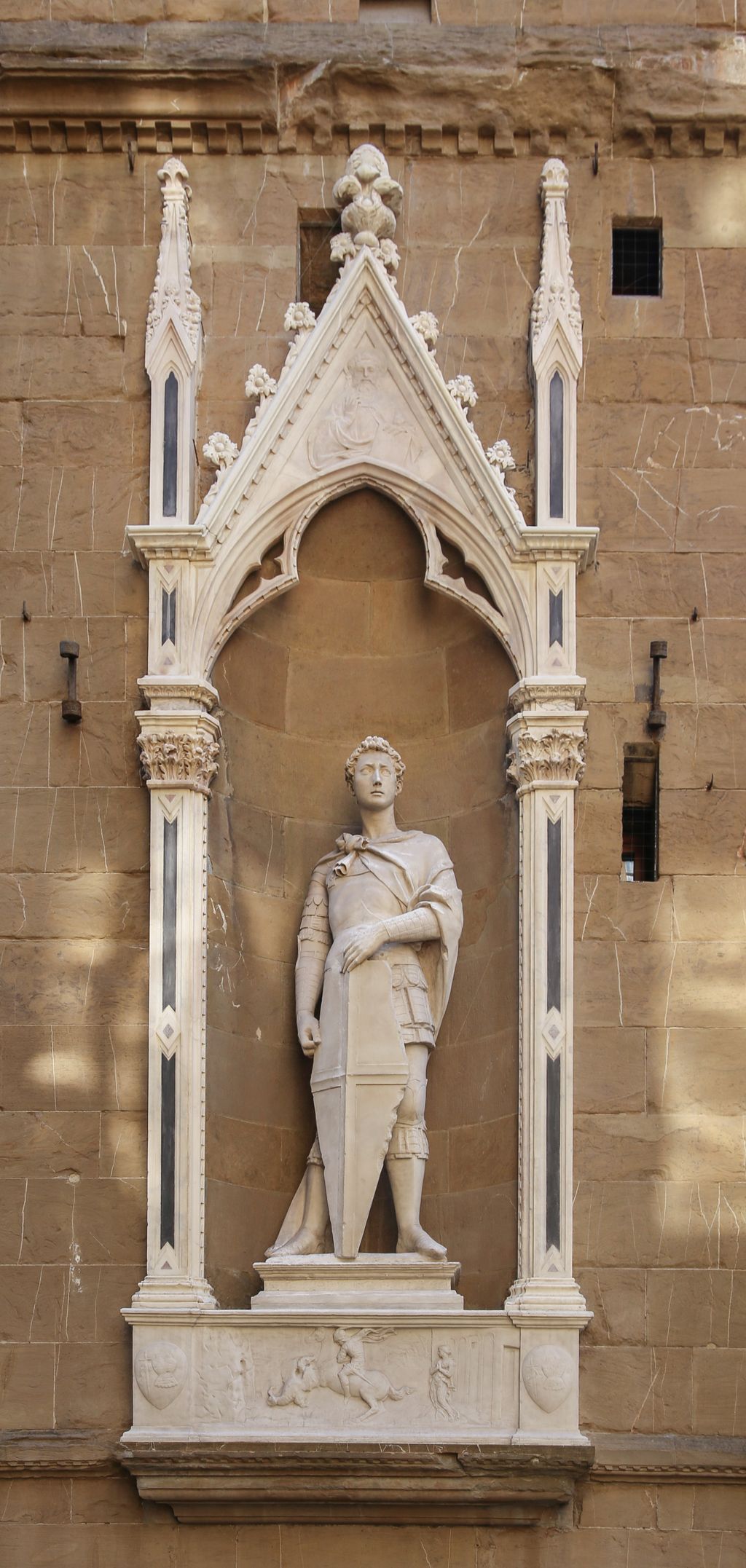
The exterior niche at Orsanmichele. The standing statue and the predella below it are replacements, while the upper relief is original. Sailko. Image source. CC BY 3.0. Resized for the web.
George’s armour made the connection to his patrons immediately legible. There is a long shield in front of him, a breastplate beneath the cloak and protection at the joints of his arms and legs. Below the niche, the guild’s own emblems, a sword and a breastplate, flank the carved legend. The cross on the shield belongs to the saint. The other signs identify the people whose trade furnished a warrior with the means to take the field. On the wall the eye can move straight from the image of the patron to the badges of the patrons who commissioned him. [4] [5]
Orsanmichele gave Donatello occasion to work for guilds whose saints called for very different figures. His earlier Saint Mark for the linen drapers and dealers carries a book and has the long folds of a robed evangelist. George’s cloak frames the short, fitted armour and leaves the wide stance visible. Both figures had to be read from below. The arrangement of each body, and the part played by what each saint carries, begins to explain how differently they occupy their niches. [2] [3]
A body ready to move
Begin with the shield. Its point touches the ground between the saint’s feet, and the long stem of the cross draws the eye up toward his face. One hand rests across the upper edge. Its weight and ease steady the central line of the statue, while the free hand closes beside his thigh. George’s shoulders and legs spread beyond that line. At the bottom a foot comes so far forward that it crosses the edge of the base. Donatello gives the figure a broad footing and then shows how little would have to change for him to leave it. [1] [6]
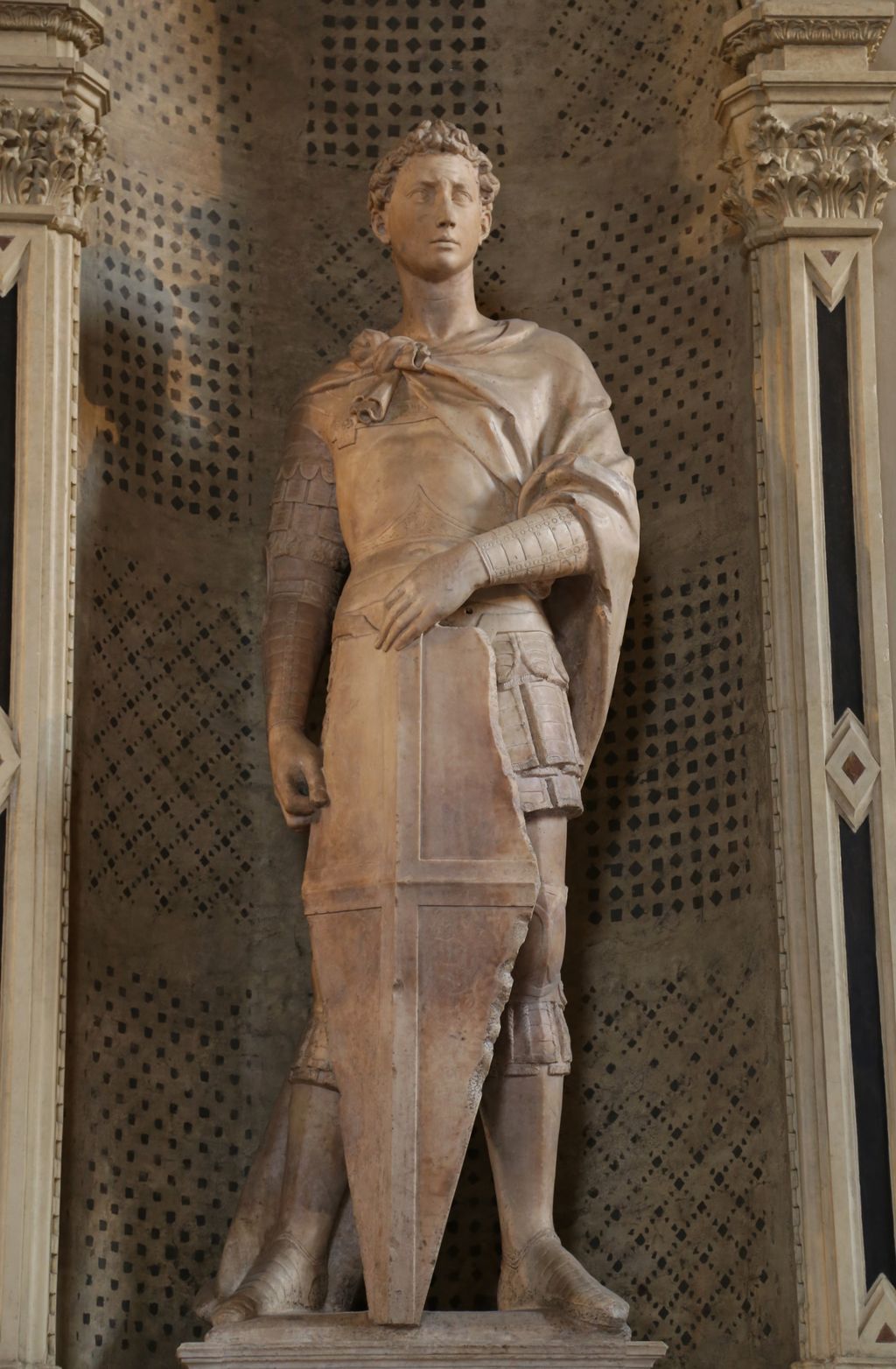
The original standing marble Saint George in the Bargello, seen from the front. Rufus46. Image source. CC BY-SA 3.0. Resized for the web.
The face carries the tension more quietly. The turn of the head leads away from the line of the cross. A furrow between the brows interrupts the smooth forehead, and the set of the mouth holds the expression in check. Aldo Galli draws attention to the oblique gaze and to the concentration that gives this young soldier an inner life. Viewed at the level of the shield, that gaze seems to pass above the onlooker. The figure is close enough to confront a passer-by, yet his attention is fixed somewhere else. The relief gives that invisible point of attention a possible subject. [6] [7]
The surviving marble may present a quieter silhouette than the guild first saw. The national catalogue records holes associated by some scholars with possible bronze attachments, including an item of headgear, a scabbard and a weapon, perhaps a sword. Their precise form remains uncertain. That distinction matters when looking at the bare head and the closed hand today. Even a relatively small attachment could have shifted the balance of light and colour, and a weapon would have given the free arm a different purpose. The steady shield and the taut turn of the head remain visible evidence of how Donatello organised the figure. [1]
A shallow niche built for a view from below
Behind the niche an internal staircase runs through the corner pier. The stair limited how deeply masons could cut into the wall. The shrine rises in a slender outline, with a pointed arch, pinnacles and a high triangular field over the saint. Toothlike mouldings take the place of the twisted shafts seen on some neighbouring shrines. Fine strips of dark marble and small areas of coloured stone articulate the upright members. In a passage where a pedestrian is often close to the building, the pale figure projects strongly against an enclosure with very little depth of its own. [4] [8]
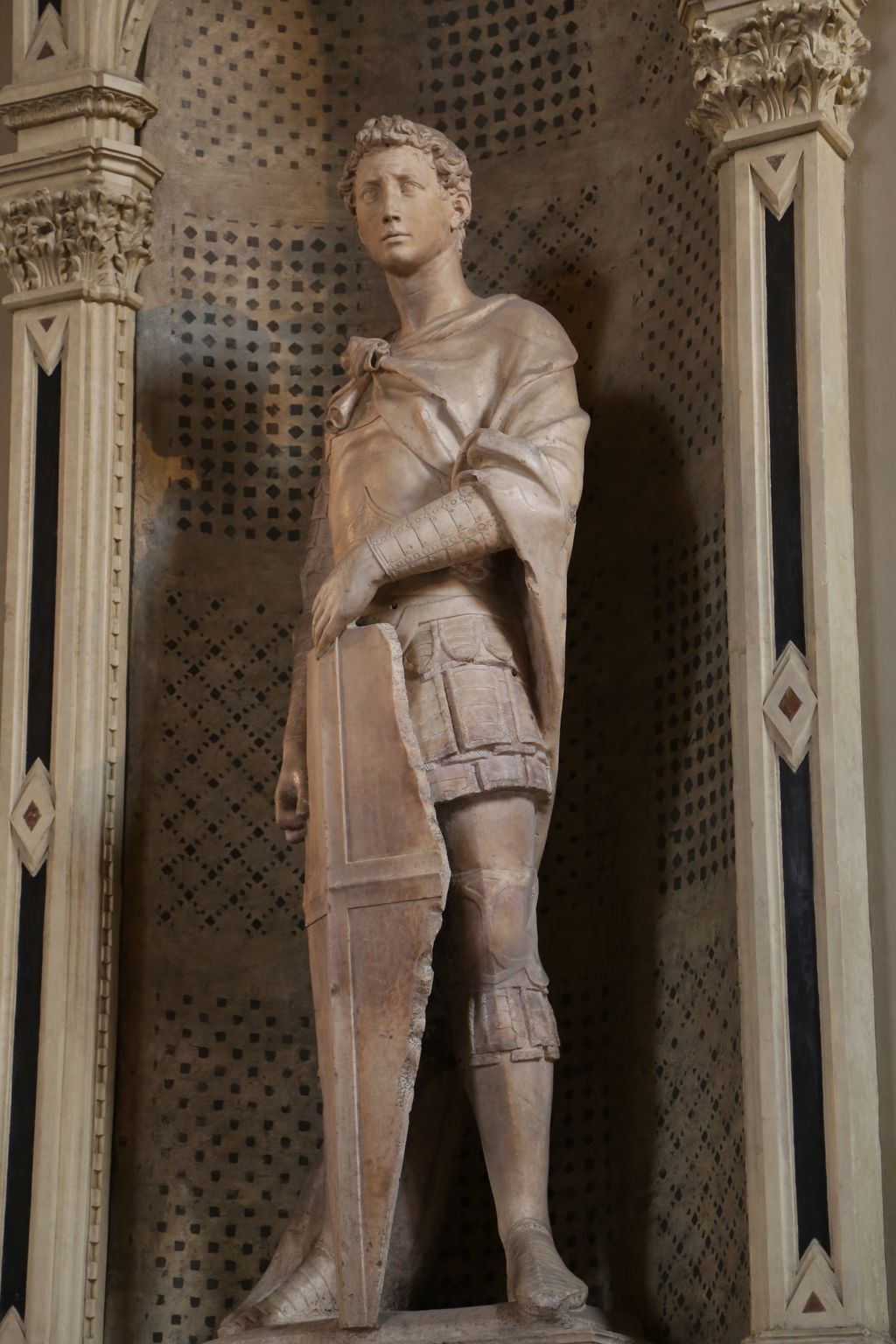
The original from the side, with the broad shield in front of the body. Rufus46. Image source. CC BY-SA 3.0. Resized for the web.
The 2012 conservation account credits Donatello with designing the shrine. The national catalogue records a longer debate over how much of the architectural frame he devised or executed, and raises the possibility that some of it preceded the statue and the predella. The same conservation account suggests that a thin gilded or decorated lining might once have covered the rough stone visible behind George. The suggestion remains hypothetical. It is a reminder that the depth of the niche can be inspected directly today, while the colour and reflectivity of its earliest surfaces are harder to recover. [4] [8]
High in the pointed gable, God the Father raises a hand in blessing. A book appears to rest on the moulding, bringing the figure into contact with the stone frame. Conservators found that the carving projects no more than about two centimetres and thins away at the chin. Seen close to its own level, the face can look distorted. From the pavement the shortened chin helps the head appear to tilt downward. George’s face, halfway down the shrine, looks past the spectator, while the face at the top appears to look down toward them. The two effects reward a change of position in the street. [4] [7]
George, the dragon and the princess
The narrative panel at the foot of a statue is called a predella. Here its low, broad field gives the legend room to unfold. At the left, the dragon lunges out from a rocky opening. George rides from the right and drives his lance across the space between them. At the opposite end, the princess draws her hands together. Her upright figure stands in front of a portico whose repeated arches draw the eye into the distance. The opening at the left and the building at the right keep the eye returning to the clash between them. [5] [6] [7]
The two Georges do different things with the same readiness. Above, the weight passes down through the legs to the base, and the shield makes the safest point in the composition its centre. In the relief, the saint drives his weight forward from the horse’s back. The dragon twists and the princess’s garment stirs. The standing figure has enough separation from the wall to cast its own shadow. Below it, the horse and dragon are held to the surface by the shallow carving, even as the rider and his opponent appear to meet in open ground. [6] [7]
The cathedral works administration, the Opera del Duomo, sold the armourers the marble for the relief in 1417. The record is for a material purchase and does not specify a day of carving or installation. The national catalogue reports that many scholars have dated the scene about 1417–20, after the statue. Galli’s entry for the 2022 exhibition dates it with the statue to about 1415–17. The dates describe slightly different reconstructions of a commission made in several parts. The purchase makes about 1417 a sound point of reference, while leaving the exact interval between figure and relief open. [1] [3] [5]
How deep can a shallow relief look?
Rilievo schiacciato, also called stiacciato, means flattened relief. An incised line or a slight rise in the stone can be enough to suggest that a distant feature has its own shape and volume. The horse’s hindquarters and the saint’s shoulder have more projection and cast stronger shadows. Follow the animal from its rounded rump toward the head, and the surface becomes flatter as the head turns away into the scene. The difference is particularly clear from an angle. Frank Fehrenbach points to the horse’s oblique position as a place where real changes in the thickness of the stone create the impression of imaginary space. [7]
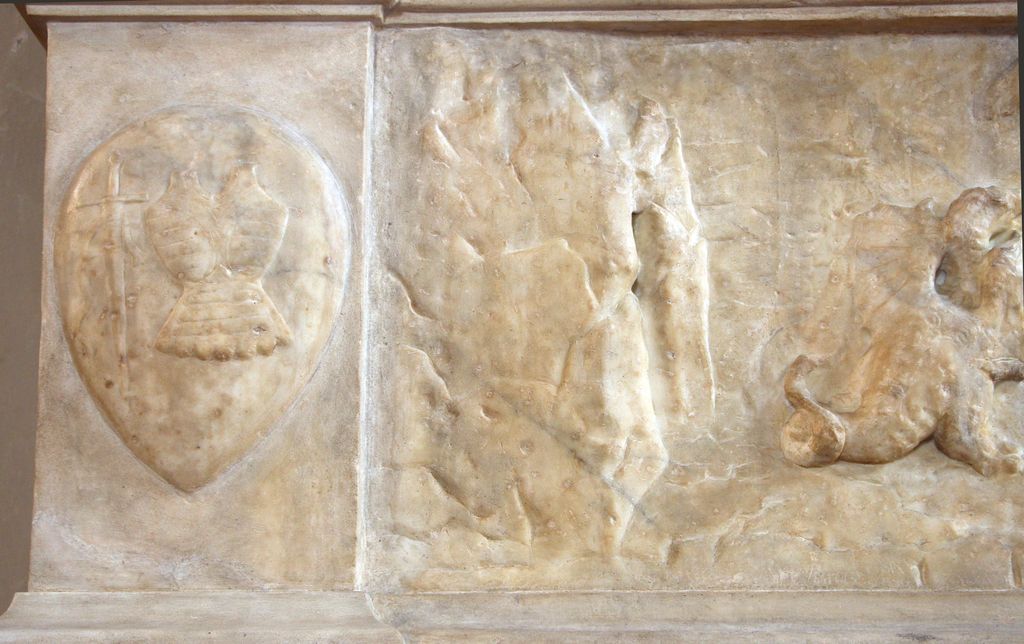
A close oblique view of the original predella shows how thinly some features are cut. Francesco Bini. Image source. CC BY-SA 4.0. Resized for the web.
Donatello gives the eye other ways to follow that recession. The portico’s repeating arches and the edges that recede behind the princess make the building look as if it extends into the stone. Beyond the figures, faint marks resolve into trees and distant hills, with touches so light that the more prominent carving can make them hard to see at first. The geometry of the architecture and the thinning of the carving work together. One establishes an apparent direction into the distance, while the other gives depth a visible change in texture and shadow. [6] [7]
The argument for calling this an early experiment in perspective is easy to see on the right of the panel, in the pavement and along the edge of the portico. The whole view also depends on the overlapping figures and on the differences in their projection, from the central encounter to the soft contours of the landscape. Fehrenbach distinguishes this mixture of depths from Donatello’s later, more consistently flattened reliefs. The contrast is part of the drama here. The horse’s hindquarters emerge strongly enough to be recognised at a glance, and the farthest details can almost disappear as the light changes. In the bronze Feast of Herod, Donatello again uses architecture to lead the eye past the foreground action, this time letting the space continue through successive rooms. [3] [7]
Watch the sculpture in context
Explore the guild commission and how the sculpture relates to its Florentine setting.
Smarthistory. Explore the guild commission and how the sculpture relates to its Florentine setting. Watch on YouTube.
Annotated Details from Saint George and the Dragon
Select a number to jump to a detail of the sculpture.
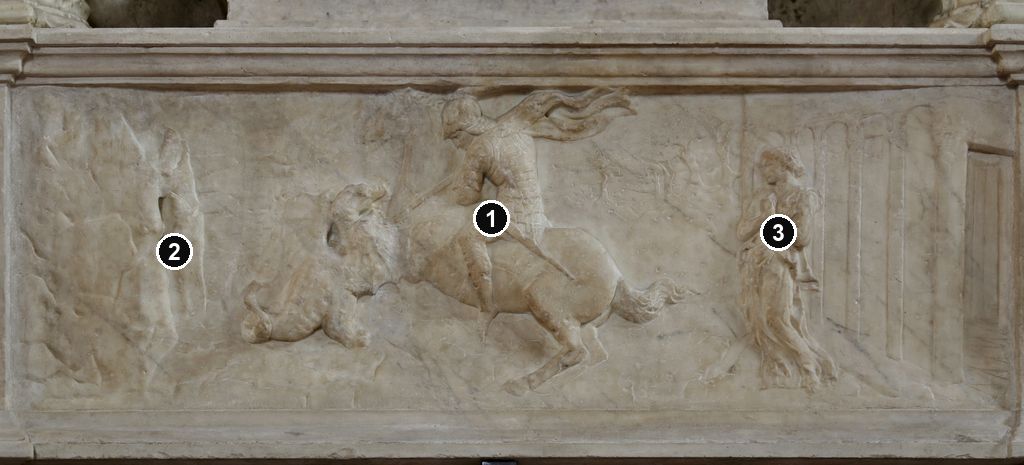
Details from SAINT GEORGE AND THE DRAGON
Open a detail image to examine the surface more closely.
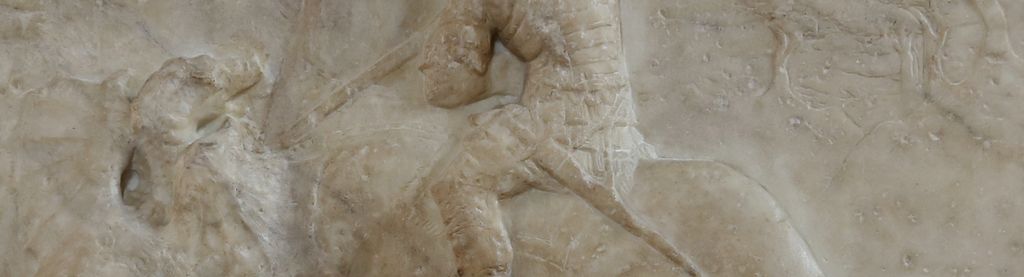
The mounted saint
The horse and rider are the largest forms in the narrow field. George’s body has enough projection to read clearly where it overlaps the more lightly cut setting.
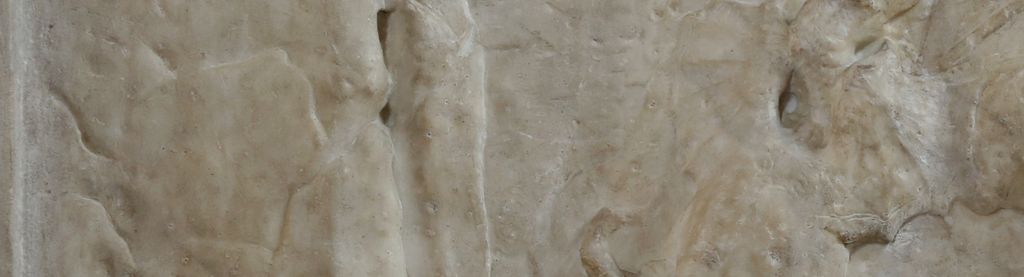
The cavern
The rock opening gives the dragon’s side of the panel a dark recess against which the low forms of the attack become easier to follow.
The princess and the portico
The woman stands clear of the horse. Fine architectural lines behind her give the flat ground a direction into the distance.
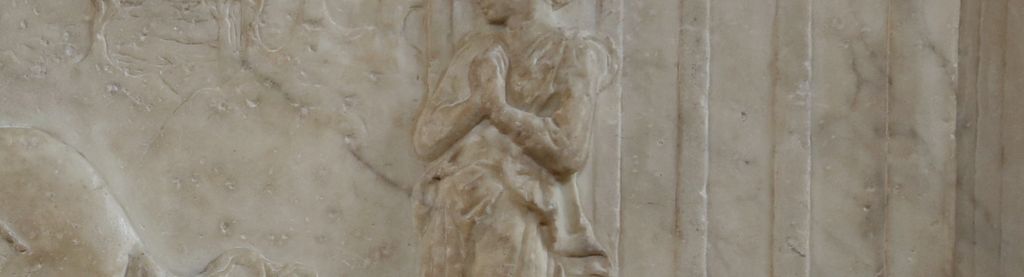
Annotated photograph and detail crops. Rufus46. Image source. CC BY-SA 3.0. Resized, annotated and cropped from the original photograph.
From the street to the Bargello
Painters could borrow George’s alertness even when they left behind the shield and niche. In Raphael’s pen drawing A Group of Four Warriors, made about 1504–05 and now in the Ashmolean Museum, a figure adapted from Donatello’s George stands among three other warriors. Raphael kept the cloak, changed the angle of the head and dispensed with most of the armour. The saint who had stood apart in the guild’s niche becomes one member of a group, his turning head now part of the exchange among the figures. [14]
George already had readers who wanted to explain the life they saw in him. In his account of Donatello, Giorgio Vasari singled out the youthful face, courage and impression of imminent motion. In 1584 Francesco Bocchi published a whole book on the statue. Its title identifies the object by its place on the outside of Orsanmichele and names three subjects for close examination, including its liveliness and beauty. Long before the statue was seen in a museum, a reader could leave the book and go straight to the street to look up at the work. [9] [10]
Outdoor display also exposed the marble to gradual weathering and sudden damage. The figure spent time in the niche of the Doctors and Apothecaries and was damaged by a thrown stone in 1858. The catalogue also records dark paint found during treatment in 1970, probably a nineteenth-century application intended to make marble look like bronze. When the original was finally moved to the Bargello in 1891, it was installed in Oronzio Lelli’s plaster reconstruction of the original shrine, raised to a little below the outdoor height. [1] [3]
The question of what should replace it had been debated for decades. In 1860 the architect Giuseppe Martelli argued for bringing the original indoors and using a bronze cast in the north niche, with Michelangelo’s David as a precedent for taking a mould. Maria Baruffetti’s archival study traces the work of the Galli foundry, whose proposal specified a lost-wax casting after Lelli’s mould. The authorities accepted a plan to recover metal from a disused mint press to pay for most of the casting. Installation of the bronze copy was under way in November 1892. The marble replacement seen in the niche today dates from 2008. [4] [11] [12]
The predella stayed in the wall until 1976. It was treated and installed beneath the statue in 1984, taking the place of a plaster cast. Outdoors, the present base, including the dragon scene and the guild emblems, is a resin reproduction. The blessing figure in the tympanum remains the original. In 2012, conservators cleaned deposits and black pollution crusts from the shrine, replaced unsuitable old fills and secured portions that had started to detach. The treatment addressed the masonry as well as the carved surfaces. [3] [4] [5]
Seeing the two settings today
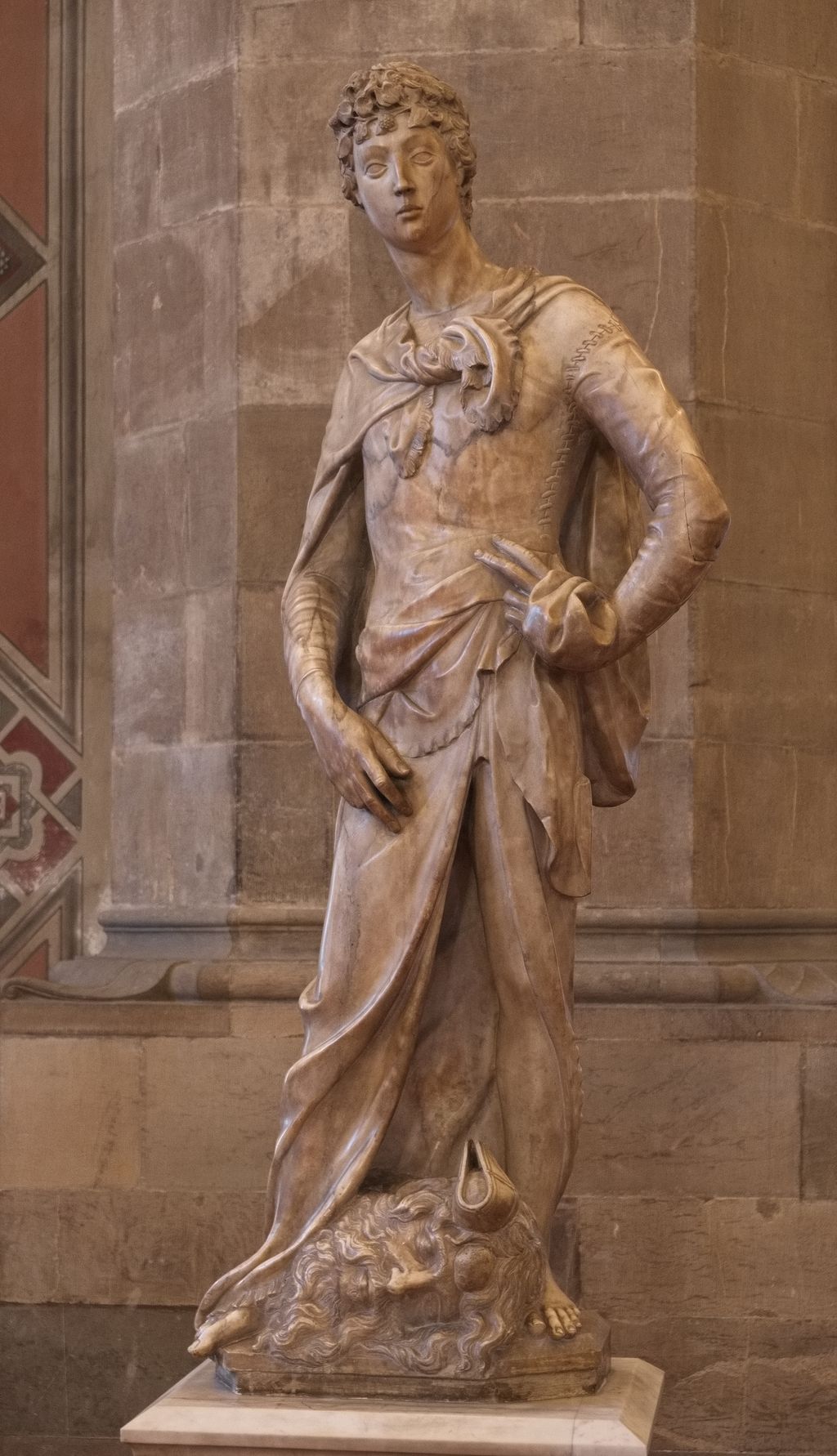
At the Bargello, the reconstructed niche puts the statue and relief back into a single upward view. The museum’s 2025 rehang placed Donatello’s marble David near George. The two young heroes share a sure footing, but the angle of George’s face and the height of his setting give him a different relationship to the person standing below. Take time with the relief as well. Look frontally to follow the architecture toward the landscape, then move to one side to see how little stone is needed to draw the horse back into that space. [2] [6] [7] [13]
At Orsanmichele, the substituted statue and base give a sense of scale against the actual pier, with the original blessing figure still above them. Look from across the narrow street, then approach the niche and tilt your head. The shield is likely to hold your eye from the farther position. From closer in, the saint seems to loom above the base, and the blessing face becomes more legible. The building and the museum each preserve evidence of how the same piece of sculpture can change as you move. [4] [7]
Donatello sculpture directory
| Name | Date | Medium and record |
|---|---|---|
| Marble David | 1408–09, adapted 1416 | Carved Carrara marble Catalogue. |
| Saint John the Evangelist | c. 1409–15 | Carved marble Catalogue. |
| Saint Mark | 1411–13 | Carved Carrara marble Catalogue. |
| Saint George and its dragon relief | c. 1415–17 | Marble statue and marble relief Catalogue. |
| Marzocco | c. 1417–20 | Carved sandstone Catalogue. |
| Saint Louis of Toulouse, Florence | 1418–25 | Gilt bronze and mixed media Catalogue. |
| Pazzi Madonna | c. 1420s | Marble relief Catalogue. |
| Reliquary Bust of Saint Rossore | c. 1420s | Gilt bronze Catalogue. |
| The Prophet Jeremiah | 1420s–30s, disputed | Marble Catalogue. |
| Zuccone | c. 1420s–30s | Marble Catalogue. |
| Feast of Herod, Siena | 1420s | Gilded bronze relief Catalogue. |
| Ascension with Christ Giving the Keys to Saint Peter | c. 1428–30 | Marble relief Catalogue. |
| Cantoria | 1433–39 | Marble and mosaic Catalogue. |
| Amor-Atys | c. 1435–40 | Partly gilded bronze Catalogue. |
| Bronze David | c. 1435–40, disputed | Partly gilded bronze Catalogue. |
| Gattamelata | Installation agreement, 1453 | Bronze and stone Catalogue. |
| Santo altar | Mid-fifteenth century | Bronze and limestone ensemble Catalogue. |
| Chellini Madonna | Given in 1456 | Partly gilded bronze tondo Catalogue. |
| Penitent Magdalene | c. 1453–55 (Opera) | Poplar, stucco, pigments and gold Catalogue. |
| Judith and Holofernes | Late 1450s–early 1460s | Bronze with surviving gilding Catalogue. |
| Pulpit of the Passion | Late work and later assembly | Bronze reliefs, Donatello and collaborators Catalogue. |
| Bust traditionally called Niccolò da Uzzano | Fifteenth century | Painted terracotta, attribution disputed Catalogue. |
| Prato Cathedral exterior pulpit | Commissioned 1428; carved 1430s | Marble reliefs, Donatello and Michelozzo Catalogue. |
| Cavalcanti Annunciation | c. 1433–35 | Gilded sandstone and terracotta Catalogue. |
| Crucifix at Santa Croce | Early fifteenth century | Painted wood Catalogue. |
| Madonna of the Clouds | c. 1425–35 | Marble relief Catalogue. |
| Old Sacristy Doors | Fifteenth century | Two paired bronze doors Catalogue. |
| Resurrection Pulpit | Late work and later assembly | Bronze reliefs, Donatello and collaborators Catalogue. |
| Brancaccio tomb | 1420s | Donatello, Michelozzo and assistants, mixed materials Catalogue. |
| Saint John the Baptist, Venice | 1438 | Polychromed and gilded wood Catalogue. |
| Sacrifice of Isaac | Early fifteenth century | Donatello and Nanni di Bartolo, marble Catalogue. |
| Madonna of Via Pietrapiana | Mid-fifteenth century | Terracotta Catalogue. |
| Miracle of the Mule | Mid-fifteenth century | Gilded bronze panel for the Santo altar Catalogue. |
| Padua Crucifix | Mid-fifteenth century | Cast bronze Catalogue. |
| Dancing Spiritello, Bargello | Fifteenth century | Bronze Catalogue. |
| Young Prophet from the Porta della Mandorla | c. 1404–09 | White marble, attributed to Donatello Catalogue. |
| Prophet or Apostle from the Duomo north tribune | Early fifteenth century | White marble, possibly Donatello Catalogue. |
| Beardless Prophet | 1415–18 | White marble Catalogue. |
| Sibyl and Prophet of the Porta della Mandorla | 1422 | Carved marble heads for the portal Catalogue. |
| Faith, Siena baptismal font | 1420s | Gilded bronze figure Catalogue. |
| Hope, Siena baptismal font | 1420s | Gilded bronze figure Catalogue. |
| Feast of Herod, Lille | c. 1430 | Carrara marble relief Catalogue. |
| Piot Madonna | c. 1440–60 | Polychrome terracotta with glass and wax inlays Catalogue. |
| Carafa Horse Head | c. 1456–58 | Cast bronze Catalogue. |
| Pazzi Madonna workshop version, Louvre | c. 1450 | Polychrome gesso, Donatello’s workshop Catalogue. |
| Pazzi Madonna tondo, Rijksmuseum | c. 1425–50 | Plaster and stucco, after Donatello Catalogue. |
| Sprite | c. 1430–40 | Bronze, sculptor or metalsmith close to Donatello Catalogue. |
Discussion
Look again at the images and ideas explored in Saint George. These editorial prompts invite your observations.
Reader Insights
What do the shield, feet and sideways gaze suggest about the moment Donatello chose for the standing George?
Follow the horse and the arches behind the princess. How do differences in projection create depth in the relief?
Join the Conversation
Share a detail, comparison or question about Saint George below.
References
- Musei del Bargello and Catalogo Generale dei Beni Culturali, “San Giorgio,” record 0900287010, Bargello Sculture 361. View source.
- Musei del Bargello, “Donatello and the Dawn of Renaissance,” collection itinerary. View source.
- Fondazione Palazzo Strozzi and Musei del Bargello, Donatello, the Renaissance, exhibition press kit, catalogue item 12.1 and Donatello Hall display history (2022). View source.
- Ministero della Cultura and Soprintendenza for Florence, “Orsanmichele: restaurato il tabernacolo di Donatello per il San Giorgio,” conservation report (26 October 2012). View source.
- Musei del Bargello and Catalogo Generale dei Beni Culturali, “San Giorgio uccide il drago,” record 0900286630, Bargello Sculture 517. View source.
- Aldo Galli, “San Giorgio,” in Donatello. Il Rinascimento (Marsilio, 2022), p. 348, extract published by the University of Trento. View source.
- Frank Fehrenbach, “Rilievo schiacciato: Donatello and the Forces of Sculpture,” in Neville Rowley, ed., Donatello: Inventor of the Renaissance (2022), pp. 59–67. View source.
- Catalogo Generale dei Beni Culturali, “San Giorgio uccide il drago / Dio Padre benedicente,” Orsanmichele niche, record 0900291920. View source.
- Giorgio Vasari, “Vita di Donato scultore fiorentino,” in Le vite de’ più eccellenti pittori, scultori e architettori (1568), edition published digitally by Fondazione Memofonte. View source.
- Francesco Bocchi, Eccellenza della statua del San Giorgio di Donatello scultore fiorentino (Florence, 1584), digital edition by Fondazione Memofonte. View source.
- Maria Baruffetti, “Formatori, fonditori, bronzisti e restauratori nella Firenze post-unitaria,” Il capitale culturale, supplement 17 (2024), pp. 111–36, especially pp. 118–23. View source.
- Tor Art, “S. Giorgio – Donatello,” project record by the makers of the replacement for Orsanmichele. View source.
- Musei del Bargello, “Museo Nazionale del Bargello: riapre al pubblico il Salone di Donatello” (18 April 2025). View source.
- The National Gallery, London, Raphael: From Urbino to Rome (2004), catalogue entry 47, “A Group of Four Warriors,” Ashmolean Museum inv. 164 P II 523. View source.
- Victoria and Albert Museum, Donatello’s David. View source
- Opera del Duomo, Donatello and the Opera del Duomo. View source
- Ministero della Cultura, David with the Head of Goliath, Bargello bronze. View source
- Save Venice, Donatello’s Equestrian Monument to Gattamelata. View source
- Opificio delle Pietre Dure, L’ultimo Donatello. View source
More DONATELLO Sculptures
Marble David
Armin Kleiner. Image source. CC BY-SA 4.0. Resized for the web.
Bronze David
Patrick A. Rodgers. Image source. CC BY-SA 2.0. Resized for the web.
Cantoria
Erik Drost. Image source. CC BY 2.0. Resized for the web.
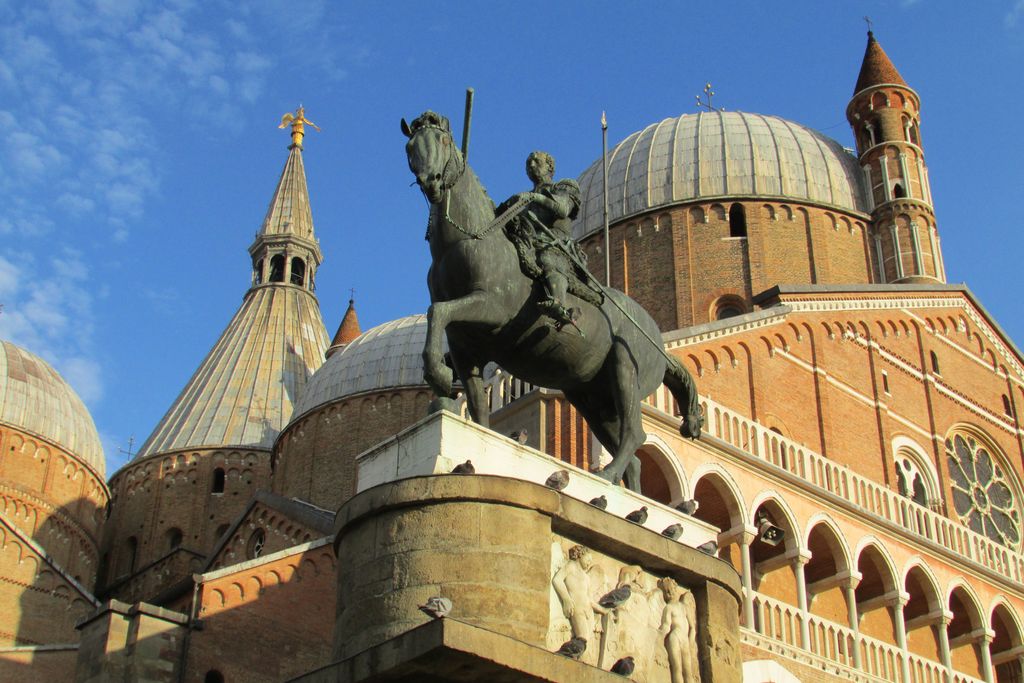
Gattamelata
Chris Light. Image source. CC BY-SA 4.0. Resized for the web.
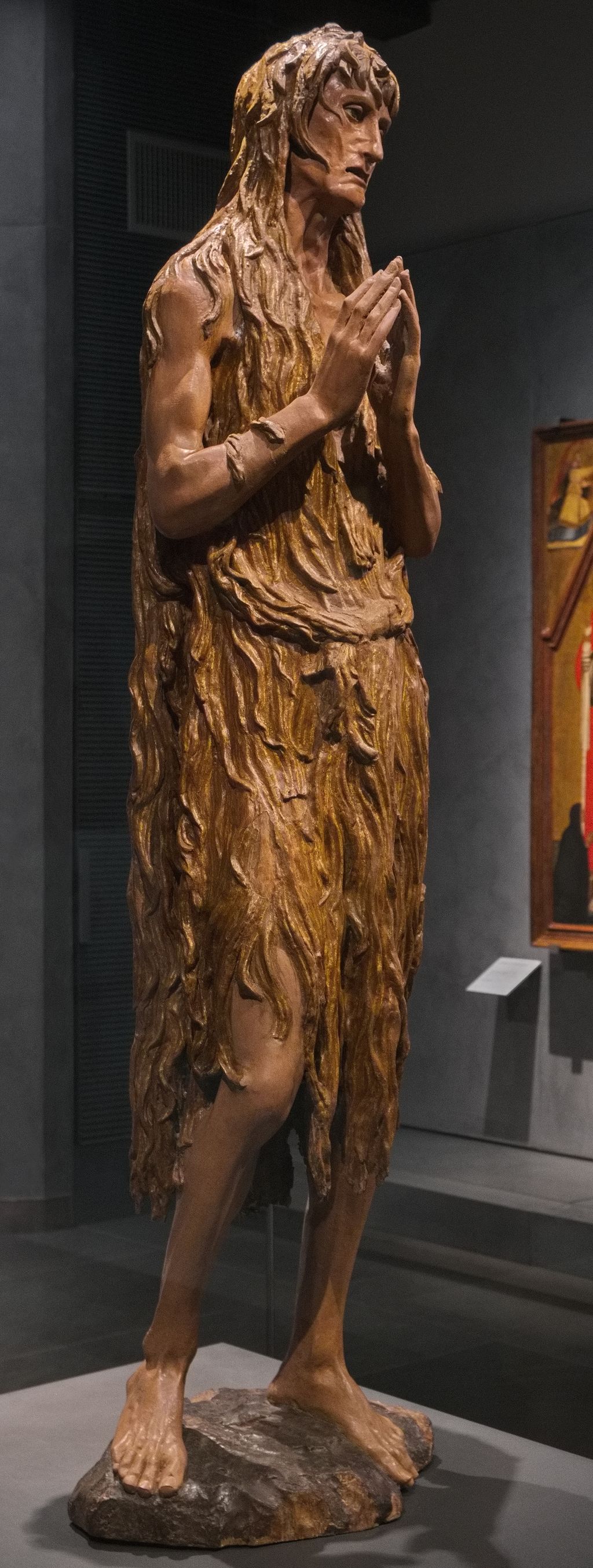
Penitent Magdalene
Armin Kleiner. Image source. CC BY-SA 4.0. Resized for the web.
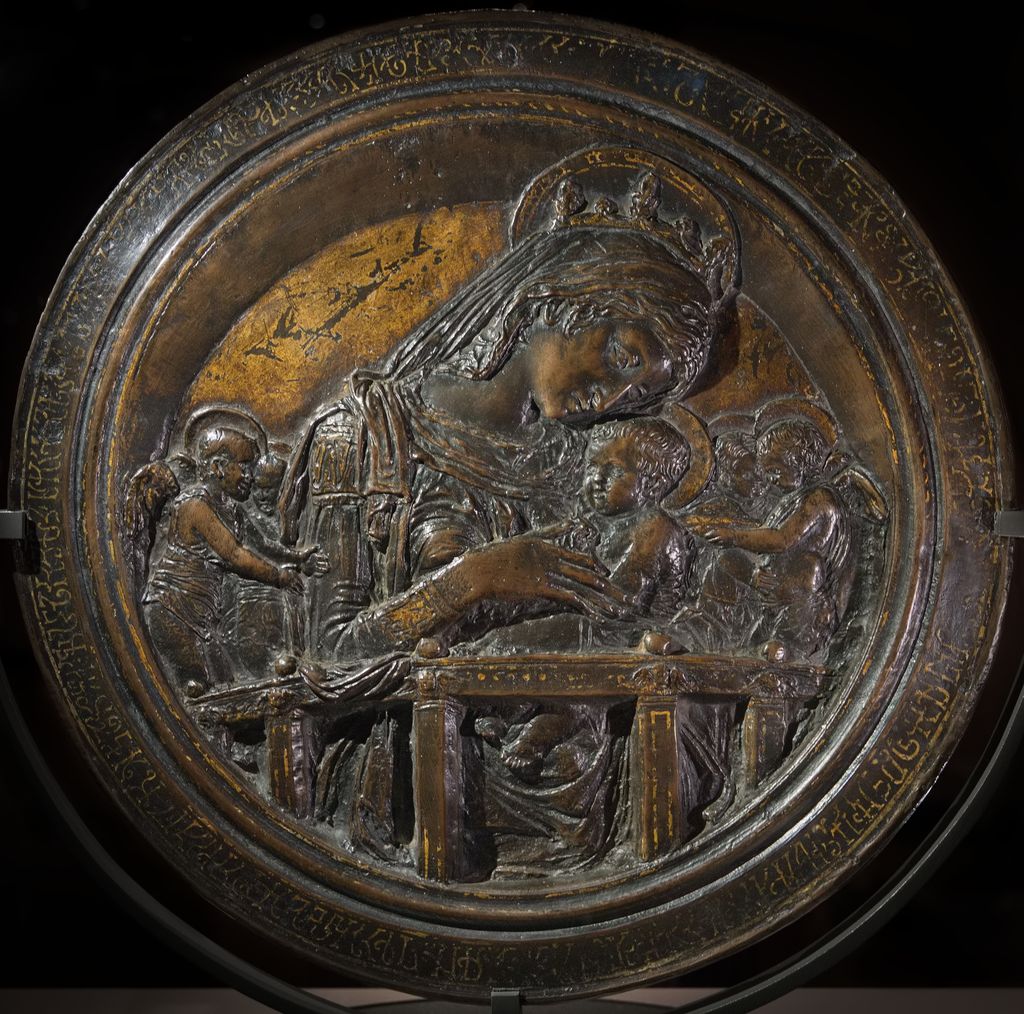
Chellini Madonna
Armin Kleiner. Image source. CC BY-SA 4.0. Resized for the web.
