

 by Tom Gurney
Tom Gurney BSc (Hons) is an art history expert with over 20 years experience
Published on June 19, 2020 / Updated on November 6, 2025
Email: tomgurney1@gmail.com / Phone: +44 7429 011000
David by Michelangelo
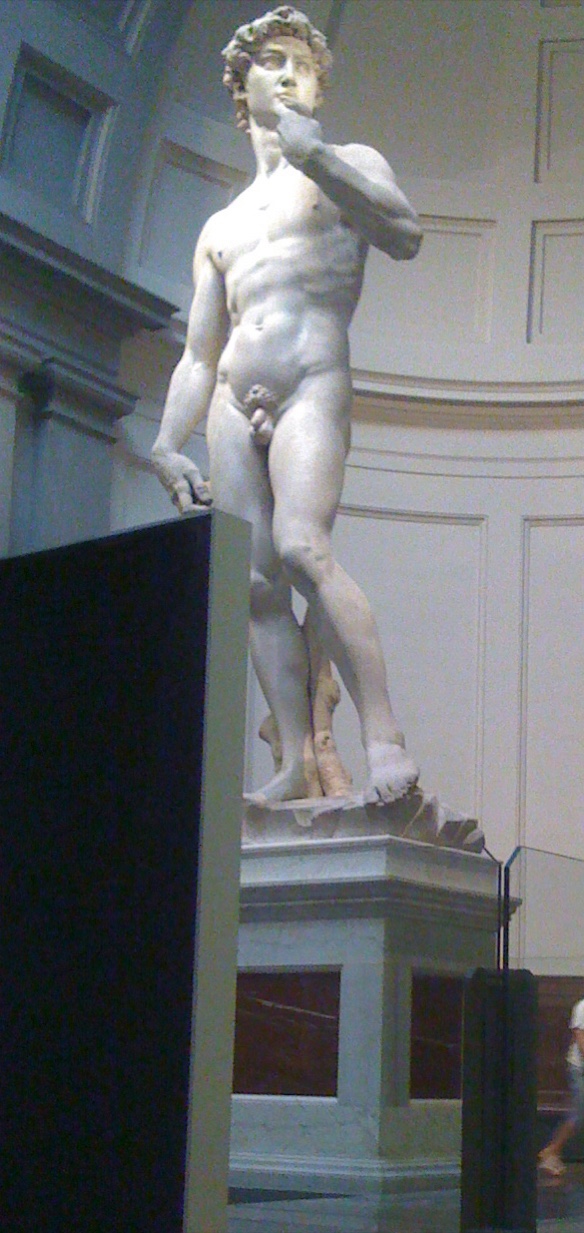
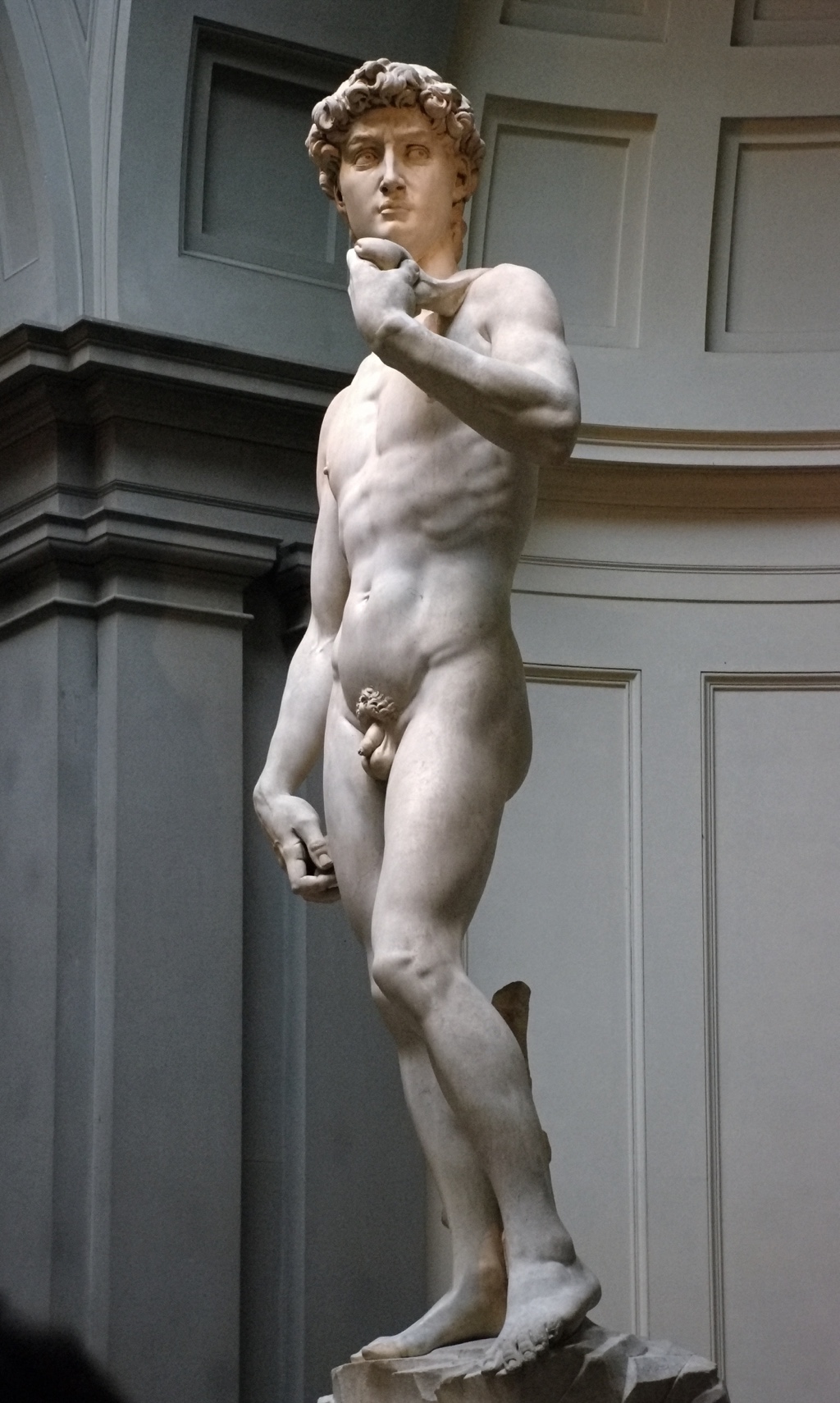
Michelangelo's David is perfectly still, but almost nothing about him is at rest. His head turns. His brow contracts. The tendons of his neck sharpen as he looks toward an enemy who is nowhere to be seen. One hand closes around a stone; the other controls a sling so discreet that it can disappear against the body. The famous giant is therefore an image of the moment before action—a colossal figure built around concentration, uncertainty and withheld force.
The statue's history is as remarkable as its pose. Michelangelo carved it between 1501 and 1504 from a tall block of marble that other sculptors had begun and abandoned. It was commissioned for Florence Cathedral, but the finished work was judged too compelling for its intended place high on the building. Instead, it became a guardian at the entrance to Palazzo Vecchio, the seat of Florentine government. A biblical shepherd made for a sacred architectural programme entered the political life of the city and became one of the most recognisable bodies in Western art.
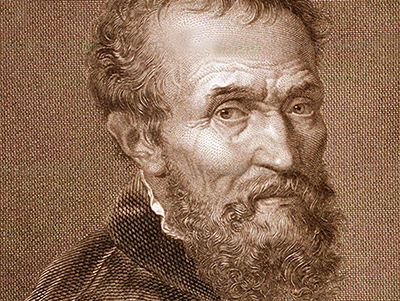
By sculpture I mean that which is made by the force of taking away.
At a Glance
- ArtistMichelangelo Buonarroti
- TitleDavid
- Date1501–1504
- MediumWhite marble
- HeightApproximately 517 cm (about 17 ft), including the carved base
- WeightApproximately 5,560 kg
- Current locationGalleria dell'Accademia, Florence
- CommissionOpera di Santa Maria del Fiore, for Florence Cathedral
- First public locationBeside the entrance to Palazzo Vecchio, Piazza della Signoria
- Unveiled8 September 1504
- Moved indoors1873[1]
Contents
- The Moment Before the Stone Flies
- A Body That Changes as You Move
- The Abandoned Block Called the Giant
- Carving Presence into Marble
- What the Face and Hands Do Together
- A Renaissance David
- Florence Before Michelangelo: A City of Davids
- From Florence Cathedral to Palazzo Vecchio
- Scale, Proportion and the Intended View
- The White Statue That Once Shone with Gold
- An Outdoor Life and a Museum Afterlife
- Copies, Casts and a Global Icon
- A Young Sculptor at a Turning Point
- Artist Up Close
- Why David Still Feels Immediate
Watch: David and the Florentine Republic
This focused video discussion is useful before the annotated close reading because it explains the statue's cathedral commission, civic setting and pre-battle subject moment.[6]
Annotated Details from David
The annotated view keeps attention on the statue as a carved body in space: head, hand, sling and weight shift all work together rather than as isolated symbols.
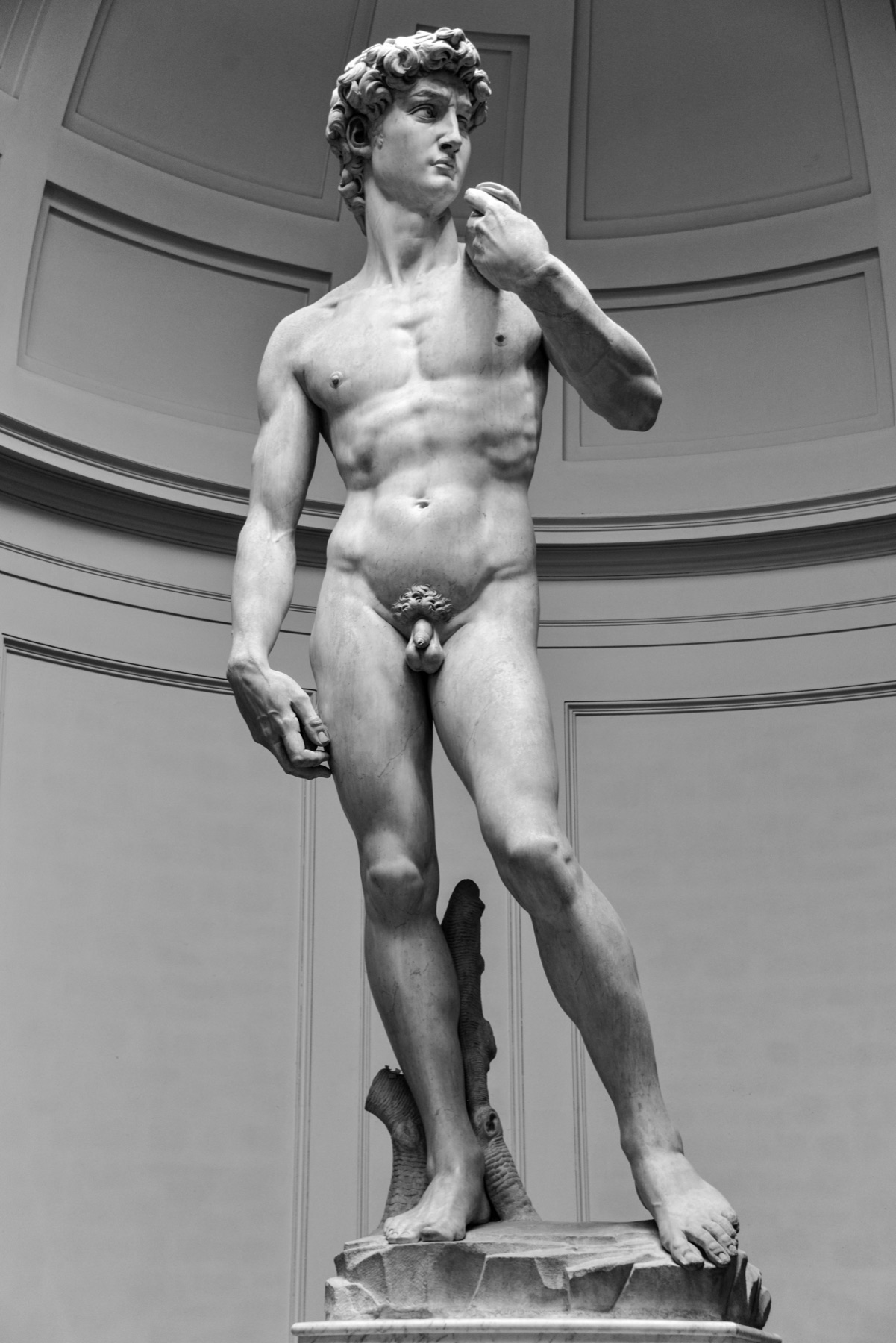
Details from DAVID
Close looking highlights the visual details that matter most on this Michelangelo page while keeping image-source and rights notes in the references.
Head and gaze
The turned head concentrates the narrative before the battle, directing attention toward an unseen Goliath.
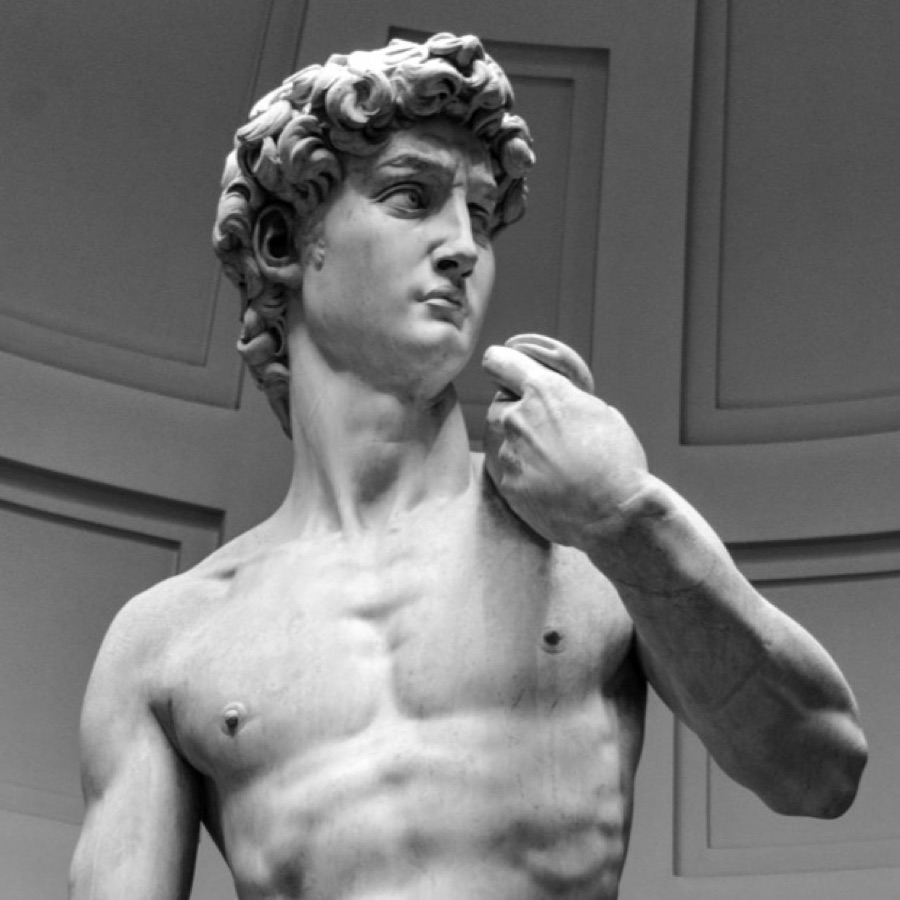
Right hand and stone
The enlarged right hand keeps the stone close to the thigh, making the act of preparation visible without showing the throw.
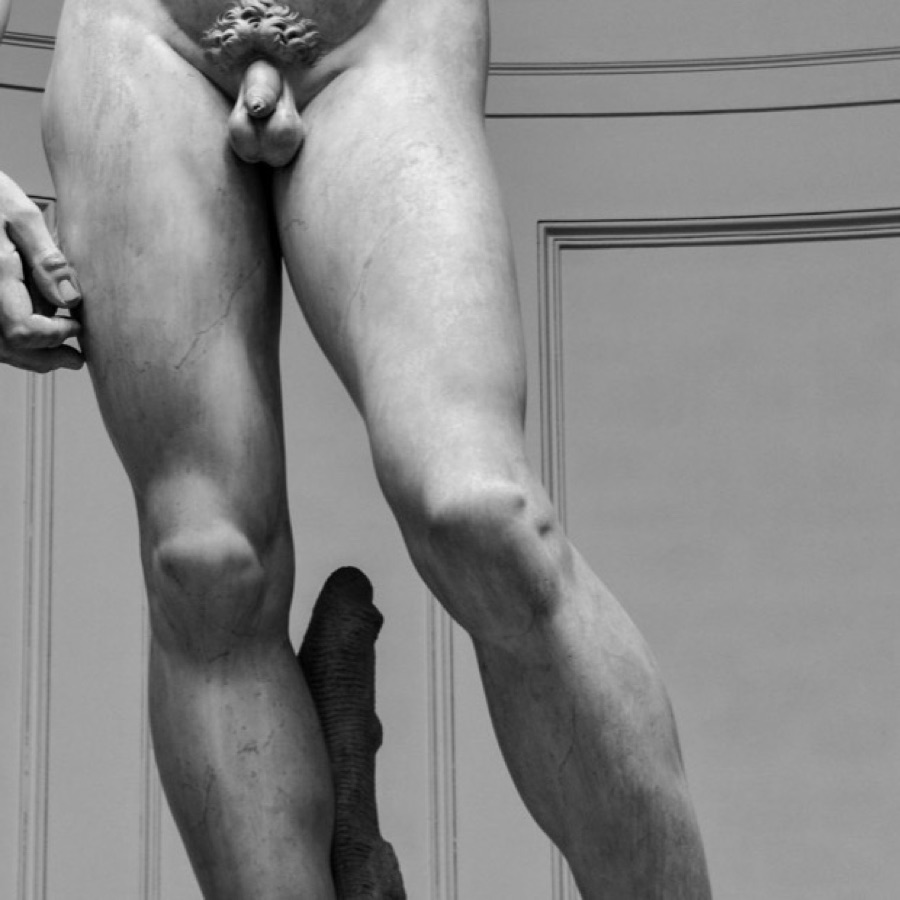
Sling over shoulder
The sling is understated from the front but essential to the subject, running over the left shoulder and across the back.
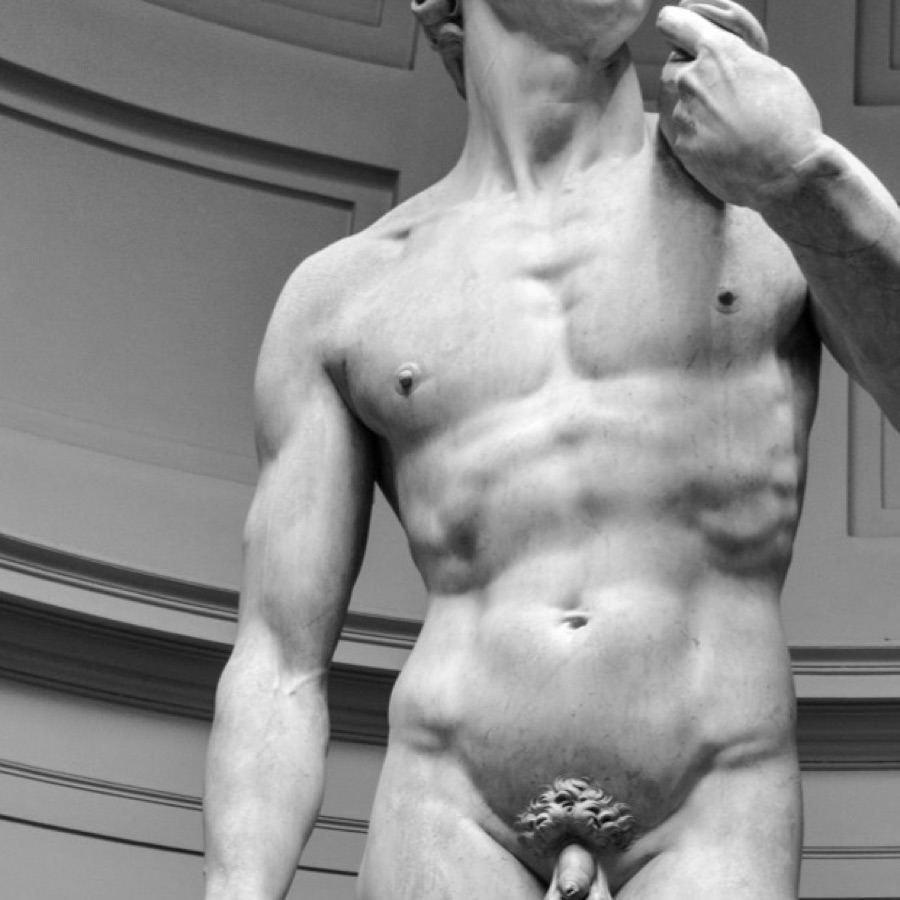
Legs and support
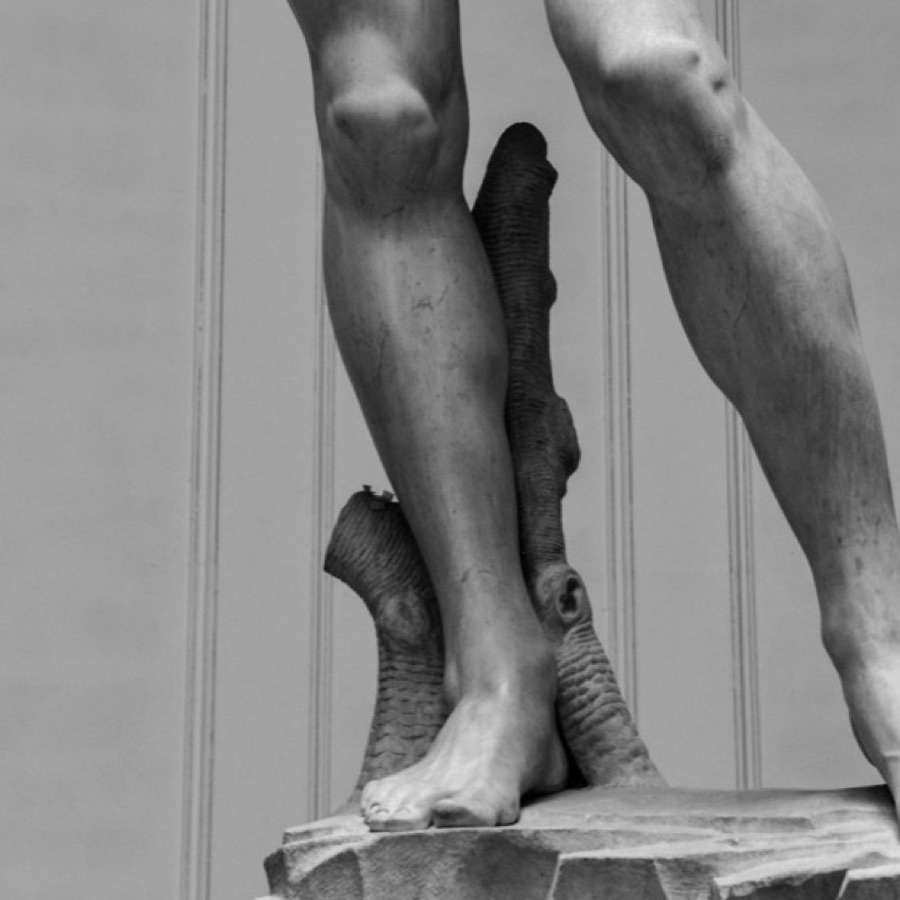
The weight-bearing leg, relaxed leg and support organise the colossal marble into a stable but alert contrapposto.
The Moment Before the Stone Flies
The biblical David defeats Goliath through a combination of courage, faith and skill. Rejecting the armour offered by King Saul, the young shepherd chooses five smooth stones and the sling he already knows how to use. He strikes the Philistine champion in the forehead, brings him down, and cuts off his head with the giant's own sword. The story turns on an astonishing reversal: an apparently vulnerable youth overcomes a heavily armed warrior.
Earlier Florentine artists had often chosen the outcome. Donatello's bronze David rests a foot upon Goliath's severed head; Verrocchio's bronze youth stands beside the same unmistakable proof of victory. Michelangelo removes the defeated giant altogether. His David has not yet thrown the stone. The face, posture and barely visible weapons locate the narrative in the interval between decision and release.[2]
That choice changes the emotional character of the subject. A victorious David can appear self-assured because the danger has passed. Michelangelo's hero has no such guarantee. He must judge the distance, read his opponent and master his own body. The tightened brow and focused gaze make thought part of physical action. This is not an abstract calm disturbed by a facial expression; the whole statue is organised around readiness.
The weapons disclose themselves slowly. The sling passes over the left shoulder and down the back, held near the shoulder by the raised left hand. The right hand keeps the stone close to the thigh. From a frontal position, both attributes can be overlooked, so the figure initially resembles an unarmed monumental nude. Moving around the marble reveals that the apparent exposure is strategic. David carries a weapon whose effectiveness depends on mobility and precision rather than weight.
Goliath's absence also expands the space around the sculpture. David's eyes and turn of the head imply an adversary beyond the marble, somewhere across the viewer's own surroundings. The encounter is no longer contained between two carved figures. The enemy becomes imagined, and the still body appears to measure the invisible distance between them.
Michelangelo does not make David physically slight. The body is mature, powerfully developed and far larger than any living man. Yet the disproportion at the heart of the biblical story survives. The visible giant is David himself, while the greater giant remains outside the work. The sling and stone preserve the paradox: impressive strength is joined to humble means.
A Body That Changes as You Move
The statue is often known through a frontal photograph, but it does not fully reveal itself from the front. Its pose is asymmetrical. Most of the weight descends through the straight right leg; the left leg bends and relaxes. The pelvis tilts, the torso answers, and the shoulders settle at a different angle. This linked adjustment is commonly described as contrapposto, a way of balancing the standing body so that rest contains the possibility of movement.[3]
From the front, the weight-bearing side appears firm while the other side opens. The line of the right leg rises toward the lowered hand and the broad torso. Across the body, the left arm bends sharply upward, bringing the sling toward the shoulder. The limbs establish two very different rhythms: one long and descending, the other compact and angular.
The head intensifies the imbalance. It turns to David's left independently of the chest. This twist separates attention from the body's main axis, as though he has just noticed a movement at the edge of his field of vision. The pose can be held, but it does not feel permanent. It is a balance chosen for an immediate purpose.
Walk toward the left side and the sling becomes legible. Continue behind the figure and its strap crosses the back, while the shoulder blades, spine and supporting tree trunk create a new set of verticals. From the right, the lowered hand and planted leg reinforce one another. The profile clarifies the projection of the face and the backward sweep of the hair. No viewpoint supplies everything.
This unfolding experience is essential to sculpture. A photograph fixes one relation between viewer and object; the marble continually offers another. Even the famous right hand changes. Seen frontally, it appears especially large and emphatic. From an angle, the fingers reveal their grip on the concealed stone and become part of a narrative action. What may look like a general symbol of artistic power is first of all David's prepared weapon hand.
The body also alternates between openness and concealment. The chest and abdomen face the viewer with startling exposure, yet the instrument of victory is folded into the silhouette. The nudity declares physical presence while the weapons reward close attention. Michelangelo makes the obvious and the hidden depend on one another.
The Abandoned Block Called the Giant
On 16 August 1501, the Opera del Duomo—the institution responsible for Florence Cathedral—commissioned Michelangelo to carve a monumental figure from a marble block already in its possession. The payment was set at 400 ducats. The intended statue belonged to a much older plan for large biblical figures on the exterior of Santa Maria del Fiore.[1]
The stone was not pristine. Agostino di Duccio had worked on it in the 1460s, probably beginning a figure for the Cathedral programme. A later attempt was associated with Antonio Rossellino in the 1470s. Neither sculptor completed a statue. For decades the long, weathered block lay in the Cathedral works and acquired a fitting nickname: the Giant.[4][5]
Its condition sharply limited Michelangelo's freedom. Earlier cutting had already removed material, and the remaining block was unusually tall and narrow. Institutional accounts also describe weaknesses and irregularities in the marble. The outer boundary had been fixed, and no stone could be added where a limb required more room. He had to fit a stable, intelligible body within decisions partly inherited from other hands.
The finished pose answers those restrictions with remarkable economy. The legs remain comparatively close, preserving a strong vertical mass. The left arm folds toward the torso instead of extending far into open space. The sling lies against the body. A tree trunk behind the right leg supplies extra support at a vulnerable point without competing with the figure. Even the narrowness of the block may contribute to the compressed energy of the result.
Marble carving is irreversible in a practical sense: once a substantial piece has been cut away, it cannot be restored as though the block were untouched. Working within an already reduced stone made every major decision consequential. Beyond carving convincing anatomy, Michelangelo organised a colossal body, an alert pose and a complete narrative idea within material left over from two abandoned projects.
The situation encouraged legend. Later storytelling often presents Michelangelo as the artist uniquely able to see a figure imprisoned in stone and release it. The history is more interesting when returned to material fact. A powerful institution owned a difficult block; previous contracts had failed; a twenty-six-year-old sculptor accepted the risk. His success depended on imagination, but also on measuring, planning, structural judgement and an exact understanding of how much marble each passage could spare.
Michelangelo worked behind a screen near the Cathedral workshops. Privacy protected the unfinished figure from constant public scrutiny, yet the making was never the act of a solitary magician outside ordinary labour. Stone of this scale required transport, equipment, assistants and the logistical support of the Opera. The authorship is Michelangelo's; the physical circumstances belonged to the working city around him.
Carving Presence into Marble
The first impression of David is bodily unity, but the surface achieves that unity through variety. Hair is cut deeply so that individual locks break into shadow. The pupils are drilled and the brows project, sharpening a gaze meant to remain visible across distance. The chest and abdomen open into broader, calmer planes. Veins and tendons emerge selectively in the hands, arms and neck.
This is not anatomy transcribed without interpretation. Michelangelo adjusts emphasis according to the work's scale and expressive purpose. The right hand is larger than strict natural proportion would suggest; the head, too, can seem enlarged in relation to the torso. These features have often been explained as corrections for a high original position, where parts farther from the viewer might otherwise recede. Such an explanation is plausible, especially for a statue intended for architecture, but no surviving instruction from Michelangelo sets out a complete optical formula. The enlargement also works expressively: head and hand concentrate seeing, deciding and acting.
The feet are broad enough to establish weight, though the ankles remain structurally delicate for so great a mass. The planted right foot presses into the base while the left touches more lightly. Kneecaps, hip bones and the turn of the torso create a responsive chain of adjustments. The body feels observed because each part answers the pose.
Michelangelo's familiarity with the male nude drew on several kinds of knowledge. He studied living bodies through drawing, learned from carved antiquities, and understood anatomy with an intensity unusual even in Renaissance Florence. The Metropolitan Museum's account of his work as a draftsman and designer places these practices within disegno: both the physical act of drawing and the intellectual conception through which a work is ordered.[6] In David, observation and invention cannot be separated neatly. A real body could supply weight, tension and surface knowledge; no model could supply the statue's colossal scale or exact psychological situation.
Light completes what the chisel began. Deep passages in the hair, eyes and between the fingers hold darkness. The torso receives light more evenly, allowing its major turns to remain legible. Seen outdoors, these relations would have changed continuously with weather and hour. In the Accademia, controlled illumination creates a steadier encounter but cannot reproduce the full variation of the square.
The marble is also less visually uniform than photographs suggest. Veining, small condition differences and the traces of a long material history interrupt the idea of a flawlessly white ideal. Michelangelo's finish can make stone resemble warm skin, but it never ceases to be stone. Its weight is present in the support behind the leg, the thickness of wrists and ankles, and the enormous practical fact that this alert young man weighs several tonnes.
What the Face and Hands Do Together
The face is often described as anxious, angry or determined. Each word catches something, but none is sufficient on its own. Michelangelo gives the brow a forceful downward pull, sets the mouth in a firm line and directs the pupils toward David's left. The expression is concentrated, its drama held inward. There is no cry, grimace or theatrical display of fear.
The uncertainty is productive. If the face showed uncomplicated confidence, the story's danger would lose force. If it showed panic, the body's monumental steadiness would become hard to reconcile with it. Michelangelo holds these states together. The figure is controlled because the risk is real, and the intensity of looking suggests that control must be actively maintained.
The hands translate that mental state into practical preparation. The left hand rises almost to the shoulder, where it gathers the sling. Its bent wrist and enclosed position make it an instrument of control. The right hand hangs lower and appears relaxed at first, but the fingers curve around the stone. It is both at rest and occupied.
That difference gives the arms distinct tasks. The raised arm manages the long, flexible weapon; the lowered arm preserves the projectile and can move swiftly into the throw. Neither performs the decisive action yet. Their asymmetry prolongs the pause already established by the legs and head.
The size of the right hand makes its restraint particularly striking. Michelangelo could have opened it to display the stone as an attribute. Instead, he hides the object within a grip that becomes clear only on inspection. Monumentality is concentrated in an action barely visible from the front.
Face and hands are linked across the torso by an implied sequence. David sees, judges, holds and will act. The viewer reconstructs that sequence by moving attention from the turned head to the raised sling hand and down to the stone hand. The broad chest between them is less a display inserted into the story than the physical field through which readiness is sustained.
The pupils deserve particular attention. Their incised and drilled forms catch darkness, helping the gaze read from below. They do not reproduce the soft optical effects of living eyes, yet from a distance they seem startlingly directed. Michelangelo uses the very artificiality of carved shadow to create attention.
In this way, the statue's most famous anatomical emphases avoid becoming isolated demonstrations. The large head and hand belong to the narrative structure. David's victory will depend on perception and precisely directed force. Michelangelo makes both capacities visible before either has reached its result.
A Renaissance David
The figure joins two visual languages that might appear incompatible: the biblical shepherd and the monumental classical nude. David's nakedness is not a literal illustration of a youth approaching combat in ancient Israel, nor is the body the slight body described by his opponents. Michelangelo gives sacred history the physical authority associated with antique sculpture.
Florence was a particularly charged setting for that union. Generations of sculptors had already made David serve religious, artistic and civic purposes. Michelangelo retained the local hero while overturning almost every expectation attached to him: a smaller youth became a colossus, the severed head vanished and victory gave way to anticipation.
The statue also refuses an easy contrast between spiritual courage and bodily power. David's strength is obvious, but muscle alone cannot explain the story. He must use judgement and a seemingly inadequate weapon. The body prepares to serve an act of intelligence. Michelangelo's enlargement does not cancel the theme of the underdog; it makes inner readiness visible through outer form.
Nudity carries vulnerability as well as grandeur. David wears no armour, and nothing separates his flesh from the imagined threat ahead. At the same time, the pose associates him with heroic antiquity and with a long artistic tradition in which the nude body can express character and moral force. The result is neither simply pagan nor simply illustrative. Michelangelo makes classical form bear a biblical drama.
The work's stillness is equally complex. An ancient standing figure might embody lasting equilibrium; David's balance belongs to a precise narrative second. His weight is settled because the throw has not begun. His attention makes the stillness provisional. The statue can therefore suggest timeless heroism while remaining rooted in time.
Florence Before Michelangelo: A City of Davids
Michelangelo's statue entered a Florentine tradition almost two centuries old. A collaborative project by the Galleria dell'Accademia, the Bargello Museums, the Opera del Duomo and other city institutions traces five major sculpted Davids from Andrea Pisano to Michelangelo. Their differences show how flexible the hero had already become.[12]
Andrea Pisano's marble figure of 1336 was made for the principal façade of Giotto's Campanile. This is an adult David presented as a poet, holding a scroll associated with the Psalms. The figure belongs to a monumental programme in which biblical authorship and prophecy mattered as much as the combat with Goliath.
Donatello's marble David of 1408–1409 was also ordered by the Cathedral authorities. Like Michelangelo's later colossus, it was intended for an elevated architectural position before entering a different civic history. The connection means that the Opera del Duomo did not arrive at David accidentally in 1501. The subject already belonged to the institution's sculptural language.
Donatello returned to David in bronze around 1440. The smaller, sensuous nude stands over Goliath's head after the fight, sword in hand and victory physically secured. Its revival of the freestanding nude gave the biblical youth the beauty and ambiguity of antique art. Michelangelo inherited that bold conjunction of Scripture and the classical body, but changed both scale and time.
Verrocchio's bronze, made around 1472–1475, presents a clothed adolescent beside the severed head. The light figure, open stance and visible trophy make clever triumph immediately readable. Michelangelo withholds the same information. His Goliath is absent, his stone almost concealed and his sling easiest to understand from behind.
The comparisons prevent David from becoming the isolated invention of one genius. Michelangelo worked inside a city already skilled at remaking the hero. His originality lies partly in his answer to that inheritance: he chose the instant no earlier Florentine monument had made so commanding.
Material sharpens the distinctions. Andrea Pisano and the younger Donatello used marble for architectural figures; the celebrated later works by Donatello and Verrocchio used bronze; Michelangelo returned to marble at a scale that overwhelmed the earlier bodies. Each material produces its own relation among weight, surface, projection and support.
Setting matters just as much. A Cathedral figure, a Medici-associated bronze, a sculpture housed in the Bargello and a guardian at Palazzo Vecchio do not carry meaning in the same way. The history of Florentine David is a history of movement among sacred, domestic, dynastic and civic spaces. Michelangelo's transfer from Cathedral programme to government palace is extraordinary, but it belongs to this longer local habit of allowing David to acquire new work in new places.
The tradition also complicates the idea that nudity alone made Michelangelo revolutionary. Donatello had already produced a freestanding nude David. Michelangelo's sharper break lies in combining the nude with colossal architectural scale, mature bodily power and pre-combat uncertainty. He revived an ancient form and made that form wait.
From Florence Cathedral to Palazzo Vecchio
The commission began with a clear institutional setting: a large figure for Florence Cathedral. The older programme imagined monumental Old Testament figures high on the exterior, where they would form part of the building's sacred and civic magnificence. Michelangelo's David was conceived within that history, not originally as a freestanding sculpture for the government square.[1][4]
By early 1504, however, the finished statue had exceeded the practical and imaginative limits of that plan. Its extraordinary scale, weight and artistic prestige made hoisting it high onto the Cathedral difficult and perhaps undesirable. A committee assembled in January to consider a new location. Among those consulted were Leonardo da Vinci, Sandro Botticelli, Filippino Lippi and Pietro Perugino—evidence of how seriously Florence treated the question.[1]
The chosen site was beside the entrance to Palazzo Vecchio in Piazza della Signoria. Moving the sculpture there took several days. Its arrival placed David at the heart of public government, ceremony and conflict. The figure was unveiled on 8 September 1504.[1]
The change of site transformed meaning without erasing origin. On the Cathedral, David would have belonged to a sequence and been read against sacred architecture from far below. At Palazzo Vecchio, he stood as a singular guardian near the doorway through which political authority passed. His watchful face could now be understood in relation to the city beyond him.
Florence's republic readily found itself in the story of a smaller power confronting stronger enemies. David's vigilance, courage and resistance became associated with civic liberty. The Accademia continues to describe the statue as an emblem of strength and independence, and the work's position beside the palace made that association public and durable.[1][7]
Chronology keeps the political reading grounded. Michelangelo accepted a Cathedral commission in 1501; the government setting was selected after the carving was nearly complete. The statue did not need to contain a secret republican code from its first cut in order to become politically potent. Meaning can be made by placement, ceremony and collective memory as well as by original design.
The palace location also altered how the body was seen. The figure remained elevated, but it could be approached from the open square and encountered against changing buildings, crowds and weather. Its outward gaze made the public environment feel continuous with the biblical drama. Anyone occupying the space could stand, imaginatively, somewhere between David and the unseen Goliath.
The statue's nudity sometimes appears to conflict with a guardian's role. In practice, the exposed body heightened both classical dignity and vulnerability. It offered no literal armour, court costume or contemporary uniform. This allowed David to become a more flexible public figure: ancient, biblical and Florentine at once.
Scale, Proportion and the Intended View
At approximately 5.17 metres high including its carved base, David is more than twice the height of a tall person. The Accademia gives a weight of roughly 5,560 kilograms.[1] Italy's national cultural catalogue records a height of 516 centimetres and also supplies width and depth, a minor variation that probably reflects rounding or a difference in measurement convention rather than disagreement about the object.[8]
Colossal scale changes ordinary anatomy. A hand the size of a human torso is not experienced as a normal hand enlarged by a neutral machine; it becomes a landscape of joints, veins, nail beds and stone. From below, the viewer sees the underside of forms that a straight-on photograph can suppress. Near the base, the feet feel especially massive. Farther up, head and shoulders recede.
The first destination makes upward viewing central, but it does not give us one recoverable ideal angle. The Cathedral position was never realised. At Palazzo Vecchio, the sculpture stood above the square on a substantial base. In the Accademia, the tribune and long approach establish a new, ceremonial axis while allowing unusually close inspection around the sides.
This history cautions against explaining every proportion in only one way. The enlarged head may assist visibility and intensify the face; the large right hand may answer distant viewing, embody agency, balance the raised arm or respond to the inherited block. Several effects can coexist. The surest starting point is what the forms do now: they draw the eye toward perception and action.
The statue also shifts between coherence and deliberate strangeness. At a moderate distance, the body gathers into a plausible whole. Close up, individual parts can feel enormous or sharply isolated. Michelangelo uses that oscillation. David is human enough for tension to register in a brow, but superhuman enough to dominate a civic space.
The White Statue That Once Shone with Gold
The modern David is so closely identified with white marble that colour can sound like an intrusion. The Accademia's object history records a different early appearance. The sling and the supporting trunk were gilded, and a garland or wreath was made for the head.[1][13]
These were not incidental accents. Gold on the sling would have made the almost hidden weapon catch light as the viewer moved. Gilding on the trunk would have separated a structural support from the flesh it stabilised. A metallic wreath above the face would have altered the silhouette and introduced a sign of honour or victory before Goliath had actually fallen.
The conservation record makes some parts of this reconstruction firmer than others. A study by Franca Falletti, former director of the Accademia, relates archival payments to a wreath made from brass wire and twenty-eight copper leaves. The documents establish that it existed, though they do not prove how long it remained on David's head. The absence of corresponding oxidation damage leaves its duration uncertain.[13]
The sling and trunk provide stronger physical evidence. Their surfaces were left rough enough to receive gilding, in contrast with the smoother treatment of flesh. Technical investigation also found a microscopic metallic remnant along the sling, although its position suggests a later gilding intervention rather than an untouched fragment from 1504.[13]
This distinction is important. Evidence for former colour can be secure without every surviving particle being original. Records, surface preparation and later residues together reconstruct a changing object, not a single pristine layer preserved whole.
The lost gold changes close looking even when it cannot be seen. Michelangelo's sling now hides through similarity of colour; in 1504 its gilded path may have disclosed itself more readily. The trunk now reads mainly as marble support; gold would have drawn it into the statue's symbolic display. The supposedly pure white colossus is a later condition created by loss, weather and intervention.
Renaissance marble and colour were never absolute opposites. Gilding could animate weapons, hair, garments and attributes without covering the whole body. In David, selective brilliance would have intensified the tension between the naturalistic nude and the public emblem. Early Florentines encountered not only a giant of white stone, but a marble body punctuated by reflective signs.
An Outdoor Life and a Museum Afterlife
For more than three and a half centuries, the original stood outside Palazzo Vecchio. Marble exposed to rain, temperature change, airborne particles and physical contact does not remain untouched. The figure also suffered human violence. During civil disturbances in 1527, an object thrown from the palace struck and broke the left arm. The fragments were recovered and the arm repaired. Later centuries brought further weathering, interventions and concern about structural vulnerability.[5]
In 1847, the Florentine caster Clemente Papi took a mould from the original. The complex operation divided the mould into more than 1,500 pieces. Casts made from it preserved the statue's form at that date, although the process of moulding and later cleaning also became part of the marble's conservation history.[5][9]
The mould was commissioned in 1846 and produced outdoors the following year. Two plaster versions were ordered soon afterward: one eventually entered the British royal collection and later the V&A, while another helped test possibilities for moving the original. Papi preserved the piece-mould in Florence, allowing future casts to be made without repeatedly covering Michelangelo's marble.[13]
The operation was nevertheless far from harmless. During conservation between 2002 and 2004, investigators found old plaster residues in confined areas, including between the toes. The mould's enormous pieces placed physical stress on the statue, whose ankles and supporting trunk already contained horizontal cracks. Nineteenth-century committees repeatedly examined those weaknesses.[13]
The risk was not confined to one intervention. Outdoor weather, the forward disposition of the giant body, vibration in the busy square, the condition of the base and wind all entered contemporary assessments. Committees in 1852, 1866 and 1872 monitored the cracks and debated reinforcement. Concern about the ankles and trunk became a major argument for taking the original indoors.[13]
The decision to bring David indoors culminated in 1873, when the original was removed from Piazza della Signoria and transferred to the Galleria dell'Accademia. The tribune designed for it was completed later in the decade. The move protected the sculpture from the open-air conditions that had shaped its surface, but it also separated the original body from the political threshold that had made it famous.
Florence answered the absence with replicas. A bronze David produced through Clemente Papi's casting work was installed at Piazzale Michelangelo in 1875, overlooking the city as part of a nineteenth-century monument. A marble copy by Luigi Arrighetti took the original's position outside Palazzo Vecchio in 1910.[10][12][13] These works keep Michelangelo's silhouette present in public Florence, but they differ in maker, date, material, surface and setting. Neither should be confused with the sixteenth-century original.
The Accademia now cares for a sculpture whose history includes original carving, old breaks, repairs, moulding, cleaning and prolonged exposure. Regular dust removal and close observation help conservators track change over time.[11] Care does not aim to turn the marble into a timeless object newly finished in 1504. It manages a material work that has lived through centuries of public attention.
The 2002–2004 conservation project combined treatment with sustained technical study; the Accademia identifies 2003–2004 as the period of the marble's careful cleaning.[1][13] The campaign addressed the fragile lower structure but did not make every concern disappear. Continuing monitoring acknowledges that colossal balance depends on comparatively narrow ankles and an old support already marked by stress.
Surface investigation also revealed why a simple narrative of “dirt removed” is inadequate. Plaster, waxy layers, weathering and the residues of old gilding or regilding can overlap. A substance between the toes may record Papi's mould; material on the sling or trunk may relate to colour; other films may derive from undocumented protection or past cleaning. Conservation reads these layers before deciding what they are.
The indoor setting creates its own pressures. David attracts immense numbers of visitors, and the familiar frontal approach can encourage a quick act of recognition: here is the image already known from textbooks, advertisements and souvenirs. The richer encounter begins when recognition gives way to looking—when the sling appears, the block's narrowness becomes perceptible, or the concentrated face is reconnected to the full weight-bearing body.
Copies, Casts and a Global Icon
Few sculptures have been reproduced as often. Casts entered museums and art schools, where students could study a celebrated nude without travelling to Florence. Photographs detached the work from scale and allowed its head, hands and torso to circulate as independent images. Replicas placed David in new architectural and political settings around the world.
The Victoria and Albert Museum's full-size plaster cast is among the most important of these later objects. Made in 1856–1857 from Papi's mould, it was sent by Grand Duke Leopold II of Tuscany to Queen Victoria. It is hollow plaster assembled in sections, not a second marble by Michelangelo. Its value lies in its own nineteenth-century history, in the culture of casting and in the evidence it preserves of the original before later changes.[9]
Reproduction makes the design available while altering it. Plaster removes the translucency and density of marble. Bronze turns pale mass into a darker, reflective surface. A miniature souvenir makes the colossal manageable. A close photograph of the eye or hand creates a new composition Michelangelo never carved as a separate work.
Even the original's colour has an afterlife. Documentary and technical histories indicate that parts of the statue once carried gilded details, including elements associated with the sling and a now-lost garland or support. Those additions have disappeared, leaving the modern viewer with a more uniformly white David than early Florentines encountered.[5] The familiar image is therefore historical, not inevitable.
The multiplication of Davids has made object identity unusually important. The figure in the Accademia is the original marble. The one beside Palazzo Vecchio is a twentieth-century marble copy. The Piazzale Michelangelo statue is a nineteenth-century bronze replica. The V&A object is a nineteenth-century plaster cast. They share a form but not a material biography.
This distinction does not diminish the copies. It allows each to become legible on its own terms. A cast can record, teach and participate in debates about museum display. A civic replica can preserve the relationship between sculpture and place. A photograph can reveal a detail impossible to examine from the floor. The mistake lies only in allowing the fame of the form to erase the history of the particular object.
A Young Sculptor at a Turning Point
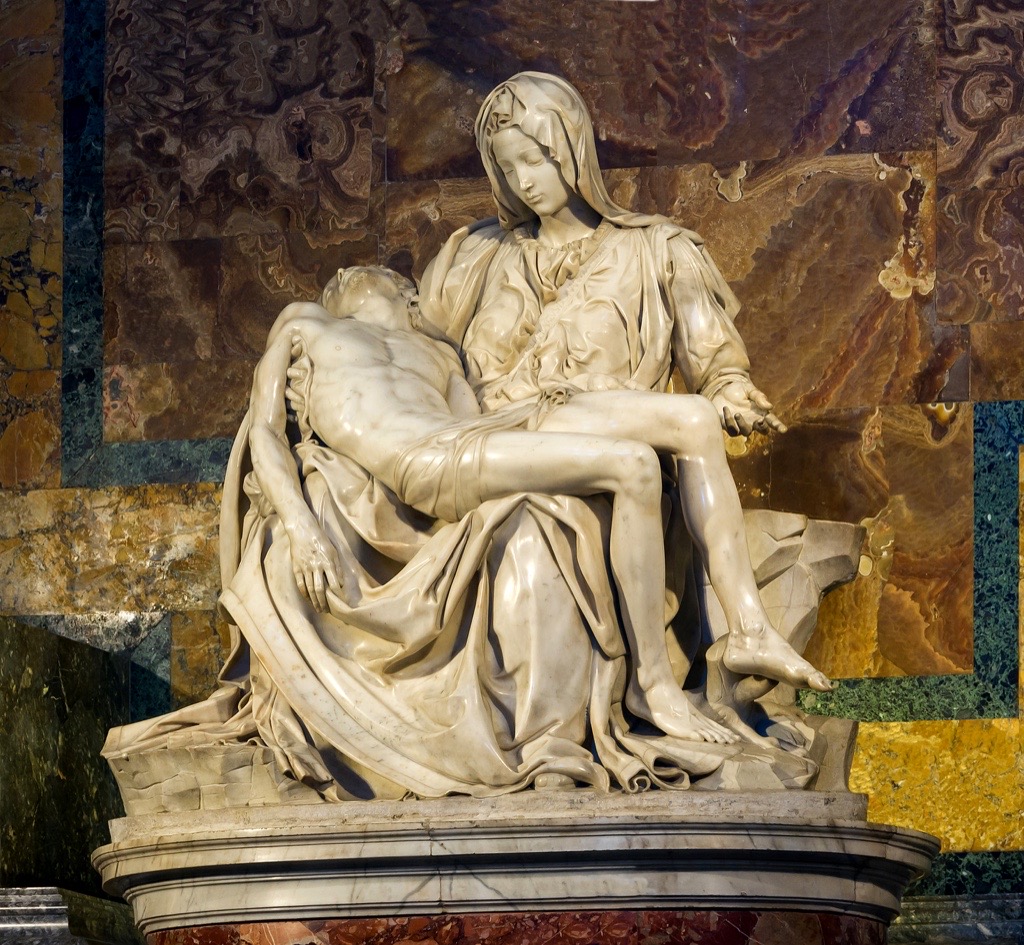
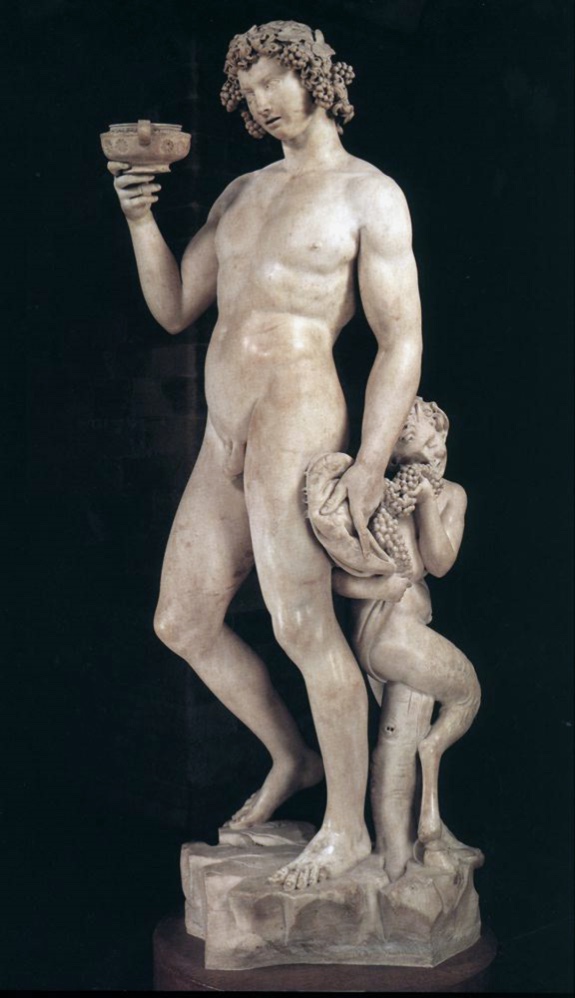
Michelangelo was twenty-six when he accepted the David commission. His reputation was already considerable, but it had been built through works with very different conditions. The marble Bacchus explored intoxicated instability and antique sensuality in Rome. The Vatican Pietà joined two figures in a polished funerary group. David asked him to work publicly in Florence, on a colossal block owned by the Cathedral and burdened with a history of failure.
The sequence reveals range rather than a smooth march toward greatness. Bacchus sways and looks outward through attributes; the Pietà folds death into a broad pyramid; David isolates a standing body and makes an absent opponent control it. Michelangelo carried knowledge from one work to another, but commission, site and subject demanded different solutions.
Florence now encountered the sculptor on a scale Rome had not. The completed statue stood in the centre of civic life, where its authorship could not be confined to a cardinal's chapel or private collection. Its placement made Michelangelo's bodily language part of the city's public identity.
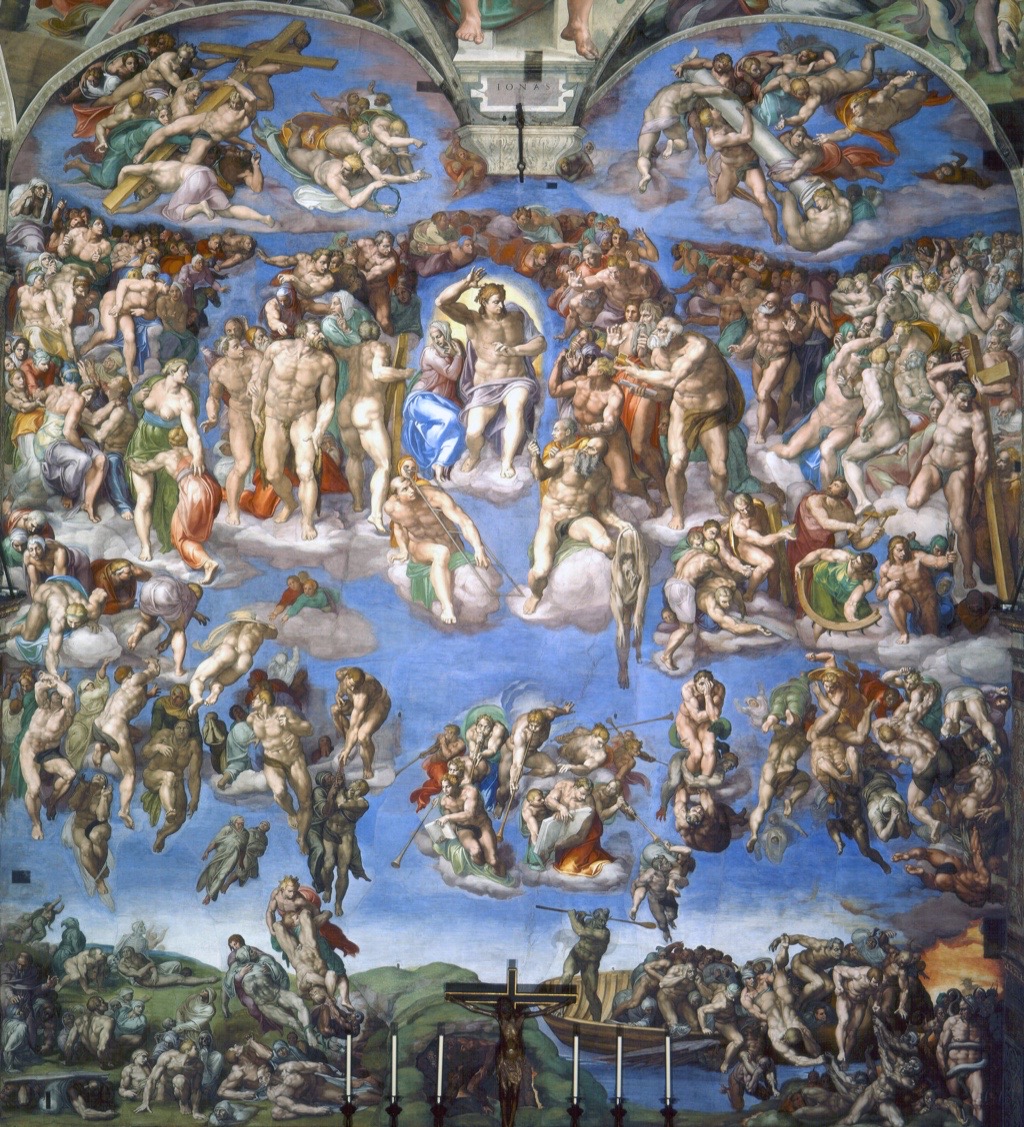
The years immediately around David also opened Michelangelo's practice beyond marble. He received the commission for the lost Battle of Cascina cartoon for the council hall of Palazzo Vecchio, working in rivalry with Leonardo da Vinci's Battle of Anghiari. The episode belongs to drawing and painting, but it extends the public ambition visible in the statue: large bodies, civic history and competition staged for Florence.[6]
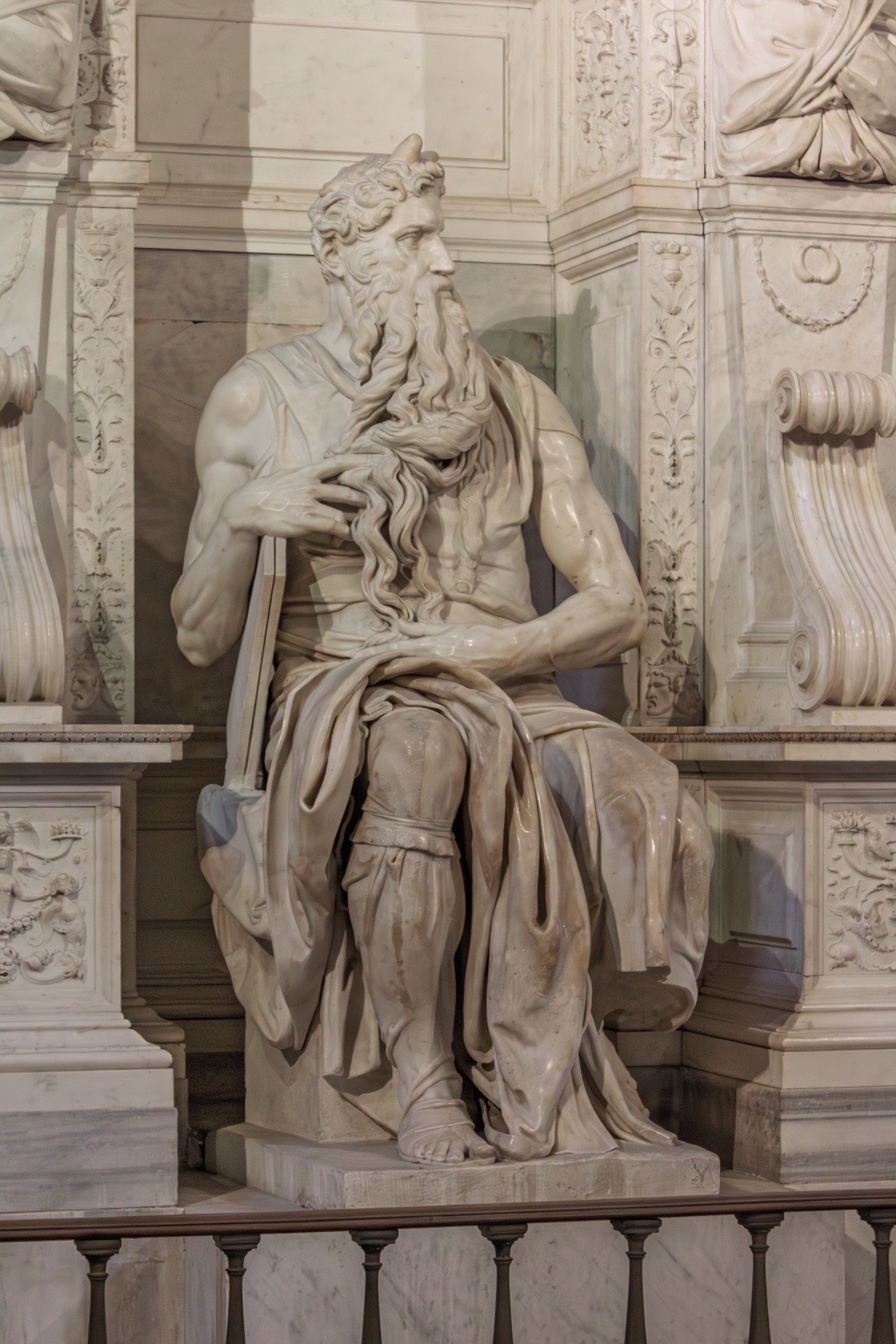
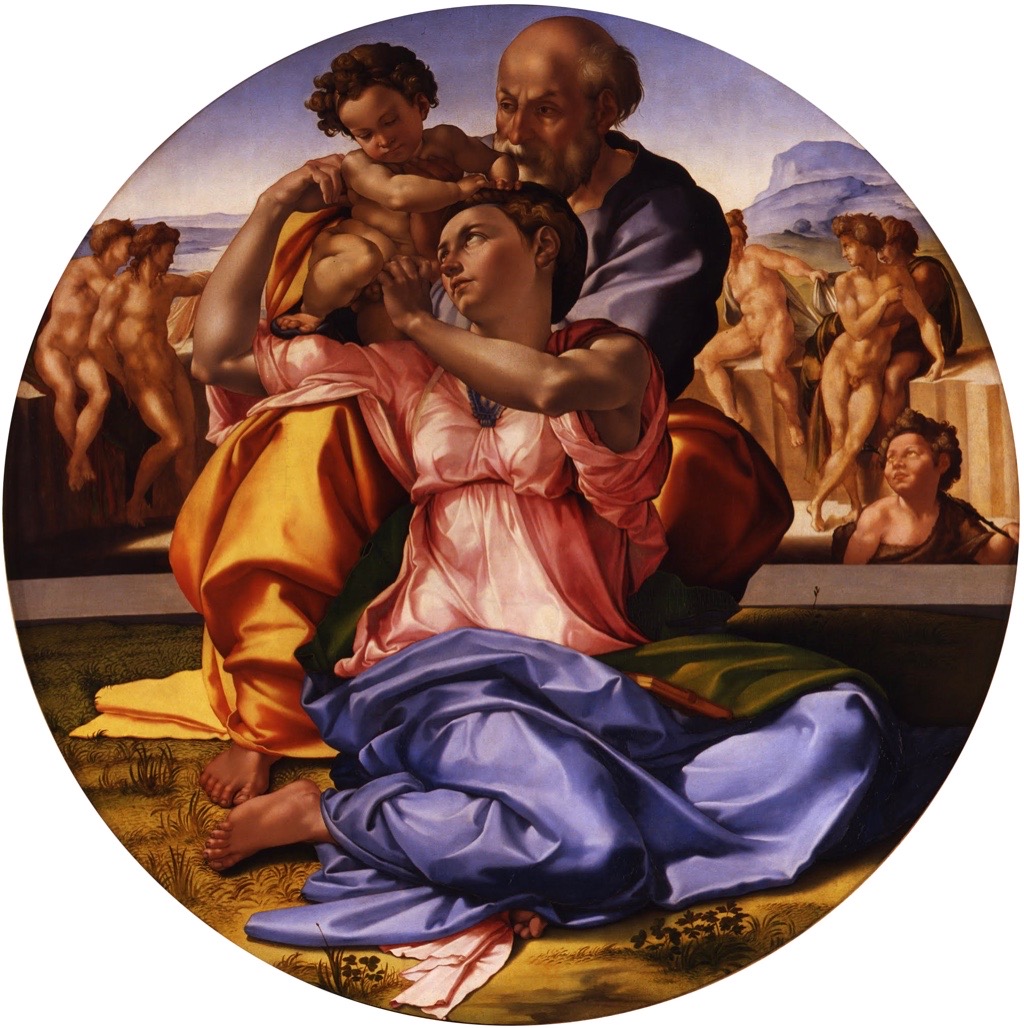
Later projects repeatedly returned Michelangelo to problems already present here. The tomb of Julius II brought difficult blocks, altered programmes and displaced intentions. The Medici Chapel joined sculpture to architecture and dynastic meaning. The late Pietàs tested how much bodily form stone could surrender. David does not predict all of them, yet its biography already contains the unstable relation among idea, material, patron and final site that would mark his career.
The statue's early place in that career matters because fame can make it look like a retrospective summary. It is instead the work of a young artist taking an inherited stone toward an unprecedented public result. Confidence and risk remain inseparable in it.
Artist Up Close
Begin with the feet and ask where the weight goes. The right leg is firm and vertical; the left loosens at the knee. Follow those differences upward into the tilt of the pelvis and the counter-movement of the shoulders. The pose becomes expressive before you reach the face.
Then look for the weapons. The right hand closes around the stone without displaying it. The left gathers the sling, whose strap is easiest to understand from the side and back. Their discretion is central to the story: David's means are modest, controlled and almost hidden.
Move to the head. Deep hair frames a face in which the strongest action is looking. Notice how the turn of the neck separates the head from the chest and directs attention across the surrounding space. Goliath exists through that line of sight.
Finally, circle the sculpture. From behind, the sling, tree support and structure of the back become prominent. From the sides, balance seems less stable than it does frontally. Return to the front and the body will no longer look simply motionless. You have seen the mechanisms of its waiting.
Why David Still Feels Immediate
The statue's fame can make it appear to stand for ready-made ideas: Renaissance genius, masculine beauty, Florence, courage or the triumph of the individual. Each association has a history, but none quite explains the work's continuing tension.
Michelangelo gives us a hero before the outcome is known. The body is magnificent, yet it has not acted. The opponent is absent, yet his threat organises every part. The stone is colossal, yet it remembers the narrow, damaged block from which it was cut. The statue became a civic emblem, yet it carries the history of a Cathedral commission. Its apparent certainty rests on unresolved conditions.
That may be why the figure survives reproduction so well without being exhausted by it. The frontal silhouette is immediately recognisable, but the actual sculpture resists a single image. It asks the viewer to move, to find the sling, to watch balance change and to imagine the empty space toward which David looks.
The decisive action remains forever just beyond the work. Michelangelo carved neither the stone's flight nor Goliath's fall. He made readiness monumental. In doing so, he turned a familiar victory into a study of what courage looks like while danger is still present.
Frequently Asked Questions
Discussion
Make two lists: documented events in the statue’s commission and location history, and later claims about its political meaning. Where do the two kinds of evidence meet?
Reader Insights
Begin at the front, then move around the left side and back. At what point do the sling and stone become unmistakable?
Trace the weight-bearing right leg upward through the pelvis and shoulders. Which parts stabilise the pose?
Imagine the figure high on Florence Cathedral, beside Palazzo Vecchio and in the Accademia. What changes in each setting?
Join the Conversation
Compare the original with the V&A cast, the Piazza della Signoria copy and the Piazzale Michelangelo bronze. How do changes of material, date and setting alter the design?
References
- Galleria dell'Accademia di Firenze, Michelangelo's David., View source.
- Smarthistory, Michelangelo, David., View source.
- J. Paul Getty Museum, The Body in Balance: Contrapposto., View source.
- Opera di Santa Maria del Fiore, A Giant on the Move: Michelangelo's David, Part 1., View source.
- Victoria and Albert Museum, The Story of Michelangelo's David., View source.
- The Metropolitan Museum of Art, Michelangelo: Divine Draftsman and Designer, View source.
- MUS.E Firenze, Michelangelo and Power., View source.
- Catalogo Generale dei Beni Culturali, David., View source.
- Victoria and Albert Museum, Cleaning David., View source.
- Smarthistory, Replicating Michelangelo., View source.
- Galleria dell'Accademia di Firenze, Annual Report 2024, View source.
- Galleria dell'Accademia di Firenze, The Sculptures of David in Florence Amidst History and Symbol., View source.
- Franca Falletti, Victoria and Albert Museum, The Restoration of Michelangelo's David and the Interventions by Clemente Papi., View source.
- Smarthistory, Replicating Michelangelo, View source.
- Michelangelo Buonarroti, Le lettere di Michelangelo Buonarroti, edited by Gaetano Milanesi, Project Gutenberg, Italian letters and records, View source.