


 by Tom Gurney
Tom Gurney BSc (Hons) is an art history expert with over 20 years experience
Published on June 19, 2020 / Updated on November 29, 2026
Email: tomgurney1@gmail.com / Phone: +44 7429 011000
Overview
Andrea Mantegna (about 1431–1506) asks something different of your eyes in each of his great works. In the Lamentation over the Dead Christ, you look along a body laid out for burial. In the Camera Picta, you look up at people leaning over a balustrade that exists only in paint. To follow the Triumphs of Caesar, you look across nine canvases, past musicians, trophies and captives, before the victorious general comes into view. The painter who made these works trained in Padua, served the Gonzaga family in Mantua and spent two years working for the pope in Rome. [1] [2] [3] [4]
His interest in ancient sculpture runs through that career, from the weight of a saint’s body to the objects paraded in Caesar’s honour. Look, too, for what he does with the edge of a picture. A slab brings a body almost within reach, a window frame can make sacred figures seem to advance towards you, and a painted curtain can turn a castle wall into the setting for an audience with a marchese. [2] [3] [4] [5]
At a Glance
- LifeAbout 1431–1506
- Gonzaga courtMoved to Mantua in 1460 to serve Ludovico III Gonzaga
- Camera Picta1465–1474, fresco and tempera, Castello di San Giorgio, Mantua
- Lamentation over the Dead ChristAbout 1483, tempera on canvas, Pinacoteca di Brera, inventory 352
- The Introduction of the Cult of Cybele at Rome1505–06, glue tempera on canvas, National Gallery, London, NG902
Mantegna’s artistic connections
- Francesco Squarcione Mantegna trained in Squarcione’s Paduan workshop and later disputed the terms of their agreement. [5]
- Donatello Donatello’s work at the Basilica of Sant’Antonio offered a local example of figures, relief and architectural space. [5]
- Giovanni Bellini Marriage joined the painters’ families. Their respective pictures of the Agony and the Presentation show how closely their work could engage. [11]
- Ludovico Gonzaga Ludovico brought Mantegna to Mantua. Court service gave the painter the setting and patrons for the Camera Picta. [1]
- Albrecht Dürer Dürer studied designs that travelled in Italian prints, including Mantegna’s Battle of the Sea Gods. [24]
Andrea Mantegna in context
Early Renaissance in Padua
Padua, c. 1440s–1450s [5]Gonzaga court in Mantua
1460–1506 [1]San Zeno Altarpiece
1457–59 [9]The Triumphs of Caesar
About 1485–1506 [17]Madonna della Vittoria
1495–96 [28]Padua and the weight of a figure
Mantegna is associated with Isola di Carturo in the Paduan area, and his birth is usually placed around 1431. By 1445 a notarial record described him as both a painter and the adoptive son of Francesco Squarcione. By late 1447 he was named as a master in the commission for an altarpiece at Santa Sofia. In 1448 he took a dispute with Squarcione over his compensation to arbitration. The two records show a painter winning commissions in his own name while still having to settle the terms of his workshop labour. In Padua, the study of classical remains and the work of living artists offered different ways to think about the body. Donatello’s work in Padua, especially his sculpture for the Basilica of Sant’Antonio, gave painters a local example of how expressive a figure could be when its mass and gesture were made palpable. The biography follows Mantegna from the Paduan workshop to the Gonzaga court. [1] [5] [6]
The Ovetari Chapel at the Eremitani church in Padua was a collaborative commission from the start. The 1448 agreement brought together Mantegna and Nicolò Pizolo alongside Antonio Vivarini and Giovanni d’Alemagna. Work on the chapel changed hands over time. Among Mantegna’s contributions were two episodes from the story of Saint Christopher, the martyrdom and the removal of his body. A column divides the episodes while the architecture makes the space around them continuous. Follow the base of the column and the space behind it before looking for the saint. The body being hauled away on one side gives the setting a physical scale. The architecture gives two successive events somewhere to happen within one field of vision. Much of the cycle was shattered by bombing in 1944. Prewar photographs preserve the arrangement of scenes since lost. Surviving areas of paint and recovered fragments convey the actual surfaces on which the painters worked. [5] [6] [7]
Some of the most revealing first works are smaller or more self-contained. Mantegna painted Saints Anthony and Bernardino for the lunette above the principal portal of the Basilica of Sant’Antonio, a work now in the Museo Antoniano. The San Luca Altarpiece, made in 1453–54 for the chapel of Saint Luke at Santa Giustina and now in the Pinacoteca di Brera, gave him another kind of surface. Its compartments keep the saints distinct against gold. Yet the seated evangelist’s bent figure and the solid desk at which he writes make the centre feel inhabited. The Brera links the altarpiece’s handling of space and figures to the example of Donatello’s work in Padua. Gold ground, separate compartments and convincing bodily weight could all belong to the same commission. The altarpiece makes a good starting point for seeing how painters of the Early Renaissance worked with formats their patrons already knew. [6] [8]
A church frame becomes a painted building
The San Zeno Altarpiece at Verona, painted in 1457–59 for Abbot Gregorio Correr, takes a different approach to the divisions of an altarpiece. Four columns in its carved, gilded surround separate the three main panels. Look past them and the saints appear to gather in a single painted structure around the enthroned Virgin and Child. Garlands hang across the front of that space, helping the eye move from one panel to the next. The frame gives the worshipper real projecting architecture to look through, while the painted masonry carries the illusion further back. The Opificio delle Pietre Dure treats the woodwork and the pictures as parts of one design, and its investigation identified egg yolk as the paint binder of the main panels. [9]
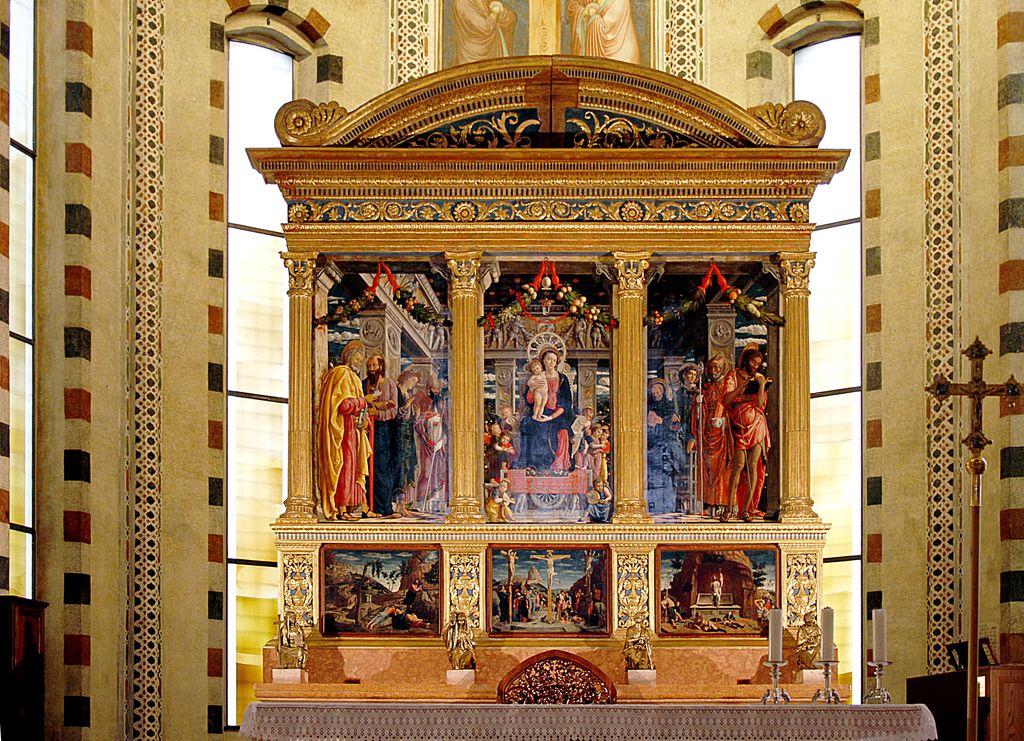
The San Zeno Altarpiece in its frame, Basilica of San Zeno, Verona José Luiz. Image source. CC BY-SA 4.0. Resized from the cited image.
The smaller scenes at the foot of the altarpiece once took the eye through Christ’s prayer, Crucifixion and Resurrection. The main panels were removed under Napoleon and eventually returned to Verona. The frame had stayed at San Zeno. Copies now occupy the lower register in Verona, while the original centre panel, the Crucifixion, is at the Louvre and the two outer scenes are at the Musée des Beaux-Arts in Tours. The original distribution matters when comparing photographs. The devotional assembly above and the compact sequence of historical scenes below were designed to be seen together. A separate painting of Christ praying in the National Gallery in London lets us see how Mantegna reworked one of those subjects on a different panel. [9] [10]
Two painters at the same threshold
In 1453 Mantegna married Nicolosia Bellini, the daughter of Jacopo and sister of Gentile and Giovanni. It is the pictures that allow us to say where the painters drew on one another. The joint National Gallery and Staatliche Museen zu Berlin exhibition paired works of the same subject so that their borrowings and departures could be examined together. In Mantegna’s Presentation at the Temple, catalogued by Berlin under inventory number 29 and dated 1454, Simeon reaches for the tightly swaddled Christ Child. Mary’s elbow rests on the sill, and the Child stands on a cushion set on the same painted ledge. Beyond that ledge the surrounding temple falls away. Berlin’s catalogue compares the closely pressed faces and recessed frame with Donatello’s marble Pazzi Madonna, and allows that a related work visible in Padua could have served as Mantegna’s model. [6] [11] [12]
Klaus Krüger, discussing the Berlin painting, describes Mantegna’s use of the half-length narrative close-up to hold a moment of action still before the viewer. One can see the effect in the interval between Mary’s face and Simeon’s. The space is narrow, but giving up the child takes time. Giovanni Bellini took up the central group in the version now at the Fondazione Querini Stampalia. He kept the foreground parapet and opened out the composition, exchanging Mantegna’s surrounding painted frame for a wider view with an additional figure at either side. Compare the way the two groups fill their allotted space. In Berlin the sides press in on the encounter. In Venice the extra faces give the eye somewhere else to go before returning to the Child. [11] [12] [13] [14]
The London versions of The Agony in the Garden offer another pair. In Mantegna’s painting, Christ kneels on a ledge of bare rock while cherubs show him the instruments of his coming suffering. Below, the disciples sleep and the arresting party makes its way through the landscape. The stepped rock keeps those actions visibly apart. Bellini takes up the arrangement but sends the light of dawn across the land and makes the angel’s chalice the focus of Christ’s prayer. The landscape can be read through changes of light as well as through the placement of rock and path. The National Gallery also proposes a drawing by Jacopo Bellini as a possible starting point for Mantegna’s design. That possibility, alongside Giovanni’s use of Mantegna’s composition, shows how much can be lost by reducing the relationship to a single debt between two painters. [10] [11] [15]
At the Gonzaga court, the ceiling looks back
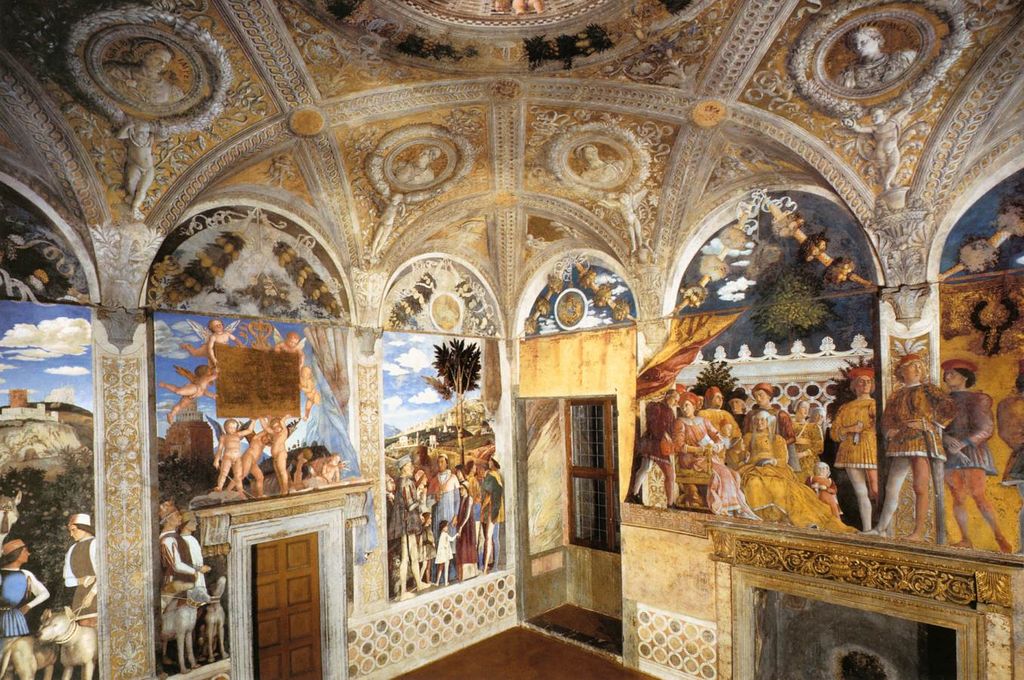
Mantegna moved to Mantua in 1460 after being recruited to the service of Ludovico III Gonzaga. Court work ranged from pictures for chapels to decorations for residences. At the Castello di San Giorgio, a room roughly eight metres square acquired the reach of a much larger space. The Vatican Museums describe the decoration as combining fresco and tempera. Palazzo Ducale dates its decoration from 1465 to 1474 and uses the early name Camera Picta, or painted chamber, alongside the familiar Camera degli Sposi. An inscription in a window recess supplies the earlier date, and the dedication held by painted winged children gives the completion date. The room served both intimate and representative purposes. Its family portraits belong to a place where access to the family was itself meaningful. [1] [3] [5] [6]
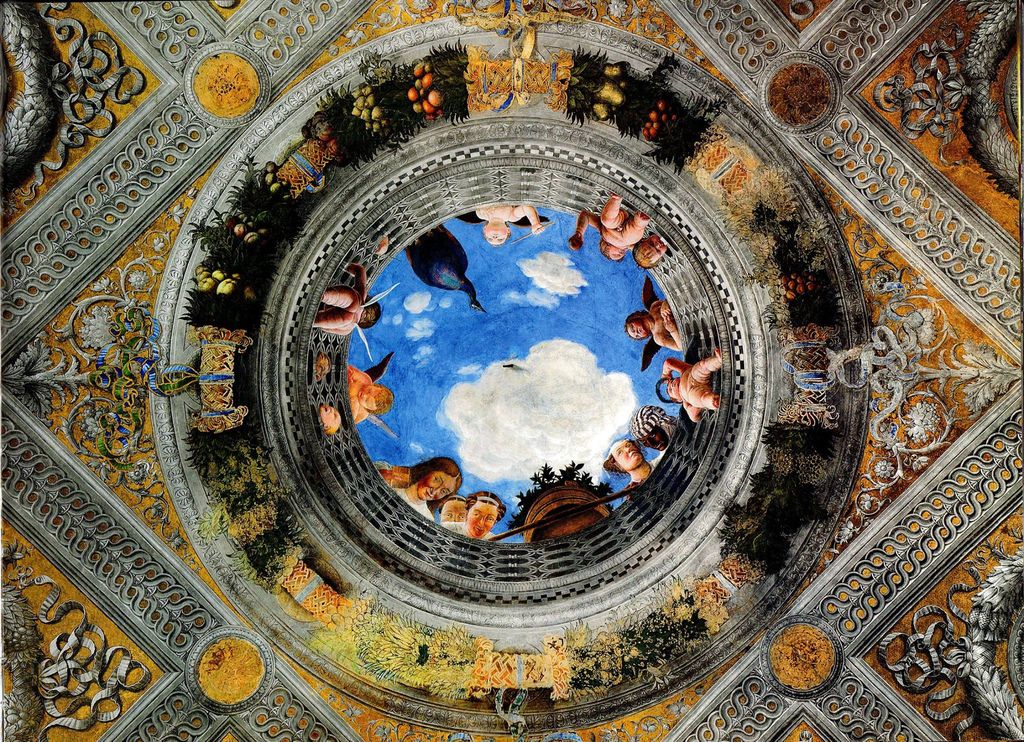
The Camera degli Sposi ceiling, Palazzo Ducale, Mantua Image source. Public domain.
On the north wall, Ludovico sits beside Barbara of Brandenburg. A letter has been brought to him, and his turn towards the messenger draws attention to an exchange tucked into a much larger assembly. On the west wall he meets his son, Cardinal Francesco. Palazzo Ducale interprets the letter as news of Francesco Sforza’s illness and places the encounter with the cardinal at Bozzolo. The precise events behind the paintings and the identities of some of the people remain matters of interpretation. The contrast between the walls can be seen directly. The seated group keeps drawing the eye back to a few gestures at close quarters. The standing figures of the meeting leave intervals through which the landscape can be seen. A single room accommodates two very different ways of presenting the family. [3] [5]
Start at the painted base of the walls and look upwards. Imitation marble gives way to pilasters and curtains, then to figures from myth and busts of Roman emperors on the vault. At its centre, a round opening, or oculus, appears to let in the sky. The inner edge of the balustrade swings around the opening. Winged children are seen from below, a peacock perches on the rim and figures look down beside a precariously balanced basket of citrus. The faces that look back make the opening feel occupied. Standing beneath them, you occupy a place in their field of vision, just as you occupy a place in front of the court on the adjoining walls. The room rewards more than one direction of looking. [3]
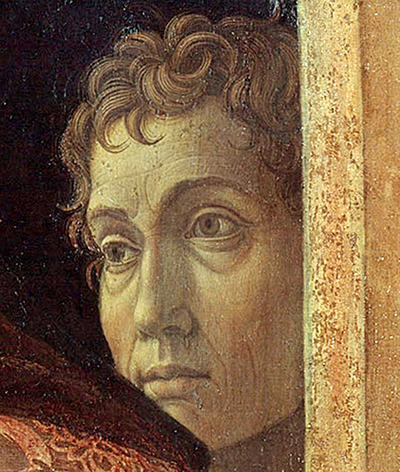
On the west wall, there is a second face to look for among the painted decorations. Jérémie Koering discusses a face embedded in painted foliage on a pilaster of the west wall, which he reads as Mantegna’s self-portrait, and the rocks being cut and carried by tiny figures in the landscape of the Meeting. For Koering these are instances of painting making forms emerge from other forms, akin to the growth or transformation of organic matter. Look between the foliage and the highly legible dedication. One declares who made the room, while the other asks how long it takes for a face to emerge from a pattern. This reading gives the background and borders a role alongside the portraits that dominate a first visit. [5] [16]
At the foot of the stone
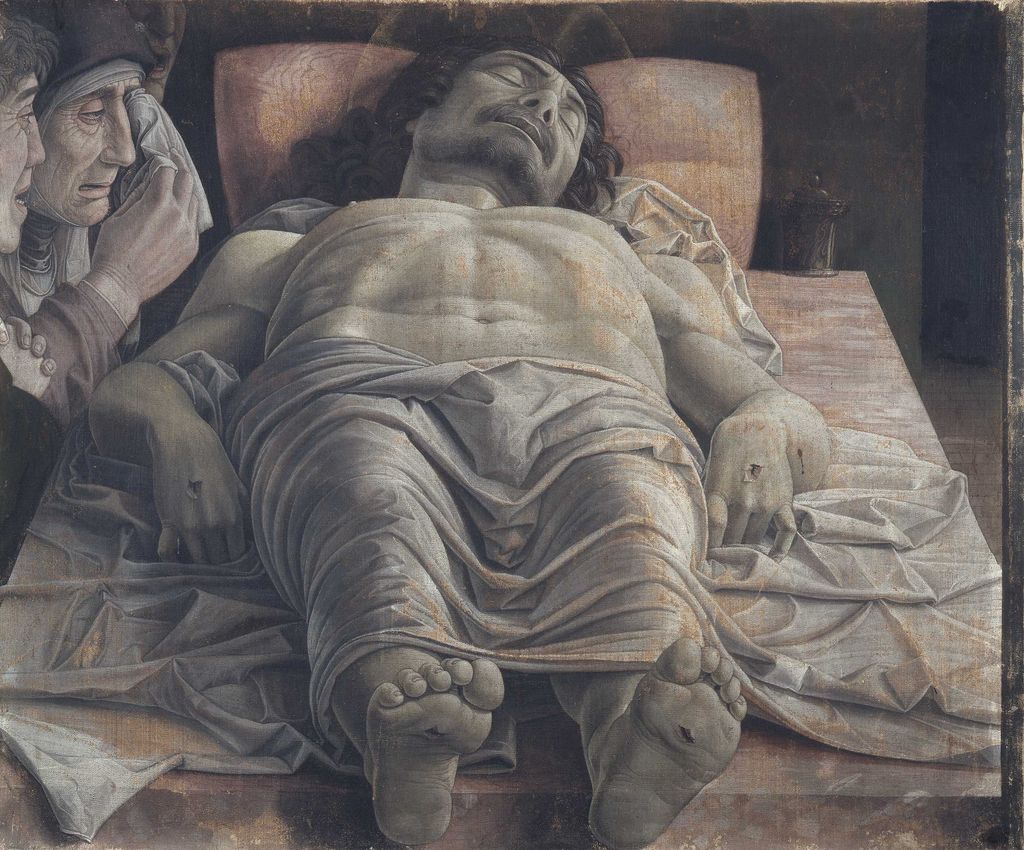
In the Lamentation over the Dead Christ, the painted stone sets the terms of the encounter. The Pinacoteca di Brera dates the work to about 1483 and catalogues it as tempera on canvas, inventory 352. The canvas measures 68 by 81 centimetres. The feet occupy the front of the image, the shroud gathers around the legs, and the head lies far back on the slab. The mourners are pressed together at the left edge. Once you have found their faces it becomes harder to look at the body as an exercise in foreshortening alone. The angle gives those at the left very little room, yet their furrowed faces and the hand raised to a cheek set a slower pace for looking than the steep recession of the slab. [2]
Look at how much of the torso remains visible beyond the feet. The angle creates depth through overlapping shapes and a sharply shortened body, while the soles leave enough room for the briskly drawn wounds, the hands and the face to register. The Brera relates those clearly offered wounds to the traditions of devotional imagery and considers private devotion a probable function. The museum also considers it plausible that this is the foreshortened Christ recorded in the artist’s studio after his death. Different versions of the subject make that identification uncertain. The date attached to the canvas, its possible original use and its connection to a recorded picture rest on different sorts of evidence. [2]
Both the Mantuan oculus and the Brera canvas are famous for foreshortening. In the chamber one’s eye travels up to people beyond a rim, while in the smaller painting the stone sends it away from the feet to the head. The putti’s abbreviated limbs help establish the distance above the floor. Christ’s wounds bring the body close enough for an intimate act of looking. The same device can make a figure feel remote overhead or unnervingly close. [2] [3]
Caesar’s procession and the interval in Rome
By August 1486 Mantegna was working on the Triumphs of Caesar. A letter reporting the visit of Ercole d’Este to Mantua places the series in progress, though it leaves open how much the visitor saw. In 1488 Mantegna went to Rome for Innocent VIII to paint the chapel of the Belvedere. Treccani records that he wrote back to Mantua with instructions to look after the canvases already made. He returned in 1490. The chapel, later demolished, was dedicated to Saint John the Baptist. The surviving descriptions point to painted architecture as part of its decoration. That suggests a connection with the problems Mantegna had tackled in the Camera Picta, now in a setting for Christian worship. The letter also establishes that his work on Caesar was already under way before this visit to Rome. [4] [5] [6]
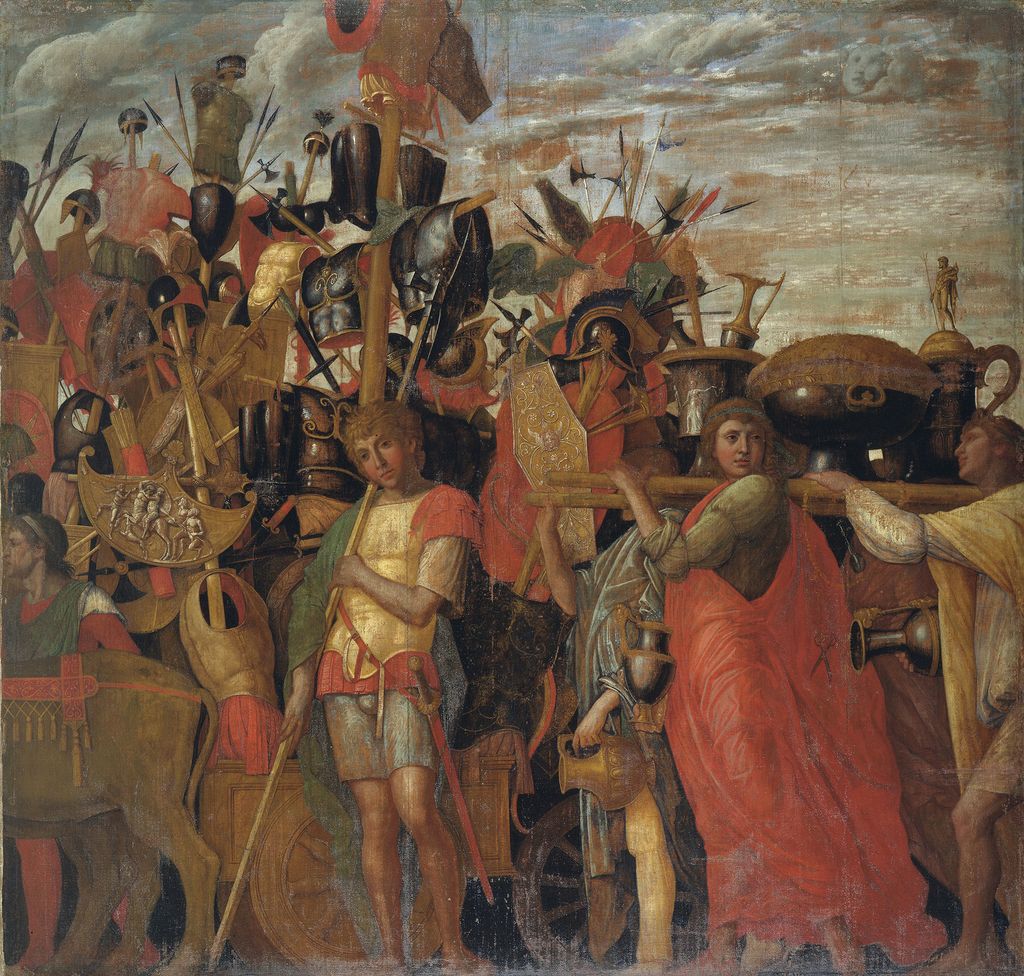
The Triumphs of Caesar, canvas III, Royal Collection Image source. Public domain.
The Triumphs draw on ancient accounts of victory processions and on the forms of Roman reliefs and monuments. The exact initial commission and the date at which the whole sequence was finished are open questions. Even which victory the series evokes admits different readings. The National Gallery relates the opening canvas to Caesar’s campaigns in Gaul, while the Royal Collection Trust cautions against tying the whole parade to any single campaign. A placard, a chariot or an ornate vessel can occupy the foreground long enough to be studied in its own right. These are the things through which the Romans in the painting make victory legible to a crowd. [4] [17]
Take the first canvas, catalogued by the National Gallery as The Trumpeters. It is egg tempera on canvas and stands about 2.7 metres high. The raised trumpets and painted banners announce the arrival of the procession before its main attractions appear. In the next canvas an immense load of statuary comes into sight, and later elephants and bearers of heavy spoils continue the advance. There is also a canvas devoted to captives. Only in the ninth does the general himself arrive in his chariot. The sequence gives weight and duration to an event that one canvas might have summed up in the gesture of a hero. You spend time among the things and people whose capture or display made his triumph possible. [4] [17]
At San Zeno the columns organise a gathering that can be taken in at once. In the Camera Picta the painted architecture and vault invite the visitor to turn or look up. The Triumphs use the intervals between canvases to make a continuous event arrive in stages. Each boundary briefly suspends the march, and the next canvas starts it again. Charles I acquired the series from the Gonzaga collection in 1629, and the paintings reached England around 1630. They belong to the Royal Collection. They have also undergone repeated restoration, so the force of the surviving procession and the condition of its painted surfaces tell different parts of its history. [3] [4] [9] [17]
A votive Madonna, a private study and a Roman frieze
The late pictures show how much the court could ask of the same painter. Francesco II Gonzaga commissioned the Madonna della Vittoria to commemorate the 1495 battle of Fornovo. The Louvre, where the altarpiece is now held as INV 369, describes it as a votive offering for the Mantuan chapel of Santa Maria della Vittoria. Francesco kneels in armour below the Virgin and Child. Soldiers and spoils were central to the language of Roman victory in the Triumphs. Here the armour is worn by a man in prayer, and the prominent public act is his appeal to sacred protection. The bower overhead encloses the group almost as a canopy would. [4] [18]
For Isabella d’Este, Francesco’s wife, Mantegna painted mythological subjects for her studiolo, a private study. In the picture known as the Triumph of the Virtues, Louvre INV 371, Minerva drives the Vices out of the garden. Look for the change from the ordered arches of foliage to the conspicuously misshapen figures fleeing through the water. Here bodies make moral character visible, sometimes through deliberate distortion. The picture originally belonged to an ensemble that also included Mantegna’s Parnassus. Its later travels crossed those of the San Zeno predella. The two outer scenes from the altarpiece were sent to Tours in exchange for the two paintings from Isabella’s study. A modern division between museums grew out of decisions made long after Mantegna had designed either setting. [6] [19] [20]
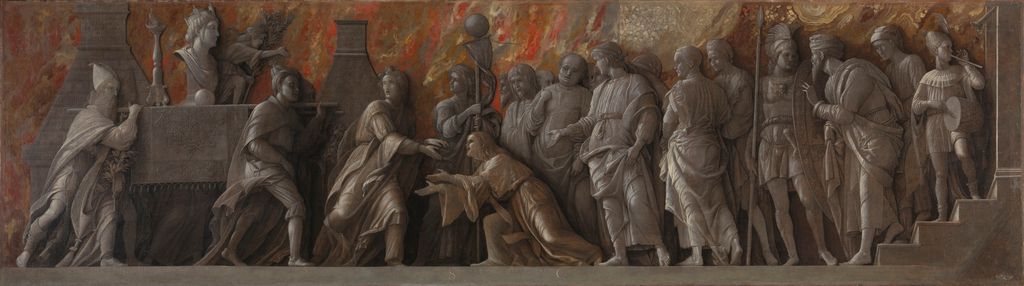
One of his last works, The Introduction of the Cult of Cybele at Rome, is a long glue-tempera canvas of 1505–06 in the National Gallery, NG902. The Cornaro commission called for a subject that could honour the family’s claimed Roman ancestry. The figures seem carved from pale stone and set against coloured marble. Among their sharply defined profiles and gestures sits the transported image of the goddess, so that within a painted imitation of sculpture we see people carrying a sculpture of their own. This is a procession as in the Triumphs, but the shallow space and restrained colouring make the eye read it as a relief. Mantegna completed only this canvas for the project before he died in Mantua in 1506. The National Gallery records that Giovanni Bellini was subsequently asked to contribute to the commission. [1] [21]
There is a quieter counterpart in the Getty’s Adoration of the Magi, about 1495–1505, painted in distemper on linen. The Getty relates the close-packed half-length figures to ancient Roman reliefs. There is still room to examine individual offerings. The blue-and-white porcelain cup carried by the first king sits below the Child’s hand, and behind it are two vessels that differ markedly in colour and shape. The antique example could serve a picture of careful gifts and close attention as readily as a pageant of imperial power. [22] [23]
How the figures travelled
The paintings range from portraits and small devotional pictures to the rooms and altarpieces for which Mantegna devised whole settings. To follow Mantegna’s influence beyond the places where he worked, turn to engravings. The Metropolitan Museum of Art catalogues its left portion of The Battle of the Sea Gods under Mantegna’s name, with the object number 18.12. For engravings associated with Mantegna, scholars distinguish who devised a composition from who cut the plate. Each surviving impression is also a particular object, pulled from a plate that might have been printed many times. Across the long, narrow scene, battling bodies and the creatures that carry them intertwine in a strip of water. A design with the breadth and rhythm of a relief could travel on a sheet of paper. [24] [25]
In 1494 Albrecht Dürer made a pen drawing after The Battle of the Sea Gods, now in the Albertina, inventory 3061. The museum points to the almost matching size as a reason to consider tracing and observes that Dürer simplified the setting while giving skin, hair and fur more differentiated treatment. This is a documented encounter with Mantegna’s work that can be studied line by line. The figures survive the move from ink printed off a plate to ink applied with a pen, down to the slender bright edges left against darker areas of the body. [26]
Peter Paul Rubens found another use for Mantegna’s figures. The National Gallery traces his A Roman Triumph, painted about 1630, to two canvases from the series he had seen in Mantua. Compare the man lighting a taper or the procession’s elephants, which carry over into Rubens’s new gathering. The priest in red and the heated light around the torches pull the action into a different rhythm. The two artists give the eye different walks through the crowd. Mantegna makes the procession unfold across successive fields of canvas. Rubens brings selected figures into one scene and lets a flame, a raised trunk or a flick of red draw attention across it. [4] [27]
Four stages of Mantegna’s career
Training and independent commissions
The Squarcione workshop gave Mantegna a foothold in Padua. The Ovetari Chapel and San Zeno show how he fitted figures and painted space into architectural settings. José Luiz photographed the accompanying view. [5] The San Zeno Altarpiece in its frame, Basilica of San Zeno, Verona José Luiz. Image source. CC BY-SA 4.0. Resized from the cited image.
Work for the Gonzaga court
Mantegna entered Ludovico Gonzaga’s service. In the Camera Picta, actual doors and fireplace meet painted openings, people and fabric. [1]
A broadening range of commissions
The Gonzaga court remained the centre of his career while he worked in Rome for Innocent VIII. The Triumphs of Caesar probably began during the 1480s. [5]
Altarpieces and private commissions
Works for Isabella d’Este, the Madonna della Vittoria and the late painting of Cybele explore different uses of classical figures and stories. [1]
Essential works
Camera degli Sposi (Camera Picta)
1465–74 · A court room whose real walls and openings meet invented architecture. [3]
Lamentation over the Dead Christ
C. 1483 (Brera dating) · A shortened view of Christ’s body places the viewer near the burial stone. [2]
The Triumphs of Caesar
About 1485–1506 · Nine canvases carry the Roman procession across successive frames. [17]
San Zeno Altarpiece
1457–59 · Three main panels are unified by the fictive architecture inside the frame. [9]
José Luiz · Image source · CC BY-SA 4.0

Saint Sebastian (Louvre)
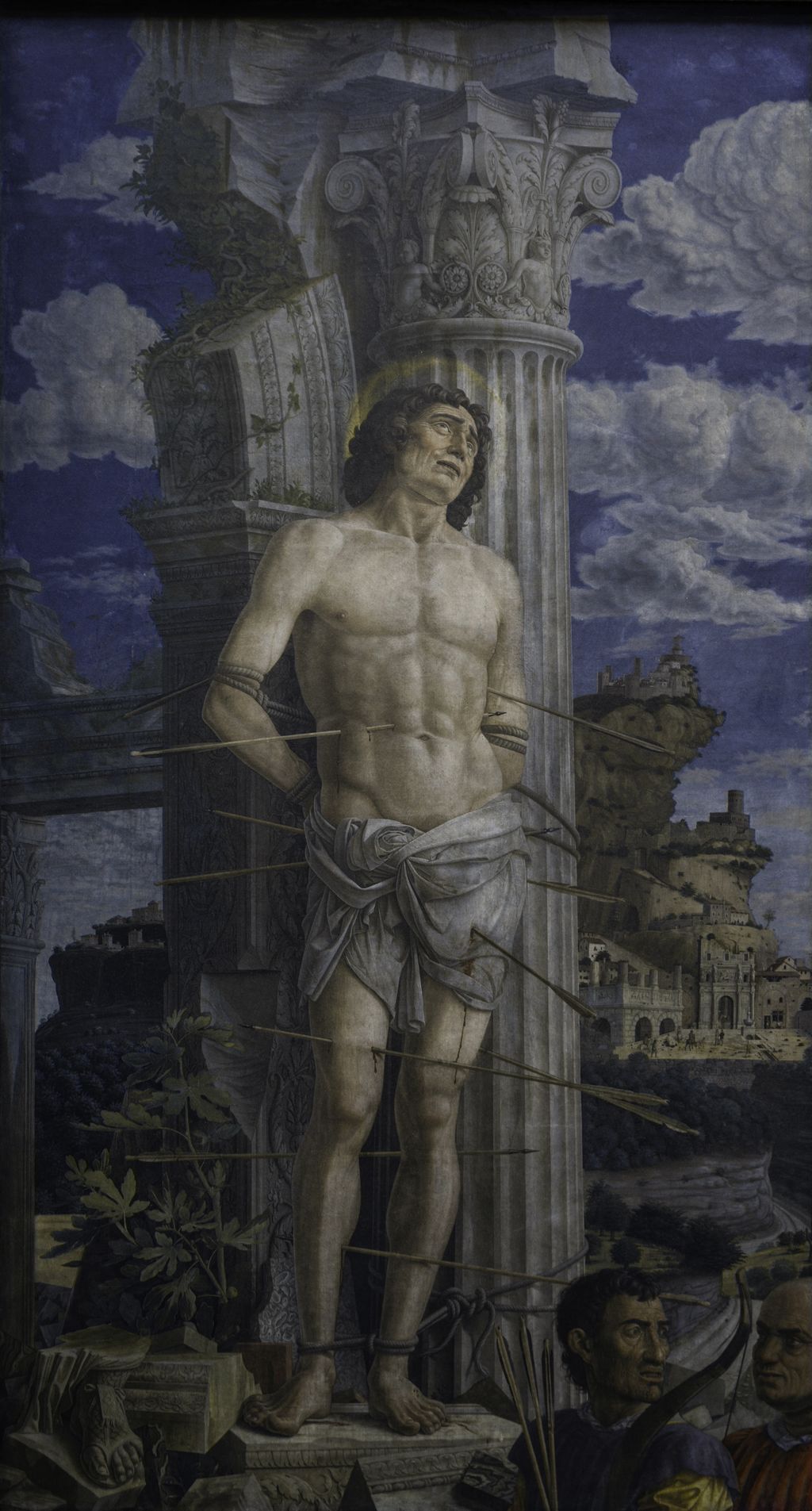
Around 1480 · The saint stands against ancient ruins, with the archers low at one side. [29]
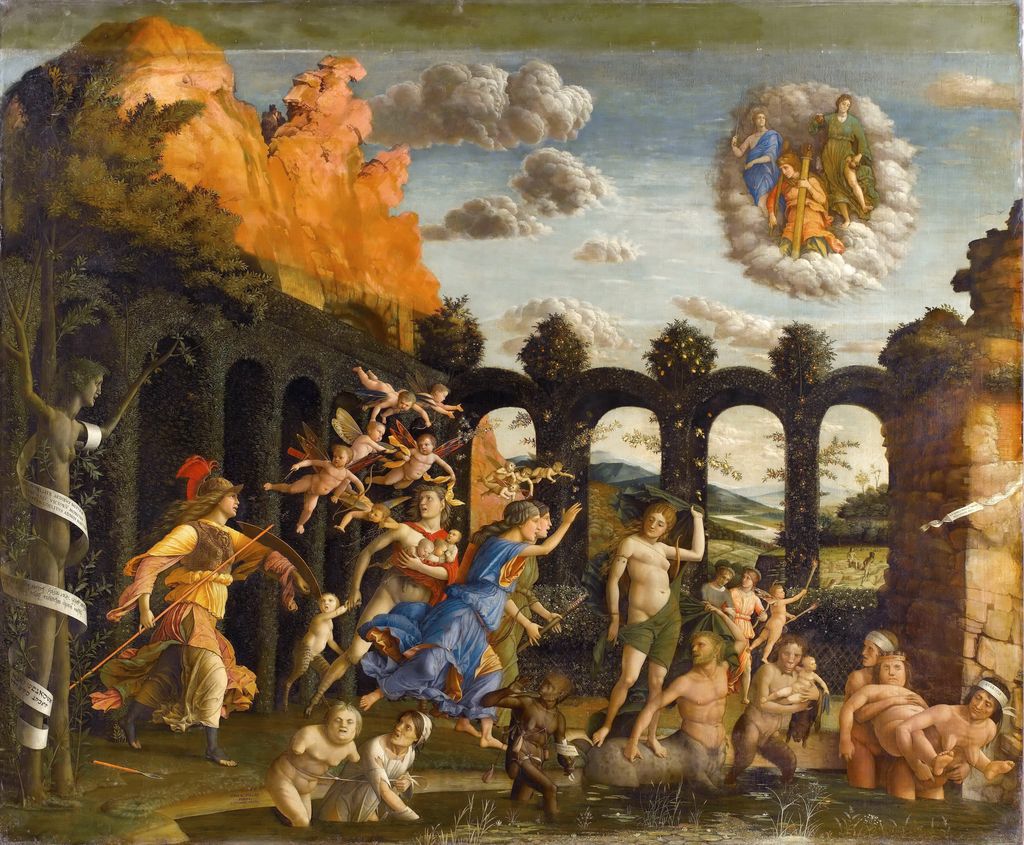
Minerva Expelling the Vices from the Garden of Virtue
C. 1502 · Minerva enters the garden in a painting for Isabella d’Este’s studiolo. [30]
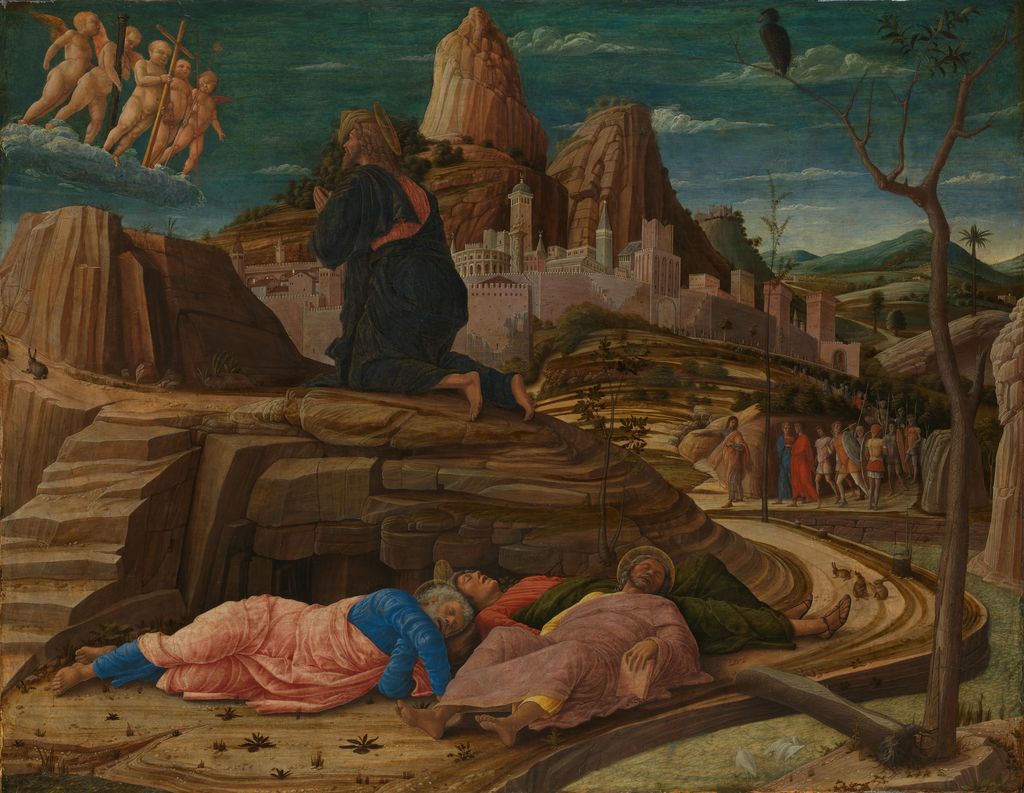
The Agony in the Garden (London)
C. 1455–56 · A rocky setting and a series of winding paths organise the events in Gethsemane. [10]
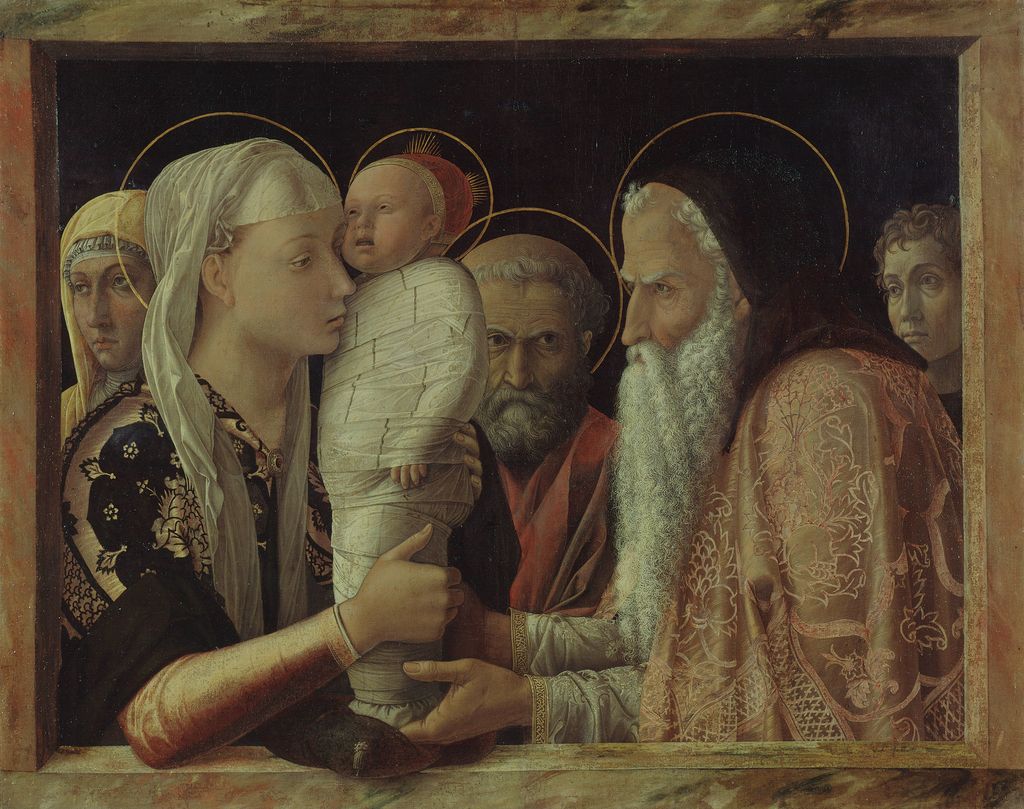
The Presentation of Christ at the Temple
1454 (Berlin dating) · A fictive frame and ledge bring the figures near the viewer. [12]
Artworks directory
| Name | Date | Medium and collection |
|---|---|---|
| The Adoration of the Shepherds | Shortly after 1450 | Painting · Metropolitan Museum of Art · 32.130.2 Catalogue. |
| Saint Mark the Evangelist | C. 1448–51 | Painting · Städel Museum · 1046 Catalogue. |
| Saint Jerome Penitent in the Desert | C. 1448–51 | Painting · Museu de Arte de São Paulo · MASP.00015 Catalogue. |
| Martyrdom and Transport of the Body of Saint Christopher | Mid-1450s | Painting · Ovetari Chapel, Padua Catalogue. |
| San Luca Altarpiece | 1453–55 | Painting · Pinacoteca di Brera · 176 Catalogue. |
| The Presentation of Christ at the Temple | 1454 (Berlin dating) | Painting · Gemäldegalerie, Berlin · 29 Catalogue. |
| San Zeno Altarpiece | 1457–59 | Painting · Basilica of San Zeno, Verona Catalogue. |
| The Crucifixion | 1456–59 | Painting · Musée du Louvre · INV 368 Catalogue. |
| The Agony in the Garden (London) | C. 1455–56 | Painting · National Gallery, London · NG1417 Catalogue. |
| The Agony in the Garden (Tours) | 1459 (Tours dating) | Painting · Musée des Beaux-Arts de Tours · 1803-1-24 Catalogue. |
| The Resurrection | 1459 (Tours dating) | Painting · Musée des Beaux-Arts de Tours · 1803-1-25 Catalogue. |
| Saint Sebastian (Vienna) | C. 1457–59 | Painting · Kunsthistorisches Museum · GG 301 Catalogue. |
| Cardinal Ludovico Trevisan | C. 1459–60 (Berlin exhibition dating) | Painting · Gemäldegalerie, Berlin · 9 Catalogue. |
| The Death of the Virgin | C. 1462 | Painting · Museo Nacional del Prado · P000248 Catalogue. |
| Christ with the Soul of the Virgin | C. 1460–64 | Painting · Pinacoteca Nazionale, Ferrara Catalogue only. |
| Portrait of a Young Man (traditionally Francesco Gonzaga) | C. 1461 or 1470, depending on sitter | Painting · Museo di Capodimonte · Q 60 Catalogue. |
| Portrait of a Prelate (Carlo de’ Medici?) | C. 1465–70 | Painting · Uffizi Galleries · 1890 no. 8540 Catalogue. |
| Portrait of a Man | C. 1470 | Painting · National Gallery of Art, Washington · 1952.2.5 Catalogue. |
| Madonna with Sleeping Child (Berlin) | C. 1455–60 | Painting · Gemäldegalerie, Berlin · S.5 Catalogue. |
| Camera degli Sposi (Camera Picta) | 1465–74 | Painting · Palazzo Ducale, Mantua Catalogue. |
| Saint Sebastian (Louvre) | Around 1480 | Painting · Musée du Louvre · RF 1766 Catalogue. |
| Lamentation over the Dead Christ | C. 1483 (Brera dating) | Painting · Pinacoteca di Brera · 352 Catalogue. |
| The Triumphs of Caesar | About 1485–1506 | Painting · Royal Collection · RCIN 403958–403966 Catalogue. |
| Madonna of the Caves | C. 1488–90 | Painting · Uffizi Galleries · 1890 no. 1348 Catalogue. |
| Madonna and Child with a Choir of Cherubim | C. 1485 | Painting · Pinacoteca di Brera · 297 Catalogue. |
| Madonna and Child (Poldi Pezzoli) | Early 1490s (museum dating) | Painting · Museo Poldi Pezzoli · 1595 Catalogue. |
| The Holy Family with Saint Mary Magdalen | C. 1495–1500 | Painting · Metropolitan Museum of Art · 14.40.643 Catalogue. |
| The Virgin and Child with Saint Mary Magdalene and Saint John the Baptist | C. 1490–1505 | Painting · National Gallery, London · NG274 Catalogue. |
| Christ as the Suffering Redeemer | 1485–95 (SMK dating) | Painting · Statens Museum for Kunst · KMSsp69 Catalogue. |
| Ecce Homo | C. 1500 | Painting · Musée Jacquemart-André · MJAP-P 1840 Catalogue. |
| Judith with the Head of Holofernes (Mantegna or follower) | C. 1495–1500 | Painting · National Gallery of Art, Washington · 1942.9.42 Catalogue. |
| Madonna della Vittoria | 1495–96 | Painting · Musée du Louvre · INV 369 Catalogue. |
| Mars and Venus (Parnassus) | C. 1496–97 | Painting · Musée du Louvre · INV 370 Catalogue. |
| The Trivulzio Madonna | 1497 | Painting · Castello Sforzesco, Milan · 0554 Catalogue. |
| The Adoration of the Magi | C. 1495–1505 | Painting · J. Paul Getty Museum · 85.PA.417 Catalogue. |
| Minerva Expelling the Vices from the Garden of Virtue | C. 1502 | Painting · Musée du Louvre · INV 371 Catalogue. |
| The Introduction of the Cult of Cybele at Rome | 1505–06 | Painting · National Gallery, London · NG902 Catalogue. |
| Saint Sebastian (Venice) | Probably c. 1504–06 | Painting · Galleria Giorgio Franchetti alla Ca’ d’Oro · D.11 Catalogue. |
| Samson and Delilah | C. 1500 | Painting · National Gallery, London · NG1145 Catalogue only. |
| A Woman Drinking (probably Sophonisba) | C. 1495–1506 | Painting · National Gallery, London · NG1125.2 Catalogue only. |
| The Vestal Virgin Tuccia with a Sieve | C. 1495–1506 | Painting · National Gallery, London · NG1125.1 Catalogue only. |
| Judith with the Head of Holofernes (Dublin) | C. 1495–1500 | Painting · National Gallery of Ireland · NGI.442 Catalogue only. |
| Battle of the Sea Gods, left half (Met impression) | Before 1481 (Met dating) | Print · Metropolitan Museum of Art · 18.12 Catalogue only. |
| Battle of the Sea Gods, right half (Met impression) | Before 1481 (Met dating) | Print · Metropolitan Museum of Art · 1984.1201.4 Catalogue only. |
| Battle of the Sea Gods, left half (Tokyo impression) | C. 1475 (Tokyo dating) | Print · National Museum of Western Art, Tokyo · G.1981-0002 Catalogue only. |
| Battle of the Sea Gods, left half (Washington impression) | C. 1485–88 (NGA dating) | Print · National Gallery of Art, Washington · 1941.1.6 Catalogue only. |
| The Entombment of Christ, second state of two | Before 1475 (Met dating) | Print · Metropolitan Museum of Art · 37.42.30 Catalogue only. |
| The Entombment of Christ (possibly Zoan Andrea, after Mantegna) | 1460–1549 (Rijksmuseum dating) | Print · Rijksmuseum · RP-P-1924-60 Catalogue only. |
| Four Dancing Muses (Gian Marco Cavalli after Mantegna) | C. 1497 | Print · Metropolitan Museum of Art · 20.5.3 Catalogue only. |
| Bacchanal with Silenus | Before 1475 (Met dating) | Print · Metropolitan Museum of Art · 29.44.15 Catalogue only. |
| Bacchanal with a Wine Vat | Before 1475 (Met dating) | Print · Metropolitan Museum of Art Catalogue only. |
| St James on His Way to Execution | C. 1453–57 | Drawing · British Museum · 1976,0616.1 Catalogue only. |
| Three Studies for a Dead Christ | C. 1455–65 | Drawing · British Museum · 1909,0406.3 Catalogue only. |
| Pietà (Venice) | C. 1456–65 (exhibition datings) | Drawing · Gallerie dell’Accademia, Venice · 115 Catalogue only. |
| Studies for Christ at the Column | 1460–65 | Drawing · The Courtauld · D.1978.PG.345 Catalogue only. |
| Virtus Combusta | C. 1490 (technical study) | Drawing · British Museum · Pp,1.23 Catalogue only. |
| Virtus Combusta (Giovanni Antonio da Brescia after Mantegna) | C. 1495–1506 | Print · Musée du Louvre · 3881 LR/ Recto Catalogue only. |
| The Calumny of Apelles | C. 1504–06 | Drawing · British Museum · 1860,0616.85 Catalogue only. |
Frequently Asked Questions
The San Zeno Altarpiece shows how he connects painted and real architecture. The Camera degli Sposi extends that illusion through a room. The Lamentation over the Dead Christ brings the viewer close to a single body.
His paintings and frescoes include altarpieces, portraits and court decorations. His designs also circulated on paper. The Engravings article explains why credit can differ for the design, the plate and a particular impression.
Discussion
Look again at the images and ideas explored in Andrea Mantegna. These editorial prompts invite your observations.
Reader Insights
How does each work position you in relation to its figures when you compare the Lamentation at the foot of the slab, the Camera Picta beneath the oculus and the Triumphs along the route of the procession?
What changes in the encounter between Mary and Simeon when Bellini keeps the group at the parapet but widens the composition of the Presentation at the Temple?
Join the Conversation
Share a detail, comparison or question about Andrea Mantegna below.
References
- National Gallery, London, Andrea Mantegna. View source.
- Pinacoteca di Brera, Lamentation over the Dead Christ. View source.
- Palazzo Ducale, Mantua, Camera Picta (Camera degli Sposi). View source.
- National Gallery, London, The Triumphs of Caesar: 1, The Trumpeters, and series essay. View source.
- Treccani, Mantegna, Andrea, in the Dizionario Biografico degli Italiani. View source.
- Vatican Museums, Andrea Mantegna (1431–1506): cenni biografici. View source.
- Ministero della Cultura, Padua and the recovery of fragments from the Ovetari Chapel. View source.
- Pinacoteca di Brera, Polittico di San Luca. View source.
- Opificio delle Pietre Dure, Andrea Mantegna, Pala di San Zeno, 1457–1459. View source.
- National Gallery, London, Andrea Mantegna, The Agony in the Garden. View source.
- National Gallery, London, Mantegna and Bellini. View source.
- Staatliche Museen zu Berlin, Die Darbringung Christi im Tempel, Gemäldegalerie 29. View source.
- Art History, Klaus Krüger, Andrea Mantegna: Painting’s Mediality, p. 233 and fig. 8. View source.
- Fondazione Querini Stampalia, Giovanni Bellini, Presentazione di Gesù al Tempio. View source.
- National Gallery, London, Giovanni Bellini, The Agony in the Garden. View source.
- Art History, Jérémie Koering, Changing Forms: Mantegna’s Poietics in the Camera Picta, pp. 300–303. View source.
- Royal Collection Trust, The Triumphs of Caesar: 7. The Captives. View source.
- Musée du Louvre, La Vierge de la Victoire, INV 369. View source.
- Musée du Louvre, Minerve chassant les Vices du Jardin de la Vertu, INV 371. View source.
- Opificio delle Pietre Dure, La Pala di San Zeno di Andrea Mantegna: Studio e conservazione. View source.
- National Gallery, London, The Introduction of the Cult of Cybele at Rome. View source.
- Getty Research Institute, Adoration of the Magi, Getty CONA record. View source.
- J. Paul Getty Museum, Balthazar exhibition gallery text: The Adoration of the Magi. View source.
- Metropolitan Museum of Art, The Battle of the Sea Gods (left portion of frieze). View source.
- Art History, Stephen J. Campbell and Jérémie Koering, In Search of Mantegna’s Poetics: An Introduction. View source.
- Albertina, Kampf der Meergötter (nach Mantegna). View source.
- National Gallery, London, Peter Paul Rubens, A Roman Triumph. View source.
- Musée du Louvre, Madonna della Vittoria, View source.
- Musée du Louvre, Saint Sebastian (Louvre), View source.
- Musée du Louvre, Minerva Expelling the Vices from the Garden of Virtue, View source.
More MANTEGNA Paintings
San Zeno Altarpiece
The San Zeno Altarpiece in its frame, Basilica of San Zeno, Verona José Luiz. Image source. CC BY-SA 4.0. Resized from the cited image.