 by Tom Gurney
Tom Gurney BSc (Hons) is an art history expert with over 20 years experience
Published on June 19, 2020 / Updated on November 29, 2026
Email: tomgurney1@gmail.com / Phone: +44 7429 011000
Overview
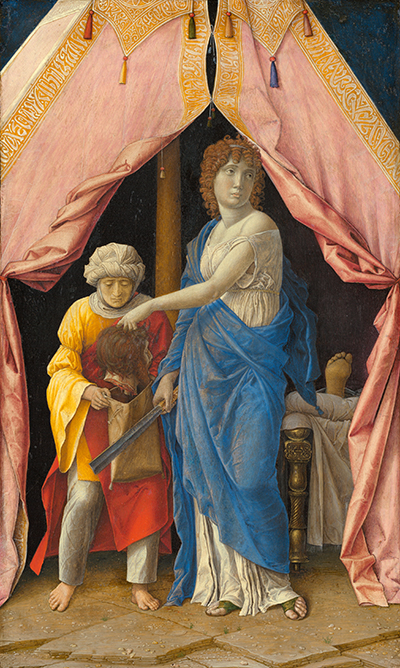
Judith looks over her shoulder while her attendant holds a sack open. Between them hangs the head of Holofernes. A single bare foot emerging from the darkness of the tent is almost all that remains visible of the general’s body. Painted in tempera on poplar panel, Judith with the Head of Holofernes is dated about 1495–1500 by the National Gallery of Art in Washington, D.C. It is part of the Widener Collection, accession 1942.9.42. [1]
The painting’s authorship is uncertain. The National Gallery of Art’s online record displays Andrea Mantegna and lists both Mantegna and Giulio Campagnola under its associated names. In its published attribution revision, the gallery gives Andrea Mantegna or a follower as the alternatives, with Giulio Campagnola as a possible follower. [1] [2]
At a Glance
- AttributionAndrea Mantegna or a follower, possibly Giulio Campagnola
- DateAbout 1495–1500
- MediumTempera on poplar panel
- CollectionNational Gallery of Art, Washington, D.C., Widener Collection
- Accession1942.9.42
Andrea Mantegna in context
San Zeno Altarpiece
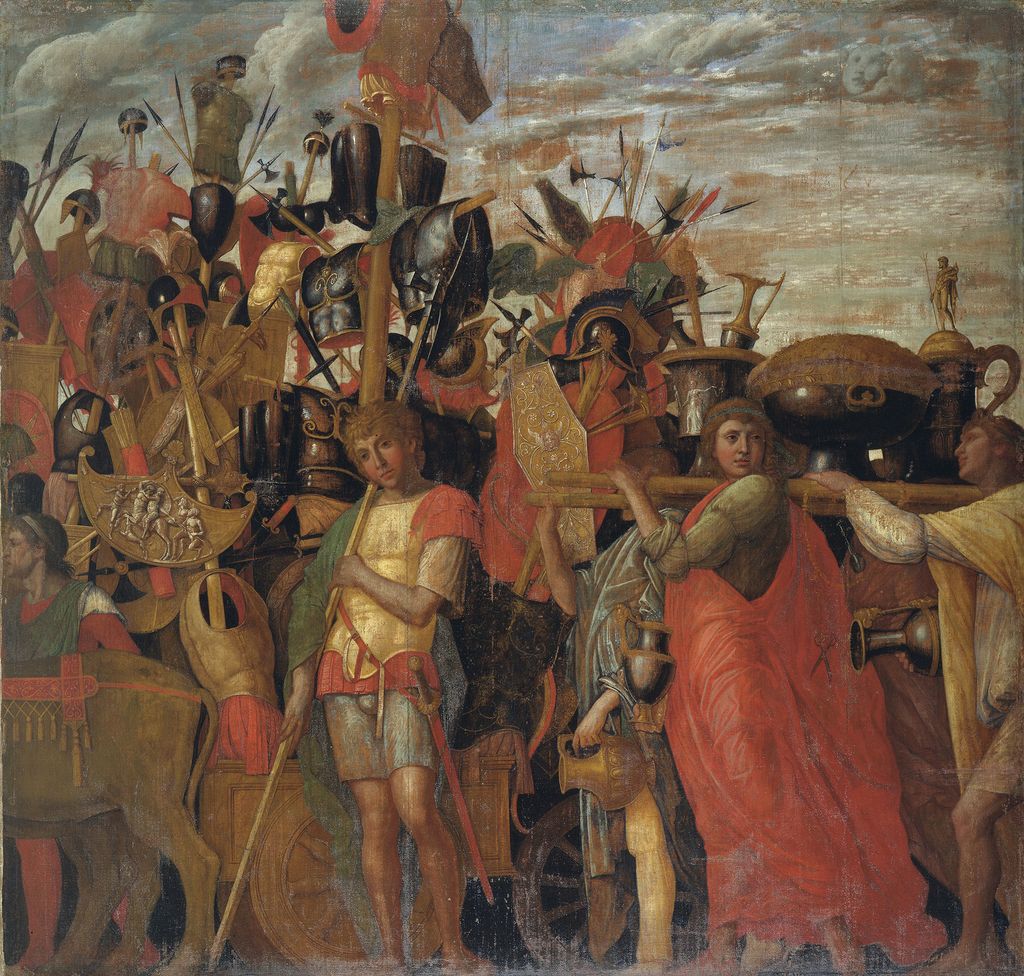
1457–59 [19]The Triumphs of Caesar
Mid-1480s–before 1506 [21]Madonna della Vittoria
1495–96 [22]Judith with the Head of Holofernes (Mantegna or follower)
C. 1495–1500 [1]The instant before the sack closes
In the Book of Judith, the Jewish widow enters the Assyrian camp during the siege of Bethulia. After Holofernes has collapsed from drinking, she takes his own sword and kills him. She comes out of his quarters and hands his head to her attendant, who puts it into a bag they brought for carrying food. The women leave the camp under cover of their usual departure for prayer and make their way back to Bethulia. [3] The head that has to be hidden here will later be hung from the city wall, where the Assyrians can see it. [4]
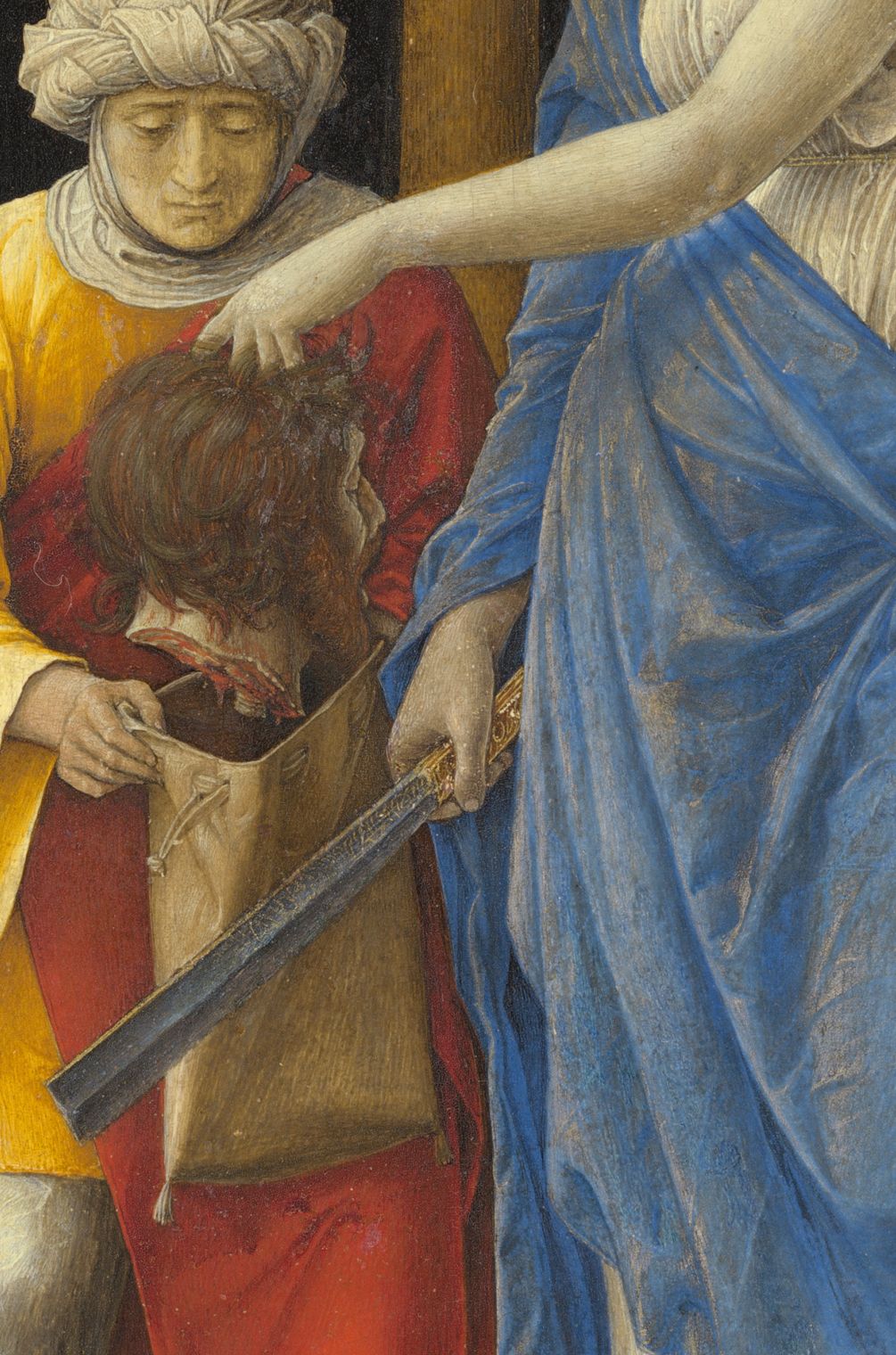
The panel catches the instant when the head is still in sight and the sack is open. Judith’s right hand holds the broad sword low beside her hip, where its straight edge and squared tip catch the light. Her left arm crosses her waist to lower the head towards the bag. The attendant looks down to guide it in. Judith’s own gaze has already moved to the right, past the edge of the painting. That split in attention makes it possible to read both tasks at once. One woman sees to the handover while the other seems to watch for interruption. [1]
In the text, Judith rolls Holofernes’s body off the bed and takes down its canopy before she comes out. In the picture, the bed is still visible with a bare foot projecting beside it. The painter keeps the bed, body and handover close enough to take in at a glance. The killing is over, but the weapon, the head and the foreshortened sole tell us where it happened and make the few remaining seconds at the tent feel consequential. [1] [3]
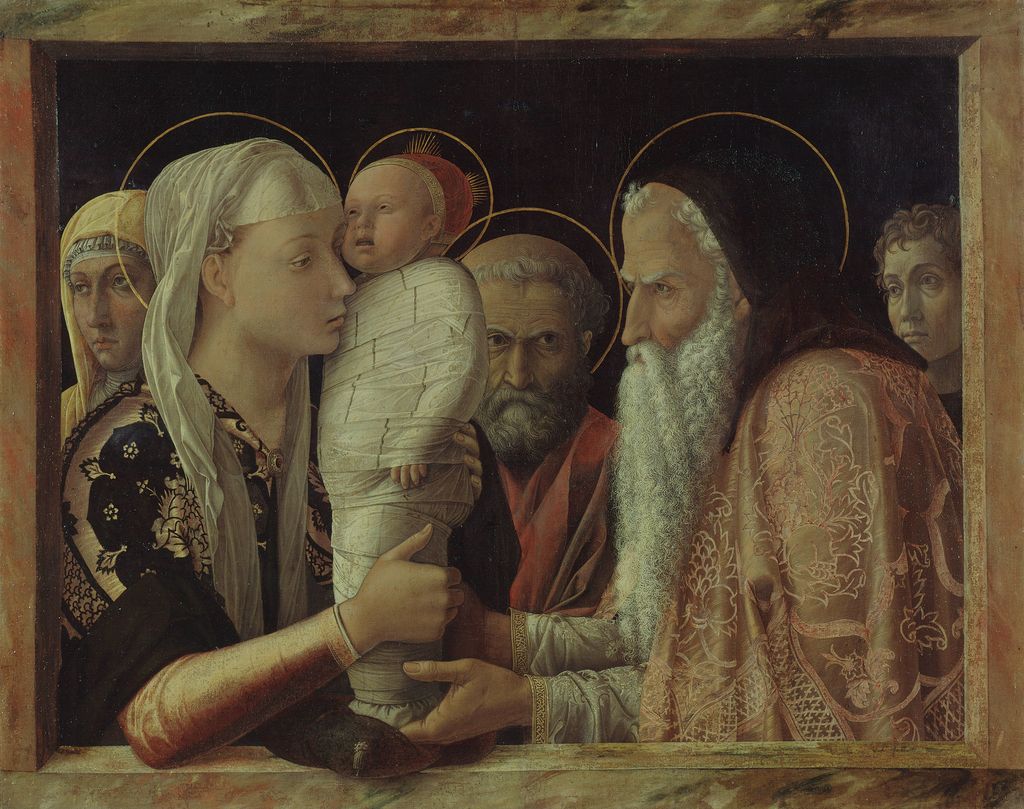
The Presentation at the Temple, Gemäldegalerie, Berlin Image source. Public domain.
A tent that opens like a curtain
At just over thirty centimetres high, the painted surface has the proportions of a narrow doorway. The rose-coloured tent flaps are drawn to either side, their gold edging picking out the opening against the dark sky and darker interior. The centre pole shows in the gap between the two women. At ground level, the roughly squared stones and scattered pebbles give the figures a firm place to stand. Above them, the fabric rises beyond the top of the panel. The composition gives us enough of the structure to know where we are, then brings us close enough that the tent barely fits. [1]
The tent also controls how we discover what has happened. Judith and her attendant are fully lit at the opening. Behind them, the pale bed linen and the sole of a foot emerge from shadow. The face of Holofernes is turned away so that only part of it can be seen. The severed head and the glimpse of the body are far enough apart that the eye has to put them together. Much of the panel’s tension comes from that delay, especially if the blue drapery catches the eye first. [1]
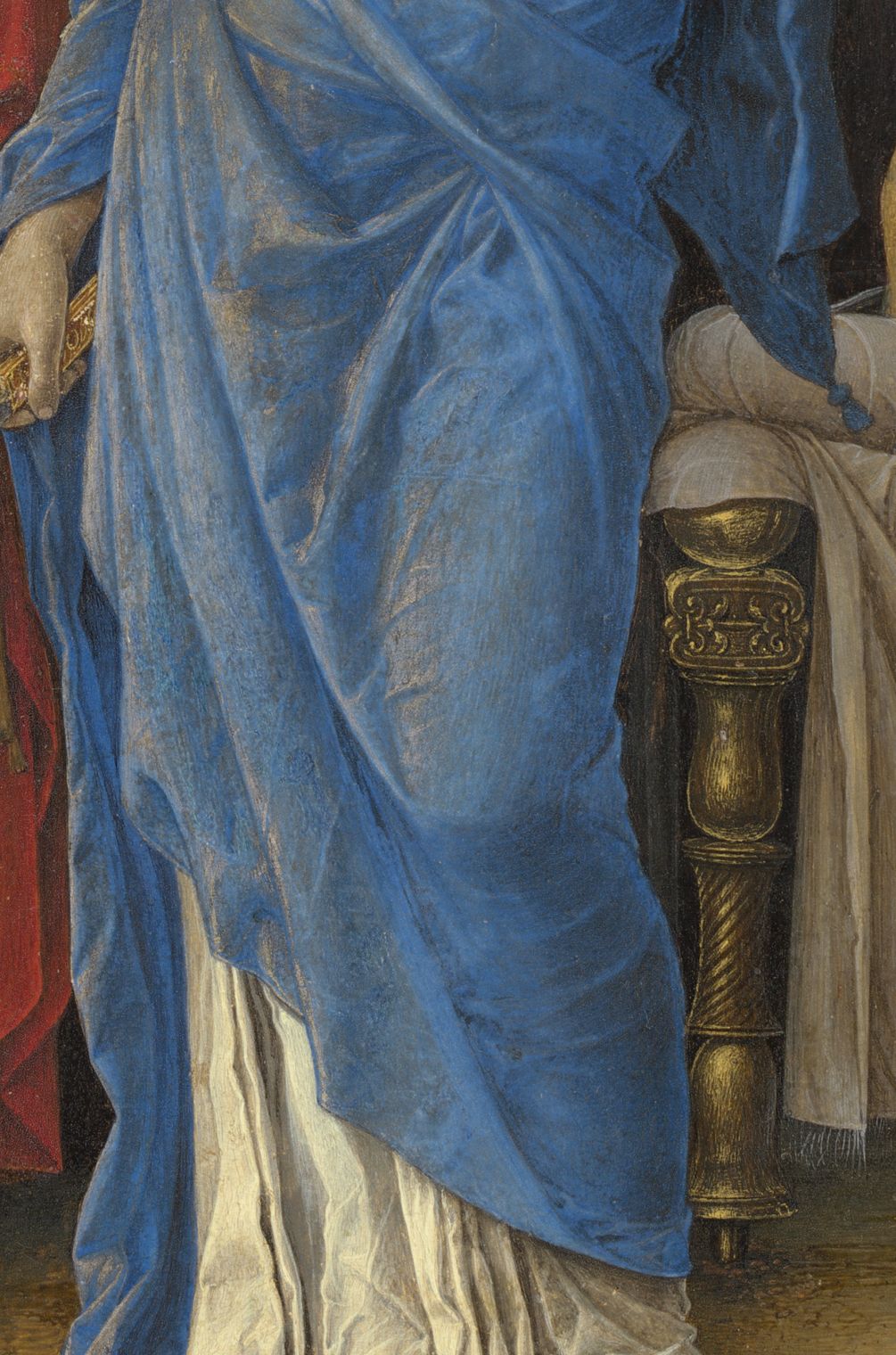
Clothing is part of Judith’s strategy in the story. Before approaching the camp, she changes out of her widow’s dress, arranges her hair, and puts on fine clothes and sandals. Her attendant carries the provisions. [5] The panel gives that difference in duties a visual form. Judith’s blue mantle sweeps over a pale, high-belted dress and curls frame her uncovered face. The attendant’s head is wrapped in white cloth and her red outer garment falls over a yellow tunic. She is barefoot, while Judith’s sandals show below her hem. The folds over Judith’s arm lead into the handover, while the white cloth around the attendant’s face makes the angle of her downward gaze clear. [1]
Why the panel has two names attached to it
Mantegna’s name appears in an inscription on the back of the Washington panel, which the National Gallery of Art records as the work of a later hand. The exhibition history also shows how differently the picture has been understood. The 1992 Mantegna exhibition in London showed it as a work after Mantegna. The NGA published its revised attribution in 2004. The Louvre’s 2008 exhibition archive filed the same accession under Mantegna and dated it to about 1470–75. The National Gallery of Art’s current record dates it about twenty years later. [1] [2] [6]
The art historian Irene Brooke traces the Campagnola proposal to David Alan Brown’s entry in the NGA systematic catalogue. Brooke cites a letter of recommendation written in 1497, when Campagnola was seeking a place at the Mantuan court. The letter mentions his interest in Mantegna, and Brooke reads it as evidence of his skill in illumination. She also discusses Marcantonio Michiel’s record of two miniatures by Campagnola in Pietro Bembo’s collection, described as copies of works by other artists. Together these accounts make it easier to see why Campagnola enters the discussion of a finely worked little panel in Mantegna’s orbit. The Washington gallery leaves the attribution open. [7] [2]
The Washington gallery also records a proposal that the panel was the small Judith listed in the 1492 inventory of Lorenzo de’ Medici’s collection. The inventory describes a small panel in a box and identifies its subject as Judith with the head and an attendant. The resemblance in scale and subject led Lionello Venturi to identify it with the Washington picture. The NGA also records scholars who rejected the match, among them Ronald Lightbown. The object has firmer footing in a 1731 description of the Earl of Pembroke’s collection at Wilton and in the record of the Widener gift to the National Gallery of Art in 1942. [1]
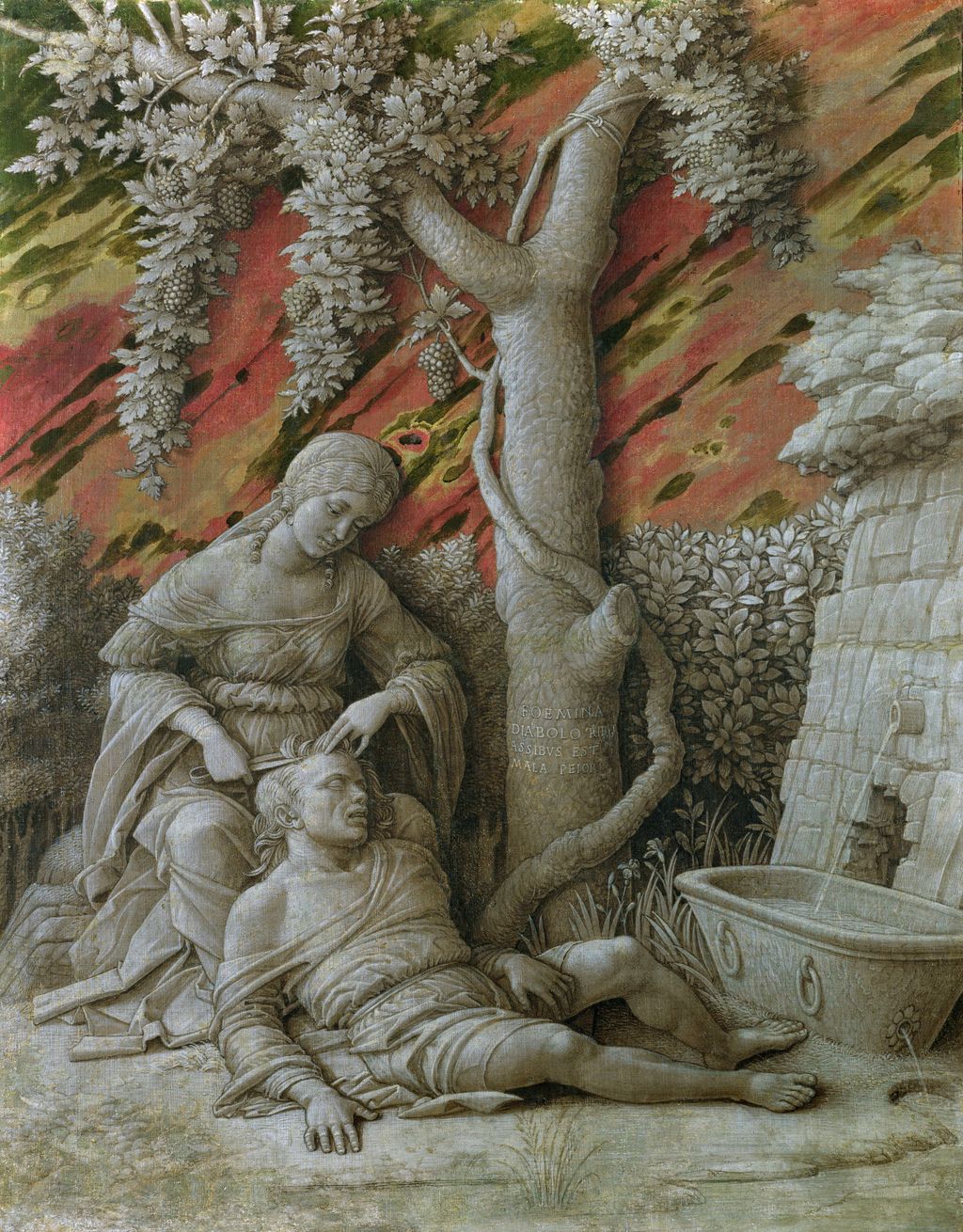
Samson and Delilah, National Gallery, London Image source. Public domain.
The same handover in Dublin, Montreal and Florence
The National Gallery of Ireland’s Judith with the Head of Holofernes, NGI.442, is a distinct painting catalogued as Andrea Mantegna, about 1495–1500, in tempera on linen. In Dublin the tent, open sack and foot on the bed are still there, but the colours are subdued almost to monochrome. The Dublin gallery reads the grisaille as an evocation of carved figures set against marble. In that painting, changes in tone make the figures appear to project like relief sculpture. In Washington, the separation of blue, yellow and rose directs attention from one figure to another and from them to the tent that shelters the action. [8] [1]
The Montreal Museum of Fine Arts holds another painting catalogued as Mantegna, Judith with the Head of Holofernes, accession 1920.103. Dated about 1500 and executed in tempera and gold, its canvas is more than twice as high as it is wide. The tall format brings the standing figures into a more compressed space than in the Dublin composition. The catalogue at Museum Boijmans Van Beuningen points to a telling comparison with a related drawing in Rotterdam. Montreal reverses the arrangement relative to that sheet and has Judith hold the head in her left hand without reaching across her body. The Rotterdam catalogue also reports Keith Christiansen’s comparison of its arm-crossing gesture with the Washington panel. In the Washington panel the crossed arm draws the woman on the right towards her companion on the left even as Judith turns her head away. [9] [10] [1]
There is firmer evidence for Mantegna’s own treatment of the subject in Florence. His finished Uffizi drawing, inventory F 404 E, bears his name and the date February 1491, which the museum gives as 1492 in modern reckoning. Here Judith looks down at the head and the attendant looks up towards her. Paul Kaplan, writing for the Uffizi, reads the women’s parted lips as a sign of conversation. He identifies African features in the attendant and draws attention to how stature, dress and placement mark her subordinate role. The Dublin museum likewise identifies the attendant in its picture as a woman of colour. In Washington the NGA describes both figures as pale, and the attendant’s headcloth, bare feet and bent attention establish her role within that particular image. The biblical account gives the attendant a part in the escape without specifying her ethnicity. [11] [10] [8] [1] [3]
The finish of the Uffizi sheet has prompted different readings of what it was for. Kaplan places it among the kinds of highly worked drawings Renaissance artists could give to friends or patrons. Art historian Kristen Lippincott has argued that it more likely served as a modello, a finished design that could be kept and adapted for paintings, citing the small pictures now in Dublin, Montreal and Washington. A separate group of sheets makes the relationship between design and execution more complicated. The Boijmans catalogue treats the drawings in Rotterdam, Chatsworth and Washington as copies of another, lost Mantegna design. The Washington sheet is catalogued separately by the NGA under accession 1939.1.178. For readers comparing the panel with Mantegna’s drawings, the distinction matters because the signed Florence sheet, the copies and the disputed panel each preserve different evidence of his involvement. [11] [12] [10] [13]
From a handover to a public image
In the Metropolitan Museum of Art’s engraving Judith and her maidservant with the head of Holofernes, dated 1500–30, the engraver is Girolamo Mocetto and the design is credited as after Mantegna. The Met impression is accession 19.27.2. A second-state impression in Washington, accession 1968.14.1, shows the handover in the open air, with trees and distant buildings behind the women. In that impression Judith stands to the left, and both women attend to the bag. The exchange is still recognisable when the tent, bed and foot are gone. In the history of Mantegna’s engravings, Mocetto’s print shows how the pairing of figures and the gesture could circulate in a composition with a setting of its own. [14] [15]
Other artists made very different choices about when to show Judith. Lucas Cranach the Elder’s painting at the Met, about 1530, presents her in elaborate contemporary court dress, with the sword upright and the head already set before her. She looks out towards the viewer. In Washington her gaze goes past us and the head is on its way into concealment. The change from a furtive handover to a presentation gives Cranach’s Judith the bearing of a portrait sitter, even with the evidence of the deed before her. [16] [1]
In Caravaggio’s Judith Beheading Holofernes, the fatal act is still in progress and the attendant waits with the sack. Artemisia Gentileschi’s version at the Uffizi brings the attendant into the struggle itself, helping to hold Holofernes down. In the Washington panel, the attendant’s part has a different physical emphasis. Her task is to hold open a bag while Judith has one hand full and the sword in the other. The body has nearly vanished into the tent. What remains in the light is the practical work the two women have to do together before they can leave. [17] [18] [1]
Annotated Details from Judith with the Head of Holofernes
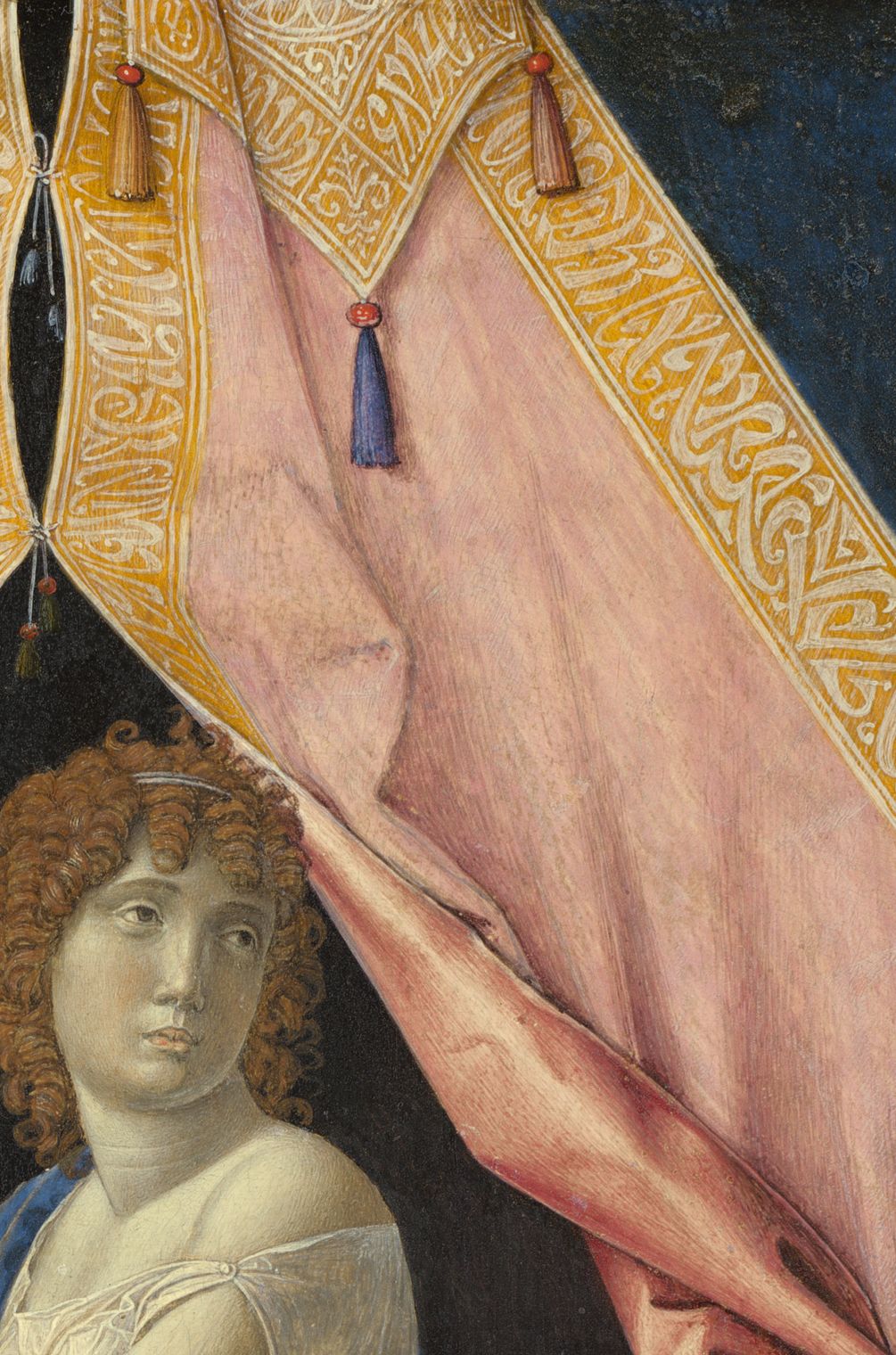
The numbered points identify details to look at closely. The detail images below preserve the native scale of the selected crops.
Judith with the Head of Holofernes
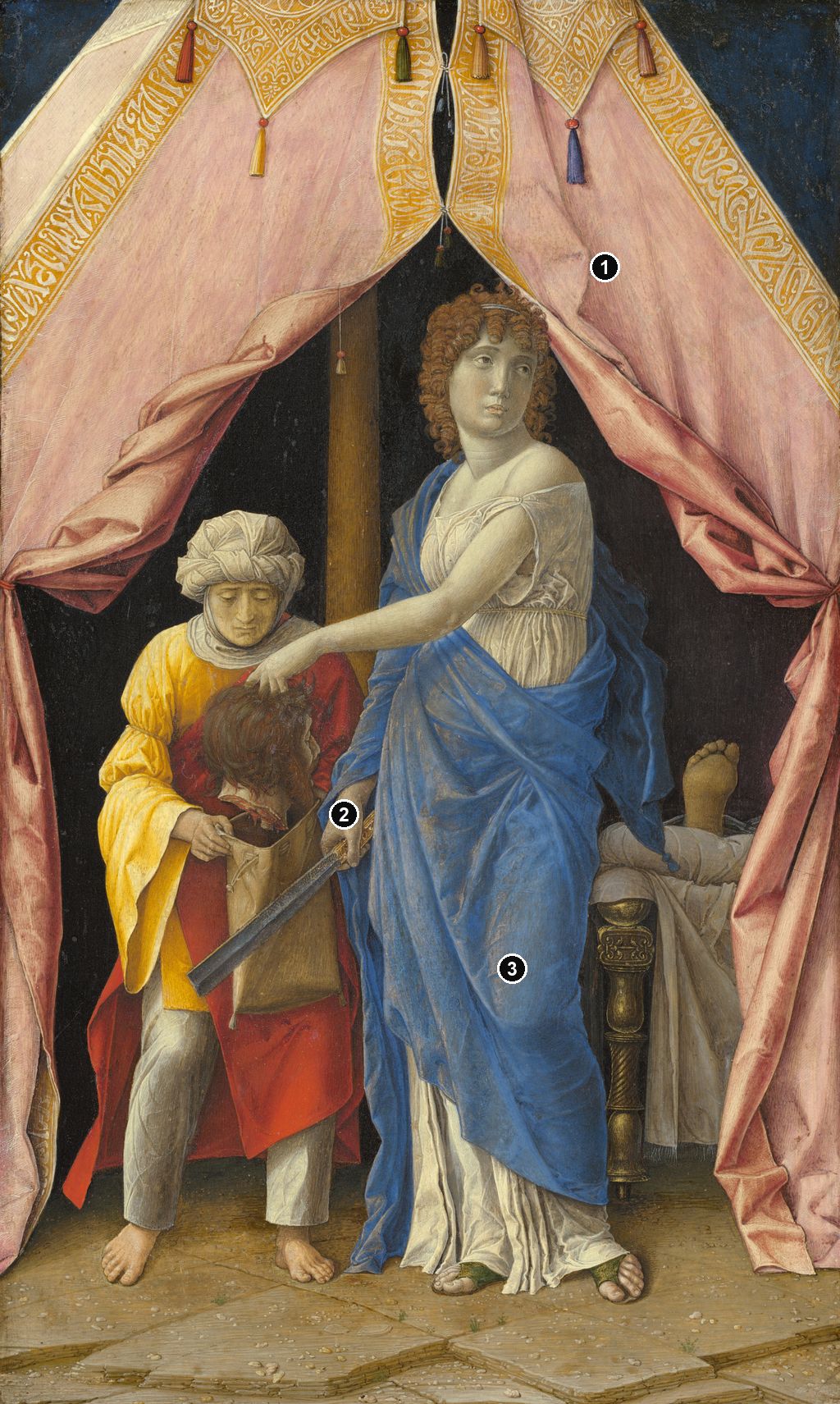
Details from JUDITH WITH THE HEAD OF HOLOFERNES
Choose a detail to enlarge it.
Judith with the Head of Holofernes
The opening of the tent
The curtains draw apart at an angle. The fabrics frame the standing figure and a much darker area behind her.
Attendant and sack
The attendant’s hands meet the object held near the sack. The twisting gestures mark the instant after the act itself.
The sword beside the drapery
The sword descends past the bright blue clothing. Its straight edge cuts across the garment’s more fluid folds.
Artworks directory
| Name | Date | Medium and collection |
|---|---|---|
| The Adoration of the Shepherds | Shortly after 1450 | Painting · Metropolitan Museum of Art · 32.130.2 Catalogue. |
| Saint Mark the Evangelist | C. 1448–51 | Painting · Städel Museum · 1046 Catalogue. |
| Saint Jerome Penitent in the Desert | C. 1448–51 | Painting · Museu de Arte de São Paulo · MASP.00015 Catalogue. |
| Martyrdom and Transport of the Body of Saint Christopher | Mid-1450s | Painting · Ovetari Chapel, Padua Catalogue. |
| San Luca Altarpiece | 1453–55 | Painting · Pinacoteca di Brera · 176 Catalogue. |
| The Presentation of Christ at the Temple | 1454 (Berlin dating) | Painting · Gemäldegalerie, Berlin · 29 Catalogue. |
| San Zeno Altarpiece | 1457–59 | Painting · Basilica of San Zeno, Verona Catalogue. |
| The Crucifixion | 1456–59 | Painting · Musée du Louvre · INV 368 Catalogue. |
| The Agony in the Garden (London) | C. 1455–56 | Painting · National Gallery, London · NG1417 Catalogue. |
| The Agony in the Garden (Tours) | 1459 (Tours dating) | Painting · Musée des Beaux-Arts de Tours · 1803-1-24 Catalogue. |
| The Resurrection | 1459 (Tours dating) | Painting · Musée des Beaux-Arts de Tours · 1803-1-25 Catalogue. |
| Saint Sebastian (Vienna) | C. 1457–59 | Painting · Kunsthistorisches Museum · GG 301 Catalogue. |
| Cardinal Ludovico Trevisan | C. 1459–60 (Berlin exhibition dating) | Painting · Gemäldegalerie, Berlin · 9 Catalogue. |
| The Death of the Virgin | C. 1462 | Painting · Museo Nacional del Prado · P000248 Catalogue. |
| Christ with the Soul of the Virgin | C. 1460–64 | Painting · Pinacoteca Nazionale, Ferrara Catalogue only. |
| Portrait of a Young Man (traditionally Francesco Gonzaga) | C. 1461 or 1470, depending on sitter | Painting · Museo di Capodimonte · Q 60 Catalogue. |
| Portrait of a Prelate (Carlo de’ Medici?) | C. 1465–70 | Painting · Uffizi Galleries · 1890 no. 8540 Catalogue. |
| Portrait of a Man | C. 1470 | Painting · National Gallery of Art, Washington · 1952.2.5 Catalogue. |
| Madonna with Sleeping Child (Berlin) | C. 1455–60 | Painting · Gemäldegalerie, Berlin · S.5 Catalogue. |
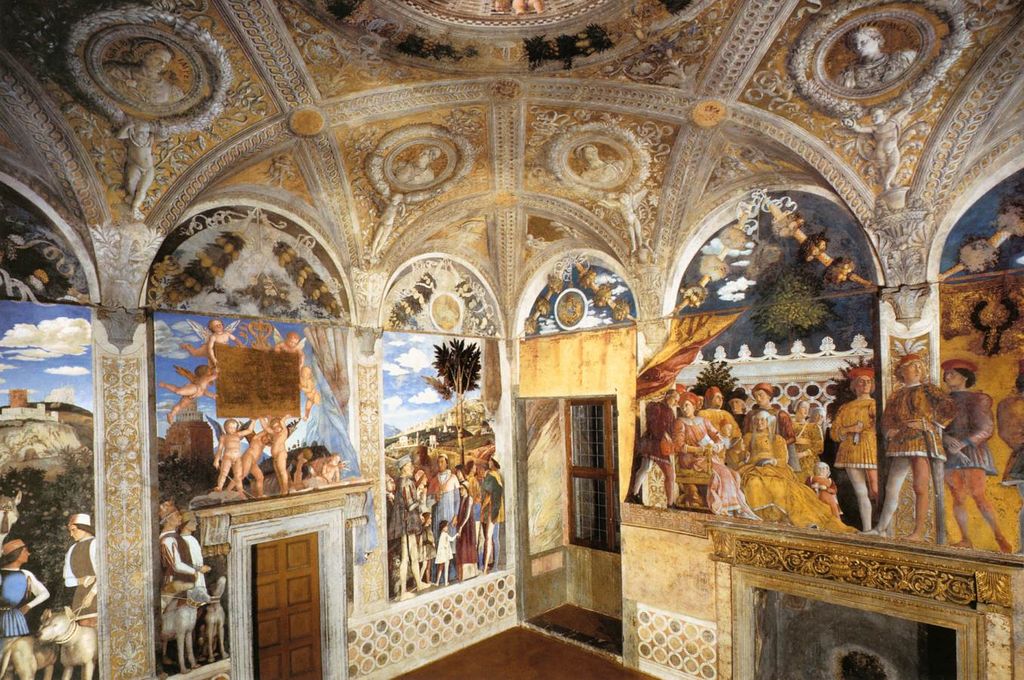
| Camera degli Sposi (Camera Picta) | 1465–74 | Painting · Palazzo Ducale, Mantua Catalogue. |
| Saint Sebastian (Louvre) | Around 1480 | Painting · Musée du Louvre · RF 1766 Catalogue. |
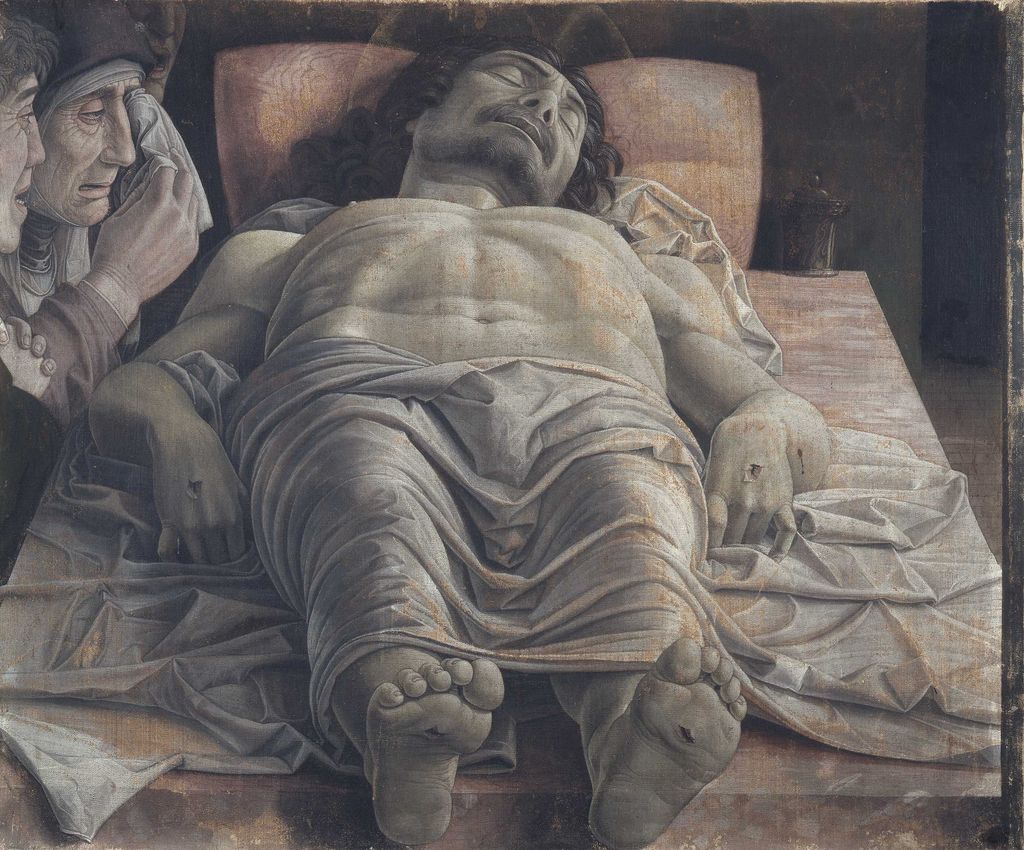
| Lamentation over the Dead Christ | C. 1483 (Brera dating) | Painting · Pinacoteca di Brera · 352 Catalogue. |
| The Triumphs of Caesar | About 1485–1506 | Painting · Royal Collection · RCIN 403958–403966 Catalogue. |
| Madonna of the Caves | C. 1488–90 | Painting · Uffizi Galleries · 1890 no. 1348 Catalogue. |
| Madonna and Child with a Choir of Cherubim | C. 1485 | Painting · Pinacoteca di Brera · 297 Catalogue. |
| Madonna and Child (Poldi Pezzoli) | Early 1490s (museum dating) | Painting · Museo Poldi Pezzoli · 1595 Catalogue. |
| The Holy Family with Saint Mary Magdalen | C. 1495–1500 | Painting · Metropolitan Museum of Art · 14.40.643 Catalogue. |
| The Virgin and Child with Saint Mary Magdalene and Saint John the Baptist | C. 1490–1505 | Painting · National Gallery, London · NG274 Catalogue. |
| Christ as the Suffering Redeemer | 1485–95 (SMK dating) | Painting · Statens Museum for Kunst · KMSsp69 Catalogue. |
| Ecce Homo | C. 1500 | Painting · Musée Jacquemart-André · MJAP-P 1840 Catalogue. |
| Judith with the Head of Holofernes (Mantegna or follower) | C. 1495–1500 | Painting · National Gallery of Art, Washington · 1942.9.42 Catalogue. |
| Madonna della Vittoria | 1495–96 | Painting · Musée du Louvre · INV 369 Catalogue. |
| Mars and Venus (Parnassus) | C. 1496–97 | Painting · Musée du Louvre · INV 370 Catalogue. |
| The Trivulzio Madonna | 1497 | Painting · Castello Sforzesco, Milan · 0554 Catalogue. |
| The Adoration of the Magi | C. 1495–1505 | Painting · J. Paul Getty Museum · 85.PA.417 Catalogue. |
| Minerva Expelling the Vices from the Garden of Virtue | C. 1502 | Painting · Musée du Louvre · INV 371 Catalogue. |
| The Introduction of the Cult of Cybele at Rome | 1505–06 | Painting · National Gallery, London · NG902 Catalogue. |
| Saint Sebastian (Venice) | Probably c. 1504–06 | Painting · Galleria Giorgio Franchetti alla Ca’ d’Oro · D.11 Catalogue. |
| Samson and Delilah | C. 1500 | Painting · National Gallery, London · NG1145 Catalogue only. |
| A Woman Drinking (probably Sophonisba) | C. 1495–1506 | Painting · National Gallery, London · NG1125.2 Catalogue only. |
| The Vestal Virgin Tuccia with a Sieve | C. 1495–1506 | Painting · National Gallery, London · NG1125.1 Catalogue only. |
| Judith with the Head of Holofernes (Dublin) | C. 1495–1500 | Painting · National Gallery of Ireland · NGI.442 Catalogue only. |
| Battle of the Sea Gods, left half (Met impression) | Before 1481 (Met dating) | Print · Metropolitan Museum of Art · 18.12 Catalogue only. |
| Battle of the Sea Gods, right half (Met impression) | Before 1481 (Met dating) | Print · Metropolitan Museum of Art · 1984.1201.4 Catalogue only. |
| Battle of the Sea Gods, left half (Tokyo impression) | C. 1475 (Tokyo dating) | Print · National Museum of Western Art, Tokyo · G.1981-0002 Catalogue only. |
| Battle of the Sea Gods, left half (Washington impression) | C. 1485–88 (NGA dating) | Print · National Gallery of Art, Washington · 1941.1.6 Catalogue only. |
| The Entombment of Christ, second state of two | Before 1475 (Met dating) | Print · Metropolitan Museum of Art · 37.42.30 Catalogue only. |
| The Entombment of Christ (possibly Zoan Andrea, after Mantegna) | 1460–1549 (Rijksmuseum dating) | Print · Rijksmuseum · RP-P-1924-60 Catalogue only. |
| Four Dancing Muses (Gian Marco Cavalli after Mantegna) | C. 1497 | Print · Metropolitan Museum of Art · 20.5.3 Catalogue only. |
| Bacchanal with Silenus | Before 1475 (Met dating) | Print · Metropolitan Museum of Art · 29.44.15 Catalogue only. |
| Bacchanal with a Wine Vat | Before 1475 (Met dating) | Print · Metropolitan Museum of Art Catalogue only. |
| St James on His Way to Execution | C. 1453–57 | Drawing · British Museum · 1976,0616.1 Catalogue only. |
| Three Studies for a Dead Christ | C. 1455–65 | Drawing · British Museum · 1909,0406.3 Catalogue only. |
| Pietà (Venice) | C. 1456–65 (exhibition datings) | Drawing · Gallerie dell’Accademia, Venice · 115 Catalogue only. |
| Studies for Christ at the Column | 1460–65 | Drawing · The Courtauld · D.1978.PG.345 Catalogue only. |
| Virtus Combusta | C. 1490 (technical study) | Drawing · British Museum · Pp,1.23 Catalogue only. |
| Virtus Combusta (Giovanni Antonio da Brescia after Mantegna) | C. 1495–1506 | Print · Musée du Louvre · 3881 LR/ Recto Catalogue only. |
| The Calumny of Apelles | C. 1504–06 | Drawing · British Museum · 1860,0616.85 Catalogue only. |
Frequently Asked Questions
Its current attribution leaves open Mantegna or a follower, possibly Giulio Campagnola. This article covers the Washington panel 1942.9.42 and treats the variants separately.
Judith and her attendant are putting Holofernes’s head into a sack just outside the tent. The killing itself has already taken place.
Discussion
Look again at the images and ideas explored in Judith and Holofernes. These editorial prompts invite your observations.
Reader Insights
How do Judith’s outward gaze and the attendant’s downward gaze divide the action at the mouth of the sack?
What does the visible foot tell us in the Washington panel that Mocetto’s open-air engraving leaves us to infer?
Join the Conversation
Share a detail, comparison or question about Judith and Holofernes below.
References
- National Gallery of Art, Judith with the Head of Holofernes, accession 1942.9.42. View source.
- National Gallery of Art, 2004 Annual Report, Changes of Attribution, accession 1942.9.42. View source.
- United States Conference of Catholic Bishops, Book of Judith, chapter 13. View source.
- United States Conference of Catholic Bishops, Book of Judith, chapter 14. View source.
- United States Conference of Catholic Bishops, Book of Judith, chapter 10. View source.
- Musée du Louvre, Mantegna exhibition archive, First Years in Mantua, Judith with Her Maidservant Abra. View source.
- Colnaghi Studies Journal, Irene Brooke, Giulio Campagnola, Landscape, and Venetian Illumination, pp. 137–39 and p. 152 n. 9. View source.
- National Gallery of Ireland, Judith with the Head of Holofernes, NGI.442. View source.
- Musée des beaux-arts de Montréal, Judith avec la tête d’Holopherne, 1920.103. View source.
- Museum Boijmans Van Beuningen, Judith and her Maid with the Head of Holofernes, Italian Drawings catalogue. View source.
- Gallerie degli Uffizi, Paul Kaplan on Giuditta e l’ancella con la testa di Oloferne, F 404 E, in On Being Present. View source.
- Art Institute of Chicago, Kristen Lippincott, A Masterpiece of Renaissance Drawing, Museum Studies 17(1), pp. 14–15. View source.
- National Gallery of Art, Judith with the Head of Holofernes, accession 1939.1.178. View source.
- The Metropolitan Museum of Art, Girolamo Mocetto, Judith and her maidservant with the head of Holofernes, 19.27.2. View source.
- National Gallery of Art, Girolamo Mocetto, Judith with the Head of Holofernes, 1968.14.1. View source.
- The Metropolitan Museum of Art, Lucas Cranach the Elder, Judith with the Head of Holofernes, 11.15. View source.
- Gallerie Nazionali Barberini Corsini, Caravaggio e Artemisia, la sfida di Giuditta, exhibition dossier. View source.
- Gallerie degli Uffizi, Artemisia Gentileschi, Giuditta decapita Oloferne. View source.
- Basilica of San Zeno, Verona, San Zeno Altarpiece, View source.
- Palazzo Ducale, Mantua, Camera degli Sposi (Camera Picta), View source.
- Royal Collection, The Triumphs of Caesar, View source.
- Musée du Louvre, Madonna della Vittoria, View source.
- National Gallery, London, The Introduction of the Cult of Cybele at Rome, View source.
More MANTEGNA Paintings
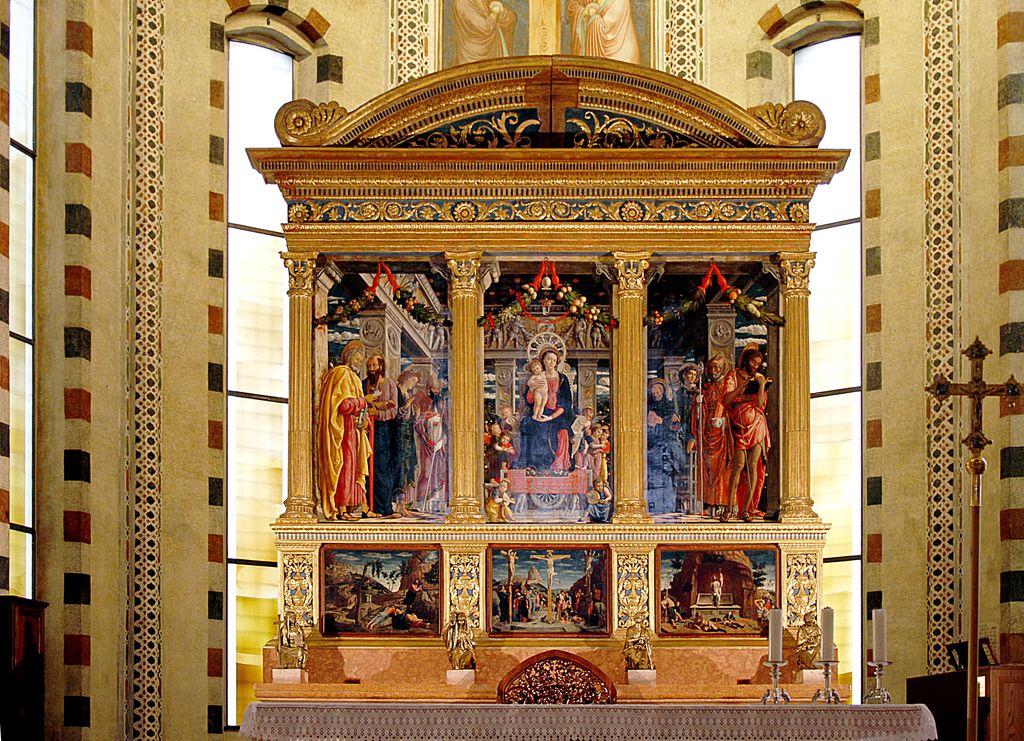
San Zeno Altarpiece
The San Zeno Altarpiece in its frame, Basilica of San Zeno, Verona José Luiz. Image source. CC BY-SA 4.0. Resized from the cited image.