 by Tom Gurney
Tom Gurney BSc (Hons) is an art history expert with over 20 years experience
Published on June 19, 2020 / Updated on November 29, 2026
Email: tomgurney1@gmail.com / Phone: +44 7429 011000
Overview
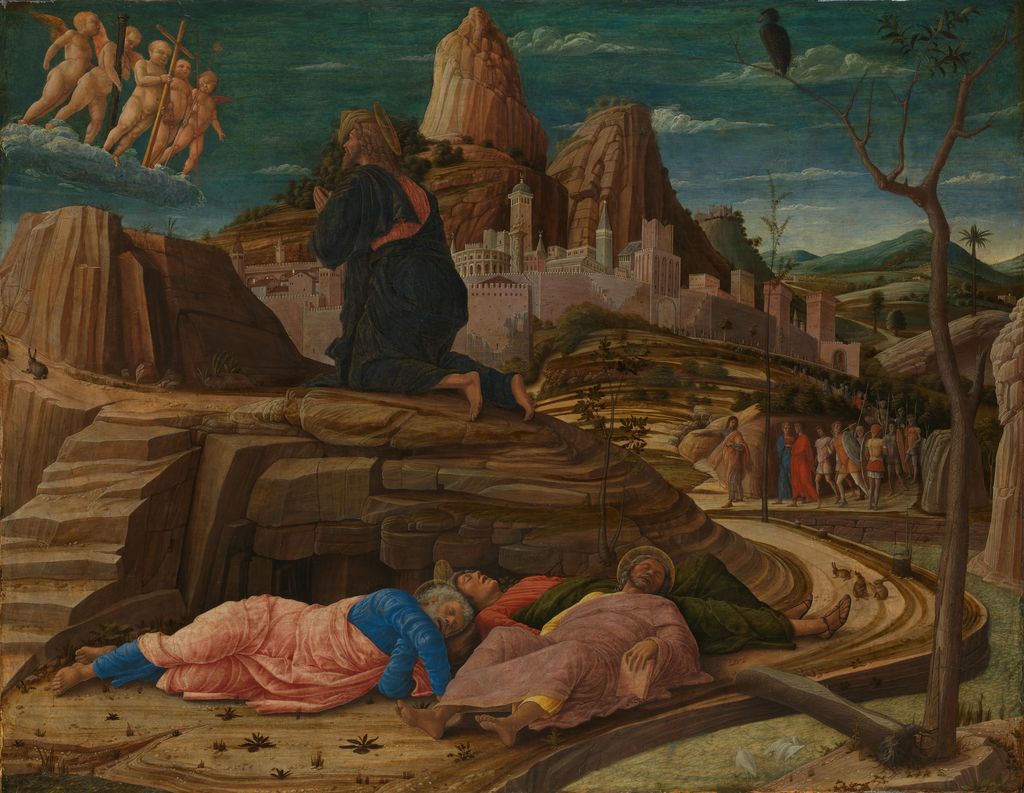
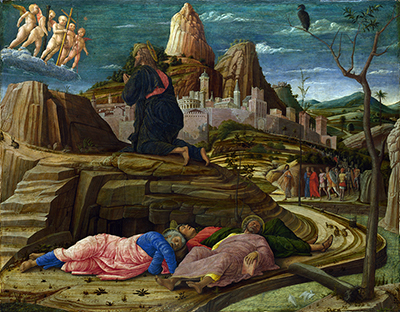
A file of armed men winds down from Jerusalem while Christ kneels on a shelf of rock. Three disciples sleep below him, close enough to touch and oblivious to the approaching danger. Andrea Mantegna gives each group a different place in the landscape. In his signed Agony in the Garden, which the National Gallery in London dates to about 1455–56, the distance between one figure and another becomes a measure of the time Christ has left before his arrest. [1]
At a Glance
- Date (London)About 1455–56
- Medium and size (London)Egg tempera on wood, 62.9 × 80 cm
- Collection (London)National Gallery, London, NG1417
- Mantegna’s Tours version1459 (Tours dating), oil on wood, Musée des Beaux-Arts de Tours, 1803-1-24
- Giovanni Bellini comparisonAbout 1458–60, egg tempera on wood (probably poplar), National Gallery, London, NG726
Andrea Mantegna in context
The Agony in the Garden (London)
C. 1455–56 [1]San Zeno Altarpiece
1457–59 [18]The Triumphs of Caesar
Mid-1480s–before 1506 [20]Madonna della Vittoria
1495–96 [21]Prayer on a ledge in the London panel
In Matthew’s Gospel, Jesus goes to Gethsemane after the Last Supper and asks Peter, James and John to keep watch. He withdraws to pray that the cup of suffering might pass from him, while submitting himself to his Father’s will. He returns to find the disciples asleep. The arrival of Judas and the arrest follow the prayer. Luke likewise tells of the prayer and the sleeping disciples, and includes an angel from heaven who strengthens Jesus. The two accounts help explain why painters of the scene could give a place to both the angel and the cup, even though Matthew’s cup is spoken of in prayer. [2] [3]
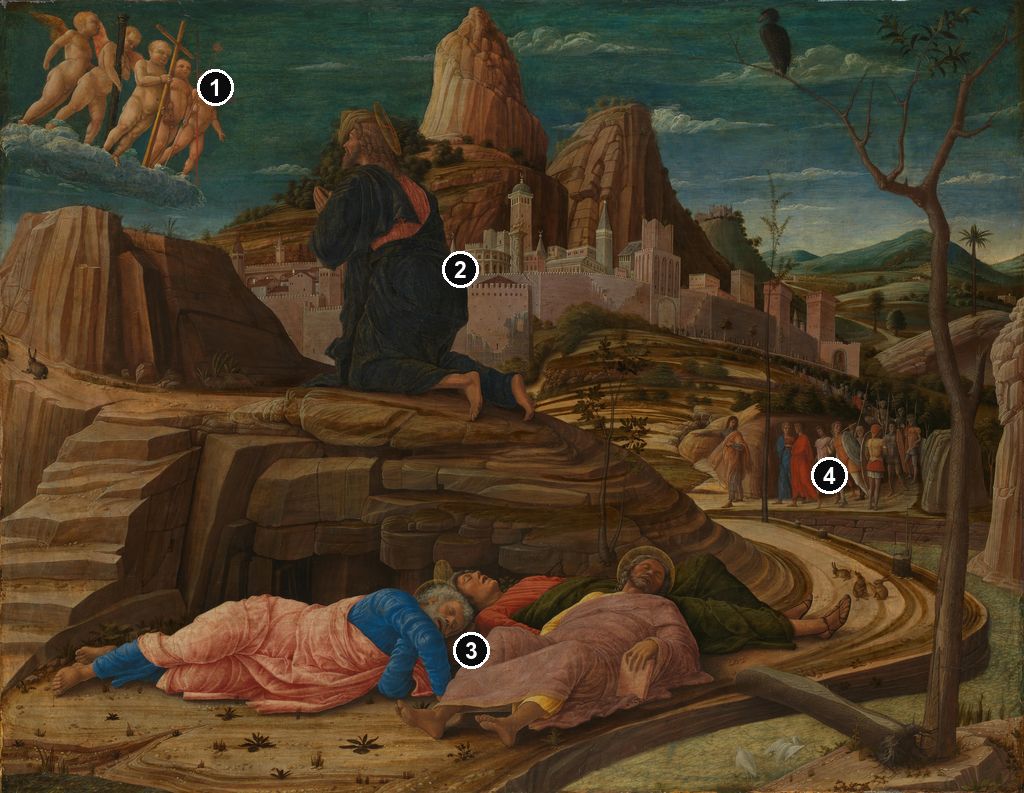
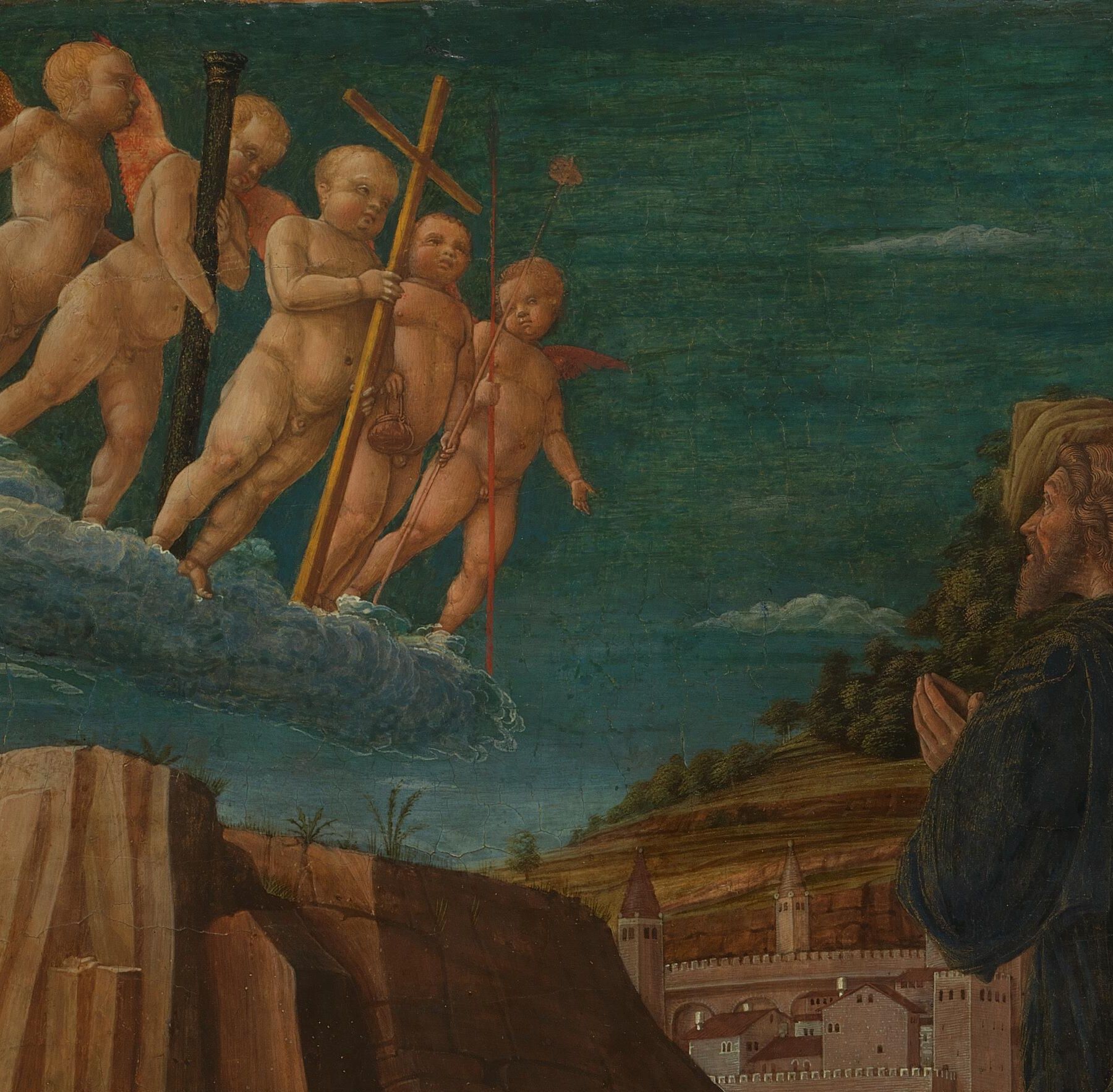
In the London panel, Christ kneels on the left with his hands joined. His gaze meets a cluster of cherubs on a cloud. They hold up instruments of the Passion, including the cross that anticipates his death. These objects put the future visibly before him while Judas and the arrest party are still some way off. The National Gallery compares the rock before Christ to a church altar. Its squared edges and horizontal top give the cross a place in the composition much like the one it might occupy above an altar, even as the cloud carries it clear of the ground. [1]
The ledge also gives his prayer a physical setting. Follow its broad reddish face down to the sleepers and you can see how a short distance divides them. The rock raises Christ just high enough for his profile and hands to stand clear of the figures below. The stepped strata then pull the eye down towards the bodies. Farther back, the steep, tapering peaks make the foreground shelf look unusually solid and level. The setting gives Christ a place apart in an exposed landscape. There is little in it to shelter him from the company coming down the road. [1]
Jerusalem and the road to the garden
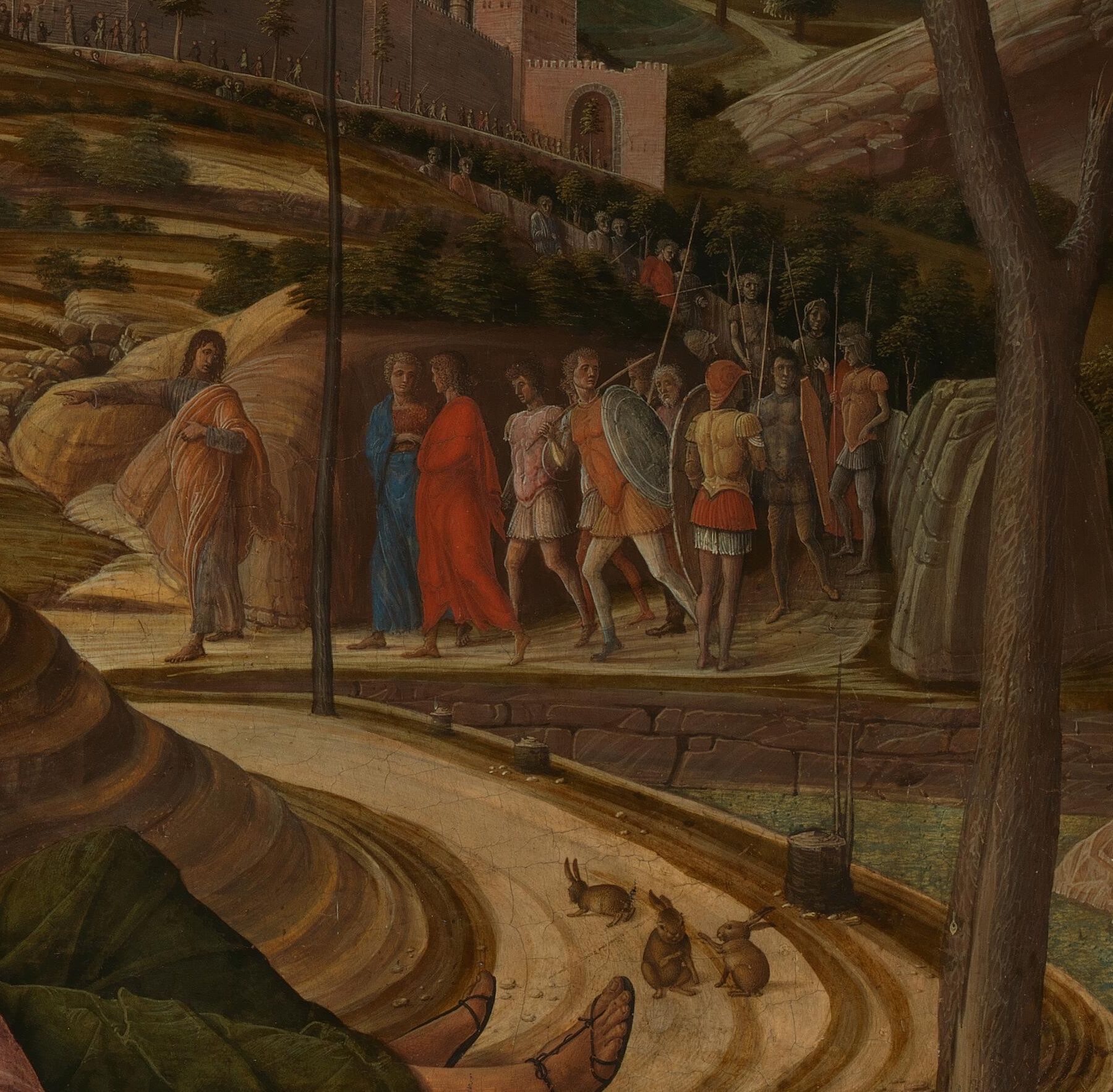
Start at the city gate and follow the arrest party towards the right. At first, the column of figures is so small that it almost merges with the walls. Lower down the winding route, individual faces and pieces of armour become legible. Judas leads the group. Because the slope doubles back, the line of men occupies more than one level of the hillside, and the eye has to travel some way to get from the distant ranks to those nearest the garden. Matthew tells the prayer and the arrest in succession. Mantegna places their beginnings within a single view, where the progress of the armed men can be read against the stillness of Christ and the disciples. [1] [2]
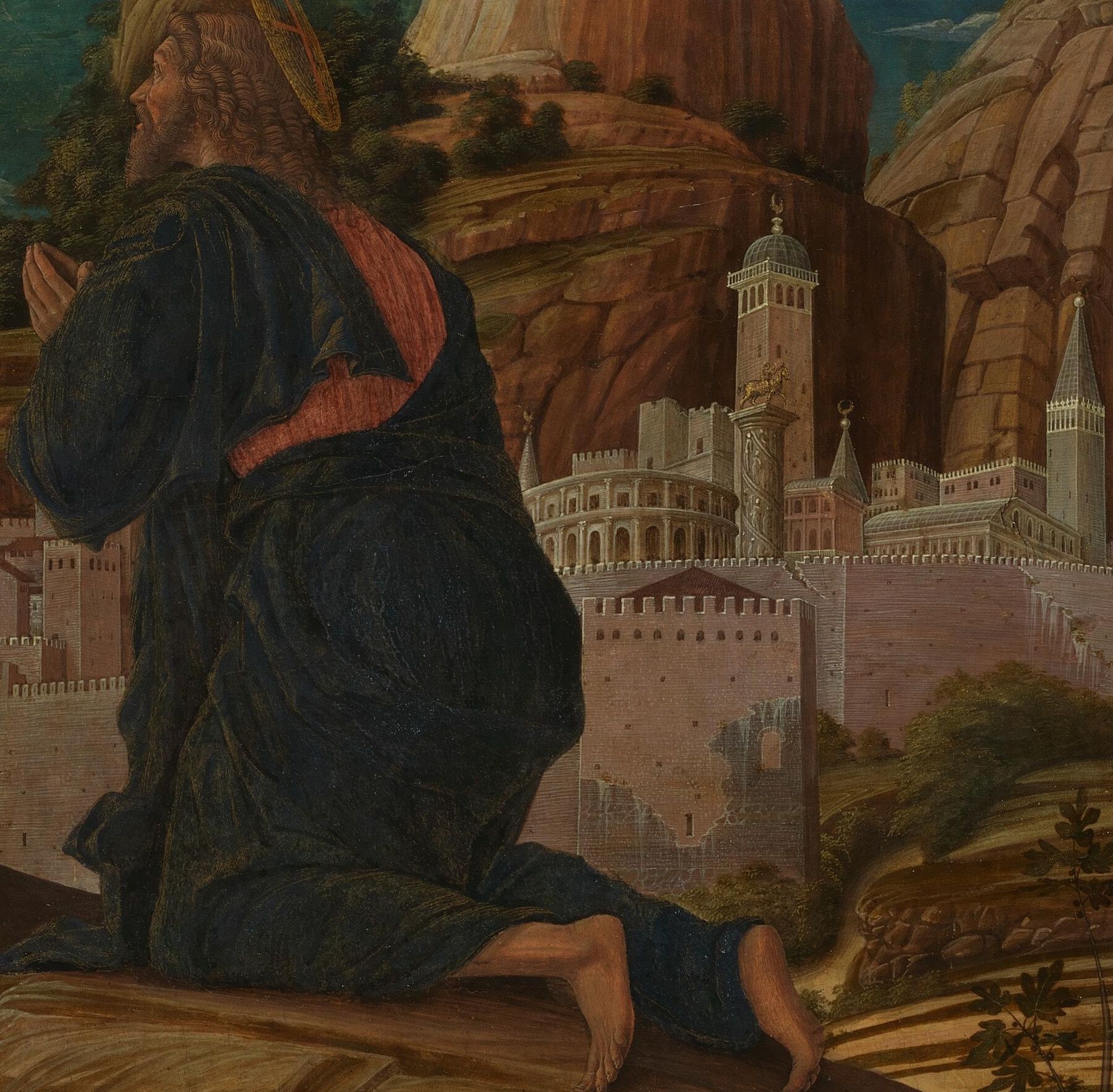
The city rewards a slower look. The National Gallery’s panel, NG1417, is painted in egg tempera on wood. It measures 62.9 by 80 centimetres, yet the walls carry rows of individually described bricks. The National Gallery connects this precision to the quick-drying tempera, in which egg binds the pigment. At close range the masonry breaks into small, distinct strokes. Seen across the panel, those strokes hold the wall together as a continuous surface, while the gate interrupts it at the very point where the story comes out into the landscape. The minute detail helps the viewer find the beginning of the soldiers’ route. [1]
High over the buildings, a tiny gilded horse and rider stand on a column. The National Gallery compares the figure to ancient Roman equestrian monuments and to Donatello’s bronze Gattamelata, made in the years immediately before the London panel and set up in Padua, where Mantegna was working at this stage of his career. In Padua, Donatello commemorated the military commander Erasmo da Narni on a stone base. In Mantegna’s city the high column and the gleam of the rider give a very small feature the authority of a public monument. It is the type of statue that makes the comparison persuasive. Even at this reduced scale the city looks like a place with a history of its own. [1] [4]
The weight of the sleeping disciples
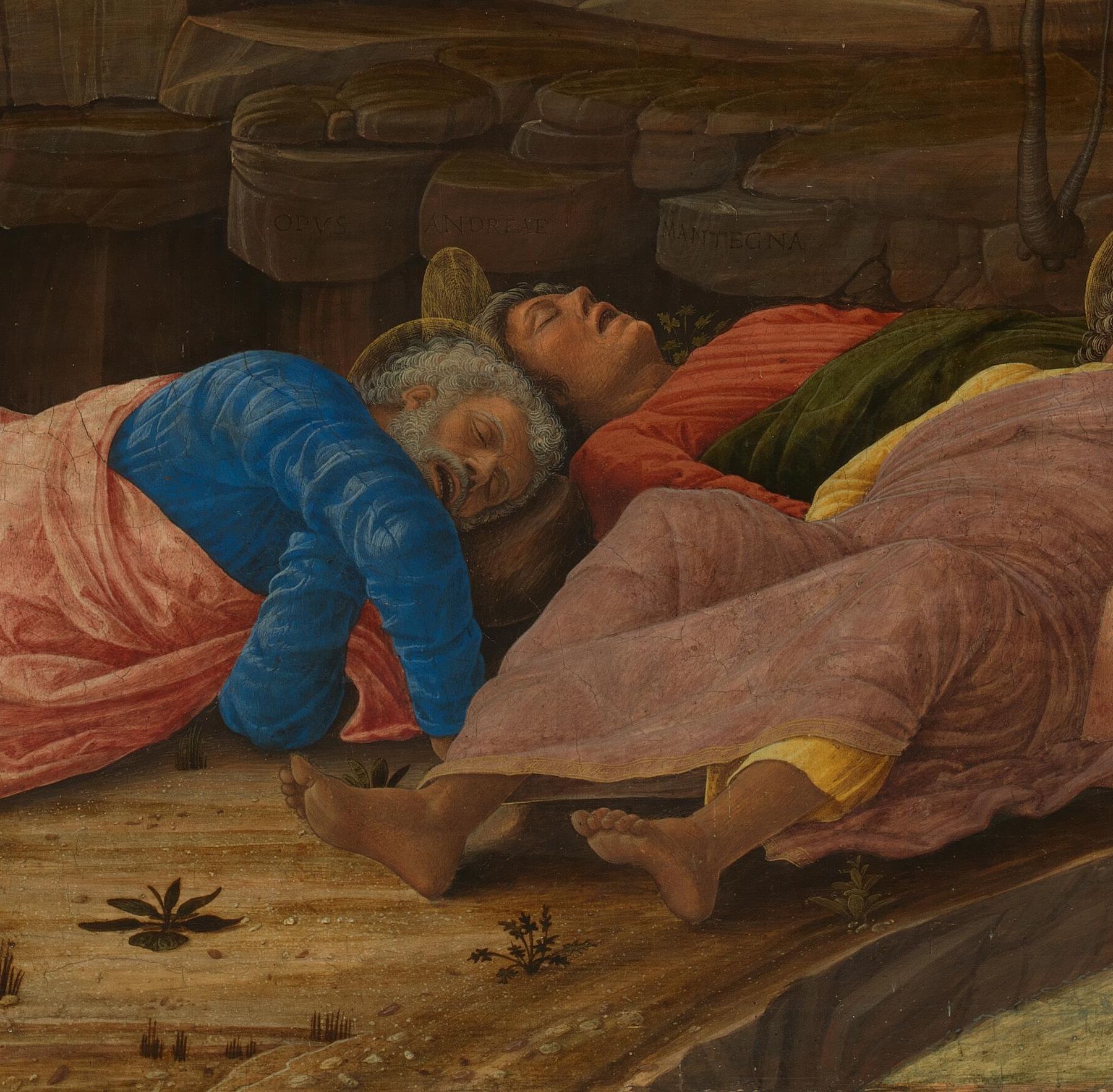
The sleepers come closer to the picture’s edge than anyone else. One disciple’s feet point out towards us and the rest of his body recedes into the panel. This is foreshortening. The length of the figure has to be conveyed through the overlap of feet, legs and folds because we see him almost end-on. The pose brings the foreground into play immediately. There is a short path for the eye from the soles towards the sleeper’s head and then up towards the kneeling Christ. The disciples’ failure to keep watch is all the more striking for the care with which Mantegna makes their bodies occupy the ground. [1]
The National Gallery likens the disciples to Roman statues, with folds as crisp as carved marble and mantles arranged like togas. The comparison helps explain their strange poise in sleep. Their limbs look heavy, yet the cloth holds pronounced ridges where it turns over a body. Christ’s finely defined curls have a similar sculptural quality. Even the cherubs have firmly modelled legs, which the Gallery relates to the sculpture of Donatello. Their apparent weight is especially striking against the cloud, whose edge seems scarcely capable of bearing them. [1]
The smallest passages supply a different kind of movement. Rabbits face one another below the cloud and tussle near the stream. Two white birds stand in the water. The Gallery identifies them as egrets and reads them as a baptismal reference. Above the sleepers, a fig sapling pushes through the rock, its bark picked out in tiny pale strokes. The Gallery suggests a possible connection with the later legend that Judas hanged himself from a fig tree. These readings start with details that are also vivid in their own right. The thin strokes of the bark give the little tree a surprisingly distinct texture against the mass of stone, and the animals go about their business while the armed men come closer. [1]
Christ and the arrest party change sides in Tours
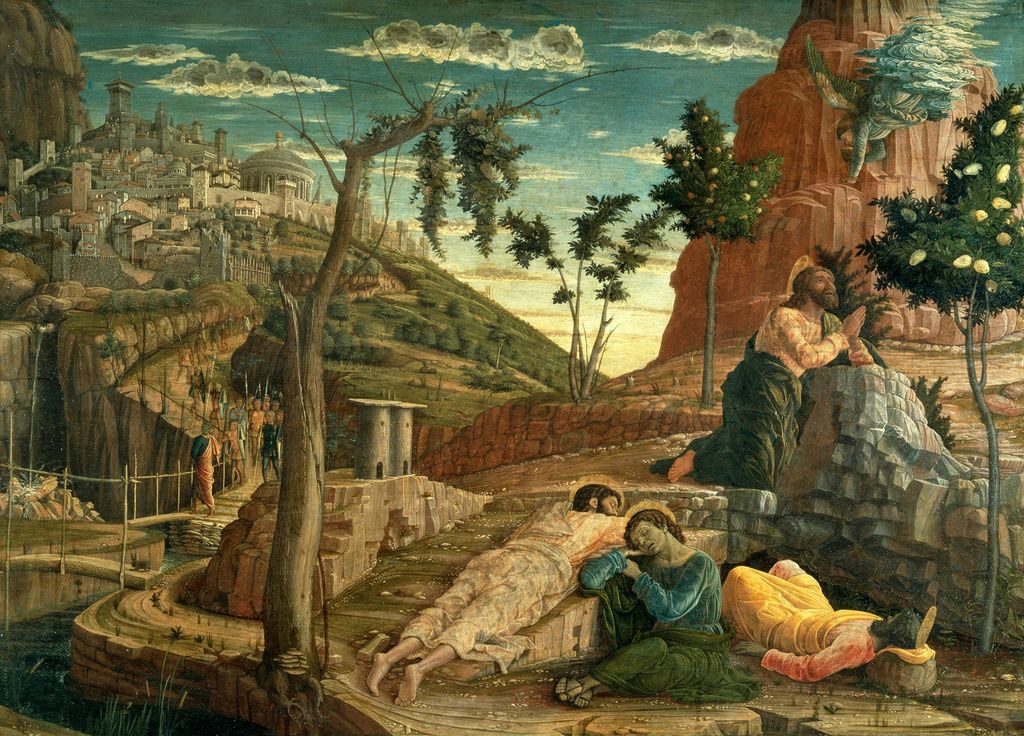
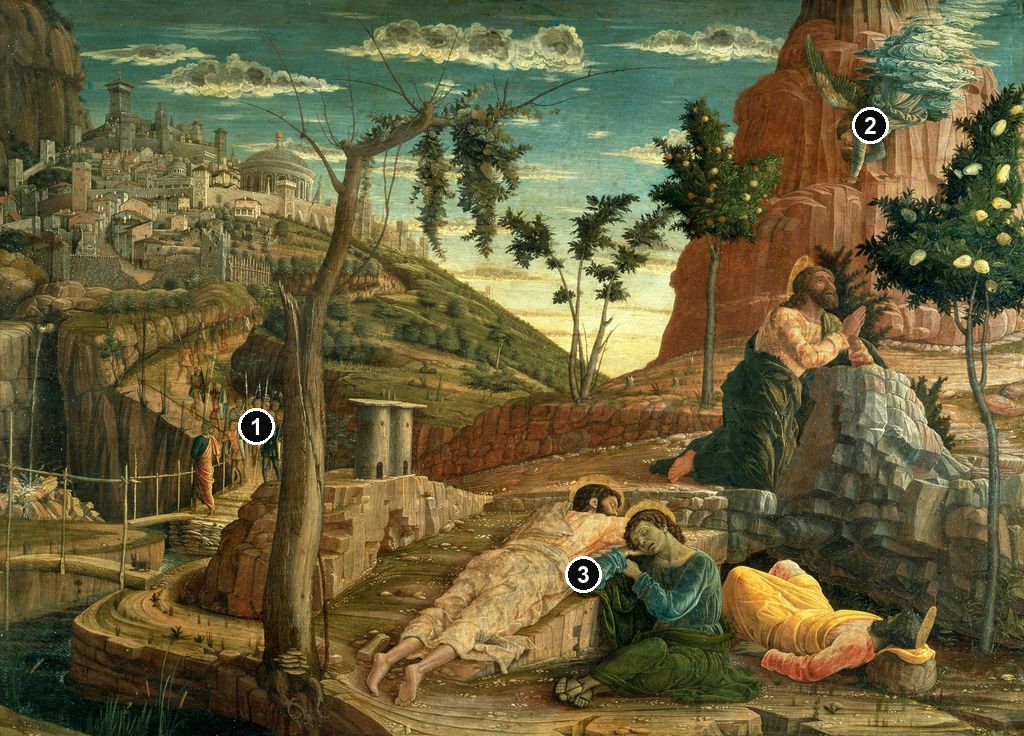
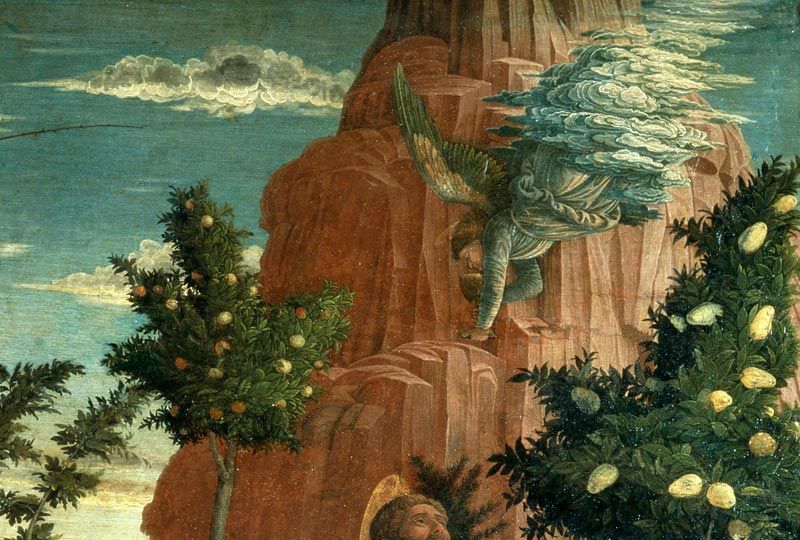
Mantegna’s Prayer in the Garden of Olives at the Musée des Beaux-Arts de Tours is a separate composition made for the San Zeno predella. The museum dates it to 1459 and catalogues it as oil on wood. It measures 71.1 by 93.7 centimetres and bears inventory number 1803-1-24. Christ kneels on the right, with his face visible as he looks towards a single angel bringing a chalice. On the left, Judas leads the arrest party along the road below a fortified city. The London picture sets the group of cherubs and the instruments of the Passion against the city and its soldiers. The Tours panel answers Christ’s prayer with the cup itself. [5] [6]
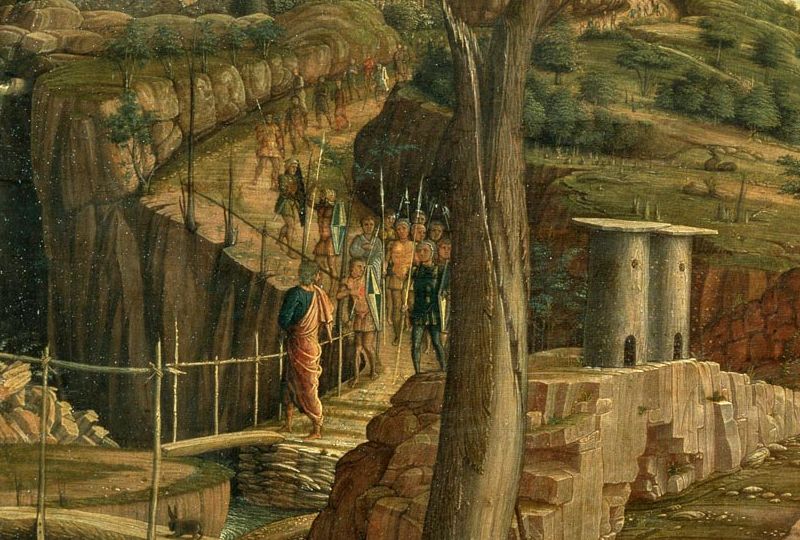
A broken tree rises just left of centre. The soldiers approach on one side of its trunk, while Christ and the sleepers occupy the other. A bridge and the winding road carry the approach across the lower ground, and the tall rock behind Christ brings the eye up to the angel. The Tours dossier identifies a vine growing on the dead tree and reads it as an echo of the wine shared at the Last Supper. The detail gives the chalice a counterpart on earth. A viewer can trace the connection from the living vine to the cup while also seeing how the trunk divides successive episodes of the Gospel story. [2] [6]
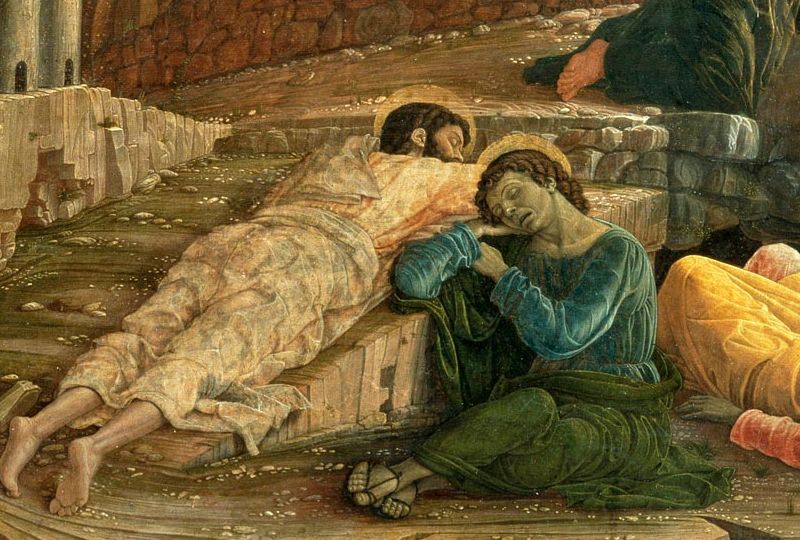
The poses of the disciples give Tours its own rhythm. The museum identifies Peter lying on his back at the left of the group, John leaning against the rock in the middle, and James lying face down on the right. Peter’s feet extend towards the lower edge, but the three bodies spread unevenly around the rocks. John’s head rests on his hand as the ground rises behind him. James’s bent legs bring the eye back along the front of the ledge. Their clustered forms make Christ’s separation from them more conspicuous even though he kneels only a short distance above. [6]
The museum’s dossier describes a fine underdrawing in the faces and clothing, with broader marks in the rocks. It also records how pale hatching brings out the folds of John’s mantle and how warm pigments lighten the sky near the horizon. The museum reads this pale band as the first light of dawn. Above the hillside, a narrow strip of early light opens a gap between the dark city slope and the great rock on the right. The dossier also records that the painting was transferred to a replacement poplar support in Paris in 1870. The Institut national d’histoire de l’art records a canvas layer in the transferred work. [6] [7]
Tours proposes that the background city may recall the first-century historian Flavius Josephus. The description reproduced in the museum dossier, with its fortified hills and intervening valley, comes from Book V of The Jewish War. The parallel is suggestive. The walls in the painting climb and turn with the hill, so that Jerusalem has a shape governed by its terrain. Mantegna also gives the city a clear role in the composition. Perched above the route into the garden, it supplies a visible point of departure for the armed party. The resemblance to Josephus’s topography leaves open how Mantegna arrived at the design. [5] [6] [8]
The Agony in the Garden, Musée des Beaux-Arts de Tours Image source. Public domain.
The garden at the foot of the San Zeno Altarpiece
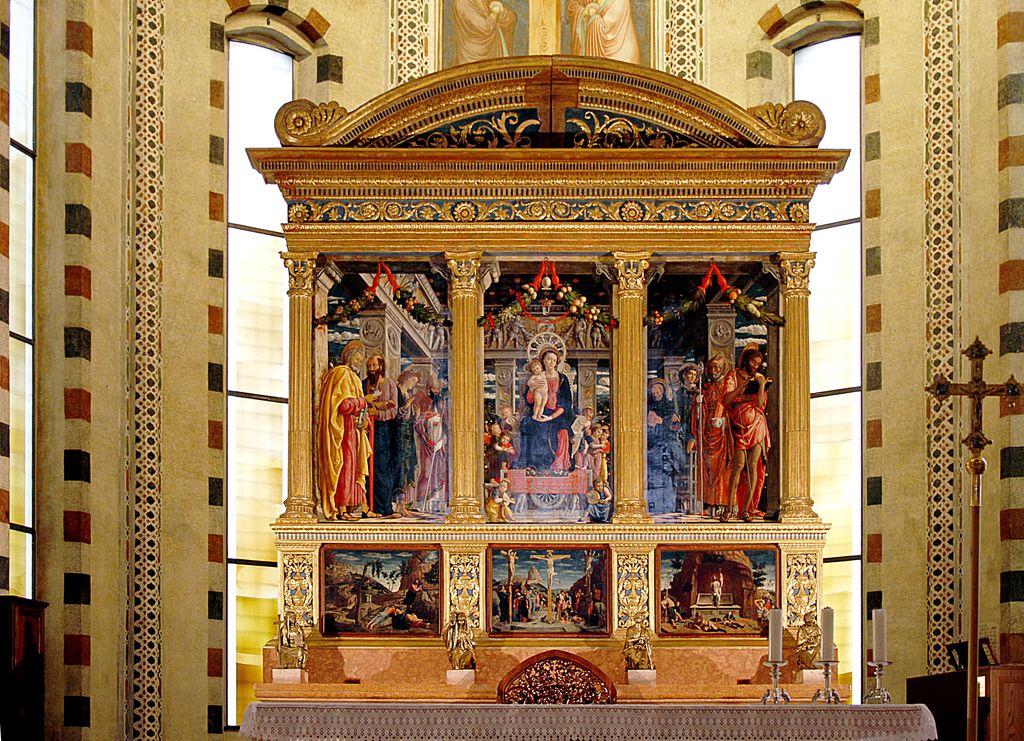
Gregorio Correr, abbot of San Zeno in Verona, commissioned Mantegna in 1456 to paint the San Zeno Altarpiece for the church’s high altar. It was completed in 1459. The Prayer belonged on the left of its predella, the row of smaller scenes beneath the main panels. Mantegna’s Crucifixion, now in the Louvre, occupied the centre. The Resurrection, now in Tours with the Prayer, occupied the right. As the eye moved across the three scenes, the cup presented in the garden gave way to the cross itself and then to the risen Christ. [5] [6] [9]
The San Zeno Altarpiece in its frame, Basilica of San Zeno, Verona José Luiz. Image source. CC BY-SA 4.0. Resized from the cited image.
The two outer scenes ask the viewer to look at bodies near the ground. In the Prayer, the disciples have fallen asleep below the praying Christ. In the Resurrection, guards are gathered at the foot of a rocky tomb while Christ appears above them. Read together, the two scenes turn a similar arrangement to different purposes. In the first, the lowered heads leave Christ alone in his distress. In the last, the rise of his figure above the tomb sets the miracle against the guards’ inability to contain it. The Louvre’s exhibition on Mantegna also stressed how closely observed details of nature link the predella scenes and proposed that their gentler figures and feeling for landscape owe something to Giovanni Bellini. [5] [10]
The altarpiece was dismantled in 1797 during the Napoleonic campaigns. The two outer predella panels went to Tours in 1806, while the Crucifixion remained in Paris. The upper paintings returned to Verona after Napoleon’s defeat. The panels beneath them in the basilica are copies. In Verona the arrangement still shows where the Prayer belonged in relation to the high altar and to the paintings above. In Tours, the original panel can be studied beside the original Resurrection, whose presence restores the last part of the sequence that began with Christ on his knees. [5] [6] [9] [11]
Bellini’s dawn and the family resemblance
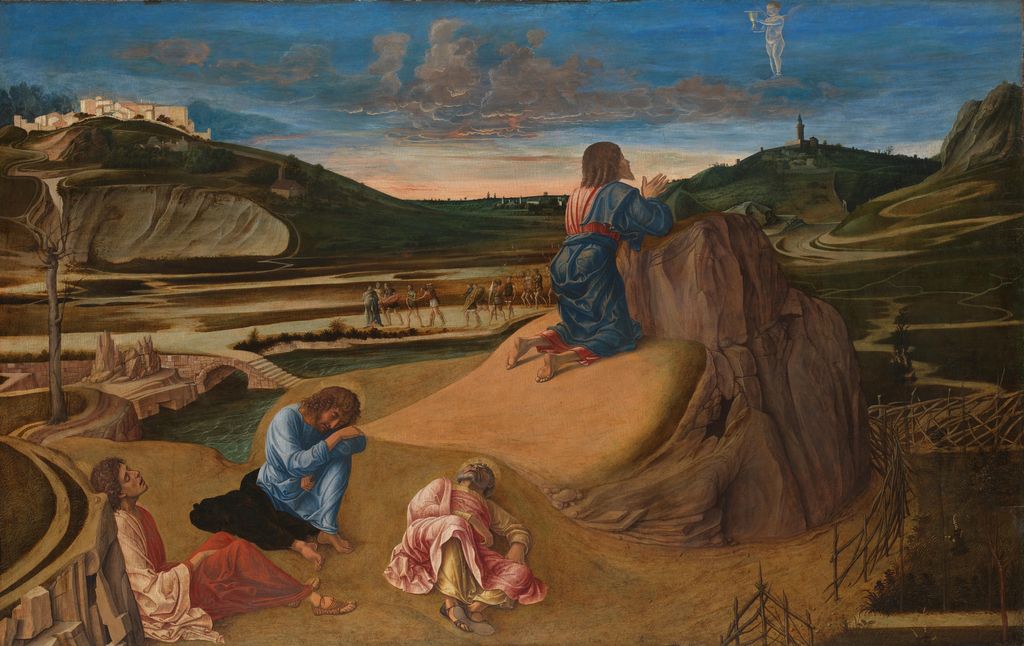
Giovanni Bellini’s Agony in the Garden is the other London painting of this subject. The National Gallery dates it to about 1458–60 and catalogues it as egg tempera on wood, probably poplar. It measures 80.4 by 127 centimetres and is numbered NG726. Bellini gives the landscape more room across the panel. Christ kneels on a projecting outcrop, turned away from the viewer, and a single cherub presents a chalice. Judas and the armed men appear beyond the river. The rocky foreground still carries the sleeping disciples, but the passage from their bodies to the distant hills feels longer and more open. [12]
The National Gallery points to a drawing by Jacopo Bellini, Giovanni’s father and Mantegna’s father-in-law, as a possible model for Mantegna’s London composition. It also notes that Giovanni’s picture resembles the drawing in its view of Christ from behind, turned towards the far hillside. The drawing is in the British Museum. It helps explain how an altar-like outcrop and a kneeling figure could belong to a shared repertory even as the painters took the subject in different directions. Within that repertory, the National Gallery sees a more specific debt to Mantegna in Giovanni’s attempt to repeat the pose of one foreshortened sleeper. [1] [12]
Bellini’s foreground retains some of the angular rock edges and sharply turned drapery folds visible in Mantegna’s London panel. Infrared examination, the National Gallery reports, shows unusually careful drawing beneath those parts of Bellini’s picture. Fine strokes of powdered gold in a binder, known as shell gold, pick out highlights on Christ’s clothing. The pink of his tunic echoes the warm band of sky and the light beneath the clouds. Looking across the panel, the touches of warmth seem to come from the same hour of the morning, even where the rocks and river remain in shade. [12]
Bellini also builds a relationship between the golden cup and the earth below it. The National Gallery connects a pointed fence post beneath the chalice with the crown of thorns. The cup thus recalls both the words of the prayer and, in the Gallery’s reading, the Eucharistic wine, while the rocky shelf takes on the form of an altar. Mantegna’s London image makes the instruments of the Passion visible in the sky. Bellini leaves more of that future to be inferred from the chalice, the pointed stakes and the armed figures still across the water. [1] [2] [12]
Art historian Conrad Rudolph points out another possible association of Bellini’s outcrop. Pilgrims to the Holy Land were shown a stone traditionally identified as the place of Christ’s prayer, and Rudolph notes a resemblance between the shape of the stone now venerated at the Church of All Nations and the rock in Bellini’s panel. Matthew and Luke describe Christ praying without specifying a rock. The resemblance suggests how a familiar pictorial detail might have evoked a specific place for viewers who knew the tradition, alongside its resemblance to an altar. [2] [3] [12] [13]
Giovanni Bellini’s Agony in the Garden, National Gallery, London Image source. Public domain.
From Manchester to the London and Berlin exhibitions
The London paintings had already been brought together in public while they were in separate private collections. At the Art Treasures Exhibition in Manchester in 1857, George Scharf hung them on the same wall, with two smaller pictures in between, and sketched both works in his notebook. Mantegna’s panel was then owned by Thomas Baring and Bellini’s by Walter Davenport Bromley. Bellini’s entered the National Gallery in 1863 and Mantegna’s in 1894. The two have been shown as a pair at the Gallery since the late nineteenth century. [1] [12] [14] [15]
The pair became a central comparison in a joint exhibition at the National Gallery in 2018–19 and at Berlin’s Gemäldegalerie in 2019. Berlin co-curator Neville Rowley suggested that Bellini’s landscape painting impressed Mantegna, just as Mantegna’s interest in antiquity mattered to Bellini. The Louvre’s reading of the San Zeno predella offers a way to see that exchange in the third garden. Put the narrow strip of dawn at Tours beside Bellini’s illuminated clouds, then look back at the cliffs in Mantegna’s London panel. The same scene gave each painter a chance to reconsider how light falls on rock, and how much of Christ’s distress the landscape itself can convey. [1] [6] [10] [12] [15] [16] [17]
Annotated Details from The Two Agonies in the Garden
The numbered points identify details to look at closely. The detail images below preserve the native scale of the selected crops.
The Agony in the Garden (London)
The Agony in the Garden (Tours)
Details from THE TWO AGONIES IN THE GARDEN
Choose a detail to enlarge it.
The Agony in the Garden (London)
Angels and the instruments
Small figures arrive above the bare rock. Their gathering occupies a narrow patch of sky on the opposite side from the approaching soldiers.
Christ on the rock
Christ’s bowed body is raised above the apostles by the stepped slab. The rock gives his solitude a clear visual contour.
The sleeping apostles
Three bodies lie close to the picture edge. The contours of their backs and robes press into the uneven planes of stone.
The approaching party
The figures close on the scene through the narrow landscape. The winding approach keeps their movement distinct from the sleeping group.
The Agony in the Garden (Tours)
The route from Jerusalem
In the Tours picture, the arresting group approaches on the left. The riders and foot soldiers follow a descending road from the walled city before passing behind the tree.
A single angel
One angel appears against the steep rock above Christ. Compare this compact encounter at the right of the picture with the small cluster of angels in the London panel.
The disciples on the ledges
The overlapping bodies occupy the near bank. One light-coloured garment runs diagonally across the darker folds and stepped stone.
Artworks directory
| Name | Date | Medium and collection |
|---|---|---|
| The Adoration of the Shepherds | Shortly after 1450 | Painting · Metropolitan Museum of Art · 32.130.2 Catalogue. |
| Saint Mark the Evangelist | C. 1448–51 | Painting · Städel Museum · 1046 Catalogue. |
| Saint Jerome Penitent in the Desert | C. 1448–51 | Painting · Museu de Arte de São Paulo · MASP.00015 Catalogue. |
| Martyrdom and Transport of the Body of Saint Christopher | Mid-1450s | Painting · Ovetari Chapel, Padua Catalogue. |
| San Luca Altarpiece | 1453–55 | Painting · Pinacoteca di Brera · 176 Catalogue. |
| The Presentation of Christ at the Temple | 1454 (Berlin dating) | Painting · Gemäldegalerie, Berlin · 29 Catalogue. |
| San Zeno Altarpiece | 1457–59 | Painting · Basilica of San Zeno, Verona Catalogue. |
| The Crucifixion | 1456–59 | Painting · Musée du Louvre · INV 368 Catalogue. |
| The Agony in the Garden (London) | C. 1455–56 | Painting · National Gallery, London · NG1417 Catalogue. |
| The Agony in the Garden (Tours) | 1459 (Tours dating) | Painting · Musée des Beaux-Arts de Tours · 1803-1-24 Catalogue. |
| The Resurrection | 1459 (Tours dating) | Painting · Musée des Beaux-Arts de Tours · 1803-1-25 Catalogue. |
| Saint Sebastian (Vienna) | C. 1457–59 | Painting · Kunsthistorisches Museum · GG 301 Catalogue. |
| Cardinal Ludovico Trevisan | C. 1459–60 (Berlin exhibition dating) | Painting · Gemäldegalerie, Berlin · 9 Catalogue. |
| The Death of the Virgin | C. 1462 | Painting · Museo Nacional del Prado · P000248 Catalogue. |
| Christ with the Soul of the Virgin | C. 1460–64 | Painting · Pinacoteca Nazionale, Ferrara Catalogue only. |
| Portrait of a Young Man (traditionally Francesco Gonzaga) | C. 1461 or 1470, depending on sitter | Painting · Museo di Capodimonte · Q 60 Catalogue. |
| Portrait of a Prelate (Carlo de’ Medici?) | C. 1465–70 | Painting · Uffizi Galleries · 1890 no. 8540 Catalogue. |
| Portrait of a Man | C. 1470 | Painting · National Gallery of Art, Washington · 1952.2.5 Catalogue. |
| Madonna with Sleeping Child (Berlin) | C. 1455–60 | Painting · Gemäldegalerie, Berlin · S.5 Catalogue. |
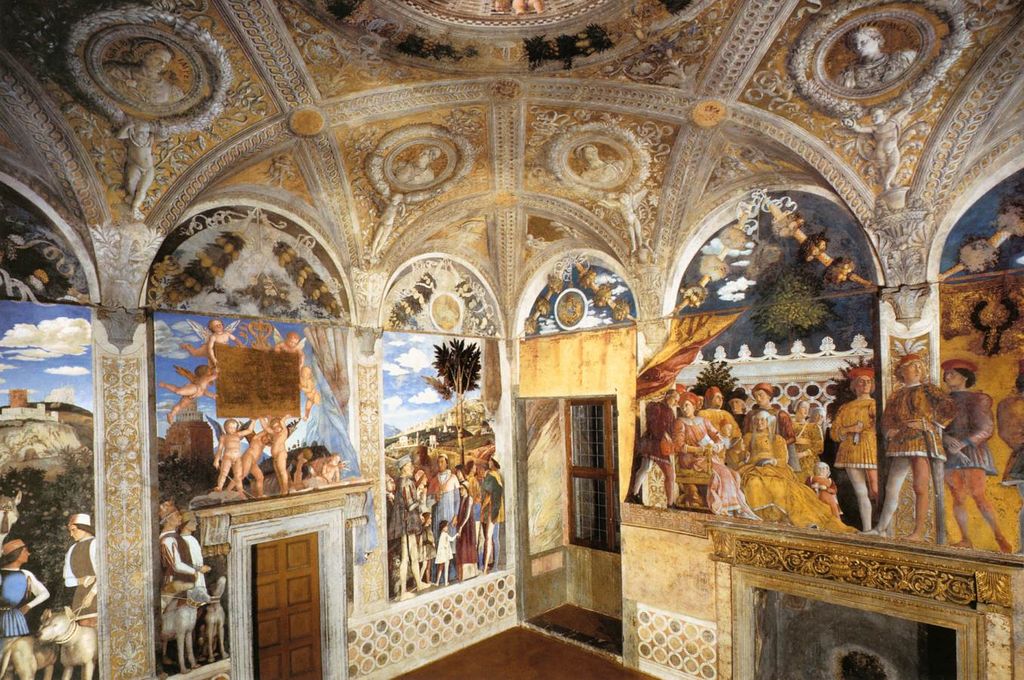
| Camera degli Sposi (Camera Picta) | 1465–74 | Painting · Palazzo Ducale, Mantua Catalogue. |
| Saint Sebastian (Louvre) | Around 1480 | Painting · Musée du Louvre · RF 1766 Catalogue. |
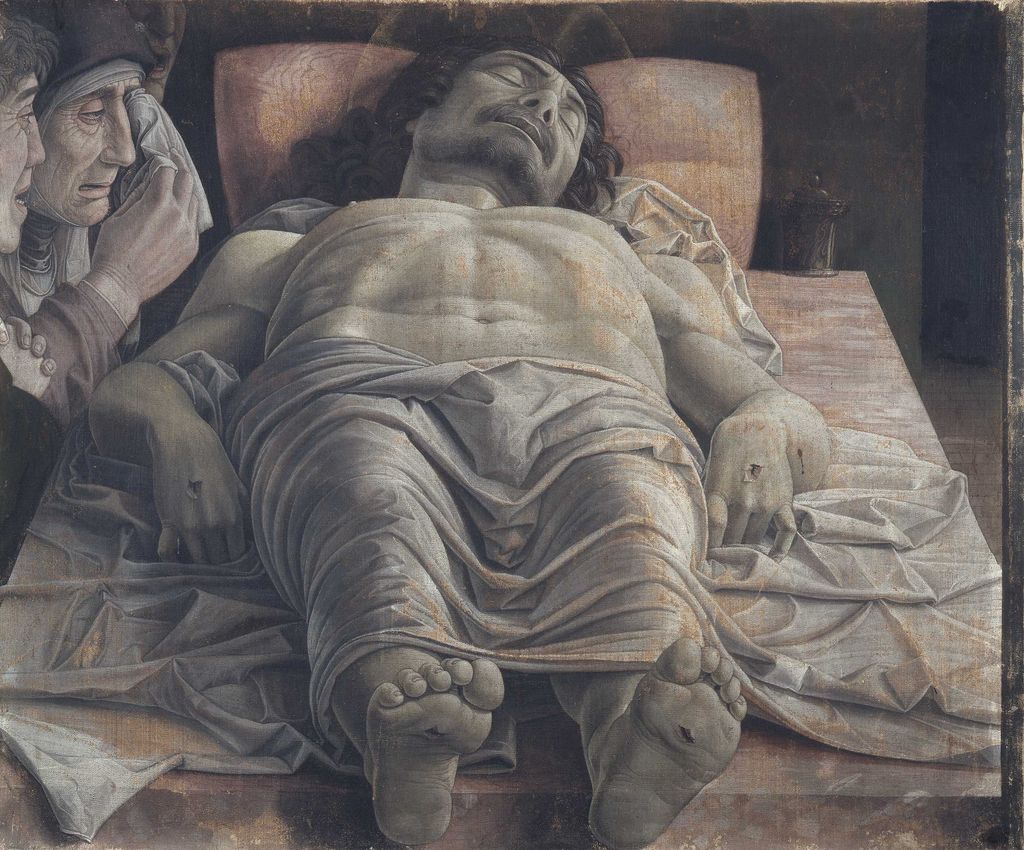
| Lamentation over the Dead Christ | C. 1483 (Brera dating) | Painting · Pinacoteca di Brera · 352 Catalogue. |
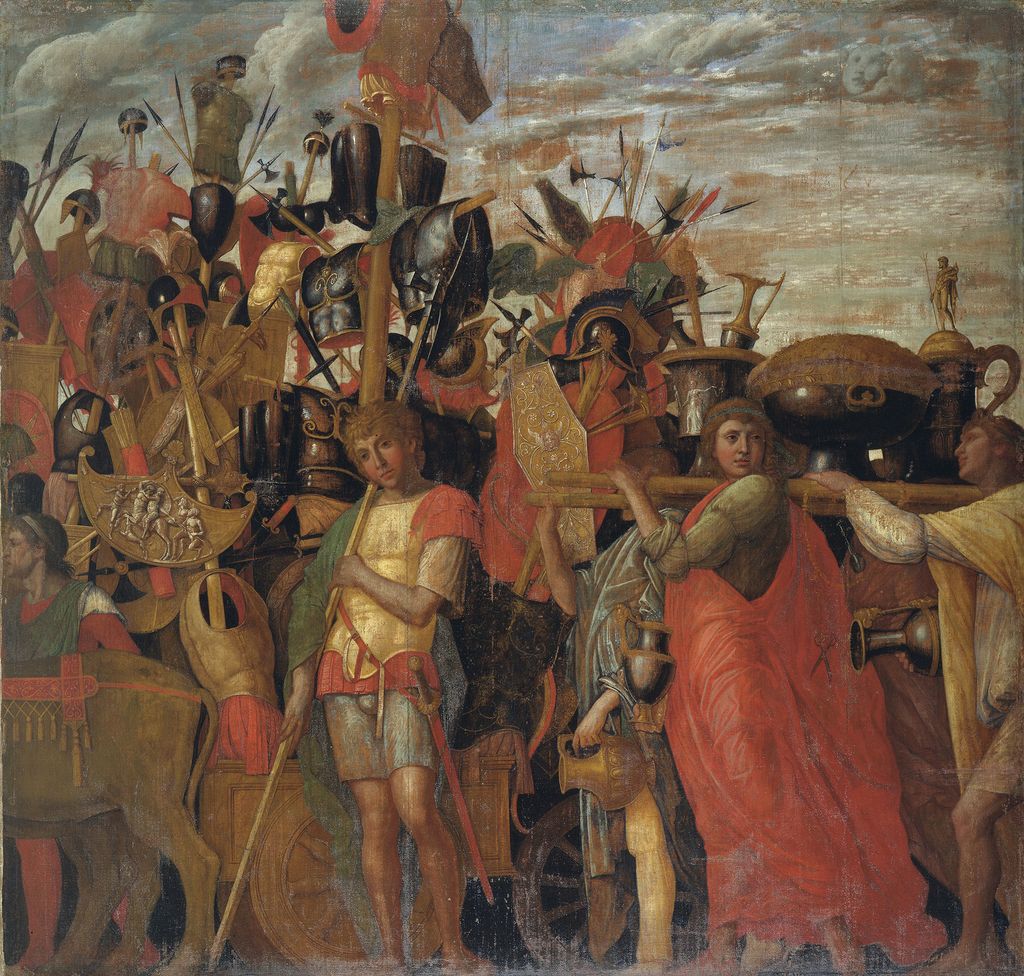
| The Triumphs of Caesar | About 1485–1506 | Painting · Royal Collection · RCIN 403958–403966 Catalogue. |
| Madonna of the Caves | C. 1488–90 | Painting · Uffizi Galleries · 1890 no. 1348 Catalogue. |
| Madonna and Child with a Choir of Cherubim | C. 1485 | Painting · Pinacoteca di Brera · 297 Catalogue. |
| Madonna and Child (Poldi Pezzoli) | Early 1490s (museum dating) | Painting · Museo Poldi Pezzoli · 1595 Catalogue. |
| The Holy Family with Saint Mary Magdalen | C. 1495–1500 | Painting · Metropolitan Museum of Art · 14.40.643 Catalogue. |
| The Virgin and Child with Saint Mary Magdalene and Saint John the Baptist | C. 1490–1505 | Painting · National Gallery, London · NG274 Catalogue. |
| Christ as the Suffering Redeemer | 1485–95 (SMK dating) | Painting · Statens Museum for Kunst · KMSsp69 Catalogue. |
| Ecce Homo | C. 1500 | Painting · Musée Jacquemart-André · MJAP-P 1840 Catalogue. |
| Judith with the Head of Holofernes (Mantegna or follower) | C. 1495–1500 | Painting · National Gallery of Art, Washington · 1942.9.42 Catalogue. |
| Madonna della Vittoria | 1495–96 | Painting · Musée du Louvre · INV 369 Catalogue. |
| Mars and Venus (Parnassus) | C. 1496–97 | Painting · Musée du Louvre · INV 370 Catalogue. |
| The Trivulzio Madonna | 1497 | Painting · Castello Sforzesco, Milan · 0554 Catalogue. |
| The Adoration of the Magi | C. 1495–1505 | Painting · J. Paul Getty Museum · 85.PA.417 Catalogue. |
| Minerva Expelling the Vices from the Garden of Virtue | C. 1502 | Painting · Musée du Louvre · INV 371 Catalogue. |
| The Introduction of the Cult of Cybele at Rome | 1505–06 | Painting · National Gallery, London · NG902 Catalogue. |
| Saint Sebastian (Venice) | Probably c. 1504–06 | Painting · Galleria Giorgio Franchetti alla Ca’ d’Oro · D.11 Catalogue. |
| Samson and Delilah | C. 1500 | Painting · National Gallery, London · NG1145 Catalogue only. |
| A Woman Drinking (probably Sophonisba) | C. 1495–1506 | Painting · National Gallery, London · NG1125.2 Catalogue only. |
| The Vestal Virgin Tuccia with a Sieve | C. 1495–1506 | Painting · National Gallery, London · NG1125.1 Catalogue only. |
| Judith with the Head of Holofernes (Dublin) | C. 1495–1500 | Painting · National Gallery of Ireland · NGI.442 Catalogue only. |
| Battle of the Sea Gods, left half (Met impression) | Before 1481 (Met dating) | Print · Metropolitan Museum of Art · 18.12 Catalogue only. |
| Battle of the Sea Gods, right half (Met impression) | Before 1481 (Met dating) | Print · Metropolitan Museum of Art · 1984.1201.4 Catalogue only. |
| Battle of the Sea Gods, left half (Tokyo impression) | C. 1475 (Tokyo dating) | Print · National Museum of Western Art, Tokyo · G.1981-0002 Catalogue only. |
| Battle of the Sea Gods, left half (Washington impression) | C. 1485–88 (NGA dating) | Print · National Gallery of Art, Washington · 1941.1.6 Catalogue only. |
| The Entombment of Christ, second state of two | Before 1475 (Met dating) | Print · Metropolitan Museum of Art · 37.42.30 Catalogue only. |
| The Entombment of Christ (possibly Zoan Andrea, after Mantegna) | 1460–1549 (Rijksmuseum dating) | Print · Rijksmuseum · RP-P-1924-60 Catalogue only. |
| Four Dancing Muses (Gian Marco Cavalli after Mantegna) | C. 1497 | Print · Metropolitan Museum of Art · 20.5.3 Catalogue only. |
| Bacchanal with Silenus | Before 1475 (Met dating) | Print · Metropolitan Museum of Art · 29.44.15 Catalogue only. |
| Bacchanal with a Wine Vat | Before 1475 (Met dating) | Print · Metropolitan Museum of Art Catalogue only. |
| St James on His Way to Execution | C. 1453–57 | Drawing · British Museum · 1976,0616.1 Catalogue only. |
| Three Studies for a Dead Christ | C. 1455–65 | Drawing · British Museum · 1909,0406.3 Catalogue only. |
| Pietà (Venice) | C. 1456–65 (exhibition datings) | Drawing · Gallerie dell’Accademia, Venice · 115 Catalogue only. |
| Studies for Christ at the Column | 1460–65 | Drawing · The Courtauld · D.1978.PG.345 Catalogue only. |
| Virtus Combusta | C. 1490 (technical study) | Drawing · British Museum · Pp,1.23 Catalogue only. |
| Virtus Combusta (Giovanni Antonio da Brescia after Mantegna) | C. 1495–1506 | Print · Musée du Louvre · 3881 LR/ Recto Catalogue only. |
| The Calumny of Apelles | C. 1504–06 | Drawing · British Museum · 1860,0616.85 Catalogue only. |
Frequently Asked Questions
Yes. The National Gallery holds the independent London panel. The Tours version formed the left-hand scene in the lower row of the San Zeno Altarpiece.
The National Gallery’s NG726 is Bellini’s painting. The same museum holds Mantegna’s NG1417. Their related figure groups and different treatments of light make them worth comparing together.
Discussion
Look again at the images and ideas explored in Mantegna’s Agony in the Garden. These editorial prompts invite your observations.
Reader Insights
How do the winding road from Jerusalem and the foreshortened disciple’s feet make you experience different distances in Mantegna’s London panel?
What changes when the London Mantegna’s cross and other Passion instruments give way to a chalice in Tours and Bellini, and how does each painter direct your eye towards it?
Join the Conversation
Share a detail, comparison or question about Mantegna’s Agony in the Garden below.
References
- National Gallery, Andrea Mantegna, The Agony in the Garden (NG1417). View source.
- United States Conference of Catholic Bishops, Matthew, Chapter 26. View source.
- United States Conference of Catholic Bishops, Luke, Chapter 22. View source.
- Istituto Centrale per il Restauro, Monumento equestre al Gattamelata. View source.
- Musée des Beaux-Arts de Tours, La Prière au jardin des oliviers et La Résurrection. View source.
- Musée des Beaux-Arts de Tours, La Prière au jardin des Oliviers, dossier pédagogique. View source.
- Institut national d’histoire de l’art, Andrea Mantegna, La Prière au Jardin des Oliviers (1803.1.24). View source.
- Flavius Josephus, The Jewish War, Book V, Chapter 4. View source.
- Musée du Louvre, Andrea Mantegna, La Crucifixion (INV 368). View source.
- Musée du Louvre, Around the San Zeno triptych in Verona, Resurrection. View source.
- Basilica di San Zeno, La Basilica di San Zeno, guida alla visita. View source.
- National Gallery, Giovanni Bellini, The Agony in the Garden (NG726). View source.
- Conrad Rudolph, Oxford Art Journal, Wonders: Guide Culture and Narrative Detail in Western Images Related to Pilgrimage in the Holy Land. View source.
- National Portrait Gallery, Introduction to George Scharf’s Sketchbook 47. View source.
- National Gallery, Mantegna & Bellini, exhibition announcement. View source.
- Staatliche Museen zu Berlin, Mantegna and Bellini: Masters of the Renaissance. View source.
- Karolin Korthase, Staatliche Museen zu Berlin, Innige Rivalen, Museum 1/2019, pp. 6–9. View source.
- Basilica of San Zeno, Verona, San Zeno Altarpiece, View source.
- Palazzo Ducale, Mantua, Camera degli Sposi (Camera Picta), View source.
- Royal Collection, The Triumphs of Caesar, View source.
- Musée du Louvre, Madonna della Vittoria, View source.
- National Gallery, London, The Introduction of the Cult of Cybele at Rome, View source.
More MANTEGNA Paintings
San Zeno Altarpiece
The San Zeno Altarpiece in its frame, Basilica of San Zeno, Verona José Luiz. Image source. CC BY-SA 4.0. Resized from the cited image.