 by Tom Gurney
Tom Gurney BSc (Hons) is an art history expert with over 20 years experience
Published on June 19, 2020 / Updated on November 29, 2026
Email: tomgurney1@gmail.com / Phone: +44 7429 011000
Overview
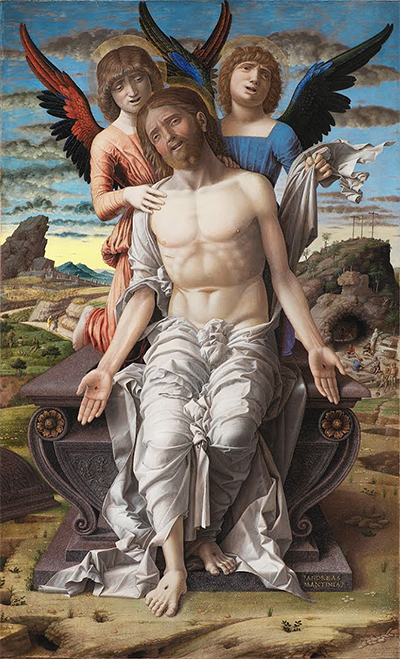
Christ sits on the edge of a stone coffin with his hands open and his feet unevenly planted, one on the base of the tomb and the other on the ground. Two angels draw back the white burial cloth. Against the pale chest and the brilliant wings, the punctures in the palms, the wound below the ribs and the marks on the feet take a moment to come into focus. Far behind him, three crosses stand empty against the light. [1]
Andrea Mantegna painted Christ as the Suffering Redeemer in tempera on wood. The panel measures 78 by 48 centimetres and belongs to the Statens Museum for Kunst (SMK) in Copenhagen, where it is catalogued as KMSsp69 and dated about 1485–95. [1]
At a Glance
- ArtistAndrea Mantegna
- DateAbout 1485–95 (SMK catalogue)
- MediumTempera on wood
- Dimensions78 × 48 cm
- Collection and inventoryStatens Museum for Kunst, Copenhagen, KMSsp69
Andrea Mantegna in context
San Zeno Altarpiece
1457–59 [13]The Triumphs of Caesar
Mid-1480s–before 1506 [15]Christ as the Suffering Redeemer
1485–95 (SMK dating) [1]Madonna della Vittoria
1495–96 [16]A date range and two titles
The main date in SMK’s catalogue is an estimate. The Danish record preserves a separate note giving about 1495–1500 and records that Ronald Lightbown proposed 1495–97. The National Gallery’s 2018–19 exhibition Mantegna and Bellini, which borrowed the panel from Copenhagen, dated it about 1485–1500 and called it The Dead Christ supported by Two Angels. The two titles put the emphasis in different places. The London title describes the kind of image and the angels’ action. SMK’s title gives that action a theological setting, and its catalogue interprets the figure as the resurrected Christ still bearing the signs of his death. [2] [3]
There is a firmer date in the painting’s later history. SMK records that Gerhard Morell bought it in Amsterdam on 18 May 1763 at the sale of Cardinal Silvio Valenti Gonzaga’s collection. The same record cites Ettore Camesasca’s observation that an object of identical subject appears in a 1627 inventory of the castle at Mantua. A shared subject leaves open the identity of the earlier picture, along with the Copenhagen panel’s original commission and setting. [2]
What the angels uncover
Start with the angel in red on the viewer’s left. The angel looks down, with fingers spread where the shroud slips off Christ’s shoulder. The angel in blue looks up and gathers a loose end of the cloth in one hand, lifting it against the sky. Both have parted lips. In his text for SMK, Henrik Holm reads them as singing in praise of the Resurrection as they uncover Christ. The nineteenth-century connoisseur Giovanni Battista Cavalcaselle, whose sketches and notes Fabio Franz studied, dwelt on the gesture of the sorrowing angels and the way they reveal the body for the viewer’s devotion. Grief and praise are both plausible responses to the faces Mantegna painted. The downward gaze of one angel and the lifted face of the other give each response a place in the picture. [2] [4]
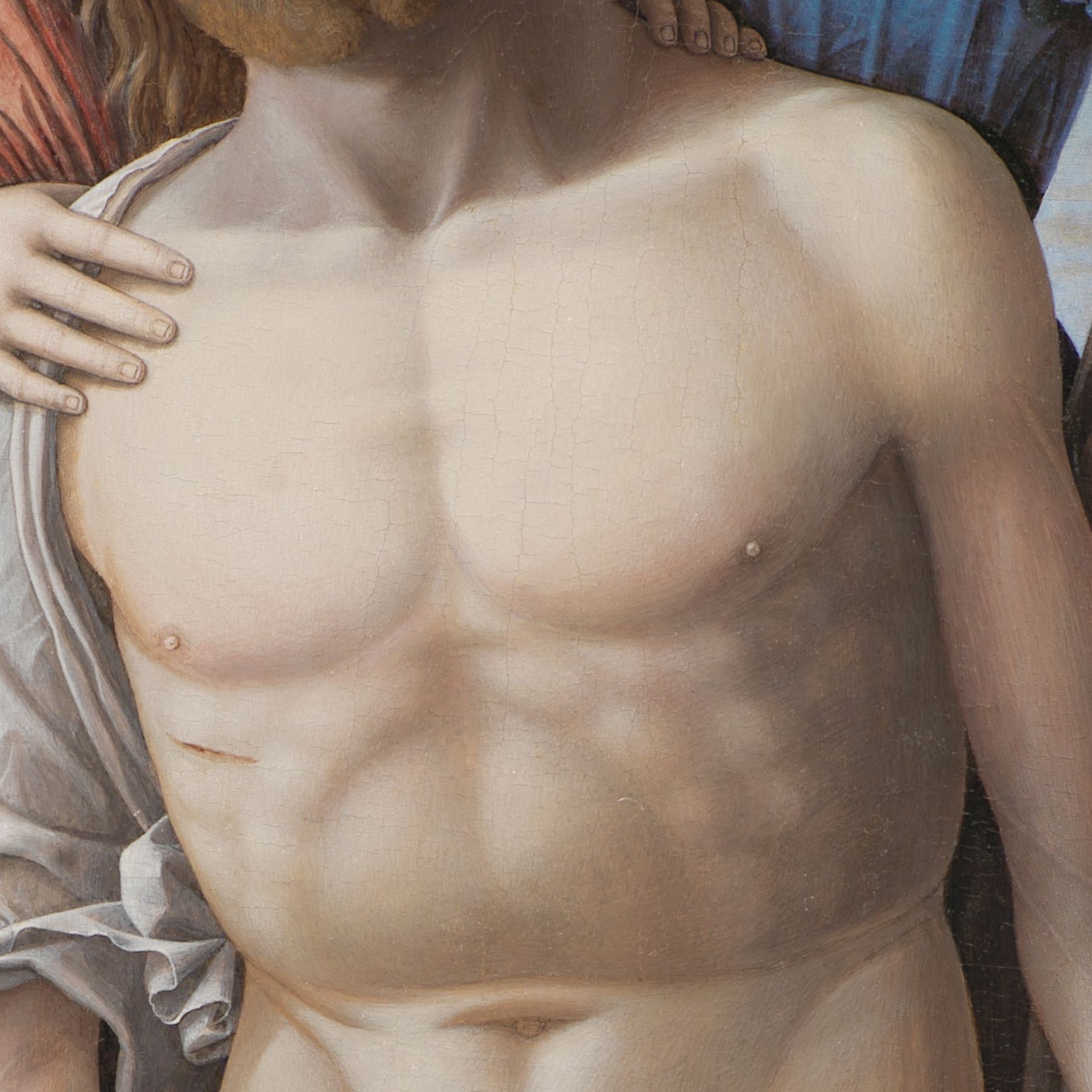
Christ’s arms slope down on either side of his waist. Above them, the outer wings rise toward the upper corners. An SMK exhibition text traces an X through those diagonals, crossing at Christ’s navel. The design gives the exposed torso a central, almost symmetrical place, while the body itself keeps slipping away from symmetry. The head inclines towards the red angel. One hand hangs a little lower than the other, and the feet rest at different heights. His open palms face outwards even as his gaze goes elsewhere. The arrangement makes the wounds available for inspection without the direct address of a face looking straight out of the panel. [1] [2]
A coffin painted like sculpture
The visible end of the sarcophagus fills much of the lower panel. At either side, a gold-coloured rosette sits inside the upper curl of a scroll, while a finer pattern occupies the recessed panels beneath. Look at how the dark rims make the scrolls project and the low pattern fall back. Mantegna uses the small differences in depth that let a viewer read a carved surface. At lower right, the gold letters of his signature, recorded by SMK as ANDREAS MANTINIA, sit on the face of the base, as if the painted coffin carried an inscription of its own. [1] [2]
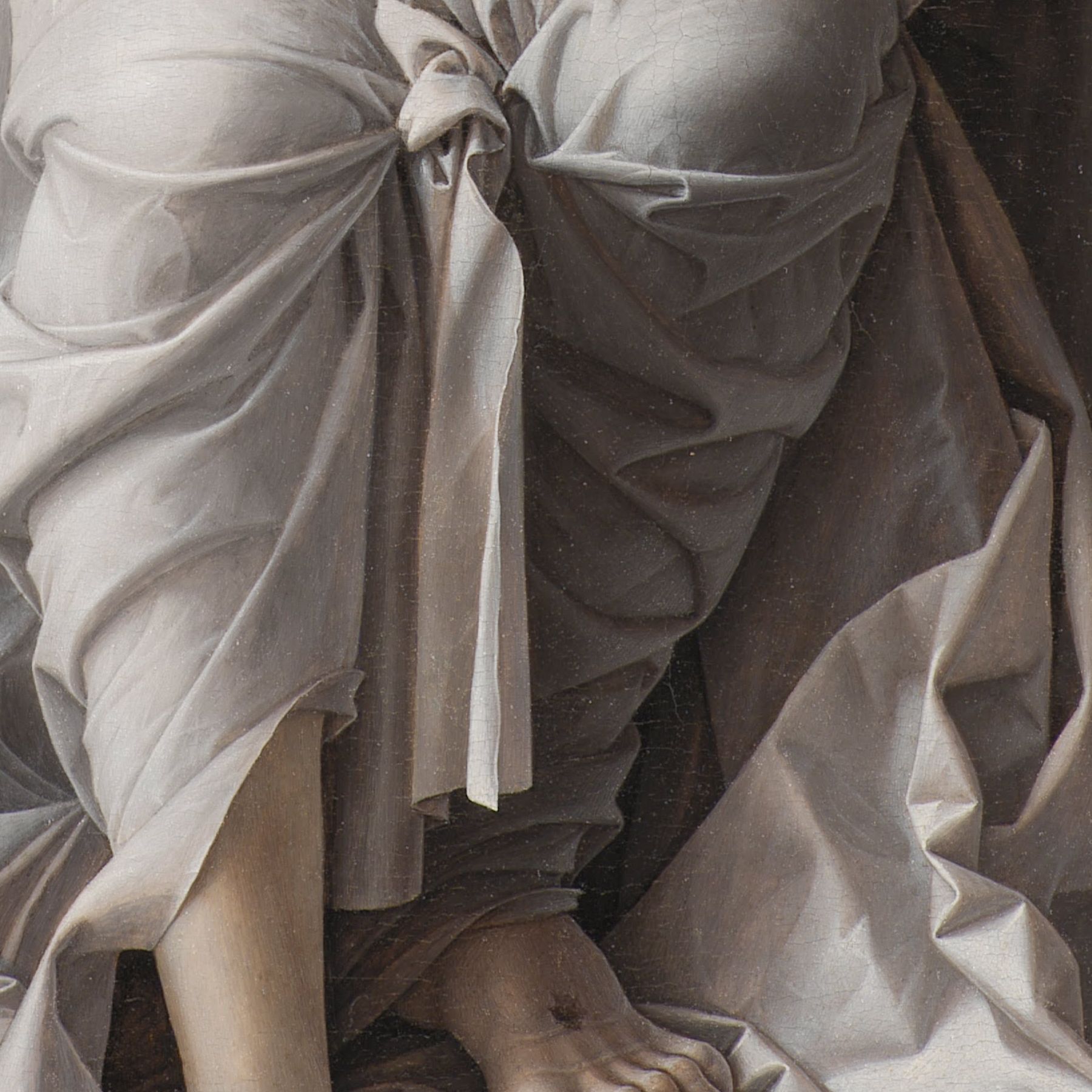
SMK describes the coffin as porphyry and likens the pale torso to marble statuary. The comparison begins with the way Christ sits above the base, like a figure on a plinth. Yet the painted surfaces respond differently. Fine speckles run through the dark stone, the shroud catches the light in sharp ridges, and the face has warmer colour than the chest. The cloth bunches at the waist and folds over the knees before falling to either side of the bare feet. Those folds register the shape and weight of the legs beneath them. Where the torso looks polished and still, the fabric records the body settling into its seat and the angels’ hands pulling the cloth away. Cavalcaselle studied the light and shade in the folds so closely that he compared Mantegna’s treatment of drapery to Leonardo’s, as Franz records. An SMK exhibition text finds a double sense of revival in the panel, linking Christ’s Resurrection to the renewal of antique forms in Renaissance Italy. On the coffin itself, these two ideas meet where the burial cloth falls over the carved stone. [1] [2] [4]
Easter morning beyond the tomb
The landscape is easiest to read in two passages. On the left, beyond the nearer pasture and its animals, a road leads past a rocky slope towards distant buildings. SMK identifies the women on that side as the holy women on their way to Christ’s tomb on Easter morning. On the right, the three empty crosses mark Golgotha. Below them are a dark opening, stretches of worked stone and tiny figures at work. The cliffs carry the eye from the crosses down to the quarry, while the yellow band on the horizon casts the scene in the first light of the day. Behind the foreground figure, people are already walking or working. Their small scale lets an ordinary morning unfold around a group whose gestures fill the foreground. [1] [2]
The workers have a close counterpart in Mantegna’s Madonna of the Quarries in the Uffizi, which the museum dates to about 1488–90. Daniela Parenti, writing for the Uffizi, reads the column and sarcophagus being cut in the background of that panel as anticipations of Christ’s flagellation and burial. The two landscapes give comparable details different work to do. In the Madonna, Christ is still a child and the stonework can point ahead to the Passion. In Copenhagen, quarrying continues in view of the empty crosses, and a completed sarcophagus supports the wounded adult Christ. Parenti places the Uffizi panel probably in Rome, where Mantegna went around 1488. The similar motifs help place the Copenhagen panel within his work of this period, and its place of execution remains uncertain. [1] [2] [5]
The landscape has also shaped accounts of Mantegna’s relationship with Giovanni Bellini, his brother-in-law. Cavalcaselle compared its detail to Van Eyck and found something of Bellini’s Agony in the Garden in its feeling for landscape, as Franz reports. Curator Caroline Campbell likewise singled out the Copenhagen panel in her account of the London exhibition as an example of Bellini’s continuing effect on Mantegna’s landscape painting. In this panel the suggestion is easiest to test at the horizon. The light travels behind both hills and across the cloud bands, joining the two sides of a landscape largely hidden by the figures. [4] [6]
The Resurrection from the San Zeno predella, Musée des Beaux-Arts de Tours Image source. Public domain.
The devotional image and its variations
The National Gallery describes the imago pietatis, or image of pity, as a devotional type in which Christ is shown upright or propped against his tomb, with the wounds exposed. Marco Zoppo’s The Dead Christ supported by Saints, painted about 1465, gives that convention a different emphasis. His Christ slumps, one hand resting limply on the stone, while Saint Jerome cradles his head. The smaller panel brings the viewer close to the upper body and the extinguished candles. In Copenhagen the vertical format leaves room for the length of the legs, the planted feet and both open palms. Zoppo’s decorated reverse leads the National Gallery to suggest that his panel was portable and probably used for private prayer. Mantegna’s composition likewise invites sustained contemplation, while the Copenhagen panel’s documented history leaves its first setting open. [1] [2] [7]
In Bellini’s The Blood of the Redeemer, about 1465, the risen Christ presses his side and an angel catches his blood in a chalice. The National Gallery connects this action to the Eucharist and interprets the reliefs on the low stone walls in relation to ancient sacrifice. The equivalent details in Copenhagen guide the eye differently. Mantegna’s relief-like ornament belongs to the very tomb on which Christ sits, and the viewer is left to find the small wound in his side among the marks on the rest of his body. Bellini gives the wound a recipient and an action. Mantegna gives the exposed body the span of the picture. [1] [8]
Bellini’s Christ Blessing, painted about 1500 and now at the Kimbell Art Museum, comes closer still to the individual viewer. Its half-length Christ meets the viewer’s gaze and lifts a wounded hand in blessing. The Kimbell points to the shadow of the raised arm as a sign of the risen figure’s physical presence. In Mantegna the feet give a comparable sense of physical presence. The lower foot extends past the base and presses into the foreground, where its shadow makes the contact legible. The two works make quite different claims on the eye. Bellini draws it up to an answering gaze and a blessing. Mantegna lets it move down from Christ’s face to the open hands and the ground where his foot comes to rest. [1] [9]
Three other ways Mantegna shows Christ’s body
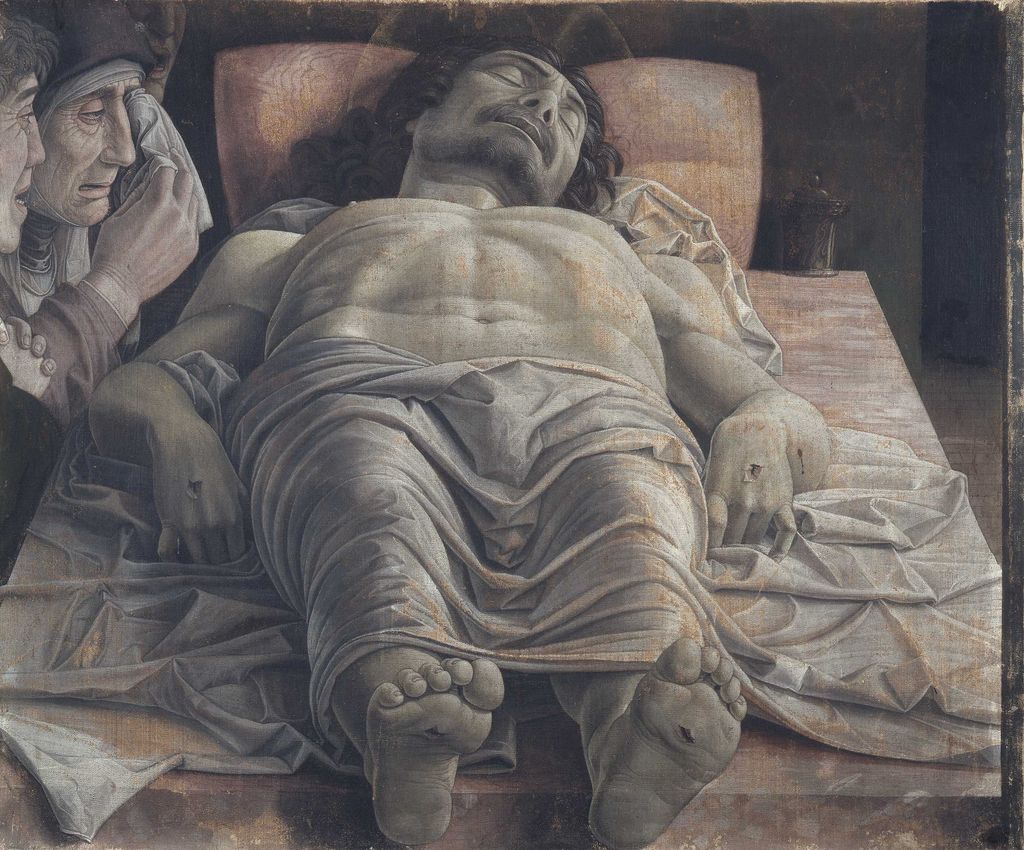
In the Brera’s Lamentation over the Dead Christ, dated about 1483 by the museum, Christ lies on the stone of unction, with his feet towards the viewer. The wounds in the feet come forward first, and the foreshortened body recedes towards the head and the mourners at the left. Copenhagen turns that encounter upright. Both compositions put the wounded feet within close reach of the eye, but the Milan picture takes the viewer along the length of a body prepared for burial. The Copenhagen panel brings the spread hands, chest and face into view above the tomb, where the angels can uncover and support him. [1] [10]
The Dead Christ and Three Mourners, Pinacoteca di Brera Image source. Public domain.
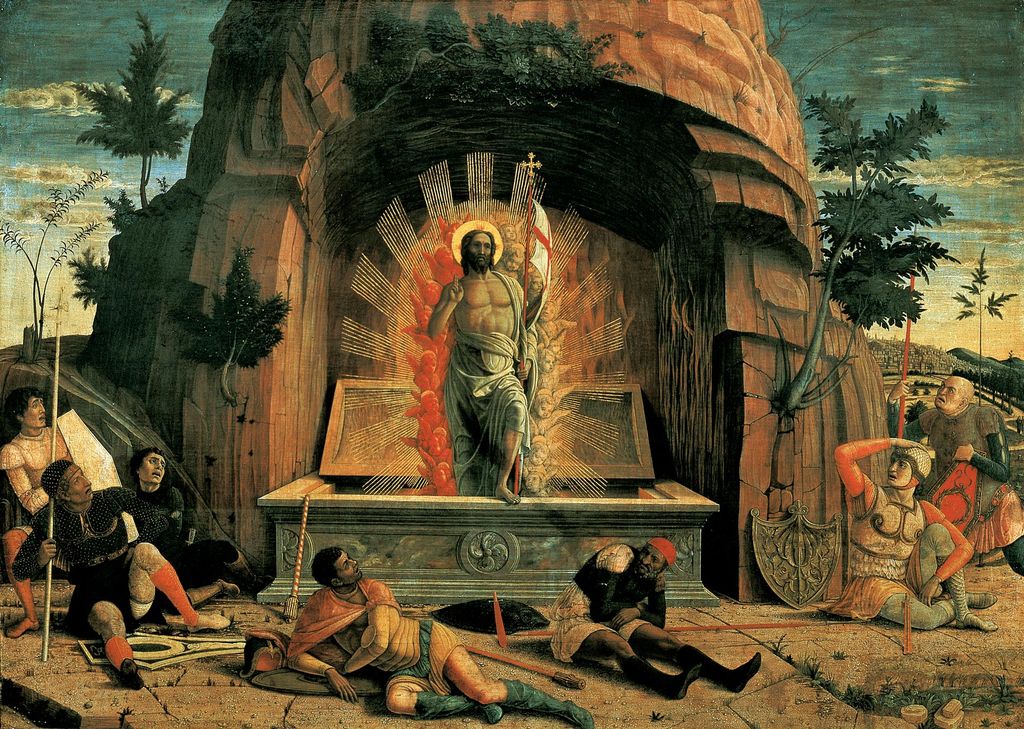
The Resurrection in Tours, painted in 1459 for the predella of the San Zeno Altarpiece, puts the event itself at the centre. Christ stands upright, carrying the cross-banner and raising a hand in blessing. Radiance surrounds him and the guards respond with alarm. He sets one foot on the rim of the tomb in a slight twist that the Tours museum relates to ancient statuary. Wounds still mark his hands, feet and side, while the banner and the guards’ reactions announce what has happened. In the Copenhagen painting the signs are dispersed across the panel. The crosses remain on the distant hill and the women are still on the road, while the open hands direct attention to what Christ carries on his body. [1] [11]
The Ecce Homo in the Musée Jacquemart-André takes the viewer back to the hours before the Crucifixion. The Paris museum describes a bare torso marked by scourging, bound wrists and a rope around the neck. The crop brings Christ and the people crowding him close to the surface, and the museum relates the thinly applied colour to the sculptural density of the figures. The wrists in Paris show a body being restrained. In Copenhagen, the hands hang free and turned outwards, while the figures behind Christ tend to the cloth. The difference is clearest where the marks of violence meet a gesture. The rope in Paris draws the eye to what is still being done to Christ. The two open palms in Copenhagen allow time to look at what has already been done. [1] [12]
Annotated Details from Christ as the Suffering Redeemer
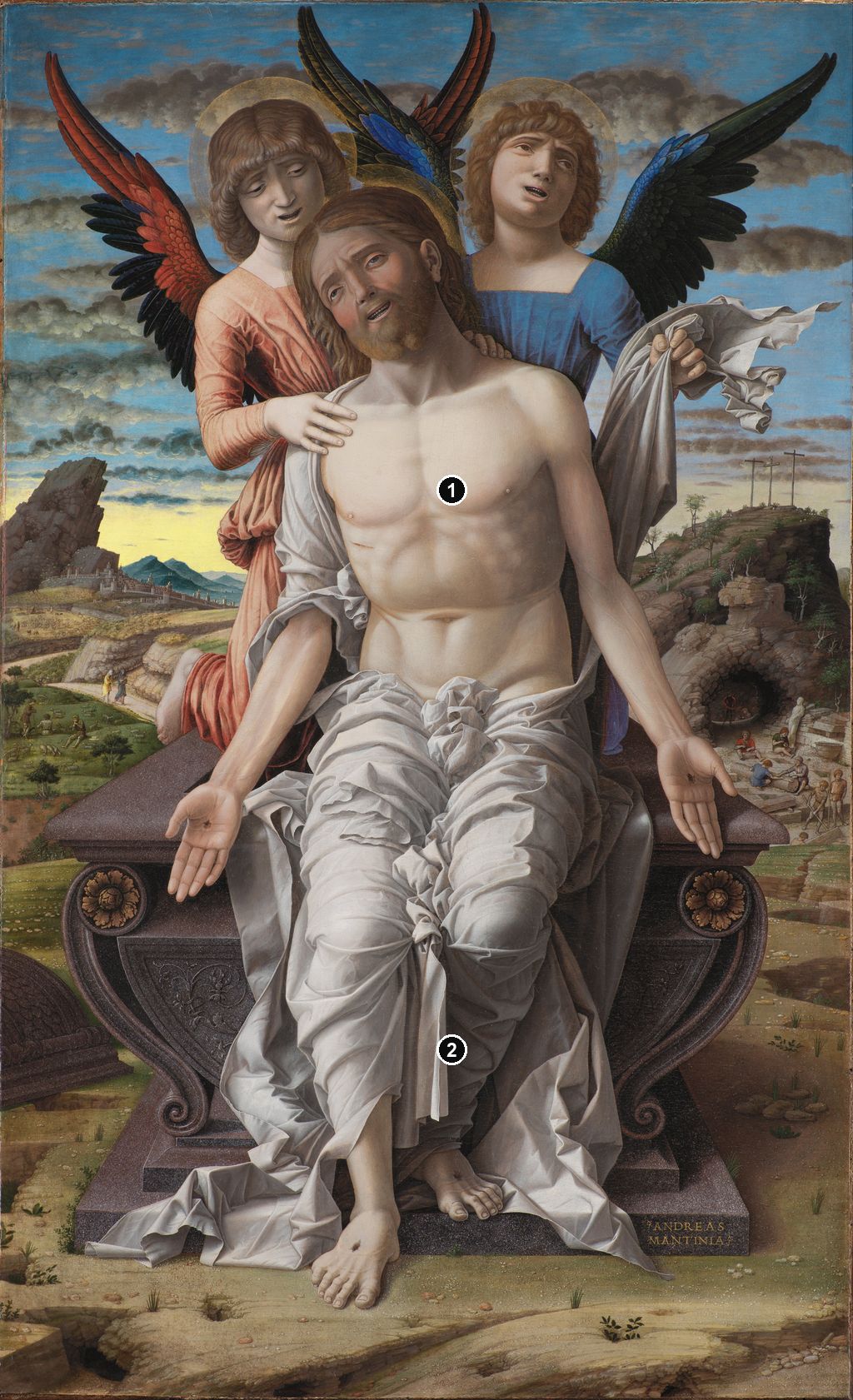
The numbered points identify details to look at closely. The detail images below preserve the native scale of the selected crops.
Christ as the Suffering Redeemer
Details from CHRIST AS THE SUFFERING REDEEMER
Choose a detail to enlarge it.
Christ as the Suffering Redeemer
Christ between the angels
The central body is held upright between the angels. Their overlapping arms are easiest to follow against the darker passage behind him.
Sarcophagus and folds
The figure’s lower drapery meets the decorated stone. Compare the deep folds above it with the shallow modelling of the ornament.
Artworks directory
| Name | Date | Medium and collection |
|---|---|---|
| The Adoration of the Shepherds | Shortly after 1450 | Painting · Metropolitan Museum of Art · 32.130.2 Catalogue. |
| Saint Mark the Evangelist | C. 1448–51 | Painting · Städel Museum · 1046 Catalogue. |
| Saint Jerome Penitent in the Desert | C. 1448–51 | Painting · Museu de Arte de São Paulo · MASP.00015 Catalogue. |
| Martyrdom and Transport of the Body of Saint Christopher | Mid-1450s | Painting · Ovetari Chapel, Padua Catalogue. |
| San Luca Altarpiece | 1453–55 | Painting · Pinacoteca di Brera · 176 Catalogue. |
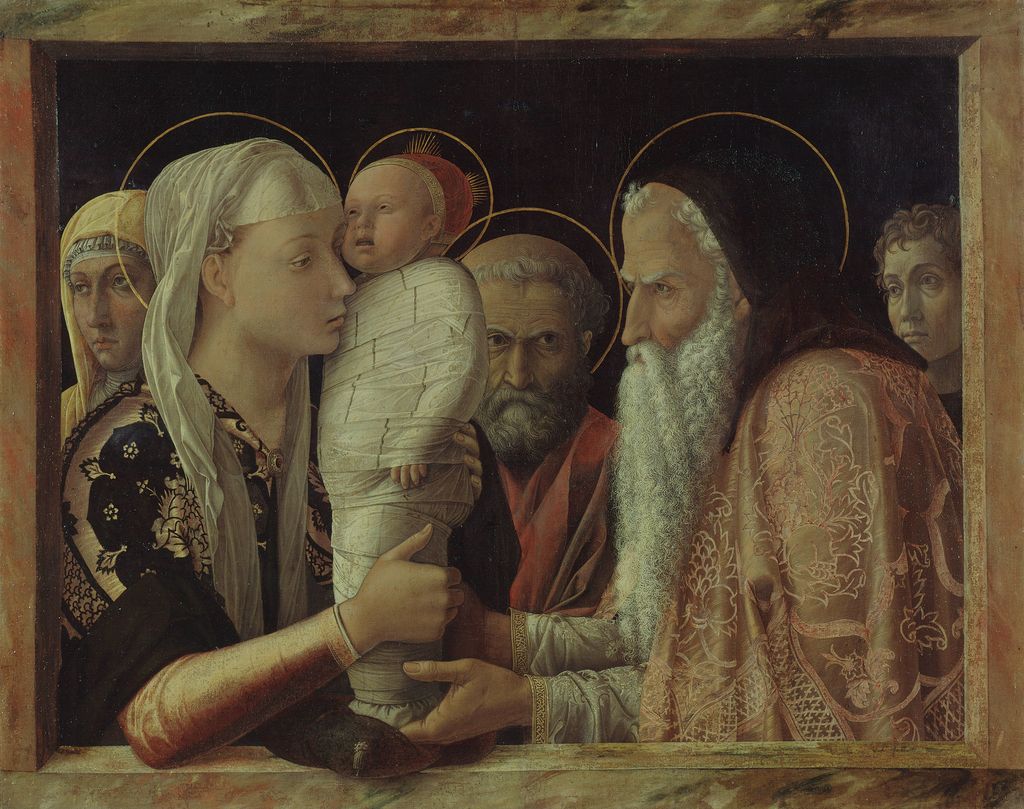
| The Presentation of Christ at the Temple | 1454 (Berlin dating) | Painting · Gemäldegalerie, Berlin · 29 Catalogue. |
| San Zeno Altarpiece | 1457–59 | Painting · Basilica of San Zeno, Verona Catalogue. |
| The Crucifixion | 1456–59 | Painting · Musée du Louvre · INV 368 Catalogue. |
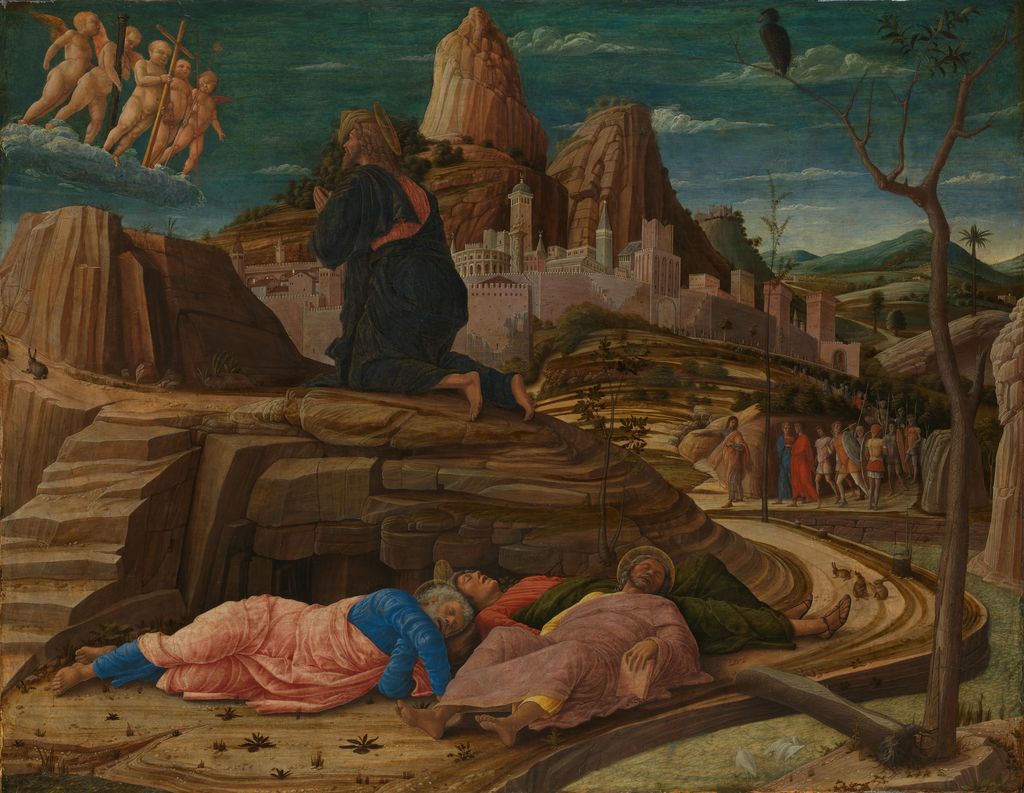
| The Agony in the Garden (London) | C. 1455–56 | Painting · National Gallery, London · NG1417 Catalogue. |
| The Agony in the Garden (Tours) | 1459 (Tours dating) | Painting · Musée des Beaux-Arts de Tours · 1803-1-24 Catalogue. |
| The Resurrection | 1459 (Tours dating) | Painting · Musée des Beaux-Arts de Tours · 1803-1-25 Catalogue. |
| Saint Sebastian (Vienna) | C. 1457–59 | Painting · Kunsthistorisches Museum · GG 301 Catalogue. |
| Cardinal Ludovico Trevisan | C. 1459–60 (Berlin exhibition dating) | Painting · Gemäldegalerie, Berlin · 9 Catalogue. |
| The Death of the Virgin | C. 1462 | Painting · Museo Nacional del Prado · P000248 Catalogue. |
| Christ with the Soul of the Virgin | C. 1460–64 | Painting · Pinacoteca Nazionale, Ferrara Catalogue only. |
| Portrait of a Young Man (traditionally Francesco Gonzaga) | C. 1461 or 1470, depending on sitter | Painting · Museo di Capodimonte · Q 60 Catalogue. |
| Portrait of a Prelate (Carlo de’ Medici?) | C. 1465–70 | Painting · Uffizi Galleries · 1890 no. 8540 Catalogue. |
| Portrait of a Man | C. 1470 | Painting · National Gallery of Art, Washington · 1952.2.5 Catalogue. |
| Madonna with Sleeping Child (Berlin) | C. 1455–60 | Painting · Gemäldegalerie, Berlin · S.5 Catalogue. |
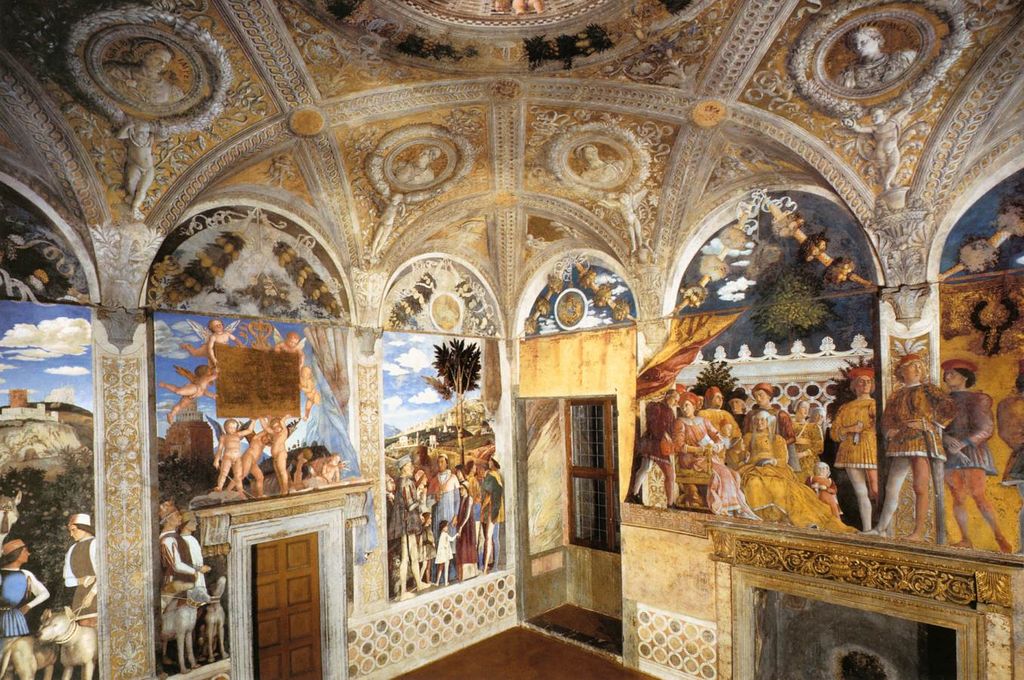
| Camera degli Sposi (Camera Picta) | 1465–74 | Painting · Palazzo Ducale, Mantua Catalogue. |
| Saint Sebastian (Louvre) | Around 1480 | Painting · Musée du Louvre · RF 1766 Catalogue. |
| Lamentation over the Dead Christ | C. 1483 (Brera dating) | Painting · Pinacoteca di Brera · 352 Catalogue. |
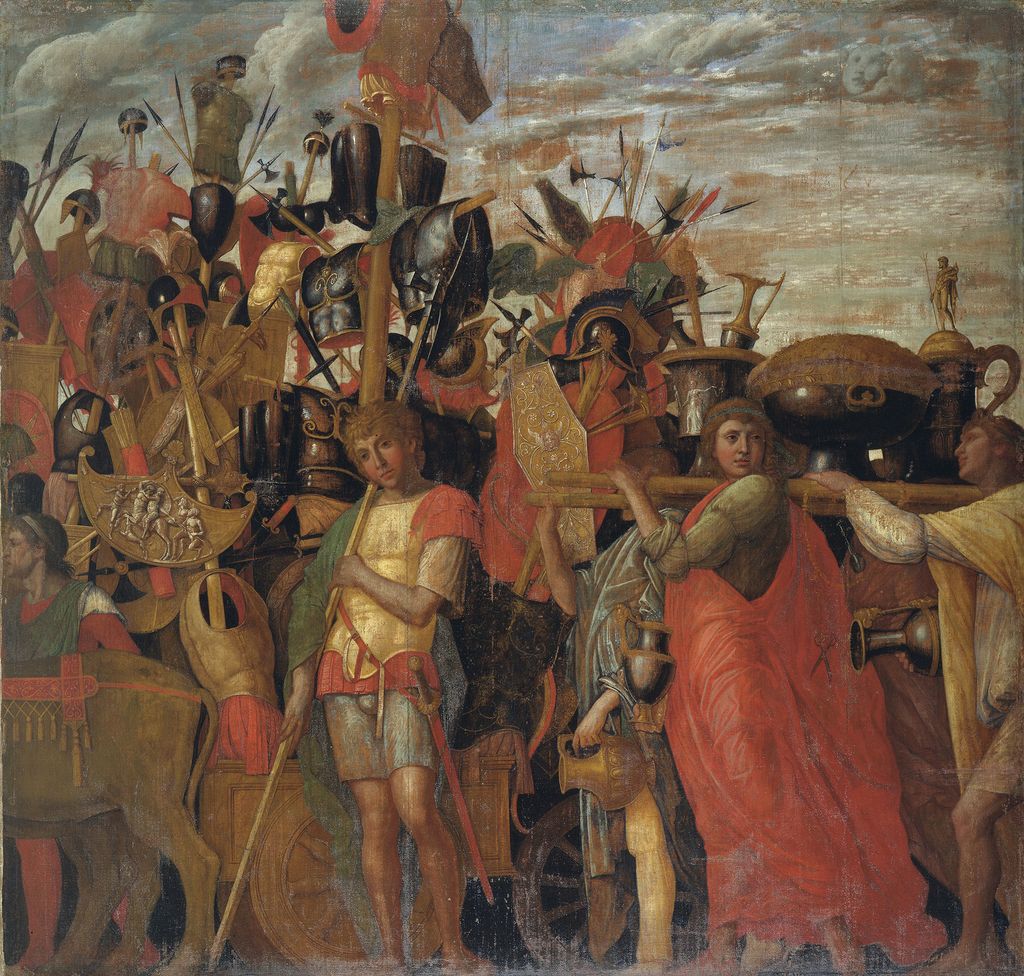
| The Triumphs of Caesar | About 1485–1506 | Painting · Royal Collection · RCIN 403958–403966 Catalogue. |
| Madonna of the Caves | C. 1488–90 | Painting · Uffizi Galleries · 1890 no. 1348 Catalogue. |
| Madonna and Child with a Choir of Cherubim | C. 1485 | Painting · Pinacoteca di Brera · 297 Catalogue. |
| Madonna and Child (Poldi Pezzoli) | Early 1490s (museum dating) | Painting · Museo Poldi Pezzoli · 1595 Catalogue. |
| The Holy Family with Saint Mary Magdalen | C. 1495–1500 | Painting · Metropolitan Museum of Art · 14.40.643 Catalogue. |
| The Virgin and Child with Saint Mary Magdalene and Saint John the Baptist | C. 1490–1505 | Painting · National Gallery, London · NG274 Catalogue. |
| Christ as the Suffering Redeemer | 1485–95 (SMK dating) | Painting · Statens Museum for Kunst · KMSsp69 Catalogue. |
| Ecce Homo | C. 1500 | Painting · Musée Jacquemart-André · MJAP-P 1840 Catalogue. |
| Judith with the Head of Holofernes (Mantegna or follower) | C. 1495–1500 | Painting · National Gallery of Art, Washington · 1942.9.42 Catalogue. |
| Madonna della Vittoria | 1495–96 | Painting · Musée du Louvre · INV 369 Catalogue. |
| Mars and Venus (Parnassus) | C. 1496–97 | Painting · Musée du Louvre · INV 370 Catalogue. |
| The Trivulzio Madonna | 1497 | Painting · Castello Sforzesco, Milan · 0554 Catalogue. |
| The Adoration of the Magi | C. 1495–1505 | Painting · J. Paul Getty Museum · 85.PA.417 Catalogue. |
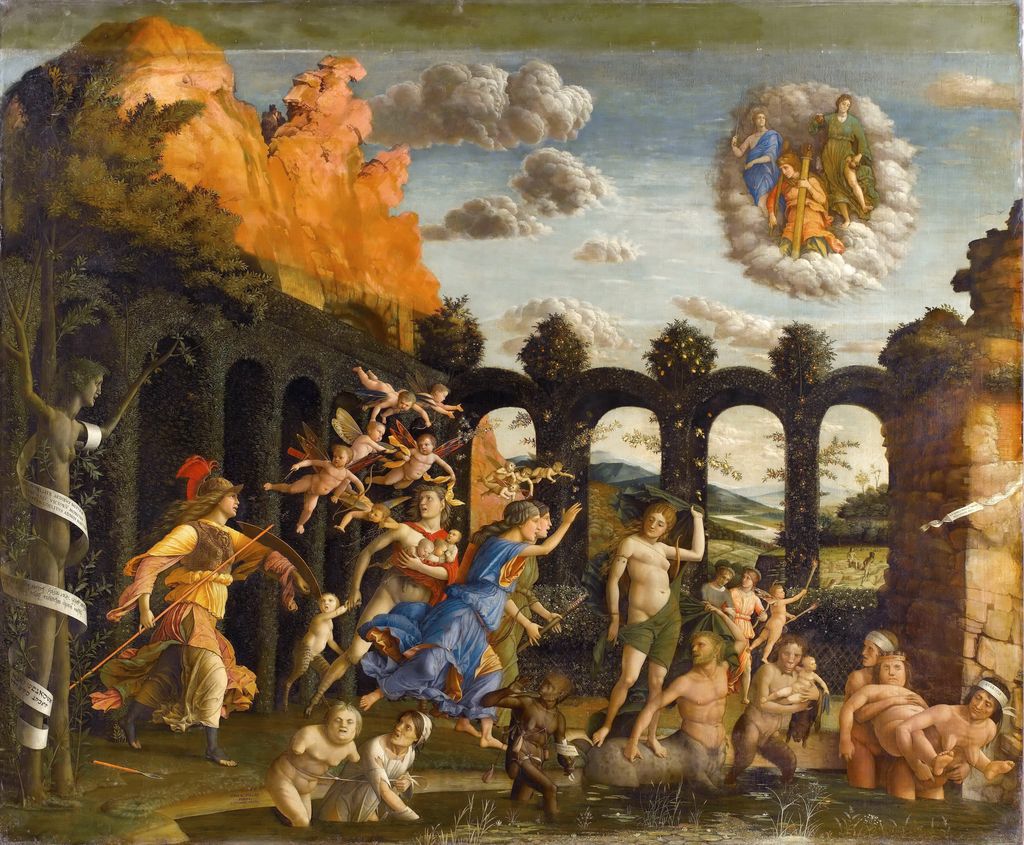
| Minerva Expelling the Vices from the Garden of Virtue | C. 1502 | Painting · Musée du Louvre · INV 371 Catalogue. |
| The Introduction of the Cult of Cybele at Rome | 1505–06 | Painting · National Gallery, London · NG902 Catalogue. |
| Saint Sebastian (Venice) | Probably c. 1504–06 | Painting · Galleria Giorgio Franchetti alla Ca’ d’Oro · D.11 Catalogue. |
| Samson and Delilah | C. 1500 | Painting · National Gallery, London · NG1145 Catalogue only. |
| A Woman Drinking (probably Sophonisba) | C. 1495–1506 | Painting · National Gallery, London · NG1125.2 Catalogue only. |
| The Vestal Virgin Tuccia with a Sieve | C. 1495–1506 | Painting · National Gallery, London · NG1125.1 Catalogue only. |
| Judith with the Head of Holofernes (Dublin) | C. 1495–1500 | Painting · National Gallery of Ireland · NGI.442 Catalogue only. |
| Battle of the Sea Gods, left half (Met impression) | Before 1481 (Met dating) | Print · Metropolitan Museum of Art · 18.12 Catalogue only. |
| Battle of the Sea Gods, right half (Met impression) | Before 1481 (Met dating) | Print · Metropolitan Museum of Art · 1984.1201.4 Catalogue only. |
| Battle of the Sea Gods, left half (Tokyo impression) | C. 1475 (Tokyo dating) | Print · National Museum of Western Art, Tokyo · G.1981-0002 Catalogue only. |
| Battle of the Sea Gods, left half (Washington impression) | C. 1485–88 (NGA dating) | Print · National Gallery of Art, Washington · 1941.1.6 Catalogue only. |
| The Entombment of Christ, second state of two | Before 1475 (Met dating) | Print · Metropolitan Museum of Art · 37.42.30 Catalogue only. |
| The Entombment of Christ (possibly Zoan Andrea, after Mantegna) | 1460–1549 (Rijksmuseum dating) | Print · Rijksmuseum · RP-P-1924-60 Catalogue only. |
| Four Dancing Muses (Gian Marco Cavalli after Mantegna) | C. 1497 | Print · Metropolitan Museum of Art · 20.5.3 Catalogue only. |
| Bacchanal with Silenus | Before 1475 (Met dating) | Print · Metropolitan Museum of Art · 29.44.15 Catalogue only. |
| Bacchanal with a Wine Vat | Before 1475 (Met dating) | Print · Metropolitan Museum of Art Catalogue only. |
| St James on His Way to Execution | C. 1453–57 | Drawing · British Museum · 1976,0616.1 Catalogue only. |
| Three Studies for a Dead Christ | C. 1455–65 | Drawing · British Museum · 1909,0406.3 Catalogue only. |
| Pietà (Venice) | C. 1456–65 (exhibition datings) | Drawing · Gallerie dell’Accademia, Venice · 115 Catalogue only. |
| Studies for Christ at the Column | 1460–65 | Drawing · The Courtauld · D.1978.PG.345 Catalogue only. |
| Virtus Combusta | C. 1490 (technical study) | Drawing · British Museum · Pp,1.23 Catalogue only. |
| Virtus Combusta (Giovanni Antonio da Brescia after Mantegna) | C. 1495–1506 | Print · Musée du Louvre · 3881 LR/ Recto Catalogue only. |
| The Calumny of Apelles | C. 1504–06 | Drawing · British Museum · 1860,0616.85 Catalogue only. |
Frequently Asked Questions
In Copenhagen Christ is shown upright above the tomb with his wounds exposed, supported by angels. In Milan his body lies along the stone, with the viewer placed near his feet.
The front is painted as relief. Its form makes the edge of the tomb read as a solid object at the front of the picture, below the bodies and wings.
Discussion
Look again at the images and ideas explored in Christ as the Suffering Redeemer. These editorial prompts invite your observations.
Reader Insights
How do the red angel’s downward gaze and the blue angel’s raised face change the way you read the act of uncovering Christ?
What changes when the same kinds of wounds are shown on the body lying foreshortened at Brera, standing at Tours and sitting upright in Copenhagen?
Join the Conversation
Share a detail, comparison or question about Christ as the Suffering Redeemer below.
References
- Statens Museum for Kunst, Christ as the Suffering Redeemer, KMSsp69. View source.
- Statens Museum for Kunst, Kristus som den lidende frelser, Danish catalogue and interpretive texts. View source.
- National Gallery, London, Mantegna and Bellini, exhibition highlights. View source.
- Edizioni Ca’ Foscari, Fabio Franz, Disvelando pale, effigi e panneggi. Le ricognizioni danesi di Crowe e Cavalcaselle. View source.
- Gallerie degli Uffizi, Madonna delle cave. View source.
- National Gallery, London, Caroline Campbell, Mantegna and Bellini, Review of the Year 2018–2019. View source.
- National Gallery, London, Marco Zoppo, The Dead Christ supported by Saints, NG590. View source.
- National Gallery, London, Giovanni Bellini, The Blood of the Redeemer, NG1233. View source.
- Kimbell Art Museum, Giovanni Bellini, Christ Blessing, AP 1967.07. View source.
- Pinacoteca di Brera, Lamentation over the Dead Christ. View source.
- Musée des Beaux-Arts de Tours, Andrea Mantegna, La Résurrection and the San Zeno predella. View source.
- Musée Jacquemart-André, Andrea Mantegna, Ecce Homo. View source.
- Basilica of San Zeno, Verona, San Zeno Altarpiece, View source.
- Palazzo Ducale, Mantua, Camera degli Sposi (Camera Picta), View source.
- Royal Collection, The Triumphs of Caesar, View source.
- Musée du Louvre, Madonna della Vittoria, View source.
- National Gallery, London, The Introduction of the Cult of Cybele at Rome, View source.
More MANTEGNA Paintings
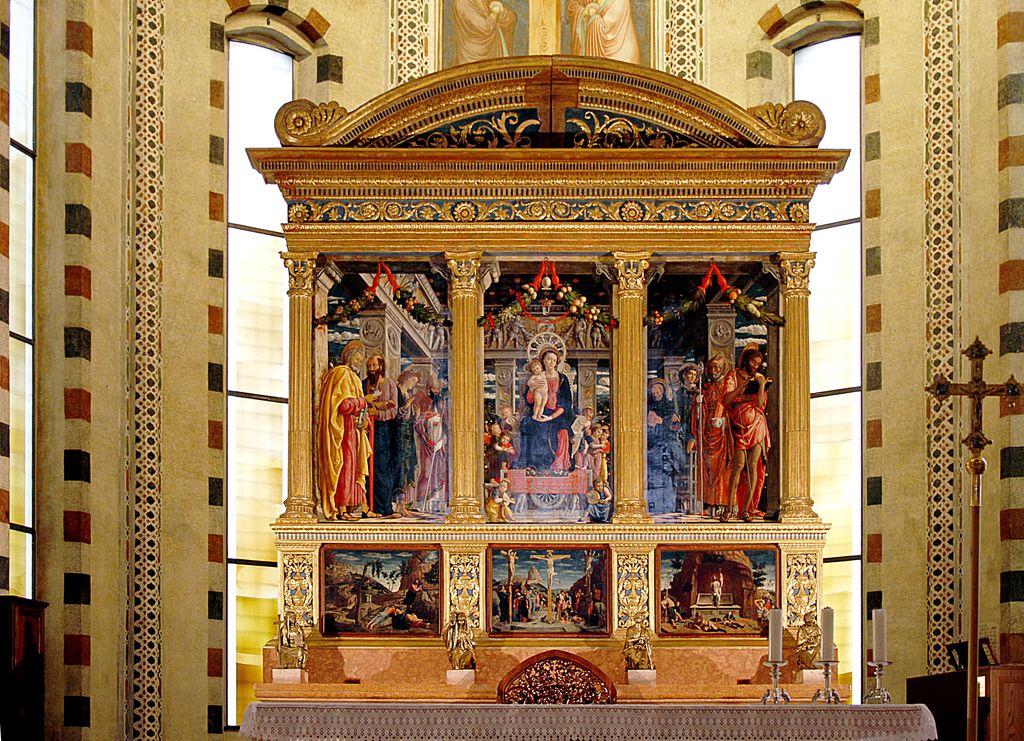
San Zeno Altarpiece
The San Zeno Altarpiece in its frame, Basilica of San Zeno, Verona José Luiz. Image source. CC BY-SA 4.0. Resized from the cited image.