 by Tom Gurney
Tom Gurney BSc (Hons) is an art history expert with over 20 years experience
Published on June 19, 2020 / Updated on November 29, 2026
Email: tomgurney1@gmail.com / Phone: +44 7429 011000
Overview
Caesar takes his time to arrive. Trumpeters enter first, with flags, torches and banners painted with battles. Carts follow with statues and weapons, then men carrying precious vessels and oxen dressed for sacrifice. Elephants bear lights and fruit. A barefoot man lowers a pole under the weight of captured armour. Prisoners are made to walk in the parade, and musicians take up the march before Caesar appears in his chariot. Andrea Mantegna gives the procession nine canvases, each approximately 2.7 metres high and 2.8 metres wide. Together they place us beside the route, close enough to catch a soldier turning his head and obliged, like any spectator, to wait for the victor. The paintings now belong to the Royal Collection (RCIN 403958–403966). The historic singular title, Triumph of Caesar, captures the way these nine scenes make up one continuous ceremony. [1] [2] [3] (pp. 23–28, figs. 0.1–0.9)
Mantegna worked on the paintings from about 1485 to 1506, with the project documented in 1486. He painted the series in tempera on canvas, and the National Gallery specifies egg tempera for the first six. The march follows a clear sequence. The order in which Mantegna painted its episodes remains uncertain. Six canvases appeared in a temporary theatre at the Mantuan Carnival of 1501. By 1512 a room in a Gonzaga palace bore their name. The paintings then crossed to England in the reign of Charles I and passed through several rooms at Hampton Court. Those settings changed the distance, light and intervals in which people saw the march. Treatment changed what they could see on the canvases themselves. In one scene the hills and figures still give an unusually clear impression of Mantegna’s handling of space. For another, a late sixteenth-century woodcut offers a clearer view of how he arranged the people. [1] [3] (pp. 23–28)
At a Glance
- ArtistAndrea Mantegna
- DateAbout 1485–1506
- MediumTempera on canvas
- DimensionsApproximately 2.7 × 2.8 m each (height × width)
- CollectionRoyal Collection, nine canvases, RCIN 403958–403966
Andrea Mantegna in context
San Zeno Altarpiece
1457–59 [49]The Triumphs of Caesar
About 1485–1506 [19]Madonna della Vittoria
1495–96 [51]I–III. Trumpets, triumphal carts and the wealth of conquest
The titles are catalogue descriptions, and their variants direct attention to different aspects of the parade. The Trumpeters names the sound that makes the procession conspicuous before its participants come close. The older title, The Picture-Bearers, points to the images it carries. The catalogue sequence begins here and ends with the chariot, so it is possible to follow the action even when the paintings are displayed apart. [3] (figs. 0.1–0.9) [4]
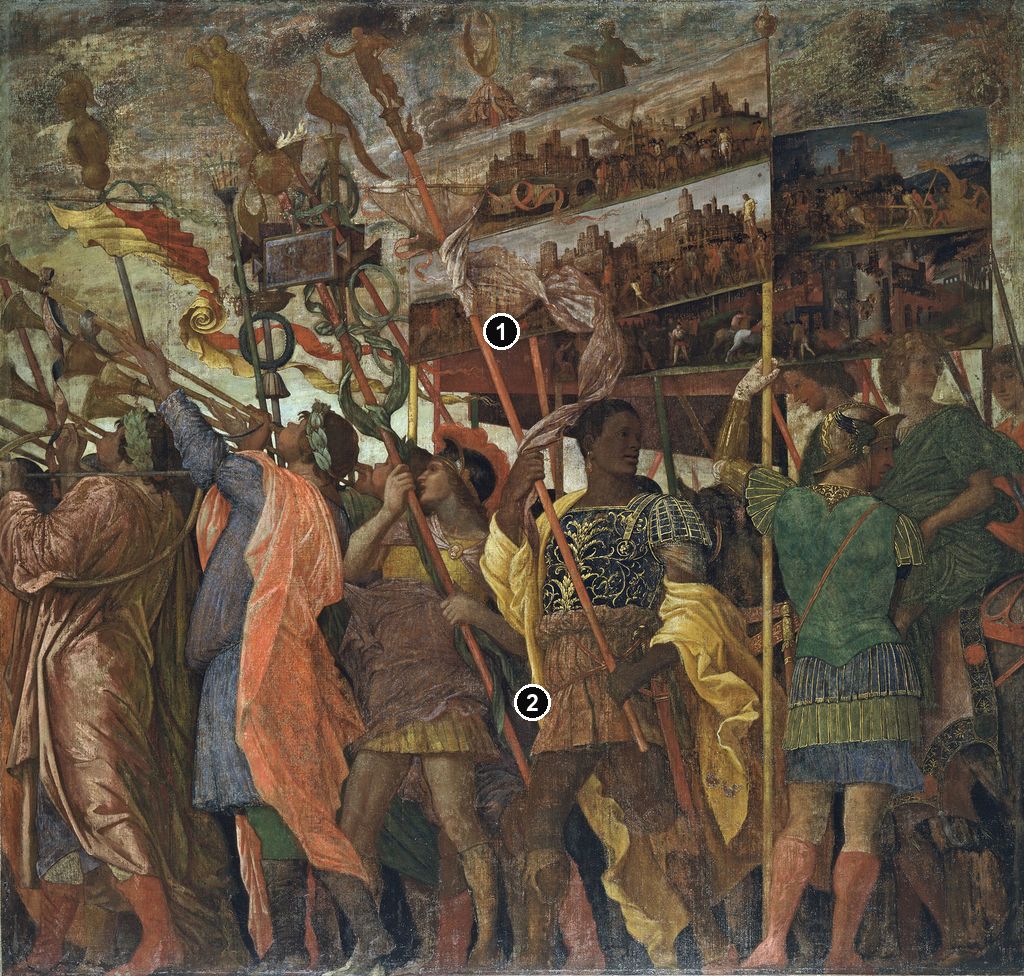
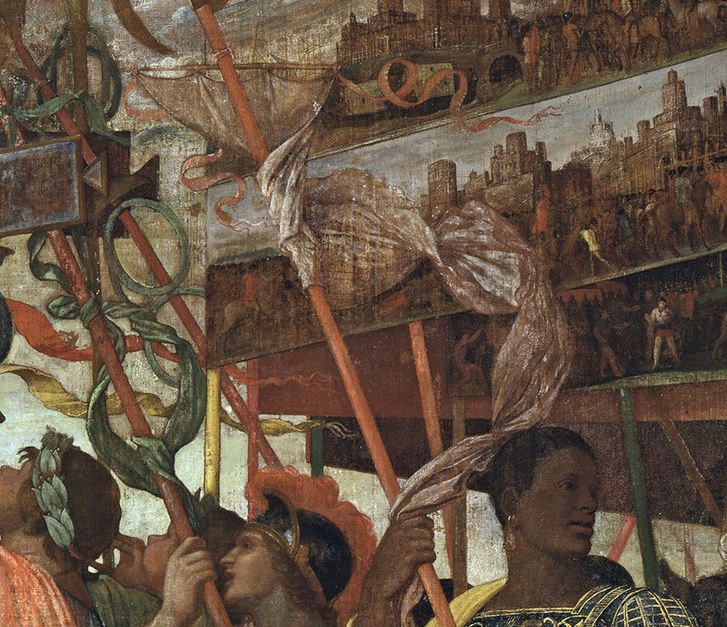
I. The Trumpeters. Trumpets, torches and flags enter with banners depicting battles. The fighting has been turned into pictures, raised above the marchers so that a crowd along the route can see what is being celebrated. The scene therefore gives us a procession and, within it, a series of smaller pictures that are themselves in motion. A young Black soldier in the foreground helps set the pace. His stride takes him forward while his head turns back, leading the eye towards the people advancing behind him. We can look in the direction he is going or follow his glance into the crowd. That turn gives a busy opening scene a point of orientation and makes it feel as though we have caught the march already under way. The National Gallery suggests that the soldier’s prominence may point to the geographical reach of Roman power. His individual identity remains uncertain. [5] [6] [7]
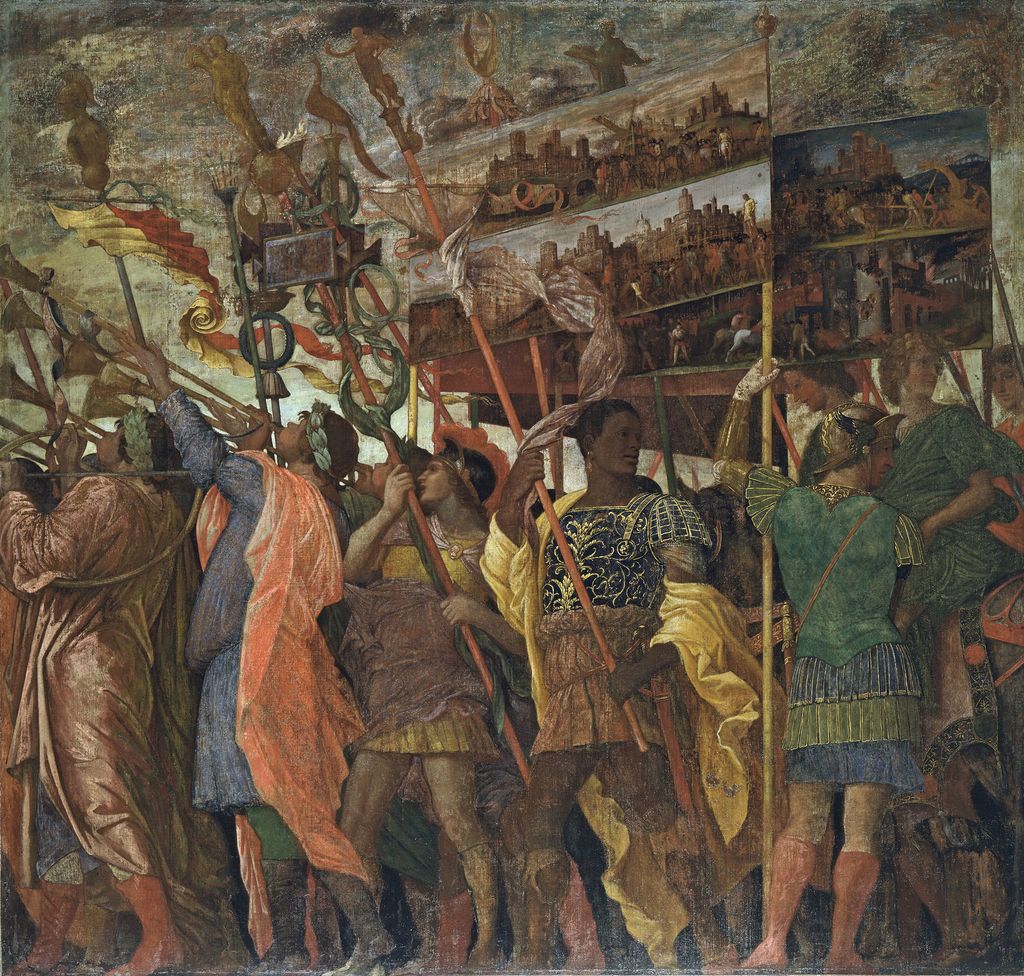
I. The Trumpeters, The Triumphs of Caesar. Royal Collection, RCIN 403958. Image source. Public domain.
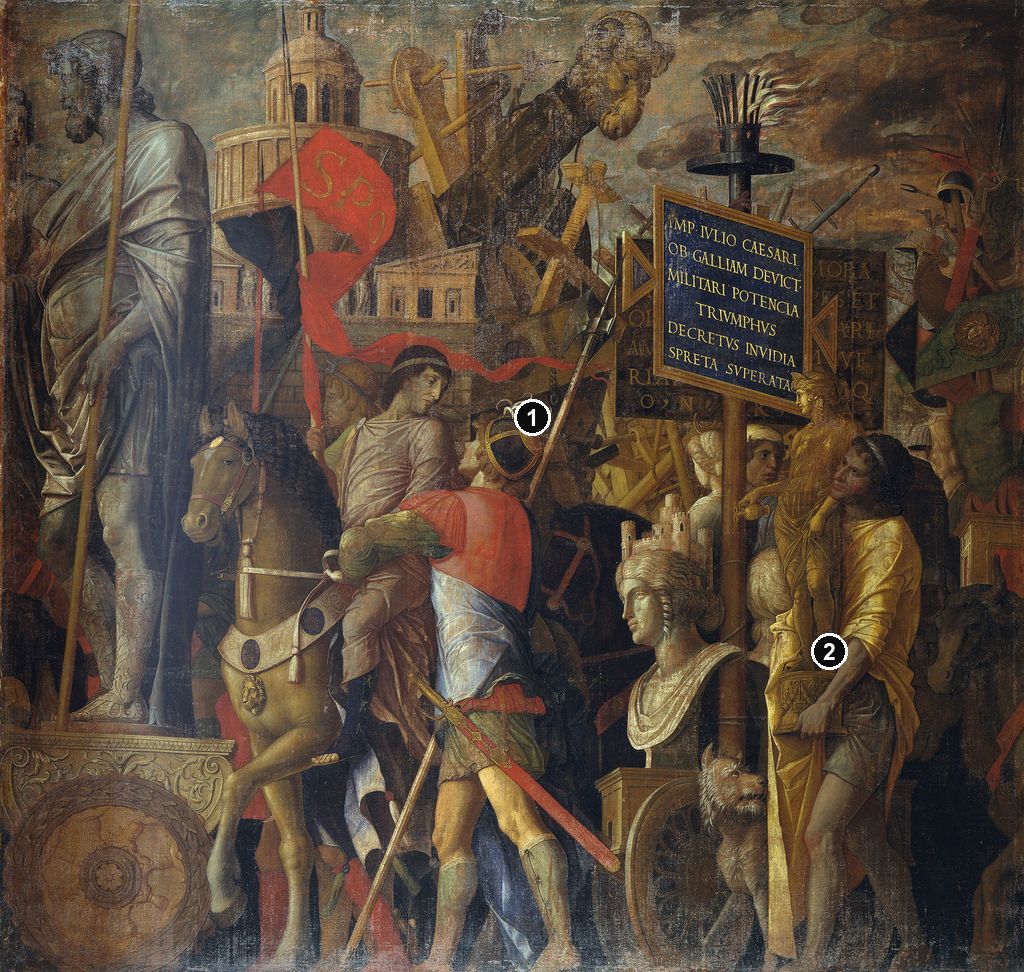
II. The Triumphal Carts. The next painting gives much of its space to objects too large for individuals to shoulder. Full-length statues travel on a cart. In front of a raised tablet is a bust that the National Gallery identifies as Cybele. The tablet praises victories in Gaul, giving the display a geographical anchor. [8] The older title, The Bearers of Standards and Siege Equipment, directs the eye towards a battering ram that ends in a carved ram’s head. [9] The sculpture and the siege engine present two sides of conquest. The ram shows the means by which a fortified place might be taken. The statues show what could be removed and put on public view afterwards. The carved head makes even a tool for breaking down defences something to look at. Where the first canvas carries painted scenes of combat, this one sets a written claim above the things that lend it weight.
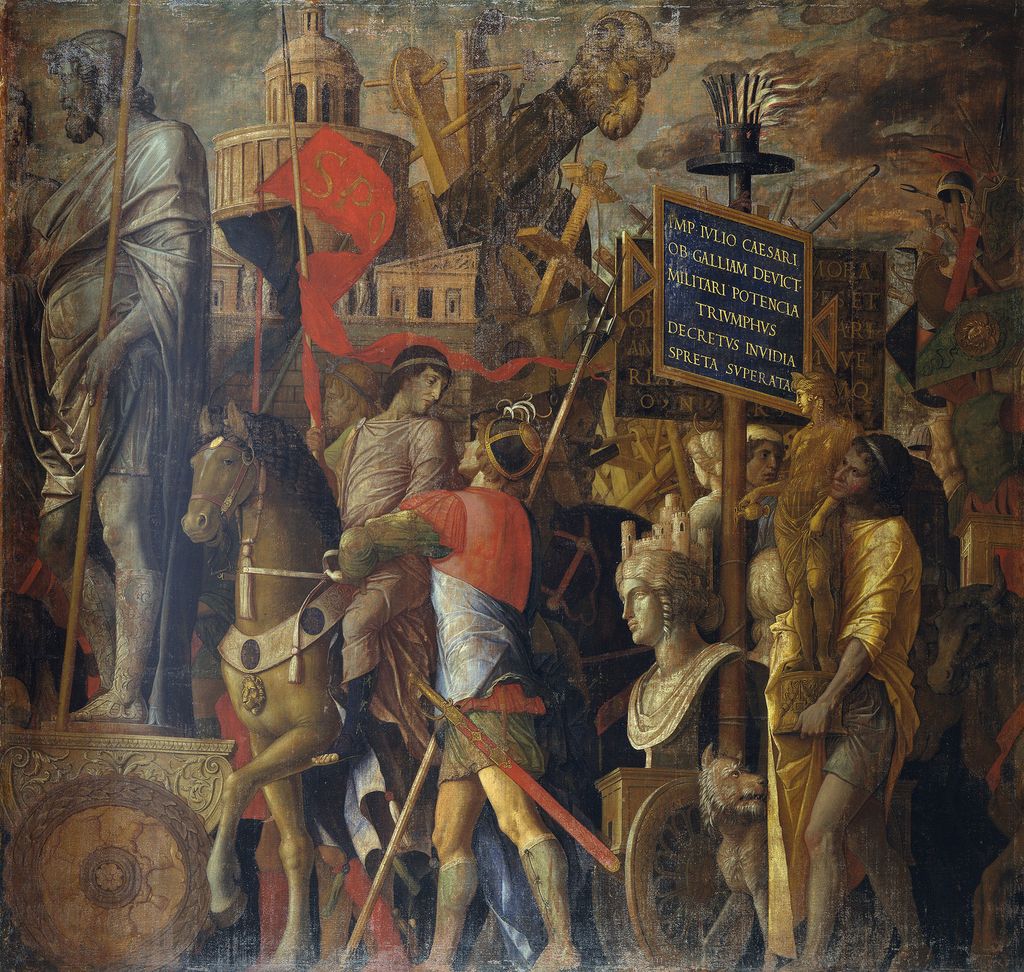
II. The Triumphal Carts, The Triumphs of Caesar. Royal Collection, RCIN 403959. Image source. Public domain.
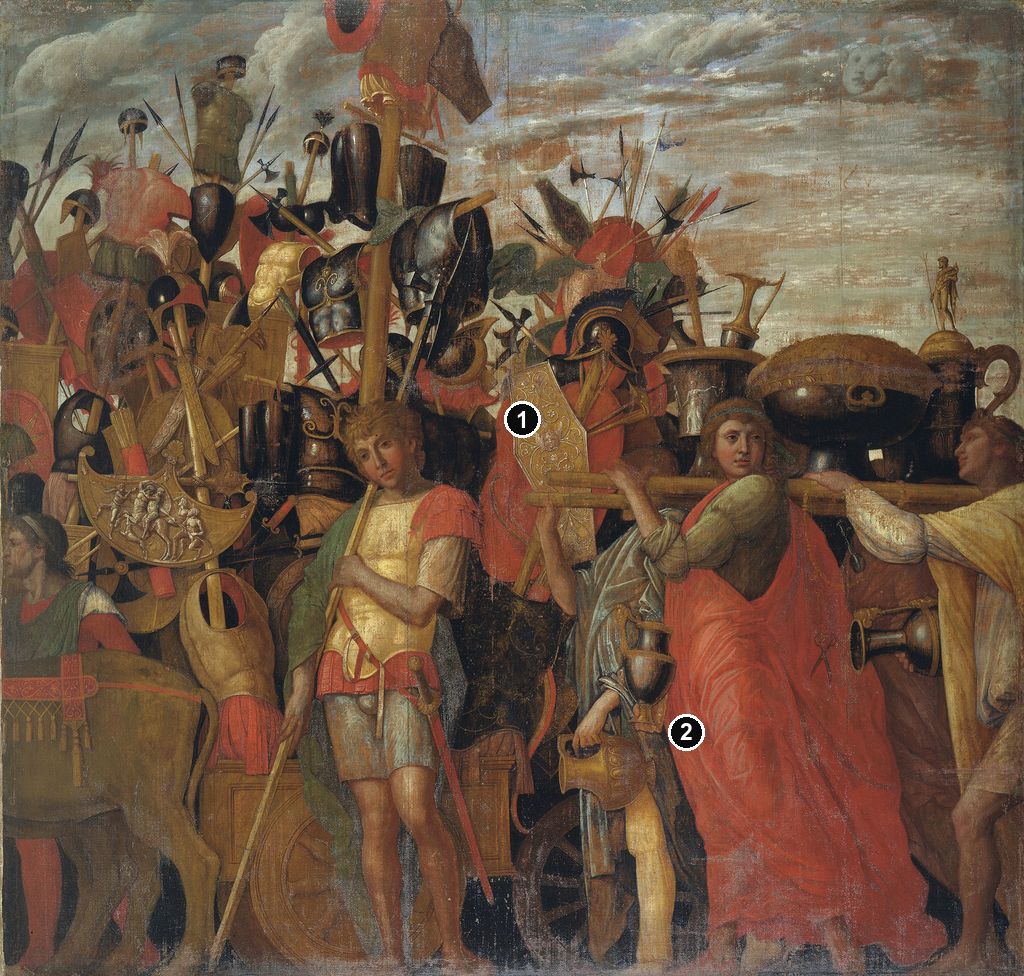
III. The Trophy Bearers. A piled cart of arms, a decorated crescent-shaped shield and a vessel carrying gold coins put the rewards of victory on view. The older title, The Bearers of Trophies and Bullion, makes the distinction between the kinds of wealth plain. The arms tell spectators that someone else has been disarmed. The coins show what can be brought home and counted. The piled weapons register as a mass, while the shape and decoration of the crescent shield let the viewer pick out a single piece of equipment. Putting the coins in a vessel makes a different kind of accumulation legible. The shield’s ornament still shows something of its earlier life, and the quantity of coins announces the value of the haul. A young halberd bearer looks out of the painting, as though he has noticed someone standing along the route. His glance brings us into the scene differently from the backward turn of the soldier in the first canvas. The earlier figure directed us towards the next marchers. This one seems to acknowledge that the things being carried have been brought out for people to see. Towards the end of the canvas the vessels begin to attract attention in their own right. Their bearers prepare the eye for a passage in which precious containers accompany the preparations for sacrifice. [10] [11]
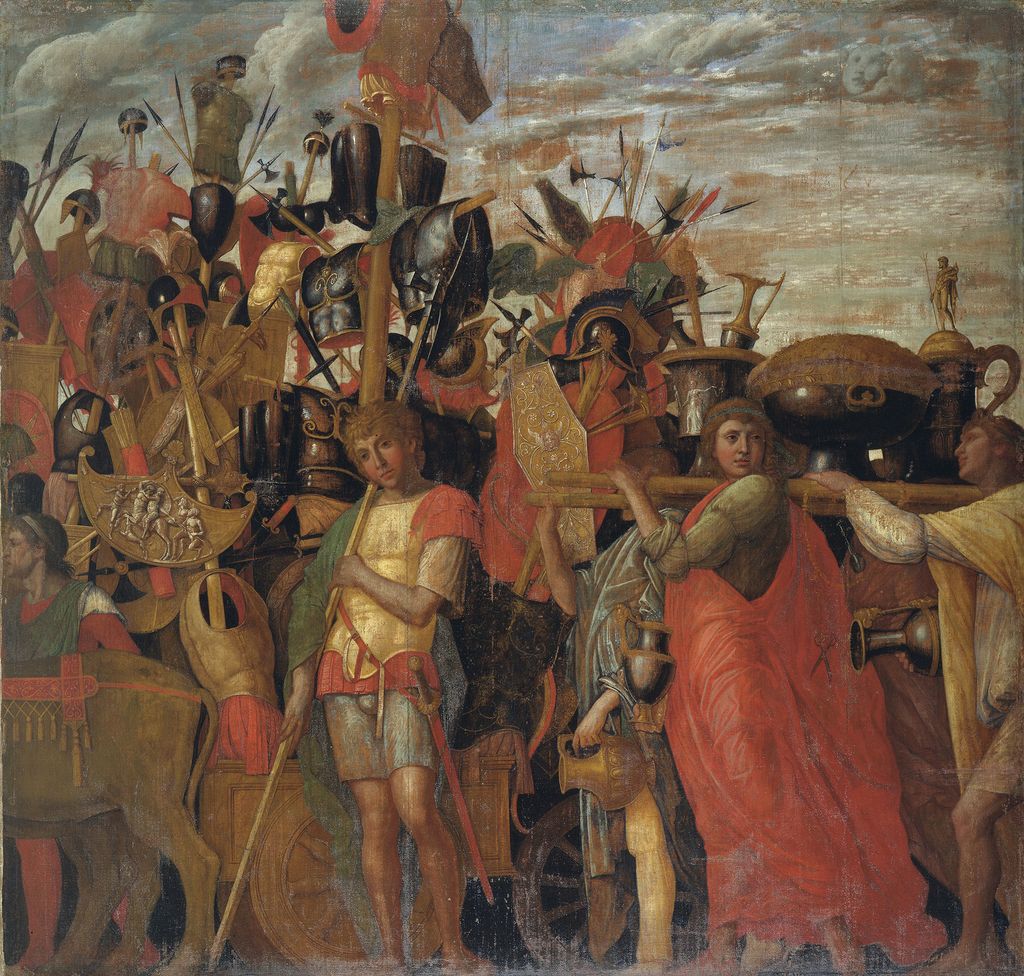
III. The Trophy Bearers, The Triumphs of Caesar. Royal Collection, RCIN 403960. Image source. Public domain.
The first three pictures give a spectator several ways to take in the campaign. Banners offer a framed view of battle, the tablet makes a claim about a named region, and captured objects pass within sight. Each type of evidence asks for a different sort of attention. A person can scan the banners from a distance, pick out the shape of the ram or shield, or try to read the tablet as it goes by. Mantegna makes those changes of attention part of the pace of the march. [5] [8] [10]
IV–VI. Sacrifice, elephants and the weight of the spoils
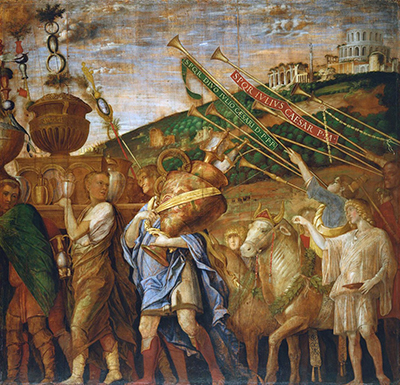
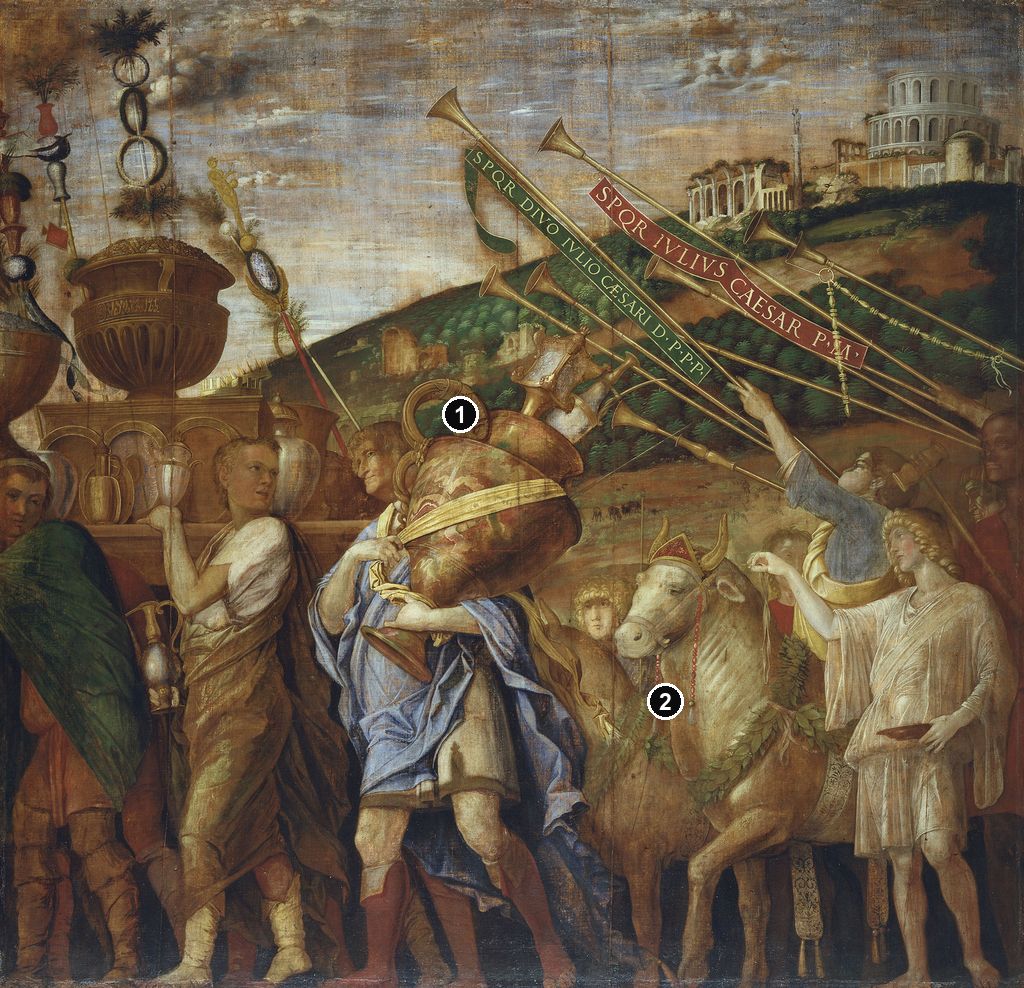
IV. The Vase-Bearers. Men carry precious vessels and younger attendants guide oxen dressed for sacrifice. Trumpets and standards continue across the scene, but there is more room between the bodies and objects, and we can see further towards the hills. The opening in the landscape gives a distant point of reference for the movements at the front. The oxen have their own steady pace, and the attendants have the work of keeping it in step with the men carrying vessels. The National Gallery describes this as the best-preserved canvas of the nine. The relative clarity of the paint makes it easier to see how carefully Mantegna varied the intervals between these groups. The letters SPQR stand for Senatus Populusque Romanus, the Senate and People of Rome. The inscription brings the public authority of Rome into a spectacle that will culminate in honours for one person. The dressed animals also make visible the religious purpose of this part of the march. [12] [13]
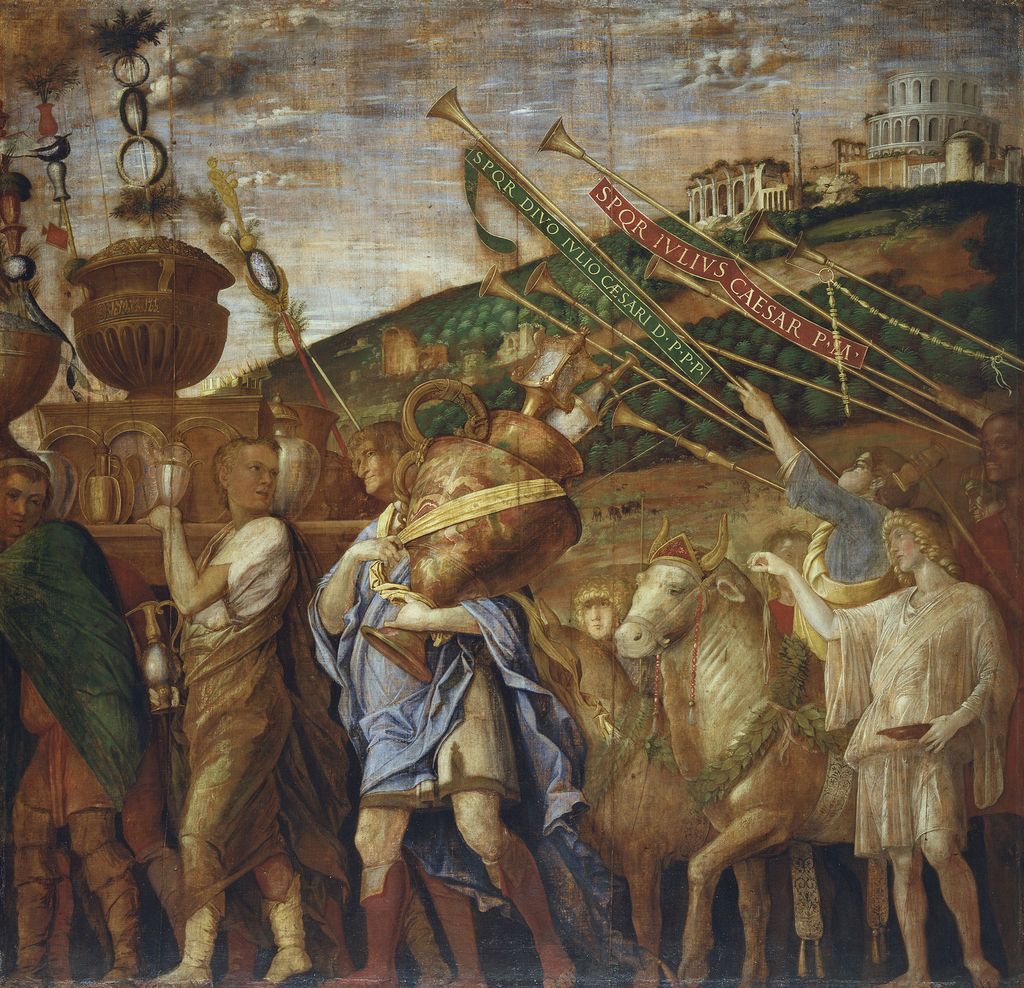
IV. The Vase-Bearers, The Triumphs of Caesar. Royal Collection, RCIN 403961. Image source. Public domain.
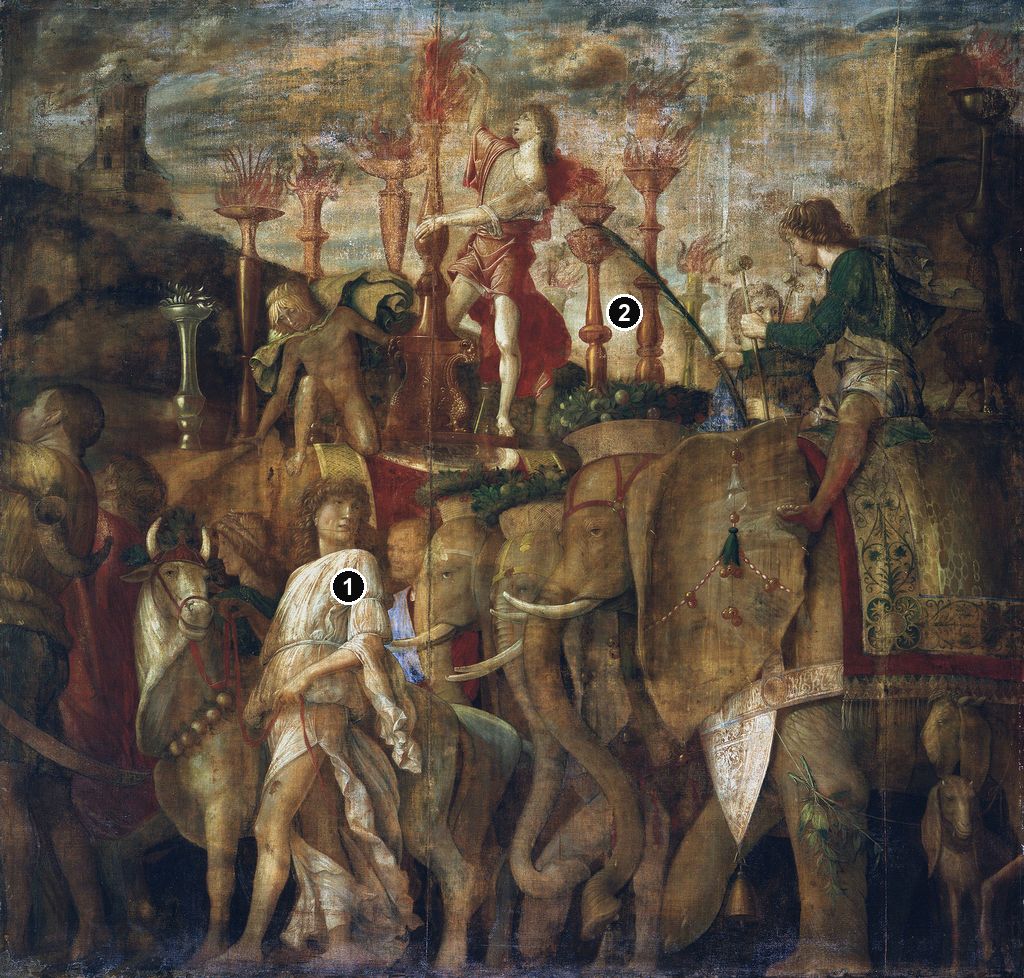
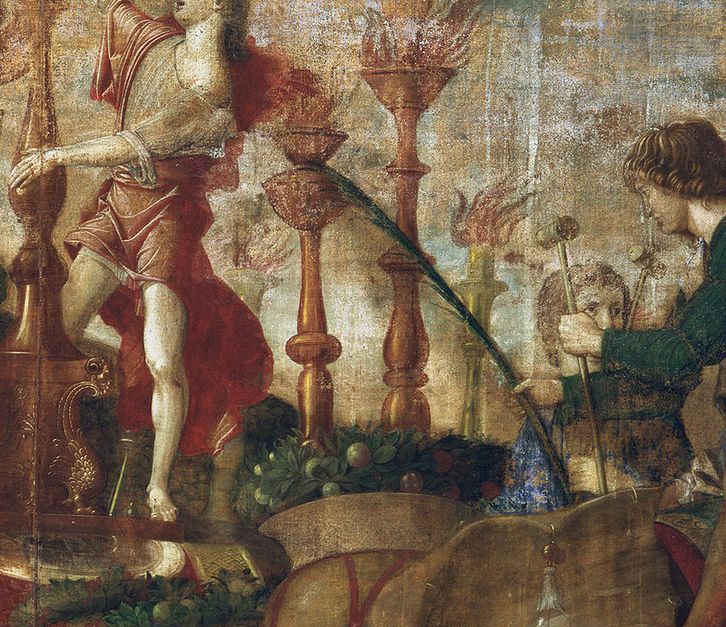
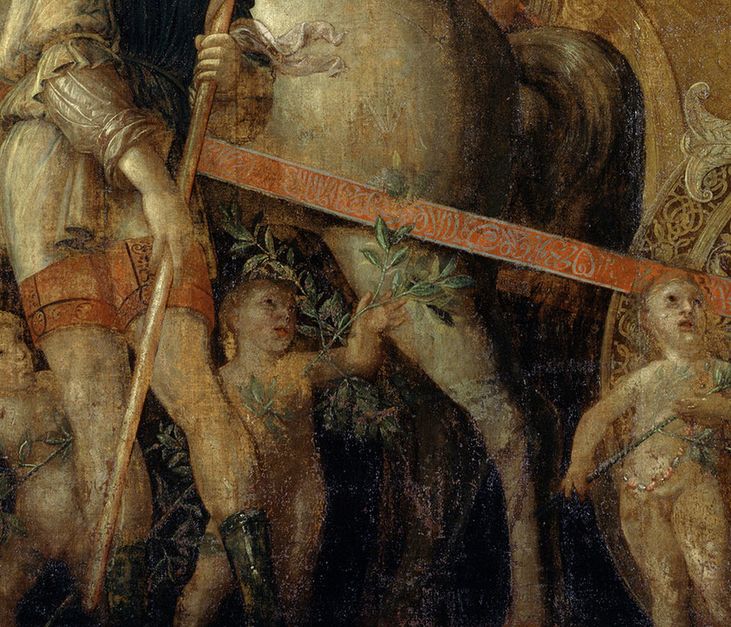
V. The Elephants. Four elephants and their riders recede into the picture. Their repeated forms allow Mantegna to suggest within a single canvas how much of the procession extends away from the immediate view. Golden candelabra and baskets of fruit connect the animals to the ritual already under way. Suetonius describes forty elephants bearing lights in Caesar’s Gallic triumph. [14] (Julius 37.2) The four painted elephants carry the resemblance through their lights, while their spacing and recession are Mantegna’s way of making the group work pictorially. One pair of eyes can follow the animals into depth just as it could follow the oxen across the preceding canvas. The change in scale is part of the surprise. The order of the two scenes also changes the way the ceremonial equipment is seen. The bearers of the fourth canvas carry their vessels at the height of a man. In the fifth, the height of the animals takes lights and offerings up into the part of the picture where standards have been visible. The largest bodies in the march give the smaller objects they carry a place of prominence. The riders and the animals’ ceremonial loads also give the viewer something to measure their bulk against. After several paintings that show what people can lift or pull on a cart, this one makes visible a different kind of effort in putting the parade together. [15] [16]
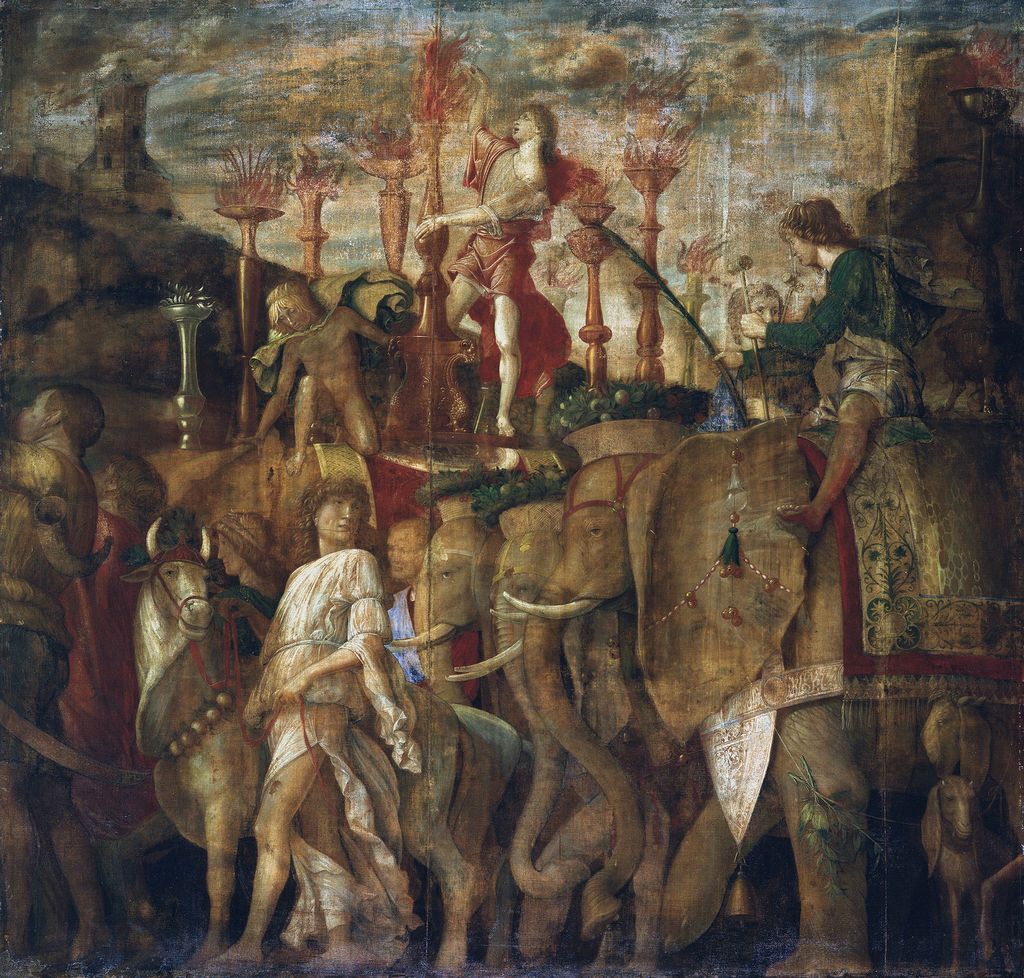
V. The Elephants, The Triumphs of Caesar. Royal Collection, RCIN 403962. Image source. Public domain.
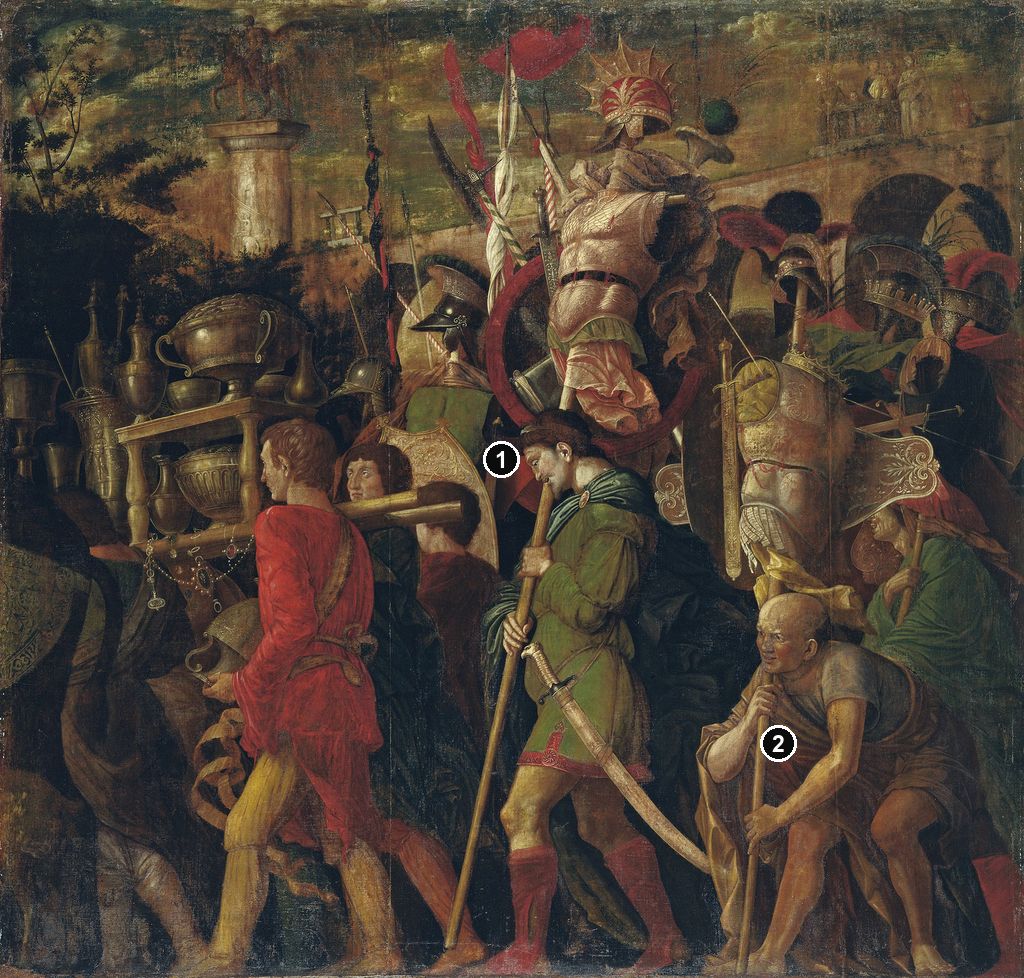
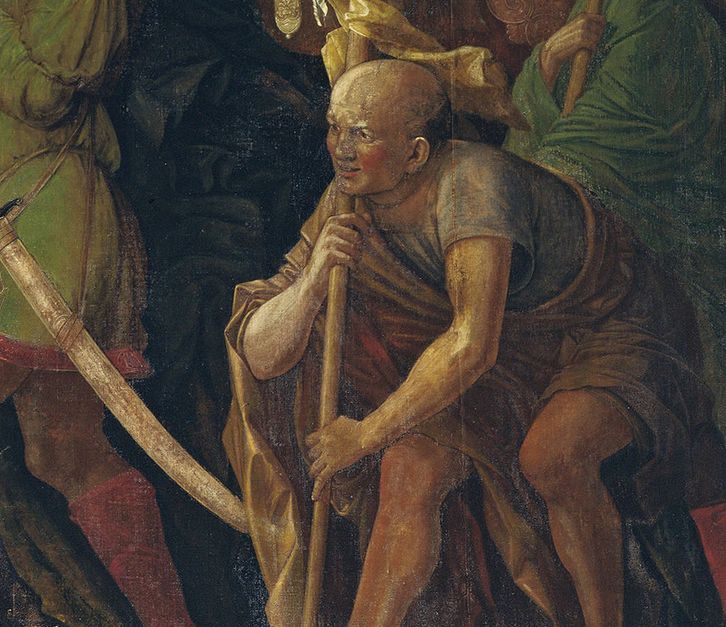
VI. The Corselet-Bearers. A corselet is armour for the torso. Here such armour is among the spoils hoisted on poles, where the crowd can see it. A barefoot bearer lowers his pole under the load. A piece of armour that once took its shape from the person wearing it now bears down on the person carrying it. Raising the trophies makes them more imposing, and the lowered pole gives a measure of the cost of keeping them raised. Above the march, spectators look down from an aqueduct. They have room to survey a procession that fills our view with bodies and objects. A tall triumphal column extends the pageant upwards again. The architecture thus gives people a place to watch from and provides a scale against which the march can look monumental. The bearer’s movement brings the attention back down to one body doing its work in the foreground. [17] [18]
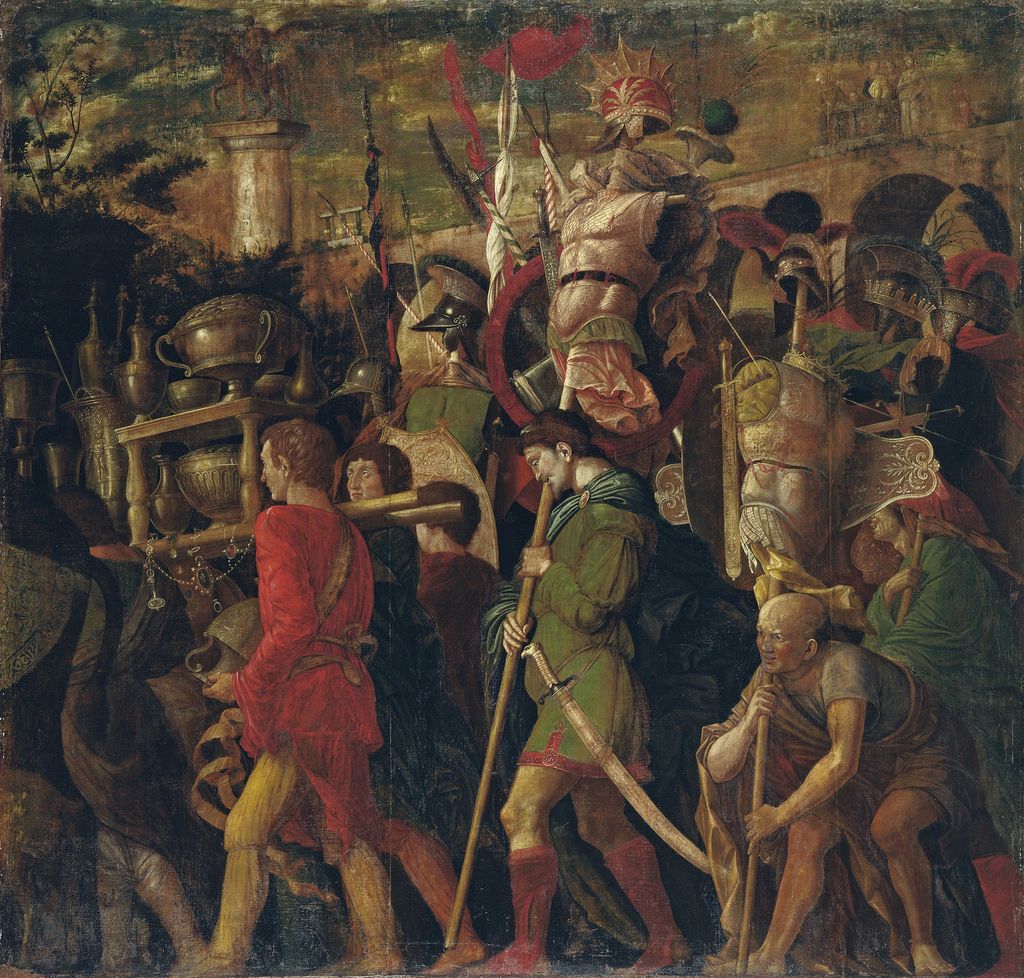
VI. The Corselet-Bearers, The Triumphs of Caesar. Royal Collection, RCIN 403963. Image source. Public domain.
Across these three canvases the viewer can look past the attendants to the hills, follow the line of elephants into depth and then look up to people watching from an aqueduct. That last group makes explicit something the earlier canvases have already implied. The triumph is planned around people being able to see it, whether they are close enough to catch a bearer bending or high enough to see one group coming behind another. Beyond the aqueduct, the character of the display changes again. The column and the raised armour give way to the people the procession has made part of its spoils. [12] [15] [17] [19]
Videos
A Sotheby’s specialist examines a preparatory drawing associated with the series.
The Only Surviving Drawing from Mantegna’s Triumphs of Caesar
The film discusses the handling and subject of the preparatory sheet and compares it with the painted series.
Watch on YouTubeVII–IX. Captives, returning music and Caesar’s chariot
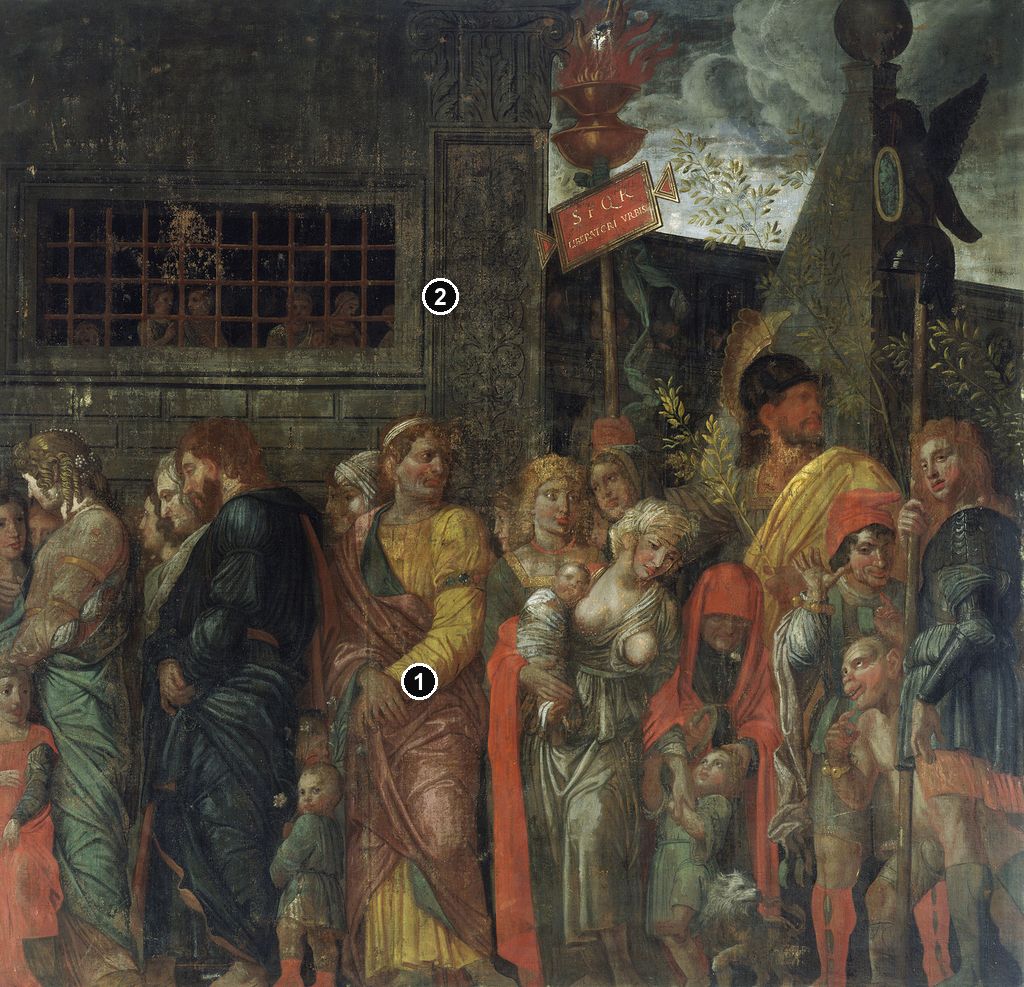
VII. The Captives. Men, women and children enter as prisoners. [19] The banners at the beginning showed battles at a distance, in pictures carried by the winning side. Here defeat is visible in the presence of adults and children made to walk through the city. A woman holding an infant is especially clear in Andrea Andreani’s separate woodcut after this canvas, the impression catalogued by the Cleveland Museum of Art as 1930.583.8 and dated 1593–99. [20] The child has to be carried as the group advances, an intimate detail exposed to the scrutiny of a crowd. The surface of Mantegna’s painting has been heavily altered, and the print helps recover the arrangement of the figures. [3] (pp. 26–28, 33–39) Ancient accounts give names to some of the people exhibited in Roman triumphs. The identities of the figures in this painted group remain uncertain. The presence of children alongside adults widens the human scope of a celebration that has so far shown the results of campaigns chiefly through possessions and ritual.
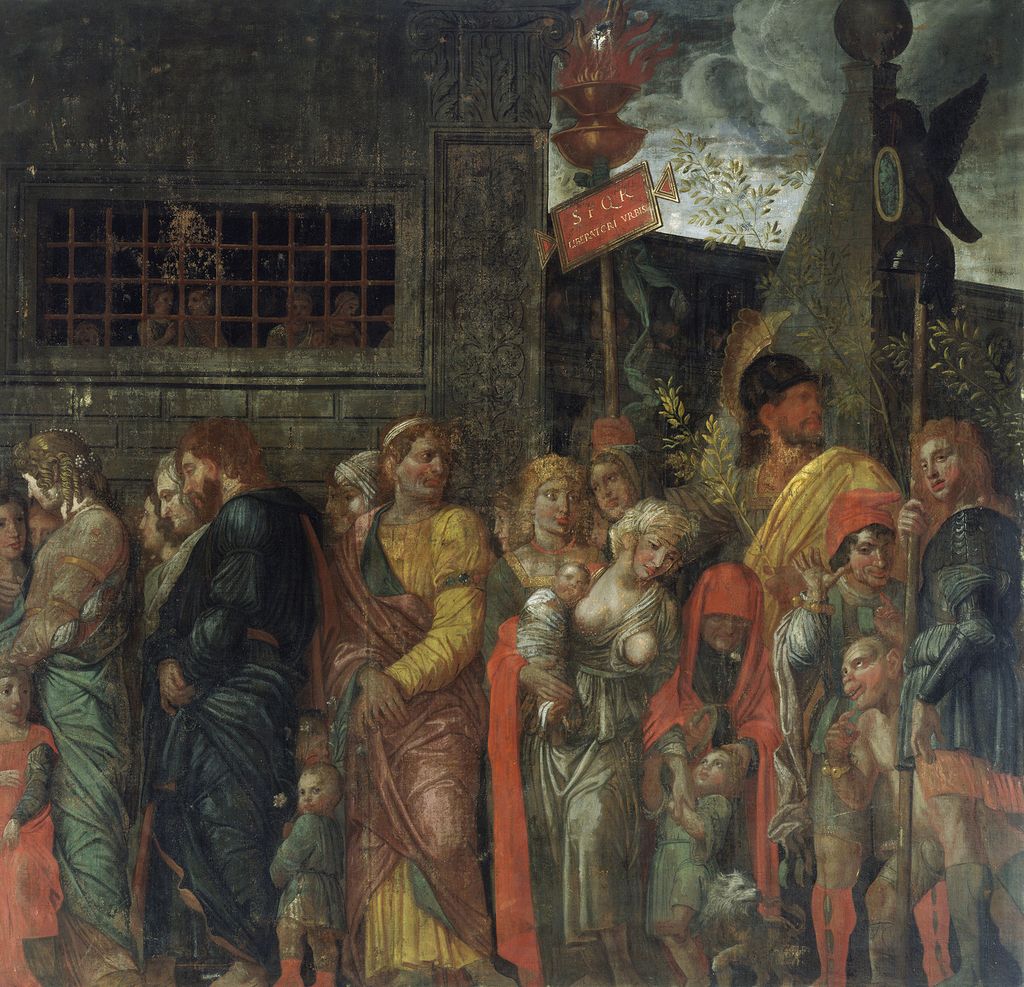
VII. The Captives, The Triumphs of Caesar. Royal Collection, RCIN 403964. Image source. Public domain.
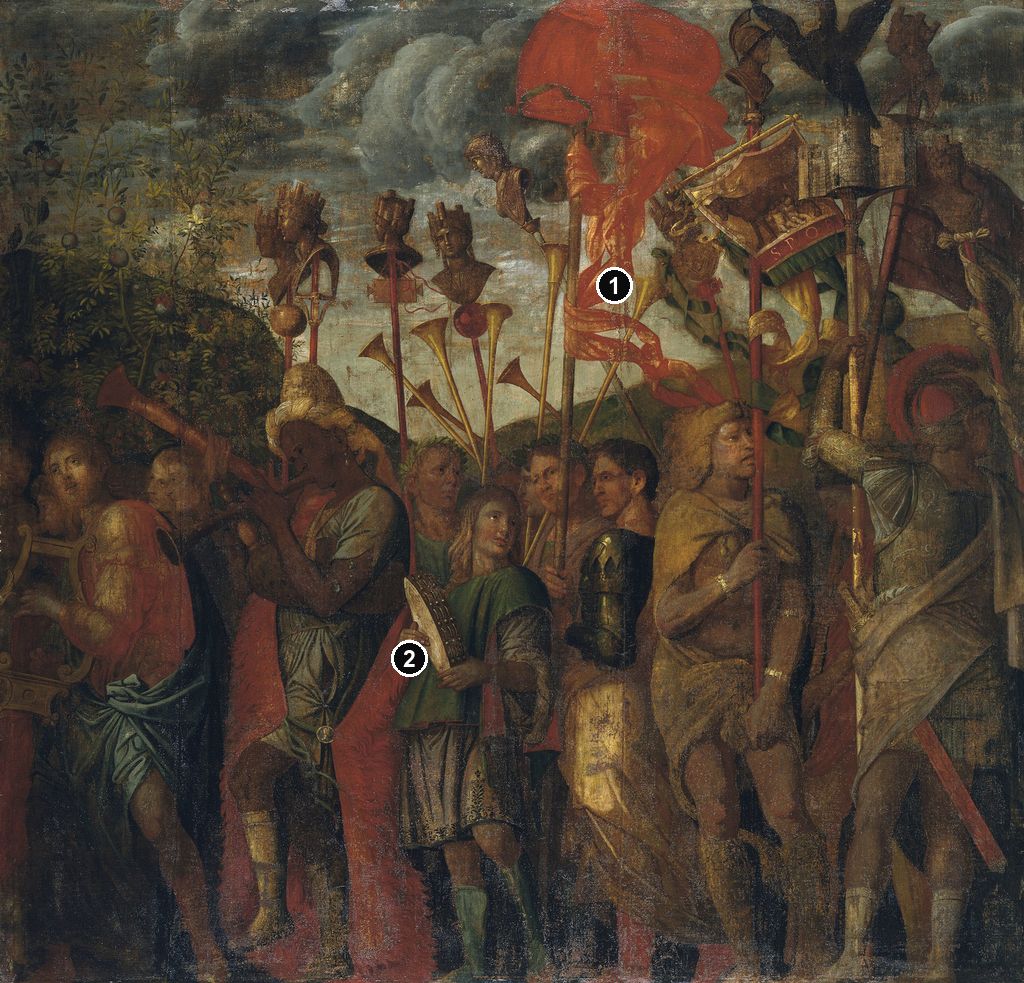
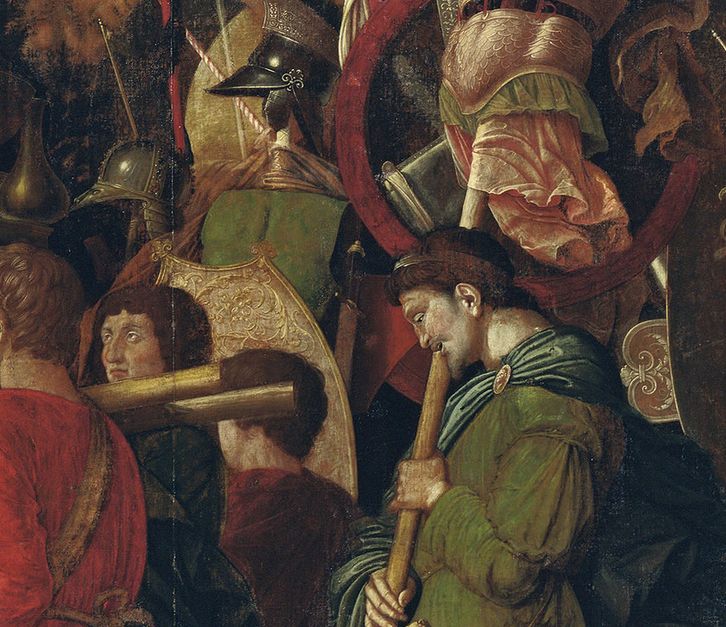
VIII. The Musicians. Players and raised standards bring back the imagined sound and rhythm of the opening. The alternative title, Musicians and standard-bearers, gives equal weight to what could be heard and what could be seen above the group. In the first canvas those elements announced the arrival of the entire procession. Here they announce the approach of its most important figure. The effect depends on following the scenes in order. Just after the captive group, the return of formal music makes the transition into the victor’s entrance remarkably swift. The upright standards carry the eye forward as they tie the moving figures together. The march keeps its time and gives little space for a pause between the passing of the prisoners and the appearance of the chariot. [21]
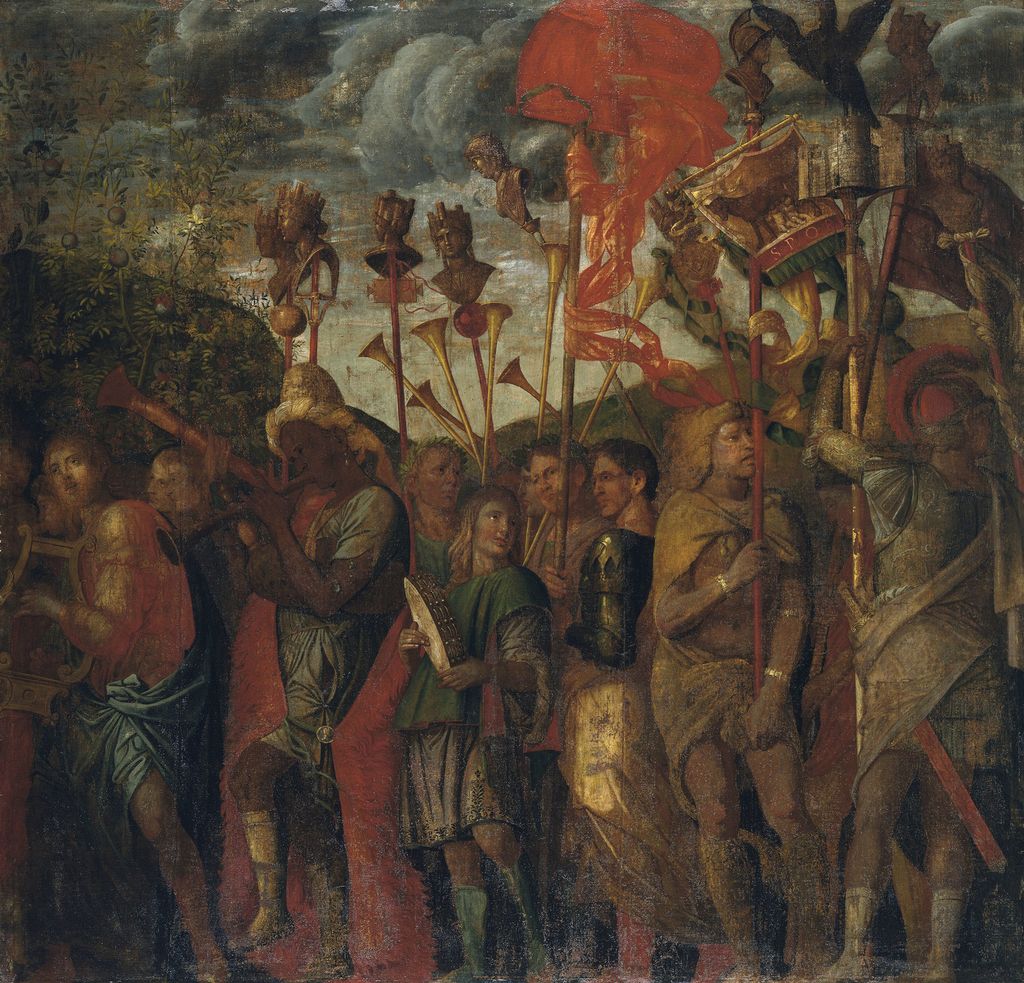
VIII. The Musicians, The Triumphs of Caesar. Royal Collection, RCIN 403965. Image source. Public domain.
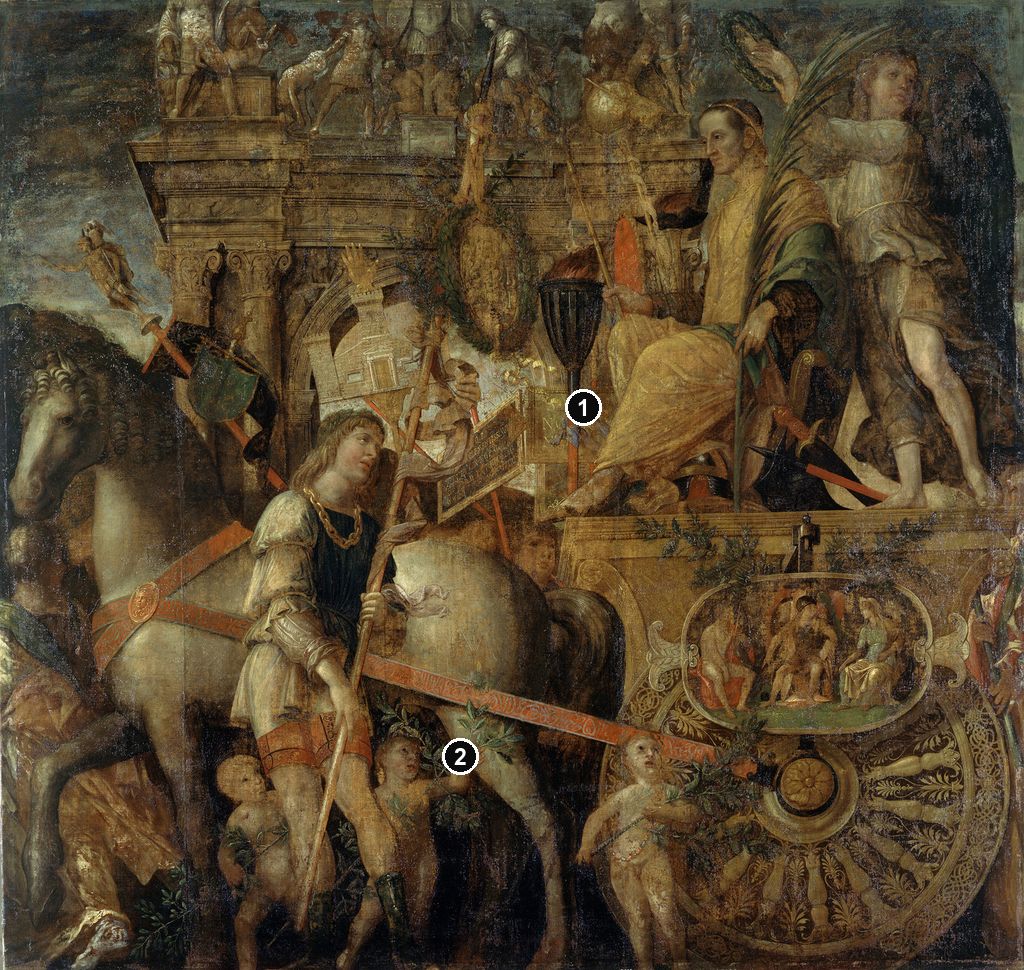
IX. Caesar on his Chariot. The chariot finally raises Caesar into view. The palm, the wreath and the crowning figure gather the signs of victory around him. A triumphal arch belongs to the monumental setting Mantegna supplies for the culmination. The series has already shown battles, statues, armour, precious vessels, animals and prisoners, each with its own time in view. All are now understood as the grounds for the honour conferred on this one figure. The delay matters because of the amount of work it has allowed the viewer to see. People carry the heavy objects, guide the animals, sound the instruments and keep each group moving. The captive families must walk before the man whose victory has put them there. The chariot brings those earlier actions into a single relationship with Caesar, even though the people performing them have already passed out of sight. The gesture of crowning him brings the ceremony to a still point within a scene that is itself moving past us. The distinction is already there in the opening soldier, whose body moves one way while he directs his attention elsewhere. At the end of the march, the signs held beside and above Caesar give all that movement an object of attention. [2]
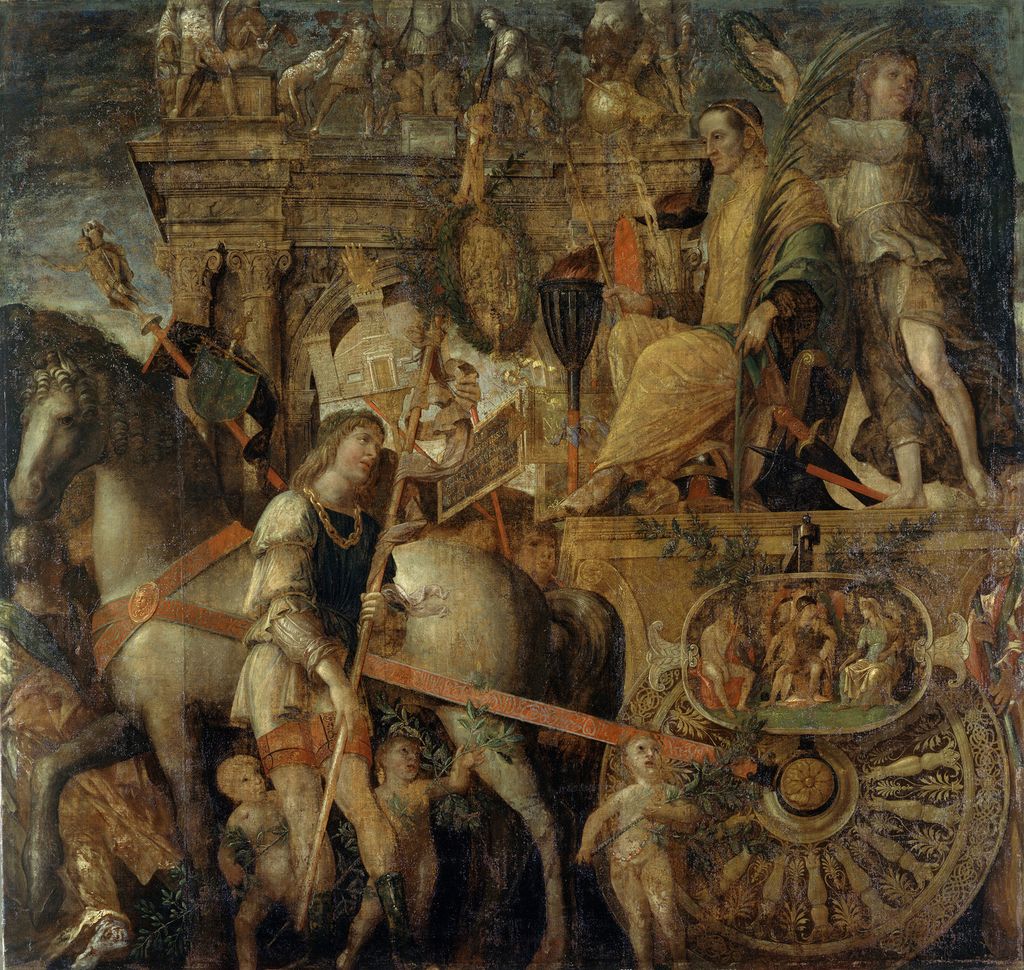
IX. Caesar on his Chariot, The Triumphs of Caesar. Royal Collection, RCIN 403966. Image source. Public domain.
The Roman triumph and Mantegna’s sources
A Roman triumph made a campaign visible to people who had never been near the fighting. Arms and valuables could be displayed, animals led to sacrifice and captives marched before the victorious commander. Mantegna’s subject is a triumph for Julius Caesar, the Roman general and dictator. The National Gallery foregrounds his victories in Gaul. [1] (In-depth) The tablet in Canvas II names those victories, and the lights carried in Canvas V recall the forty lamp-bearing elephants of Suetonius’s Gallic account. [8] [14] (Julius 37.2) The wars in Gaul and their later celebration in Rome were separate events. The tablet shows how one could be made the subject of the other.
The Royal Collection cautions that the procession as a whole is difficult to match to a single campaign. [2] (Description) Bryn Critz Schockmel reads the words Veni, vidi, vici (‘I came, I saw, I conquered’) on a flag in Canvas IX. [3] (pp. 32, 37, fig. 1.13 and n. 57) Suetonius assigns those words to Caesar’s Pontic triumph. [14] [22] (Julius 37.2) A viewer who follows the tablet in II and the elephants in V is given another victory to think about beside the chariot. The Gallic references are strong, and the Pontic flag makes sense in a parade that draws its signs of victory from more than one occasion.
Appian describes four triumphs on one occasion. [23] (Civil Wars II.101) Suetonius counts five overall. [14] (Julius 37.1–2) Appian’s account describes pictures of the defeated and names the infant Juba among the African captives. [23] (Civil Wars II.101) That combination offers a comparison for the pictures of battle carried at the beginning of Mantegna’s march and for the captive families in Canvas VII, whose individual identities remain open. Plutarch’s account of the triumph of Aemilius Paullus describes another procession with comparable arrangements of precious objects, sacrifices and prisoners. [24] (Aemilius 32–34) Such accounts show how spectators were told what had happened and how to understand it before the commander came into view. The Louvre’s entry on a drawing associated with the series proposes Flavio Biondo’s Roma triumphans as a literary route by which material on ancient ceremony may have reached Mantegna. [25]
Roman reliefs offered an example of how to give that material visible form. On the Arch of Titus, a procession carries spoils and a triumphator is crowned. The reliefs commemorate the Flavian victory in Judaea, in the era of the Roman emperors. [26] Their treatment of moving bodies, the objects they carry and the honour paid to the victor makes them a comparison across centuries of Roman history. The comparison helps explain what an ancient relief could offer to a painter arranging a procession, especially a way to keep figures in motion while making their loads legible. Mantegna had the additional possibility of distance. He could let the hills appear between figures, send the elephants back into depth, or put people high up on an aqueduct and give them a view of the spectacle.
The first commission and the surviving Mantuan letters
Mantegna’s career at the Gonzaga court provides the setting for the earliest record of the project. Calandra’s letter of 26 August 1486 records Ercole I d’Este’s visit to see the paintings in progress. [3] (p. 68 n. 16) The pictures were already of interest beyond Mantua while Mantegna was still making them. From Rome on 31 January 1489, he asked for protection at the windows and said that he hoped to paint more. [3] (p. 69 n. 17) Francesco II Gonzaga replied with reassurance on 23 February. [3] (p. 69 n. 18) The exchange records Mantegna’s concern for the canvases already in Mantua alongside his intention to continue the work.
Francesco’s decree of 1492 distinguishes the already-painted Camera degli Sposi from the Triumphs, which were still in progress. [3] (p. 69 n. 19) In 1494 Isabella d’Este reported a viewing by Giovanni de’ Medici. [3] (p. 69 n. 20) The two records show how a work still in progress could already serve as something the Gonzaga wanted a visitor to see.
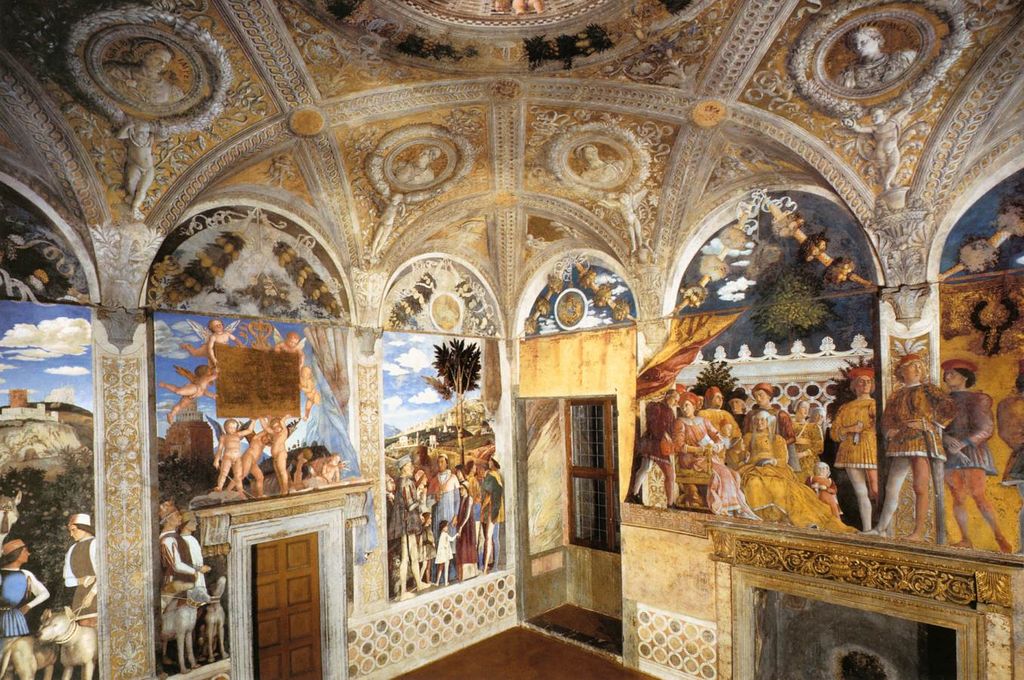
The Louvre retrospective leaves the choice of patron between Federico I and Francesco II. [27] After weighing the earlier case for Lodovico Gonzaga, Bryn Critz Schockmel makes the case that Federico I commissioned the paintings and that they may have been meant for the Domus Nova. Federico died in 1484, so that proposal would place the commission before the conventional starting date of about 1485. [3] (pp. 68–108, 128–130) Andrew Martindale proposed the Corridoio del Passerino. [3] (pp. 68–108) His argument draws on what can be seen and measured in the paintings, especially their dimensions and the consistent direction of their lighting. In an extended space, the same fall of light across successive groups could help join the scenes into one procession. Scholars who question the corridor proposal allow for a different room or the possibility that the project initially had no permanent space assigned to it. [3] (pp. 68–108) A room’s suitability is one part of the evidence. Connecting it to the decision that set Mantegna to work requires a record of the commission or its early arrangements. Francesco’s role is clearest in the correspondence and the later housing of the paintings.
Ercole’s visit gives a date by which the work could be shown, and the window request gives a glimpse of the conditions in which it was kept. The consistent format and lighting show how the canvases could be brought together. The first record that puts a definite number of them in a particular setting takes us into a temporary theatre at Carnival.
Six canvases at Carnival and a hall at San Sebastiano
At Carnival in 1501, six paintings of Caesar’s triumph decorated one side of a temporary Mantuan theatre, according to Sigismondo Cantelmo’s report. [28] (no. II, pp. 4–5) [29] (b. 1, fasc. 48, PDF p. 8) The theatre had an architectural and decorative scheme of its own. Individual bays could have given the canvases separate openings, so that a spectator saw each group of marchers across an interval in the building. The report establishes their position along one side. Cantelmo locates Mantegna’s separate Triumphs after Petrarch at the lower front of the stage. [28] (no. II, p. 4) [30] (pp. 150–152, 165–166) The locations distinguish the Petrarch cycle from the Roman procession in the same decorative scheme. Here the Gonzaga could use the monumental canvases as part of a court celebration in a building expressly set up for the occasion.
Charles Hope takes the theatre display as evidence that only six canvases had been finished. He identifies them as I–III and VII–IX. [3] (pp. 79–84) Hope also proposed that Mantegna had adapted the edge of Canvas III so it could sit next to VII in the interim. [3] (p. 82 n. 75) Putting VII after III would change what the eye picks up at the join. In the familiar sequence the vessels carried towards the end of The Trophy Bearers prepare for the vessels of IV and the shift towards sacrifice. In Hope’s sequence that group would give way directly to the captive families. The eye would move from the arms and money Rome could carry off to the people it could force to march. The proposed join can be read that way, while Cantelmo establishes only the number displayed. Which six were shown, how many were available and in what order Mantegna painted them remain open. Documents from 1505 to 1507 raise the possibility of further temporary uses. Francesca Bortoletti points out that Fetti’s reference in 1507 may refer to either Caesar’s triumph or the Petrarch cycle. [30] (p. 148 n. 6) The distinct locations Cantelmo assigns the two cycles are especially valuable when other records refer simply to ‘triumphs’.
Palazzo San Sebastiano supplies firmer evidence of a room associated with the pictures. Construction began in 1506, some twenty years after the first notice of the work. [31] In a letter of 11 December 1512 to Alessandro Gabbioneta, Francesco II recalled entertaining Massimiliano Sforza ‘in la Sala di Triumphi di Cesare, qui a Santo Sebastiano’ (‘in the Hall of the Triumphs of Caesar, here at San Sebastiano’). The archival reference is Archivio Gonzaga, b. 2920, libro 225, cc. 34v–37v. [30] (p. 147 n. 1) Mario Equicola’s chronicle of 1521 associates the hall with the purpose of housing the pictures. [32] [33] (printed p. 91) In the theatre the cycle belonged to a scheme assembled for Carnival. At San Sebastiano it furnished a palace room in which Francesco received a guest and which he could identify by the work on its walls.
In Christoph Luitpold Frommel’s reconstruction, the wall available for the paintings runs for about 30 metres. He raises the possibility that Mantegna had a hand in planning how the room would accommodate them. [33] (p. 91, fig. 2) Nine canvases about 2.8 metres wide would occupy roughly 25 metres before the intervals between them. Schockmel reconstructs a long row on the south wall opposite the windows. [3] (pp. 91–95, 175–180) Pilasters, shallow rectangular columns projecting from a wall, could have marked off the individual pictures. The surviving Mantuan pilasters are evidence of the later Renaissance presentation. Their exact arrangement, the gaps between the canvases and the height at which they hung remain uncertain. [34] (printed p. 34) Schockmel also notes later sixteenth-century accounts that report seven canvases, so even a room large enough for the full cycle may have held fewer at times. [3] (p. 92 n. 120) On the scale of the proposed wall, a viewer beside the Triumphal Carts would have had much of the distance still to cover before reaching Caesar. The proposed arrangement would have made that interval a part of moving through the room.
From the Gonzaga collection to Charles I’s Hampton Court
The paintings returned to the Palazzo Ducale under Vincenzo I Gonzaga. Schockmel cites an inventory dated 12 January 1627 that records them in the Galleria della Mostra. [3] (p. 95 n. 142) The first Gonzaga transaction, negotiated in 1626–28, left the Triumphs in Mantua. Daniel Nijs, also known as Nys, brought the cycle into a second transaction alongside sculpture and other material. The acquisition by Charles I is conventionally dated 1629. [35] (pp. 54–59) [36] (pp. 18–21 and nn. 46–49) In a letter to Dorchester that February, printed in English translation by William Noel Sainsbury, Nijs says that the Gonzaga had initially reserved all nine paintings and that Vincenzo had placed them in two new chambers. [37] (appendix, item CII, pp. 327–329) Nijs was defending the deal, with an interest in stressing the pictures’ value and the significance of securing them. The relationship between the two chambers he describes and the named gallery in the 1627 inventory remains open.
The logistics of moving the acquisitions took longer than the negotiation. In October 1630 Rowlandson wrote to Weston that crates of pictures had been assigned to ships. The published extract gives no canvas-by-canvas manifest from which to establish a departure date, an exact arrival or the day the nine were first hung. [37] (appendix, item CXII, p. 336) Late 1630 is the likely date of the paintings’ arrival in England. Their first hanging at Hampton Court appears to have followed soon afterwards, probably in the Tudor Long Gallery. [3] (ch. 4, pp. 191–208) Later payments and shipments of outstanding pieces belong to the wider purchase and extend beyond the probable arrival of the nine canvases. [36] (pp. 18–21 and nn. 46–49) [38] In Mantua the paintings had lent their name to a Gonzaga room. At Hampton Court they entered the collection of an English king and again called for a space in which a viewer could follow one episode after another.
After Charles I’s execution in 1649, the Commonwealth inventory valued the paintings at £1,000, and the state retained them. [2] (Provenance) [35] (“The ‘Triumph’ in England,” n. 23) In 1666 they were recorded in the King’s Gallery. [2] (Provenance, entry no. 155 for 1666) As William and Mary rebuilt parts of Hampton Court, the canvases underwent restoration and found a new setting in the Green Gallery, today the Queen’s Gallery. [36] (printed p. 34) From the 1920s the Lower Orangery became their long-term home. [39] Each move raised anew practical questions the canvases had posed in Mantua. How much of the march could someone see on entering a room? How far back could they stand, and how would the light fall along the wall? The name Hampton Court covers a succession of answers, as well as periods of work on the paintings between one hanging and the next.
The surviving paint and the evidence of the frames
The fourth and seventh canvases give markedly different access to Mantegna’s painting. In The Vase-Bearers, the spacing of people and vessels and the hills behind them remain easy to follow. [12] In The Captives, alterations to the paint surface interfere with the reading of the group. [19] [3] (pp. 26–28) Andreani’s woodcut makes the woman with her infant and her place among the other prisoners easier to distinguish. [20] The print preserves the relationship of figures through another artist’s drawing and cutting. The treated painting preserves surviving paint and the traces of what was done to it. A detail that is difficult to see on the canvas today may have been readily legible to someone watching the procession in Mantua.
Parry Walton and Louis Laguerre worked on the paintings in earlier centuries. Roger Fry began a treatment in 1910. [3] (pp. 26–27) Kennedy North intervened in the 1930s. Wax applied in that decade eventually obscured imagery. [40] (pp. 160–162) In the wider campaign of 1962–74, work led by John Brealey removed wax and overpaint in much of the ensemble, recovering substantial areas of original paint. [3] (printed p. 27) Dianne Dwyer Modestini recounts how Brealey completed the Hampton Court restoration. [41] (printed p. 28) The Captives was left out of comparable recovery because the assessment at the time was that little original paint survived. [3] (pp. 26–28) Its present appearance reflects both the accumulated effects of treatment and the decision about how far that campaign could go. The treatment accounts cited here give no figure for the amount of original paint surviving on the seventh canvas today.
The frames also affect how we see the procession. For the National Gallery’s 2018–19 exhibition, frame specialist Peter Schade described the use of modern approximations to the Mantuan pilasters around The Triumphal Carts, The Vase-Bearers and The Elephants. A shallow border below the canvases suggested a ledge like the bottom edge of an ancient relief. The low vanishing point makes the marchers seem to occupy a space above the viewer. Schade reads the shadows at the edges together with the repeated uprights. A group seems to slip behind one of those uprights before the march emerges again in the next opening. [34] (printed p. 34) The effect helps explain why even a gap between canvases can feel like part of the procession. Mantegna’s involvement in designing the pilasters remains an inference. For the loan that opened in 2023, the Gallery provided new frames for six canvases. [42] (printed p. 6, PDF p. 8)
The series usually hangs at Hampton Court Palace. The displays were split on 23 November 2026. The National Gallery listed the first six canvases in Room 12 and reported that The Captives was off display for study. [4] [1] (In-depth) At Hampton Court, Historic Royal Palaces listed The Musicians and Caesar on his Chariot in the Queen’s Presence Chamber. It planned to bring all nine together when the Mantegna Gallery reopened in spring 2027. [43]
Andreani’s woodcuts and Rubens’s A Roman Triumph
In 1599 Andrea Andreani issued his chiaroscuro woodcuts after the Triumphs, working from drawings by Bernardo Malpizzi. The Metropolitan Museum of Art’s suite contains nine image sheets and a title sheet. [44] These prints belong to the wider history of engravings and other prints after Mantegna. In this form someone could examine the procession at close quarters and follow the episodes in sequence far from Mantua. The Met’s separate impression of The Elephants retains the recession of the animals in a composition small enough to take in at a glance. [45] The Cleveland impression of The Captives makes the shape of the group around the woman with the infant especially clear. [20]
A woodcut could carry the rhythm of the framing as well as the figures. The National Gallery of Art in Washington holds an impression of the ninth scene with two printed columns. They flank the chariot scene, giving the eye a pair of upright boundaries like those that the reconstructed pilasters give the painted groups. The print brings that rhythm into a format where a reader could set one sheet beside another. [46] The Berlin exhibition on Mantegna and Goethe traces one consequence of the prints’ circulation. Goethe never saw the paintings and knew the series chiefly through prints he owned that were derived from Andreani’s woodcuts. [47] The rhythm of looking for a viewer in his position depended on moving between sheets.
Peter Paul Rubens had seen the paintings in Mantua. His A Roman Triumph, dating from about 1630, draws chiefly on the elephants in the fifth canvas and also takes details from the fourth. In Mantegna the vessels and sacrificial oxen occupy one stage of the march, while the repeated forms of the elephants carry the next scene into depth. Rubens brings elements of the neighbouring canvases together. The elephants carry the adornments of a religious procession, and a red-robed priest becomes the human centre of the ritual. That change gives the attendants and animals a new point of relationship within the picture. Rubens had already left England by the time the canvases arrived, so his reworking belongs to the history of his encounter with them in Mantua. [48] [3] (p. 197)
The woodcuts keep the sequence available to a viewer who can examine the sheets one by one. Rubens’s painting shows how much can be made of the meeting of two adjoining episodes. The monumental cycle invites both kinds of looking. It lets us stay with a bearer lowering his pole or an elephant advancing behind another, and it makes the significance of those incidents change as the march goes on. By the time Caesar arrives, the viewer has had time to consider what Roman victory puts on display, what it asks of the people who stage it and what it does to the people marched through the city as its proof.
Annotated Details from The Triumphs of Caesar
The numbered points identify details to look at closely. The detail images below preserve the native scale of the selected crops.
The Triumphs of Caesar
The Triumphs of Caesar
The Triumphs of Caesar
The Triumphs of Caesar
The Triumphs of Caesar
The Triumphs of Caesar
The Triumphs of Caesar
The Triumphs of Caesar
The Triumphs of Caesar
Details from THE TRIUMPHS OF CAESAR
Choose a detail to enlarge it.
The Triumphs of Caesar
Spoils carried high
The things carried above the crowd interrupt the upper half of the painting. The bodies bearing them are set beneath the mass of objects.
The marching line
The marchers’ feet occupy the low foreground. Their steps supply a pace across the base of the first canvas.
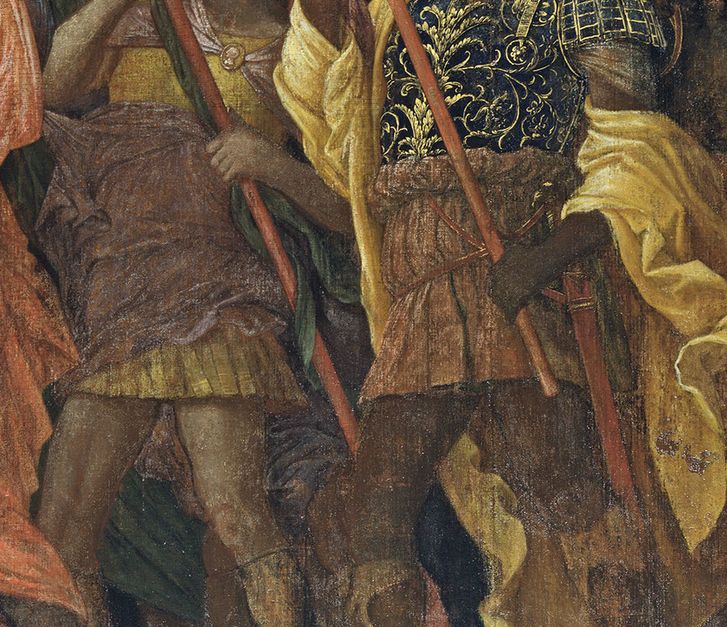
The Triumphs of Caesar
Standards and their bearers
Poles and angled equipment cut through the vertical positions of the marchers. Their layered forms connect foreground movement to a crowded distance.
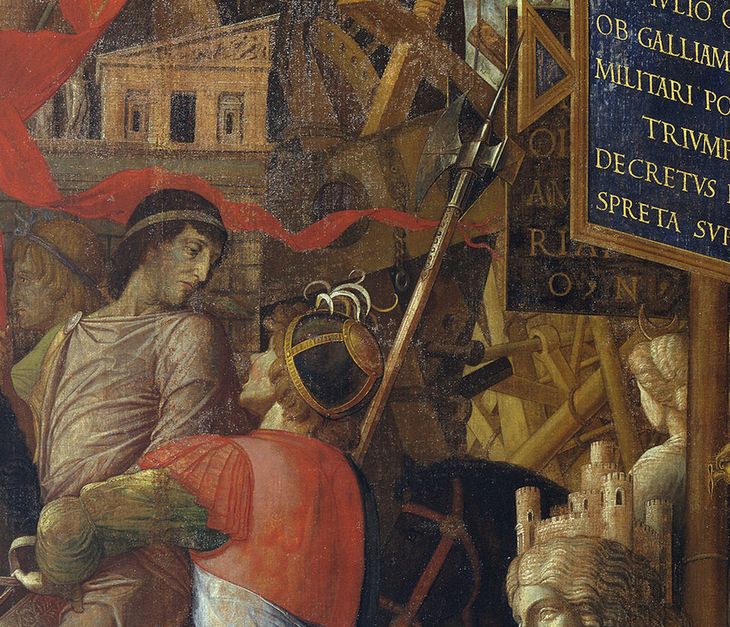
The edge of the procession
Marchers and equipment crowd the edge. The figures’ repeated positions suggest that the sequence extends into the adjoining scene.
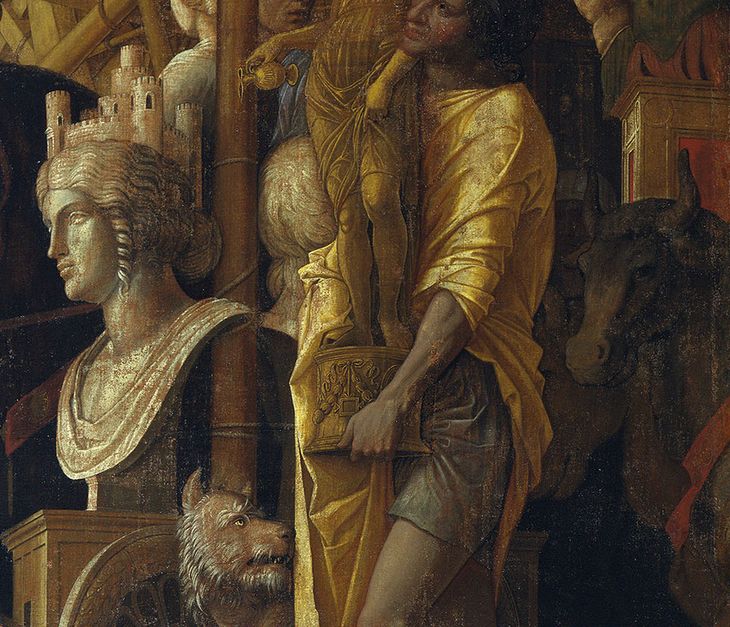
The Triumphs of Caesar
Collected trophies
The packed objects rise above their bearers. Overlap and contrasts of colour allow separate shapes to emerge from the large mass.
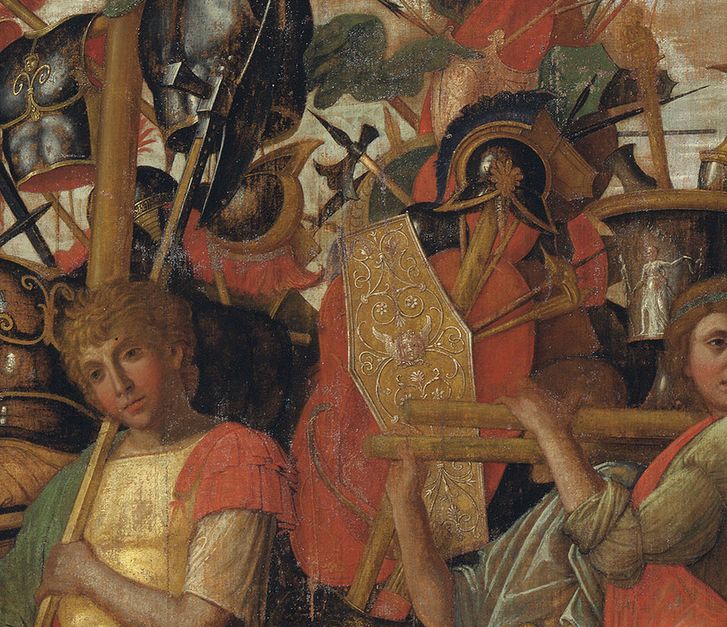
Steps below the weight
The low line of feet and robes keeps the procession continuous while the objects pull the eye upward.
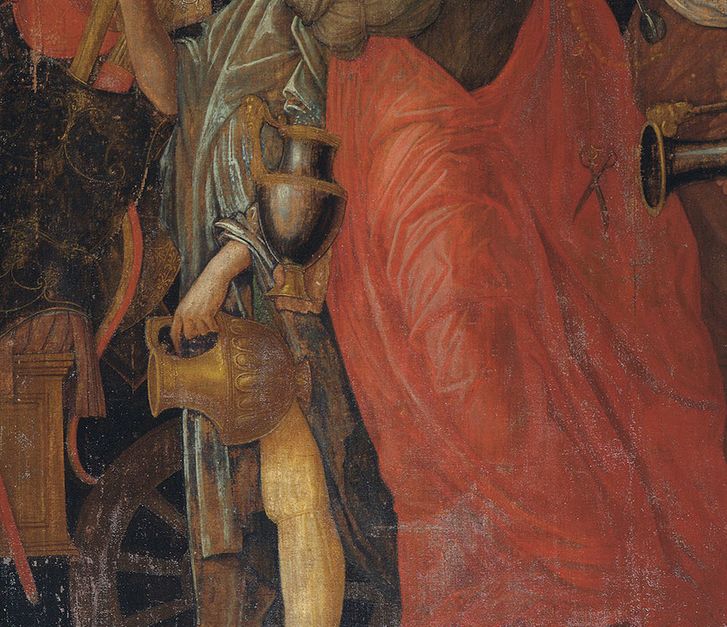
The Triumphs of Caesar
Carried vessels
Large rounded shapes occupy the upper part of the procession. Supporting hands and shoulders show how the burden moves with its bearers.
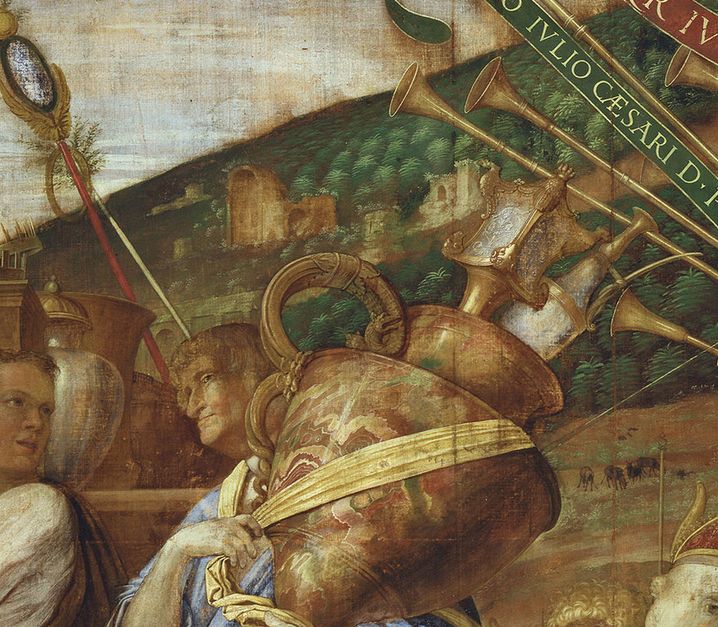
Packed figures
The closely spaced bodies are separated by changes in colour and direction. Their rhythm is easier to see near the lower edge.
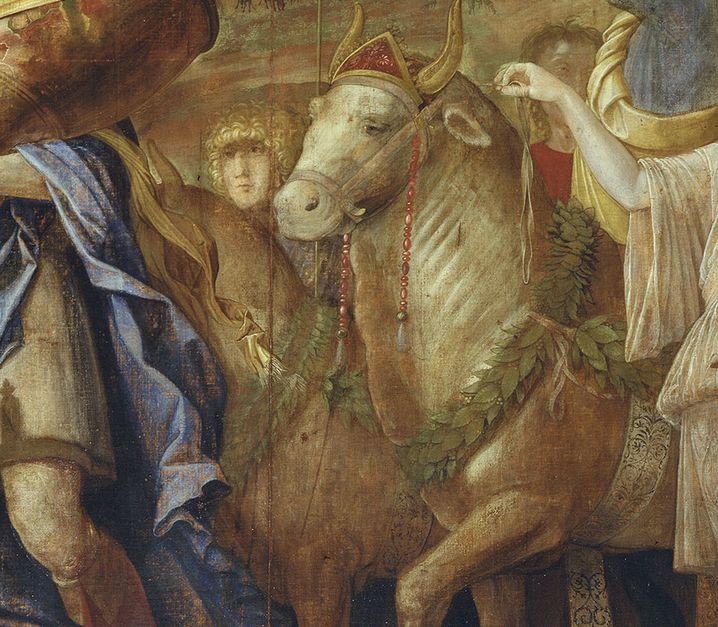
The Triumphs of Caesar
The elephants
The animals rise above neighbouring figures. Harness and drapery reveal where people and animals meet in the crowd.
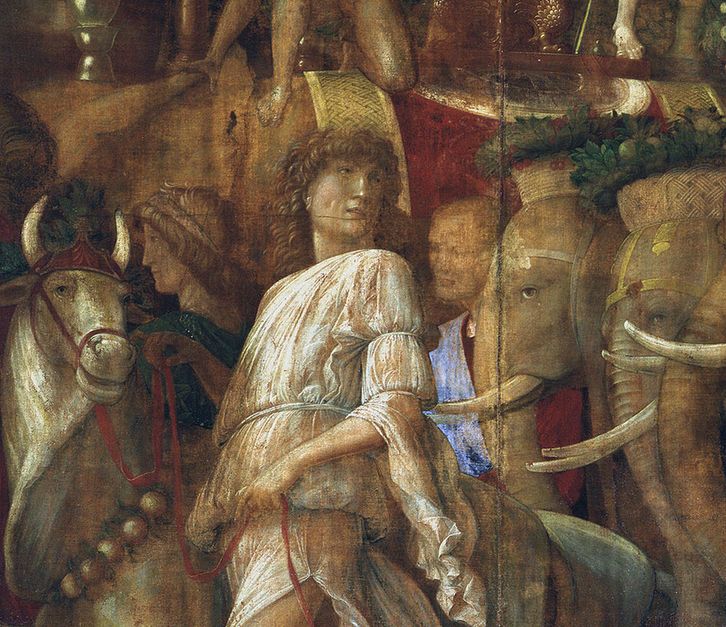
The loads above the animals
The elevated shapes and diagonal fittings interrupt the sky. They make this part of the procession distinct from the line of feet below.
The Triumphs of Caesar
Armour and attendants
Body shapes recur as costumes and pieces of armour. The eye moves between the men bearing the trophies and their metal counterparts.
Movement along the base
The figures at floor level show a repeated sequence of steps. Greater variation occupies the area above their heads.
The Triumphs of Caesar
The captive group
The foreground people span a range of heights and positions. Their gestures and spacing distinguish this episode from the dense displays of trophies.
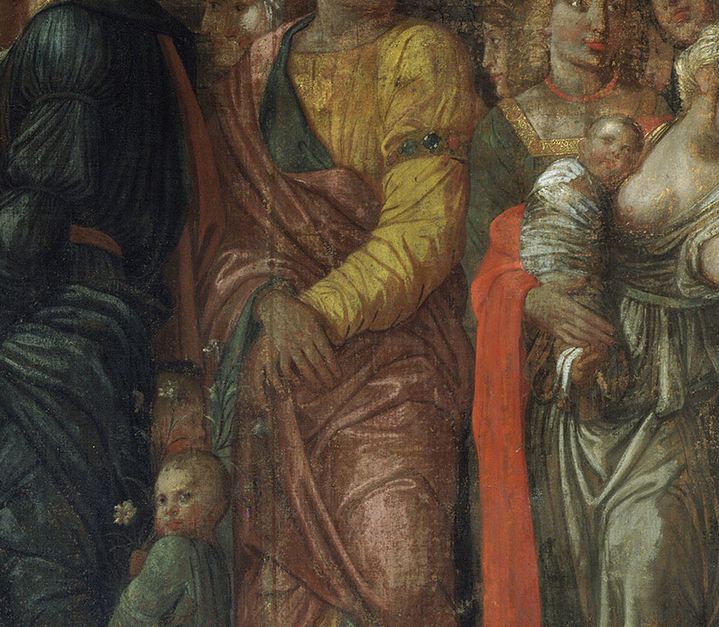
The dark building
The architectural surface gives the group a darker background. Its unbroken patches let the lighter heads and clothes read clearly.
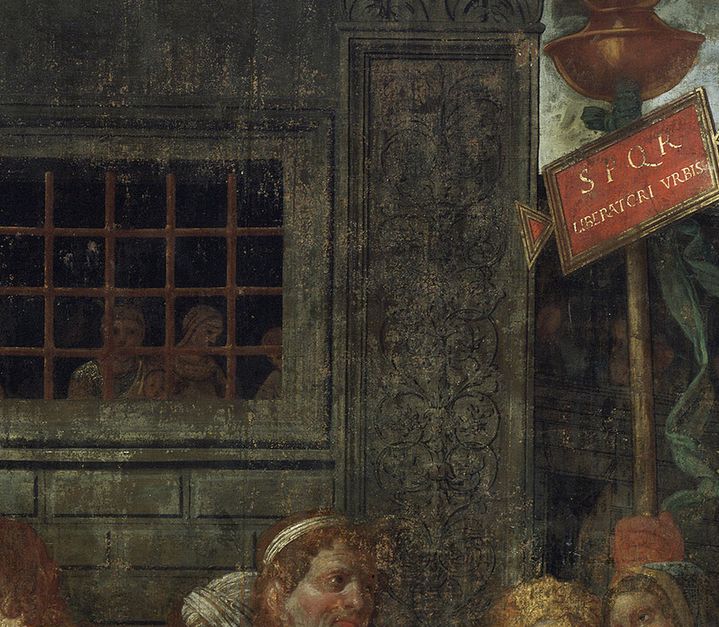
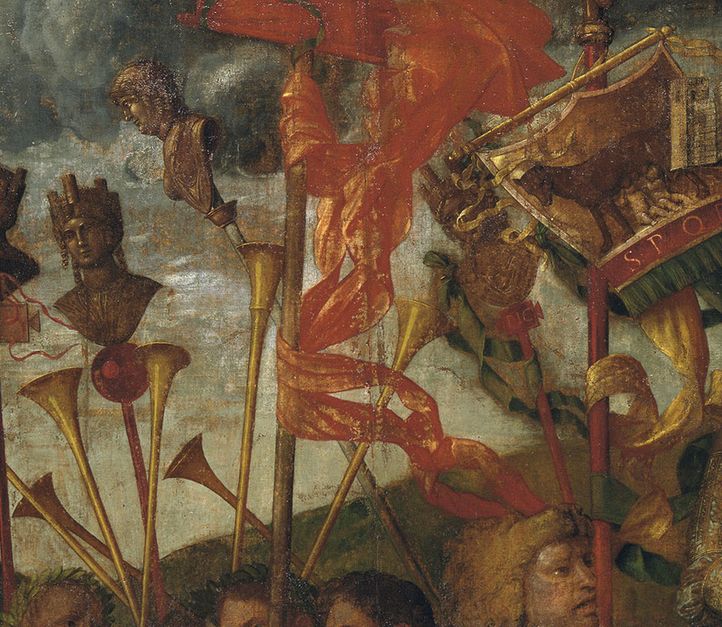
The Triumphs of Caesar
Standards above the crowd
The banners and poles form a set of vertical and diagonal accents above the people. The gaps between them keep the movement legible.
The clustered musicians
Figures close into a line beneath the standards. The small spaces between equipment and faces reward sustained looking.
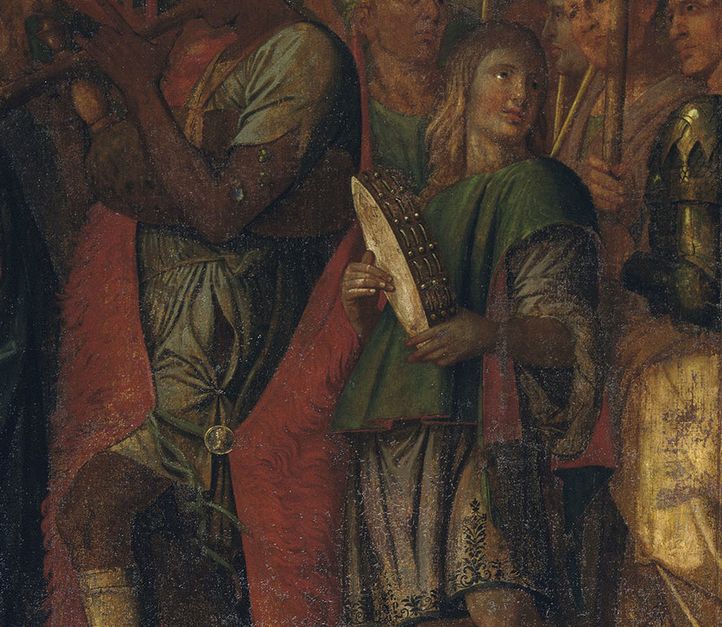
The Triumphs of Caesar
Caesar in the chariot
The principal figure rises above the people around the vehicle. Steps and wheels carry the steady horizontal movement of the lower series into the last picture.
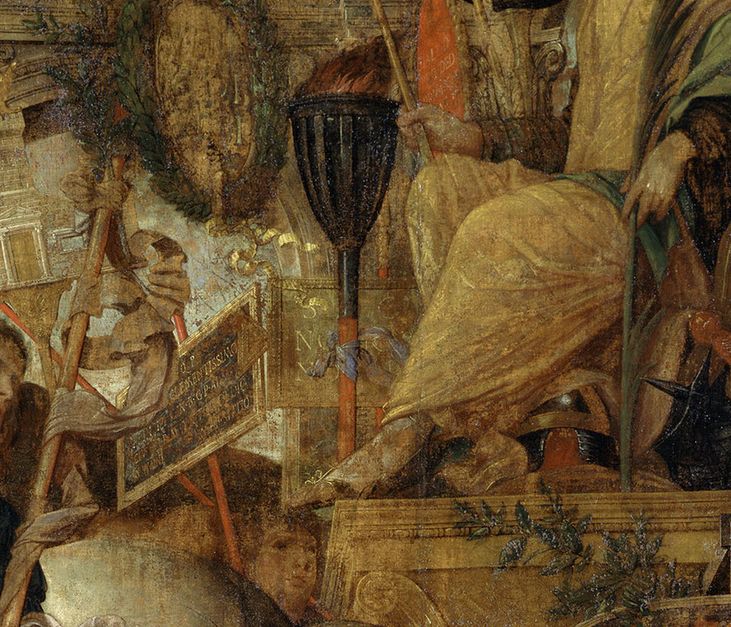
Wheel and procession
The large wheel introduces a conspicuous circle at the base. Nearby legs and garments continue the line of motion across the lower edge.
Artworks directory
| Name | Date | Medium and collection |
|---|---|---|
| The Adoration of the Shepherds | Shortly after 1450 | Painting · Metropolitan Museum of Art · 32.130.2 Catalogue. |
| Saint Mark the Evangelist | C. 1448–51 | Painting · Städel Museum · 1046 Catalogue. |
| Saint Jerome Penitent in the Desert | C. 1448–51 | Painting · Museu de Arte de São Paulo · MASP.00015 Catalogue. |
| Martyrdom and Transport of the Body of Saint Christopher | Mid-1450s | Painting · Ovetari Chapel, Padua Catalogue. |
| San Luca Altarpiece | 1453–55 | Painting · Pinacoteca di Brera · 176 Catalogue. |
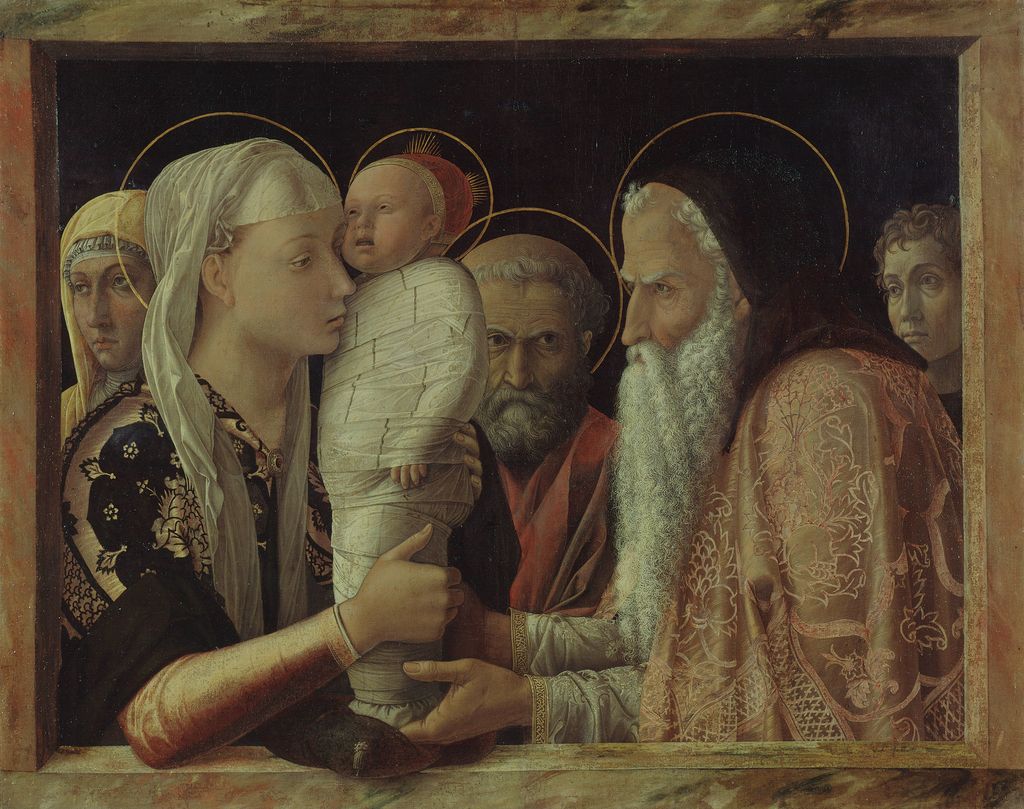
| The Presentation of Christ at the Temple | 1454 (Berlin dating) | Painting · Gemäldegalerie, Berlin · 29 Catalogue. |
| San Zeno Altarpiece | 1457–59 | Painting · Basilica of San Zeno, Verona Catalogue. |
| The Crucifixion | 1456–59 | Painting · Musée du Louvre · INV 368 Catalogue. |
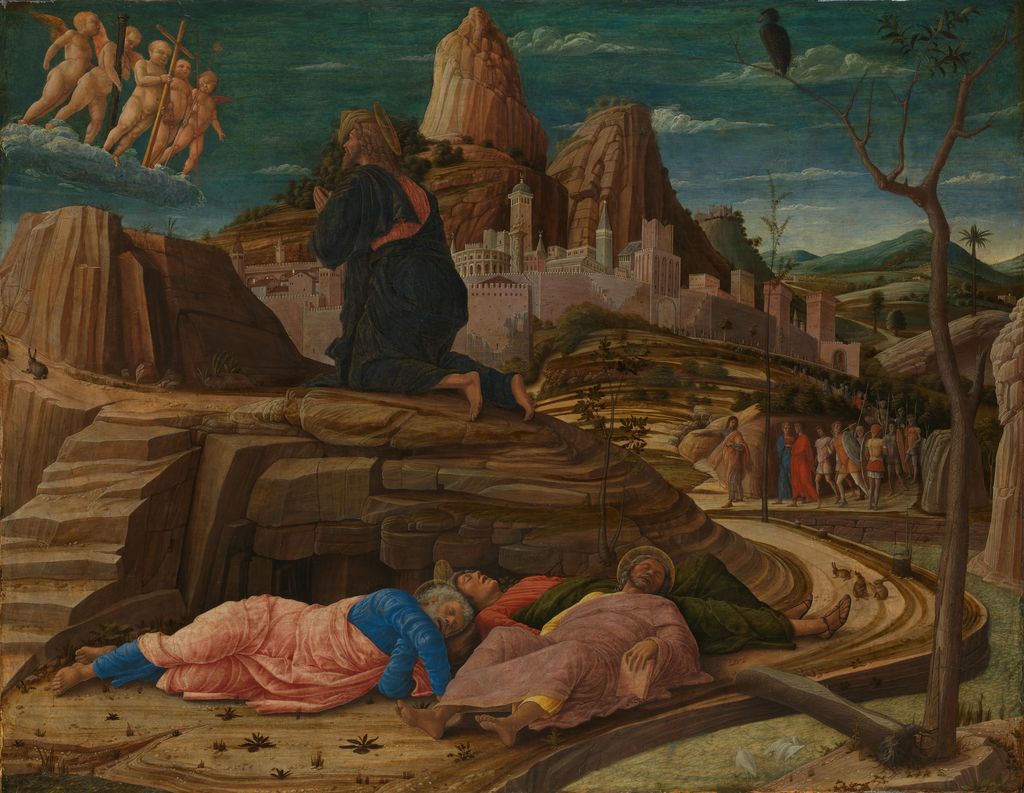
| The Agony in the Garden (London) | C. 1455–56 | Painting · National Gallery, London · NG1417 Catalogue. |
| The Agony in the Garden (Tours) | 1459 (Tours dating) | Painting · Musée des Beaux-Arts de Tours · 1803-1-24 Catalogue. |
| The Resurrection | 1459 (Tours dating) | Painting · Musée des Beaux-Arts de Tours · 1803-1-25 Catalogue. |
| Saint Sebastian (Vienna) | C. 1457–59 | Painting · Kunsthistorisches Museum · GG 301 Catalogue. |
| Cardinal Ludovico Trevisan | C. 1459–60 (Berlin exhibition dating) | Painting · Gemäldegalerie, Berlin · 9 Catalogue. |
| The Death of the Virgin | C. 1462 | Painting · Museo Nacional del Prado · P000248 Catalogue. |
| Christ with the Soul of the Virgin | C. 1460–64 | Painting · Pinacoteca Nazionale, Ferrara Catalogue only. |
| Portrait of a Young Man (traditionally Francesco Gonzaga) | C. 1461 or 1470, depending on sitter | Painting · Museo di Capodimonte · Q 60 Catalogue. |
| Portrait of a Prelate (Carlo de’ Medici?) | C. 1465–70 | Painting · Uffizi Galleries · 1890 no. 8540 Catalogue. |
| Portrait of a Man | C. 1470 | Painting · National Gallery of Art, Washington · 1952.2.5 Catalogue. |
| Madonna with Sleeping Child (Berlin) | C. 1455–60 | Painting · Gemäldegalerie, Berlin · S.5 Catalogue. |
| Camera degli Sposi (Camera Picta) | 1465–74 | Painting · Palazzo Ducale, Mantua Catalogue. |
| Saint Sebastian (Louvre) | Around 1480 | Painting · Musée du Louvre · RF 1766 Catalogue. |
| Lamentation over the Dead Christ | C. 1483 (Brera dating) | Painting · Pinacoteca di Brera · 352 Catalogue. |
| The Triumphs of Caesar | About 1485–1506 | Painting · Royal Collection · RCIN 403958–403966 Catalogue. |
| Madonna of the Caves | C. 1488–90 | Painting · Uffizi Galleries · 1890 no. 1348 Catalogue. |
| Madonna and Child with a Choir of Cherubim | C. 1485 | Painting · Pinacoteca di Brera · 297 Catalogue. |
| Madonna and Child (Poldi Pezzoli) | Early 1490s (museum dating) | Painting · Museo Poldi Pezzoli · 1595 Catalogue. |
| The Holy Family with Saint Mary Magdalen | C. 1495–1500 | Painting · Metropolitan Museum of Art · 14.40.643 Catalogue. |
| The Virgin and Child with Saint Mary Magdalene and Saint John the Baptist | C. 1490–1505 | Painting · National Gallery, London · NG274 Catalogue. |
| Christ as the Suffering Redeemer | 1485–95 (SMK dating) | Painting · Statens Museum for Kunst · KMSsp69 Catalogue. |
| Ecce Homo | C. 1500 | Painting · Musée Jacquemart-André · MJAP-P 1840 Catalogue. |
| Judith with the Head of Holofernes (Mantegna or follower) | C. 1495–1500 | Painting · National Gallery of Art, Washington · 1942.9.42 Catalogue. |
| Madonna della Vittoria | 1495–96 | Painting · Musée du Louvre · INV 369 Catalogue. |
| Mars and Venus (Parnassus) | C. 1496–97 | Painting · Musée du Louvre · INV 370 Catalogue. |
| The Trivulzio Madonna | 1497 | Painting · Castello Sforzesco, Milan · 0554 Catalogue. |
| The Adoration of the Magi | C. 1495–1505 | Painting · J. Paul Getty Museum · 85.PA.417 Catalogue. |
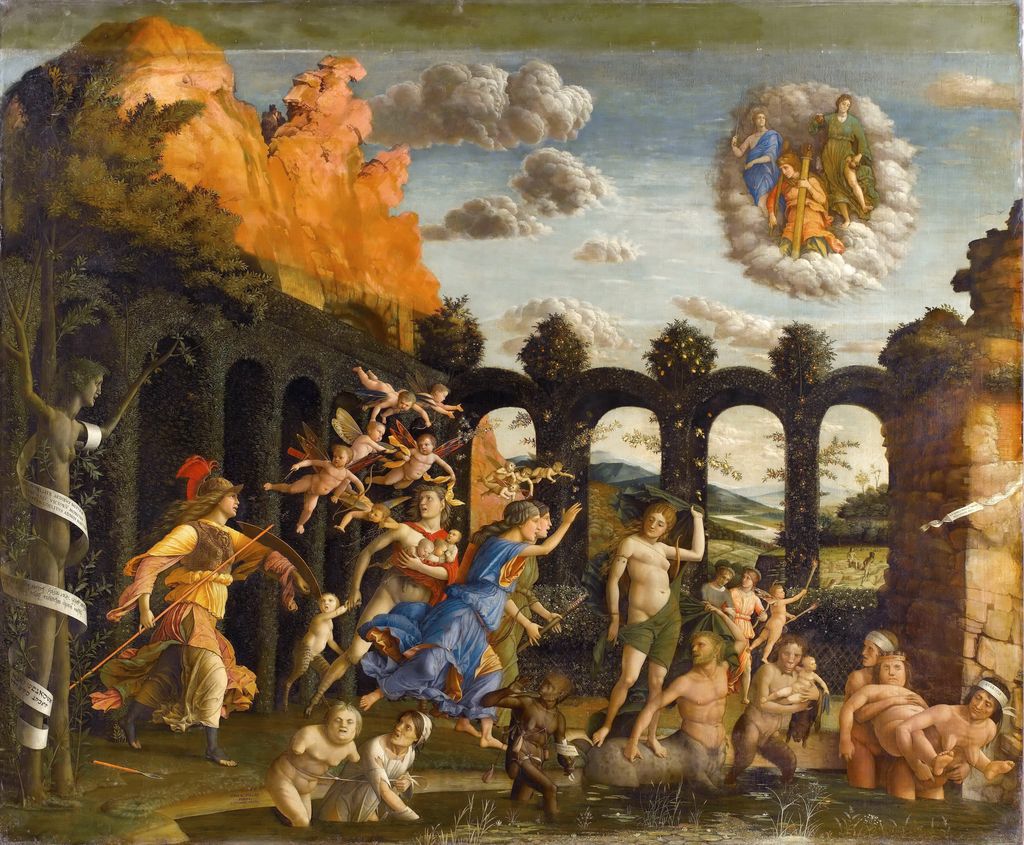
| Minerva Expelling the Vices from the Garden of Virtue | C. 1502 | Painting · Musée du Louvre · INV 371 Catalogue. |
| The Introduction of the Cult of Cybele at Rome | 1505–06 | Painting · National Gallery, London · NG902 Catalogue. |
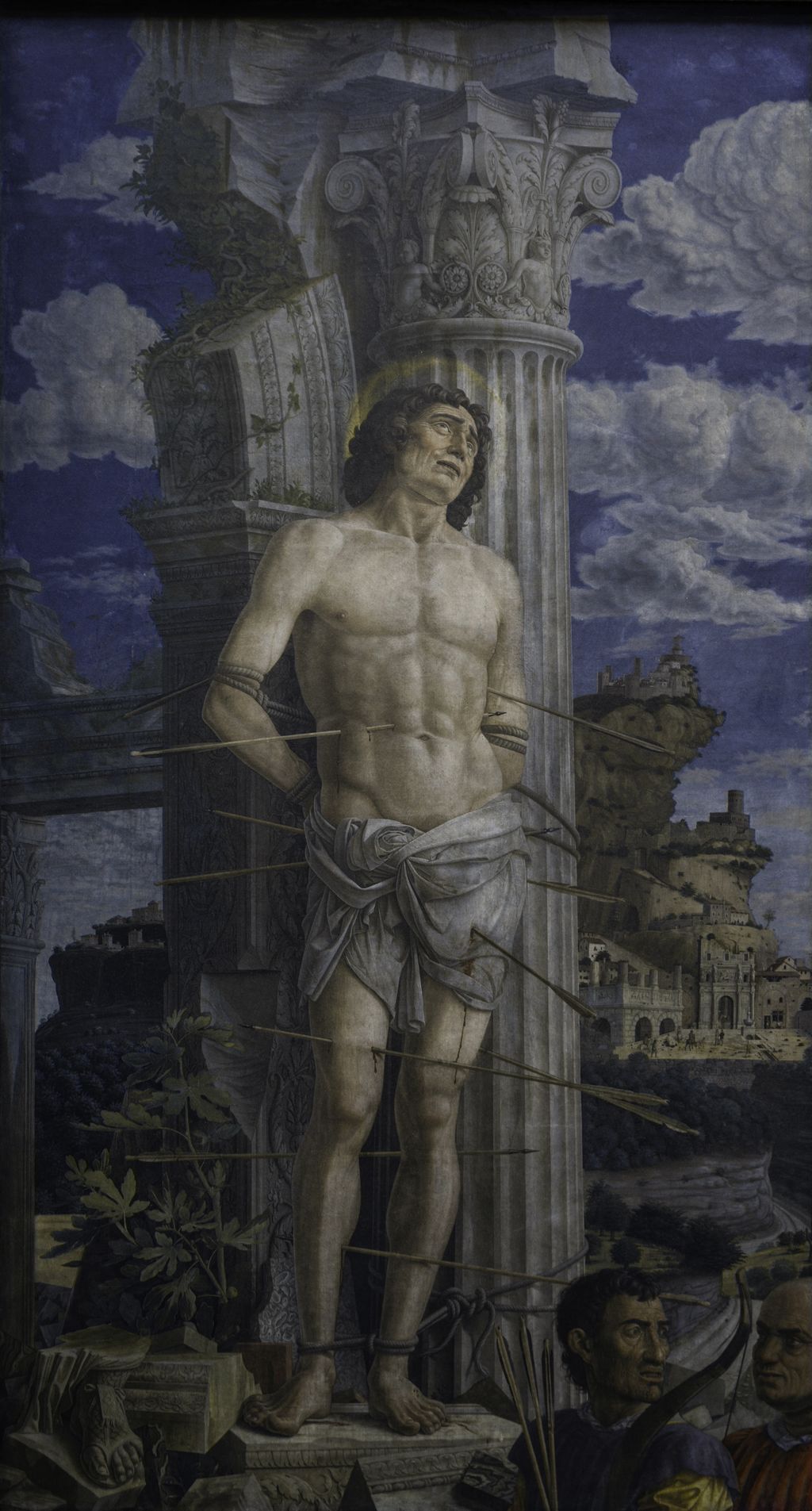
| Saint Sebastian (Venice) | Probably c. 1504–06 | Painting · Galleria Giorgio Franchetti alla Ca’ d’Oro · D.11 Catalogue. |
| Samson and Delilah | C. 1500 | Painting · National Gallery, London · NG1145 Catalogue only. |
| A Woman Drinking (probably Sophonisba) | C. 1495–1506 | Painting · National Gallery, London · NG1125.2 Catalogue only. |
| The Vestal Virgin Tuccia with a Sieve | C. 1495–1506 | Painting · National Gallery, London · NG1125.1 Catalogue only. |
| Judith with the Head of Holofernes (Dublin) | C. 1495–1500 | Painting · National Gallery of Ireland · NGI.442 Catalogue only. |
| Battle of the Sea Gods, left half (Met impression) | Before 1481 (Met dating) | Print · Metropolitan Museum of Art · 18.12 Catalogue only. |
| Battle of the Sea Gods, right half (Met impression) | Before 1481 (Met dating) | Print · Metropolitan Museum of Art · 1984.1201.4 Catalogue only. |
| Battle of the Sea Gods, left half (Tokyo impression) | C. 1475 (Tokyo dating) | Print · National Museum of Western Art, Tokyo · G.1981-0002 Catalogue only. |
| Battle of the Sea Gods, left half (Washington impression) | C. 1485–88 (NGA dating) | Print · National Gallery of Art, Washington · 1941.1.6 Catalogue only. |
| The Entombment of Christ, second state of two | Before 1475 (Met dating) | Print · Metropolitan Museum of Art · 37.42.30 Catalogue only. |
| The Entombment of Christ (possibly Zoan Andrea, after Mantegna) | 1460–1549 (Rijksmuseum dating) | Print · Rijksmuseum · RP-P-1924-60 Catalogue only. |
| Four Dancing Muses (Gian Marco Cavalli after Mantegna) | C. 1497 | Print · Metropolitan Museum of Art · 20.5.3 Catalogue only. |
| Bacchanal with Silenus | Before 1475 (Met dating) | Print · Metropolitan Museum of Art · 29.44.15 Catalogue only. |
| Bacchanal with a Wine Vat | Before 1475 (Met dating) | Print · Metropolitan Museum of Art Catalogue only. |
| St James on His Way to Execution | C. 1453–57 | Drawing · British Museum · 1976,0616.1 Catalogue only. |
| Three Studies for a Dead Christ | C. 1455–65 | Drawing · British Museum · 1909,0406.3 Catalogue only. |
| Pietà (Venice) | C. 1456–65 (exhibition datings) | Drawing · Gallerie dell’Accademia, Venice · 115 Catalogue only. |
| Studies for Christ at the Column | 1460–65 | Drawing · The Courtauld · D.1978.PG.345 Catalogue only. |
| Virtus Combusta | C. 1490 (technical study) | Drawing · British Museum · Pp,1.23 Catalogue only. |
| Virtus Combusta (Giovanni Antonio da Brescia after Mantegna) | C. 1495–1506 | Print · Musée du Louvre · 3881 LR/ Recto Catalogue only. |
| The Calumny of Apelles | C. 1504–06 | Drawing · British Museum · 1860,0616.85 Catalogue only. |
Frequently Asked Questions
The tablet and elephants point to Caesar’s Gallic triumph. Bryn Critz Schockmel reads the words on a flag in Canvas IX as Veni, vidi, vici, which Suetonius associates with the Pontic triumph. Together these clues suggest that Mantegna combined details from different celebrations in one painted procession. See “The Roman triumph and Mantegna’s sources” for the supporting evidence.
The paint surface of the seventh canvas has been heavily altered. Andrea Andreani’s woodcut makes the arrangement of the prisoners easier to follow, especially the woman carrying an infant.
Discussion
Look again at the images and ideas explored in The Triumphs of Caesar. These editorial prompts invite your observations.
Reader Insights
Compare the burdened porter in VI with the families made to march in VII. How does the shift from captured armour to captive people change what Caesar’s entrance in IX celebrates?
In Andreani’s Cleveland print after VII, find the woman holding an infant. Which relationships in the group become easier to follow alongside the painted canvas, and what can the print tell you about the composition?
Join the Conversation
Share a detail, comparison or question about The Triumphs of Caesar below.
References
- National Gallery, Andrea Mantegna, The Triumphs of Caesar, series essay (In-depth), also available in the Canvas I entry. View source.
- Royal Collection Trust, The Triumphs of Caesar 9: Caesar on his Chariot, RCIN 403966, Description and Provenance. View source.
- Boston University, Bryn Critz Schockmel, The Historical Procession of Andrea Mantegna’s Triumphs of Caesar: From Mantua to Hampton Court (2019), repository record, persistent Handle link and full text with numbered figures 0.1–0.9. View source 1. View source 2. View source 3.
- National Gallery, Room 12 and the displayed sequence of The Triumphs of Caesar. View source.
- National Gallery, The Triumphs of Caesar 1: The Trumpeters, individual canvas overview. View source.
- National Gallery, October 2026 Picture of the Month study of The Trumpeters. View source.
- Royal Collection Trust, The Triumphs of Caesar 1: The Trumpeters, RCIN 403958. View source.
- National Gallery, The Triumphs of Caesar 2: The Triumphal Carts. View source.
- Royal Collection Trust, The Triumphs of Caesar 2: The Triumphal Carts, RCIN 403959. View source.
- National Gallery, The Triumphs of Caesar 3: The Trophy Bearers. View source.
- Royal Collection Trust, The Triumphs of Caesar 3: The Trophy Bearers, RCIN 403960. View source.
- National Gallery, The Triumphs of Caesar 4: The Vase-Bearers, overview and key facts. View source.
- Royal Collection Trust, The Triumphs of Caesar 4: The Vase Bearers, RCIN 403961. View source.
- University of Chicago, LacusCurtius, Suetonius, Julius 37, translated by J. C. Rolfe. View source.
- National Gallery, The Triumphs of Caesar 5: The Elephants. View source.
- Royal Collection Trust, The Triumphs of Caesar 5: The Elephants, RCIN 403962. View source.
- National Gallery, The Triumphs of Caesar 6: The Corselet-Bearers. View source.
- Royal Collection Trust, The Triumphs of Caesar 6: The Corselet Bearers, RCIN 403963. View source.
- Royal Collection Trust, The Triumphs of Caesar 7: The Captives, exhibition record for RCIN 403964. View source.
- Cleveland Museum of Art, Andrea Andreani’s woodcut of The Captives, 1930.583.8. View source.
- Royal Collection Trust, The Triumphs of Caesar 8: The Musicians, RCIN 403965. View source.
- University of Chicago, LacusCurtius, Suetonius, Julius 37, Latin text. View source.
- University of Chicago, LacusCurtius, Appian, Civil Wars II.101, Caesar’s triumphs. View source.
- University of Chicago, LacusCurtius, Plutarch, Aemilius 32–34, the triumph of Aemilius Paullus. View source.
- Musée du Louvre, Collection commentary on a drawing associated with The Triumphs of Caesar. View source.
- Parco archeologico del Colosseo, The Arch of Titus and its triumphal reliefs. View source.
- Musée du Louvre, Mantegna retrospective, section on The Triumphs of Caesar. View source.
- Giuseppe Campori, Sigismondo Cantelmo’s Carnival report in Lettere artistiche inedite, no. II, pp. 4–5, digital facsimile and searchable transcription. View source 1. View source 2.
- Archivio di Stato di Modena, Finding aid for the Mantua ambassadors’ correspondence, b. 1, fasc. 48, PDF p. 8. View source.
- Università Iuav di Venezia, Francesca Bortoletti, “Mantova 1501. Festa e politica sul modello del ‘theatro delli antichi o moderni’,” in Feste e teatro, p. 147 n. 1, pp. 147–152 and 165–166 and Università Ca’ Foscari Venezia, parallel institutional copy, p. 147 n. 1, pp. 147–152 and 165–166. View source 1. View source 2.
- Musei Civici di Mantova, Palazzo San Sebastiano and its building history. View source.
- Musei Civici di Mantova, I trionfi di Cesare, with an excerpt from Mario Equicola’s chronicle. View source.
- Heidelberg University Library, Christoph Luitpold Frommel, “Galleria e loggia”, p. 91, fig. 2, plan of the hall and repository record. View source 1. View source 2.
- National Gallery, Peter Schade, “Reframing Three Canvases”, Annual Review 2018–19, printed p. 34. View source.
- Royal Academy of Arts catalogue, Barbara Furlotti and Guido Rebecchini on Mantegna’s Triumph and the Gonzaga collection, pp. 54–59. View source.
- Royal Collection Trust, The Art of Italy in the Royal Collection, pp. 18–21 and notes 46–49 on the acquisition, and printed p. 34 on Hampton Court. View source.
- Internet Archive, William Noel Sainsbury’s 1859 collection of original papers, appendix, Nijs to Dorchester, item CII, pp. 327–329, and Rowlandson to Weston, item CXII, p. 336. View source.
- Fondazione Venezia 2000, Leandro Ventura on Murano and the second shipment of Gonzaga works. View source.
- National Gallery, 2023 announcement of The Triumphs of Caesar loan and display history. View source.
- Hamilton Kerr Institute, Fitzwilliam Museum, Bulletin 10, treatment history of The Triumphs of Caesar, pp. 160–162. View source.
- Metropolitan Museum of Art, Dianne Dwyer Modestini, “John Brealey and the Cleaning of Paintings”, Metropolitan Museum Journal 40 (2005), pp. 27–36, especially p. 28 on the Hampton Court restoration and publisher PDF, PDF p. 2. View source 1. View source 2.
- National Gallery, Annual Report and Accounts 2023 to 2024, reframing for the loan display, printed p. 6 (PDF p. 8). View source.
- Historic Royal Palaces, Hampton Court Palace’s Mantegna Gallery, interim display and reopening plans. View source.
- Metropolitan Museum of Art, Andrea Andreani’s Triumphs of Caesar woodcut suite, print catalogue data for 2017.449. View source.
- Metropolitan Museum of Art, Andrea Andreani’s elephant impression after Mantegna, 22.73.3–93. View source.
- National Gallery of Art, Washington, Andrea Andreani, The Triumph of Julius Caesar: No. 9, plus 2 Columns, 1943.3.5766.f. View source.
- Staatliche Museen zu Berlin, Mantegna and Goethe exhibition. View source.
- National Gallery, Peter Paul Rubens, A Roman Triumph, NG278. View source.
- Basilica of San Zeno, Verona, San Zeno Altarpiece, View source.
- Palazzo Ducale, Mantua, Camera degli Sposi (Camera Picta), View source.
- Musée du Louvre, Madonna della Vittoria, View source.
- National Gallery, London, The Introduction of the Cult of Cybele at Rome, View source.
More MANTEGNA Paintings
San Zeno Altarpiece
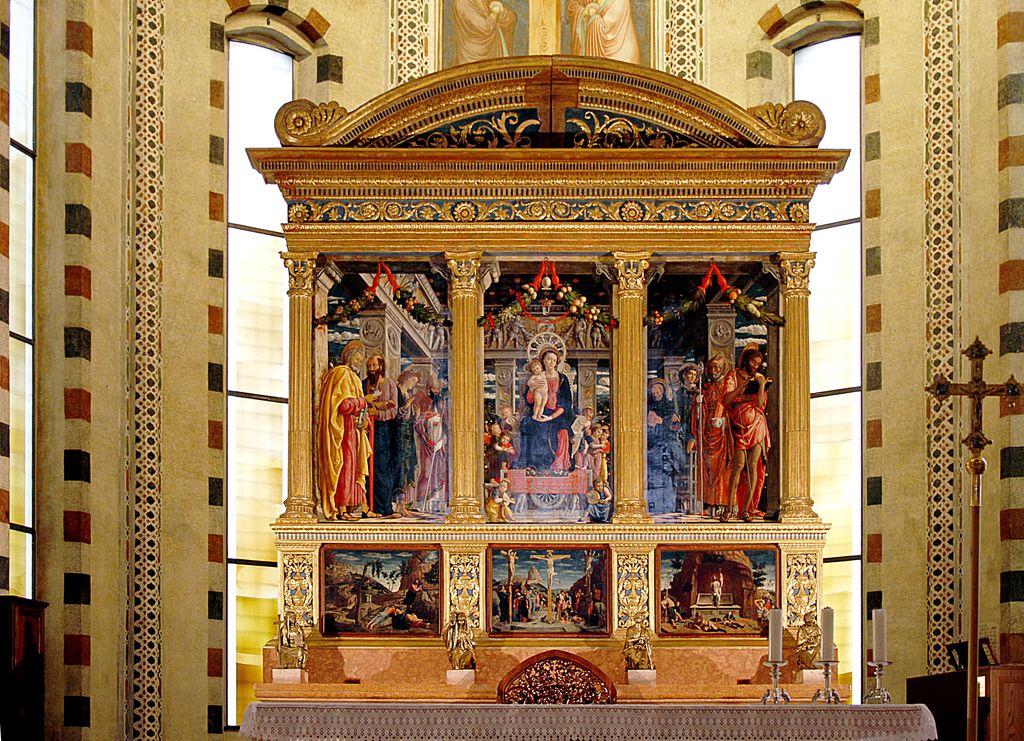
The San Zeno Altarpiece in its frame, Basilica of San Zeno, Verona José Luiz. Image source. CC BY-SA 4.0. Resized from the cited image.