 by Tom Gurney
Tom Gurney BSc (Hons) is an art history expert with over 20 years experience
Published on June 19, 2020 / Updated on November 29, 2026
Email: tomgurney1@gmail.com / Phone: +44 7429 011000
Overview
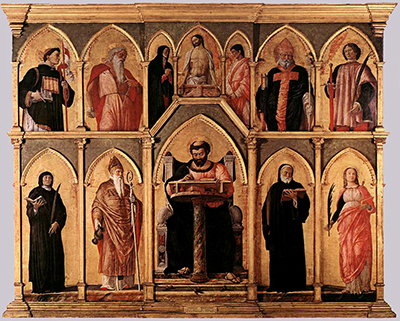
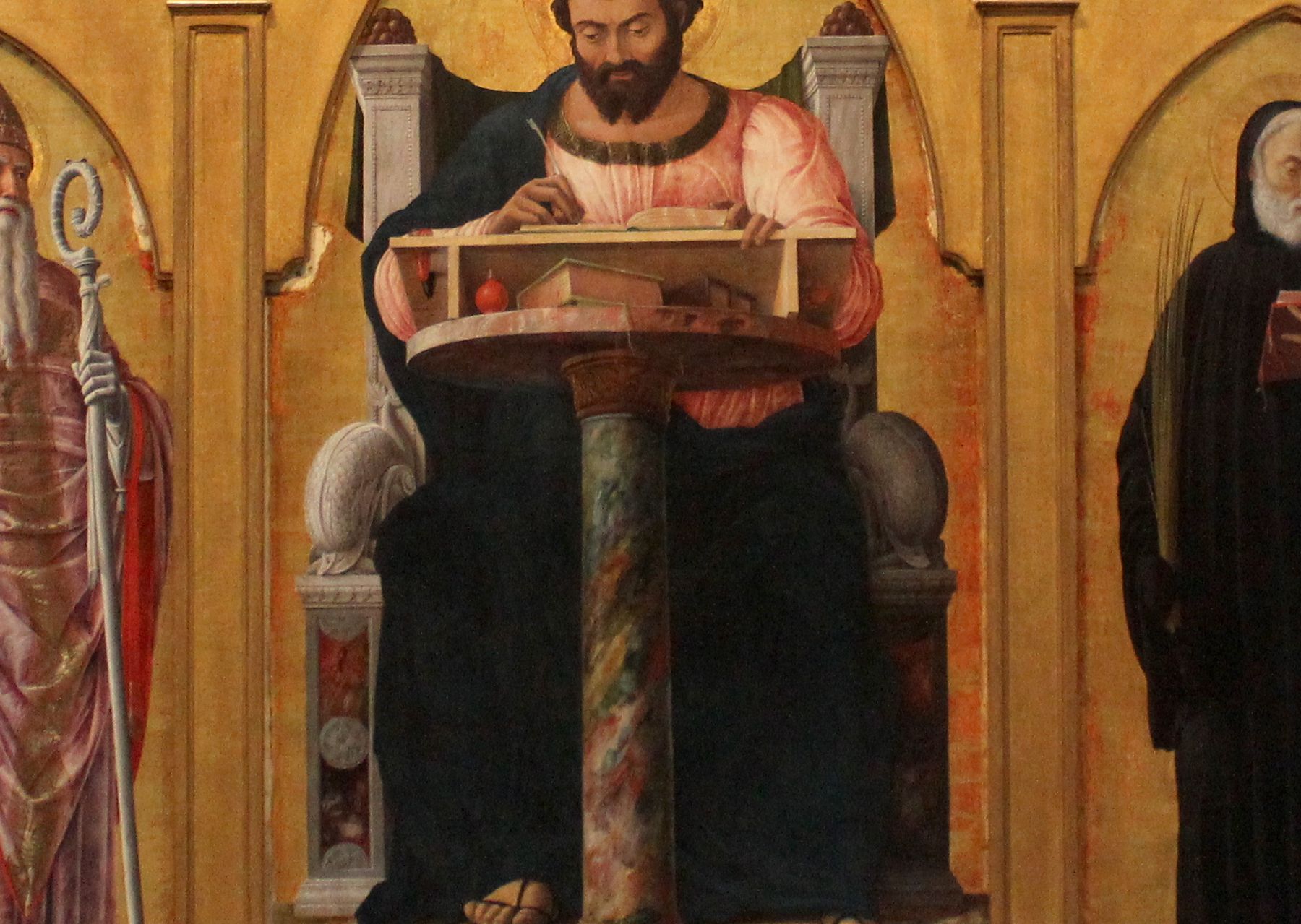
Saint Luke bends over an open book in the middle of Andrea Mantegna’s San Luca Altarpiece. His desk and marble seat take up much of the central panel, yet the stone platform beneath him appears to extend into the compartments on either side. Directly above him, Christ appears between Mary and Saint John, his wounded body framed by gold. Mantegna asks the eye to make connections across the divisions of a polyptych, an altarpiece made up of several compartments. [1] [2]
At a Glance
- Date1453–54 for the painting in Brera’s essay, with frame work documented in 1455
- MediumTempera on panel
- InstitutionPinacoteca di Brera, Milan
- Brera inventory176
- Original settingChapel of Saint Luke, Santa Giustina, Padua
Andrea Mantegna in context
San Luca Altarpiece
1453–55 [1]San Zeno Altarpiece
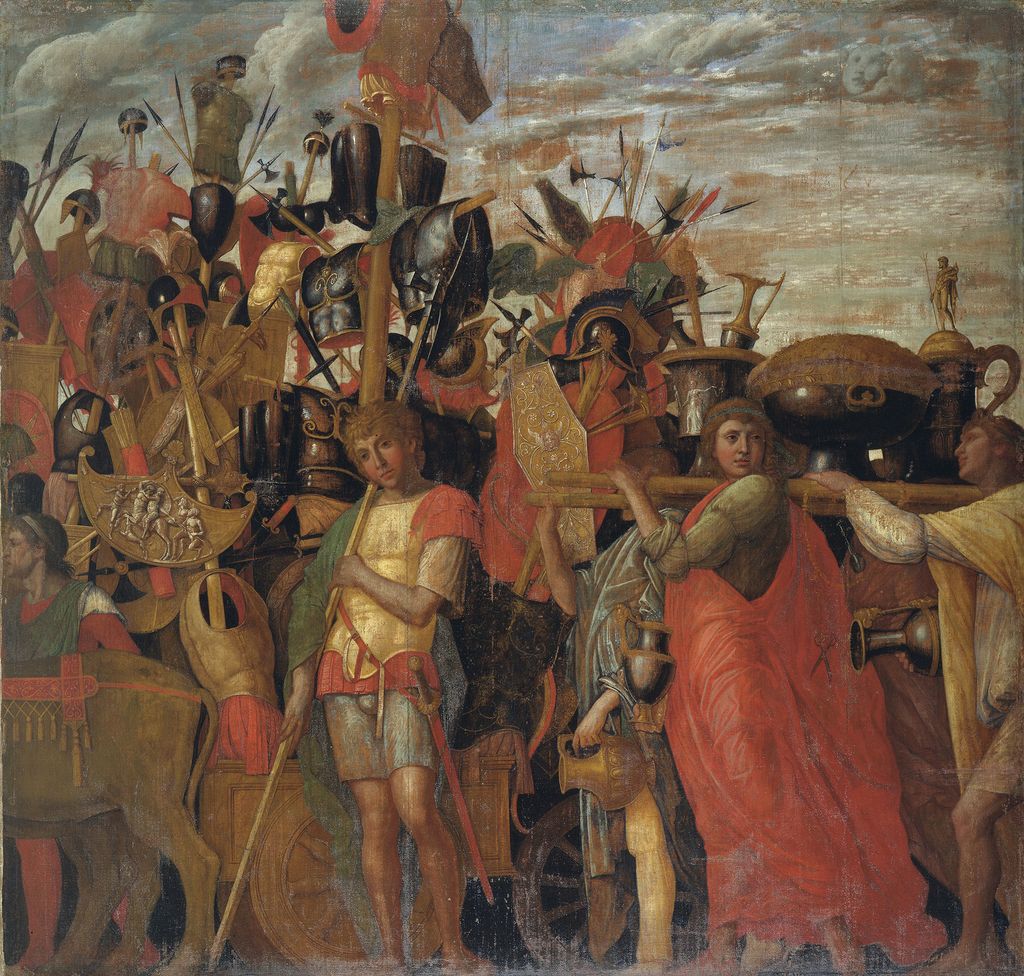
1457–59 [18]The Triumphs of Caesar
Mid-1480s–before 1506 [21]Madonna della Vittoria
1495–96 [22]An altarpiece for Luke’s chapel
On 10 August 1453, Abbot Mauro, born Sigismondo de’ Folperti of Pavia, contracted Mantegna to paint an altarpiece for the chapel of Saint Luke in the Benedictine abbey of Santa Giustina in Padua. The agreed price for the painting was fifty ducats. The chapel already had a programme devoted to its patron. In 1436 Giovanni Storlato had been commissioned to paint its walls with scenes concerning Luke, including the journey of the relics that Santa Giustina venerates as his. Mantegna’s panels gave that setting a concentrated image of the evangelist at work, surrounded by saints familiar to the community. [2] [3] [4]
Painting and framing had distinct schedules. Brera’s essay dates the painting to 1453–54, while its object record uses 1453–55. In November 1454 Mantegna undertook to gild the woodwork, which the national catalogue records as the work of a craftsman named Master Guglielmo. The catalogue documents a payment for gilding in February 1455. That later date belongs to the history of the ensemble and helps explain why the two date ranges appear. The surviving work is in tempera on panel, measures 177 by 230 centimetres overall according to Brera, and is held by the Pinacoteca di Brera in Milan, inventory 176. It came to the museum in the wake of the Napoleonic suppressions. According to the Italian culture ministry’s account to Parliament, it was on display at Brera by 1811. [1] [2] [3] [5]
Santa Giustina still offers a sense of how many places within one church could be associated with a single saint. The old chapel for which Mantegna painted is known as the Cappella Cornaro. The Italian Bishops’ Conference inventory records a copy of the altarpiece there and describes the separate chapel in the north transept where Luke’s shrine now stands. The distinction matters when looking at photographs of the basilica. A view of the present shrine shows the continuing importance of Luke at Santa Giustina. The old chapel and the record of its wall paintings bring us closer to the setting for which Abbot Mauro commissioned the panels. [2] [4] [6]
The saints on either side of Luke
On the left of the lower register stand a woman in a dark habit and Saint Prosdocimus. On the right are Saint Benedict and Saint Justina. The national catalogue favours Saint Felicitas, the reading also used by art historian Marco Tanzi. The Fondazione Federico Zeri’s catalogue calls her Saint Scholastica. Either name gives the monastic habit a particular local resonance. Felicitas is venerated at Santa Giustina and associated with its relics, while Scholastica belongs to the Benedictine tradition. The dark habit gives the viewer little help in choosing between the two names. [2] [3] [6] [7] [8] [9]
Prosdocimus, venerated as Padua’s first bishop, wears episcopal vestments. Across the seated evangelist, Benedict’s dark habit makes a strong patch of colour and his book recalls the rule by which the community lived. Justina carries the palm of martyrdom. Her position at the outside of the lower tier gives the abbey’s titular saint a clear silhouette, with the palm easy to pick out against the gold. The grouping brings figures belonging to the history of the city and its shrine into the same row as the founder whose rule defined the monks’ daily life. The national catalogue connects the choice of saints with the abbey’s written traditions about its holy figures. [1] [2] [6] [7]
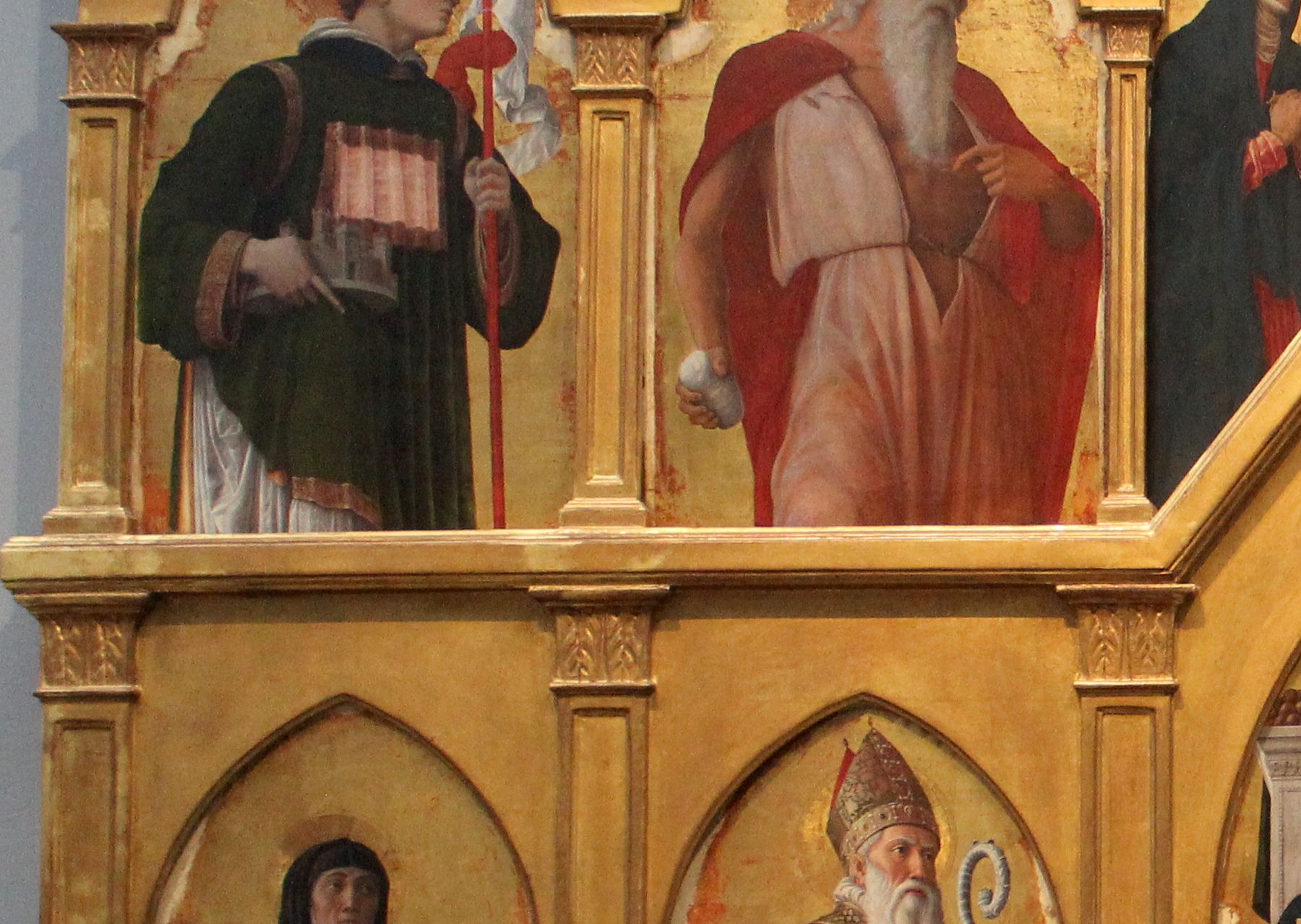
The upper register has Saint Daniel of Padua and Saint Jerome on the left, and Saint Maximus and Saint Julian on the right, following the identifications used by the national catalogue and Tanzi. In Daniel’s hands the catalogue identifies two signs of his role as a patron of Padua, a miniature walled city and the civic banner with its red cross. They bring a recognisable image of Padua into the upper tier. [2] [7] [10]
In the middle, Mary and John the Evangelist turn toward the dead Christ. This is an Imago Pietatis, or image of the suffering Christ, with the wounded body presented upright for contemplation. Luke’s table and the tomb above it give the two scenes different settings. Their alignment leads the eye from the hand at work on the Gospel to the body that gives the account of the Passion its subject. [1] [2] [3] [7]
Luke’s desk and the space made by gold
The national catalogue gives Luke’s panel a height of 140 centimetres, and the working area at his knees rewards a closer look. The open volume rests on an inclined board. Below it, other books occupy the space under the writing surface, and small pieces of fruit lie low in the foreground. The desk has a practical shape, with room for a book to be held open while Luke writes. The fruit gives a sense of how far below the page the marble lies. From a distance the figures and arches hold their places in the ensemble. Up close, the eye settles on the small interval between Luke’s hand and the surface of the page. [1] [11] [12]
That attention to the apparatus of writing has a particular significance at Santa Giustina. Brera connects the commission with the Benedictine reform associated with Ludovico Barbo. Art historian Alberta De Nicolò Salmazo, as discussed by Francesca Marcellan, reads Luke’s activity in light of the reformed community’s emphasis on study and the growth of its library. The proposal brings the subject down to the scale of a working day. The monks could recognise the tools of their own intellectual labour in those of the evangelist, whose book occupies the most prominent position in the altarpiece. [1] [12]
Follow the painted stone beneath the lower figures. Its visible top narrows into depth, and the edges pick up on the far side of the vertical dividers. The marble is particularly conspicuous beneath Luke, where the desk, seat and steps introduce surfaces at several angles. Along the edges of the garments and furnishings, gold is the only thing visible behind them. It supplies no distant wall or horizon by which to measure the depth of the setting. The stone has to do that work in a narrow band, and the solid fall of drapery helps carry the sense of volume upward from the feet. Brera reads the lower platform as a single foreshortened support shared across the compartments. [1]
In the upper register the figures feel close to the front of their openings. Seen from below, they retain a weight that their smaller scale might otherwise diminish. Brera suggests that the original projecting frame would have strengthened the impression of figures looking out from a raised arcade. The national catalogue proposes a Gothic structure with blue showing in the ornamental openings and records De Nicolò Salmazo’s view that the frame may have been more modern in character than is generally assumed. The original is lost, and the catalogue reports that restoration found no evidence to substantiate the tradition that a lightning strike destroyed it. The painted platforms and figures provide the clearest evidence of how the illusion was meant to work. [1] [2]
The move to Milan gave the surviving panels a new setting, and their wooden supports have limited subsequent moves. In 2000 the Italian culture ministry turned down a request to lend the polyptych to Padua for a conference on Saint Luke. The ministry noted that the panels had undergone extensive restoration in 1988–89 and cited the fragility of the wood in its decision. Even a temporary return to its city of origin posed a risk to the painted panels. [1] [5]
Donatello’s bronzes at the Santo
Brera connects Mantegna’s handling of perspective to the solutions Donatello developed for the high altar of the Basilica of Saint Anthony, known in Padua as the Santo. Mantegna had already painted figures for the lunette above that basilica’s main doorway in 1452. Donatello’s sculptural ensemble included Justina, Daniel and Prosdocimus, three saints who also appear at Santa Giustina. The basilica credits the arrangement visible at the Santo today to Camillo Boito in 1895. Comparisons with individual bronzes can therefore be more precise than comparisons with the present altar as a whole. [1] [3] [13]
In the bronze Miracle of the Mule, the receding bays behind the action make a shallow relief seem to contain an extensive interior. The arches and the lines of the vaults give the crowd a space to inhabit. At Santa Giustina a much smaller part of the image carries the illusion of depth. The marble platform and Luke’s furniture work against an extensive field of gold. Both artists give hard architectural edges a part in making the figures look solid. Their different settings show how much can be done with either an elaborately receding interior or just a few planes underfoot. [1] [14]
Donatello’s bronze Dead Christ with Angels, also from the Santo altar, offers a closer comparison of figure groups. In the relief, two angels draw near to the upright body within the same field. In Mantegna’s upper centre, Mary and John occupy narrow compartments of their own. Their gestures direct attention inwards across the dividers. The comparison makes the separation of the figures a feature of the image. Each mourner has room for a distinct response, while Christ remains the point to which both turn. [1] [2] [15]
From Mark’s parapet to the portico at San Zeno
The earlier St Mark the Evangelist, dated about 1448–51 by the Städel Museum, makes a painted window into the boundary between another evangelist and the viewer. Books rest close to the edge, and a small inscribed slip appears to be attached to the parapet. The Louvre’s exhibition account relates the half-length figure to Donatellian compositions in bronze or terracotta. Mark’s picture concentrates the illusion at a single threshold. For Luke, the seat, steps and furniture achieve a similar sense of near and far around a full-length seated figure, and the ledge beneath him has to connect with four standing neighbours. [1] [16] [17]
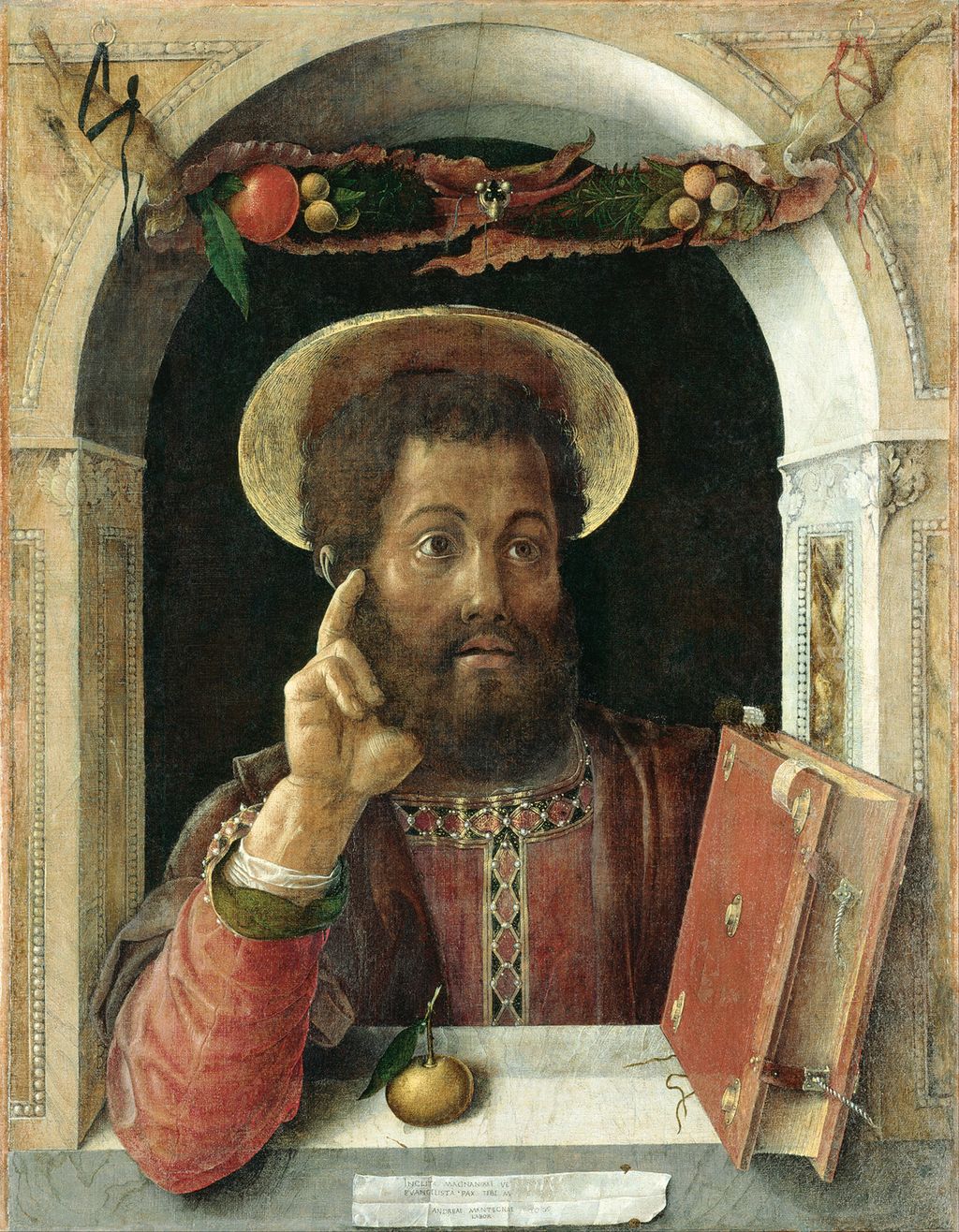
Saint Mark the Evangelist, Städel Museum Image source. Public domain.
Mantegna’s later San Zeno Altarpiece in Verona extends the relationship between painting and woodwork in a different direction. The Opificio delle Pietre Dure dates the altarpiece to 1457–59 and describes a three-dimensional wooden frame made to Mantegna’s design. Its four columns stand in front of the three main painted panels. The painted architecture beyond them reads across the joins as a single portico in which the Virgin and Child and the attendant saints are gathered. At San Luca the platform supplies the strongest horizontal connection, but above it the gold and the separate openings preserve the unmistakable presence of each figure. Look at where a divider meets the marble in San Luca, then where a column stands in front of the painted architecture at San Zeno. In both works the frame interrupts the painted surface. What changes is how much of the imagined setting the eye carries across that interruption. [1] [18] [19]
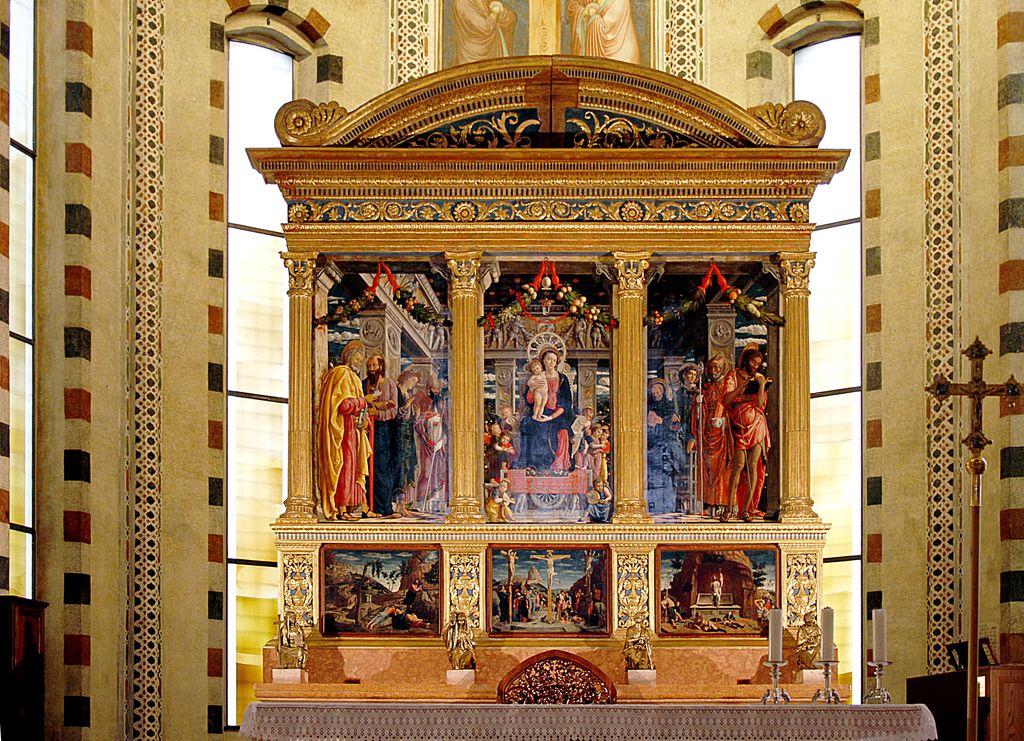
The San Zeno Altarpiece in its frame, Basilica of San Zeno, Verona José Luiz. Image source. CC BY-SA 4.0. Resized from the cited image.
Annotated Details from The San Luca Altarpiece
The numbered points identify details to look at closely. The detail images below preserve the native scale of the selected crops.
The San Luca Altarpiece
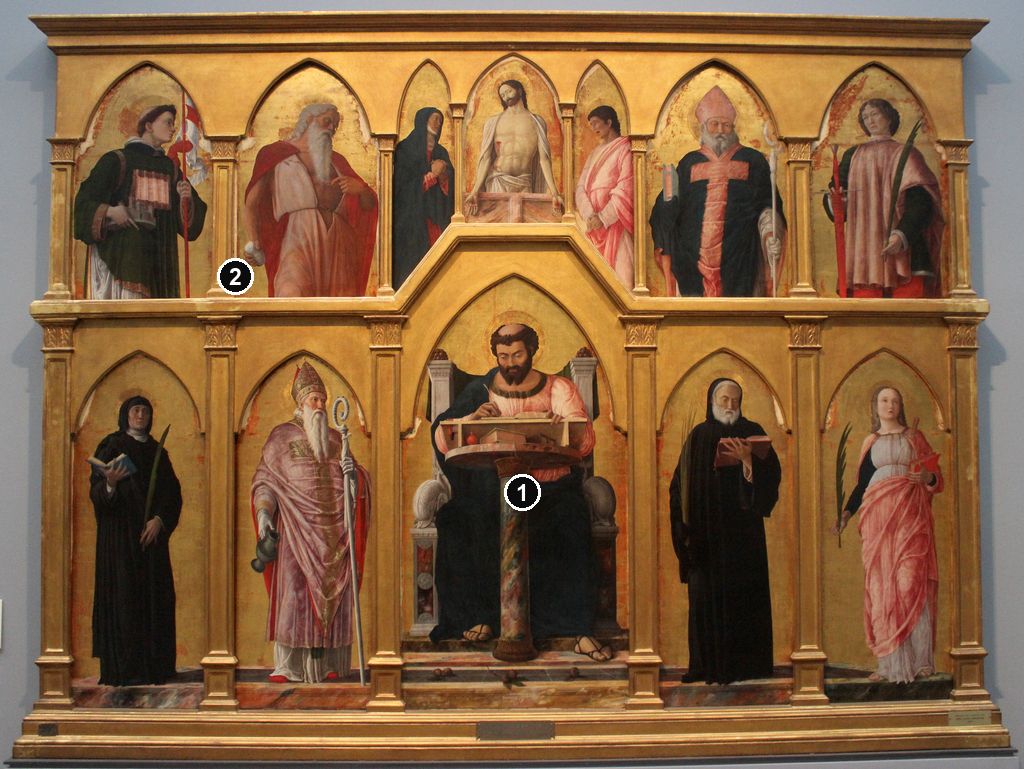
Details from THE SAN LUCA ALTARPIECE
Choose a detail to enlarge it.
The San Luca Altarpiece
Luke at his desk
The central saint appears in a deeper interior than some neighbours. Furniture points into that space within the painted compartment.
Registers and divisions
The surrounding gold and arch profiles keep the saints separate. Their scale and positions establish the levels of the ensemble.
Artworks directory
| Name | Date | Medium and collection |
|---|---|---|
| The Adoration of the Shepherds | Shortly after 1450 | Painting · Metropolitan Museum of Art · 32.130.2 Catalogue. |
| Saint Mark the Evangelist | C. 1448–51 | Painting · Städel Museum · 1046 Catalogue. |
| Saint Jerome Penitent in the Desert | C. 1448–51 | Painting · Museu de Arte de São Paulo · MASP.00015 Catalogue. |
| Martyrdom and Transport of the Body of Saint Christopher | Mid-1450s | Painting · Ovetari Chapel, Padua Catalogue. |
| San Luca Altarpiece | 1453–55 | Painting · Pinacoteca di Brera · 176 Catalogue. |
| The Presentation of Christ at the Temple | 1454 (Berlin dating) | Painting · Gemäldegalerie, Berlin · 29 Catalogue. |
| San Zeno Altarpiece | 1457–59 | Painting · Basilica of San Zeno, Verona Catalogue. |
| The Crucifixion | 1456–59 | Painting · Musée du Louvre · INV 368 Catalogue. |
| The Agony in the Garden (London) | C. 1455–56 | Painting · National Gallery, London · NG1417 Catalogue. |
| The Agony in the Garden (Tours) | 1459 (Tours dating) | Painting · Musée des Beaux-Arts de Tours · 1803-1-24 Catalogue. |
| The Resurrection | 1459 (Tours dating) | Painting · Musée des Beaux-Arts de Tours · 1803-1-25 Catalogue. |
| Saint Sebastian (Vienna) | C. 1457–59 | Painting · Kunsthistorisches Museum · GG 301 Catalogue. |
| Cardinal Ludovico Trevisan | C. 1459–60 (Berlin exhibition dating) | Painting · Gemäldegalerie, Berlin · 9 Catalogue. |
| The Death of the Virgin | C. 1462 | Painting · Museo Nacional del Prado · P000248 Catalogue. |
| Christ with the Soul of the Virgin | C. 1460–64 | Painting · Pinacoteca Nazionale, Ferrara Catalogue only. |
| Portrait of a Young Man (traditionally Francesco Gonzaga) | C. 1461 or 1470, depending on sitter | Painting · Museo di Capodimonte · Q 60 Catalogue. |
| Portrait of a Prelate (Carlo de’ Medici?) | C. 1465–70 | Painting · Uffizi Galleries · 1890 no. 8540 Catalogue. |
| Portrait of a Man | C. 1470 | Painting · National Gallery of Art, Washington · 1952.2.5 Catalogue. |
| Madonna with Sleeping Child (Berlin) | C. 1455–60 | Painting · Gemäldegalerie, Berlin · S.5 Catalogue. |
| Camera degli Sposi (Camera Picta) | 1465–74 | Painting · Palazzo Ducale, Mantua Catalogue. |
| Saint Sebastian (Louvre) | Around 1480 | Painting · Musée du Louvre · RF 1766 Catalogue. |
| Lamentation over the Dead Christ | C. 1483 (Brera dating) | Painting · Pinacoteca di Brera · 352 Catalogue. |
| The Triumphs of Caesar | About 1485–1506 | Painting · Royal Collection · RCIN 403958–403966 Catalogue. |
| Madonna of the Caves | C. 1488–90 | Painting · Uffizi Galleries · 1890 no. 1348 Catalogue. |
| Madonna and Child with a Choir of Cherubim | C. 1485 | Painting · Pinacoteca di Brera · 297 Catalogue. |
| Madonna and Child (Poldi Pezzoli) | Early 1490s (museum dating) | Painting · Museo Poldi Pezzoli · 1595 Catalogue. |
| The Holy Family with Saint Mary Magdalen | C. 1495–1500 | Painting · Metropolitan Museum of Art · 14.40.643 Catalogue. |
| The Virgin and Child with Saint Mary Magdalene and Saint John the Baptist | C. 1490–1505 | Painting · National Gallery, London · NG274 Catalogue. |
| Christ as the Suffering Redeemer | 1485–95 (SMK dating) | Painting · Statens Museum for Kunst · KMSsp69 Catalogue. |
| Ecce Homo | C. 1500 | Painting · Musée Jacquemart-André · MJAP-P 1840 Catalogue. |
| Judith with the Head of Holofernes (Mantegna or follower) | C. 1495–1500 | Painting · National Gallery of Art, Washington · 1942.9.42 Catalogue. |
| Madonna della Vittoria | 1495–96 | Painting · Musée du Louvre · INV 369 Catalogue. |
| Mars and Venus (Parnassus) | C. 1496–97 | Painting · Musée du Louvre · INV 370 Catalogue. |
| The Trivulzio Madonna | 1497 | Painting · Castello Sforzesco, Milan · 0554 Catalogue. |
| The Adoration of the Magi | C. 1495–1505 | Painting · J. Paul Getty Museum · 85.PA.417 Catalogue. |
| Minerva Expelling the Vices from the Garden of Virtue | C. 1502 | Painting · Musée du Louvre · INV 371 Catalogue. |
| The Introduction of the Cult of Cybele at Rome | 1505–06 | Painting · National Gallery, London · NG902 Catalogue. |
| Saint Sebastian (Venice) | Probably c. 1504–06 | Painting · Galleria Giorgio Franchetti alla Ca’ d’Oro · D.11 Catalogue. |
| Samson and Delilah | C. 1500 | Painting · National Gallery, London · NG1145 Catalogue only. |
| A Woman Drinking (probably Sophonisba) | C. 1495–1506 | Painting · National Gallery, London · NG1125.2 Catalogue only. |
| The Vestal Virgin Tuccia with a Sieve | C. 1495–1506 | Painting · National Gallery, London · NG1125.1 Catalogue only. |
| Judith with the Head of Holofernes (Dublin) | C. 1495–1500 | Painting · National Gallery of Ireland · NGI.442 Catalogue only. |
| Battle of the Sea Gods, left half (Met impression) | Before 1481 (Met dating) | Print · Metropolitan Museum of Art · 18.12 Catalogue only. |
| Battle of the Sea Gods, right half (Met impression) | Before 1481 (Met dating) | Print · Metropolitan Museum of Art · 1984.1201.4 Catalogue only. |
| Battle of the Sea Gods, left half (Tokyo impression) | C. 1475 (Tokyo dating) | Print · National Museum of Western Art, Tokyo · G.1981-0002 Catalogue only. |
| Battle of the Sea Gods, left half (Washington impression) | C. 1485–88 (NGA dating) | Print · National Gallery of Art, Washington · 1941.1.6 Catalogue only. |
| The Entombment of Christ, second state of two | Before 1475 (Met dating) | Print · Metropolitan Museum of Art · 37.42.30 Catalogue only. |
| The Entombment of Christ (possibly Zoan Andrea, after Mantegna) | 1460–1549 (Rijksmuseum dating) | Print · Rijksmuseum · RP-P-1924-60 Catalogue only. |
| Four Dancing Muses (Gian Marco Cavalli after Mantegna) | C. 1497 | Print · Metropolitan Museum of Art · 20.5.3 Catalogue only. |
| Bacchanal with Silenus | Before 1475 (Met dating) | Print · Metropolitan Museum of Art · 29.44.15 Catalogue only. |
| Bacchanal with a Wine Vat | Before 1475 (Met dating) | Print · Metropolitan Museum of Art Catalogue only. |
| St James on His Way to Execution | C. 1453–57 | Drawing · British Museum · 1976,0616.1 Catalogue only. |
| Three Studies for a Dead Christ | C. 1455–65 | Drawing · British Museum · 1909,0406.3 Catalogue only. |
| Pietà (Venice) | C. 1456–65 (exhibition datings) | Drawing · Gallerie dell’Accademia, Venice · 115 Catalogue only. |
| Studies for Christ at the Column | 1460–65 | Drawing · The Courtauld · D.1978.PG.345 Catalogue only. |
| Virtus Combusta | C. 1490 (technical study) | Drawing · British Museum · Pp,1.23 Catalogue only. |
| Virtus Combusta (Giovanni Antonio da Brescia after Mantegna) | C. 1495–1506 | Print · Musée du Louvre · 3881 LR/ Recto Catalogue only. |
| The Calumny of Apelles | C. 1504–06 | Drawing · British Museum · 1860,0616.85 Catalogue only. |
Frequently Asked Questions
He sits at the central desk with a book. His position and the furniture give his compartment a spatial depth that differs from the surrounding gold fields.
The Brera essay distinguishes the painting from work on the frame. The wider date range includes documented frame work in 1455.
Discussion
Look again at the images and ideas explored in San Luca Altarpiece. These editorial prompts invite your observations.
Reader Insights
Where does the marble platform carry the eye across a divider in the lower tier, and what changes as the eye rises into the gold background?
How do the separate panels for Mary and John affect the way you look at Christ compared with the two angels within Donatello’s single bronze relief?
Join the Conversation
Share a detail, comparison or question about San Luca Altarpiece below.
References
- Pinacoteca di Brera, Polittico di San Luca. View source.
- Ministero della Cultura, Polittico di San Luca, national catalogue record 0300180067-0. View source.
- Treccani, Mantegna, Andrea, Dizionario Biografico degli Italiani. View source.
- Abbazia di Santa Giustina, San Luca Evangelista. View source.
- Camera dei Deputati, Ministerial response on the San Luca Polyptych, 20 September 2000, interrogation 4-24948. View source.
- Conferenza Episcopale Italiana, Chiesa di Santa Giustina Vergine e Martire, Padova. View source.
- Marco Tanzi, I due tondi mancanti: Romanino a Padova e L’Edípeo enciclopedico. View source.
- Ministero della Cultura, Santa Felicita, national catalogue record 0300180067-8. View source.
- Fondazione Federico Zeri, Polittico di San Luca, object and photographic records. View source.
- Ministero della Cultura, San Daniele da Padova, national catalogue record 0300180067-1. View source.
- Ministero della Cultura, San Luca, national catalogue record 0300180067-10. View source.
- Francesca Marcellan, Il Quattrocento a Santa Giustina: Riflessi artistici che accompagnarono la rinascita del monastero dopo la riforma di Ludovico Barbo. View source.
- Basilica di Sant’Antonio di Padova, Presbiterio e altare maggiore. View source.
- Fondazione Federico Zeri, Donatello, Sant’Antonio da Padova e il miracolo della mula. View source.
- Fondazione Federico Zeri, Donatello, Cristo in pietà e angeli. View source.
- Städel Museum, St Mark the Evangelist. View source.
- Musée du Louvre, Around the Ovetari Chapel. View source.
- Opificio delle Pietre Dure, Andrea Mantegna, Pala di San Zeno. View source.
- Ministero della Cultura, Cornice della Pala di San Zeno, national catalogue record 0500127966. View source.
- Palazzo Ducale, Mantua, Camera degli Sposi (Camera Picta), View source.
- Royal Collection, The Triumphs of Caesar, View source.
- Musée du Louvre, Madonna della Vittoria, View source.
- National Gallery, London, The Introduction of the Cult of Cybele at Rome, View source.
More MANTEGNA Paintings
San Zeno Altarpiece
The San Zeno Altarpiece in its frame, Basilica of San Zeno, Verona José Luiz. Image source. CC BY-SA 4.0. Resized from the cited image.