 by Tom Gurney
Tom Gurney BSc (Hons) is an art history expert with over 20 years experience
Published on June 19, 2020 / Updated on November 29, 2026
Email: tomgurney1@gmail.com / Phone: +44 7429 011000
Overview
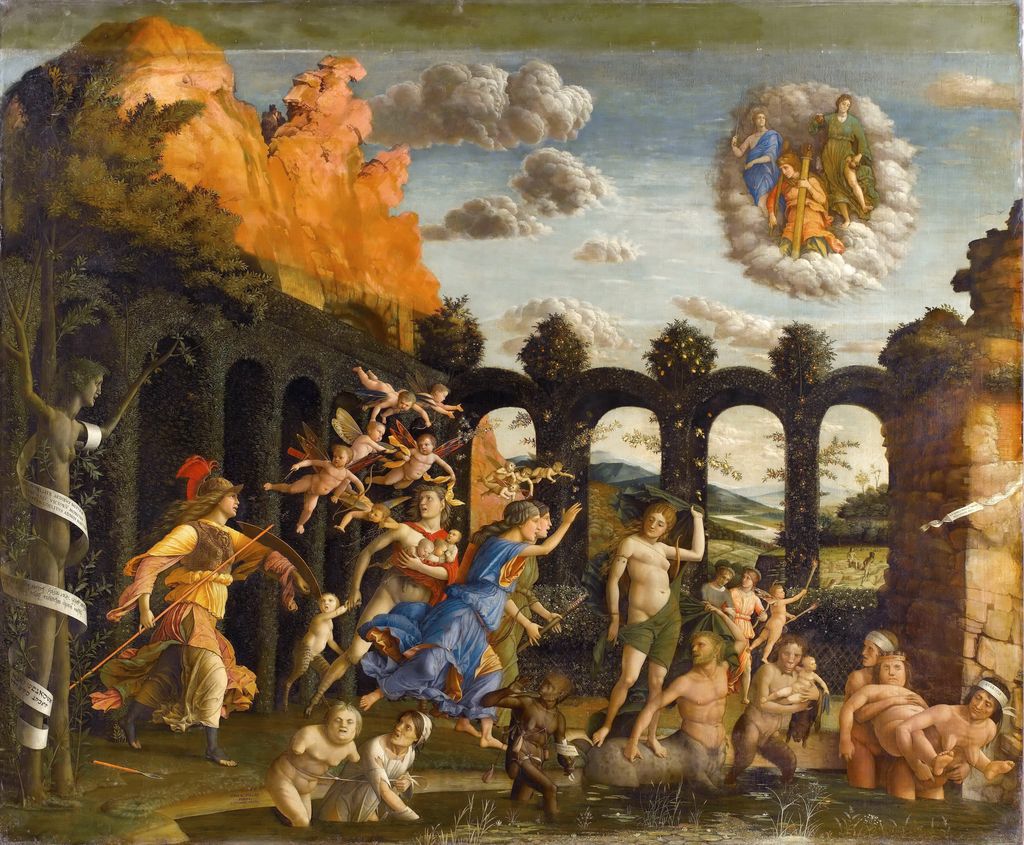
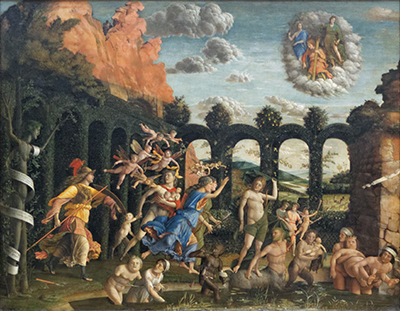
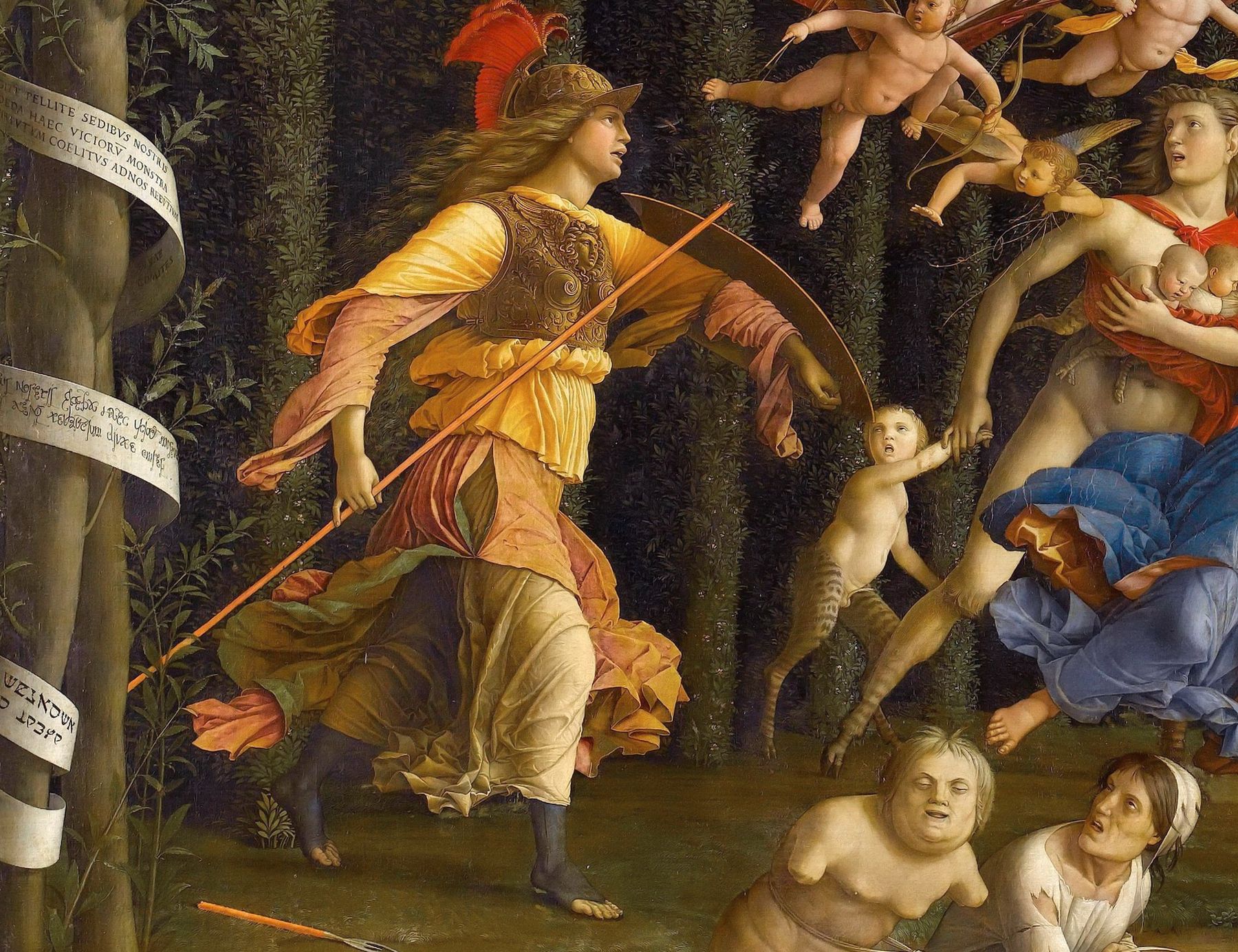
Minerva enters from the left with her shield forward and a broken lance in her hand. Ahead of her, figures scatter along the bank or struggle through a pool. Behind her, a tree with a woman's face calls for help. Andrea Mantegna's Triumph of the Virtues, which the Louvre calls Minerva Expelling the Vices from the Garden of Virtue, catches the intervention in progress. The garden is still occupied, the Virtues are still in the clouds, and someone out of sight is still asking to be rescued. [1] [2]
Isabella d’Este, Marchioness of Mantua, commissioned the painting for her private study in the Castello di San Giorgio. The Louvre's retrospective dated it to about 1500–1502 and gave 1502 as its year of completion. The museum's collection record files it more broadly under the last quarter of the fifteenth century and notes that the humanist Pomponio Gaurico mentioned it in 1504. The collection record gives the dimensions as 160 by 192 centimetres and lists the medium as tempera on canvas. It belongs to the Louvre's Department of Paintings as INV 371. [1] [2] [3]
At a Glance
- DateAbout 1500–1502, dated to completion in 1502 by the Louvre retrospective
- MediumTempera on canvas
- Original settingIsabella d’Este’s first studiolo, Castello di San Giorgio, Mantua
- CollectionMusée du Louvre, Department of Paintings
- AccessionINV 371
Andrea Mantegna in context
San Zeno Altarpiece
1457–59 [21]The Triumphs of Caesar
Mid-1480s–before 1506 [19]Madonna della Vittoria
1495–96 [23]Minerva Expelling the Vices from the Garden of Virtue
C. 1502 [1]Minerva takes the bank
The goddess has a foothold on dry ground, just above the figures in the water. Her shield leads the movement, while her right hand holds the stump of the lance. The long folds of her clothing carry the movement back towards the left. The twist between shoulders and hips makes her advance feel like a stride seen halfway through. The painter gives her the force of a combatant even though the effect of her arrival is clearest in what other bodies do. Some recoil, some strain to get away, and others turn to see what is driving the crowd behind them. [1] [3] [4]
Minerva, also called Pallas, brings the authority of the goddess of wisdom into a scene fought at close quarters. The damaged lance is an unusual thing to give a figure who has only just come into view. Ronald Lightbown, as discussed by art historian Gail A. Kallins, read it in the light of tournament practice, in which a broken lance could mark a successful encounter. That interpretation leaves open where, or against whom, it was broken. Its immediate effect is to suggest action that began outside the stretch of ground Mantegna lets us see. [4]
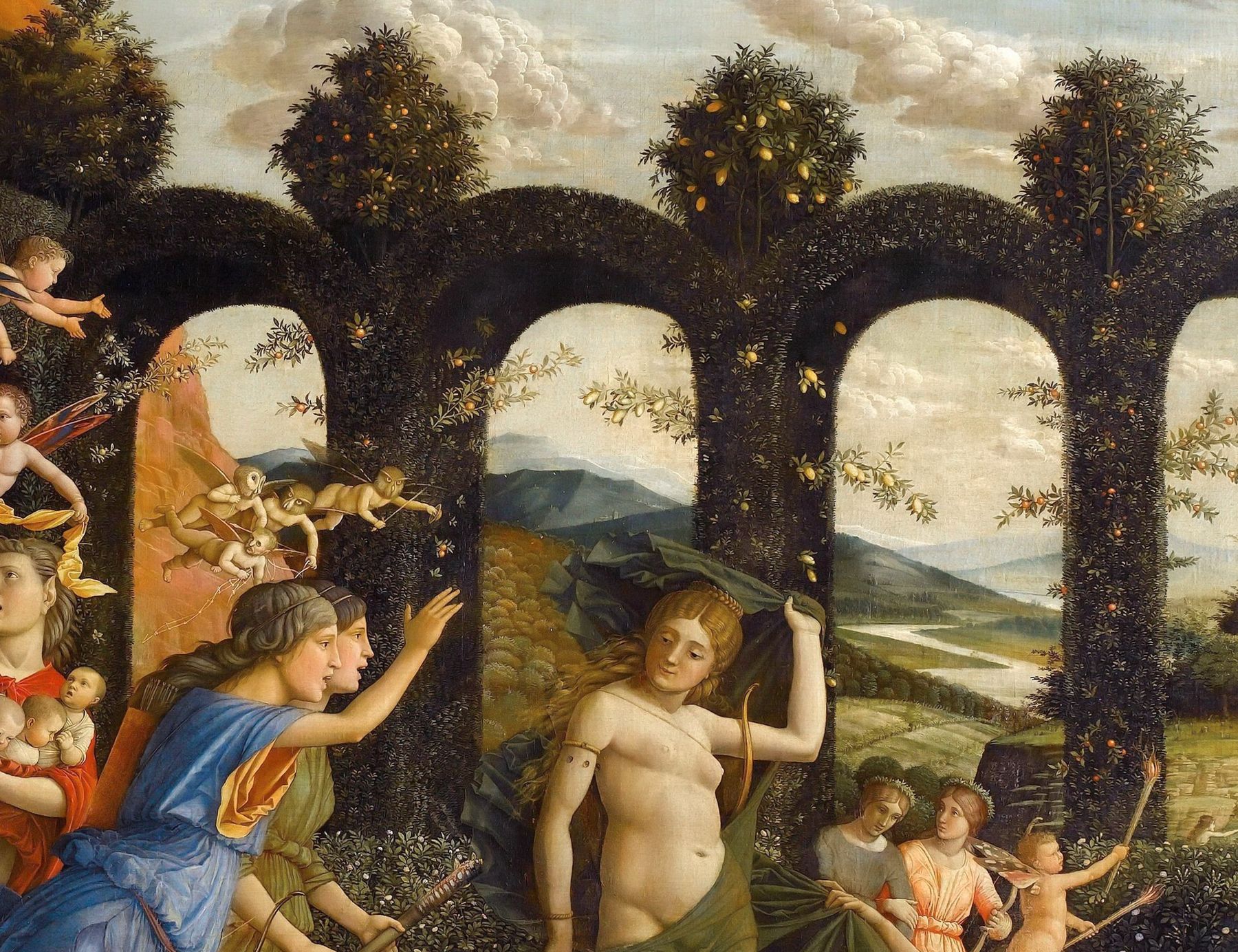
Two women ahead of Minerva pose a different problem. The one in blue carries a bow and quiver, and the other carries a torch. Lightbown identified them as nymphs of Venus, whose flight would put them among the fugitives. Egon Verheyen read them as goddesses going to the aid of the Mother of the Virtues. The same rightward movement supports both readings. Once the eye picks up running figures all headed the same way, it is easy to sort them into a single group. Yet here the pursuer and the pursued need to travel in the same direction, and the women occupy just the stretch of bank where the two parties could overlap. [4]
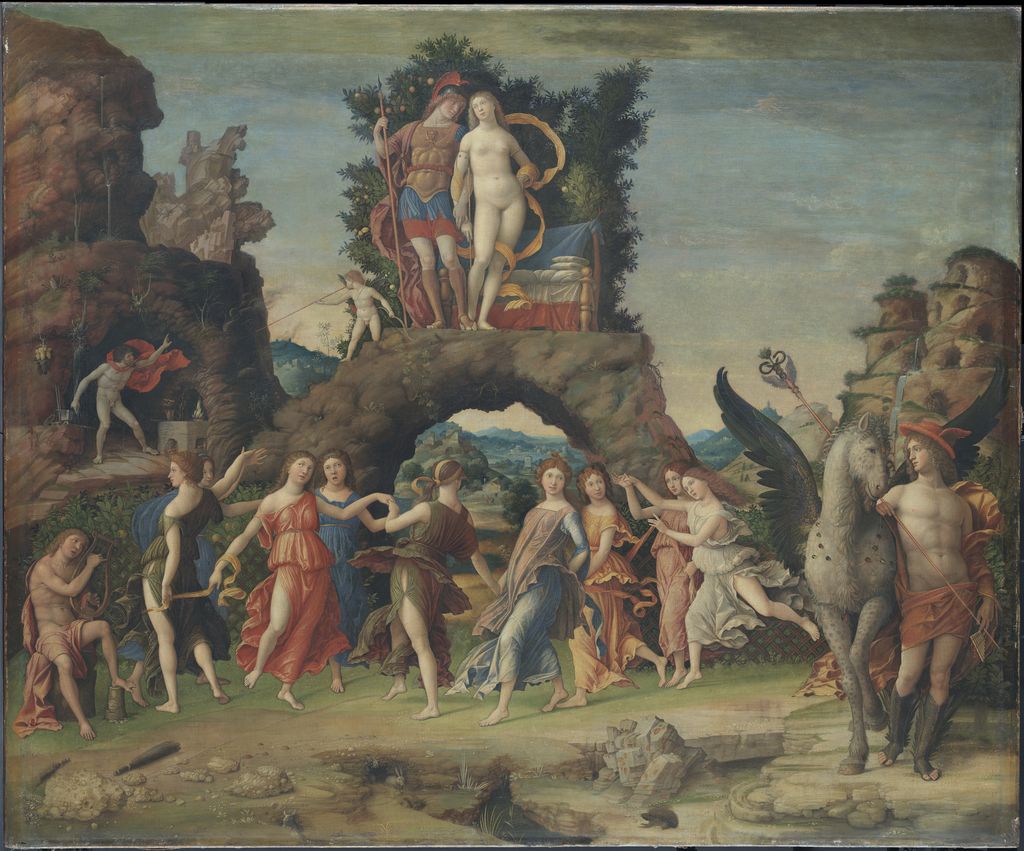
Mars and Venus (Parnassus), Musée du Louvre Image source. Public domain.
What the fugitives carry
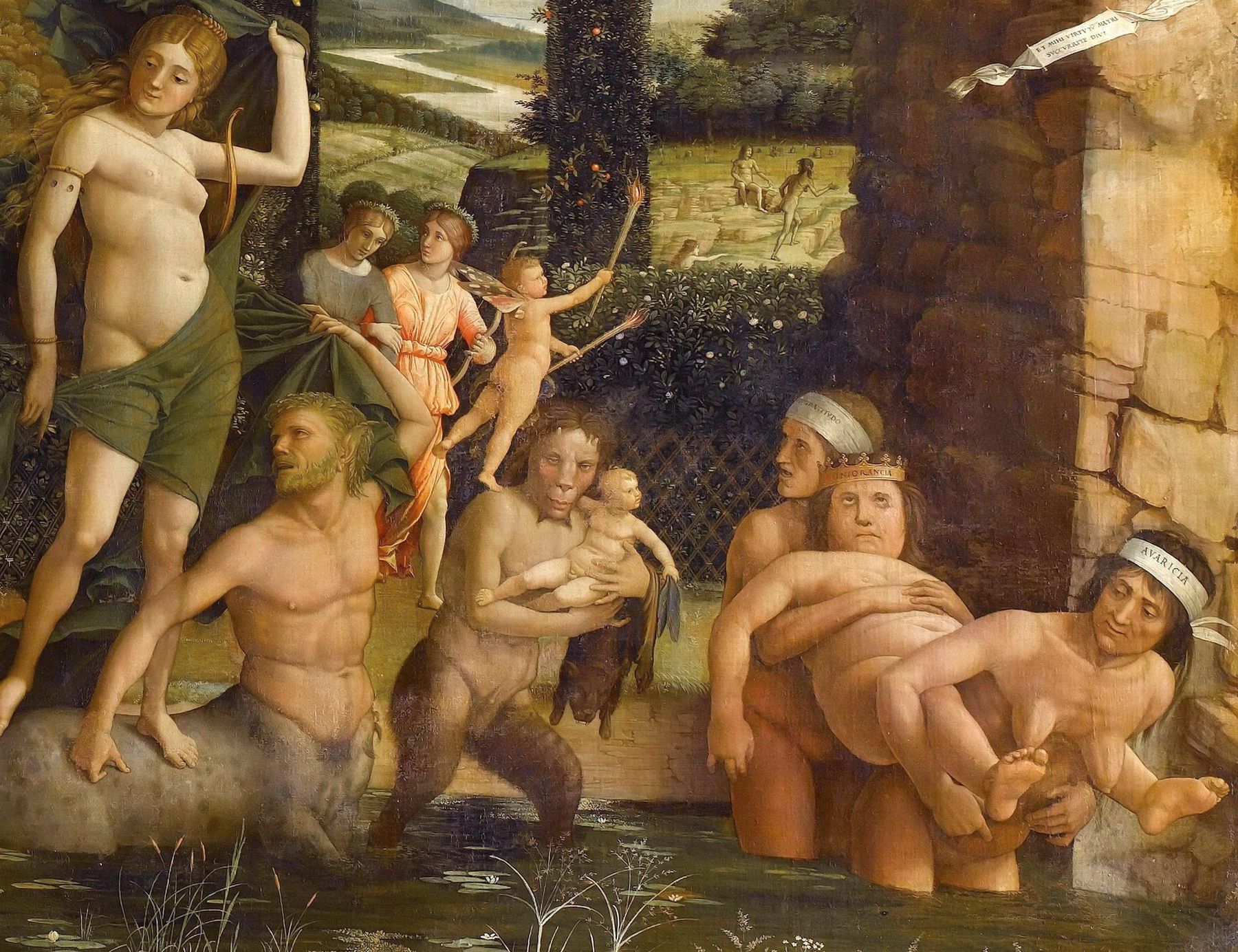
A pair in the shallows offers a firmer point of entry. Idleness, whose arms end in stumps, is tethered at the waist and pulled along by Inertia. Mantegna connects two abstractions by a rope and gives the pair the awkward cooperation of bodies obliged to move together. An inscription beside them takes a line from Ovid's Remedies for Love. Its point is that Cupid's bows lose their power when idleness is removed. Ovid's advice becomes a visible action. Someone who would stay still is being physically hauled away. [4]
Farther right, a figure with an ape-like head looks back as it wades away. Kallins reads the writing on its scroll as a cluster of qualities including hatred, fraud and malice. The bags the figure carries offer another set of labels. They move through degrees of evil and include the seeds of discord. The bags turn a fleeing figure into a travelling store of trouble. The seeds in particular suggest that what leaves the garden might take root elsewhere. The several labels attached to a single body also complicate the expectation that every figure in an allegory ought to stand for one thing. [4] [5]
Near the centre, a lightly draped woman balances on a centaur. Kallins reads her as a Venus of sensual love and sets her against the Venus in Mantegna's earlier canvas for the studiolo. The pose helps explain the appeal of that reading. She stands with a composure absent from many of the bodies around her, raised above the crowd by the animal that carries her. Yet a figure's beauty and height are unreliable guides to her place in this scene. Nearby, a satyr carries a child whom Kallins identifies as a Cupid holding his severed wings. The small figure's loss gives visible form to much the same idea as the line from Ovid. Desire can be deprived of what lets it reach its target. [4] [5]
At the right, headbands identify Ignorance and the pair that bear her up, Avarice and Ingratitude. Ignorance is the most cumbersome burden in the group. Her attendants have to wrap their arms around her, and the crown she wears makes the dependence all the more pointed. The Louvre's retrospective singled out Ignorance as a recurring enemy of virtue in Mantegna's work. Here the painter goes a step further by giving that enemy people to keep her aloft. The image makes the alliance of the three vices intelligible before the viewer can decipher every letter. [2] [4] [5]
A garden built to slow the eye
The leafy arches repeat across the middle distance and hold the frieze of figures together. They also make the garden feel carefully ordered. A glimpse through one opening gives the eye a route farther back, towards rocks and distant country. The lower half works differently. The bank and pool divide the action into bands, and the mass of partly submerged bodies slows the eye just where the open ground ought to let it travel. The spectator can see a considerable distance through the enclosure while some of the figures seem scarcely able to move across it. [1] [3] [5]
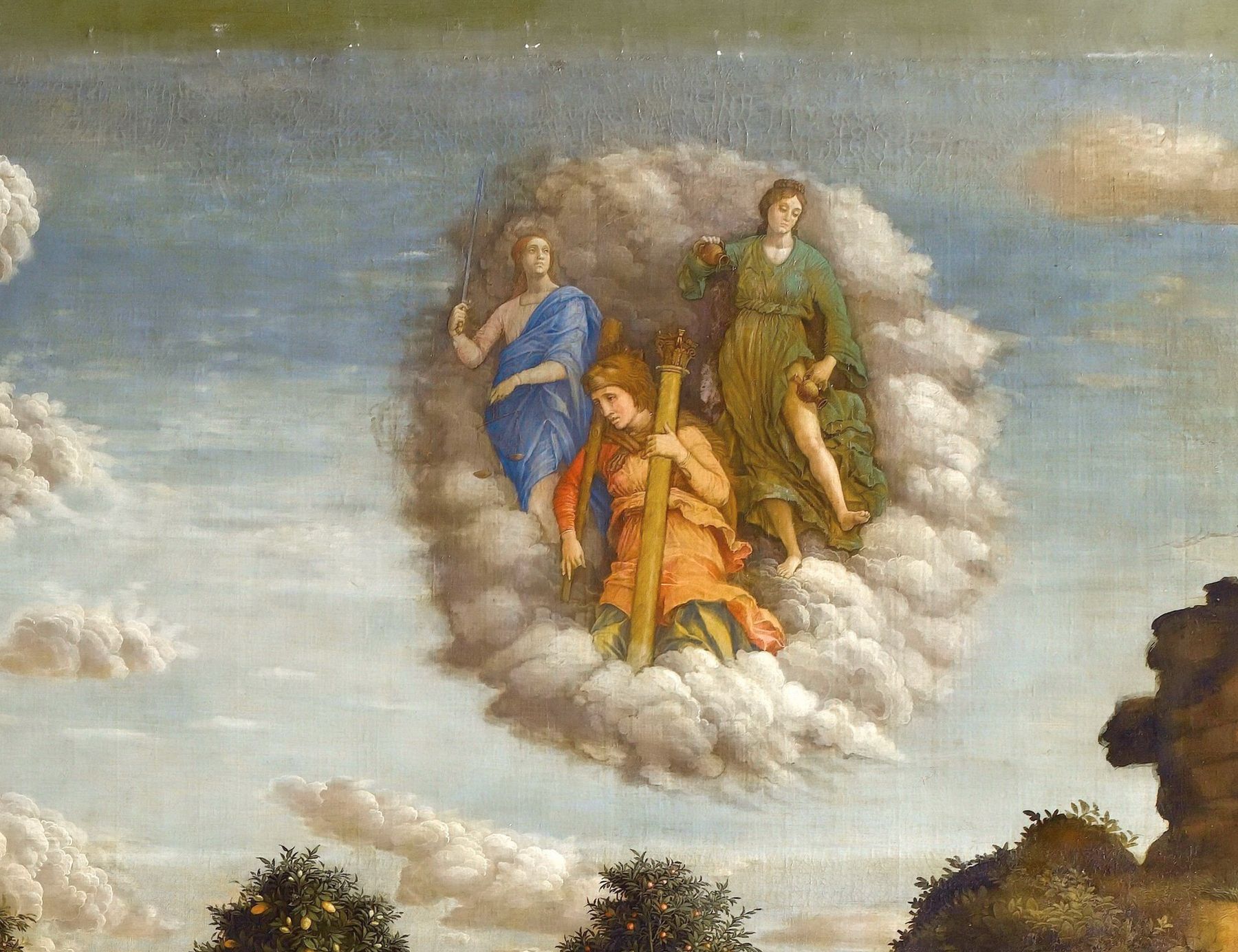
Mantegna lets vegetation assume the shape of architecture and lets rock approach the appearance of masonry. In the sky, the edges of clouds form profiles that are easy to overlook on a first pass. The small company at the upper right has clearer attributes. A figure with a sword, another with vessels and a third associated with a column are conventionally read as Justice, Temperance and Fortitude. Their distance from the activity in the water is striking. The lower figures carry each other, scramble or haul on ropes, while the three Virtues can appear together in an opening in the sky. [1] [2] [4] [5]
The tree at the left brings these changes of form down to eye level. Its trunk takes on the shape of a woman whose head and branch-like arms seem to emerge from the wood. Kallins identifies her with Daphne, transformed into a laurel as she escapes Apollo in Ovid's Metamorphoses. Lightbown saw an olive, the tree associated with Minerva, and proposed that Mantegna had deliberately joined that tree to an image of chastity. The two accounts give the figure rather different allegiances. The first directs attention to the predicament of the woman inside the tree. The second draws the tree into the orbit of the goddess passing it. Either way, the open mouth and encircling scroll make the tree an active witness. [4] [5]
The enclosed greenery also has a Mantuan counterpart in Mantegna's Madonna della Vittoria. In the altarpiece, citrus trees trained over an open framework form a canopy for the Virgin and the saints. Francesco II Gonzaga kneels in armour, and Saint George holds a broken lance. The similarities are easiest to see in the way each composition uses greenery to direct the eye. The canopy over the Virgin gathers the figures around her throne in a votive image commissioned by Francesco after the battle of Fornovo in 1495. In Isabella's canvas, the repeated arches run across the action and make the garden look like a place with several ways through it. The broken lance in each picture contributes to a different kind of victory. [1] [2] [6]
Three ways of reading a ribbon
The broad ribbon winding around the tree first presents its appeal in Roman capitals. It summons the divine companions of the returning Virtues to drive the monsters out of their seats. At the far right, a scroll by a walled structure speaks in the first person on behalf of the Mother of the Virtues, asking the gods to come to her aid. The two texts pull the viewer towards opposite edges. At one end there is a face from which speech seems to issue. At the other, the appeal makes the presence of a captive felt without disclosing a body. Lightbown proposed that the Mother might be Prudence, the fourth cardinal virtue, but the words on the wall give her a title whose precise identity remains open. [4] [5]
The tree ribbon changes its appearance as it winds down. The middle passage has often been called Greek or Greek-looking. Alexander Nagel, crediting Giulio Busi, explains that its leafy flourishes disguise a repetition of the Latin above. A viewer can compare the two versions of nostris, meaning “our,” and start to tell an unfamiliar letter from the extra strokes around it. The lowest register contains Hebrew letters that, in Nagel's account, form no known words. Giulio Dalvit likewise distinguishes the repeated Latin from the Hebrew-letter passage. The three registers promise different degrees of access to the same object. One is designed to be read readily, one asks for patient comparison, and one has the appearance of writing without yielding a sentence. [5] [7]
Nagel connects that experiment to a question Isabella put to the humanist Paride Ceresara. He had sent her specimens of writing she described as Syrian or Babylonian sacred letters. She asked which marks belonged to the letters and which were decorations, and requested examples of the characters in their plain forms. The letter gives a glimpse of the sort of scrutiny the painted ribbon invites. Nagel also suggests that the apparent combination of three scripts and the tree's outstretched form evoke the trilingual inscription of the Crucifixion. It is a proposed Christian resonance within a scene whose central actor is a classical goddess. [5]
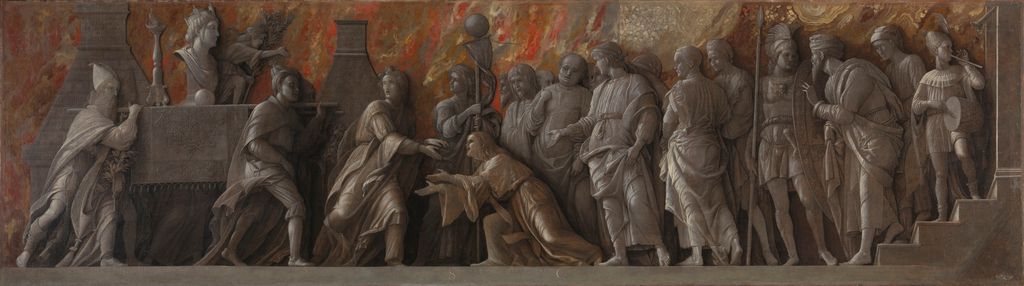
The Introduction of the Cult of Cybele at Rome, National Gallery, London Image source. Public domain.
Two canvases facing each other
Isabella began fitting out a studiolo in a tower of the Castello di San Giorgio after marrying Francesco II in 1490. A study of this kind belonged to the intellectual life of a Renaissance court, and hers acquired a group of paintings over years of commissions. Mantegna, whose long service to the Gonzaga shaped his life in Mantua, supplied the first two. The Louvre dates the commission for Mars and Venus, usually called Parnassus, to the winter of 1496–1497. The museum's retrospective gives 1497 as its completion year. [1] [2] [8]
Parnassus puts Mars and Venus above a dance of the Muses to Apollo's music. As the dancers turn, their rhythm joins them across the foreground. In the Triumph, one group after another breaks into a different action. A body is pulled forward, another turns its face back, and another can move only because two companions carry it. Mantegna gives the two scenes the same width of canvas. In one the crowd keeps time, and in the other it comes apart. The Louvre's retrospective reads the earlier canvas as a celebration of the arts and a victory of spiritual over earthly love. In that reading, the presence of Venus in both paintings, if the poised rider is indeed Venus, points to the different kinds of love that mattered across the sequence. The curators also suggest that the union of Mars and Venus could allude to Francesco and Isabella. In that reading the court's patron appears in divine company, above a dance that gives an image of what her patronage makes possible. [1] [2] [4] [8]
In the Louvre's reconstruction, the paintings were conceived for opposite walls. The curators pointed to the light entering Parnassus from the left and the Triumph from the right. Nagel relates the latter direction to an east-facing window of the first study. The comparison is especially revealing at the scale of a room, where painted light can appear to come from an actual opening. The surfaces also have histories of their own. The Louvre identifies areas of oil repainting in the landscape and some figures of Parnassus, probably by Lorenzo Leonbruno. Its account of the facing walls brings one aspect of the original design into focus even though the two canvases have come down to us in different states. [2] [5] [8]
What Isabella asked of Perugino
The first studiolo eventually had five paintings. Their family resemblance is evident in the struggle between virtue and vice, but the Louvre's curators leave open whether the whole programme was settled at the outset. They also see strong evidence of Mantegna's part in inventing the Triumph, given the recurrence in his work of figured clouds, elaborate inscriptions and Ignorance as an antagonist. The limits of the evidence about his instructions become particularly clear alongside a commission whose instructions survive. [1] [2] [4]
Isabella commissioned Pietro Perugino's Combat of Love and Chastity in 1503. Her instructions, preserved in the contract drawn up by her agent Francesco Malatesta, make Pallas, Diana, Venus and Cupid indispensable. They also propose more distant encounters, among them Apollo pursuing Daphne already transformed into a laurel. Isabella sent a small drawing with the instructions and allowed Perugino to reduce the cast if he found it too large, provided he kept the four leading figures. The explicit Daphne in that document makes the resemblance to Mantegna's tree worth noticing. The instructions describe Perugino's commission, and the identity of Mantegna's tree remains a separate question. [9] [10] [11]
Perugino himself had to consider how his canvas would look next to its neighbours. In January 1504 he wrote asking for the sizes of figures in the other paintings. His own foreground figures seemed small to him, and he worried that pictures meant to go together would jar if their people were drawn at markedly different scales. The Combat, finished in 1505, offers the comparison he was thinking about. Its incidents are spaced across an open landscape. The Louvre notes that the canvas has been extended by about twelve centimetres along the bottom, one reason its present appearance cannot answer every question about the original fit. Mantegna brings the crowded rout up close and makes much of it take place along the front edge of the garden. The letter shows how closely a painter working at a distance had to consider figures already on the walls. [1] [9] [12]
Lorenzo Costa supplied the other two works. His Allegory of the Court of Isabella d’Este was commissioned in 1504 and painted in Bologna in 1505–1506. Where Mantegna crowds the bank with urgent gestures, Costa assembles a company around a crowning beside the water. The other canvas, The Reign of Comus, probably incorporates a project Mantegna began shortly before his death in 1506. The Louvre attributes the finished painting to Costa and tentatively dates its completion to 1511. Its account preserves the possibility of continuity between the two painters while leaving open how much of Mantegna's design survived. [2] [13] [14]
From the Corte Vecchia to the Louvre
After Francesco's death in 1519, Isabella moved to a ground-floor apartment in the Corte Vecchia, another part of the ducal palace. By October 1520 her son Federico was already writing about the move. Furnishings from the earlier study and its Grotta were brought over and supplemented. The surviving Corte Vecchia studiolo has a carved wooden ceiling with blue and gilded ornament, and a marble portal connects it to the Grotta. Parts of the woodwork travelled again in the seventeenth century and were restored and reassembled here in 1933. The room as it stands gives a sense of the setting Isabella made in widowhood, with a history of rearrangement of its own. [15] [16]
In this second studiolo, Isabella added Correggio's companion allegories of the Virtues and the Vices, painted around 1530. They took the ensemble from five canvases to seven. Their narrower, upright format brings a new scale to the theme. Mantegna spreads pursuit across a wide strip of ground, whereas Correggio gives opposing moral conditions separate, more concentrated scenes. The two campaigns of decoration therefore belong to different moments in Isabella's life as well as different rooms. [2] [17] [18]
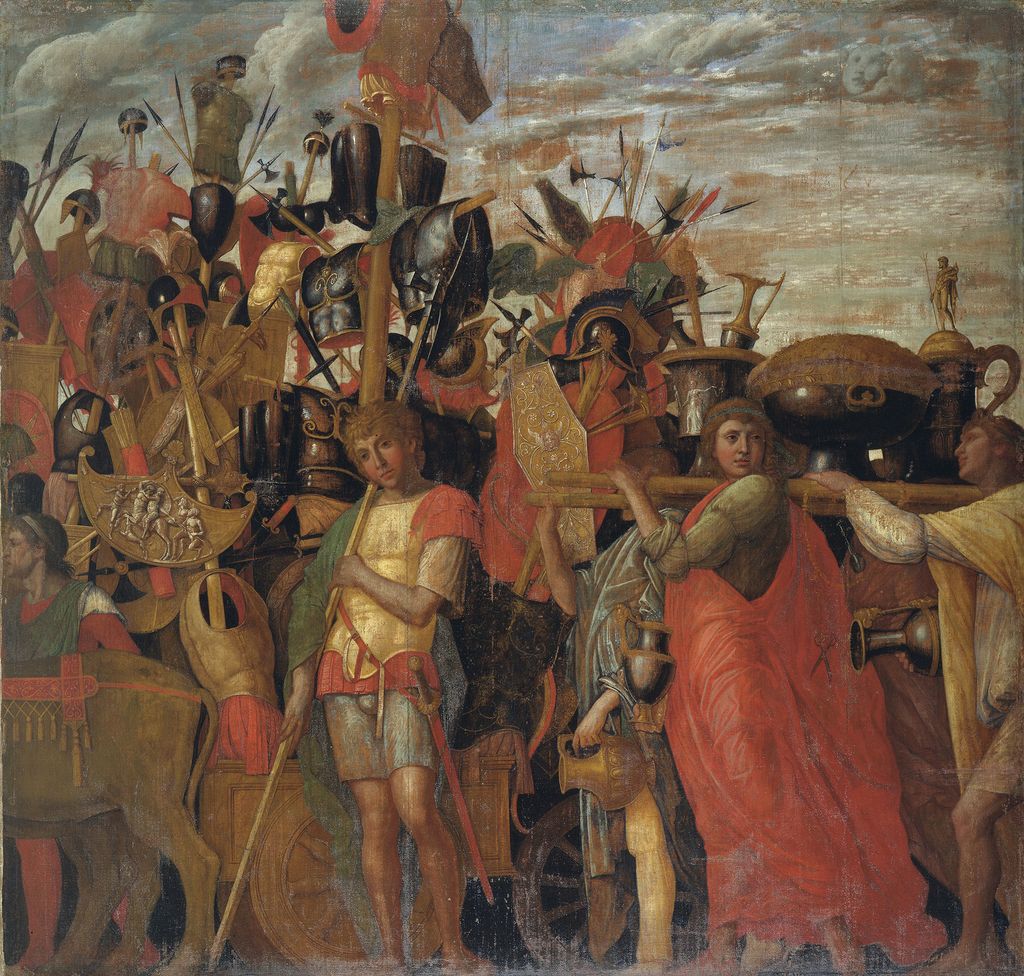
The National Gallery's loan record traces the Triumph from Isabella and the Gonzaga to Cardinal Richelieu in the late 1620s. It then passed through the Richelieu family, remained at the Château de Richelieu and entered the Paris museum collection in 1801. The Louvre records that acquisition as a seizure. The companion pictures are now also in the Louvre, though the two Correggios entered its collections through other routes. The museum's record for Allegory of the Vices, for example, names Cardinal Mazarin as a previous owner and records an acquisition date of 1661. Mantegna's similarly titled Triumphs of Caesar, nine canvases depicting a Roman procession, passed from the Gonzaga collection to Charles I of England around the same time that the Triumph of the Virtues went to France. [1] [3] [8] [9] [13] [14] [17] [18] [19]
When the Louvre staged its Mantegna retrospective in 2008–2009, it used the arrangement of Isabella's second studiolo as the basis for its installation and reversed the direction of the visitor's route. That decision made the paintings' relationship something a visitor could experience by turning to look across a room. Minerva's canvas also rewards the opposite movement, a step closer to read the painted ribbon. From that distance the line of Latin divided into unfamiliar shapes is just as much a part of the picture as the stride that first draws the eye across it. [2] [5] [20]
Annotated Details from Minerva Expelling the Vices from the Garden of Virtue
The numbered points identify details to look at closely. The detail images below preserve the native scale of the selected crops.
Minerva Expelling the Vices from the Garden of Virtue
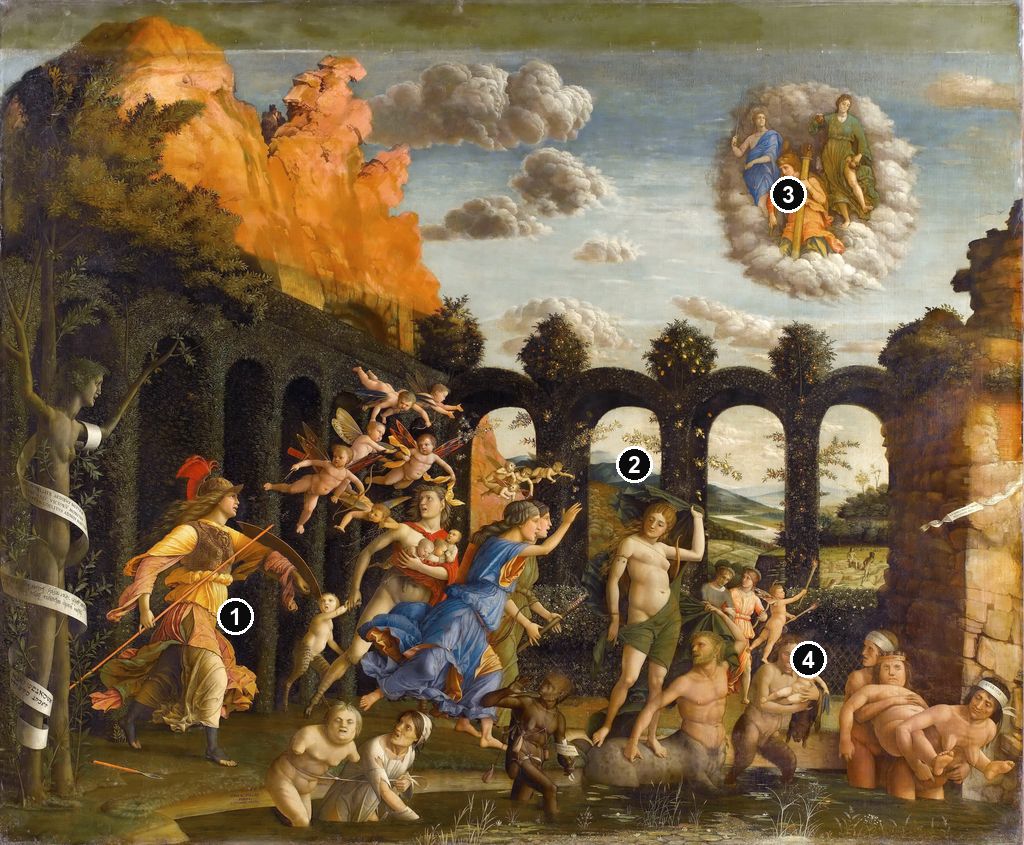
Details from MINERVA EXPELLING THE VICES FROM THE GARDEN OF VIRTUE
Choose a detail to enlarge it.
Minerva Expelling the Vices from the Garden of Virtue
Minerva’s arrival
Minerva advances from the left. Her stride and the thrust of her arm bring a sharp diagonal into the crowded foreground.
Garden arcades
Openings in the clipped arches show successive glimpses of the distance. Figures pass across the lower edge of the ordered garden.
Figures in the clouds
The small group in the bright opening sits above the activity of the garden. Compare its calm grouping with the uneven spacing below.
Figures at the waterline
Arms and heads break the irregular surface of the foreground ground and water. The struggle continues into the lower right edge.
Artworks directory
| Name | Date | Medium and collection |
|---|---|---|
| The Adoration of the Shepherds | Shortly after 1450 | Painting · Metropolitan Museum of Art · 32.130.2 Catalogue. |
| Saint Mark the Evangelist | C. 1448–51 | Painting · Städel Museum · 1046 Catalogue. |
| Saint Jerome Penitent in the Desert | C. 1448–51 | Painting · Museu de Arte de São Paulo · MASP.00015 Catalogue. |
| Martyrdom and Transport of the Body of Saint Christopher | Mid-1450s | Painting · Ovetari Chapel, Padua Catalogue. |
| San Luca Altarpiece | 1453–55 | Painting · Pinacoteca di Brera · 176 Catalogue. |
| The Presentation of Christ at the Temple | 1454 (Berlin dating) | Painting · Gemäldegalerie, Berlin · 29 Catalogue. |
| San Zeno Altarpiece | 1457–59 | Painting · Basilica of San Zeno, Verona Catalogue. |
| The Crucifixion | 1456–59 | Painting · Musée du Louvre · INV 368 Catalogue. |
| The Agony in the Garden (London) | C. 1455–56 | Painting · National Gallery, London · NG1417 Catalogue. |
| The Agony in the Garden (Tours) | 1459 (Tours dating) | Painting · Musée des Beaux-Arts de Tours · 1803-1-24 Catalogue. |
| The Resurrection | 1459 (Tours dating) | Painting · Musée des Beaux-Arts de Tours · 1803-1-25 Catalogue. |
| Saint Sebastian (Vienna) | C. 1457–59 | Painting · Kunsthistorisches Museum · GG 301 Catalogue. |
| Cardinal Ludovico Trevisan | C. 1459–60 (Berlin exhibition dating) | Painting · Gemäldegalerie, Berlin · 9 Catalogue. |
| The Death of the Virgin | C. 1462 | Painting · Museo Nacional del Prado · P000248 Catalogue. |
| Christ with the Soul of the Virgin | C. 1460–64 | Painting · Pinacoteca Nazionale, Ferrara Catalogue only. |
| Portrait of a Young Man (traditionally Francesco Gonzaga) | C. 1461 or 1470, depending on sitter | Painting · Museo di Capodimonte · Q 60 Catalogue. |
| Portrait of a Prelate (Carlo de’ Medici?) | C. 1465–70 | Painting · Uffizi Galleries · 1890 no. 8540 Catalogue. |
| Portrait of a Man | C. 1470 | Painting · National Gallery of Art, Washington · 1952.2.5 Catalogue. |
| Madonna with Sleeping Child (Berlin) | C. 1455–60 | Painting · Gemäldegalerie, Berlin · S.5 Catalogue. |
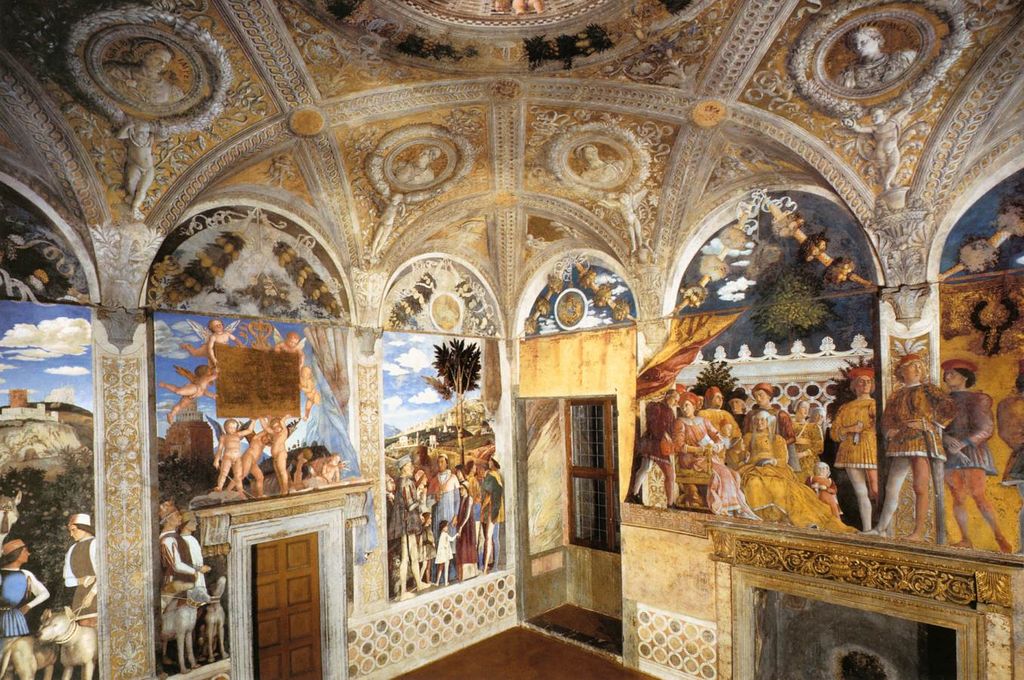
| Camera degli Sposi (Camera Picta) | 1465–74 | Painting · Palazzo Ducale, Mantua Catalogue. |
| Saint Sebastian (Louvre) | Around 1480 | Painting · Musée du Louvre · RF 1766 Catalogue. |
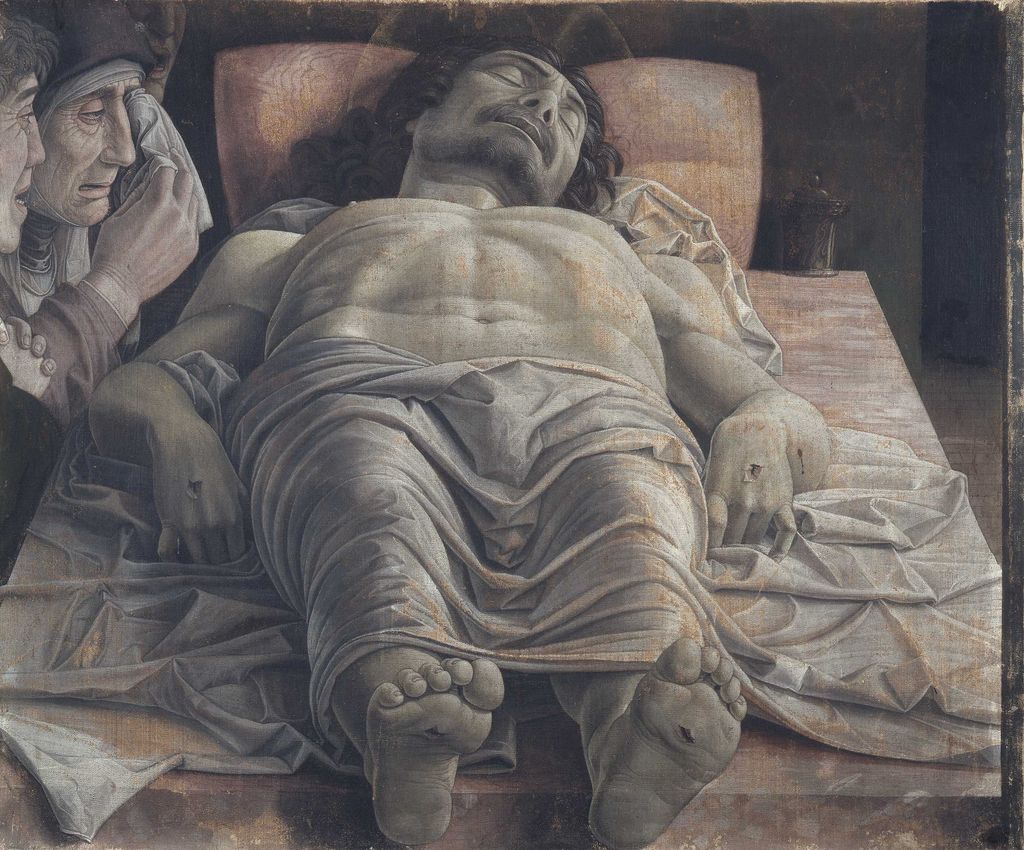
| Lamentation over the Dead Christ | C. 1483 (Brera dating) | Painting · Pinacoteca di Brera · 352 Catalogue. |
| The Triumphs of Caesar | About 1485–1506 | Painting · Royal Collection · RCIN 403958–403966 Catalogue. |
| Madonna of the Caves | C. 1488–90 | Painting · Uffizi Galleries · 1890 no. 1348 Catalogue. |
| Madonna and Child with a Choir of Cherubim | C. 1485 | Painting · Pinacoteca di Brera · 297 Catalogue. |
| Madonna and Child (Poldi Pezzoli) | Early 1490s (museum dating) | Painting · Museo Poldi Pezzoli · 1595 Catalogue. |
| The Holy Family with Saint Mary Magdalen | C. 1495–1500 | Painting · Metropolitan Museum of Art · 14.40.643 Catalogue. |
| The Virgin and Child with Saint Mary Magdalene and Saint John the Baptist | C. 1490–1505 | Painting · National Gallery, London · NG274 Catalogue. |
| Christ as the Suffering Redeemer | 1485–95 (SMK dating) | Painting · Statens Museum for Kunst · KMSsp69 Catalogue. |
| Ecce Homo | C. 1500 | Painting · Musée Jacquemart-André · MJAP-P 1840 Catalogue. |
| Judith with the Head of Holofernes (Mantegna or follower) | C. 1495–1500 | Painting · National Gallery of Art, Washington · 1942.9.42 Catalogue. |
| Madonna della Vittoria | 1495–96 | Painting · Musée du Louvre · INV 369 Catalogue. |
| Mars and Venus (Parnassus) | C. 1496–97 | Painting · Musée du Louvre · INV 370 Catalogue. |
| The Trivulzio Madonna | 1497 | Painting · Castello Sforzesco, Milan · 0554 Catalogue. |
| The Adoration of the Magi | C. 1495–1505 | Painting · J. Paul Getty Museum · 85.PA.417 Catalogue. |
| Minerva Expelling the Vices from the Garden of Virtue | C. 1502 | Painting · Musée du Louvre · INV 371 Catalogue. |
| The Introduction of the Cult of Cybele at Rome | 1505–06 | Painting · National Gallery, London · NG902 Catalogue. |
| Saint Sebastian (Venice) | Probably c. 1504–06 | Painting · Galleria Giorgio Franchetti alla Ca’ d’Oro · D.11 Catalogue. |
| Samson and Delilah | C. 1500 | Painting · National Gallery, London · NG1145 Catalogue only. |
| A Woman Drinking (probably Sophonisba) | C. 1495–1506 | Painting · National Gallery, London · NG1125.2 Catalogue only. |
| The Vestal Virgin Tuccia with a Sieve | C. 1495–1506 | Painting · National Gallery, London · NG1125.1 Catalogue only. |
| Judith with the Head of Holofernes (Dublin) | C. 1495–1500 | Painting · National Gallery of Ireland · NGI.442 Catalogue only. |
| Battle of the Sea Gods, left half (Met impression) | Before 1481 (Met dating) | Print · Metropolitan Museum of Art · 18.12 Catalogue only. |
| Battle of the Sea Gods, right half (Met impression) | Before 1481 (Met dating) | Print · Metropolitan Museum of Art · 1984.1201.4 Catalogue only. |
| Battle of the Sea Gods, left half (Tokyo impression) | C. 1475 (Tokyo dating) | Print · National Museum of Western Art, Tokyo · G.1981-0002 Catalogue only. |
| Battle of the Sea Gods, left half (Washington impression) | C. 1485–88 (NGA dating) | Print · National Gallery of Art, Washington · 1941.1.6 Catalogue only. |
| The Entombment of Christ, second state of two | Before 1475 (Met dating) | Print · Metropolitan Museum of Art · 37.42.30 Catalogue only. |
| The Entombment of Christ (possibly Zoan Andrea, after Mantegna) | 1460–1549 (Rijksmuseum dating) | Print · Rijksmuseum · RP-P-1924-60 Catalogue only. |
| Four Dancing Muses (Gian Marco Cavalli after Mantegna) | C. 1497 | Print · Metropolitan Museum of Art · 20.5.3 Catalogue only. |
| Bacchanal with Silenus | Before 1475 (Met dating) | Print · Metropolitan Museum of Art · 29.44.15 Catalogue only. |
| Bacchanal with a Wine Vat | Before 1475 (Met dating) | Print · Metropolitan Museum of Art Catalogue only. |
| St James on His Way to Execution | C. 1453–57 | Drawing · British Museum · 1976,0616.1 Catalogue only. |
| Three Studies for a Dead Christ | C. 1455–65 | Drawing · British Museum · 1909,0406.3 Catalogue only. |
| Pietà (Venice) | C. 1456–65 (exhibition datings) | Drawing · Gallerie dell’Accademia, Venice · 115 Catalogue only. |
| Studies for Christ at the Column | 1460–65 | Drawing · The Courtauld · D.1978.PG.345 Catalogue only. |
| Virtus Combusta | C. 1490 (technical study) | Drawing · British Museum · Pp,1.23 Catalogue only. |
| Virtus Combusta (Giovanni Antonio da Brescia after Mantegna) | C. 1495–1506 | Print · Musée du Louvre · 3881 LR/ Recto Catalogue only. |
| The Calumny of Apelles | C. 1504–06 | Drawing · British Museum · 1860,0616.85 Catalogue only. |
Frequently Asked Questions
The Triumph of the Virtues describes the outcome. Minerva Expelling the Vices from the Garden of Virtue identifies the principal figure and action.
Parnassus was made for the same studiolo. The paintings offer very different scenes within the same commission setting, a dance under an arch and a pursuit through a garden.
Discussion
Look again at the images and ideas explored in Triumph of the Virtues. These editorial prompts invite your observations.
Reader Insights
How does the rope joining Inertia and Idleness change the way you read the nearby line from Ovid?
Why do the two women with a bow and a torch look equally plausible as fugitives and as allies of Minerva?
Join the Conversation
Share a detail, comparison or question about Triumph of the Virtues below.
References
- Musée du Louvre, Minerve chassant les Vices du Jardin de la Vertu (INV 371). View source.
- Musée du Louvre, Le Studiolo d’Isabelle d’Este, Mantegna retrospective. View source.
- National Gallery, Mantegna and Bellini loan provenance, Minerva Expelling the Vices from the Garden of Virtue. View source.
- Gail A. Kallins, Mantegna’s Minerva Overcoming the Vices Reconsidered. View source.
- Alexander Nagel, Twenty-five notes on pseudoscript in Italian art. View source.
- Musée du Louvre, La Vierge de la Victoire et les reliefs peints. View source.
- Giulio Dalvit, New Names for the Old Sacristy of the Siena Hospital. View source.
- Musée du Louvre, Mars et Vénus, dit Le Parnasse (INV 370). View source.
- Musée du Louvre, Le Combat de l’Amour et de la Chasteté (INV 722). View source.
- Archivio di Stato di Firenze, Isabella d’Este’s instructions for Perugino, fol. 285r, transcribed by the Italian Renaissance Document Site. View source.
- Archivio di Stato di Firenze, Isabella d’Este’s instructions for Perugino, fol. 285v, transcribed by the Italian Renaissance Document Site. View source.
- Archivio di Stato di Mantova, Perugino to Isabella d’Este, 24 January 1504, transcribed by the Italian Renaissance Document Site. View source.
- Musée du Louvre, Allégorie de la cour d’Isabelle d’Este (INV 255). View source.
- Musée du Louvre, Le Règne de Comus (INV 256). View source.
- Istituto Centrale per il Catalogo e la Documentazione, Personificazione della Fortuna (?), portal of Isabella d’Este’s studiolo, historical commentary. View source.
- Lombardia Beni Culturali, Studiolo di Isabella d’Este in Corte Vecchia. View source.
- Musée du Louvre, Allégorie des Vertus (INV 5926). View source.
- Musée du Louvre, Allégorie des vices (INV 5927). View source.
- Royal Collection Trust, The Triumphs of Caesar: 7. The Captives (RCIN 403964). View source.
- Musée du Louvre, Mantegna retrospective, exhibition dates. View source.
- Basilica of San Zeno, Verona, San Zeno Altarpiece, View source.
- Palazzo Ducale, Mantua, Camera degli Sposi (Camera Picta), View source.
- Musée du Louvre, Madonna della Vittoria, View source.
- National Gallery, London, The Introduction of the Cult of Cybele at Rome, View source.
More MANTEGNA Paintings
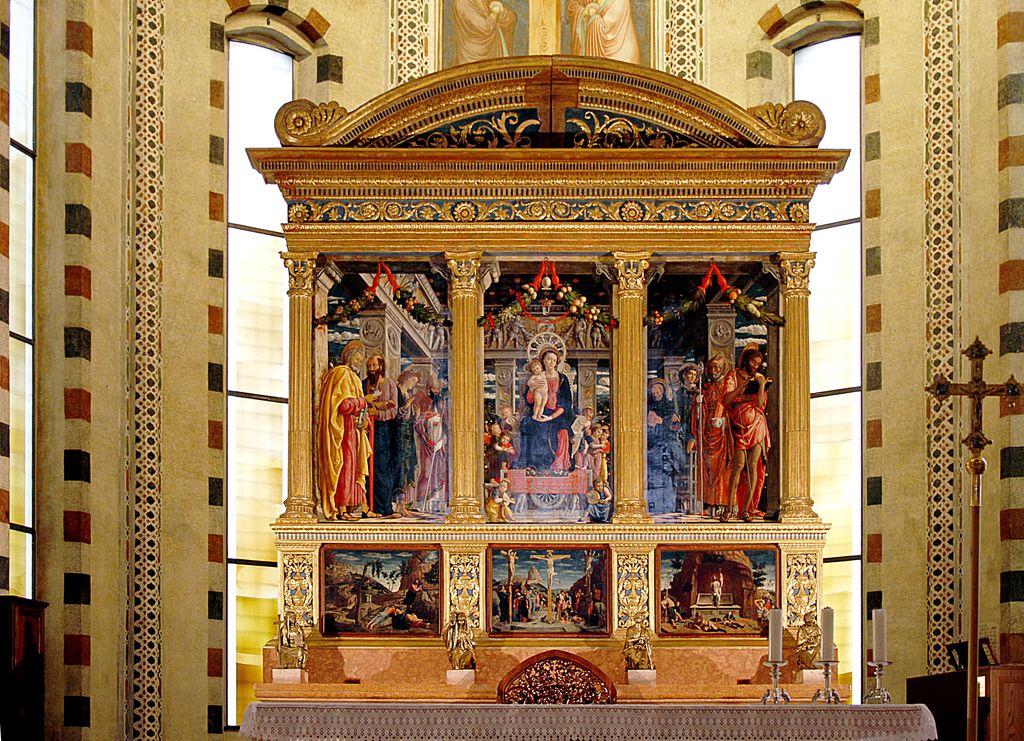
San Zeno Altarpiece
The San Zeno Altarpiece in its frame, Basilica of San Zeno, Verona José Luiz. Image source. CC BY-SA 4.0. Resized from the cited image.