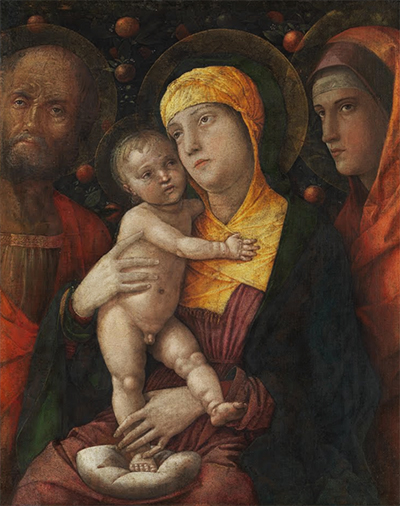
 by Tom Gurney
Tom Gurney BSc (Hons) is an art history expert with over 20 years experience
Published on June 19, 2020 / Updated on November 29, 2026
Email: tomgurney1@gmail.com / Phone: +44 7429 011000
Overview
The Christ Child plants one foot on a cushion in the Virgin’s lap and reaches across the yellow cloth at her throat. Joseph and a young woman appear close behind them, their shoulders cut by the sides of the picture. Andrea Mantegna’s The Holy Family with Saint Mary Magdalen, known as the Altman Madonna, is just 57.2 by 45.7 centimetres. The Metropolitan Museum of Art in New York dates it to about 1495–1500 and records it as distemper on canvas, accession 14.40.643. [1]
The name comes from Benjamin Altman, who owned the painting from 1912 until his death in 1913 and bequeathed it to the Met. The Fondazione Federico Zeri records the same accession and gives a slightly wider date range, 1495–1506. The picture belongs to Mantegna’s late career, when he was working for the Gonzaga court in Mantua. [1] [2]
At a Glance
- DateAbout 1495–1500, according to The Metropolitan Museum of Art
- MediumDistemper on canvas
- Dimensions57.2 × 45.7 cm
- CollectionThe Metropolitan Museum of Art, New York
- Accession14.40.643
Andrea Mantegna in context
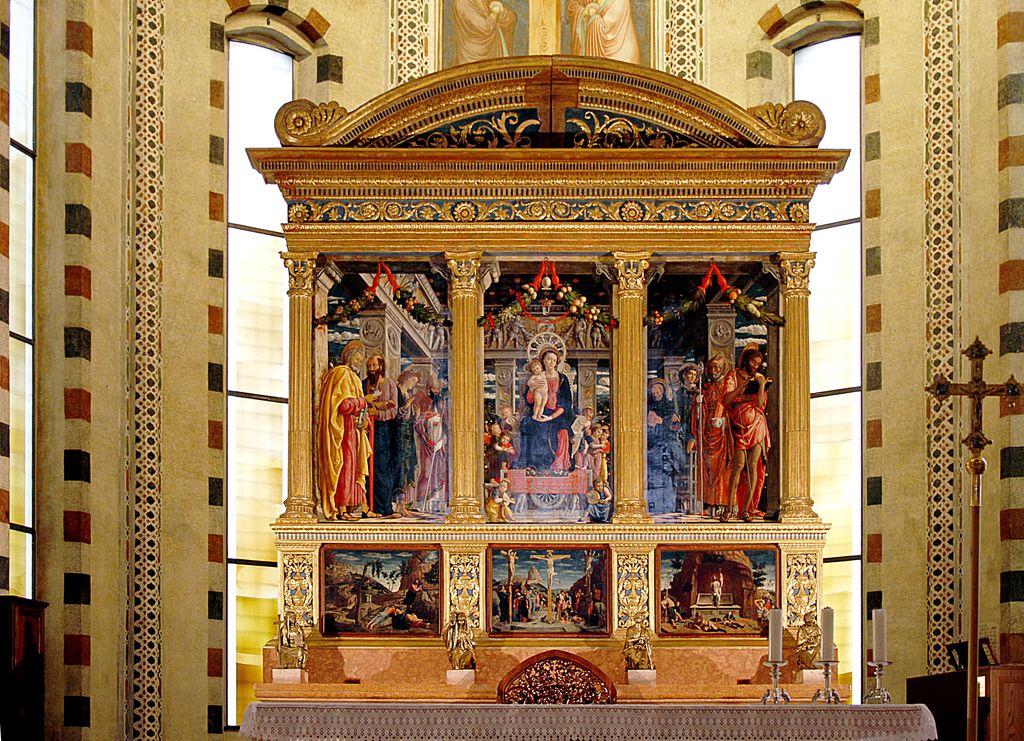
San Zeno Altarpiece
1457–59 [15]The Triumphs of Caesar
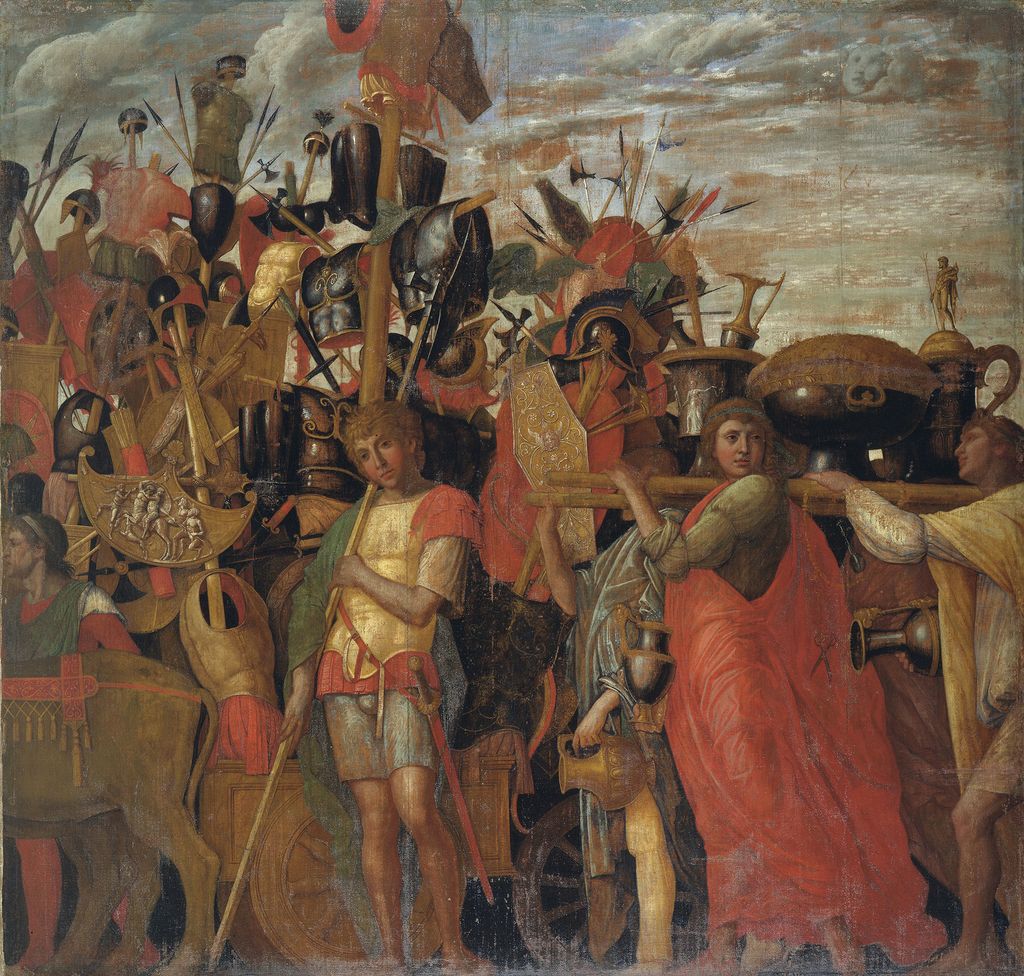
Mid-1480s–before 1506 [17]Madonna della Vittoria
1495–96 [18]The Holy Family with Saint Mary Magdalen
C. 1495–1500 [1]The weight of a child
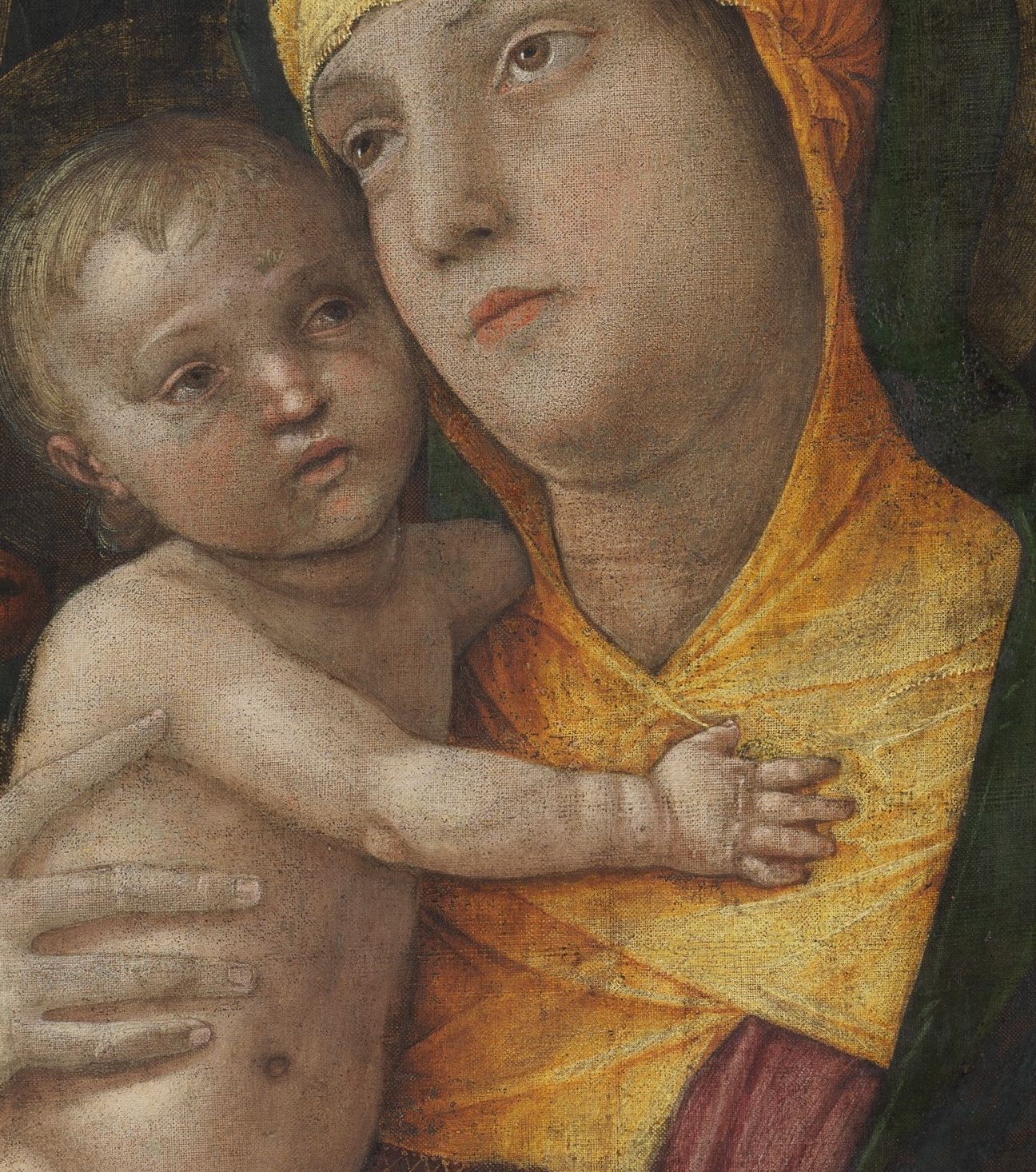
The Child stands at an angle. One leg carries his weight, pressing a hollow into the cushion, while the other bends outward and brings his bare foot across the fold above Mary’s wrist. Mary cups his side with one hand and steadies his lower leg with the other. Follow the hands and the pose becomes legible as a balancing act. The Child’s little fingers open against her scarf, directly above Mary’s hand spread around his ribs. The fingertips on fabric and the palm against flesh give two distinct measures of touch. [1]
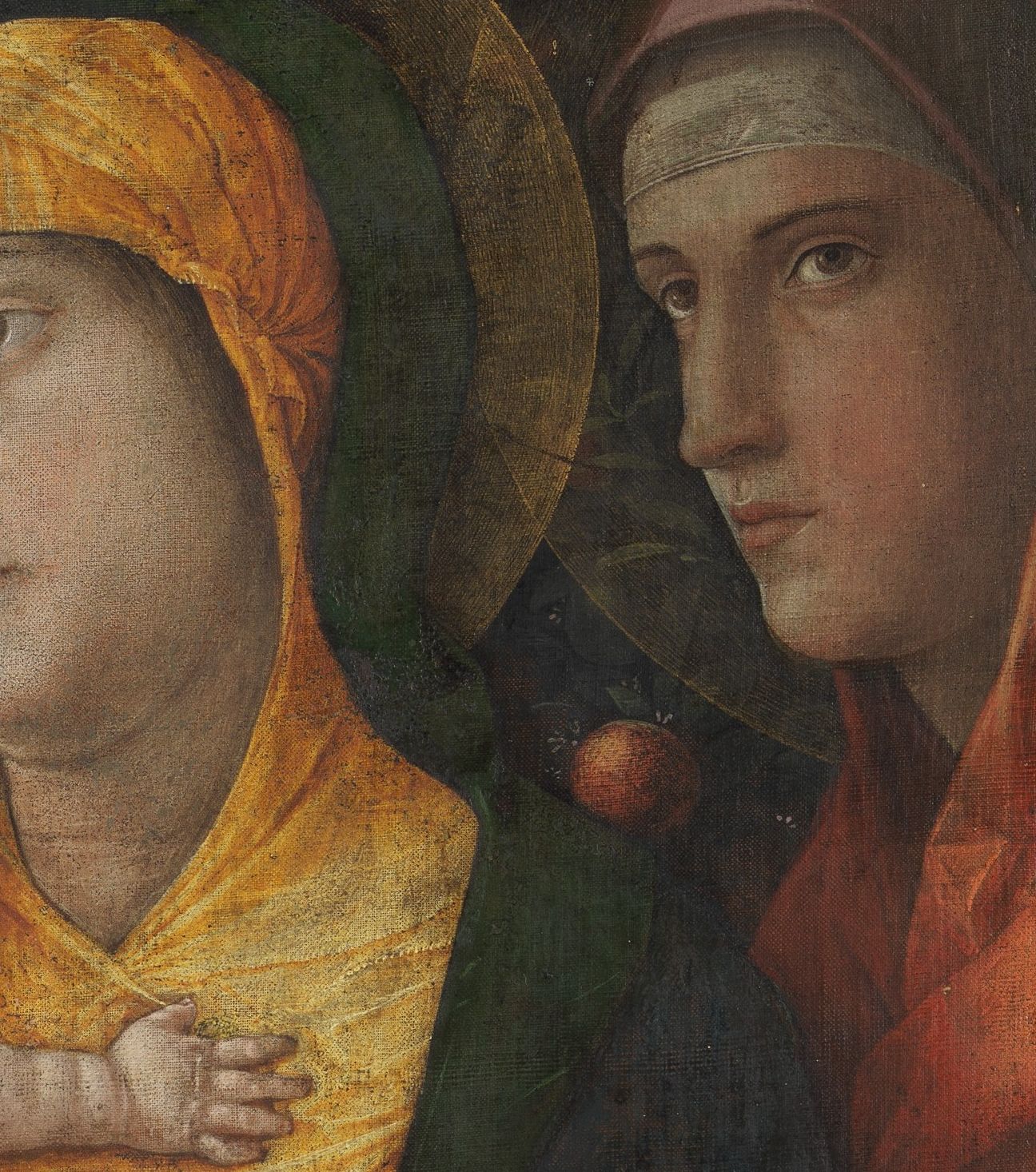
The faces are close enough for the rims of the haloes to overlap, yet the figures attend to different things. The Child turns towards Mary, whose eyes lift towards the left. Joseph’s broad, lined face is presented nearly frontally, while the young woman at the right turns inwards in three-quarter view. At either edge, a cropped shoulder suggests that the group continues into the space beside us. There is room for barely a glimpse of foliage between the heads. Mantegna can make the company feel close without making everyone share the same expression or direction of attention. [1]
The scale and framing suit close devotional viewing. The cushion is set low in the composition, where it makes the Child’s weight easy to imagine, and Mary’s hands give the eye a path from his unsteady feet to his face. The Met’s title identifies the woman as Mary Magdalen. The figure is cropped at the shoulder, leaving her face and dress as the principal clues to her identity. No ointment jar is visible. Zeri and Elizabeth E. Gardner’s catalogue for the Met treats the identification in the Altman painting as plausible and uncertain. The original patron and setting remain unestablished. [1] [3]
An ancient form for a sacred family
The Met traces Mantegna’s arrangement to Roman funerary reliefs, in which members of a family often appear side by side within a shallow space. One useful comparison is the Met’s second- or third-century marble tondo of a man, a woman and two boys. A second is the surviving upper portion of a Roman relief from about 138–141 CE, whose two sitters the museum tentatively identifies as mother and son from their resemblance. Both illustrate a type of ancient family grouping. The museum’s interpretation of the painting concerns the form of such reliefs, and neither marble has a documented connection to Mantegna. [1] [4] [5]
In the painting, Joseph’s shoulder and the woman’s mantle partly disappear behind the central pair, while the haloes mark successive layers around the heads. The orange hedge closes off the space behind them. The tondo’s rim gathers its sitters into a single group. Mantegna’s rectangular edges crop the adults at either side and press the group towards the viewer. The Child crosses the diagonal of Mary’s scarf with his arm, then sends a bare foot out across the folds of her sleeve. Those small projections have an effect like the play of raised and recessed surfaces in relief. The ancient comparison also helps explain why the outer faces matter so much. They are given the visual weight of portraits, even as the Child’s movement holds the centre. [1] [3]
Zeri and Gardner read the oranges as a Marian symbol and point out that the fruit recurs in Mantegna’s late painting. Here, the oranges also help organise what we see. Small points of colour rise over Joseph’s head, follow the curve of Mary’s halo and reappear in the narrow gap to her right. The hedge binds the group together behind the figures, while Mary’s elaborate headdress makes her face easy to find amid the overlapping forms. The much earlier Berlin Madonna with Sleeping Child offers another kind of concentration. There, the swaddled Child rests against Mary’s chest and the two figures can fill the image by themselves. In New York the Child is upright, and the two companions and the fruit hedge press in around the embrace. [1] [3] [6]
The composition returns with different gestures
Among the related compositions in the Met catalogue, the version in Verona is especially close in its choice and placement of figures. In the Museo di Castelvecchio’s Holy Family with a Female Saint, Joseph again appears on the left and a woman on the right, with the Virgin and Child in front of both. In Verona the Child’s arm reaches behind Mary’s neck, and her forearm runs across the lower front of the composition, like a ledge beneath his hands and feet. In New York the Child stretches across the front of her scarf, and the cushion gives his planted foot a point of arrival. The points where their bodies meet are worked out afresh in each picture. The Verona catalogue also notes that the central pair turn inwards, while the companion figures look laterally out of the group. [1] [3] [7]
In the Dresden Holy Family, cited by Zeri and Gardner, the Child likewise reaches around his mother’s neck. There is an additional figure low at the right, the young John the Baptist, who points towards Christ. The Dresden gallery’s historical catalogue called the woman above John Saint Elizabeth and recorded Saint Anne as an alternative identification. The pointing hand gives the eye a route into the picture that the Altman painting leaves to the Child’s reach and Mary’s supporting hands. The Met catalogue also names a three-saint composition at the Musée Jacquemart-André. Its authors regarded that painting as a workshop work, while France’s Institut national d’histoire de l’art records a more favourable view of the attribution. The relationships are clearest in the way the figures are arranged. These comparisons leave the order in which the designs were made and the means by which they were repeated open. [3] [8] [9]
The attribution of the Altman painting itself has a separate history. Wilhelm von Bode accepted it as a late Mantegna in 1904, while Adolfo Venturi attributed it to Andrea’s son Francesco in 1914. Zeri and Gardner found the painting’s quality and its affinities with Andrea’s late work more persuasive than the suggested attributions to Francesco or the workshop. The Met continues to catalogue the painting under Andrea’s name. A familiar figure arrangement can recur across works of very different quality and condition. In this case it was the execution that mattered to Zeri and Gardner’s judgement. [1] [3]
Two London paintings, two different comparisons
Mantegna’s Virgin and Child with Saints at the National Gallery is a much larger canvas. Mary sits beneath a red canopy with an adult John the Baptist at one side and Mary Magdalene at the other. The Child raises a hand in blessing. The Magdalene lifts her ointment pot, which the Gallery reads as a reference to the anointing of Christ’s body, while John’s cross and scroll also point ahead to Christ’s sacrifice. Setting the works beside each other makes the difference in gesture immediately visible. The London Child’s hand is raised for others to see. The New York Child’s hand lies against his mother’s clothing. [1] [10]
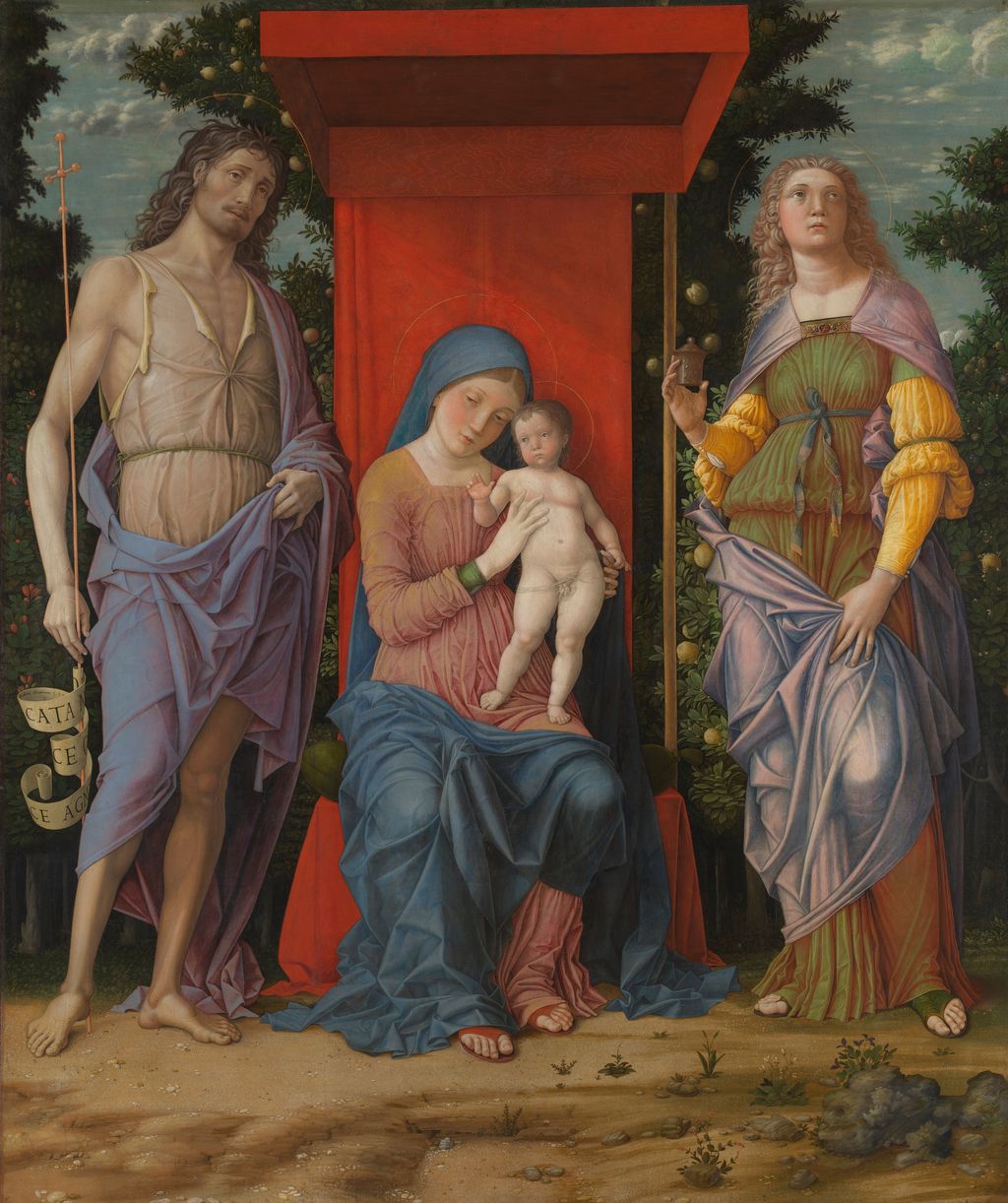
The Virgin and Child with the Magdalen and Saint John the Baptist, National Gallery, London Image source. Public domain.
The National Gallery’s smaller Holy Family with Saint John the Baptist is another comparison for scale and foliage. Here the Baptist is a child and the two boys dominate the foreground. Its clustering of holy figures near the viewer makes it closer in format to the Altman painting than the red-canopy altarpiece. Across these paintings by Mantegna, the presence of another child, an outstretched finger or an ointment jar changes where attention falls and how explicitly the image directs it. [1] [10] [11]
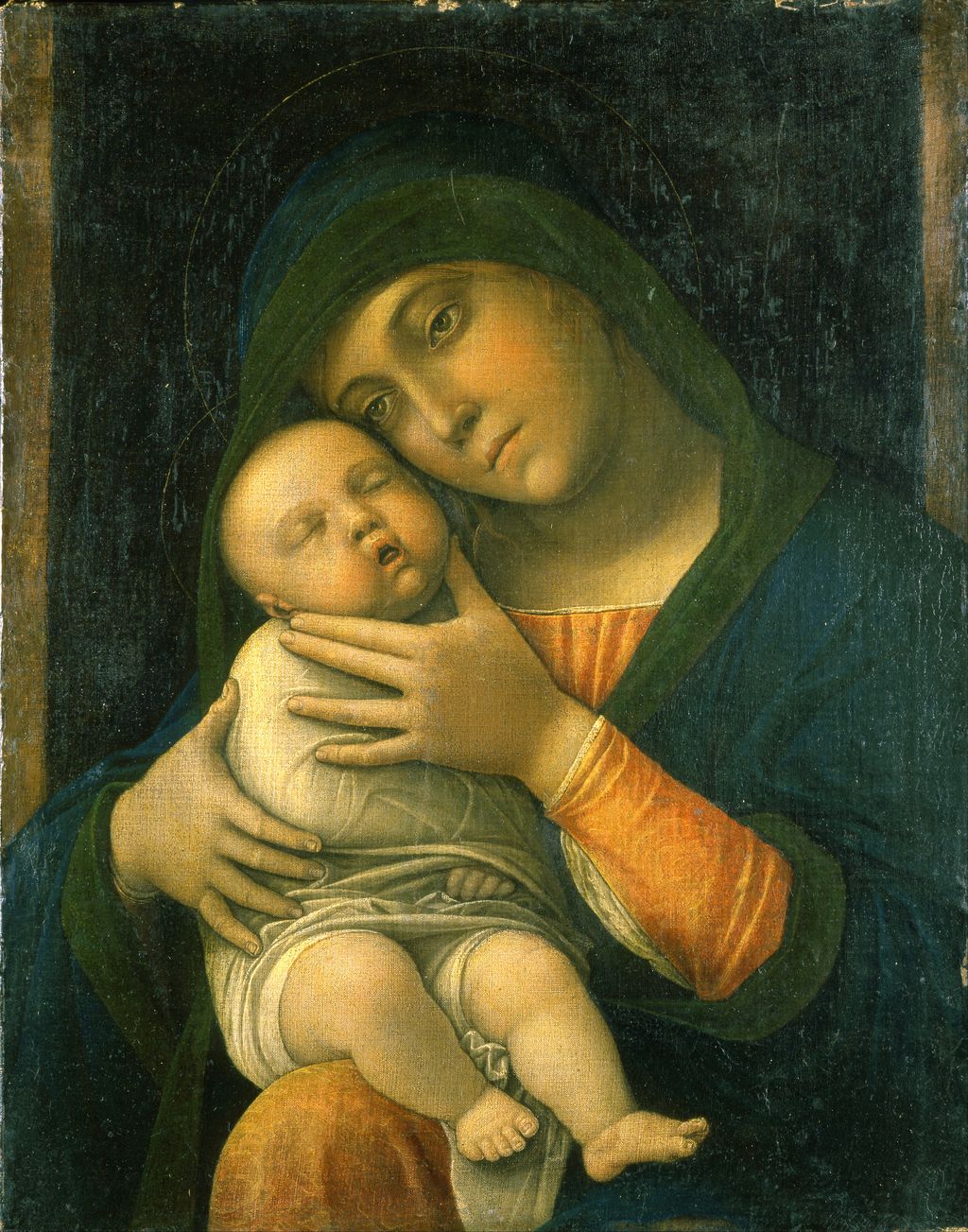
Madonna and Child, Museo Poldi Pezzoli Image source. Public domain.
Distemper on fine cotton
The word canvas names the fabric support. In the Altman picture, Zeri and Gardner specify fine cotton and a water-based medium. The Met calls the paint distemper, a glue-bound medium that remains sensitive to water after drying. The museum credits its handling here with the transitions that give the figures volume. Look at the turn from the lit part of the Child’s thigh into shadow, or at the gentler change across Mary’s cheek. This gradual modelling sits alongside very fine lines at the edge of the veil and along the folds of her dress. [1] [3] [12]
The surface has changed since it was painted. The Met points to past cleanings and to varnish that penetrated the distemper and darkened the colours. The 1986 catalogue describes limited local retouching, mainly following the weave, and identifies the nostril, cheek and, to a lesser degree, mouth of the Virgin as places where retouching affects the form. The darkness of the hedge today is therefore an unreliable guide to how strongly the fruit and foliage once stood out. Mary’s headcloth still catches the eye first, but the darkened green around it makes the colour contrast difficult to reconstruct. [1] [3]
Canvas also accommodated different kinds of paint. Rachel Higgitt and Raymond White’s technical study identifies egg tempera over a gesso ground in the large London altarpiece, although it too was painted on fabric. Mantegna’s two similarly titled cherub paintings show a further distinction. The Met’s Madonna and Child with Seraphim and Cherubim, about 1454, is tempera and gold on wood and came from the Friedsam collection. The Pinacoteca di Brera’s Madonna of Cherubim, dated about 1485 by the museum, is also a panel in tempera. The cotton support and glue-bound paint belong to the particular history of the Altman picture. [1] [3] [12] [13] [14]
A Venetian description and a New York bequest
In the seventeenth century, the Venetian writer Marco Boschini recorded a small painting of the Virgin and Child with Joseph and Mary Magdalen in the sacristy of the church of the Ospedale degli Incurabili. Seymour de Ricci matched the account to the New York canvas in 1912, and the Italian national catalogue records that Keith Christiansen also proposed that identification. The same Italian entry, drawing on Sergio Marinelli’s catalogue, favours the Verona painting. It cites a manuscript inventory of Cesare Bernasconi’s collection from 1871 that associates the Verona canvas with the Incurabili. As Zeri and Gardner observed, matching the New York canvas to the description depends in part on the identity of the female saint. Both paintings fit the broad outlines of the account. [3] [7]
The Met catalogue’s firmer ownership history begins in the nineteenth century with Monsignor Andrea d’Aiuti, who had the painting in Munich and Naples. It lists Count Agosto d’Aiuti as a possible subsequent owner. The picture passed through Dowdeswell and Dowdeswell in London in 1903 to the Hamburg collector Eduard F. Weber. In February 1912 it was lot 20 in the Weber sale at Lepke’s in Berlin. It passed through F. Kleinberger and Co. in New York that year to Benjamin Altman. His 1913 bequest supplies the museum credit and the name by which this particular Holy Family is known. [1] [2] [3]
Annotated Details from The Holy Family with Saint Mary Magdalen
The numbered points identify details to look at closely. The detail images below preserve the native scale of the selected crops.
The Holy Family with Saint Mary Magdalen
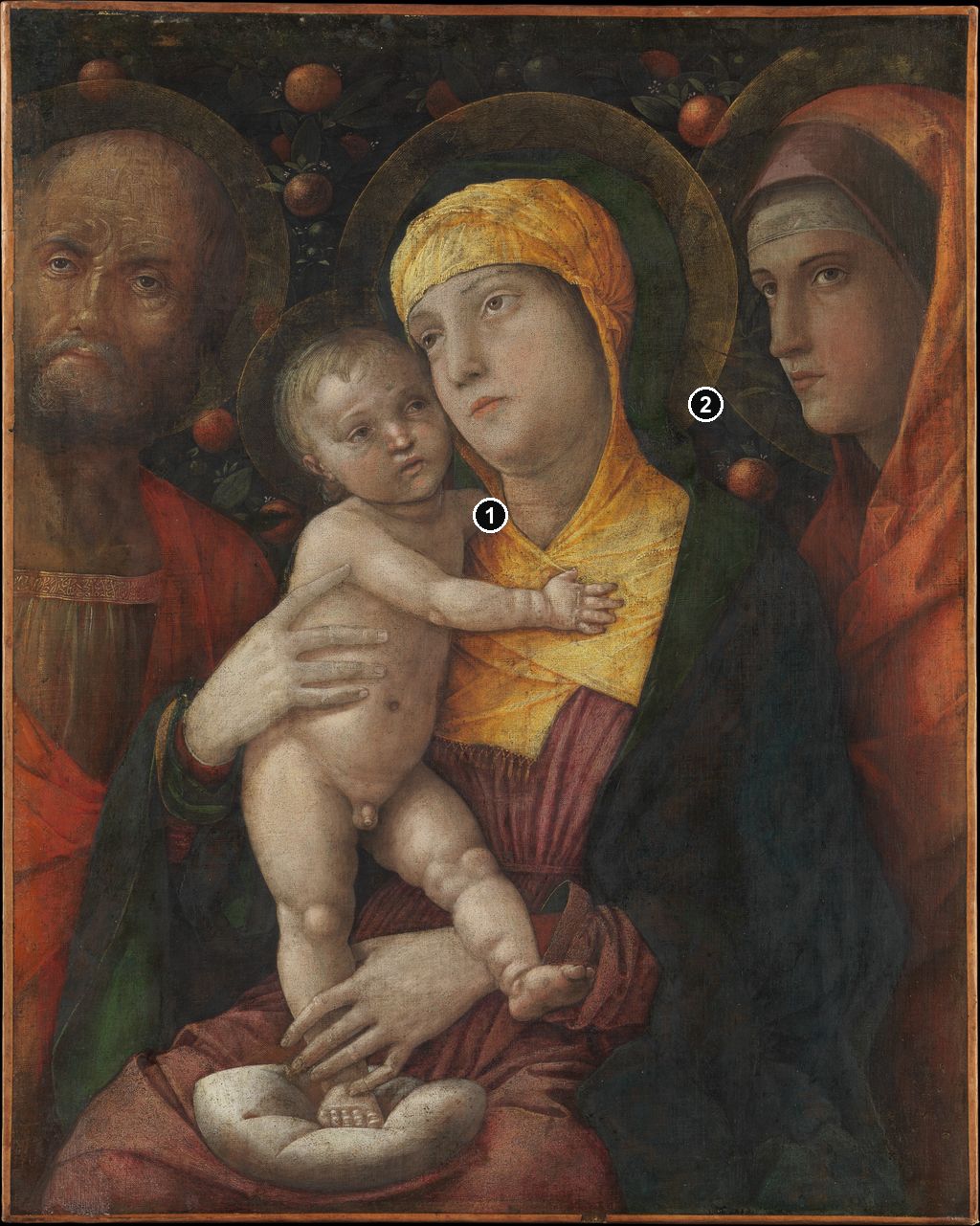
Details from THE HOLY FAMILY WITH SAINT MARY MAGDALEN
Choose a detail to enlarge it.
The Holy Family with Saint Mary Magdalen
The child between faces
The infant’s movement creates a small opening in a dense group. The adults look inward from different angles.
The figure at right
The sideward turn of the head and the enclosing shadows separate the face from the main patch of light.
Artworks directory
| Name | Date | Medium and collection |
|---|---|---|
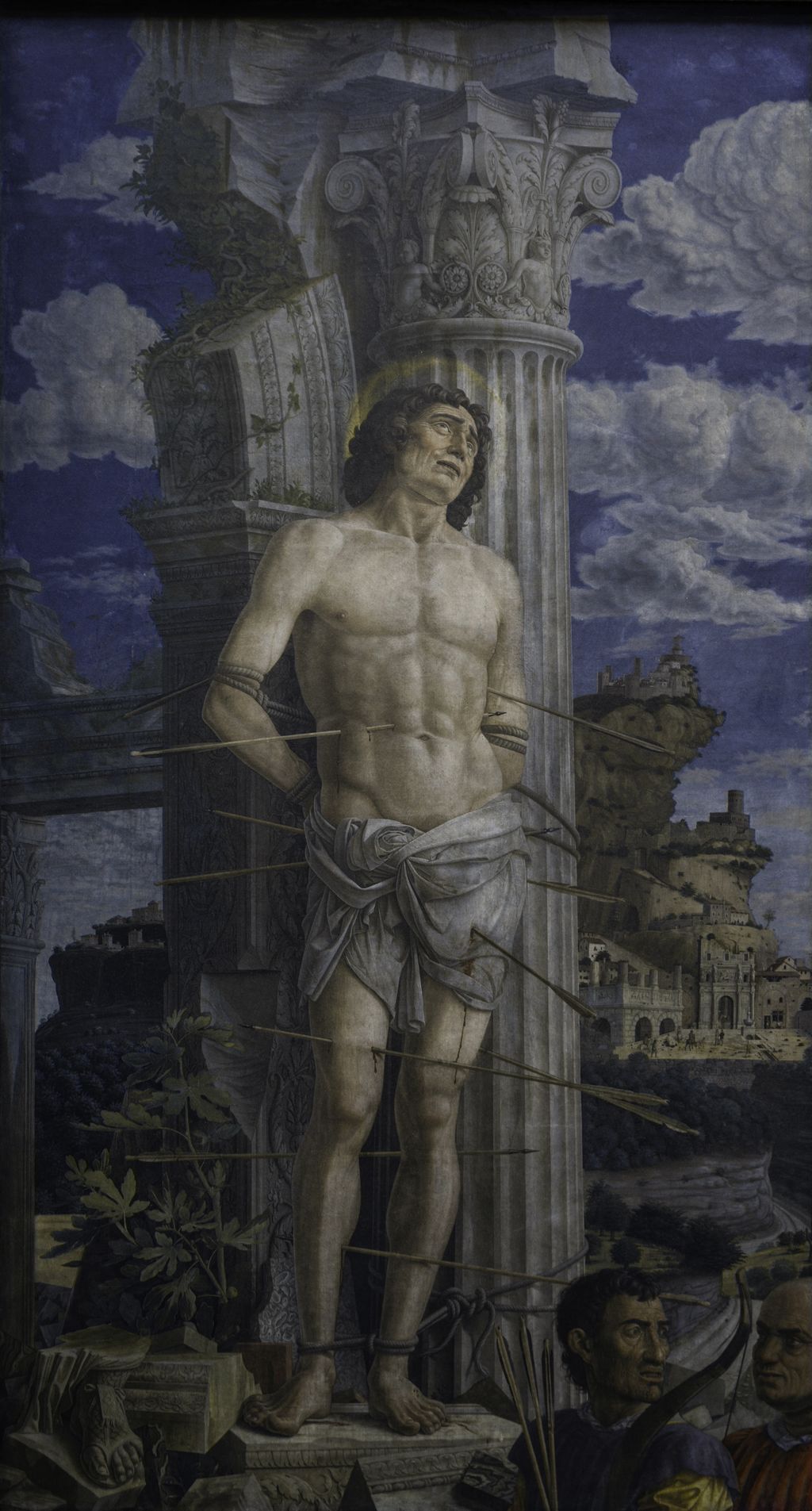
| The Adoration of the Shepherds | Shortly after 1450 | Painting · Metropolitan Museum of Art · 32.130.2 Catalogue. |
| Saint Mark the Evangelist | C. 1448–51 | Painting · Städel Museum · 1046 Catalogue. |
| Saint Jerome Penitent in the Desert | C. 1448–51 | Painting · Museu de Arte de São Paulo · MASP.00015 Catalogue. |
| Martyrdom and Transport of the Body of Saint Christopher | Mid-1450s | Painting · Ovetari Chapel, Padua Catalogue. |
| San Luca Altarpiece | 1453–55 | Painting · Pinacoteca di Brera · 176 Catalogue. |
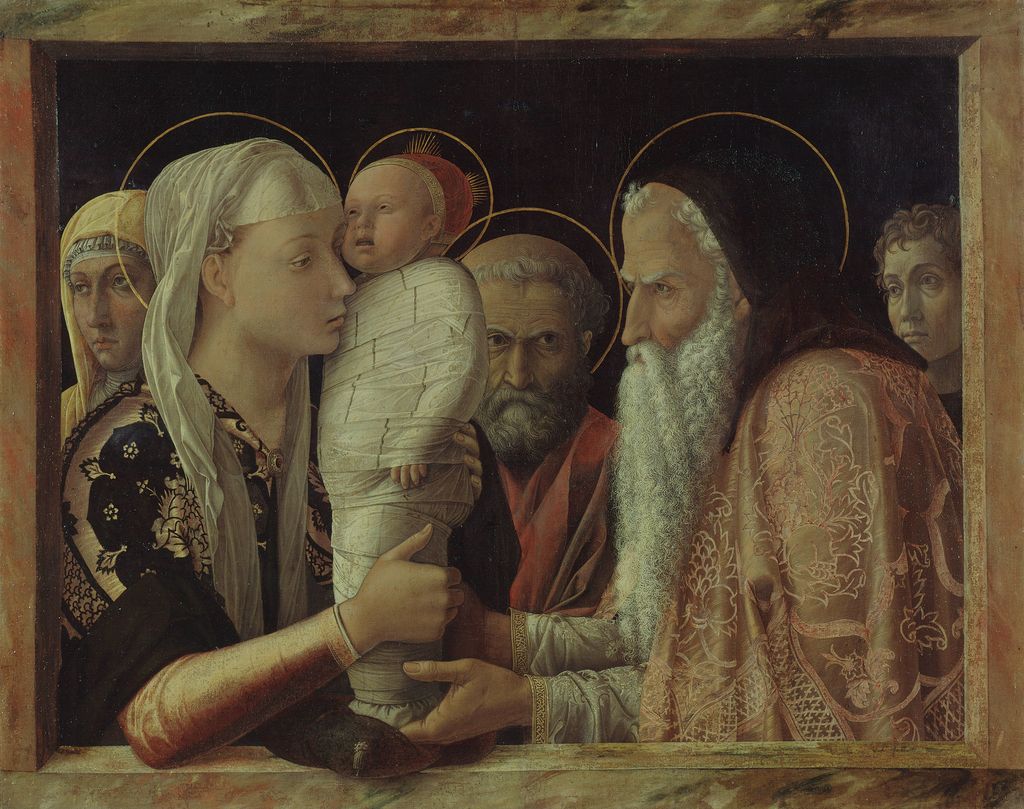
| The Presentation of Christ at the Temple | 1454 (Berlin dating) | Painting · Gemäldegalerie, Berlin · 29 Catalogue. |
| San Zeno Altarpiece | 1457–59 | Painting · Basilica of San Zeno, Verona Catalogue. |
| The Crucifixion | 1456–59 | Painting · Musée du Louvre · INV 368 Catalogue. |
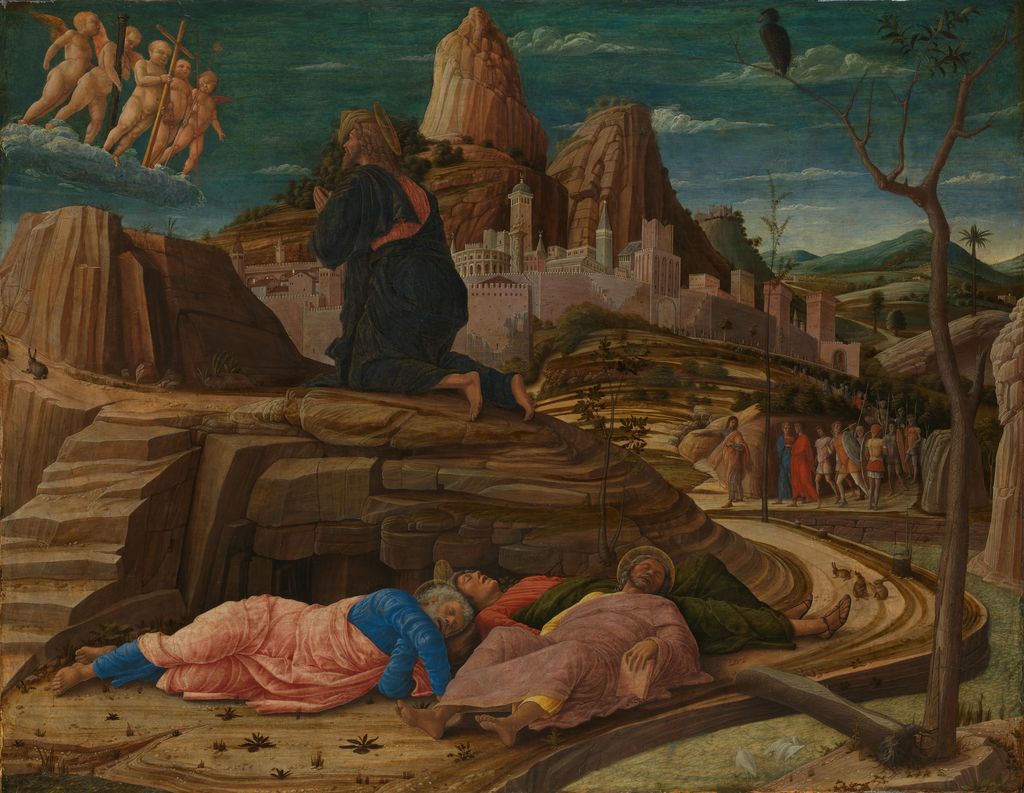
| The Agony in the Garden (London) | C. 1455–56 | Painting · National Gallery, London · NG1417 Catalogue. |
| The Agony in the Garden (Tours) | 1459 (Tours dating) | Painting · Musée des Beaux-Arts de Tours · 1803-1-24 Catalogue. |
| The Resurrection | 1459 (Tours dating) | Painting · Musée des Beaux-Arts de Tours · 1803-1-25 Catalogue. |
| Saint Sebastian (Vienna) | C. 1457–59 | Painting · Kunsthistorisches Museum · GG 301 Catalogue. |
| Cardinal Ludovico Trevisan | C. 1459–60 (Berlin exhibition dating) | Painting · Gemäldegalerie, Berlin · 9 Catalogue. |
| The Death of the Virgin | C. 1462 | Painting · Museo Nacional del Prado · P000248 Catalogue. |
| Christ with the Soul of the Virgin | C. 1460–64 | Painting · Pinacoteca Nazionale, Ferrara Catalogue only. |
| Portrait of a Young Man (traditionally Francesco Gonzaga) | C. 1461 or 1470, depending on sitter | Painting · Museo di Capodimonte · Q 60 Catalogue. |
| Portrait of a Prelate (Carlo de’ Medici?) | C. 1465–70 | Painting · Uffizi Galleries · 1890 no. 8540 Catalogue. |
| Portrait of a Man | C. 1470 | Painting · National Gallery of Art, Washington · 1952.2.5 Catalogue. |
| Madonna with Sleeping Child (Berlin) | C. 1455–60 | Painting · Gemäldegalerie, Berlin · S.5 Catalogue. |
| Camera degli Sposi (Camera Picta) | 1465–74 | Painting · Palazzo Ducale, Mantua Catalogue. |
| Saint Sebastian (Louvre) | Around 1480 | Painting · Musée du Louvre · RF 1766 Catalogue. |
| Lamentation over the Dead Christ | C. 1483 (Brera dating) | Painting · Pinacoteca di Brera · 352 Catalogue. |
| The Triumphs of Caesar | About 1485–1506 | Painting · Royal Collection · RCIN 403958–403966 Catalogue. |
| Madonna of the Caves | C. 1488–90 | Painting · Uffizi Galleries · 1890 no. 1348 Catalogue. |
| Madonna and Child with a Choir of Cherubim | C. 1485 | Painting · Pinacoteca di Brera · 297 Catalogue. |
| Madonna and Child (Poldi Pezzoli) | Early 1490s (museum dating) | Painting · Museo Poldi Pezzoli · 1595 Catalogue. |
| The Holy Family with Saint Mary Magdalen | C. 1495–1500 | Painting · Metropolitan Museum of Art · 14.40.643 Catalogue. |
| The Virgin and Child with Saint Mary Magdalene and Saint John the Baptist | C. 1490–1505 | Painting · National Gallery, London · NG274 Catalogue. |
| Christ as the Suffering Redeemer | 1485–95 (SMK dating) | Painting · Statens Museum for Kunst · KMSsp69 Catalogue. |
| Ecce Homo | C. 1500 | Painting · Musée Jacquemart-André · MJAP-P 1840 Catalogue. |
| Judith with the Head of Holofernes (Mantegna or follower) | C. 1495–1500 | Painting · National Gallery of Art, Washington · 1942.9.42 Catalogue. |
| Madonna della Vittoria | 1495–96 | Painting · Musée du Louvre · INV 369 Catalogue. |
| Mars and Venus (Parnassus) | C. 1496–97 | Painting · Musée du Louvre · INV 370 Catalogue. |
| The Trivulzio Madonna | 1497 | Painting · Castello Sforzesco, Milan · 0554 Catalogue. |
| The Adoration of the Magi | C. 1495–1505 | Painting · J. Paul Getty Museum · 85.PA.417 Catalogue. |
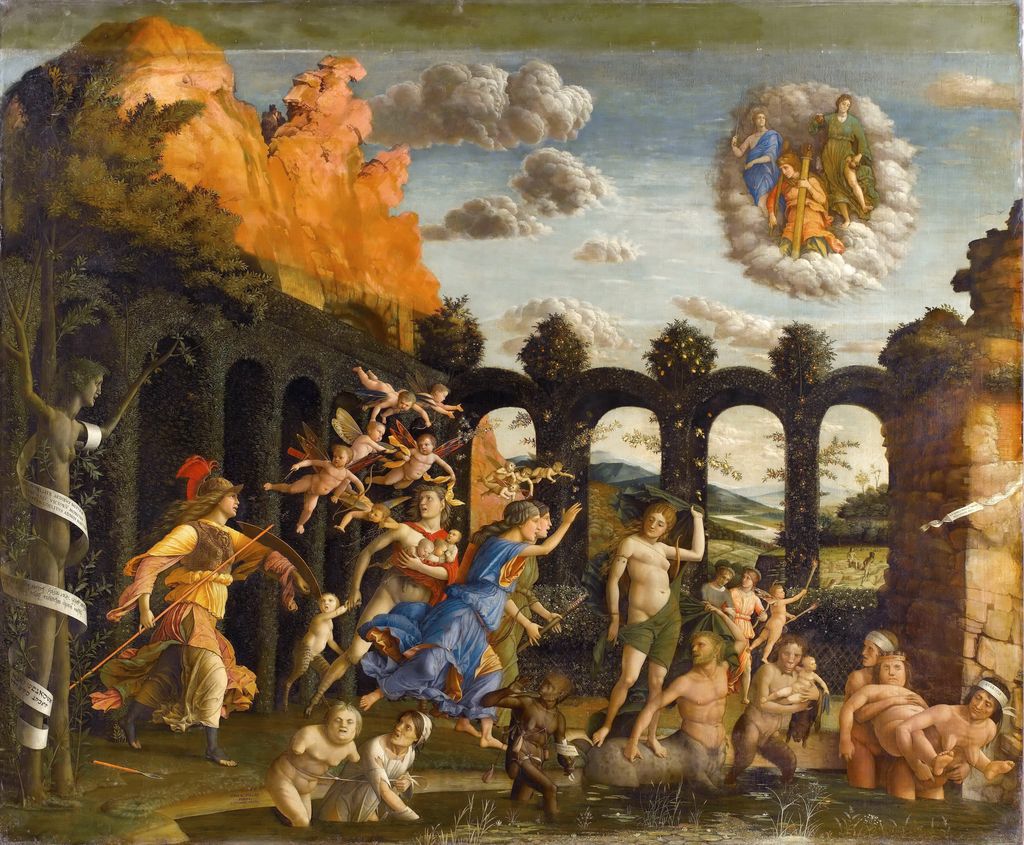
| Minerva Expelling the Vices from the Garden of Virtue | C. 1502 | Painting · Musée du Louvre · INV 371 Catalogue. |
| The Introduction of the Cult of Cybele at Rome | 1505–06 | Painting · National Gallery, London · NG902 Catalogue. |
| Saint Sebastian (Venice) | Probably c. 1504–06 | Painting · Galleria Giorgio Franchetti alla Ca’ d’Oro · D.11 Catalogue. |
| Samson and Delilah | C. 1500 | Painting · National Gallery, London · NG1145 Catalogue only. |
| A Woman Drinking (probably Sophonisba) | C. 1495–1506 | Painting · National Gallery, London · NG1125.2 Catalogue only. |
| The Vestal Virgin Tuccia with a Sieve | C. 1495–1506 | Painting · National Gallery, London · NG1125.1 Catalogue only. |
| Judith with the Head of Holofernes (Dublin) | C. 1495–1500 | Painting · National Gallery of Ireland · NGI.442 Catalogue only. |
| Battle of the Sea Gods, left half (Met impression) | Before 1481 (Met dating) | Print · Metropolitan Museum of Art · 18.12 Catalogue only. |
| Battle of the Sea Gods, right half (Met impression) | Before 1481 (Met dating) | Print · Metropolitan Museum of Art · 1984.1201.4 Catalogue only. |
| Battle of the Sea Gods, left half (Tokyo impression) | C. 1475 (Tokyo dating) | Print · National Museum of Western Art, Tokyo · G.1981-0002 Catalogue only. |
| Battle of the Sea Gods, left half (Washington impression) | C. 1485–88 (NGA dating) | Print · National Gallery of Art, Washington · 1941.1.6 Catalogue only. |
| The Entombment of Christ, second state of two | Before 1475 (Met dating) | Print · Metropolitan Museum of Art · 37.42.30 Catalogue only. |
| The Entombment of Christ (possibly Zoan Andrea, after Mantegna) | 1460–1549 (Rijksmuseum dating) | Print · Rijksmuseum · RP-P-1924-60 Catalogue only. |
| Four Dancing Muses (Gian Marco Cavalli after Mantegna) | C. 1497 | Print · Metropolitan Museum of Art · 20.5.3 Catalogue only. |
| Bacchanal with Silenus | Before 1475 (Met dating) | Print · Metropolitan Museum of Art · 29.44.15 Catalogue only. |
| Bacchanal with a Wine Vat | Before 1475 (Met dating) | Print · Metropolitan Museum of Art Catalogue only. |
| St James on His Way to Execution | C. 1453–57 | Drawing · British Museum · 1976,0616.1 Catalogue only. |
| Three Studies for a Dead Christ | C. 1455–65 | Drawing · British Museum · 1909,0406.3 Catalogue only. |
| Pietà (Venice) | C. 1456–65 (exhibition datings) | Drawing · Gallerie dell’Accademia, Venice · 115 Catalogue only. |
| Studies for Christ at the Column | 1460–65 | Drawing · The Courtauld · D.1978.PG.345 Catalogue only. |
| Virtus Combusta | C. 1490 (technical study) | Drawing · British Museum · Pp,1.23 Catalogue only. |
| Virtus Combusta (Giovanni Antonio da Brescia after Mantegna) | C. 1495–1506 | Print · Musée du Louvre · 3881 LR/ Recto Catalogue only. |
| The Calumny of Apelles | C. 1504–06 | Drawing · British Museum · 1860,0616.85 Catalogue only. |
Frequently Asked Questions
Benjamin Altman owned the painting before it entered the Metropolitan Museum of Art as part of his bequest. The Met catalogues it as 14.40.643.
The Met picture groups the family around the child with the Magdalen. The London canvas places Mary and the child beneath a red canopy with the Magdalen and Saint John the Baptist.
Discussion
Look again at the images and ideas explored in Altman Madonna. These editorial prompts invite your observations.
Reader Insights
How do Mary’s supporting hands, the Child’s foot on the cushion and the overlapping haloes make the four figures feel close?
Which visible details help distinguish the female saint in the Altman Madonna from the Magdalene in the National Gallery altarpiece, and what can those details tell us about Boschini’s description?
Join the Conversation
Share a detail, comparison or question about Altman Madonna below.
References
- The Metropolitan Museum of Art, The Holy Family with Saint Mary Magdalen, 14.40.643. View source.
- Fondazione Federico Zeri, Mantegna Andrea, Sacra Famiglia con santa Maria Maddalena. View source.
- The Metropolitan Museum of Art, Federico Zeri with Elizabeth E. Gardner, North Italian School, “The Holy Family with Saint Mary Magdalen,” pp. 32–33, plate 14. View source.
- The Metropolitan Museum of Art, Marble funerary relief. View source.
- The Metropolitan Museum of Art, Top of a marble funerary relief with portrait busts of a young man and an elderly woman. View source.
- Staatliche Museen zu Berlin, Maria mit dem schlafenden Kind, S.5. View source.
- Ministero della Cultura, Sacra famiglia con una santa, Museo di Castelvecchio. View source.
- Königliche Gemäldegalerie zu Dresden, Karl Woermann, “Heilige Familie,” gallery catalogue, 1887, p. 43, no. 51. View source.
- Institut national d’histoire de l’art, La Vierge et l’Enfant avec trois saints, D 1041. View source.
- The National Gallery, The Virgin and Child with Saints, NG274. View source.
- The National Gallery, The Holy Family with Saint John the Baptist, NG5641. View source.
- The National Gallery, Rachel Higgitt and Raymond White, “Analyses of Paint Media,” Technical Bulletin 26, pp. 91–93. View source.
- The Metropolitan Museum of Art, Madonna and Child with Seraphim and Cherubim, 32.100.97. View source.
- Pinacoteca di Brera, Madonna con il Bambino e coro di cherubini, inv. 297. View source.
- Basilica of San Zeno, Verona, San Zeno Altarpiece, View source.
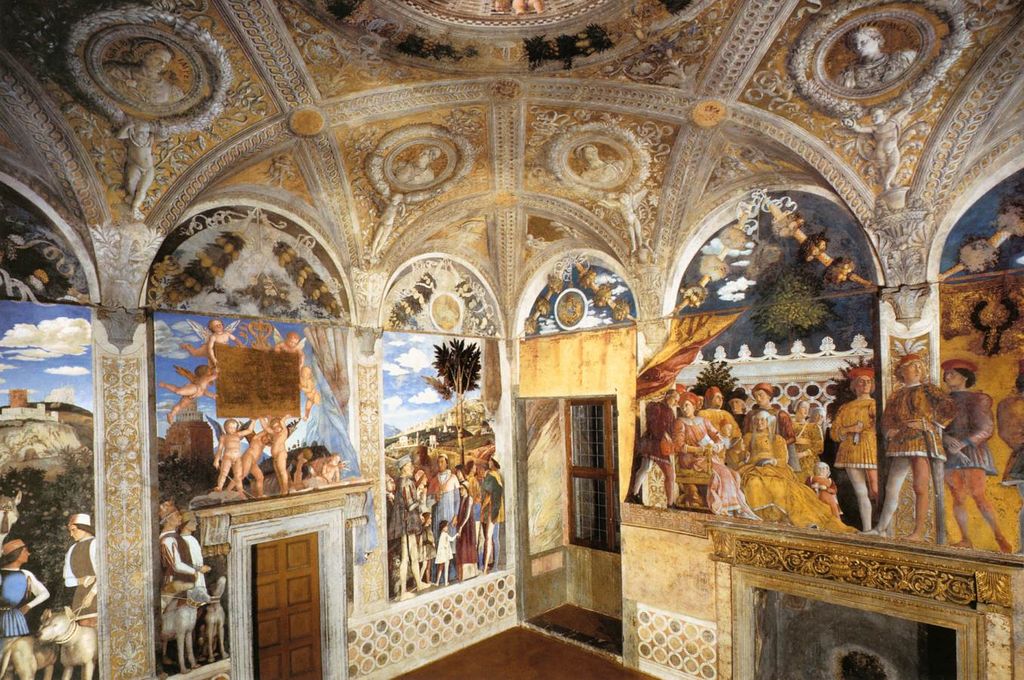
- Palazzo Ducale, Mantua, Camera degli Sposi (Camera Picta), View source.
- Royal Collection, The Triumphs of Caesar, View source.
- Musée du Louvre, Madonna della Vittoria, View source.
- National Gallery, London, The Introduction of the Cult of Cybele at Rome, View source.
More MANTEGNA Paintings
San Zeno Altarpiece
The San Zeno Altarpiece in its frame, Basilica of San Zeno, Verona José Luiz. Image source. CC BY-SA 4.0. Resized from the cited image.