 by Tom Gurney
Tom Gurney BSc (Hons) is an art history expert with over 20 years experience
Email: tomgurney1@gmail.com / Phone: +44 7429 011000
Overview
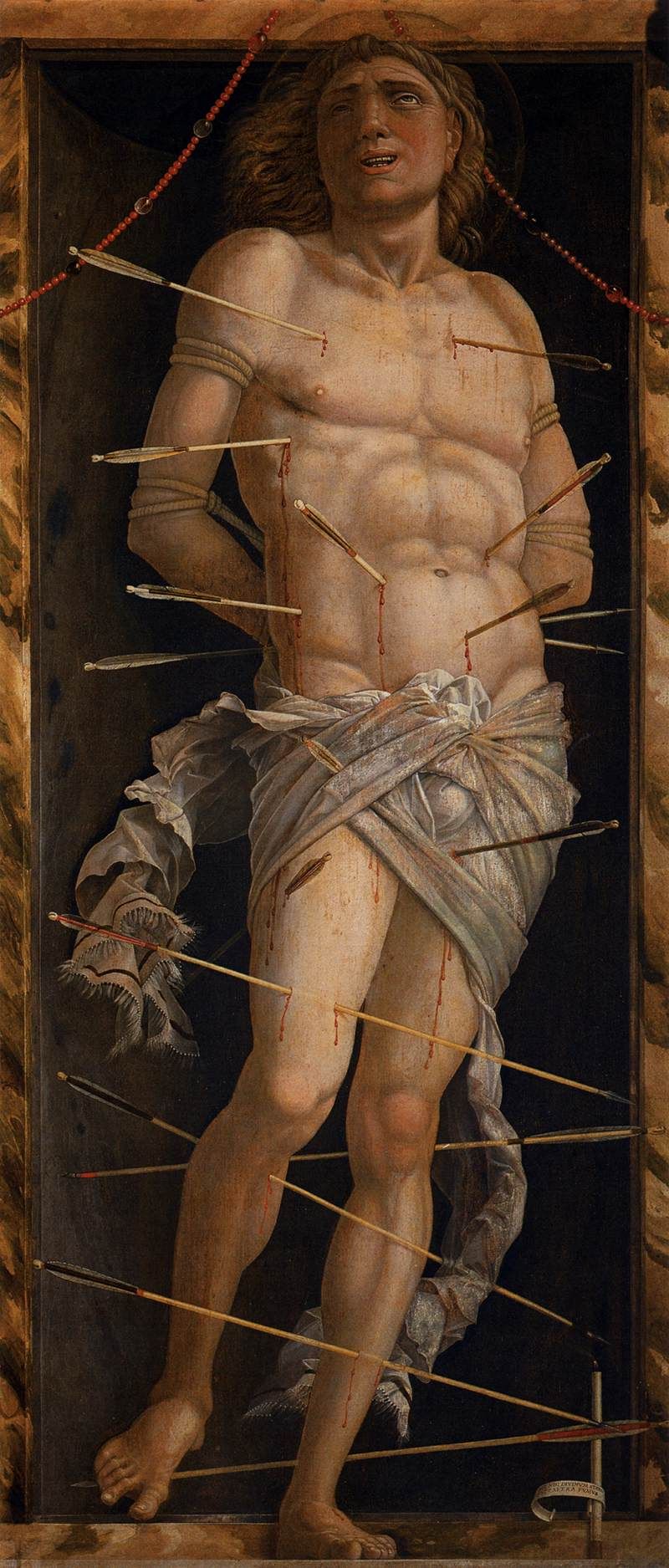
Andrea Mantegna’s Saint Sebastian in the collection of the Galleria Giorgio Franchetti alla Ca’ d’Oro in Venice gives Sebastian barely enough room to stand. The saint’s arms are bound behind him, his head tips back, and arrows jut into the narrow space around his body. At the lower right, a strip of writing curls around a candle. Painted late in Mantegna’s career, probably in the years leading up to his death in 1506, the canvas makes this small detail a way of reading the whole scene. [1] [2] [3]
At a Glance
- DateProbably about 1504–06
- MediumTempera on canvas (2022–23 exhibition record)
- Dimensions213 × 95 cm (2022–23 exhibition record)
- CollectionGalleria Giorgio Franchetti alla Ca’ d’Oro, Venice
- Inventory numberD.11
Andrea Mantegna in context
San Zeno Altarpiece
1457–59 [21]The Triumphs of Caesar
Mid-1480s–before 1506 [23]Madonna della Vittoria
1495–96 [24]Saint Sebastian (Venice)
Probably c. 1504–06 [26]A body too large for its niche
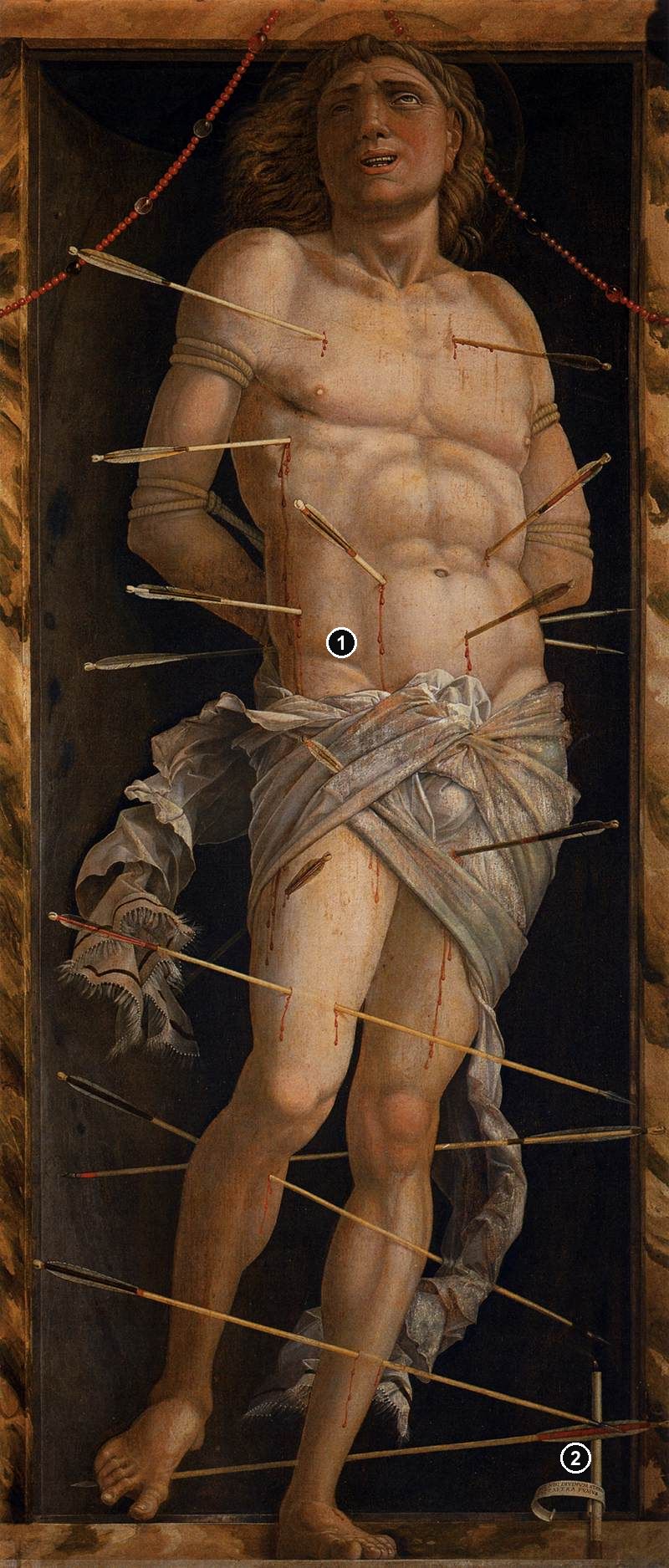
The surface behind Sebastian is almost entirely dark. Enough of the curve survives in the shadows to establish a niche, and a band of painted imitation marble defines its outer edge. With little to tell us where the punishment takes place, the niche directs attention to the outline of the figure. It is the kind of recess that might hold a statue. Sebastian’s stance disturbs that symmetry. A shoulder turns, hair lifts away from the head, and the cloth beside the hip opens in angular folds. The narrow surround makes those small departures from the upright pose easy to see. [2] [3] [4]
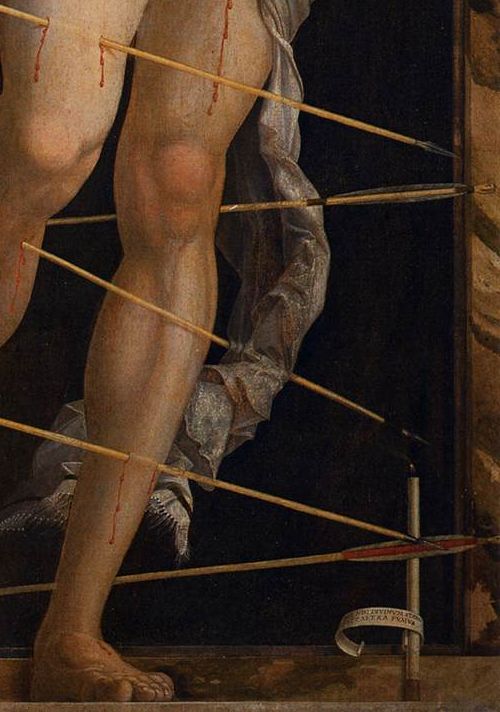
Follow the rope at the upper arms. The wrists are out of sight behind the body, so the tension has to be read from the visible loops and the position of the shoulders. The fastening disappears into the darkness. A bent knee and a foot close to the ledge give the figure the suggestion of a forward step, although the restraint above makes it hard to imagine the step being completed. Tiziana Migliore reads the lower edge as a threshold. The same border that encloses the saint from above and at the sides gives him a ledge from which he seems about to enter the viewer’s space. [2] [3]
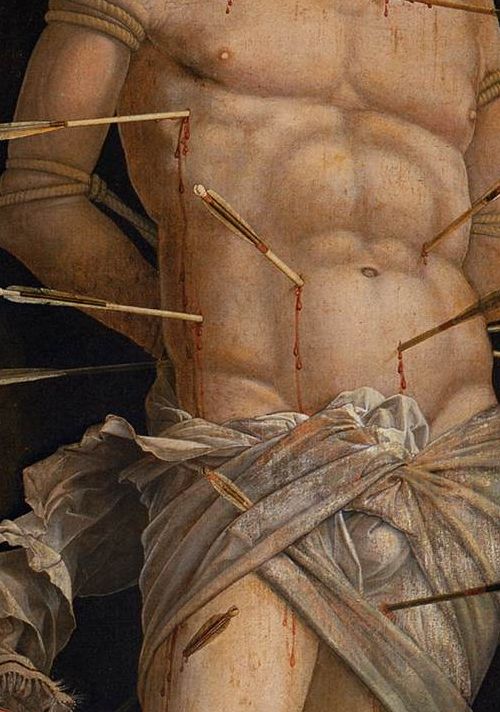
The arrows give the body a second enclosure. Their angles differ, so some shafts extend out past the silhouette while others cross the pale flesh. Thin runs of blood descend under their own weight. The viewer can follow those lines down to the ledge or follow the pulling tendons of the neck up to the head. Seen together, the two directions give the pose its strain. At the top, the furrowed brow, the upturned eyes and the parted lips register how much effort it takes to remain upright. Carlo Severi draws attention to the tension between the pale, almost marble-like skin and the blood on its surface. The painted recess prepares us for a statue. A trail of blood shows us skin that has just been pierced. [2] [3] [4] [5]
Saint Sebastian, Galleria Giorgio Franchetti alla Ca’ d’Oro, Venice Zairon. Image source. CC BY-SA 4.0. Resized from the cited image.
The smoke and the painted words
In the legend, the Roman emperor Diocletian has Sebastian shot for his Christian faith. The archers leave him for dead, but he survives, and Irene tends his wounds. He is killed only after he returns to confront the emperor. The candle can suggest a life about to end without fixing the scene at the moment of Sebastian’s death. There is no one beside him to discover that he is alive. Mantegna leaves that work to the raised foot, the open eyes and the strained mouth. [2] [3] [5]
The gallery’s Italian guide describes the candle as extinguished, with a wisp of smoke still leaving the wick. A Ministry of Culture notice reads the same detail as a weak flame about to go out. Both descriptions place the candle at the instant when light gives way to smoke. The notice also draws attention to the raised hair, as though a current of air had reached both ends of the picture. On the ledge, the little candle stands close enough to Sebastian’s feet for its scale to be felt. The big body and the small column of wax occupy the same shallow space, with one upright form under strain and the other at the point of losing its light. [4] [6]
In the museum’s transcription, the Latin reads Nihil nisi divinum stabile est, coetera fumus. Only the divine endures. Everything else is smoke. The words appear on a painted strip, or cartiglio, winding around the candle. The viewer moves from the long first clause to the shorter phrase about smoke, then has the trace at the wick to look back at. The letters stay sharply defined while the thing they name is disappearing. That difference makes the inscription part of the action at the ledge. [3] [4]
The art historian Herbert von Einem compared the phrase with passages in Psalm 102 and Isaiah 51 that set what passes like smoke against what endures. He also found the image of smoke in the account of Sebastian in the Golden Legend. Von Einem found no earlier text with the complete wording of the painted maxim. In his reading, the saint’s suffering belongs to the world of things that pass, however overwhelming it is in the moment. The painting gives that idea an uncomfortable physical starting point. The body is still turning and the mouth still open when the inscription asks the viewer to think beyond what can be seen. [3]
What the letter of 1506 records
On 2 October 1506, after his father’s death, Mantegna’s son Lodovico wrote to Francesco II Gonzaga, Marquis of Mantua, about the family’s debts and the expense of completing his father’s chapel. He discussed works that could help the heirs meet those obligations, then mentioned a Saint Sebastian his father had wanted the bishop of Mantua to have. The bishop was Ludovico Gonzaga, a different man from the writer of the letter. Von Einem and the Italian Ministry of Culture identify the painting mentioned there with the Venice canvas. The letter gives the intended recipient by office. When the artist began the canvas, where it was meant to hang and what arrangements he made with the bishop remain open. [3] [6] [7] [8]
A date around 1504–06 follows the late chronology used by Migliore and is consistent with the association with the works left at Mantegna’s death. The Italian national catalogue assigns the painting a broader, earlier range in the second half of the fifteenth century, and the Fondazione Federico Zeri’s photo catalogue puts it between 1480 and 1500. The letter provides a firm date for the mention of a Saint Sebastian. Its value as the latest possible date for the surviving canvas depends on identifying the two. The national record, which gives the gallery’s inventory number as D.11, also lists oil on canvas. The 2022–23 exhibition at the Hôtel de la Marine, organised with the Veneto museum authority, lists tempera on canvas and measures the work at 213 by 95 centimetres. [2] [3] [5] [7] [9] [10] [11]
Saint Sebastian, Musée du Louvre Image source. Public domain.
The places left open in Vienna and Paris
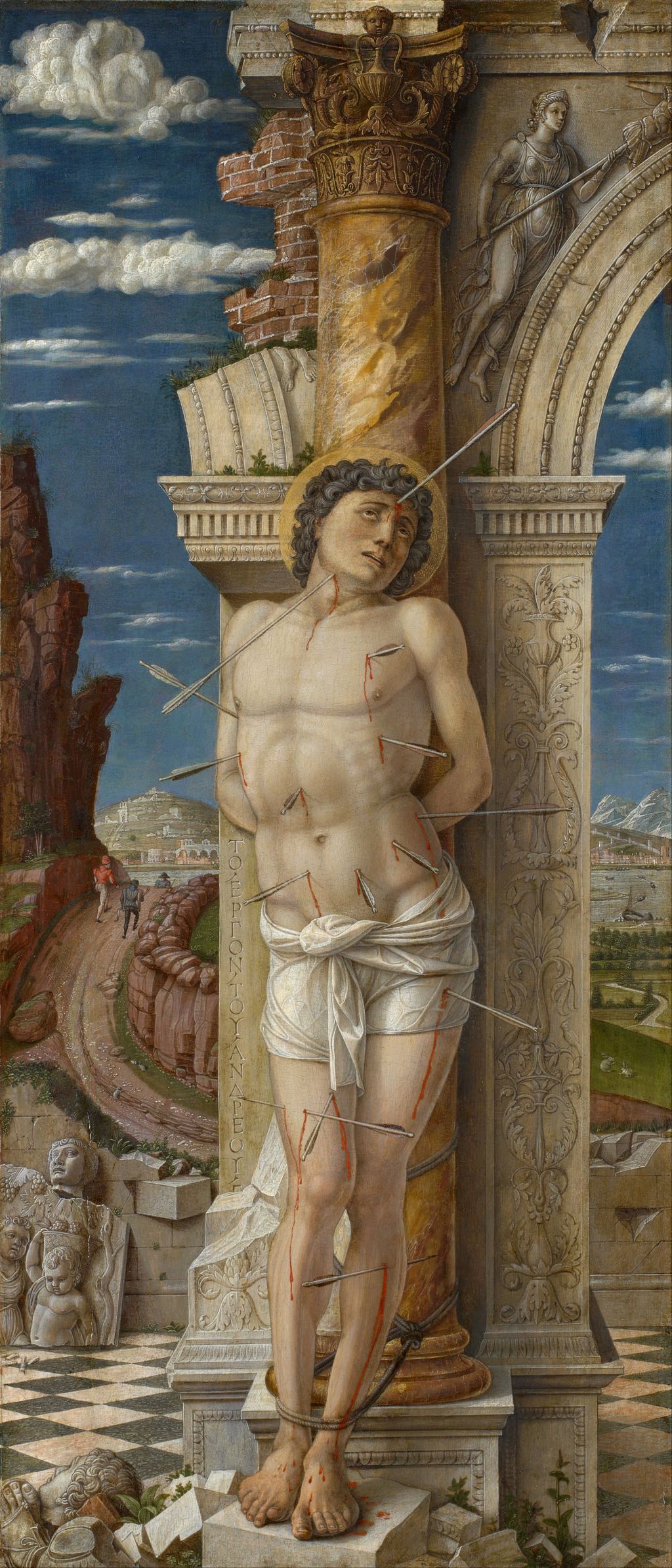
In the Vienna Saint Sebastian, the Kunsthistorisches Museum’s small panel, a ruined classical structure frames the saint. The paving leads the eye along the ground, and gaps in the architecture disclose a road, distant figures and sky. The archers have withdrawn along a curving path. Cäcilia Bischoff, writing for the museum, suggests that the rider formed in the clouds may evoke the transience of human life. In Venice the inscription gives the thought explicit words, and the smoke rises from the same ledge on which Sebastian stands. [3] [4] [12]
Saint Sebastian, Kunsthistorisches Museum, Vienna Image source. Public domain.
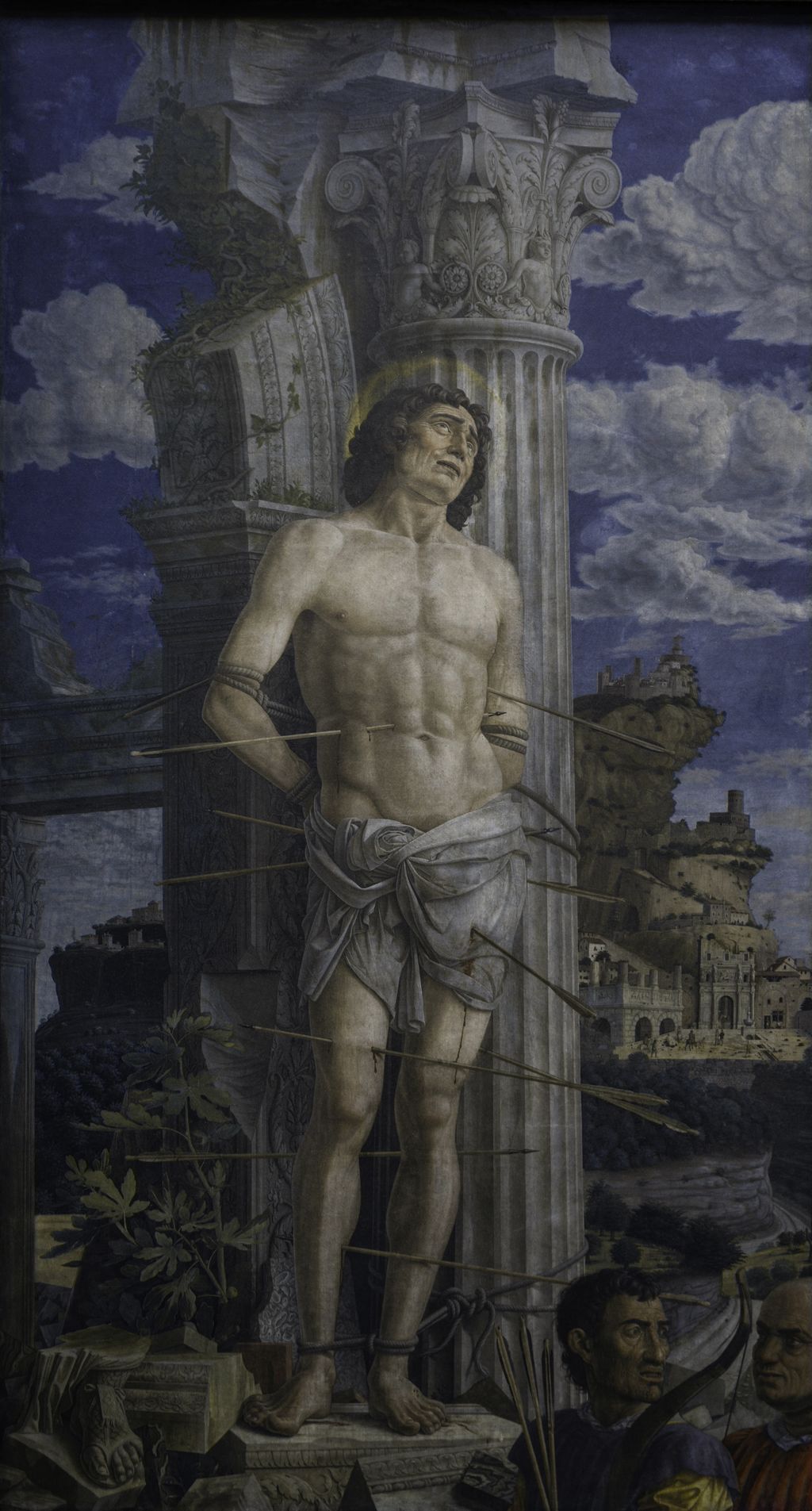
The Louvre Saint Sebastian has a broad stretch of sky, fragments of ancient sculpture and two archers cut off by the lower right edge. The men are close to the viewer, well below the saint’s face. Mantegna also used a painted stone border here, which the Louvre identifies as imitation porphyry. The museum dates the tempera canvas to the last quarter of the fifteenth century and proposes that it reached Aigueperse around the time of Chiara Gonzaga’s marriage to Gilbert de Bourbon in 1481. Its presence in the Sainte-Chapelle there is documented from 1636. [3] [13]
Set the lower right corners of the two canvases side by side. In Paris, the men at the edge give the eye somewhere to go after it has followed an arrow out from the body. In Venice, that corner leads to the candle, a sign of something that has happened a moment before. The archers can be imagined beyond the bounds of the scene, but the act of aiming and shooting has already passed. Vienna gives the aftermath distance along the road. Venice gives it duration in the last trace of smoke. Across the three paintings, the wounds remain visible while Mantegna changes how a viewer reconstructs the moment that caused them. [3] [4] [12] [13]
The ledge and the slab in the Brera Lamentation
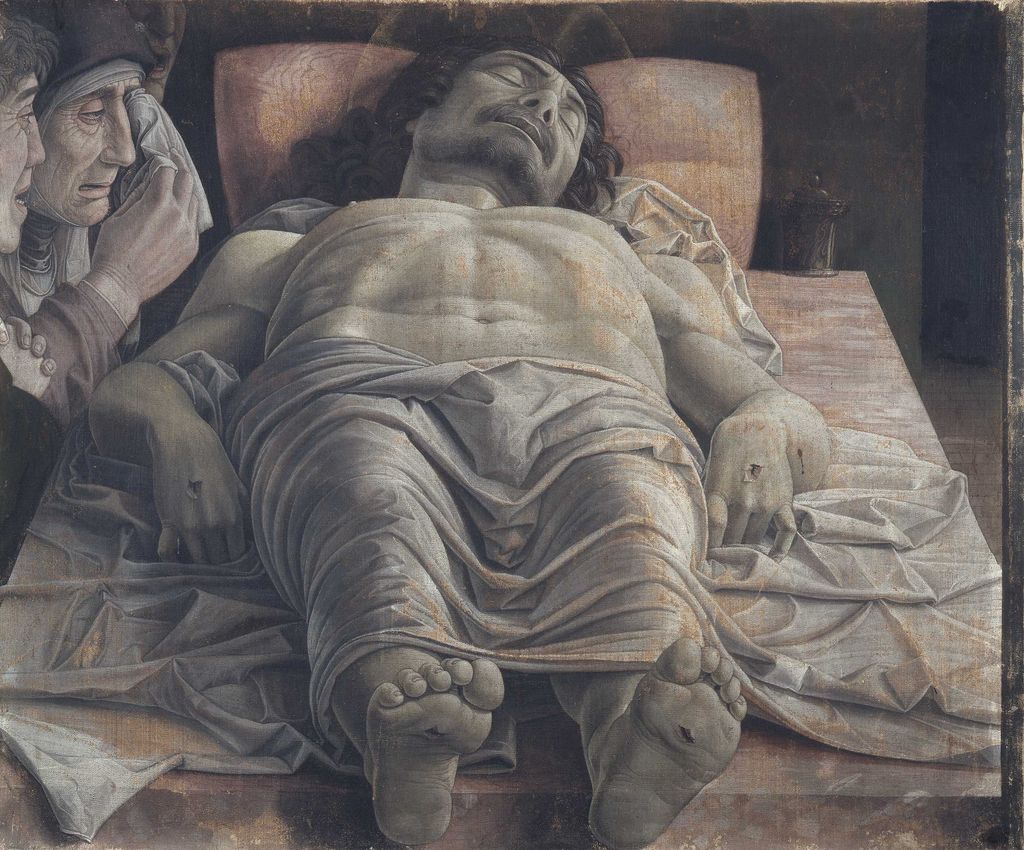
The 1506 letter also describes a foreshortened Christ. The Pinacoteca di Brera considers its own Lamentation over the Dead Christ the most convincing candidate for that work, while acknowledging that several versions complicate the identification. Brera dates its tempera canvas to about 1483 and proposes that the studio painting was sold to Cardinal Sigismondo Gonzaga. That is a different transaction from the intended transfer of the Saint Sebastian to the bishop. The two mentions in Lodovico’s letter have drawn these paintings together in discussions of Mantegna’s studio, with room for a substantial interval between their making. [3] [7] [14]
The visual relationship is easier to test. In Milan, Christ’s feet face the viewer and the body recedes sharply along the slab. The mourners are crowded into the left edge, leaving the foreground to the wounded feet and the hard surface supporting them. In Venice, the body rises almost the full height of the picture and the foot comes forward to meet the lower edge. The slab and the ledge bring each figure close to the viewer. Christ’s body rests with its weight on the stone. Sebastian still appears to negotiate his weight, caught between the step suggested by the knee and the hold of the bindings. Von Einem brought the two works together through their compression of space around a suffering body. [2] [3] [4] [14]
From Bembo’s house to Franchetti’s chapel
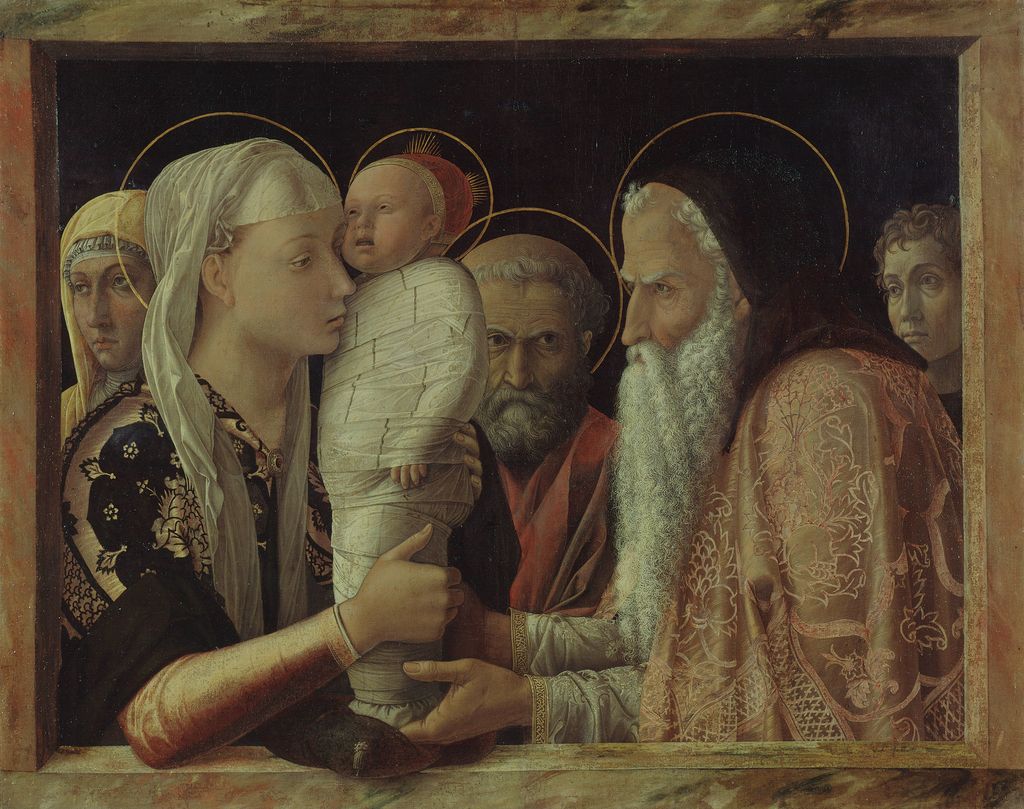
In his notes on Pietro Bembo’s house in Padua, the sixteenth-century observer Marcantonio Michiel records a larger-than-life Sebastian on canvas by Mantegna. He describes the saint as shot with arrows at a column. The description is generally taken to refer to the Venice painting, although its architectural shorthand differs from the dark niche described by the museum today. Michiel lists it alongside another Mantegna, a small panel of the Presentation, in a collection that included ancient marbles, medals and gems. His notes locate the large canvas in a private collection where it could be seen alongside the kinds of ancient objects Mantegna studied. [4] [15] [16]
Rosella Lauber traces the work onward through the Gradenigo family to Antonio Scarpa, the anatomist and collector whose heirs kept the collection at Motta di Livenza. Giorgio Franchetti acquired the painting in 1893. It had already left the Scarpa collection before much of that collection went to auction in Milan in 1895. [1] [9] [15] [16] [17]
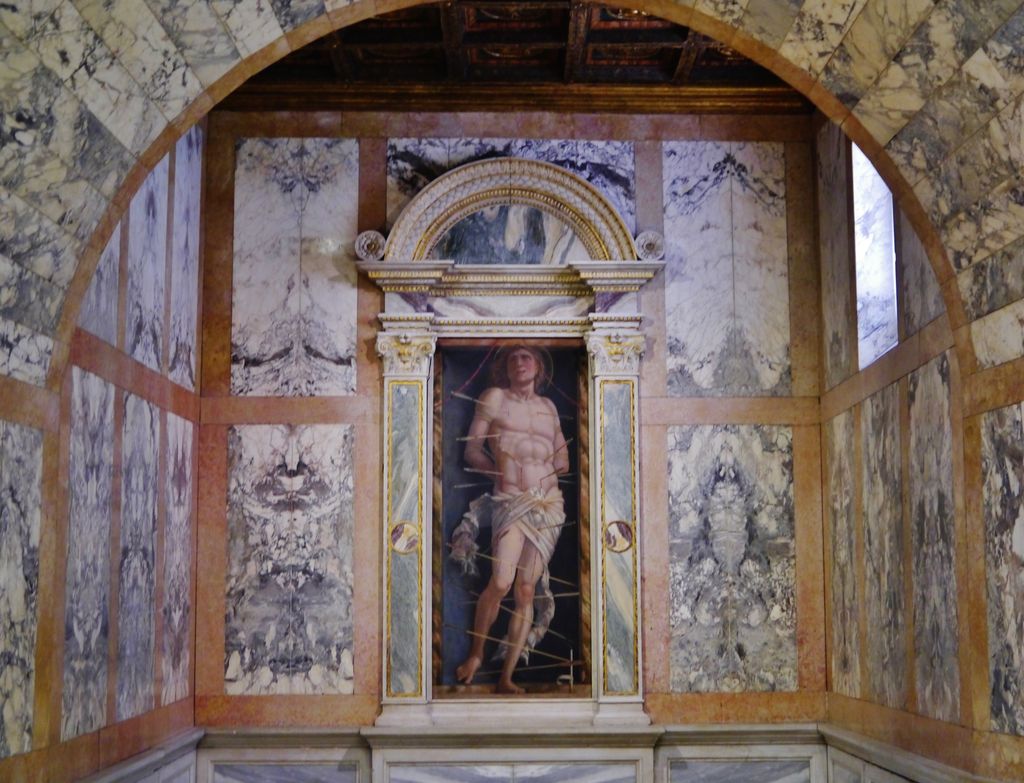
Franchetti bought the Ca’ d’Oro in 1894. One of his first display projects was to build a chapel around the Saint Sebastian, lining the space with marble and setting the canvas above an altar. The regional museum authority identifies the Venetian church of Santa Maria dei Miracoli as a principal model for the room. Franchetti donated the palace and the original core of his collection to the Italian state in 1916. The museum opened to the public in 1927. [1] [18]
The chapel gives physical depth to an effect that Mantegna produced with shading and painted stone. From the room, the eye moves past the real marble and the altar to the painted ledge where the candle sits. The chapel’s arrangement belongs to Franchetti’s reading of the painting, centuries after the letter that mentions the bishop. Its effect is particularly clear in the gallery’s account of the 2025 exhibition with Giovanni Bellini’s Pietà. Bellini’s painting was lit separately in a darkened area beside the restored chapel. The two works were close enough to compare, while Franchetti’s architecture still gave Sebastian a space of his own. In 2026 the pairing was repeated at Rimini’s Museo della Città, where the two paintings could be seen together away from the chapel built to hold Sebastian alone. [1] [18] [19] [20]
Annotated Details from Saint Sebastian
The numbered points identify details to look at closely. The detail images below preserve the native scale of the selected crops.
Saint Sebastian
Details from SAINT SEBASTIAN
Choose a detail to enlarge it.
Saint Sebastian
The taut body
The central body emerges from a dark setting. The narrow confines give unusual force to the tension across the shoulders.
The lower edge
The lower part of the picture holds the small candle and inscription close to the composition’s boundary.
Artworks directory
| Name | Date | Medium and collection |
|---|---|---|
| The Adoration of the Shepherds | Shortly after 1450 | Painting · Metropolitan Museum of Art · 32.130.2 Catalogue. |
| Saint Mark the Evangelist | C. 1448–51 | Painting · Städel Museum · 1046 Catalogue. |
| Saint Jerome Penitent in the Desert | C. 1448–51 | Painting · Museu de Arte de São Paulo · MASP.00015 Catalogue. |
| Martyrdom and Transport of the Body of Saint Christopher | Mid-1450s | Painting · Ovetari Chapel, Padua Catalogue. |
| San Luca Altarpiece | 1453–55 | Painting · Pinacoteca di Brera · 176 Catalogue. |
| The Presentation of Christ at the Temple | 1454 (Berlin dating) | Painting · Gemäldegalerie, Berlin · 29 Catalogue. |
| San Zeno Altarpiece | 1457–59 | Painting · Basilica of San Zeno, Verona Catalogue. |
| The Crucifixion | 1456–59 | Painting · Musée du Louvre · INV 368 Catalogue. |
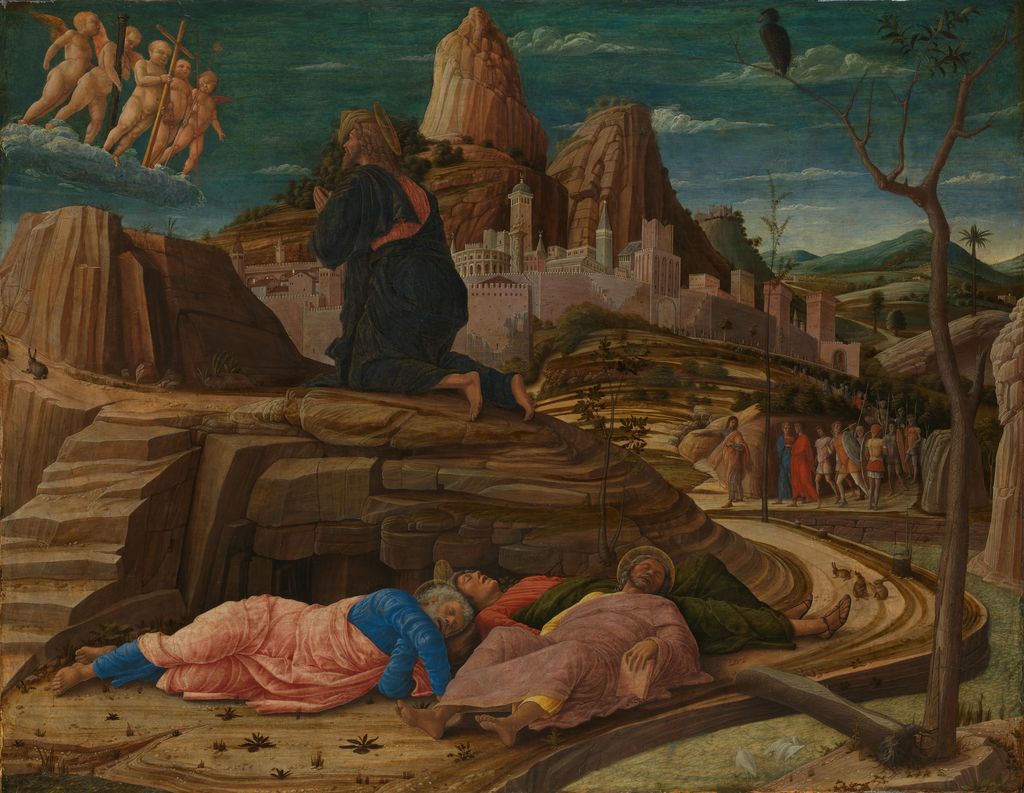
| The Agony in the Garden (London) | C. 1455–56 | Painting · National Gallery, London · NG1417 Catalogue. |
| The Agony in the Garden (Tours) | 1459 (Tours dating) | Painting · Musée des Beaux-Arts de Tours · 1803-1-24 Catalogue. |
| The Resurrection | 1459 (Tours dating) | Painting · Musée des Beaux-Arts de Tours · 1803-1-25 Catalogue. |
| Saint Sebastian (Vienna) | C. 1457–59 | Painting · Kunsthistorisches Museum · GG 301 Catalogue. |
| Cardinal Ludovico Trevisan | C. 1459–60 (Berlin exhibition dating) | Painting · Gemäldegalerie, Berlin · 9 Catalogue. |
| The Death of the Virgin | C. 1462 | Painting · Museo Nacional del Prado · P000248 Catalogue. |
| Christ with the Soul of the Virgin | C. 1460–64 | Painting · Pinacoteca Nazionale, Ferrara Catalogue only. |
| Portrait of a Young Man (traditionally Francesco Gonzaga) | C. 1461 or 1470, depending on sitter | Painting · Museo di Capodimonte · Q 60 Catalogue. |
| Portrait of a Prelate (Carlo de’ Medici?) | C. 1465–70 | Painting · Uffizi Galleries · 1890 no. 8540 Catalogue. |
| Portrait of a Man | C. 1470 | Painting · National Gallery of Art, Washington · 1952.2.5 Catalogue. |
| Madonna with Sleeping Child (Berlin) | C. 1455–60 | Painting · Gemäldegalerie, Berlin · S.5 Catalogue. |
| Camera degli Sposi (Camera Picta) | 1465–74 | Painting · Palazzo Ducale, Mantua Catalogue. |
| Saint Sebastian (Louvre) | Around 1480 | Painting · Musée du Louvre · RF 1766 Catalogue. |
| Lamentation over the Dead Christ | C. 1483 (Brera dating) | Painting · Pinacoteca di Brera · 352 Catalogue. |
| The Triumphs of Caesar | About 1485–1506 | Painting · Royal Collection · RCIN 403958–403966 Catalogue. |
| Madonna of the Caves | C. 1488–90 | Painting · Uffizi Galleries · 1890 no. 1348 Catalogue. |
| Madonna and Child with a Choir of Cherubim | C. 1485 | Painting · Pinacoteca di Brera · 297 Catalogue. |
| Madonna and Child (Poldi Pezzoli) | Early 1490s (museum dating) | Painting · Museo Poldi Pezzoli · 1595 Catalogue. |
| The Holy Family with Saint Mary Magdalen | C. 1495–1500 | Painting · Metropolitan Museum of Art · 14.40.643 Catalogue. |
| The Virgin and Child with Saint Mary Magdalene and Saint John the Baptist | C. 1490–1505 | Painting · National Gallery, London · NG274 Catalogue. |
| Christ as the Suffering Redeemer | 1485–95 (SMK dating) | Painting · Statens Museum for Kunst · KMSsp69 Catalogue. |
| Ecce Homo | C. 1500 | Painting · Musée Jacquemart-André · MJAP-P 1840 Catalogue. |
| Judith with the Head of Holofernes (Mantegna or follower) | C. 1495–1500 | Painting · National Gallery of Art, Washington · 1942.9.42 Catalogue. |
| Madonna della Vittoria | 1495–96 | Painting · Musée du Louvre · INV 369 Catalogue. |
| Mars and Venus (Parnassus) | C. 1496–97 | Painting · Musée du Louvre · INV 370 Catalogue. |
| The Trivulzio Madonna | 1497 | Painting · Castello Sforzesco, Milan · 0554 Catalogue. |
| The Adoration of the Magi | C. 1495–1505 | Painting · J. Paul Getty Museum · 85.PA.417 Catalogue. |
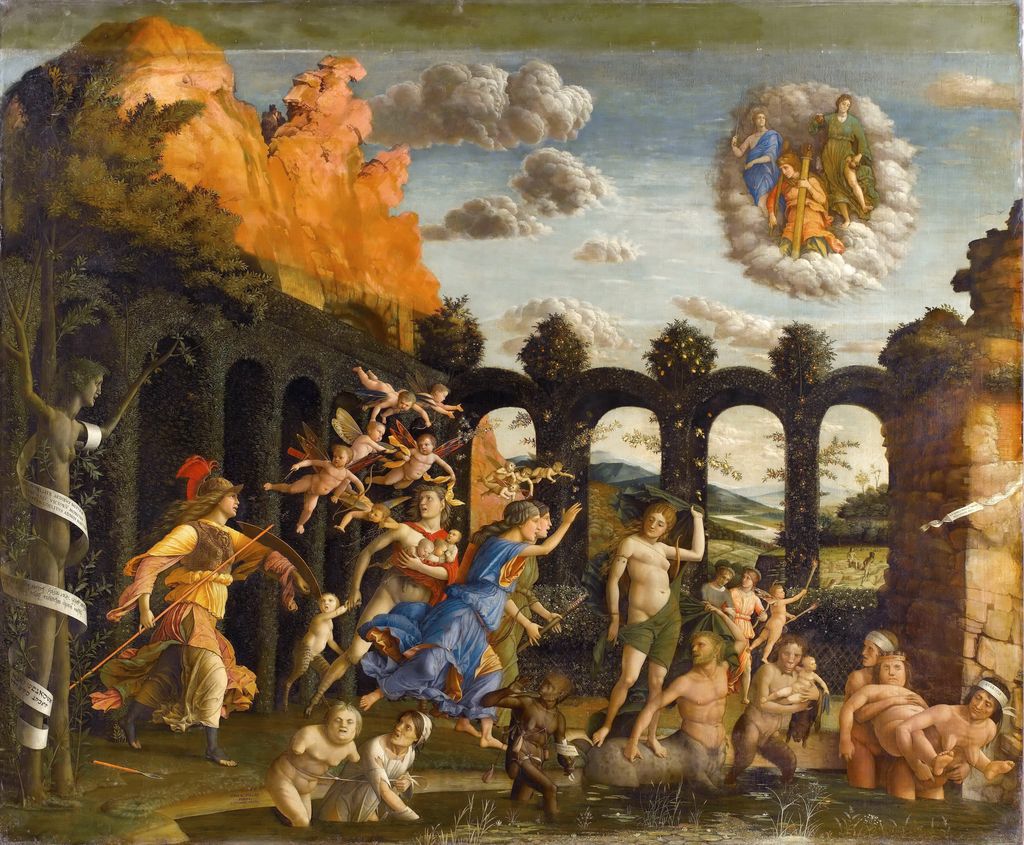
| Minerva Expelling the Vices from the Garden of Virtue | C. 1502 | Painting · Musée du Louvre · INV 371 Catalogue. |
| The Introduction of the Cult of Cybele at Rome | 1505–06 | Painting · National Gallery, London · NG902 Catalogue. |
| Saint Sebastian (Venice) | Probably c. 1504–06 | Painting · Galleria Giorgio Franchetti alla Ca’ d’Oro · D.11 Catalogue. |
| Samson and Delilah | C. 1500 | Painting · National Gallery, London · NG1145 Catalogue only. |
| A Woman Drinking (probably Sophonisba) | C. 1495–1506 | Painting · National Gallery, London · NG1125.2 Catalogue only. |
| The Vestal Virgin Tuccia with a Sieve | C. 1495–1506 | Painting · National Gallery, London · NG1125.1 Catalogue only. |
| Judith with the Head of Holofernes (Dublin) | C. 1495–1500 | Painting · National Gallery of Ireland · NGI.442 Catalogue only. |
| Battle of the Sea Gods, left half (Met impression) | Before 1481 (Met dating) | Print · Metropolitan Museum of Art · 18.12 Catalogue only. |
| Battle of the Sea Gods, right half (Met impression) | Before 1481 (Met dating) | Print · Metropolitan Museum of Art · 1984.1201.4 Catalogue only. |
| Battle of the Sea Gods, left half (Tokyo impression) | C. 1475 (Tokyo dating) | Print · National Museum of Western Art, Tokyo · G.1981-0002 Catalogue only. |
| Battle of the Sea Gods, left half (Washington impression) | C. 1485–88 (NGA dating) | Print · National Gallery of Art, Washington · 1941.1.6 Catalogue only. |
| The Entombment of Christ, second state of two | Before 1475 (Met dating) | Print · Metropolitan Museum of Art · 37.42.30 Catalogue only. |
| The Entombment of Christ (possibly Zoan Andrea, after Mantegna) | 1460–1549 (Rijksmuseum dating) | Print · Rijksmuseum · RP-P-1924-60 Catalogue only. |
| Four Dancing Muses (Gian Marco Cavalli after Mantegna) | C. 1497 | Print · Metropolitan Museum of Art · 20.5.3 Catalogue only. |
| Bacchanal with Silenus | Before 1475 (Met dating) | Print · Metropolitan Museum of Art · 29.44.15 Catalogue only. |
| Bacchanal with a Wine Vat | Before 1475 (Met dating) | Print · Metropolitan Museum of Art Catalogue only. |
| St James on His Way to Execution | C. 1453–57 | Drawing · British Museum · 1976,0616.1 Catalogue only. |
| Three Studies for a Dead Christ | C. 1455–65 | Drawing · British Museum · 1909,0406.3 Catalogue only. |
| Pietà (Venice) | C. 1456–65 (exhibition datings) | Drawing · Gallerie dell’Accademia, Venice · 115 Catalogue only. |
| Studies for Christ at the Column | 1460–65 | Drawing · The Courtauld · D.1978.PG.345 Catalogue only. |
| Virtus Combusta | C. 1490 (technical study) | Drawing · British Museum · Pp,1.23 Catalogue only. |
| Virtus Combusta (Giovanni Antonio da Brescia after Mantegna) | C. 1495–1506 | Print · Musée du Louvre · 3881 LR/ Recto Catalogue only. |
| The Calumny of Apelles | C. 1504–06 | Drawing · British Museum · 1860,0616.85 Catalogue only. |
Frequently Asked Questions
The late canvas in the Ca’ d’Oro, Venice. The candle and its painted words belong to a scene tightly framed around the figure.
It records a Saint Sebastian left after Mantegna’s death. The association with the Venice canvas helps explain the late dating, while the exact year of production remains uncertain.
Discussion
Look again at the images and ideas explored in Saint Sebastian (Venice). These editorial prompts invite your observations.
Reader Insights
How do the visible loops of rope, the turned shoulders and the foot near the ledge make Sebastian seem poised to move even as he is held in place?
How does moving from the candle and the Latin words in Venice to the archers at the same corner of the Louvre painting change your sense of the moment each canvas depicts?
Join the Conversation
Share a detail, comparison or question about Saint Sebastian (Venice) below.
References
- Galleria Giorgio Franchetti alla Ca’ d’Oro, Le Raccolte. View source.
- Tiziana Migliore, Curare e far risorgere il martire. San Sebastiano, pp. 389–411. View source.
- Herbert von Einem, Mantegnas „Sebastian“ in der Ca d’Oro. View source.
- Direzione regionale Musei nazionali Veneto, Cenni storici sull’edificio e la Galleria: La Cappella del Mantegna. View source.
- Carlo Severi, Parer vivo and Perspective: The Case of Mantegna, pp. 190–193. View source.
- Ministero della Cultura, Abel Ferrara legge “Blades” di Gabriele Tinti: San Sebastiano di Andrea Mantegna. View source.
- Graz University of Technology Library, Published transcription of Lodovico Mantegna’s letter to Francesco Gonzaga, 2 October 1506. View source.
- Diocesi di Mantova, I Vescovi della Diocesi di Mantova. View source.
- Catalogo Generale dei Beni Culturali, San Sebastiano, record 0500447892, inventory D.11. View source.
- Fondazione Federico Zeri, Mantegna Andrea, San Sebastiano, Fototeca entry 28001. View source.
- The Al Thani Collection, Ca’ d’Oro: Masterpieces of the Renaissance in Venice, Saint Sebastian exhibition entry. View source.
- Kunsthistorisches Museum, St. Sebastian, GG 301, with Cäcilia Bischoff’s gallery guide. View source.
- Musée du Louvre, Saint Sébastien, RF 1766. View source.
- Pinacoteca di Brera, Lamentation over the Dead Christ, inventory 352. View source.
- Marcantonio Michiel, Notizia d’opere di disegno, Opere in Padoa: In casa de M. Pietro Bembo. View source.
- Rosella Lauber, Ecco perché Il culto di Cibele, un capolavoro di Mantegna, sfugge a Venezia, e va a Londra, pp. 100–101. View source.
- Locus Globus, Sergio Momesso, La collezione di Antonio Scarpa (1752–1832), volume summary. View source.
- Direzione regionale Musei nazionali Veneto, Sede: La Cappella del Mantegna. View source.
- Direzione regionale Musei nazionali Veneto, Venetian Heritage presenta il restauro della Pietà di Giovanni Bellini in mostra alla Galleria Giorgio Franchetti alla Ca’ d’Oro in dialogo con Mantegna. View source.
- Comune di Rimini, Il codice della Passione. Bellini e Mantegna allo specchio. View source.
- Basilica of San Zeno, Verona, San Zeno Altarpiece, View source.
- Palazzo Ducale, Mantua, Camera degli Sposi (Camera Picta), View source.
- Royal Collection, The Triumphs of Caesar, View source.
- Musée du Louvre, Madonna della Vittoria, View source.
- National Gallery, London, The Introduction of the Cult of Cybele at Rome, View source.
- Galleria Giorgio Franchetti alla Ca’ d’Oro, Saint Sebastian (Venice), View source.
More MANTEGNA Paintings
San Zeno Altarpiece
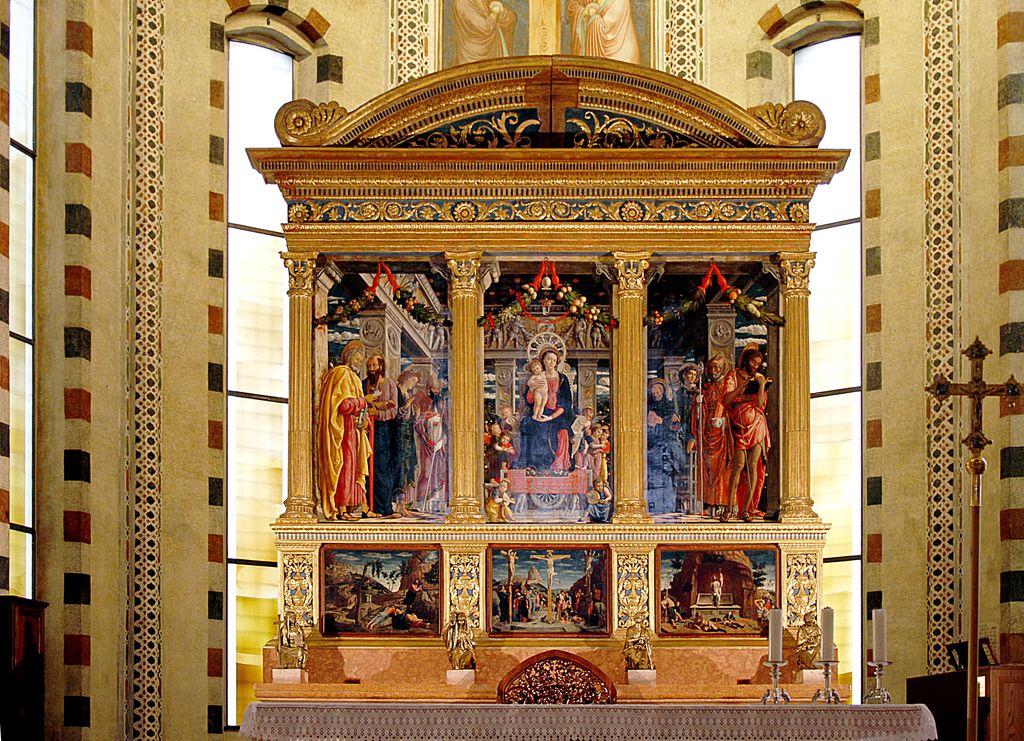
The San Zeno Altarpiece in its frame, Basilica of San Zeno, Verona José Luiz. Image source. CC BY-SA 4.0. Resized from the cited image.