 by Tom Gurney
Tom Gurney BSc (Hons) is an art history expert with over 20 years experience
Published on June 19, 2020 / Updated on November 29, 2026
Email: tomgurney1@gmail.com / Phone: +44 7429 011000
Overview
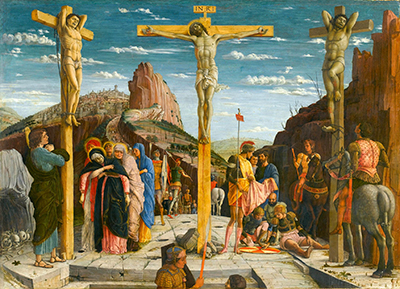
The first thing to look for in Andrea Mantegna’s Crucifixion is the road. It climbs from a walled city, skirts a bare outcrop and disappears among the people behind the crosses. The paved ground in front seems close enough to step onto, yet the execution takes place high above a landscape busy with people going about their lives. Mantegna makes the death of Christ the centre of the painting while giving the eye plenty of reasons to wander away from it. [1]
Now in the Musée du Louvre, Paris, the painting was made for the high altar of San Zeno in Verona. The Louvre dates it to about 1456–59 and catalogues it as tempera on poplar, 76 × 96 cm, inventory number INV 368. It occupied the middle of the predella, the painted tier at the base of the altarpiece. The prayer in Gethsemane came before it, to the left, and the Resurrection followed it, to the right. [1] [2]
At a Glance
- DateAbout 1456–59
- MediumTempera on poplar
- Dimensions76 × 96 cm
- CollectionMusée du Louvre, Paris
- Inventory numberINV 368
Andrea Mantegna in context
The Crucifixion
1456–59 [1]San Zeno Altarpiece
1457–59 [2]The Triumphs of Caesar
Mid-1480s–before 1506 [15]Madonna della Vittoria
1495–96 [16]Below the enthroned Virgin
Gregorio Correr, abbot of the Benedictine monastery of San Zeno, commissioned the San Zeno Altarpiece in the mid-1450s. Above the predella, the Virgin and Child sit among music-making angels, with saints assembled to either side. The built frame helps the three large panels read as a single scene. Its columns stand in front of a painted classical vestibule that appears to run behind them. The predella changes the terms of that illusion. Each panel has its own ground, sky and action, and the physical divisions give the story three distinct settings. Even a panel as wide as the Crucifixion is small beside the figures above it. [1] [2] [3] [4]
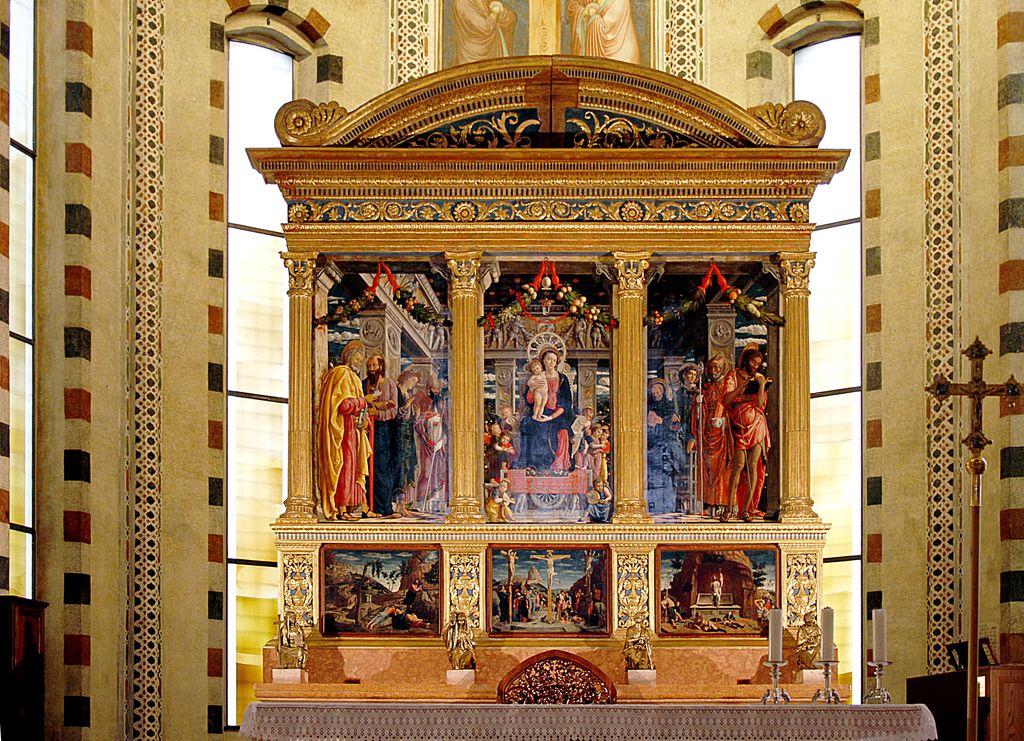
The San Zeno Altarpiece in its frame, Basilica of San Zeno, Verona José Luiz. Image source. CC BY-SA 4.0. Resized from the cited image.
The middle position brings Christ’s cross beneath the throne. Looking down the axis of the altarpiece takes the eye from the Child seated on Mary’s lap to the body suspended high over her in the lower panel. The Virgin’s posture changes just as sharply. Above, she sits upright at the centre of the gathering. Below, she is one of several small figures on the left and can barely keep her feet. The strip of open sky behind the cross gives the body a prominence that survives the change in scale. The design makes those relationships visible before the finer details of either scene come into focus. [1] [3] [4]
The Louvre’s exhibition account connects the upper vestibule to Donatello’s bronze altar at the Santo in Padua. Art historian Andrea De Marchi, in the Tours exhibition dossier, also points to the substantial size of Donatello’s narrative reliefs as a precedent for Mantegna’s unusually tall predella scenes. There is a particular gain in height here. Mantegna can spread the figures at the foot of the crosses across a broad surface and still leave enough sky above them to show how far the bodies have been lifted. [3] [4]
The people at the foot of the crosses
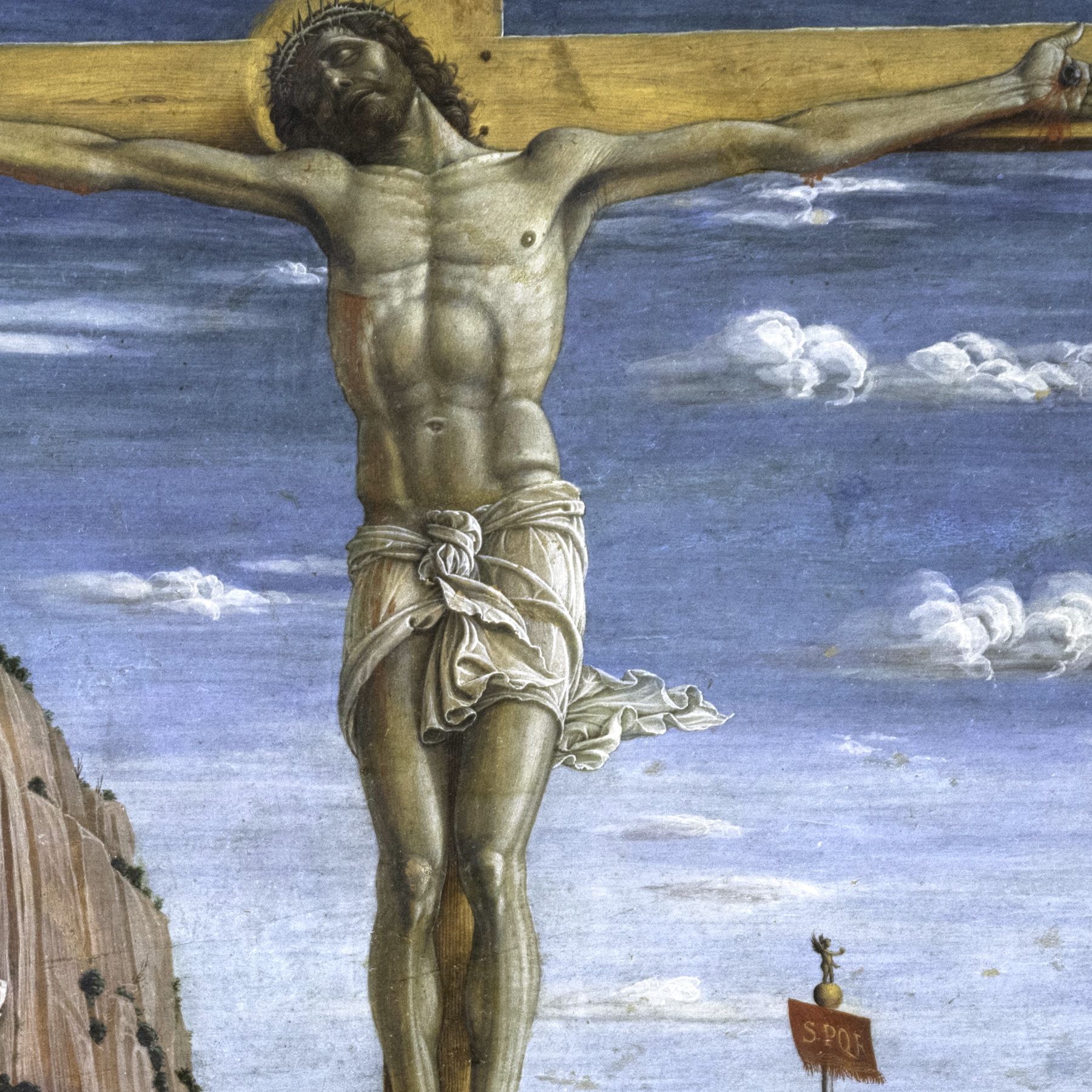
Christ hangs from a squared cross, his arms stretched almost level, his head dropped and his feet set one over the other. The two men beside him have their arms pulled back around the crosspieces. Their sharply bent elbows rise beside their heads. The man at the left lifts his face, while the one at the right folds his head into the shadows. The outer crosspieces are seen at angles, breaking the strong horizontal across the centre. Above Christ’s head, the small plaque marked INRI sits clear of the crossbeam. From below, the angles of the wood and the positions of the arms distinguish the three bodies even before their faces come into view. [1]
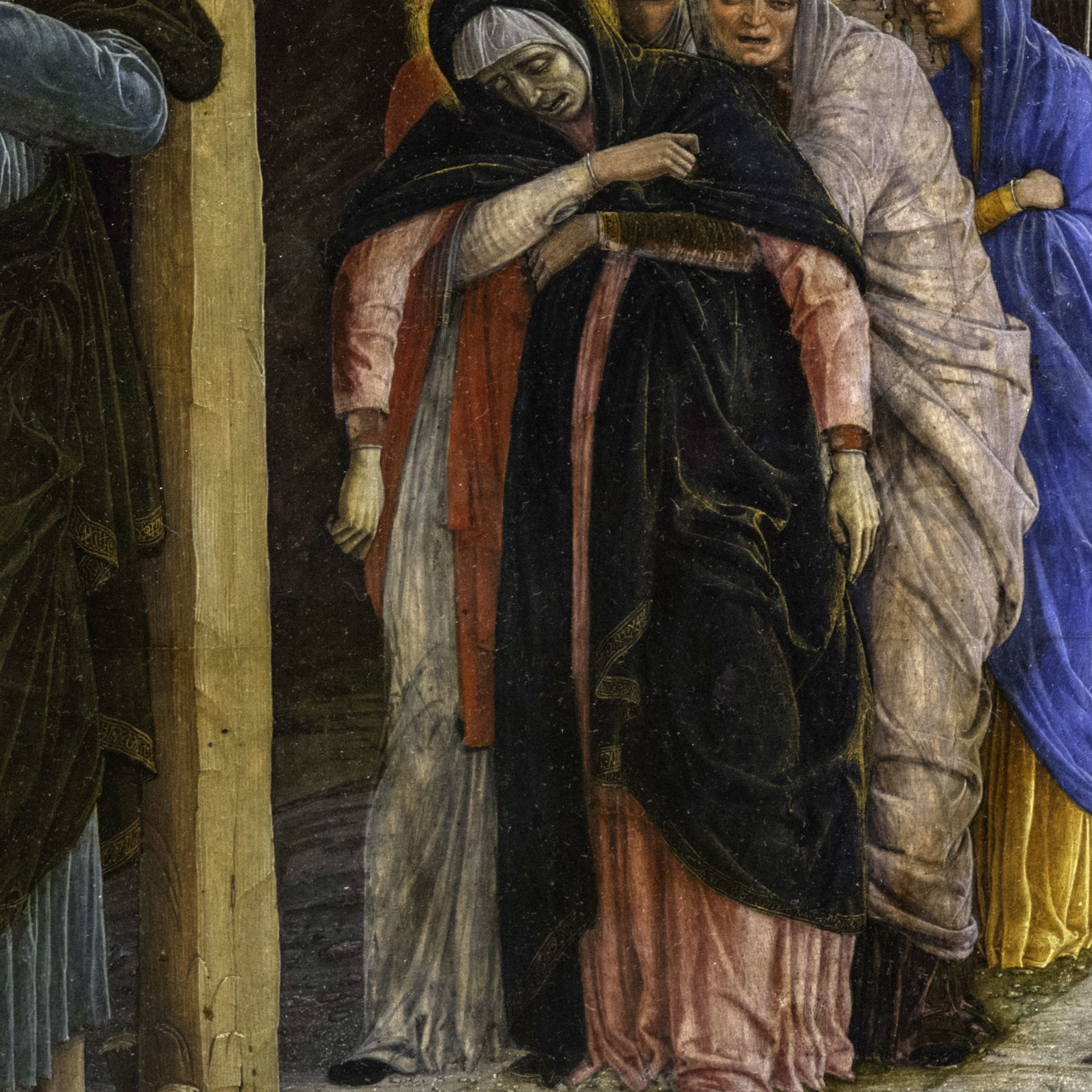
Mary’s dark cloak makes her easy to find in the group to the left of Christ. One arm hangs down as the women crowd in to support her. Their hands and shoulders close around her as she slumps, and one woman turns towards her almost face to face. Saint John stands apart at the far left, with his hands clenched and his head lifted. His upright body follows the line of the outer cross, while Mary’s weight pulls the eye back down. The two responses to the same death take up very different amounts of space. John needs room to stand and look. The women draw so close that their outlines nearly merge. [1] [3] [5]
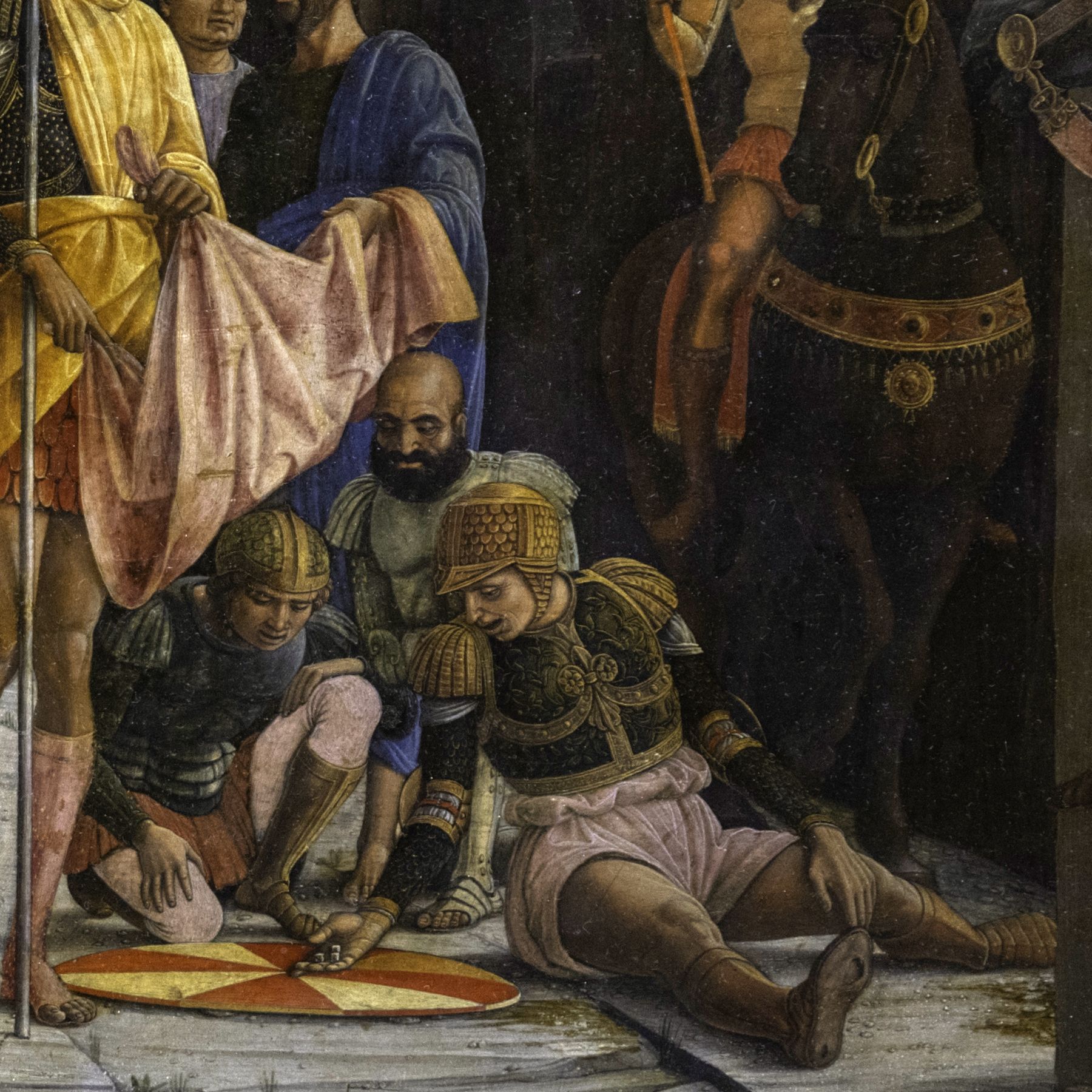
On the right the soldiers’ attention falls on a much smaller patch of ground. In her Louvre essay, Séverine Laborie identifies them as casting lots for Christ’s tunic, an episode in the Gospel of John. One figure stands holding up the cloth while others crouch or sit at his feet. Close to the right edge, a horse turns its hindquarters towards the viewer. Its rider’s patterned garment and the contrasting surfaces of armour and cloth give the soldiers a visible presence even where their faces are hard to distinguish. Mantegna uses antique-looking military dress to place the action in a Roman past. The equipment also gives him hard edges and small flashes of colour to set beside the broad folds around Mary. [1] [5]
At the very bottom, the frame cuts off two figures below the level of the main crowd. Laborie identifies the spear-bearer as Longinus, the traditional name of the soldier who pierced Christ’s side. His spear rises almost parallel to the main cross. Look back down its line and the difference in height becomes clear. The man is only partly visible because he occupies the space below the cracked step. Each of the two groups farther back stays within its own patch of pavement, but these figures imply that the crowd continues into the space directly in front of the painting. [1] [5]
A paved summit above Jerusalem
The foreground is scored with joints and cracks that narrow towards the rear of the rock platform. Laborie locates the main vanishing point behind Christ’s cross near the far edge of the summit. That low point makes the crosses loom. The same view leaves the ground legible enough to show where a cloak trails, a soldier settles or a horse plants its hooves. The rock beside the foot of the central cross and the broken nose of the step interrupt the geometry. The fissures widen as they approach the viewer. Near the bottom of the picture the pavement ends abruptly in a step, making the two partly visible figures seem lower still. [1] [5]
Laborie reads the cross as a symbolic division as well. On Christ’s right, the viewer’s left, are the repentant thief, the mourners and the more populous, illuminated country around Jerusalem. On his left are the other thief and the darker slope with bare trees. In that reading the skull belongs to the Christian tradition that places Adam’s burial at Golgotha, the place where Christ’s death redeems humanity. The painted scene is more crowded than a diagram of that division would suggest. A rider’s back catches the light on the darker side, and the bright garment held above the soldiers gives their group almost as sharp a focus as Mary’s dark cloak gives the mourners. [1] [5]
The road provides a second way of moving through the picture. Behind the mourners, a line of small figures makes the uphill route from the vicinity of the city easy to trace. They bend around the base of a tall, reddish spur of rock and become harder to pick out behind the crowd on Golgotha. Walls, roofs and a domed building give the road a place to come from. A few tiny changes in the direction of the procession measure a distance that would otherwise be difficult to judge. De Marchi relates the idea of the steep, isolated summit to an invention by Jan van Eyck that circulated among painters close to him. The comparison concerns the shape and staging of the hill, where Mantegna’s fiction of depth depends as much on the receding figures as on the contours of the rock. [1] [3]
The city changes sides
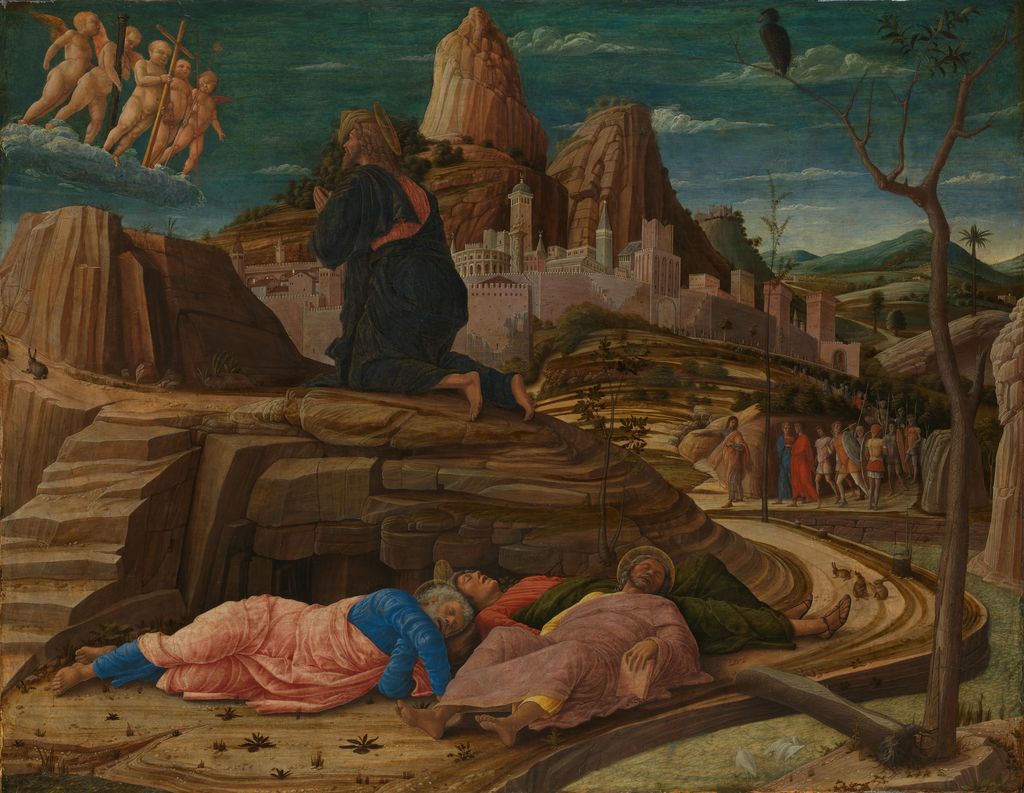
The two original panels beside the Crucifixion are now in the Musée des Beaux-Arts de Tours. In the left-hand Prayer in the Garden of Olives, Christ kneels while the disciples sleep and the party coming to arrest him approaches through the landscape. The Tours painting belongs to the Verona ensemble. Mantegna’s Agony in the Garden at the National Gallery in London, NG1417, is a separate version of the subject. At the right of the predella, the Resurrection gathers the action around the rock-cut tomb, with the risen Christ above the guards. [3] [6] [7]
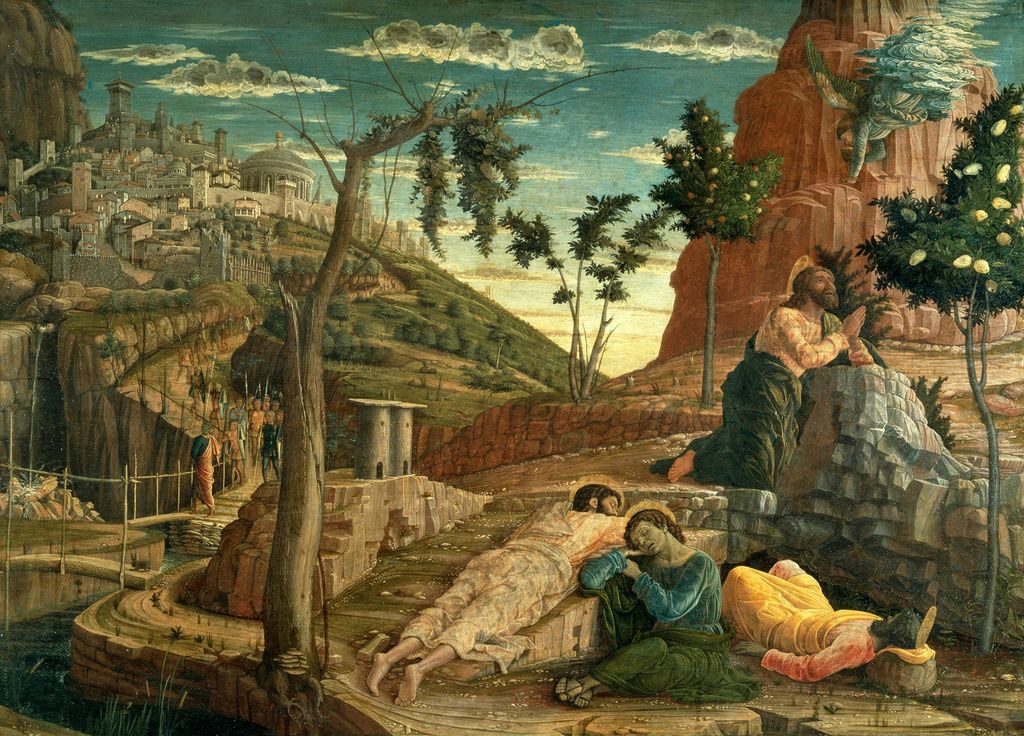
The Agony in the Garden, Musée des Beaux-Arts de Tours Image source. Public domain.
De Marchi identifies the city as Jerusalem in all three pictures and connects its imagined architecture to the ancient historian Flavius Josephus. He traces a change in vantage point across the first two panels. The domed Temple and the citadel change their relative positions in the Crucifixion, and the rocky spur stands on the opposite side of the city. In the Resurrection, Jerusalem is reduced to a distant cluster at the right. Seen in that order, the three views make the Passion feel as though it happens at successive locations around one city. Christ’s arrest is still some way off in the garden, the road is full of people at Golgotha, and by the last scene the city has receded from the open tomb. [3] [6]
The reunion of the predella for exhibitions in Paris and Tours also allowed researchers at the Centre de Recherche et de Restauration des Musées de France to examine the three panels together. Infrared reflectography made the preparatory drawing visible. The researchers noted especially fine initial lines in the distant hills of the Crucifixion, and beneath the clothes of the women supporting Mary they could see that Mantegna had first drawn the bodies unclothed. The analyses also found that the near-violet of a foreground soldier’s helmet came from a red lake laid over lapis lazuli. The study also reports powdered gold on the Virgin’s now-darkened mantle. The colour in the helmet and the faint glints on the cloak reward a closer look than the central cross demands. [3]
From the high altar to the Grande Galerie
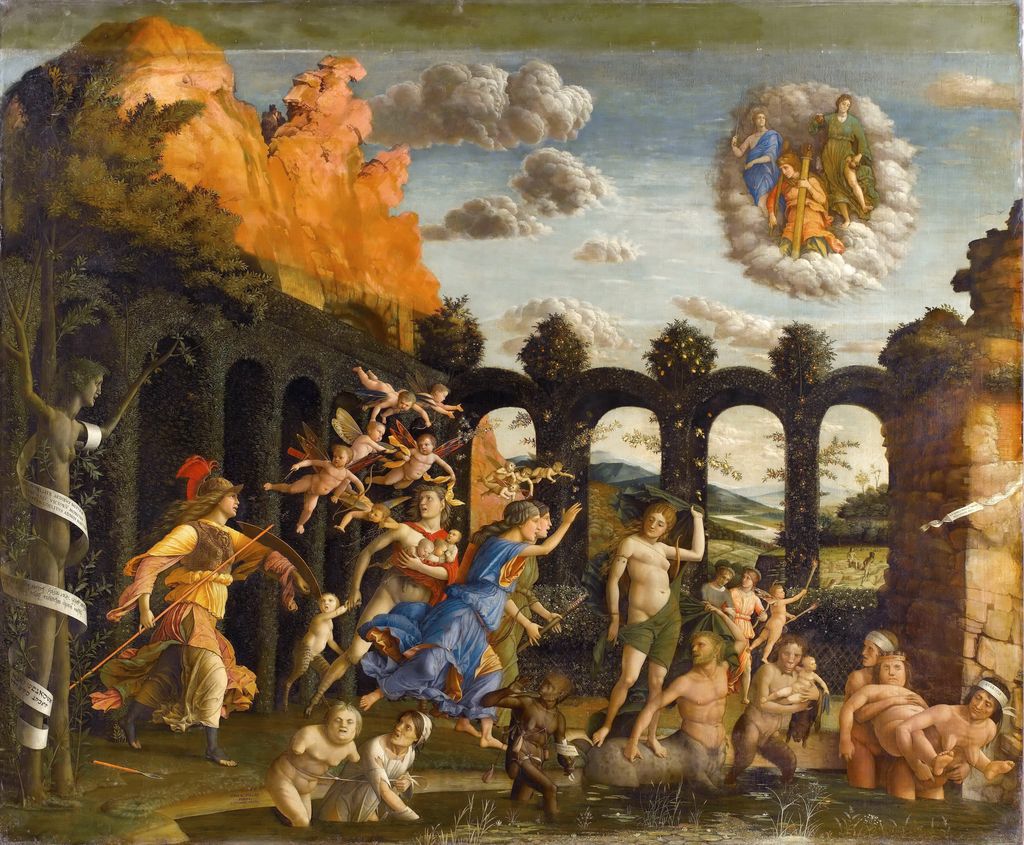
The six painted panels were taken from San Zeno during the French military requisitions of 1797. The large frame stayed in Verona. According to the Tours exhibition dossier, the paintings arrived in Paris in July 1798 and went on display that November. In 1806 Vivant Denon sent the two outer predella panels to Tours in compensation for two other Mantegnas that had gone to the Louvre from the former Richelieu collection, Parnassus and Minerva Expelling the Vices from the Garden of Virtue. The Crucifixion stayed in Paris. [1] [2] [3] [6]
The three large upper panels were recovered after Napoleon’s fall and were back in Verona by 1817. The three originals from the base remained in France, and the predella at San Zeno is now represented by painted canvas copies attributed to Paolino Caliari. This is why a photograph of the altarpiece at the basilica still shows a crucifixion under the Virgin and Child. It records the relationship between the parts at their intended scale, while the Louvre panel supplies the painted surface and detail of the original. The Opificio delle Pietre Dure completed conservation work on the Verona altarpiece in 2009, including work on the wooden structure and frame. [2] [8] [9]
The Louvre lists the original panel in the Grande Galerie, Denon wing, room 710. Its exhibition record also documents journeys back to Verona for the 2006 Mantegna anniversary exhibition and to Tours in 2009. In Tours, the centre and flanks could again be seen together, along with later responses to the Crucifixion. The National Gallery’s 2018–19 exhibition took a different approach. It put Mantegna’s panel beside Giovanni Bellini’s Calvary, also from the Louvre, to let viewers compare how the two painters arranged figures and landscape around the same subject. Bellini gives Christ a single cross and leaves Mary and John standing apart on either side. The open ground between them lets the eye travel straight into a landscape of low hills and water. Mantegna fills that interval with people and equipment, then sends the eye around the edge of a rock face to recover the view. [1] [3] [10] [11]
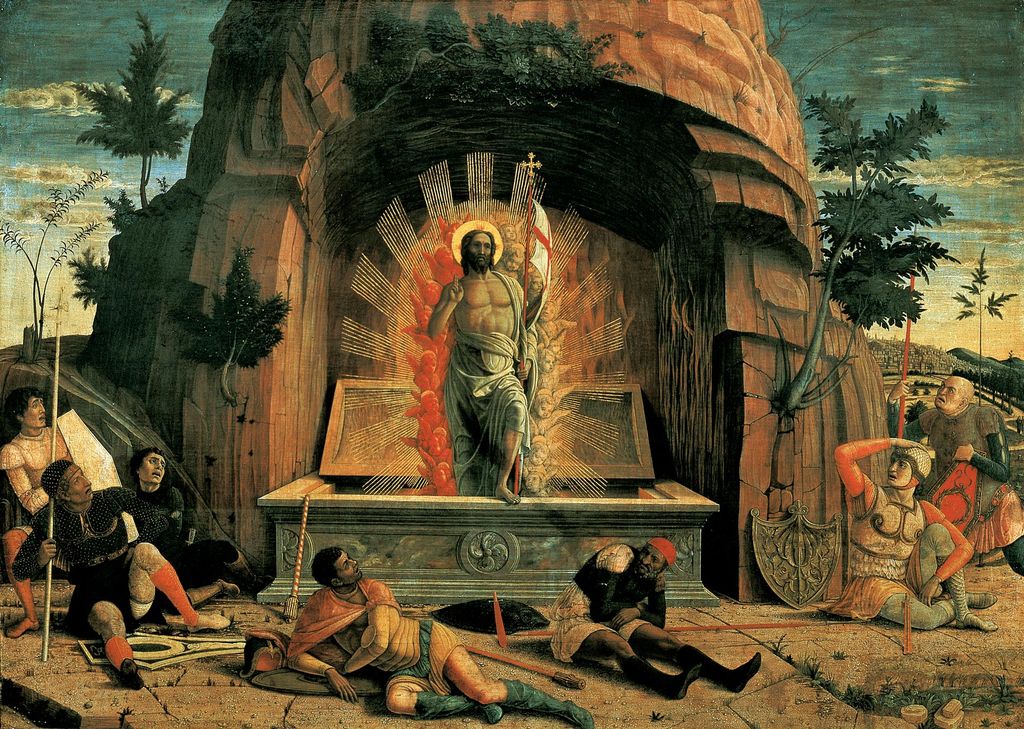
The Resurrection from the San Zeno predella, Musée des Beaux-Arts de Tours Image source. Public domain.
What Degas carried away
Around 1861, Edgar Degas painted his own Crucifixion after Mantegna from the Louvre panel. The copy, an oil painting on canvas, belongs to the same museum in Tours as the two original flanks. The Tours museum describes it as a painter’s study of the disposition of masses and colours. In Degas’s version the pale wood behind Christ’s outstretched arms and the pale ledge underfoot hold the composition together even as many smaller details dissolve into brushwork. The road is still there and still climbs toward the rock, but the little figures that mark its course are much harder to pick out. The two figures interrupted by the bottom edge survive the change of handling. Their position is enough to keep the crowd coming towards us. [1] [12]
The copy also helps explain how a detail could leave the painting behind and acquire a life of its own. The Tours museum traces the group of women around Mary into Degas’s history painting The Daughter of Jephthah. At the 2009 exhibition, Tours displayed his canvas alongside another kind of translation, Achille Jacquet’s engraved Passion Triptych, produced for the 1900 Universal Exhibition. The Louvre catalogues Jacquet’s central plate, made with etching and burin, separately as 6065 C/ Recto. Jacquet put the three scenes back in sequence in a reproducible form. Degas studied one scene closely enough to take a group of grieving women into a different story. [3] [12] [13]
Annotated Details from The Crucifixion from the San Zeno predella
The numbered points identify details to look at closely. The detail images below preserve the native scale of the selected crops.
The Crucifixion from the San Zeno predella
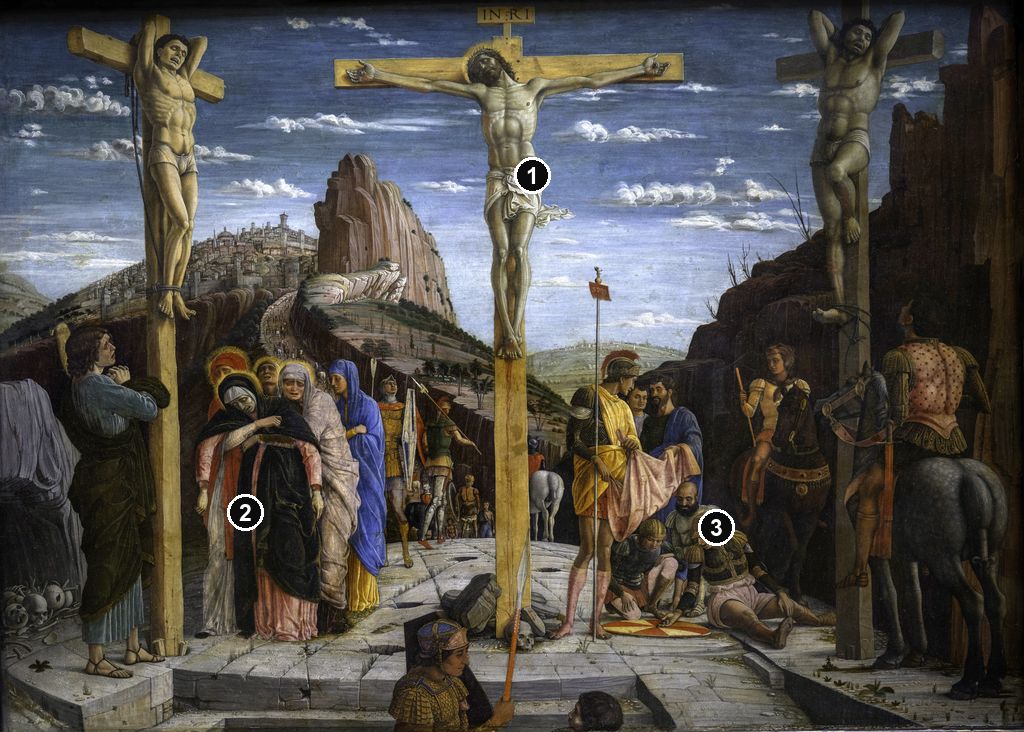
Details from THE CRUCIFIXION FROM THE SAN ZENO PREDELLA
Choose a detail to enlarge it.
The Crucifixion from the San Zeno predella
The central cross
The upright divides the deep landscape and rises above the smaller groupings at its foot.
Mourners at left
The bent figures cluster close to the rocks. Their gestures emerge gradually within the group rather than forming a single line.
Figures and arms at right
The patterns of armour and raised weapons contrast with the draperies and gestures of the mourners.
Artworks directory
| Name | Date | Medium and collection |
|---|---|---|
| The Adoration of the Shepherds | Shortly after 1450 | Painting · Metropolitan Museum of Art · 32.130.2 Catalogue. |
| Saint Mark the Evangelist | C. 1448–51 | Painting · Städel Museum · 1046 Catalogue. |
| Saint Jerome Penitent in the Desert | C. 1448–51 | Painting · Museu de Arte de São Paulo · MASP.00015 Catalogue. |
| Martyrdom and Transport of the Body of Saint Christopher | Mid-1450s | Painting · Ovetari Chapel, Padua Catalogue. |
| San Luca Altarpiece | 1453–55 | Painting · Pinacoteca di Brera · 176 Catalogue. |
| The Presentation of Christ at the Temple | 1454 (Berlin dating) | Painting · Gemäldegalerie, Berlin · 29 Catalogue. |
| San Zeno Altarpiece | 1457–59 | Painting · Basilica of San Zeno, Verona Catalogue. |
| The Crucifixion | 1456–59 | Painting · Musée du Louvre · INV 368 Catalogue. |
| The Agony in the Garden (London) | C. 1455–56 | Painting · National Gallery, London · NG1417 Catalogue. |
| The Agony in the Garden (Tours) | 1459 (Tours dating) | Painting · Musée des Beaux-Arts de Tours · 1803-1-24 Catalogue. |
| The Resurrection | 1459 (Tours dating) | Painting · Musée des Beaux-Arts de Tours · 1803-1-25 Catalogue. |
| Saint Sebastian (Vienna) | C. 1457–59 | Painting · Kunsthistorisches Museum · GG 301 Catalogue. |
| Cardinal Ludovico Trevisan | C. 1459–60 (Berlin exhibition dating) | Painting · Gemäldegalerie, Berlin · 9 Catalogue. |
| The Death of the Virgin | C. 1462 | Painting · Museo Nacional del Prado · P000248 Catalogue. |
| Christ with the Soul of the Virgin | C. 1460–64 | Painting · Pinacoteca Nazionale, Ferrara Catalogue only. |
| Portrait of a Young Man (traditionally Francesco Gonzaga) | C. 1461 or 1470, depending on sitter | Painting · Museo di Capodimonte · Q 60 Catalogue. |
| Portrait of a Prelate (Carlo de’ Medici?) | C. 1465–70 | Painting · Uffizi Galleries · 1890 no. 8540 Catalogue. |
| Portrait of a Man | C. 1470 | Painting · National Gallery of Art, Washington · 1952.2.5 Catalogue. |
| Madonna with Sleeping Child (Berlin) | C. 1455–60 | Painting · Gemäldegalerie, Berlin · S.5 Catalogue. |
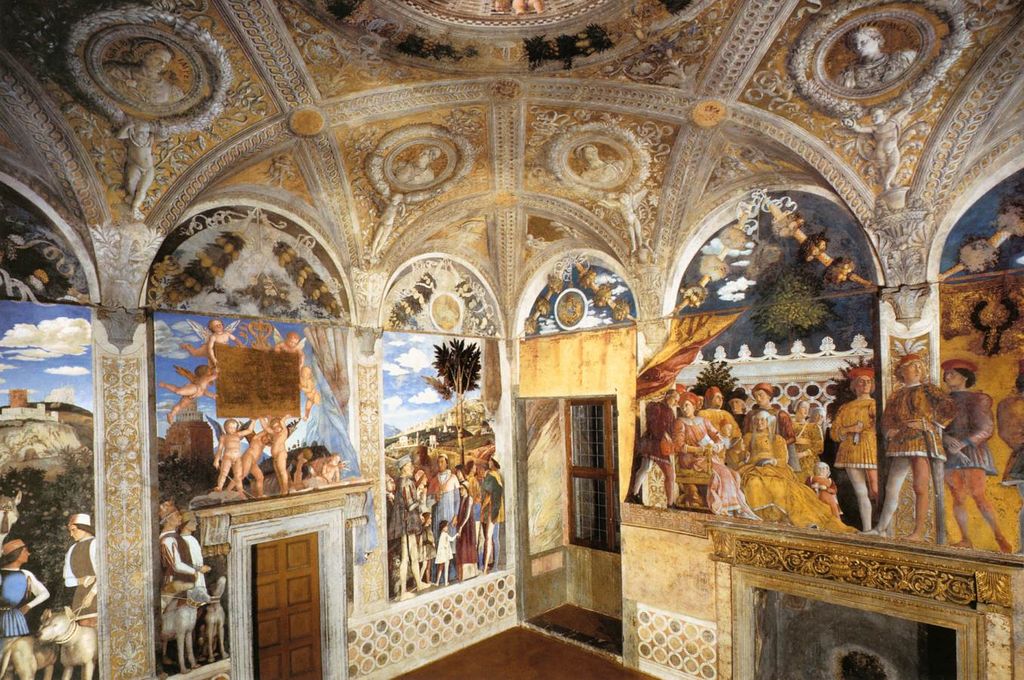
| Camera degli Sposi (Camera Picta) | 1465–74 | Painting · Palazzo Ducale, Mantua Catalogue. |
| Saint Sebastian (Louvre) | Around 1480 | Painting · Musée du Louvre · RF 1766 Catalogue. |
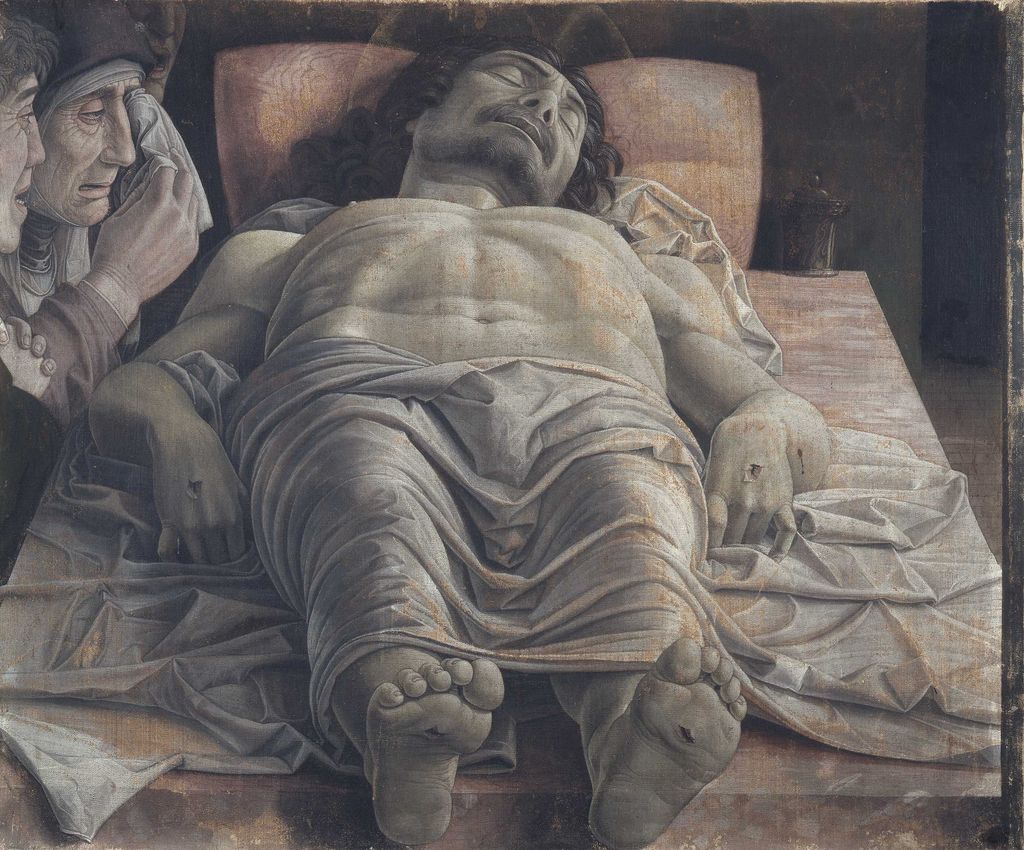
| Lamentation over the Dead Christ | C. 1483 (Brera dating) | Painting · Pinacoteca di Brera · 352 Catalogue. |
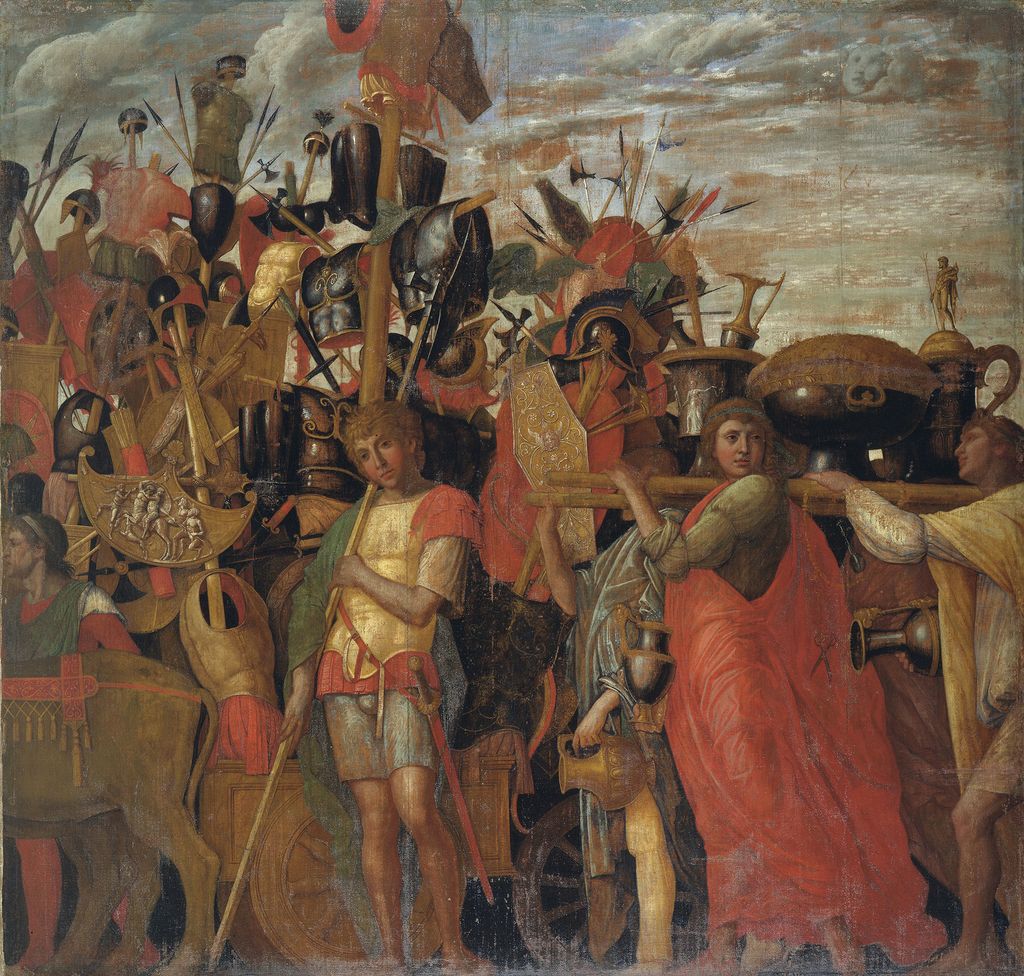
| The Triumphs of Caesar | About 1485–1506 | Painting · Royal Collection · RCIN 403958–403966 Catalogue. |
| Madonna of the Caves | C. 1488–90 | Painting · Uffizi Galleries · 1890 no. 1348 Catalogue. |
| Madonna and Child with a Choir of Cherubim | C. 1485 | Painting · Pinacoteca di Brera · 297 Catalogue. |
| Madonna and Child (Poldi Pezzoli) | Early 1490s (museum dating) | Painting · Museo Poldi Pezzoli · 1595 Catalogue. |
| The Holy Family with Saint Mary Magdalen | C. 1495–1500 | Painting · Metropolitan Museum of Art · 14.40.643 Catalogue. |
| The Virgin and Child with Saint Mary Magdalene and Saint John the Baptist | C. 1490–1505 | Painting · National Gallery, London · NG274 Catalogue. |
| Christ as the Suffering Redeemer | 1485–95 (SMK dating) | Painting · Statens Museum for Kunst · KMSsp69 Catalogue. |
| Ecce Homo | C. 1500 | Painting · Musée Jacquemart-André · MJAP-P 1840 Catalogue. |
| Judith with the Head of Holofernes (Mantegna or follower) | C. 1495–1500 | Painting · National Gallery of Art, Washington · 1942.9.42 Catalogue. |
| Madonna della Vittoria | 1495–96 | Painting · Musée du Louvre · INV 369 Catalogue. |
| Mars and Venus (Parnassus) | C. 1496–97 | Painting · Musée du Louvre · INV 370 Catalogue. |
| The Trivulzio Madonna | 1497 | Painting · Castello Sforzesco, Milan · 0554 Catalogue. |
| The Adoration of the Magi | C. 1495–1505 | Painting · J. Paul Getty Museum · 85.PA.417 Catalogue. |
| Minerva Expelling the Vices from the Garden of Virtue | C. 1502 | Painting · Musée du Louvre · INV 371 Catalogue. |
| The Introduction of the Cult of Cybele at Rome | 1505–06 | Painting · National Gallery, London · NG902 Catalogue. |
| Saint Sebastian (Venice) | Probably c. 1504–06 | Painting · Galleria Giorgio Franchetti alla Ca’ d’Oro · D.11 Catalogue. |
| Samson and Delilah | C. 1500 | Painting · National Gallery, London · NG1145 Catalogue only. |
| A Woman Drinking (probably Sophonisba) | C. 1495–1506 | Painting · National Gallery, London · NG1125.2 Catalogue only. |
| The Vestal Virgin Tuccia with a Sieve | C. 1495–1506 | Painting · National Gallery, London · NG1125.1 Catalogue only. |
| Judith with the Head of Holofernes (Dublin) | C. 1495–1500 | Painting · National Gallery of Ireland · NGI.442 Catalogue only. |
| Battle of the Sea Gods, left half (Met impression) | Before 1481 (Met dating) | Print · Metropolitan Museum of Art · 18.12 Catalogue only. |
| Battle of the Sea Gods, right half (Met impression) | Before 1481 (Met dating) | Print · Metropolitan Museum of Art · 1984.1201.4 Catalogue only. |
| Battle of the Sea Gods, left half (Tokyo impression) | C. 1475 (Tokyo dating) | Print · National Museum of Western Art, Tokyo · G.1981-0002 Catalogue only. |
| Battle of the Sea Gods, left half (Washington impression) | C. 1485–88 (NGA dating) | Print · National Gallery of Art, Washington · 1941.1.6 Catalogue only. |
| The Entombment of Christ, second state of two | Before 1475 (Met dating) | Print · Metropolitan Museum of Art · 37.42.30 Catalogue only. |
| The Entombment of Christ (possibly Zoan Andrea, after Mantegna) | 1460–1549 (Rijksmuseum dating) | Print · Rijksmuseum · RP-P-1924-60 Catalogue only. |
| Four Dancing Muses (Gian Marco Cavalli after Mantegna) | C. 1497 | Print · Metropolitan Museum of Art · 20.5.3 Catalogue only. |
| Bacchanal with Silenus | Before 1475 (Met dating) | Print · Metropolitan Museum of Art · 29.44.15 Catalogue only. |
| Bacchanal with a Wine Vat | Before 1475 (Met dating) | Print · Metropolitan Museum of Art Catalogue only. |
| St James on His Way to Execution | C. 1453–57 | Drawing · British Museum · 1976,0616.1 Catalogue only. |
| Three Studies for a Dead Christ | C. 1455–65 | Drawing · British Museum · 1909,0406.3 Catalogue only. |
| Pietà (Venice) | C. 1456–65 (exhibition datings) | Drawing · Gallerie dell’Accademia, Venice · 115 Catalogue only. |
| Studies for Christ at the Column | 1460–65 | Drawing · The Courtauld · D.1978.PG.345 Catalogue only. |
| Virtus Combusta | C. 1490 (technical study) | Drawing · British Museum · Pp,1.23 Catalogue only. |
| Virtus Combusta (Giovanni Antonio da Brescia after Mantegna) | C. 1495–1506 | Print · Musée du Louvre · 3881 LR/ Recto Catalogue only. |
| The Calumny of Apelles | C. 1504–06 | Drawing · British Museum · 1860,0616.85 Catalogue only. |
Frequently Asked Questions
It was the central lower scene of the San Zeno Altarpiece, directly below the enthroned Virgin and between the Agony and Resurrection.
The high altar in San Zeno contains a copy in the original central opening. Mantegna’s poplar panel is in the Louvre, inventory INV 368.
Discussion
Look again at the images and ideas explored in The Crucifixion. These editorial prompts invite your observations.
Reader Insights
How do the figures cut off below the step and the small figures on the road establish different distances from Christ’s cross?
What does Degas keep of the mourning group and the route into Jerusalem, and how does his handling change where you look first?
Join the Conversation
Share a detail, comparison or question about The Crucifixion below.
References
- Musée du Louvre, Andrea Mantegna, La Crucifixion (INV 368). View source.
- Opificio delle Pietre Dure, Andrea Mantegna, Pala di San Zeno, 1457–1459, Basilica di San Zeno, Verona. View source.
- Musée des Beaux-Arts de Tours, Mantegna, La prédelle de San Zeno de Vérone, 1457–1459 (2009 exhibition dossier, archived copy). View source.
- Musée du Louvre, Autour du triptyque de San Zeno de Vérone. View source.
- Musée du Louvre, Séverine Laborie, La Crucifixion, in Premiers feux au musée, p. 7. View source.
- Musée des Beaux-Arts de Tours, Andrea Mantegna, La Prière au jardin des oliviers et La Résurrection. View source.
- The National Gallery, Andrea Mantegna, The Agony in the Garden (NG1417). View source.
- Ministero della Cultura, Andrea Mantegna, Pala di San Zeno (0500127961). View source.
- Opificio delle Pietre Dure, La Pala di San Zeno di Andrea Mantegna. Studio e conservazione. View source.
- The National Gallery, Annual Review 2018–19, Mantegna and Bellini. View source.
- Musée du Louvre, Giovanni Bellini, Le Calvaire. View source.
- Musée des Beaux-Arts de Tours, Edgar Degas, Le Calvaire, copie d’après Mantegna. View source.
- Musée du Louvre, Achille Jacquet, Le Calvaire. Partie centrale de la prédelle du retable de San Zeno, à Vérone (6065 C/ Recto). View source.
- Palazzo Ducale, Mantua, Camera degli Sposi (Camera Picta), View source.
- Royal Collection, The Triumphs of Caesar, View source.
- Musée du Louvre, Madonna della Vittoria, View source.
- National Gallery, London, The Introduction of the Cult of Cybele at Rome, View source.
More MANTEGNA Paintings
San Zeno Altarpiece
The San Zeno Altarpiece in its frame, Basilica of San Zeno, Verona José Luiz. Image source. CC BY-SA 4.0. Resized from the cited image.