 by Tom Gurney
Tom Gurney BSc (Hons) is an art history expert with over 20 years experience
Published on June 19, 2020 / Updated on November 29, 2026
Email: tomgurney1@gmail.com / Phone: +44 7429 011000
Overview
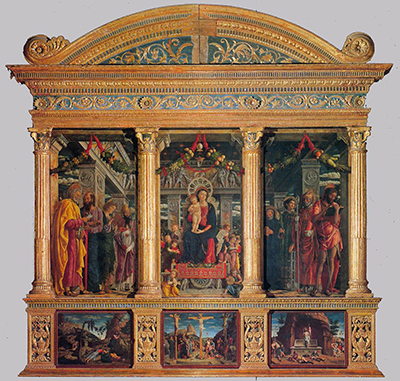
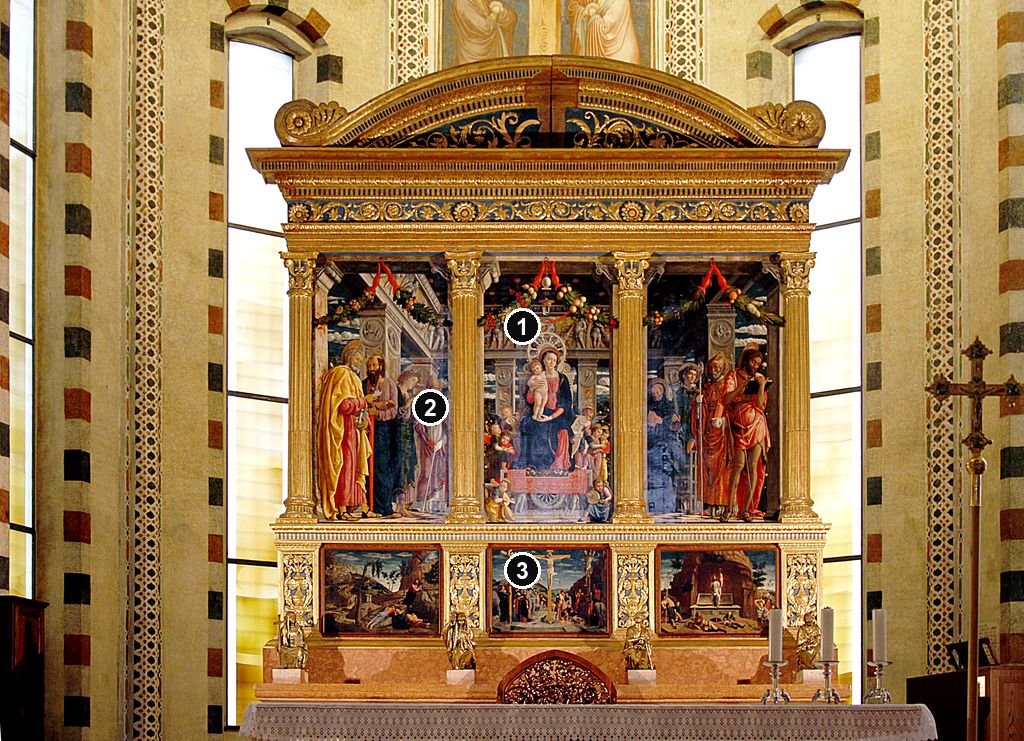
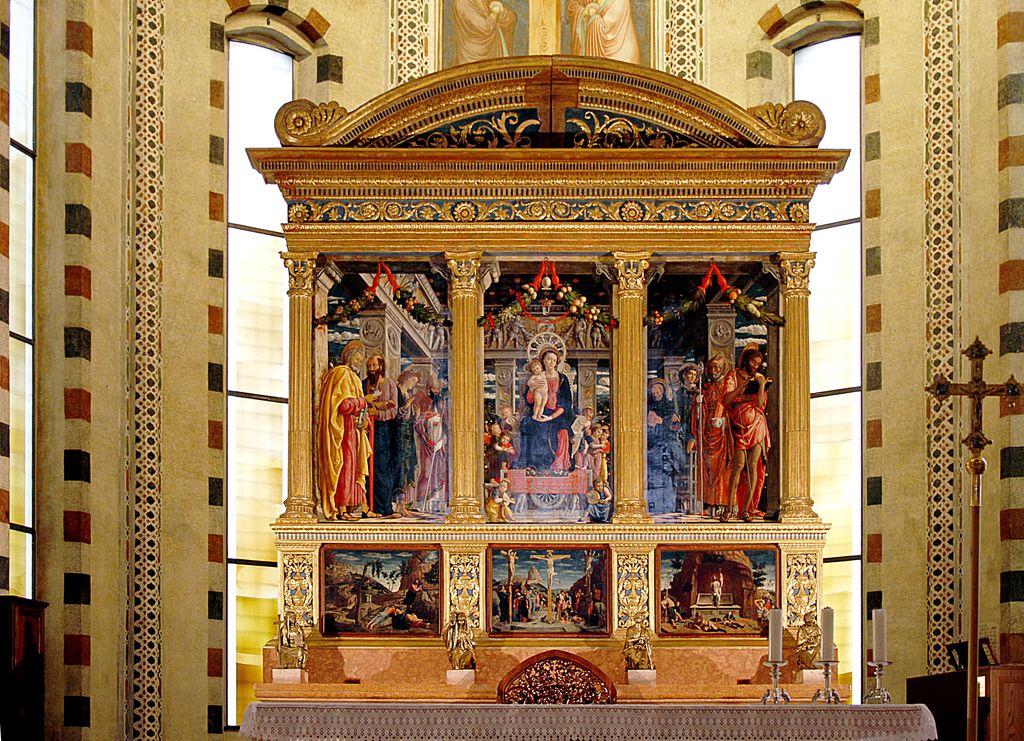
Four gilded columns stand across the front of Andrea Mantegna’s San Zeno Altarpiece. Behind them, painted pillars recede, and the Virgin and Child sit with eight saints under what appears to be a single roof. The columns belong to the wooden frame, and the people and room are painted on three separate panels. From the nave of the Basilica of San Zeno in Verona, the distinction is easy to miss. Mantegna made the frame and painting work together so that the three compartments look like three openings into the same place. [1]
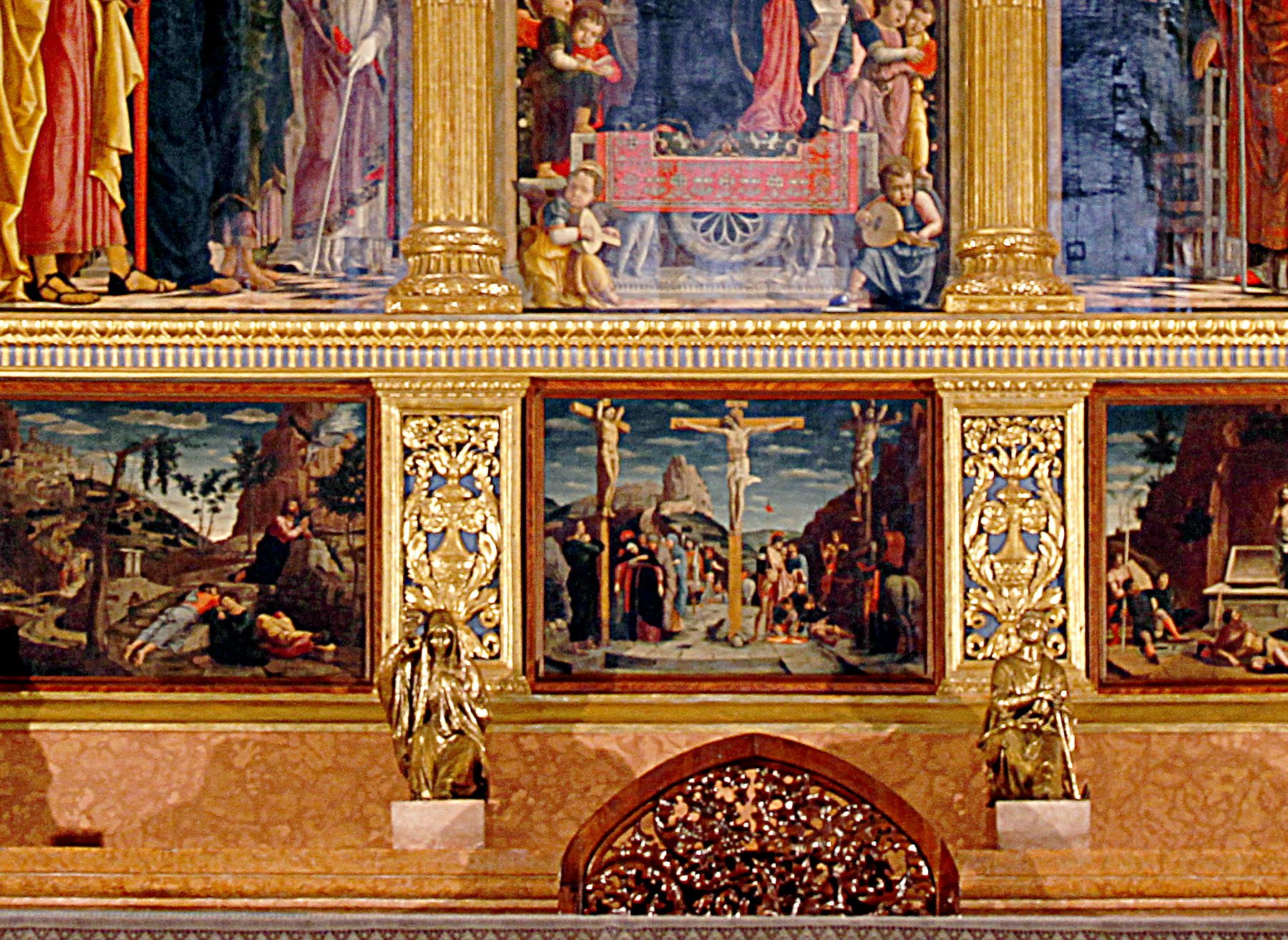
The basilica holds the original upper panels and the surviving carved frame. The three small scenes along its base, or predella, are copies on canvas. Mantegna’s central Crucifixion is at the Louvre in Paris, while the original Agony in the Garden and Resurrection are at the Musée des Beaux-Arts de Tours. Seeing the originals together, even in reproduction, restores a visual relationship that the altarpiece’s history broke apart. [1] [2] [3]
At a Glance
- DatePainted c. 1457–1459, with the Italian state catalogue placing installation in early 1460
- MediumEgg tempera on poplar in the upper panels, with a carved and gilded wooden frame
- VeronaBasilica of San Zeno, original main panels and surviving frame with canvas predella copies
- ParisMusée du Louvre, Crucifixion, INV 368
- ToursMusée des Beaux-Arts de Tours, Agony in the Garden, 1803-1-24, and Resurrection, 1803-1-25
Andrea Mantegna in context
San Zeno Altarpiece
1457–59 [1]The Triumphs of Caesar
Mid-1480s–before 1506 [24]Madonna della Vittoria
1495–96 [25]Gregorio Correr’s commission for the high altar
Gregorio Correr, the commendatory abbot of the Benedictine monastery of San Zeno and an apostolic protonotary, commissioned Mantegna to paint the altarpiece for the high altar. The Italian cultural heritage catalogue places the job within a broader renewal of the choir and crypt that began after Correr took up the abbacy in 1443. It cites a letter of 5 January 1457 from Ludovico Gonzaga to Mantegna as evidence that the project was already under way. The Opificio delle Pietre Dure dates the painting to 1457–59. The Louvre dates the work from late 1456 to 1459, and the Italian catalogue gives a wider span, 1456–60, with installation in the early months of 1460. San Zeno was the last major undertaking of Mantegna’s years in Padua before he moved to the Gonzaga court at Mantua. [1] [2] [3] [4] [5]
The altarpiece introduced a classical interior into an older church. San Zeno’s approach is Romanesque, with a sculpted entrance porch and a great rose window. The main chapel, by contrast, was rebuilt in Gothic forms in the late fourteenth century. Inside, the altarpiece stands high beyond the nave, above the level of the crypt. The basilica’s guide also records a twentieth-century reordering of the presbytery that repositioned the work. The long approach and the rise towards the altar still help explain why Mantegna made the architectural divisions and the figures legible from below. [5] [6]
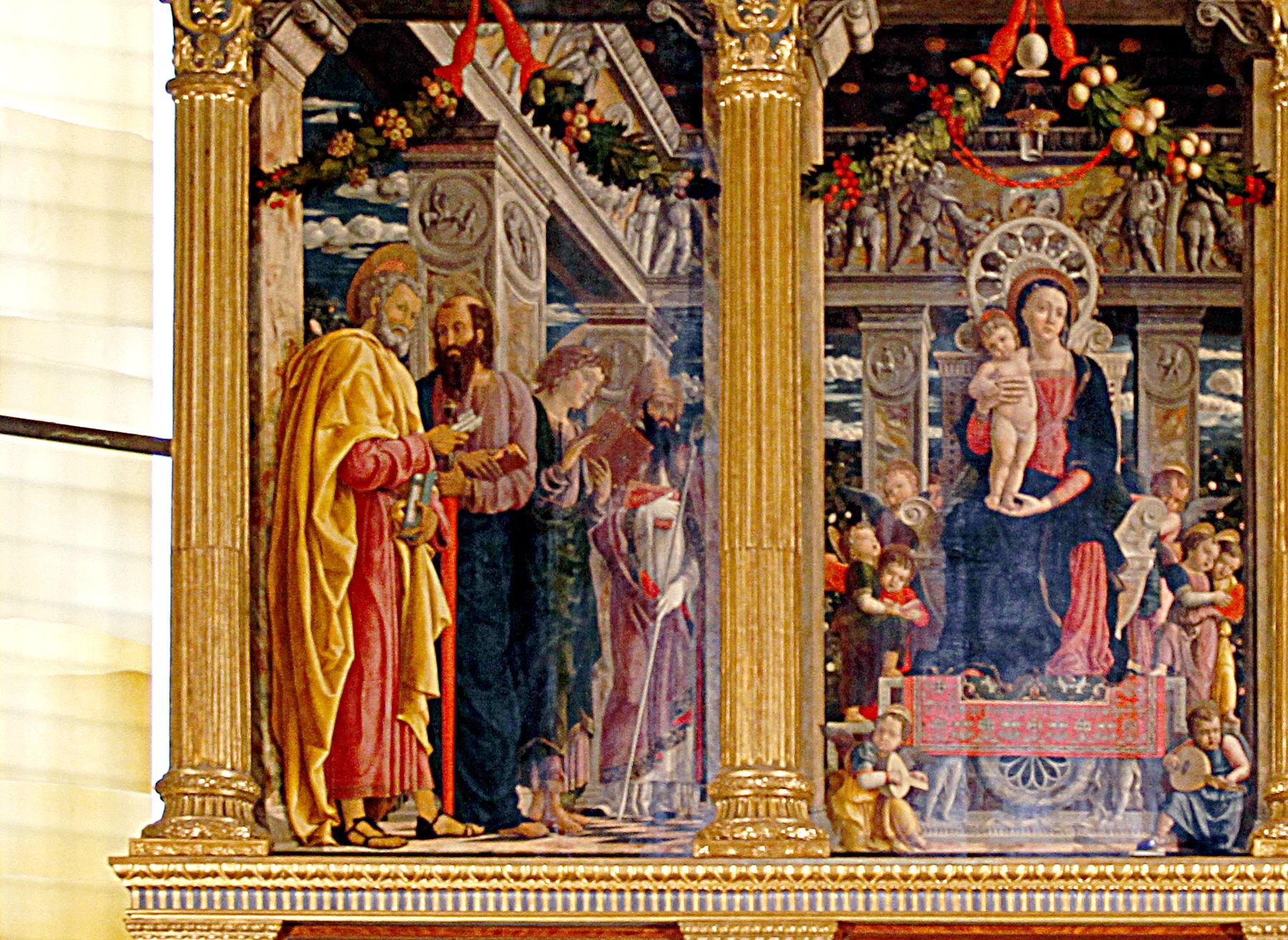
Saint Zeno himself stands nearest the throne on the left, identifiable as a bishop. Peter, Paul and John the Evangelist complete his group. On the right are Benedict, Lawrence, Gregory and John the Baptist. The presence of Zeno, the bishop whose cult and relics were central to the basilica, gives the gathering a local focus. Benedict, next to the throne on the opposite side, belongs especially naturally in a church that served a Benedictine community. The two groups bring different kinds of religious authority into the same assembly. Peter’s keys are visible at the far left, while books in several hands give the figures different things to do as they stand together. [1] [6]
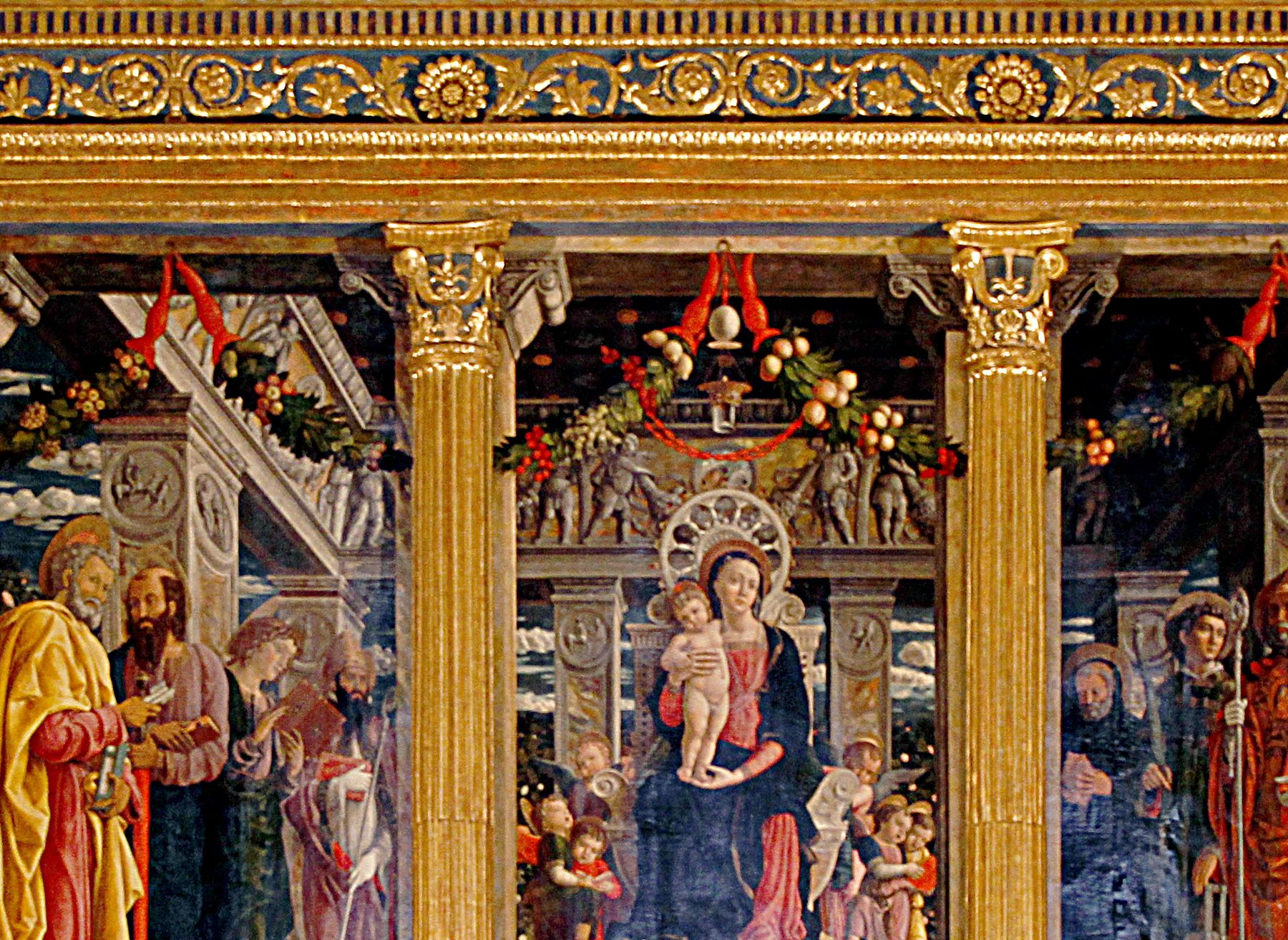
In the centre, the Child stands on the seated Virgin’s lap. Small angels below them sing and play, bringing movement to the steps of the throne. Above, a hanging lamp marks the middle of the picture. An early design for the left panel survives in the J. Paul Getty Museum. The Getty identifies the same four saints in the drawing and notes that Mantegna changed their positions in the painting. The arrangement has an air of inevitability when seen in the finished ensemble, but the drawing shows how much room the artist had to decide where a head, shoulder or gesture should fall. [1] [5] [7]
Where carved wood gives way to painted stone
The frame is about four and a half metres high and wide in the Opificio’s account of the wooden structure. Designed by Mantegna, it comprises the base for the predella, four columns, an architrave and two scrolls. These elements project into the church. Each column has physical depth, and light can catch its gilding as a viewer moves. The carved architrave across their tops establishes a common height for all three openings. Mantegna then gives that actual front to the building an interior, with a painted structure whose supports appear farther away. [1] [8]
Start at the upper junction of an inner gilded column and the carved beam. Behind the column, inside the paint, the edges of the entablature recede, and rectangular supports stand back from the front plane. Drop your eye to the base of the same column and follow the painted floor beside it. Its seams turn into depth on both sides of the opening, and the change in direction across the ensemble draws attention back towards the throne. The gilded posts interrupt the view just where solid columns would interrupt it. The cross-panel effect depends on following the lines on either side of each interruption. [1] [8]
The garlands of fruit and leaves are equally important to that effect. They hang across the openings and describe the width of each bay. Their curves come forward against the straighter receding lines of the painted stone. Beyond the pillars, gaps reveal blue sky. Mantegna gives a sense of air passing through the building, even though the figures have the stability of statues. At the centre, where the throne and its steps fill the opening, space can feel crowded. The openings to either side give that central mass room without loosening the symmetry of the whole. [1] [8]
The subject is often described as a sacra conversazione, a gathering of the Virgin and Child with saints. Here it takes place across real wooden divisions. The people occupy a common floor, but there are pauses in their gestures and intervals between their bodies. Several turn partly towards the viewer or attend to a book. It is possible to take in one figure at a time and still feel that each belongs to a single gathering. The capitals, garlands and jutting steps make the shared room easier to grasp from a distance, long before the quieter differences among the saints become visible. [1] [6] [8]
From San Luca to the altar of Donatello
Mantegna had already used perspective to connect figures in separate compartments. His San Luca Altarpiece, painted in 1453–54 for the chapel of Saint Luke in Santa Giustina, Padua, is now at the Pinacoteca di Brera. Its separate fields of gold remain conspicuous. Look beneath the standing saints, however, and their feet occupy what Brera describes as a single platform seen in foreshortening. The museum proposes that its lost original frame projected forward and made the figures appear to look out from an elevated arcade. At San Zeno, the survival of the framing structure lets us see this kind of partnership between a projecting front and figures set behind it. Painted architecture now binds the spaces overhead as well as underfoot. [1] [9]
The Louvre identifies the bronze altar by Donatello at the Basilica of Sant’Antonio in Padua as a model for the antique-style vestibule at San Zeno. The comparison is particularly clear in the relationship between a central Virgin and Child and the weighty saints around them. At Padua their bodies occupy real space in bronze. At Verona the sculptural presence comes partly from what is built and partly from the silhouettes, poses and modelling of the painted figures. Brera also sees Donatello’s influence at San Luca, making the two paintings successive examples of Mantegna working through ideas available in Padua. The basilica of Sant’Antonio dates the present arrangement of its altar sculptures to Camillo Boito’s installation of 1895, so the group seen there now can illustrate the comparison in figures and materials. The exact arrangement Mantegna knew remains a separate historical question. [8] [9] [10]
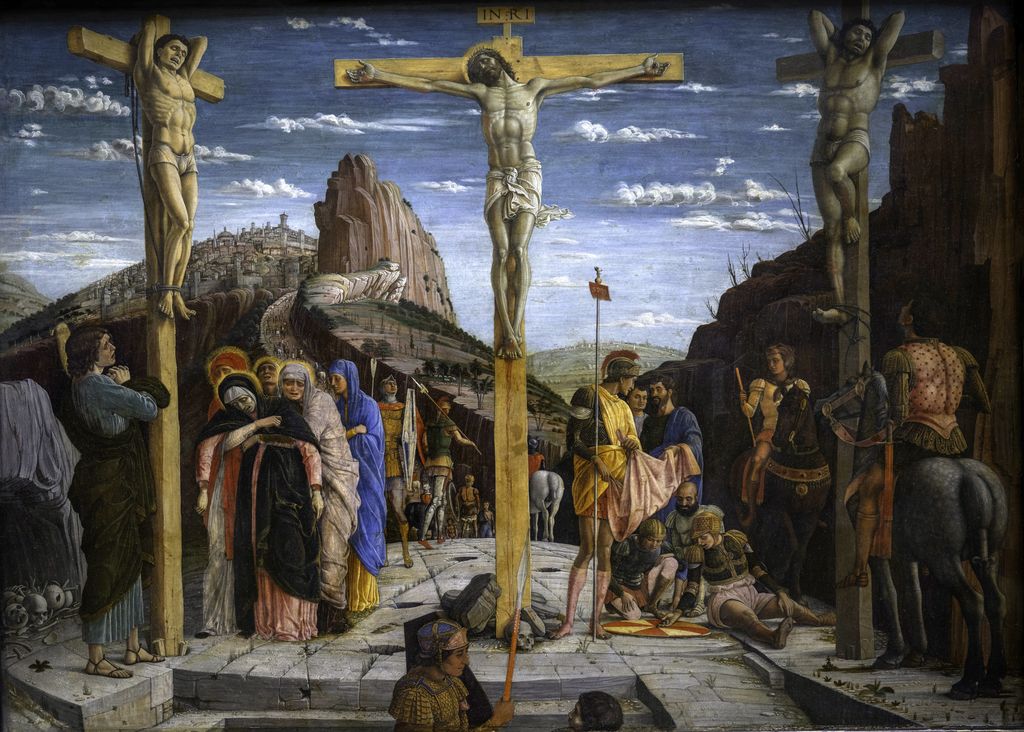
The Crucifixion from the San Zeno predella, Musée du Louvre Image source. Public domain.
Light from the right
The Louvre’s account draws attention to the correspondence between the light painted in Mantegna’s vestibule and daylight entering the church from a window on the right. Start with the painted architecture, where the lights and shadows around the supports make edges project or retreat. Similar shifts occur in the faces and heavy cloth. The continuity matters across the columns. If the saints on either side looked as though they were lit independently, the shared floor and roof would have less power to join them. A light that seems to arrive from one side of the basilica gives the painted architecture something in common with the carved frame in front of it. [5] [8]
How that correspondence was arranged is harder to pin down. The Italian state catalogue treats Mantegna’s role in altering the choir as a matter of debate and considers it quite plausible that he worked with an existing lighting arrangement. The broad effect is visible in the painting, while the history of the opening requires a more cautious reading. Changes to the placement of the altarpiece and to the presbytery also matter when comparing a present view with one from Correr’s time. The correspondence is most readily understood as a directional relationship between two spaces. Actual daylight changes throughout the day. In the picture, each highlight stays in place and helps the eye register where the next figure or pillar stands. [5] [6] [8]
There is a further distinction within the paint itself. In the Verona panels the Opificio found a pale, luminous base containing lead white, adjusted in tone for the colour that would go over it. Its team also found more translucent paint handling on the right than on the left, with the central panel intermediate in effect. A common direction of represented light could therefore coexist with a different build-up of colour in each panel. Those differences were made by hand, layer by layer, and some colours have since been affected by treatment and age. [1]
Three episodes beneath the throne
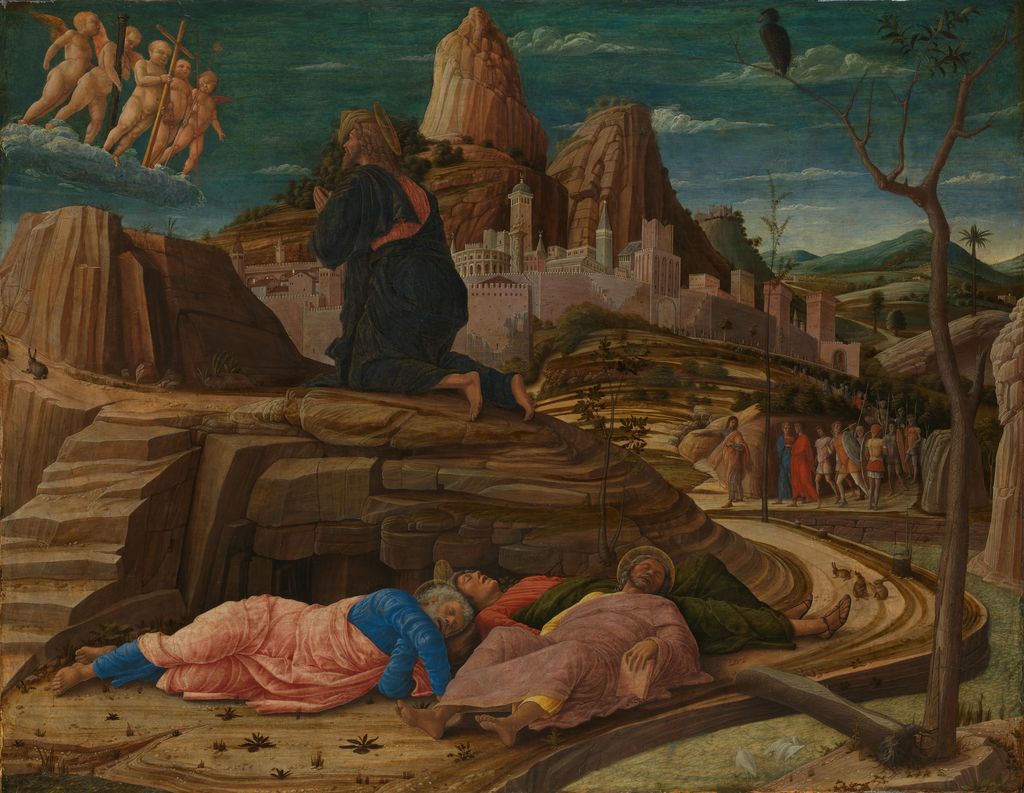
The predella put the events of Christ’s Passion and Resurrection below the enthroned Virgin and Child. At left, the Agony in the Garden shows Christ kneeling above the disciples while an angel presents a chalice. The apostles’ sleeping bodies spread low across the ground. Across the picture, the approaching party winds down from the fortified city, small enough at first to be overlooked. Following its path changes the way the panel reads. The prayer is momentarily still, but the arrest is already on its way. Tours suggests that the depiction of Jerusalem can be read in light of descriptions by the ancient historian Flavius Josephus. The city is Mantegna’s imaginative reconstruction, built up from visible walls, gates and towers. The San Zeno panel in Tours is a separate composition from Mantegna’s Agony in the Garden at the National Gallery in London. [3] [11] [12]
The central Crucifixion turns the movement upwards. The crosses stand out against open sky, while mourners cluster to the left and soldiers gather on the right. At the lower right, the men occupied with Christ’s clothing sit so low that the eye must travel almost the full height of the panel to reach his body. The slabs and fissures in the rock draw attention to the space between those clusters. Jerusalem lies far away. The Louvre identifies this as the central panel, painted in tempera on poplar, and catalogues it as INV 368. The central cross originally stood below the throne and the upright figure of the infant. The correspondence is visible in the altarpiece’s layout, where the two very different images of Christ occupy the same central axis. [1] [2] [8]
On the right, in the Resurrection, the opening in the rock surrounds the standing Christ, and the startled guards twist or recoil below him. The deep shade of the cave gives the figure its own setting even as the sky opens beyond. Tours describes two kinds of illumination here, the daylight at the horizon and the gold around Christ. Technical examination identified gold applied as a paint, with gold powder mixed in a binder. It picks out such details as the ivy, armour and weapons. The museum distinguishes these passages from the heavier later regilding of Christ’s halo. The distinction is worth making when following the light around the scene. Some of its strongest surviving effects are the small flashes that reach the things and people around him. [3] [13]
The three stories have separate spaces, but the landscapes give them something to share. Rocky ledges, distant buildings and the gradual lightening of the sky invite the eye to travel farther than each crowded foreground. The Louvre’s curators compare Mantegna’s attention to small features of the natural world with his Adoration of the Shepherds, now at the Metropolitan Museum of Art, and see an affinity with Flemish painting he could have encountered in Venetian territory. They also associate the sensitivity to landscape with his closeness to Giovanni Bellini. In the predella a sprig, a fold picked out by a fine stroke, or a small figure on a winding approach can hold the eye almost as long as a protagonist. The Tours dossiers identify lapis lazuli and lead white in the skies of both outer panels. Those blue passages are especially effective beside the warm bands at the horizon, where a narrow change in colour makes the country feel as though it continues beyond the edge of each panel. That change of scale is especially pronounced beneath the monumental upper figures. [8] [11] [13] [14]
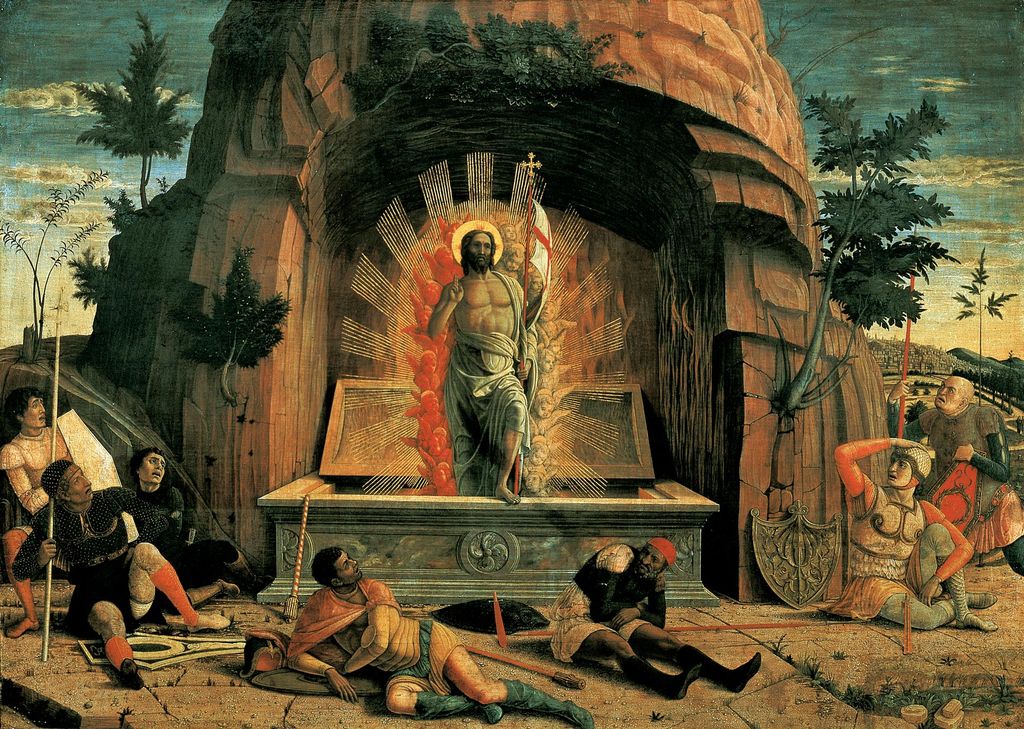
The Resurrection from the San Zeno predella, Musée des Beaux-Arts de Tours Image source. Public domain.
From the basilica to Paris and Tours
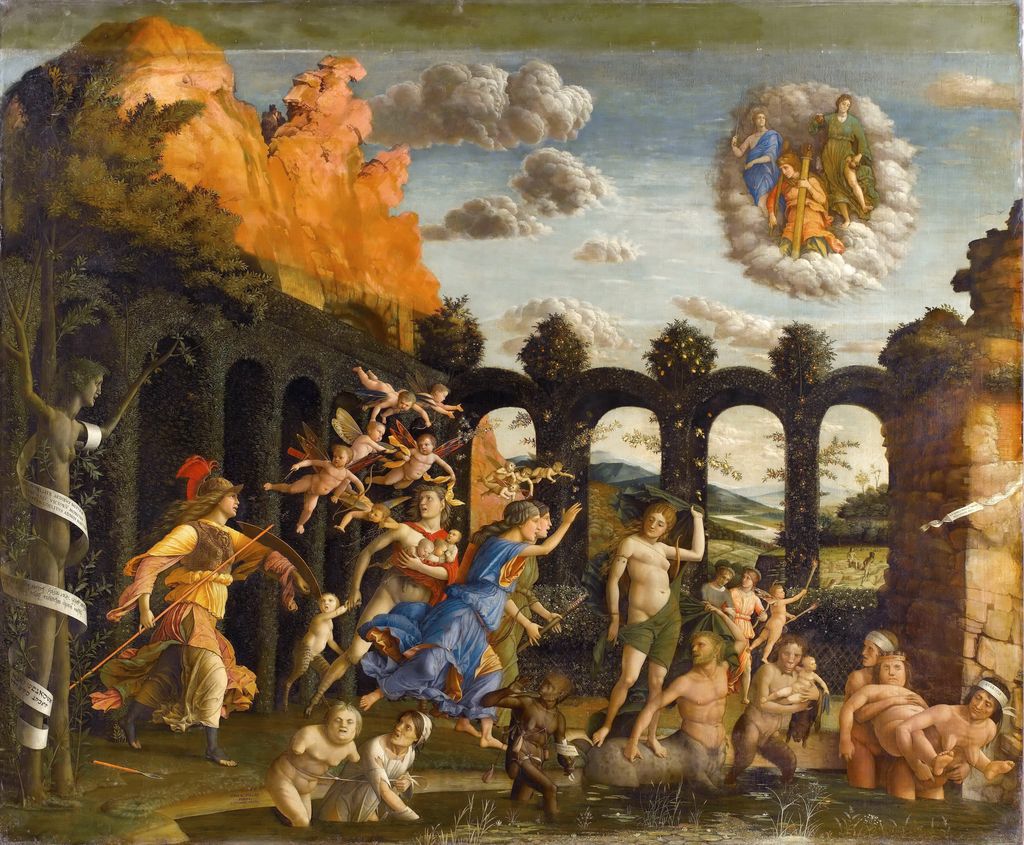
French commissioners dismantled the work on 15 May 1797 during the Napoleonic campaigns in Italy. The six paintings went to France, and the Louvre records the arrival of the Crucifixion in 1798. The wooden frame stayed at San Zeno. Without it, the upper and lower paintings entered the Paris museum as individual works. In 1806 Vivant Denon assigned the two outer predella scenes to Tours. The museum describes his decision as compensation for Mantegna paintings from the Richelieu collection that had gone to the Louvre. The Opificio identifies those earlier paintings as the Parnassus and Minerva Expelling the Vices from the Garden of Virtue, originally made for Isabella d’Este’s study in Mantua. The transferred Verona works are now catalogued in Tours as 1803-1-24 (Agony) and 1803-1-25 (Resurrection), and ownership passed from the French state to the city in 2010. [1] [2] [3] [15]
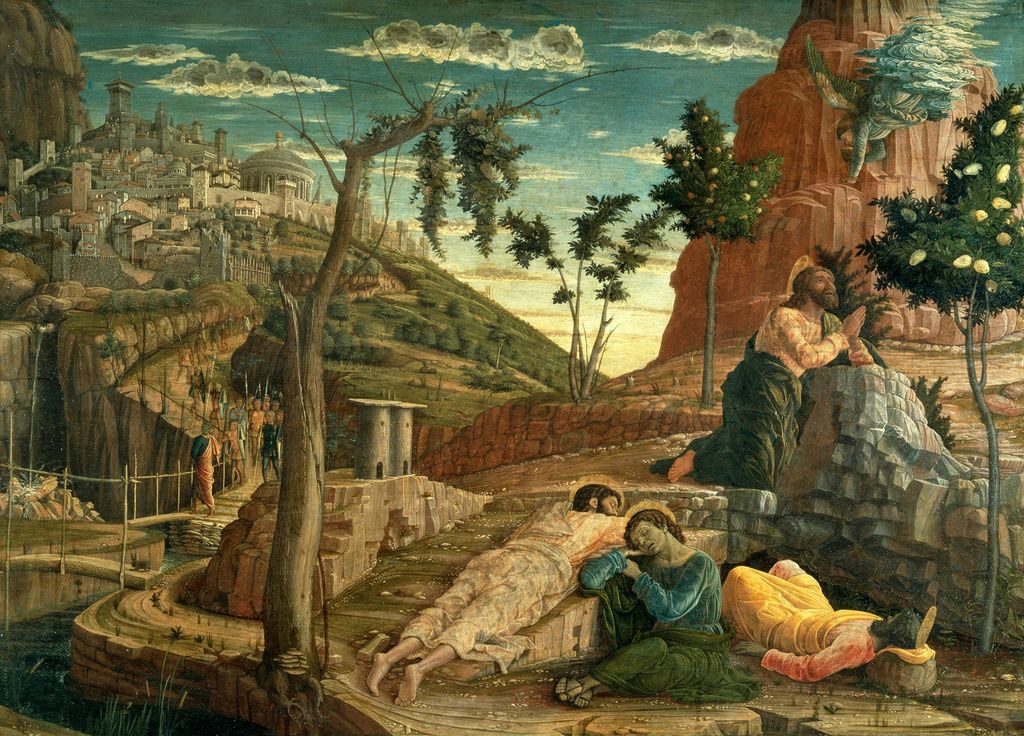
The Agony in the Garden, Musée des Beaux-Arts de Tours Image source. Public domain.
The Italian state catalogue records the recovery of the three large paintings from the Louvre in 1815. The Opificio’s treatment record gives 1817 for their return to Verona. The three predella paintings stayed in France. The Opificio dates the canvas copies now at San Zeno to the late eighteenth century, and the Italian catalogue identifies their maker as the Veronese painter Paolino Caliari, working for Benedetto Del Bene. Their presence makes the former order of the lower scenes intelligible. The altarpiece had already been moved within the choir before the seizure, and further reassembly and repositioning followed its return. The wooden structure survives with traces of those changes. The Opificio identifies the upper moulding of the predella as probably a nineteenth-century replacement. [1] [5] [6] [16]
In Tours, a copy made by Edgar Degas after the Louvre Crucifixion gives a second way to picture the missing centre. From April to June 2009, Tours displayed Mantegna’s original on loan from Paris alongside its two companions. The grouping restored the left-to-right sequence for the duration of the exhibition, and the juxtaposition renewed attention to what the three works share and how their materials and condition differ. The Agony, for example, had recurring problems with its support and was transferred to a new poplar panel in Paris in 1870. The Resurrection still has its original two-board poplar support. The museum’s technical accounts describe fine brushwork in the underdrawing for faces and clothing and broader strokes for rock. In the Resurrection, incisions helped lay out the architecture of the tomb. Even at the stage of the underdrawing, a viewer can trace the difference between the marks that give a figure its expression and those that establish the weight and direction of stone. [2] [11] [13] [17] [18] [19]
What conservation changed in Verona
Much of the work in Verona took place behind the painting. Mantegna painted the three upper panels in egg tempera on joined poplar boards. Before painting, the makers prepared the surfaces with glue and used textile reinforcement between wood and ground, with a layer of cloth on the left and hemp fibres over parts of the other panels. In 1933–34, Mauro Pellicioli removed the original crossbars and their nails, cut into and thinned the boards to flatten them, and installed a rigid wooden cradle on the back. By 2006, when the city of Verona reported on the initial investigations, raking light showed deformations in the surface. The investigators also reported small areas of lifting paint and the outlines of deep repair keys showing through. The work needed support that could accommodate the movement of the wood. [1] [20]
The Opificio’s treatment, completed in April 2009, began by tackling active wood-boring insects in the panels and the frame with a low-oxygen nitrogen treatment. Conservators dismantled the old cradle gradually, stabilised the wood with tiny wedges and fitted spring restraints that allow more movement than the rigid system. A rear enclosure slows the exchange of moisture with the surrounding air. The design addresses a particular challenge for a painting still installed in a church: the large wooden supports have to respond to their surroundings without forcing the brittle layers above them to follow every change. [1] [15]
Study of the paint went hand in hand with this structural work. The Opificio found charcoal-black underdrawing and lines scored with a metal point, as well as reddish-brown lines defining the architecture on the left. Alessia Andreotti, Maria Perla Colombini and Ilaria Degano reported that gas chromatography coupled with mass spectrometry identified egg binder in the material sampled from the Verona work. The Opificio specifies yolk. Analysis of organic colourants found kermes in a vivid red lake and a mixture including kermes, woad and a quercetin-based dye in violet. A yellow lake contained a luteolin-based dye. A separate study combined X-ray fluorescence and visible reflectance spectroscopy to investigate pigment mixtures and layers. These investigations help explain how a single painted room could be constructed from many different mixtures and degrees of transparency. [1] [21] [22]
The treatment of the painted surface was deliberately restrained. Earlier cleaning had damaged parts of the blue paint, and some of those passages had been extensively overpainted. The team worked within the layers of later varnish and retouching, filled losses and used watercolour to reintegrate them. Losses in the carved frame were repaired where there was enough evidence for the missing forms. On the gilded surfaces the conservators used gold leaf and fine watercolour hatching to bring new areas into harmony with the older gold. These choices affect the view from the nave as much as a close study of the surface. The clearer balance of lights and darks in the painted room and the repaired gilding at its threshold let the eye follow an architectural line from one bay to the next. At the base, Caliari’s copies still carry the eye through the three episodes, while the colour, brushwork and golden glints of Mantegna’s small originals are seen in Paris and Tours. [1] [5] [8] [13]
Annotated Details from The San Zeno Altarpiece in its frame
The numbered points identify details to look at closely. The detail images below preserve the native scale of the selected crops.
The San Zeno Altarpiece in its frame
Image source. Photograph by José Luiz. Overview marked; details cropped. CC BY-SA 4.0.
Details from THE SAN ZENO ALTARPIECE IN ITS FRAME
Choose a detail to enlarge it.
The San Zeno Altarpiece in its frame
Central bay
The throne stands inside the centre bay. The pillars supply a real frame and correspond to the columnar language painted inside.
Shared architectural space
The figures on either side occupy a continuous painted setting. The real column intersects the view in the foreground.
Predella register
The three scenes form a lower band beneath the main ensemble. The panels now installed in the base represent originals held elsewhere.
Artworks directory
| Name | Date | Medium and collection |
|---|---|---|
| The Adoration of the Shepherds | Shortly after 1450 | Painting · Metropolitan Museum of Art · 32.130.2 Catalogue. |
| Saint Mark the Evangelist | C. 1448–51 | Painting · Städel Museum · 1046 Catalogue. |
| Saint Jerome Penitent in the Desert | C. 1448–51 | Painting · Museu de Arte de São Paulo · MASP.00015 Catalogue. |
| Martyrdom and Transport of the Body of Saint Christopher | Mid-1450s | Painting · Ovetari Chapel, Padua Catalogue. |
| San Luca Altarpiece | 1453–55 | Painting · Pinacoteca di Brera · 176 Catalogue. |
| The Presentation of Christ at the Temple | 1454 (Berlin dating) | Painting · Gemäldegalerie, Berlin · 29 Catalogue. |
| San Zeno Altarpiece | 1457–59 | Painting · Basilica of San Zeno, Verona Catalogue. |
| The Crucifixion | 1456–59 | Painting · Musée du Louvre · INV 368 Catalogue. |
| The Agony in the Garden (London) | C. 1455–56 | Painting · National Gallery, London · NG1417 Catalogue. |
| The Agony in the Garden (Tours) | 1459 (Tours dating) | Painting · Musée des Beaux-Arts de Tours · 1803-1-24 Catalogue. |
| The Resurrection | 1459 (Tours dating) | Painting · Musée des Beaux-Arts de Tours · 1803-1-25 Catalogue. |
| Saint Sebastian (Vienna) | C. 1457–59 | Painting · Kunsthistorisches Museum · GG 301 Catalogue. |
| Cardinal Ludovico Trevisan | C. 1459–60 (Berlin exhibition dating) | Painting · Gemäldegalerie, Berlin · 9 Catalogue. |
| The Death of the Virgin | C. 1462 | Painting · Museo Nacional del Prado · P000248 Catalogue. |
| Christ with the Soul of the Virgin | C. 1460–64 | Painting · Pinacoteca Nazionale, Ferrara Catalogue only. |
| Portrait of a Young Man (traditionally Francesco Gonzaga) | C. 1461 or 1470, depending on sitter | Painting · Museo di Capodimonte · Q 60 Catalogue. |
| Portrait of a Prelate (Carlo de’ Medici?) | C. 1465–70 | Painting · Uffizi Galleries · 1890 no. 8540 Catalogue. |
| Portrait of a Man | C. 1470 | Painting · National Gallery of Art, Washington · 1952.2.5 Catalogue. |
| Madonna with Sleeping Child (Berlin) | C. 1455–60 | Painting · Gemäldegalerie, Berlin · S.5 Catalogue. |
| Camera degli Sposi (Camera Picta) | 1465–74 | Painting · Palazzo Ducale, Mantua Catalogue. |
| Saint Sebastian (Louvre) | Around 1480 | Painting · Musée du Louvre · RF 1766 Catalogue. |
| Lamentation over the Dead Christ | C. 1483 (Brera dating) | Painting · Pinacoteca di Brera · 352 Catalogue. |
| The Triumphs of Caesar | About 1485–1506 | Painting · Royal Collection · RCIN 403958–403966 Catalogue. |
| Madonna of the Caves | C. 1488–90 | Painting · Uffizi Galleries · 1890 no. 1348 Catalogue. |
| Madonna and Child with a Choir of Cherubim | C. 1485 | Painting · Pinacoteca di Brera · 297 Catalogue. |
| Madonna and Child (Poldi Pezzoli) | Early 1490s (museum dating) | Painting · Museo Poldi Pezzoli · 1595 Catalogue. |
| The Holy Family with Saint Mary Magdalen | C. 1495–1500 | Painting · Metropolitan Museum of Art · 14.40.643 Catalogue. |
| The Virgin and Child with Saint Mary Magdalene and Saint John the Baptist | C. 1490–1505 | Painting · National Gallery, London · NG274 Catalogue. |
| Christ as the Suffering Redeemer | 1485–95 (SMK dating) | Painting · Statens Museum for Kunst · KMSsp69 Catalogue. |
| Ecce Homo | C. 1500 | Painting · Musée Jacquemart-André · MJAP-P 1840 Catalogue. |
| Judith with the Head of Holofernes (Mantegna or follower) | C. 1495–1500 | Painting · National Gallery of Art, Washington · 1942.9.42 Catalogue. |
| Madonna della Vittoria | 1495–96 | Painting · Musée du Louvre · INV 369 Catalogue. |
| Mars and Venus (Parnassus) | C. 1496–97 | Painting · Musée du Louvre · INV 370 Catalogue. |
| The Trivulzio Madonna | 1497 | Painting · Castello Sforzesco, Milan · 0554 Catalogue. |
| The Adoration of the Magi | C. 1495–1505 | Painting · J. Paul Getty Museum · 85.PA.417 Catalogue. |
| Minerva Expelling the Vices from the Garden of Virtue | C. 1502 | Painting · Musée du Louvre · INV 371 Catalogue. |
| The Introduction of the Cult of Cybele at Rome | 1505–06 | Painting · National Gallery, London · NG902 Catalogue. |
| Saint Sebastian (Venice) | Probably c. 1504–06 | Painting · Galleria Giorgio Franchetti alla Ca’ d’Oro · D.11 Catalogue. |
| Samson and Delilah | C. 1500 | Painting · National Gallery, London · NG1145 Catalogue only. |
| A Woman Drinking (probably Sophonisba) | C. 1495–1506 | Painting · National Gallery, London · NG1125.2 Catalogue only. |
| The Vestal Virgin Tuccia with a Sieve | C. 1495–1506 | Painting · National Gallery, London · NG1125.1 Catalogue only. |
| Judith with the Head of Holofernes (Dublin) | C. 1495–1500 | Painting · National Gallery of Ireland · NGI.442 Catalogue only. |
| Battle of the Sea Gods, left half (Met impression) | Before 1481 (Met dating) | Print · Metropolitan Museum of Art · 18.12 Catalogue only. |
| Battle of the Sea Gods, right half (Met impression) | Before 1481 (Met dating) | Print · Metropolitan Museum of Art · 1984.1201.4 Catalogue only. |
| Battle of the Sea Gods, left half (Tokyo impression) | C. 1475 (Tokyo dating) | Print · National Museum of Western Art, Tokyo · G.1981-0002 Catalogue only. |
| Battle of the Sea Gods, left half (Washington impression) | C. 1485–88 (NGA dating) | Print · National Gallery of Art, Washington · 1941.1.6 Catalogue only. |
| The Entombment of Christ, second state of two | Before 1475 (Met dating) | Print · Metropolitan Museum of Art · 37.42.30 Catalogue only. |
| The Entombment of Christ (possibly Zoan Andrea, after Mantegna) | 1460–1549 (Rijksmuseum dating) | Print · Rijksmuseum · RP-P-1924-60 Catalogue only. |
| Four Dancing Muses (Gian Marco Cavalli after Mantegna) | C. 1497 | Print · Metropolitan Museum of Art · 20.5.3 Catalogue only. |
| Bacchanal with Silenus | Before 1475 (Met dating) | Print · Metropolitan Museum of Art · 29.44.15 Catalogue only. |
| Bacchanal with a Wine Vat | Before 1475 (Met dating) | Print · Metropolitan Museum of Art Catalogue only. |
| St James on His Way to Execution | C. 1453–57 | Drawing · British Museum · 1976,0616.1 Catalogue only. |
| Three Studies for a Dead Christ | C. 1455–65 | Drawing · British Museum · 1909,0406.3 Catalogue only. |
| Pietà (Venice) | C. 1456–65 (exhibition datings) | Drawing · Gallerie dell’Accademia, Venice · 115 Catalogue only. |
| Studies for Christ at the Column | 1460–65 | Drawing · The Courtauld · D.1978.PG.345 Catalogue only. |
| Virtus Combusta | C. 1490 (technical study) | Drawing · British Museum · Pp,1.23 Catalogue only. |
| Virtus Combusta (Giovanni Antonio da Brescia after Mantegna) | C. 1495–1506 | Print · Musée du Louvre · 3881 LR/ Recto Catalogue only. |
| The Calumny of Apelles | C. 1504–06 | Drawing · British Museum · 1860,0616.85 Catalogue only. |
Frequently Asked Questions
The main panels and gilded wooden frame remain above the high altar. The three lower scenes appear there as copies.
The Crucifixion is in the Louvre. The Agony and Resurrection are in the Musée des Beaux-Arts de Tours.
Discussion
Look again at the images and ideas explored in San Zeno Altarpiece. These editorial prompts invite your observations.
Reader Insights
Where do the painted floor and entablature pick up the view across the real columns, and how does that continuity affect the way you see the saints?
How does viewing the Louvre Crucifixion between the two Tours originals change your reading of the central axis and the pace of the predella?
Join the Conversation
Share a detail, comparison or question about San Zeno Altarpiece below.
References
- Opificio delle Pietre Dure, Andrea Mantegna, Pala di San Zeno, 1457–1459, Basilica di San Zeno, Verona. View source.
- Musée du Louvre, La Crucifixion, INV 368. View source.
- Musée des Beaux-Arts de Tours, La Prière au jardin des oliviers et La Résurrection. View source.
- Catalogo generale dei Beni Culturali, Santi, right panel of the San Zeno Altarpiece, 0500056247-3. View source.
- Istituto Centrale per il Catalogo e la Documentazione, Central Madonna and Child panel, catalogue record 0500127961. View source.
- Basilica di San Zeno and Associazione Chiese Vive, La Basilica di San Zeno, visitor guide. View source.
- J. Paul Getty Museum, Study of Four Saints (Peter, Paul, John the Evangelist, and Zeno). View source.
- Musée du Louvre, Mantegna exhibition: Around the San Zeno triptych in Verona. View source.
- Pinacoteca di Brera, Polittico di San Luca. View source.
- Basilica di Sant’Antonio di Padova, Presbiterio e altare maggiore. View source.
- Musée des Beaux-Arts de Tours, La Prière au jardin des Oliviers, museum study dossier. View source.
- The National Gallery, Andrea Mantegna, The Agony in the Garden, NG1417. View source.
- Musée des Beaux-Arts de Tours, La Résurrection, museum study dossier. View source.
- The Metropolitan Museum of Art, The Adoration of the Shepherds. View source.
- Opificio delle Pietre Dure, La Pala di San Zeno di Andrea Mantegna: Studio e conservazione, publication summary. View source.
- Catalogo generale dei Beni Culturali, Paolino Caliari, Resurrezione di Cristo, Verona predella copy. View source.
- Musée des Beaux-Arts de Tours, Edgar Degas, Le Calvaire, copie d’après Mantegna. View source.
- Musée du Louvre, Mantegna: la prédelle de San Zeno de Vérone, 1457–1459, Tours exhibition record. View source.
- Bibliothèque nationale de France, Mantegna: la prédelle de San Zeno de Vérone, 1457–1459, exhibition catalogue record. View source.
- Comune di Verona, Celebrazioni Mantegna: il restauro della pala a San Zeno, 30 May 2006. View source.
- Alessia Andreotti, Maria Perla Colombini and Ilaria Degano, The Identification of the Organic Painting Materials in Andrea Mantegna’s Pala di San Zeno, DHA 29, p. 30. View source.
- Università degli Studi di Milano, Di mescole e di strati: i pigmenti di Mantegna nella pala di San Zeno secondo le analisi integrate EDXRF e vis-RS. View source.
- Palazzo Ducale, Mantua, Camera degli Sposi (Camera Picta), View source.
- Royal Collection, The Triumphs of Caesar, View source.
- Musée du Louvre, Madonna della Vittoria, View source.
- National Gallery, London, The Introduction of the Cult of Cybele at Rome, View source.
More MANTEGNA Paintings
San Zeno Altarpiece
The San Zeno Altarpiece in its frame, Basilica of San Zeno, Verona José Luiz. Image source. CC BY-SA 4.0. Resized from the cited image.