 by Tom Gurney
Tom Gurney BSc (Hons) is an art history expert with over 20 years experience
Email: tomgurney1@gmail.com / Phone: +44 7429 011000
Overview
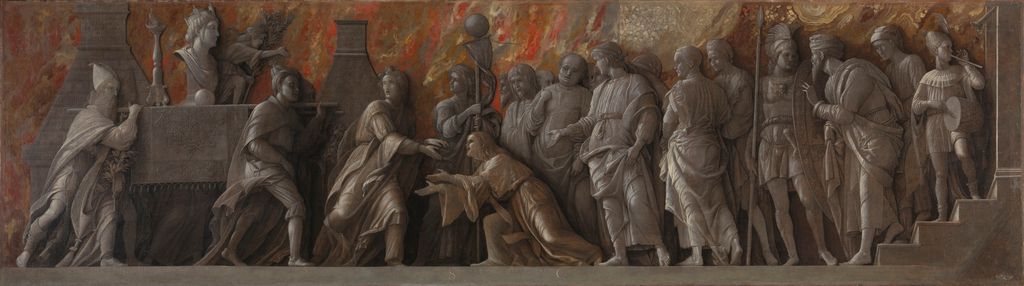
A woman drops to her knees in the path of a litter. Above her, a crowned bust rides past two inscribed monuments, while men turn to speak and musicians crowd the far end of the procession. Andrea Mantegna makes the scene look as though it was carved in pale stone and set against veined marble. The figures spring from a canvas barely three-quarters of a metre high. [1]
The National Gallery in London dates The Introduction of the Cult of Cybele at Rome to 1505–06, the last years of Mantegna’s life. Painted in glue tempera on canvas, it measures 76.5 × 273 cm and has the inventory number NG902. Its subject is the arrival of a goddess in Rome in 204 BCE. For the Venetian Cornaro family, who traced their ancestry to the Roman Cornelii, that arrival was also an occasion to remember the young man chosen to receive her. [1]
At a Glance
- Date1505–06 (National Gallery dating)
- MediumGlue tempera on canvas
- Dimensions76.5 × 273 cm
- CollectionNational Gallery, London
- Inventory numberNG902
Andrea Mantegna in context
San Zeno Altarpiece
1457–59 [22]The Triumphs of Caesar
Mid-1480s–before 1506 [19]Madonna della Vittoria
1495–96 [24]The Introduction of the Cult of Cybele at Rome
1505–06 [1]How paint takes on the weight of marble
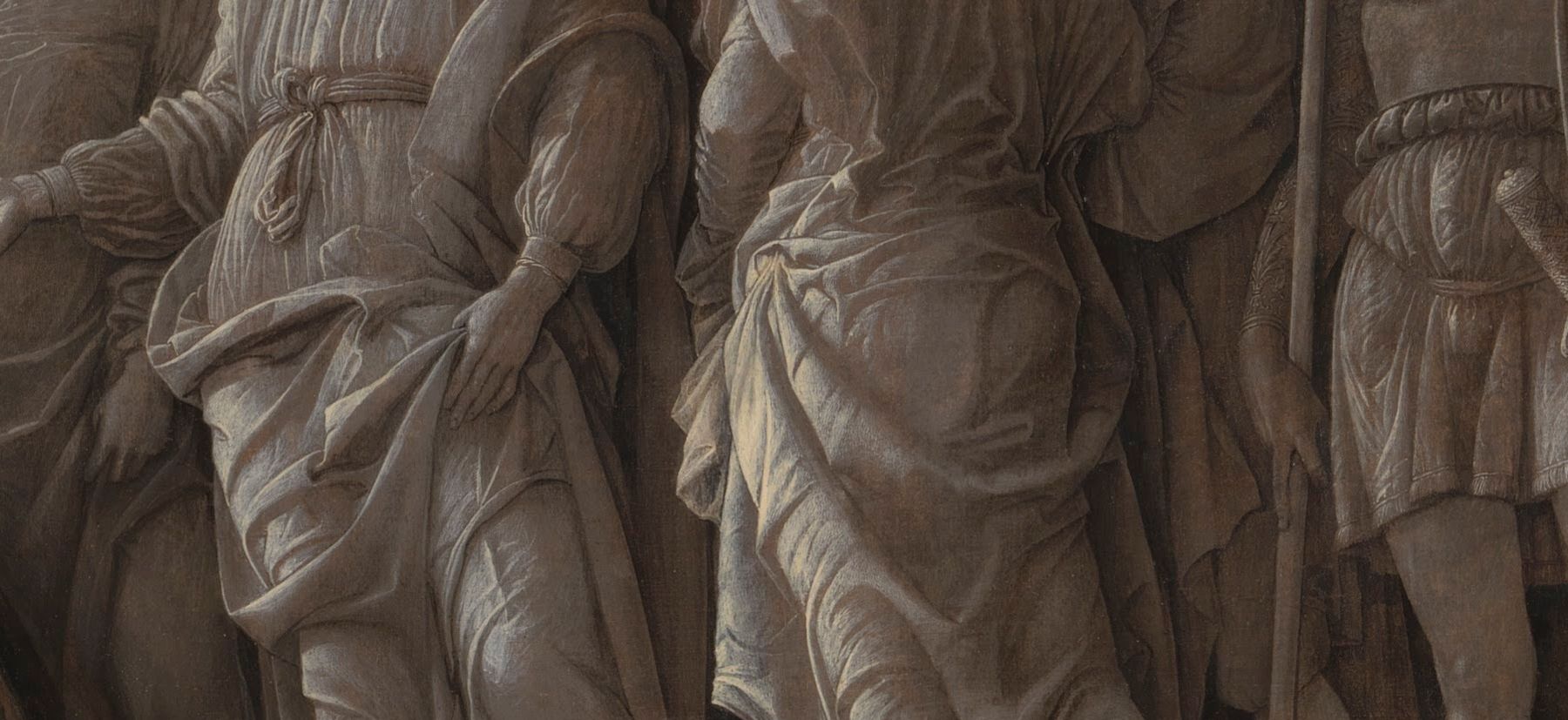
The strip beneath the procession is one of the easiest places to see how the illusion works. Its upper edge gives the people a narrow shelf to stand on, while the face below carries lettering as though it belonged to the same piece of architecture. Immediately above it, hems, feet and knees come forward in uneven degrees. Look at the woman in the centre. The fabric breaks into bright ridges around her bent knee and sinks into greyer folds where it gathers. Your eye can follow a contour around the body and then lose it where one form overlaps another. That alternation gives the impression of varying depths of carving across a single surface. [1]
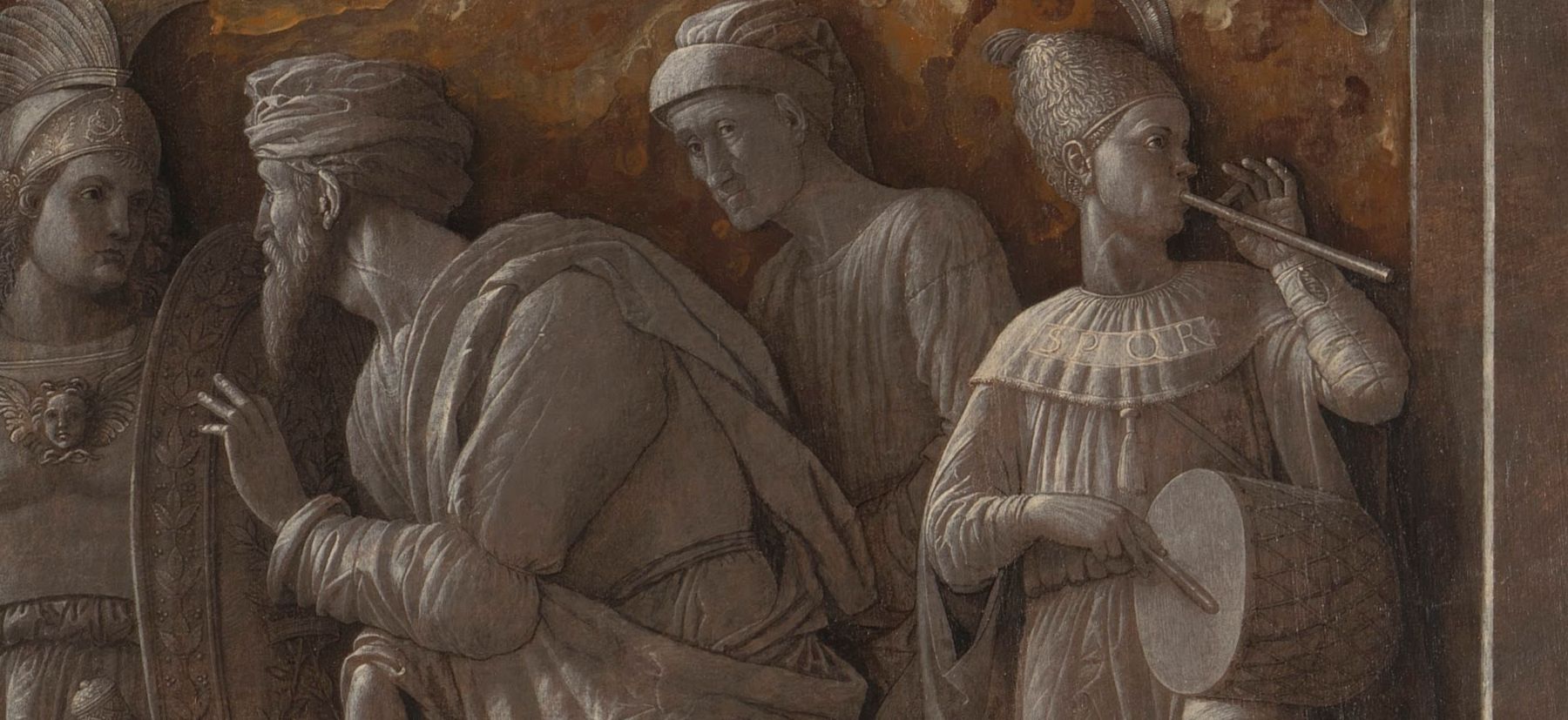
The imitation involves several kinds of stone. A reddish, pale-veined field runs behind the procession and shows through wherever the packed figures open up. The pale bodies have their own gradations, from the lit edges of sleeves to the hollows beside a neck or between two heads. In this use of grisaille, a restricted range of tones gives the figures their sculptural character, while the coloured ground makes them appear to belong to a different material. Cybele’s bust adds another layer to the illusion. It is a painted sculpture carried by painted people who themselves look carved. The men bracing the litter against their shoulders have a burden to carry. Each head clears a different part of the pole or the body beside it, while the upright bust keeps its composure. [1]
Technical analysis gives that effect a material basis. In their study of Italian painting media for the National Gallery, Catherine Higgitt and Raymond White report a more substantial layer of glue size and more opaque paint in Cybele than in the Northern European glue paintings they use for comparison. Earlier National Gallery tests identified glue in three samples from the canvas, including red-brown paint and a white stripe on one of the painted monuments. The same kind of binder therefore served quite different appearances. The tests left open the possibility of egg tempera in some thicker passages. Higgitt and White describe the generally matt finish of Mantegna’s glue-bound pictures. The impression of polished marble in Cybele depends on how the painter distributes streaks of colour and light across the surface. [2] [3]
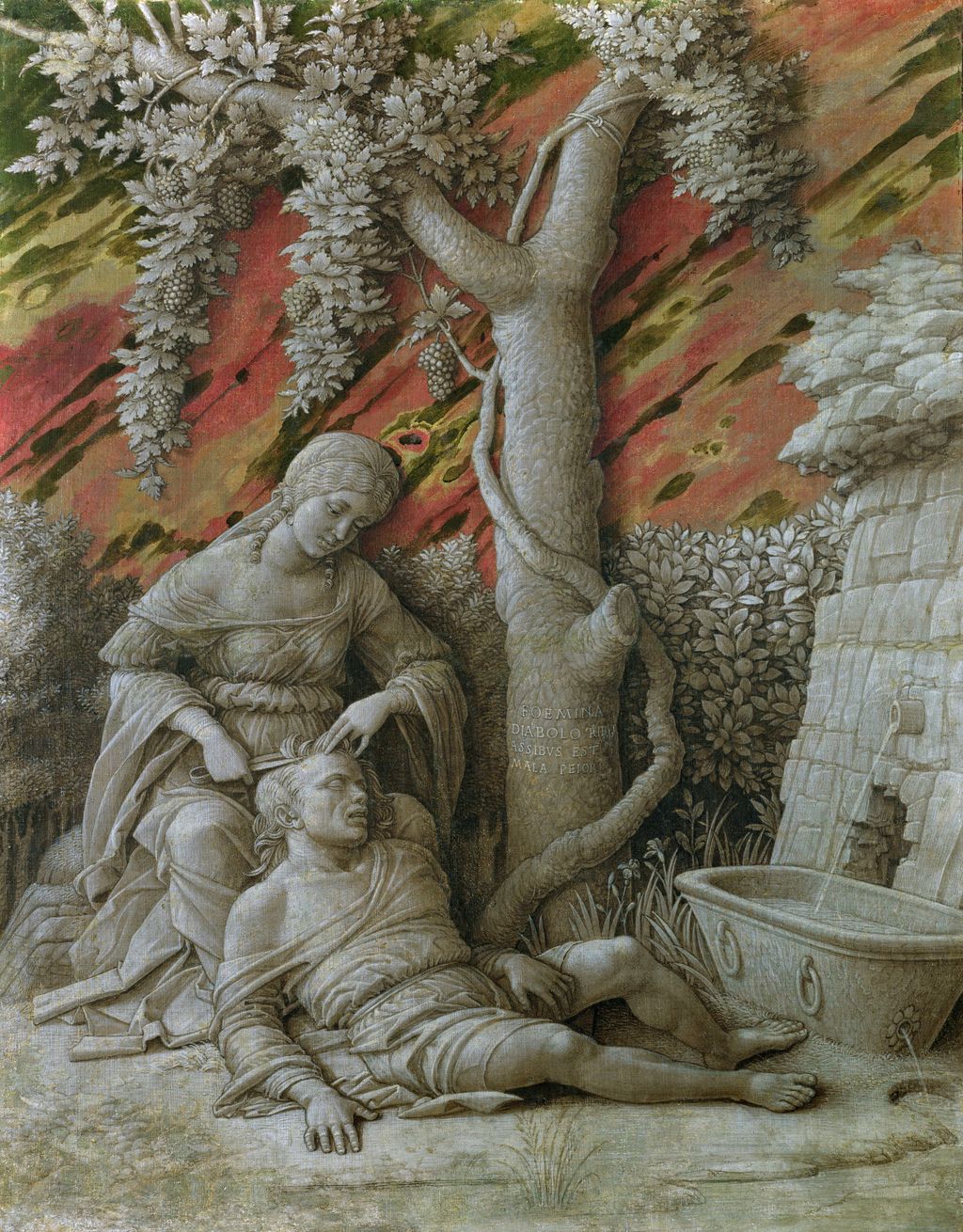
Samson and Delilah, National Gallery, London Image source. Public domain.
The goddess Rome asked for
Livy places the decision to bring Cybele to Rome late in the Second Punic War. He reports repeated showers of stones and a consultation of the Sibylline Books, whose prophecy offered a way to defeat a foreign enemy on Italian soil. Rome would have to bring the Mother of Mount Ida from Pessinus in Phrygia, in what is now Turkey. In Livy’s account, the Roman envoys visit Delphi and enlist the help of King Attalus, who hands over a sacred stone revered as the Mother of the Gods. The oracle calls for a host worthy of the goddess. The Senate chooses Publius Cornelius Scipio Nasica, a young man who had yet to hold the office of quaestor. Livy says the grounds for the Senate’s particular choice had already become obscure. [4]
Livy follows the stone from the mouth of the Tiber into the city. Nasica takes it from the priests aboard the ship and brings it ashore, where Roman matrons receive it. They carry the goddess onward in relays as people burn incense at their doors. Claudia Quinta stands out among the women. Livy says that her service to the goddess brought her a reputation for chastity after earlier doubts about her conduct. The episode takes a different shape in Ovid’s Fasti. There the ship runs aground, and a crowd strains to free it. Claudia prays to Cybele to vindicate her, then draws the vessel free herself. Ovid brings the goddess through the Porta Capena on a wagon and also names Nasica as her receiver. [4] [5]
Mantegna concentrates that long journey in a meeting on land. The open-mouthed woman kneeling before the litter may be Claudia. Her lifted face and gathered skirts suggest a sudden appeal. In Ovid, Claudia also kneels before the goddess just before the ship comes free. Mantegna’s figure can recall that prayer in the midst of the later procession, with no need to show the riverbank, rope or ship. The National Gallery proposes that the standing man who gestures towards her while turning to a companion may be Nasica. The figure is hard to isolate. Drapery and limbs overlap, and the direction of his hand draws attention back to the woman. What could have been simply the arrival of a sacred object becomes a public occasion on which a woman’s reputation and a Roman citizen’s worth are both at stake. [1] [4] [5]
The goddess has a clear profile and a crown shaped like the walls and towers of a city. The round object beside her is harder to read. The National Gallery identifies it as the sacred stone. In a study for the Parco archeologico del Colosseo’s Magna Mater tra Roma e Zama exhibition, Claudio Castelletti interprets the sphere as an emblem of the Earth. There is a precedent for the first reading in Appian’s account, in which the Romans are told to fetch something that will fall from the sky at Pessinus. The late antique author Arnobius, writing against pagan worship, describes the stone itself as small, dark and rough. The painted sphere is strikingly regular. Its shape is part of the reason the little object still invites more than one reading. [1] [6] [7] [8]
The names built into the procession
The two monuments are unusually conspicuous. Their sloping sides rise above the heads like truncated pyramids, and their inscriptions break the continuous flow of the marble behind the procession. The National Gallery identifies them as the tombs of Nasica’s father and uncle. His father was Gnaeus Cornelius Scipio. His uncle, Publius, was the father of Scipio Africanus. The two tombs place the older generation of the family in view while the young Nasica receives the goddess. The lettering along the bottom singles out the office he performs. HOSPES NUMINIS IDAEI calls him the host of the deity of Ida, and the S and C to either side abbreviate senatus consulto, by decree of the Senate. Livy makes Nasica the man who brings the goddess ashore. Valerius Maximus adds his household to the account of her reception, giving the title of host the more personal sense of a man opening his home. [1] [4] [9] [10]
The inscription gives the Senate’s choice a permanence that the restless figure group alone could scarcely convey. A viewer sees heads turn and hands lift in immediate response to the arrival, then reads the words below as a record of a civic act. In the background, names are attached to bodies long dead. In the foreground, the Senate authorises a living descendant to act for Rome. Ovid supplies the route through the Porta Capena, which Claudia Cieri Via uses to situate the funerary references, while the forms of the monuments belong to Mantegna’s imagined setting. Cieri Via also proposes that a pair of men towards the right could be Scipio Africanus and Licinius Crassus. That remains a reading of their gestures and positions. The named monuments and the line beneath the figures give firmer evidence of where Mantegna wanted the viewer’s attention to settle. [1] [5] [9]
A Venetian commission still in the studio
On 15 March 1505 Cardinal Marco Cornaro wrote to Francesco II Gonzaga, Mantegna’s patron in Mantua, seeking permission for his brother Francesco Cornaro to obtain work from the painter. As Gino Benzoni notes in his study of the period, the cardinal acknowledged that the decision rested with the marquis. The Venetian request passed through the Mantuan court that employed the painter. Pietro Bembo later raised the stalled commission in a letter to Isabella d’Este dated 1 January 1506, or 1505 by the Venetian calendar. As Paul Kristeller recounts it, Bembo reported an agreed price of 150 ducats, with 25 paid in advance, and said Mantegna now wanted more. Isabella promised to intervene once the painter had recovered from a recent illness. The letter gives the patron’s side of the dispute and shows why the fine distinctions of price and delivery mattered to people well beyond the painter’s studio. [1] [11] [12] [13]
A cycle honouring the Cornelii suited the family’s claim to Roman descent. Choosing Nasica’s episode gave that claim a civic meaning. The honour the painting celebrates is being trusted to receive the goddess on behalf of the city, and its Latin lettering gives the honour the form of a public record. The frieze format would have extended that impression around a room if several such canvases had hung together. Treccani describes a commission for four paintings in all, while the National Gallery’s account refers to preparations for four canvases in addition to this one. Only this canvas survives from Mantegna’s side of the project. The National Gallery also points to an original diagonal cut at the lower right, which raises the possibility that the canvas was shaped to abut a chimney breast. The cut offers a clue to a particular architectural setting, though the arrangement of the room remains uncertain. [1] [9] [11] [13]
A letter written by Mantegna’s son Lodovico less than three weeks after the painter’s death in September 1506 lists a work on Scipio Cornelius among the paintings left in the studio. It had been undertaken for Francesco Cornaro, and Cardinal Sigismondo Gonzaga wanted to keep it. The National Gallery considers its canvas very likely to be the picture named in the letter of 2 October. Lodovico calls the picture principiata, or begun, in the letter transcribed by Kristeller. The word leaves open how far along it was when Mantegna died. Another son, Francesco Mantegna, tried to recover it, and the Gallery’s provenance records payments to Lodovico from the cardinal in 1507. The canvas did eventually reach the Palazzo Cornaro, later known as Palazzo Mocenigo at San Polo in Venice, where it was recorded in 1815. It later passed through the Vivian family, and the National Gallery bought it from Captain Ralph Vivian in 1873. [1] [12]
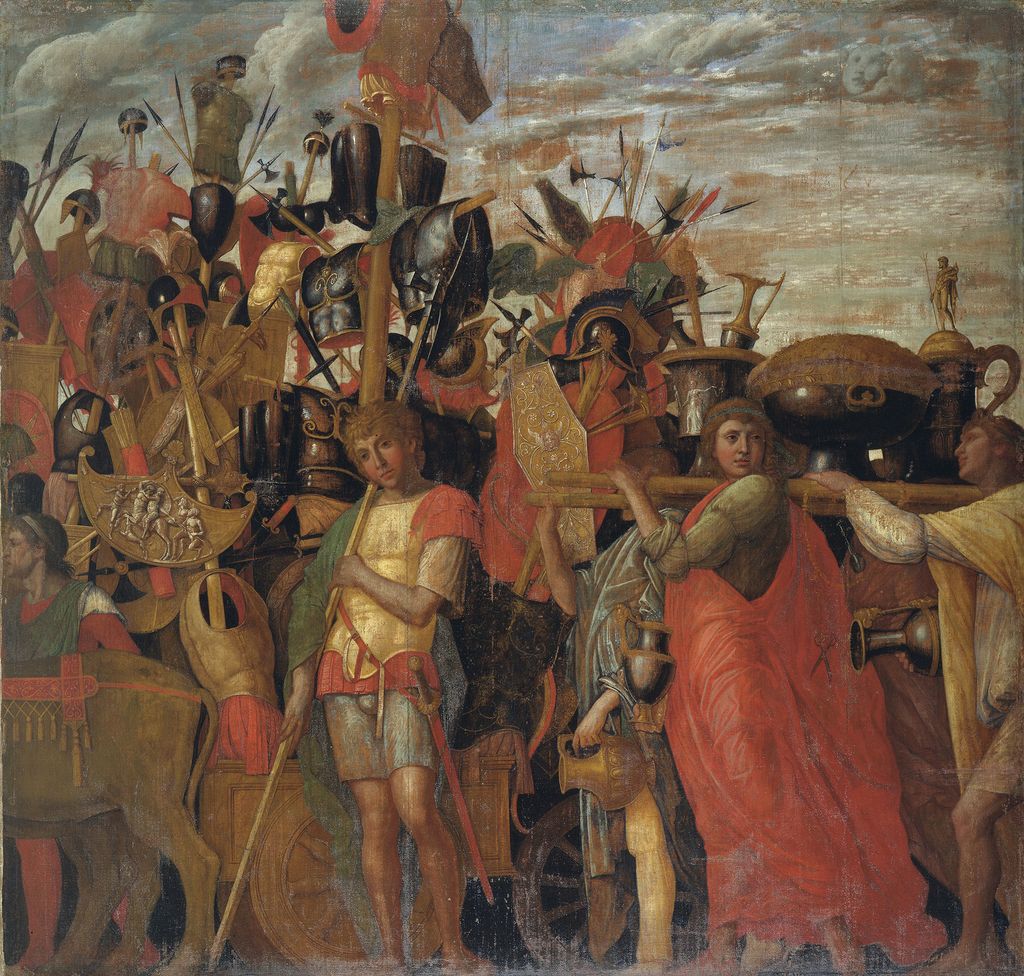
The Triumphs of Caesar, canvas III, Royal Collection Image source. Public domain.
Bellini takes up the Roman theme
Giovanni Bellini’s An Episode from the Life of Publius Cornelius Scipio, often exhibited as The Continence of Scipio, is the surviving work most closely connected with the project. London presents it as the work Cornaro commissioned after Mantegna’s death. The National Gallery of Art in Washington dates it to after 1506 and gives Francesco Cornaro as the probable patron. The traditional title refers to a different Scipio. Livy tells how Africanus returned a captive woman to her betrothed, and gave the gold her family had brought to ransom her as a wedding gift. That story offered the Cornaro another model of Roman conduct, this time in the exercise of a victorious general’s power. [1] [14] [15]
The two canvases are close in height but Bellini’s is appreciably longer. Both set pale figures against a reddish imitation of marble. In Bellini, the seat of authority is unmistakable. Scipio sits on a raised throne, extending his hand towards the people who wait before him, while a lettered plaque near the steps fixes the encounter in the language of Roman example. Mantegna lets the authority of the occasion emerge more gradually, through the approaching litter, the worshipper below it and the inscription near the viewer’s eye. Bellini’s oil on canvas and Mantegna’s glue tempera achieve related effects through different materials. Their kinship helps explain why the two were shown together in London’s Mantegna and Bellini exhibition in 2018. [1] [14] [16]
The same goddess in stone and paint
An actual Roman relief tells the story at a different moment. The marble altar dedicated to the Mother of the Gods and Navisalvia in the Musei Capitolini shows a seated Cybele in a vessel, while a woman on the bank draws it towards her. The museum dates the altar to the reign of Claudius, 37–54 CE, and tentatively links the figure with Claudia Quinta. The name below the relief belongs to the freedwoman Claudia Synthyche, who dedicated the altar. Where Mantegna gives the goddess a long approach and crowded reception, the stone relief keeps the action between the ship and the woman who rescues it. On the altar’s sides, carved instruments and a Phrygian cap carry the ritual associations beyond the main scene. In the painting, musicians occupy the far right of the procession itself. The altar was found in the early eighteenth century, and its value alongside the painting is as an ancient treatment of the subject. [1] [17]
In Neroccio de’ Landi’s Claudia Quinta, painted about 1490–95, the heroine occupies nearly the whole height of a panel. She holds a small ship in one hand, while the episode that explains it plays out behind her on the riverbank. Text on her pedestal has her speak in her own defence. Mantegna gives the kneeling woman the expressive centre of the encounter, and the inscription reserves the principal honour for the Roman host. The two painters find different ways to tell the same story of virtue in public. [1] [6] [18]
Mantegna’s own Triumphs of Caesar give the closest parallel for the way he makes a sacred image travel. In the second canvas, The Triumphal Carts, the National Gallery also identifies a bust of Cybele. It rides amid monumental statues, weapons and equipment, with a tablet celebrating Caesar behind it. That surge of people and objects belongs to a procession carried across nine canvases. In Cybele, the smaller litter and the gap opened by the kneeling woman make the goddess’s passage more intimate. Both paintings make a carried image and public lettering interact. In the triumph the tablet names a military achievement, while the words beneath the Cornaro procession honour the host of a goddess. [1] [6] [19] [20]
In Parnassus, commissioned for Isabella d’Este’s first studiolo in Mantua in the winter of 1496–97, Mantegna gives antiquity another setting. The Louvre’s Mars and Venus places the couple high on a rocky arch and the dancing Muses below, with enough depth and colour to carry the eye into a landscape. The Louvre attributes some later oil repainting, including parts of the landscape and figures, probably to Lorenzo Leonbruno. The arch in Parnassus creates an opening into the distance, while the veined field in Cybele holds the figures near the viewer. At the far right of Cybele, the drummer turns his head back towards the edge. His glance makes it easy to imagine the procession carrying on beyond the canvas, even as the painted ledge stops at its edge. [1] [21]
Annotated Details from The Introduction of the Cult of Cybele at Rome
The numbered points identify details to look at closely. The detail images below preserve the native scale of the selected crops.
The Introduction of the Cult of Cybele at Rome
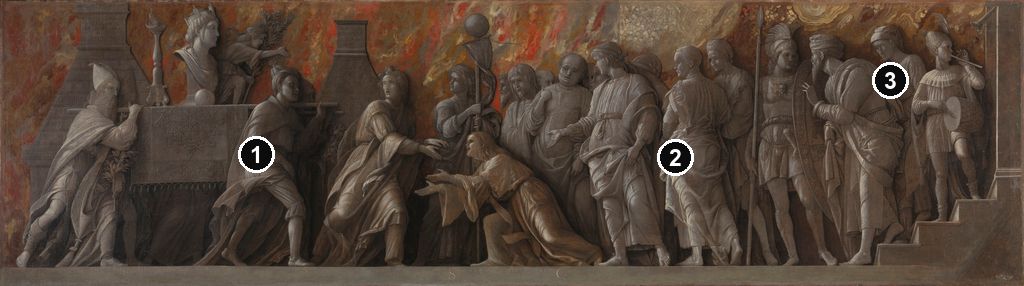
Details from THE INTRODUCTION OF THE CULT OF CYBELE AT ROME
Choose a detail to enlarge it.
The Introduction of the Cult of Cybele at Rome
Carriers at the statue’s support
The carrying group bunches around a focused object. The shadows make the projecting hands and faces read like carved forms.
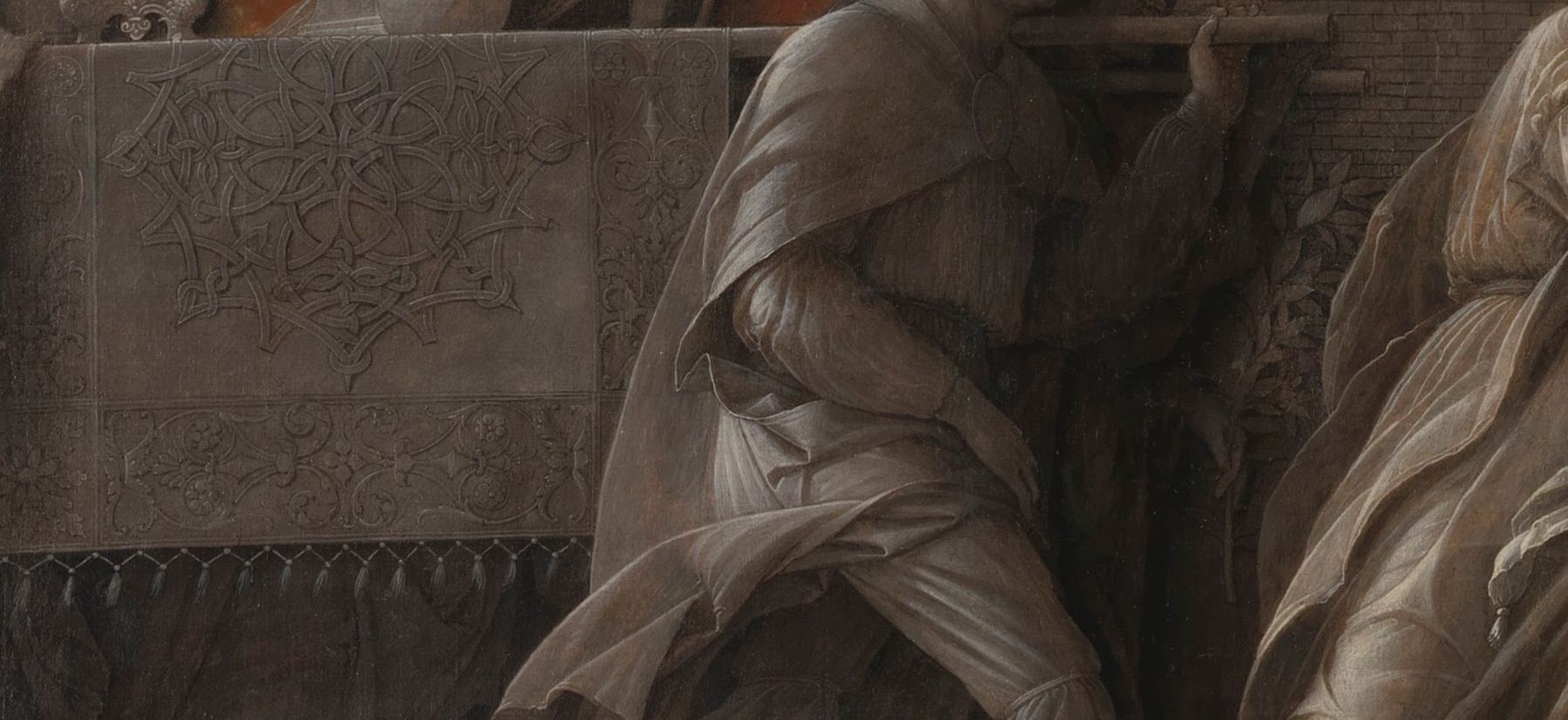
Overlapping robes
Robes and limbs overlap along the crowded shallower plane. The darkest pockets lie where one figure passes behind another.
Architectural limit
The architecture behind the procession supplies upright stops. The warm field helps the paler bands of paint suggest stone.
Artworks directory
| Name | Date | Medium and collection |
|---|---|---|
| The Adoration of the Shepherds | Shortly after 1450 | Painting · Metropolitan Museum of Art · 32.130.2 Catalogue. |
| Saint Mark the Evangelist | C. 1448–51 | Painting · Städel Museum · 1046 Catalogue. |
| Saint Jerome Penitent in the Desert | C. 1448–51 | Painting · Museu de Arte de São Paulo · MASP.00015 Catalogue. |
| Martyrdom and Transport of the Body of Saint Christopher | Mid-1450s | Painting · Ovetari Chapel, Padua Catalogue. |
| San Luca Altarpiece | 1453–55 | Painting · Pinacoteca di Brera · 176 Catalogue. |
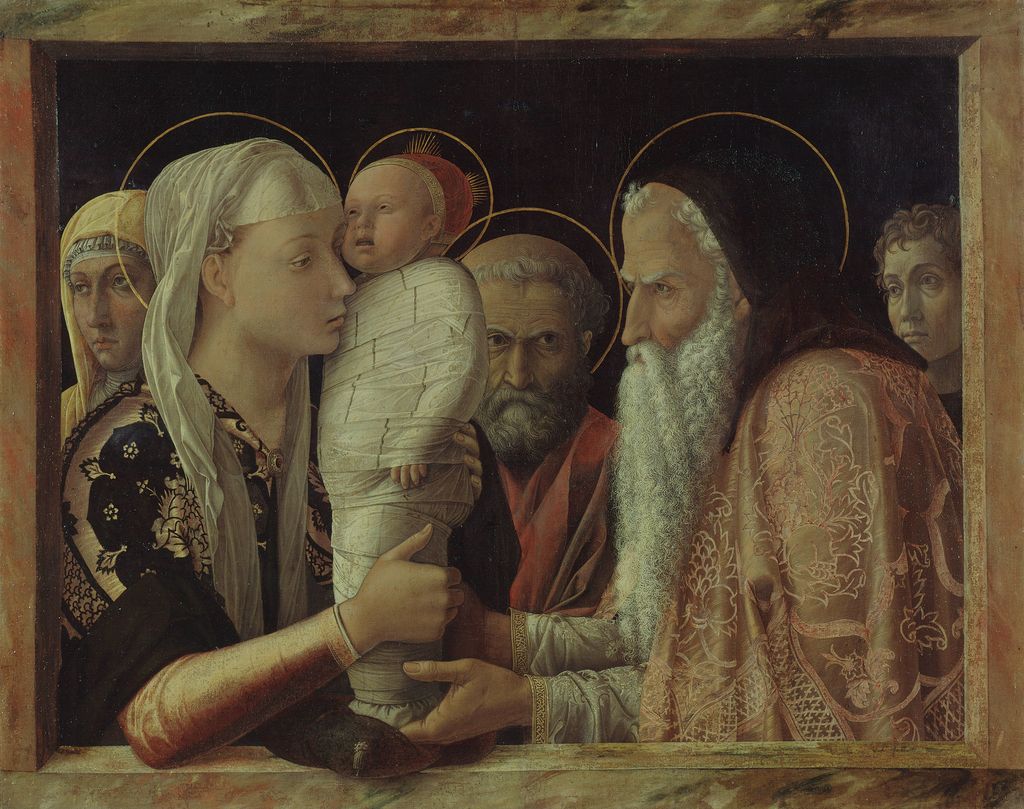
| The Presentation of Christ at the Temple | 1454 (Berlin dating) | Painting · Gemäldegalerie, Berlin · 29 Catalogue. |
| San Zeno Altarpiece | 1457–59 | Painting · Basilica of San Zeno, Verona Catalogue. |
| The Crucifixion | 1456–59 | Painting · Musée du Louvre · INV 368 Catalogue. |
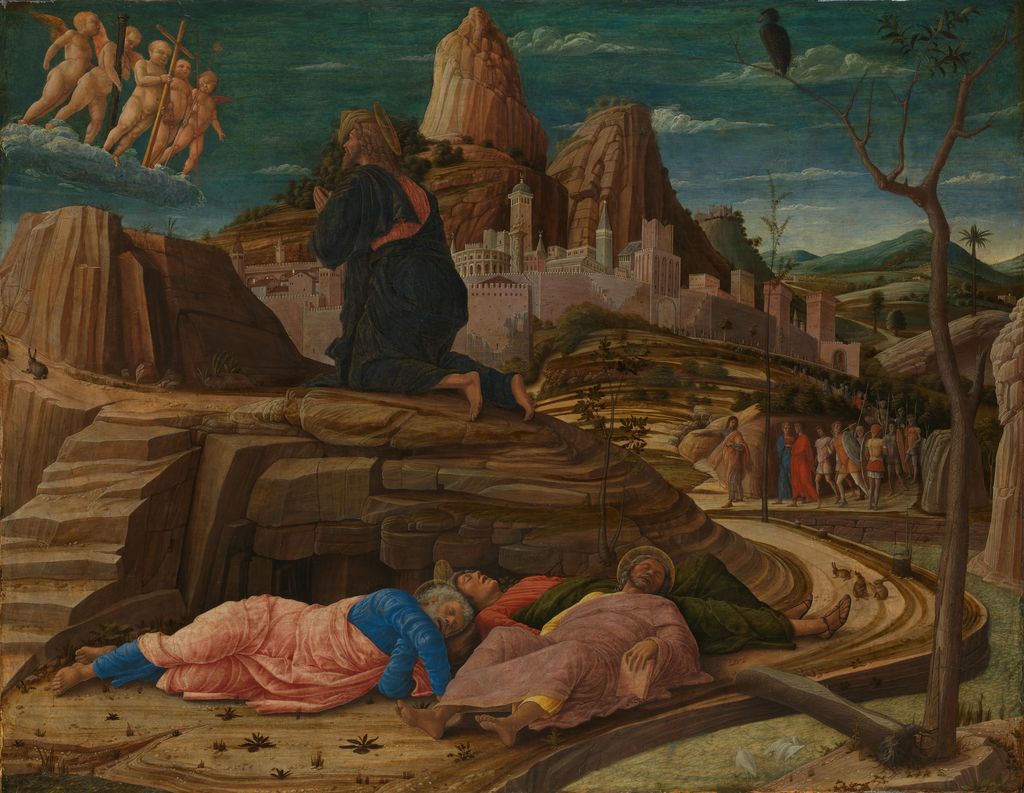
| The Agony in the Garden (London) | C. 1455–56 | Painting · National Gallery, London · NG1417 Catalogue. |
| The Agony in the Garden (Tours) | 1459 (Tours dating) | Painting · Musée des Beaux-Arts de Tours · 1803-1-24 Catalogue. |
| The Resurrection | 1459 (Tours dating) | Painting · Musée des Beaux-Arts de Tours · 1803-1-25 Catalogue. |
| Saint Sebastian (Vienna) | C. 1457–59 | Painting · Kunsthistorisches Museum · GG 301 Catalogue. |
| Cardinal Ludovico Trevisan | C. 1459–60 (Berlin exhibition dating) | Painting · Gemäldegalerie, Berlin · 9 Catalogue. |
| The Death of the Virgin | C. 1462 | Painting · Museo Nacional del Prado · P000248 Catalogue. |
| Christ with the Soul of the Virgin | C. 1460–64 | Painting · Pinacoteca Nazionale, Ferrara Catalogue only. |
| Portrait of a Young Man (traditionally Francesco Gonzaga) | C. 1461 or 1470, depending on sitter | Painting · Museo di Capodimonte · Q 60 Catalogue. |
| Portrait of a Prelate (Carlo de’ Medici?) | C. 1465–70 | Painting · Uffizi Galleries · 1890 no. 8540 Catalogue. |
| Portrait of a Man | C. 1470 | Painting · National Gallery of Art, Washington · 1952.2.5 Catalogue. |
| Madonna with Sleeping Child (Berlin) | C. 1455–60 | Painting · Gemäldegalerie, Berlin · S.5 Catalogue. |
| Camera degli Sposi (Camera Picta) | 1465–74 | Painting · Palazzo Ducale, Mantua Catalogue. |
| Saint Sebastian (Louvre) | Around 1480 | Painting · Musée du Louvre · RF 1766 Catalogue. |
| Lamentation over the Dead Christ | C. 1483 (Brera dating) | Painting · Pinacoteca di Brera · 352 Catalogue. |
| The Triumphs of Caesar | About 1485–1506 | Painting · Royal Collection · RCIN 403958–403966 Catalogue. |
| Madonna of the Caves | C. 1488–90 | Painting · Uffizi Galleries · 1890 no. 1348 Catalogue. |
| Madonna and Child with a Choir of Cherubim | C. 1485 | Painting · Pinacoteca di Brera · 297 Catalogue. |
| Madonna and Child (Poldi Pezzoli) | Early 1490s (museum dating) | Painting · Museo Poldi Pezzoli · 1595 Catalogue. |
| The Holy Family with Saint Mary Magdalen | C. 1495–1500 | Painting · Metropolitan Museum of Art · 14.40.643 Catalogue. |
| The Virgin and Child with Saint Mary Magdalene and Saint John the Baptist | C. 1490–1505 | Painting · National Gallery, London · NG274 Catalogue. |
| Christ as the Suffering Redeemer | 1485–95 (SMK dating) | Painting · Statens Museum for Kunst · KMSsp69 Catalogue. |
| Ecce Homo | C. 1500 | Painting · Musée Jacquemart-André · MJAP-P 1840 Catalogue. |
| Judith with the Head of Holofernes (Mantegna or follower) | C. 1495–1500 | Painting · National Gallery of Art, Washington · 1942.9.42 Catalogue. |
| Madonna della Vittoria | 1495–96 | Painting · Musée du Louvre · INV 369 Catalogue. |
| Mars and Venus (Parnassus) | C. 1496–97 | Painting · Musée du Louvre · INV 370 Catalogue. |
| The Trivulzio Madonna | 1497 | Painting · Castello Sforzesco, Milan · 0554 Catalogue. |
| The Adoration of the Magi | C. 1495–1505 | Painting · J. Paul Getty Museum · 85.PA.417 Catalogue. |
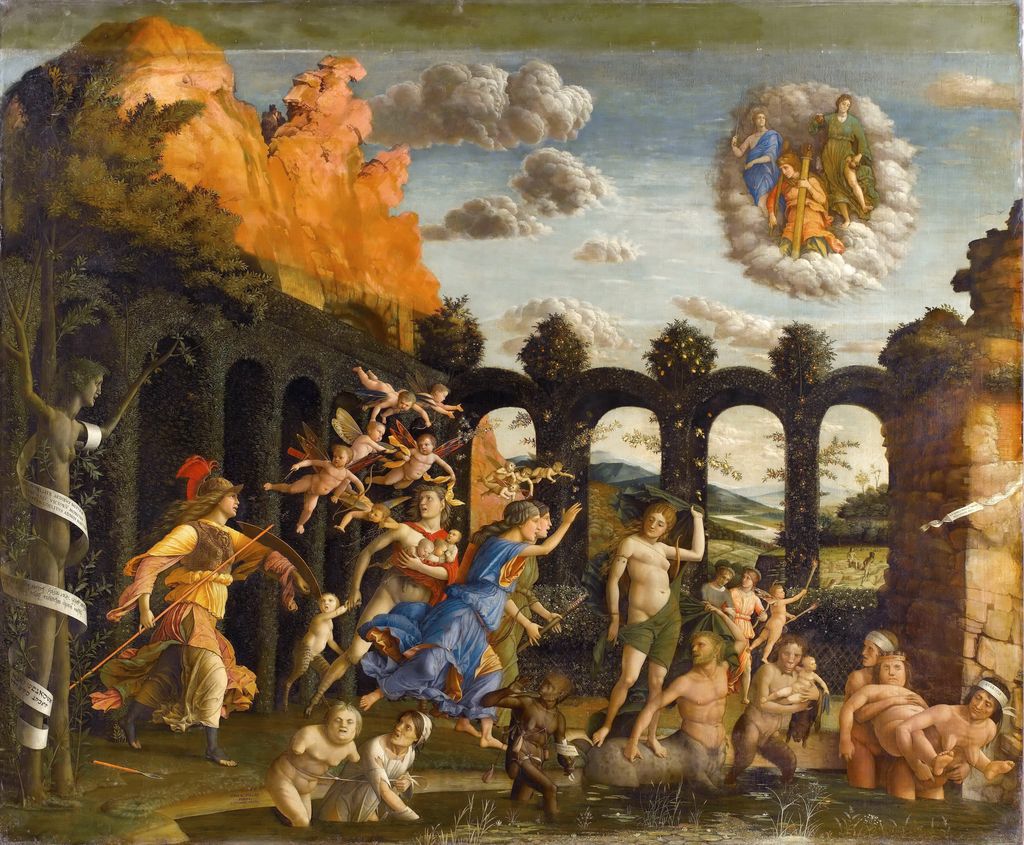
| Minerva Expelling the Vices from the Garden of Virtue | C. 1502 | Painting · Musée du Louvre · INV 371 Catalogue. |
| The Introduction of the Cult of Cybele at Rome | 1505–06 | Painting · National Gallery, London · NG902 Catalogue. |
| Saint Sebastian (Venice) | Probably c. 1504–06 | Painting · Galleria Giorgio Franchetti alla Ca’ d’Oro · D.11 Catalogue. |
| Samson and Delilah | C. 1500 | Painting · National Gallery, London · NG1145 Catalogue only. |
| A Woman Drinking (probably Sophonisba) | C. 1495–1506 | Painting · National Gallery, London · NG1125.2 Catalogue only. |
| The Vestal Virgin Tuccia with a Sieve | C. 1495–1506 | Painting · National Gallery, London · NG1125.1 Catalogue only. |
| Judith with the Head of Holofernes (Dublin) | C. 1495–1500 | Painting · National Gallery of Ireland · NGI.442 Catalogue only. |
| Battle of the Sea Gods, left half (Met impression) | Before 1481 (Met dating) | Print · Metropolitan Museum of Art · 18.12 Catalogue only. |
| Battle of the Sea Gods, right half (Met impression) | Before 1481 (Met dating) | Print · Metropolitan Museum of Art · 1984.1201.4 Catalogue only. |
| Battle of the Sea Gods, left half (Tokyo impression) | C. 1475 (Tokyo dating) | Print · National Museum of Western Art, Tokyo · G.1981-0002 Catalogue only. |
| Battle of the Sea Gods, left half (Washington impression) | C. 1485–88 (NGA dating) | Print · National Gallery of Art, Washington · 1941.1.6 Catalogue only. |
| The Entombment of Christ, second state of two | Before 1475 (Met dating) | Print · Metropolitan Museum of Art · 37.42.30 Catalogue only. |
| The Entombment of Christ (possibly Zoan Andrea, after Mantegna) | 1460–1549 (Rijksmuseum dating) | Print · Rijksmuseum · RP-P-1924-60 Catalogue only. |
| Four Dancing Muses (Gian Marco Cavalli after Mantegna) | C. 1497 | Print · Metropolitan Museum of Art · 20.5.3 Catalogue only. |
| Bacchanal with Silenus | Before 1475 (Met dating) | Print · Metropolitan Museum of Art · 29.44.15 Catalogue only. |
| Bacchanal with a Wine Vat | Before 1475 (Met dating) | Print · Metropolitan Museum of Art Catalogue only. |
| St James on His Way to Execution | C. 1453–57 | Drawing · British Museum · 1976,0616.1 Catalogue only. |
| Three Studies for a Dead Christ | C. 1455–65 | Drawing · British Museum · 1909,0406.3 Catalogue only. |
| Pietà (Venice) | C. 1456–65 (exhibition datings) | Drawing · Gallerie dell’Accademia, Venice · 115 Catalogue only. |
| Studies for Christ at the Column | 1460–65 | Drawing · The Courtauld · D.1978.PG.345 Catalogue only. |
| Virtus Combusta | C. 1490 (technical study) | Drawing · British Museum · Pp,1.23 Catalogue only. |
| Virtus Combusta (Giovanni Antonio da Brescia after Mantegna) | C. 1495–1506 | Print · Musée du Louvre · 3881 LR/ Recto Catalogue only. |
| The Calumny of Apelles | C. 1504–06 | Drawing · British Museum · 1860,0616.85 Catalogue only. |
Frequently Asked Questions
Mantegna creates the relief with paint on canvas. Narrow gradations of light and shadow make the figures and the objects they carry seem to project from stone.
It was made for a Venetian commission for Francesco Cornaro. The carried image of Cybele has a related counterpart in Canvas II of the Triumphs.
Discussion
Look again at the images and ideas explored in The Cult of Cybele. These editorial prompts invite your observations.
Reader Insights
Where does the boundary between the painted marble and the figures appear most convincing, and how do the highlights around the kneeling woman’s knee contribute to it?
How does the Latin inscription change your reading of a scene in which the kneeling woman draws the eye before the man who may be Nasica?
Join the Conversation
Share a detail, comparison or question about The Cult of Cybele below.
References
- National Gallery, The Introduction of the Cult of Cybele at Rome, NG902. View source.
- National Gallery, Catherine Higgitt and Raymond White, Analyses of Paint Media: New Studies of Italian Paintings of the Fifteenth and Sixteenth Centuries. View source.
- National Gallery, John Mills and Raymond White, Analyses of Paint Media, Technical Bulletin 1, pp. 58–59. View source.
- The Latin Library, Livy, Ab Urbe Condita, Book 29, chapters 10–11 and 14. View source.
- The Latin Library, Ovid, Fasti, Book 4, lines 247–348. View source.
- Parco archeologico del Colosseo, Claudio Castelletti, Il ritorno della Magna Mater, in Magna Mater tra Roma e Zama, pp. 227–236. View source.
- New Advent, Arnobius, Against the Heathen, Book 7, chapter 49. View source.
- Livius, Appian, War against Hannibal, section 56, translated by Horace White. View source.
- Claudia Cieri Via, Andrea Mantegna e l’eloquenza della pittura, pp. 100–102. View source.
- Packard Humanities Institute, Valerius Maximus, Facta et Dicta Memorabilia, 8.15.3. View source.
- Fondazione Giorgio Cini, Gino Benzoni, Venezia, 11 agosto 1508: mille orecchie per Luca Pacioli, p. 220. View source.
- Paul Kristeller, Andrea Mantegna, p. 362 and appendix, document 82. View source.
- Treccani, Andrea Mantegna, Dizionario Biografico degli Italiani. View source.
- National Gallery of Art, An Episode from the Life of Publius Cornelius Scipio, 1952.2.7. View source.
- The Latin Library, Livy, Ab Urbe Condita, Book 26, chapter 50. View source.
- National Gallery, Annual Review 2018–2019, Mantegna and Bellini exhibition, pp. 42–43. View source.
- Musei Capitolini, Ara dedicata a Magna Mater, scu 321. View source.
- National Gallery of Art, Neroccio de’ Landi, Claudia Quinta, 1937.1.12. View source.
- Royal Collection Trust, The Triumphs of Caesar: 7. The Captives, RCIN 403964, with series history. View source.
- National Gallery, The Triumphs of Caesar: 2, The Triumphal Carts, L1324. View source.
- Musée du Louvre, Mars et Vénus, dit Le Parnasse, INV 370. View source.
- Basilica of San Zeno, Verona, San Zeno Altarpiece, View source.
- Palazzo Ducale, Mantua, Camera degli Sposi (Camera Picta), View source.
- Musée du Louvre, Madonna della Vittoria, View source.
More MANTEGNA Paintings
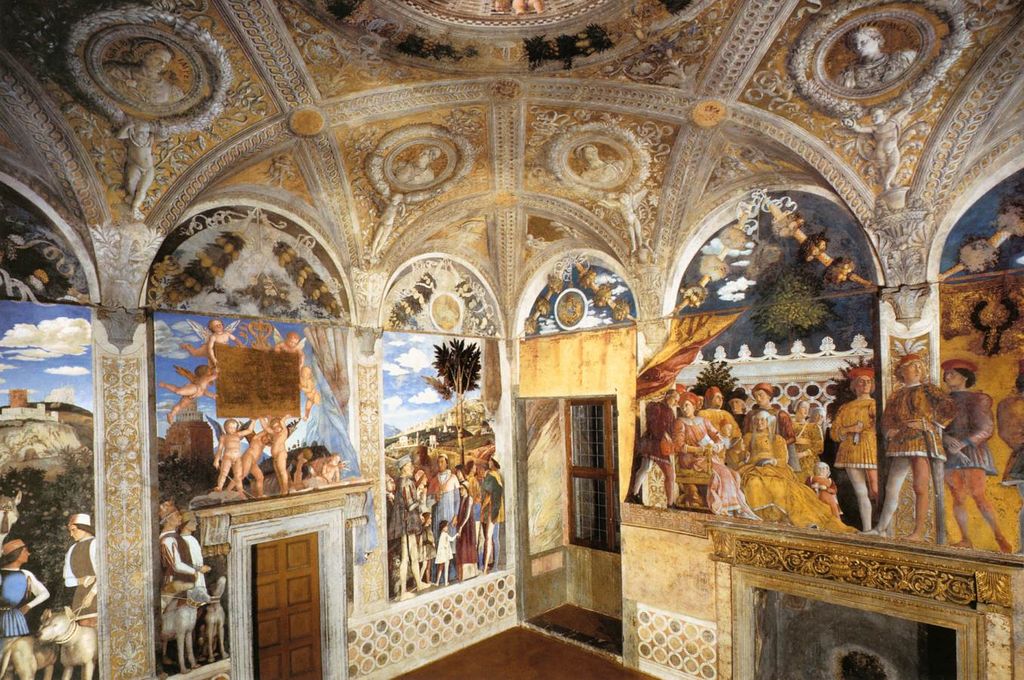
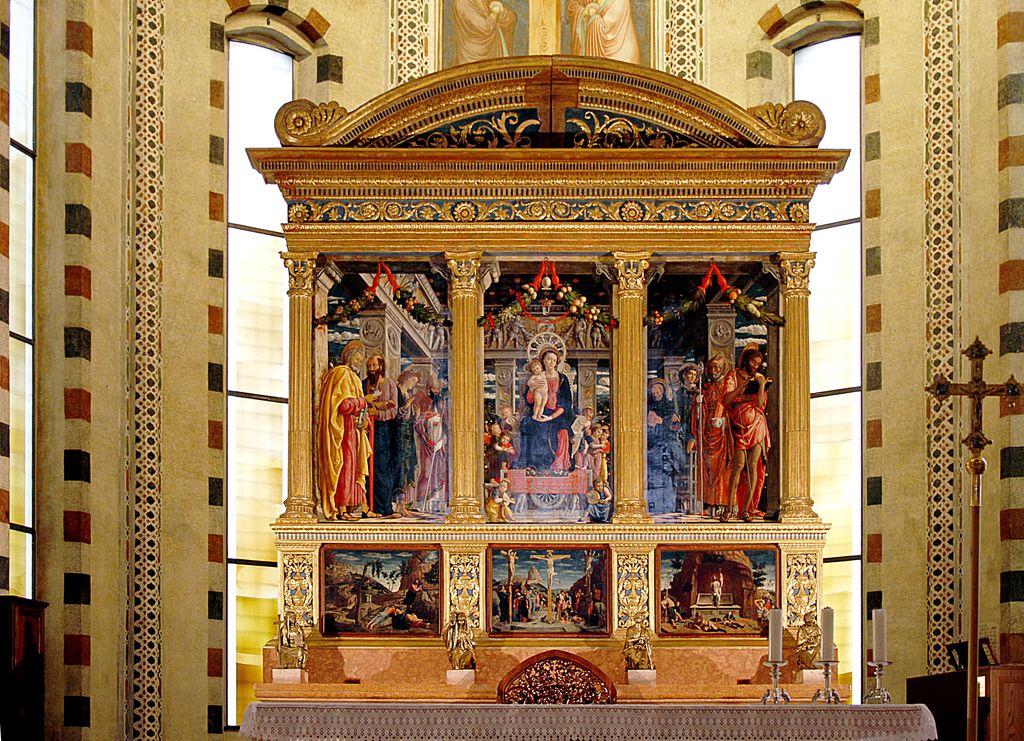
San Zeno Altarpiece
The San Zeno Altarpiece in its frame, Basilica of San Zeno, Verona José Luiz. Image source. CC BY-SA 4.0. Resized from the cited image.