 by Tom Gurney
Tom Gurney BSc (Hons) is an art history expert with over 20 years experience
Published on June 19, 2020 / Updated on November 29, 2026
Email: tomgurney1@gmail.com / Phone: +44 7429 011000
Overview
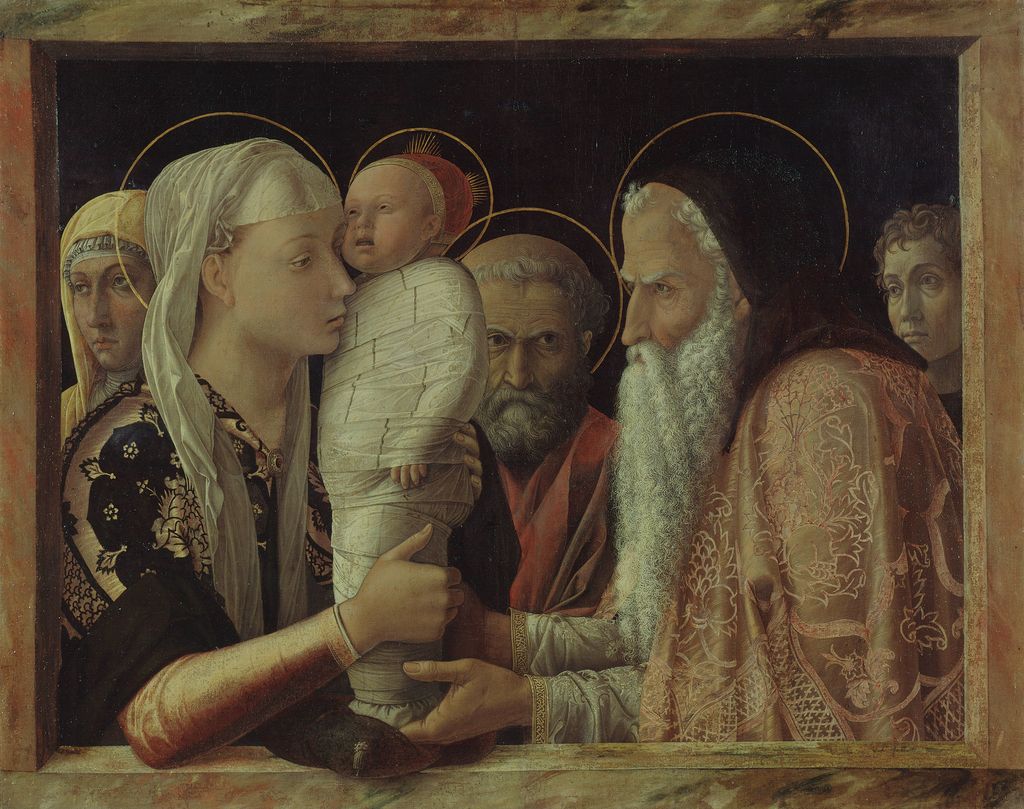
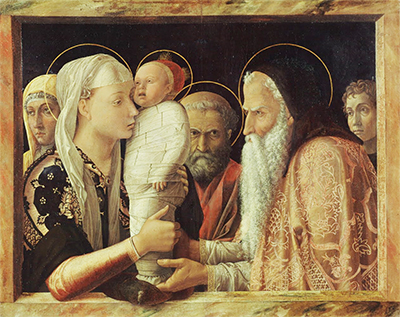
In Andrea Mantegna’s Presentation at the Temple, Mary rests her elbow on what appears to be a marble sill. The cushion beneath the infant Christ projects over the sill’s edge. Both the sill and the objects that seem to come forward over it are painted on the same canvas. Mantegna used that illusion to bring the encounter between Mary, Christ and Simeon within apparent reach. The Gemäldegalerie, part of the Staatliche Museen zu Berlin, dates the painting to about 1454. It is painted in egg tempera on canvas and carries inventory number 29. [1] [2]
At a Glance
- DateAbout 1454
- MediumEgg tempera on canvas
- CollectionGemäldegalerie, Staatliche Museen zu Berlin
- Inventory number29
Andrea Mantegna in context
The Presentation of Christ at the Temple
1454 (Berlin dating) [1]San Zeno Altarpiece
1457–59 [18]The Triumphs of Caesar
Mid-1480s–before 1506 [20]Madonna della Vittoria
1495–96 [21]The moment Simeon reaches for the child
In Luke’s Gospel, Mary and Joseph bring Jesus to Jerusalem to fulfil the prescriptions for purification after childbirth and the consecration of the firstborn. Simeon has been promised that he will see the Messiah before he dies. He takes the child in his arms and blesses God, then tells Mary that a sword will pierce her soul. The prophetess Anna gives thanks and speaks about the child. Luke places the circumcision on the eighth day, before the visit to Jerusalem. [3]
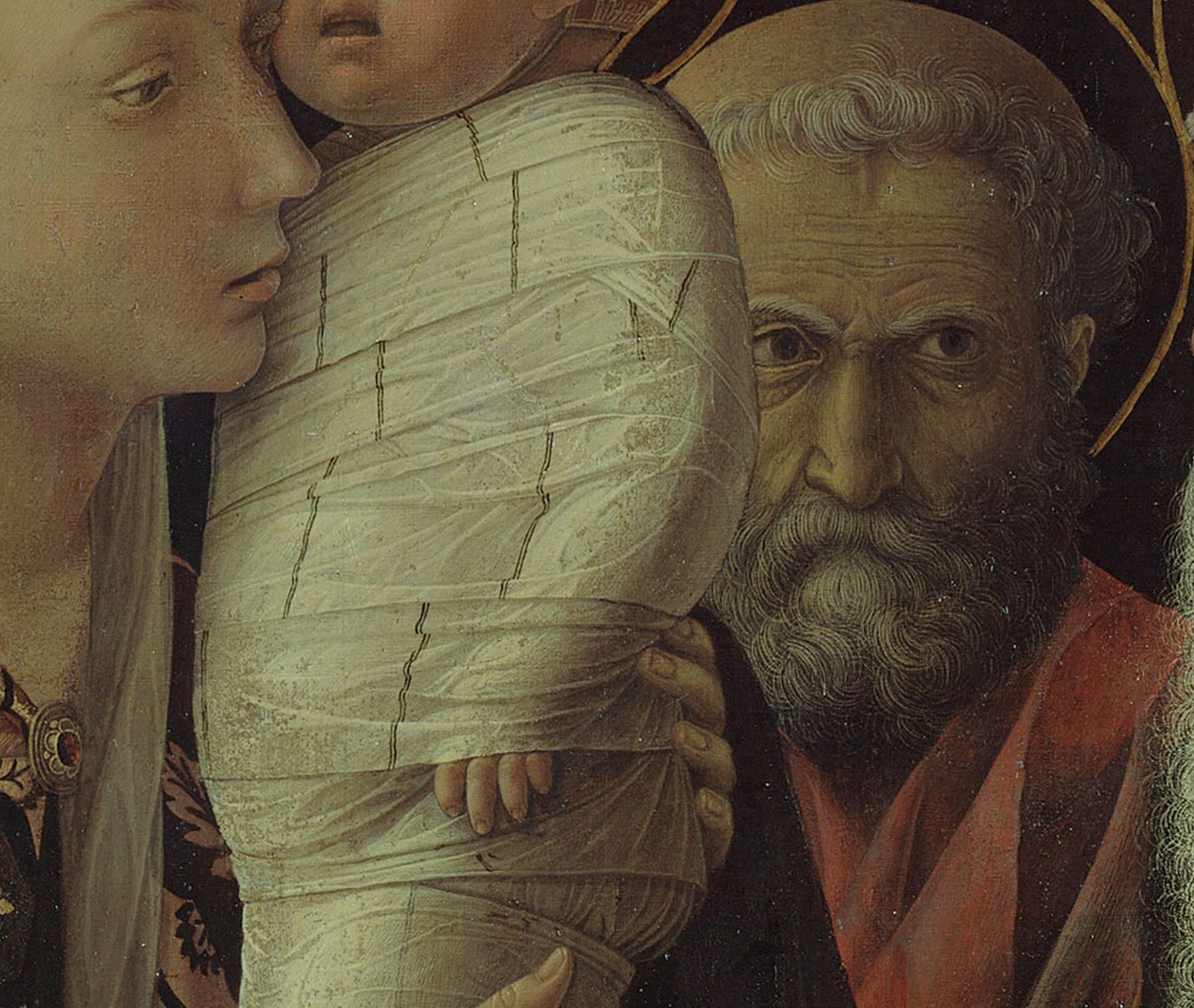
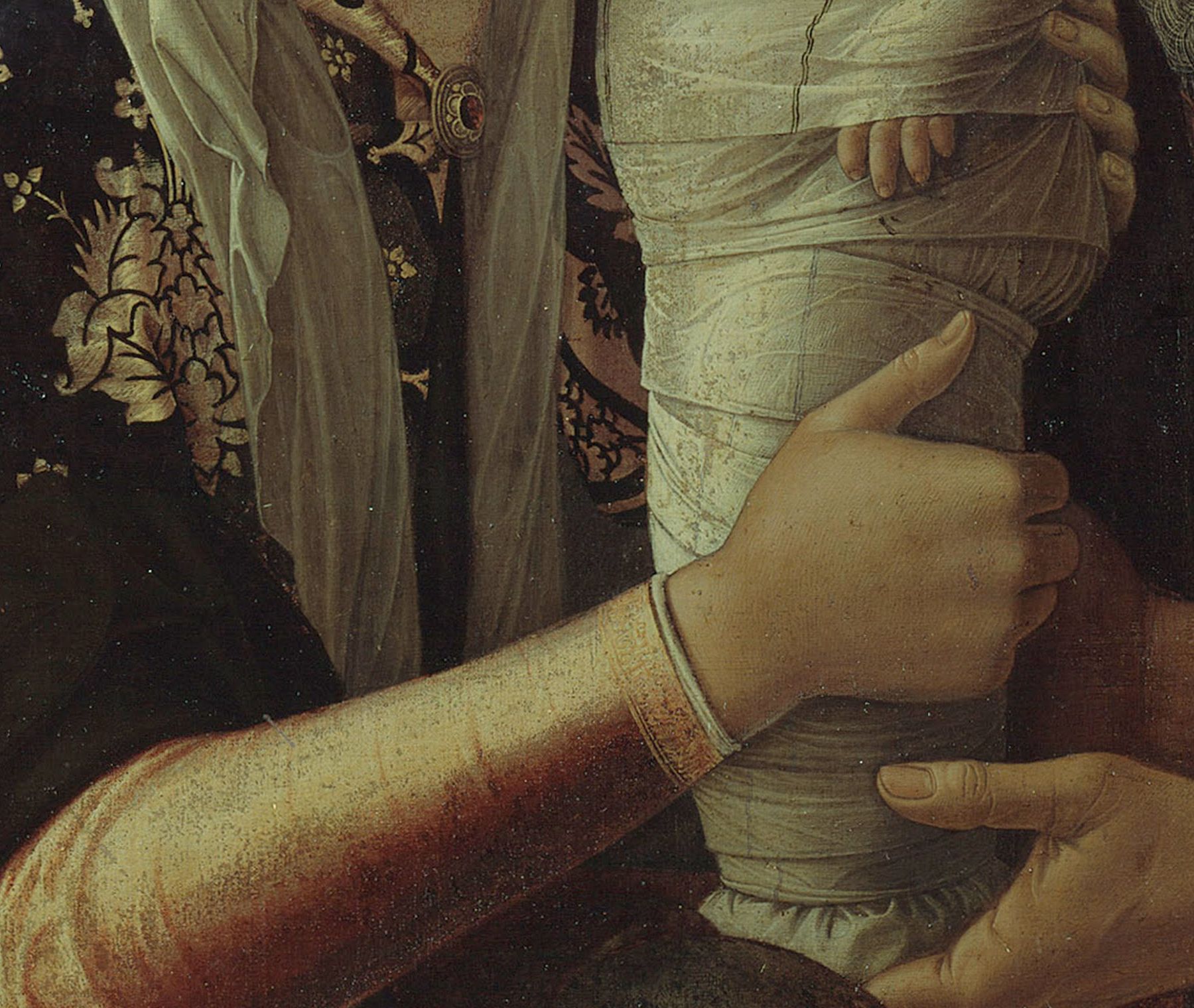
Mantegna fixes on the instant when Simeon reaches for Jesus. Mary grips the swaddling near the child’s legs and supports him higher up with her other hand. Simeon extends both arms, with his lower hand opening beneath the child. Even Jesus plays a small part in this arrangement of hands. His fingertips slip out between the folds of linen just above Mary’s grip. The child’s mouth is open, and the vertical bundle of cloth seems all the more rigid beside those vulnerable fingers. Joseph appears almost head-on between the two adults, his eyes turned towards Simeon. His face sits just above the meeting of their arms, giving the viewer another way back into the exchange. [1]
The hands leave the encounter poised between giving and receiving. Simeon’s lowered brow and forward inclination suggest urgency, while Mary still has the child firmly in her grasp. In his Gemäldegalerie catalogue entry, Neville Rowley reads the child’s cry, the tight swaddling and the stone sill as anticipations of the Crucifixion, the burial cloth and the tomb. The Gospel’s warning to Mary gives that reading a particular force. Her cheek is close to the child’s face, and the tension in her hands makes the act of surrender imaginable before it has happened. [1] [3]
A window where the Temple might be
In a fifteenth-century Byzantine Presentation in the Temple at the Metropolitan Museum of Art, four full-length adults take their places around the child. Architecture and the gold ground make the ritual setting visible, and Anna is recognisable among the witnesses. Giotto’s earlier treatment of the episode in the Scrovegni Chapel in Padua likewise gives the figures room to stand and makes the Temple visible through a canopied structure. These are comparisons of pictorial choices. In Mantegna the sacrificial birds and the architecture of the sanctuary drop away, and the sacred story is brought into the close quarters of a half-length devotional image. [1] [4] [5]
The border does much of the work that architecture performs in those other scenes. At the upper corners, narrow planes turn inward as though a shaft had been cut through stone. The broad front surface of the lower ledge runs right across the picture, but the cushion obscures part of its upper edge. Mary’s sleeve rests across the inner edge and stretches diagonally back into the group. Those overlaps let the eye judge the positions of the figures against the one measurable piece of space the picture supplies. Beyond them, the darkness offers very little sense of how far the room extends. [1]
Brigit Blass-Simmen draws attention to a U-shaped passage of light that runs from the white swaddling through Simeon’s sleeves and up his beard. Follow it and the gap between Simeon’s face and the child closes through the very hands that are about to take him. Elsewhere the light makes each surface distinct. It catches the translucent layers of Mary’s veil, the fine curls in Simeon’s beard and the tracery of his brocade. A tiny glint at the cushion’s tassel gives weight and texture to the object whose edge seems nearest the viewer. These minute details help sustain the illusion of a scene that can be inspected at close range. [1] [6]
Donatello’s marble Pazzi Madonna, made about 1420 and now also in Berlin, helps explain how much Mantegna could do with so little apparent depth. Donatello sets the Virgin and Child inside a recess worked in perspective. Their foreheads meet within the shallow relief. In the painted Presentation, Mary’s face is drawn similarly close to the child’s, but Simeon’s intervention interrupts the intimacy of the pair. An X-radiograph shows that Mantegna narrowed the distance between the two faces during painting. Rowley compares the result with Donatello’s relief and allows for the possibility that Mantegna encountered a similar work in Padua. The visual kinship is easier to establish than the precise model he saw. [1] [7]
The faces at the margins
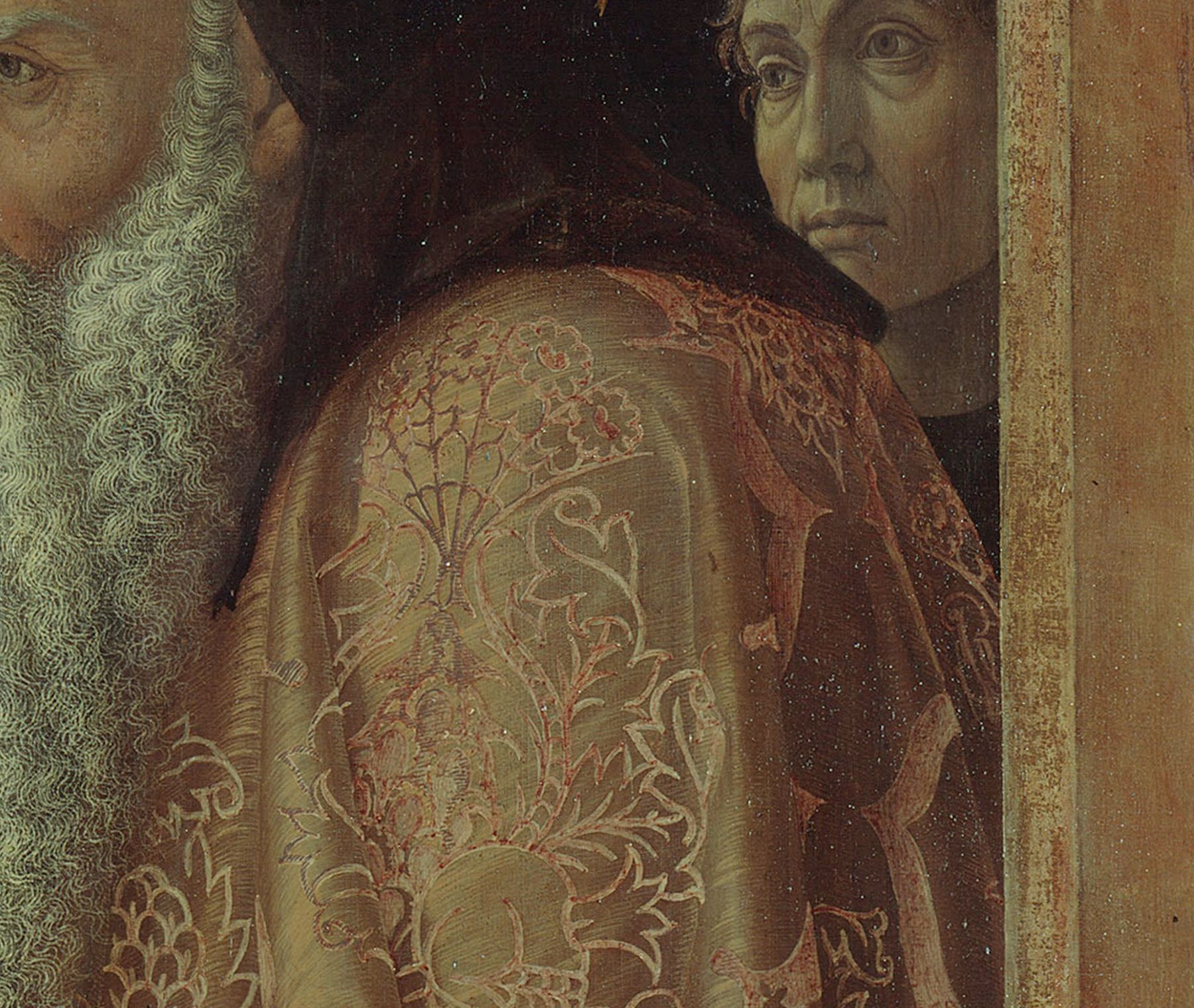
The woman at far left peers from behind Mary’s shoulder, her face pressed into the slim interval between the veil and the upright. Across from her, a younger man appears above Simeon’s shoulder. Their faces receive enough light to disclose quite different features, and their glances do little to guide the eye towards the child. They can register as witnesses present at the scene and at the same time absorbed in something of their own. The left-hand woman’s youthful appearance also makes her an unlikely candidate for Luke’s elderly Anna. [1] [3]
The Gemäldegalerie’s technical study found that Mantegna reworked the composition directly on the canvas to include the two lateral figures. The changes can be traced even where the finished surface looks settled. Blass-Simmen describes an earlier position for Mary’s head that was higher and farther left, and relates the shift to the insertion of the woman behind her. Infrared examination also disclosed an earlier, small cap on Simeon beneath the later dark head covering. Blass-Simmen notes that the fine halo rings visible today are early nineteenth-century additions. The imaging shows that Mantegna had considered a different, more solid form of halo while developing the picture. [6] [8]
Berlin interprets the man on the right as a possible self-portrait, citing a resemblance to the grey-toned likeness associated with Mantegna above the frescoes of the Ovetari Chapel in Padua. The identification of the woman as Nicolosia Bellini, whom Mantegna married in 1453, depends more on her position as a counterpart to that proposed self-portrait. The marriage made Mantegna and Giovanni Bellini brothers-in-law. It helps account for the appeal of reading the two faces together, and gives the painting a place in Mantegna’s early career in Padua. The painting is unsigned and undated. The wedding and the birth of a child have both been proposed as occasions for it, and its original purpose remains uncertain. [1] [6] [9]
There is firmer evidence for part of the painting’s later history. A red seal on the back links it to the Venetian Gradenigo family, who acquired the house and contents of Cardinal Pietro Bembo in Padua. The Gemäldegalerie identifies a description of a Mantegna in Bembo’s collection in the 1520s as a close match. The description calls it a small panel, although the Berlin work is painted on canvas, and picks out the half-length figures. A Milanese export seal and records of the collector Edward Solly document a later stage of its passage from Italy to Berlin, where it was acquired with the Solly collection in 1821. [1] [6] [9]
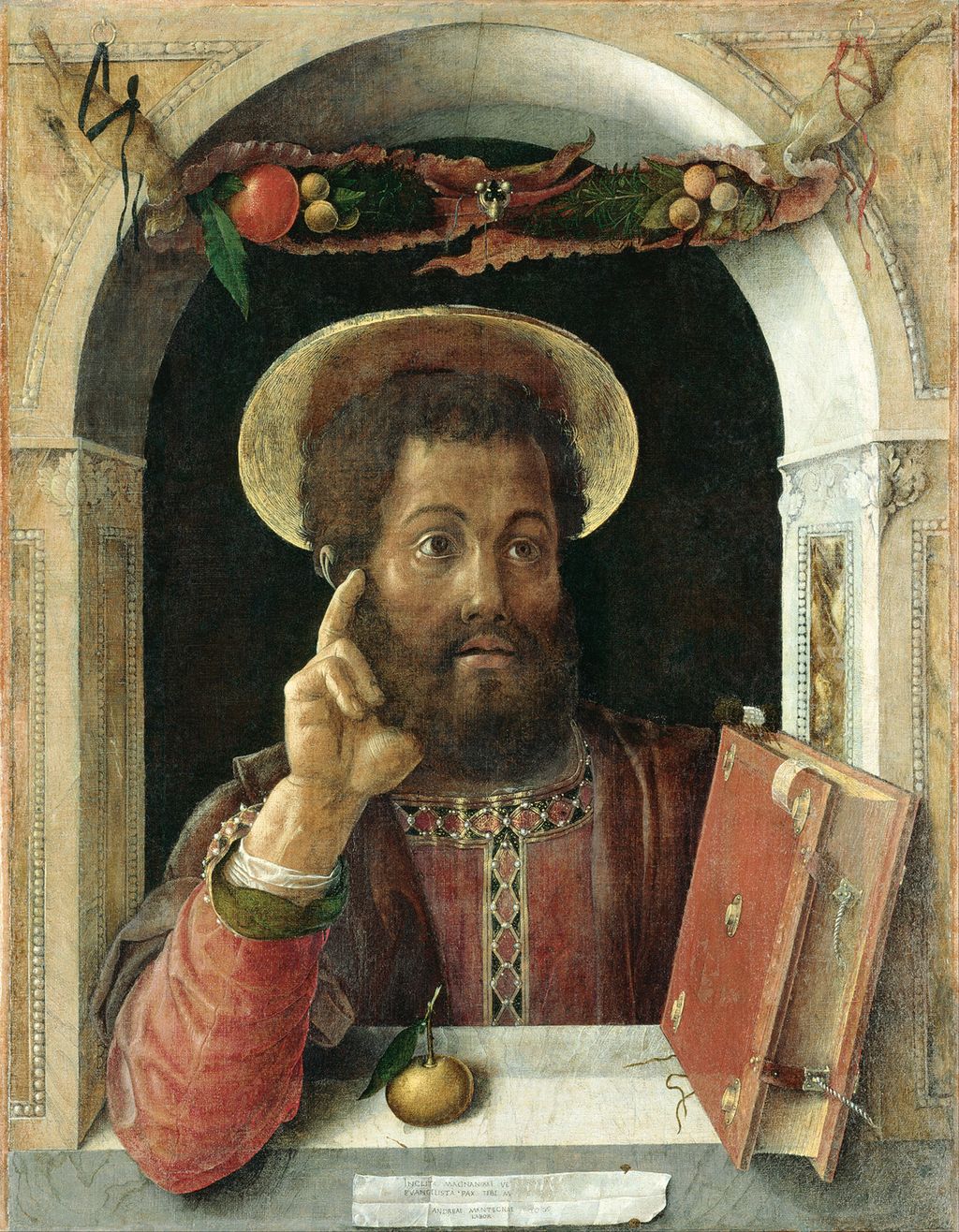
Saint Mark the Evangelist, Städel Museum Image source. Public domain.
How Bellini carried the design to Venice
The Fondazione Querini Stampalia in Venice holds Giovanni Bellini’s Presentation of Jesus in the Temple, an oil painting on a wooden panel dated about 1470–75 in the joint Mantegna and Bellini exhibition. The two originals were shown together at the Querini Stampalia in 2018, then at the National Gallery in London in 2018–19 and the Gemäldegalerie in 2019. Bellini’s panel is wider, yet the space between Mary’s face and Simeon’s, and the scale of the child between them, are remarkably close in both works. [2] [6] [10] [11] [12]
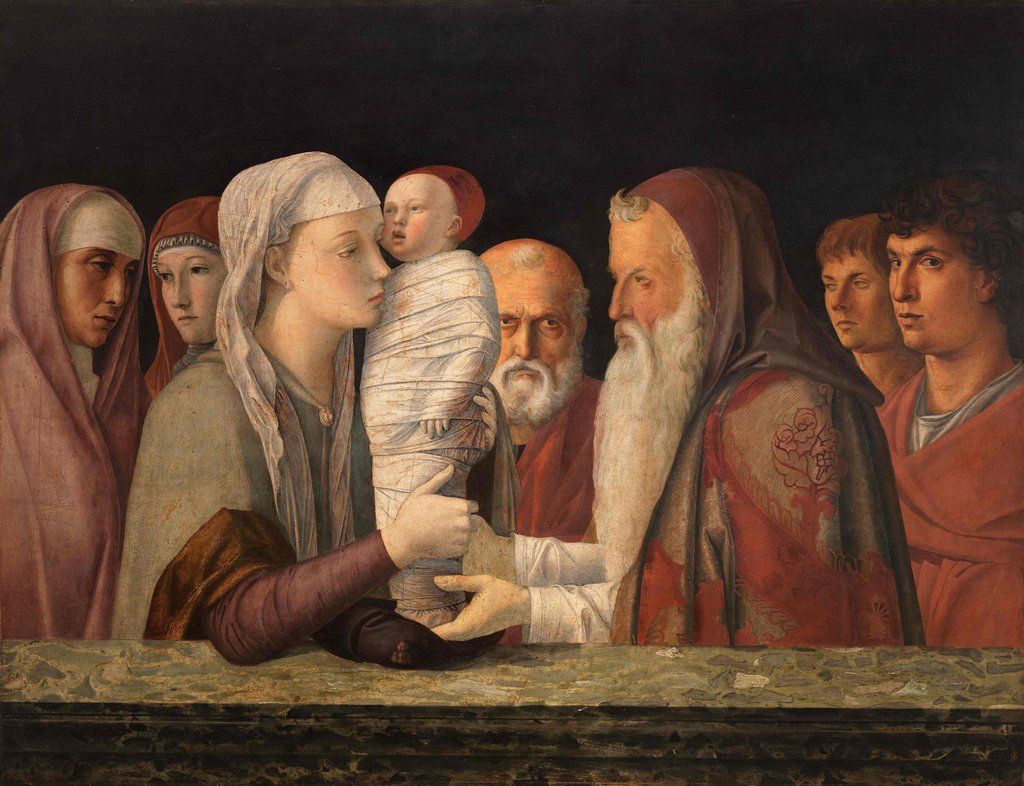
Giovanni Bellini’s Presentation at the Temple, Fondazione Querini Stampalia, Venice Image source. Public domain.
Blass-Simmen tested the correspondence by superimposing outlines of Mantegna’s design on an image of Bellini’s. Berlin’s conservators then checked the match in Venice, holding a full-size transparency traced from Mantegna’s canvas over Bellini’s panel. The principal forms aligned closely. The transparency records a modern test, and the researchers infer from it that a tracing at actual size was used in the fifteenth century. Raking light also reveals incised lines at Mary’s veil on the Venice painting, where a stylus could have transferred contours to the prepared panel. Bellini follows the revised arrangement visible on Mantegna’s surface, including Mary’s position, and the earlier positions detected beneath the Berlin paint help establish which way the design travelled. The circumstances in which the design passed between the painters remain uncertain. [6] [8] [13]
The attribution of the Venice painting has a history of its own. Mantegna’s name appears on the back of the panel, and past restoration and losses have complicated the reading of its surface. The Querini Stampalia records that Mauro Pelliccioli identified extensive overpainting in 1946 and subsequently removed much of it. Rowley points to the quality of the better-preserved painting and its affinity with Bellini’s work of the mid-1470s. The transferred outlines explain why the design looks so unmistakably Mantegnesque, while the handling of the paint helps establish the identity of the artist who reworked it. [1] [10]
The same gestures in a different light
Bellini keeps the dark background and keeps the hands at the heart of the scene. He exchanges Mantegna’s four-sided window for a single low parapet. With the uprights gone, the figures can extend across the panel, and he places one more person at each side. The outer witnesses are still partly concealed behind other bodies, but the wider group offers more exchanges of glances. At the right, the outermost man turns towards the viewer. The sidelong glance of Mantegna’s man at the edge has become a direct address to the viewer in Bellini’s outermost portrait. That change makes the self-portrait reading tempting, but Rowley questions it on the grounds that the man’s features differ from Bellini’s known likeness. The Querini Stampalia proposes a family group, with Gentile Bellini or Mantegna among the possible sitters, while Berlin’s exhibition label leaves the identities of the added figures open. [1] [10] [12]
The profiles of Simeon offer a close comparison of the painters’ handling. Mantegna builds the beard from separate pale curls and threads of light. Bellini lets the highlights and dark strokes gather into a softer mass, even where individual hairs remain visible. The effect continues down the sleeves and across the shoulders. Mantegna describes the pattern of the brocade with fine drawn marks that give the eye something to follow through the folds. In Bellini the brighter touches vary in shape and thickness, so the pattern seems to come and go as the cloth catches the light. Blass-Simmen connects these differences with what each painter did with his medium, Mantegna laying down precise strokes in egg tempera and Bellini varying translucent layers and raised touches in oil. [2] [6]
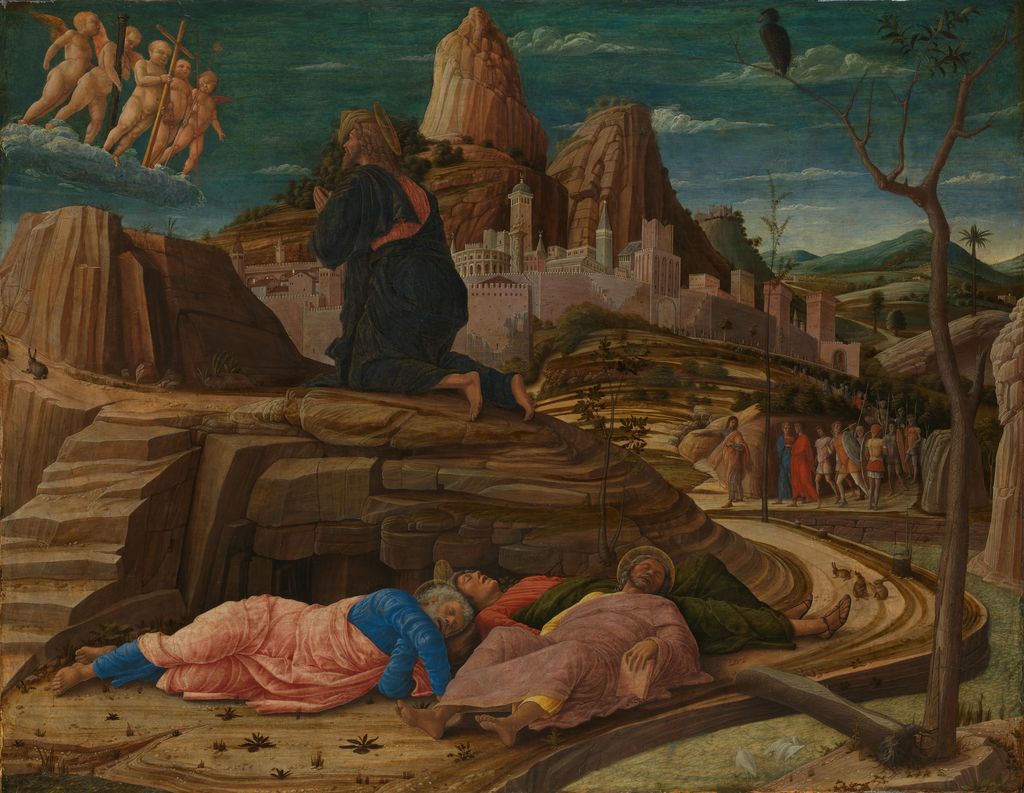
The two versions of The Agony in the Garden in London offer another comparison. There a related arrangement of figures opens onto two differently conceived landscapes, with Bellini letting dawn light run from the clouds into Christ’s robe. The Presentation affords an even closer test of what can change within a borrowed design. In Venice the eye can travel farther along the row of faces before returning to the gesture that holds the composition together. [1] [6] [11] [14] [15]
The design also had an afterlife in Bellini’s workshop. The Gemäldegalerie has a separate Presentation, inventory 36, which it catalogues under Bellini’s school and dates to 1490–1500. And there is another treatment by Mantegna himself at the Uffizi, where the Presentation is the right-hand scene in a three-panel grouping assembled in a nineteenth-century frame. There the child recoils in Mary’s arms inside an imposing Temple. The child’s movement is plain in the Florence panel. In Berlin it falls to the adults to carry the action, and a shift in the position of either hand would change the force of the scene. [1] [16] [17]
Further reading
The exhibition puts related works side by side.
Mantegna and Bellini. Caroline Campbell, Dagmar Korbacher, Neville Rowley and Sarah Vowles, with contributors. National Gallery Company, 2018.
The catalogue explores how the two painters developed shared compositions and different approaches to landscape and light. Read the publisher’s description.
Annotated Details from The Presentation at the Temple
The numbered points identify details to look at closely. The detail images below preserve the native scale of the selected crops.
The Presentation at the Temple
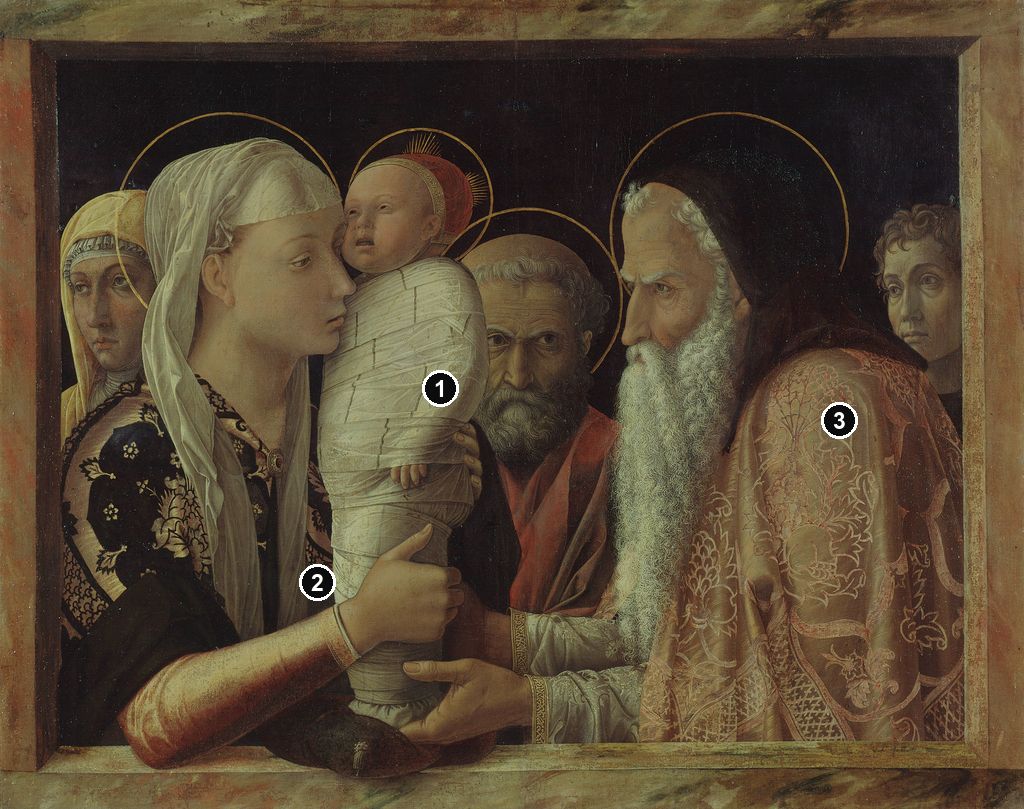
Details from THE PRESENTATION AT THE TEMPLE
Choose a detail to enlarge it.
The Presentation at the Temple
The swaddled child
The child’s upright form occupies a tight gap between two faces. The white bands and supporting hands keep his silhouette clear.
Hands at the ledge
The fingers emerge close to the fictive stone ledge. Their varying positions separate the individual gestures within the dense grouping.
The figure beyond the edge of the group
The face and richly patterned robe stand partly out of the dark. The painted frame constrains the group at close range.
Artworks directory
| Name | Date | Medium and collection |
|---|---|---|
| The Adoration of the Shepherds | Shortly after 1450 | Painting · Metropolitan Museum of Art · 32.130.2 Catalogue. |
| Saint Mark the Evangelist | C. 1448–51 | Painting · Städel Museum · 1046 Catalogue. |
| Saint Jerome Penitent in the Desert | C. 1448–51 | Painting · Museu de Arte de São Paulo · MASP.00015 Catalogue. |
| Martyrdom and Transport of the Body of Saint Christopher | Mid-1450s | Painting · Ovetari Chapel, Padua Catalogue. |
| San Luca Altarpiece | 1453–55 | Painting · Pinacoteca di Brera · 176 Catalogue. |
| The Presentation of Christ at the Temple | 1454 (Berlin dating) | Painting · Gemäldegalerie, Berlin · 29 Catalogue. |
| San Zeno Altarpiece | 1457–59 | Painting · Basilica of San Zeno, Verona Catalogue. |
| The Crucifixion | 1456–59 | Painting · Musée du Louvre · INV 368 Catalogue. |
| The Agony in the Garden (London) | C. 1455–56 | Painting · National Gallery, London · NG1417 Catalogue. |
| The Agony in the Garden (Tours) | 1459 (Tours dating) | Painting · Musée des Beaux-Arts de Tours · 1803-1-24 Catalogue. |
| The Resurrection | 1459 (Tours dating) | Painting · Musée des Beaux-Arts de Tours · 1803-1-25 Catalogue. |
| Saint Sebastian (Vienna) | C. 1457–59 | Painting · Kunsthistorisches Museum · GG 301 Catalogue. |
| Cardinal Ludovico Trevisan | C. 1459–60 (Berlin exhibition dating) | Painting · Gemäldegalerie, Berlin · 9 Catalogue. |
| The Death of the Virgin | C. 1462 | Painting · Museo Nacional del Prado · P000248 Catalogue. |
| Christ with the Soul of the Virgin | C. 1460–64 | Painting · Pinacoteca Nazionale, Ferrara Catalogue only. |
| Portrait of a Young Man (traditionally Francesco Gonzaga) | C. 1461 or 1470, depending on sitter | Painting · Museo di Capodimonte · Q 60 Catalogue. |
| Portrait of a Prelate (Carlo de’ Medici?) | C. 1465–70 | Painting · Uffizi Galleries · 1890 no. 8540 Catalogue. |
| Portrait of a Man | C. 1470 | Painting · National Gallery of Art, Washington · 1952.2.5 Catalogue. |
| Madonna with Sleeping Child (Berlin) | C. 1455–60 | Painting · Gemäldegalerie, Berlin · S.5 Catalogue. |
| Camera degli Sposi (Camera Picta) | 1465–74 | Painting · Palazzo Ducale, Mantua Catalogue. |
| Saint Sebastian (Louvre) | Around 1480 | Painting · Musée du Louvre · RF 1766 Catalogue. |
| Lamentation over the Dead Christ | C. 1483 (Brera dating) | Painting · Pinacoteca di Brera · 352 Catalogue. |
| The Triumphs of Caesar | About 1485–1506 | Painting · Royal Collection · RCIN 403958–403966 Catalogue. |
| Madonna of the Caves | C. 1488–90 | Painting · Uffizi Galleries · 1890 no. 1348 Catalogue. |
| Madonna and Child with a Choir of Cherubim | C. 1485 | Painting · Pinacoteca di Brera · 297 Catalogue. |
| Madonna and Child (Poldi Pezzoli) | Early 1490s (museum dating) | Painting · Museo Poldi Pezzoli · 1595 Catalogue. |
| The Holy Family with Saint Mary Magdalen | C. 1495–1500 | Painting · Metropolitan Museum of Art · 14.40.643 Catalogue. |
| The Virgin and Child with Saint Mary Magdalene and Saint John the Baptist | C. 1490–1505 | Painting · National Gallery, London · NG274 Catalogue. |
| Christ as the Suffering Redeemer | 1485–95 (SMK dating) | Painting · Statens Museum for Kunst · KMSsp69 Catalogue. |
| Ecce Homo | C. 1500 | Painting · Musée Jacquemart-André · MJAP-P 1840 Catalogue. |
| Judith with the Head of Holofernes (Mantegna or follower) | C. 1495–1500 | Painting · National Gallery of Art, Washington · 1942.9.42 Catalogue. |
| Madonna della Vittoria | 1495–96 | Painting · Musée du Louvre · INV 369 Catalogue. |
| Mars and Venus (Parnassus) | C. 1496–97 | Painting · Musée du Louvre · INV 370 Catalogue. |
| The Trivulzio Madonna | 1497 | Painting · Castello Sforzesco, Milan · 0554 Catalogue. |
| The Adoration of the Magi | C. 1495–1505 | Painting · J. Paul Getty Museum · 85.PA.417 Catalogue. |
| Minerva Expelling the Vices from the Garden of Virtue | C. 1502 | Painting · Musée du Louvre · INV 371 Catalogue. |
| The Introduction of the Cult of Cybele at Rome | 1505–06 | Painting · National Gallery, London · NG902 Catalogue. |
| Saint Sebastian (Venice) | Probably c. 1504–06 | Painting · Galleria Giorgio Franchetti alla Ca’ d’Oro · D.11 Catalogue. |
| Samson and Delilah | C. 1500 | Painting · National Gallery, London · NG1145 Catalogue only. |
| A Woman Drinking (probably Sophonisba) | C. 1495–1506 | Painting · National Gallery, London · NG1125.2 Catalogue only. |
| The Vestal Virgin Tuccia with a Sieve | C. 1495–1506 | Painting · National Gallery, London · NG1125.1 Catalogue only. |
| Judith with the Head of Holofernes (Dublin) | C. 1495–1500 | Painting · National Gallery of Ireland · NGI.442 Catalogue only. |
| Battle of the Sea Gods, left half (Met impression) | Before 1481 (Met dating) | Print · Metropolitan Museum of Art · 18.12 Catalogue only. |
| Battle of the Sea Gods, right half (Met impression) | Before 1481 (Met dating) | Print · Metropolitan Museum of Art · 1984.1201.4 Catalogue only. |
| Battle of the Sea Gods, left half (Tokyo impression) | C. 1475 (Tokyo dating) | Print · National Museum of Western Art, Tokyo · G.1981-0002 Catalogue only. |
| Battle of the Sea Gods, left half (Washington impression) | C. 1485–88 (NGA dating) | Print · National Gallery of Art, Washington · 1941.1.6 Catalogue only. |
| The Entombment of Christ, second state of two | Before 1475 (Met dating) | Print · Metropolitan Museum of Art · 37.42.30 Catalogue only. |
| The Entombment of Christ (possibly Zoan Andrea, after Mantegna) | 1460–1549 (Rijksmuseum dating) | Print · Rijksmuseum · RP-P-1924-60 Catalogue only. |
| Four Dancing Muses (Gian Marco Cavalli after Mantegna) | C. 1497 | Print · Metropolitan Museum of Art · 20.5.3 Catalogue only. |
| Bacchanal with Silenus | Before 1475 (Met dating) | Print · Metropolitan Museum of Art · 29.44.15 Catalogue only. |
| Bacchanal with a Wine Vat | Before 1475 (Met dating) | Print · Metropolitan Museum of Art Catalogue only. |
| St James on His Way to Execution | C. 1453–57 | Drawing · British Museum · 1976,0616.1 Catalogue only. |
| Three Studies for a Dead Christ | C. 1455–65 | Drawing · British Museum · 1909,0406.3 Catalogue only. |
| Pietà (Venice) | C. 1456–65 (exhibition datings) | Drawing · Gallerie dell’Accademia, Venice · 115 Catalogue only. |
| Studies for Christ at the Column | 1460–65 | Drawing · The Courtauld · D.1978.PG.345 Catalogue only. |
| Virtus Combusta | C. 1490 (technical study) | Drawing · British Museum · Pp,1.23 Catalogue only. |
| Virtus Combusta (Giovanni Antonio da Brescia after Mantegna) | C. 1495–1506 | Print · Musée du Louvre · 3881 LR/ Recto Catalogue only. |
| The Calumny of Apelles | C. 1504–06 | Drawing · British Museum · 1860,0616.85 Catalogue only. |
Frequently Asked Questions
He concentrates on the presentation itself and sets the figures behind a painted stone opening. Their proximity to that opening takes the place of an expansive architectural interior.
The identification of the two side figures as the painter and Nicolosia is a proposal. The sitters are not securely documented.
Discussion
Look again at the images and ideas explored in Presentation at the Temple. These editorial prompts invite your observations.
Reader Insights
How do Mary’s elbow, the projecting cushion and Simeon’s lower hand make the transfer seem to happen at the viewer’s side of the painted window?
What changes when Bellini removes the uprights, widens the group and gives the rightmost witness a direct gaze while keeping the central gestures?
Join the Conversation
Share a detail, comparison or question about Presentation at the Temple below.
References
- Staatliche Museen zu Berlin, Die Darbringung Christi im Tempel, Gemäldegalerie inventory 29. View source.
- Staatliche Museen zu Berlin, Mantegna and Bellini. Masters of the Renaissance, exhibition checklist. View source.
- United States Conference of Catholic Bishops, Luke 2:21–39. View source.
- The Metropolitan Museum of Art, The Presentation in the Temple, Byzantine Painter, 31.67.8. View source.
- Fondazione Federico Zeri, Alinari photograph of Giotto’s Presentazione di Gesù al tempio, Scrovegni Chapel. View source.
- Brigit Blass-Simmen, Die Künstlerbeziehung Andrea Mantegna und Giovanni Bellini, Berliner Wissenschaftliche Gesellschaft Jahrbuch, pp. 9–26. View source.
- Staatliche Museen zu Berlin, Donatello, The Virgin and Child (the Pazzi Madonna), SKS 51. View source.
- Gemäldegalerie, Staatliche Museen zu Berlin, Paintings by Andrea Mantegna, Giovanni Bellini and Their Circles. View source.
- Lisa Lang and Babette Hartwieg, Die Geschichte eines Bildes: Ein Mantegna aus der Gemäldegalerie. View source.
- Fondazione Querini Stampalia, Giovanni Bellini, Presentazione di Gesù al Tempio, 1475 ca. View source.
- The National Gallery, London, Mantegna and Bellini, exhibition highlights. View source.
- Staatliche Museen zu Berlin, Mantegna and Bellini. Masters of the Renaissance, exhibition wall texts. View source.
- Gemäldegalerie, Staatliche Museen zu Berlin, Around Mantegna and Bellini, tracing overlay and conservation display. View source.
- The National Gallery, London, Andrea Mantegna, The Agony in the Garden, NG1417. View source.
- The National Gallery, London, Giovanni Bellini, The Agony in the Garden, NG726. View source.
- Staatliche Museen zu Berlin, Darbringung Christi im Tempel, school of Giovanni Bellini, Gemäldegalerie inventory 36. View source.
- The Uffizi Galleries, Ascension of Christ; Adoration of the Magi; Presentation of Christ at the Temple. View source.
- Basilica of San Zeno, Verona, San Zeno Altarpiece, View source.
- Palazzo Ducale, Mantua, Camera degli Sposi (Camera Picta), View source.
- Royal Collection, The Triumphs of Caesar, View source.
- Musée du Louvre, Madonna della Vittoria, View source.
- National Gallery, London, The Introduction of the Cult of Cybele at Rome, View source.
More MANTEGNA Paintings
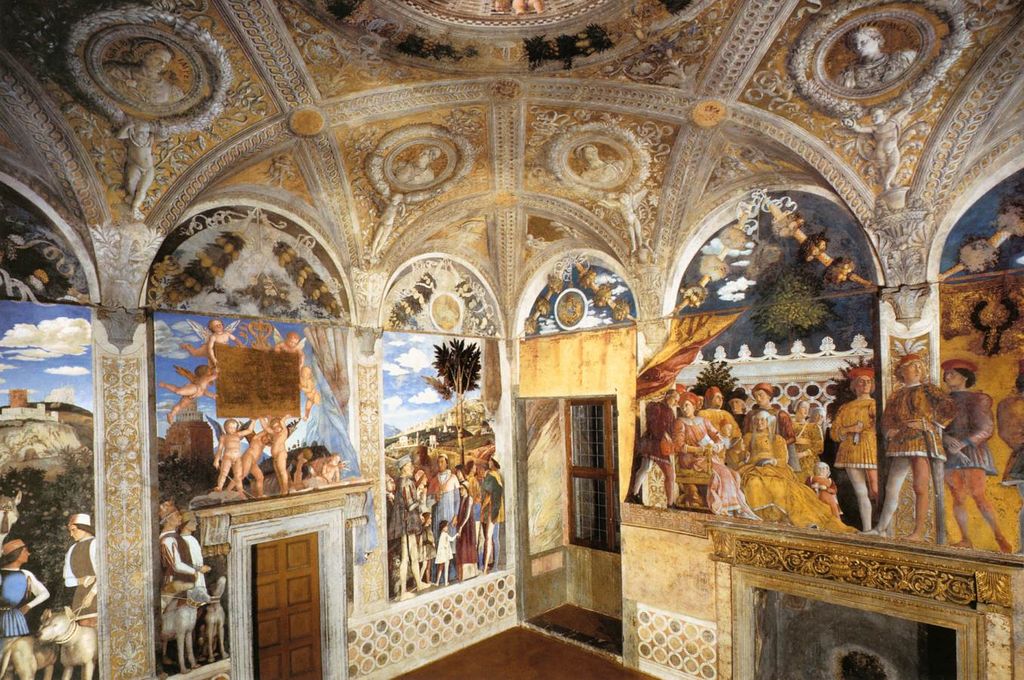
San Zeno Altarpiece
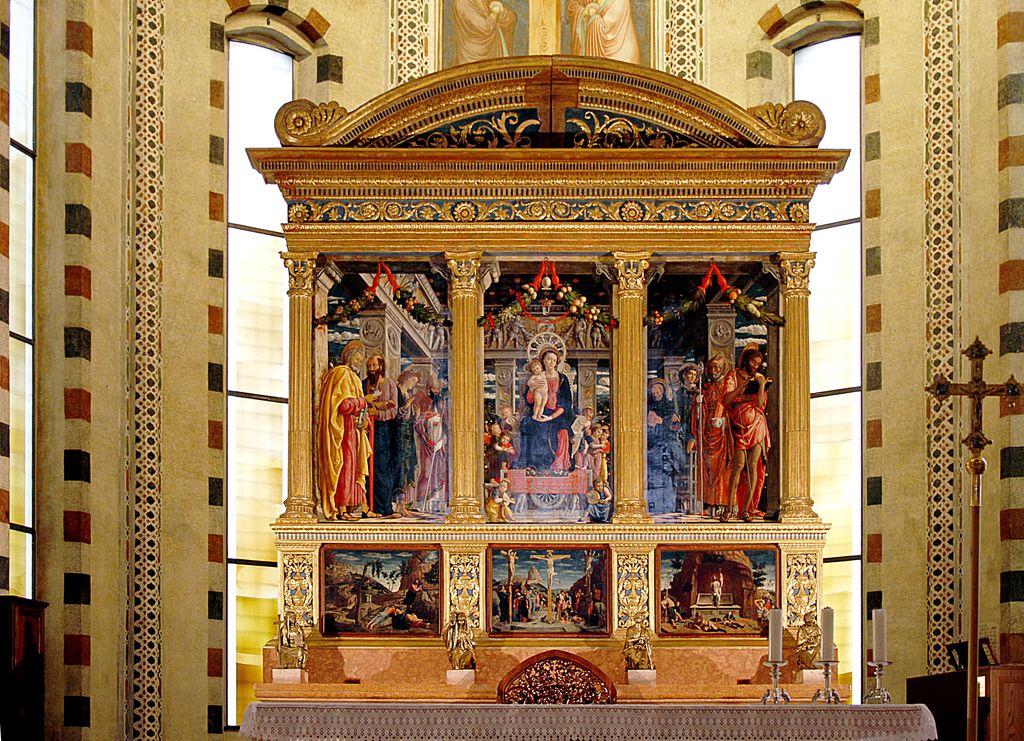
The San Zeno Altarpiece in its frame, Basilica of San Zeno, Verona José Luiz. Image source. CC BY-SA 4.0. Resized from the cited image.