 by Tom Gurney
Tom Gurney BSc (Hons) is an art history expert with over 20 years experience
Published on June 19, 2020 / Updated on November 29, 2026
Email: tomgurney1@gmail.com / Phone: +44 7429 011000
Overview
In one of Andrea Mantegna’s altarpieces, saints in separate gold compartments seem to stand on the same platform. In another, the columns of a real frame help complete a painted loggia. In a room at Mantua, figures lean over an opening in the ceiling and look back at the people below. [1] [2] [3]
The distance between the viewer and the painted world mattered to Mantegna. A small canvas held close could make that distance feel as consequential as the height of a church altar. The ledges, steps and curtains in the paintings that follow are clues to where Mantegna imagined you standing. Follow them from Padua and Verona to the Gonzaga court, where his work ranged from chapel pictures and portraits to mythologies for a private study.
At a Glance
- San Luca Altarpiece1453–55 (Brera catalogue), tempera on panel, Pinacoteca di Brera, inv. 176.
- Adoration of the ShepherdsShortly after 1450, tempera on canvas transferred from wood, Metropolitan Museum of Art, 32.130.2.
- San Zeno CrucifixionCentral predella panel of the later-1450s altarpiece, tempera on poplar, Musée du Louvre, INV 368.
- Lamentation over the Dead ChristCirca 1483 (Brera catalogue), tempera on canvas, Pinacoteca di Brera, inv. 352.
- Introduction of the Cult of Cybele at Rome1505–06, glue tempera on canvas, National Gallery, London, NG902.
Padua and the painted threshold
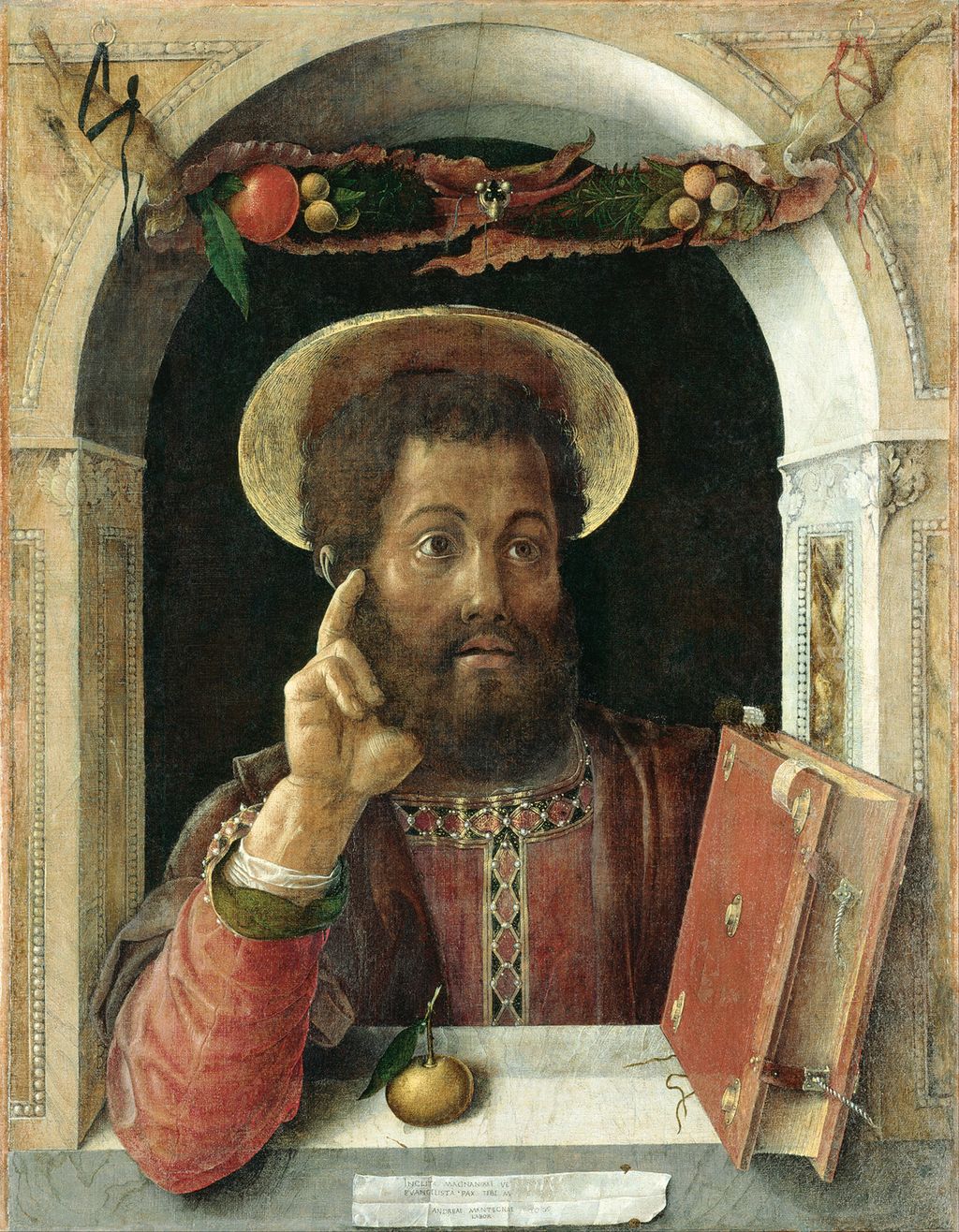
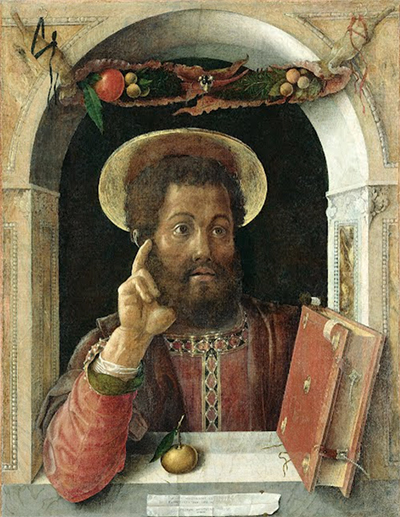
The Louvre’s retrospective located Mantegna’s early work in a Padua where the study of antiquities went hand in hand with experiments in sculpture and painting. He trained in Francesco Squarcione’s workshop while Donatello was working in the city on the equestrian monument to Gattamelata and the bronze altar of the Basilica of Sant’Antonio. The Louvre sees an affinity with Donatello’s reliefs in the half-length framing of the young painter’s Saint Mark, now at the Städel Museum in Frankfurt, which dates it to about 1448–51. Mark occupies a painted window. The fruit on the ledge and the book close to its edge make the ledge register as a surface with depth. It takes very little architecture to suggest a saint turning in a space on the other side of the wall. [4] [5]
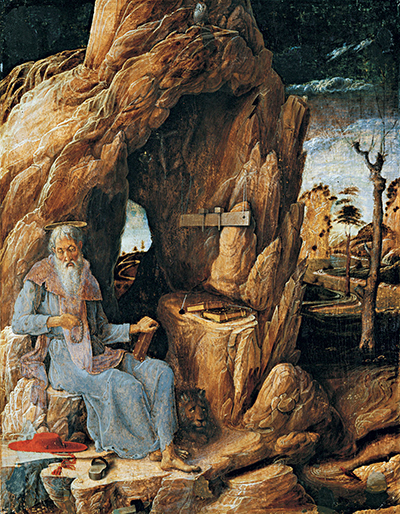
In the Saint Jerome in the Wilderness at the Museu de Arte de São Paulo, the boundary is a rocky opening. The eye passes through a rough arch to the seated saint and the small crucifix near him. Writing for the museum, Renato Menezes connects the rock strata with the landscape of the Agony in the Garden and the grotto with the setting of Parnassus. The rock has the visual weight of masonry, but its irregular opening lets the landscape show through. That permeability suits the subject. Jerome sits apart from the world, still within sight of it. [6]
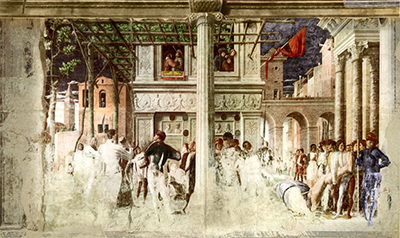
A chapel wall could place the spectator much further below the action. In 1448 Mantegna joined the team engaged to paint the Ovetari Chapel at the Eremitani in Padua. In the paired scenes associated with the Martyrdom of Saint Christopher, painted architecture carries the eye through the martyrdom and the removal of the saint’s enormous body. The low position from which the buildings are seen gives the street height, and the scale of Christopher’s body becomes legible against the people who handle it. Much of the larger cycle was lost in the bombing of 1944. The Christopher scenes had been detached before the attack, while recovered fragments from other parts of the chapel have been partially recomposed with the help of photographs. The detached scenes preserve large passages of Mantegna’s painting, while the reassembled fragments indicate the scale of what was lost. [4] [7] [8]
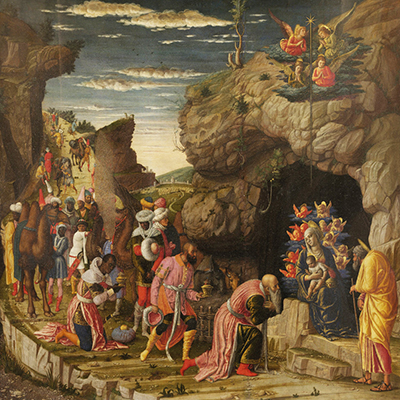
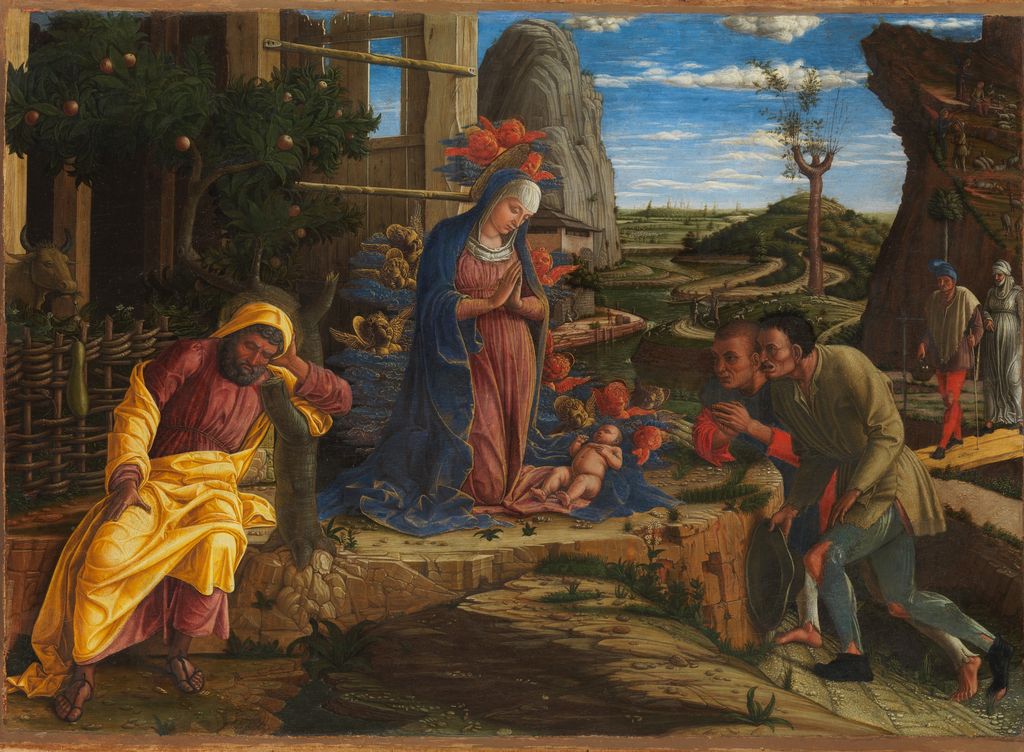
The scale shifts again in the Metropolitan Museum of Art’s Adoration of the Shepherds, dated shortly after 1450. Here the narrative spreads from the shepherds’ torn clothes and the kneeling Virgin to the much smaller figures and incidents in the country behind them. The Met raises Borso d’Este as a possible patron and relates the attention to detail to the taste for Netherlandish painting in Ferrara. Its systematic catalogue compares the work with the later San Zeno predella but finds no evidence that the Adoration itself formed part of a predella. The catalogue cites a version of the right side with an extra figure behind the people on the bridge as evidence that Mantegna’s painting was cropped. The Met records the surviving work, 32.130.2, as tempera on canvas transferred from wood. Horizontal cracks from the old panel remain visible after the transfer. The roadside figures and those traces of the former support tell two different stories about the object’s history. [9] [10]
San Luca and San Zeno seen from below
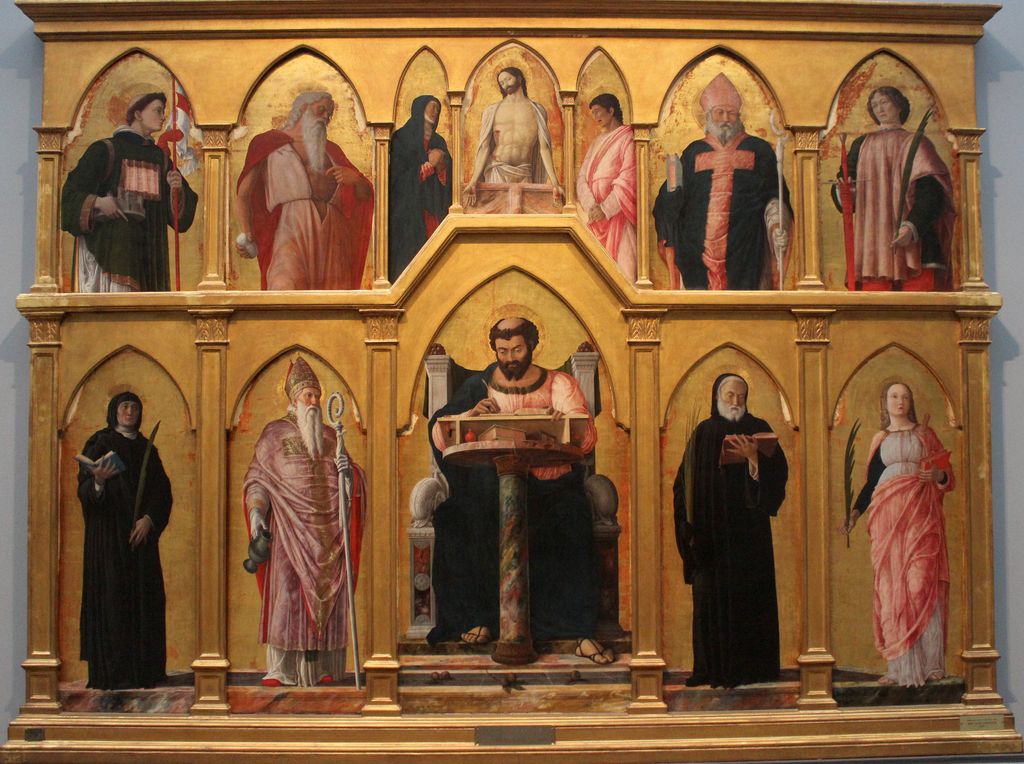
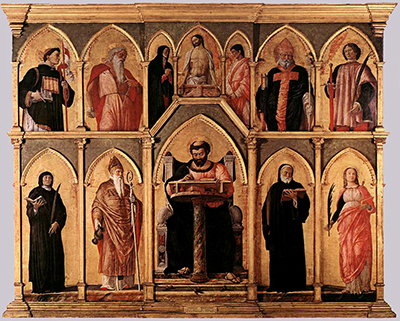
At the San Luca Altarpiece, begin with the feet. The saints in the lower tier stand on sections of what Brera reads as a single platform, seen in foreshortening. Their golden backgrounds and separate compartments give each figure a distinct place, while those slivers of floor give the row a common level. At the centre, the seated Luke has room for his desk as well as his body. Looking up to the second tier, the bodies retain their mass even where there is little visible space around them. Brera connects these effects to Donatello’s altar and proposes that the lost projecting frame would have made the figures appear to occupy an elevated arcade. The tempera panels were made for the chapel of Saint Luke at Santa Giustina in Padua. Brera catalogues the ensemble as 1453–55, inventory 176. [1]
The San Luca Altarpiece, Pinacoteca di Brera Image source. Public domain.
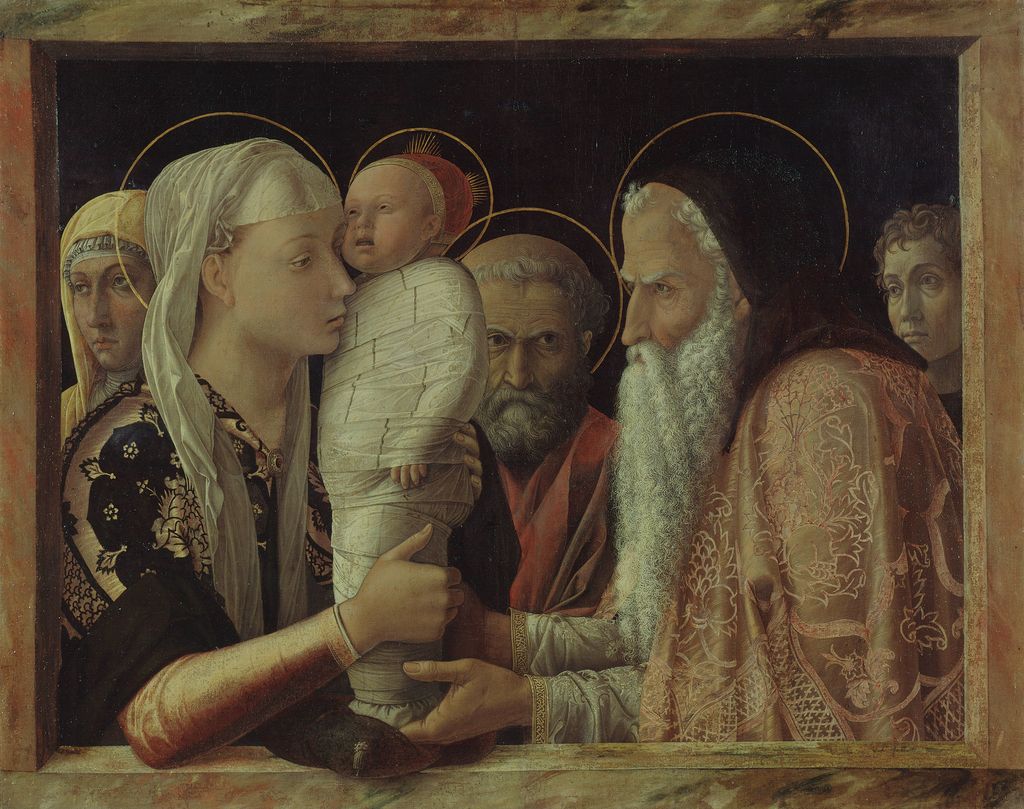
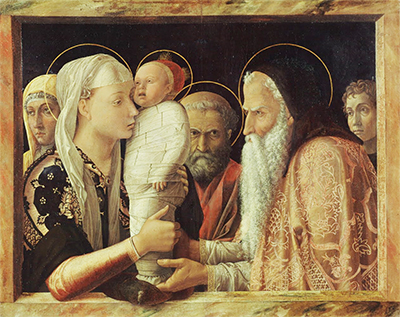
At about the same time, Mantegna gave a far smaller picture the force of a figure pushing against the frame. In Berlin’s Presentation at the Temple, dated about 1454, Mary’s elbow rests on a painted marble ledge and the cushion under the swaddled child lies on the same boundary. The figures are cut off at the waist or closer. The Berlin catalogue reads the tight swaddling and stone ledge as anticipations of Christ’s burial. Those forms work on another level as well. The ledge gives a definite point of contact to an otherwise crowded exchange of hands, and the faces beside the central action appear close enough to witness it with us. Bellini’s later version in Venice, shown in the National Gallery and Berlin exhibition, opens the group out with additional figures and carries a parapet across the foreground. The Fondazione Querini Stampalia describes Bellini’s picture as a reworking of Mantegna’s. Mary, the child and Simeon still form the core of the scene, but the parapet gives the eye an unbroken line along which to travel. [11] [12] [13]
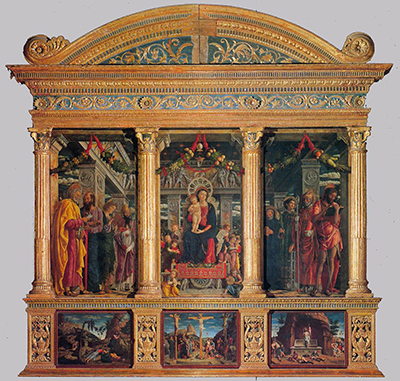
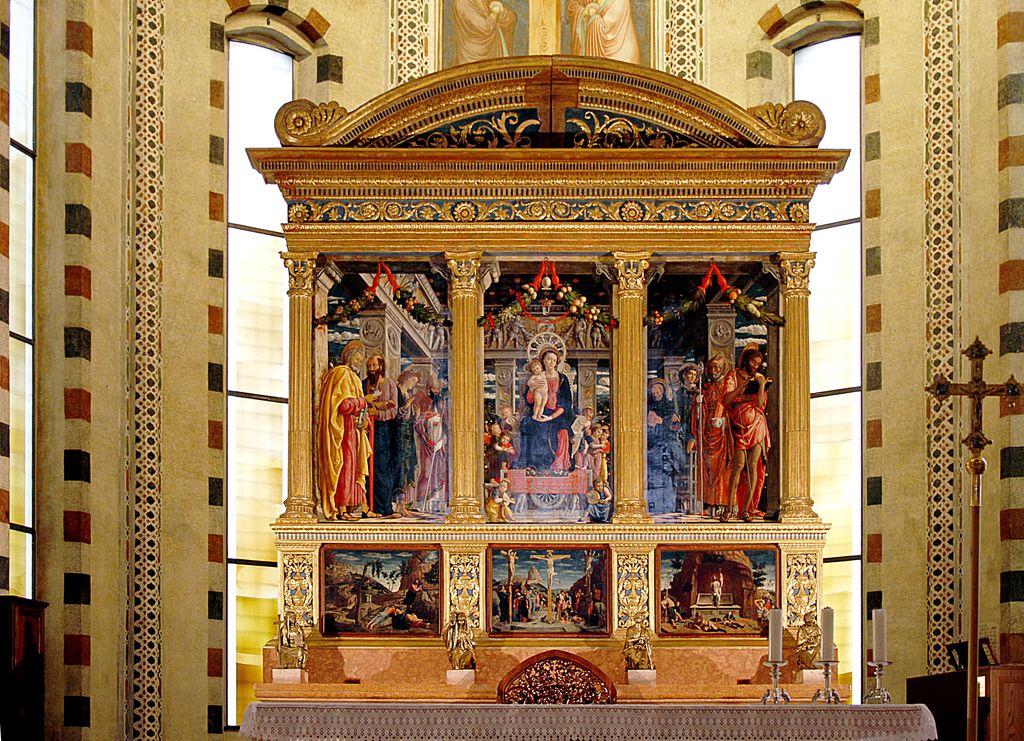
Gregorio Correr commissioned the San Zeno Altarpiece for the high altar of the Veronese basilica. In the main panels, made in the later 1450s, the enthroned Virgin and Child and the saints on either side occupy one decorated loggia. Follow the architecture across the uprights of the frame and notice the succession of garlands over the figures. At San Luca the shared platform joins figures separated by gold. At San Zeno the columns between the panels can themselves be read as the near supports of the building in which the gathering takes place. The Opificio delle Pietre Dure attributes the frame’s design to Mantegna and identified egg yolk as the binder in the painted main panels. Light and colour differ across those panels. The conservators describe a translucent effect particularly evident on the right, with the centre mediating between the two sides. The frame keeps the three pieces in register while the painted space draws them together. [1] [2]
The Virgin and Child with the Magdalen and Saint John the Baptist, National Gallery, London Image source. Public domain.
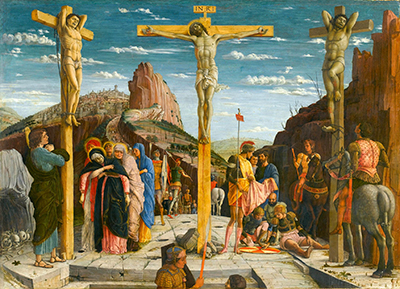
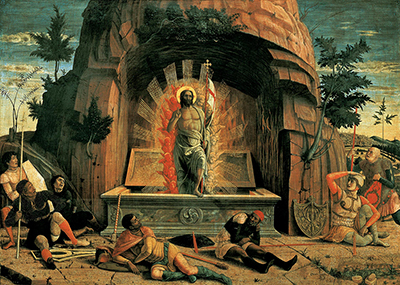
The smaller scenes below the main panels tell a story in time. In the original predella, the Agony in the Garden led from Christ’s prayer toward the arrest, the Crucifixion put the crosses above a ground busy with soldiers and mourners, and the Resurrection brought Christ up over the tomb and its startled guards. The Crucifixion, tempera on poplar, is the centre panel and is now Louvre INV 368. Tours holds the two outer originals. After the Napoleonic requisition the main panels eventually returned to Verona, where copies now occupy the predella. Both original outer panels went to Tours in 1806. The low, wide panels reward a change in viewing distance. The saints above present themselves as a group from across the church. The soldiers’ gestures and the terrain beneath the crosses become legible when the viewer draws nearer. [2] [14] [15]
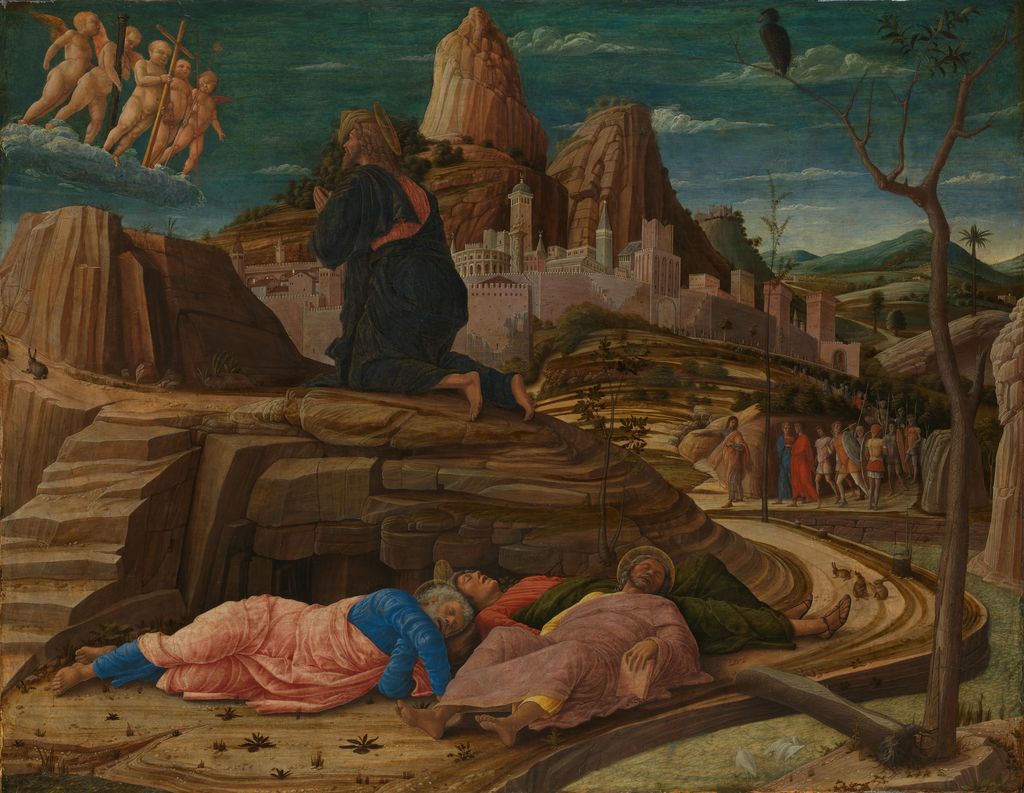
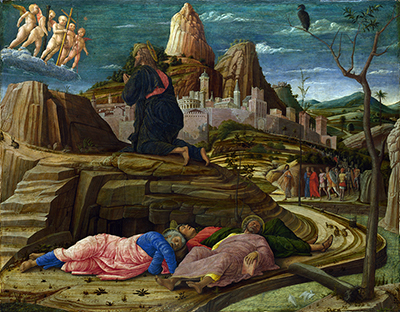
The National Gallery’s Agony in the Garden by Mantegna, NG1417, is a separate panel. Its hard ledges bring the sleeping disciples forward, while the route from the city draws attention to Judas and the approaching soldiers. The landscape gives the viewer time to register what the disciples are sleeping through. In Bellini’s version, also in London, the light of dawn falls across the countryside and Christ’s robe, binding together elements that Mantegna differentiates with sharper turns in the terrain. The contrast helps explain what Mantegna and Bellini could do with a shared subject. The rising light gives Bellini’s scene a sense of the hour, just as the length of the road marks the time left to Mantegna’s praying Christ. [12] [16] [17]
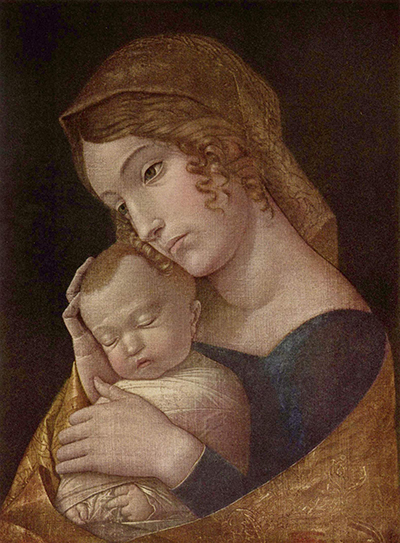
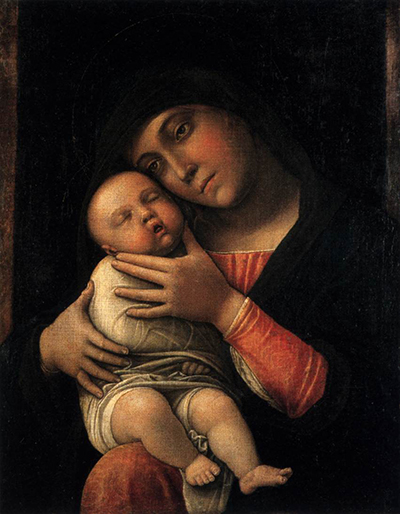
The closely wrapped child at the centre of the Berlin Madonna with Sleeping Child belongs to a much quieter sort of encounter. Berlin’s collection entry lists the canvas under 1455–60 and relates the intimate grouping to Donatello’s Madonna reliefs. Mary supports the baby’s head and closes her cloak around him. The cloth and the meeting of the faces do the work that a ledge does in the Presentation, giving the viewer a point at which to enter the image. The absence of haloes makes that closeness particularly striking. [18]
Faces and rooms at the Gonzaga court
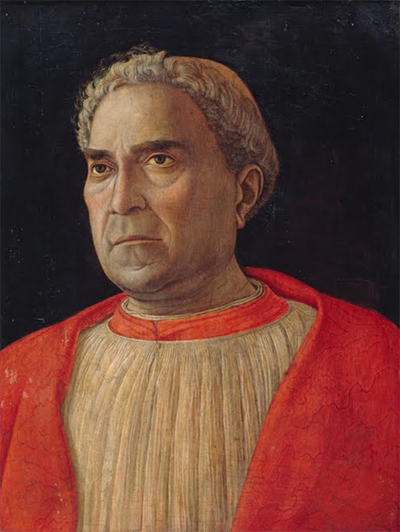
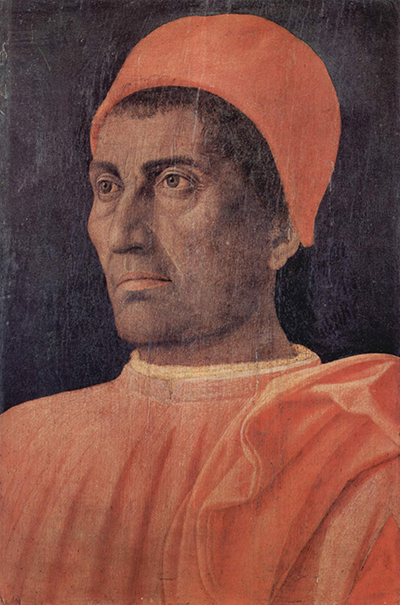
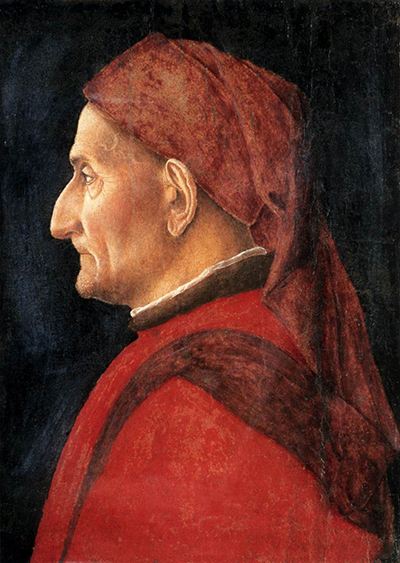
The Portrait of Cardinal Ludovico Trevisan in Berlin belongs near the transition to Mantegna’s Mantuan career. The museum’s catalogue essay places it around the congress held in Mantua in 1459–60 and stresses the resemblance of its modelling to antique sculpture. The head turns far enough for the light to define both the brow and the plane of the cheek. The high line of the garment and the dark field give the head much of the independent, solid presence of a bust. The same collection gives about 1455–59 in its date field, so the congress provides a proposed context for the portrait. [19]
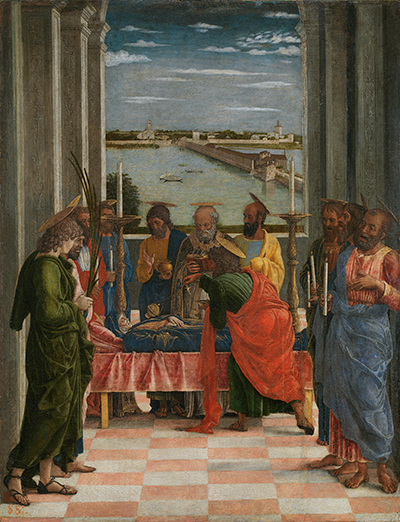
Mantegna entered the service of Ludovico Gonzaga in Mantua in 1460. The Louvre places a group of paintings from those first years in the context of his work on the chapel of the Castello di San Giorgio. [20] In the Death of the Virgin, dated about 1462, the apostles gather around Mary’s low bed. The tiled floor measures the interior, while the window takes the eye out to the bridge and waters of Mantua. The Louvre retrospective identifies the vista with the San Giorgio bridge and the water formed by the Mincio. The main panel is at the Prado, P000248. The Fondazione Zeri catalogues the fragment in Ferrara showing Christ with the Virgin’s soul as part of the same work. In the proposed reconstruction, Christ receives the small figure of Mary’s soul above the gathering of the apostles. The window sets the view of Mantua between that upper scene and the human activity in the foreground. [20] [21] [22]
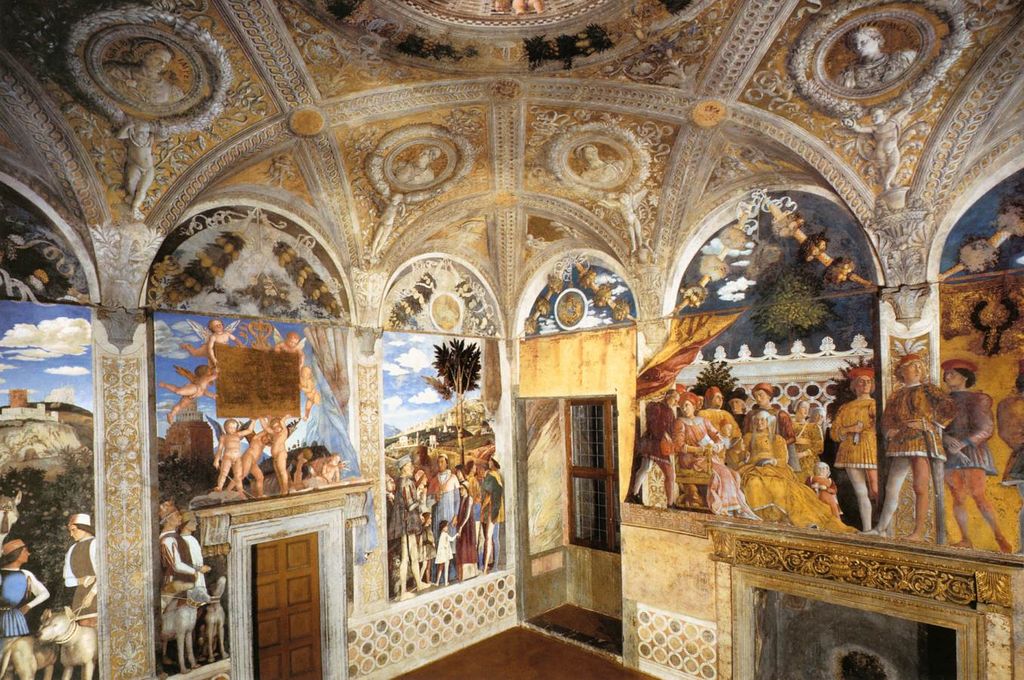
In the Camera degli Sposi, or Camera Picta, the painted setting extends over the walls and vault of a whole room. Palazzo Ducale dates the decoration to 1465–74. Painted pilasters divide the walls, and curtains seem to draw back to reveal the Gonzaga court. Above, the ceiling culminates in an oculus whose balustrade is seen from far below. Faces and putti look down, and a basket rests precariously on the rim. When you move your eyes from the figures on the walls to the figures overhead, you change your relation to the people in the painting. At wall height you seem to be admitted to the court’s presence. Looking up, you become the person being watched. The painted marble, emperor portraits and classical stories belong to the same room as those very human exchanges of looks. [3]
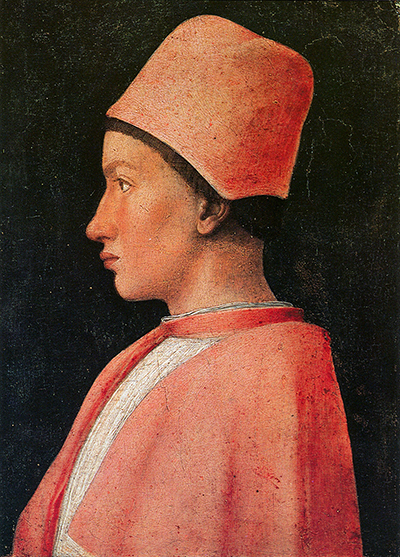
The Uffizi’s Portrait of a Prelate, about 1465–70, shows a man in the red robes of an apostolic protonotary. The museum traces his identification as Carlo de’ Medici to a later reproduction associated with the family tree and notes doubts raised by comparison with another proposed likeness. The small profile at Capodimonte traditionally called Francesco Gonzaga poses a related problem. A historic inventory gives the family name, but the museum discusses Francesco and his younger brother Ludovico as alternatives, with different implications for the date. Its softly modelled young face is contained within a severe outline that Capodimonte compares to ancient coins and medals. The outline may suggest a type of public image even when the individual’s name remains uncertain. [23] [24]
Washington’s Portrait of a Man, dated about 1470 by the National Gallery of Art, shows how carefully the artist could vary that type. The dark cap, red garment and blue ground give the turned head a marked clarity. There is no name in the collection title to guide a reading of the costume or expression. The museum catalogues it under Mantegna and records that the tempera paint was transferred from panel to canvas and then to hardboard. [25]
Saint Mark the Evangelist, Städel Museum Image source. Public domain.
Devotion at closer quarters
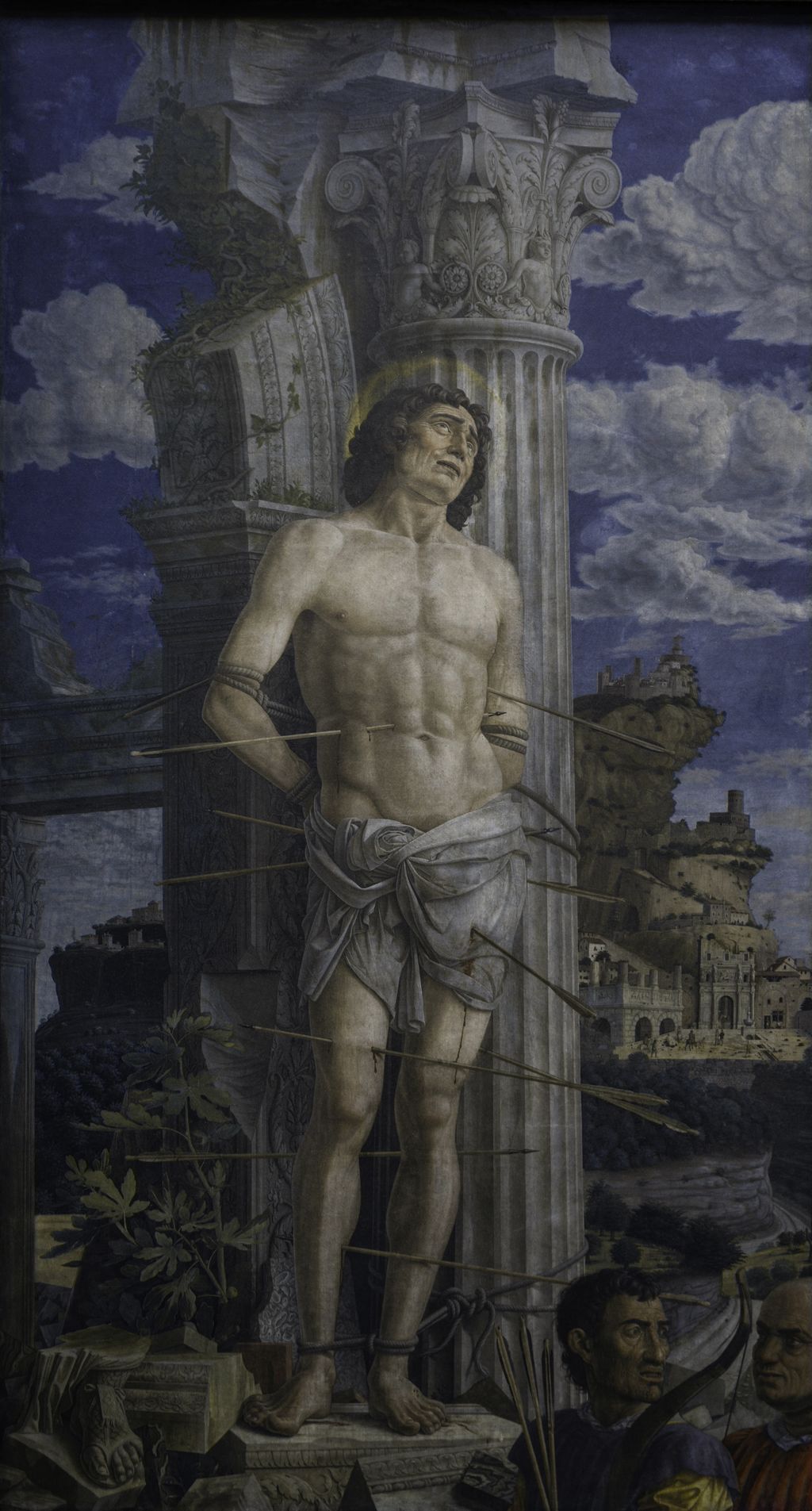
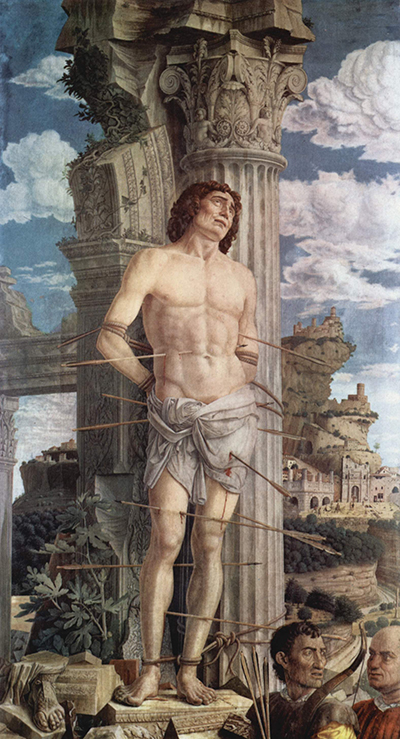
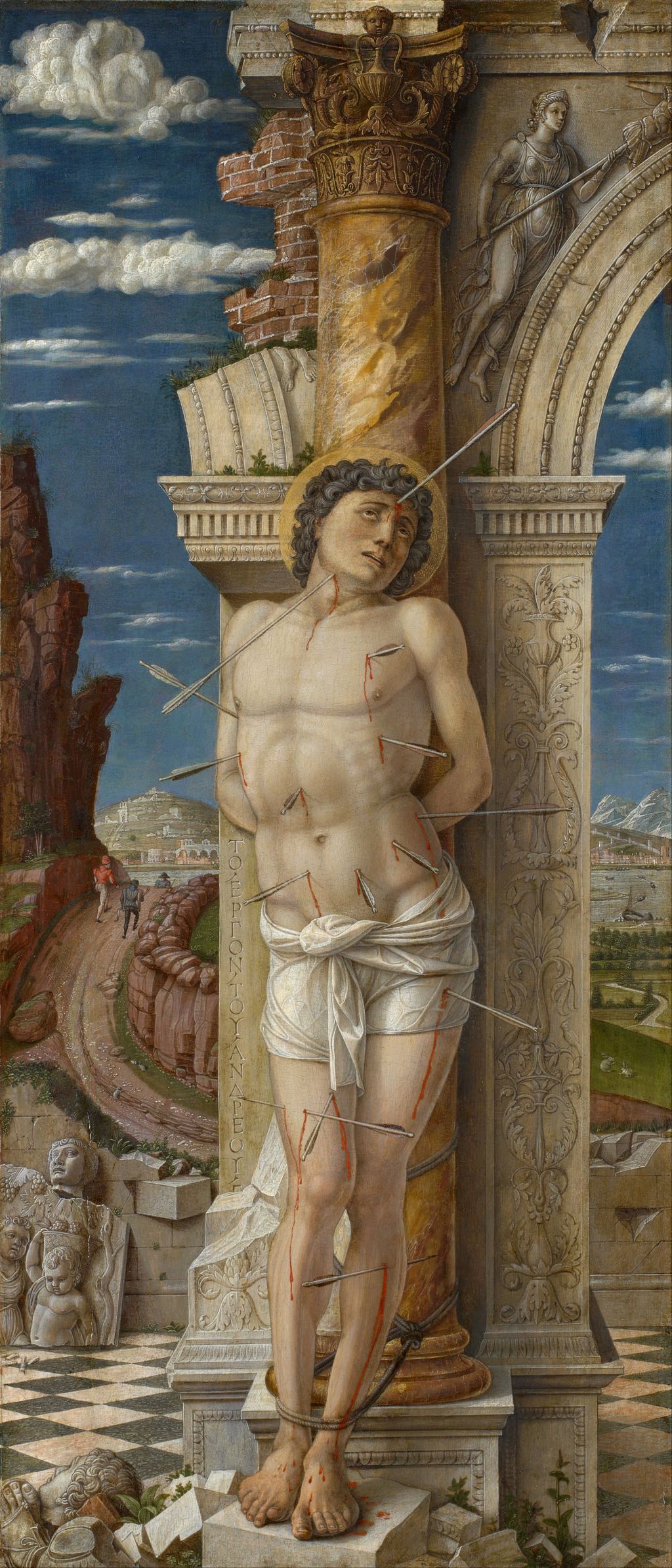
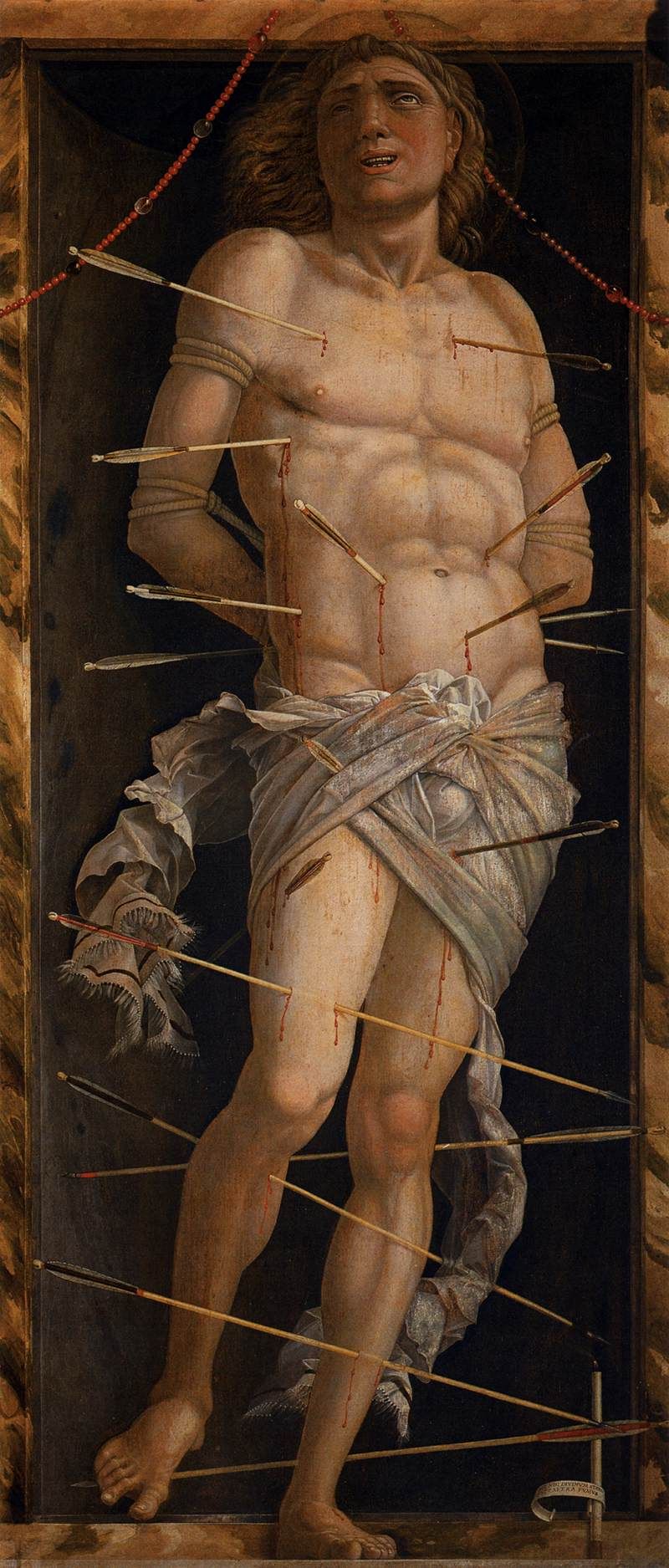
The Louvre’s Saint Sebastian uses a ruined classical setting for a body under strain. A carved fragment lies low in the scene, where stone and living flesh can be compared directly. Two archers, seen only in part near the lower right, reinforce the low viewpoint and give the tall, bound figure a measure of human scale. The Louvre catalogues this tempera on canvas, RF 1766, in the last quarter of the fifteenth century and records it at Aigueperse. The earlier Saint Sebastian shown in the London exhibition, Vienna GG 301, is painted on a much smaller wood panel. Comparing the two brings out how much space the Louvre picture gives to its archers and to the battered architecture that towers over them. [12] [26] [27]
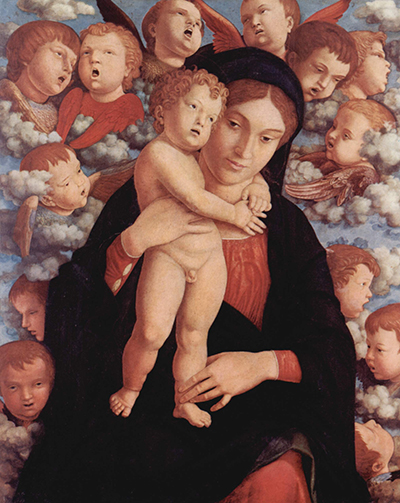
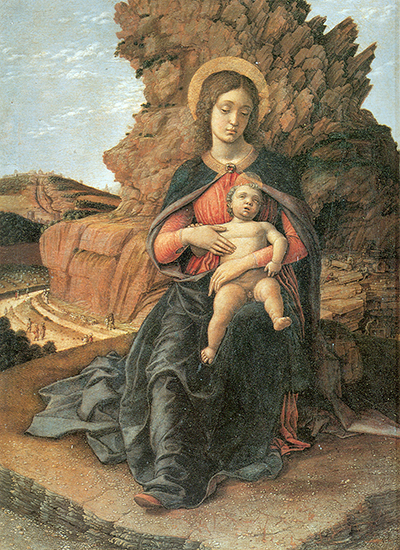
Mantegna could use devotional scale for very different kinds of space. In the Madonna of the Cherubim, dated about 1485 at Brera, faces emerge in banks of cloud immediately around Mary and the child. The museum records that it was long attributed to Bellini, an instructive detail given the warmth of the colour and expression. The Uffizi’s tiny Madonna of the Caves, about 1488–90, draws the eye away from the seated pair toward working figures and the crevices of a landscape. The rocky enclave gives Mary a shelter and also allows the everyday activity behind her to remain visible. [28] [29]
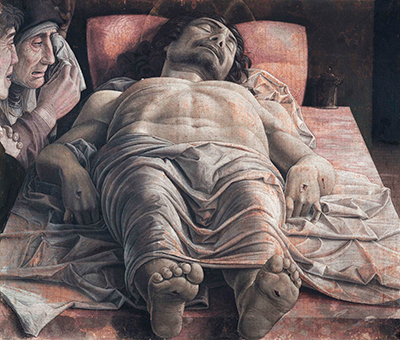
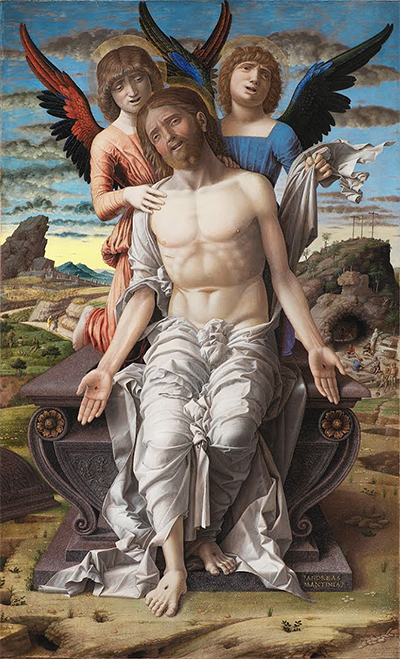
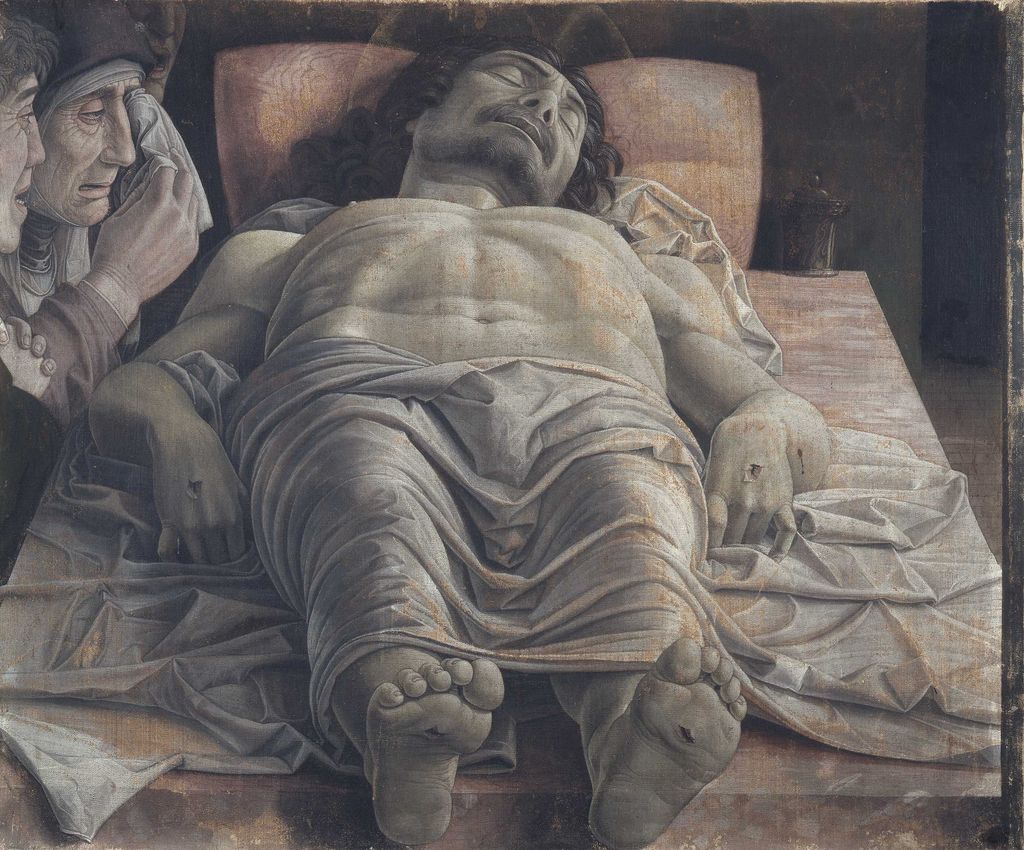
In Brera’s Lamentation over the Dead Christ, the feet lie just behind the edge of the stone slab and the torso recedes steeply, with three mourners pressed to one side. Look at how much of the face and chest Mantegna allows to remain visible beyond the feet. It is a view arranged so the dead body can be recognised and contemplated even from a difficult angle. Brera catalogues the tempera on canvas as circa 1483, inventory 352, and considers it likely to be the foreshortened Christ recorded in Mantegna’s studio after his death. Brera also proposes that it was meant for private devotion. In the Copenhagen Christ as the Suffering Redeemer, SMK KMSsp69, two angels support an upright Christ who presents his wounded body frontally. The Danish museum reads the work as a close devotional image with a further narrative in the background. The view into the distance gives that narrative space beyond the tightly grouped figures at the tomb. [30] [31]
The Poldi Pezzoli Madonna in Milan, dated around 1490 by the museum, returns to the sleeping child on canvas. In the earlier Berlin picture the child nestles high against Mary’s face. Here he lies lower, supported by Mary’s knee, his parted lips and small face held by her fingers. The museum reads the pale cloth as a possible anticipation of the shroud. That interpretation gains force when the picture is seen alongside the Lamentation, where the cloth on a dead body is already part of the scene. In both, the viewer is drawn close enough to register what the body’s weight means to the people around it. [18] [30] [32]
A procession for a court and a canvas for an altar
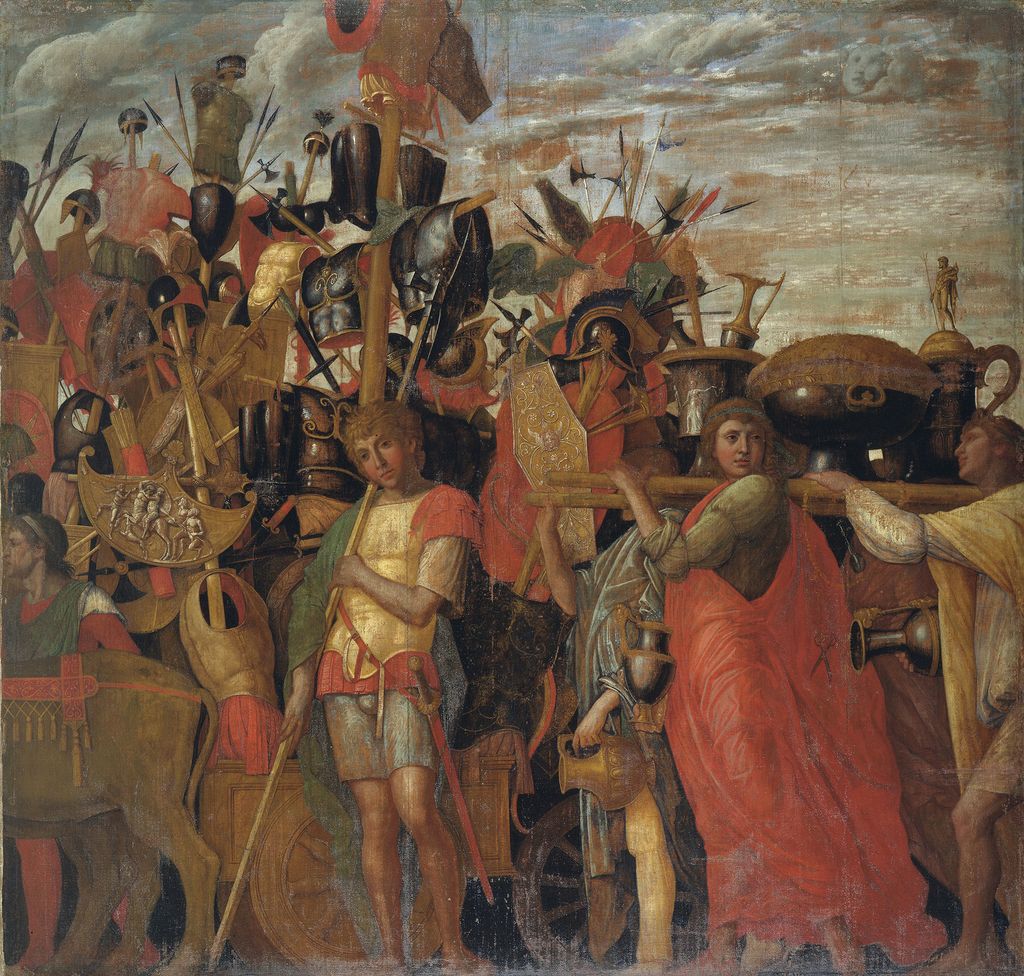
In the nine canvases of the Triumphs of Caesar, the spectator takes up a place beside a procession. The Royal Collection considers Francesco II Gonzaga the probable patron, and the National Gallery dates the series broadly from the mid-1480s to before 1506. The Louvre’s retrospective leaves the patron open between Francesco and his predecessor Federico, and cites evidence that some of the works were seen in 1486. All nine eventually entered Charles I’s collection. [33] [34] [35]
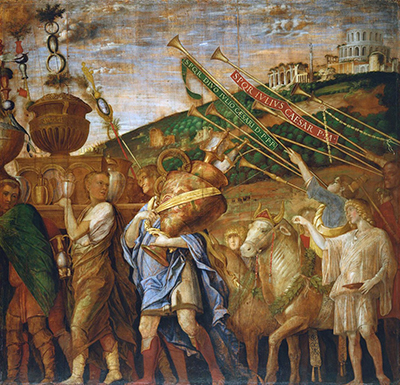
In The Trophy Bearers, the young man in front of a cart turns his gaze outward while captured weapons rise in a tall mass behind him. Several images later, The Captives makes people part of what Rome puts on display. Viewed in sequence, the parade changes its substance from one canvas to the next. Equipment and spoils offer a measure of conquest, while the captives give it a human cost. It is possible to look at the canvases one at a time, but much of the force of the series lies in waiting to see what comes into view after the edge of each picture. [33] [34]
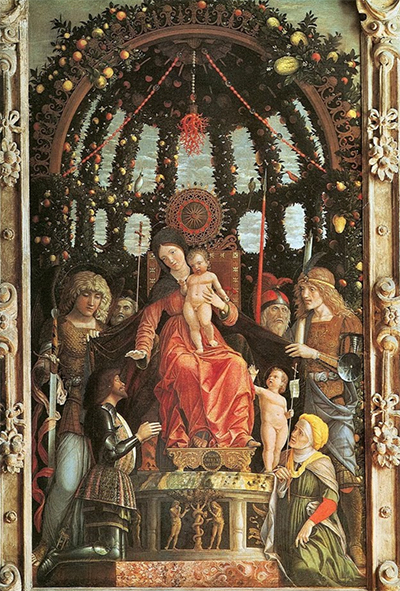
Francesco himself appears kneeling in the Louvre’s Madonna della Vittoria, a large tempera on canvas, INV 369, made as an ex-voto commemorating the battle of Fornovo in 1495 and installed in Mantua the following year. The Virgin reaches out over the armoured marquis, who is surrounded by saints under a canopy of foliage. The posture of the donor and the gesture above him give a political claim the form of a prayer. The commission also had a coercive history. The Italian state archives’ study of the Norsa family documents how the Jewish banker Daniele Norsa’s house was confiscated and the altarpiece commissioned at his expense. The picture attests to how the marquis wished to commemorate Fornovo, while the archive establishes who bore the cost of the commission. [36] [37]
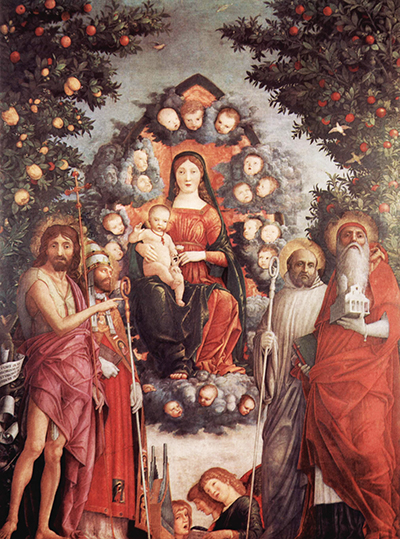
Compare San Luca and San Zeno with the large Trivulzio Madonna at the Castello Sforzesco in Milan. Mantegna painted it in tempera on canvas for the high altar of the Olivetan church of Santa Maria in Organo in Verona. The Castello relates the date on the signed scroll, 15 August 1497, to the feast of the Assumption. In the Padua polyptych Luke and the saints occupy distinct fields with a shared footing. At San Zeno a single loggia gives the gathering its depth. In the Trivulzio canvas the Virgin and Child rise over the standing saints, and the climbing lines of the trees lead the eye into the upper part of one uninterrupted surface. Below the Virgin, the angels mass around an organ that the Castello identifies with the church’s emblem. These are three ways of making height count at an altar. It gives the saints a place above the viewer, makes a gathering look as though it occupies a building, or directs the eye from standing figures toward an apparition. The altarpiece in Milan is displayed with its restored historic frame. The city’s conservation account describes woodwork from different periods assembled into the form associated with the Trivulzio collection. The present frame gives the canvas an imposing surround of its own. [1] [2] [38] [39]
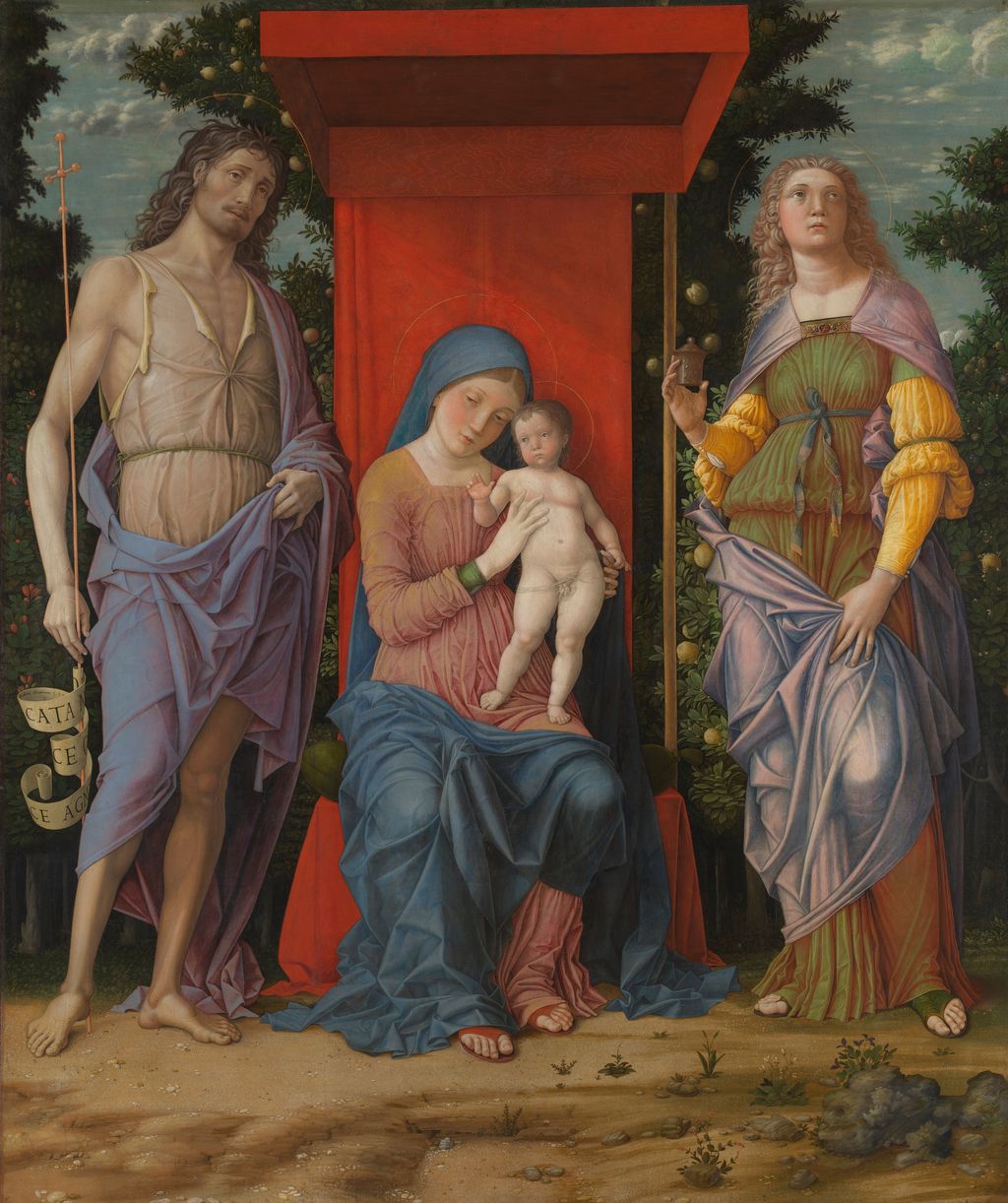
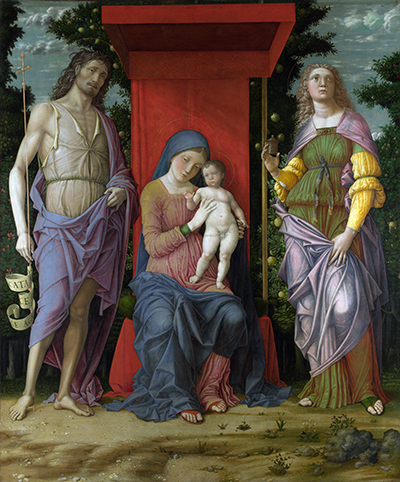
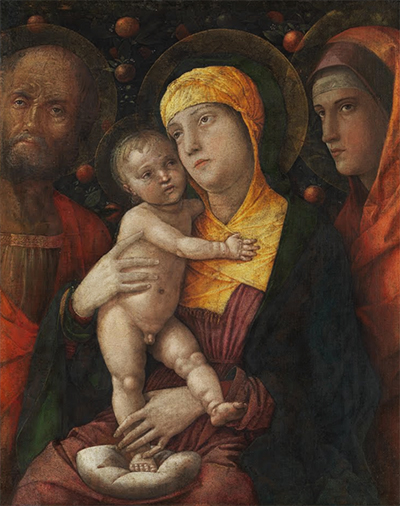
The National Gallery’s Virgin and Child with Saints, a signed canvas that the museum dates to about 1490–1505, uses a canopy to define the space around a group of saints. It is a smaller altarpiece than the Trivulzio, with the blessing child under a red canopy between John the Baptist and Mary Magdalene. The gallery leaves its original church open. Technical analysis by Catherine Higgitt and Raymond White identifies egg tempera over a substantial gesso ground. In the Altman Madonna, the Met’s Holy Family with Saint Mary Magdalen, the support is also canvas but the museum records distemper. Magdalene belongs to a close group around the child in that painting. The Met relates its shallow grouping to Roman funerary reliefs, where the ties between family members can be conveyed through a turn of the head or the proximity of two bodies. The same textile support could carry a different paint system and work at a very different scale. [40] [41] [42]
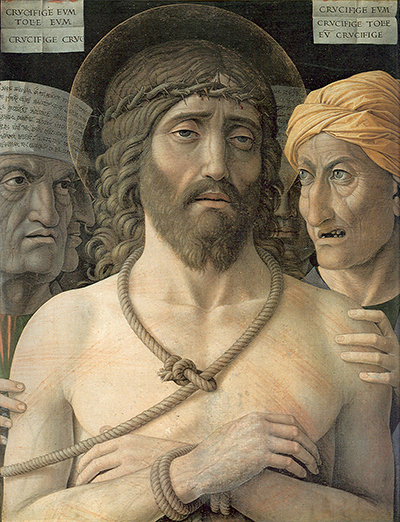
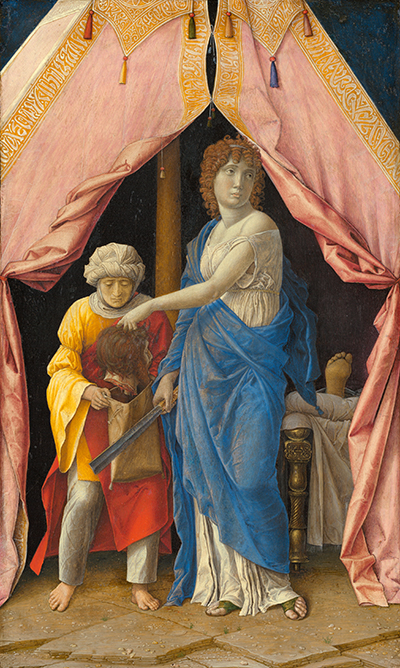
Some late pictures bring the drama almost entirely into gestures and expressions. In the Getty’s Adoration of the Magi, about 1495–1505, the kings’ offerings move along a tight row of half-length figures. The Getty identifies Balthazar as the Black king and points out the bands of colour in his vessel, which suggest agate or alabaster. The eldest king presents a blue-and-white porcelain bowl, which the Getty relates to Ming wares reaching Europe. In this shallow space the vessels help distinguish where the kings were understood to come from, a role that a fuller scene could give to landscape or retinue. At the Musée Jacquemart-André, Ecce Homo uses a similarly tight crop for the opposite kind of encounter. The museum draws attention to the caricatured faces crowded in against Christ. In Washington’s Judith and Holofernes, the opening of a tent has room for Judith, the attendant and the trace of a body on the bed. The National Gallery of Art displays the work under Mantegna’s name and also lists Giulio Campagnola among its associated painters. Here it is the opening between the curtains, and Judith’s backward glance, that suggest a story extending beyond the part we see. [43] [44] [45]
Isabella’s painted garden and a procession in stone colours
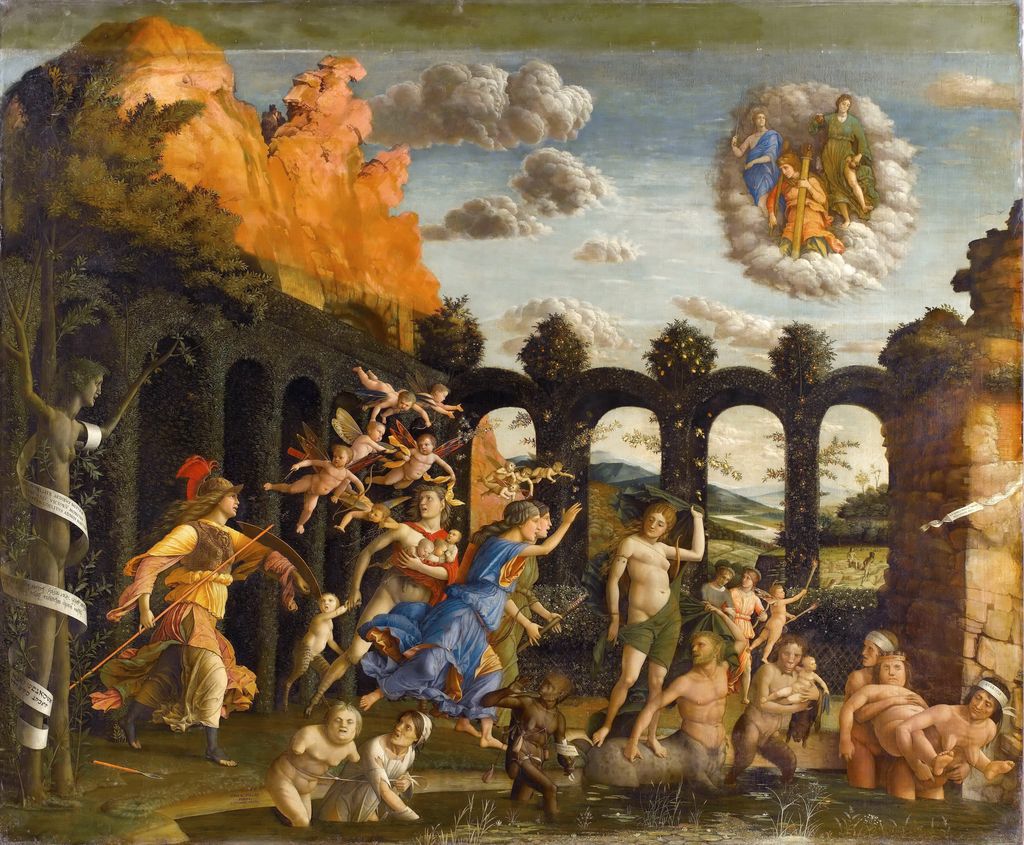
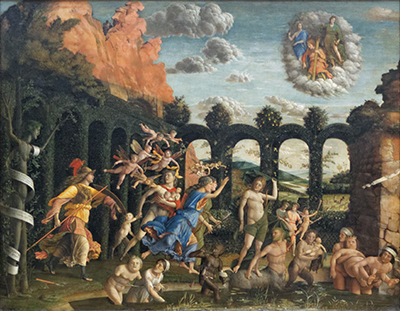
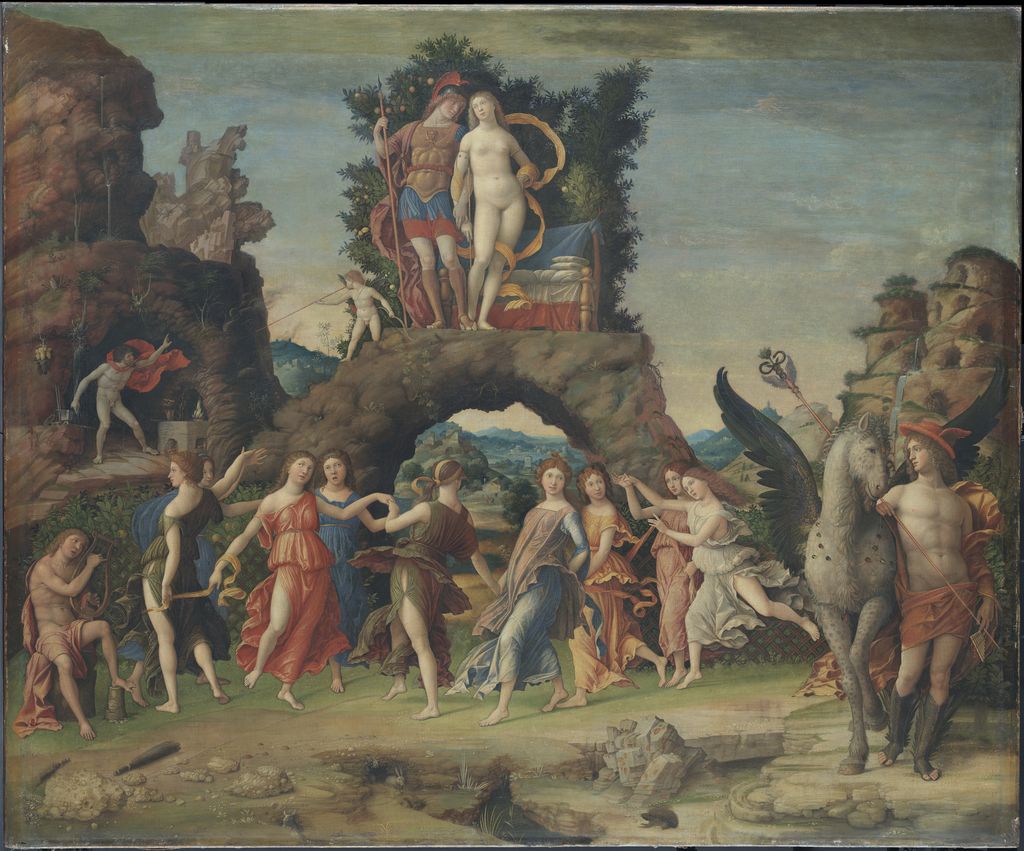
For Isabella d’Este’s first studiolo, in the Castello di San Giorgio, Mantegna painted Mars and Venus, usually called Parnassus, and Minerva Expelling the Vices from the Garden of Virtue, both now at the Louvre. The former was commissioned in the winter of 1496–97. Mars and Venus appear high on a rock arch with the dancing Muses below them, the movements of the dancers held together in a band across the foreground. The Louvre retrospective read the mythological pairing as a possible allusion to the ruling couple and the celebration of the arts as a theme. The current collection record also identifies later repainting, probably by Lorenzo Leonbruno, in parts of the landscape and on several figures. [46] [47] [48]
In Minerva, which the retrospective dates about 1500–02, an armed goddess rushes into a garden where figures struggle in water and inscriptions help name moral qualities. In Parnassus the dancers’ steps give the foreground time and rhythm. Here the active diagonal of Minerva’s advance sends the eye across a scene crowded with obstructions and fleeing bodies. The Louvre sees a common theme of virtue overcoming vice across the five canvases of the first studiolo, while leaving open whether the whole plan was fixed from the beginning. Perugino’s Combat of Love and Chastity and Lorenzo Costa’s Allegory of the Court of Isabella d’Este added different painters’ responses to the theme. The Louvre retrospective proposes that Mantegna’s two canvases faced one another, pointing to the light falling from opposite sides. The canvases were moved to Isabella’s later apartments in the Corte Vecchia. The surviving studiolo there helps convey the enclosed setting in which such a series could be seen. Isabella added two allegories by Correggio in the later room. [46] [47] [48] [49] [50] [51]
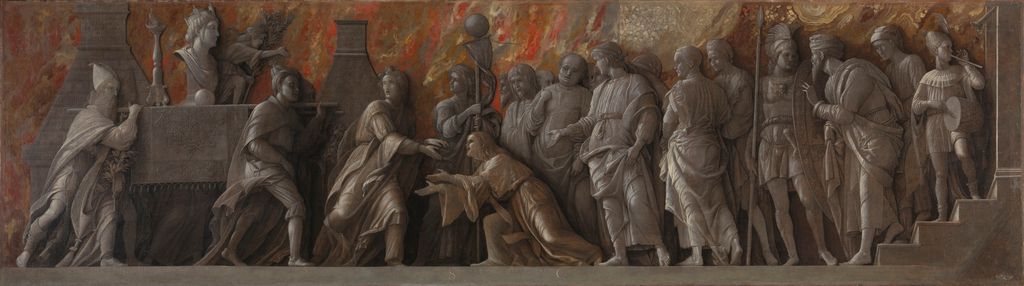
One of Mantegna’s last canvases brings grandeur back to the scale and appearance of an antique relief. In the National Gallery’s Introduction of the Cult of Cybele at Rome, NG902, dated 1505–06 and painted in glue tempera on canvas, the reception of the goddess in Rome in 204 BCE takes the form of pale, sculptural figures against a coloured stone ground. The gallery relates the picture to a commission from Francesco Cornaro, whose family traced its ancestry to the Roman who received Cybele. The association gives particular force to the inscribed tombs that mark the route of the procession. Letters indicate that Mantegna planned further canvases, and after his death Cornaro commissioned Bellini to make at least one more. At one end of Mantegna’s picture a drummer looks out of the scene. Like the outward turn of the young man in The Trophy Bearers, the glance makes the edge feel temporary. In the Triumphs, another canvas can carry the procession past it. Here the glance gives a sense of the larger enterprise that Mantegna left behind. [34] [52]
Browse Mantegna’s paintings
Artworks directory
| Name | Date | Medium and collection |
|---|---|---|
| The Adoration of the Shepherds | Shortly after 1450 | Painting · Metropolitan Museum of Art · 32.130.2 Catalogue. |
| Saint Mark the Evangelist | C. 1448–51 | Painting · Städel Museum · 1046 Catalogue. |
| Saint Jerome Penitent in the Desert | C. 1448–51 | Painting · Museu de Arte de São Paulo · MASP.00015 Catalogue. |
| Martyrdom and Transport of the Body of Saint Christopher | Mid-1450s | Painting · Ovetari Chapel, Padua Catalogue. |
| San Luca Altarpiece | 1453–55 | Painting · Pinacoteca di Brera · 176 Catalogue. |
| The Presentation of Christ at the Temple | 1454 (Berlin dating) | Painting · Gemäldegalerie, Berlin · 29 Catalogue. |
| San Zeno Altarpiece | 1457–59 | Painting · Basilica of San Zeno, Verona Catalogue. |
| The Crucifixion | 1456–59 | Painting · Musée du Louvre · INV 368 Catalogue. |
| The Agony in the Garden (London) | C. 1455–56 | Painting · National Gallery, London · NG1417 Catalogue. |
| The Agony in the Garden (Tours) | 1459 (Tours dating) | Painting · Musée des Beaux-Arts de Tours · 1803-1-24 Catalogue. |
| The Resurrection | 1459 (Tours dating) | Painting · Musée des Beaux-Arts de Tours · 1803-1-25 Catalogue. |
| Saint Sebastian (Vienna) | C. 1457–59 | Painting · Kunsthistorisches Museum · GG 301 Catalogue. |
| Cardinal Ludovico Trevisan | C. 1459–60 (Berlin exhibition dating) | Painting · Gemäldegalerie, Berlin · 9 Catalogue. |
| The Death of the Virgin | C. 1462 | Painting · Museo Nacional del Prado · P000248 Catalogue. |
| Christ with the Soul of the Virgin | C. 1460–64 | Painting · Pinacoteca Nazionale, Ferrara Catalogue only. |
| Portrait of a Young Man (traditionally Francesco Gonzaga) | C. 1461 or 1470, depending on sitter | Painting · Museo di Capodimonte · Q 60 Catalogue. |
| Portrait of a Prelate (Carlo de’ Medici?) | C. 1465–70 | Painting · Uffizi Galleries · 1890 no. 8540 Catalogue. |
| Portrait of a Man | C. 1470 | Painting · National Gallery of Art, Washington · 1952.2.5 Catalogue. |
| Madonna with Sleeping Child (Berlin) | C. 1455–60 | Painting · Gemäldegalerie, Berlin · S.5 Catalogue. |
| Camera degli Sposi (Camera Picta) | 1465–74 | Painting · Palazzo Ducale, Mantua Catalogue. |
| Saint Sebastian (Louvre) | Around 1480 | Painting · Musée du Louvre · RF 1766 Catalogue. |
| Lamentation over the Dead Christ | C. 1483 (Brera dating) | Painting · Pinacoteca di Brera · 352 Catalogue. |
| The Triumphs of Caesar | About 1485–1506 | Painting · Royal Collection · RCIN 403958–403966 Catalogue. |
| Madonna of the Caves | C. 1488–90 | Painting · Uffizi Galleries · 1890 no. 1348 Catalogue. |
| Madonna and Child with a Choir of Cherubim | C. 1485 | Painting · Pinacoteca di Brera · 297 Catalogue. |
| Madonna and Child (Poldi Pezzoli) | Early 1490s (museum dating) | Painting · Museo Poldi Pezzoli · 1595 Catalogue. |
| The Holy Family with Saint Mary Magdalen | C. 1495–1500 | Painting · Metropolitan Museum of Art · 14.40.643 Catalogue. |
| The Virgin and Child with Saint Mary Magdalene and Saint John the Baptist | C. 1490–1505 | Painting · National Gallery, London · NG274 Catalogue. |
| Christ as the Suffering Redeemer | 1485–95 (SMK dating) | Painting · Statens Museum for Kunst · KMSsp69 Catalogue. |
| Ecce Homo | C. 1500 | Painting · Musée Jacquemart-André · MJAP-P 1840 Catalogue. |
| Judith with the Head of Holofernes (Mantegna or follower) | C. 1495–1500 | Painting · National Gallery of Art, Washington · 1942.9.42 Catalogue. |
| Madonna della Vittoria | 1495–96 | Painting · Musée du Louvre · INV 369 Catalogue. |
| Mars and Venus (Parnassus) | C. 1496–97 | Painting · Musée du Louvre · INV 370 Catalogue. |
| The Trivulzio Madonna | 1497 | Painting · Castello Sforzesco, Milan · 0554 Catalogue. |
| The Adoration of the Magi | C. 1495–1505 | Painting · J. Paul Getty Museum · 85.PA.417 Catalogue. |
| Minerva Expelling the Vices from the Garden of Virtue | C. 1502 | Painting · Musée du Louvre · INV 371 Catalogue. |
| The Introduction of the Cult of Cybele at Rome | 1505–06 | Painting · National Gallery, London · NG902 Catalogue. |
| Saint Sebastian (Venice) | Probably c. 1504–06 | Painting · Galleria Giorgio Franchetti alla Ca’ d’Oro · D.11 Catalogue. |
| Samson and Delilah | C. 1500 | Painting · National Gallery, London · NG1145 Catalogue only. |
| A Woman Drinking (probably Sophonisba) | C. 1495–1506 | Painting · National Gallery, London · NG1125.2 Catalogue only. |
| The Vestal Virgin Tuccia with a Sieve | C. 1495–1506 | Painting · National Gallery, London · NG1125.1 Catalogue only. |
| Judith with the Head of Holofernes (Dublin) | C. 1495–1500 | Painting · National Gallery of Ireland · NGI.442 Catalogue only. |
| Battle of the Sea Gods, left half (Met impression) | Before 1481 (Met dating) | Print · Metropolitan Museum of Art · 18.12 Catalogue only. |
| Battle of the Sea Gods, right half (Met impression) | Before 1481 (Met dating) | Print · Metropolitan Museum of Art · 1984.1201.4 Catalogue only. |
| Battle of the Sea Gods, left half (Tokyo impression) | C. 1475 (Tokyo dating) | Print · National Museum of Western Art, Tokyo · G.1981-0002 Catalogue only. |
| Battle of the Sea Gods, left half (Washington impression) | C. 1485–88 (NGA dating) | Print · National Gallery of Art, Washington · 1941.1.6 Catalogue only. |
| The Entombment of Christ, second state of two | Before 1475 (Met dating) | Print · Metropolitan Museum of Art · 37.42.30 Catalogue only. |
| The Entombment of Christ (possibly Zoan Andrea, after Mantegna) | 1460–1549 (Rijksmuseum dating) | Print · Rijksmuseum · RP-P-1924-60 Catalogue only. |
| Four Dancing Muses (Gian Marco Cavalli after Mantegna) | C. 1497 | Print · Metropolitan Museum of Art · 20.5.3 Catalogue only. |
| Bacchanal with Silenus | Before 1475 (Met dating) | Print · Metropolitan Museum of Art · 29.44.15 Catalogue only. |
| Bacchanal with a Wine Vat | Before 1475 (Met dating) | Print · Metropolitan Museum of Art Catalogue only. |
| St James on His Way to Execution | C. 1453–57 | Drawing · British Museum · 1976,0616.1 Catalogue only. |
| Three Studies for a Dead Christ | C. 1455–65 | Drawing · British Museum · 1909,0406.3 Catalogue only. |
| Pietà (Venice) | C. 1456–65 (exhibition datings) | Drawing · Gallerie dell’Accademia, Venice · 115 Catalogue only. |
| Studies for Christ at the Column | 1460–65 | Drawing · The Courtauld · D.1978.PG.345 Catalogue only. |
| Virtus Combusta | C. 1490 (technical study) | Drawing · British Museum · Pp,1.23 Catalogue only. |
| Virtus Combusta (Giovanni Antonio da Brescia after Mantegna) | C. 1495–1506 | Print · Musée du Louvre · 3881 LR/ Recto Catalogue only. |
| The Calumny of Apelles | C. 1504–06 | Drawing · British Museum · 1860,0616.85 Catalogue only. |
Frequently Asked Questions
Compare the San Zeno Altarpiece, where painted architecture continues behind real columns, with the Berlin Presentation, where the figures crowd a painted stone opening.
Discussion
Look again at the images and ideas explored in Andrea Mantegna’s Paintings. These editorial prompts invite your observations.
Reader Insights
How do the shared platform at San Luca, the timber columns at San Zeno and the rising trees of the Trivulzio Madonna direct a viewer looking up at an altar?
How does the spectator’s position change between the Camera Picta oculus, the Brera Dead Christ and the young man looking out of The Trophy Bearers?
Join the Conversation
Share a detail, comparison or question about Andrea Mantegna’s Paintings below.
References
- Pinacoteca di Brera, Polittico di San Luca. View source.
- Opificio delle Pietre Dure, Andrea Mantegna, Pala di San Zeno, 1457–1459. View source.
- Palazzo Ducale di Mantova, Camera Picta (Camera degli Sposi). View source.
- Musée du Louvre, Padua, an Artistic Crossroad. View source.
- Städel Museum, Saint Mark the Evangelist, inv. 1046. View source.
- Museu de Arte de São Paulo, São Jerônimo penitente no deserto. View source.
- Comune di Padova, Padova italiana. View source.
- Australian National University Open Research Repository, Arundel Society: The Translation of a Translation, discussion of the Ovetari frescoes. View source.
- The Metropolitan Museum of Art, The Adoration of the Shepherds. View source.
- The Metropolitan Museum of Art, Italian Paintings, Volume IV: North Italian School, pp. 35–38. View source.
- Staatliche Museen zu Berlin, Die Darbringung Christi im Tempel. View source.
- National Gallery, London, Mantegna and Bellini. View source.
- Fondazione Querini Stampalia, Giovanni Bellini, Presentazione di Gesù al Tempio. View source.
- Musée du Louvre, La Crucifixion, INV 368. View source.
- Musée des Beaux-Arts de Tours, Les chefs-d’œuvre du musée: La Résurrection. View source.
- National Gallery, London, Andrea Mantegna, The Agony in the Garden, NG1417. View source.
- National Gallery, London, Giovanni Bellini, The Agony in the Garden, NG726. View source.
- Staatliche Museen zu Berlin, Maria mit dem schlafenden Kind. View source.
- Staatliche Museen zu Berlin, Kardinal Ludovico Trevisan. View source.
- Musée du Louvre, First Years in Mantua: Christ with the Soul of the Virgin. View source.
- Real Academia de Bellas Artes de San Fernando and Fundación Ramón Areces, El Tránsito de la Virgen. View source.
- Fondazione Federico Zeri, Cristo con l’animula della Madonna. View source.
- Uffizi Galleries, Portrait of a Prelate (Carlo de’ Medici?). View source.
- Museo e Real Bosco di Capodimonte, Una nuova cornice per l’opera di Andrea Mantegna. View source.
- National Gallery of Art, Washington, Portrait of a Man. View source.
- Musée du Louvre, Saint Sébastien, RF 1766. View source.
- Kunsthistorisches Museum Wien, Saint Sebastian, GG 301. View source.
- Pinacoteca di Brera, Madonna and Child with a Choir of Cherubim. View source.
- Uffizi Galleries, Madonna of the Caves. View source.
- Pinacoteca di Brera, Lamentation over the Dead Christ. View source.
- Statens Museum for Kunst, Christ as the Suffering Redeemer, KMSsp69. View source.
- Museo Poldi Pezzoli, Madonna con il Bambino. View source.
- Royal Collection Trust, The Triumphs of Caesar: 7. The Captives, RCIN 403964. View source.
- National Gallery, London, The Triumphs of Caesar: 3, The Trophy Bearers. View source.
- Musée du Louvre, The Triumphs of Caesar. View source.
- Musée du Louvre, La Vierge de la Victoire, INV 369. View source.
- Archivio di Stato di Mantova, Il Codice Maimonide e i Norsa: Una famiglia ebraica nella Mantova dei Gonzaga. View source.
- Castello Sforzesco, Sforza Castle Museums’ Highlights: Madonna in Glory and Saints. View source.
- Comune di Milano, La Pala Trivulzio di Mantegna ritrova la sua cornice storica. View source.
- National Gallery, London, The Virgin and Child with Saints, NG274. View source.
- National Gallery, London, Catherine Higgitt and Raymond White, Analyses of Paint Media: New Studies of Italian Paintings of the Fifteenth and Sixteenth Centuries. View source.
- The Metropolitan Museum of Art, The Holy Family with Saint Mary Magdalen. View source.
- J. Paul Getty Museum, The Adoration of the Magi, exhibition text for Balthazar: A Black African King in Medieval and Renaissance Art. View source.
- Musée Jacquemart-André, Ecce Homo. View source.
- National Gallery of Art, Washington, Judith with the Head of Holofernes. View source.
- Musée du Louvre, Mars et Vénus, dit Le Parnasse, INV 370. View source.
- Musée du Louvre, Minerve chassant les Vices du Jardin de la Vertu, INV 371. View source.
- Musée du Louvre, Isabella d’Este’s Studiolo. View source.
- Musée du Louvre, Lorenzo Costa, Allégorie de la cour d’Isabelle d’Este, INV 255. View source.
- Musée du Louvre, Pérugin, Le Combat de l’Amour et de la Chasteté, INV 722. View source.
- Palazzo Ducale di Mantova, La corte vecchia. View source.
- National Gallery, London, The Introduction of the Cult of Cybele at Rome, NG902. View source.
More MANTEGNA Paintings
San Zeno Altarpiece
The San Zeno Altarpiece in its frame, Basilica of San Zeno, Verona José Luiz. Image source. CC BY-SA 4.0. Resized from the cited image.