 by Tom Gurney
Tom Gurney BSc (Hons) is an art history expert with over 20 years experience
Published on June 19, 2020 / Updated on November 29, 2026
Email: tomgurney1@gmail.com / Phone: +44 7429 011000
Overview
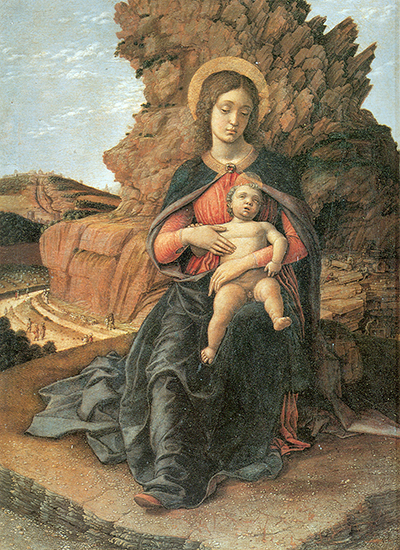
At first, the great red rock in Andrea Mantegna’s Madonna of the Caves makes a backdrop for Mary and the Christ Child. Look beside her blue mantle and it becomes a place of work. Tiny figures bend over lengths of cut stone in the shelter of a cave. Across the panel, travellers follow a bright road through a valley of fields and flocks. The two sides invite the eye to travel quite different distances from the still figure at the centre. [1] [2]
The Uffizi Galleries date the painting to about 1488–1490 and catalogue it as tempera on wood, 32 × 29.6 cm, inventory 1890 no. 1348. A panel of this size rewards a viewer who comes close, yet Mary has the presence of a figure on a much larger scale. Mantegna achieves both effects in the space between the sole of her shoe and the distant people at work. [1]
At a Glance
- DateAbout 1488–1490
- MediumTempera on wood
- Dimensions32 × 29.6 cm
- CollectionUffizi Galleries
- Inventory1890 no. 1348
Andrea Mantegna in context
San Zeno Altarpiece
1457–59 [14]The Triumphs of Caesar
Mid-1480s–before 1506 [16]Madonna of the Caves
C. 1488–90 [1]Madonna della Vittoria
1495–96 [17]A seat cut into the rock
Mary sits on a rock seat near the edge of a shelf of ground. Thin layers of stone show along the broken lip below her, while the mantle spreads across the top in broad, angular folds. One leg extends towards the lower edge, just far enough for the sole of the shoe to show. The other knee rises under the cloth and supports the Child. The visible sole and the foreshortening of the Child help establish the low viewpoint the Uffizi sees in the pair. Her seated figure still fills most of the panel’s height. The Uffizi suggests that the arrangement of her legs may owe something to antique sculpture. [1] [2]
Her left arm keeps the Child steady while the fingers of her right hand lie against his torso. Uffizi curator Daniela Parenti relates the gesture to the Byzantine Hodegetria, the image type in which Mary directs attention to Christ. Here it takes the form of a touch. His feet hang at different heights and his head tilts back. Mary lowers her eyes, while he looks upwards with his mouth open. The exchange of gestures is close and physical, although their expressions suggest that each is absorbed in a separate thought. [1] [2]
A road through fields and a ledge for stonecutters
Begin on the viewer’s left, where the pale road curves round the foot of the cliff. Pairs and little groups of travellers give it a scale. A flock threads along the base of the rock, close to the road, and farther back people work among piles of harvested crops. Beyond the valley a steep track climbs towards the buildings on the skyline. Each stretch of the landscape has its own pace, from the travellers in the open to the figures occupied in the fields. The sunny distance is legible in part because Mantegna leaves strips of bare ground between the little figures and the darker cultivated areas. [1] [2] [3]
On the right the eye has to work harder. Follow the edge of the mantle down from Mary’s shoulder to the ledge behind her. The quarry workers are spread across different levels. A long cylindrical piece lies on its side near the mouth of the cave, with men gathered around it. Squared pieces and a separate round form catch the light against the shadow. Farther down, figures cluster around a chest-like stone object. The pale edges of worked stone make a series of short lines across the crag, so that the change from rock face to roughly cut block to shaped object can be followed in a few centimetres of paint. [1] [2] [3]
The workers gave the picture its Italian title, Madonna delle cave, in which cave means quarries. Giorgio Vasari singled them out in his 1568 life of Mantegna. He marvelled at the patience it must have taken to render men cutting stone with so fine a brush. The passage registers a double feat of workmanship. The tiny men turn stone into usable forms, and Mantegna gives differences of weight, posture and finish to shapes that can almost disappear into the mountain when the panel is seen from a distance. Vasari described the Child as sleeping, although the raised eyes and open mouth are visible in the painting and are central to the Uffizi’s account of his expression. [1] [2] [4]
The column, the tomb and the clasp
The Uffizi identifies a column and a sarcophagus among the objects the workers are making. In Parenti’s reading, the column anticipates the Flagellation, the whipping of Christ before the Crucifixion, and the sarcophagus looks ahead to his burial before the Resurrection. She also suggests that the mountain may evoke Golgotha. Seen this way, the quarry puts the future Passion within sight of the infant: the objects that recall violence and death are still being made. The same site allows a second association. The Uffizi sees the workers as a possible tribute to the artisans who produced the architecture and sculpture of Greek and Roman antiquity. A stone column can carry both associations because Mantegna shows a recognisable piece of craftsmanship before it takes on a role in a sacred story. [1]
The cave itself has prompted a range of readings. As the Italian state catalogue records, Frederick Hartt read the rock and the quarry in relation to Christ’s virginal birth and Resurrection. Andreas Hauser develops the connection between the cave of the Nativity and the cave of burial. He also records Hartt’s reading of the harvest and the shepherds as allusions to the Eucharist and to Christ as the Good Shepherd. On that reading, the far valley carries its own religious associations, distinct from the instruments of suffering being made in the quarry. [2] [3]
Hauser also questions whether the jagged mountain represents a particular rock formation. The state catalogue records two competing identifications, Carrara proposed by Giuseppe Fiocco and Monte Bolca near Roncà proposed by Paul Kristeller. The rock’s sharp, tilted masses look distinct enough to invite that kind of search, but Hauser points out that jagged formations recur throughout Mantegna’s work. The location remains disputed. [2] [3]
Another small detail connects the figures with that wider field of interpretation. At Mary’s throat, the clasp has a rounded ruby at its centre and three pearls around it. The Uffizi’s exhibition on painted jewellery reads the ruby in relation to Mary’s love and Christ’s redemptive mission and associates the three pearls with the Trinity. The clasp can also be followed simply as part of the composition. It draws the edges of the blue cloak together above the Child’s head, where the red of Mary’s garment meets the red-brown of the rock. Viewed close up, the light on the jewel is as carefully placed as the light on the cut stone. [1] [5]
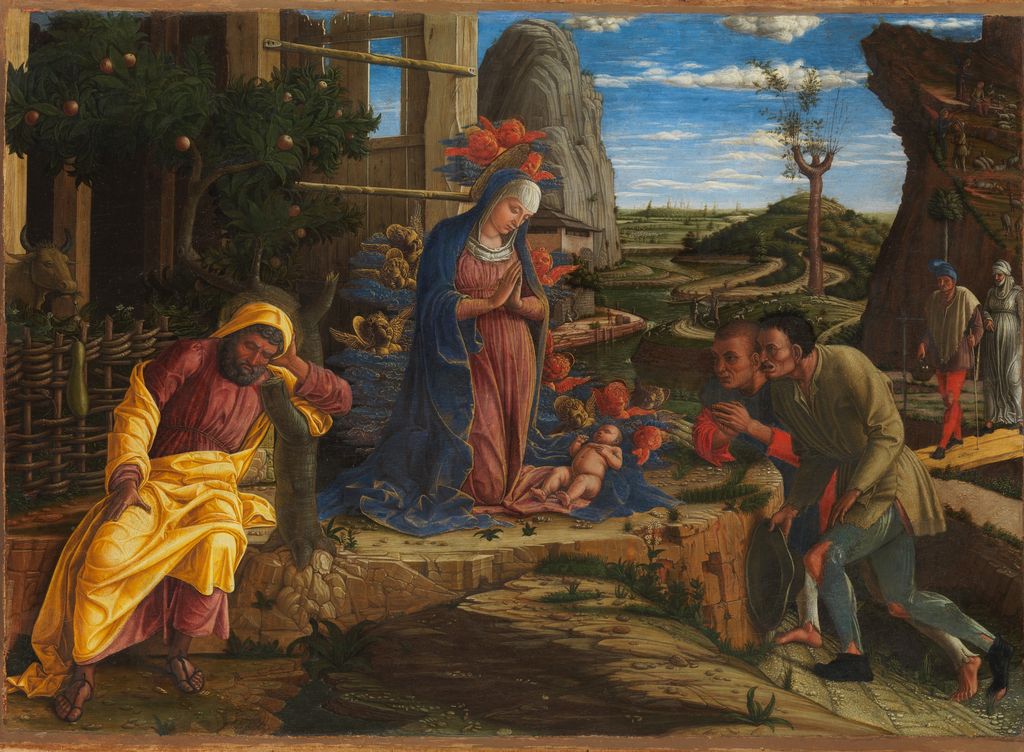
The Adoration of the Shepherds, Metropolitan Museum of Art Image source. Public domain.
A Roman date and an unidentified first owner
Vasari places the making of the panel during Mantegna’s stay in Rome, when Pope Innocent VIII engaged him to decorate a chapel at the Belvedere. The Uffizi follows that account in dating the painting to about 1488–1490. The late 1480s or early 1490s are also plausible on stylistic grounds, according to the Dizionario Biografico degli Italiani. Vasari names the chapel as papal work and describes the little Madonna as a separate painting made during the same stay. Any papal commission for the panel remains conjectural. Mantegna’s service at the Gonzaga court supplies another context in which an intimate devotional picture might have been wanted, but the first recipient is unknown. [1] [4] [6]
The Italian Uffizi entry describes a painted imitation of marble on the reverse. That finish, together with the panel’s size, leads the gallery to suggest a portable object for private devotion. The stone on the back and the painted quarry on the front make an apt pairing, although the finish gives no precise account of how or where the work was used. The named owner supplied by Vasari is Francesco de’ Medici, the future grand duke of Tuscany, who prized the painting by 1568. The Uffizi traces it in the gallery from at least 1704. [4] [7]
Art historian Sabine Frommel mentions Lorenzo de’ Medici as a possible commissioner. Mantegna had dealings with Lorenzo, but a link to this specific panel remains uncertain. Hauser notes that the picture is absent from Lorenzo’s 1492 inventory and raises the possibility that Francesco acquired it himself much later. Vasari gives the panel a firm place in Francesco’s collection, leaving its route into Medici hands open. [2] [4] [6] [8]
Mantegna’s Madonna della Vittoria shows what firmer evidence for a commission looks like. The Louvre identifies it as a votive work made for the chapel of Santa Maria della Vittoria in Mantua to commemorate the Battle of Fornovo. Francesco II Gonzaga kneels at the Virgin’s feet, his place in the painting as conspicuous as the scale of the commission. The Madonna of the Caves asks for a different kind of attention. Its small format brings the figure of Mary within reach of close inspection, and the distant people are occupied with their own journeys and work. [1] [6] [9]
How Mantegna puts rock to work elsewhere
In Saint Jerome in the Wilderness at the Museu de Arte de São Paulo, the cave has a plainly devotional use. A candle burns in front of a crucifix and the saint prays beside his books. The museum points to the way Jerome’s stony figure seems to merge with its surroundings. The Uffizi Mary is also closely fitted to her seat, but the cave is set apart from her. In São Paulo the recess accommodates the implements of prayer. In Florence it gives shelter to men finishing the objects that may direct a viewer’s thoughts towards the Passion. [1] [10]
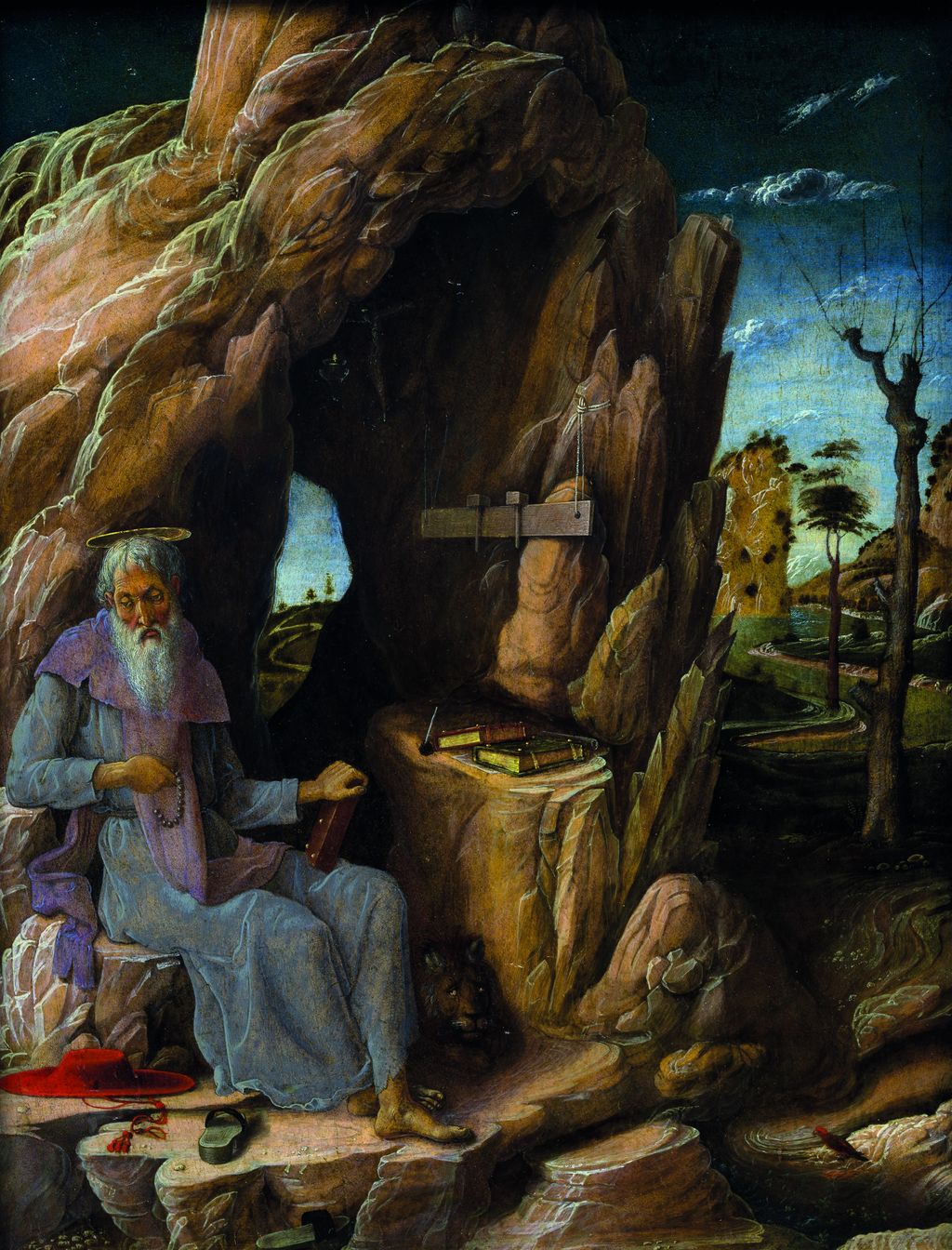
Saint Jerome Penitent in the Desert, Museu de Arte de São Paulo Image source. Public domain.
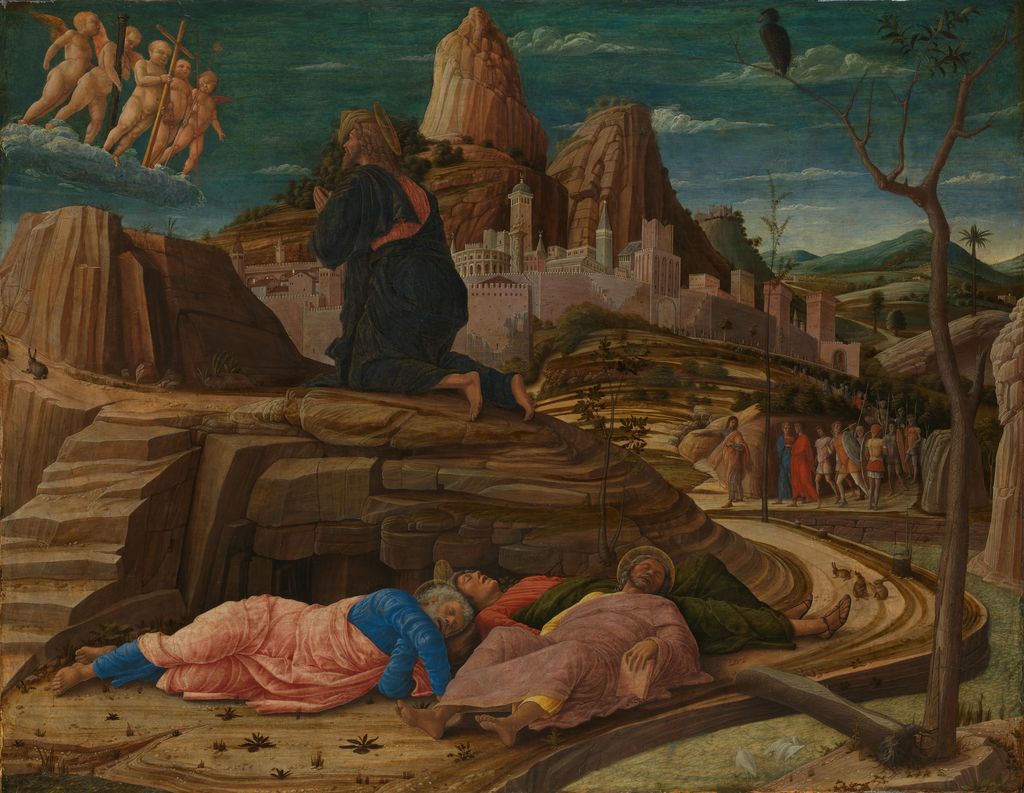
In the London Agony in the Garden, a rock formation serves as an altar-like place for Christ to pray. The road leads from the distant city towards the foreground, carrying Judas and the soldiers who will arrest him. It gives the eye a route along which an event is about to arrive. On the Uffizi panel the road fills with the slower traffic of the valley, while the busy ledge on the other side holds objects that can point forward to the Passion. The sense of anticipation in both paintings depends on looking from an immediately recognisable sacred figure to activity some distance away. [1] [11]
The quarry finds a closer counterpart in Christ as the Suffering Redeemer in Copenhagen. There Christ sits on an antique sarcophagus and displays his wounds. On the left, women follow the road towards the tomb. On the right, below the crosses of Calvary, tiny figures and pieces of cut stone surround another dark opening. The return of the quarry is easy to miss just beyond Christ’s outstretched hand. The Dizionario Biografico connects that panel with the Madonna of the Caves through Mantegna’s several uses of stone, from natural formation to carved object. In Florence, the objects on the ledge are at the scale of the workers. In Copenhagen, the sarcophagus has moved to the foreground and carries the weight of Christ’s body. The worked stone that may foreshadow his death in the Madonna is, in the later subject of the Resurrection, directly beneath him. [1] [6] [12]
The Berlin Madonna with Sleeping Child gives the mother and infant nearly the whole field of the image. The child rests with his face against Mary and the closeness of their heads holds the eye. In Florence the Child turns his face up and away, and the space around the figures opens onto a working landscape. The difference is most apparent if you return to the hand resting against his ribs after following the road and looking into the quarry. Its small movement again fixes attention on the infant, now with the column and the tomb within sight. [1] [13]
Annotated Details from Madonna of the Caves
The numbered points identify details to look at closely. The detail images below preserve the native scale of the selected crops.
Madonna of the Caves
Image source. Photograph by Armin Kleiner. Overview marked; details cropped. CC BY-SA 4.0.
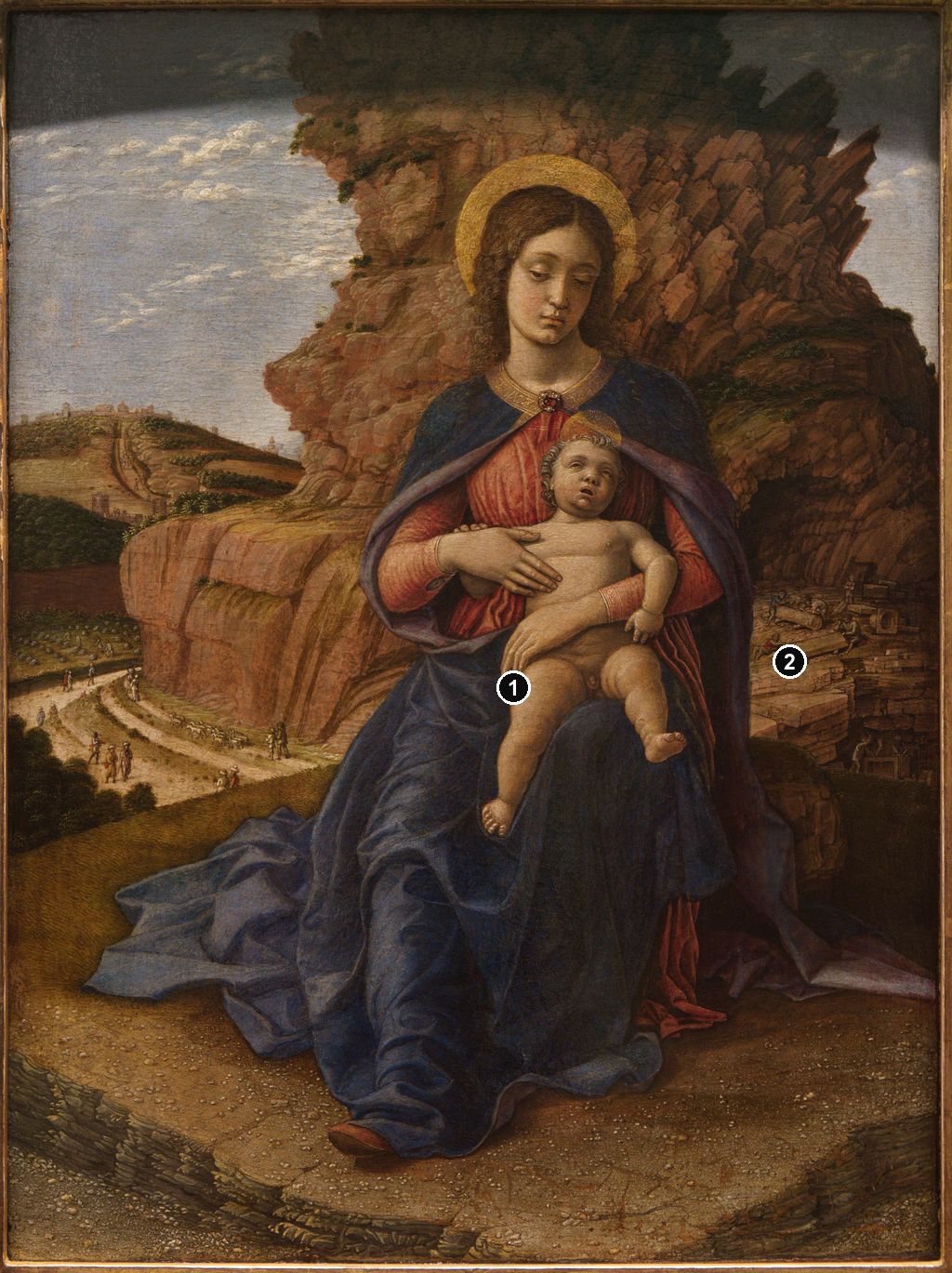
Details from MADONNA OF THE CAVES
Choose a detail to enlarge it.
Madonna of the Caves
The mother and child
The figures sit low against the rock face. The Madonna’s folded drapery follows the sloping stone before breaking into a sharper contour.
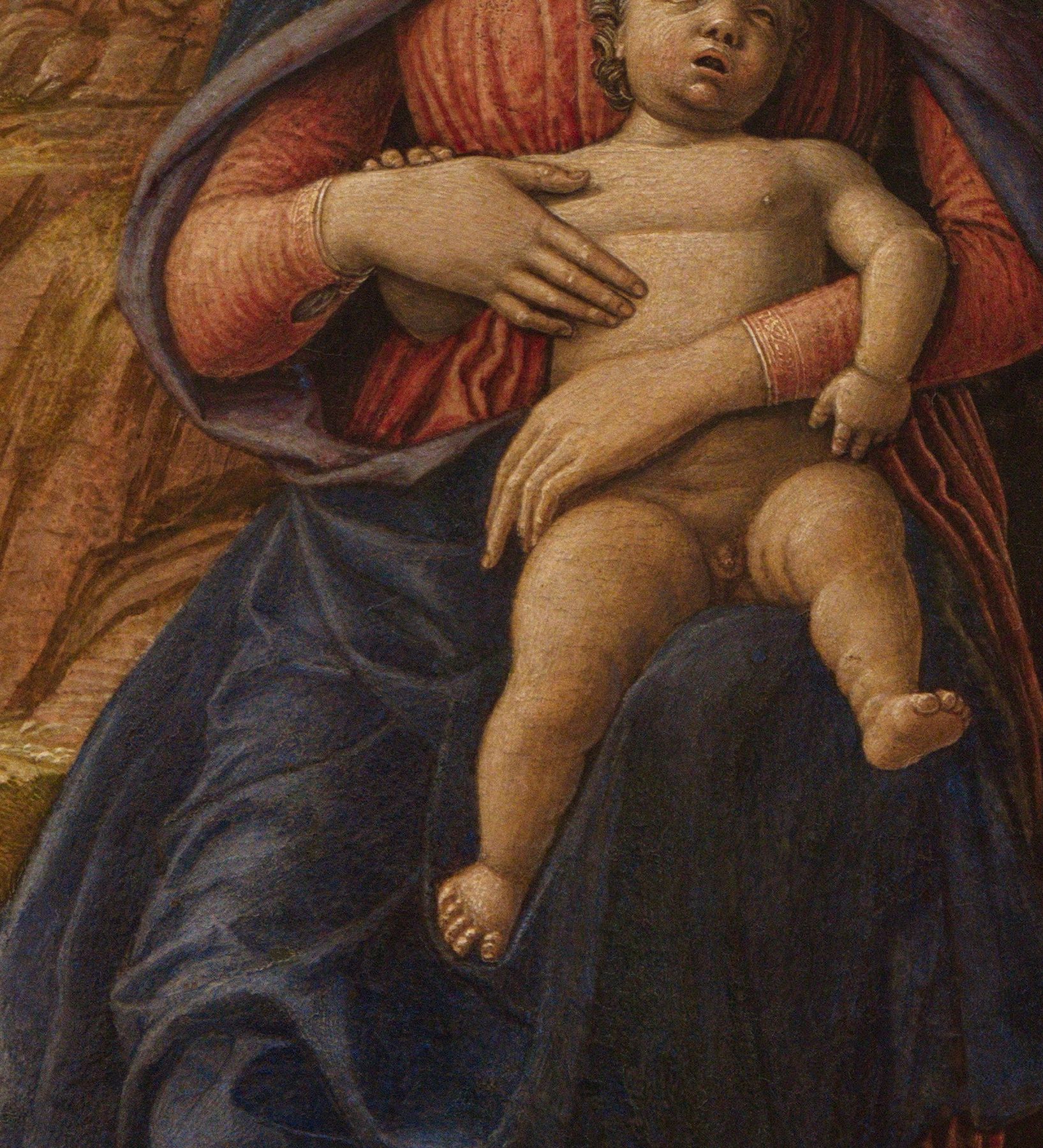
Workers among the rocks
The small workers are easier to see alongside the seated figures. Their scale makes the work around the rocks feel distant.
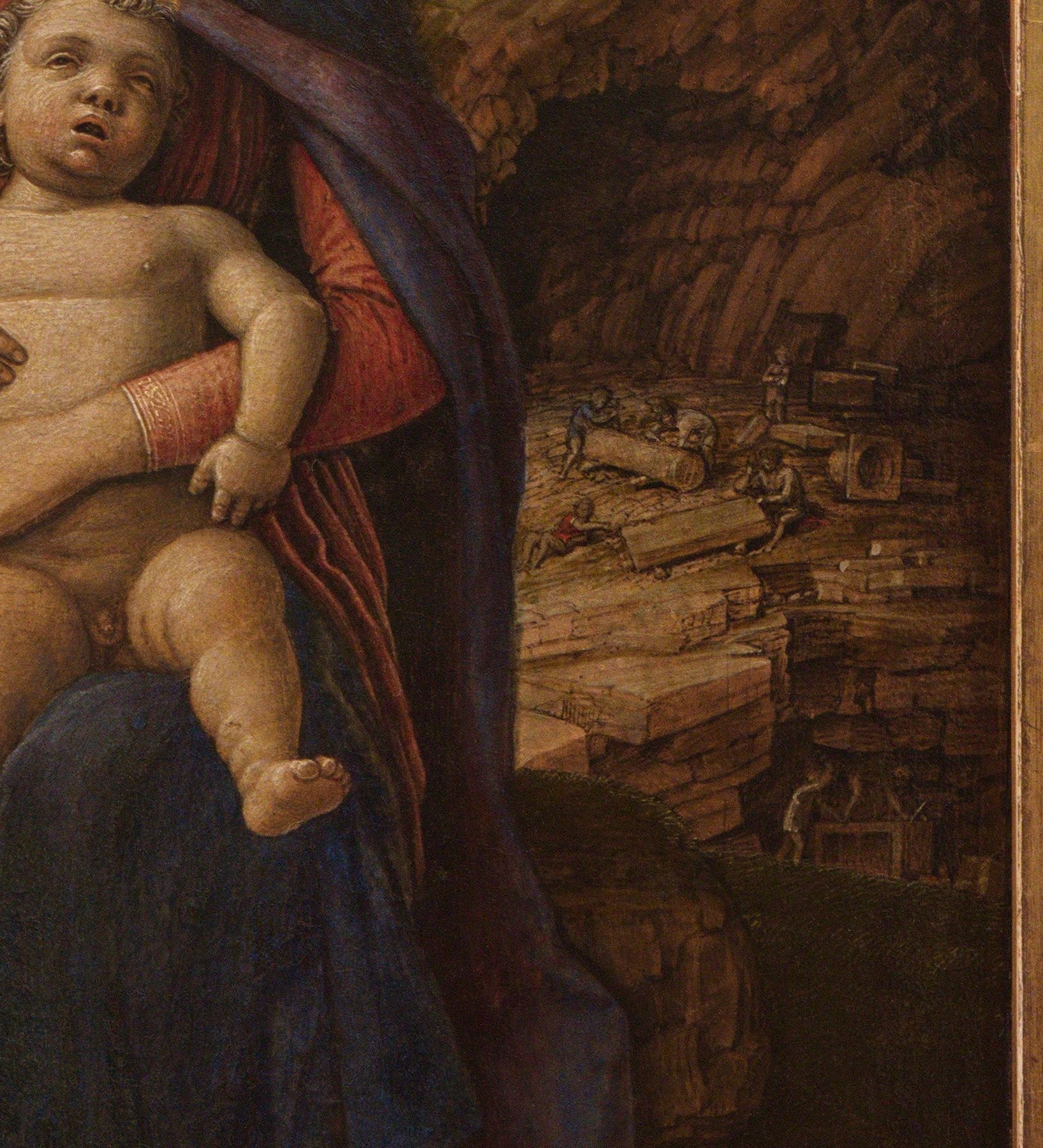
Artworks directory
| Name | Date | Medium and collection |
|---|---|---|
| The Adoration of the Shepherds | Shortly after 1450 | Painting · Metropolitan Museum of Art · 32.130.2 Catalogue. |
| Saint Mark the Evangelist | C. 1448–51 | Painting · Städel Museum · 1046 Catalogue. |
| Saint Jerome Penitent in the Desert | C. 1448–51 | Painting · Museu de Arte de São Paulo · MASP.00015 Catalogue. |
| Martyrdom and Transport of the Body of Saint Christopher | Mid-1450s | Painting · Ovetari Chapel, Padua Catalogue. |
| San Luca Altarpiece | 1453–55 | Painting · Pinacoteca di Brera · 176 Catalogue. |
| The Presentation of Christ at the Temple | 1454 (Berlin dating) | Painting · Gemäldegalerie, Berlin · 29 Catalogue. |
| San Zeno Altarpiece | 1457–59 | Painting · Basilica of San Zeno, Verona Catalogue. |
| The Crucifixion | 1456–59 | Painting · Musée du Louvre · INV 368 Catalogue. |
| The Agony in the Garden (London) | C. 1455–56 | Painting · National Gallery, London · NG1417 Catalogue. |
| The Agony in the Garden (Tours) | 1459 (Tours dating) | Painting · Musée des Beaux-Arts de Tours · 1803-1-24 Catalogue. |
| The Resurrection | 1459 (Tours dating) | Painting · Musée des Beaux-Arts de Tours · 1803-1-25 Catalogue. |
| Saint Sebastian (Vienna) | C. 1457–59 | Painting · Kunsthistorisches Museum · GG 301 Catalogue. |
| Cardinal Ludovico Trevisan | C. 1459–60 (Berlin exhibition dating) | Painting · Gemäldegalerie, Berlin · 9 Catalogue. |
| The Death of the Virgin | C. 1462 | Painting · Museo Nacional del Prado · P000248 Catalogue. |
| Christ with the Soul of the Virgin | C. 1460–64 | Painting · Pinacoteca Nazionale, Ferrara Catalogue only. |
| Portrait of a Young Man (traditionally Francesco Gonzaga) | C. 1461 or 1470, depending on sitter | Painting · Museo di Capodimonte · Q 60 Catalogue. |
| Portrait of a Prelate (Carlo de’ Medici?) | C. 1465–70 | Painting · Uffizi Galleries · 1890 no. 8540 Catalogue. |
| Portrait of a Man | C. 1470 | Painting · National Gallery of Art, Washington · 1952.2.5 Catalogue. |
| Madonna with Sleeping Child (Berlin) | C. 1455–60 | Painting · Gemäldegalerie, Berlin · S.5 Catalogue. |
| Camera degli Sposi (Camera Picta) | 1465–74 | Painting · Palazzo Ducale, Mantua Catalogue. |
| Saint Sebastian (Louvre) | Around 1480 | Painting · Musée du Louvre · RF 1766 Catalogue. |
| Lamentation over the Dead Christ | C. 1483 (Brera dating) | Painting · Pinacoteca di Brera · 352 Catalogue. |
| The Triumphs of Caesar | About 1485–1506 | Painting · Royal Collection · RCIN 403958–403966 Catalogue. |
| Madonna of the Caves | C. 1488–90 | Painting · Uffizi Galleries · 1890 no. 1348 Catalogue. |
| Madonna and Child with a Choir of Cherubim | C. 1485 | Painting · Pinacoteca di Brera · 297 Catalogue. |
| Madonna and Child (Poldi Pezzoli) | Early 1490s (museum dating) | Painting · Museo Poldi Pezzoli · 1595 Catalogue. |
| The Holy Family with Saint Mary Magdalen | C. 1495–1500 | Painting · Metropolitan Museum of Art · 14.40.643 Catalogue. |
| The Virgin and Child with Saint Mary Magdalene and Saint John the Baptist | C. 1490–1505 | Painting · National Gallery, London · NG274 Catalogue. |
| Christ as the Suffering Redeemer | 1485–95 (SMK dating) | Painting · Statens Museum for Kunst · KMSsp69 Catalogue. |
| Ecce Homo | C. 1500 | Painting · Musée Jacquemart-André · MJAP-P 1840 Catalogue. |
| Judith with the Head of Holofernes (Mantegna or follower) | C. 1495–1500 | Painting · National Gallery of Art, Washington · 1942.9.42 Catalogue. |
| Madonna della Vittoria | 1495–96 | Painting · Musée du Louvre · INV 369 Catalogue. |
| Mars and Venus (Parnassus) | C. 1496–97 | Painting · Musée du Louvre · INV 370 Catalogue. |
| The Trivulzio Madonna | 1497 | Painting · Castello Sforzesco, Milan · 0554 Catalogue. |
| The Adoration of the Magi | C. 1495–1505 | Painting · J. Paul Getty Museum · 85.PA.417 Catalogue. |
| Minerva Expelling the Vices from the Garden of Virtue | C. 1502 | Painting · Musée du Louvre · INV 371 Catalogue. |
| The Introduction of the Cult of Cybele at Rome | 1505–06 | Painting · National Gallery, London · NG902 Catalogue. |
| Saint Sebastian (Venice) | Probably c. 1504–06 | Painting · Galleria Giorgio Franchetti alla Ca’ d’Oro · D.11 Catalogue. |
| Samson and Delilah | C. 1500 | Painting · National Gallery, London · NG1145 Catalogue only. |
| A Woman Drinking (probably Sophonisba) | C. 1495–1506 | Painting · National Gallery, London · NG1125.2 Catalogue only. |
| The Vestal Virgin Tuccia with a Sieve | C. 1495–1506 | Painting · National Gallery, London · NG1125.1 Catalogue only. |
| Judith with the Head of Holofernes (Dublin) | C. 1495–1500 | Painting · National Gallery of Ireland · NGI.442 Catalogue only. |
| Battle of the Sea Gods, left half (Met impression) | Before 1481 (Met dating) | Print · Metropolitan Museum of Art · 18.12 Catalogue only. |
| Battle of the Sea Gods, right half (Met impression) | Before 1481 (Met dating) | Print · Metropolitan Museum of Art · 1984.1201.4 Catalogue only. |
| Battle of the Sea Gods, left half (Tokyo impression) | C. 1475 (Tokyo dating) | Print · National Museum of Western Art, Tokyo · G.1981-0002 Catalogue only. |
| Battle of the Sea Gods, left half (Washington impression) | C. 1485–88 (NGA dating) | Print · National Gallery of Art, Washington · 1941.1.6 Catalogue only. |
| The Entombment of Christ, second state of two | Before 1475 (Met dating) | Print · Metropolitan Museum of Art · 37.42.30 Catalogue only. |
| The Entombment of Christ (possibly Zoan Andrea, after Mantegna) | 1460–1549 (Rijksmuseum dating) | Print · Rijksmuseum · RP-P-1924-60 Catalogue only. |
| Four Dancing Muses (Gian Marco Cavalli after Mantegna) | C. 1497 | Print · Metropolitan Museum of Art · 20.5.3 Catalogue only. |
| Bacchanal with Silenus | Before 1475 (Met dating) | Print · Metropolitan Museum of Art · 29.44.15 Catalogue only. |
| Bacchanal with a Wine Vat | Before 1475 (Met dating) | Print · Metropolitan Museum of Art Catalogue only. |
| St James on His Way to Execution | C. 1453–57 | Drawing · British Museum · 1976,0616.1 Catalogue only. |
| Three Studies for a Dead Christ | C. 1455–65 | Drawing · British Museum · 1909,0406.3 Catalogue only. |
| Pietà (Venice) | C. 1456–65 (exhibition datings) | Drawing · Gallerie dell’Accademia, Venice · 115 Catalogue only. |
| Studies for Christ at the Column | 1460–65 | Drawing · The Courtauld · D.1978.PG.345 Catalogue only. |
| Virtus Combusta | C. 1490 (technical study) | Drawing · British Museum · Pp,1.23 Catalogue only. |
| Virtus Combusta (Giovanni Antonio da Brescia after Mantegna) | C. 1495–1506 | Print · Musée du Louvre · 3881 LR/ Recto Catalogue only. |
| The Calumny of Apelles | C. 1504–06 | Drawing · British Museum · 1860,0616.85 Catalogue only. |
Frequently Asked Questions
They work the stone in the rocky setting. Their visible activity gives the landscape a human scale and helps distinguish the quarry from the foreground seat where Mary holds the child.
The Uffizi’s date range falls around Mantegna’s Roman stay. The dating allows the connection, while the place of production and the first owner need cautious treatment.
Discussion
Look again at the images and ideas explored in Madonna of the Caves. These editorial prompts invite your observations.
Reader Insights
How does following the road on the left and then looking into the quarry on the right change your reading of Mary’s gesture towards the Child?
What changes when Mantegna moves the sarcophagus from the stonecutters’ ledge in the Madonna to the foreground beneath Christ in the Copenhagen panel?
Join the Conversation
Share a detail, comparison or question about Madonna of the Caves below.
References
- Uffizi Galleries, Virgin and Child (‘Madonna of the Caves’). View source.
- Andreas Hauser, Andrea Mantegnas »Madonna delle cave«. Ein vulkanischer Christus als Quelle geistigen Lebens. View source.
- Italian Ministry of Culture, Madonna delle cave, Madonna con Bambino, national catalogue record 0900287163. View source.
- Giorgio Vasari, Vita di Andrea Mantegna, Le vite, 1568 edition, p. 491. View source.
- Uffizi Galleries, Gioielli agli Uffizi, Madonna delle Cave, entries 40–41. View source.
- Istituto della Enciclopedia Italiana, Mantegna, Andrea, Dizionario Biografico degli Italiani. View source.
- Uffizi Galleries, Madonna con il Bambino detta Madonna delle cave. View source.
- Sabine Frommel, An welchem Ort huldigt man dem neugeborenen Christus? Leonardos Anbetung von San Donato in Scopeto, pp. 98–99. View source.
- Musée du Louvre, La Vierge de la Victoire. View source.
- Museu de Arte de São Paulo Assis Chateaubriand, Saint Jerome Penitent in the Desert. View source.
- The National Gallery, The Agony in the Garden. View source.
- Statens Museum for Kunst, Kristus som den lidende frelser. View source.
- Staatliche Museen zu Berlin, The Reinstallation of the James Simon Cabinet in the Bode-Museum. View source.
- Basilica of San Zeno, Verona, San Zeno Altarpiece, View source.
- Palazzo Ducale, Mantua, Camera degli Sposi (Camera Picta), View source.
- Royal Collection, The Triumphs of Caesar, View source.
- Musée du Louvre, Madonna della Vittoria, View source.
- National Gallery, London, The Introduction of the Cult of Cybele at Rome, View source.
More MANTEGNA Paintings
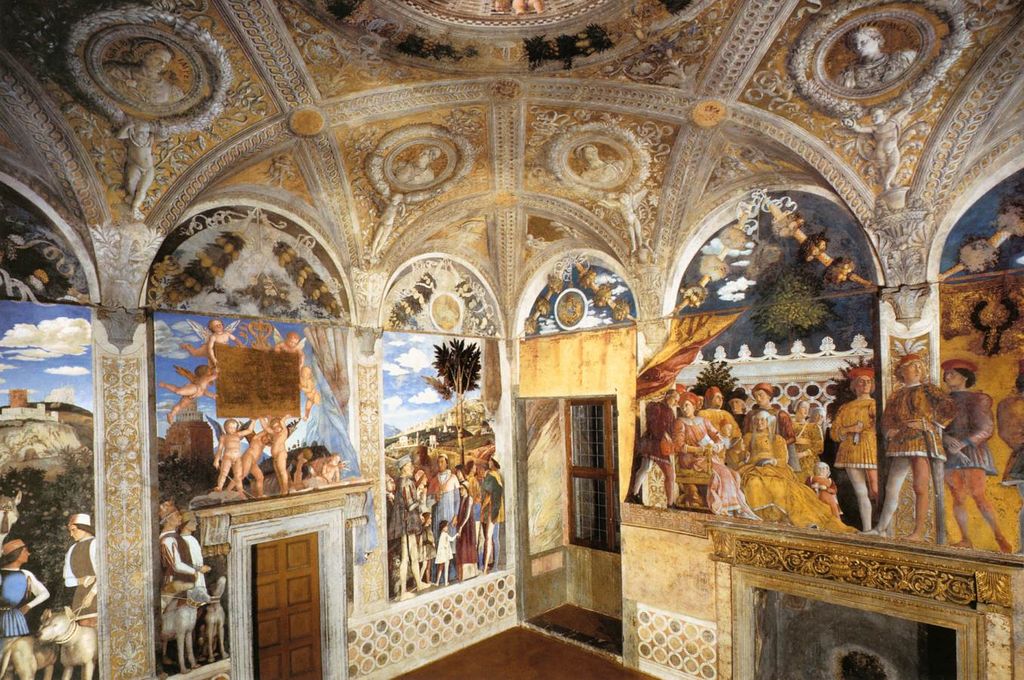
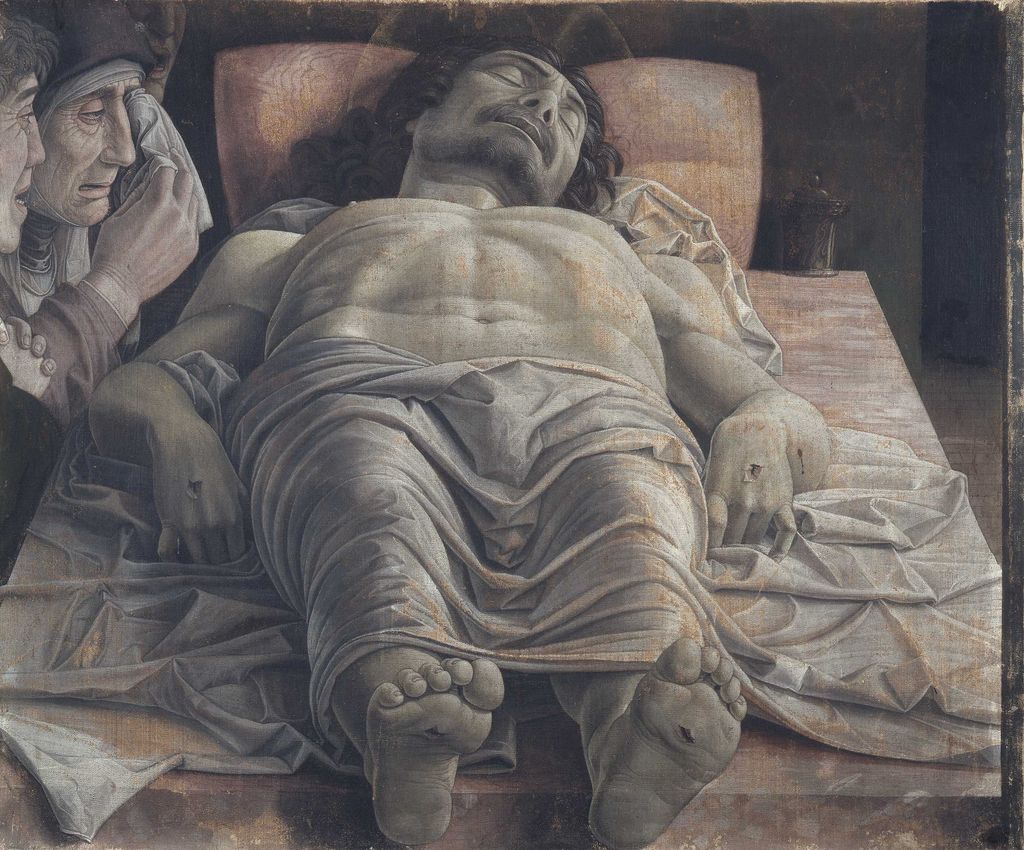
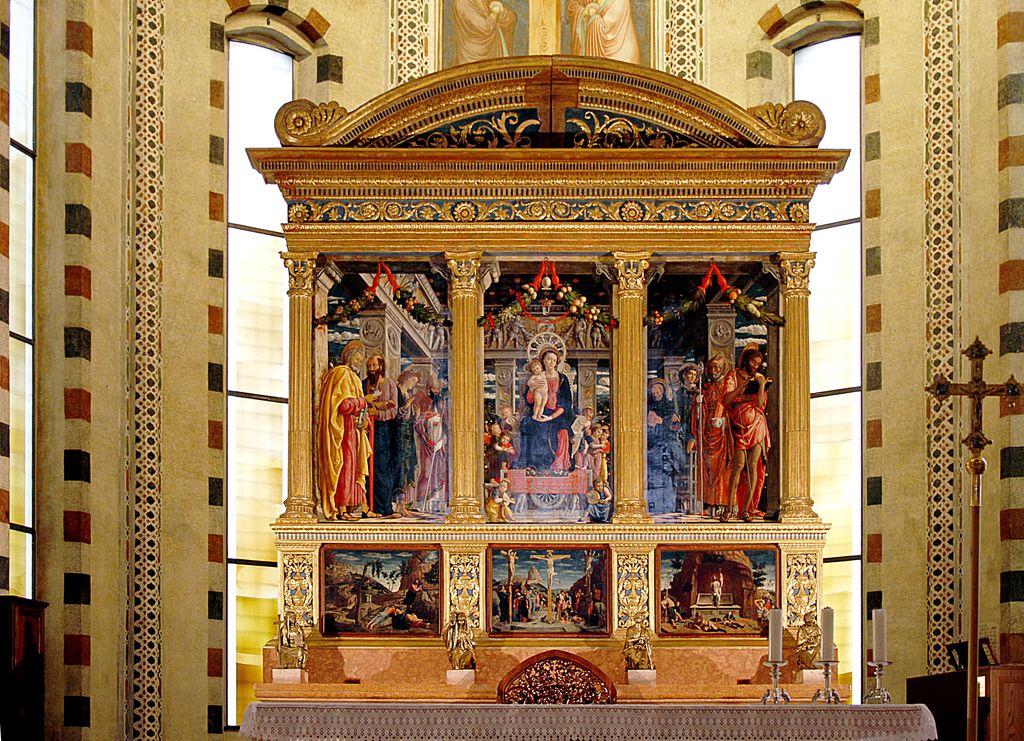
San Zeno Altarpiece
The San Zeno Altarpiece in its frame, Basilica of San Zeno, Verona José Luiz. Image source. CC BY-SA 4.0. Resized from the cited image.