 by Tom Gurney
Tom Gurney BSc (Hons) is an art history expert with over 20 years experience
Published on June 19, 2020 / Updated on November 29, 2026
Email: tomgurney1@gmail.com / Phone: +44 7429 011000
Overview
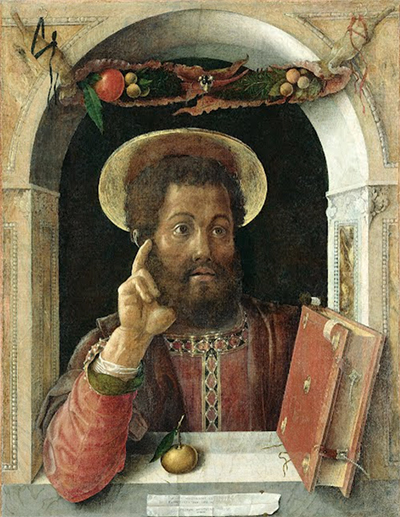
A red book juts past the edge of a stone sill in Andrea Mantegna’s St Mark the Evangelist. Above it, a bearded man props his head on his right hand and looks past us. The book comes almost within reach, but the man’s attention is elsewhere. That combination of physical nearness and an elusive gaze gives an unusually intimate character to this early Renaissance devotional image. [1] [2]
The Städel Museum in Frankfurt am Main dates the painting to about 1448–1451. The museum acquired it in 1867 and catalogues it as mixed technique on canvas, inventory number 1046. Canvas was an unusual choice for a painting of this kind at the time. The surface nevertheless makes a persuasive stone window, complete with enough room for a man to lean on it and a book to tip towards us. [1] [2]
At a Glance
- ArtistAndrea Mantegna
- DateAbout 1448–1451 (Städel Museum dating)
- MediumMixed technique on canvas
- CollectionStädel Museum, Frankfurt am Main
- Inventory number1046
Andrea Mantegna in context
Saint Mark the Evangelist
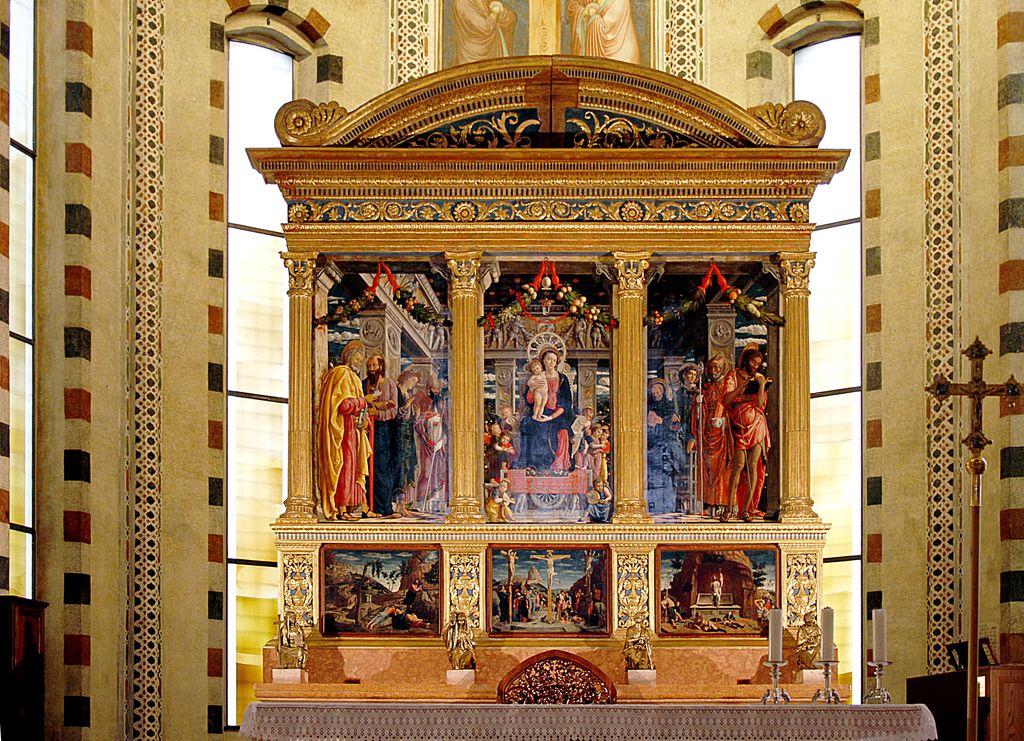
C. 1448–51 [1]San Zeno Altarpiece
1457–59 [12]The Triumphs of Caesar
Mid-1480s–before 1506 [14]Madonna della Vittoria
1495–96 [15]A window with room to lean
The arch and the sill establish two very different kinds of space. Across the bottom, the upper surface of the veined stone is broad enough for Mark to rest his elbow. Higher up, the darkness behind him gives away almost nothing about the room. The figure fills the aperture, and the dark ground makes it easier to follow the contour of his cheek, beard and shoulders. The frame provides the depth that the background withholds. [1] [2]
Mark’s right arm gives the window its first practical use. Follow the line from his temple down to his elbow and the pose becomes a small demonstration of weight. The folds in the purple mantle gather around the bent arm, while the red garment gives the torso a warmer, more continuous shape. His lips are slightly parted, and his eyes look beyond the viewer. The pose can suggest a pause in thought or speech. Mantegna leaves the reason for it open, giving us a distinct person to look at within a familiar image of a saint. [1] [2]
The hanging garland gives the stonework an outer face as well as an inner edge. Its foliage and fruit sit in front of the arch, where they interrupt the sweep of the masonry. Mark is farther back, within the opening, although his elbow and sleeve come forward to the sill. The illusion depends on overlaps a viewer can read in an instant. It also depends on the pleasure of looking more slowly, as the varied surfaces of stone, leaves, cloth and skin begin to register. The Städel connects that attention to different textures and reflective surfaces with Mantegna’s study of early Netherlandish oil paintings. Its account of his visual sources sits alongside its description of the work’s own mixed technique. [1] [2]
A closed Gospel and a piece of fruit
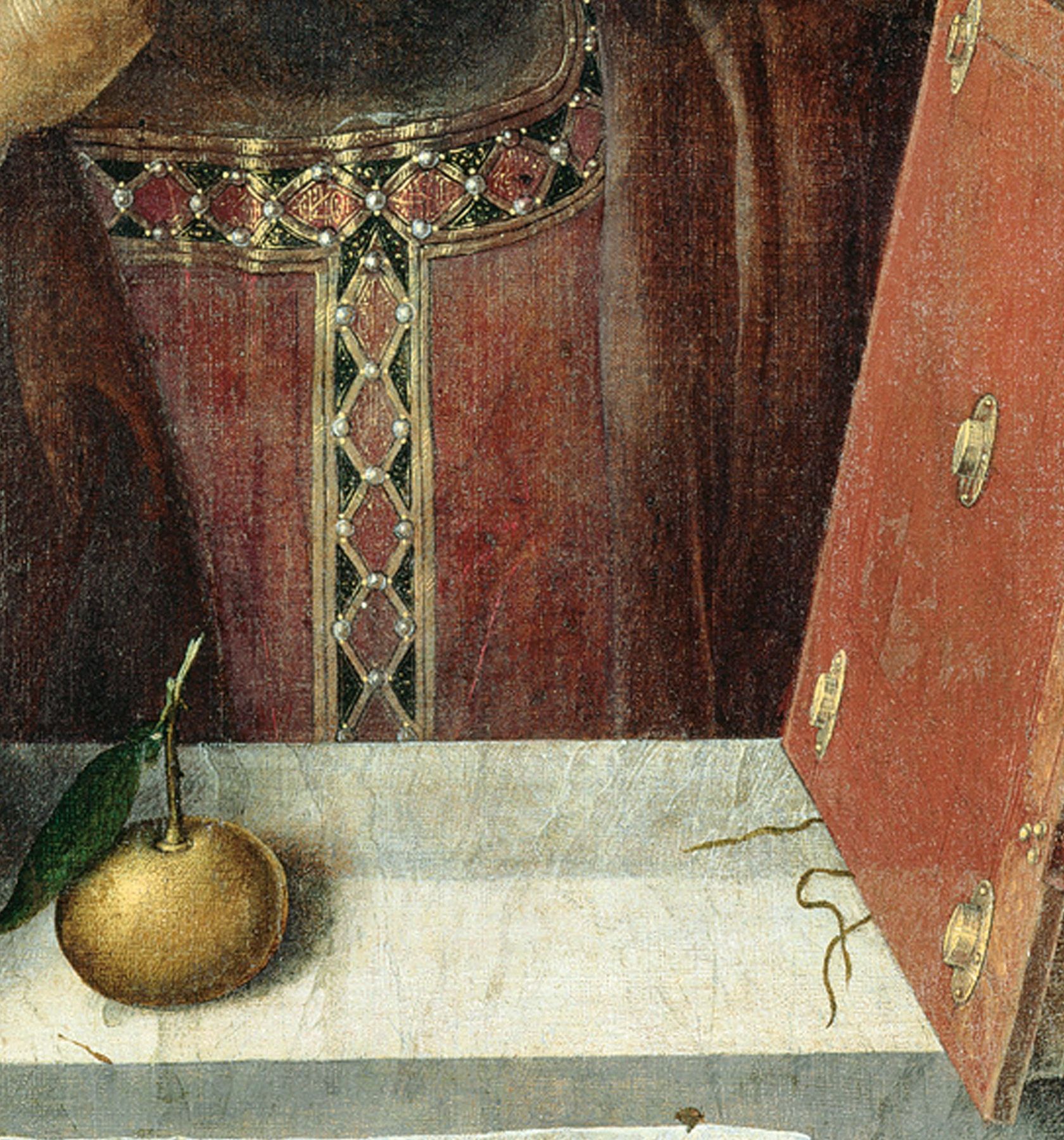
At the lower left, a corner of the red-bound volume reaches beyond the front edge of the sill. The diagonal of the binding and the thickness of the page block make the book seem like something that could be picked up. The account accompanying the Städel’s 2009 exhibition identifies it as Mark’s Gospel. Because it is closed, it identifies the evangelist by his work as a writer while leaving his face and posture free to suggest what he might be thinking. [1] [2] [3]
The single fruit on the sill gives the eye a different way to judge depth. The book does it with edges that recede. The fruit does it with a rounded surface tipped towards the viewer. Its foreshortening is easy to miss precisely because the object looks so ordinary. Notice how little room it takes up beside the massive book and the strong diagonal of Mark’s arm. The small object helps establish the width of a ledge that the much larger body can plausibly lean on. The museum’s subject index classifies it as an apple, and the exhibition’s English account calls it a lemon. Its placement and angle are the clearest evidence of what it does in the composition. [1] [2]
The fruit above and the fruit below also help distinguish the parts of the opening. In the garland, fruit belongs to something suspended against the arch. On the sill, the loose fruit has the same support as the Gospel and the evangelist’s arm. The two positions make the window feel built for use. The frame can carry something, cast a shadow, and place different objects at different distances from our eyes. [1] [2]
The painter’s name and the date
A small painted slip of paper, known as a cartellino, appears on the face of the parapet below the book. It has a different orientation from the objects on the sill. Its writing faces outward, so the viewer who has been looking into the window is invited to read the front of it. The Städel’s German catalogue transcribes the partly legible Latin and records a phrase crediting Andrea Mantegna with the work. The surviving text supplies no year. [1] [3]
The signature itself once formed part of the argument over who painted the picture. In the Städel’s 1900 catalogue, Heinrich Weizsäcker assigned it to Francesco Bonsignori, judging the inscription to be later than the painting. The 1992 cleaning brought the quality of the painting back into view and helped secure its acceptance as an early work by Mantegna himself. The Louvre’s retrospective dated the same Frankfurt painting to 1447–about 1448, slightly earlier than the Städel’s present range. Both assessments place it near the start of his career. [4] [5] [6]
A second phrase on the slip, Pax tibi Marce, means “Peace to you, Mark.” Art historian Debra Pincus reads it as a reference to the Venetian legend that Christ promised Mark, during his lifetime, that Venice would be his final resting place. She links that greeting and the intimate presentation of the saint to Venetian devotional icons and proposes a private commission in a politically influential, humanist circle. The inscription gives the proposal a foothold in the painting. The Städel’s published provenance has gaps before the work’s documented passage from the Salamanca collection through a Paris auction to Frankfurt in 1867, so the original owner and setting remain open questions. [1] [3] [5]
The picture was also revised as it was being made. The Städel’s 2009 exhibition, curated by Gabriel Dette, reported that X-rays and infrared reflectography had revealed a substantial revision beneath the visible paint. The revision leaves open what setting the first composition was intended for. Pincus’s reading begins with the picture as it survives, where the window brings Mark close enough for the greeting to feel like something spoken in his presence. [2] [5]
An early experiment in Padua
The years around 1450 were a period of rapid change in Mantegna’s career. Treccani records him as a painter and the adopted son of Francesco Squarcione in a Paduan document of 1445. By 1448, when he sought arbitration over his financial arrangements with Squarcione, he was undertaking independent work and was named alongside Nicolò Pizzolo in the commission to decorate the Ovetari Chapel in Padua’s Eremitani church. Those records place the painting in the period when Mantegna was establishing himself professionally. [1] [7]
The Louvre’s exhibition connected Mark’s half-length figure to Donatello’s compositions in relief and suggested Pizzolo’s painted Church Fathers in the Ovetari Chapel as a possible comparison for the saint’s serious, absorbed presence. Look at how Mark’s shoulder and bent arm come out of the dark. The stonework confines the figure, and at the same time it makes his volume easier to see, much as the edge of a relief gives the eye a limit against which to measure projection. The painted sleeve and the book can appear to go a little farther than that edge. [1] [6]
What the ledge does in three paintings
A later example is the San Luca Altarpiece at the Pinacoteca di Brera, commissioned in 1453 for the chapel of St Luke in Santa Giustina, Padua. Luke is seated at a lectern, actively writing, and the saint’s place within the altarpiece is part of the meaning of the image. Brera points out that a single foreshortened platform runs through the lower register, giving figures in separate gold-backed compartments a common footing. The original physical frame is lost. Brera proposes that its projecting architecture would have reinforced the impression of saints seen in an elevated arcade. In Frankfurt the single painted sill makes one writer seem close enough to touch. In Milan a continuous platform helps bring a company of saints together. [8] [9]
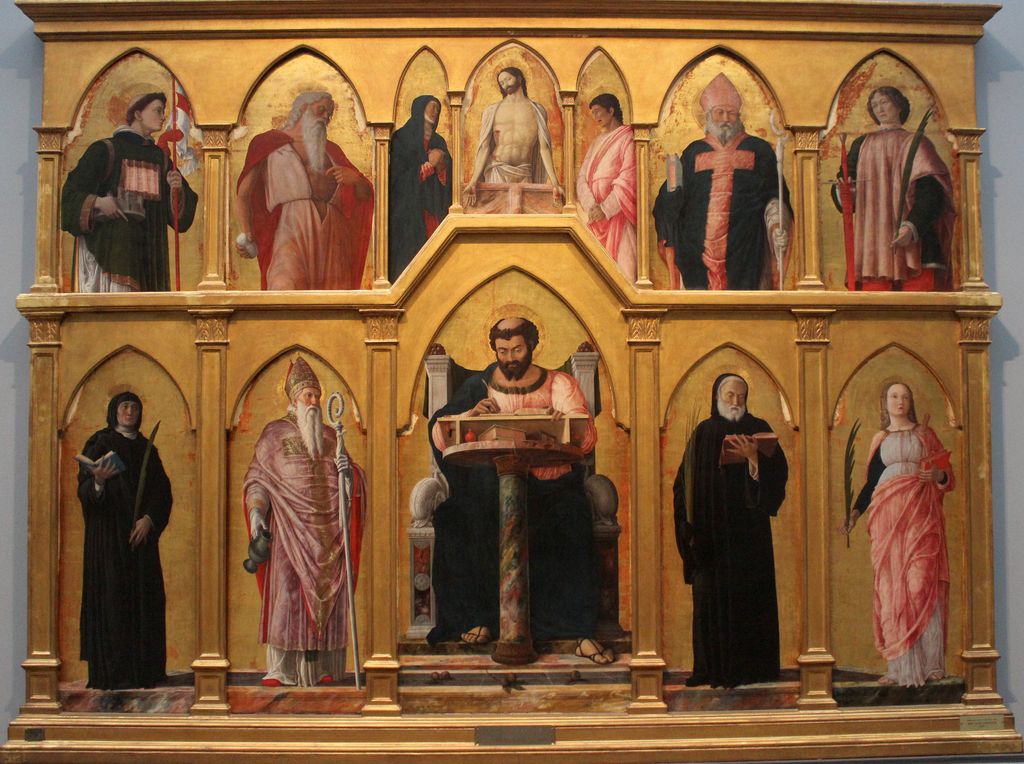
The San Luca Altarpiece, Pinacoteca di Brera Image source. Public domain.
The painted frame returns more directly in the Berlin Gemäldegalerie’s Presentation at the Temple, dated about 1454. There, the swaddled Christ stands on a cushion resting on the lower edge of the fictive marble frame. Mary’s elbow rests there too. In both works, an elbow makes the bottom of the picture behave like a solid shelf. The Berlin museum compares the Presentation with Donatello’s Pazzi Madonna, a marble relief in which the sides of a carved recess give depth to the intimate encounter between mother and child. Mantegna uses the same kind of narrow opening to bring a whole exchange within reach. Our eyes follow Mary’s arm from the ledge to the child she is holding and then to Simeon’s outstretched hands. In Frankfurt the figure has come to rest at the window. In Berlin the window gives us a place to stand while the action unfolds. [1] [10] [11]
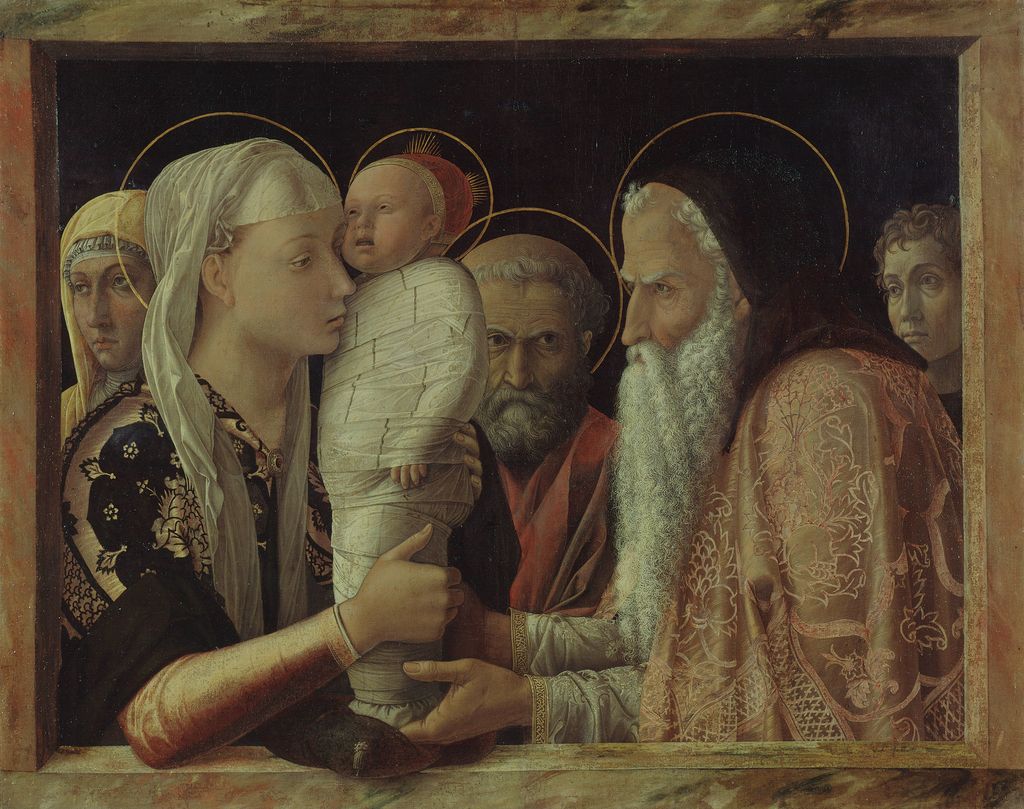
The Presentation at the Temple, Gemäldegalerie, Berlin Image source. Public domain.
Annotated Details from Saint Mark the Evangelist
The numbered points identify details to look at closely. The detail images below preserve the native scale of the selected crops.
Saint Mark the Evangelist
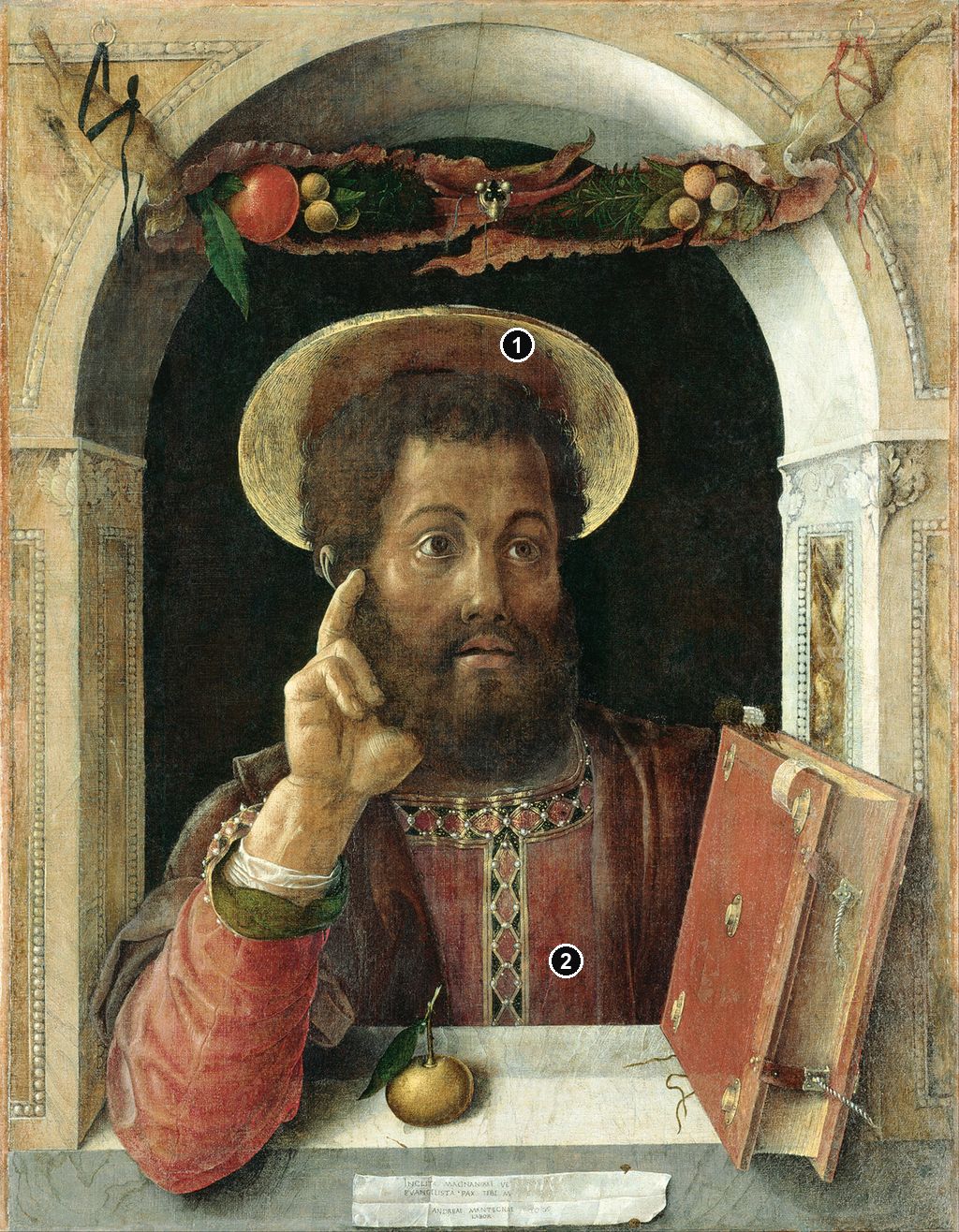
Details from SAINT MARK THE EVANGELIST
Choose a detail to enlarge it.
Saint Mark the Evangelist
The painted opening
The light-coloured arch sets off the head and surrounding darkness. Its depth helps turn a flat surface into a threshold.
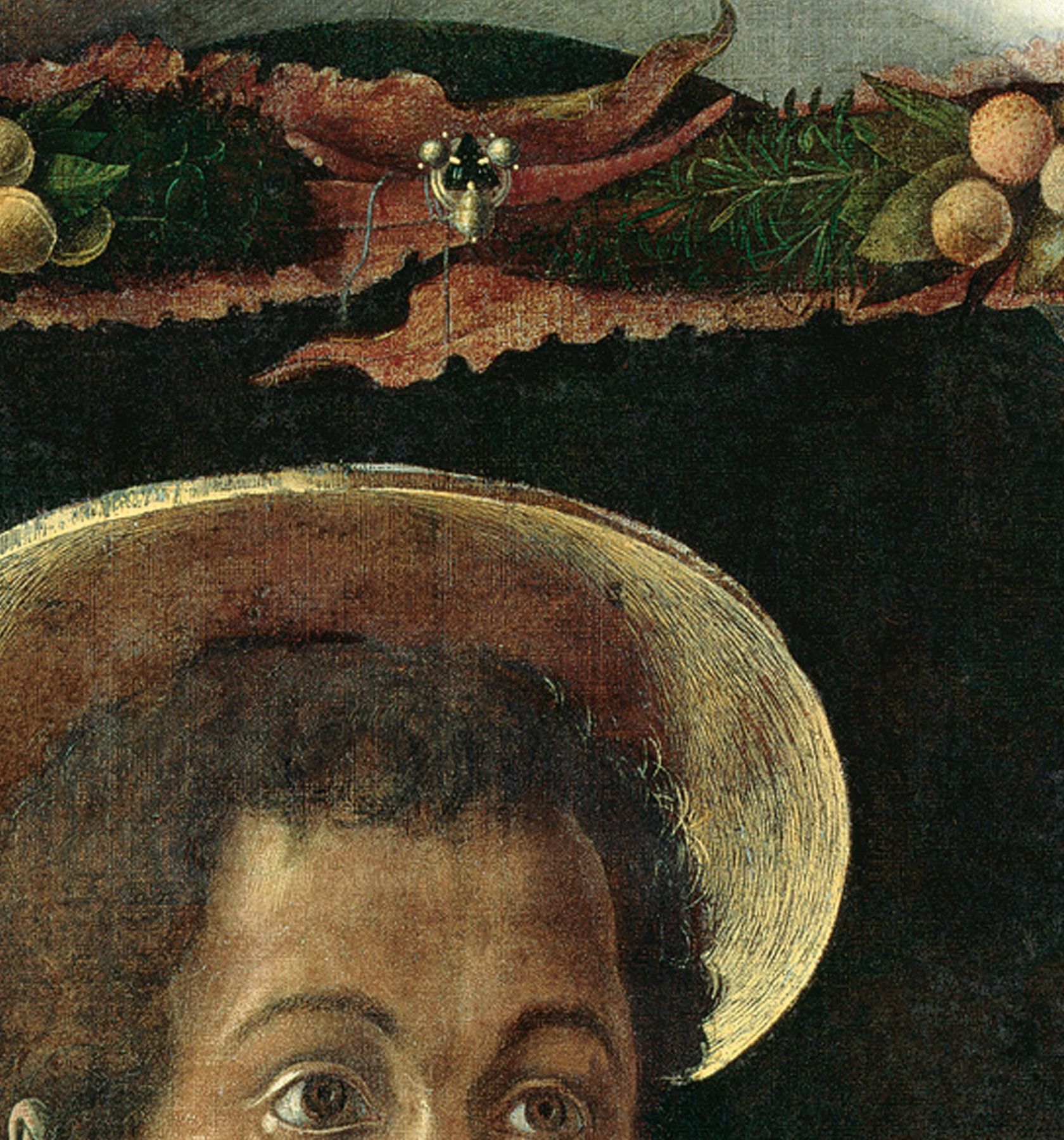
Book and fruit at the ledge
The book shows a sharply angled edge near the ledge. The small fruit supplies a second cue to the boundary with the viewer.
Artworks directory
| Name | Date | Medium and collection |
|---|---|---|
| The Adoration of the Shepherds | Shortly after 1450 | Painting · Metropolitan Museum of Art · 32.130.2 Catalogue. |
| Saint Mark the Evangelist | C. 1448–51 | Painting · Städel Museum · 1046 Catalogue. |
| Saint Jerome Penitent in the Desert | C. 1448–51 | Painting · Museu de Arte de São Paulo · MASP.00015 Catalogue. |
| Martyrdom and Transport of the Body of Saint Christopher | Mid-1450s | Painting · Ovetari Chapel, Padua Catalogue. |
| San Luca Altarpiece | 1453–55 | Painting · Pinacoteca di Brera · 176 Catalogue. |
| The Presentation of Christ at the Temple | 1454 (Berlin dating) | Painting · Gemäldegalerie, Berlin · 29 Catalogue. |
| San Zeno Altarpiece | 1457–59 | Painting · Basilica of San Zeno, Verona Catalogue. |
| The Crucifixion | 1456–59 | Painting · Musée du Louvre · INV 368 Catalogue. |
| The Agony in the Garden (London) | C. 1455–56 | Painting · National Gallery, London · NG1417 Catalogue. |
| The Agony in the Garden (Tours) | 1459 (Tours dating) | Painting · Musée des Beaux-Arts de Tours · 1803-1-24 Catalogue. |
| The Resurrection | 1459 (Tours dating) | Painting · Musée des Beaux-Arts de Tours · 1803-1-25 Catalogue. |
| Saint Sebastian (Vienna) | C. 1457–59 | Painting · Kunsthistorisches Museum · GG 301 Catalogue. |
| Cardinal Ludovico Trevisan | C. 1459–60 (Berlin exhibition dating) | Painting · Gemäldegalerie, Berlin · 9 Catalogue. |
| The Death of the Virgin | C. 1462 | Painting · Museo Nacional del Prado · P000248 Catalogue. |
| Christ with the Soul of the Virgin | C. 1460–64 | Painting · Pinacoteca Nazionale, Ferrara Catalogue only. |
| Portrait of a Young Man (traditionally Francesco Gonzaga) | C. 1461 or 1470, depending on sitter | Painting · Museo di Capodimonte · Q 60 Catalogue. |
| Portrait of a Prelate (Carlo de’ Medici?) | C. 1465–70 | Painting · Uffizi Galleries · 1890 no. 8540 Catalogue. |
| Portrait of a Man | C. 1470 | Painting · National Gallery of Art, Washington · 1952.2.5 Catalogue. |
| Madonna with Sleeping Child (Berlin) | C. 1455–60 | Painting · Gemäldegalerie, Berlin · S.5 Catalogue. |
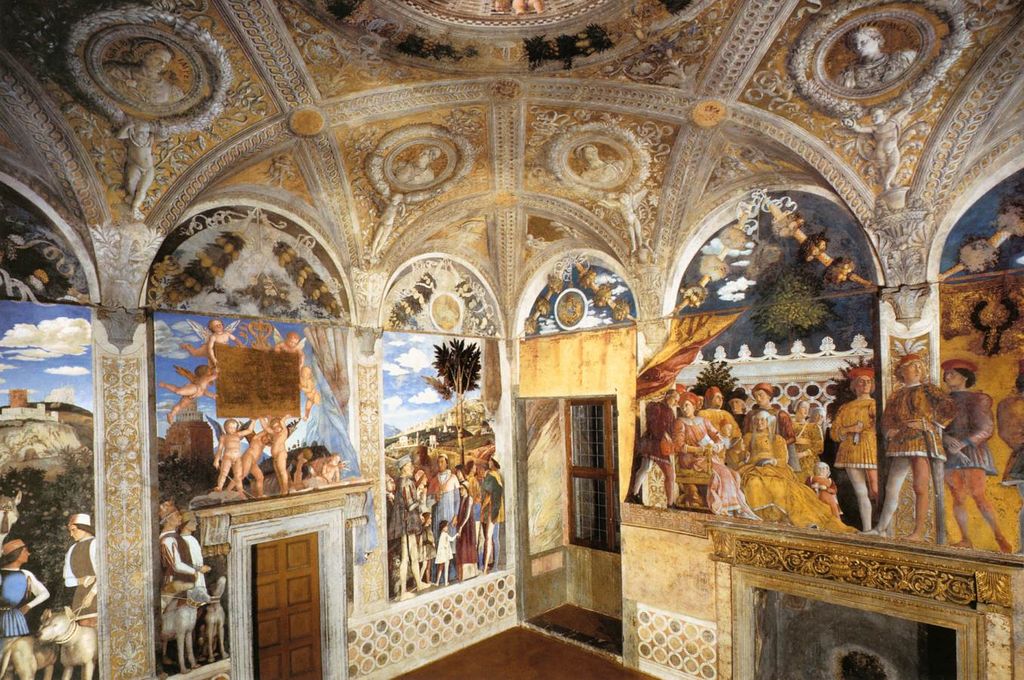
| Camera degli Sposi (Camera Picta) | 1465–74 | Painting · Palazzo Ducale, Mantua Catalogue. |
| Saint Sebastian (Louvre) | Around 1480 | Painting · Musée du Louvre · RF 1766 Catalogue. |
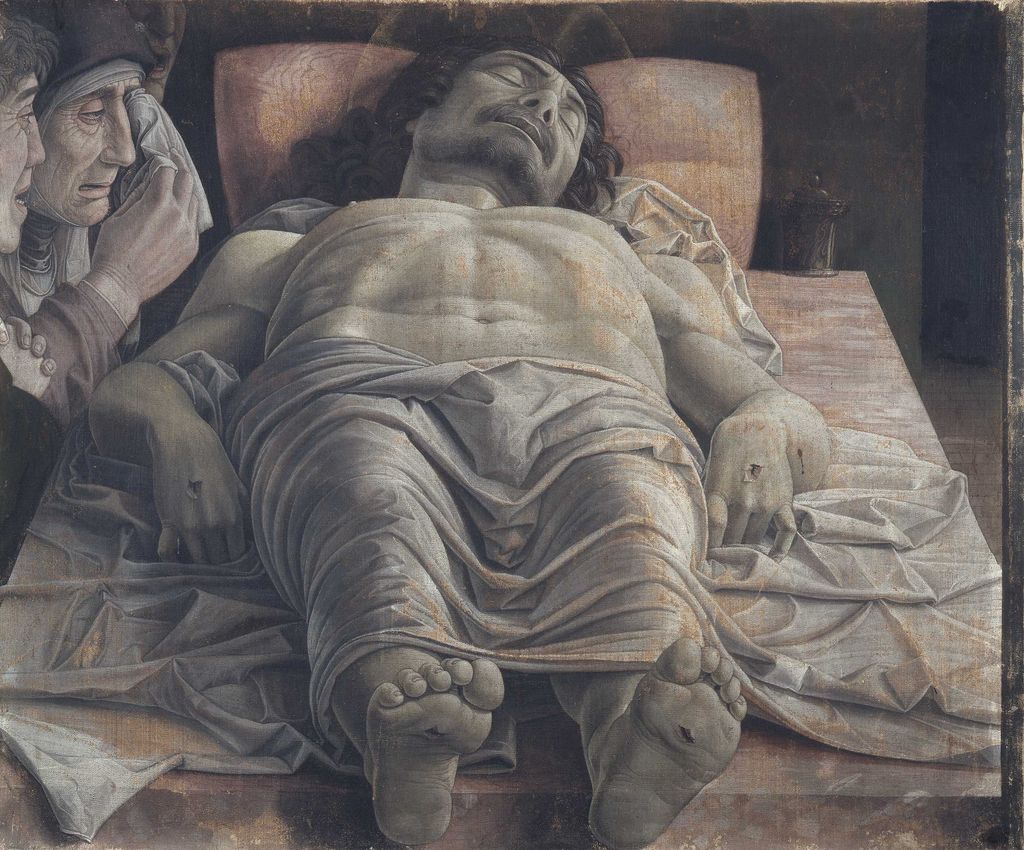
| Lamentation over the Dead Christ | C. 1483 (Brera dating) | Painting · Pinacoteca di Brera · 352 Catalogue. |
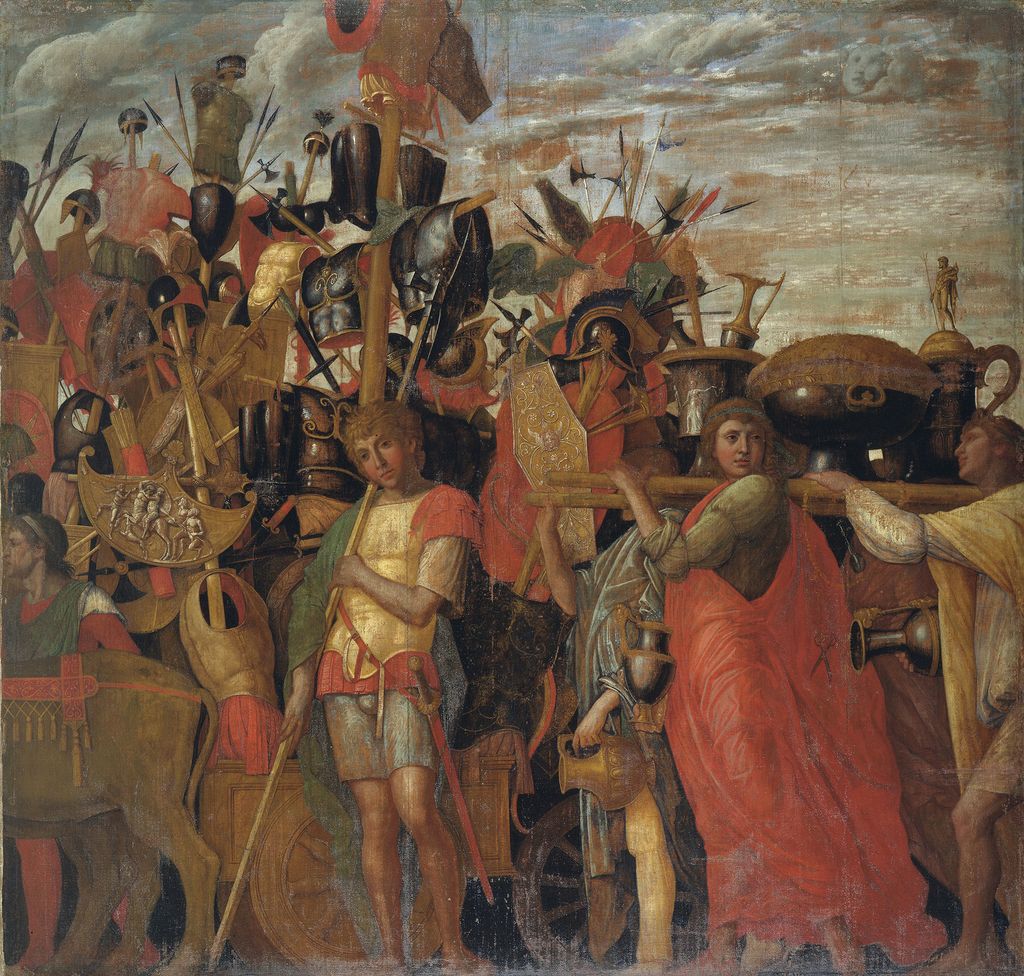
| The Triumphs of Caesar | About 1485–1506 | Painting · Royal Collection · RCIN 403958–403966 Catalogue. |
| Madonna of the Caves | C. 1488–90 | Painting · Uffizi Galleries · 1890 no. 1348 Catalogue. |
| Madonna and Child with a Choir of Cherubim | C. 1485 | Painting · Pinacoteca di Brera · 297 Catalogue. |
| Madonna and Child (Poldi Pezzoli) | Early 1490s (museum dating) | Painting · Museo Poldi Pezzoli · 1595 Catalogue. |
| The Holy Family with Saint Mary Magdalen | C. 1495–1500 | Painting · Metropolitan Museum of Art · 14.40.643 Catalogue. |
| The Virgin and Child with Saint Mary Magdalene and Saint John the Baptist | C. 1490–1505 | Painting · National Gallery, London · NG274 Catalogue. |
| Christ as the Suffering Redeemer | 1485–95 (SMK dating) | Painting · Statens Museum for Kunst · KMSsp69 Catalogue. |
| Ecce Homo | C. 1500 | Painting · Musée Jacquemart-André · MJAP-P 1840 Catalogue. |
| Judith with the Head of Holofernes (Mantegna or follower) | C. 1495–1500 | Painting · National Gallery of Art, Washington · 1942.9.42 Catalogue. |
| Madonna della Vittoria | 1495–96 | Painting · Musée du Louvre · INV 369 Catalogue. |
| Mars and Venus (Parnassus) | C. 1496–97 | Painting · Musée du Louvre · INV 370 Catalogue. |
| The Trivulzio Madonna | 1497 | Painting · Castello Sforzesco, Milan · 0554 Catalogue. |
| The Adoration of the Magi | C. 1495–1505 | Painting · J. Paul Getty Museum · 85.PA.417 Catalogue. |
| Minerva Expelling the Vices from the Garden of Virtue | C. 1502 | Painting · Musée du Louvre · INV 371 Catalogue. |
| The Introduction of the Cult of Cybele at Rome | 1505–06 | Painting · National Gallery, London · NG902 Catalogue. |
| Saint Sebastian (Venice) | Probably c. 1504–06 | Painting · Galleria Giorgio Franchetti alla Ca’ d’Oro · D.11 Catalogue. |
| Samson and Delilah | C. 1500 | Painting · National Gallery, London · NG1145 Catalogue only. |
| A Woman Drinking (probably Sophonisba) | C. 1495–1506 | Painting · National Gallery, London · NG1125.2 Catalogue only. |
| The Vestal Virgin Tuccia with a Sieve | C. 1495–1506 | Painting · National Gallery, London · NG1125.1 Catalogue only. |
| Judith with the Head of Holofernes (Dublin) | C. 1495–1500 | Painting · National Gallery of Ireland · NGI.442 Catalogue only. |
| Battle of the Sea Gods, left half (Met impression) | Before 1481 (Met dating) | Print · Metropolitan Museum of Art · 18.12 Catalogue only. |
| Battle of the Sea Gods, right half (Met impression) | Before 1481 (Met dating) | Print · Metropolitan Museum of Art · 1984.1201.4 Catalogue only. |
| Battle of the Sea Gods, left half (Tokyo impression) | C. 1475 (Tokyo dating) | Print · National Museum of Western Art, Tokyo · G.1981-0002 Catalogue only. |
| Battle of the Sea Gods, left half (Washington impression) | C. 1485–88 (NGA dating) | Print · National Gallery of Art, Washington · 1941.1.6 Catalogue only. |
| The Entombment of Christ, second state of two | Before 1475 (Met dating) | Print · Metropolitan Museum of Art · 37.42.30 Catalogue only. |
| The Entombment of Christ (possibly Zoan Andrea, after Mantegna) | 1460–1549 (Rijksmuseum dating) | Print · Rijksmuseum · RP-P-1924-60 Catalogue only. |
| Four Dancing Muses (Gian Marco Cavalli after Mantegna) | C. 1497 | Print · Metropolitan Museum of Art · 20.5.3 Catalogue only. |
| Bacchanal with Silenus | Before 1475 (Met dating) | Print · Metropolitan Museum of Art · 29.44.15 Catalogue only. |
| Bacchanal with a Wine Vat | Before 1475 (Met dating) | Print · Metropolitan Museum of Art Catalogue only. |
| St James on His Way to Execution | C. 1453–57 | Drawing · British Museum · 1976,0616.1 Catalogue only. |
| Three Studies for a Dead Christ | C. 1455–65 | Drawing · British Museum · 1909,0406.3 Catalogue only. |
| Pietà (Venice) | C. 1456–65 (exhibition datings) | Drawing · Gallerie dell’Accademia, Venice · 115 Catalogue only. |
| Studies for Christ at the Column | 1460–65 | Drawing · The Courtauld · D.1978.PG.345 Catalogue only. |
| Virtus Combusta | C. 1490 (technical study) | Drawing · British Museum · Pp,1.23 Catalogue only. |
| Virtus Combusta (Giovanni Antonio da Brescia after Mantegna) | C. 1495–1506 | Print · Musée du Louvre · 3881 LR/ Recto Catalogue only. |
| The Calumny of Apelles | C. 1504–06 | Drawing · British Museum · 1860,0616.85 Catalogue only. |
Frequently Asked Questions
Mark’s body and the things on the sill occupy different depths. The ledge gives the viewer a precise boundary against which to judge how far the figure and objects approach.
The museum dates the painting to about 1448–51. The inscription supplies Mantegna’s name, while the date is an estimate from the work’s early context.
Discussion
Look again at the images and ideas explored in St Mark the Evangelist. These editorial prompts invite your observations.
Reader Insights
How do the overhanging Gospel, the foreshortened fruit and Mark’s elbow each help you judge the depth of the painted sill?
How does the same gesture of resting an elbow on painted stone shape the encounter with Mark in Frankfurt and the exchange between Mary and Simeon in the Berlin Presentation?
Join the Conversation
Share a detail, comparison or question about St Mark the Evangelist below.
References
- Städel Museum, St Mark the Evangelist. View source.
- Schering Stiftung, Focus on: Mark the Evangelist. View source.
- Städel Museum, Der Evangelist Markus. View source.
- Städel Museum, Zeitreise: St Mark the Evangelist, inventory no. 1046. View source.
- Debra Pincus, Mark Gets the Message: Mantegna and the Praedestinatio in Fifteenth-Century Venice. View source.
- Musée du Louvre, Mantegna retrospective: St Mark. View source.
- Treccani, Mantegna, Andrea, Dizionario Biografico degli Italiani. View source.
- Pinacoteca di Brera, Polittico di San Luca. View source.
- Ministero della Cultura, Polittico di San Luca: San Luca scrive il vangelo e Santi. View source.
- Gemäldegalerie, Staatliche Museen zu Berlin, Die Darbringung Christi im Tempel. View source.
- Skulpturensammlung, Staatliche Museen zu Berlin, Madonna und Kind (Die Pazzi Madonna). View source.
- Basilica of San Zeno, Verona, San Zeno Altarpiece, View source.
- Palazzo Ducale, Mantua, Camera degli Sposi (Camera Picta), View source.
- Royal Collection, The Triumphs of Caesar, View source.
- Musée du Louvre, Madonna della Vittoria, View source.
- National Gallery, London, The Introduction of the Cult of Cybele at Rome, View source.
More MANTEGNA Paintings
San Zeno Altarpiece
The San Zeno Altarpiece in its frame, Basilica of San Zeno, Verona José Luiz. Image source. CC BY-SA 4.0. Resized from the cited image.