 by Tom Gurney
Tom Gurney BSc (Hons) is an art history expert with over 20 years experience
Published on June 19, 2020 / Updated on November 29, 2026
Email: tomgurney1@gmail.com / Phone: +44 7429 011000
Overview
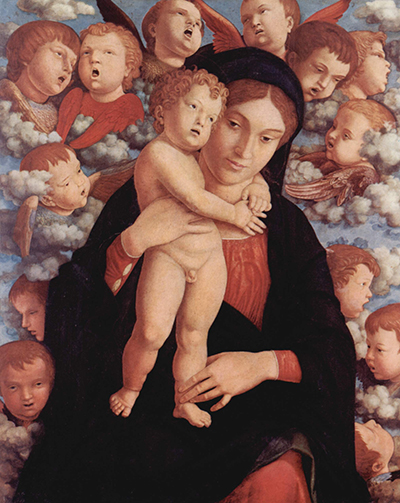
The Christ Child presses against Mary’s cheek and looks up. Around them, winged faces crowd between banks of cloud, some with their mouths wide open. Andrea Mantegna gives the pair the intimacy of an embrace and surrounds them with the suggestion of singing. The Pinacoteca di Brera in Milan dates its Madonna and Child with a Choir of Cherubim to about 1485. Painted in tempera on a wooden panel, it measures 88 × 70 cm and bears the museum’s inventory number 297. [1]
At a Glance
- DateAbout 1485
- MediumTempera on wooden panel
- Dimensions88 × 70 cm
- CollectionPinacoteca di Brera, Milan
- Inventory number297
Andrea Mantegna in context
San Zeno Altarpiece
1457–59 [10]The Triumphs of Caesar
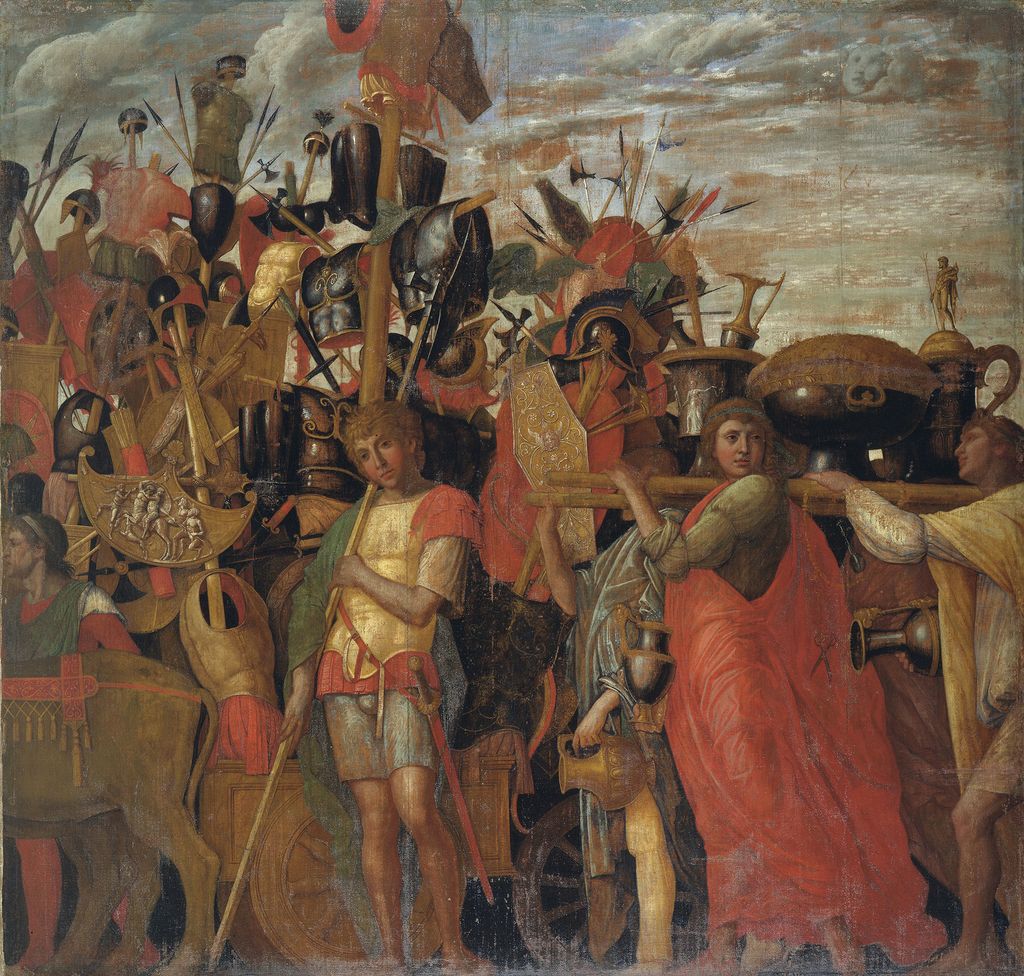
Mid-1480s–before 1506 [12]Madonna and Child with a Choir of Cherubim
C. 1485 [1]Madonna della Vittoria
1495–96 [13]How the choir frames the embrace
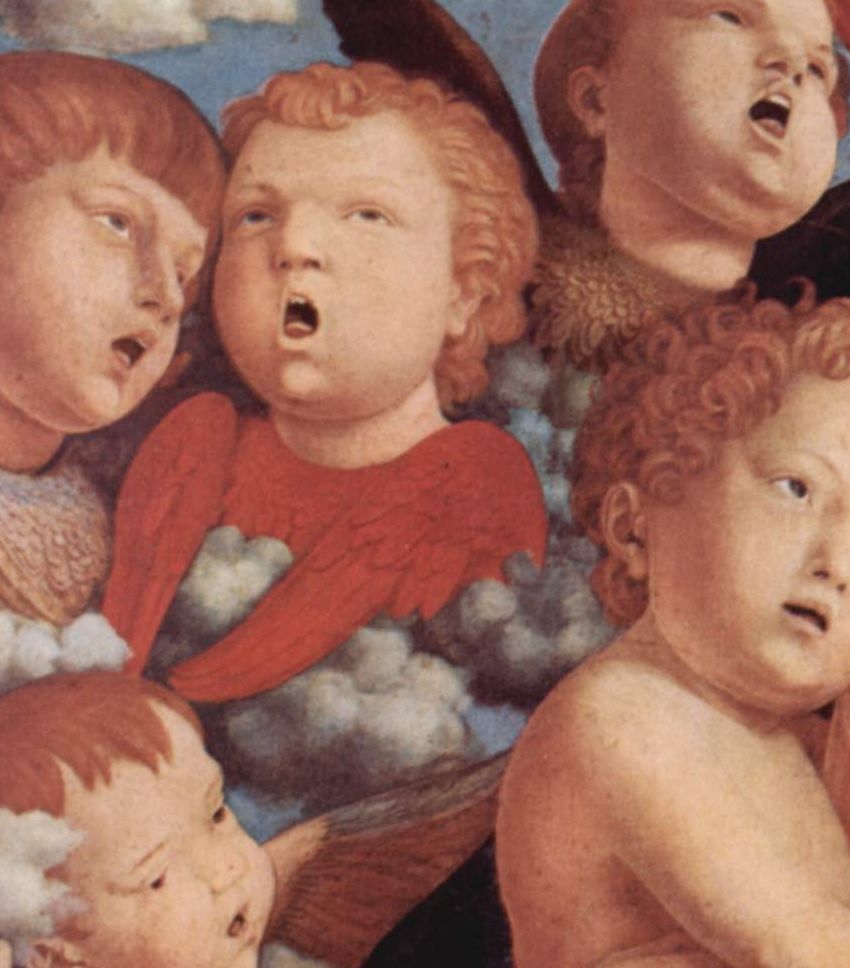
Start with the faces above Mary’s head. At the upper left, a round-faced singer opens its mouth into a small circle, while the head beside it turns at an angle, its lips parted. Near the top centre a singer tips its chin back, exposing the shadow inside its mouth. To the right of Mary’s hood one face inclines sharply downwards while another turns almost into profile. The changing angles and shapes of the mouths give the repeated heads the character of a choir. The painted faces make it easy to imagine several voices sounding at once. [1]
The frame is thickest at the top. Along the sides, the faces are spaced farther apart and broken up by clouds and by the widening silhouette of Mary’s cloak. At the lower left, a face looks out of the panel. Near the lower right, another tilts back and is partly hidden beside the mantle. Some faces and wing tips disappear at the edges; others emerge from soft grey or cream cloud. These partial appearances make the gathering feel larger than the painted surface. The clouds separate the faces just enough for each to register while holding them together as a continuous surround. [1]
The title names cherubim collectively. Brera identifies two orders in the picture, calling the red-winged figures cherubim and the blue-winged figures seraphim. That is the museum’s reading of this panel. Colour also helps a viewer follow the design. At the upper left, the red wings against the cool clouds pick up the red at Mary’s cuff and bodice. Across the middle, the blue sky and pearl-grey clouds give way almost abruptly to the deep blue of her cloak. Its broad, dark shape gives the Child’s pale legs and Mary’s supporting hand an especially clear outline. Even at the centre of a restless crowd, the hold of her hand is easy to see. [1]
The Metropolitan Museum of Art has a separate Mantegna called Madonna and Child with Seraphim and Cherubim. The Friedsam painting, dated by the Met to about 1454, is a much smaller, arched panel in tempera and gold. The recurrence of celestial attendants across the two paintings makes their similar names understandable. At Brera, the choir runs up against the edges of a larger rectangle, and the interlocking heads and clouds supply its own arch around Mary. [1] [2]
What the dark blue can tell us
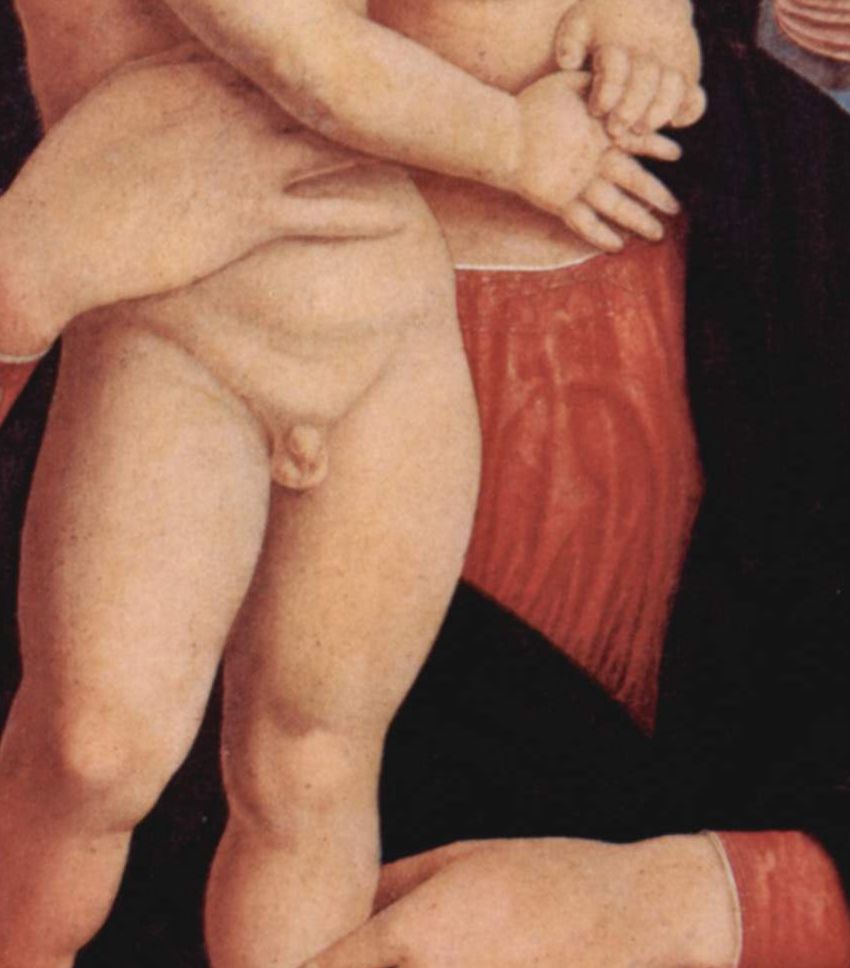
The force of the colour comes partly from the difference between the mantle and the air around it. Where the cloak curves around Mary’s head, its deep, almost black blue sets off the lighter blue of the sky and the warmer skin tones in quick succession. The flesh is modelled through more gradual transitions. Look at the Child’s highlighted shoulder and the soft shadow beneath his arm, then at the edge where his thigh meets the cloak. Mantegna uses both kinds of transition to make the central figures seem solid within a sky made up of shifting, partly obscured forms. [1]
Technical study gives that dark blue a material history. Letizia Bonizzoni and colleagues combined X-ray fluorescence and visible reflectance spectroscopy to examine layered paint. In the Brera panel they reported a thin layer of lapis lazuli over azurite, with lead white beneath. What registers at a glance as a single dark blue was built in layers in the passage they examined. The finding is specific to that area. A reproduction shows how the dark cloak sets off the lighter clouds, while the makeup of other passages or the panel’s first appearance would require further evidence. [3]
From a Venetian church to Brera
The panel reached Brera from Santa Maria Maggiore in Venice in 1808, following the Napoleonic suppressions. The Italian national catalogue gives the date as 7 September and identifies the panel as no. 67 in the Napoleonic inventory, where the cherubim distinguish it from another Virgin and Child. It also records a mark on the back naming Santa Maria Maggiore. There is a more unusual clue on the face of the panel. The catalogue links Pietro Edwards’s record of damage to the Child’s right thigh with its own observation that this area was extensively restored. The correspondence helps tie a historical description to a particular object. [1] [4]
The work entered Brera under Giovanni Bellini’s name. Brera points to the brilliance of the palette and the tenderness of Mary’s expression as reasons the attribution seemed plausible. Luigi Cavenaghi’s restoration in 1885 made it possible to recognise Mantegna’s hand, and the national catalogue credits Gustavo Frizzoni with making the new attribution in print. The shared motif helps explain how readily the names could be associated. At the Gallerie dell’Accademia in Venice, Giovanni Bellini’s Madonna of the Red Cherubim also gathers heads into a semicircle, with echoes between the red of the angels and Mary’s dress and between the white clouds and the garments. The Venetian museum sees both the Brera panel and a work by Bellini’s father Jacopo behind Giovanni’s use of the motif. [1] [4] [5]
The history before Venice is harder to establish. Brera considers the panel probably the picture Mantegna gave his friend Matteo Bosso, prior of the Badia at Fiesole. The identification, proposed by Henry Thode, rests on the resemblance to a work Giorgio Vasari described in the abbey library, with a half-length Virgin, the Child and angel heads. The national catalogue takes a more sceptical view. It notes a tension between Vasari’s account of where in Mantegna’s career he painted the Fiesole picture and the later style of the Brera panel. It also cites Raffaello Borghini’s report of a matching work at Fiesole in 1584 and distinguishes the Fiesole and Venetian references. A separate proposal by Frizzoni links the panel to a Madonna mentioned in a letter from Francesco Gonzaga to Eleonora d’Aragona in 1485. The letter’s broad description leaves room for other identifications. Brera’s approximate date accords with the late style noted in the national catalogue. The original recipient and setting remain open questions. [1] [4]
What changes when the choir falls away
At Brera, Mary’s eyes lower as the Child’s turn upward. His lips are parted like those of some of the angels. Meanwhile, her upper hand supports his body and her lower hand steadies his leg, drawing the eye from the crowded sky back to the physical act of holding him. For devotional viewing, the two directions of attention can coexist. The angels suggest praise, and the familiar care of a mother for her child gives the viewer somewhere close at hand to rest the eye. That reading begins with the gestures on the panel. Its original viewing conditions remain uncertain. [1] [4]
In Berlin’s Madonna with Sleeping Child, the outer curve of Mary’s cloak encloses the pair. Her bent head and the hand she cups around the sleeping infant make the embrace the frame’s most important contour. Katharina Weick-Joch, writing for the Gemäldegalerie, relates this concentrated arrangement to Donatello’s Madonna reliefs and suggests that sleep may allude to Christ’s death. She also notes that the painting’s muted appearance reflects changes over time, including abrasion of the red pattern on Mary’s cloak and later overpainting of the background visible at the edges. Berlin’s quiet comes through in the infant’s closed eyes and in the way Mary bends towards him. The dark background deepens that impression today. [6]
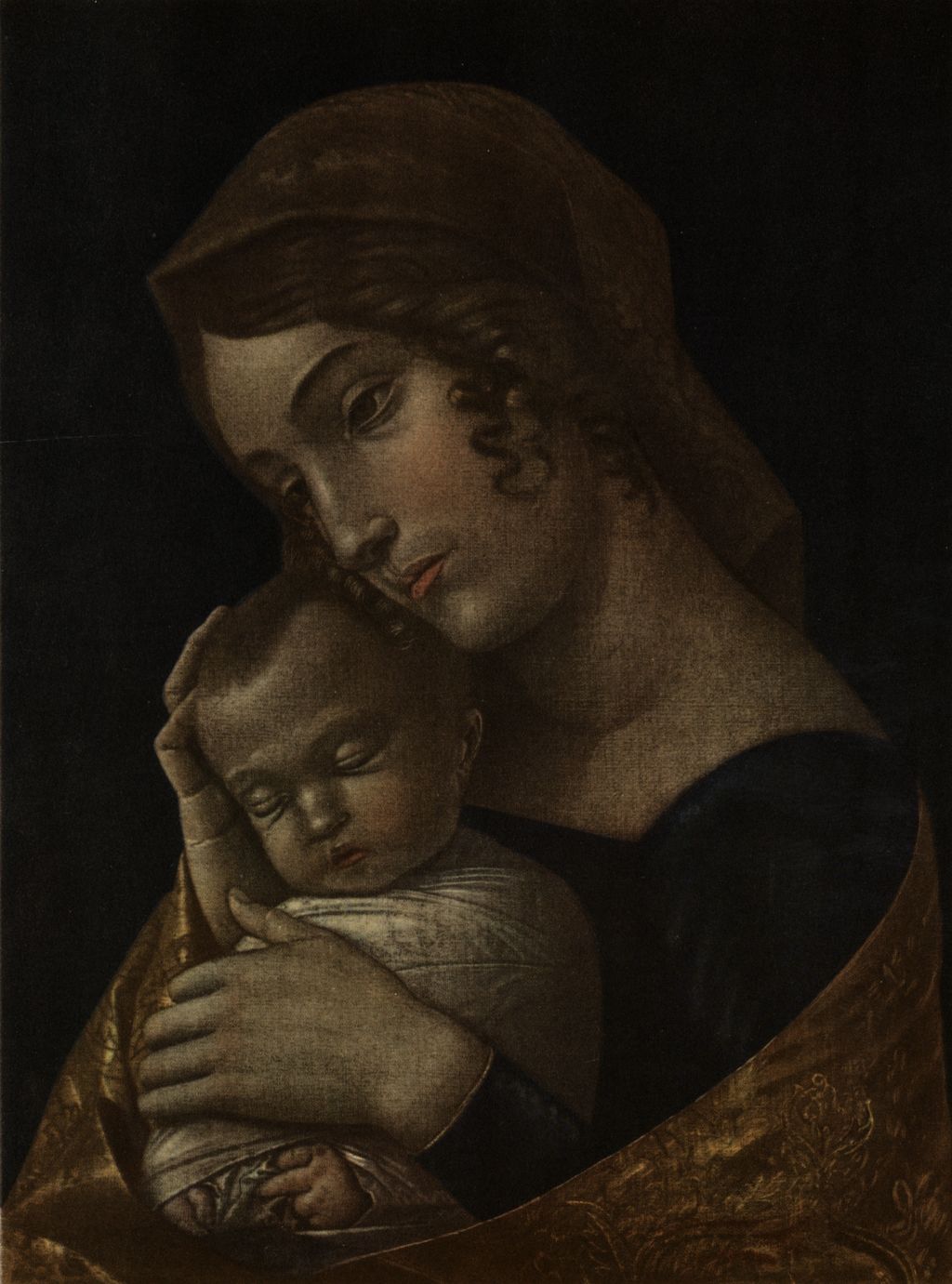
Madonna with Sleeping Child, Gemäldegalerie, Berlin Image source. Public domain.
In the Poldi Pezzoli Madonna, the enveloping mantle again makes the two figures a single compact form. The museum reads the possible doorway or window at the edges as a suggestion of depth and the white swaddling as a possible allusion to a shroud. The dark space also once carried words. During conservation, the Opificio delle Pietre Dure mapped surviving traces of gold to reconstruct a line from the Song of Songs, “I am black but beautiful.” The words are now legible through the reconstruction. The conservators also found original azurite beneath nineteenth-century repainting on the mantle. Removing the repainting and the darkened varnish made the distinction between cloak and background clearer. That boundary matters in both pictures. The Brera mantle separates an embrace from a host of singers, while the Poldi Pezzoli mantle sets a sleeping child apart from a field that once held a scriptural verse. [1] [7] [8]
The Altman Madonna, catalogued by the Met as The Holy Family with Saint Mary Magdalen, comes closer to Brera in the upright pose of the Child. Joseph and Mary Magdalen flank the mother and Child, and oranges and foliage fill the spaces between the haloes. The Child’s toes rest on a cushion, giving a clear foothold to the body that Mary is steadying. The two adults at the edges do much of the framing that clouds and angels do at Brera. The Met relates the Altman composition to Roman funerary reliefs, a comparison that draws attention to the close-set heads and their distinct directions of gaze. In the Altman painting, the eye moves sideways from one adult face to another. At Brera, it climbs from the Child’s upturned eyes into the gathering above Mary’s hood. [1] [9]
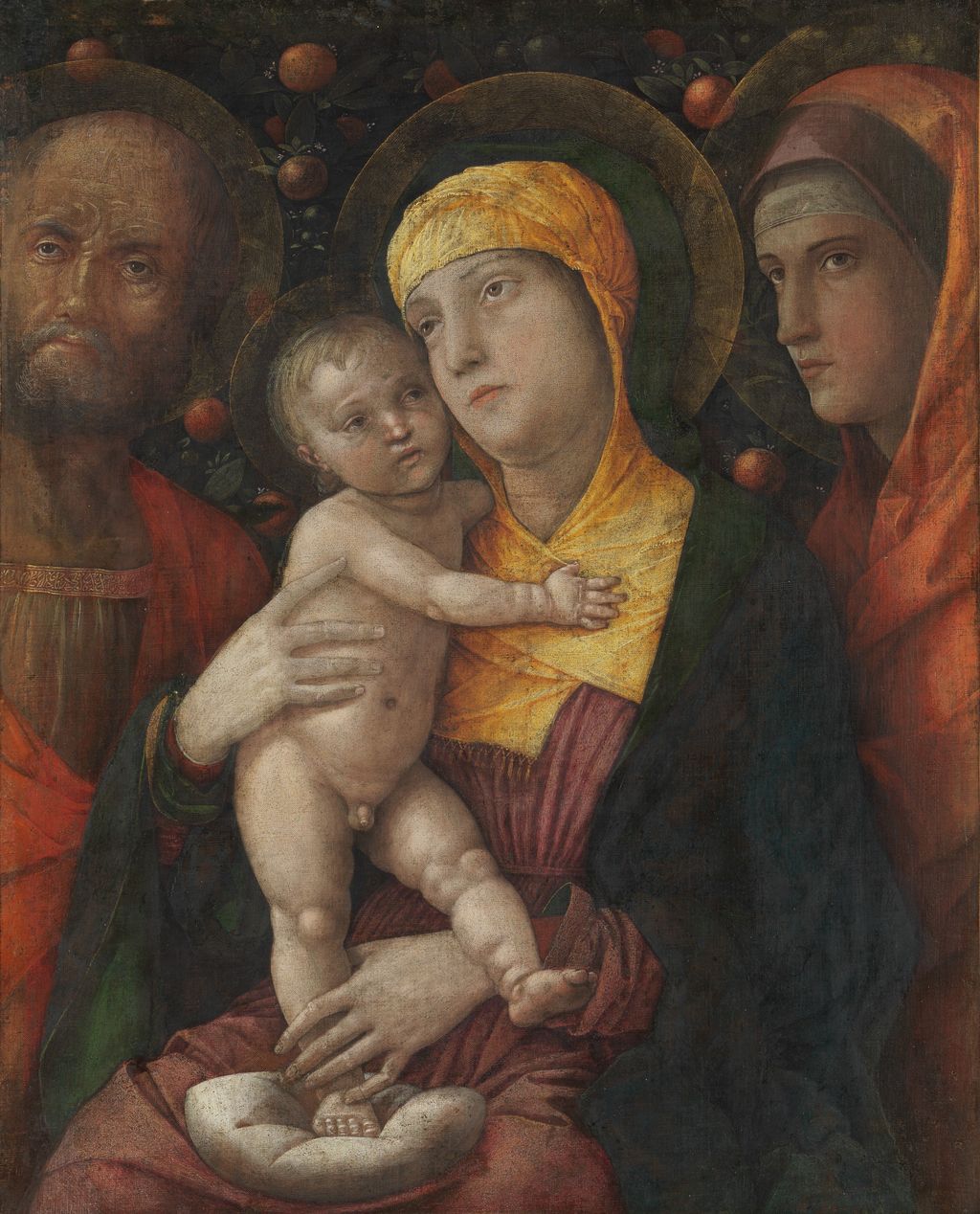
The Holy Family with Saint Mary Magdalen, Metropolitan Museum of Art Image source. CC0 / Public domain.
Annotated Details from Madonna and Child with a Choir of Cherubim
The numbered points identify details to look at closely. The detail images below preserve the native scale of the selected crops.
Madonna and Child with a Choir of Cherubim
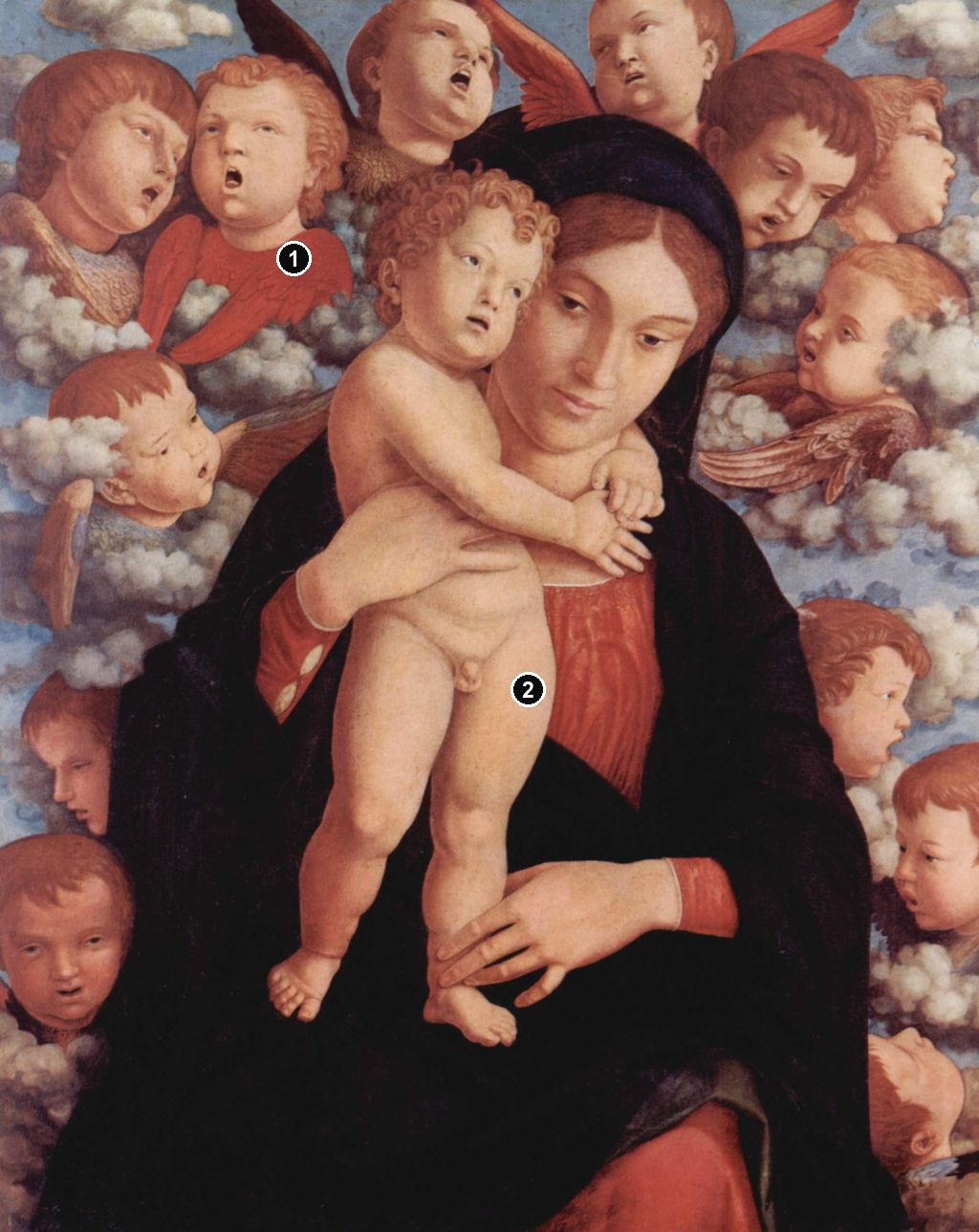
Details from MADONNA AND CHILD WITH A CHOIR OF CHERUBIM
Choose a detail to enlarge it.
Madonna and Child with a Choir of Cherubim
The surrounding choir
The heads cluster closely with shallow intervals of cloud between them. Individual turns keep the pattern from becoming uniform.
The child’s turned body
The infant’s shoulders and feet describe different angles. The Madonna’s hands steady the central figure within the encircling faces.
Artworks directory
| Name | Date | Medium and collection |
|---|---|---|
| The Adoration of the Shepherds | Shortly after 1450 | Painting · Metropolitan Museum of Art · 32.130.2 Catalogue. |
| Saint Mark the Evangelist | C. 1448–51 | Painting · Städel Museum · 1046 Catalogue. |
| Saint Jerome Penitent in the Desert | C. 1448–51 | Painting · Museu de Arte de São Paulo · MASP.00015 Catalogue. |
| Martyrdom and Transport of the Body of Saint Christopher | Mid-1450s | Painting · Ovetari Chapel, Padua Catalogue. |
| San Luca Altarpiece | 1453–55 | Painting · Pinacoteca di Brera · 176 Catalogue. |
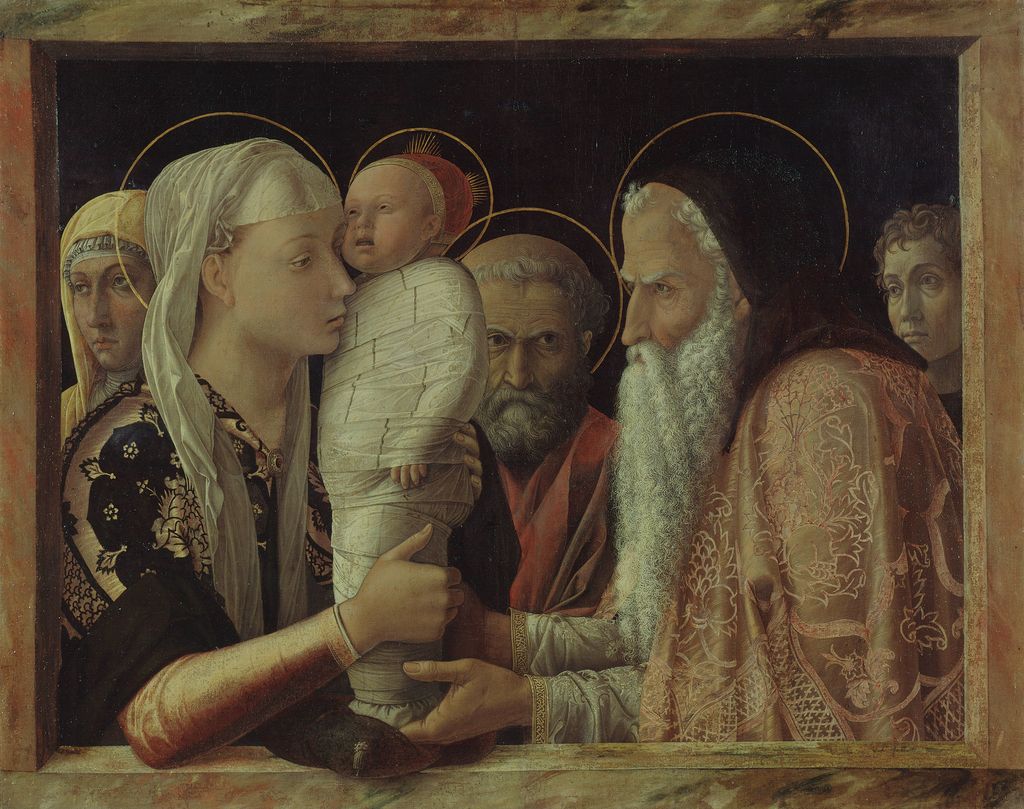
| The Presentation of Christ at the Temple | 1454 (Berlin dating) | Painting · Gemäldegalerie, Berlin · 29 Catalogue. |
| San Zeno Altarpiece | 1457–59 | Painting · Basilica of San Zeno, Verona Catalogue. |
| The Crucifixion | 1456–59 | Painting · Musée du Louvre · INV 368 Catalogue. |
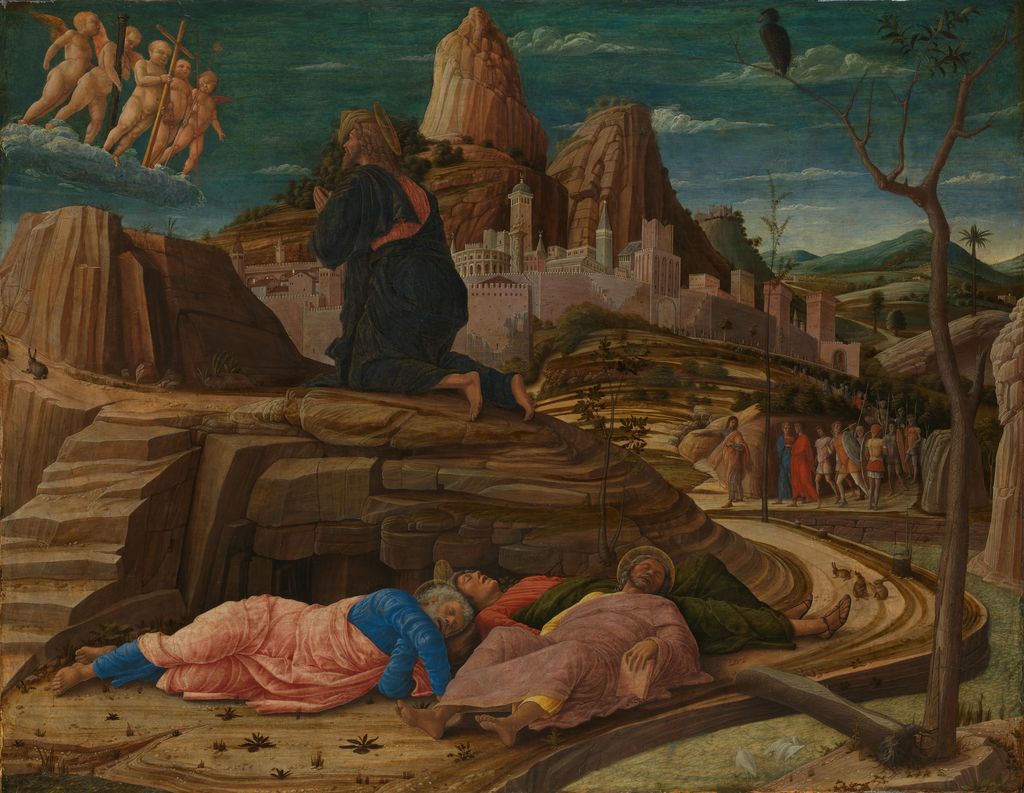
| The Agony in the Garden (London) | C. 1455–56 | Painting · National Gallery, London · NG1417 Catalogue. |
| The Agony in the Garden (Tours) | 1459 (Tours dating) | Painting · Musée des Beaux-Arts de Tours · 1803-1-24 Catalogue. |
| The Resurrection | 1459 (Tours dating) | Painting · Musée des Beaux-Arts de Tours · 1803-1-25 Catalogue. |
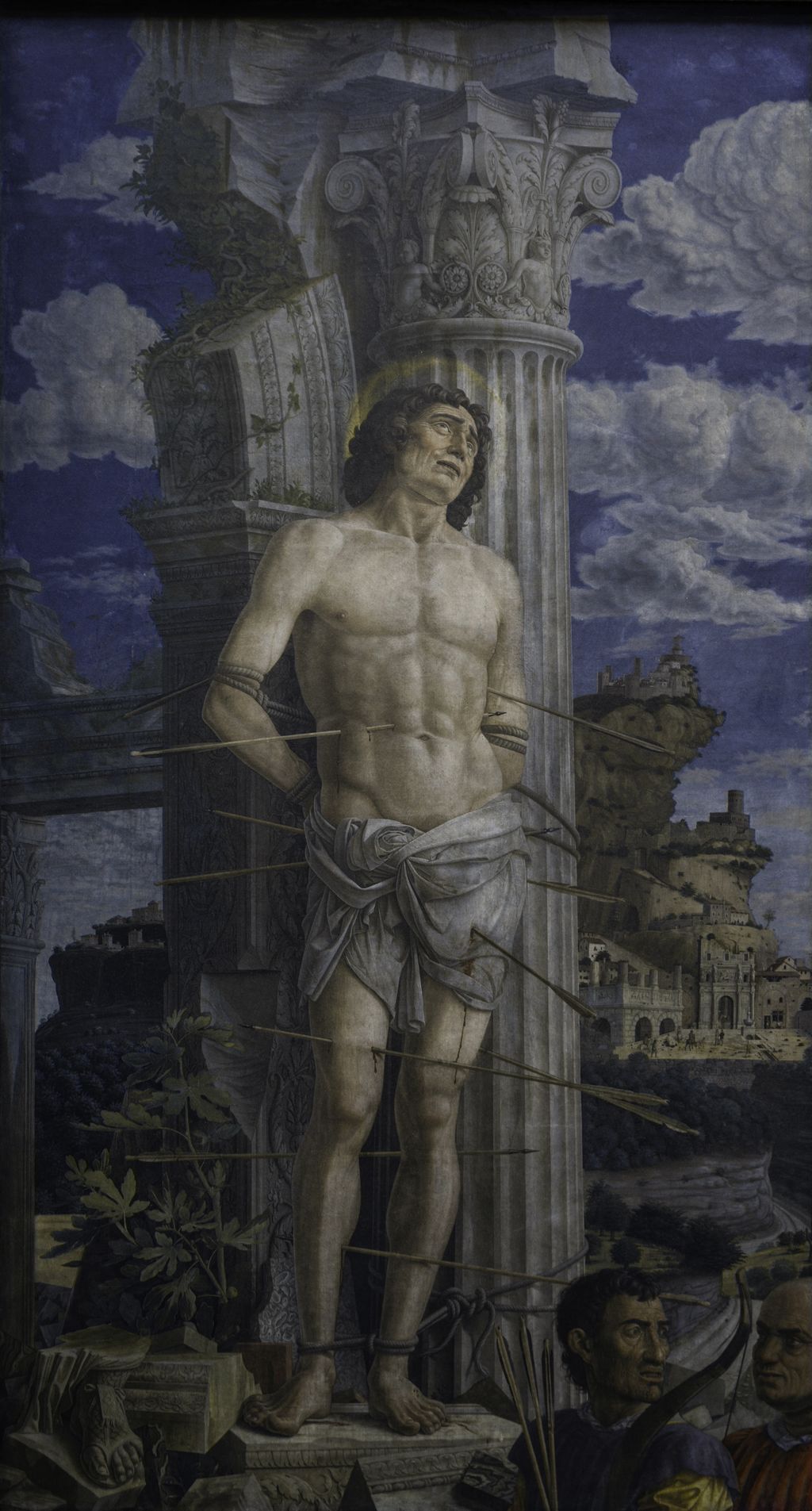
| Saint Sebastian (Vienna) | C. 1457–59 | Painting · Kunsthistorisches Museum · GG 301 Catalogue. |
| Cardinal Ludovico Trevisan | C. 1459–60 (Berlin exhibition dating) | Painting · Gemäldegalerie, Berlin · 9 Catalogue. |
| The Death of the Virgin | C. 1462 | Painting · Museo Nacional del Prado · P000248 Catalogue. |
| Christ with the Soul of the Virgin | C. 1460–64 | Painting · Pinacoteca Nazionale, Ferrara Catalogue only. |
| Portrait of a Young Man (traditionally Francesco Gonzaga) | C. 1461 or 1470, depending on sitter | Painting · Museo di Capodimonte · Q 60 Catalogue. |
| Portrait of a Prelate (Carlo de’ Medici?) | C. 1465–70 | Painting · Uffizi Galleries · 1890 no. 8540 Catalogue. |
| Portrait of a Man | C. 1470 | Painting · National Gallery of Art, Washington · 1952.2.5 Catalogue. |
| Madonna with Sleeping Child (Berlin) | C. 1455–60 | Painting · Gemäldegalerie, Berlin · S.5 Catalogue. |
| Camera degli Sposi (Camera Picta) | 1465–74 | Painting · Palazzo Ducale, Mantua Catalogue. |
| Saint Sebastian (Louvre) | Around 1480 | Painting · Musée du Louvre · RF 1766 Catalogue. |
| Lamentation over the Dead Christ | C. 1483 (Brera dating) | Painting · Pinacoteca di Brera · 352 Catalogue. |
| The Triumphs of Caesar | About 1485–1506 | Painting · Royal Collection · RCIN 403958–403966 Catalogue. |
| Madonna of the Caves | C. 1488–90 | Painting · Uffizi Galleries · 1890 no. 1348 Catalogue. |
| Madonna and Child with a Choir of Cherubim | C. 1485 | Painting · Pinacoteca di Brera · 297 Catalogue. |
| Madonna and Child (Poldi Pezzoli) | Early 1490s (museum dating) | Painting · Museo Poldi Pezzoli · 1595 Catalogue. |
| The Holy Family with Saint Mary Magdalen | C. 1495–1500 | Painting · Metropolitan Museum of Art · 14.40.643 Catalogue. |
| The Virgin and Child with Saint Mary Magdalene and Saint John the Baptist | C. 1490–1505 | Painting · National Gallery, London · NG274 Catalogue. |
| Christ as the Suffering Redeemer | 1485–95 (SMK dating) | Painting · Statens Museum for Kunst · KMSsp69 Catalogue. |
| Ecce Homo | C. 1500 | Painting · Musée Jacquemart-André · MJAP-P 1840 Catalogue. |
| Judith with the Head of Holofernes (Mantegna or follower) | C. 1495–1500 | Painting · National Gallery of Art, Washington · 1942.9.42 Catalogue. |
| Madonna della Vittoria | 1495–96 | Painting · Musée du Louvre · INV 369 Catalogue. |
| Mars and Venus (Parnassus) | C. 1496–97 | Painting · Musée du Louvre · INV 370 Catalogue. |
| The Trivulzio Madonna | 1497 | Painting · Castello Sforzesco, Milan · 0554 Catalogue. |
| The Adoration of the Magi | C. 1495–1505 | Painting · J. Paul Getty Museum · 85.PA.417 Catalogue. |
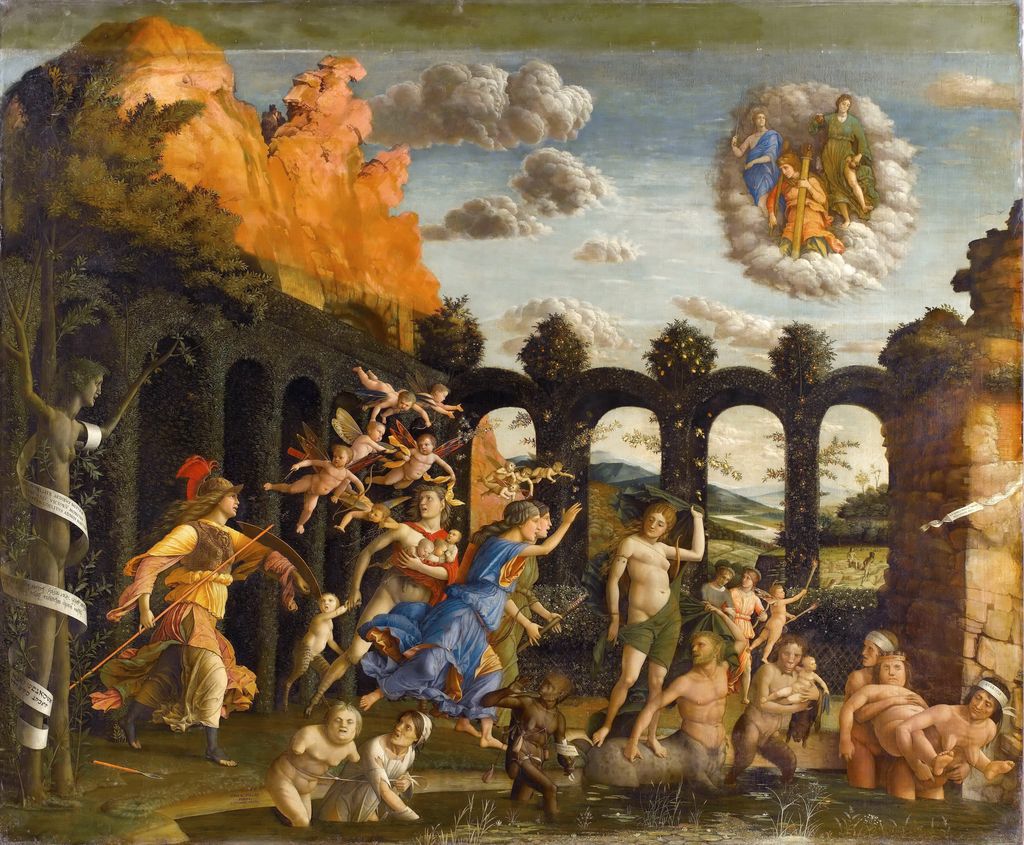
| Minerva Expelling the Vices from the Garden of Virtue | C. 1502 | Painting · Musée du Louvre · INV 371 Catalogue. |
| The Introduction of the Cult of Cybele at Rome | 1505–06 | Painting · National Gallery, London · NG902 Catalogue. |
| Saint Sebastian (Venice) | Probably c. 1504–06 | Painting · Galleria Giorgio Franchetti alla Ca’ d’Oro · D.11 Catalogue. |
| Samson and Delilah | C. 1500 | Painting · National Gallery, London · NG1145 Catalogue only. |
| A Woman Drinking (probably Sophonisba) | C. 1495–1506 | Painting · National Gallery, London · NG1125.2 Catalogue only. |
| The Vestal Virgin Tuccia with a Sieve | C. 1495–1506 | Painting · National Gallery, London · NG1125.1 Catalogue only. |
| Judith with the Head of Holofernes (Dublin) | C. 1495–1500 | Painting · National Gallery of Ireland · NGI.442 Catalogue only. |
| Battle of the Sea Gods, left half (Met impression) | Before 1481 (Met dating) | Print · Metropolitan Museum of Art · 18.12 Catalogue only. |
| Battle of the Sea Gods, right half (Met impression) | Before 1481 (Met dating) | Print · Metropolitan Museum of Art · 1984.1201.4 Catalogue only. |
| Battle of the Sea Gods, left half (Tokyo impression) | C. 1475 (Tokyo dating) | Print · National Museum of Western Art, Tokyo · G.1981-0002 Catalogue only. |
| Battle of the Sea Gods, left half (Washington impression) | C. 1485–88 (NGA dating) | Print · National Gallery of Art, Washington · 1941.1.6 Catalogue only. |
| The Entombment of Christ, second state of two | Before 1475 (Met dating) | Print · Metropolitan Museum of Art · 37.42.30 Catalogue only. |
| The Entombment of Christ (possibly Zoan Andrea, after Mantegna) | 1460–1549 (Rijksmuseum dating) | Print · Rijksmuseum · RP-P-1924-60 Catalogue only. |
| Four Dancing Muses (Gian Marco Cavalli after Mantegna) | C. 1497 | Print · Metropolitan Museum of Art · 20.5.3 Catalogue only. |
| Bacchanal with Silenus | Before 1475 (Met dating) | Print · Metropolitan Museum of Art · 29.44.15 Catalogue only. |
| Bacchanal with a Wine Vat | Before 1475 (Met dating) | Print · Metropolitan Museum of Art Catalogue only. |
| St James on His Way to Execution | C. 1453–57 | Drawing · British Museum · 1976,0616.1 Catalogue only. |
| Three Studies for a Dead Christ | C. 1455–65 | Drawing · British Museum · 1909,0406.3 Catalogue only. |
| Pietà (Venice) | C. 1456–65 (exhibition datings) | Drawing · Gallerie dell’Accademia, Venice · 115 Catalogue only. |
| Studies for Christ at the Column | 1460–65 | Drawing · The Courtauld · D.1978.PG.345 Catalogue only. |
| Virtus Combusta | C. 1490 (technical study) | Drawing · British Museum · Pp,1.23 Catalogue only. |
| Virtus Combusta (Giovanni Antonio da Brescia after Mantegna) | C. 1495–1506 | Print · Musée du Louvre · 3881 LR/ Recto Catalogue only. |
| The Calumny of Apelles | C. 1504–06 | Drawing · British Museum · 1860,0616.85 Catalogue only. |
Frequently Asked Questions
The heads are grouped close around Mary and the child. Several mouths are open, giving the cluster of faces the appearance of a group engaged in song.
It is the Madonna and Child with a Choir of Cherubim, painted in tempera on wood. Brera’s inventory number 352 belongs to the Lamentation over the Dead Christ.
Discussion
Look again at the images and ideas explored in Madonna of the Cherubim. These editorial prompts invite your observations.
Reader Insights
How do the downward tilt of Mary’s face and the Child’s upward gaze change the way you follow the faces in the choir?
Where does Mary’s cloak act as a frame in its own right, and how does that effect change between the Brera panel and Berlin’s Madonna with Sleeping Child?
Join the Conversation
Share a detail, comparison or question about Madonna of the Cherubim below.
References
- Pinacoteca di Brera, Madonna and Child with a Choir of Cherubim (Madonna of Cherubim). View source.
- The Metropolitan Museum of Art, Madonna and Child with Seraphim and Cherubim. View source.
- Letizia Bonizzoni, Simone Caglio, Anna Galli and Gianluca Poldi, A non invasive method to detect stratigraphy, thicknesses and pigment concentration of pictorial multilayers based on EDXRF and vis-RS: in situ applications. View source.
- Catalogo generale dei Beni Culturali, Madonna col Bambino e un coro di cherubini. Madonna con Bambino e angeli. View source.
- Gallerie dell’Accademia di Venezia, Madonna col Bambino (Madonna dei cherubini rossi). View source.
- Gemäldegalerie, Staatliche Museen zu Berlin, Maria mit dem schlafenden Kind. View source.
- Museo Poldi Pezzoli, Madonna con il Bambino. View source.
- Opificio delle Pietre Dure, Andrea Mantegna, Madonna con Bambino, ca. 1490–1500, Museo Poldi Pezzoli, Milano. View source.
- The Metropolitan Museum of Art, The Holy Family with Saint Mary Magdalen. View source.
- Basilica of San Zeno, Verona, San Zeno Altarpiece, View source.
- Palazzo Ducale, Mantua, Camera degli Sposi (Camera Picta), View source.
- Royal Collection, The Triumphs of Caesar, View source.
- Musée du Louvre, Madonna della Vittoria, View source.
- National Gallery, London, The Introduction of the Cult of Cybele at Rome, View source.
More MANTEGNA Paintings
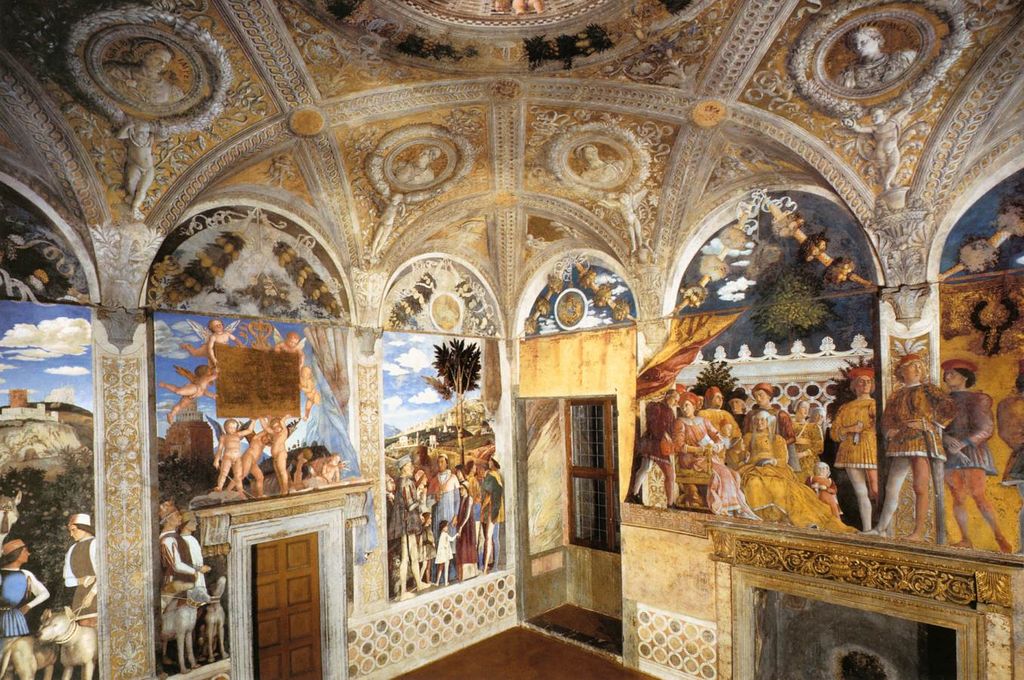
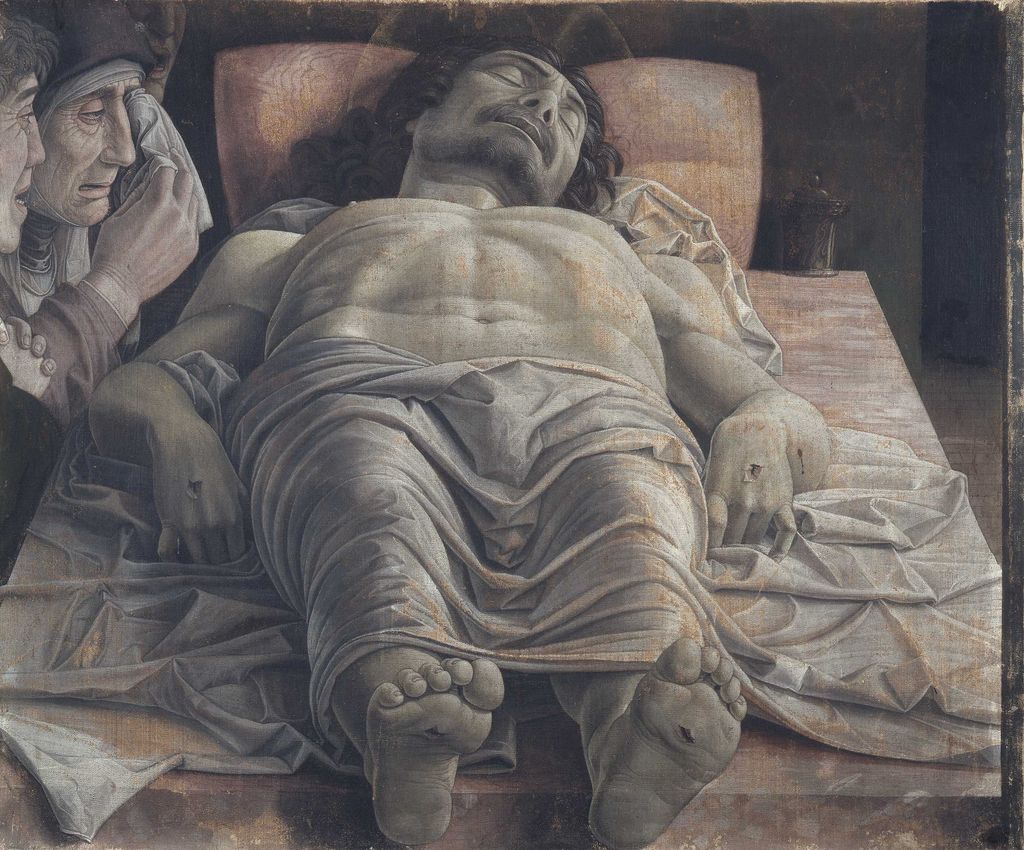
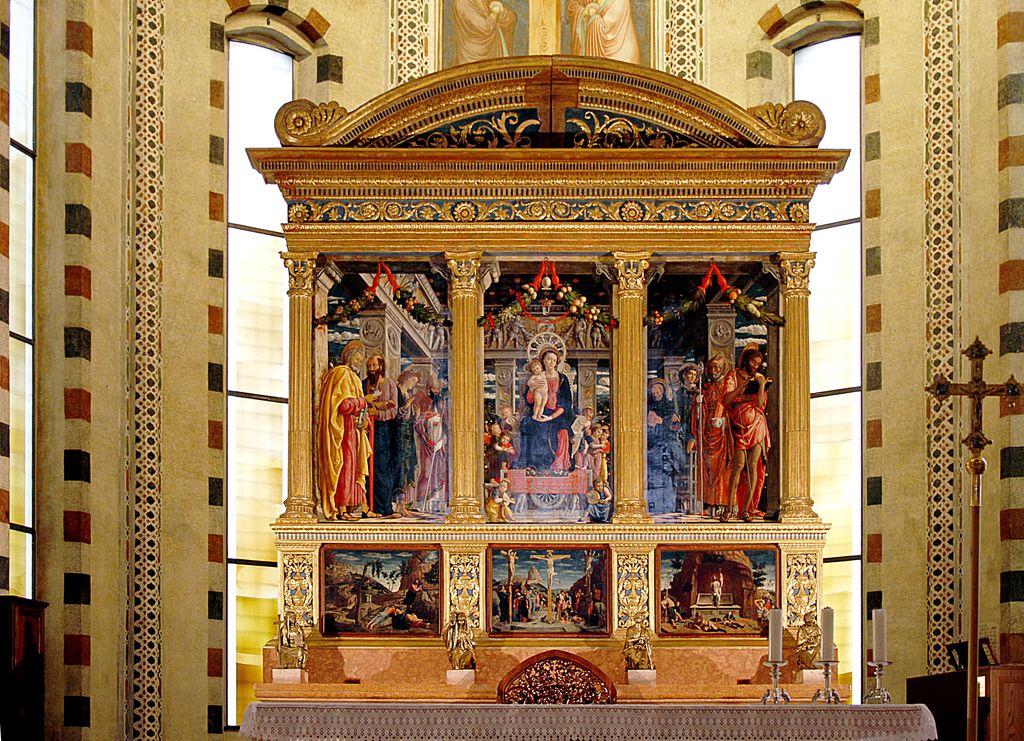
San Zeno Altarpiece
The San Zeno Altarpiece in its frame, Basilica of San Zeno, Verona José Luiz. Image source. CC BY-SA 4.0. Resized from the cited image.