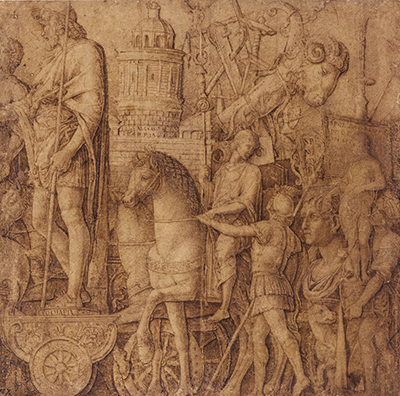
 by Tom Gurney
Tom Gurney BSc (Hons) is an art history expert with over 20 years experience
Published on June 19, 2020 / Updated on November 29, 2026
Email: tomgurney1@gmail.com / Phone: +44 7429 011000
Overview
In a pen drawing for the Ovetari Chapel, Andrea Mantegna worked out the bodies of his figures before settling their clothes. In the allegory known as Virtus Combusta, he used red and brown washes and white highlights to give figures substance against a dark ground. Between those two sheets lies much of the range of his surviving drawings, from an attempt to arrange a crowd to an elaborate composition that took on a second life in engraving. [1] [2]
The surviving sheets are scattered. Some can be tied to a particular fresco, painting or print. Others belong to groups of related works in which a pose or subject passes from one artist to another, or returns in a different medium. The evidence for each relationship can be as specific as a shared contour or as elusive as a resemblance between two figures. How a drawing was used and who made it are questions that often need separate answers. [1] [2] [3]
At a Glance
- St James studyAbout 1453–57, pen and brown ink on pink prepared paper, British Museum, 1976,0616.1.
- Venice PietàAbout 1456–65 across the Louvre and Berlin exhibition datings, pen and brown ink, Gallerie dell’Accademia, Venice, inv. 115.
- Three Studies for the Dead ChristAbout 1455–65, pen and brown ink on paper, British Museum, 1909,0406.3. Two seated women appear on the reverse.
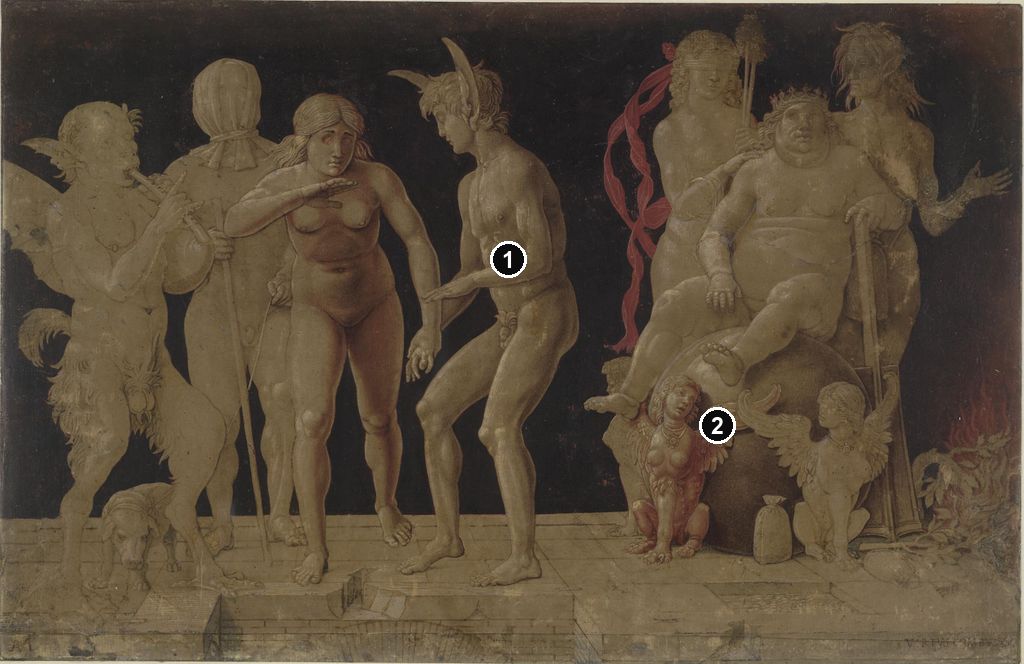
- Virtus Combusta drawingAbout 1490 in the published technical study, pen, coloured washes and white heightening on paper, British Museum, Pp,1.23.
- Virtus Combusta engravingAbout 1495–1506, burin engraving catalogued under Giovanni Antonio da Brescia, Musée du Louvre, 3881 LR/ Recto.
St James and the crowd at the Ovetari Chapel
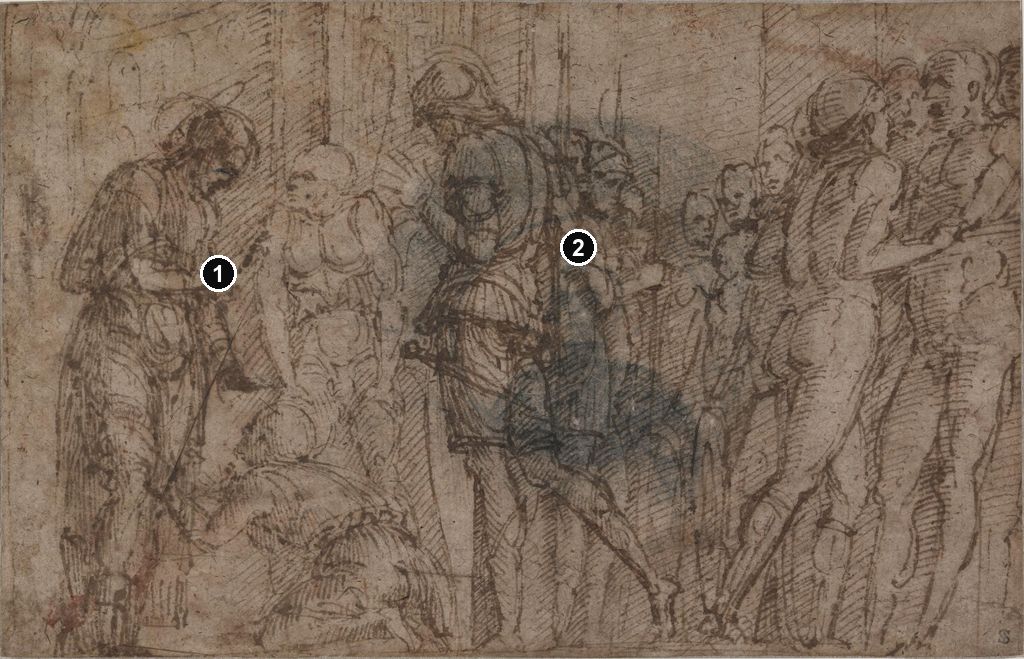
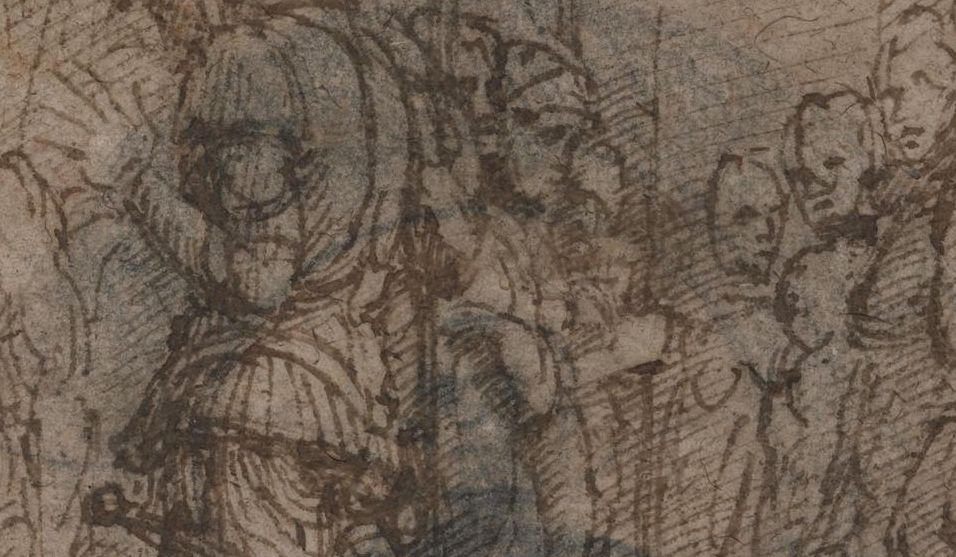
The British Museum’s St James on His Way to Execution, 1976,0616.1, is among Mantegna’s earliest surviving drawings. The museum dates it to about 1453–57 and describes the principal study as pen and brown ink on pink prepared paper. The drawing belongs to the artist’s work at the Eremitani in Padua, where he painted episodes from the lives of James and Christopher. The Martyrdom of St Christopher is another episode from the chapel. [1] [3]
James pauses on the left to bless a kneeling man whom the British Museum tentatively identifies as Josiah. A Roman soldier stands at the centre, between the encounter and the crowd. The hatching tells you where to look. It runs freely across the background and some of the figures on the right, while around the saint, the kneeling man and the soldier, the strokes follow the turn of the bodies more closely. James’s arm and leg can still be made out beneath the drapery. Drawing the body first let Mantegna establish where the saint’s weight fell and how far he could reach, before the folds began to obscure the movement. [1]
A nineteenth-century photograph in the historical collections of the Accademia di Brera records the finished fresco before the 1944 bombing devastated the chapel. In the photograph, a great arch rises over the encounter and the figures occupy the lower part of a deep architectural setting. The drawing puts the interruption itself under scrutiny. James turns, the kneeling man arrests the procession and the soldier divides the figures who are already implicated in the encounter from those still pressing forward. The photograph shows how that relationship held up when the scene had to be read from below and across a chapel wall. Together the sheet and photograph preserve different stages of the work. [1] [4] [5]
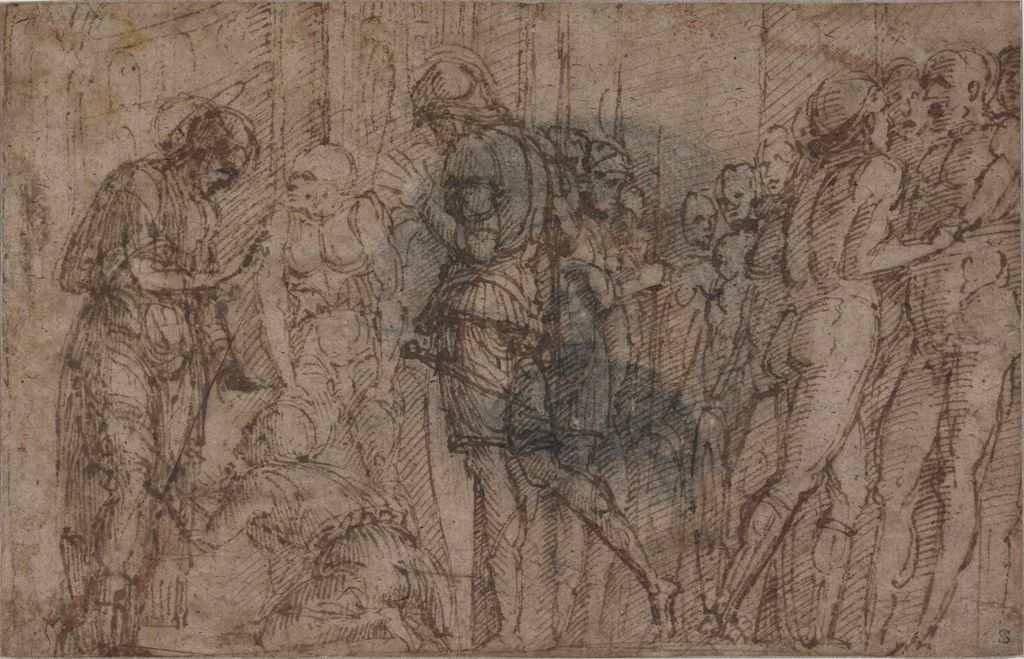
St James on his way to Execution, British Museum (1976,0616.1) Image source. Public domain.
The body on the ground and the mourners around it
The Pietà in the Gallerie dell’Accademia, Venice, is a brown-ink pen drawing just 12.7 centimetres high, inventory 115. The Louvre dated it to about 1456–59 in its Mantegna exhibition, while the 2019 Berlin checklist placed it around 1460–65. Its scale matters. At the size of a hand, the attitudes of the mourners and the angle of Christ’s body have to carry the weight of the scene. Parallel strokes build shadow within the contours, giving the figures weight without requiring much room around them. [3] [6]
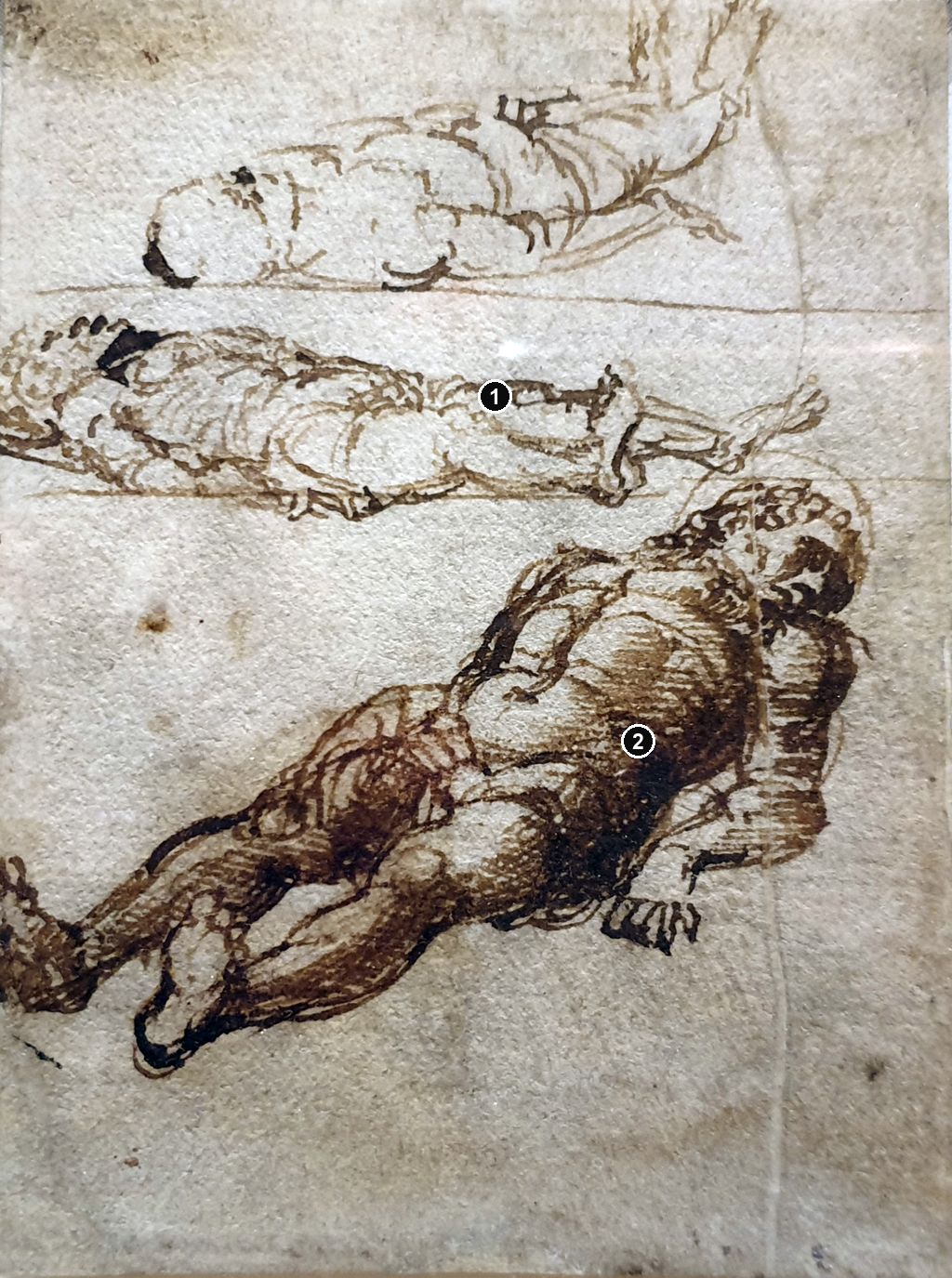
On a British Museum sheet of about 1455–65, Mantegna drew the reclining body in pen and brown ink three times. The museum sheet, 1909,0406.3, has Three Studies for the Dead Christ on the front and two seated holy women on the back, one seen from behind. The front repeats the problem of getting a recumbent figure to read in a small space. On the reverse, the woman seen from behind offers a way to put a mourner between the viewer and the centre of the action. Together the two faces show how much a figure’s orientation determines what the viewer can see and where the viewer seems to stand. The sheet was formerly given to Giovanni Bellini, a reminder that the draughtsmanship of the two artists can be especially close in studies of the Passion. [3] [7] [8]
Another small pen drawing, in Brescia, takes up the placement of the body among its attendants. The National Gallery’s loan documentation identifies the sheet as The Deposition of Christ, about 1460, with a candlestick study on the back, inventory DS 147. The reverse has a different concern altogether. It shows why an individual sheet can sit within two histories, one of narrative composition and one of ornamental design. A title drawn from the front can make the second history easy to miss. [9]
Mantegna returned to the problem of the reclining body in the Lamentation over the Dead Christ now at the Pinacoteca di Brera. The painting brings the feet and their wounds close to the viewer, with the mourners squeezed to the left. The early drawings offer comparisons for that experiment in foreshortening, the apparent shortening of a body seen along its length. The Berlin exhibition provided a further comparison in a British Museum drawing of a man on a stone slab from the late 1470s, executed in brown ink over traces of black chalk. The underlying chalk in that sheet gives a glimpse of a stage of drawing that could be difficult to see once the decisive contours had been set down in ink. The painting’s particular arrangement, with the slab and the body controlling nearly the whole field, deserves to be read on its own terms. The resemblance to a drawing of the same subject establishes a formal relationship more readily than a direct preparatory sequence. [3] [8] [10]
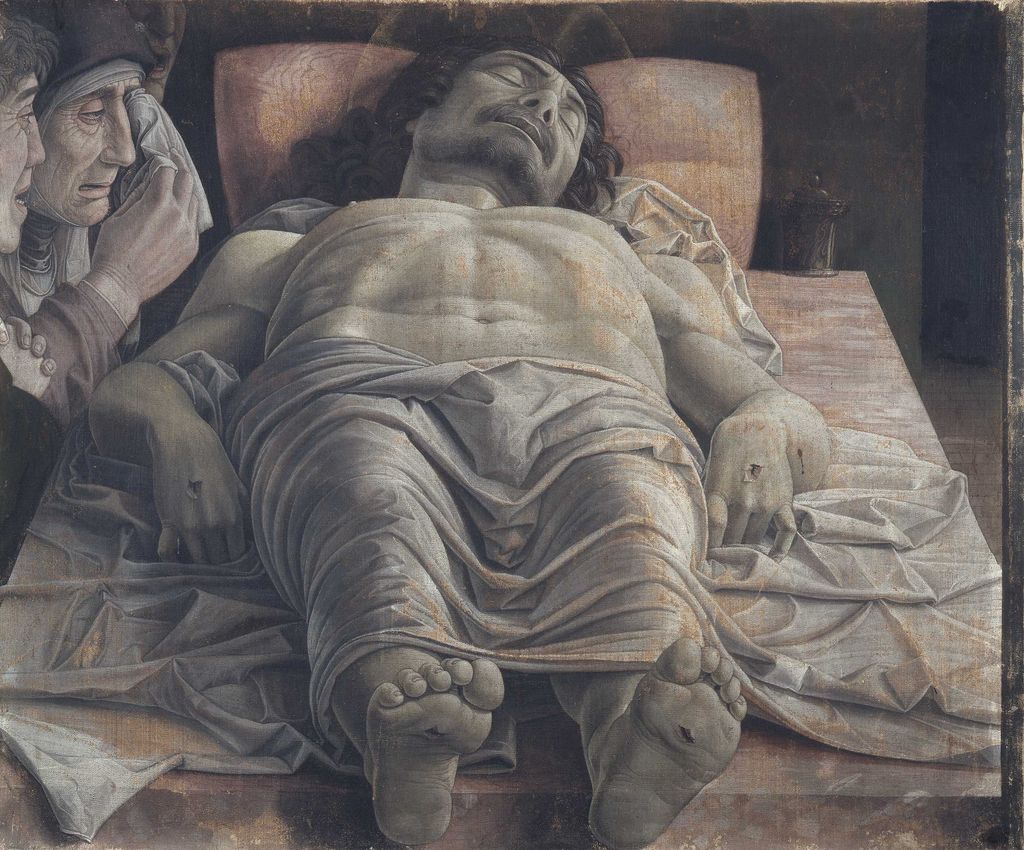
The Dead Christ and Three Mourners, Pinacoteca di Brera Image source. Public domain.
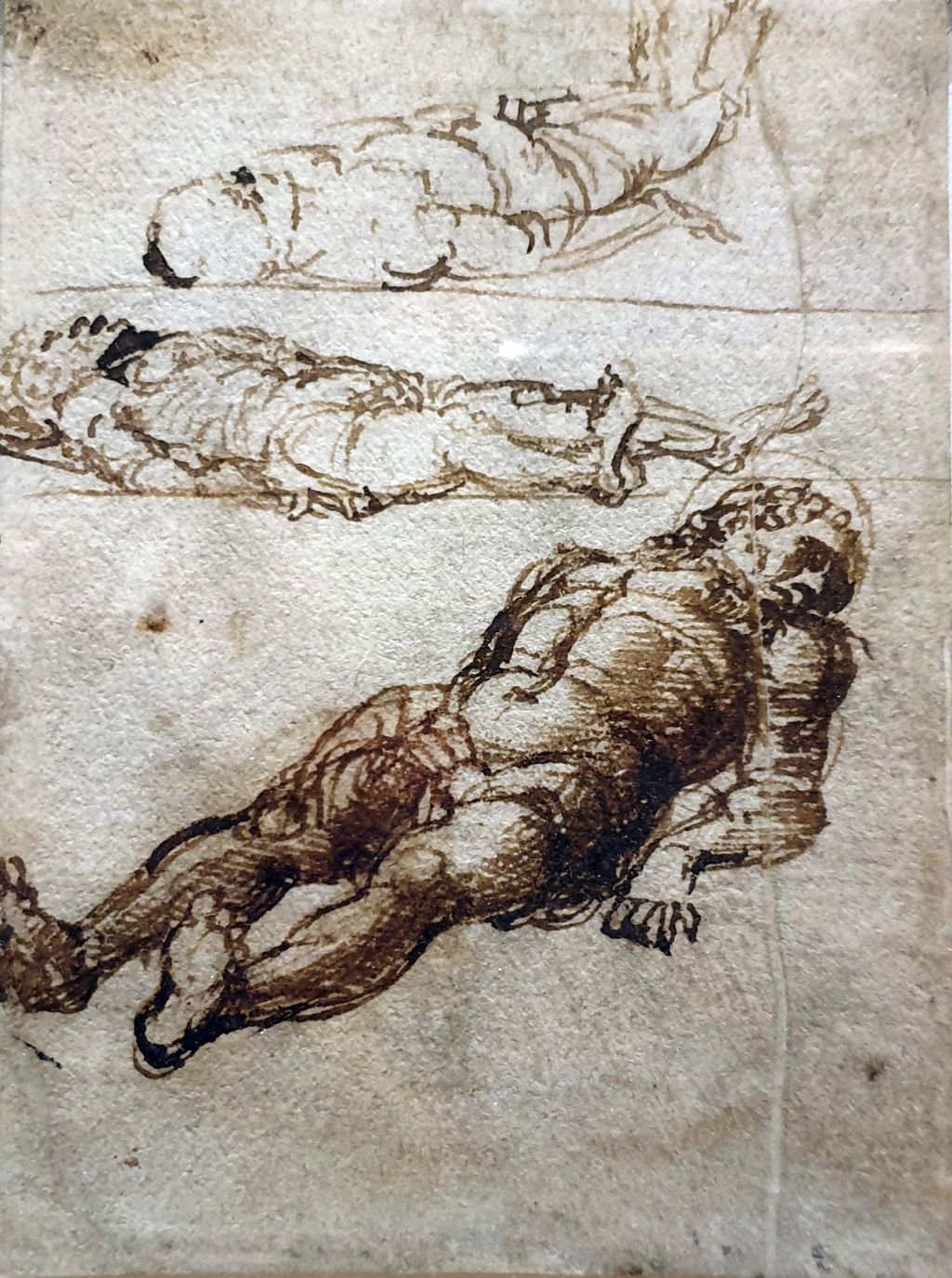
Three Studies for the Dead Christ, British Museum Image source. Public domain.
A figure worked out for copper
A more direct link survives at the Courtauld. Studies for Christ at the Column, dated 1460–65 and drawn in pen and brown ink on both sides of laid paper, is preparatory to the Flagellation engraving. On the side the Courtauld thinks came first, a large tormentor stands between two trials of Christ’s pose. The loose outline leaves Mantegna free to shift the angle of the bent torso. On the other side Christ appears twice before the whipping, with greater attention to the bearing of his head, his bound hands and the way he slumps. The figure’s muscular build makes that loss of composure all the more apparent. [11] [12]
The engraving gives the scene a more settled arrangement. In the drawing, two trials of the same figure can stand next to one another because each addresses the artist’s problem of where to place the body. In the print, where the spectator sees a single event, every figure must have a role at the same moment. The drawn alternatives let us see how much of that eventual narrative turns on the angle of Christ’s upper body. They also show why the two sides of a sheet can help identify the invention. This one was sold as Bellini in 1958. The Courtauld now attributes it to Mantegna and treats its relationship to the print as evidence that he devised the composition. The wider question of who cut a given plate belongs to the history of Mantegna’s engravings. [11] [12]
A dancing figure for Isabella d’Este
A drawing could also settle a single figure on the scale required for a painting. The Dancing Muse, about 1495, in the Staatliche Graphische Sammlung München, is a likely final study for a figure in Parnassus, according to the Morgan Library & Museum. Isabella d’Este commissioned the canvas in the winter of 1496–97 for her first studiolo, a private room in Mantua’s Castello di San Giorgio. In the painting the dancers have to read as a group. In the drawing, the folds and the turn of one figure can be considered at length. The Morgan points out differences in the face and hair in the finished canvas, evidence of how much could still change after the body and drapery had been worked out. The Louvre also records probable later repainting on several of the muses’ heads, a qualification to keep in mind when comparing the surfaces as they now appear. [13] [14]
The bronze-like modelling of the drapery has a practical effect. Light catches the ridges of the folds and leaves the hollows darker, so the position of the body remains legible underneath. Compare the isolated figure with the line of dancers in the painting. There the folds have to register at a glance, while the arms and bodies across the group carry the rhythm. The importance of the sheet lies partly in that change of scale for the eye. A figure that fills a drawing has to hold its place in a much wider scene. [13] [14]
The Louvre also holds La danse de quatre femmes, an engraving dated after 1497 and catalogued as workshop of Mantegna, 3883 LR/ Recto. Four of the dancers appear in reverse, with variations. The Louvre notes that the engraving may reflect a preparatory stage of the composition, while some variants resemble details that technical examination found to have been repainted later. The Munich sheet shows how one figure was worked out. The print shows how the dance circulated on paper even as the painting itself changed. [13] [14] [15]
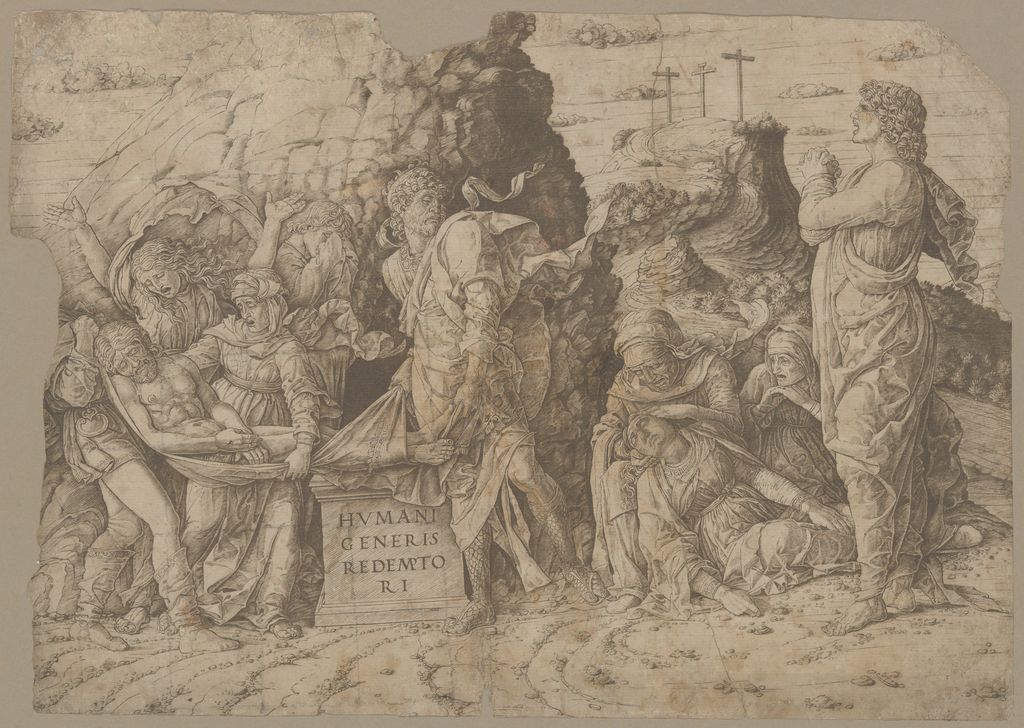
The Entombment, second state of two, Metropolitan Museum of Art (37.42.30) Image source. CC0 / Public domain.
Virtue in flames, on paper and in print
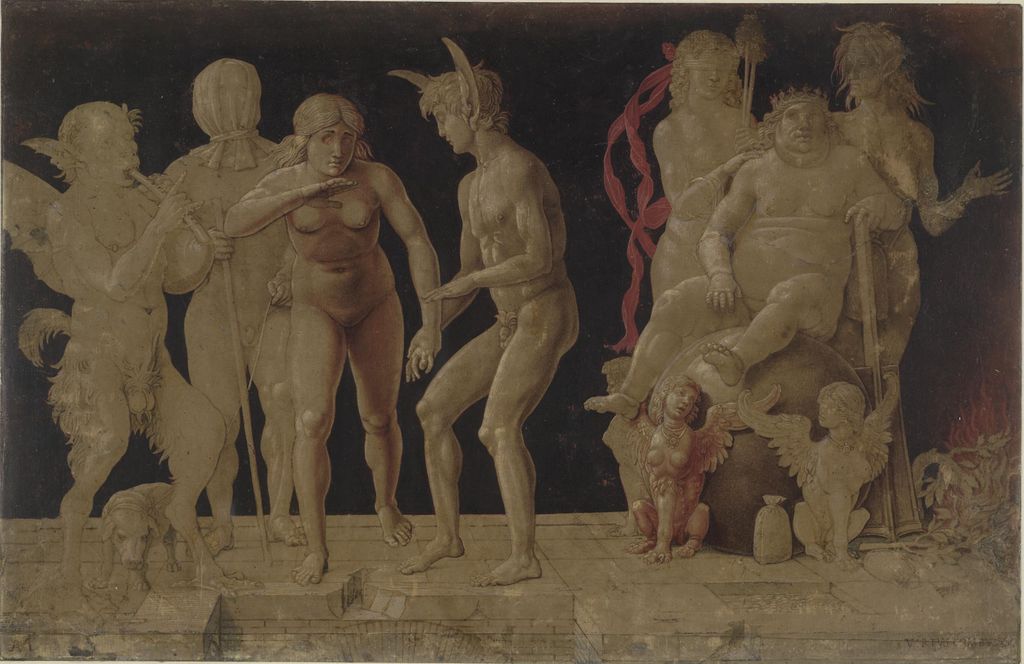
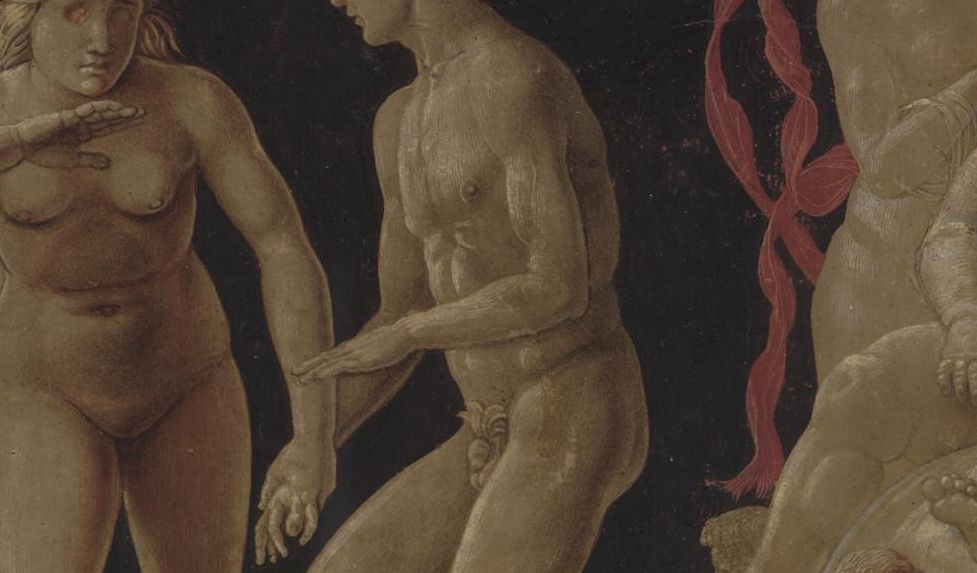
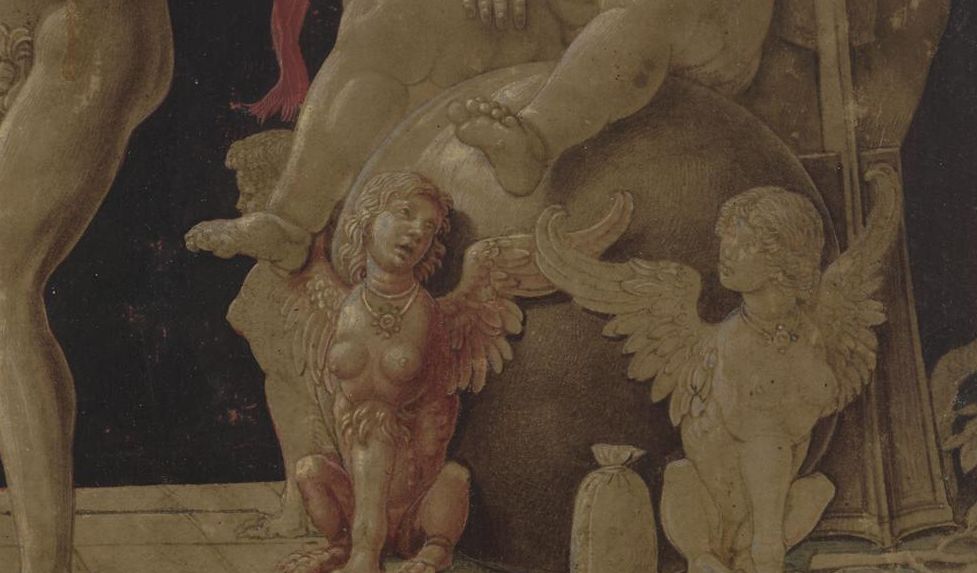
The British Museum’s Virtus Combusta (Pp,1.23) is a drawing in pen, coloured washes and white heightening on paper, dated about 1490 by the museum’s researchers. On the left a blind woman is led towards a drop. On the right, a seated figure with a globe and rudder commands the scene. The burning laurel and the inscription below it give the drawing its title, which means ‘Virtue Burnt’. The authors of the technical study discuss the figure with the rudder as a possible personification of Ignorance, borrowing attributes associated with Fortune. In that reading, the money and burning laurel connect the pursuit of wealth with the destruction of virtue. The uncertainty about the figures is part of the riddle. The woman approaching the drop acts out the consequences before the viewer has had time to decipher the figures directing her. [2]
Satoko Tanimoto and her British Museum colleagues found that the dark ground appears to have been built up with vermilion and then carbon black. They identified iron-gall ink, coloured washes and lead-white highlights and found faint particles that could be traces of a metalpoint underdrawing. The sequence varied across the sheet. Some passages appear to have been worked over, and the researchers judged that there had been retouching during earlier restoration. Look at the difference between the modelled figures and the less resolved forms at the left edge. The study makes it possible to see the dark ground as something Mantegna worked around and over alongside the figures, with local decisions still visible beneath the effect of a continuous darkness. [2]
The Louvre’s Virtus Combusta, 3881 LR/ Recto, is a burin engraving that the museum catalogues under Giovanni Antonio da Brescia, about 1495–1506. The Louvre points back to the British Museum sheet for the design. Its companion print, Virtus Deserta, 3882 LR/ Recto, gives us the lower scene, where Mercury reaches down to help a figure among the fallen. The drawing and the two prints offer different kinds of evidence. The washes show the material decisions behind the surviving upper scene. The companion engraving reveals how the story continues below the drop. Tanimoto and her colleagues suggest that the extent of the colour work makes it unlikely the original sheet was made solely to serve an engraver, and raise the possibility that it was intended for presentation. [2] [16] [17]
Mantegna made moral allegory more explicit in The Calumny of Apelles, a British Museum drawing dated about 1504–06. There, according to the museum, the figures are named in Mantegna’s handwriting. The procession restages a lost painting known from a written description. Calumny advances towards a judge, pulling a young man by the hair. The technical study of Virtus Combusta compares the long-eared woman beside the seated figure to a figure in the Calumny. The comparison shows how a grotesque feature could be adapted to more than one allegory, even when the identity of a particular figure has remained open to debate. [2] [18]
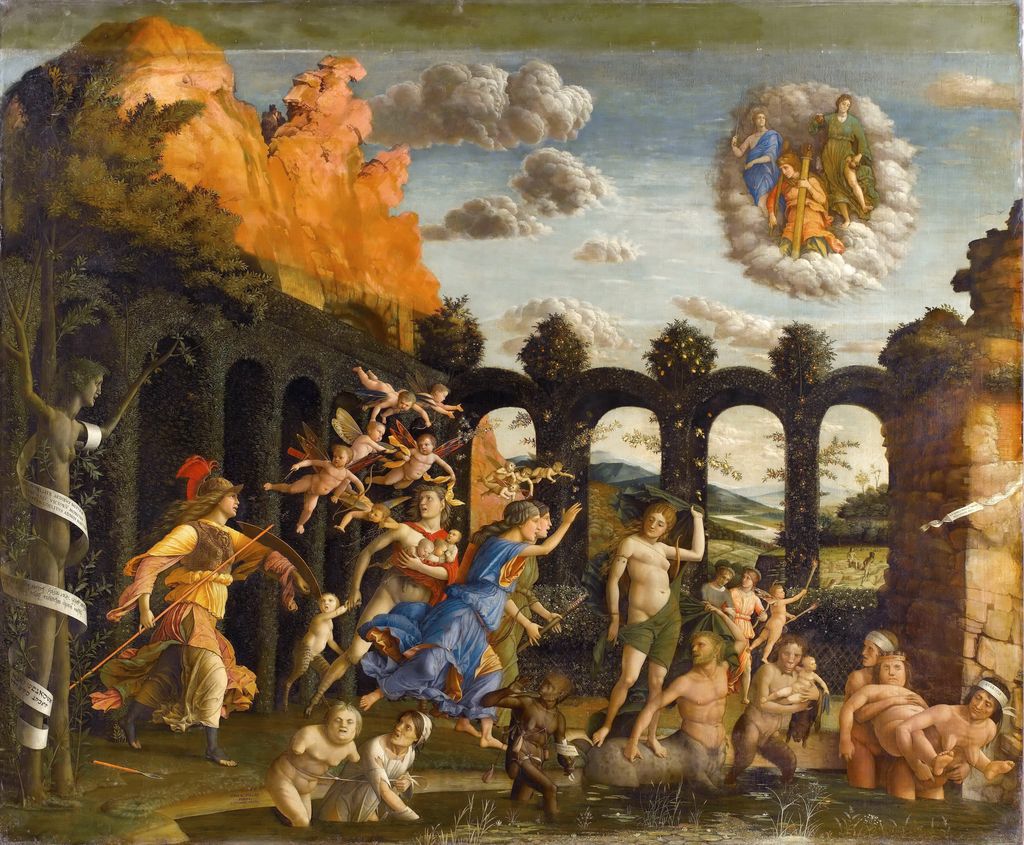
Virtus Combusta belongs in the context of Mantegna’s years at the Gonzaga court, traced in his biography. Isabella’s commission for Parnassus ties the Munich study to a specific painting and room. Another painting she commissioned for the same room, the Triumph of the Virtues, offers a comparison for the allegory. There Minerva drives the vices from a garden. In the drawing, virtue burns while the blind woman is led astray. The two inventions use bodies in motion to make moral choices visible, and give those choices very different outcomes. The documented destination of the canvas and the suggested function of the drawing carry different degrees of certainty. [2] [14] [19]
Virtus Combusta, British Museum (Pp,1.23) Image source. Public domain.
What a name on a drawing can tell us
Mantegna had a personal connection to the Bellini workshop. In 1453 he married Nicolosia, the daughter of Jacopo Bellini and sister of Giovanni. The Louvre’s graphic arts checklist for Mantegna & Bellini records the loans from its own collections to London and Berlin in 2018–19. It includes Mantegna’s Orange Tree in a Fluted Vase, 776 DR/ Recto, shown in Berlin, and Giovanni Bellini’s Lamentation over the Dead Christ, RF 436, also shown there. The orange tree, a narrow pen-and-brown-ink drawing dated about 1490 in the Berlin checklist, makes an instructive companion to the Passion studies. The challenge here is to give a plant and its decorated vessel weight and shape within an upright strip of paper. The Louvre catalogues its Lamentation under Bellini’s name, while the Berlin checklist prints a question mark after it. Even where the object and exhibition are the same, the degree of confidence can differ. [3] [6] [20] [21]
The Berlin exhibition also listed a Descent of Christ into Limbo in brown ink and wash on vellum, about 1468, lent by the École nationale supérieure des Beaux-Arts in Paris, as Mantegna. Berlin’s own Christ in Limbo, KdZ 622, is a different work, in brown and dark grey wash heightened with white on blue prepared paper, dated about 1490. The Kupferstichkabinett currently places it in Mantegna’s following and records competing proposals, including Francesco Mantegna and Niccolò Giolfino, alongside a former attribution to Marco Zoppo. The subject travelled into painting as well. The Berlin exhibition team reported that the Bristol painting it exhibited as Bellini was executed over a drawn vellum copy of a Mantegna design. That finding concerns how the image was transferred. The identity of the person who drew up the copy is a separate question. [3] [22] [23]
The Metropolitan Museum of Art’s Holy Family with Saint Elizabeth and the Infant John the Baptist offers another kind of qualification. The Met catalogues the early-sixteenth-century sheet, 1975.1.372, as by a follower of Mantegna. It describes pen and brown ink with greenish grey and brown washes, and considers the grey wash in the background probably the work of a later hand. The sense of depth that a viewer sees today therefore depends in part on an intervention the museum treats as later. An attribution may apply to the principal design while leaving room for changes made to the sheet after that design was drawn. [24]
The State Hermitage Museum approached this afterlife through prints. Its exhibition Andrea Mantegna’s Formulae put seven engravings it considers autograph at the centre of a study of earlier models and later adaptations. Its Disegno exhibition likewise identified the Mantegna examples as prints alongside drawings by other artists. An individual object record can carry yet another distinction. For the Hermitage Madonna and Child, ОГ-399016, the digital catalogue names Mantegna as the inventor, describes the technique as burin engraving and dates the impression to the second half of the eighteenth century. The name identifies a Renaissance invention that remained available to viewers centuries later. In Virtus Combusta, it is the physical survival of Mantegna’s sheet that lets us see what a print alone could never recover, from the painted darkness around the figures to the thin contours where he left the work unfinished. [2] [16] [17] [25] [26] [27]
Annotated Details from Mantegna’s Drawings
The numbered points identify details to look at closely. The detail images below preserve the native scale of the selected crops.
Three Studies for the Dead Christ
St James on his way to Execution
Virtus Combusta
Details from MANTEGNA’S DRAWINGS
Choose a detail to enlarge it.
Three Studies for the Dead Christ
The level study
Short, broken lines describe a body seen almost from the side. A line below the figures gives the eye a horizontal reference against which to compare their changing angles.
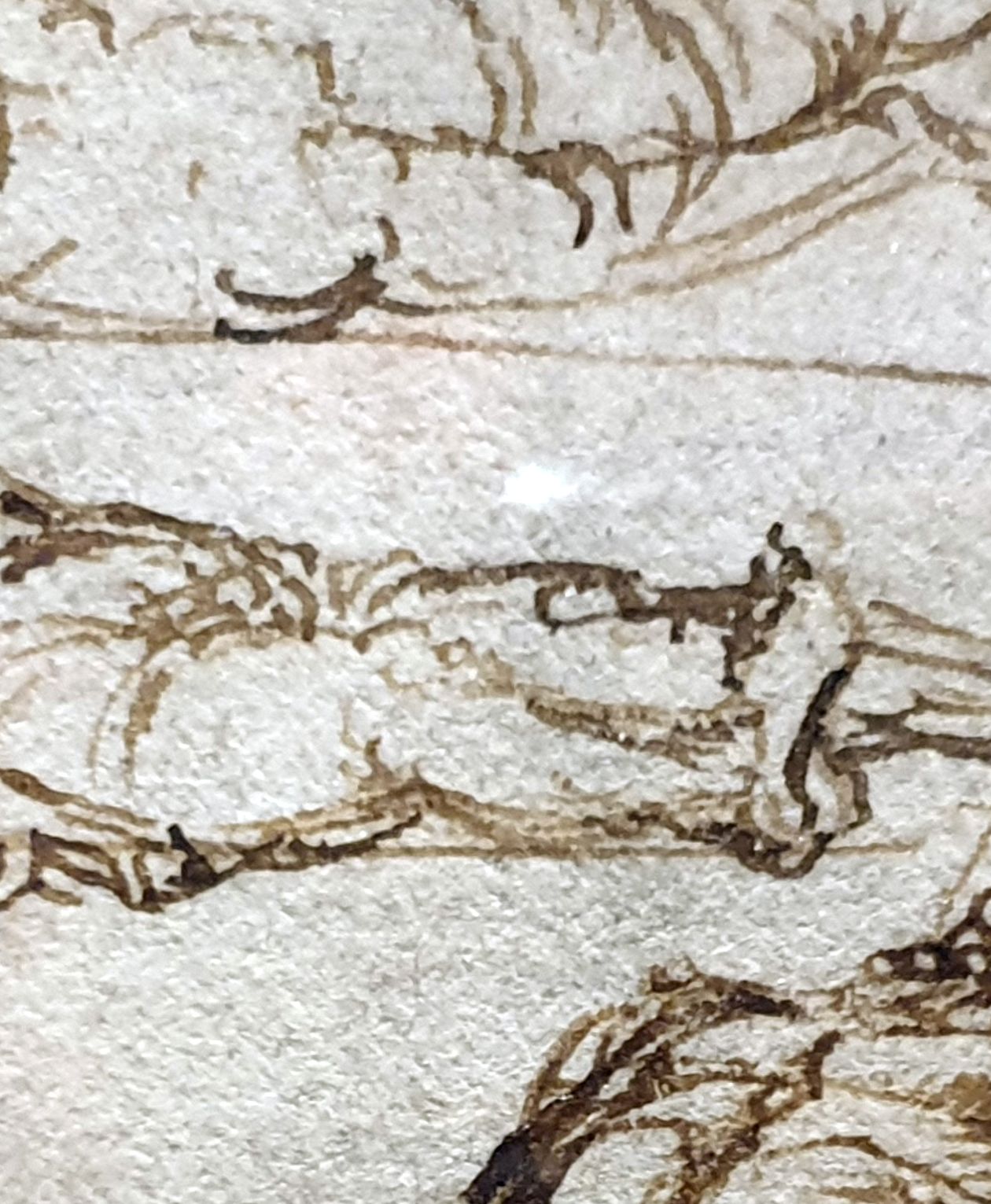
The more heavily worked figure
Closely grouped strokes darken the torso and the edge of the body. The combination of greater tonal weight and a steeper diagonal gives this study a markedly different sense of depth.
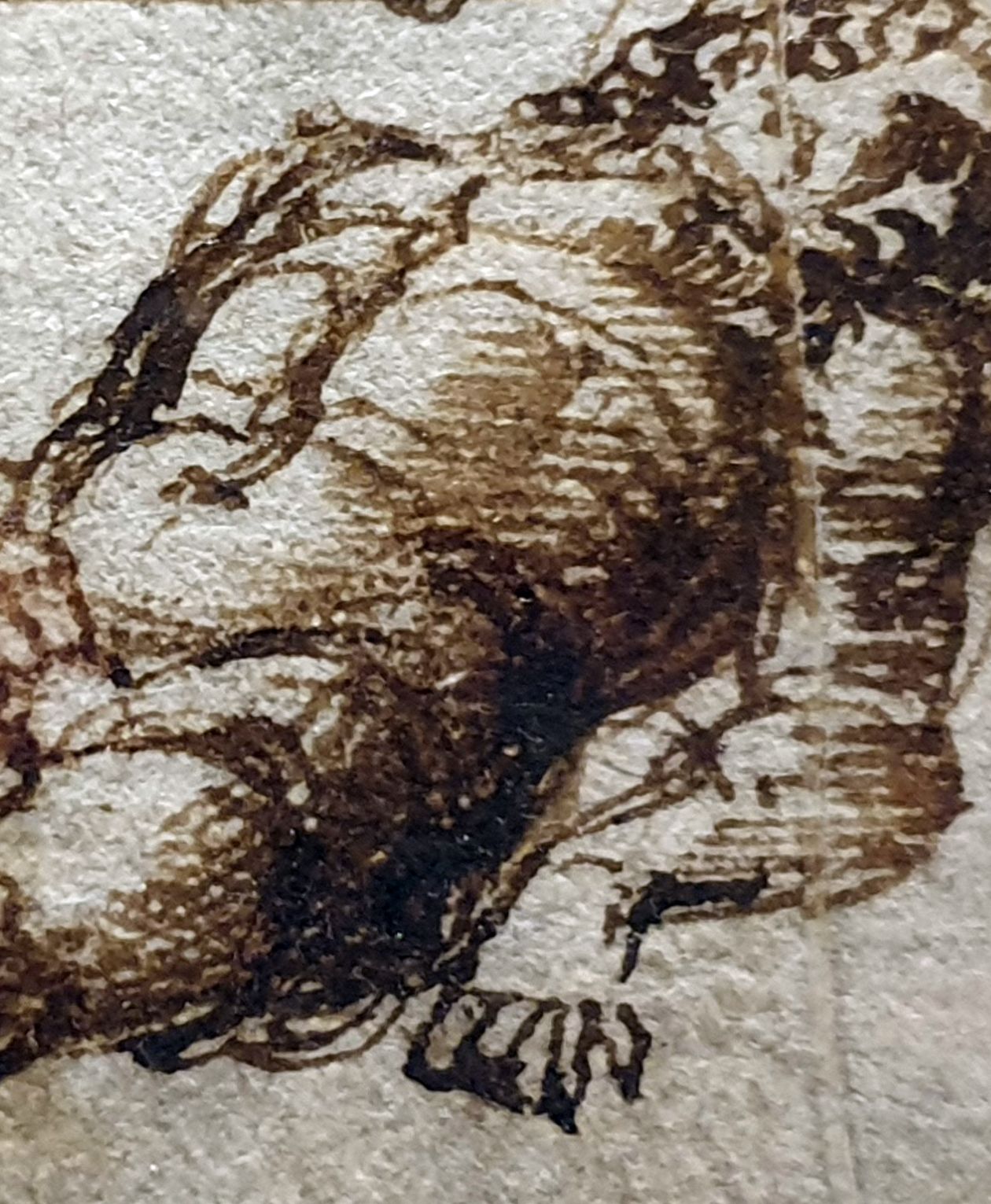
St James on his way to Execution
The blessing gesture
James turns towards a kneeling man. Short diagonal strokes run from the opening between their figures towards the more heavily shaded back of the central soldier.
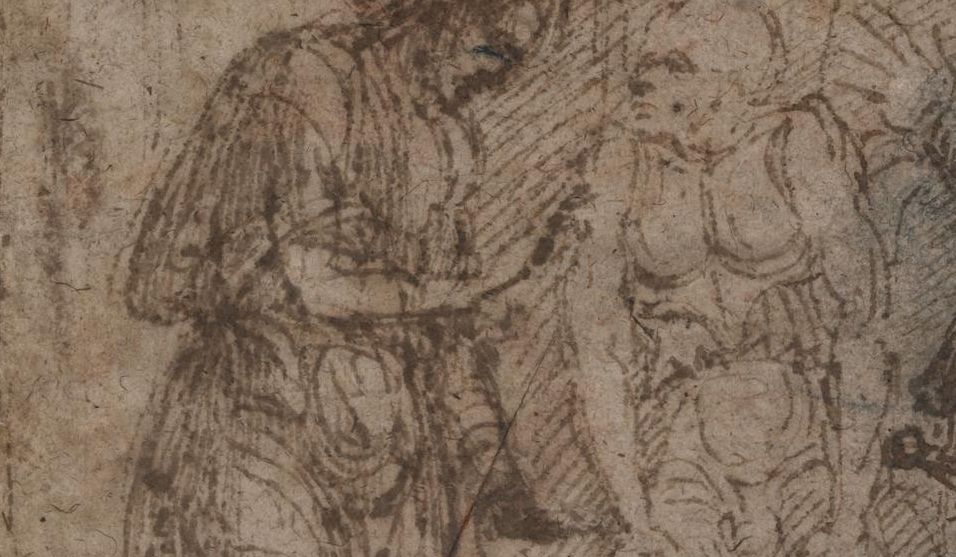
The soldier and the crowd
The soldier’s back and planted legs stand out in a dark block. Looser marks make the crowd at right easier to distinguish from his silhouette.
Virtus Combusta
The goat-eared figure
Light follows the turn of the shoulder and ribs on the central figure. Compare it with the paler, flatter handling of parts of the group on the left.
Red and pale wash
The reddish figure beside the seat stands out against the pale group. Local colour and areas of shading change how nearly each passage resembles a relief.
Artworks directory
| Name | Date | Medium and collection |
|---|---|---|
| The Adoration of the Shepherds | Shortly after 1450 | Painting · Metropolitan Museum of Art · 32.130.2 Catalogue. |
| Saint Mark the Evangelist | C. 1448–51 | Painting · Städel Museum · 1046 Catalogue. |
| Saint Jerome Penitent in the Desert | C. 1448–51 | Painting · Museu de Arte de São Paulo · MASP.00015 Catalogue. |
| Martyrdom and Transport of the Body of Saint Christopher | Mid-1450s | Painting · Ovetari Chapel, Padua Catalogue. |
| San Luca Altarpiece | 1453–55 | Painting · Pinacoteca di Brera · 176 Catalogue. |
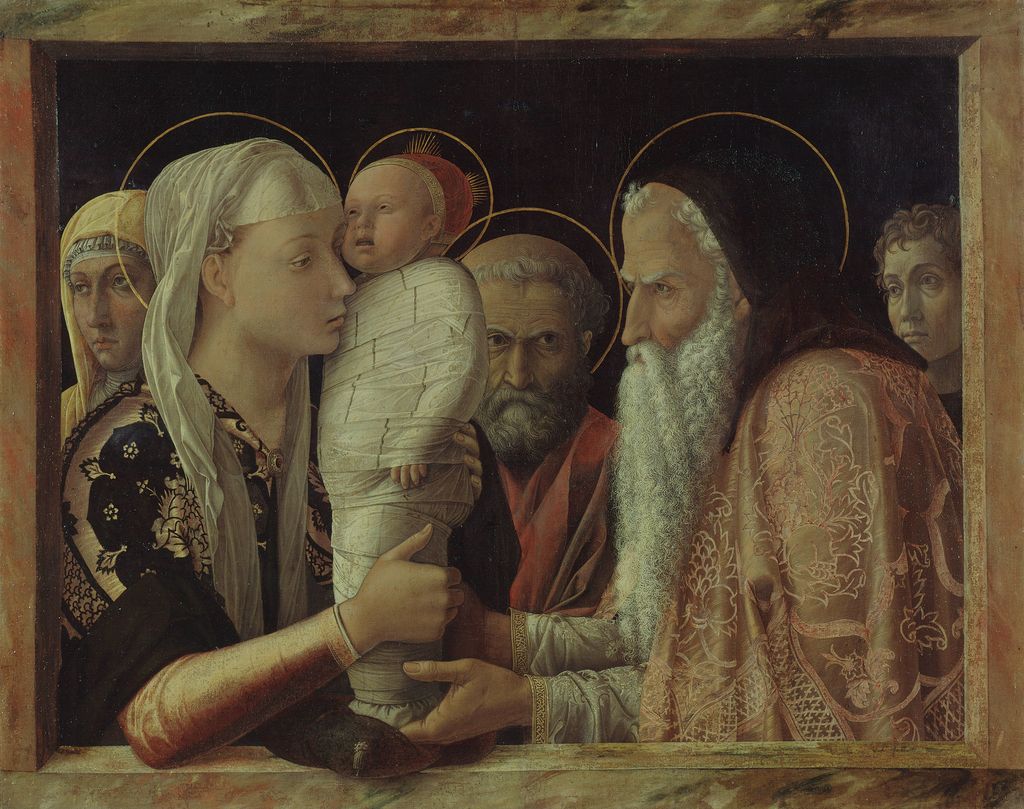
| The Presentation of Christ at the Temple | 1454 (Berlin dating) | Painting · Gemäldegalerie, Berlin · 29 Catalogue. |
| San Zeno Altarpiece | 1457–59 | Painting · Basilica of San Zeno, Verona Catalogue. |
| The Crucifixion | 1456–59 | Painting · Musée du Louvre · INV 368 Catalogue. |
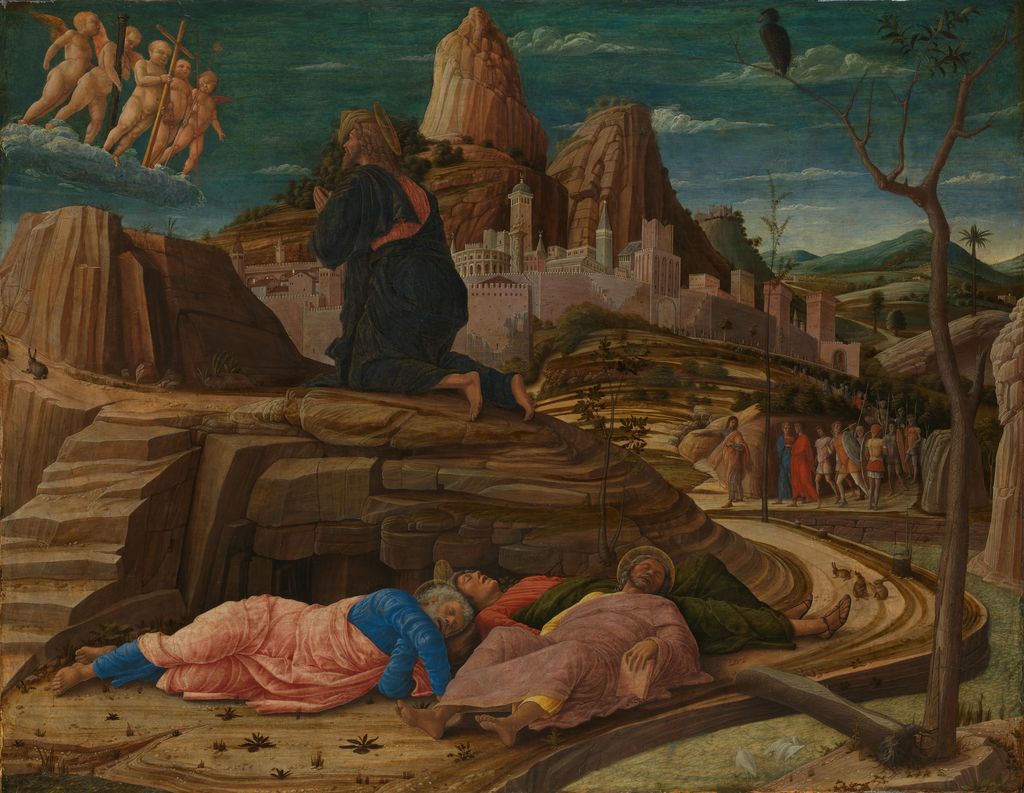
| The Agony in the Garden (London) | C. 1455–56 | Painting · National Gallery, London · NG1417 Catalogue. |
| The Agony in the Garden (Tours) | 1459 (Tours dating) | Painting · Musée des Beaux-Arts de Tours · 1803-1-24 Catalogue. |
| The Resurrection | 1459 (Tours dating) | Painting · Musée des Beaux-Arts de Tours · 1803-1-25 Catalogue. |
| Saint Sebastian (Vienna) | C. 1457–59 | Painting · Kunsthistorisches Museum · GG 301 Catalogue. |
| Cardinal Ludovico Trevisan | C. 1459–60 (Berlin exhibition dating) | Painting · Gemäldegalerie, Berlin · 9 Catalogue. |
| The Death of the Virgin | C. 1462 | Painting · Museo Nacional del Prado · P000248 Catalogue. |
| Christ with the Soul of the Virgin | C. 1460–64 | Painting · Pinacoteca Nazionale, Ferrara Catalogue only. |
| Portrait of a Young Man (traditionally Francesco Gonzaga) | C. 1461 or 1470, depending on sitter | Painting · Museo di Capodimonte · Q 60 Catalogue. |
| Portrait of a Prelate (Carlo de’ Medici?) | C. 1465–70 | Painting · Uffizi Galleries · 1890 no. 8540 Catalogue. |
| Portrait of a Man | C. 1470 | Painting · National Gallery of Art, Washington · 1952.2.5 Catalogue. |
| Madonna with Sleeping Child (Berlin) | C. 1455–60 | Painting · Gemäldegalerie, Berlin · S.5 Catalogue. |
| Camera degli Sposi (Camera Picta) | 1465–74 | Painting · Palazzo Ducale, Mantua Catalogue. |
| Saint Sebastian (Louvre) | Around 1480 | Painting · Musée du Louvre · RF 1766 Catalogue. |
| Lamentation over the Dead Christ | C. 1483 (Brera dating) | Painting · Pinacoteca di Brera · 352 Catalogue. |
| The Triumphs of Caesar | About 1485–1506 | Painting · Royal Collection · RCIN 403958–403966 Catalogue. |
| Madonna of the Caves | C. 1488–90 | Painting · Uffizi Galleries · 1890 no. 1348 Catalogue. |
| Madonna and Child with a Choir of Cherubim | C. 1485 | Painting · Pinacoteca di Brera · 297 Catalogue. |
| Madonna and Child (Poldi Pezzoli) | Early 1490s (museum dating) | Painting · Museo Poldi Pezzoli · 1595 Catalogue. |
| The Holy Family with Saint Mary Magdalen | C. 1495–1500 | Painting · Metropolitan Museum of Art · 14.40.643 Catalogue. |
| The Virgin and Child with Saint Mary Magdalene and Saint John the Baptist | C. 1490–1505 | Painting · National Gallery, London · NG274 Catalogue. |
| Christ as the Suffering Redeemer | 1485–95 (SMK dating) | Painting · Statens Museum for Kunst · KMSsp69 Catalogue. |
| Ecce Homo | C. 1500 | Painting · Musée Jacquemart-André · MJAP-P 1840 Catalogue. |
| Judith with the Head of Holofernes (Mantegna or follower) | C. 1495–1500 | Painting · National Gallery of Art, Washington · 1942.9.42 Catalogue. |
| Madonna della Vittoria | 1495–96 | Painting · Musée du Louvre · INV 369 Catalogue. |
| Mars and Venus (Parnassus) | C. 1496–97 | Painting · Musée du Louvre · INV 370 Catalogue. |
| The Trivulzio Madonna | 1497 | Painting · Castello Sforzesco, Milan · 0554 Catalogue. |
| The Adoration of the Magi | C. 1495–1505 | Painting · J. Paul Getty Museum · 85.PA.417 Catalogue. |
| Minerva Expelling the Vices from the Garden of Virtue | C. 1502 | Painting · Musée du Louvre · INV 371 Catalogue. |
| The Introduction of the Cult of Cybele at Rome | 1505–06 | Painting · National Gallery, London · NG902 Catalogue. |
| Saint Sebastian (Venice) | Probably c. 1504–06 | Painting · Galleria Giorgio Franchetti alla Ca’ d’Oro · D.11 Catalogue. |
| Samson and Delilah | C. 1500 | Painting · National Gallery, London · NG1145 Catalogue only. |
| A Woman Drinking (probably Sophonisba) | C. 1495–1506 | Painting · National Gallery, London · NG1125.2 Catalogue only. |
| The Vestal Virgin Tuccia with a Sieve | C. 1495–1506 | Painting · National Gallery, London · NG1125.1 Catalogue only. |
| Judith with the Head of Holofernes (Dublin) | C. 1495–1500 | Painting · National Gallery of Ireland · NGI.442 Catalogue only. |
| Battle of the Sea Gods, left half (Met impression) | Before 1481 (Met dating) | Print · Metropolitan Museum of Art · 18.12 Catalogue only. |
| Battle of the Sea Gods, right half (Met impression) | Before 1481 (Met dating) | Print · Metropolitan Museum of Art · 1984.1201.4 Catalogue only. |
| Battle of the Sea Gods, left half (Tokyo impression) | C. 1475 (Tokyo dating) | Print · National Museum of Western Art, Tokyo · G.1981-0002 Catalogue only. |
| Battle of the Sea Gods, left half (Washington impression) | C. 1485–88 (NGA dating) | Print · National Gallery of Art, Washington · 1941.1.6 Catalogue only. |
| The Entombment of Christ, second state of two | Before 1475 (Met dating) | Print · Metropolitan Museum of Art · 37.42.30 Catalogue only. |
| The Entombment of Christ (possibly Zoan Andrea, after Mantegna) | 1460–1549 (Rijksmuseum dating) | Print · Rijksmuseum · RP-P-1924-60 Catalogue only. |
| Four Dancing Muses (Gian Marco Cavalli after Mantegna) | C. 1497 | Print · Metropolitan Museum of Art · 20.5.3 Catalogue only. |
| Bacchanal with Silenus | Before 1475 (Met dating) | Print · Metropolitan Museum of Art · 29.44.15 Catalogue only. |
| Bacchanal with a Wine Vat | Before 1475 (Met dating) | Print · Metropolitan Museum of Art Catalogue only. |
| St James on His Way to Execution | C. 1453–57 | Drawing · British Museum · 1976,0616.1 Catalogue only. |
| Three Studies for a Dead Christ | C. 1455–65 | Drawing · British Museum · 1909,0406.3 Catalogue only. |
| Pietà (Venice) | C. 1456–65 (exhibition datings) | Drawing · Gallerie dell’Accademia, Venice · 115 Catalogue only. |
| Studies for Christ at the Column | 1460–65 | Drawing · The Courtauld · D.1978.PG.345 Catalogue only. |
| Virtus Combusta | C. 1490 (technical study) | Drawing · British Museum · Pp,1.23 Catalogue only. |
| Virtus Combusta (Giovanni Antonio da Brescia after Mantegna) | C. 1495–1506 | Print · Musée du Louvre · 3881 LR/ Recto Catalogue only. |
| The Calumny of Apelles | C. 1504–06 | Drawing · British Museum · 1860,0616.85 Catalogue only. |
Frequently Asked Questions
The reverse shows two seated women. The British Museum’s record for 1909,0406.3 identifies the studies on both faces of the sheet.
Both versions survive. The British Museum holds the drawing, and the Louvre catalogues its related engraving under Giovanni Antonio da Brescia.
Discussion
Look again at the images and ideas explored in Drawings. These editorial prompts invite your observations.
Reader Insights
How does Mantegna’s shift from loose to closely directed hatching change the way you read the encounter between St James, the kneeling man and the soldier?
What do Mantegna’s coloured washes in Virtus Combusta and the engraved lower scene in Virtus Deserta tell us about different parts of the same design?
Join the Conversation
Share a detail, comparison or question about Drawings below.
References
- The British Museum, St James on his way to Execution, 1976,0616.1. View source.
- Satoko Tanimoto and colleagues, Technical Examination and Analysis of Andrea Mantegna’s Virtus Combusta, Technè 35. View source.
- Staatliche Museen zu Berlin, Mantegna und Bellini, Berlin exhibition checklist. View source.
- Lombardia Beni Culturali, Carlo Naya, San Giacomo condotto al martirio, photographic record FF 2999. View source.
- Padova Musei Civici, Il Museo del Risorgimento e dell’Età Contemporanea. View source.
- Musée du Louvre, Andrea Mantegna and Giovanni Bellini, exhibition entry for the Venice Pietà, inventory 115. View source.
- The National Gallery, Family Matters, slide list for the Mantegna and Bellini talk. View source.
- Wikimedia Commons, British Museum reproduction of Three Studies for a Dead Christ, 1909,0406.3. View source.
- The National Gallery, Mantegna and Bellini loan report, The Deposition of Christ and Study for a Candlestick, DS 147. View source.
- Pinacoteca di Brera, Lamentation over the Dead Christ. View source.
- The Courtauld, Studies for Christ at the Column, recto and verso, D.1978.PG.345. View source.
- The Courtauld, Flagellation. View source.
- The Morgan Library & Museum, Dürer to de Kooning exhibition highlights, Dancing Muse. View source.
- Musée du Louvre, Mars et Vénus, dit Le Parnasse, INV 370. View source.
- Musée du Louvre, La danse de quatre femmes, burin engraving after 1497. View source.
- Musée du Louvre, Virtus combusta, 3881 LR/ Recto. View source.
- Musée du Louvre, Virtus deserta, 3882 LR/ Recto. View source.
- The British Museum, The Calumny of Apelles, 1860,0616.85. View source.
- Musée du Louvre, Minerve chassant les Vices du Jardin de la Vertu, INV 371. View source.
- Musée du Louvre, Mantegna & Bellini, 2018–19 graphic arts loans. View source.
- Musée du Louvre, Lamentation sur le corps du Christ, RF 436, Recto. View source.
- Staatliche Museen zu Berlin, Christus in der Vorhölle, KdZ 622. View source.
- Staatliche Museen zu Berlin, Innige Rivalen, Mantegna und Bellini in der Gemäldegalerie. View source.
- The Metropolitan Museum of Art, The Holy Family with Saint Elizabeth and the Infant John the Baptist, 1975.1.372. View source.
- The State Hermitage Museum, Формулы Андреа Мантеньи, exhibition overview. View source.
- The State Hermitage Museum, Disegno. Italian Prints and Drawings in the Age of Renaissance and Mannerism. View source.
- The State Hermitage Museum, Мадонна с младенцем, ОГ-399016. View source.
More MANTEGNA Paintings
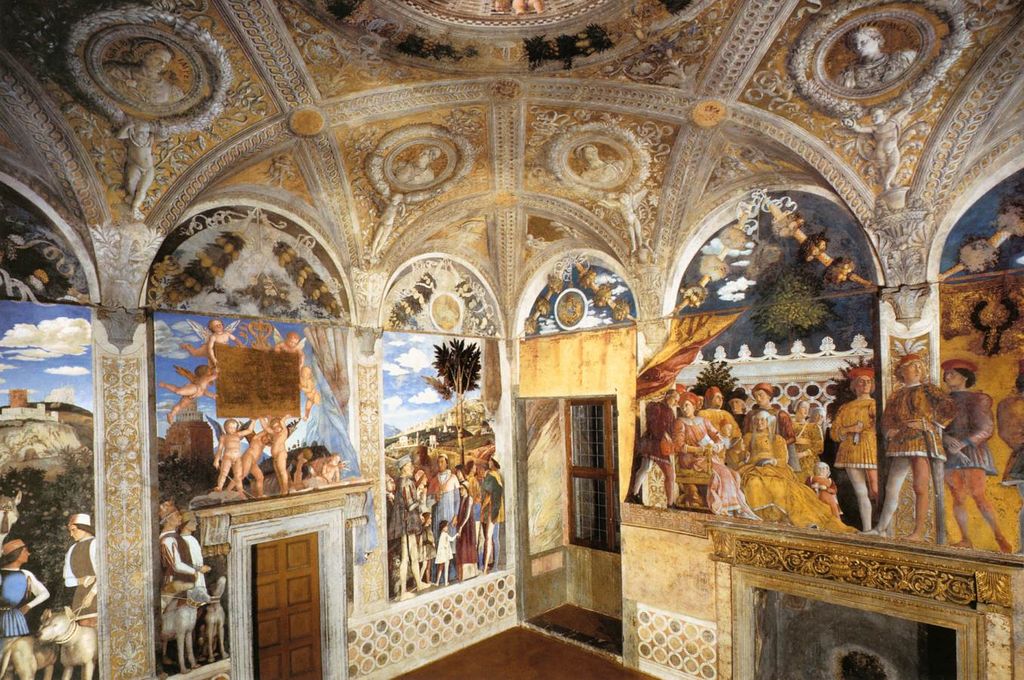
San Zeno Altarpiece
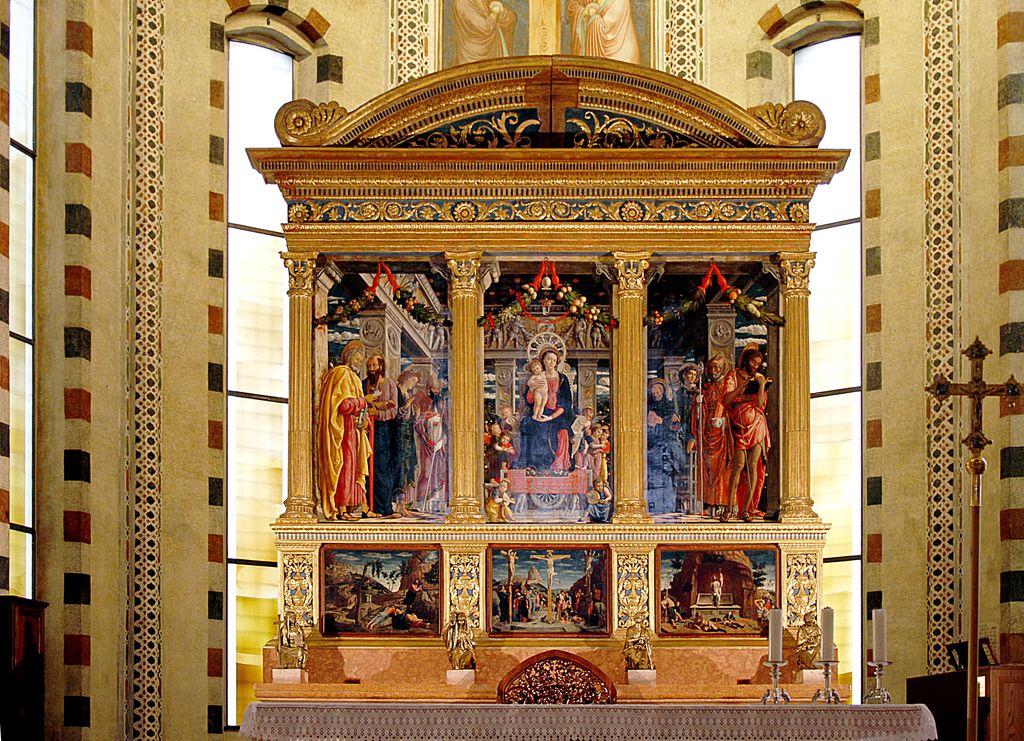
The San Zeno Altarpiece in its frame, Basilica of San Zeno, Verona José Luiz. Image source. CC BY-SA 4.0. Resized from the cited image.