 by Tom Gurney
Tom Gurney BSc (Hons) is an art history expert with over 20 years experience
Published on June 19, 2020 / Updated on November 29, 2026
Email: tomgurney1@gmail.com / Phone: +44 7429 011000
Overview
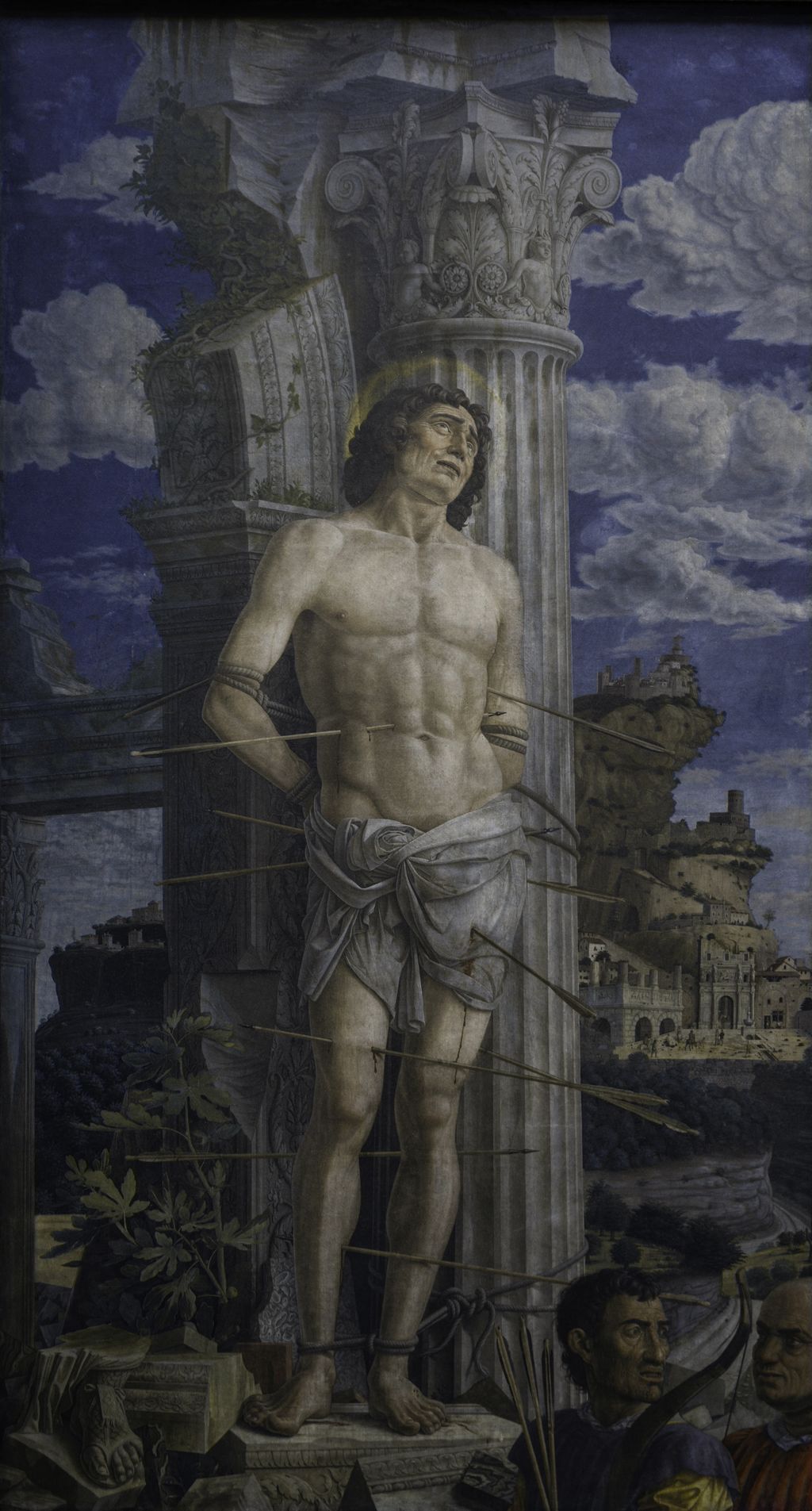
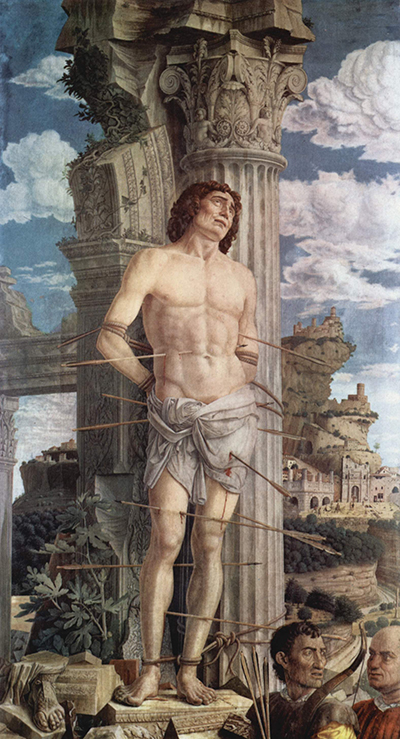
Two men appear at the bottom right of Andrea Mantegna’s St Sebastian. One carries a bow that curves up between their faces. Above them, nearly the full height of the painting is given over to the man they have shot. Sebastian stands barefoot on broken masonry, bound to a column that has outlasted much of the building it once supported. This is the large canvas in the Musée du Louvre, Paris, inventory RF 1766. The museum’s catalogue dates it to the last quarter of the fifteenth century, and its teaching guide places it around 1480. [1] [2]
At a Glance
- DateAround 1480; catalogued to the last quarter of the 15th century
- MediumTempera on canvas
- Dimensions255 × 140 cm
- CollectionMusée du Louvre, Paris
- Inventory numberRF 1766
Andrea Mantegna in context
San Zeno Altarpiece
1457–59 [18]Saint Sebastian (Louvre)
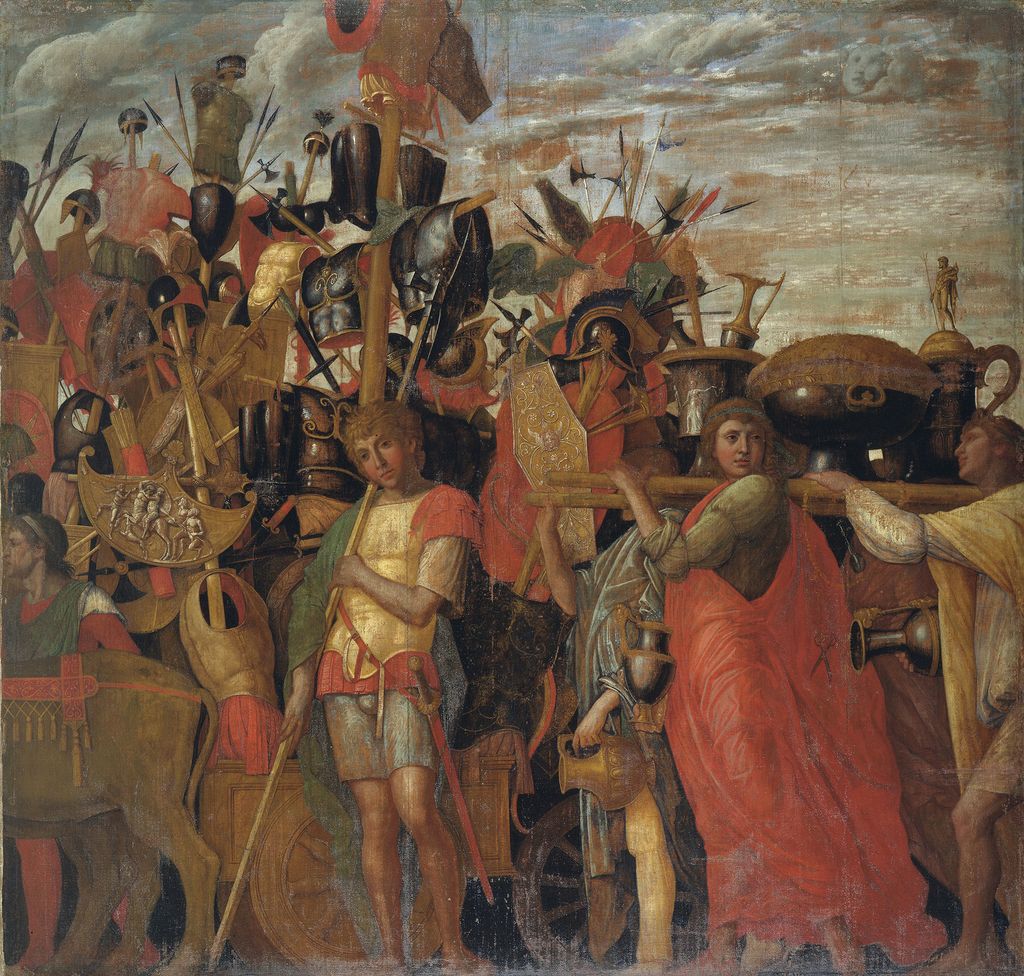
Around 1480 [1]The Triumphs of Caesar
Mid-1480s–before 1506 [19]Madonna della Vittoria
1495–96 [20]The archers at the edge
In the Christian legend, Sebastian was a soldier persecuted for his faith under the Roman emperor Diocletian. He survived the arrows, was nursed by Irene of Rome and was subsequently beaten to death. As the Princeton University Art Museum’s Veronica White explains, the story of his survival helped make him a saint people invoked against plague. Mantegna chose the episode by which the saint is most readily recognised. The arrows are already lodged in his flesh, and the ropes still bind him to the column. For a viewer who knows the story, the fact that he is still standing carries particular weight. [1] [3]
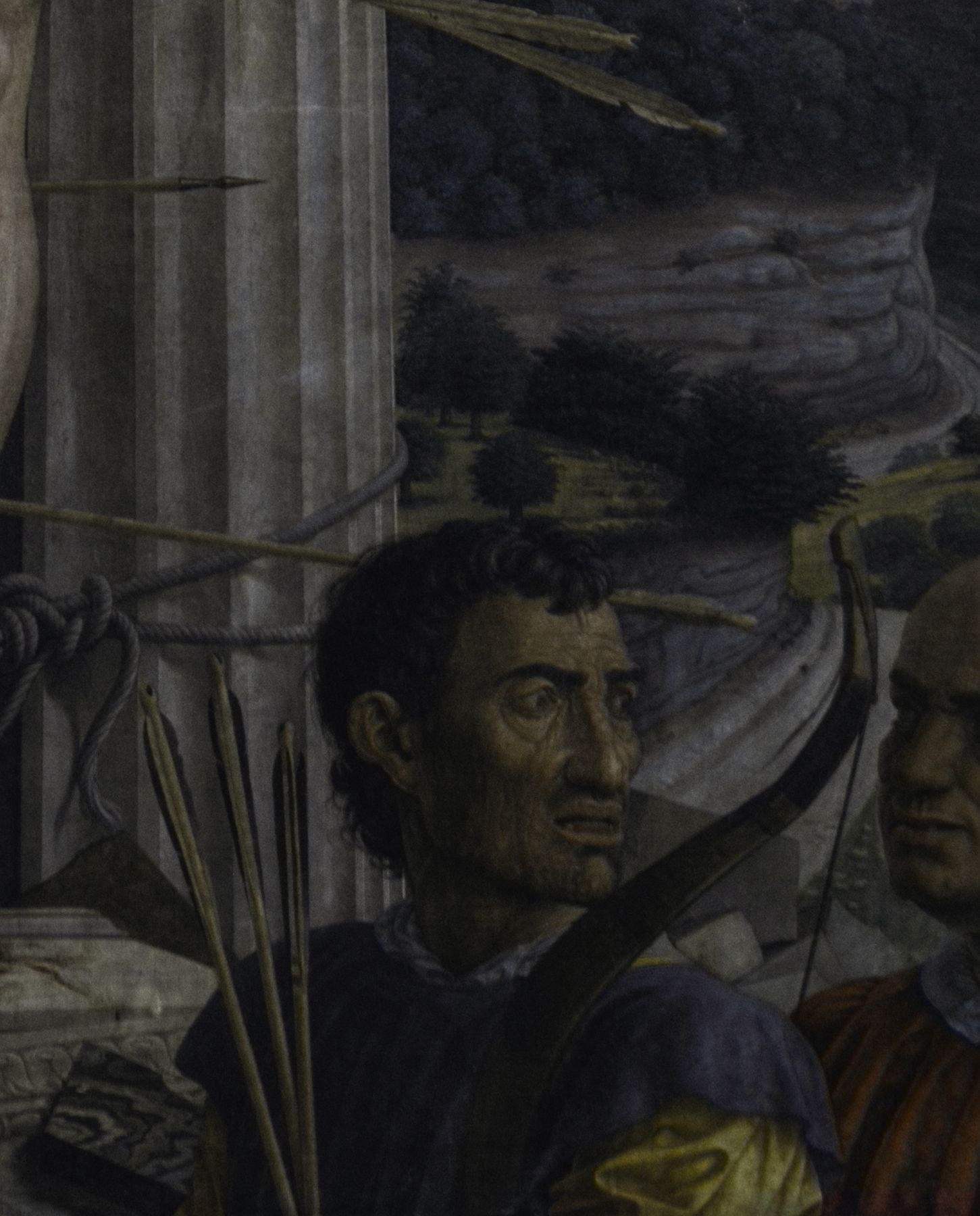
The archers establish how low we seem to be standing. Beside them, Sebastian’s feet rest on a broken platform at roughly head height. The creases in the men’s faces are clear, and the bottom edge cuts them off at the upper body. The dark-haired man turns towards the man in red, who looks back across the picture. The bow bends between their profiles, while a cluster of spare arrows rises beside the dark-haired man’s shoulder. Above them, Sebastian’s turned head and lifted eyes send attention in a different direction. The Louvre draws attention to the position of the archers at the viewer’s level, which makes the saint appear taller still. [1] [2]
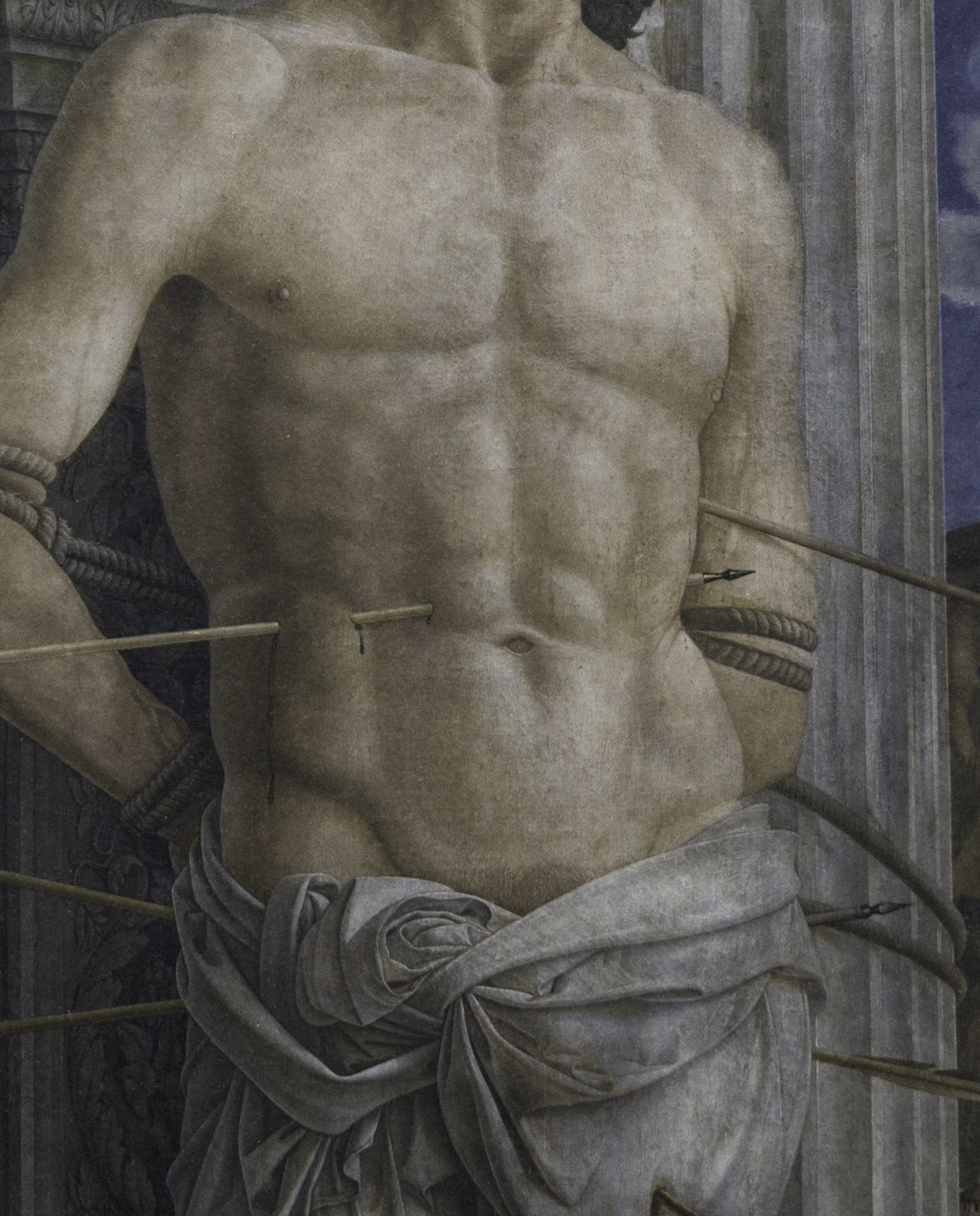
From the archers’ level, the violence reads through its aftermath. Their weapons are still in view, and the angles of the arrows lead the eye back to the body. A shaft crosses the space at the waist, others interrupt the pale expanse of the thighs and shins, and the scattered angles make the injuries register individually. His arms are pulled behind his back, leaving the chest and abdomen broad in the light. The cloth gathers at one hip, then drops in a mass of folds that divides the torso from the long line of the legs. [1] [2]
The face carries much of the strain. Sebastian’s mouth is parted and his brow contracts, even as his feet remain firmly planted. The Louvre reads the raised gaze as an expression of faith and compares the athletic body to an ancient ideal of physical beauty. The combination matters because the figure still has the weight of a person who has to stand on that ledge. Beneath the apparent steadiness are the tension in the thighs and the small adjustment of the head and neck. Mantegna gives the face and body different kinds of work to do. From a distance the posture holds the composition together. Up close, the drawn features and the entry points of the arrows make endurance look effortful. [1] [2]
A column, a bare foot and a broken statue
The column begins at the level of Sebastian’s feet and continues far above his head. Its channels carry the eye up the shaft to the leafy Corinthian capital, just above and behind the saint. At that point Mantegna lets the structure spread outward into uneven masses. To the left, part of an arch and its pier survive, with exposed masonry where the upper section has broken away. The shaft is continuous enough to measure the body against, while the surrounding ornament has been reduced to pieces. The building’s damage becomes legible through that difference. [1] [4]
At the lower left, a sculpted foot in a sandal rests on a tilted block. The straps still cross the instep, and the sudden break above the ankle leaves the eye searching for the statue it came from. Beside it, Sebastian’s bare feet take the weight of his body. The toes follow the surface of the plinth and the ankles lead into legs modelled with something like the solidity of sculpture. The rope draws tight around both ankles, and a thin line of blood trails across the stone. Mantegna makes the two kinds of foot unusually easy to compare by bringing them into the same strip of light near the bottom of the canvas. [1] [5]
Philippe Cardinali interprets the juxtaposition as a Christian reversal. He sees the broken image of an ancient god or hero beside the still upright martyr, who survived the arrows. He also proposes that the fig tree emerging between the stones recalls the parable of the barren fig tree in Luke. That reading gives the vegetation and the debris a place in the painting’s religious argument. In the painting, the leaves spread out from a cleft in the masonry, right beside the place where the carved pieces have collected. Their irregular outlines are especially conspicuous against the fluting and squared blocks around them. [1] [4] [5]
The antiquity Mantegna brings into the scene is also a matter of workmanship. The edges of mouldings catch light, and a carved surface remains recognisable even after the piece it belongs to has fallen. The Louvre’s exhibition teaching material points to the fragments of decorated cornice, the sculpted foot and the modelling of the torso as different expressions of the painter’s engagement with antique art. They ask for different kinds of looking. A bit of cornice can be understood from the succession of its profiles. A fragment of a figure invites the eye to reconstruct what is missing. The shafts that pierce Sebastian offer their own clues to volume. Their angles carry the eye across the thigh and around the ribcage, where direction and shadow reveal more of the body’s shape. [1] [6]
Through the ruin to the hill town
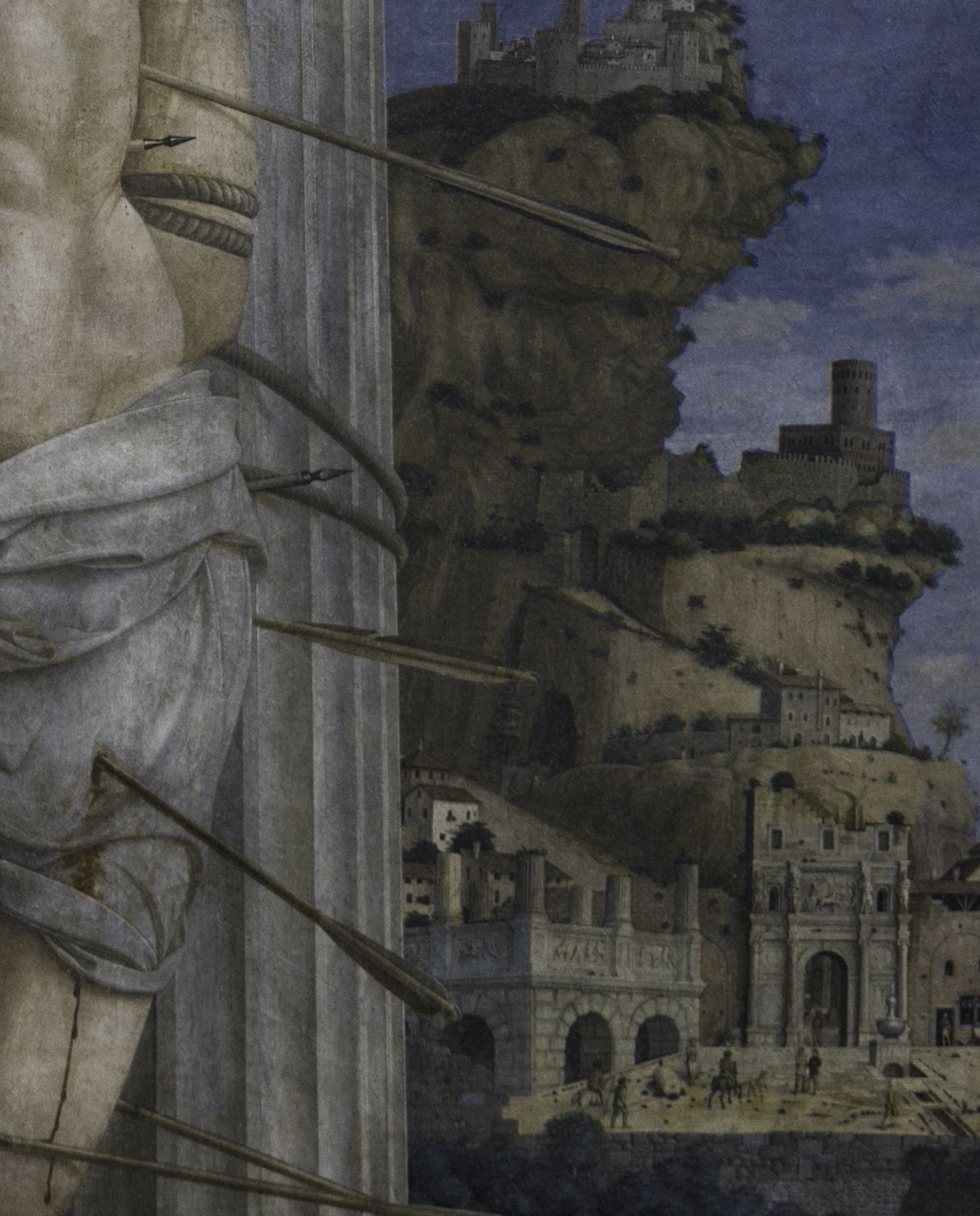
The column divides the view into two openings of unequal width and depth. To the left, the remaining arch and its horizontal moulding frame a narrow glimpse beyond the fig tree. The more expansive passage into the landscape lies to the right of the shaft, above the archers. Low rocks interrupt the passage at first. Beyond them the buildings are close enough together to read as a settlement, with tiny figures crossing a paved square between a row of arches and a tall gateway. Higher up, a round tower stands on one shelf of rock, and another set of walls crowns the overhanging summit. The eye can reach that height by tracing the broken profile of the hill, quite apart from the direct ascent provided by the column. [1] [2] [4]
The small people in the distance do something the rocks and buildings alone could never do. They give the streets a human scale, just as the two faces at the front give the foreground one. It takes a moment to reconcile those little figures and the men who fill the lower corner as inhabitants of the same painted world. Across that interval, the hard edges and warm colour of the foreground give way to more muted forms. The largest clouds retain a surprising volume at the skyline. They pass behind both the hill and the remains of the arch, making the ruin feel at once very close and open to the same weather as the town. [1] [2]
The landscape also changes the sense of time. Among the large fragments at Sebastian’s feet, the ancient building has already come apart. Farther back, masonry can still shelter people and give shape to a working settlement. The distance between one and the other leaves room to imagine ancient construction being inhabited, abandoned or built over. The ruins and the town occupy the same landscape, so that the fallen masonry at Sebastian’s feet looks like one stage in the life of a building. [1] [4]
Painted stone on a travelling canvas
The Louvre catalogue gives the unframed dimensions as 255 by 140 centimetres and the medium as tempera on canvas. A painted border imitates porphyry, the purplish stone, so that the thin strip at the perimeter belongs to Mantegna’s play with materials as much as the column and rubble inside it do. The thin border holds its straight line all the way round. Within it, the edges of the ruin buckle, split and give way to sky. [1]
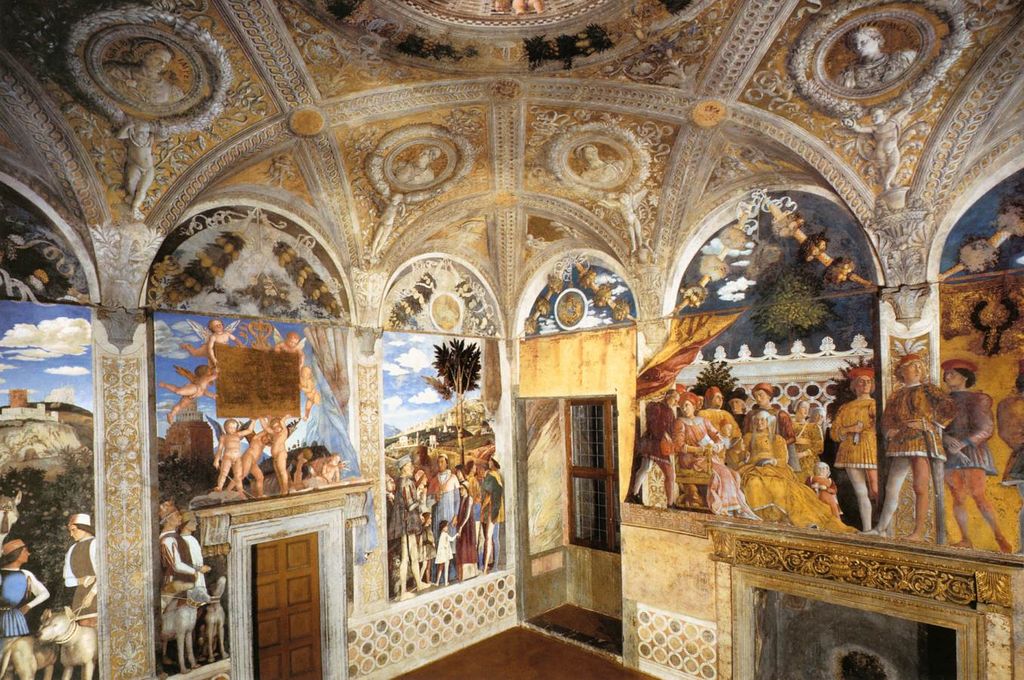
Mantegna had already made painted architecture do another kind of work in the Gonzaga palace at Mantua. In the Camera degli Sposi, which he decorated from 1465 to 1474, fictive pilasters divide the painted walls and the oculus turns the centre of the ceiling into an apparent opening onto the sky. The room gives its visitors a place from which to look up. The tall St Sebastian implies a position for its viewer through the scale and cropping of the archers, then directs the upward look along the column and figure. On the canvas, a single painted boundary has to produce a spatial effect that the room can develop across actual walls and a ceiling. [1] [2] [7]
The marriage and the record at Aigueperse
How that large canvas reached the Auvergne is a separate question from why it was painted. The Louvre considers it probable that the work came to Aigueperse in connection with the February 1481 marriage of Chiara Gonzaga, daughter of the marquis Federico, and Gilbert de Bourbon, count of Montpensier. Its exhibition account leaves the circumstances of the commission and the initial destination open. Historians Julien Noblet and Laurent Vissière consider whether the painting was a wedding gift, part of the dowry or a commission from the Montpensiers. The documented marriage negotiations allowed for part of the dowry to be paid in valuables. A canvas that could be rolled might have travelled among them. The surviving account of the dowry gives a value for the goods that accompanied Chiara, with no itemised list to connect the canvas to them. The case for a direct commission also lacks documentary confirmation. [1] [8] [9]
The painting’s earliest known documentary setting is the Sainte-Chapelle at Aigueperse. Founded in 1475 by Louis I of Bourbon-Montpensier and dedicated to Saint Louis and the Virgin, it was intended to commemorate the family and hold its tombs. Noblet and Vissière note outbreaks of plague in both Mantua and the Auvergne near the proposed time of the painting’s arrival. They raise those outbreaks as a possible reason for choosing Sebastian, whose protection had long been sought in epidemics. The association helps explain why a picture of him might have mattered in such a chapel, even though the original reason for choosing the subject remains unknown. [3] [9]
Another painting makes the Mantuan connection part of a wider story of Italian art at Aigueperse. Benedetto Ghirlandaio’s Nativity, made there in 1490, carries a French inscription identifying the Florentine painter and placing the work in the count’s household. The inscription supplies a painter, a date and a place of execution, three details that rarely come together so neatly. The two works give a sense of the different ways an Italian picture might reach the Montpensier court, either by bringing the painter to France or by moving a work across the Alps. [8] [9] [10]
The first recorded notice of the St Sebastian that Noblet and Vissière identify is a bishop’s visitation of 1636. By the eighteenth century, visitors were remarking on the lifelike faces of the two archers, especially the detail that became apparent when they approached the canvas. By 1854 it was recorded under Mantegna’s name in a chapel of Aigueperse’s collegiate church of Notre-Dame. The Louvre bought it from the municipality in 1910 using funds from the Jules Maurice Audéoud bequest. The sale called for a copy to take the original’s place in the church, and opponents in Aigueperse contested the acquisition. [1] [8] [9]
Other painters had taken up the composition long before the Louvre bought it. The Louvre’s Mantegna exhibition identifies an echo in Bernardino da Parenzo’s Saint Sebastian, a small panel in the Royal Collection. Its antique ruins and the elevated place given to the bound figure are recognisable even in a much smaller painting. In Antonio Maineri’s signed Saint Sebastian of 1492, the Pinacoteca Nazionale di Bologna identifies two close echoes of the Louvre canvas, the saint’s pose and the head of an executioner at the foot of the column. Maineri keeps that low vantage while putting Sebastian against a black ground. A painter could borrow the device that makes the martyr loom and leave the landscape behind. The precise means of transmission are harder to recover. An artist could have seen the canvas or learned the arrangement through a sketch or another intermediary. [8] [9] [11] [12]
The Vienna panel and the Venice canvas
The Vienna St Sebastian is the small, early version in the Kunsthistorisches Museum, GG 301, dated about 1457–59 in the museum’s partner record. A tiled pavement runs below the ruin and its antique fragments. Mantegna’s signature in Greek letters appears on the architecture, and a cloud at the upper left takes the shape of a horse and rider. Here the archers are already small figures on a path in the distance. The Louvre canvas brings the executioners close to the viewer. The difference is most apparent if you start with the bound body in each and look for where the men have gone. [1] [13] [14]
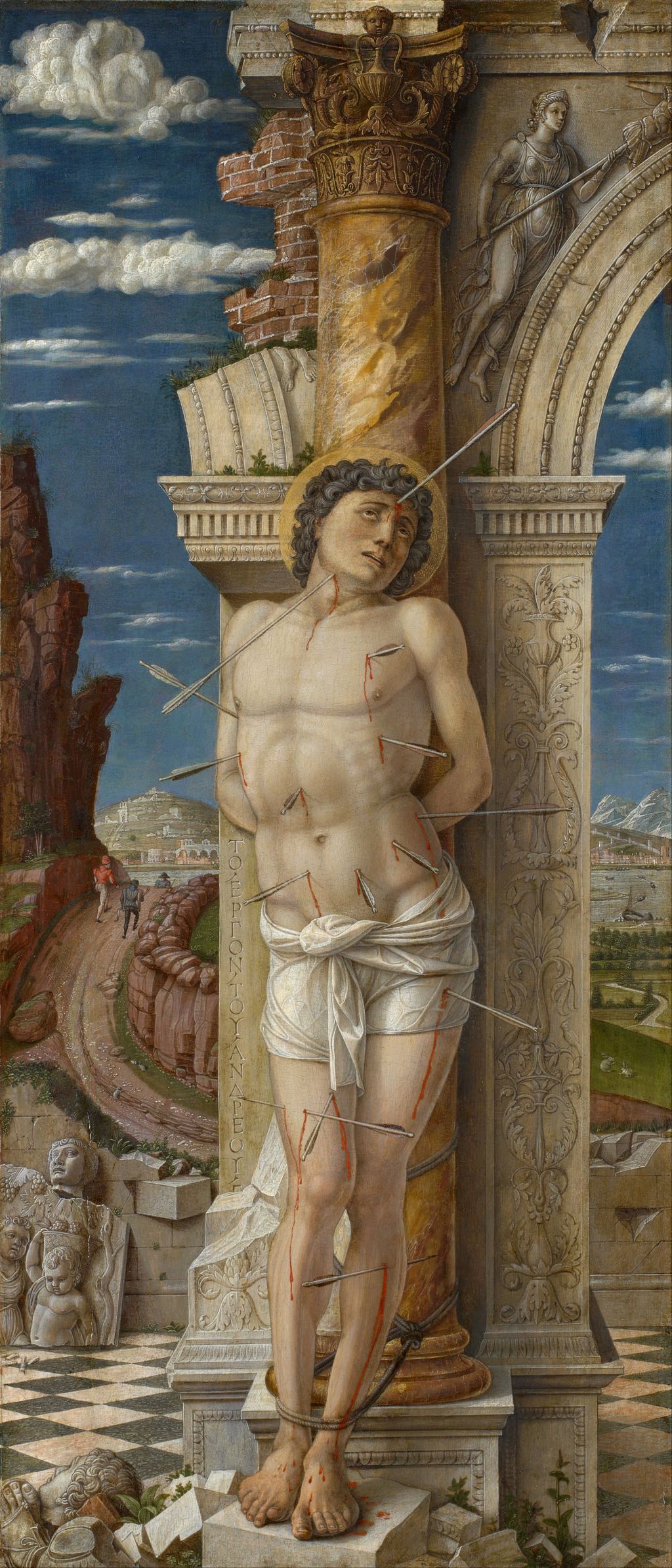
Saint Sebastian, Kunsthistorisches Museum, Vienna Image source. Public domain.
Smarthistory looks at the Vienna panel.
The Venice St Sebastian belongs to the Galleria Giorgio Franchetti alla Ca’ d’Oro and is usually treated as a late work. Its narrow canvas brings the saint forward against darkness, with a candle and a wisp of smoke low on the right. The accompanying inscription says that only the divine endures. In Paris the same corner is occupied by the faces of the two men, and beyond them the town is still visible in daylight. Franchetti had a marble-lined chapel built for the painting, with the canvas set over an altar. In 2025 the Palazzo Ducale exhibited it beside the Camera Picta in Mantua, giving visitors a chance to see how differently Mantegna used painted architecture to isolate a single figure and to draw a room’s occupants into a scene. [1] [15] [16] [17]
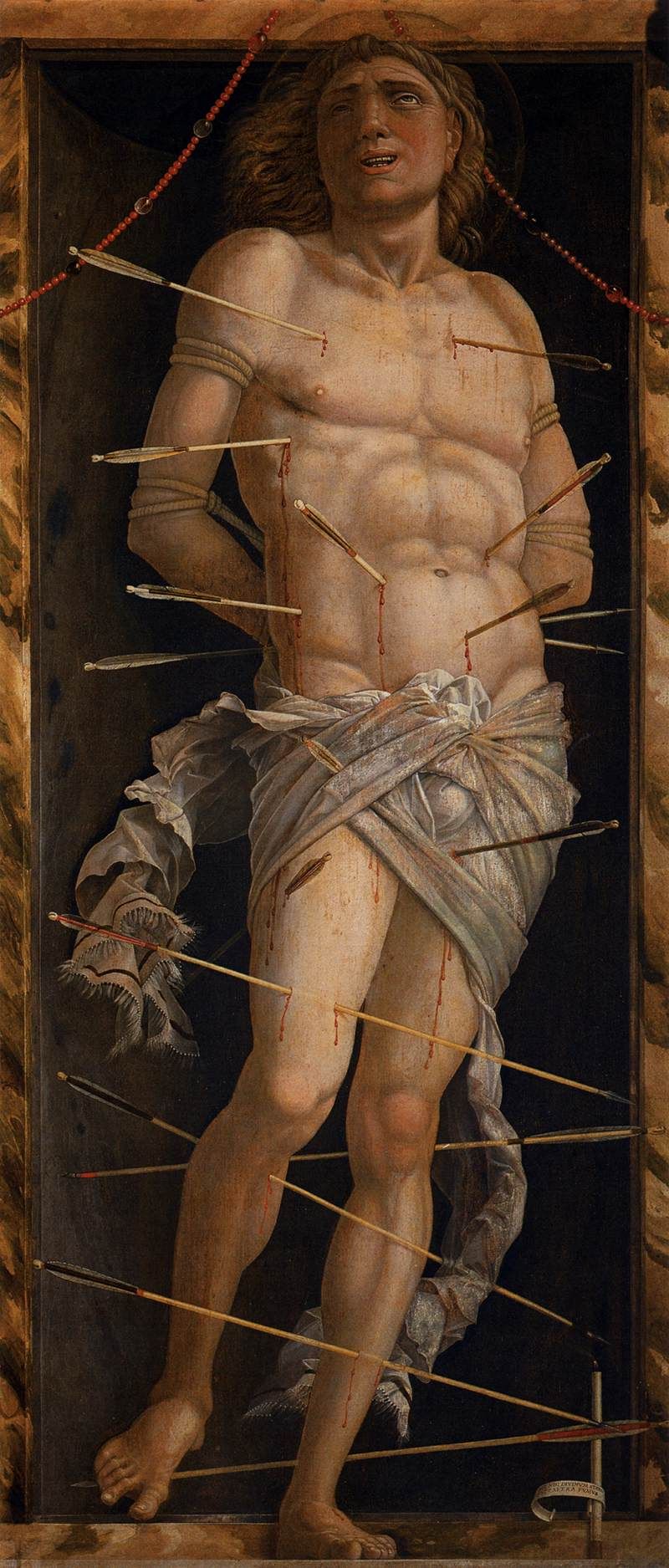
Saint Sebastian, Galleria Giorgio Franchetti alla Ca’ d’Oro, Venice Image source. Public domain.
Annotated Details from Saint Sebastian
The numbered points identify details to look at closely. The detail images below preserve the native scale of the selected crops.
Saint Sebastian
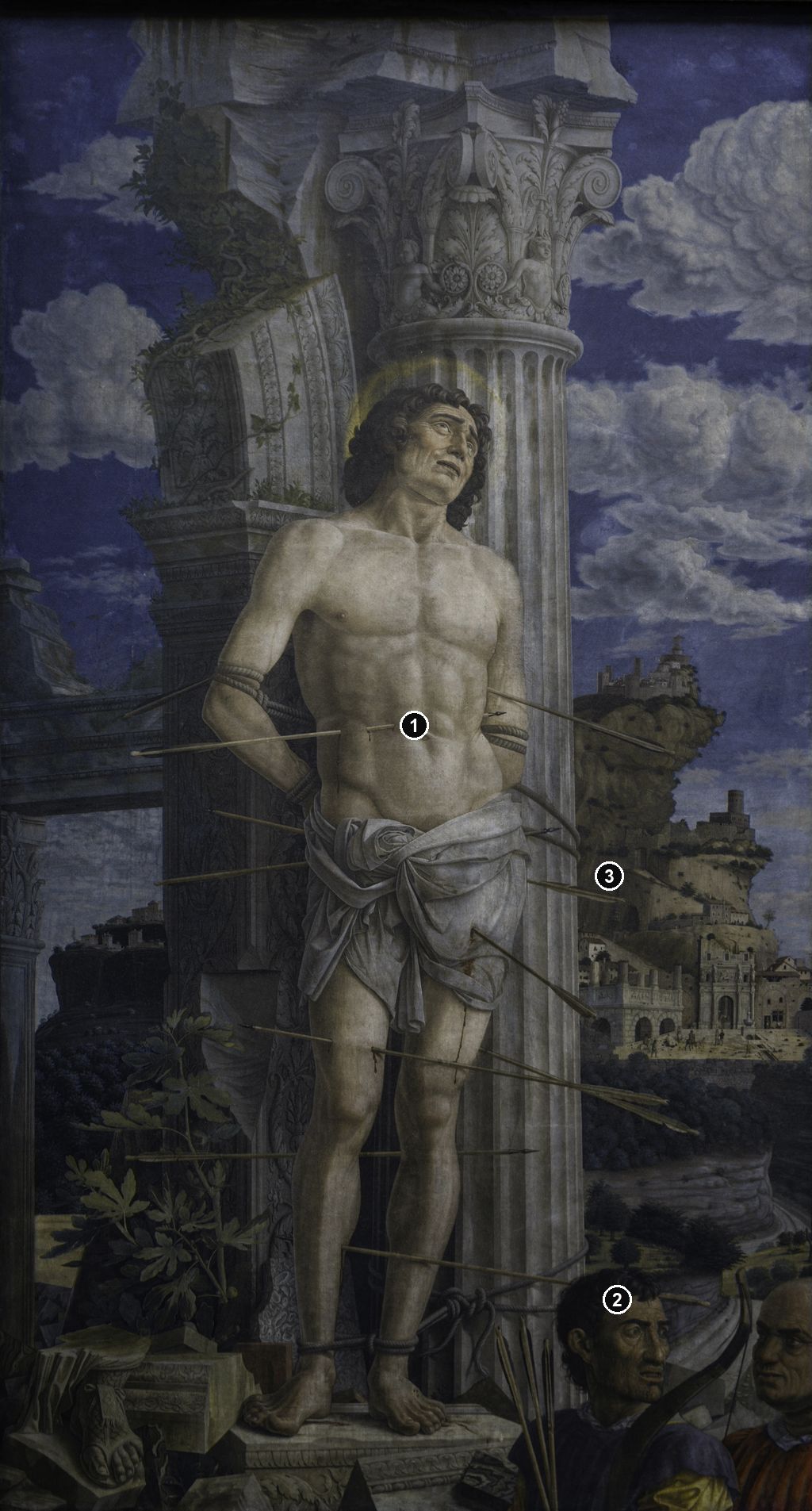
Details from SAINT SEBASTIAN
Choose a detail to enlarge it.
Saint Sebastian
Sebastian against the column
The pale body follows the tall upright behind it. Arrows cross the body and interrupt the carving’s vertical lines.
Archers at the edge
The heads appear low in the frame. Their compressed position makes the viewpoint feel close to the ruined stone beneath Sebastian.
Landscape through the ruin
The ruin opens onto a more distant landscape. Look at the changing scale of the structures beyond the foreground column.
Artworks directory
| Name | Date | Medium and collection |
|---|---|---|
| The Adoration of the Shepherds | Shortly after 1450 | Painting · Metropolitan Museum of Art · 32.130.2 Catalogue. |
| Saint Mark the Evangelist | C. 1448–51 | Painting · Städel Museum · 1046 Catalogue. |
| Saint Jerome Penitent in the Desert | C. 1448–51 | Painting · Museu de Arte de São Paulo · MASP.00015 Catalogue. |
| Martyrdom and Transport of the Body of Saint Christopher | Mid-1450s | Painting · Ovetari Chapel, Padua Catalogue. |
| San Luca Altarpiece | 1453–55 | Painting · Pinacoteca di Brera · 176 Catalogue. |
| The Presentation of Christ at the Temple | 1454 (Berlin dating) | Painting · Gemäldegalerie, Berlin · 29 Catalogue. |
| San Zeno Altarpiece | 1457–59 | Painting · Basilica of San Zeno, Verona Catalogue. |
| The Crucifixion | 1456–59 | Painting · Musée du Louvre · INV 368 Catalogue. |
| The Agony in the Garden (London) | C. 1455–56 | Painting · National Gallery, London · NG1417 Catalogue. |
| The Agony in the Garden (Tours) | 1459 (Tours dating) | Painting · Musée des Beaux-Arts de Tours · 1803-1-24 Catalogue. |
| The Resurrection | 1459 (Tours dating) | Painting · Musée des Beaux-Arts de Tours · 1803-1-25 Catalogue. |
| Saint Sebastian (Vienna) | C. 1457–59 | Painting · Kunsthistorisches Museum · GG 301 Catalogue. |
| Cardinal Ludovico Trevisan | C. 1459–60 (Berlin exhibition dating) | Painting · Gemäldegalerie, Berlin · 9 Catalogue. |
| The Death of the Virgin | C. 1462 | Painting · Museo Nacional del Prado · P000248 Catalogue. |
| Christ with the Soul of the Virgin | C. 1460–64 | Painting · Pinacoteca Nazionale, Ferrara Catalogue only. |
| Portrait of a Young Man (traditionally Francesco Gonzaga) | C. 1461 or 1470, depending on sitter | Painting · Museo di Capodimonte · Q 60 Catalogue. |
| Portrait of a Prelate (Carlo de’ Medici?) | C. 1465–70 | Painting · Uffizi Galleries · 1890 no. 8540 Catalogue. |
| Portrait of a Man | C. 1470 | Painting · National Gallery of Art, Washington · 1952.2.5 Catalogue. |
| Madonna with Sleeping Child (Berlin) | C. 1455–60 | Painting · Gemäldegalerie, Berlin · S.5 Catalogue. |
| Camera degli Sposi (Camera Picta) | 1465–74 | Painting · Palazzo Ducale, Mantua Catalogue. |
| Saint Sebastian (Louvre) | Around 1480 | Painting · Musée du Louvre · RF 1766 Catalogue. |
| Lamentation over the Dead Christ | C. 1483 (Brera dating) | Painting · Pinacoteca di Brera · 352 Catalogue. |
| The Triumphs of Caesar | About 1485–1506 | Painting · Royal Collection · RCIN 403958–403966 Catalogue. |
| Madonna of the Caves | C. 1488–90 | Painting · Uffizi Galleries · 1890 no. 1348 Catalogue. |
| Madonna and Child with a Choir of Cherubim | C. 1485 | Painting · Pinacoteca di Brera · 297 Catalogue. |
| Madonna and Child (Poldi Pezzoli) | Early 1490s (museum dating) | Painting · Museo Poldi Pezzoli · 1595 Catalogue. |
| The Holy Family with Saint Mary Magdalen | C. 1495–1500 | Painting · Metropolitan Museum of Art · 14.40.643 Catalogue. |
| The Virgin and Child with Saint Mary Magdalene and Saint John the Baptist | C. 1490–1505 | Painting · National Gallery, London · NG274 Catalogue. |
| Christ as the Suffering Redeemer | 1485–95 (SMK dating) | Painting · Statens Museum for Kunst · KMSsp69 Catalogue. |
| Ecce Homo | C. 1500 | Painting · Musée Jacquemart-André · MJAP-P 1840 Catalogue. |
| Judith with the Head of Holofernes (Mantegna or follower) | C. 1495–1500 | Painting · National Gallery of Art, Washington · 1942.9.42 Catalogue. |
| Madonna della Vittoria | 1495–96 | Painting · Musée du Louvre · INV 369 Catalogue. |
| Mars and Venus (Parnassus) | C. 1496–97 | Painting · Musée du Louvre · INV 370 Catalogue. |
| The Trivulzio Madonna | 1497 | Painting · Castello Sforzesco, Milan · 0554 Catalogue. |
| The Adoration of the Magi | C. 1495–1505 | Painting · J. Paul Getty Museum · 85.PA.417 Catalogue. |
| Minerva Expelling the Vices from the Garden of Virtue | C. 1502 | Painting · Musée du Louvre · INV 371 Catalogue. |
| The Introduction of the Cult of Cybele at Rome | 1505–06 | Painting · National Gallery, London · NG902 Catalogue. |
| Saint Sebastian (Venice) | Probably c. 1504–06 | Painting · Galleria Giorgio Franchetti alla Ca’ d’Oro · D.11 Catalogue. |
| Samson and Delilah | C. 1500 | Painting · National Gallery, London · NG1145 Catalogue only. |
| A Woman Drinking (probably Sophonisba) | C. 1495–1506 | Painting · National Gallery, London · NG1125.2 Catalogue only. |
| The Vestal Virgin Tuccia with a Sieve | C. 1495–1506 | Painting · National Gallery, London · NG1125.1 Catalogue only. |
| Judith with the Head of Holofernes (Dublin) | C. 1495–1500 | Painting · National Gallery of Ireland · NGI.442 Catalogue only. |
| Battle of the Sea Gods, left half (Met impression) | Before 1481 (Met dating) | Print · Metropolitan Museum of Art · 18.12 Catalogue only. |
| Battle of the Sea Gods, right half (Met impression) | Before 1481 (Met dating) | Print · Metropolitan Museum of Art · 1984.1201.4 Catalogue only. |
| Battle of the Sea Gods, left half (Tokyo impression) | C. 1475 (Tokyo dating) | Print · National Museum of Western Art, Tokyo · G.1981-0002 Catalogue only. |
| Battle of the Sea Gods, left half (Washington impression) | C. 1485–88 (NGA dating) | Print · National Gallery of Art, Washington · 1941.1.6 Catalogue only. |
| The Entombment of Christ, second state of two | Before 1475 (Met dating) | Print · Metropolitan Museum of Art · 37.42.30 Catalogue only. |
| The Entombment of Christ (possibly Zoan Andrea, after Mantegna) | 1460–1549 (Rijksmuseum dating) | Print · Rijksmuseum · RP-P-1924-60 Catalogue only. |
| Four Dancing Muses (Gian Marco Cavalli after Mantegna) | C. 1497 | Print · Metropolitan Museum of Art · 20.5.3 Catalogue only. |
| Bacchanal with Silenus | Before 1475 (Met dating) | Print · Metropolitan Museum of Art · 29.44.15 Catalogue only. |
| Bacchanal with a Wine Vat | Before 1475 (Met dating) | Print · Metropolitan Museum of Art Catalogue only. |
| St James on His Way to Execution | C. 1453–57 | Drawing · British Museum · 1976,0616.1 Catalogue only. |
| Three Studies for a Dead Christ | C. 1455–65 | Drawing · British Museum · 1909,0406.3 Catalogue only. |
| Pietà (Venice) | C. 1456–65 (exhibition datings) | Drawing · Gallerie dell’Accademia, Venice · 115 Catalogue only. |
| Studies for Christ at the Column | 1460–65 | Drawing · The Courtauld · D.1978.PG.345 Catalogue only. |
| Virtus Combusta | C. 1490 (technical study) | Drawing · British Museum · Pp,1.23 Catalogue only. |
| Virtus Combusta (Giovanni Antonio da Brescia after Mantegna) | C. 1495–1506 | Print · Musée du Louvre · 3881 LR/ Recto Catalogue only. |
| The Calumny of Apelles | C. 1504–06 | Drawing · British Museum · 1860,0616.85 Catalogue only. |
Frequently Asked Questions
The tall canvas RF 1766 shows Sebastian bound to a ruined column, with the archers visible near the lower edge. Vienna has a much smaller panel, and Venice holds the late canvas with the candle.
The painting is documented at Aigueperse. Its connection to the Gonzaga marriage is a proposed explanation of how it came to France, and the original commission is uncertain.
Discussion
Look again at the images and ideas explored in St Sebastian (Louvre). These editorial prompts invite your observations.
Reader Insights
How do the two archers’ position below Sebastian and the tiny figures in the hill town affect the sense of scale?
What changes in the way you read Sebastian’s body when you look from his bare feet to the carved foot at the lower left?
Join the Conversation
Share a detail, comparison or question about St Sebastian (Louvre) below.
References
- Musée du Louvre, Saint Sébastien, RF 1766. View source.
- Musée du Louvre, Une beauté idéale ? Saint Sébastien : Mantegna et l’idéal antique de beauté. View source.
- Princeton University Art Museum, Saint Sebastian in the Princeton University Art Museum. View source.
- Ministère de la Culture, Saint Sébastien, Joconde record 000PE025685. View source.
- Philippe Cardinali, Le pied sur terre, pp. 12–13. View source.
- Musée du Louvre, Naples à Paris, teaching dossier, p. 24. View source.
- Palazzo Ducale di Mantova, Camera Picta. View source.
- Musée du Louvre, Mantegna exhibition: Andrea Mantegna, Saint Sébastien. View source.
- Julien Noblet and Laurent Vissière, Autour du Saint Sébastien d’Aigueperse : la Renaissance italienne dans l’Auvergne du XVe siècle. View source.
- Ministère de la Culture, Nativité by Benedetto Ghirlandaio, Palissy record PM63000001. View source.
- Musée du Louvre, Mantegna exhibition: Bernardino da Parenzo, Saint Sébastien, RCIN 403487. View source.
- Pinacoteca Nazionale di Bologna, Antonio Maineri, San Sebastiano, inv. 63. View source.
- Kunsthistorisches Museum Wien, St. Sebastian, GG 301. View source.
- Musée du Louvre, Mantegna exhibition: Saint Sebastian, Kunsthistorisches Museum. View source.
- Galleria Giorgio Franchetti alla Ca’ d’Oro, Le Raccolte. View source.
- Direzione regionale Musei nazionali Veneto, Cenni storici sull’edificio e la Galleria: La Cappella del Mantegna. View source.
- Abbonamento Musei, Mantegna vs Mantegna: La Camera Picta e il San Sebastiano di Ca’ d’Oro. View source.
- Basilica of San Zeno, Verona, San Zeno Altarpiece, View source.
- Royal Collection, The Triumphs of Caesar, View source.
- Musée du Louvre, Madonna della Vittoria, View source.
- National Gallery, London, The Introduction of the Cult of Cybele at Rome, View source.
More MANTEGNA Paintings
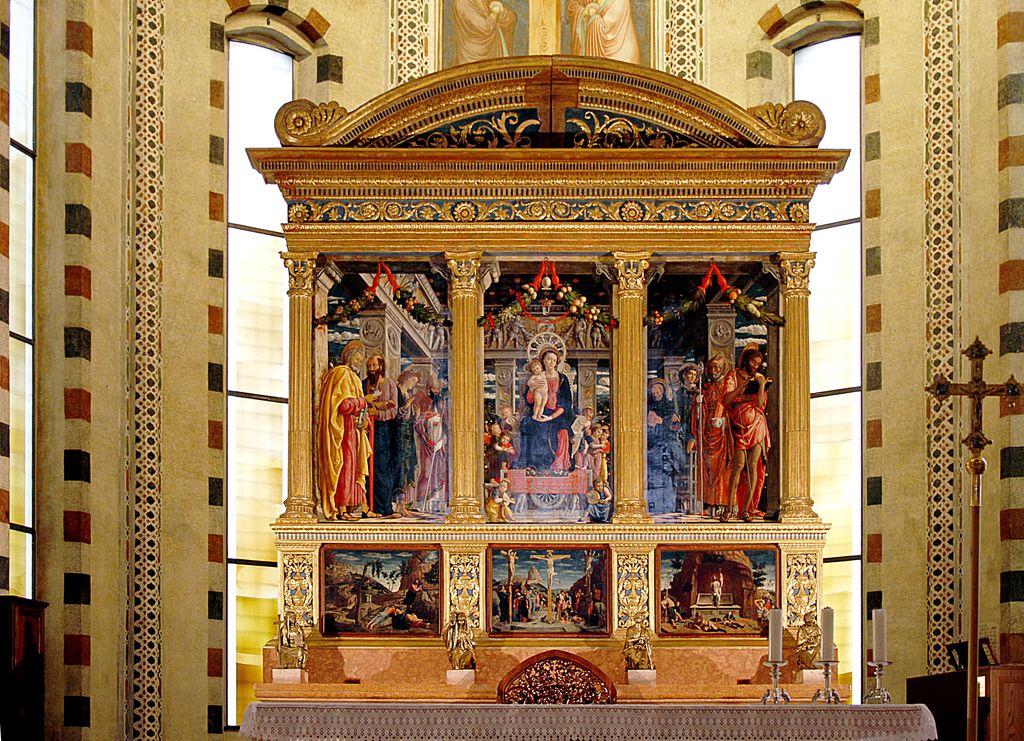
San Zeno Altarpiece
The San Zeno Altarpiece in its frame, Basilica of San Zeno, Verona José Luiz. Image source. CC BY-SA 4.0. Resized from the cited image.