 by Tom Gurney
Tom Gurney BSc (Hons) is an art history expert with over 20 years experience
Published on June 19, 2020 / Updated on November 29, 2026
Email: tomgurney1@gmail.com / Phone: +44 7429 011000
Overview
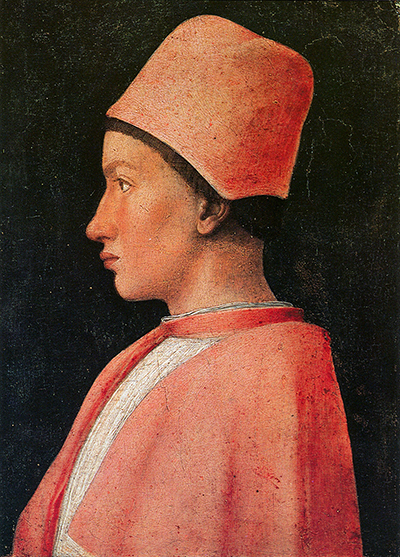
A boy in a rose-red cap looks to the left, his face outlined against a dark ground. The little panel at the Museo e Real Bosco di Capodimonte in Naples is known as Andrea Mantegna’s Portrait of Francesco Gonzaga. Italy’s national catalogue dates it to after 1460 and before 1462, close to Francesco’s appointment as cardinal. Capodimonte keeps a question mark beside his name and gives a second possibility, his younger brother Ludovico. The choice affects where the painting belongs in Mantegna’s years at the Gonzaga court. [1] [2]
At a Glance
- ArtistAndrea Mantegna
- DateTraditionally c. 1461 if Francesco is the sitter; c. 1470 proposed if Ludovico
- MediumTempera on wood (tempera grassa according to Capodimonte)
- CollectionMuseo e Real Bosco di Capodimonte, Naples
- Inventory numberQ 60
Andrea Mantegna in context
San Zeno Altarpiece
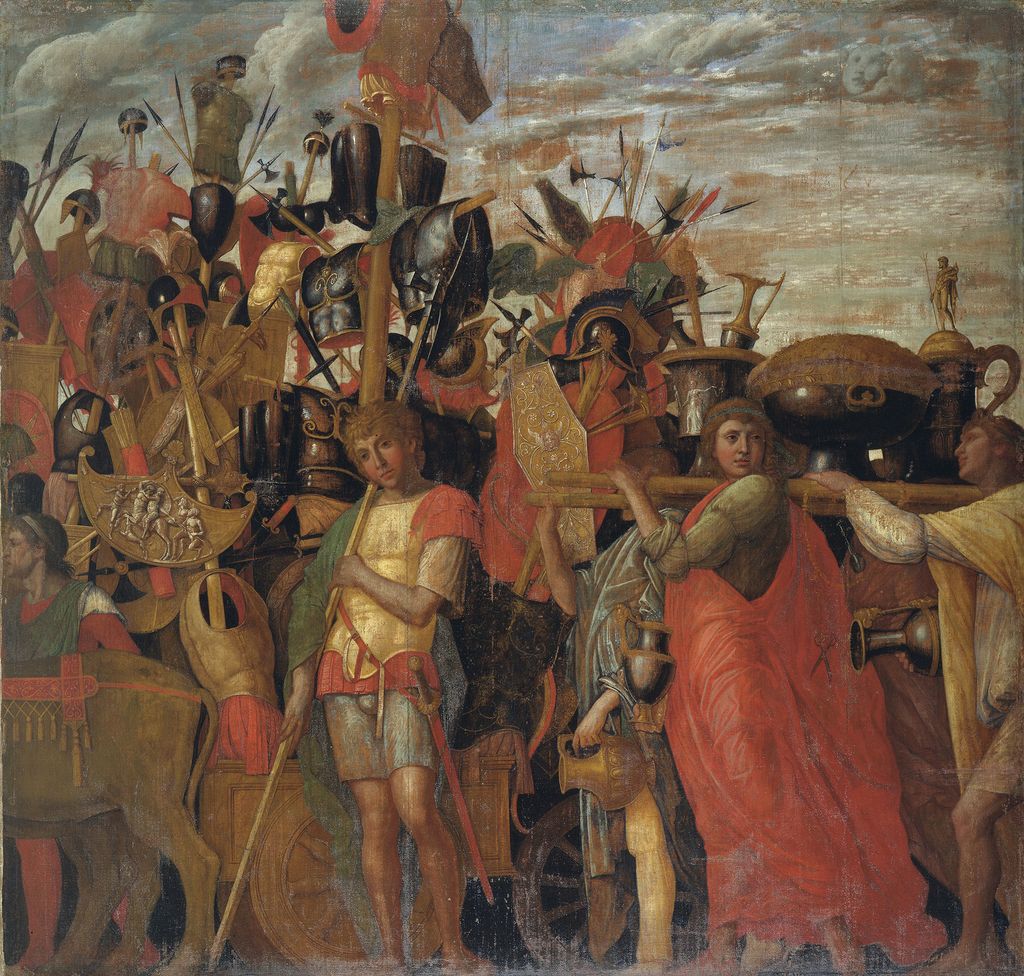
1457–59 [21]The Triumphs of Caesar
Mid-1480s–before 1506 [22]Madonna della Vittoria
1495–96 [23]Portrait of a Young Man (traditionally Francesco Gonzaga)
C. 1461 or 1470, depending on sitter [1]The red cap and the edge of the face
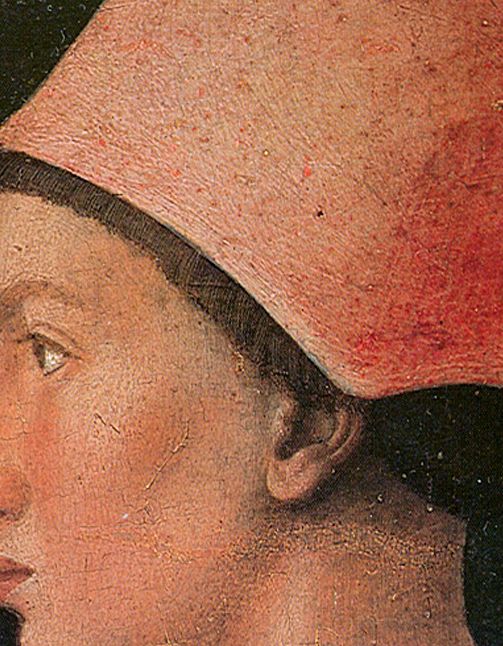
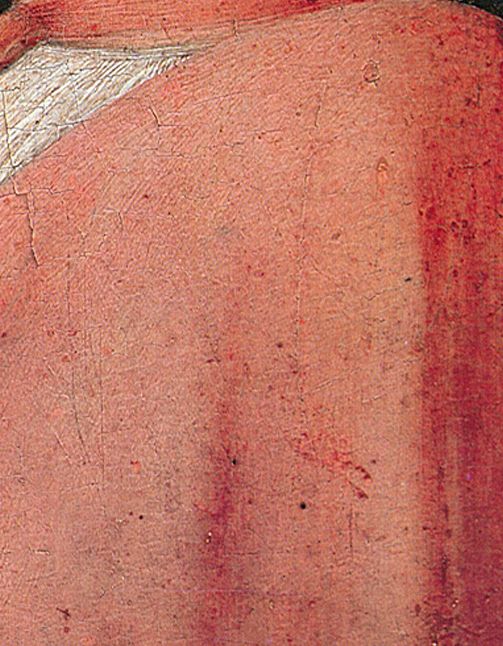
The portrait measures just 25 by 18 centimetres. At that scale, the tall cap and the sweep of the shoulder occupy a surprising amount of the picture. The cap slopes down across the forehead, then lifts slightly above the ear. A dark strip of hair separates it from the face and runs into the shadow behind the neck. Along the other edge, small changes of direction carry the eye from the bridge of the nose to the lips and chin. The pale strip at the opening of the garment takes up that movement and leads it down to the bottom of the panel. [1] [2]
Capodimonte relates the strict profile to a fifteenth-century convention inspired by ancient coins and medals. The comparison is clearest at the outer edge, where the uncovered forehead, nose and mouth can be read almost as one continuous line. Within that boundary the transitions are much softer. Light spreads across the cheek and fades towards the ear, while the cap changes from dusty pink at the front to a deeper red at the back. The face has room to turn in depth even though the pose gives us only one eye. A medal might reserve the dark space ahead of the face for lettering. Here that interval is empty, leaving the direction of the boy’s gaze as the only suggestion of anything beyond the panel. [2]
The national catalogue describes the medium as tempera on wood, specified as tempera grassa by Capodimonte. The Fondazione Federico Zeri’s photographic catalogue records the same small panel under the museum inventory number Q 60 and dates it to 1460–61. The reds are important to the composition, but their prominence can be misleading as evidence of office. Capodimonte’s account explicitly reads the costume as preceding cardinal’s dress if the sitter is Francesco. The cap, the reddish outer garment and the pale strip at the opening can be observed directly. Their precise rank is a matter of interpretation. [1] [2] [3]
A place for Francesco in the Church
Francesco was the second son of Ludovico III Gonzaga, marquess of Mantua, and Barbara of Brandenburg. His preparation for a church career began early. Pope Nicholas V appointed him apostolic protonotary in 1454, when he was still a child, and in 1460 he went to Pavia to study canon law. He had already taken a public part in the papal congress at Mantua the previous year, delivering a Latin address written for him by the humanist Francesco Filelfo. Pope Pius II made him cardinal deacon of Santa Maria Nuova on 18 December 1461, when he was seventeen. The distinction matters for the portrait because Francesco already held a papal office before he was entitled to wear a cardinal’s dress. [4]
Francesco’s promotion followed years of effort by his parents. Isabella Lazzarini traces their efforts through the 1450s and notes how hosting the papal congress strengthened the Gonzagas’ position with Pius II. Francesco took up the see of Mantua in 1466 and became papal legate for Bologna, Romagna and Ravenna in 1471. The demands of those offices could pull in different directions. His father had favoured a candidate who would reside in Mantua, whereas Francesco delegated pastoral duties to a suffragan bishop and spent much of his tenure away. David Chambers uses the cardinal’s correspondence with his family to examine the wider negotiation over appointments between Italian rulers and the papacy. The office Francesco attained so young gave the Gonzagas a presence in Rome and gave him obligations and interests of his own. [4] [5]
In 1460 Mantegna moved from Padua to Mantua after prolonged negotiations with the marquess. The terms included lodging, provisions and a regular salary. If the panel is Francesco around 1461, it belongs to the opening phase of that employment, when the painter and the young Gonzaga were entering new roles almost simultaneously. The court relationship gives a plausible setting for the likeness. The surviving ownership evidence begins much later, in Rome, and leaves the original commission and intended audience open. [2] [6]
Francesco later became a patron in his own right. The Vatican Library identifies him as the patron of an illuminated copy of Petrarch’s verse now in its Urbino collection. His cardinal’s arms appear in the lower margin of folio 11 recto, and an early inventory of Federico da Montefeltro’s library still described the volume as having belonged to Cardinal Gonzaga. Those two indications of ownership, one on the object and one in a record, show the kind of evidence that would make identification more secure for the portrait. [7]
Francesco in a fresco and on a medal
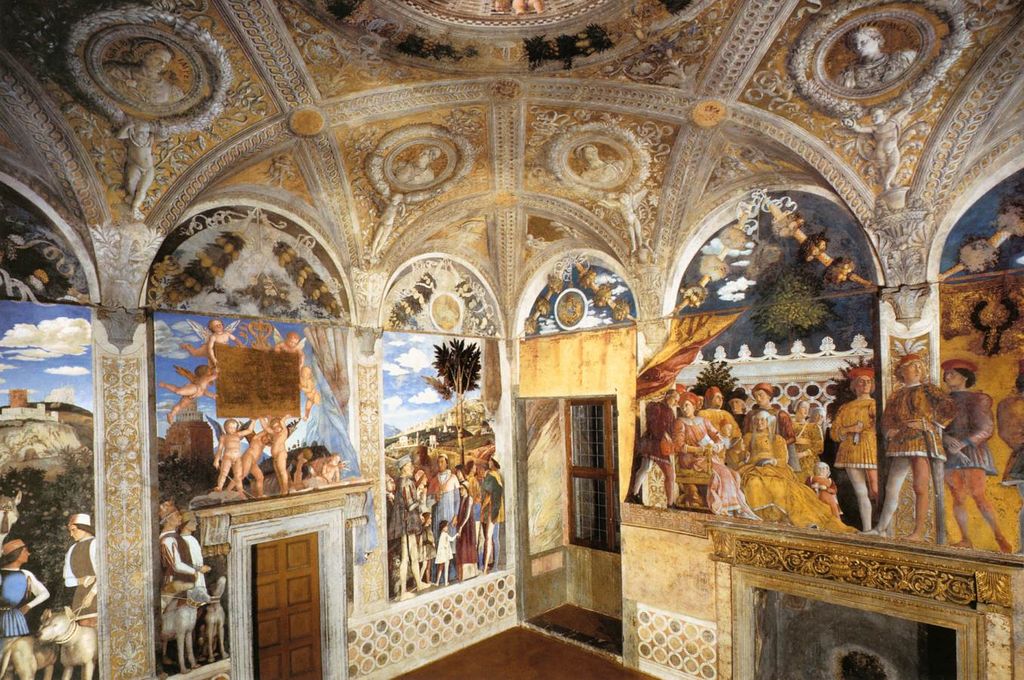
In The Meeting on the west wall of the Camera degli Sposi in Mantua, Francesco has a place within a gathering of several generations of Gonzagas. Capodimonte’s small head stands alone. In the mural, painted as part of the room Mantegna worked on from 1465 to 1474, the cardinal turns towards his father. The tilt of his face and the spread of his clothing register in relation to the people beside him. An Alinari photograph of his head preserved by Italy’s Central Institute for Catalogue and Documentation shows both eyes, curls projecting from beneath a low cap, and a band fastened at the throat. The panel’s taller cap and uninterrupted outline give the head a different shape. A rounded cheek or a similar chin is suggestive, but it is difficult to weigh such resemblance across different angles and ages. [8] [9]
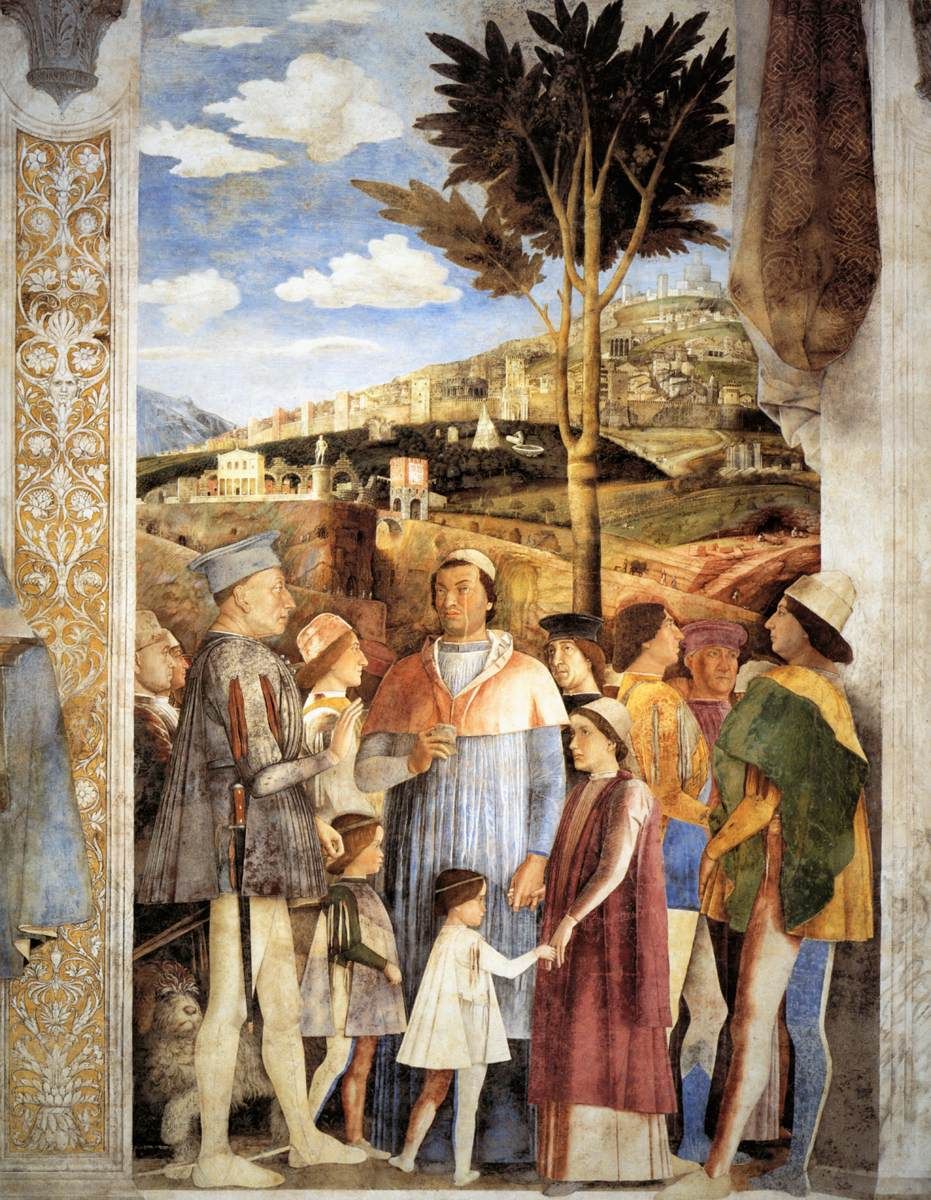
The Meeting wall, Camera degli Sposi, Palazzo Ducale, Mantua Image source. Public domain.
Palazzo Ducale reads the encounter as Ludovico’s meeting with his newly appointed son at Bozzolo. Rodolfo Signorini connected it to a documented meeting at the start of January 1462 and interpreted the evocation of Rome behind the figures as a reference to the cardinal’s new dignity. His reading distinguishes the historical meeting from the choices Mantegna made years later in painting it. The fresco gives Francesco a family, an audience and a setting appropriate to his position. Its date of execution and its arrangement of the figures limit its use as a record of exactly how he looked at seventeen. [8] [10]
Sperandio’s medal supplies a second identified image. An electrotype in Museums Victoria reproduces the design, whose inscription names Francesco Gonzaga as cardinal of Mantua. Like the boy in Naples, he faces left. The inscription curves around the silhouette, and the cardinal’s cap and cape frame a fuller face. The medal makes it easy to compare the relation of cap, forehead and neckline in two profiles. It also shows the difference between recognizing a shared pictorial convention and establishing the identity of a sitter. The medal gives the rank in words and reinforces it with costume. The dark field in the panel leaves the viewer to read the clothing and the face alone. [2] [11]
Another Francesco in Mantegna’s paintings belongs to the next generation. Francesco II, the cardinal’s nephew, is the armoured patron kneeling in the Louvre’s Madonna della Vittoria, an altarpiece he commissioned to commemorate the Battle of Fornovo in 1495. That is a documented commission in which the donor’s role explains his position within the composition. The Capodimonte portrait’s title refers to the older Francesco, whose identification must be tested through comparisons and later inventories. [4] [12] [13]
Why the younger brother enters the picture
Capodimonte identifies two comparisons behind the proposal that the boy could be Ludovico, Francesco’s younger brother. One is his likeness in the Camera degli Sposi and the other is a medal by Bartolomeo Melioli. The Palazzo Ducale medal catalogue records a bronze example for Ludovico as apostolic protonotary in the Castello Sforzesco collections. Ludovico’s own ecclesiastical career means that signs of clerical status in the panel could fit either brother. He eventually succeeded Francesco as bishop of Mantua. [2] [14] [15]
The exhibition history shows how far the two identifications can move the date. As Chiara Bonaccorsi records, the 2006 Mantegna exhibition accepted Francesco and dated the portrait around 1462. The 2008 Paris exhibition presented the case for Ludovico and a date around 1470. The older record of a Gonzaga cardinal favours Francesco if its description of the sitter is accurate, while the costume and comparative likenesses give the museum grounds to keep Ludovico in view. On the Francesco reading the panel falls around his elevation in 1461. The Ludovico proposal places it in the years Mantegna was painting the Camera. [1] [2] [16]
What Trevisan’s portrait makes visible
Mantegna’s Portrait of Cardinal Ludovico Trevisan offers a comparison from around the time he entered Gonzaga service. The Gemäldegalerie in Berlin connects its execution with the papal congress at Mantua. Trevisan had been a cardinal since 1440. Mantegna turned him three-quarters towards the viewer and let the red cloak spread across the lower half of the panel. In Berlin’s account that cloak is a ferraiolo, and the painter makes the red beneath the white surplice visible through the translucent cloth. The garments help give the bust the weight and amplitude of sculpture. [17]
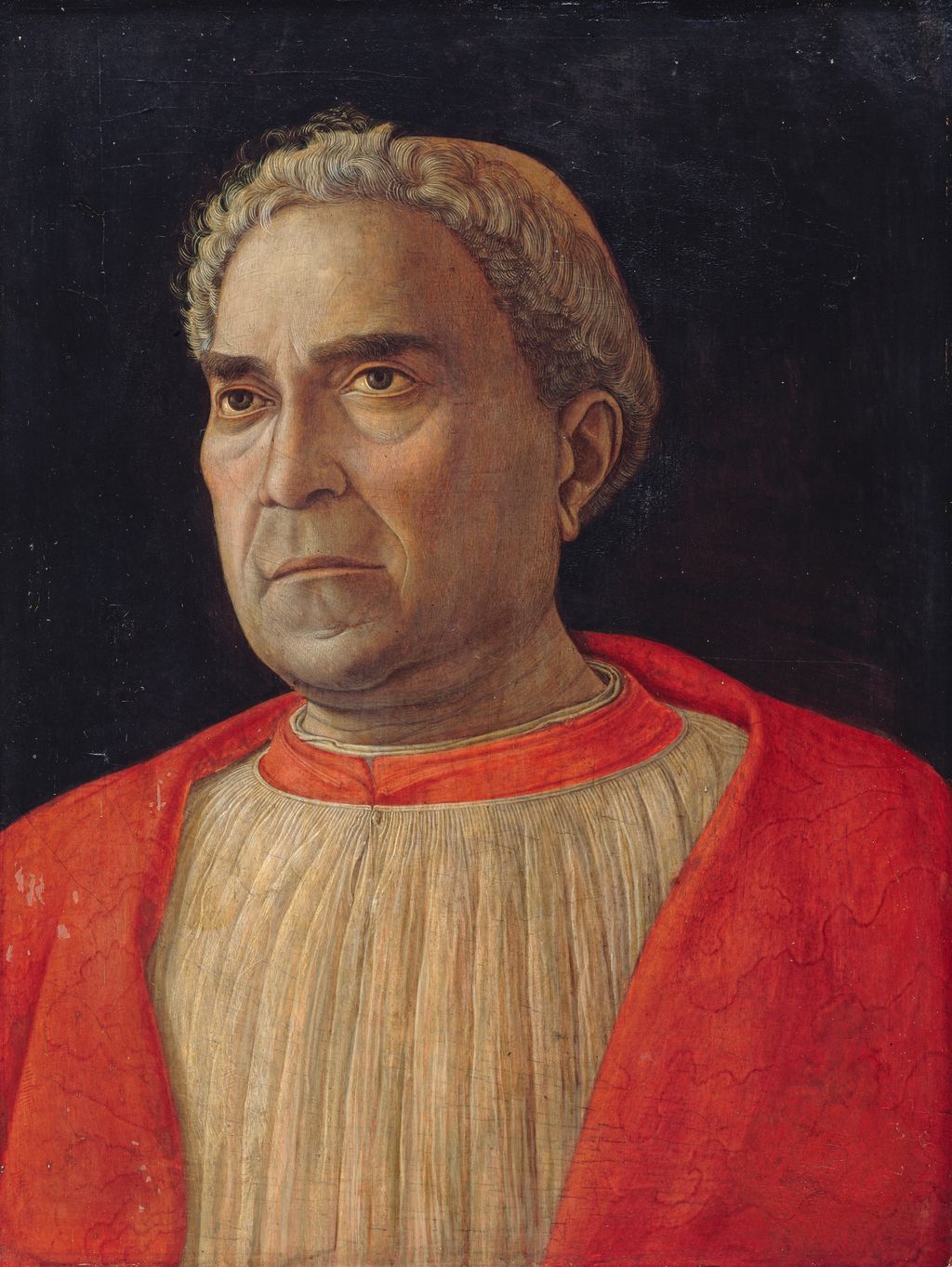
Cardinal Ludovico Trevisan, Gemäldegalerie, Berlin Image source. Public domain.
The Naples boy’s shoulder drops in a single sweep and the opening of his costume is a narrow accent. His profile shows how much character Mantegna could give to the shape of a face before the eye has taken in the clothes. In Berlin, the turn of the head gives the features a deeper field in which to catch light and cast shadow. The painter could choose between these formats in treating men associated with the same church hierarchy. Trevisan’s clothing and bearing make his standing legible in a way that the red alone in the Naples portrait cannot. [2] [17]
From a Roman inventory to a new frame
The earliest ownership trail Capodimonte gives leads to Fulvio Orsini, the Farnese librarian and collector in Rome. Michel Hochmann connects the panel with no. 50 in Orsini’s inventory, which describes a small portrait of a Gonzaga cardinal and names Giovanni Bellini as the painter. The entry gives neither a first name nor a date. Hochmann also shows how slippery a match can become in the subsequent inventories. One Farnese entry describing a boy in red is too general to be conclusive, and another candidate describes a cardinal with an open book, a detail absent from the Naples painting. [2] [18]
The picture passed to Cardinal Odoardo Farnese on Orsini’s death in 1600. According to Capodimonte, it went from the Palazzo Farnese in Rome to Naples in 1760 carrying the Bellini attribution. The museum credits Gustavo Frizzoni with assigning the panel to Mantegna in 1895, an attribution it describes as generally accepted. The Zeri archive preserves two Brogi prints made from the same negative, no. 11162, which the archive dates to 1895–97. The albumen print names Bellini and calls the sitter a prelate. The later gelatin silver print gives both Francesco Gonzaga and Mantegna. The labels changed while the underlying photograph stayed the same, a particularly clear record of how a new attribution could change what viewers were told about a face. [2] [3] [18] [19] [20]
The painting now has a different surround. Capodimonte selected a Venetian frame dated around 1480 for its reframing campaign, with raised fan-shaped ornaments and gilding over a reddish ground. In the museum’s photograph the small head is set within a much broader field of gold, where the rose of the cap picks up the warm colour around it. Orsini’s inventory recorded a walnut frame with a gilt fillet. The frame visitors see today is a museum pairing with a Renaissance object, and the evidence for Orsini’s frame remains in the inventory. [2] [18]
Annotated Details from Portrait of Francesco Gonzaga
The numbered points identify details to look at closely. The detail images below preserve the native scale of the selected crops.
Portrait of Francesco Gonzaga
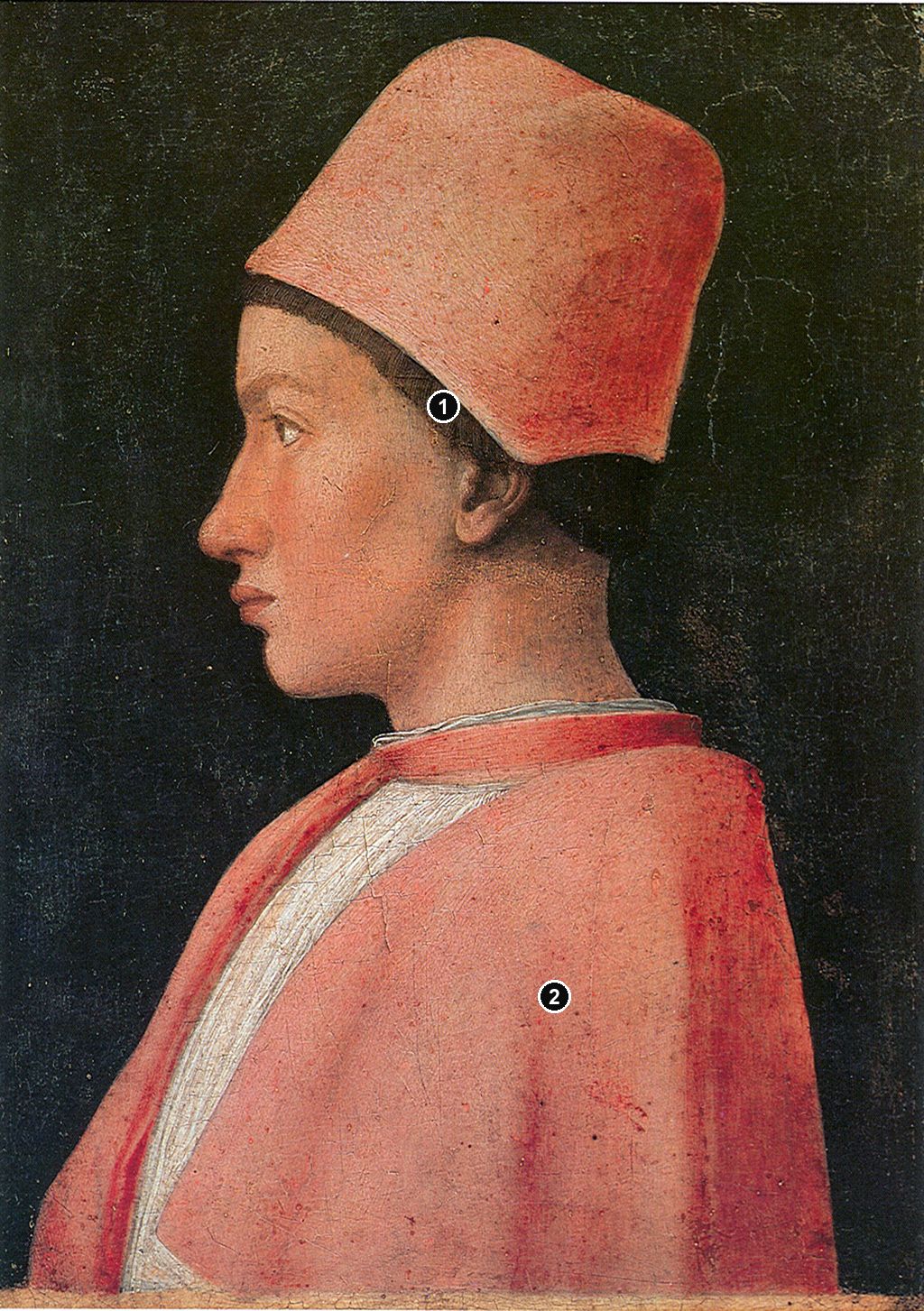
Details from PORTRAIT OF FRANCESCO GONZAGA
Choose a detail to enlarge it.
Portrait of Francesco Gonzaga
Profile and cap
The uninterrupted dark area shows the sharp contour of the sitter’s forehead, nose and mouth.
Costume against the background
The large area of red sets off the slimmer pale band near the neck. The change in colour also clarifies the angle of the shoulder.
Artworks directory
| Name | Date | Medium and collection |
|---|---|---|
| The Adoration of the Shepherds | Shortly after 1450 | Painting · Metropolitan Museum of Art · 32.130.2 Catalogue. |
| Saint Mark the Evangelist | C. 1448–51 | Painting · Städel Museum · 1046 Catalogue. |
| Saint Jerome Penitent in the Desert | C. 1448–51 | Painting · Museu de Arte de São Paulo · MASP.00015 Catalogue. |
| Martyrdom and Transport of the Body of Saint Christopher | Mid-1450s | Painting · Ovetari Chapel, Padua Catalogue. |
| San Luca Altarpiece | 1453–55 | Painting · Pinacoteca di Brera · 176 Catalogue. |
| The Presentation of Christ at the Temple | 1454 (Berlin dating) | Painting · Gemäldegalerie, Berlin · 29 Catalogue. |
| San Zeno Altarpiece | 1457–59 | Painting · Basilica of San Zeno, Verona Catalogue. |
| The Crucifixion | 1456–59 | Painting · Musée du Louvre · INV 368 Catalogue. |
| The Agony in the Garden (London) | C. 1455–56 | Painting · National Gallery, London · NG1417 Catalogue. |
| The Agony in the Garden (Tours) | 1459 (Tours dating) | Painting · Musée des Beaux-Arts de Tours · 1803-1-24 Catalogue. |
| The Resurrection | 1459 (Tours dating) | Painting · Musée des Beaux-Arts de Tours · 1803-1-25 Catalogue. |
| Saint Sebastian (Vienna) | C. 1457–59 | Painting · Kunsthistorisches Museum · GG 301 Catalogue. |
| Cardinal Ludovico Trevisan | C. 1459–60 (Berlin exhibition dating) | Painting · Gemäldegalerie, Berlin · 9 Catalogue. |
| The Death of the Virgin | C. 1462 | Painting · Museo Nacional del Prado · P000248 Catalogue. |
| Christ with the Soul of the Virgin | C. 1460–64 | Painting · Pinacoteca Nazionale, Ferrara Catalogue only. |
| Portrait of a Young Man (traditionally Francesco Gonzaga) | C. 1461 or 1470, depending on sitter | Painting · Museo di Capodimonte · Q 60 Catalogue. |
| Portrait of a Prelate (Carlo de’ Medici?) | C. 1465–70 | Painting · Uffizi Galleries · 1890 no. 8540 Catalogue. |
| Portrait of a Man | C. 1470 | Painting · National Gallery of Art, Washington · 1952.2.5 Catalogue. |
| Madonna with Sleeping Child (Berlin) | C. 1455–60 | Painting · Gemäldegalerie, Berlin · S.5 Catalogue. |
| Camera degli Sposi (Camera Picta) | 1465–74 | Painting · Palazzo Ducale, Mantua Catalogue. |
| Saint Sebastian (Louvre) | Around 1480 | Painting · Musée du Louvre · RF 1766 Catalogue. |
| Lamentation over the Dead Christ | C. 1483 (Brera dating) | Painting · Pinacoteca di Brera · 352 Catalogue. |
| The Triumphs of Caesar | About 1485–1506 | Painting · Royal Collection · RCIN 403958–403966 Catalogue. |
| Madonna of the Caves | C. 1488–90 | Painting · Uffizi Galleries · 1890 no. 1348 Catalogue. |
| Madonna and Child with a Choir of Cherubim | C. 1485 | Painting · Pinacoteca di Brera · 297 Catalogue. |
| Madonna and Child (Poldi Pezzoli) | Early 1490s (museum dating) | Painting · Museo Poldi Pezzoli · 1595 Catalogue. |
| The Holy Family with Saint Mary Magdalen | C. 1495–1500 | Painting · Metropolitan Museum of Art · 14.40.643 Catalogue. |
| The Virgin and Child with Saint Mary Magdalene and Saint John the Baptist | C. 1490–1505 | Painting · National Gallery, London · NG274 Catalogue. |
| Christ as the Suffering Redeemer | 1485–95 (SMK dating) | Painting · Statens Museum for Kunst · KMSsp69 Catalogue. |
| Ecce Homo | C. 1500 | Painting · Musée Jacquemart-André · MJAP-P 1840 Catalogue. |
| Judith with the Head of Holofernes (Mantegna or follower) | C. 1495–1500 | Painting · National Gallery of Art, Washington · 1942.9.42 Catalogue. |
| Madonna della Vittoria | 1495–96 | Painting · Musée du Louvre · INV 369 Catalogue. |
| Mars and Venus (Parnassus) | C. 1496–97 | Painting · Musée du Louvre · INV 370 Catalogue. |
| The Trivulzio Madonna | 1497 | Painting · Castello Sforzesco, Milan · 0554 Catalogue. |
| The Adoration of the Magi | C. 1495–1505 | Painting · J. Paul Getty Museum · 85.PA.417 Catalogue. |
| Minerva Expelling the Vices from the Garden of Virtue | C. 1502 | Painting · Musée du Louvre · INV 371 Catalogue. |
| The Introduction of the Cult of Cybele at Rome | 1505–06 | Painting · National Gallery, London · NG902 Catalogue. |
| Saint Sebastian (Venice) | Probably c. 1504–06 | Painting · Galleria Giorgio Franchetti alla Ca’ d’Oro · D.11 Catalogue. |
| Samson and Delilah | C. 1500 | Painting · National Gallery, London · NG1145 Catalogue only. |
| A Woman Drinking (probably Sophonisba) | C. 1495–1506 | Painting · National Gallery, London · NG1125.2 Catalogue only. |
| The Vestal Virgin Tuccia with a Sieve | C. 1495–1506 | Painting · National Gallery, London · NG1125.1 Catalogue only. |
| Judith with the Head of Holofernes (Dublin) | C. 1495–1500 | Painting · National Gallery of Ireland · NGI.442 Catalogue only. |
| Battle of the Sea Gods, left half (Met impression) | Before 1481 (Met dating) | Print · Metropolitan Museum of Art · 18.12 Catalogue only. |
| Battle of the Sea Gods, right half (Met impression) | Before 1481 (Met dating) | Print · Metropolitan Museum of Art · 1984.1201.4 Catalogue only. |
| Battle of the Sea Gods, left half (Tokyo impression) | C. 1475 (Tokyo dating) | Print · National Museum of Western Art, Tokyo · G.1981-0002 Catalogue only. |
| Battle of the Sea Gods, left half (Washington impression) | C. 1485–88 (NGA dating) | Print · National Gallery of Art, Washington · 1941.1.6 Catalogue only. |
| The Entombment of Christ, second state of two | Before 1475 (Met dating) | Print · Metropolitan Museum of Art · 37.42.30 Catalogue only. |
| The Entombment of Christ (possibly Zoan Andrea, after Mantegna) | 1460–1549 (Rijksmuseum dating) | Print · Rijksmuseum · RP-P-1924-60 Catalogue only. |
| Four Dancing Muses (Gian Marco Cavalli after Mantegna) | C. 1497 | Print · Metropolitan Museum of Art · 20.5.3 Catalogue only. |
| Bacchanal with Silenus | Before 1475 (Met dating) | Print · Metropolitan Museum of Art · 29.44.15 Catalogue only. |
| Bacchanal with a Wine Vat | Before 1475 (Met dating) | Print · Metropolitan Museum of Art Catalogue only. |
| St James on His Way to Execution | C. 1453–57 | Drawing · British Museum · 1976,0616.1 Catalogue only. |
| Three Studies for a Dead Christ | C. 1455–65 | Drawing · British Museum · 1909,0406.3 Catalogue only. |
| Pietà (Venice) | C. 1456–65 (exhibition datings) | Drawing · Gallerie dell’Accademia, Venice · 115 Catalogue only. |
| Studies for Christ at the Column | 1460–65 | Drawing · The Courtauld · D.1978.PG.345 Catalogue only. |
| Virtus Combusta | C. 1490 (technical study) | Drawing · British Museum · Pp,1.23 Catalogue only. |
| Virtus Combusta (Giovanni Antonio da Brescia after Mantegna) | C. 1495–1506 | Print · Musée du Louvre · 3881 LR/ Recto Catalogue only. |
| The Calumny of Apelles | C. 1504–06 | Drawing · British Museum · 1860,0616.85 Catalogue only. |
Frequently Asked Questions
The traditional identification is the young Cardinal Francesco. Capodimonte also discusses his brother Ludovico, based on comparison with other likenesses. The two proposals suggest different dates.
The Camera degli Sposi includes figures identified as Francesco and Ludovico in separate groups. The comparison is evidence about likenesses, and the identity of the Capodimonte sitter remains open.
Discussion
Look again at the images and ideas explored in Portrait of Francesco Gonzaga. These editorial prompts invite your observations.
Reader Insights
How do the cap, collar and outline of the cheek function differently in the Naples panel, the Camera degli Sposi detail and Sperandio’s inscribed medal?
How much weight should Orsini’s description of a Gonzaga cardinal carry when his inventory gives neither a first name nor the attribution accepted today?
Join the Conversation
Share a detail, comparison or question about Portrait of Francesco Gonzaga below.
References
- Catalogo generale dei Beni Culturali, Ritratto di Francesco Gonzaga, catalogue no. 1500625195. View source.
- Museo e Real Bosco di Capodimonte, Una nuova cornice per l’opera di Andrea Mantegna. View source.
- Fondazione Federico Zeri, Mantegna Andrea, Ritratto di Francesco Gonzaga. View source.
- Istituto dell’Enciclopedia Italiana, Isabella Lazzarini, Gonzaga, Francesco. View source.
- Cambridge University Press, David S. Chambers, A Defence of Non-Residence in the Later Fifteenth Century: Cardinal Francesco Gonzaga and Mantuan Clergy. View source.
- Istituto dell’Enciclopedia Italiana, Mantegna, Andrea, Dizionario Biografico degli Italiani. View source.
- Biblioteca Apostolica Vaticana, Petrarca, Rerum vulgarium fragmenta and Triumphi, Urb. lat. 681. View source.
- Palazzo Ducale di Mantova, Camera Picta. View source.
- Istituto Centrale per il Catalogo e la Documentazione, L’incontro tra Ludovico e il figlio Francesco. View source.
- Journal of the Warburg and Courtauld Institutes, Rodolfo Signorini, Lettura storica degli affreschi della Camera degli Sposi di A. Mantegna. View source.
- Museums Victoria, Electrotype Medal Replica – Cardinal Francesco di Gonzaga. View source.
- Musée du Louvre, La Vierge de la Victoire, INV 369. View source.
- Istituto dell’Enciclopedia Italiana, Federico I Gonzaga, marchese di Mantova. View source.
- Palazzo Ducale di Mantova, Il Medagliere, Notiziario del Portale Numismatico dello Stato no. 21, p. 193, nos. 18–21. View source.
- Diocesi di Mantova, I Vescovi della Diocesi di Mantova. View source.
- Università degli Studi di Padova, Chiara Bonaccorsi, Il disegno di ritratto nell’Italia settentrionale (1480–1530), p. 40 and nn. 188–189. View source.
- Staatliche Museen zu Berlin, Kardinal Ludovico Trevisan, Gemäldegalerie. View source.
- École française de Rome, Michel Hochmann, Les dessins et les peintures de Fulvio Orsini et la collection Farnèse. View source.
- Fondazione Federico Zeri, Brogi, Ritratto di un Prelato, Giovanni Bellini, photograph no. 65314. View source.
- Fondazione Federico Zeri, Brogi, Ritratto di Francesco Gonzaga, Andrea Mantegna, photograph no. 65316. View source.
- Basilica of San Zeno, Verona, San Zeno Altarpiece, View source.
- Royal Collection, The Triumphs of Caesar, View source.
- Musée du Louvre, Madonna della Vittoria, View source.
- National Gallery, London, The Introduction of the Cult of Cybele at Rome, View source.
More MANTEGNA Paintings
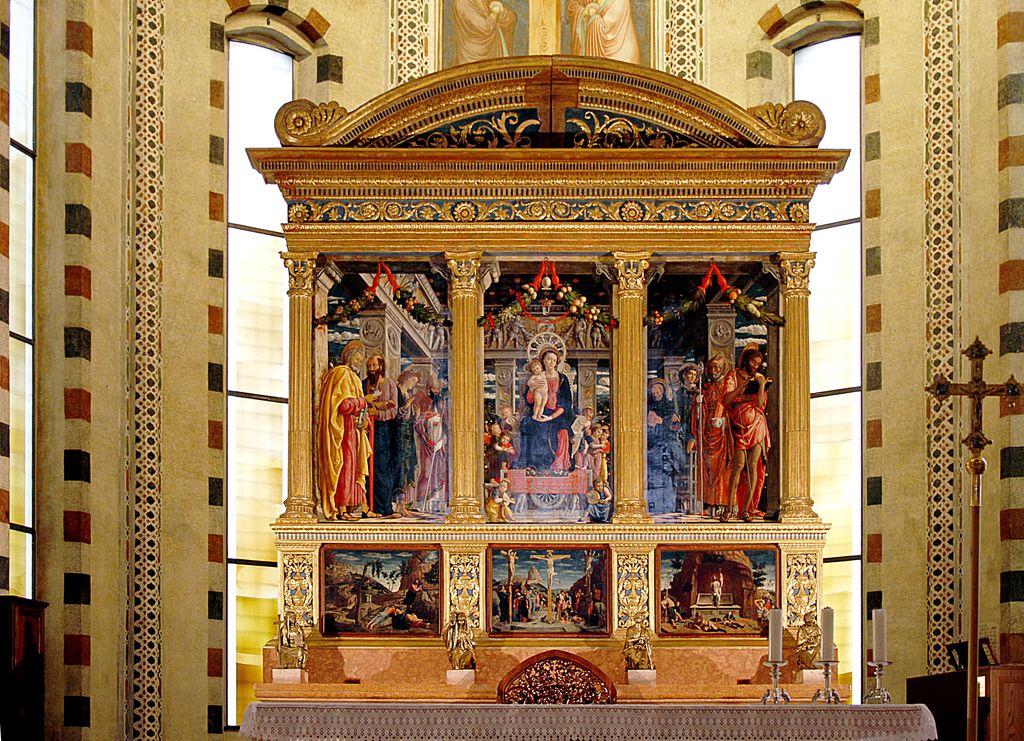
San Zeno Altarpiece
The San Zeno Altarpiece in its frame, Basilica of San Zeno, Verona José Luiz. Image source. CC BY-SA 4.0. Resized from the cited image.