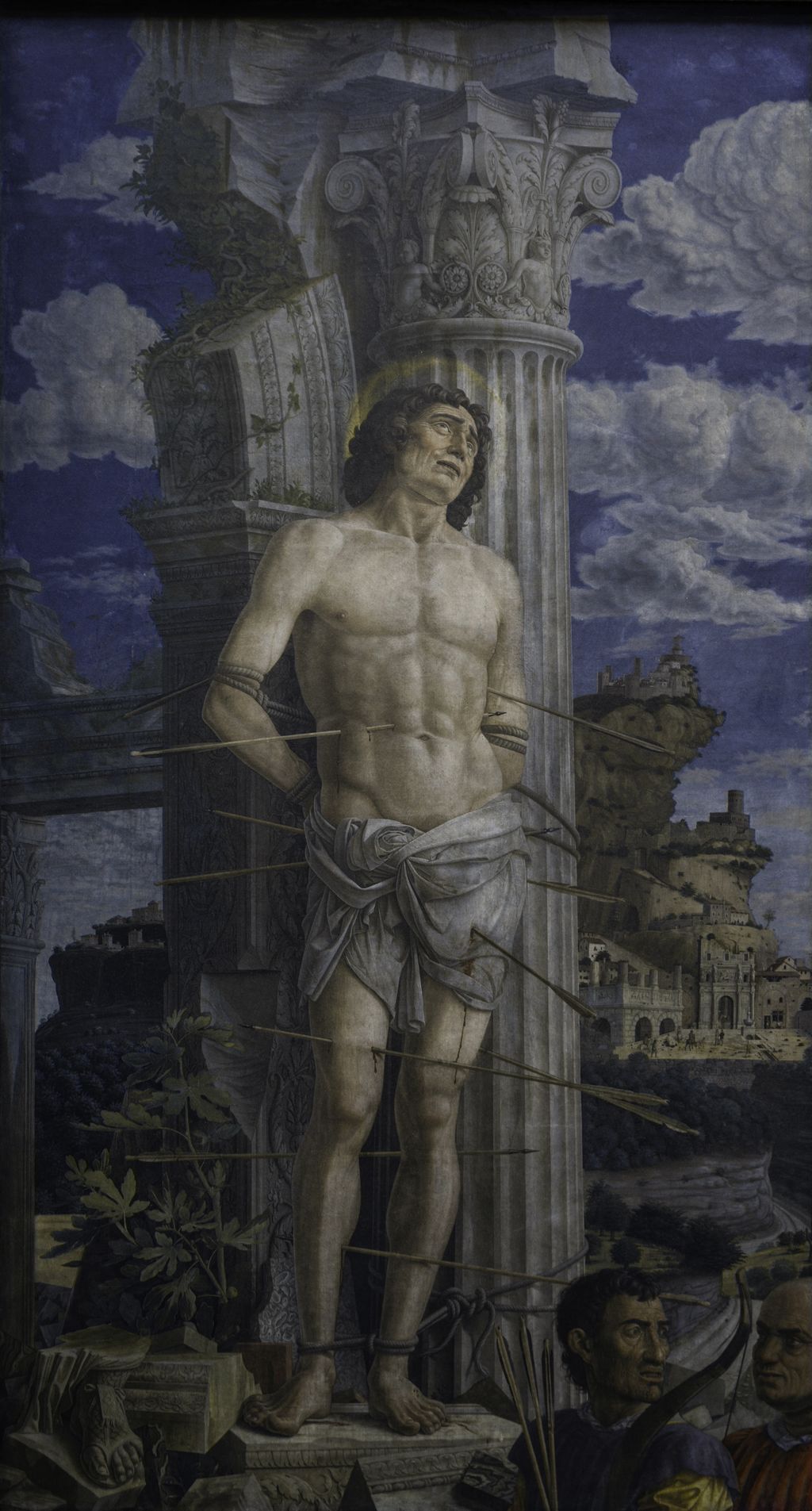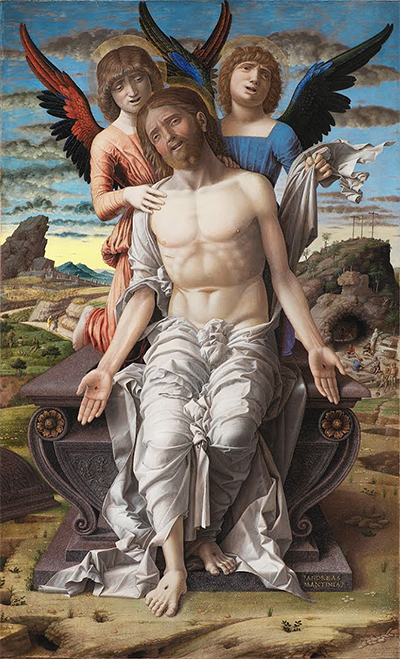
 by Tom Gurney
Tom Gurney BSc (Hons) is an art history expert with over 20 years experience
Published on June 19, 2020 / Updated on November 29, 2026
Email: tomgurney1@gmail.com / Phone: +44 7429 011000
Overview
In April 1458, Ludovico Gonzaga wrote to Andrea Mantegna about moving to Mantua. Mantegna still owed an altarpiece to an abbot in Verona, and the marquis was prepared to wait. The painter eventually brought his family to Mantua in 1460. He went from negotiating the terms on which he would enter the Gonzaga household to painting that household on the walls of its castle. [1]
Mantegna was born around 1431 in Isola di Carturo, near Padua, and died in Mantua in 1506. Between those dates he painted for Benedictine monks, a Venetian abbot, three generations of Gonzaga patrons and Pope Innocent VIII. Surviving contracts and letters record the practical demands of those relationships. In Padua, painters had to agree over who could use the scaffolding. In Rome, Mantegna wrote back to Mantua about taking care of canvases he had left behind. [1] [2] [3]
At a Glance
- BornAbout 1431, Isola di Carturo, near Padua
- Settled in Mantua1460, in the service of Ludovico Gonzaga
- Saint Luke Altarpiece1453–55, tempera on panel, Pinacoteca di Brera, inv. 176
- Camera Picta1465–74, fresco with passages painted on dry plaster, Castello di San Giorgio, Palazzo Ducale, Mantua
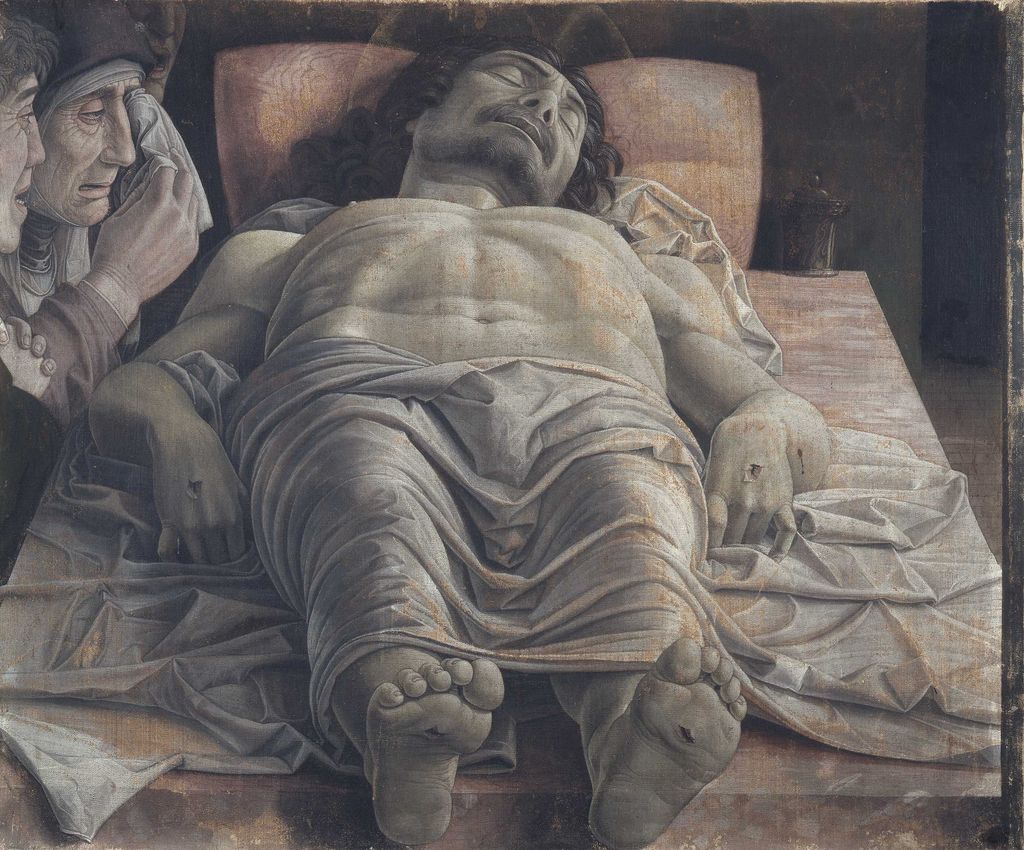
- Lamentation over the Dead ChristAbout 1483, tempera on canvas, Pinacoteca di Brera, inv. 352
Andrea Mantegna in context
Early Renaissance in Padua
Padua, c. 1440s–1450s [1]Gonzaga court in Mantua
1460–1506 [3]San Zeno Altarpiece
1457–59 [14]The Triumphs of Caesar
About 1485–1506 [24]Madonna della Vittoria
1495–96 [32]Becoming a master in Squarcione’s Padua
Isola di Carturo lay on the Brenta, north of Padua, in territory then administered from Vicenza. Andrea’s father, Biagio, was a carpenter and joiner. Giorgio Vasari much later pictured the young Mantegna tending cattle. The basis for dating his birth comes from a different sixteenth-century writer, the Paduan canon Bernardino Scardeone. In 1560 Scardeone transcribed an inscription from Mantegna’s now-lost altarpiece for Santa Sofia. It gave the painter’s age as seventeen and the year as 1448. The archive independently confirms the date of the commission, which makes the inscription useful even though it survives only in transcription. Art historian Michele Di Monte places the birth most probably in 1431, with late 1430 also possible. [1] [2]
A surviving notarial record places Mantegna in Padua on 23 May 1445. He appeared as a witness and was described both as a painter and as the adopted son of Francesco Squarcione. His name is also recorded in the Paduan painters’ guild in the first half of the 1440s. The notarial wording shows how closely a workshop could resemble a household. A young painter could be bound to a master by duties and economic expectations that went well beyond receiving instruction. In January 1448 Mantegna sought arbitration over his financial treatment. By October he was renting a house in the Santa Lucia district, and in 1455 he was still pursuing what he said were unpaid earnings from his years in the workshop. He put the unpaid earnings at 400 ducats. [1]
Squarcione’s surviving Virgin and Child in Berlin gives some sense of the visual culture in which Mantegna trained. A ledge brings the figures close to the front of the panel, and a garland hangs over them like part of a decorated architectural setting. Such devices let the painter suggest a tangible space in a small devotional picture. Donatello was also working in Padua during Mantegna’s youth. His reliefs and altar for the Basilica of Saint Anthony gave painters an example of how bodies, architecture and the spectator’s point of view could be coordinated. Squarcione’s workshop and Donatello’s public commissions offered distinct ways of studying those problems in the same city. [1] [4]
Mantegna had already taken on the Santa Sofia altarpiece in December 1447, while the dispute with his master was still ahead of him. The patron, the baker Bartolomeo di Gregorio, employed him as a master in his own right. A demand for delivery followed in August 1448, and a settlement that autumn exceeded the forty gold ducats initially agreed. If Scardeone copied the inscription accurately, Mantegna declared that he had painted the work with his own hand. Read alongside the payment records, that declaration gives the painter’s youth a professional significance. He was old enough to negotiate and answer for a commission and young enough to think his age worth putting on it. [1]
The Eremitani scaffold and the city’s altars
On 16 May 1448 Imperatrice Capodilista commissioned the decoration of her late husband Antonio degli Ovetari’s family chapel in Padua’s church of the Eremitani. The contract divided work between Giovanni d’Alemagna and Antonio Vivarini, painters established in Murano, and the younger Paduans Nicolò Pizzolo and Mantegna. The arrangement gave Mantegna an opportunity to work on a large scale, yet required painters with separate responsibilities to work in the same confined space. The September 1449 settlement gave Pizzolo responsibility for finishing the altar relief and assigned Mantegna five of the six Saint James scenes. It also divided material from scaffolding already in place. [1]
The deadline of December 1450 passed while work was still under way. Giovanni died, Vivarini withdrew, and Ansuino da Forlì and Bono da Ferrara took on parts of the decoration. After Pizzolo was killed in 1453, an assessment the following year recorded outstanding work, including the Assumption of the Virgin and the last episode in the story of Saint James. Mantegna’s later scenes are generally placed in the mid-1450s, and the Vatican chronology puts completion by 1457. Even then, the patron contested the number of apostles visible in the Assumption, an argument about what could be counted toward the price. [1] [2]
The two episodes of the Martyrdom of Saint Christopher show what Mantegna made of the chapel’s constraints. A painted column separates the martyrdom from the removal of the saint’s body. The architecture around both episodes suggests a space that continues behind the column. The eye can cross the division and follow the story across the wall. Di Monte identifies that unity as a development from the Saint James scenes opposite, where painted mouldings more decisively set off one episode from another. The Christopher fresco is especially important because its late place in the project is established chiefly by the painting and its relation to the rest of the cycle. The commission records so far identified give no corresponding instruction for that particular scene. [1]
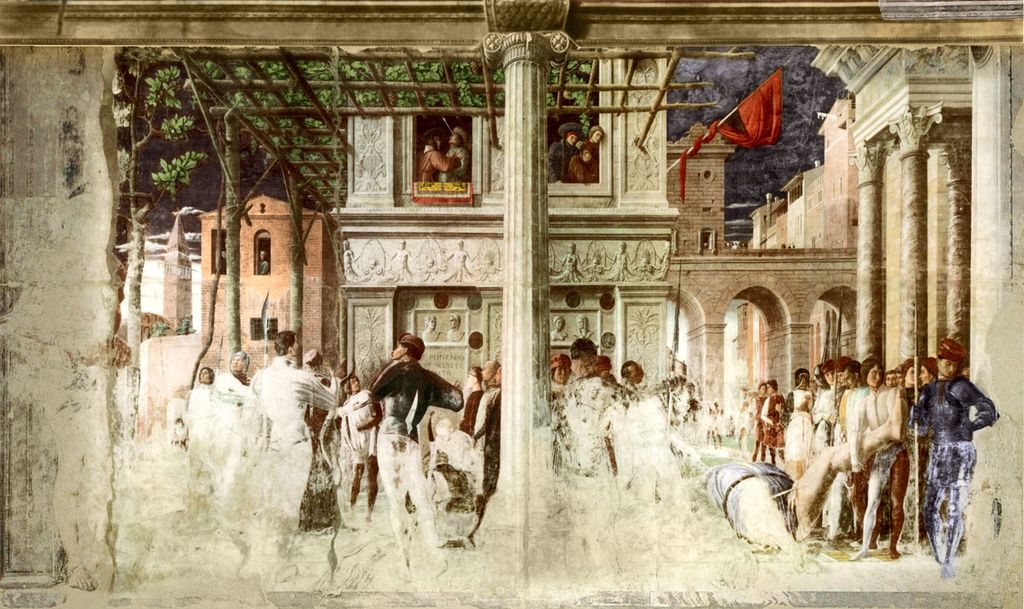
Martyrdom and Transport of the Body of Saint Christopher, Ovetari Chapel Image source. Public domain.
The chapel that visitors see contains evidence of both the fifteenth-century commission and the destruction of 1944. The Assumption and the two-part Christopher fresco, removed from the walls before the bombing, survived the destruction. For much of the rest, pre-war photographs and salvaged fragments carry different kinds of information. The photographs preserve the disposition of entire figures and scenes, while surviving plaster carries actual painted detail. ICCROM documents work by Cesare Brandi and Paolo Mora to reposition fragments of the scene in which Saint James is led to execution. In 2026 the organisation reported identifying thirty-one pieces of medieval and Renaissance wall painting in its archives, including Ovetari material. [1] [5] [6]
While the Eremitani work was under way, Mantegna built a practice that reached beyond it. A document of May 1449 records a commission in Ferrara from Leonello d’Este for portraits of himself and his chamberlain, Folco di Villafora, on opposite sides of a now-lost work. The visit brought Mantegna into the orbit of an Este court decades before he painted for Isabella, who belonged to a later generation of the family. In Padua a dated inscription still associated with the main portal of the Basilica of Saint Anthony records Mantegna’s completion of work there in 1452. He painted Saints Anthony and Bernardino kneeling beside the monogram of Christ. The fresco is now in the Museo Antoniano. [1] [2]
The date of a surviving painting can be harder to establish than the date of a lost commission. The Museu de Arte de São Paulo catalogues its panel of Saint Jerome Penitent in the Desert as Mantegna, 1448–51. Its account also traces competing attributions, including proposals for Marco Zoppo and Nicolò Pizzolo. The resemblance between the panel’s craggy landscape and the early Ovetari paintings has figured in the argument for Mantegna. It gives a way to compare painters formed in much the same surroundings, while the Ovetari contract gives independent grounds for placing Mantegna on that scaffold. [7]
The Benedictines of Santa Giustina commissioned the Saint Luke Altarpiece in August 1453. Brera catalogues the tempera panels as 1453–55, inventory 176. Its account places execution of the paintings in 1453–54, and the documents Di Monte discusses put work on the gilded frame into 1455. The original frame is lost. Across the lower register the saints occupy separate gold-backed compartments, yet a single marble platform appears to run beneath them. Saint Luke sits at his desk in its central bay. Brera connects the figures’ solidity and the perspectival platform to Donatello’s altar at Saint Anthony’s. An architectural convention familiar to the monks thus gave Mantegna room to explore how separately painted figures could appear to inhabit the same space. In 1454 he also signed and dated a Saint Euphemia for Montepeloso, now Irsina in Basilicata. Its presence so far from Padua gives a sense of the reach of his practice even before the move to Mantua. [1] [8] [9]
Nicolosia and the Bellini workshop
In 1453 Mantegna married Nicolosia Bellini, daughter of Jacopo and sister of Gentile and Giovanni. Jacopo received twenty ducats for Nicolosia’s dowry from the Scuola Grande di San Giovanni Evangelista in February. That payment helps place the marriage in time. Its importance for painting is visible in the compositions that passed between the two families’ workshops. The exhibition organised by the National Gallery and the Staatliche Museen zu Berlin brought that exchange into focus by putting works from the two careers alongside each other. [1] [2] [10]
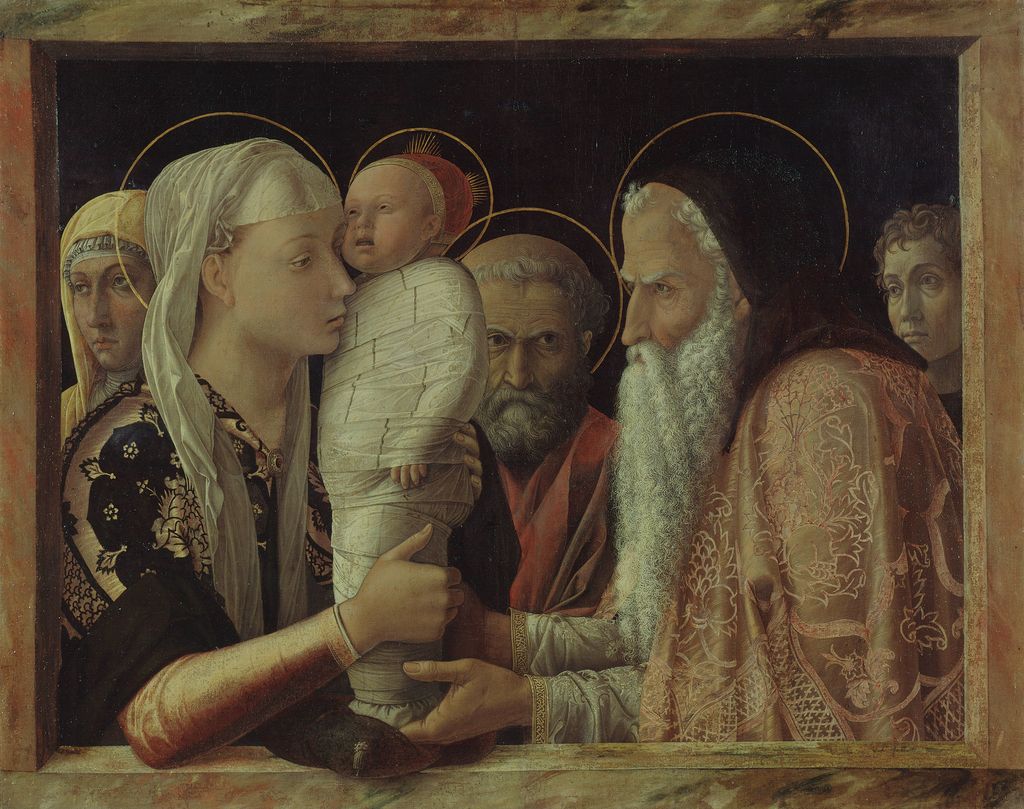
An unusually close comparison is offered by the two Presentations in the Temple. The Gemäldegalerie dates Mantegna’s version to about 1454. Mary supports the swaddled child above a hard painted ledge, and the priest reaches towards him. The figures press close to the fictive stone border. In Giovanni’s painting, which the Berlin exhibition material dates to around 1470–75, the central group remains recognisable, but the space opens to either side and two more witnesses can be seen. Berlin’s conservators showed an overlay of the outlines that makes the correspondence of the main group precise. The side figures in Mantegna’s version have been read as the painter and Nicolosia, and the picture has been linked to the marriage or the birth of a child. Di Monte treats those readings as hypotheses. The comparison of outlines establishes a relationship between compositions independently of the proposed family portraits. [1] [11]
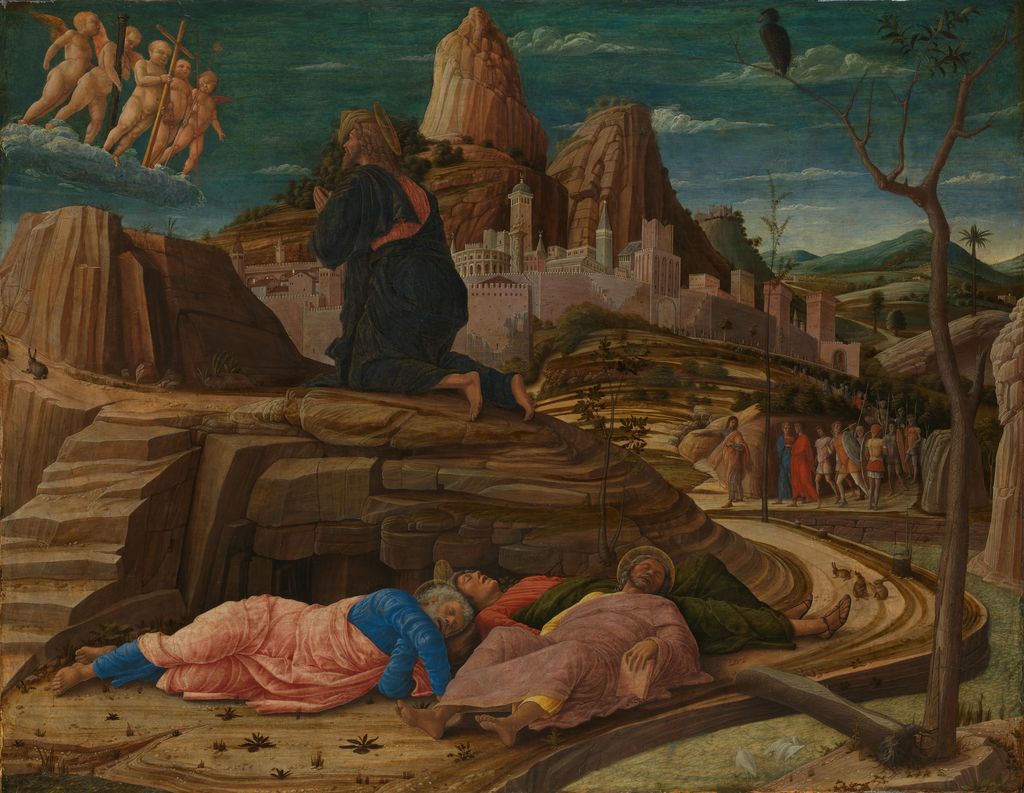
The network becomes broader in the Agony in the Garden. The National Gallery traces Mantegna’s composition to a drawing by Jacopo Bellini and relates Giovanni’s painting of the same subject to Mantegna’s. In Mantegna’s panel the rock under Christ rises like a platform while the soldiers approach from the distance. The arrangement makes the betrayal visible to the spectator while the disciples sleep below. In Giovanni’s version the advancing light gives the distant landscape a different weight in the story. A drawing by one generation and paintings by the next reveal how a composition could travel through a family and acquire a different sense of time and place in another painter’s hands. [10] [12] [13]
San Zeno and the terms of the move to Mantua
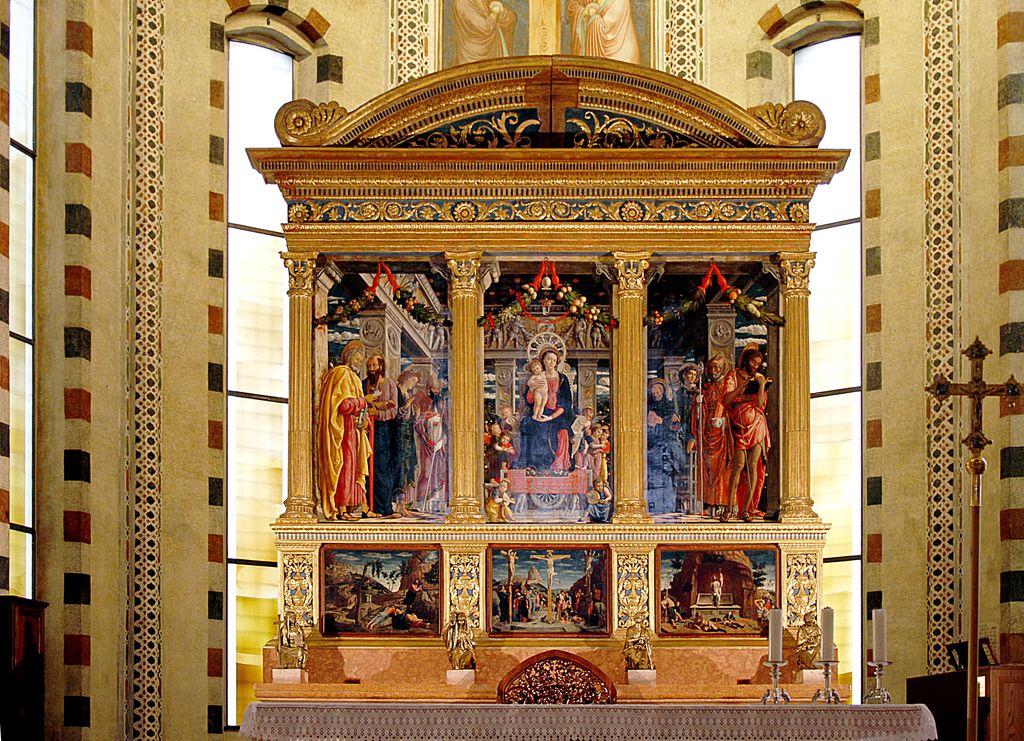
Gregorio Correr, commendatory abbot of San Zeno in Verona, commissioned Mantegna to paint for the high altar. The Opificio delle Pietre Dure dates the San Zeno Altarpiece to 1457–59. Like the Saint Luke altarpiece, it consists of separate panels. At Verona the actual columns of the frame stand in front of painted architecture that appears to continue behind them. The Madonna and the saints therefore appear to share a single architectural setting even as the wooden frame divides them into bays. This dependence on the frame helps explain why seeing the surviving upper ensemble above the high altar matters. Copies now stand in for the three lower narrative panels, seized by French troops in 1797. The original Crucifixion is in the Louvre. The Agony in the Garden and Resurrection are in Tours. [1] [2] [14]
San Zeno also helps explain why the Gonzaga appointment took several years to arrange. In the letter of 15 April 1458, Ludovico offered fifteen ducats a month, rooms for Mantegna and his family, provisions, firewood and assistance with the move. The letter also gave the painter latitude to finish the Verona commission and his other business. The altarpiece was being made in Padua, and in June 1459 Ludovico was still urging Mantegna to come to Mantua, even if he had to bring the altarpiece with him. In January 1459 he granted Mantegna permission to use an adapted version of his personal emblem. The family’s permanent move belongs to 1460, the date used by the Vatican Museums and National Gallery for the start of his settled court career. [1] [2] [3] [15]
Court employment meant work on several properties. In 1463–64 Mantegna supplied drawings to another painter for the Gonzaga villa at Cavriana and painted panels for a chapel at Goito. From Goito on 7 March 1464 he wrote a request for money to Ludovico, preserved in the State Archive of Mantua. In the Castello di San Giorgio itself, Mantegna worked on the marquis’s private chapel. The Uffizi dates its three early Mantuan panels to 1460–65 and discusses the castle chapel in connection with them. Their present triptych frame is a nineteenth-century reconstruction. Another painting associated with the chapel, the Death of the Virgin in the Prado, has been linked to a separate panel of Christ receiving Mary’s soul in Ferrara. The chapel’s original arrangement remains harder to recover than the commissions dispersed from it. [1] [2] [16] [17] [18]
The Gonzaga household on the walls of the Camera
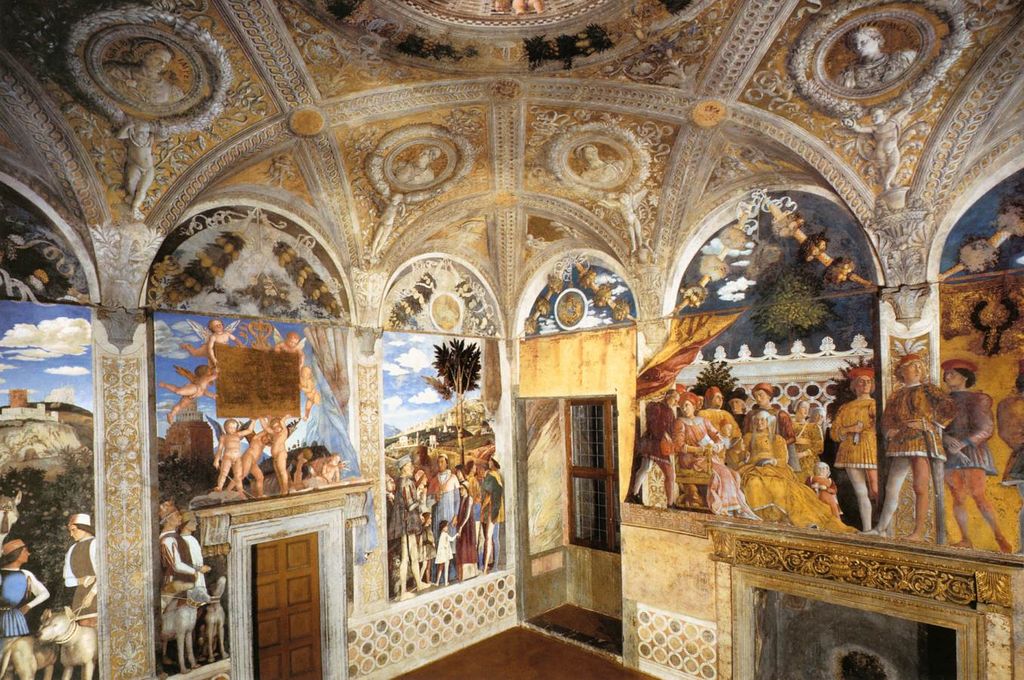
The Camera Picta, or painted chamber, occupies a tower room in the Castello di San Giorgio. A date inscribed in the splay of a north window, 16 June 1465, marks the period in which work began. On the west wall painted putti hold a dedication to Ludovico and Barbara of Brandenburg that supplies the date 1474. Those entries bracket an intermittent undertaking. Ludovico complained in 1470 about how far there was still to go, and Mantegna continued to take on other tasks. The wall paintings combine fresco with passages painted on dry plaster. The dates are recorded in two different registers. In the window splay the date is written in numerals and cursive script. The more conspicuous dedication uses Roman capitals, names the two patrons and records that Mantegna completed the work in their honour. [1] [2] [19] [20]
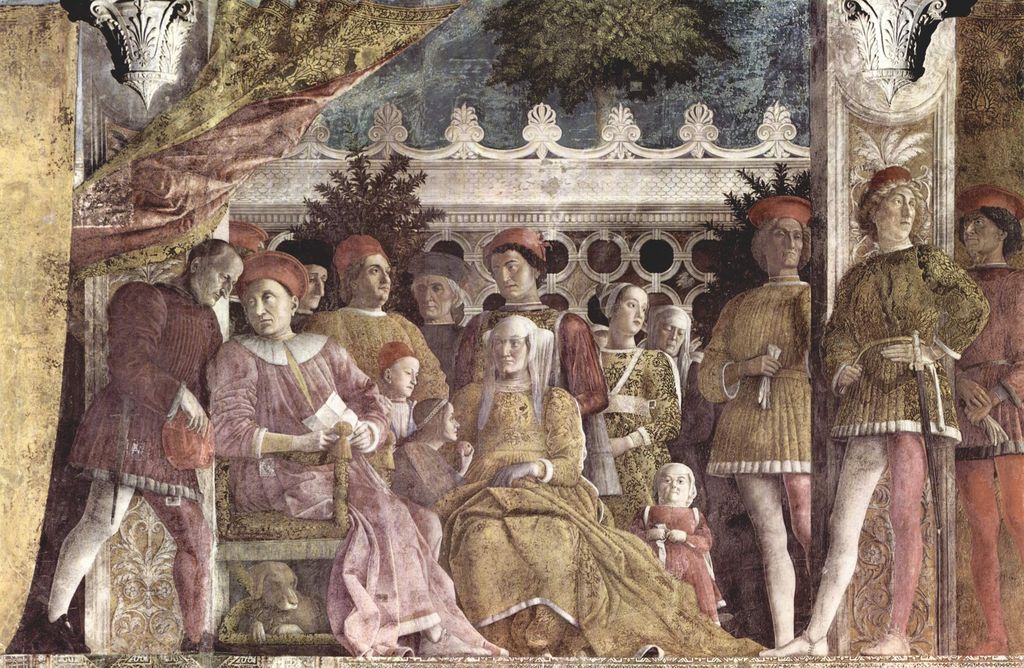
The Court scene, Camera degli Sposi, Palazzo Ducale, Mantua Image source. Public domain.
On the north wall, Ludovico turns towards a man who brings him a letter. Barbara sits beside him among children and attendants. On the west wall the marquis meets his son Francesco, represented as a cardinal. Palazzo Ducale’s room account reads the two scenes together, identifying the letter with news of Francesco Sforza’s illness and the meeting with an encounter at Bozzolo. Di Monte notes the range of scholarly interpretations of the events and the difficulty of naming every sitter. The painted gestures carry much of the meaning even when the historical occasion is left open. A quiet exchange to one side of Barbara’s seated figure gives the court scene the intimacy of a family gathering, while the cardinal’s robes make the family’s standing visible on the opposite wall. [1] [19]
A comparison with Pisanello’s earlier bronze medal of Ludovico shows what the room’s scale made possible. The medal’s obverse gives the marquis a profile circled by titles. Mantegna could suggest rank through proximity: who sits, who stands, who can approach and who turns to listen. He also had the whole room in which to vary that impression. Pilasters and hanging curtains seem to continue the actual architecture. Painted medallions of Roman emperors appear above the family, while the oculus opens onto a painted sky. Along its parapet figures peer down towards the real visitor. The oculus gives that visitor a position within the room’s fiction just as the other surfaces assign positions to the members of the court. [19] [21]
Caesar’s procession and the pope’s chapel
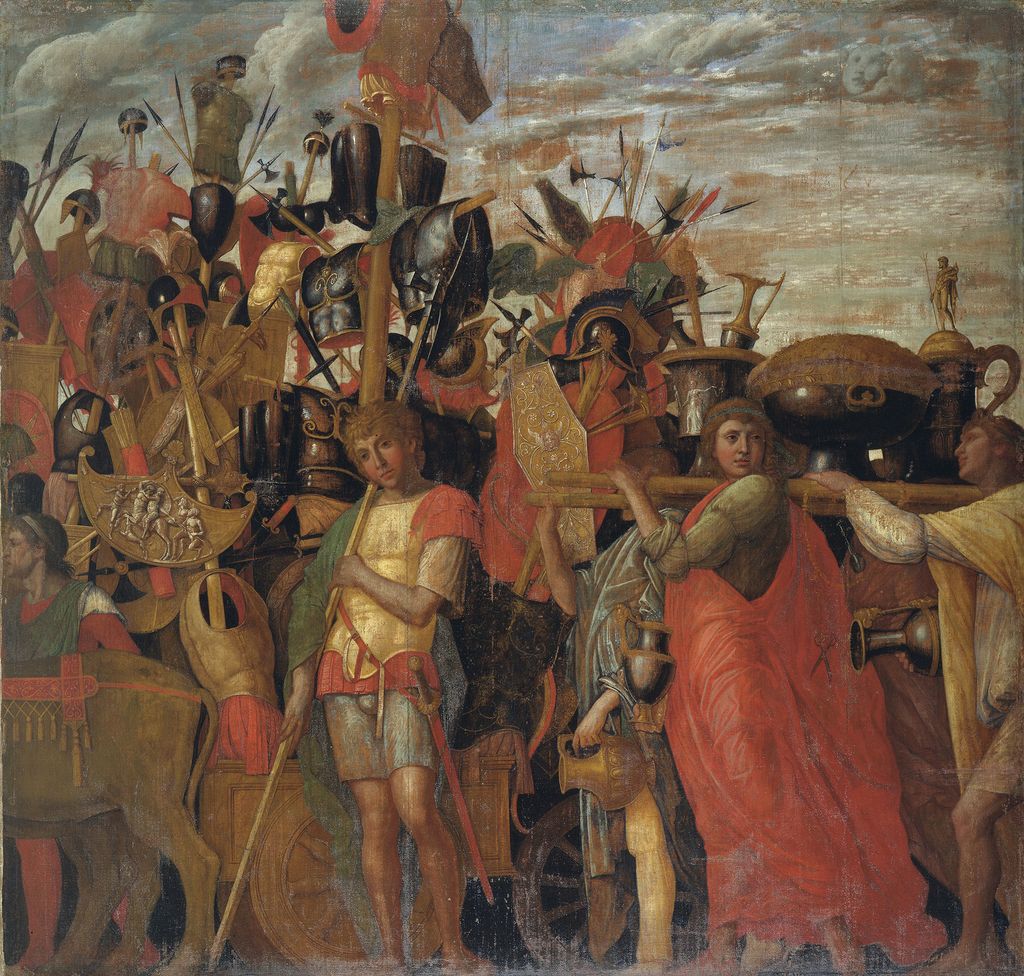
After Ludovico’s death in 1478 Mantegna served Federico I and then Francesco II, who succeeded in 1484. The antiquarian interests shared by painter and patrons found their most extensive expression in the nine canvases of the Triumphs of Caesar. Stefano Pierguidi places the work in a court that collected ancient marbles and cultivated artists such as the bronze sculptor known as Antico. The National Gallery gives the series a broad date of about 1485–1506. Objects within the sequence can carry more specific estimates: the Royal Collection dates The Captives, RCIN 403964, to about 1484–92. Documents record work in progress by 1486 and again in 1492. The exact original destination of the canvases remains uncertain. [1] [22] [23] [24]
The nine paintings form one procession. Standard-bearers, animals, spoils and captives pass across successive canvases before Caesar appears in his chariot. In The Captives, the figures move beneath a crowd of raised objects, and the people on foot have a vulnerability that sets off the assurance of Caesar’s entrance in the final canvas. The Royal Collection relates the series to accounts of Roman triumphs and the drawn record of Roman monuments. The cycle was already under way before Mantegna went to Rome, a point that matters when considering the part played by texts, drawings and objects available in northern Italy. The Gonzaga collection held the canvases long after his death. Charles I bought them in 1629, and they reached England around 1630. [1] [23] [24]
Mantegna interrupted that work in June 1488 to paint for Innocent VIII at the Belvedere in Rome. He decorated a small chapel dedicated to Saint John the Baptist and worked in the adjoining sacristy. From Rome he asked Francesco II to arrange for the proper care of the canvases already painted. Other letters to the marquis register difficulties over money during the papal commission. The painter could accept work from the pope and acquire the prestige that came with it, while continuing to turn to Mantua over both material and financial concerns. He returned to Mantua in September 1490. [1] [2]
The chapel was demolished in the late 1770s during the enlargement of the Vatican museum. The Vatican Museums’ biography reports Vasari’s later description of scenes from the lives of John the Baptist and the infant Christ. His comparison to illumination gives a sense of the fineness he perceived, while the artist’s correspondence establishes the dates and circumstances of the job. Di Monte reports that the lost signature gave Mantegna’s titles of count palatine and knight. The Santa Sofia inscription had reportedly stressed the hand and age of a young master. Four decades later the inscription associated with the Belvedere recorded the honours a painter could bring to a papal commission. [1] [2]
Isabella d’Este and the paintings for her studiolo
Isabella d’Este married Francesco II and made her formal entry into Mantua in February 1490, while Mantegna was still in Rome. Francesco’s Madonna of Victory, now in the Louvre, commemorated the battle of Fornovo in 1495. In the altarpiece he kneels in armour while the Virgin extends a hand above him. It casts the battle as an occasion for public thanksgiving. The church built to house it stood on the site of a Jewish banker’s home. As Di Monte recounts, the project began with an order to replace a devotional image removed from the house and grew into a commission for a new church and altarpiece under Gonzaga direction. Isabella’s first studiolo, or private study, in the Castello di San Giorgio called for paintings that could reward close examination and conversation about poetry, myth and moral allegory. [1] [25] [26]
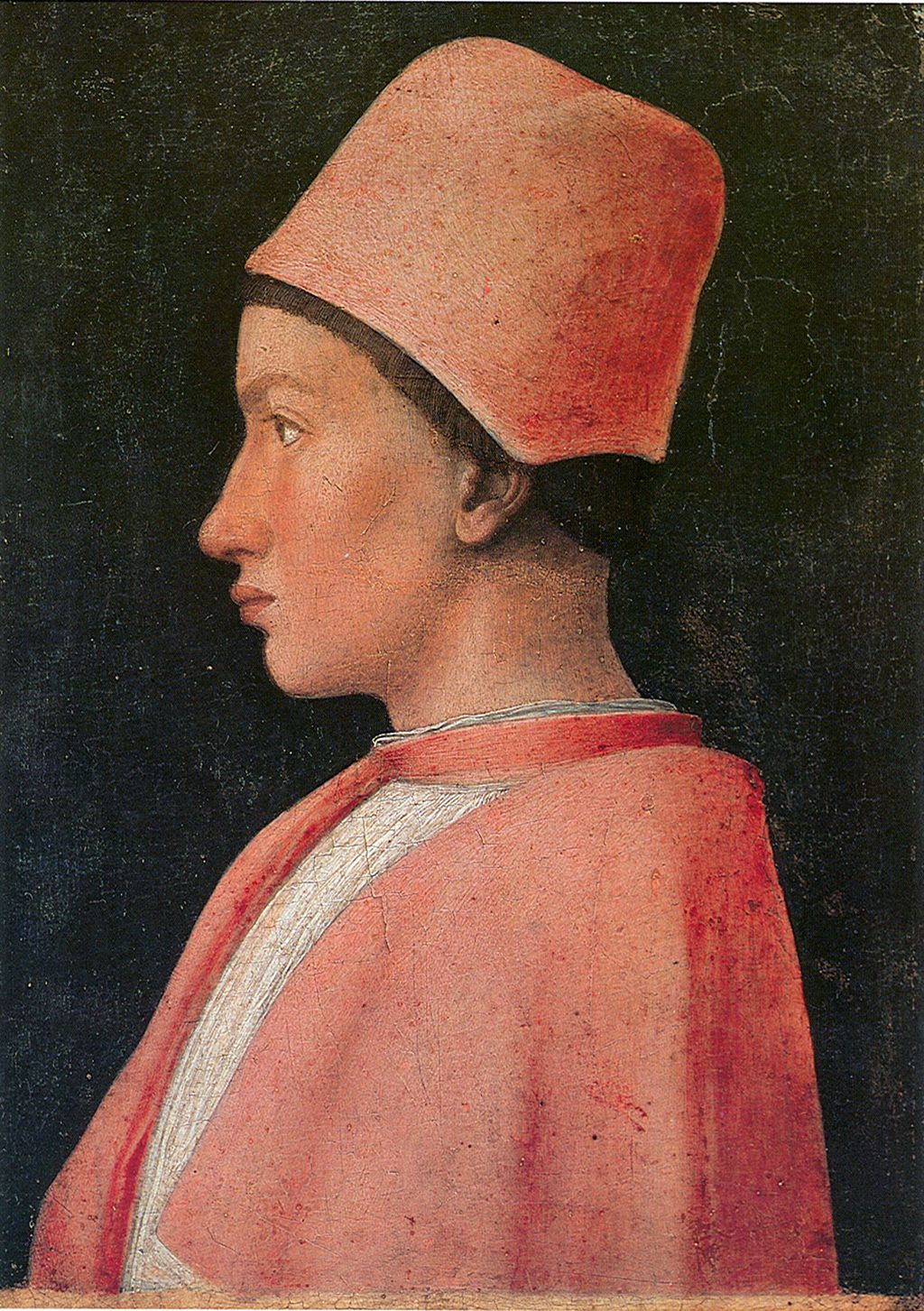
Portrait of Francesco Gonzaga, Museo di Capodimonte Image source. Public domain.
The Louvre’s object history dates the commission of Mars and Venus, known as Parnassus, to the winter of 1496–97. The painting places Mars and Venus above a rocky arch, with the Muses dancing below to Apollo’s music. The level occupied by the dancers is close to the spectator, while the gods stand above as if on a separate stage. The Louvre records later repainting in the landscape and on some of the figures, probably by Lorenzo Leonbruno. The treatment of individual passages as they now appear therefore has a history that extends beyond Mantegna’s delivery to Isabella. [26]
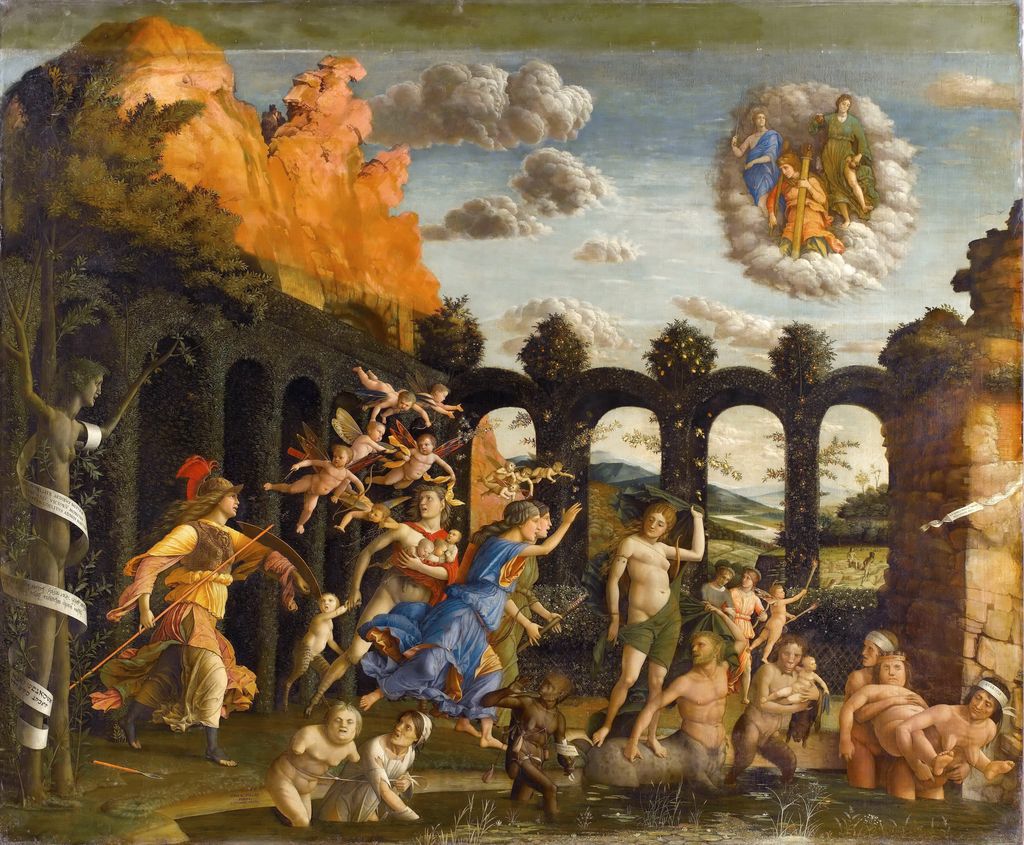
In Minerva Expelling the Vices from the Garden of Virtue, the armoured goddess advances from the left and the Vices scatter. Inscriptions identify some of the figures and add another way to follow the action. The Louvre catalogues the work as tempera on canvas, inventory INV 371, and records a mention by Pomponio Gaurico in 1504. Its retrospective placed completion in 1502, whereas its collection record gives a broader late-fifteenth-century date. The retrospective also points to the grotesque figures, anthropomorphic forms and multiple inscriptions as grounds for thinking Mantegna played a substantial part in conceiving the allegory. The extent of his role in devising the programme remains open. [2] [27] [28]
The first studiolo took shape over several years. The Louvre groups Mantegna’s two completed pictures with Perugino’s contribution, a painting by Lorenzo Costa and a further work begun by Mantegna and finished by Costa. Isabella also tried to obtain a painting for the room from Giovanni Bellini. The correspondence of 1501–02 shows that she dealt through agents and had to negotiate over subject, dimensions, advance payment and delay. At one point she was willing to leave the choice of a suitable ancient story to Bellini, but still sent him the measurements the room required. A letter from Mantegna in July 1506 mentions the projected picture of the god Comus. Di Monte considers it likely that Mantegna left the work at or near the design stage before Costa completed the commission. [1] [15] [26] [27] [28]
The last commissions and the family chapel
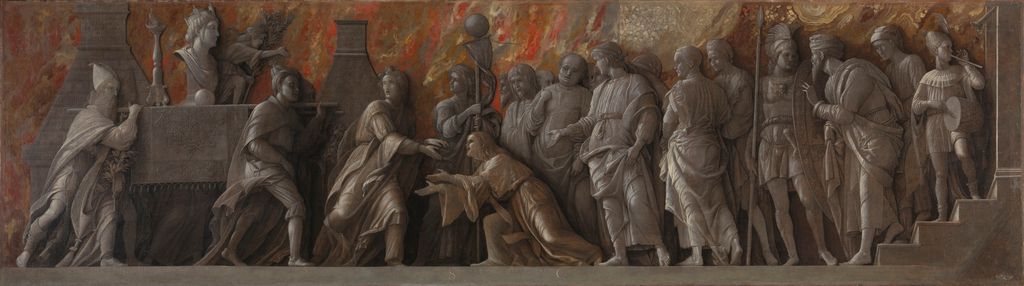
Mantegna’s last years brought him back to the Venetian network as well as to the question of his place in Mantua. In March 1505 Francesco Cornaro’s brother Marco sought Francesco Gonzaga’s permission to commission Mantegna for a Venetian palace. For Cornaro, Mantegna painted The Introduction of the Cult of Cybele at Rome, dated 1505–06 by the National Gallery, NG902. The figures look like a sculpted relief brought into motion, an effect produced through painted highlights and shadows. The commission envisaged a series, but Mantegna completed only this canvas. The subject gave the Cornaro family a place in Roman history through their claimed descent from Scipio Nasica, who received the goddess in Rome. Cornaro subsequently turned to Giovanni Bellini for another painting. The two painters whose compositions had been so closely related in the 1450s were thus connected again through a single patron’s project. [1] [29]
Mantegna made a will on 1 March 1504 and arranged for a family burial chapel in the basilica of Sant’Andrea, Mantua. Both the Vatican Museums and Di Monte date his death to 13 September 1506. A letter from his son Ludovico to Francesco Gonzaga on 2 October records works left behind, including paintings still in progress for the chapel. His sons faced decisions about the works in the studio as well as commissions that needed further work. Isabella called on Francesco, who was also a painter, to restore the Camera soon after his father’s death in advance of a visit by Julius II. Di Monte also considers Francesco likely to have helped complete the Baptism of Christ and the Holy Family with the Family of Saint John the Baptist. [1] [2]
Brera dates its Lamentation over the Dead Christ, a tempera on canvas, to about 1483 and catalogues it as inventory 352. The museum considers it the most plausible candidate for the foreshortened Christ recorded among the works left at Mantegna’s death, while acknowledging that variants complicate the identification. Its viewpoint places the viewer at the foot of the stone on which the body lies. The feet and wounds are near the foreground and the mourners are confined to the left edge. The possible studio provenance opens a question about what part the painting played in Mantegna’s own devotional life, which Brera also treats as a matter of interpretation. [30]
In Sant’Andrea the bronze bust of Mantegna is set against a porphyry disc. The national catalogue distinguishes the identity of the sitter from the uncertain authorship of the sculpture. It also records the date of 21 October 1516 from the now largely effaced inscription above the bust, suggesting that the installation completed the chapel about a decade after Mantegna’s death. The wreath around his head recalls the honour conferred on poets and men of learning. In the room where Mantegna arranged to be buried, that public claim to distinction shares a wall with the provisions he made for family remembrance and worship. [1] [31]
Four stages of Mantegna’s career
Training and independent commissions
The Squarcione workshop gave Mantegna a foothold in Padua. The Ovetari Chapel and San Zeno show how he fitted figures and painted space into architectural settings. José Luiz photographed the accompanying view. [1] The San Zeno Altarpiece in its frame, Basilica of San Zeno, Verona José Luiz. Image source. CC BY-SA 4.0. Resized from the cited image.
Work for the Gonzaga court
Mantegna entered Ludovico Gonzaga’s service. In the Camera Picta, actual doors and fireplace meet painted openings, people and fabric. [3]
A broadening range of commissions
The Gonzaga court remained the centre of his career while he worked in Rome for Innocent VIII. The Triumphs of Caesar probably began during the 1480s. [1]
Altarpieces and private commissions
Works for Isabella d’Este, the Madonna della Vittoria and the late painting of Cybele explore different uses of classical figures and stories. [3]
Artworks directory
| Name | Date | Medium and collection |
|---|---|---|
| The Adoration of the Shepherds | Shortly after 1450 | Painting · Metropolitan Museum of Art · 32.130.2 Catalogue. |
| Saint Mark the Evangelist | C. 1448–51 | Painting · Städel Museum · 1046 Catalogue. |
| Saint Jerome Penitent in the Desert | C. 1448–51 | Painting · Museu de Arte de São Paulo · MASP.00015 Catalogue. |
| Martyrdom and Transport of the Body of Saint Christopher | Mid-1450s | Painting · Ovetari Chapel, Padua Catalogue. |
| San Luca Altarpiece | 1453–55 | Painting · Pinacoteca di Brera · 176 Catalogue. |
| The Presentation of Christ at the Temple | 1454 (Berlin dating) | Painting · Gemäldegalerie, Berlin · 29 Catalogue. |
| San Zeno Altarpiece | 1457–59 | Painting · Basilica of San Zeno, Verona Catalogue. |
| The Crucifixion | 1456–59 | Painting · Musée du Louvre · INV 368 Catalogue. |
| The Agony in the Garden (London) | C. 1455–56 | Painting · National Gallery, London · NG1417 Catalogue. |
| The Agony in the Garden (Tours) | 1459 (Tours dating) | Painting · Musée des Beaux-Arts de Tours · 1803-1-24 Catalogue. |
| The Resurrection | 1459 (Tours dating) | Painting · Musée des Beaux-Arts de Tours · 1803-1-25 Catalogue. |
| Saint Sebastian (Vienna) | C. 1457–59 | Painting · Kunsthistorisches Museum · GG 301 Catalogue. |
| Cardinal Ludovico Trevisan | C. 1459–60 (Berlin exhibition dating) | Painting · Gemäldegalerie, Berlin · 9 Catalogue. |
| The Death of the Virgin | C. 1462 | Painting · Museo Nacional del Prado · P000248 Catalogue. |
| Christ with the Soul of the Virgin | C. 1460–64 | Painting · Pinacoteca Nazionale, Ferrara Catalogue only. |
| Portrait of a Young Man (traditionally Francesco Gonzaga) | C. 1461 or 1470, depending on sitter | Painting · Museo di Capodimonte · Q 60 Catalogue. |
| Portrait of a Prelate (Carlo de’ Medici?) | C. 1465–70 | Painting · Uffizi Galleries · 1890 no. 8540 Catalogue. |
| Portrait of a Man | C. 1470 | Painting · National Gallery of Art, Washington · 1952.2.5 Catalogue. |
| Madonna with Sleeping Child (Berlin) | C. 1455–60 | Painting · Gemäldegalerie, Berlin · S.5 Catalogue. |
| Camera degli Sposi (Camera Picta) | 1465–74 | Painting · Palazzo Ducale, Mantua Catalogue. |
| Saint Sebastian (Louvre) | Around 1480 | Painting · Musée du Louvre · RF 1766 Catalogue. |
| Lamentation over the Dead Christ | C. 1483 (Brera dating) | Painting · Pinacoteca di Brera · 352 Catalogue. |
| The Triumphs of Caesar | About 1485–1506 | Painting · Royal Collection · RCIN 403958–403966 Catalogue. |
| Madonna of the Caves | C. 1488–90 | Painting · Uffizi Galleries · 1890 no. 1348 Catalogue. |
| Madonna and Child with a Choir of Cherubim | C. 1485 | Painting · Pinacoteca di Brera · 297 Catalogue. |
| Madonna and Child (Poldi Pezzoli) | Early 1490s (museum dating) | Painting · Museo Poldi Pezzoli · 1595 Catalogue. |
| The Holy Family with Saint Mary Magdalen | C. 1495–1500 | Painting · Metropolitan Museum of Art · 14.40.643 Catalogue. |
| The Virgin and Child with Saint Mary Magdalene and Saint John the Baptist | C. 1490–1505 | Painting · National Gallery, London · NG274 Catalogue. |
| Christ as the Suffering Redeemer | 1485–95 (SMK dating) | Painting · Statens Museum for Kunst · KMSsp69 Catalogue. |
| Ecce Homo | C. 1500 | Painting · Musée Jacquemart-André · MJAP-P 1840 Catalogue. |
| Judith with the Head of Holofernes (Mantegna or follower) | C. 1495–1500 | Painting · National Gallery of Art, Washington · 1942.9.42 Catalogue. |
| Madonna della Vittoria | 1495–96 | Painting · Musée du Louvre · INV 369 Catalogue. |
| Mars and Venus (Parnassus) | C. 1496–97 | Painting · Musée du Louvre · INV 370 Catalogue. |
| The Trivulzio Madonna | 1497 | Painting · Castello Sforzesco, Milan · 0554 Catalogue. |
| The Adoration of the Magi | C. 1495–1505 | Painting · J. Paul Getty Museum · 85.PA.417 Catalogue. |
| Minerva Expelling the Vices from the Garden of Virtue | C. 1502 | Painting · Musée du Louvre · INV 371 Catalogue. |
| The Introduction of the Cult of Cybele at Rome | 1505–06 | Painting · National Gallery, London · NG902 Catalogue. |
| Saint Sebastian (Venice) | Probably c. 1504–06 | Painting · Galleria Giorgio Franchetti alla Ca’ d’Oro · D.11 Catalogue. |
| Samson and Delilah | C. 1500 | Painting · National Gallery, London · NG1145 Catalogue only. |
| A Woman Drinking (probably Sophonisba) | C. 1495–1506 | Painting · National Gallery, London · NG1125.2 Catalogue only. |
| The Vestal Virgin Tuccia with a Sieve | C. 1495–1506 | Painting · National Gallery, London · NG1125.1 Catalogue only. |
| Judith with the Head of Holofernes (Dublin) | C. 1495–1500 | Painting · National Gallery of Ireland · NGI.442 Catalogue only. |
| Battle of the Sea Gods, left half (Met impression) | Before 1481 (Met dating) | Print · Metropolitan Museum of Art · 18.12 Catalogue only. |
| Battle of the Sea Gods, right half (Met impression) | Before 1481 (Met dating) | Print · Metropolitan Museum of Art · 1984.1201.4 Catalogue only. |
| Battle of the Sea Gods, left half (Tokyo impression) | C. 1475 (Tokyo dating) | Print · National Museum of Western Art, Tokyo · G.1981-0002 Catalogue only. |
| Battle of the Sea Gods, left half (Washington impression) | C. 1485–88 (NGA dating) | Print · National Gallery of Art, Washington · 1941.1.6 Catalogue only. |
| The Entombment of Christ, second state of two | Before 1475 (Met dating) | Print · Metropolitan Museum of Art · 37.42.30 Catalogue only. |
| The Entombment of Christ (possibly Zoan Andrea, after Mantegna) | 1460–1549 (Rijksmuseum dating) | Print · Rijksmuseum · RP-P-1924-60 Catalogue only. |
| Four Dancing Muses (Gian Marco Cavalli after Mantegna) | C. 1497 | Print · Metropolitan Museum of Art · 20.5.3 Catalogue only. |
| Bacchanal with Silenus | Before 1475 (Met dating) | Print · Metropolitan Museum of Art · 29.44.15 Catalogue only. |
| Bacchanal with a Wine Vat | Before 1475 (Met dating) | Print · Metropolitan Museum of Art Catalogue only. |
| St James on His Way to Execution | C. 1453–57 | Drawing · British Museum · 1976,0616.1 Catalogue only. |
| Three Studies for a Dead Christ | C. 1455–65 | Drawing · British Museum · 1909,0406.3 Catalogue only. |
| Pietà (Venice) | C. 1456–65 (exhibition datings) | Drawing · Gallerie dell’Accademia, Venice · 115 Catalogue only. |
| Studies for Christ at the Column | 1460–65 | Drawing · The Courtauld · D.1978.PG.345 Catalogue only. |
| Virtus Combusta | C. 1490 (technical study) | Drawing · British Museum · Pp,1.23 Catalogue only. |
| Virtus Combusta (Giovanni Antonio da Brescia after Mantegna) | C. 1495–1506 | Print · Musée du Louvre · 3881 LR/ Recto Catalogue only. |
| The Calumny of Apelles | C. 1504–06 | Drawing · British Museum · 1860,0616.85 Catalogue only. |
Frequently Asked Questions
He and his family settled there in 1460. Ludovico Gonzaga had already offered him terms in 1458, while Mantegna was still completing the San Zeno commission.
Mantegna married Nicolosia Bellini, Giovanni’s sister. Their related paintings of the Agony and Presentation show how compositions circulated between the two painters.
Discussion
Look again at the images and ideas explored in Biography. These editorial prompts invite your observations.
Reader Insights
What do Bellini’s changes to the Presentation in the Temple reveal when the side figures in Mantegna’s painting are treated as unidentified witnesses?
How does Mantegna make Ludovico’s authority visible through gestures and placement in the Camera Picta, compared with Pisanello’s use of profile and inscription on his medal?
Join the Conversation
Share a detail, comparison or question about Biography below.
References
- Treccani, Michele Di Monte, “Mantegna, Andrea,” Dizionario Biografico degli Italiani. View source.
- Vatican Museums, Andrea Mantegna (1431–1506), biographical note. View source.
- National Gallery, London, Andrea Mantegna (about 1431–1506). View source.
- Staatliche Museen zu Berlin, Francesco Squarcione’s Virgin and Child. View source.
- ICCROM, Repositioning Ovetari Chapel mural fragments in the Church of the Eremitani. View source.
- ICCROM, Discovery of mural fragments including material from the Ovetari Chapel. View source.
- Museu de Arte de São Paulo, Saint Jerome Penitent in the Desert, MASP.00015. View source.
- Pinacoteca di Brera, Polittico di San Luca. View source.
- Museo e Real Bosco di Capodimonte, Il rientro di Mantegna e Polidoro a Capodimonte. View source.
- National Gallery, London, Mantegna and Bellini. View source.
- Staatliche Museen zu Berlin, Around Mantegna and Bellini: Technical Studies and Conservation. View source.
- National Gallery, London, Andrea Mantegna, The Agony in the Garden, NG1417. View source.
- National Gallery, London, Giovanni Bellini, The Agony in the Garden, NG726. View source.
- Opificio delle Pietre Dure, Andrea Mantegna, Pala di San Zeno, 1457–1459. View source.
- Texas Lutheran University, Ludovico Gonzaga’s letter of 15 April 1458 and Isabella d’Este’s correspondence on Bellini, English translations. View source.
- Archivio di Stato di Mantova, Mantegna’s request for money from Goito, 7 March 1464, Autografi b. 7, c. 90 recto. View source.
- Uffizi Galleries, Ascension of Christ, Adoration of the Magi and Presentation of Christ at the Temple. View source.
- Fondazione Federico Zeri, University of Bologna, Cristo con l’animula della Madonna, Pinacoteca Nazionale di Ferrara. View source.
- Palazzo Ducale, Mantua, Camera Picta (Camera degli Sposi). View source.
- Lombardia Beni Culturali, Camera degli Sposi, SIRBeC MN020-00085, inscriptions and catalogue record. View source.
- National Gallery of Art, Washington, Pisanello, Lodovico Gonzaga, 2nd Marquess of Mantua, obverse. View source.
- Treccani, Stefano Pierguidi, “Mantegna e la Mantova dei Gonzaga”. View source.
- National Gallery, London, The Triumphs of Caesar. View source.
- Royal Collection Trust, The Triumphs of Caesar: 7. The Captives, RCIN 403964. View source.
- Musée du Louvre, La Vierge de la Victoire, INV 369. View source.
- Musée du Louvre, Mars et Vénus, dit Le Parnasse, INV 370. View source.
- Musée du Louvre, Minerve chassant les Vices du Jardin de la Vertu, INV 371. View source.
- Musée du Louvre, Mantegna retrospective: Le studiolo d’Isabelle d’Este. View source.
- National Gallery, London, The Introduction of the Cult of Cybele at Rome, NG902. View source.
- Pinacoteca di Brera, Lamentation over the Dead Christ, inventory 352. View source.
- Italian Ministry of Culture, Bronze bust of Andrea Mantegna, national catalogue 0300147110-2. View source.
- Musée du Louvre, Madonna della Vittoria, View source.
More MANTEGNA Paintings
San Zeno Altarpiece
The San Zeno Altarpiece in its frame, Basilica of San Zeno, Verona José Luiz. Image source. CC BY-SA 4.0. Resized from the cited image.