 by Tom Gurney
Tom Gurney BSc (Hons) is an art history expert with over 20 years experience
Published on June 19, 2020 / Updated on November 29, 2026
Email: tomgurney1@gmail.com / Phone: +44 7429 011000
Overview
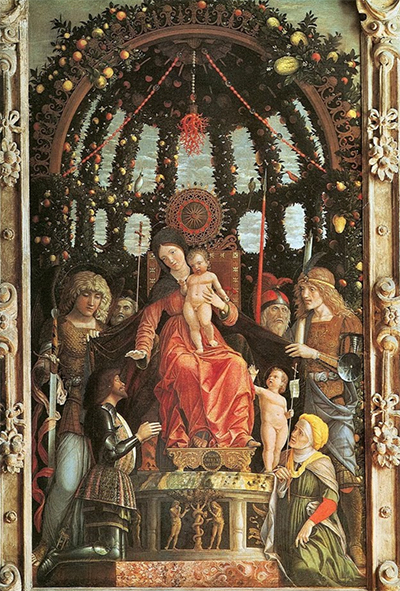
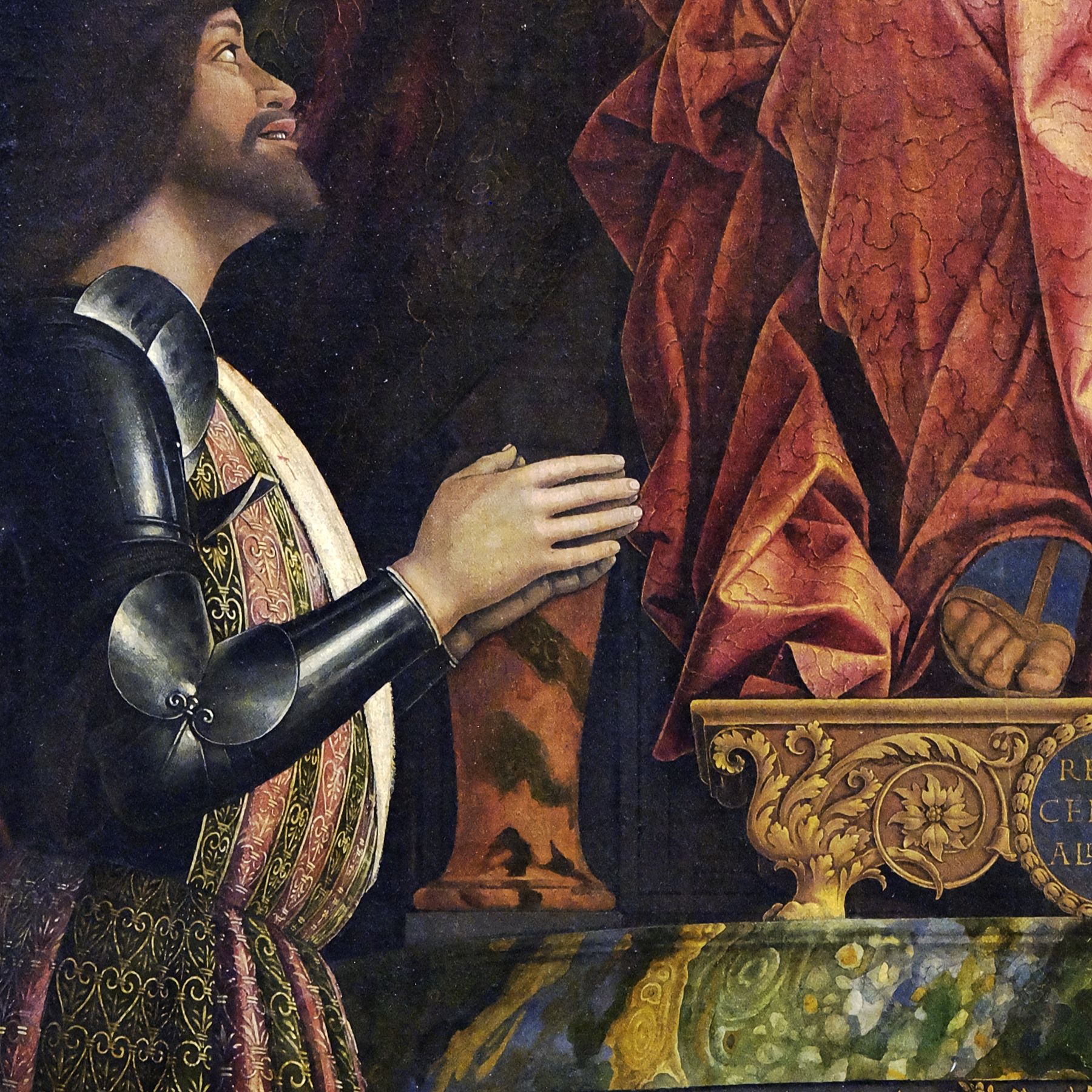
Francesco II Gonzaga kneels in armour beneath the outstretched hand of the Virgin Mary. His helmet is off, his hands are joined, and above him hangs a branch of red coral. Andrea Mantegna painted the Madonna della Vittoria, or Madonna of Victory, in 1495–96 as an offering of thanks commissioned by the marquess of Mantua after the Battle of Fornovo. The altarpiece, nearly three metres high and painted in tempera on canvas, is now in the Musée du Louvre. [1] [2]
The name gives Fornovo the outcome Francesco wished to commemorate. The image gives that outcome a cause, placing the commander under Mary's protection. The story of how the painting was paid for begins elsewhere, at the façade of a house belonging to a Jewish banker named Daniel da Norsa. [3]
At a Glance
- Date1495–96, installed on 6 July 1496
- MediumTempera on canvas
- Dimensions2.85 × 1.68 m
- CollectionMusée du Louvre, Paris
- InventoryINV 369, also recorded as MR 337
Andrea Mantegna in context
San Zeno Altarpiece
1457–59 [16]The Triumphs of Caesar
Mid-1480s–before 1506 [17]Madonna della Vittoria
1495–96 [18]What counted as victory at Fornovo?
On 6 July 1495, at Fornovo on the Taro near Parma, the army of the League of Venice under Francesco confronted the forces of Charles VIII of France. Charles had entered Italy to claim the kingdom of Naples and was marching north again when the League met him. The fighting was bloody, and the French were able to continue their march. The Louvre's exhibition account calls the victory doubtful. The League had failed to stop Charles, but the court could build a triumphant account around Francesco's survival and the French departure. [2] [3]
The art historian Molly Bourne traces that account across several media. The Gonzaga chancery praised Francesco for restoring Italy's liberty, and the court sent the painter Francesco Bonsignori to study the terrain for a battle fresco that is now lost. Another version of the story survives on a bronze medal by Sperandio, made around 1495. Its obverse shows Francesco in profile, armed and wearing headgear. On the reverse the mounted commander appears among soldiers beneath a Latin inscription crediting him with restoring liberty to Italy. The medal makes a military action the measure of the man. In Mantegna's altarpiece, the same man has uncovered his head and depends on a gesture from above. Each image assigns Francesco a different part in the victory he claimed. [3] [4] [5]
The religious account acquired further detail over time. As Bourne notes, the Mantuan ecclesiastical historian Ippolito Donesmondi wrote more than a century after the battle that Francesco had promised Mary a church if she delivered him from danger. The story gives the building and its altarpiece a single dramatic origin on the battlefield. The Gonzaga correspondence follows the project through a series of decisions made after the fighting, with Francesco still away on military business and his brother Sigismondo acting in Mantua. [3] [6]
The house in San Simone
Daniel da Norsa had acquired a house in Mantua's San Simone neighbourhood with a painted image of the Virgin and saints on its exterior. In a petition to the marquess dated 29 May 1495, Norsa said that the bishop's vicar had given him permission to remove the image and that he had paid the sum required. He also described what happened during an Ascension procession two days earlier. Figures of saints and verses had appeared on his wall, and people passing the house shouted and threw stones into it. In a letter of 31 July, Francesco treated the removal as an affront to Mary and to the Christian faith and instructed Sigismondo to have the image replaced with a more splendid one. [3] [6]
The proposal grew from a replacement on an exterior wall into an altarpiece in a new church. In a letter of 8 August, the friar Girolamo Redini reported that the cleric Marco Antonio da Porto had proposed making the house into a church and that, at Sigismondo's urging, Mantegna would paint the image. Redini envisaged Francesco in armour alongside his brothers, with Isabella d'Este, his wife, on the other side of the Virgin. In the finished painting Francesco is the sole figure portrayed as a contemporary supplicant. Bourne reads the narrowing of the scheme as a decision to give the marquess a personal claim on Mary's favour. Salvatore Settis, writing in the Italian state archives' exhibition catalogue, stresses the role of the three men who developed the programme in Mantua and the limits of the letters as evidence of Francesco's personal instructions. [1] [3] [6] [7]
Francesco's order required Norsa to provide 110 gold ducats for a new image by Mantegna and threatened him with hanging for nonpayment. Sigismondo later reported that the money had been handed over and that he had passed part of it to the painter, with the balance to follow once work began. Norsa's house was taken and demolished, and Santa Maria della Vittoria was built on its site. Francesco occupies the traditional place of a donor in the altarpiece, where the gesture of prayer publicly identifies him with the offering. The court's own letters identify the person compelled to pay for it. [3] [6]
The threat raised a question of Jewish religious law. Joseph Koerner and Tamara Morsel-Eisenberg study the altarpiece alongside a ruling by Rabbi Joseph Colon on whether a Jew under threat could commission a Christian image. The ruling puts the problem of religious coercion into terms that the marquess's letters leave out. A separate, anonymous painting associated with the Norsa family offers another comparison. The state archives catalogue identifies members of the family kneeling beneath a sacred company that again includes Elizabeth and the young Baptist. An inscription expresses the Christian claim that Jewish audacity had been overcome. Settis places the anonymous painting in the church's refectory, where a smaller audience would have seen it. The altarpiece, in public view, made the Virgin's protection of the marquess the centre of attention. [6] [8]
A commander at the foot of Mary's throne
Mantegna sets the decisive gesture low in the composition. Mary leans slightly toward Francesco and holds her right hand palm-down above him. The Child raises his hand in blessing. The marquess's upturned face and joined hands bring the eye back to Mary's fingers. His plates of armour catch the light in narrow bands, still declaring his rank while the kneeling pose makes him look small beneath the throne. Treccani relates the composition to the Madonna della Misericordia, the Virgin of Mercy, whose mantle shelters those who come under her protection. Here the archangel Michael and Saint George hold the mantle open, giving its folds the span of a canopy immediately above the people at Mary's feet. [1] [2] [6] [7]
The four standing saints are easiest to recognise in pairs. On the viewer's left stands Michael with a jewelled sword, with Andrew and his cross behind him. Across the throne, George carries a broken lance, and the plumed figure behind him is Longinus. Bourne connects George's broken weapon with a fragment of Francesco's own lance sent home after Fornovo. Andrew and Longinus were patron saints of Mantua. The lance of Longinus recalls the piercing of Christ's side and the saint's association with the relic of the Holy Blood venerated in Mantua. Sigismondo himself drew a parallel between Longinus's lance and Francesco's in a letter praising his brother after the battle. The two weapons in the painting bring that comparison into view on the same side of the throne. [2] [3]
At lower right the Louvre identifies the kneeling woman as Saint Elizabeth, accompanied by her son John the Baptist as a child. Mantua's civic museum associates Elizabeth with Isabella d'Este's devotion. The association gives Isabella a possible point of reference within the final design without turning the saint into a portrait of the marchioness. Elizabeth's lowered position balances Francesco, while the little Baptist brings the right side into relation with the Child on Mary's lap. These figures give the foreground some of the intimacy of a family encounter, even as the saints' weapons and the marble throne keep it ceremonial. [1] [9]
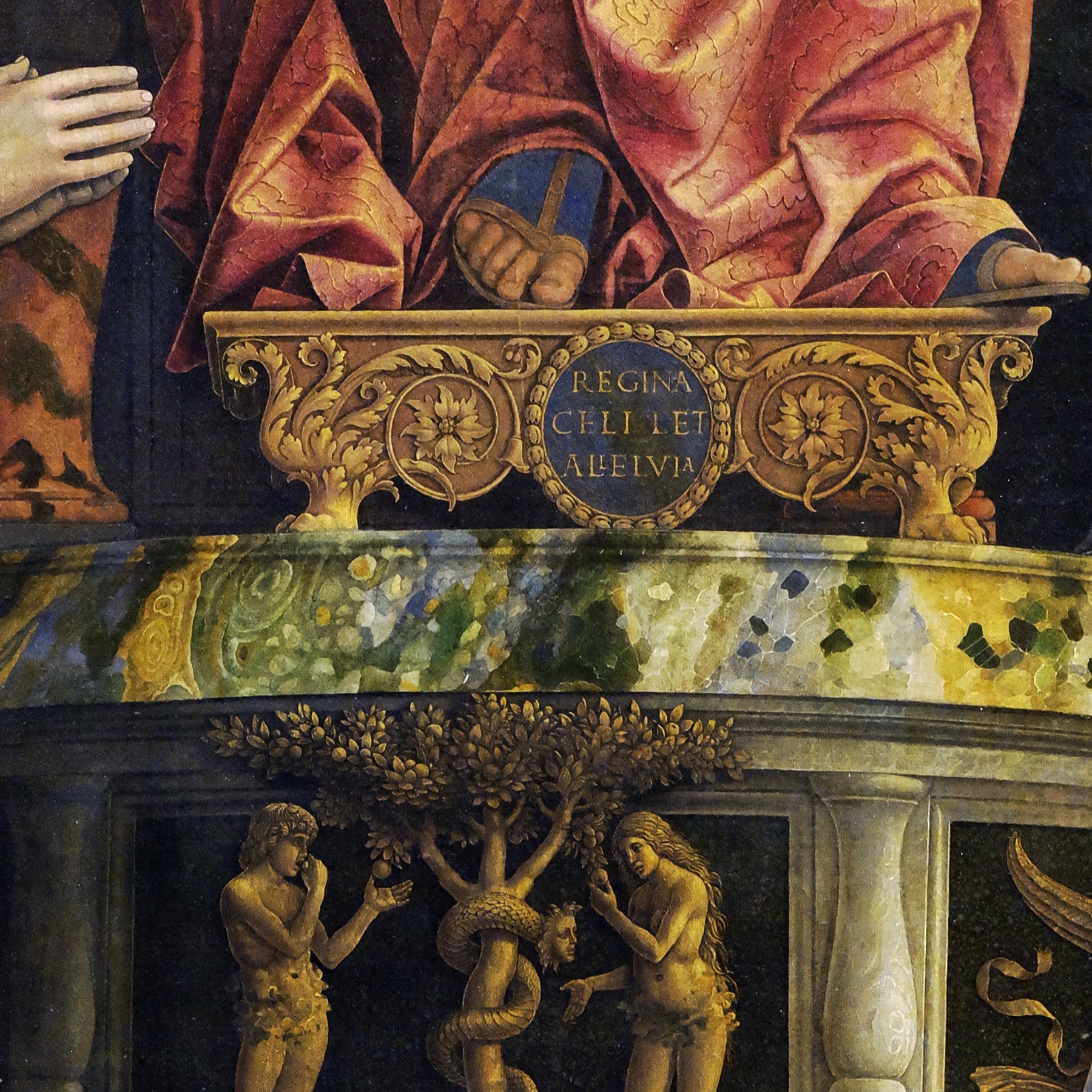
Look at the pedestal between the two kneeling figures. Its centre contains Adam and Eve at the tree, painted to resemble a relief. Settis identifies the central scene as the Fall and reads the partly obscured winged figure to the right as a possible classical Victory. He also points to the Baptist's banner, whose words identify Christ as the Lamb of God who takes away the sins of the world. The banner and the relief bring the Fall and redemption into the same field of view as the thanksgiving for Fornovo. The central scene is much easier to see than the material at the sides. Within a few inches of painted surface, the eye moves from the Fall to the Child above it, and from a carefully modelled imitation of hard stone or metal to faces and hands that seem to have room to move. The Louvre's exhibition placed this passage alongside Mantegna's experiments in making paint behave like sculpture. [2] [6]
Coral and citrus above the armour
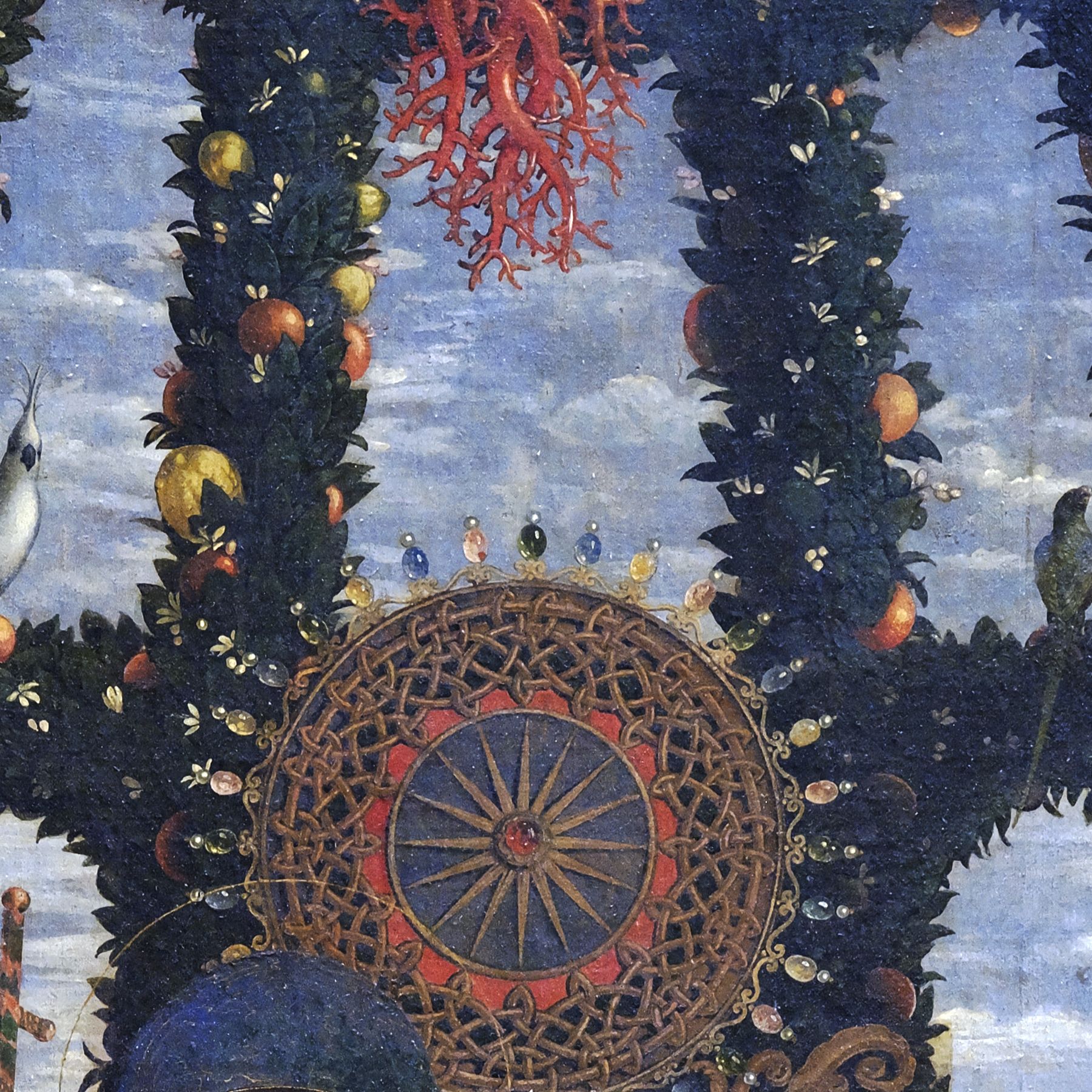
The upper half of the altarpiece has its own depth and rhythm. Pale ribs curve along the rounded top, and leafy branches thicken against the openings of the trellis. The Louvre identifies orange and lemon trees. The gaps let in patches of blue and leave the birds partly secluded, so the canopy reads both as a garden structure and as something built to honour the figure beneath it. Just above Mary's head a carefully aligned hanging descends from the centre. Its bright beads and forked red coral pick up the glints on the weapons below, drawing attention back to the axis of the throne. [1] [2] [10]
Heather Dalton discusses coral's associations with protection in battle and reads the costly hangings, with their beads and pearls, as part of the work's language of victory, purity and magnificence. The coral's position matters as much as its material. It hangs clear of the foliage, under the trellis and over Mary and the Child. The white crested bird high in the trellis is easier to miss. Dalton identifies it as a sulphur-crested cockatoo and uses its presence to investigate the reach of trade through which an Australasian bird could become known in Renaissance Italy. The likeness is precise enough for the species to be proposed. How Mantegna came to know the bird remains uncertain. [1] [10]
Vittore Crivelli's Madonna and Child with Two Angels, painted about 1481–82, offers a comparison on a more intimate scale. In that panel a swag of fruit hangs close to the heads, and a devotional book and cherries sit within reach on the parapet. The Metropolitan Museum of Art identifies the cherries with original sin and the goldfinch held by Christ with the Passion. Mantegna distributes comparable kinds of imagery across a much greater height. The garden and birds are overhead, the Fall is in the base of the throne, and the interval between them is filled by the bodily encounter of Mary, the Child and their petitioners. [1] [6] [11]
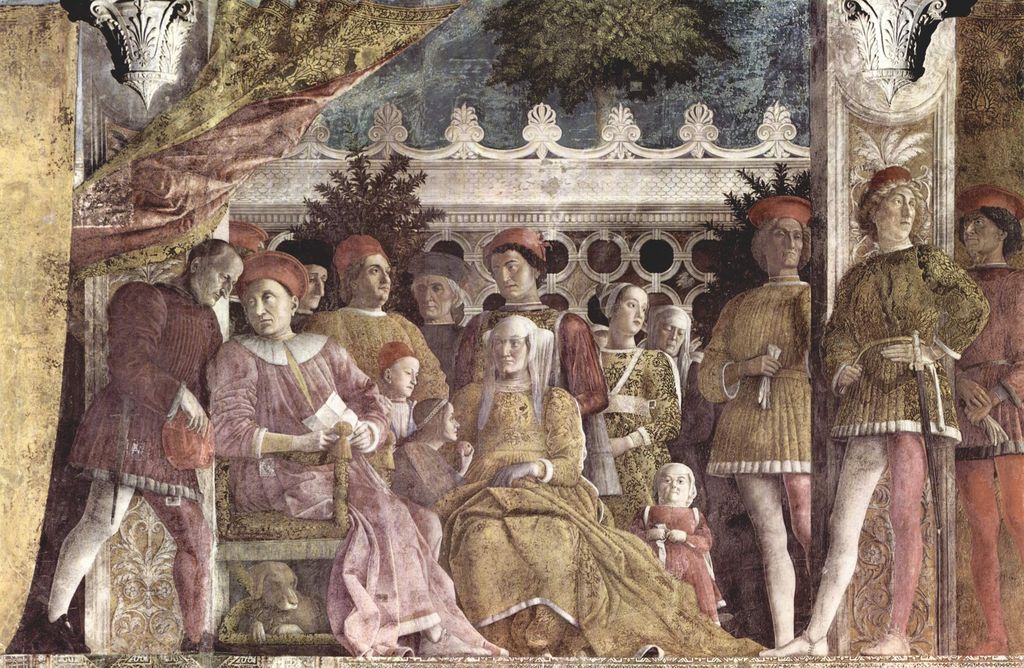
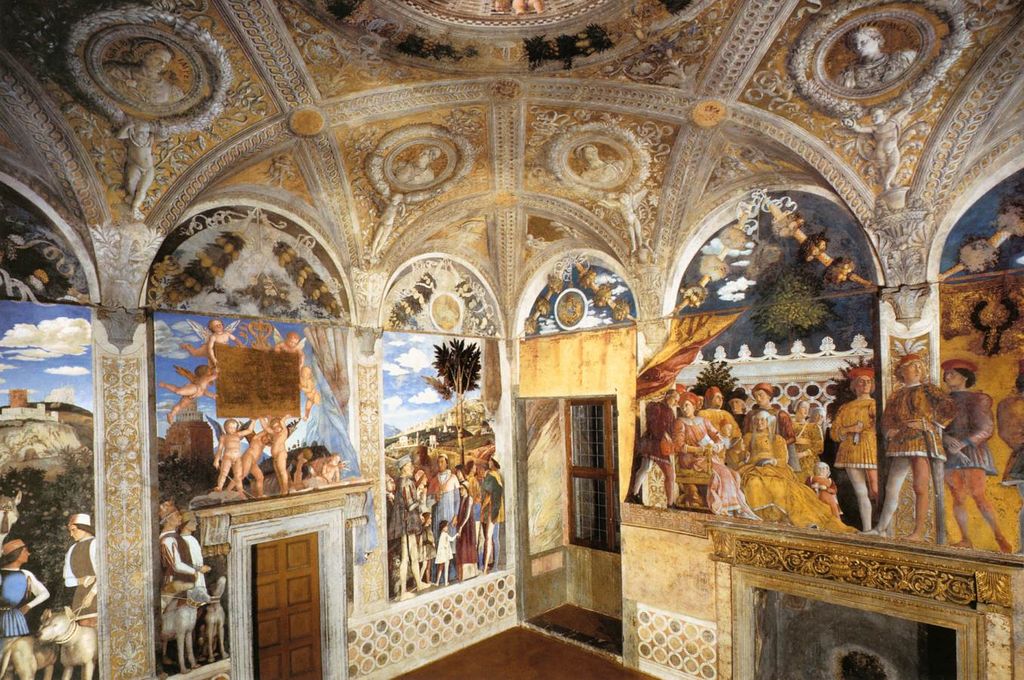
The Court scene, Camera degli Sposi, Palazzo Ducale, Mantua Image source. Public domain.
From a procession to the high altar
On 6 July 1496, the first anniversary of Fornovo, the altarpiece was carried from near Mantegna's house and studio by San Sebastiano to Santa Maria della Vittoria. Sigismondo described the ceremony in a letter to Francesco. The canvas was raised on a decorated platform with performers representing biblical figures, and children dressed as angels sang devotional songs. Twenty bearers carried the platform through Mantua. At the church, a sermon called on the people to thank Mary for saving Francesco and to pray for his future protection. Bourne records that candles and wax and silver offerings gathered at the shrine. Donesmondi also says that Francesco hung the armour he wore at Fornovo in the church as a votive gift. In his account the kneeling figure's armour had a counterpart in the space of the worshippers. For a viewer who had seen the image in the streets, the church gave the gesture above Francesco's head a permanent place to return to. [3] [6] [9]
At the high altar the painting stood opposite the entrance. Mantua's account of the building identifies surviving decoration on that wall imitating patterned leather, and attributes the architectural design to the Gonzaga works official Bernardino Ghisolfo. It describes the illusionistic interior as closely related to Mantegna's ideas. Seen from the entrance, the upright canvas would have drawn the eye along the church towards a second enclosure, the painted bower. The fictive pedestal lifts Mary within that enclosure, just as the placement over the altar lifted the work above the church floor. [3] [12]
The arrangement belongs to a career spent making painted space answer to real rooms. Mantegna had been in Gonzaga service since 1460, and in the Camera degli Sposi he carried an illusion of pilasters, curtains and an opening to the sky across the walls and ceiling of a room in the Gonzaga palace. In the altarpiece the view into a fictive space is concentrated on a single canvas. Its trellis does some of the work of the palace room's painted architecture, giving the eye a framework in which to locate the figures and judge the space above them. [7] [13]
A year later, in the Trivulzio Madonna, Mantegna again used tempera on a monumental canvas for a high altar, this time at Santa Maria in Organo in Verona. Citrus trees and saints again help establish the space, but in Verona Mary is suspended in glory above the standing figures. In the Mantuan painting the throne and its deeply worked base have to bring Mary close enough to reach out to a particular person. The two canvases use their height for different purposes, the one to lift the Virgin into the sky, the other to show her leaning over a man at prayer. [1] [14]
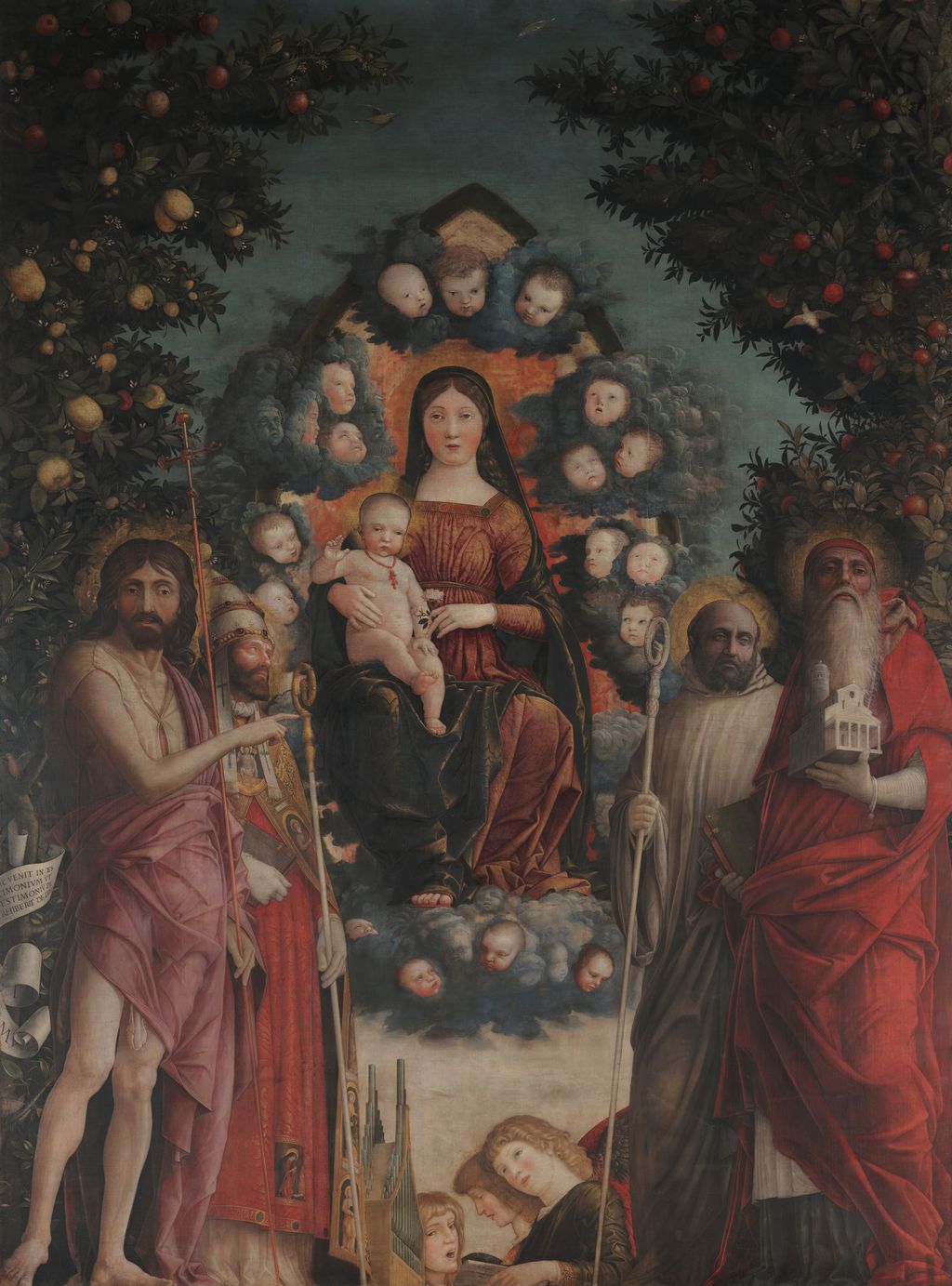
The Trivulzio Madonna, Castello Sforzesco, Milan Image source. Public domain.
A tracing before the canvas left Mantua
The French selected the altarpiece for confiscation after taking Mantua in 1797. According to Mantua's civic museum, the decision was made on 14 February despite municipal protests, and the painting was transferred to Paris in July 1798. The Louvre records 1798 as its acquisition year and describes the means of acquisition as military conquest. Its main inventory number is INV 369, with MR 337 also listed. The canvas itself measures 2.85 by 1.68 metres in the current Louvre record. [1] [9]
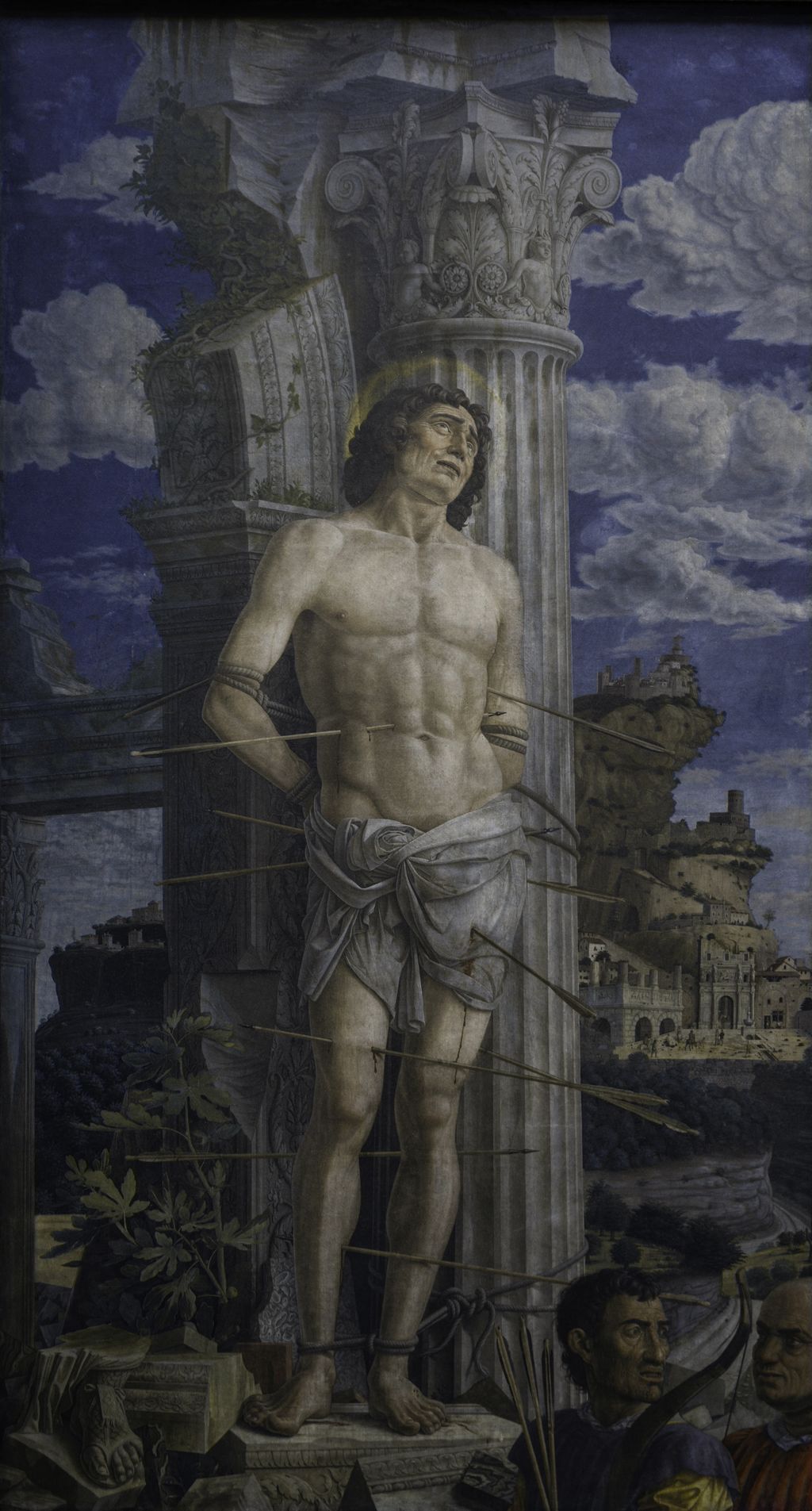
Mantegna's large Saint Sebastian from Aigueperse offers a comparison in the Louvre. There a fictive porphyry border encloses a saint bound to a ruined classical structure. In the Madonna della Vittoria, painted stones support the throne and living branches close over it. Both canvases create the impression of being built into a setting. Their routes into the museum differ. The Louvre records the probable early journey of Saint Sebastian to Auvergne in connection with a Gonzaga marriage and its purchase from the commune of Aigueperse in 1910. Mantegna's Mantuan altarpiece entered the collection through seizure. [1] [9] [15]
The delay before the transfer gave Mantua time to record the painting on its original scale. Count Giovanni De Lazzara commissioned the young Mantuan painter Antonio Ruggeri to make a full-size tracing in 1797. The civic museum describes how twenty sheets were joined and backed with canvas, with fine white brushwork picking out the forms against paper that is now brown. The tracing preserves the shape of the altarpiece at the scale intended for the church. The white lines pick out the figures and trellis that Mantuan worshippers had been accustomed to seeing in colour above the altar. [9]
Annotated Details from Madonna della Vittoria
The numbered points identify details to look at closely. The detail images below preserve the native scale of the selected crops.
Madonna della Vittoria
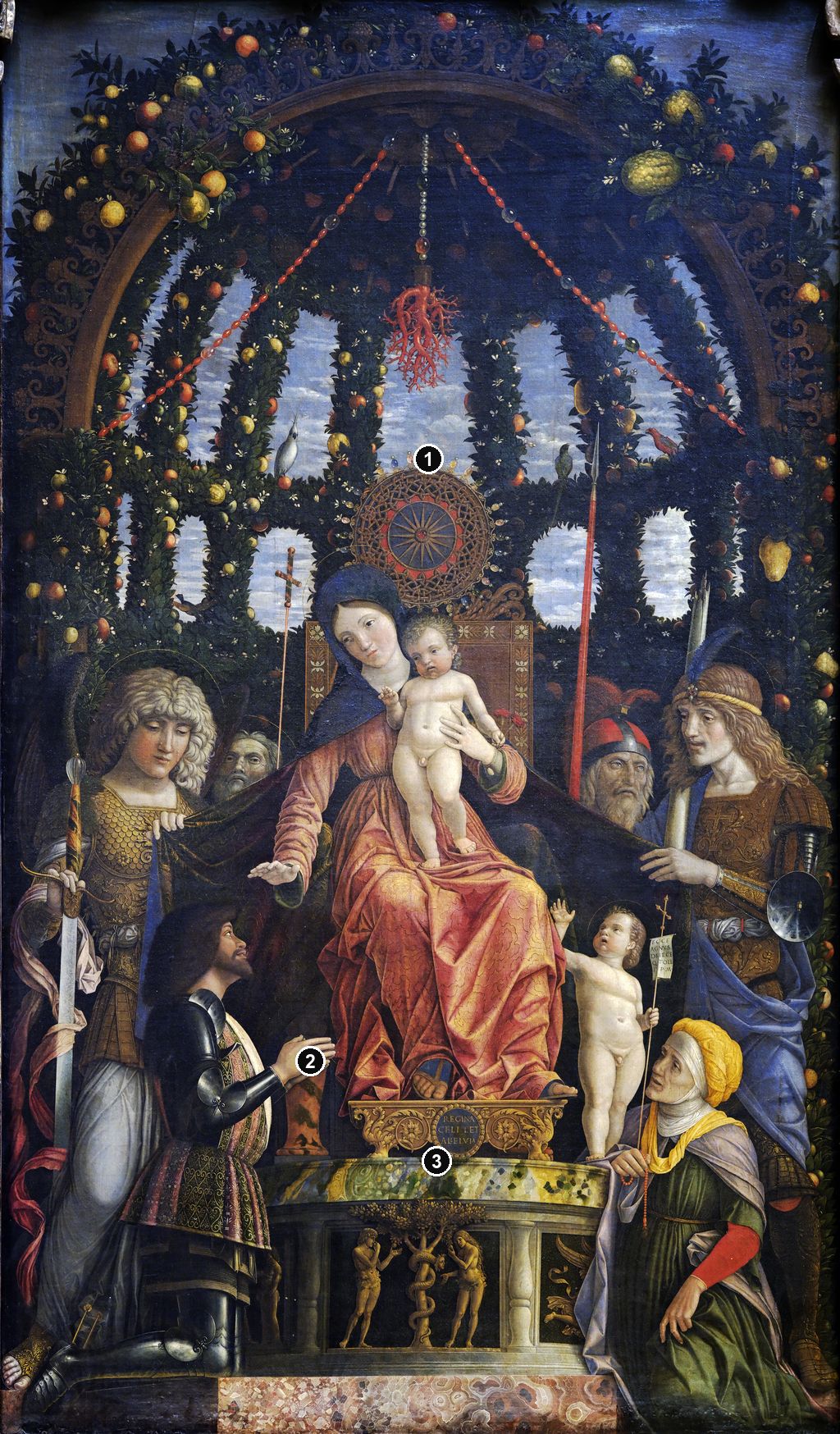
Details from MADONNA DELLA VITTORIA
Choose a detail to enlarge it.
Madonna della Vittoria
Pergola and hanging ornament
The canopy rises above the figures in concentric curves. Ornaments hanging along the axes make its construction legible.
The kneeling donor
The donor’s turned body and shining armour sit beneath the sheltering gesture of the central group.
Carving below the throne
The small rectangular scene on the base reads differently from the large living figures. Its scale invites a close approach.
Artworks directory
| Name | Date | Medium and collection |
|---|---|---|
| The Adoration of the Shepherds | Shortly after 1450 | Painting · Metropolitan Museum of Art · 32.130.2 Catalogue. |
| Saint Mark the Evangelist | C. 1448–51 | Painting · Städel Museum · 1046 Catalogue. |
| Saint Jerome Penitent in the Desert | C. 1448–51 | Painting · Museu de Arte de São Paulo · MASP.00015 Catalogue. |
| Martyrdom and Transport of the Body of Saint Christopher | Mid-1450s | Painting · Ovetari Chapel, Padua Catalogue. |
| San Luca Altarpiece | 1453–55 | Painting · Pinacoteca di Brera · 176 Catalogue. |
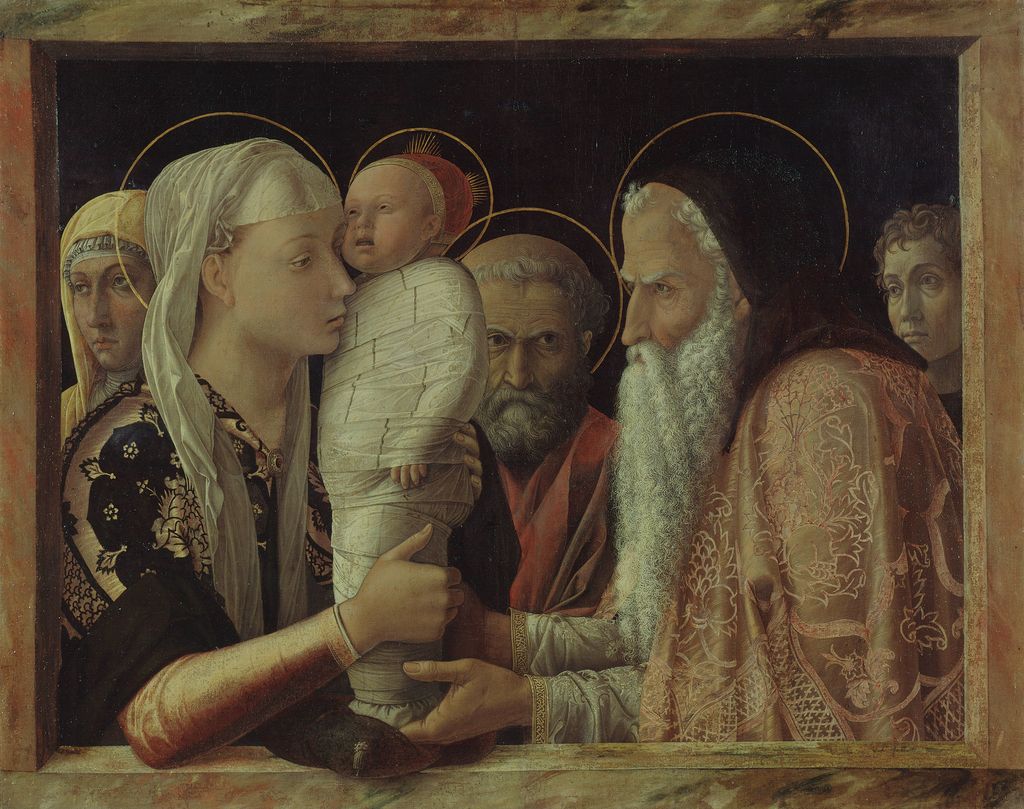
| The Presentation of Christ at the Temple | 1454 (Berlin dating) | Painting · Gemäldegalerie, Berlin · 29 Catalogue. |
| San Zeno Altarpiece | 1457–59 | Painting · Basilica of San Zeno, Verona Catalogue. |
| The Crucifixion | 1456–59 | Painting · Musée du Louvre · INV 368 Catalogue. |
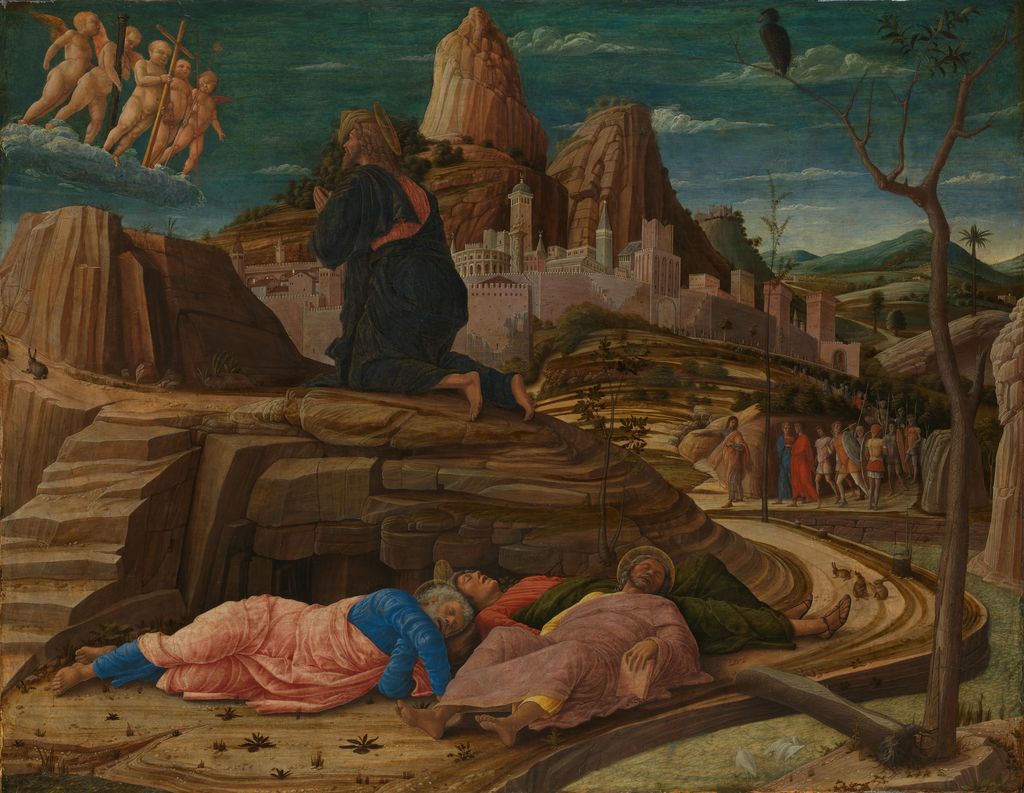
| The Agony in the Garden (London) | C. 1455–56 | Painting · National Gallery, London · NG1417 Catalogue. |
| The Agony in the Garden (Tours) | 1459 (Tours dating) | Painting · Musée des Beaux-Arts de Tours · 1803-1-24 Catalogue. |
| The Resurrection | 1459 (Tours dating) | Painting · Musée des Beaux-Arts de Tours · 1803-1-25 Catalogue. |
| Saint Sebastian (Vienna) | C. 1457–59 | Painting · Kunsthistorisches Museum · GG 301 Catalogue. |
| Cardinal Ludovico Trevisan | C. 1459–60 (Berlin exhibition dating) | Painting · Gemäldegalerie, Berlin · 9 Catalogue. |
| The Death of the Virgin | C. 1462 | Painting · Museo Nacional del Prado · P000248 Catalogue. |
| Christ with the Soul of the Virgin | C. 1460–64 | Painting · Pinacoteca Nazionale, Ferrara Catalogue only. |
| Portrait of a Young Man (traditionally Francesco Gonzaga) | C. 1461 or 1470, depending on sitter | Painting · Museo di Capodimonte · Q 60 Catalogue. |
| Portrait of a Prelate (Carlo de’ Medici?) | C. 1465–70 | Painting · Uffizi Galleries · 1890 no. 8540 Catalogue. |
| Portrait of a Man | C. 1470 | Painting · National Gallery of Art, Washington · 1952.2.5 Catalogue. |
| Madonna with Sleeping Child (Berlin) | C. 1455–60 | Painting · Gemäldegalerie, Berlin · S.5 Catalogue. |
| Camera degli Sposi (Camera Picta) | 1465–74 | Painting · Palazzo Ducale, Mantua Catalogue. |
| Saint Sebastian (Louvre) | Around 1480 | Painting · Musée du Louvre · RF 1766 Catalogue. |
| Lamentation over the Dead Christ | C. 1483 (Brera dating) | Painting · Pinacoteca di Brera · 352 Catalogue. |
| The Triumphs of Caesar | About 1485–1506 | Painting · Royal Collection · RCIN 403958–403966 Catalogue. |
| Madonna of the Caves | C. 1488–90 | Painting · Uffizi Galleries · 1890 no. 1348 Catalogue. |
| Madonna and Child with a Choir of Cherubim | C. 1485 | Painting · Pinacoteca di Brera · 297 Catalogue. |
| Madonna and Child (Poldi Pezzoli) | Early 1490s (museum dating) | Painting · Museo Poldi Pezzoli · 1595 Catalogue. |
| The Holy Family with Saint Mary Magdalen | C. 1495–1500 | Painting · Metropolitan Museum of Art · 14.40.643 Catalogue. |
| The Virgin and Child with Saint Mary Magdalene and Saint John the Baptist | C. 1490–1505 | Painting · National Gallery, London · NG274 Catalogue. |
| Christ as the Suffering Redeemer | 1485–95 (SMK dating) | Painting · Statens Museum for Kunst · KMSsp69 Catalogue. |
| Ecce Homo | C. 1500 | Painting · Musée Jacquemart-André · MJAP-P 1840 Catalogue. |
| Judith with the Head of Holofernes (Mantegna or follower) | C. 1495–1500 | Painting · National Gallery of Art, Washington · 1942.9.42 Catalogue. |
| Madonna della Vittoria | 1495–96 | Painting · Musée du Louvre · INV 369 Catalogue. |
| Mars and Venus (Parnassus) | C. 1496–97 | Painting · Musée du Louvre · INV 370 Catalogue. |
| The Trivulzio Madonna | 1497 | Painting · Castello Sforzesco, Milan · 0554 Catalogue. |
| The Adoration of the Magi | C. 1495–1505 | Painting · J. Paul Getty Museum · 85.PA.417 Catalogue. |
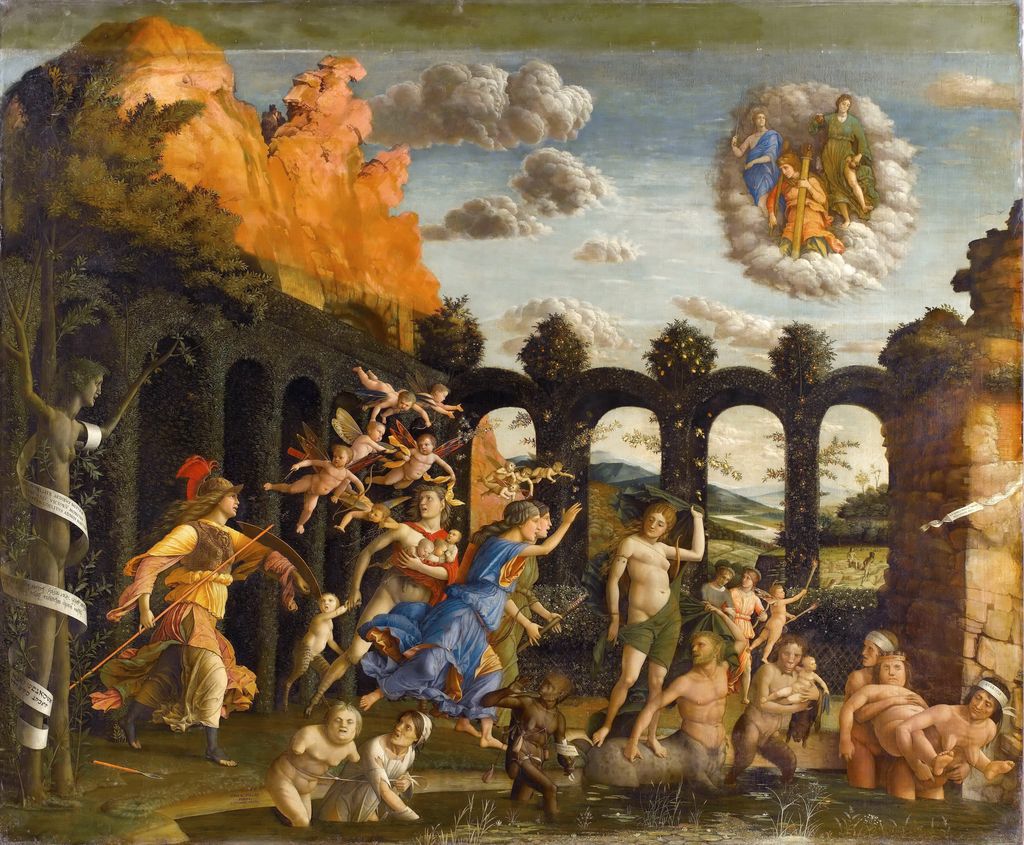
| Minerva Expelling the Vices from the Garden of Virtue | C. 1502 | Painting · Musée du Louvre · INV 371 Catalogue. |
| The Introduction of the Cult of Cybele at Rome | 1505–06 | Painting · National Gallery, London · NG902 Catalogue. |
| Saint Sebastian (Venice) | Probably c. 1504–06 | Painting · Galleria Giorgio Franchetti alla Ca’ d’Oro · D.11 Catalogue. |
| Samson and Delilah | C. 1500 | Painting · National Gallery, London · NG1145 Catalogue only. |
| A Woman Drinking (probably Sophonisba) | C. 1495–1506 | Painting · National Gallery, London · NG1125.2 Catalogue only. |
| The Vestal Virgin Tuccia with a Sieve | C. 1495–1506 | Painting · National Gallery, London · NG1125.1 Catalogue only. |
| Judith with the Head of Holofernes (Dublin) | C. 1495–1500 | Painting · National Gallery of Ireland · NGI.442 Catalogue only. |
| Battle of the Sea Gods, left half (Met impression) | Before 1481 (Met dating) | Print · Metropolitan Museum of Art · 18.12 Catalogue only. |
| Battle of the Sea Gods, right half (Met impression) | Before 1481 (Met dating) | Print · Metropolitan Museum of Art · 1984.1201.4 Catalogue only. |
| Battle of the Sea Gods, left half (Tokyo impression) | C. 1475 (Tokyo dating) | Print · National Museum of Western Art, Tokyo · G.1981-0002 Catalogue only. |
| Battle of the Sea Gods, left half (Washington impression) | C. 1485–88 (NGA dating) | Print · National Gallery of Art, Washington · 1941.1.6 Catalogue only. |
| The Entombment of Christ, second state of two | Before 1475 (Met dating) | Print · Metropolitan Museum of Art · 37.42.30 Catalogue only. |
| The Entombment of Christ (possibly Zoan Andrea, after Mantegna) | 1460–1549 (Rijksmuseum dating) | Print · Rijksmuseum · RP-P-1924-60 Catalogue only. |
| Four Dancing Muses (Gian Marco Cavalli after Mantegna) | C. 1497 | Print · Metropolitan Museum of Art · 20.5.3 Catalogue only. |
| Bacchanal with Silenus | Before 1475 (Met dating) | Print · Metropolitan Museum of Art · 29.44.15 Catalogue only. |
| Bacchanal with a Wine Vat | Before 1475 (Met dating) | Print · Metropolitan Museum of Art Catalogue only. |
| St James on His Way to Execution | C. 1453–57 | Drawing · British Museum · 1976,0616.1 Catalogue only. |
| Three Studies for a Dead Christ | C. 1455–65 | Drawing · British Museum · 1909,0406.3 Catalogue only. |
| Pietà (Venice) | C. 1456–65 (exhibition datings) | Drawing · Gallerie dell’Accademia, Venice · 115 Catalogue only. |
| Studies for Christ at the Column | 1460–65 | Drawing · The Courtauld · D.1978.PG.345 Catalogue only. |
| Virtus Combusta | C. 1490 (technical study) | Drawing · British Museum · Pp,1.23 Catalogue only. |
| Virtus Combusta (Giovanni Antonio da Brescia after Mantegna) | C. 1495–1506 | Print · Musée du Louvre · 3881 LR/ Recto Catalogue only. |
| The Calumny of Apelles | C. 1504–06 | Drawing · British Museum · 1860,0616.85 Catalogue only. |
Frequently Asked Questions
He is Francesco II Gonzaga, who commissioned the altarpiece in connection with the Battle of Fornovo. His place beneath the Virgin gives the scene the form of public thanksgiving.
It was made for Santa Maria della Vittoria in Mantua. French seizures took it to Paris in the 1790s, and it remains in the Louvre.
Discussion
Look again at the images and ideas explored in Madonna della Vittoria. These editorial prompts invite your observations.
Reader Insights
How do Sperandio’s mounted commander and Mantegna’s kneeling marquess ask viewers to understand the same claim to victory?
How do the open mantle and the paired lances of George and Longinus connect Francesco’s particular claim to protection with Mantua’s religious traditions?
Join the Conversation
Share a detail, comparison or question about Madonna della Vittoria below.
References
- Musée du Louvre, La Vierge de la Victoire, INV 369. View source.
- Musée du Louvre, The Madonna della Vittoria and the painted reliefs. View source.
- Molly Bourne, Mantegna’s Madonna della Vittoria and the Rewriting of Gonzaga History. View source.
- National Gallery of Art, Sperandio, Francesco II Gonzaga, Fourth Marquess of Mantua, obverse. View source.
- National Gallery of Art, Sperandio, Francesco Gonzaga on Horseback, with Soldiers, reverse. View source.
- Direzione Generale Archivi, Il Codice Maimonide e i Norsa. Una famiglia ebraica nella Mantova dei Gonzaga. Banche, Libri, Quadri. View source.
- Treccani, Andrea Mantegna, Dizionario Biografico degli Italiani. View source.
- Joseph Koerner and Tamara Morsel-Eisenberg, Iconoclash in Northern Italy circa 1500. View source.
- Musei Civici Mantova, Madonna della Vittoria, Antonio Ruggeri’s full-size tracing. View source.
- Heather Dalton, A Sulphur-crested Cockatoo in fifteenth-century Mantua. View source.
- The Metropolitan Museum of Art, Vittore Crivelli, Madonna and Child with Two Angels. View source.
- Turismo Mantova, Ex chiesa di Santa Maria della Vittoria. View source.
- Palazzo Ducale Mantova, Camera Picta (Camera degli Sposi). View source.
- Castello Sforzesco, Madonna in glory with Saint John the Baptist, Saint Gregory the Great, Saint Benedict and Saint Jerome. View source.
- Musée du Louvre, Saint Sébastien, RF 1766. View source.
- Basilica of San Zeno, Verona, San Zeno Altarpiece, View source.
- Royal Collection, The Triumphs of Caesar, View source.
- Musée du Louvre, Madonna della Vittoria, View source.
- National Gallery, London, The Introduction of the Cult of Cybele at Rome, View source.
More MANTEGNA Paintings
San Zeno Altarpiece
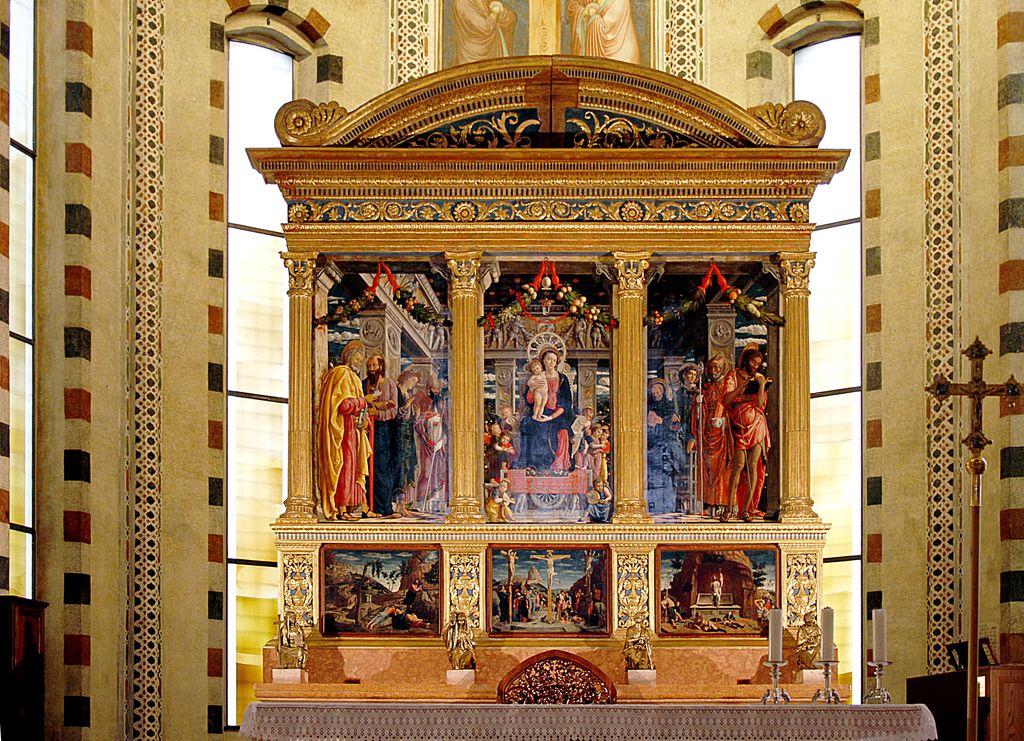
The San Zeno Altarpiece in its frame, Basilica of San Zeno, Verona José Luiz. Image source. CC BY-SA 4.0. Resized from the cited image.