 by Tom Gurney
Tom Gurney BSc (Hons) is an art history expert with over 20 years experience
Published on June 19, 2020 / Updated on November 29, 2026
Email: tomgurney1@gmail.com / Phone: +44 7429 011000
Overview
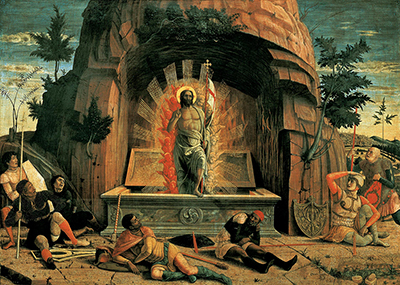
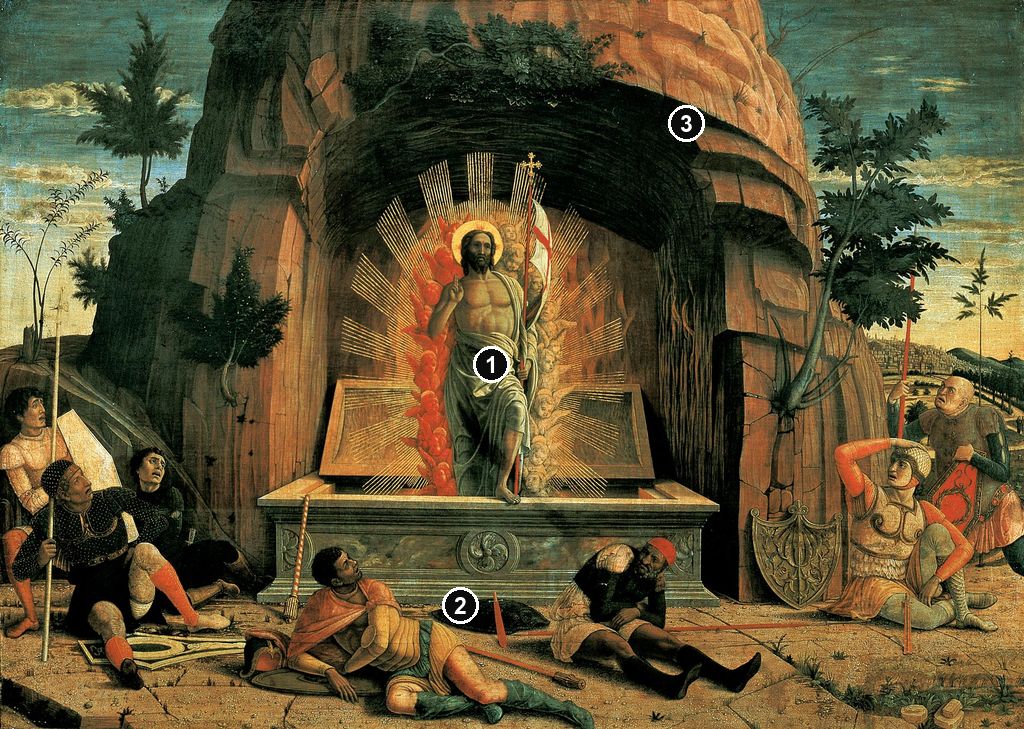
A stone lid stands open in a rocky cavern. In front of it, Christ rises into a fan of gold rays while the men posted around his tomb are still on the ground or struggling to get up. Andrea Mantegna painted the scene for the high altar of San Zeno in Verona, where it completed a sequence that began with Christ praying in the garden and passed through his death on the cross. Seen on its own in Tours, the panel still makes much of that change legible in the distance between Christ’s upright body and the guards at his feet. [1]
The Musée des Beaux-Arts de Tours dates the painting to 1459, the year the altarpiece was completed. The French national inventory and the Fondazione Federico Zeri place it within the broader commission of 1456–59. The Tours museum catalogues it as oil on wood, measuring 71.1 × 94 cm, with inventory number 1803-1-25. Its companion in Tours, the Prayer in the Garden of Olives, is the same height and a little narrower at 93.7 cm. [1] [2] [3]
At a Glance
- Date1459 (Tours dating, within the 1456–59 commission)
- MediumOil on wood (Tours catalogue)
- Dimensions71.1 × 94 cm
- CollectionMusée des Beaux-Arts de Tours
- Inventory number1803-1-25
Andrea Mantegna in context
San Zeno Altarpiece
1457–59 [4]The Resurrection
1459 (Tours dating) [1]The Triumphs of Caesar
Mid-1480s–before 1506 [14]Madonna della Vittoria
1495–96 [15]The right-hand panel below the saints
Gregorio Correr, abbot of San Zeno, commissioned the altarpiece in 1456. Mantegna designed the great carved and gilded wooden frame as well as the paintings it held. Above, saints and angels gather around the enthroned Virgin and Child. The frame’s columns stand in front of this assembly, giving its painted architecture the appearance of a space that continues across all three upper panels. The lower tier, or predella, sets out three successive episodes in Christ’s Passion and Resurrection. From the viewer’s left they are the Prayer in the Garden of Olives, the Crucifixion and the Resurrection. The small compartment beneath the saints on the right thus carries the last event in the sequence. [1] [4] [5] [6]
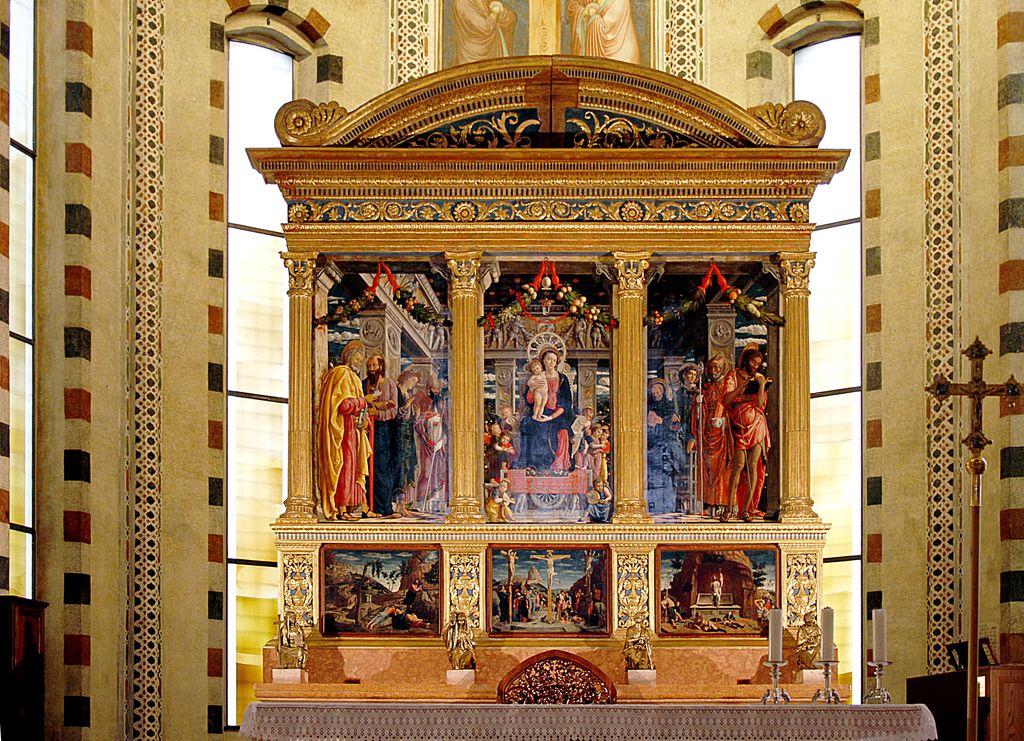
The San Zeno Altarpiece in its frame, Basilica of San Zeno, Verona José Luiz. Image source. CC BY-SA 4.0. Resized from the cited image.
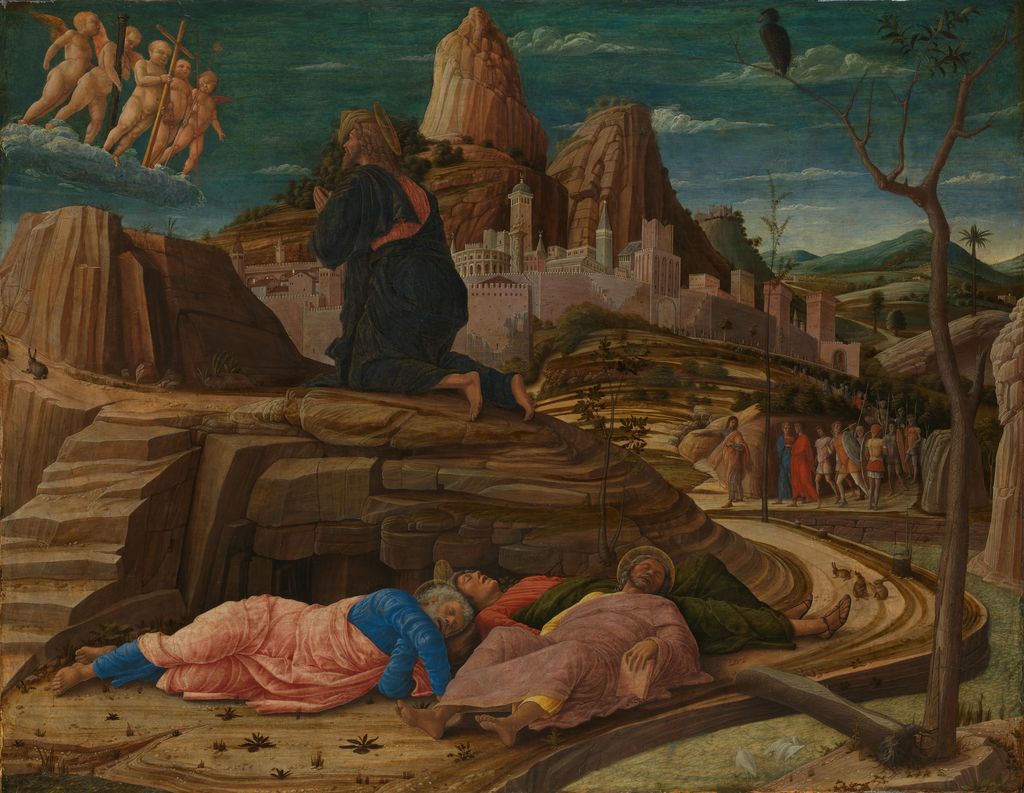
Placed side by side, the scenes bring out changes in the posture of Christ and those around him. In the Tours Prayer, Christ kneels on a rocky ledge to the right while three disciples sleep below him. On the left, the party coming to arrest him follows the road out of the city. In the Louvre’s Crucifixion, Christ’s body hangs high at the centre, with mourners on one side below him and soldiers gathered on the other. At the far end of the predella, he stands upright under his own power, and it is the soldiers who have fallen low. The disciples in the first panel and the guards in the last are both slow to register what is happening above them. [5] [6] [7]
Mantegna also painted a separate Agony in the Garden, now in the National Gallery in London, in which a group of angels brings Christ the instruments of his Passion. The Garden scene that belongs beside the Resurrection is the Tours panel, where the angel bears a chalice. The difference matters when the predella is laid out in order. In Verona, a single vessel introduced the ordeal that the central cross made visible and the right-hand panel brought to an end. [7] [8]
The opening in the rock
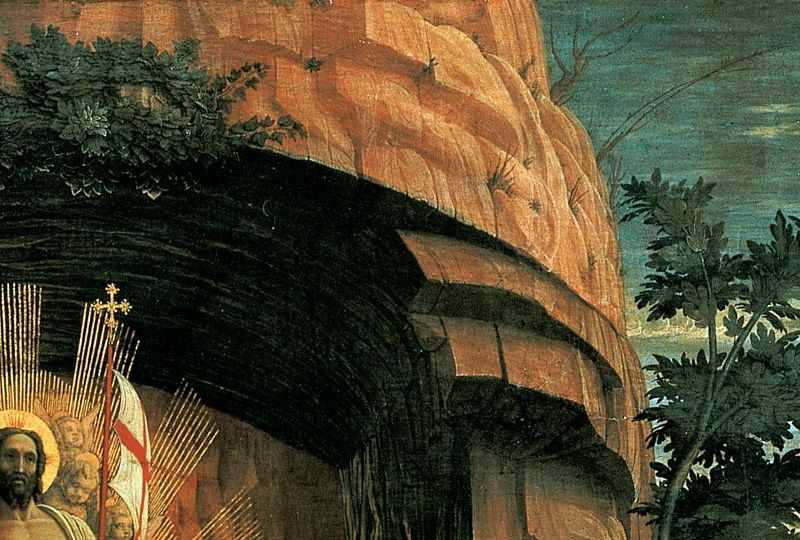
The dark mouth of the cave is wide enough to enclose the sarcophagus, its raised lid and most of the radiance around Christ. Mantegna makes that opening out of thick, broken layers of rock. Ledges jut into the light above the helmeted guard on the right. Vegetation grows across the crown of the arch. A strip of sky remains visible on either side. The small buildings in the distance on the right, identified as Jerusalem in the Tours dossier, make the rock seem all the more imposing. The cavern works like a second frame within the panel, drawing a boundary around the apparition while leaving glimpses of the world beyond it. [6]
Within that rough arch sits a stone chest with sharply defined corners. Its lid tips back, two angled edges leading towards Christ, and the front face carries a roundel and shallow ornament. The broad front establishes the width of the tomb, while the rim and tilted lid allow the eye to read back into the space behind it. The Tours dossier points out that the receding sides of the sarcophagus lead towards Christ, while the joins of the paving contribute depth through a different pattern. The soldiers sprawl across those slabs, so their legs and weapons help measure the distance from the near edge of the panel to the base of the tomb. [6]
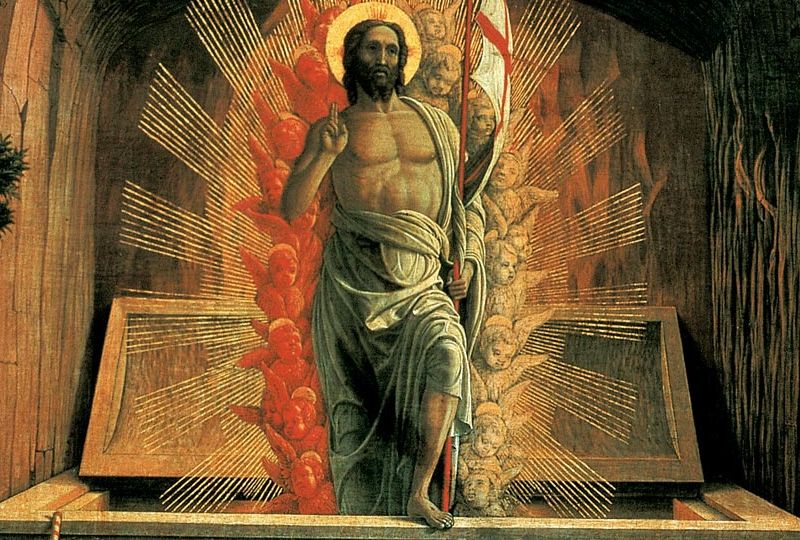
Christ holds a cross-topped staff with a banner and raises his free hand in blessing. His body turns slightly at the hips, and the cloth gathers across one leg as he lifts it. The front rim cuts across his lower body, leaving the precise position of his feet uncertain. Mantegna gives a sense of elevation through the bent knee, the tall staff and the strip of light that separates the figure from the rock behind him. The Tours museum relates the body to antique statuary. The turn of the torso and the clear articulation of its muscles are visible grounds for that comparison. [1] [2] [6]
The guards wake at different speeds
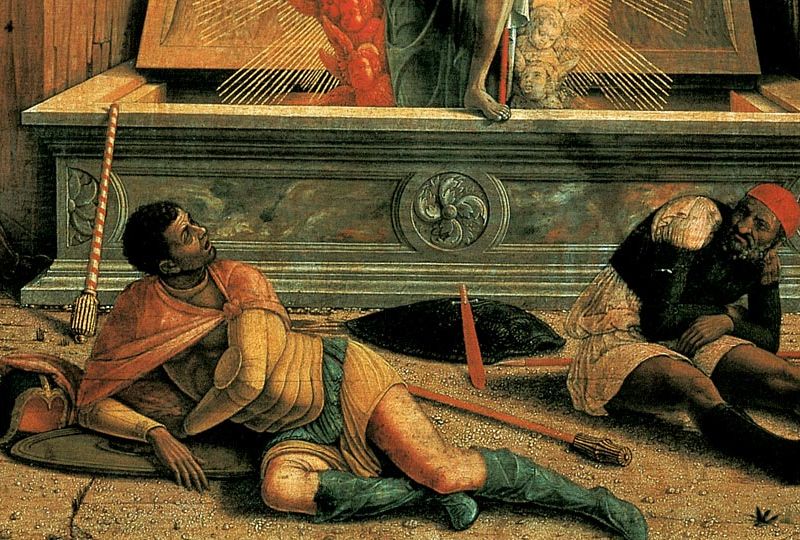
Across the foreground, one soldier twists from a reclining position and looks back towards the tomb, his legs still stretched along the slabs. Beside him, a dark-clad guard folds an arm over his head. At the right, a helmeted man braces himself on one hand and brings his other forearm up to his brow. At the left, a soldier with a vertical spear stands just behind a seated companion, while the open-mouthed man by the rock seems to recoil. The spear is an exception in a group whose weapons and limbs lie scattered at angles across the paving. [6]
In Matthew’s Gospel, the guards are terrified when the angel rolls away the stone. Mantegna places the risen Christ in full view, and the guards’ gestures make the event seem to unfold before them. The foreground holds several responses to the same instant, from the first turn of the head to a whole body caught in the effort of getting up. The straight lines of the sarcophagus make the men’s unsteady poses more conspicuous. [6]
Their equipment rewards a slower look. The Tours dossier identifies a crescent-shaped shield modelled on an ancient pelta, a shield decorated with a small figure and medallion, and one made to resemble a great tortoise shell. The fitted armour, rounded helmets and patterned surfaces give antiquity a material presence in the scene. The museum treats the costumes as inventions informed by antiquity. Their variety is part of the effect. A guard’s gear can still catch the eye or glint in the light even as he loses his composure. [1] [6]
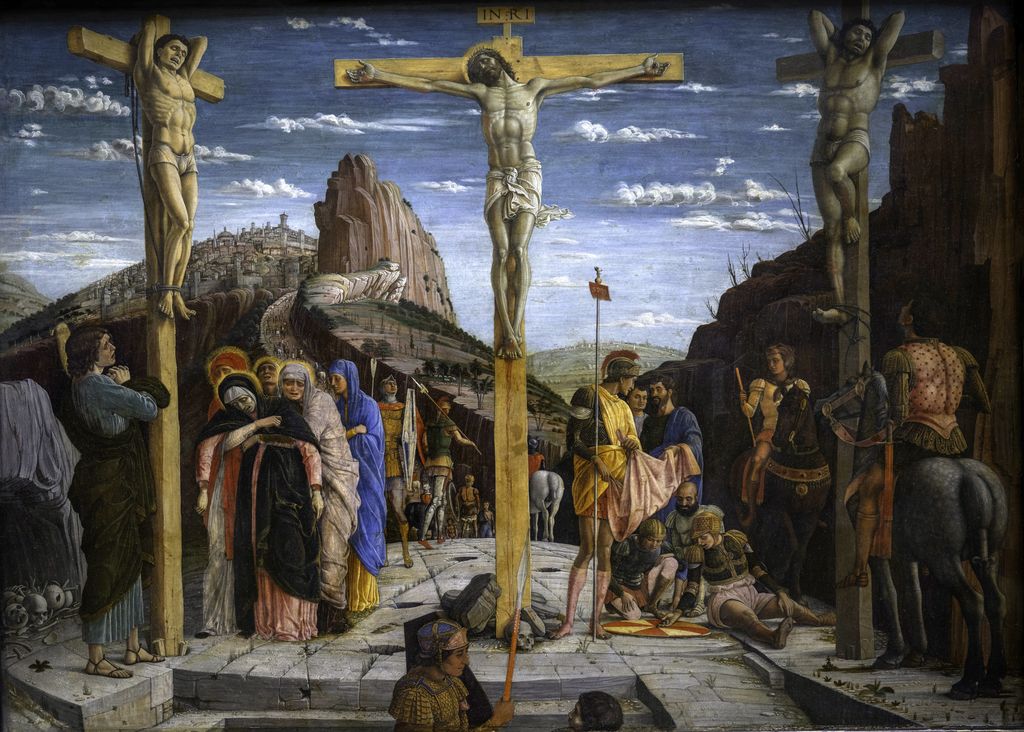
The Crucifixion from the San Zeno predella, Musée du Louvre Image source. Public domain.
Daybreak outside, gold inside
Pale bands of daybreak run low in the sky. Inside the cave a warmer light spreads from Christ, picking out the wall behind him and the winged heads gathered around his body. The difference is easier to see if you follow the colours away from the centre. The blue above the horizon fades towards the distance, while touches of gold recur close at hand, on the ivy at the mouth of the cave and on the soldiers’ shields and weapons. The Tours dossier identifies shell gold, finely powdered gold mixed with a binder, among the materials used to produce those glints. It also records later regilding of Christ’s halo. The gold on the ivy and military gear gives a better sense of how finely the painter distributed the original accents. [6]
The way Mantegna prepared the scene helps explain why the chest looks so solid and the figures within the radiance seem less substantial. The museum describes incised lines in parts of the tomb and closely spaced hatching beneath the paint of Christ’s body. The hatching for the surrounding angels is lighter and more widely spaced. The artist worked over a white ground on two joined poplar boards, still the original support in Tours. Fine strokes rich in lead white pick out folds in Christ’s cloth, and lapis lazuli and lead white help build the gradations of the sky. The resulting differences in texture distinguish cloth, stone and sky even where the warm light brings them close together. [6]
How the original reached Tours
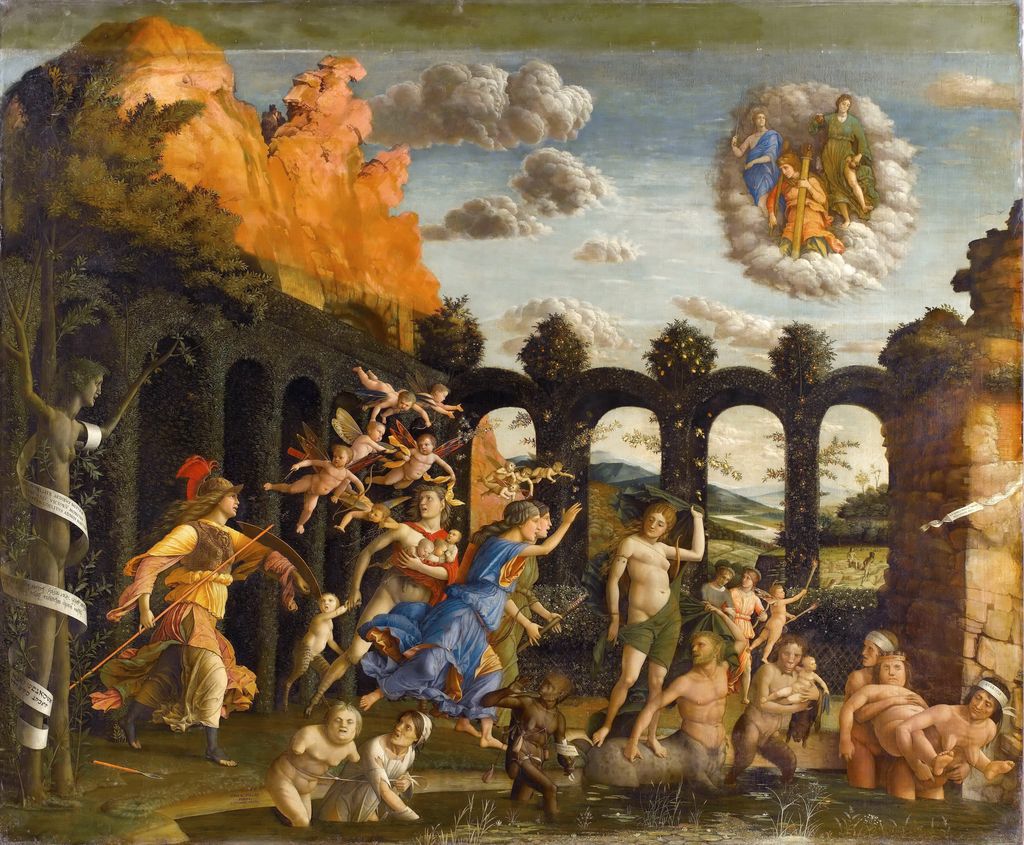
French commissioners dismantled the altarpiece on 15 May 1797. The wooden frame stayed in Verona, while the six painted panels entered the Paris museum that became the Louvre the following year. In 1806, museum director Vivant Denon sent the two lateral predella panels to Tours as compensation for paintings removed from the Château de Richelieu that had gone to the Louvre. The Opificio delle Pietre Dure identifies the two works involved in that exchange as Mantegna’s Parnassus and Minerva Expelling the Vices from the Garden of Virtue, both made for Isabella d’Este’s studiolo in Mantua. The centre of the predella, The Crucifixion, stayed in Paris. [1] [2] [5] [9]
The three large upper panels returned to Verona after 1815. The Opificio identifies the three scenes now below them as canvas copies, and its account of the conservation project names Paolino Caliari as their painter. The copies preserve the position of each episode in the carved ensemble. In Tours, a different copy explains the missing centre. During his years of training, Edgar Degas copied the Crucifixion at the Louvre, and the Musée des Beaux-Arts de Tours now holds his version, painted around 1861. The Louvre’s original also travelled to Tours for the 2009 exhibition on the San Zeno predella. The city acquired ownership of the two original end panels from the French state in 2010, after more than two centuries of holding them on deposit. [1] [4] [5] [9] [10]
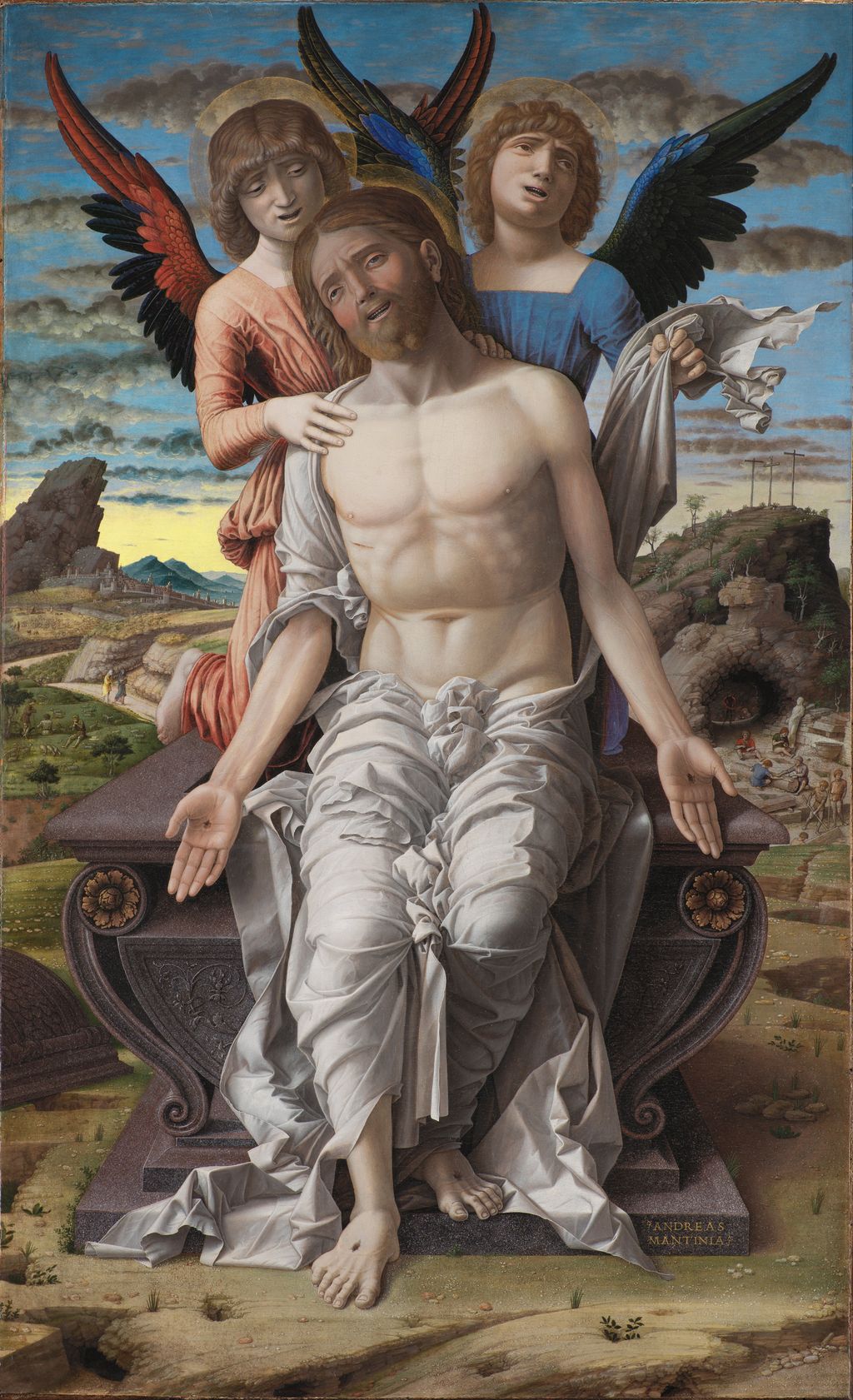
Christ as the Suffering Redeemer, Statens Museum for Kunst Image source. Public domain.
A second Resurrection in Bergamo
The Accademia Carrara in Bergamo holds a smaller, upright Resurrection of Christ, dated to about 1492 and catalogued by the National Gallery as attributed to Mantegna for its 2018 exhibition in London. In the Bergamo picture, Christ reaches down with one bare foot towards a stone ledge and looks towards the figures below. The cloth flies outward behind him. A soldier in orange lies almost crosswise across the rock, and a standing man in blue turns towards Christ with both hands open. The figure of Christ is set against the rock with a strip of sky to his left, while the guards cluster on the steep slope below him. [11] [12]
The Carrara’s exhibition account credits curator Giovanni Valagussa with noticing an incomplete cross near the lower edge. He connected it with the staff in a Descent into Limbo and proposed that the two scenes were once joined, with the Resurrection above. The connection can be studied at the bottom of the Bergamo picture, where the rocky arch continues down to the edge. At San Zeno the structure runs the other way. The rock arches over Christ, and the neighbouring scenes once extended to either side at the same level. The long line of guards across the Tours foreground suits that horizontal sequence. Their rising and twisting bodies carry the eye from the edges of the panel back to Christ, where the story that began in the garden comes to rest. [4] [6] [11] [12]
Annotated Details from The Resurrection from the San Zeno predella
The numbered points identify details to look at closely. The detail images below preserve the native scale of the selected crops.
The Resurrection from the San Zeno predella
Details from THE RESURRECTION FROM THE SAN ZENO PREDELLA
Choose a detail to enlarge it.
The Resurrection from the San Zeno predella
Christ and the opening
The upright figure and banner occupy the centre of the dark rock opening. Light picks out the figure and the horizontal rim of the tomb.
Guards across the foreground
The angles of the guards’ legs and bodies shape the foreground. Their low positions emphasise the rise of the central figure.
Masonry and rock
The edge of the structure picks up the curved wall of stone. The dark interior reads as a bounded space within this larger formation.
Artworks directory
| Name | Date | Medium and collection |
|---|---|---|
| The Adoration of the Shepherds | Shortly after 1450 | Painting · Metropolitan Museum of Art · 32.130.2 Catalogue. |
| Saint Mark the Evangelist | C. 1448–51 | Painting · Städel Museum · 1046 Catalogue. |
| Saint Jerome Penitent in the Desert | C. 1448–51 | Painting · Museu de Arte de São Paulo · MASP.00015 Catalogue. |
| Martyrdom and Transport of the Body of Saint Christopher | Mid-1450s | Painting · Ovetari Chapel, Padua Catalogue. |
| San Luca Altarpiece | 1453–55 | Painting · Pinacoteca di Brera · 176 Catalogue. |
| The Presentation of Christ at the Temple | 1454 (Berlin dating) | Painting · Gemäldegalerie, Berlin · 29 Catalogue. |
| San Zeno Altarpiece | 1457–59 | Painting · Basilica of San Zeno, Verona Catalogue. |
| The Crucifixion | 1456–59 | Painting · Musée du Louvre · INV 368 Catalogue. |
| The Agony in the Garden (London) | C. 1455–56 | Painting · National Gallery, London · NG1417 Catalogue. |
| The Agony in the Garden (Tours) | 1459 (Tours dating) | Painting · Musée des Beaux-Arts de Tours · 1803-1-24 Catalogue. |
| The Resurrection | 1459 (Tours dating) | Painting · Musée des Beaux-Arts de Tours · 1803-1-25 Catalogue. |
| Saint Sebastian (Vienna) | C. 1457–59 | Painting · Kunsthistorisches Museum · GG 301 Catalogue. |
| Cardinal Ludovico Trevisan | C. 1459–60 (Berlin exhibition dating) | Painting · Gemäldegalerie, Berlin · 9 Catalogue. |
| The Death of the Virgin | C. 1462 | Painting · Museo Nacional del Prado · P000248 Catalogue. |
| Christ with the Soul of the Virgin | C. 1460–64 | Painting · Pinacoteca Nazionale, Ferrara Catalogue only. |
| Portrait of a Young Man (traditionally Francesco Gonzaga) | C. 1461 or 1470, depending on sitter | Painting · Museo di Capodimonte · Q 60 Catalogue. |
| Portrait of a Prelate (Carlo de’ Medici?) | C. 1465–70 | Painting · Uffizi Galleries · 1890 no. 8540 Catalogue. |
| Portrait of a Man | C. 1470 | Painting · National Gallery of Art, Washington · 1952.2.5 Catalogue. |
| Madonna with Sleeping Child (Berlin) | C. 1455–60 | Painting · Gemäldegalerie, Berlin · S.5 Catalogue. |
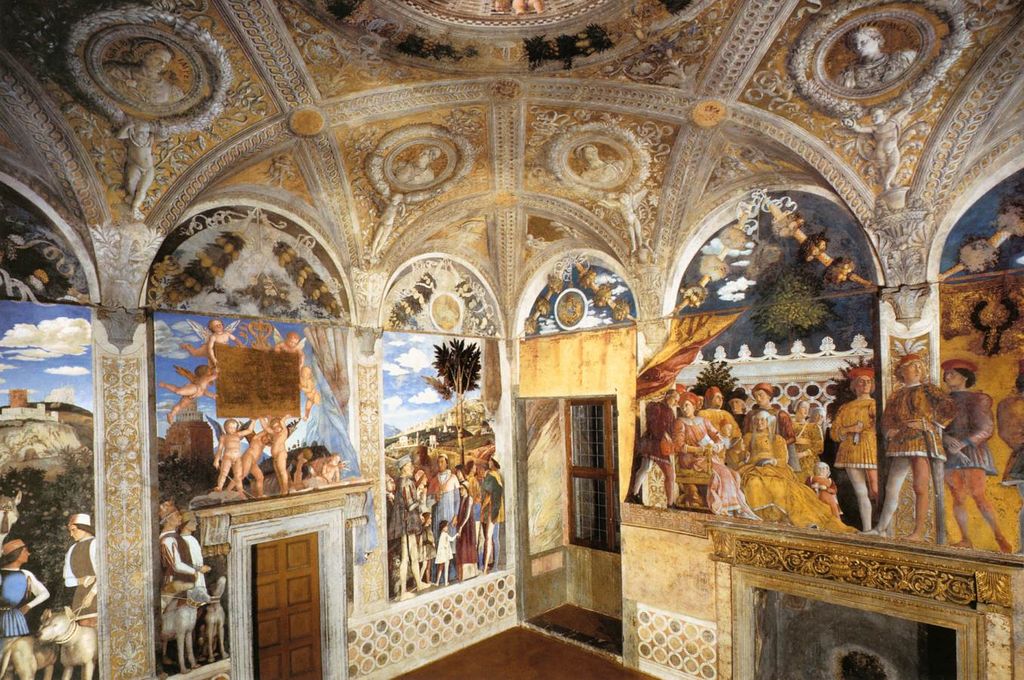
| Camera degli Sposi (Camera Picta) | 1465–74 | Painting · Palazzo Ducale, Mantua Catalogue. |
| Saint Sebastian (Louvre) | Around 1480 | Painting · Musée du Louvre · RF 1766 Catalogue. |
| Lamentation over the Dead Christ | C. 1483 (Brera dating) | Painting · Pinacoteca di Brera · 352 Catalogue. |
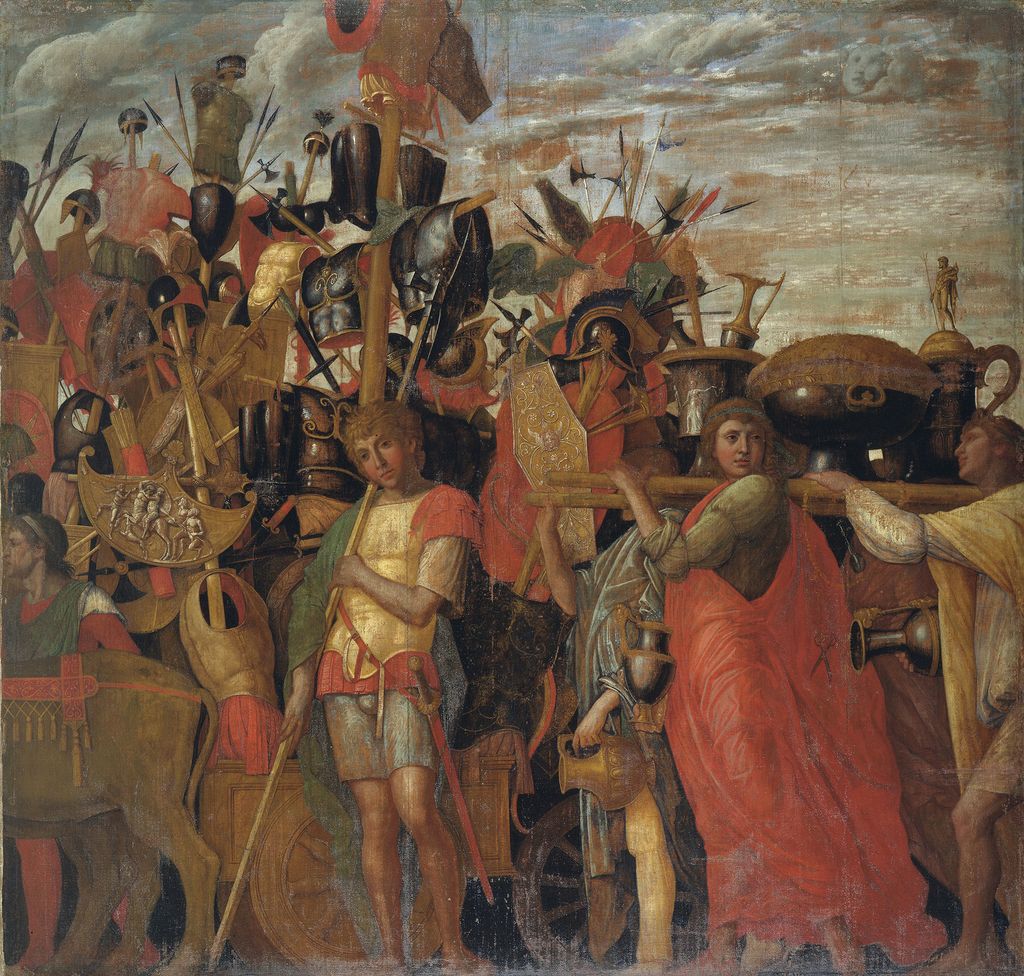
| The Triumphs of Caesar | About 1485–1506 | Painting · Royal Collection · RCIN 403958–403966 Catalogue. |
| Madonna of the Caves | C. 1488–90 | Painting · Uffizi Galleries · 1890 no. 1348 Catalogue. |
| Madonna and Child with a Choir of Cherubim | C. 1485 | Painting · Pinacoteca di Brera · 297 Catalogue. |
| Madonna and Child (Poldi Pezzoli) | Early 1490s (museum dating) | Painting · Museo Poldi Pezzoli · 1595 Catalogue. |
| The Holy Family with Saint Mary Magdalen | C. 1495–1500 | Painting · Metropolitan Museum of Art · 14.40.643 Catalogue. |
| The Virgin and Child with Saint Mary Magdalene and Saint John the Baptist | C. 1490–1505 | Painting · National Gallery, London · NG274 Catalogue. |
| Christ as the Suffering Redeemer | 1485–95 (SMK dating) | Painting · Statens Museum for Kunst · KMSsp69 Catalogue. |
| Ecce Homo | C. 1500 | Painting · Musée Jacquemart-André · MJAP-P 1840 Catalogue. |
| Judith with the Head of Holofernes (Mantegna or follower) | C. 1495–1500 | Painting · National Gallery of Art, Washington · 1942.9.42 Catalogue. |
| Madonna della Vittoria | 1495–96 | Painting · Musée du Louvre · INV 369 Catalogue. |
| Mars and Venus (Parnassus) | C. 1496–97 | Painting · Musée du Louvre · INV 370 Catalogue. |
| The Trivulzio Madonna | 1497 | Painting · Castello Sforzesco, Milan · 0554 Catalogue. |
| The Adoration of the Magi | C. 1495–1505 | Painting · J. Paul Getty Museum · 85.PA.417 Catalogue. |
| Minerva Expelling the Vices from the Garden of Virtue | C. 1502 | Painting · Musée du Louvre · INV 371 Catalogue. |
| The Introduction of the Cult of Cybele at Rome | 1505–06 | Painting · National Gallery, London · NG902 Catalogue. |
| Saint Sebastian (Venice) | Probably c. 1504–06 | Painting · Galleria Giorgio Franchetti alla Ca’ d’Oro · D.11 Catalogue. |
| Samson and Delilah | C. 1500 | Painting · National Gallery, London · NG1145 Catalogue only. |
| A Woman Drinking (probably Sophonisba) | C. 1495–1506 | Painting · National Gallery, London · NG1125.2 Catalogue only. |
| The Vestal Virgin Tuccia with a Sieve | C. 1495–1506 | Painting · National Gallery, London · NG1125.1 Catalogue only. |
| Judith with the Head of Holofernes (Dublin) | C. 1495–1500 | Painting · National Gallery of Ireland · NGI.442 Catalogue only. |
| Battle of the Sea Gods, left half (Met impression) | Before 1481 (Met dating) | Print · Metropolitan Museum of Art · 18.12 Catalogue only. |
| Battle of the Sea Gods, right half (Met impression) | Before 1481 (Met dating) | Print · Metropolitan Museum of Art · 1984.1201.4 Catalogue only. |
| Battle of the Sea Gods, left half (Tokyo impression) | C. 1475 (Tokyo dating) | Print · National Museum of Western Art, Tokyo · G.1981-0002 Catalogue only. |
| Battle of the Sea Gods, left half (Washington impression) | C. 1485–88 (NGA dating) | Print · National Gallery of Art, Washington · 1941.1.6 Catalogue only. |
| The Entombment of Christ, second state of two | Before 1475 (Met dating) | Print · Metropolitan Museum of Art · 37.42.30 Catalogue only. |
| The Entombment of Christ (possibly Zoan Andrea, after Mantegna) | 1460–1549 (Rijksmuseum dating) | Print · Rijksmuseum · RP-P-1924-60 Catalogue only. |
| Four Dancing Muses (Gian Marco Cavalli after Mantegna) | C. 1497 | Print · Metropolitan Museum of Art · 20.5.3 Catalogue only. |
| Bacchanal with Silenus | Before 1475 (Met dating) | Print · Metropolitan Museum of Art · 29.44.15 Catalogue only. |
| Bacchanal with a Wine Vat | Before 1475 (Met dating) | Print · Metropolitan Museum of Art Catalogue only. |
| St James on His Way to Execution | C. 1453–57 | Drawing · British Museum · 1976,0616.1 Catalogue only. |
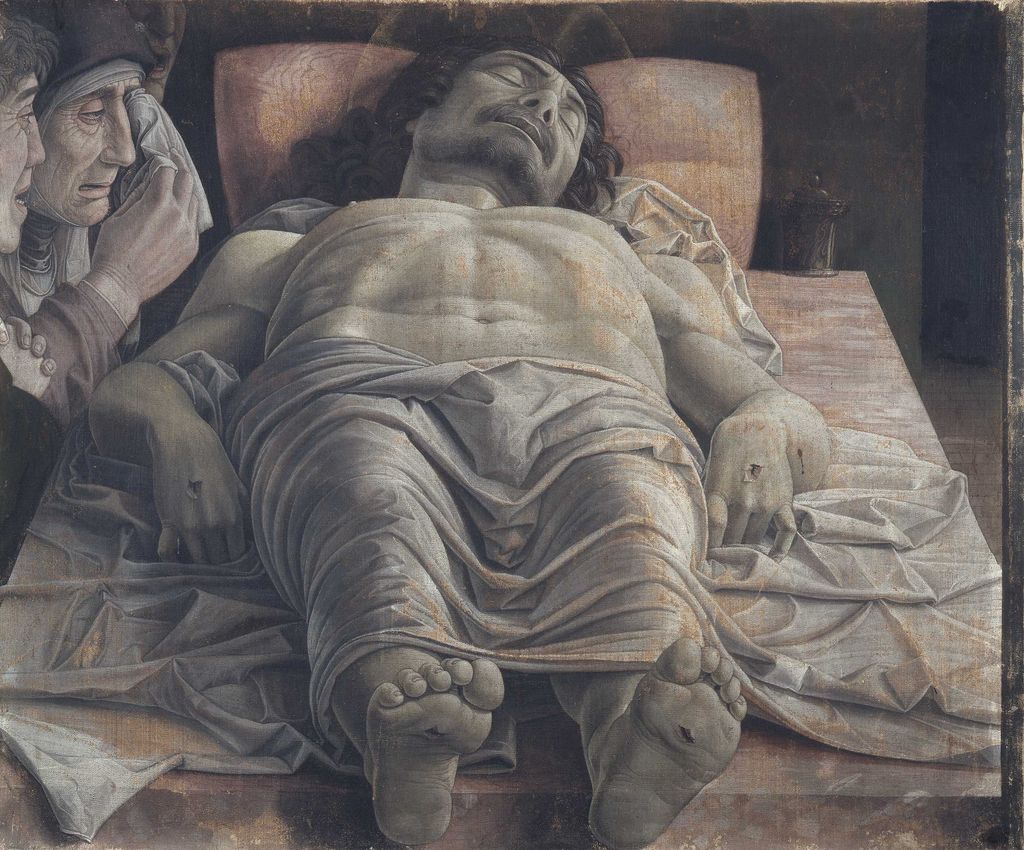
| Three Studies for a Dead Christ | C. 1455–65 | Drawing · British Museum · 1909,0406.3 Catalogue only. |
| Pietà (Venice) | C. 1456–65 (exhibition datings) | Drawing · Gallerie dell’Accademia, Venice · 115 Catalogue only. |
| Studies for Christ at the Column | 1460–65 | Drawing · The Courtauld · D.1978.PG.345 Catalogue only. |
| Virtus Combusta | C. 1490 (technical study) | Drawing · British Museum · Pp,1.23 Catalogue only. |
| Virtus Combusta (Giovanni Antonio da Brescia after Mantegna) | C. 1495–1506 | Print · Musée du Louvre · 3881 LR/ Recto Catalogue only. |
| The Calumny of Apelles | C. 1504–06 | Drawing · British Museum · 1860,0616.85 Catalogue only. |
Frequently Asked Questions
It was the right-hand scene of the predella, the row of smaller paintings below the saints. The sequence runs from Christ’s prayer in the garden through the Crucifixion to his rising from the tomb.
It covers the Tours panel, inventory 1803-1-25. The related Resurrection in Bergamo is a separate work, with differences in the setting and arrangement of the figures.
Discussion
Look again at the images and ideas explored in Resurrection. These editorial prompts invite your observations.
Reader Insights
How do the slanted lid and receding sides of the sarcophagus direct your eye back to Christ after you follow the guards across the foreground?
What changes in the way you read Christ’s posture when the Tours Resurrection is placed to the right of the Garden scene and the Crucifixion?
Join the Conversation
Share a detail, comparison or question about Resurrection below.
References
- Musée des Beaux-Arts de Tours, La Prière au jardin des oliviers et La Résurrection. View source.
- Ministère de la Culture, Joconde, La Résurrection. View source.
- Fondazione Federico Zeri, Mantegna Andrea, Resurrezione di Cristo. View source.
- Opificio delle Pietre Dure, Andrea Mantegna, Pala di San Zeno, 1457–1459, Basilica di San Zeno, Verona. View source.
- Musée du Louvre, La Crucifixion. View source.
- Musée des Beaux-Arts de Tours, La Résurrection, dossier pédagogique. View source.
- Musée des Beaux-Arts de Tours, La Prière au Jardin des Oliviers, dossier pédagogique. View source.
- National Gallery, Andrea Mantegna, The Agony in the Garden. View source.
- Opificio delle Pietre Dure, La Pala di San Zeno di Andrea Mantegna. Studio e conservazione. View source.
- Musée des Beaux-Arts de Tours, Le Calvaire, copie d’après Mantegna. View source.
- National Gallery, Mantegna and Bellini, loan documentation for The Resurrection of Christ, X10392. View source.
- Accademia Carrara, RE • M | Mantegna Bergamo. View source.
- Palazzo Ducale, Mantua, Camera degli Sposi (Camera Picta), View source.
- Royal Collection, The Triumphs of Caesar, View source.
- Musée du Louvre, Madonna della Vittoria, View source.
- National Gallery, London, The Introduction of the Cult of Cybele at Rome, View source.
More MANTEGNA Paintings
San Zeno Altarpiece
The San Zeno Altarpiece in its frame, Basilica of San Zeno, Verona José Luiz. Image source. CC BY-SA 4.0. Resized from the cited image.