 by Tom Gurney
Tom Gurney BSc (Hons) is an art history expert with over 20 years experience
Published on June 19, 2020 / Updated on November 29, 2026
Email: tomgurney1@gmail.com / Phone: +44 7429 011000
Overview
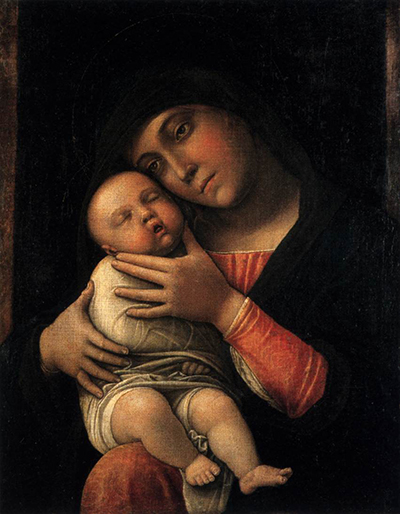
One of Mary’s hands steadies the sleeping child’s head. The other holds him against her as his bare feet hang over her knee. Andrea Mantegna brings the small gestures that support a child’s weight close enough for us to see the space between Mary’s fingers and the folds that gather where she holds him. Her wide mantle draws the two bodies into a single shape. [1]
The Madonna and Child at the Museo Poldi Pezzoli in Milan measures 45.2 by 35.5 centimetres and is catalogued as inventory number 1595. The museum’s object sheet dates it to the early 1490s, while the Opificio delle Pietre Dure uses the range about 1490–1500. Conservators working on the lean tempera recovered the blue that separates the mantle from the dark background. They also found traces of gold lettering in the dark itself. [1] [2]
At a Glance
- DateEarly 1490s (Museo Poldi Pezzoli); about 1490–1500 (Opificio delle Pietre Dure)
- MediumLean tempera on linen canvas
- Dimensions45.2 × 35.5 cm
- CollectionMuseo Poldi Pezzoli, Milan
- Inventory number1595
Andrea Mantegna in context
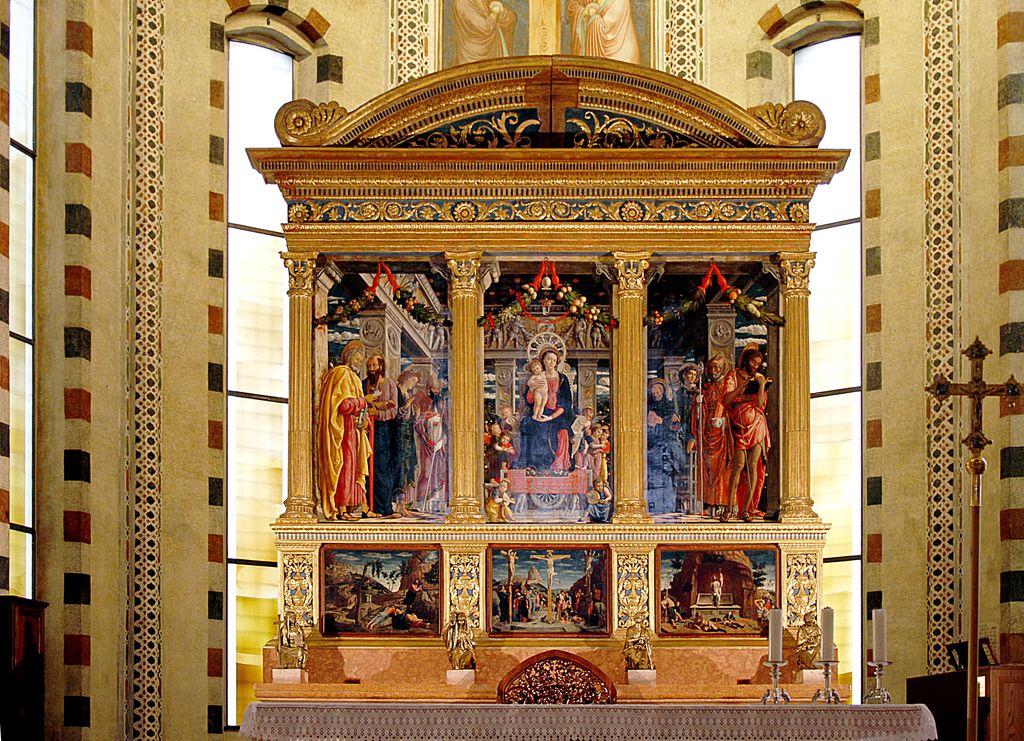
San Zeno Altarpiece
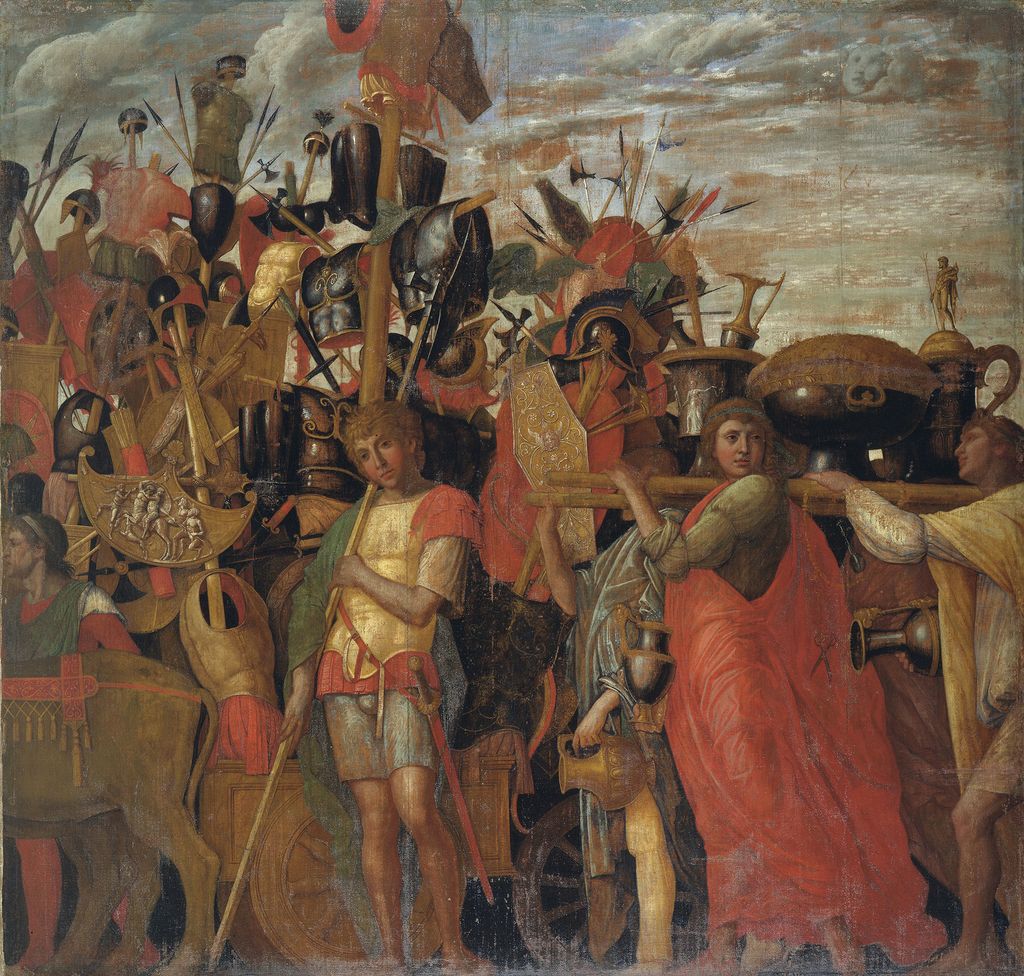
1457–59 [12]The Triumphs of Caesar
Mid-1480s–before 1506 [14]Madonna della Vittoria
1495–96 [15]Madonna and Child (Poldi Pezzoli)
Early 1490s (museum dating) [1]How Mary holds the sleeping child
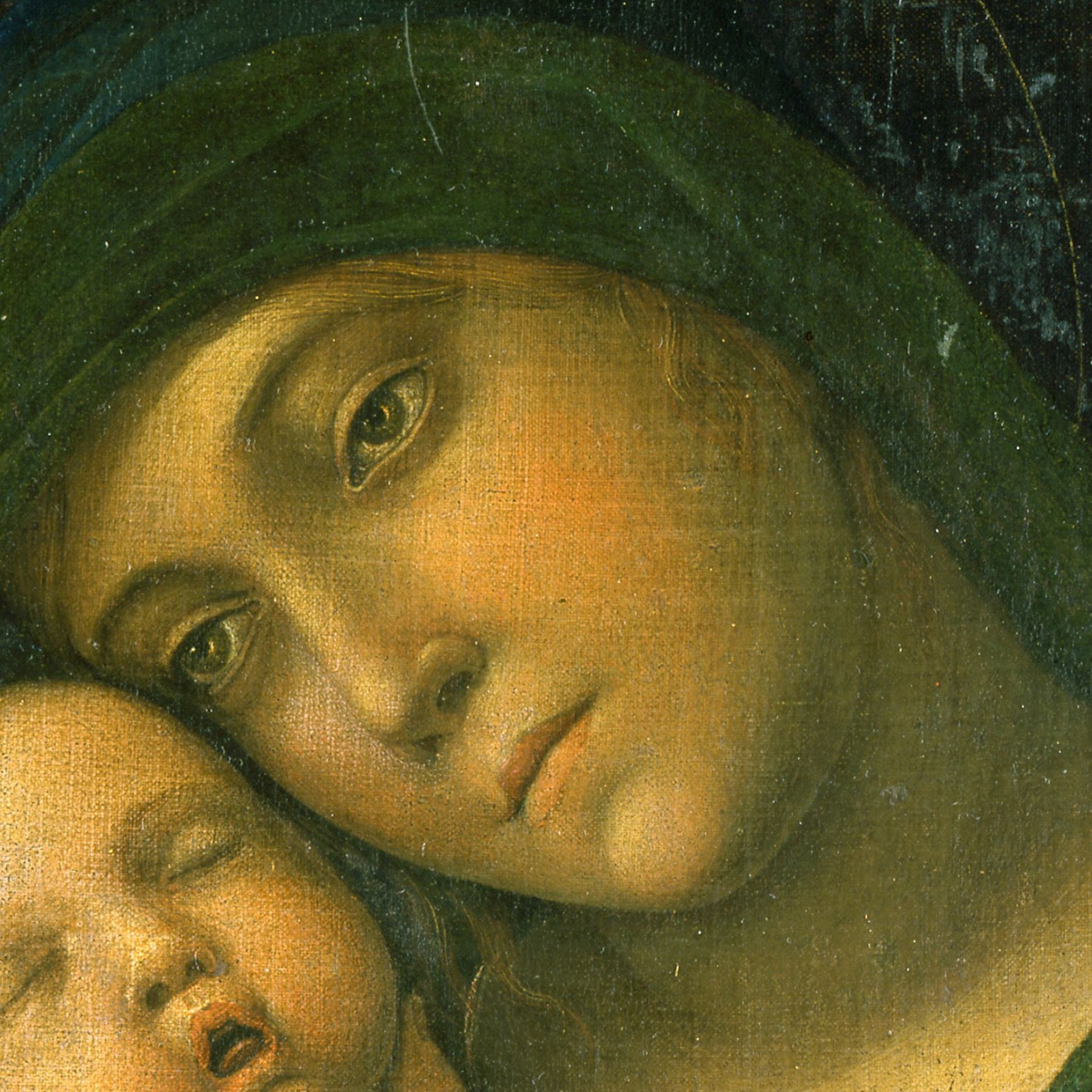
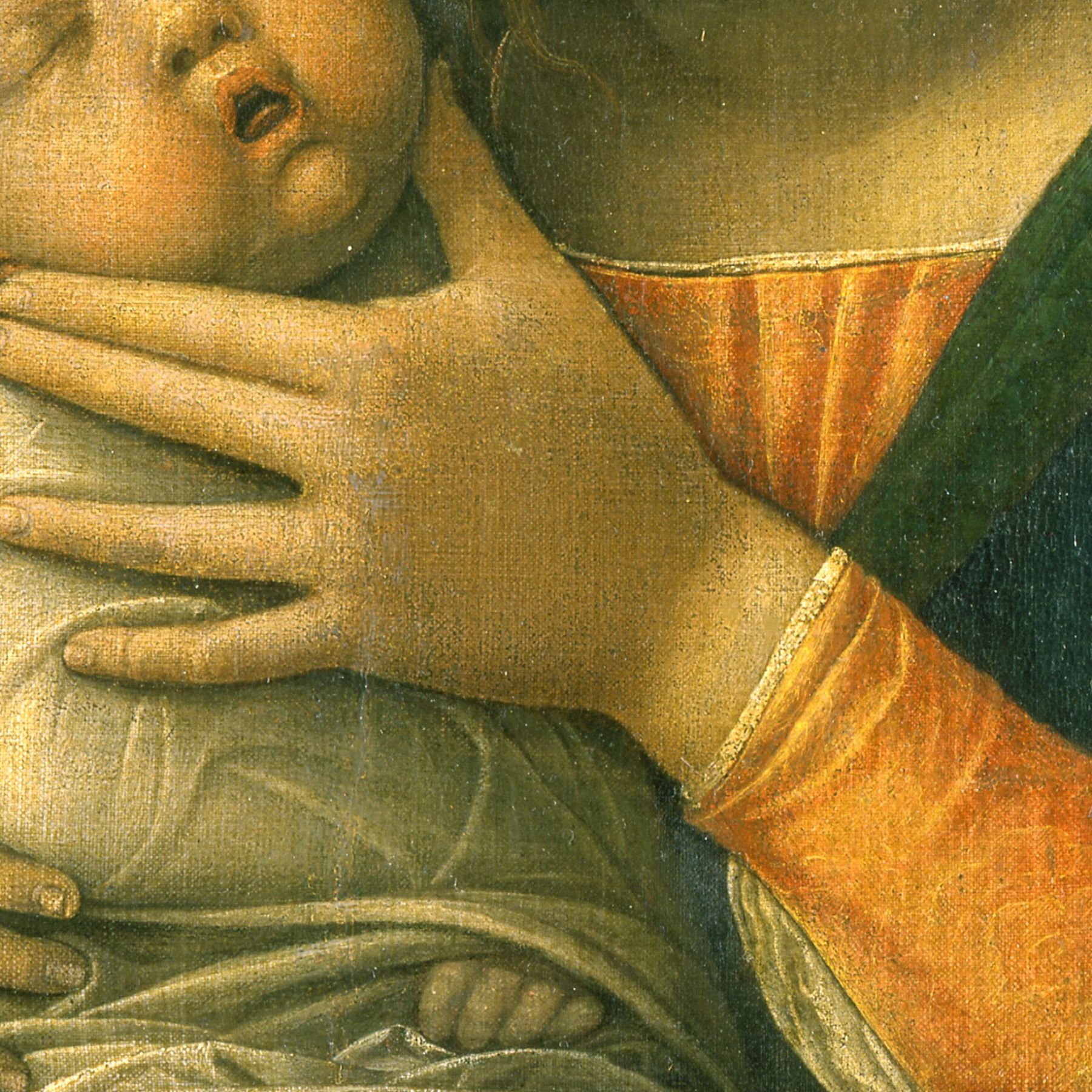
Begin with the hand that crosses the centre of the picture. Mary spreads her fingers just below the child’s ear, over the cloth at his shoulder. Her other hand comes around his side, its fingers descending toward his lap. The two hands give the pose its shape. The upper one supports the head where it tilts against her. The lower one fits the curve of the child’s body and steadies him on the knee that rises from the bottom edge. The fingers leave much of the cloth exposed, so that we can follow it where it bunches at his waist and opens over his legs. [1]
The child’s mouth is slightly open. A small hand emerges from the white wrapping near his waist, and his feet hang at different heights. These details give sleep a physical character. Mary’s eyes are open, but her gaze seems to pass to one side of him. The Poldi Pezzoli reads her absorbed expression and the white cloth as possible anticipations of Christ’s death and burial. The suggestion rests on things that make sense in the immediate scene as well. Cloth keeps the sleeping child warm, and the hand that takes the weight of his head can also recall the way a limp body is supported. [1]
The museum describes the group as pyramidal. Its apex is the tilted head beneath Mary’s hood, and its sides widen into the mantle and arms. At the edges of the canvas, two brown uprights sit behind the figures. The museum suggests that they may belong to a door or window frame and relates the black background to Flemish painting known in fifteenth-century Italy. Whatever the uprights represent, the overlap tells us where the bodies are. Mary’s shoulder turns toward us, her arms interrupt the side boundaries, and her knee comes forward under the child. Against so little architectural detail, those few indications of depth give the embrace room to take place. [1]
What Morelli and Molteni saw
The Opificio traces the first known mention of the painting to a letter Giovanni Morelli wrote to Niccolò Antinori on 23 May 1856. Morelli said the work had been sold to him as a painting of Mantegna’s school. He was convinced that it was by Mantegna himself, even though he could already see retouching on Mary’s head. His letter establishes that the picture had been worked on before the intervention for which its nineteenth-century history is best documented. [2]
Morelli sold the canvas to Gian Giacomo Poldi Pezzoli in 1861 for 2,000 lire. Two years later the collector entrusted it to the painter and restorer Giuseppe Molteni. The collector is the sitter in Francesco Hayez’s portrait dated 1851 by the museum, a picture exhibited at Brera a decade before he bought the Mantegna. In 1879 Giuseppe Bertini, the museum’s first director, valued the Madonna at 15,000 lire in the inventory drawn up after Poldi Pezzoli’s death. It entered the museum through the collector’s bequest that year. [1] [2] [3]
Molteni backed the original canvas with a second fabric to support it, filled losses and painted over portions of the surface. His additions included new folds on Mary’s mantle and gold decoration on her clothes. He also varnished the picture, darkening the tones and reducing the distinction between the mantle and the background. The photographs in the Opificio’s report let us follow the consequences at the edges of the blue garment. In the view before treatment, it is harder to separate the cloth from the dark around it. In the view after treatment, the contours and folds are easier to follow, particularly where the mantle opens at the sleeve. The pictures show a change in appearance. The identification of the separate paint layers comes from the technical examination. [2]
Colour on a nearly bare weave
The grain visible through the pale passages belongs to a fine linen, with 23 threads per centimetre in both directions. The Opificio found a thin sizing of starch and animal glue that made the fabric less flexible and absorbent before painting. There was no conventional ground to create a smooth surface above the weave. Mantegna applied thin washes of colour in an animal-glue medium, a method the Opificio relates to the northern European practice known as Tüchlein, named for the cloth support. The paint follows the texture of the linen, leaving a matte, slightly granular surface. [2]
The word tempera on the museum label covers more than one way of working. In their survey for the National Gallery’s Technical Bulletin, Catherine Higgitt and Raymond White distinguish Mantegna’s glue-bound paintings on lightly sized canvas from works in which he used egg tempera over a substantial ground. The Milan canvas belongs with the first approach. A coat of varnish alters the way the surface reflects light. In Milan the result was a deeper, glossier colour that could make the thin tempera look more like oil paint. [1] [2] [4]
A small number of colours do much of the work. The turn of the mantle gives us a green edge against blue. The warm sleeve picks out the wrist, just where it bends to support the child. The Opificio identifies lead white, vermilion, azurite, malachite, red lake and a carbon black among the pigments. It also records original touches of shell gold, a paint made with powdered gold, around Mary’s eyes and in her hair and clothing. The conservation team could thus distinguish the discreet gold Mantegna used from the nineteenth-century embellishments. A gleam on a strand of hair belongs to a different scale of detail from a gold pattern spread over a garment. [1] [2]
Two blues and traces of a verse
The conservation project ran from March to December 2019 under the direction of Marco Ciatti and Cecilia Frosinini, with Lucia Maria Bresci leading the technical work. The team used methods including X-radiography, infrared reflectography and scanning X-ray fluorescence. On the mantle they found two versions of the folds. Against the comparatively intact azurite beneath, the upper version contained Prussian blue, a manufactured pigment that came into use centuries after Mantegna. The difference in both pigment and design gave the team evidence for identifying the upper folds as Molteni’s work. [2]
The decisions about what to remove were made area by area. The nineteenth-century lining was still well adhered, and the original linen was in generally good structural condition apart from a cut in the central area. The team kept the lining. The absorbent, water-sensitive paint required non-aqueous methods for the gradual removal of the varnish, and the conservators removed Molteni’s blue overpaint and added gold decoration. With blue distinguishable from the dark field, the curve of Mary’s shoulder leads into folds that turn around her arm. We can see how the cloak encloses the child by following those folds to the wrist that holds him. [2]
During cleaning, tiny fragments of gold also came to light in the background. The conservators located the fragments under magnification and plotted them on an enlarged photograph. Their reconstruction reads Nigra sum sed formosa, “I am black, but beautiful,” from the Song of Songs. The phrase survives in scattered remnants, and its full reading comes from the reconstruction. Where the dark field first seems to empty the picture of everything except mother and child, it once also carried words. The gold in the lettering would have asked for the same sort of close attention as the glints in Mary’s hair. [2]
A Brogi photograph in the Fondazione Federico Zeri preserves an earlier view of the canvas. The archive dates the negative to 1898–1903. It documents how the painting was reproduced decades after Molteni’s work and long before the Opificio’s. As a black-and-white record it is useful for outlines and tonal relations, while the Opificio’s paired colour views show the changed relation between cloak and background. The museum presented the treated picture in Mantegna ritrovato, which opened in October 2020. [2] [5] [6]
Berlin’s sleeping child and two other Madonnas
Mantegna’s Madonna with Sleeping Child in the Gemäldegalerie collection, Berlin, offers the closest comparison in subject. Berlin’s object record dates its narrower canvas to 1455–60. Mary supports the head and draws the sleeping infant to her, as she does in Milan, but the child in Berlin is swaddled so closely that only the tiny hands emerge. In Milan the exposed knees and feet carry the shape of the child out over the mother’s lap. Katharina Weick-Joch, writing for the Berlin museum, relates the composition there to the concentrated contact of mother and child in Donatello’s reliefs, citing the Pazzi Madonna. In the 2022 Donatello exhibition in Florence, the organisers showed the Milan canvas alongside reliefs including Donatello’s terracotta Madonna of the Cherubs. Their display traced how painters and sculptors renewed the image of the Virgin and Child for domestic devotion. [1] [7] [8]
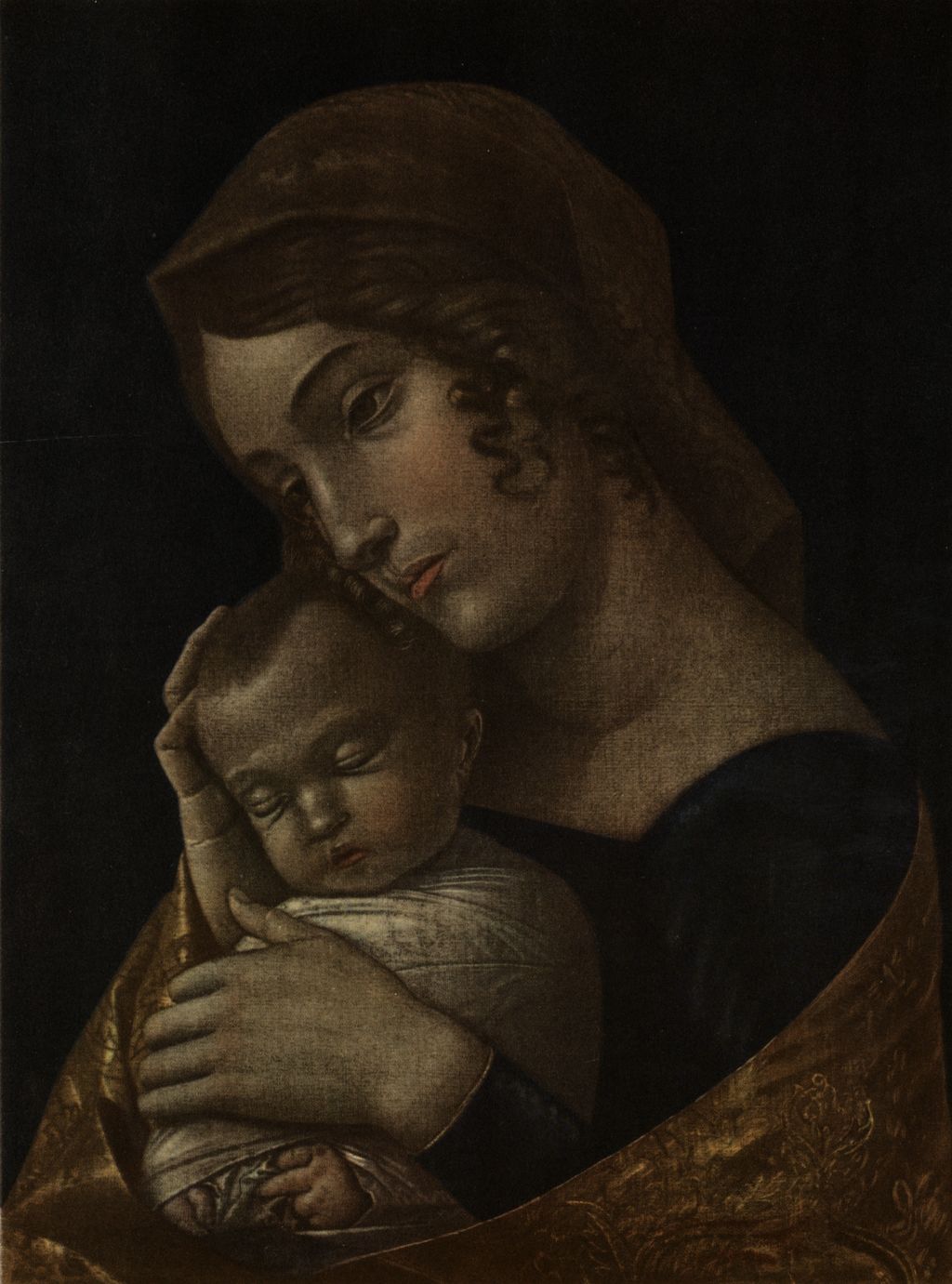
Madonna with Sleeping Child, Gemäldegalerie, Berlin Image source. Public domain.
The two sleeping children also make a revealing material comparison. Berlin reports visible weave from painting on unprimed canvas, the survival of costly lapis blue in Mary’s dress and the near loss of the red from a pattern on her cloak. The catalogue notes later overpainting at the edges of the dark background. In Milan it was the surviving azurite beneath a later layer that gave the conservators the fuller account of the mantle. In both pictures, what looks at first like a subdued choice of colour has to be read in light of what has worn away or been covered. [2] [7]
The Madonna of the Cherubim at Brera gives Mary and Christ a company of red cherubim and blue seraphim. It is a substantially larger work in tempera on panel, dated about 1485 by Brera. The coloured wings fill the space around Mary’s head that Mantegna leaves largely dark in the Poldi Pezzoli canvas. Brera also records a different consequence of restoration. Luigi Cavenaghi’s work in 1885 helped establish the attribution to Mantegna after the panel had been given to Giovanni Bellini. Brera connects the former attribution with the vivid colours and Mary’s tender expression. [8] [9]
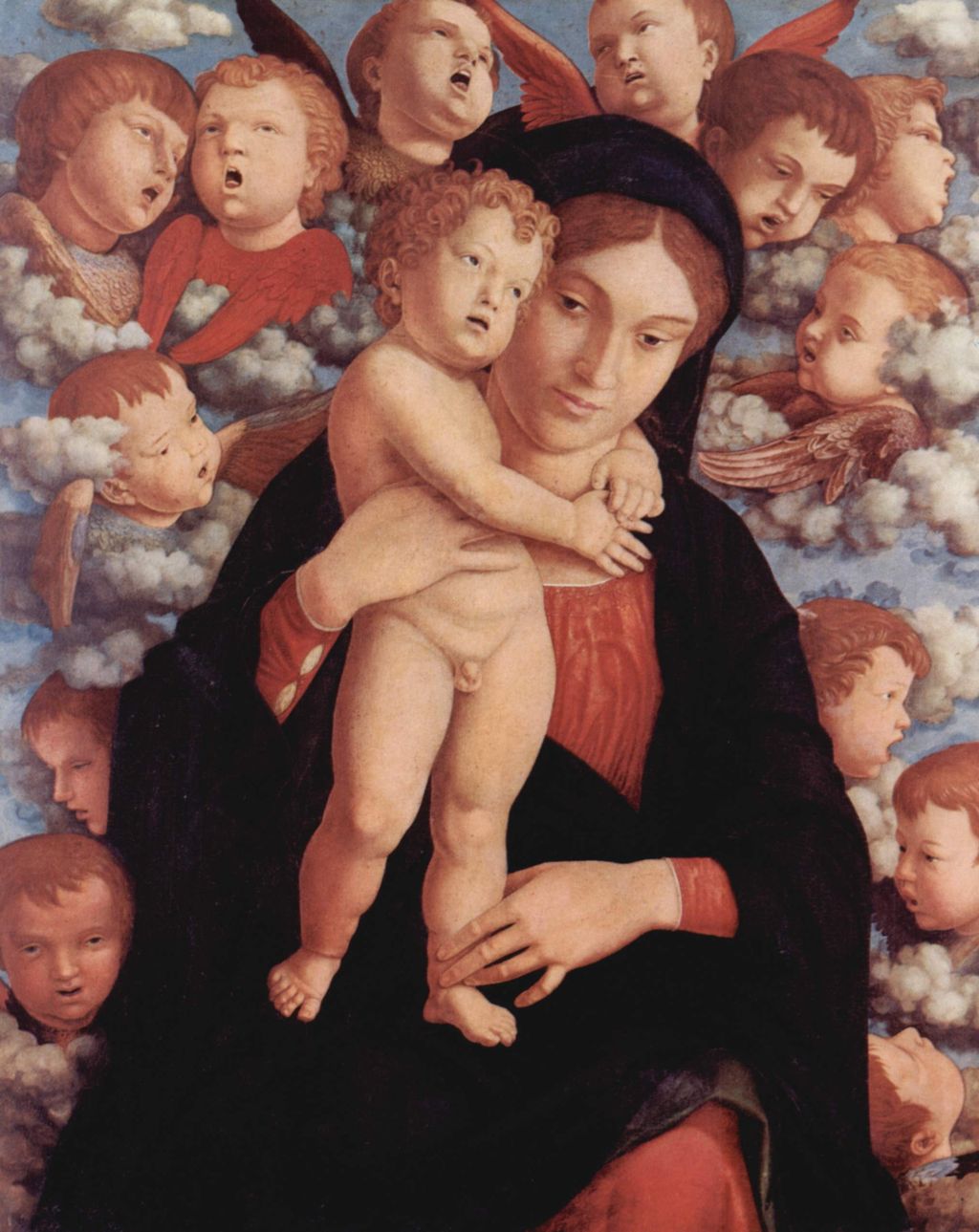
Madonna and Child with a Choir of Cherubim, Pinacoteca di Brera Image source. Public domain.
The Altman Madonna is the Metropolitan Museum of Art’s Holy Family with Saint Mary Magdalen, dated about 1495–1500 and catalogued as distemper on canvas. It puts the Virgin and child close to us within a gathering that also includes Joseph and the Magdalen. The orange-laden foliage behind them gives the eye something to follow around the heads, and the other figures draw our attention beyond the central pair. The closeness of the figures and the related medium make it a good comparison for the Milan painting. The Poldi Pezzoli canvas concentrates the effect of that closeness in the clasp of two hands. [1] [2] [10]
Giovanni Bellini’s early Madonna and Child in the Met’s Robert Lehman Collection offers a final comparison for the relationship between the hand and the painted frame. The Met sees Mantegna’s influence in Bellini’s figure types and garland and draws attention to Mary’s fingertip projecting over the parapet into the viewer’s space. In the Milan painting the brown uprights stand behind the embrace, and Mary’s fingers reach across her child. At that distance we can see the folds the fingers make in the cloth and the narrow gap between Mary’s fingertips and the child’s ear. [1] [11]
Annotated Details from Madonna and Child
The numbered points identify details to look at closely. The detail images below preserve the native scale of the selected crops.
Madonna and Child
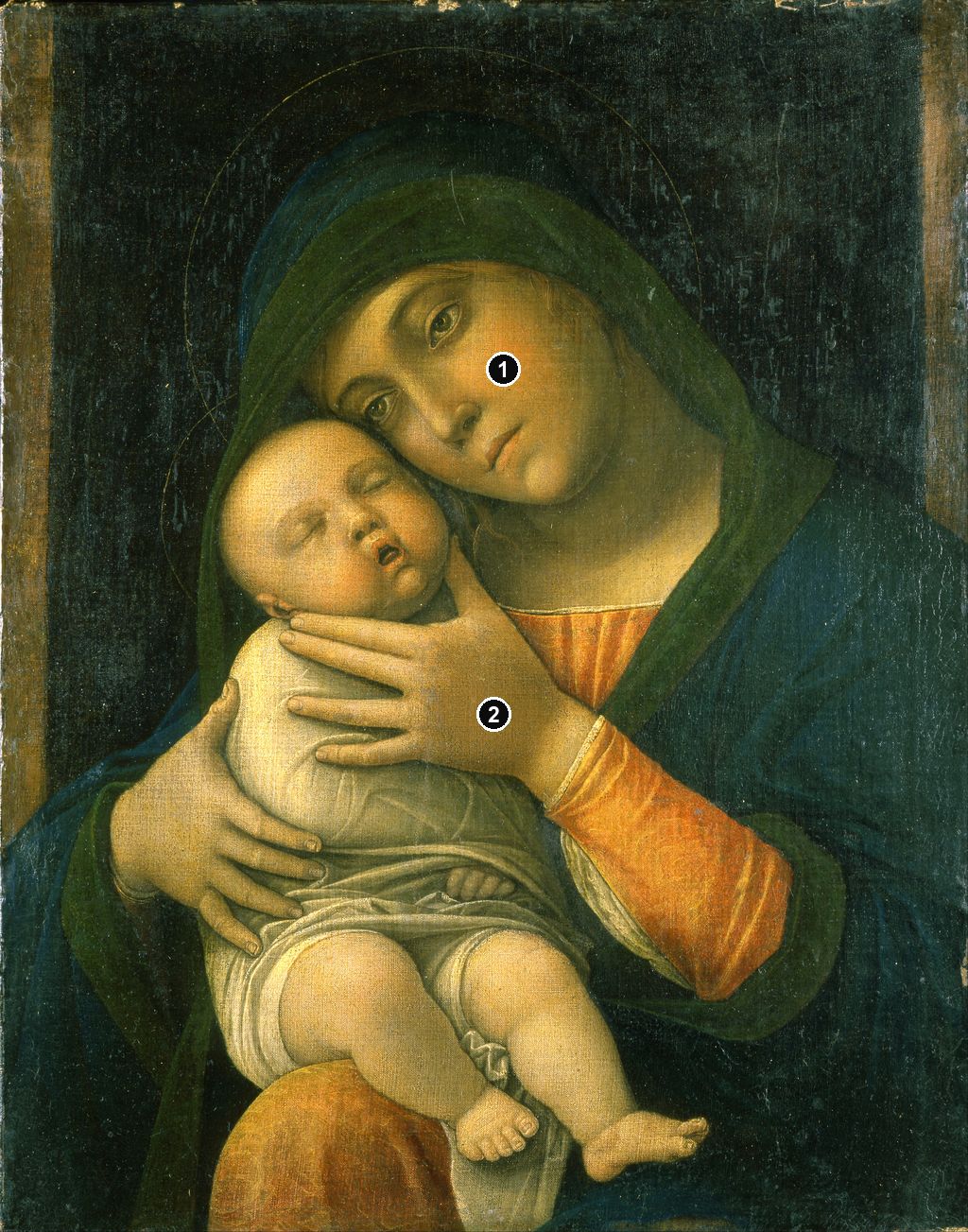
Details from MADONNA AND CHILD
Choose a detail to enlarge it.
Madonna and Child
Faces in contact
The two heads touch at an angle. Their adjoining contours create a small patch of light against the darker cloth.
The hands beneath the child
The visible hands form a cradle around the infant. The tight crop of the figure group makes each point of contact matter.
Artworks directory
| Name | Date | Medium and collection |
|---|---|---|
| The Adoration of the Shepherds | Shortly after 1450 | Painting · Metropolitan Museum of Art · 32.130.2 Catalogue. |
| Saint Mark the Evangelist | C. 1448–51 | Painting · Städel Museum · 1046 Catalogue. |
| Saint Jerome Penitent in the Desert | C. 1448–51 | Painting · Museu de Arte de São Paulo · MASP.00015 Catalogue. |
| Martyrdom and Transport of the Body of Saint Christopher | Mid-1450s | Painting · Ovetari Chapel, Padua Catalogue. |
| San Luca Altarpiece | 1453–55 | Painting · Pinacoteca di Brera · 176 Catalogue. |
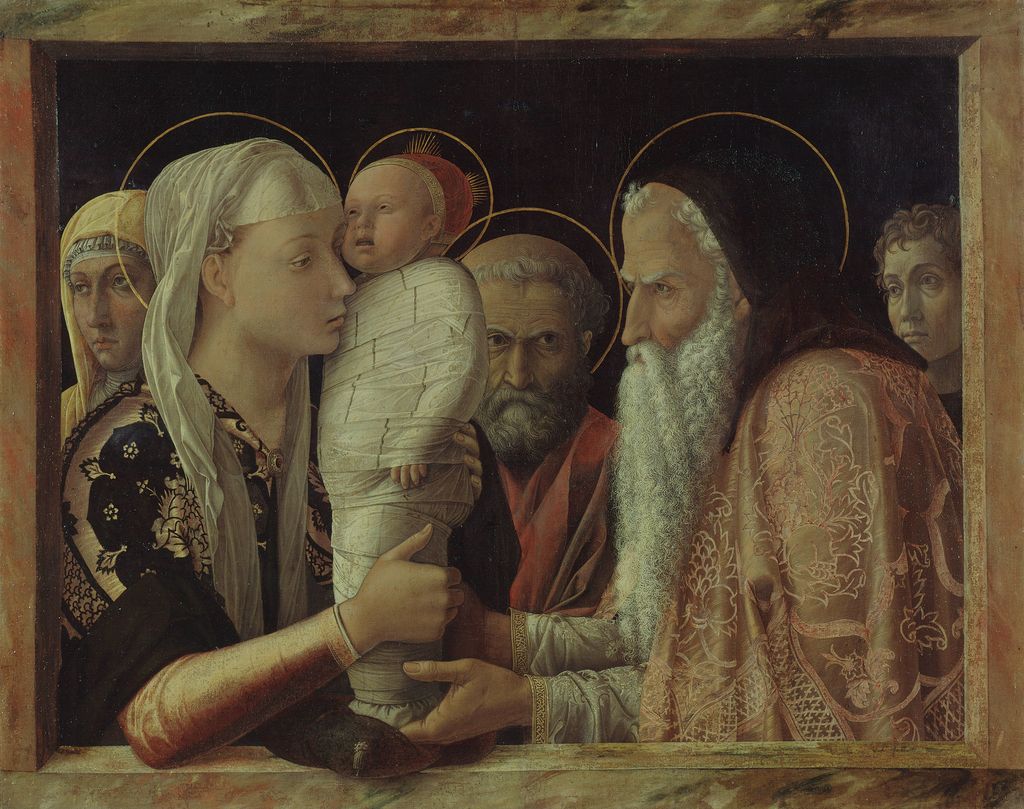
| The Presentation of Christ at the Temple | 1454 (Berlin dating) | Painting · Gemäldegalerie, Berlin · 29 Catalogue. |
| San Zeno Altarpiece | 1457–59 | Painting · Basilica of San Zeno, Verona Catalogue. |
| The Crucifixion | 1456–59 | Painting · Musée du Louvre · INV 368 Catalogue. |
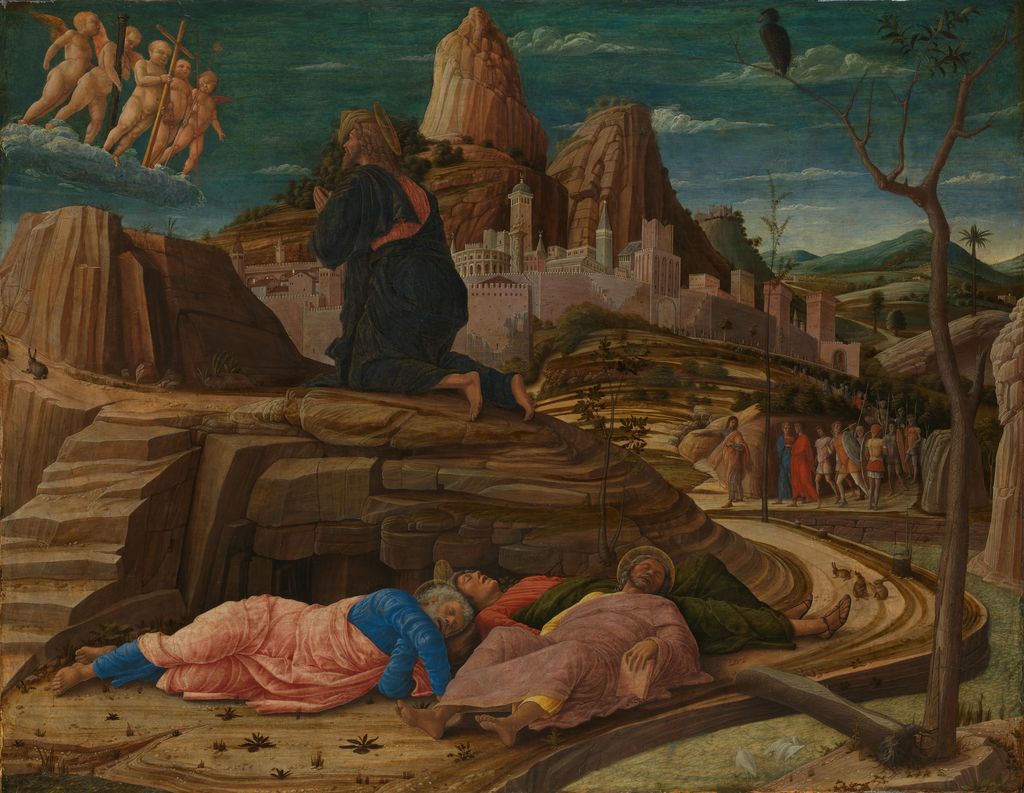
| The Agony in the Garden (London) | C. 1455–56 | Painting · National Gallery, London · NG1417 Catalogue. |
| The Agony in the Garden (Tours) | 1459 (Tours dating) | Painting · Musée des Beaux-Arts de Tours · 1803-1-24 Catalogue. |
| The Resurrection | 1459 (Tours dating) | Painting · Musée des Beaux-Arts de Tours · 1803-1-25 Catalogue. |
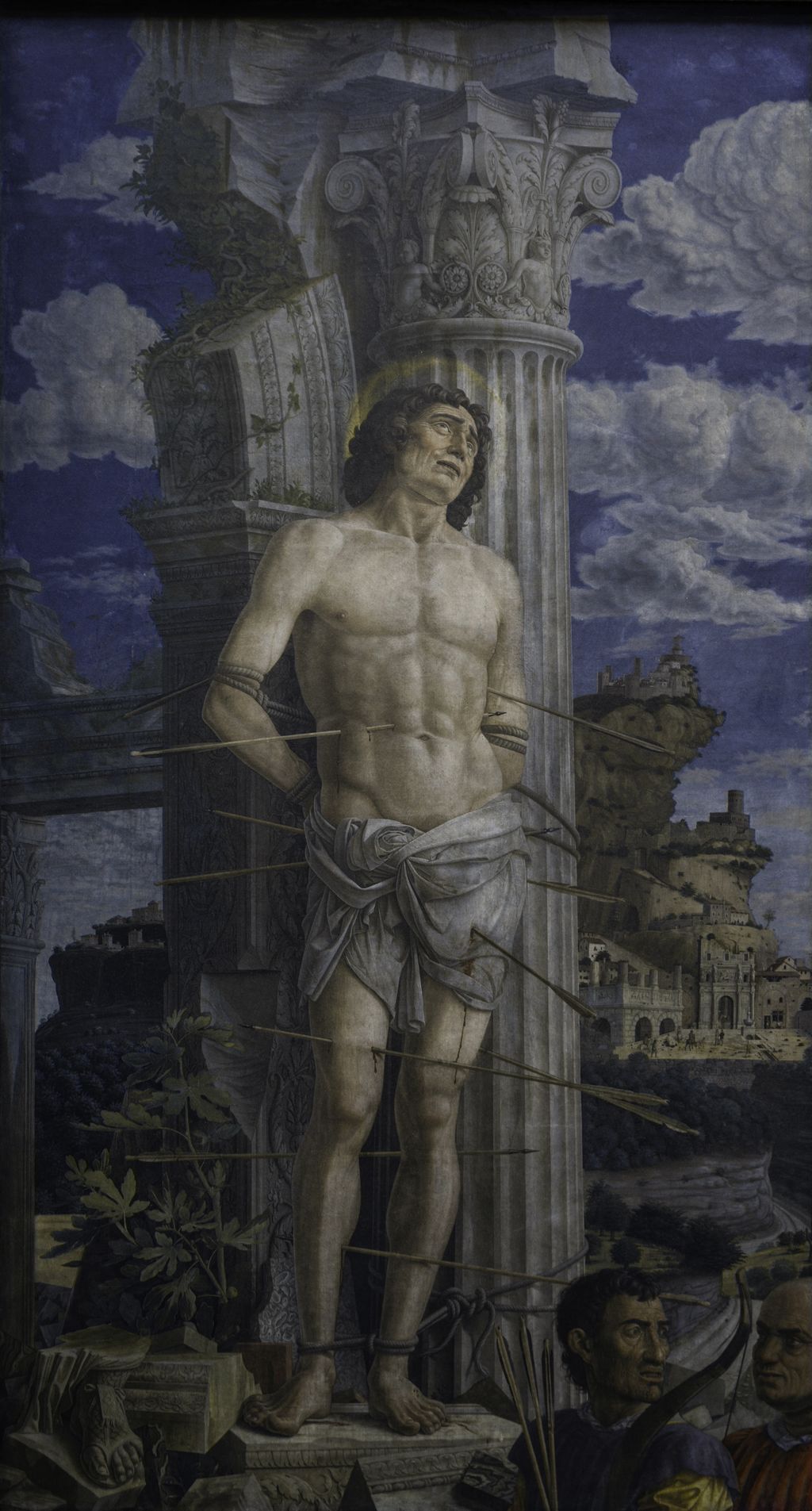
| Saint Sebastian (Vienna) | C. 1457–59 | Painting · Kunsthistorisches Museum · GG 301 Catalogue. |
| Cardinal Ludovico Trevisan | C. 1459–60 (Berlin exhibition dating) | Painting · Gemäldegalerie, Berlin · 9 Catalogue. |
| The Death of the Virgin | C. 1462 | Painting · Museo Nacional del Prado · P000248 Catalogue. |
| Christ with the Soul of the Virgin | C. 1460–64 | Painting · Pinacoteca Nazionale, Ferrara Catalogue only. |
| Portrait of a Young Man (traditionally Francesco Gonzaga) | C. 1461 or 1470, depending on sitter | Painting · Museo di Capodimonte · Q 60 Catalogue. |
| Portrait of a Prelate (Carlo de’ Medici?) | C. 1465–70 | Painting · Uffizi Galleries · 1890 no. 8540 Catalogue. |
| Portrait of a Man | C. 1470 | Painting · National Gallery of Art, Washington · 1952.2.5 Catalogue. |
| Madonna with Sleeping Child (Berlin) | C. 1455–60 | Painting · Gemäldegalerie, Berlin · S.5 Catalogue. |
| Camera degli Sposi (Camera Picta) | 1465–74 | Painting · Palazzo Ducale, Mantua Catalogue. |
| Saint Sebastian (Louvre) | Around 1480 | Painting · Musée du Louvre · RF 1766 Catalogue. |
| Lamentation over the Dead Christ | C. 1483 (Brera dating) | Painting · Pinacoteca di Brera · 352 Catalogue. |
| The Triumphs of Caesar | About 1485–1506 | Painting · Royal Collection · RCIN 403958–403966 Catalogue. |
| Madonna of the Caves | C. 1488–90 | Painting · Uffizi Galleries · 1890 no. 1348 Catalogue. |
| Madonna and Child with a Choir of Cherubim | C. 1485 | Painting · Pinacoteca di Brera · 297 Catalogue. |
| Madonna and Child (Poldi Pezzoli) | Early 1490s (museum dating) | Painting · Museo Poldi Pezzoli · 1595 Catalogue. |
| The Holy Family with Saint Mary Magdalen | C. 1495–1500 | Painting · Metropolitan Museum of Art · 14.40.643 Catalogue. |
| The Virgin and Child with Saint Mary Magdalene and Saint John the Baptist | C. 1490–1505 | Painting · National Gallery, London · NG274 Catalogue. |
| Christ as the Suffering Redeemer | 1485–95 (SMK dating) | Painting · Statens Museum for Kunst · KMSsp69 Catalogue. |
| Ecce Homo | C. 1500 | Painting · Musée Jacquemart-André · MJAP-P 1840 Catalogue. |
| Judith with the Head of Holofernes (Mantegna or follower) | C. 1495–1500 | Painting · National Gallery of Art, Washington · 1942.9.42 Catalogue. |
| Madonna della Vittoria | 1495–96 | Painting · Musée du Louvre · INV 369 Catalogue. |
| Mars and Venus (Parnassus) | C. 1496–97 | Painting · Musée du Louvre · INV 370 Catalogue. |
| The Trivulzio Madonna | 1497 | Painting · Castello Sforzesco, Milan · 0554 Catalogue. |
| The Adoration of the Magi | C. 1495–1505 | Painting · J. Paul Getty Museum · 85.PA.417 Catalogue. |
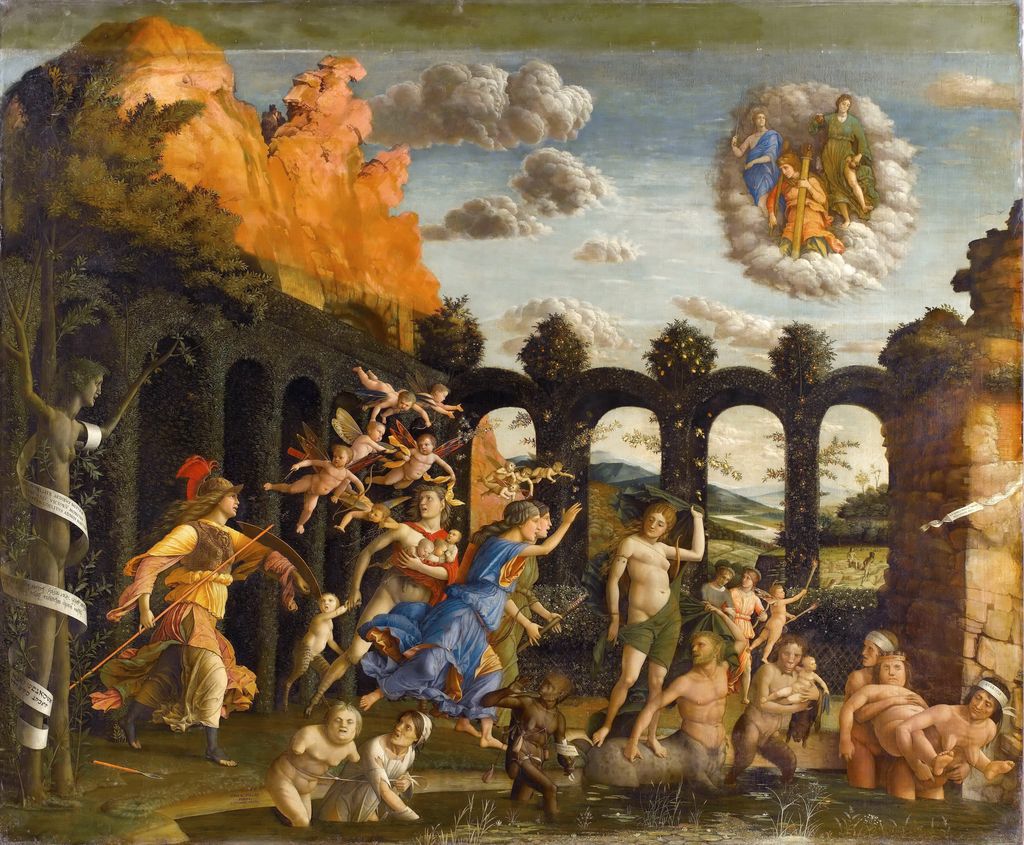
| Minerva Expelling the Vices from the Garden of Virtue | C. 1502 | Painting · Musée du Louvre · INV 371 Catalogue. |
| The Introduction of the Cult of Cybele at Rome | 1505–06 | Painting · National Gallery, London · NG902 Catalogue. |
| Saint Sebastian (Venice) | Probably c. 1504–06 | Painting · Galleria Giorgio Franchetti alla Ca’ d’Oro · D.11 Catalogue. |
| Samson and Delilah | C. 1500 | Painting · National Gallery, London · NG1145 Catalogue only. |
| A Woman Drinking (probably Sophonisba) | C. 1495–1506 | Painting · National Gallery, London · NG1125.2 Catalogue only. |
| The Vestal Virgin Tuccia with a Sieve | C. 1495–1506 | Painting · National Gallery, London · NG1125.1 Catalogue only. |
| Judith with the Head of Holofernes (Dublin) | C. 1495–1500 | Painting · National Gallery of Ireland · NGI.442 Catalogue only. |
| Battle of the Sea Gods, left half (Met impression) | Before 1481 (Met dating) | Print · Metropolitan Museum of Art · 18.12 Catalogue only. |
| Battle of the Sea Gods, right half (Met impression) | Before 1481 (Met dating) | Print · Metropolitan Museum of Art · 1984.1201.4 Catalogue only. |
| Battle of the Sea Gods, left half (Tokyo impression) | C. 1475 (Tokyo dating) | Print · National Museum of Western Art, Tokyo · G.1981-0002 Catalogue only. |
| Battle of the Sea Gods, left half (Washington impression) | C. 1485–88 (NGA dating) | Print · National Gallery of Art, Washington · 1941.1.6 Catalogue only. |
| The Entombment of Christ, second state of two | Before 1475 (Met dating) | Print · Metropolitan Museum of Art · 37.42.30 Catalogue only. |
| The Entombment of Christ (possibly Zoan Andrea, after Mantegna) | 1460–1549 (Rijksmuseum dating) | Print · Rijksmuseum · RP-P-1924-60 Catalogue only. |
| Four Dancing Muses (Gian Marco Cavalli after Mantegna) | C. 1497 | Print · Metropolitan Museum of Art · 20.5.3 Catalogue only. |
| Bacchanal with Silenus | Before 1475 (Met dating) | Print · Metropolitan Museum of Art · 29.44.15 Catalogue only. |
| Bacchanal with a Wine Vat | Before 1475 (Met dating) | Print · Metropolitan Museum of Art Catalogue only. |
| St James on His Way to Execution | C. 1453–57 | Drawing · British Museum · 1976,0616.1 Catalogue only. |
| Three Studies for a Dead Christ | C. 1455–65 | Drawing · British Museum · 1909,0406.3 Catalogue only. |
| Pietà (Venice) | C. 1456–65 (exhibition datings) | Drawing · Gallerie dell’Accademia, Venice · 115 Catalogue only. |
| Studies for Christ at the Column | 1460–65 | Drawing · The Courtauld · D.1978.PG.345 Catalogue only. |
| Virtus Combusta | C. 1490 (technical study) | Drawing · British Museum · Pp,1.23 Catalogue only. |
| Virtus Combusta (Giovanni Antonio da Brescia after Mantegna) | C. 1495–1506 | Print · Musée du Louvre · 3881 LR/ Recto Catalogue only. |
| The Calumny of Apelles | C. 1504–06 | Drawing · British Museum · 1860,0616.85 Catalogue only. |
Frequently Asked Questions
Yes. The paintings differ in how Mary supports him, in the arrangement of the textiles and in their surviving colour. The Milan work belongs to the Museo Poldi Pezzoli.
Mantegna worked with a lean paint layer on fine linen. Technical study helps distinguish the original weave from later changes to the surface.
Discussion
Look again at the images and ideas explored in Poldi Pezzoli Madonna. These editorial prompts invite your observations.
Reader Insights
How do Mary’s two hands and the folds around them make the child’s weight visible, and how does his looser wrapping change the effect compared with the Berlin canvas?
What can the two blues in the mantle tell us that the before and after photographs alone cannot establish?
Join the Conversation
Share a detail, comparison or question about Poldi Pezzoli Madonna below.
References
- Museo Poldi Pezzoli, Madonna and Child. View source.
- Opificio delle Pietre Dure, Andrea Mantegna, Madonna con Bambino, ca. 1490–1500, Museo Poldi Pezzoli, Milano. View source.
- Museo Poldi Pezzoli, Ritratto di Gian Giacomo Poldi Pezzoli. View source.
- National Gallery, Catherine Higgitt and Raymond White, Analyses of Paint Media: New Studies of Italian Paintings of the Fifteenth and Sixteenth Centuries. View source.
- Fondazione Federico Zeri, Brogi photograph of the Madonna col Bambino dormiente. View source.
- Museo Poldi Pezzoli, Madonna con Bambino, catalogue entry and exhibition history. View source.
- Staatliche Museen zu Berlin, Maria mit dem schlafenden Kind. View source.
- Fondazione Palazzo Strozzi and Museo Nazionale del Bargello, Donatello, the Renaissance, exhibition checklist, section 8. View source.
- Pinacoteca di Brera, Madonna and Child with a Choir of Cherubim. View source.
- The Metropolitan Museum of Art, The Holy Family with Saint Mary Magdalen. View source.
- The Metropolitan Museum of Art, Giovanni Bellini, Madonna and Child. View source.
- Basilica of San Zeno, Verona, San Zeno Altarpiece, View source.
- Palazzo Ducale, Mantua, Camera degli Sposi (Camera Picta), View source.
- Royal Collection, The Triumphs of Caesar, View source.
- Musée du Louvre, Madonna della Vittoria, View source.
- National Gallery, London, The Introduction of the Cult of Cybele at Rome, View source.
More MANTEGNA Paintings
San Zeno Altarpiece
The San Zeno Altarpiece in its frame, Basilica of San Zeno, Verona José Luiz. Image source. CC BY-SA 4.0. Resized from the cited image.