 by Tom Gurney
Tom Gurney BSc (Hons) is an art history expert with over 20 years experience
Published on June 19, 2020 / Updated on November 29, 2026
Email: tomgurney1@gmail.com / Phone: +44 7429 011000
Overview
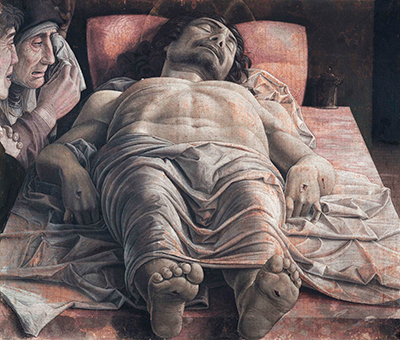
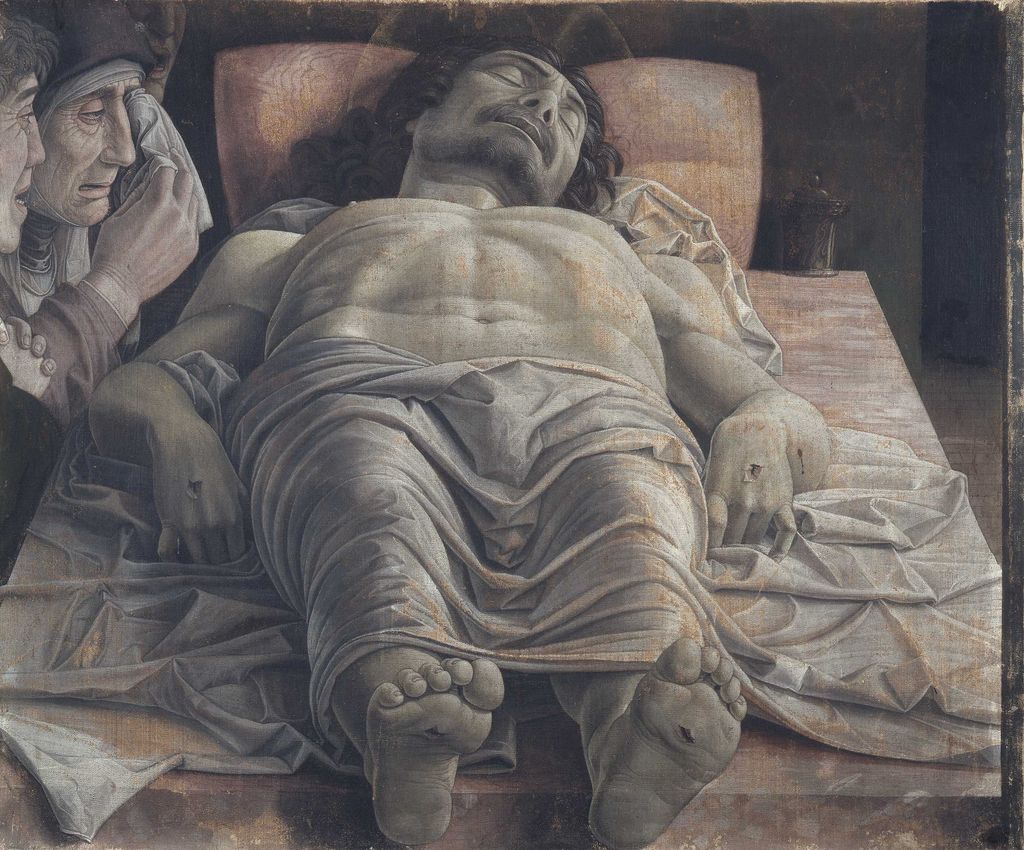
Christ’s feet are the first things we see. They project beyond a slab of reddish stone, bringing the marks of the Crucifixion within seeming reach. The rest of the body stretches away from us towards a pillow. At the upper left, three people grieve in what little space the body leaves them. Andrea Mantegna makes the few feet between the edge of the stone and the head of the dead man feel like a distance we have to travel with our eyes. [1]
The Pinacoteca di Brera in Milan calls the work Lamentation over the Dead Christ and dates it to about 1483. The date is approximate. The painting measures 68 × 81 centimetres, is painted in tempera on canvas and carries Brera inventory number 352. The canvas is modest in size, yet the position of the feet makes the body feel remarkably close. [1]
At a Glance
- DateAbout 1483 (Brera’s estimate)
- MediumTempera on canvas
- Dimensions68 × 81 cm
- CollectionPinacoteca di Brera, Milan
- Inventory352
Andrea Mantegna in context
San Zeno Altarpiece
1457–59 [20]Lamentation over the Dead Christ
C. 1483 (Brera dating) [1]The Triumphs of Caesar
Mid-1480s–before 1506 [22]Madonna della Vittoria
1495–96 [23]At the foot of the stone
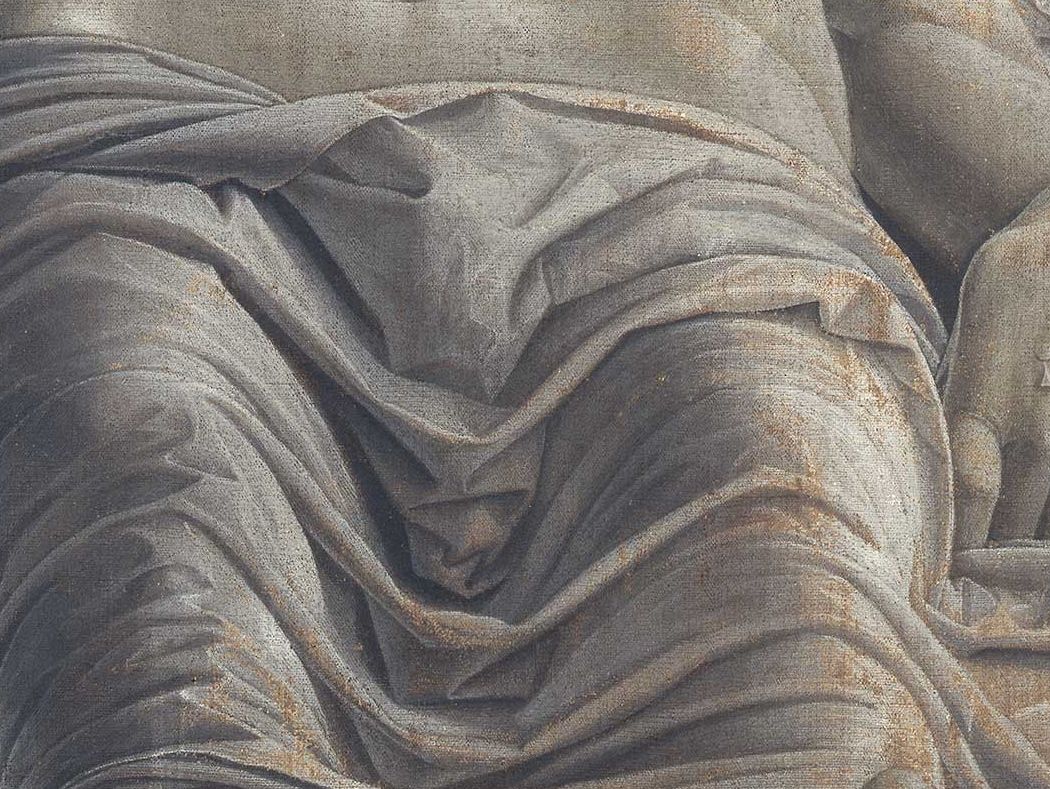
The viewpoint is slightly above the slab, near its foot. We can see the top of the stone as well as its near edge, and we look almost directly along the length of the body. Christ lies with his legs extended. We register their length partly through the ridges of the shroud, which runs up from the ankles, rises over the knees and spreads about the hips. Then there is a sudden expanse of bare chest. At the far end of the stone, the raised cushion lets us see the closed eyes and lips. The face turns a little towards our right. [2]
That compression in depth is called foreshortening. A figure turned along our line of sight takes up less space on the painted surface than the same figure seen from the side. Mantegna gives us several ways of sensing the length the image compresses. The feet overlap the lower edge of the shroud, the folds lead back to the waist, and the arms lie alongside the trunk. The body never quite falls into a symmetrical pattern. The feet are slightly to the right of the head as we look at the canvas, and the tilt of the face introduces a movement of its own. The effect is of a body laid down with weight, with enough variation in the pose for us to imagine its position in space. [1] [2]
Seen so close, the soles might be expected to loom larger. Brera’s audio guide explains the effect in terms of an enlarged head that holds its own against the feet. Its accessible description stresses the painter’s adjustment of relative proportions. Both accounts start from something readily visible. The feet occupy a commanding position, but the face remains large and distinct enough for us to read its expression from the far end of the slab. [2] [3]
There are different ways of modelling that effect. In a study in EGA, Antonio Álvaro Tordesillas and Fernando Linares García compared the painting with photographed and digitally modelled reclining figures. Changing the observer’s height and distance produced some of the proportions they saw in the canvas. Other proportions, including the relation of the torso to the legs, still resisted a single reconstruction. They proposed that the painting combines the effects of different viewing distances. Silvia Minguzzi’s illustrated study, following a reconstruction by Gherardi, instead sets out two sets of perspective lines, one for the stone bed and another for the body. The studies depend on their starting assumptions about the figure and the space around it. They offer ways to test what we see in the finished painting, while Mantegna’s working procedure remains unknown. [4] [5]
The holes in the hands and feet
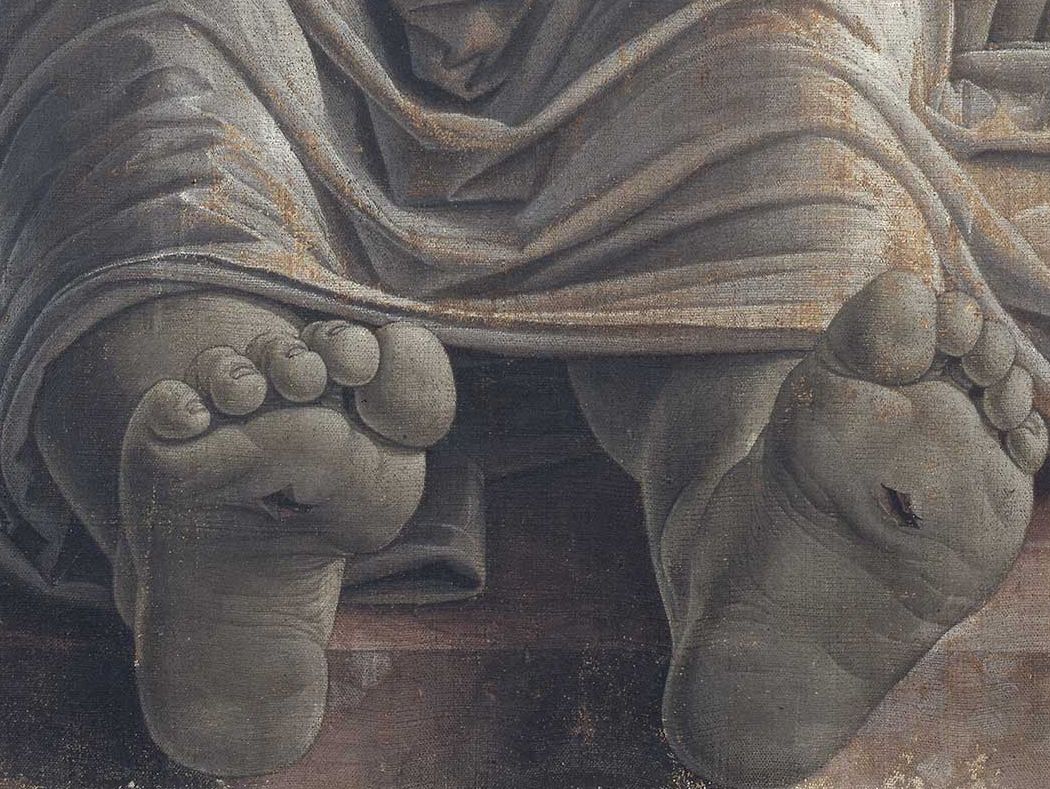
The near soles carry two wounds. Mantegna draws attention to their edges, where little raised lips of skin interrupt an otherwise continuous surface. Farther in, the backs of the hands turn towards us on either side of the waist. Their wounds are readable at a glance and their curled fingers seem to have settled in place. Look from one hand to the other and then down to the feet. The four marks spread out across the picture even though they belong to limbs receding at different distances. In Brera’s account, the body has been cleaned for burial, leaving the wounds exposed. Brera’s interpretation connects this deliberate exposure of the wounds with the devotional tradition of showing the physical evidence of the Passion. [1] [2] [3]
The body shows different kinds of weight. The ribcage rises above the hollow of the abdomen, while the arms rest heavily beside it. The folds of the cloth below them are sharply creased, with high ridges that catch the light. Their angularity makes the faint modelling of the flesh easier to see. The face holds very little colour. Its closed lips are easy to pass over beside the open mouths at the left. Brera’s audio guide describes the medium as glue-bound tempera and draws attention to its matte finish. The pale light catches each material differently, from the fine texture of skin to the hard planes of stone, with very little brilliance to distract from the edges and shadows. [2] [3]
The art historian Klaus Krüger locates the painting’s unease at the edge of the slab. The rim runs parallel to the bottom of the canvas and establishes a boundary, yet the feet project across it. In his reading, the body is almost within reach and at the same time impossible to take in from this viewpoint in its full stature. He connects that experience to the devotional paradox of encountering the divine through a body made palpably human. The position of the feet makes his argument concrete. They invite the closest look, then send the eye down a length we can only reconstruct from what the picture offers. [6]
Three faces at the edge
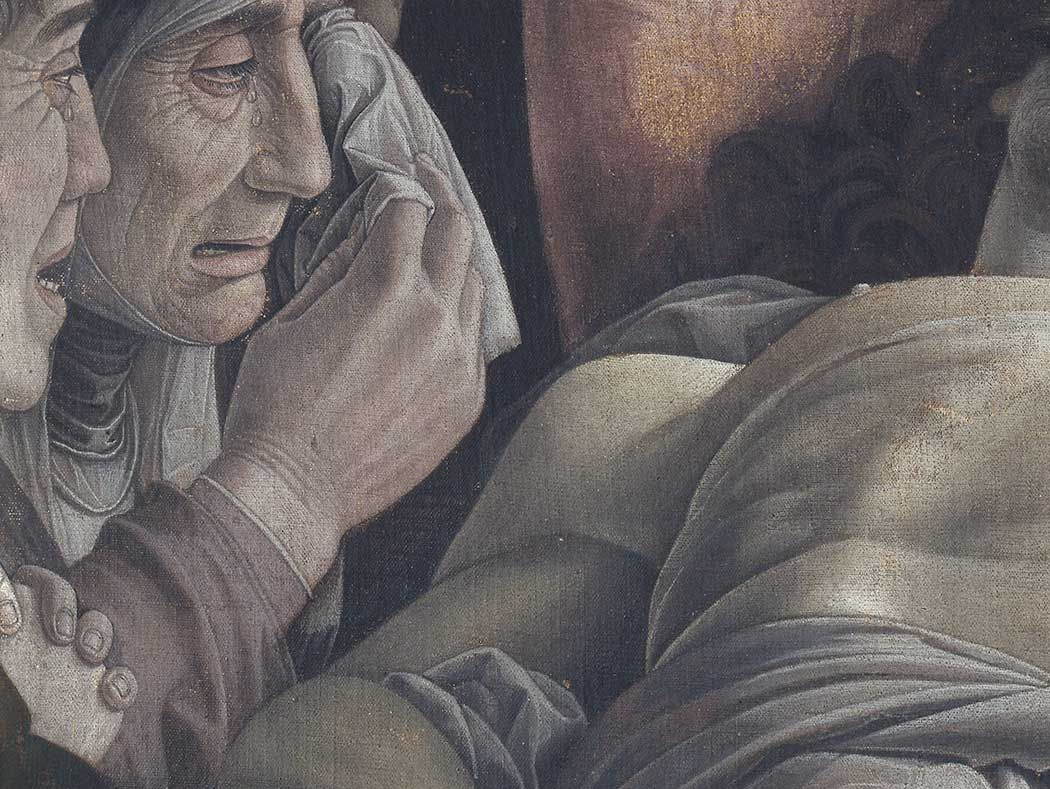
At first the mourners may register as a single knot of shadow to the left of Christ’s head. The nearest face is traditionally identified as John the Evangelist. It is cut by the border, but enough remains to see his partly open mouth, a tear and his hands gathered at his chest. Behind him, Mary raises a pale cloth to her eyes. The crease of her cheek and the cloth at her face give the gesture its force. Behind Mary, a third face is reduced almost to the nose and open mouth. Brera’s accessible account gives the traditional identification of Mary Magdalene. The narrow area of visible face gives that identification less pictorial support than the familiar gesture and dress of the Virgin beside her. [2] [3]
The crop does more than make the group crowded. We get enough of each person to recognise a separate response to death, but little sense of where the mourners’ bodies end or how they came into the room. John’s gathered fingers and Mary’s handkerchief register small movements beside Christ’s motionless hands. At the same time, the lowest, widest part of the scene is free of attendants. The viewer has that place at the foot of the slab. Brera reports that infrared reflectography picked up the mourners in the design beneath the paint, and that the unpainted edges indicate the canvas was left intact. The abrupt composition is part of the painting’s design. [2] [3]
The choice becomes clearer beside the Metropolitan Museum of Art’s 1487 maiolica Lamentation, where the mourners are freestanding figures grouped around a body, or Andrea Solario’s Lamentation of about 1505–07 in Washington, where several figures visibly carry or cradle Christ and a landscape opens behind them. In Solario’s picture one woman kneels to hold a hand. Mantegna leaves the hands exposed and unsupported, and the stone takes the weight that visible people take in Solario. The comparison brings out how much Mantegna asks of the narrow strip at the left. Grief has to be legible in a few faces and gestures, while the body occupies nearly the entire depth of the scene. [1] [7] [8]
The vessel beside the pillow
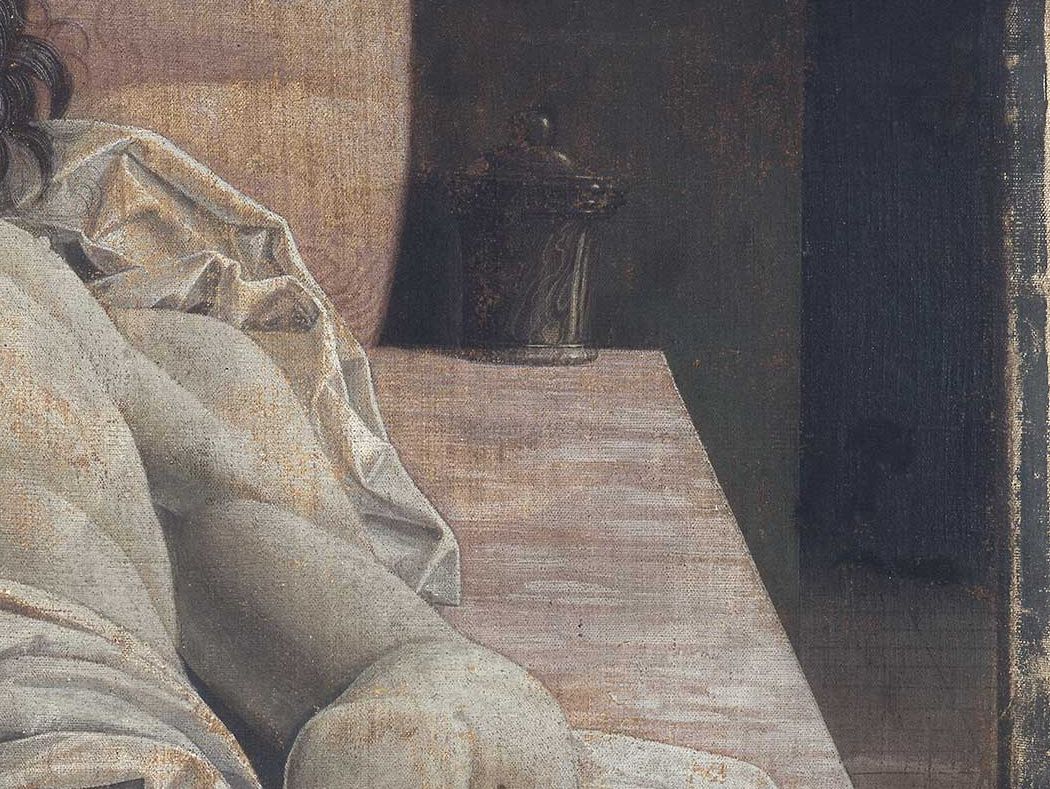
The slab supplies both a surface for the body and a clue to the moment. Its pale veins run through reddish stone. The front edge is straight and hard, and the shroud softens the line where it spills over the side. A small vessel sits on the stone near the pillow, at the upper right. Brera reads the slab as the Stone of Unction, where Christ’s body is prepared for burial, and the vessel as a container for the scented oils used to anoint him. The French scholar Stéphane Lojkine suggests that it could be Mary Magdalene’s perfume flask. The proposed association fits her traditional identification. It remains an interpretation of the vessel, whose contents and owner are left for the viewer to infer. [1] [2] [3] [9]
The shroud already covers the legs, though the head, torso, hands and feet are exposed. The painted moment lies between the taking down from the cross and the entombment. A dark opening above the vessel hints at a space beyond the slab. Very little can be made out there, and the grey-brown wall gives few clues to the size of the room. The disposition of the objects makes the interval intelligible. The body has been laid out and tended, and the mourners still have time beside it. [1] [2] [3]
Brera’s audio guide associates the estimated date of about 1483 with the reported arrival in Mantua of a fragment venerated as part of the Stone of Unction. The coincidence makes sense of the prominence of the painted slab and gives the dating proposal a local context. The regional heritage catalogue offers an earlier estimate, about 1470–74, on stylistic and bibliographic grounds. The painted veins alone establish neither a date nor a portrait of a particular piece of stone. [3] [10]
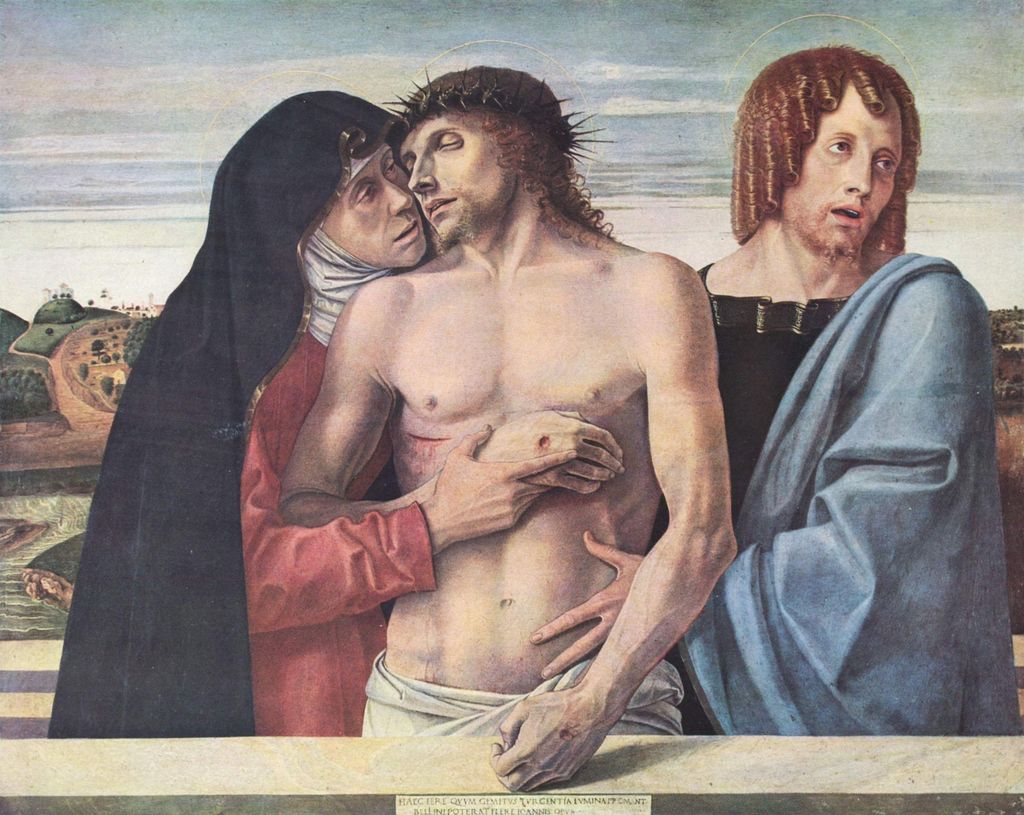
Giovanni Bellini’s Pietà, Pinacoteca di Brera Image source. Public domain.
A body laid out for contemplation
Brera proposes that Mantegna may have made the image for his own private devotion. The suggestion gains some plausibility if the canvas is the foreshortened Christ recorded among his possessions after his death. The picture can also be understood in devotional terms on the evidence of its design. It gives the believer time to dwell on the wounds and on the grief they call forth. The lack of a broad narrative setting keeps the act of looking concentrated on physical details. The thin halo around the head identifies a sacred body whose weight, injuries and stillness are made insistently visible. [1] [2] [3]
The title Lamentation locates the image in an episode of mourning, but the pause it makes for contemplation also has affinities with the devotional Pietà. Andreas Hauser, writing primarily about Mantegna’s Christ as the Suffering Redeemer in Copenhagen, brings the Milan canvas into his argument about the bodily presence of Christ. He likens the way its severely shortened limbs accumulate before the eye to a gathering of sculptural fragments. It is a suggestive comparison when looking at the Milan picture. We see the body as a whole through the relationship between parts that are almost aggressively distinct, particularly the feet, wounded hands, chest and head. [11]
Giovanni Bellini’s Pietà, also at Brera, gives that body another form. Brera dates it to about 1460 and catalogues it as tempera on panel. Christ appears half-length and upright behind a stone parapet. Mary and John support him. The line from Mary’s face to her son’s is so short that their profiles almost touch. Look also at Christ’s injured hand resting across the front edge. Bellini makes one wounded hand cross the boundary of the scene. Mantegna gives that role to the feet and places the hands farther away, exposed beside the reclining torso. [1] [12]
Bellini opens a landscape behind the group and uses natural light to soften the contours of the faces. An inscription on the parapet, drawing on the Roman poet Propertius, imagines a painting that weeps when it brings the viewer to tears. Bellini leads us into that exchange through contact between the figures. In Mantegna the distance between the solitary body and the huddled witnesses is part of what we feel. The two paintings are particularly revealing side by side because both bring grief to the edge of the viewer’s space, one through an upright encounter with faces and hands and the other through the approach to a body stretched out at our feet. [3] [12]
From the garden to the burial stone
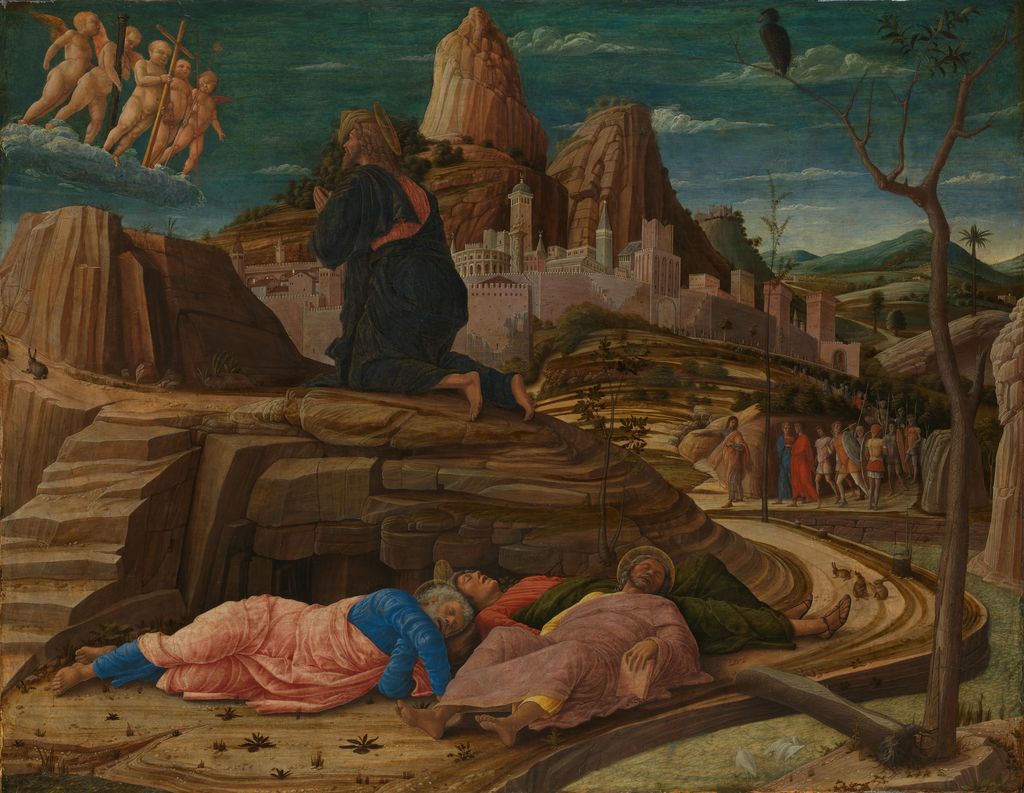
Among Mantegna’s paintings, the earlier Agony in the Garden offers another way to look at his treatment of reclining bodies. In the National Gallery’s London panel, Christ kneels above three sleeping disciples sprawled among rocks. The gallery compares those disciples to toppled marble statues, with their emphatic contours and crisp folds. There, the disciples’ heavy sleep belongs to an episode in which the alert viewer can trace the approach of danger through a rocky landscape. In the Brera canvas, one recumbent figure takes over the whole space, and the weight that in the garden suggests sleep is made permanent by the wounds and the witnesses. [1] [13]
Mantegna painted another Agony for the predella, the lower tier of the San Zeno Altarpiece in Verona. The original Agony and Resurrection panels are now in Tours, and the central Crucifixion is at the Louvre. The three scenes give successive events in the Passion and its aftermath distinct settings and actions. The Brera painting concentrates instead on an interval between the Crucifixion and Resurrection, within the length of the body and the reach of the stone. San Zeno was made for the high altar. The Brera canvas has no securely documented original setting. [1] [10] [14] [15]
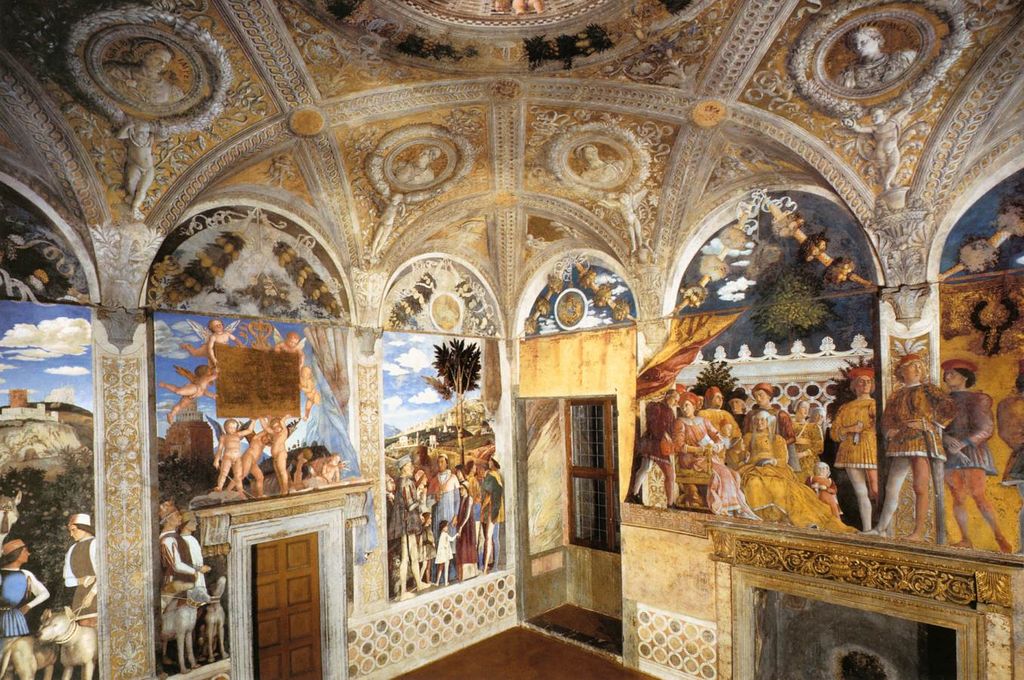
The Brera audio guide also points to the oculus Mantegna painted in the ceiling of the Camera degli Sposi in Mantua. The bodies there are foreshortened for a view from below. The illusion draws the eye up through an apparent opening, while the view along the burial slab presses the body towards a person standing in front of the canvas. The same interest in making a body seem to occupy a space beyond the painted surface serves two very different encounters. [3]
A sheet in the British Museum with three pen studies of the dead Christ, dated to about 1455–65 in the Berlin Mantegna and Bellini exhibition list, gives another point of comparison. The repeated poses suggest how much variety there was to explore in a theme that might seem to offer only a single immobile subject. The exhibition also listed Mantegna’s later drawing of a man lying on a stone slab, a separate work. The drawings show the persistence of his interest in recumbent figures across his career. Their relation to the finished Brera composition is less certain than the shared interest in pose. [16]
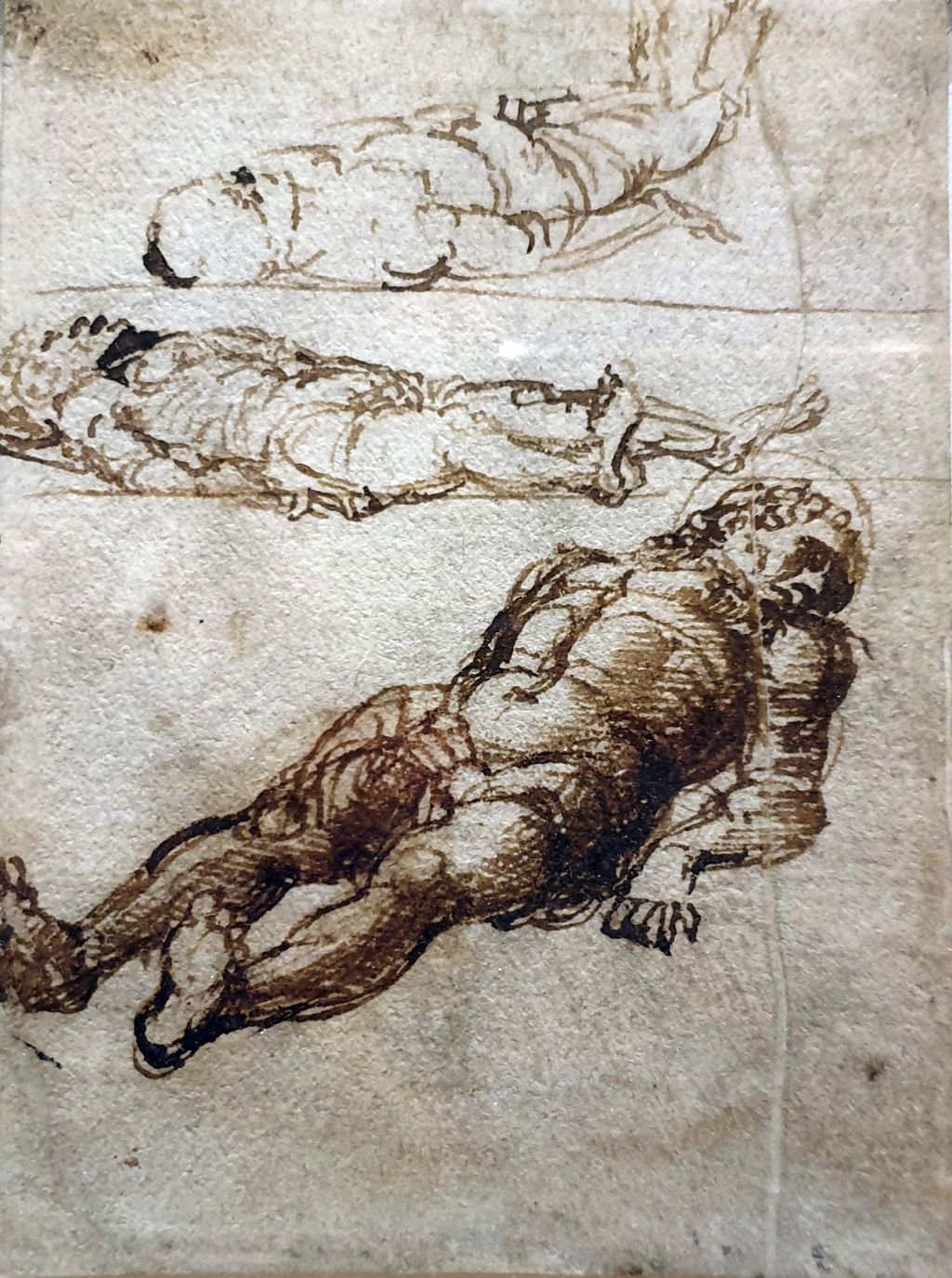
Three Studies for the Dead Christ, British Museum Image source. Public domain.
From a studio letter to the Brera collection
On 2 October 1506, after his father’s death, Ludovico Mantegna wrote to Francesco Gonzaga about paintings still in the studio. One was a Cristo in scurto, a Christ seen in foreshortening. Another letter records the acquisition of the foreshortened Christ by Cardinal Sigismondo Gonzaga. Brera favours identifying its canvas with this painting and with the foreshortened Christ recorded in the Gonzaga collection in 1627. A letter from 1531 mentions a foreshortened Christ by Mantegna among works for the rooms of Duchess Margherita Paleologa. This adds another point along the Gonzaga trail, with the link to the Milan canvas still conditional. The phrase describes a striking feature of the Milan painting, but gives no measurement or description of the mourners that would securely distinguish it from other versions. [1] [10] [17]
The regional catalogue traces how one proposed sequence leads from the Gonzaga collection to Charles I of England. A letter by the dealer Daniel Nys in 1627 describes a foreshortened Christ with weeping women among works intended for England. On Brera’s account of the hypothesis, the painting would have passed to Charles in the Gonzaga sale of 1628 and eventually reached Cardinal Mazarin after the sale of the English royal collection. The regional record connects that reconstruction with the account of the royal sale and Mazarin’s 1661 inventory. The succession of records makes the route possible. Which of them describes the painting now in Milan remains open, as does the picture’s whereabouts in the generations after Mazarin’s collection was dispersed. [1] [10]
A competing account, proposed by Keith Christiansen and summarised by the regional catalogue, looks towards Ferrara and the collection of Cardinal Pietro Aldobrandini in Rome. An Aldobrandini inventory describes a foreshortened dead Christ attributed to Mantegna with two women who weep. Two women do appear in the Brera picture, along with John. That is a closer description in one respect than the studio letter provides, yet the records still leave room for more than one picture. A surviving variant without the mourners, known as the Navarro Dead Christ and catalogued by Christie’s as circle of Mantegna, illustrates how the same premise could circulate with a different cast. Its existence gives the older inventory descriptions more than one plausible context. [10] [17]
The trail is firmer with Giuseppe Bossi, secretary of the Accademia di Brera. The museum’s collection entry records that in 1806 he asked the sculptor Antonio Canova to help him obtain the Mantegna. Accounts differ over the date of Bossi’s private purchase. A Brera exhibition publication places it in Rome in 1807. The regional catalogue records the Pinacoteca’s purchase from Bossi’s heirs in 1824 and gives 3 July as the end of the painting’s time in the Bossi collection. The 1824 purchase gives the present canvas a documented point of entry into a public collection. [1] [10] [18]
Brera subsequently brought the painting into a different kind of company in its exhibition Andrea Mantegna: New Perspectives. The museum placed it in dialogue with feet-first treatments by Annibale Carracci and Orazio Borgianni. In Carracci’s painting the crown of thorns and other instruments of the Passion share the foreground with Christ. Mantegna places the burial vessel in the distance and leaves the foreground to the slab and the soles of the feet. Even where another painter takes up that arresting angle, the first thing we encounter at the edge of the image can change the character of the encounter. [1] [19]
Annotated Details from The Dead Christ and Three Mourners
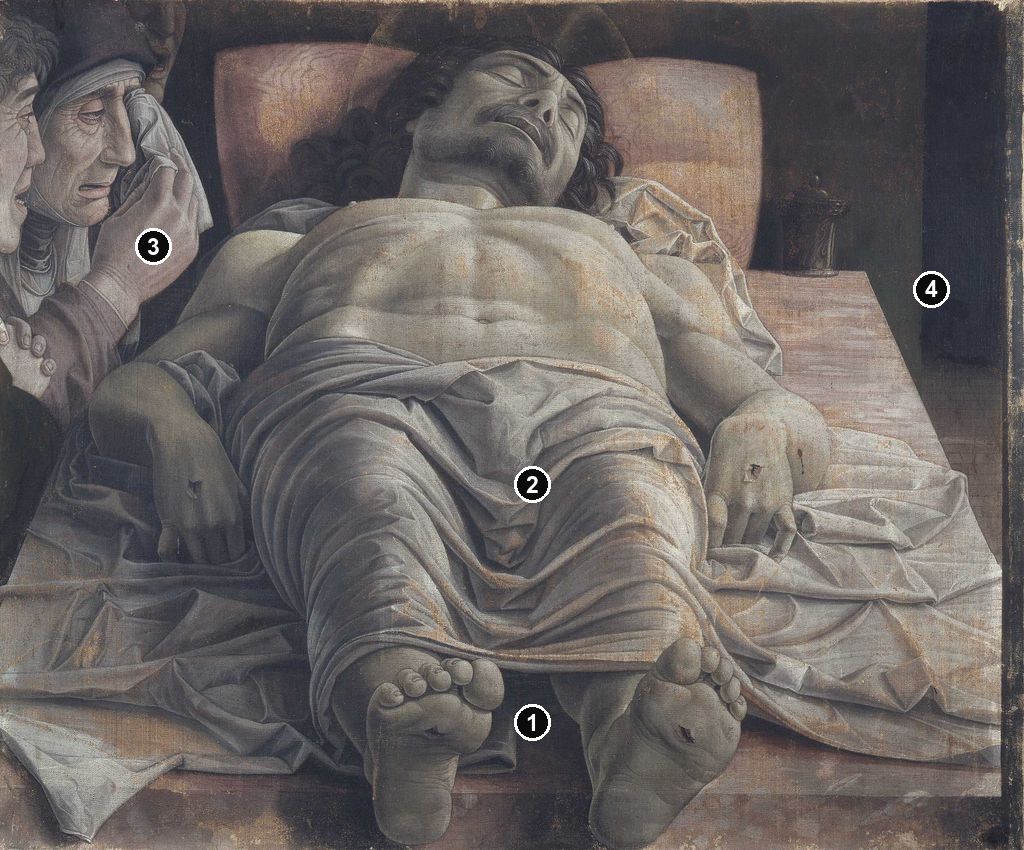
The numbered points identify details to look at closely. The detail images below preserve the native scale of the selected crops.
The Dead Christ and Three Mourners
Details from THE DEAD CHRIST AND THREE MOURNERS
Choose a detail to enlarge it.
The Dead Christ and Three Mourners
Feet near the edge
The feet sit at the near end of the stone. The toes and wounds stay legible even as the rest of the body rapidly narrows into depth.
Folds over the body
The fabric gathers into repeated curves over the legs and crosses the stone. Its changing width helps our eye follow the body away from us.
Mourners in close quarters
The faces press into the left edge. Their position leaves the centre of the painting to the body and its foreshortened reach.
Vessel beside the pillow
A small vessel appears at the upper edge of the stone. Its scale is easier to judge against the width of the pillow.
Artworks directory
| Name | Date | Medium and collection |
|---|---|---|
| The Adoration of the Shepherds | Shortly after 1450 | Painting · Metropolitan Museum of Art · 32.130.2 Catalogue. |
| Saint Mark the Evangelist | C. 1448–51 | Painting · Städel Museum · 1046 Catalogue. |
| Saint Jerome Penitent in the Desert | C. 1448–51 | Painting · Museu de Arte de São Paulo · MASP.00015 Catalogue. |
| Martyrdom and Transport of the Body of Saint Christopher | Mid-1450s | Painting · Ovetari Chapel, Padua Catalogue. |
| San Luca Altarpiece | 1453–55 | Painting · Pinacoteca di Brera · 176 Catalogue. |
| The Presentation of Christ at the Temple | 1454 (Berlin dating) | Painting · Gemäldegalerie, Berlin · 29 Catalogue. |
| San Zeno Altarpiece | 1457–59 | Painting · Basilica of San Zeno, Verona Catalogue. |
| The Crucifixion | 1456–59 | Painting · Musée du Louvre · INV 368 Catalogue. |
| The Agony in the Garden (London) | C. 1455–56 | Painting · National Gallery, London · NG1417 Catalogue. |
| The Agony in the Garden (Tours) | 1459 (Tours dating) | Painting · Musée des Beaux-Arts de Tours · 1803-1-24 Catalogue. |
| The Resurrection | 1459 (Tours dating) | Painting · Musée des Beaux-Arts de Tours · 1803-1-25 Catalogue. |
| Saint Sebastian (Vienna) | C. 1457–59 | Painting · Kunsthistorisches Museum · GG 301 Catalogue. |
| Cardinal Ludovico Trevisan | C. 1459–60 (Berlin exhibition dating) | Painting · Gemäldegalerie, Berlin · 9 Catalogue. |
| The Death of the Virgin | C. 1462 | Painting · Museo Nacional del Prado · P000248 Catalogue. |
| Christ with the Soul of the Virgin | C. 1460–64 | Painting · Pinacoteca Nazionale, Ferrara Catalogue only. |
| Portrait of a Young Man (traditionally Francesco Gonzaga) | C. 1461 or 1470, depending on sitter | Painting · Museo di Capodimonte · Q 60 Catalogue. |
| Portrait of a Prelate (Carlo de’ Medici?) | C. 1465–70 | Painting · Uffizi Galleries · 1890 no. 8540 Catalogue. |
| Portrait of a Man | C. 1470 | Painting · National Gallery of Art, Washington · 1952.2.5 Catalogue. |
| Madonna with Sleeping Child (Berlin) | C. 1455–60 | Painting · Gemäldegalerie, Berlin · S.5 Catalogue. |
| Camera degli Sposi (Camera Picta) | 1465–74 | Painting · Palazzo Ducale, Mantua Catalogue. |
| Saint Sebastian (Louvre) | Around 1480 | Painting · Musée du Louvre · RF 1766 Catalogue. |
| Lamentation over the Dead Christ | C. 1483 (Brera dating) | Painting · Pinacoteca di Brera · 352 Catalogue. |
| The Triumphs of Caesar | About 1485–1506 | Painting · Royal Collection · RCIN 403958–403966 Catalogue. |
| Madonna of the Caves | C. 1488–90 | Painting · Uffizi Galleries · 1890 no. 1348 Catalogue. |
| Madonna and Child with a Choir of Cherubim | C. 1485 | Painting · Pinacoteca di Brera · 297 Catalogue. |
| Madonna and Child (Poldi Pezzoli) | Early 1490s (museum dating) | Painting · Museo Poldi Pezzoli · 1595 Catalogue. |
| The Holy Family with Saint Mary Magdalen | C. 1495–1500 | Painting · Metropolitan Museum of Art · 14.40.643 Catalogue. |
| The Virgin and Child with Saint Mary Magdalene and Saint John the Baptist | C. 1490–1505 | Painting · National Gallery, London · NG274 Catalogue. |
| Christ as the Suffering Redeemer | 1485–95 (SMK dating) | Painting · Statens Museum for Kunst · KMSsp69 Catalogue. |
| Ecce Homo | C. 1500 | Painting · Musée Jacquemart-André · MJAP-P 1840 Catalogue. |
| Judith with the Head of Holofernes (Mantegna or follower) | C. 1495–1500 | Painting · National Gallery of Art, Washington · 1942.9.42 Catalogue. |
| Madonna della Vittoria | 1495–96 | Painting · Musée du Louvre · INV 369 Catalogue. |
| Mars and Venus (Parnassus) | C. 1496–97 | Painting · Musée du Louvre · INV 370 Catalogue. |
| The Trivulzio Madonna | 1497 | Painting · Castello Sforzesco, Milan · 0554 Catalogue. |
| The Adoration of the Magi | C. 1495–1505 | Painting · J. Paul Getty Museum · 85.PA.417 Catalogue. |
| Minerva Expelling the Vices from the Garden of Virtue | C. 1502 | Painting · Musée du Louvre · INV 371 Catalogue. |
| The Introduction of the Cult of Cybele at Rome | 1505–06 | Painting · National Gallery, London · NG902 Catalogue. |
| Saint Sebastian (Venice) | Probably c. 1504–06 | Painting · Galleria Giorgio Franchetti alla Ca’ d’Oro · D.11 Catalogue. |
| Samson and Delilah | C. 1500 | Painting · National Gallery, London · NG1145 Catalogue only. |
| A Woman Drinking (probably Sophonisba) | C. 1495–1506 | Painting · National Gallery, London · NG1125.2 Catalogue only. |
| The Vestal Virgin Tuccia with a Sieve | C. 1495–1506 | Painting · National Gallery, London · NG1125.1 Catalogue only. |
| Judith with the Head of Holofernes (Dublin) | C. 1495–1500 | Painting · National Gallery of Ireland · NGI.442 Catalogue only. |
| Battle of the Sea Gods, left half (Met impression) | Before 1481 (Met dating) | Print · Metropolitan Museum of Art · 18.12 Catalogue only. |
| Battle of the Sea Gods, right half (Met impression) | Before 1481 (Met dating) | Print · Metropolitan Museum of Art · 1984.1201.4 Catalogue only. |
| Battle of the Sea Gods, left half (Tokyo impression) | C. 1475 (Tokyo dating) | Print · National Museum of Western Art, Tokyo · G.1981-0002 Catalogue only. |
| Battle of the Sea Gods, left half (Washington impression) | C. 1485–88 (NGA dating) | Print · National Gallery of Art, Washington · 1941.1.6 Catalogue only. |
| The Entombment of Christ, second state of two | Before 1475 (Met dating) | Print · Metropolitan Museum of Art · 37.42.30 Catalogue only. |
| The Entombment of Christ (possibly Zoan Andrea, after Mantegna) | 1460–1549 (Rijksmuseum dating) | Print · Rijksmuseum · RP-P-1924-60 Catalogue only. |
| Four Dancing Muses (Gian Marco Cavalli after Mantegna) | C. 1497 | Print · Metropolitan Museum of Art · 20.5.3 Catalogue only. |
| Bacchanal with Silenus | Before 1475 (Met dating) | Print · Metropolitan Museum of Art · 29.44.15 Catalogue only. |
| Bacchanal with a Wine Vat | Before 1475 (Met dating) | Print · Metropolitan Museum of Art Catalogue only. |
| St James on His Way to Execution | C. 1453–57 | Drawing · British Museum · 1976,0616.1 Catalogue only. |
| Three Studies for a Dead Christ | C. 1455–65 | Drawing · British Museum · 1909,0406.3 Catalogue only. |
| Pietà (Venice) | C. 1456–65 (exhibition datings) | Drawing · Gallerie dell’Accademia, Venice · 115 Catalogue only. |
| Studies for Christ at the Column | 1460–65 | Drawing · The Courtauld · D.1978.PG.345 Catalogue only. |
| Virtus Combusta | C. 1490 (technical study) | Drawing · British Museum · Pp,1.23 Catalogue only. |
| Virtus Combusta (Giovanni Antonio da Brescia after Mantegna) | C. 1495–1506 | Print · Musée du Louvre · 3881 LR/ Recto Catalogue only. |
| The Calumny of Apelles | C. 1504–06 | Drawing · British Museum · 1860,0616.85 Catalogue only. |
Frequently Asked Questions
Mantegna places them at the near end of the stone slab and paints the body receding toward the head. The view is arranged so that we can see the wounds and the mourners as well as the shortened body.
A letter after his death lists a foreshortened Christ among the works he left. Brera considers its canvas the strongest candidate, with other versions making the identification uncertain.
Discussion
Look again at the images and ideas explored in Lamentation of Christ. These editorial prompts invite your observations.
Reader Insights
How do the scale of the projecting feet and the angle of the head divide your attention between the foreground wounds and Christ’s face?
How does the distance between the mourners and the body in Mantegna change the experience of grief compared with the supporting hands in Bellini’s Pietà?
Join the Conversation
Share a detail, comparison or question about Lamentation of Christ below.
References
- Pinacoteca di Brera, Lamentation over the Dead Christ. View source.
- Pinacoteca di Brera, DescriVedendo, Room 6, Lamentation over the Dead Christ. View source.
- Pinacoteca di Brera, 10 Masterpieces for You, stops 02 and 03. View source.
- Antonio Álvaro Tordesillas and Fernando Linares García, La distancia que acerca: rectificación del Cristo yacente de Andrea Mantegna. View source.
- Silvia Minguzzi, Lamentation over the Dead Christ, illustrated perspective analysis. View source.
- Klaus Krüger, Perspektivität und Sichtfeld. View source.
- The Metropolitan Museum of Art, Sculptural Group with the Lamentation Over the Dead Christ. View source.
- National Gallery of Art, Washington, Andrea Solario, Lamentation. View source.
- Aix-Marseille Université, Utpictura18, Stéphane Lojkine, Lamentation sur le Christ mort – Mantegna. View source.
- Lombardia Beni Culturali, Cristo morto nel sepolcro e tre dolenti, record RL480-00068. View source.
- Andreas Hauser, Andrea Mantegnas »Pietà«. Ein ikonoklastisches Andachtsbild. View source.
- Pinacoteca di Brera, Giovanni Bellini, Pietà. View source.
- The National Gallery, London, Andrea Mantegna, The Agony in the Garden. View source.
- Musée des Beaux-Arts de Tours, La Prière au jardin des oliviers et La Résurrection. View source.
- Musée du Louvre, Andrea Mantegna, La Crucifixion. View source.
- Staatliche Museen zu Berlin, Mantegna und Bellini, exhibition checklist. View source.
- Christie’s, Circle of Andrea Mantegna, The Dead Christ. View source.
- Pinacoteca di Brera, Il ritorno di Napoleone: Il gesso di Canova a Brera restaurato. View source.
- Pinacoteca di Brera, Andrea Mantegna: New Perspectives. View source.
- Basilica of San Zeno, Verona, San Zeno Altarpiece, View source.
- Palazzo Ducale, Mantua, Camera degli Sposi (Camera Picta), View source.
- Royal Collection, The Triumphs of Caesar, View source.
- Musée du Louvre, Madonna della Vittoria, View source.
- National Gallery, London, The Introduction of the Cult of Cybele at Rome, View source.
More MANTEGNA Paintings
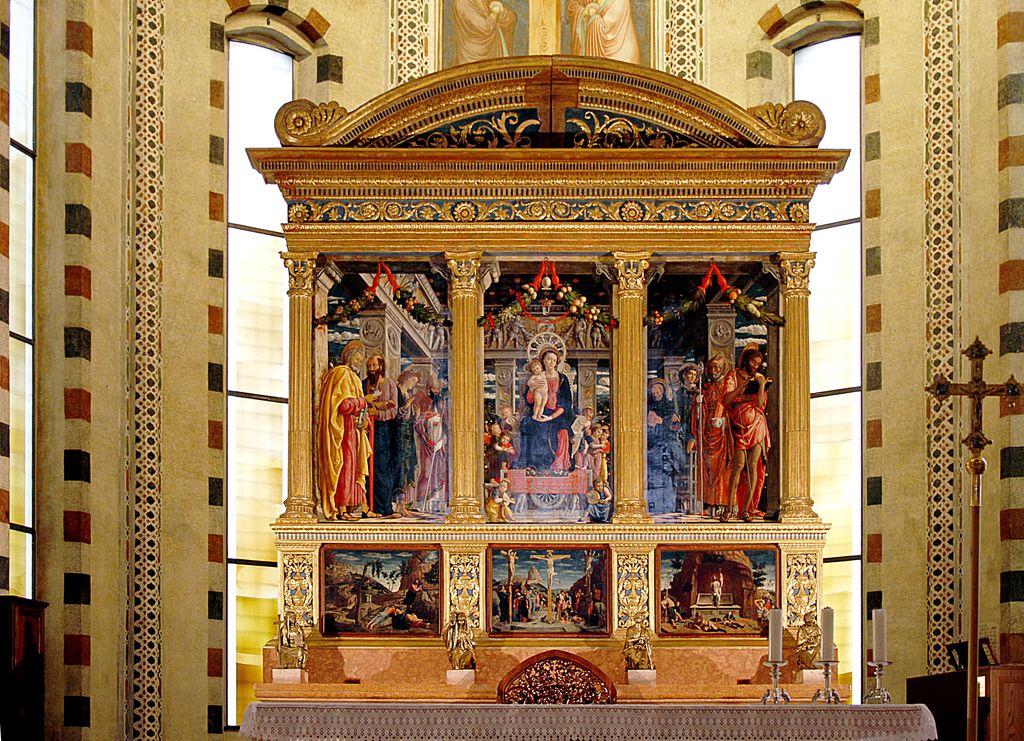
San Zeno Altarpiece
The San Zeno Altarpiece in its frame, Basilica of San Zeno, Verona José Luiz. Image source. CC BY-SA 4.0. Resized from the cited image.