 by Tom Gurney
Tom Gurney BSc (Hons) is an art history expert with over 20 years experience
Published on June 19, 2020 / Updated on November 29, 2026
Email: tomgurney1@gmail.com / Phone: +44 7429 011000
Overview
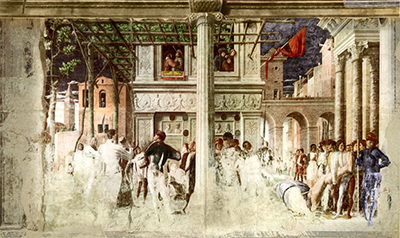
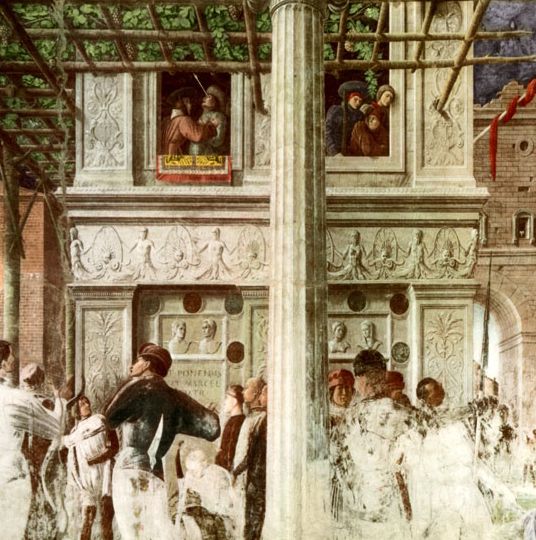
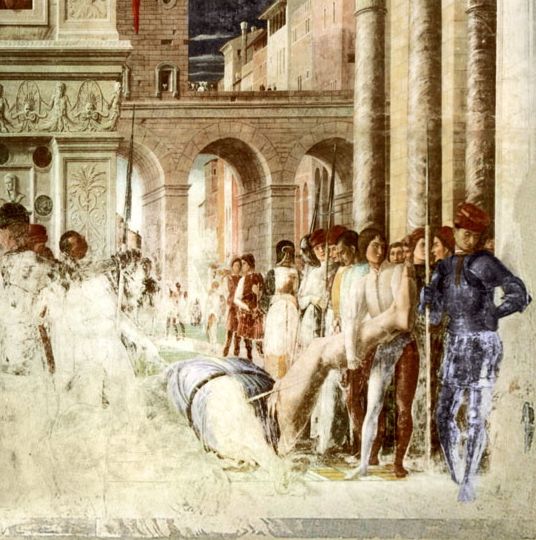
An arrow meant for Saint Christopher strikes the ruler watching from a window. In the next episode, men drag the beheaded saint across the same square. Andrea Mantegna painted both scenes at the foot of the right-hand wall of the Ovetari Chapel in Padua’s Church of the Eremitani. The Federico Zeri Foundation catalogues them separately as the Martyrdom of Saint Christopher and the Transport of Saint Christopher’s Body. In the chapel, a single painted column marks the passage from one episode to the next. [1] [2] [3]
The two scenes belong to the closing phase of the Ovetari project, generally placed in the mid-1450s. Both survive as detached frescoes. The faint figure at the far left and the visibly damaged foreground tell a longer story about the work’s condition than the wartime destruction of much of the chapel. [1] [2] [3] [4]
At a Glance
- ArtistAndrea Mantegna
- DateMid-1450s, approximate
- MediumDetached fresco
- LocationOvetari Chapel, Church of the Eremitani, Padua
Andrea Mantegna in context
San Zeno Altarpiece
1457–59 [20]The Triumphs of Caesar
Mid-1480s–before 1506 [21]Madonna della Vittoria
1495–96 [22]Martyrdom and Transport of the Body of Saint Christopher
Mid-1450s [15]The commission changes hands
On 16 May 1448, Imperatrice Capodilista, widow of Antonio degli Ovetari, commissioned the decoration of the family chapel in accordance with her husband’s will. The two lateral walls carried the stories of the chapel’s patron saints, James on the left and Christopher on the right. The original division of work assigned the entrance arch, vault and right wall to Giovanni d’Alemagna and Antonio Vivarini, established painters from Murano. The younger Paduan painters Nicolò Pizzolo and Mantegna were responsible for the remaining areas and were initially to share work on a relief altarpiece. The wall that eventually carried Mantegna’s Christopher scenes had therefore started out in the other team’s share. [3]
The arrangements shifted while the painters were still on the scaffolding. In 1449 arbitration between Pizzolo and Mantegna set out their respective areas and went so far as to divide the scaffolding materials. Pizzolo took responsibility for finishing the relief altarpiece. Giovanni d’Alemagna died, Vivarini withdrew, and Ansuino da Forlì and Bono da Ferrara took over work from the Venetian team from 1451. They contributed to the Christopher cycle above the two episodes Mantegna would paint. Pizzolo’s death in 1453 left further parts of the chapel unfinished. [3]
Treccani places the two Christopher scenes around the same time as the closing episodes of Saint James and the Assumption of the Virgin, while acknowledging that the surviving Ovetari commission documents do not explicitly name the final Christopher pair. The Zeri catalogue gives the broader span of 1448–57 for each scene. The mid-1450s date for the paired frescoes reflects their place in the sequence of work. The chapel commission ran through much of Mantegna’s early career in Padua, and its changing assignments account for the different hands across the chapel. [1] [2] [3]
The arrow and the weight of the body
At the far left, Christopher is bound to a pillar. His great size matters to the story, though his standing figure is now among the hardest passages to make out. The archers occupy a clearer part of the composition. One turns his back to us and spreads his arms, and the group’s attention shifts upwards. The ruler at the window has been hit in the eye by an arrow meant for Christopher. The Rijksmuseum identifies him as the king of Lycia in its account of the scene, which it catalogues in one of Giovanni David’s later etchings after the fresco. The painted action follows the legend in which the archers fail to wound the saint. [4] [5]
The spread arms of the foreground archer give the reversal a human scale. A viewer can follow his turn before locating the person who has been struck. The physical distance between Christopher at the edge and the ruler above the square is part of the surprise. A painted copy in the Musée Jacquemart-André makes the bound figure easier to read. Once you have located Christopher in the copy, you can return to the fresco and follow the action across its damaged left edge into the more legible group of soldiers. The French national art-history institute catalogues the Paris work as a copy after the Ovetari frescoes and records an attribution to an anonymous Paduan painter working in the second half of the fifteenth century. [4] [6]
Across the central column, the beheading has already taken place. The giant’s body lies on a diagonal in the foreground, and the men handling it bend and brace themselves under its weight. At a window on this side, women look down on the scene. Compare where the two groups of onlookers direct your attention. In the Martyrdom, the soldiers’ reaction draws the eye up to the wounded ruler. In the Transport, the height of the window makes the weight and low position of the body more striking. Christopher’s size, first registered in a standing body at the margin, now determines how much room his body takes up across the square. [2] [4] [7]
Francesca Gasperuzzo’s study of the chapel identifies a detail made difficult to see by the deterioration of the foreground. The severed head lay near the front edge of the paved space and was painted in pronounced foreshortening. She draws on copies in Paris and Parma to explain its effect and reads its proximity to the viewer in relation to the impending beheading of Saint James on the opposite wall. The Parma museum records its version as a work whose status has been disputed. It was once presented as a possible preparatory study, while later scholars treated it as a copy. The copies make it possible to discuss the placement of the head with more confidence than the surviving paint alone allows. [7] [8]
One column, one square, two moments
The upright in the middle looks like a column of the place where the story happens. Look past it at the buildings and arcades, which carry the eye into a single square. By extending the lines of the painted architecture back towards the horizon, Gasperuzzo locates a shared vanishing point at the centre of the column. Her calculations place the corresponding viewpoint close to the centre of the chapel and the painted horizon roughly a metre above the fresco’s lower edge. Those measurements describe a way the image was constructed and give a sense of where its recession would read most coherently from the chapel floor. [7]
The column solves a problem of storytelling as well as geometry. Christopher has to appear twice, at different stages of the same story, in a space the viewer can take in with one turn of the head. The column gives each episode its own foreground while preserving the view beyond. Treccani draws attention to the difference between this device and the painted ornamental borders separating the final episodes of Saint James across the chapel. In the Christopher scenes, the division has become something that might stand in the square itself. [3] [7]
The townscape feels familiar enough for Padua’s municipal guide to suggest that the elevated arches in the distance recall the traghetto, the passage that linked the Carraresi residence to the castle. Gasperuzzo describes a setting reminiscent of a northern Italian town and raises Padua and Ferrara as possibilities. The arcades and windows give the spectators places to gather and watch. The setting brings the distant world of the legend into the vernacular of a fifteenth-century Italian town. [4] [7]
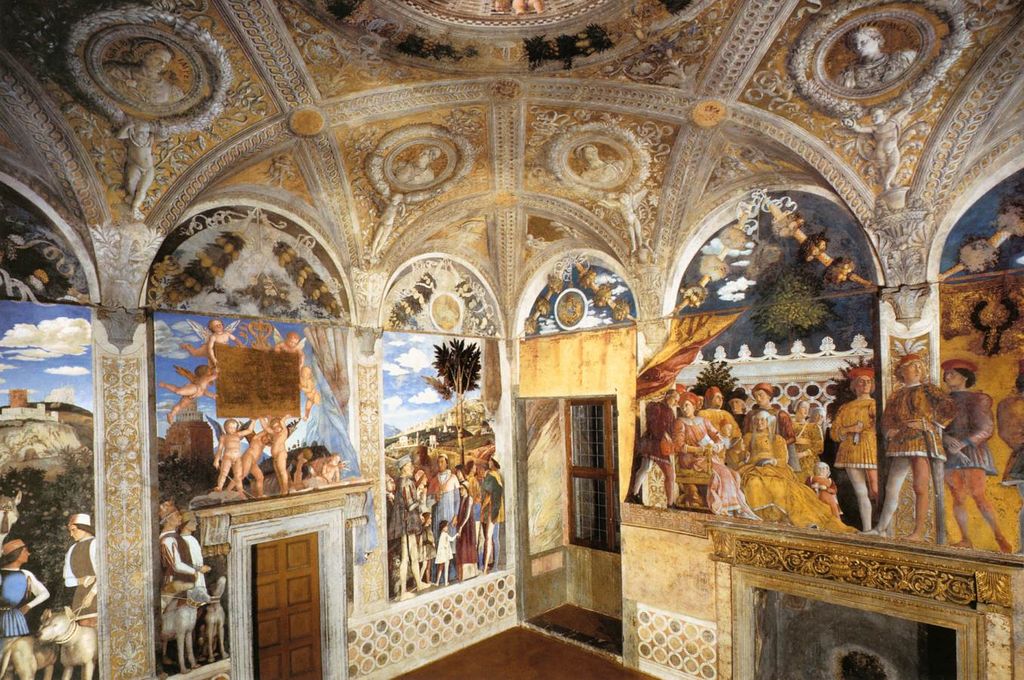
Architecture also ties figures together in the roughly contemporary San Luca Altarpiece, made for Santa Giustina in Padua. The Pinacoteca di Brera points out that the saints in the lower tier share a foreshortened platform across separate gold-backed compartments. In the chapel fresco, that continuity extends to the buildings and the open square, making room for two moments in one view. In the later Camera degli Sposi in Mantua, painted architecture extends through an entire room. The Palazzo Ducale describes how the fictive pilasters continue into the vault, where figures peer down through the painted oculus. Both rooms give the viewer a physical place in relation to the painted scene. At Padua, the illusion carries the gaze through a wall. In Mantua, it also carries it up through the ceiling. [7] [9] [10]
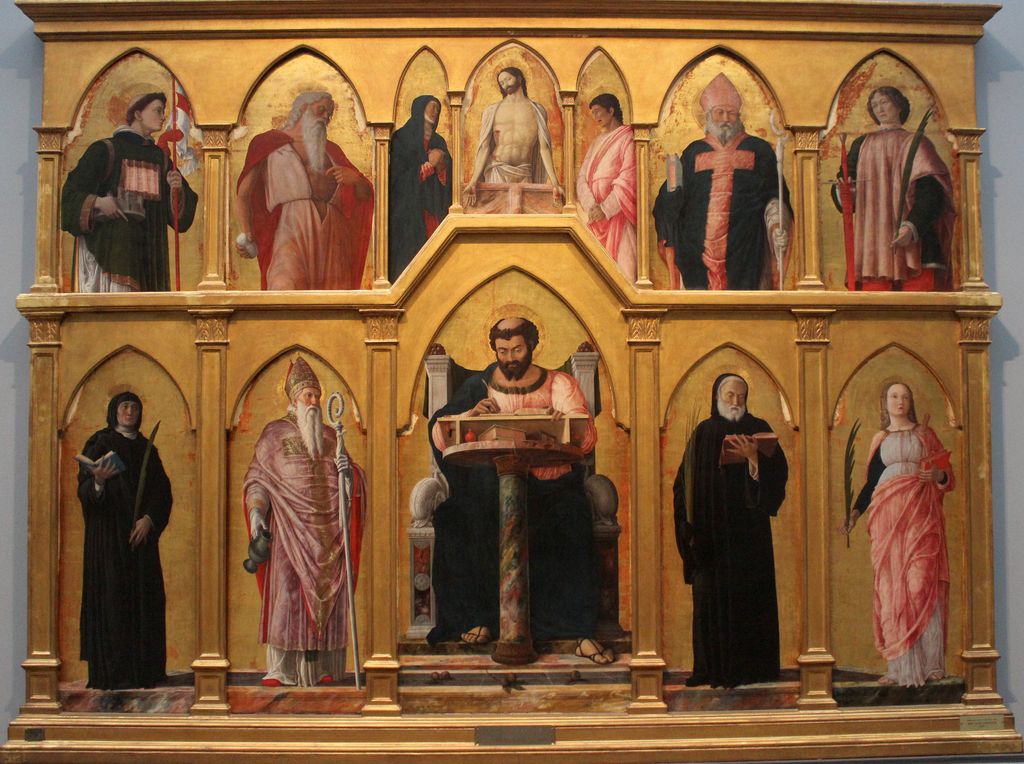
The San Luca Altarpiece, Pinacoteca di Brera Image source. Public domain.
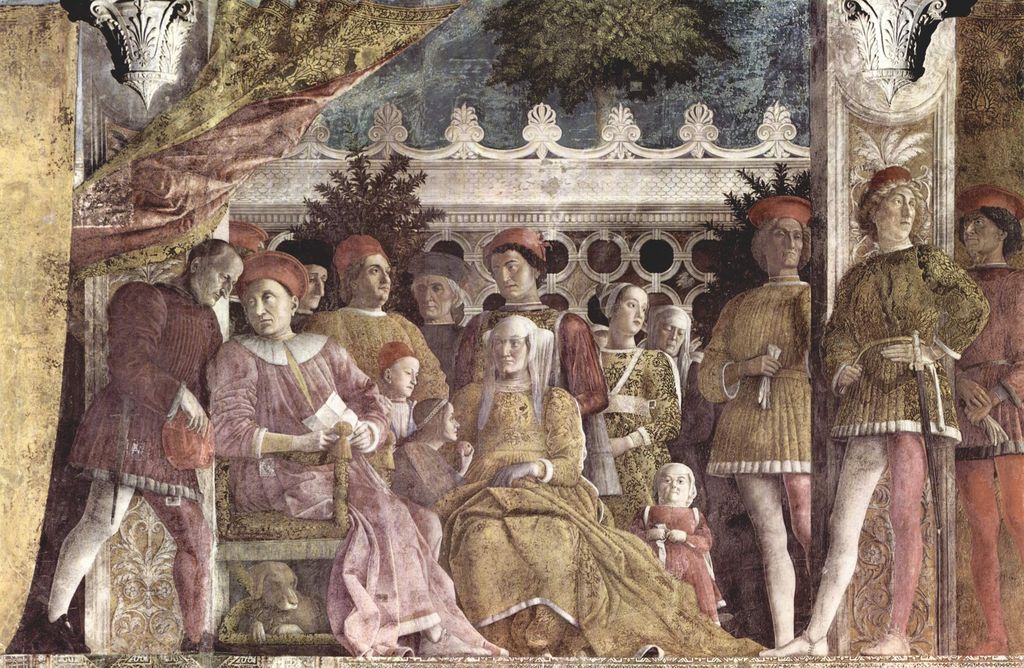
The Court scene, Camera degli Sposi, Palazzo Ducale, Mantua Image source. Public domain.
Why the lower scenes survived the bombing
Moisture had made the lower paintings vulnerable well before the Second World War. In the late nineteenth century the Christopher scenes and Mantegna’s Assumption of the Virgin were detached and transferred to movable supports. That earlier intervention made it possible to store them away from the church during the war. On 11 March 1944 an Allied air raid devastated the chapel. Much of the decoration still on the walls broke into fragments. The Christopher pair survived away from the building and is now back at the foot of the right wall. The damaged passages along its lower edge are part of the history of the surviving painting. [4] [7] [11] [12] [13]
Recovery of the paintings that shattered began soon after the war. In 1947, discussing the partial reassembly of the Martyrdom of Saint James, the conservator Cesare Brandi argued that even a single square decimetre of recovered painting mattered. Decades later, from 1999, the University of Padua’s Mantegna Project brought the chapel fragments into an interdisciplinary study. Art historian Alberta De Nicolò Salmazo joined physicists, mathematicians and engineers at the university’s laboratory in 2001. The reconstruction involved comparing pieces of painted plaster with old photographs to propose where the pieces belonged. The Istituto Veneto per i Beni Culturali describes an installation in which fragments were set into panels with subdued reproductions of photographs by Anderson and the Alinari brothers. Enough of the photographic image remains visible to indicate the composition between one piece of original paint and another. The architectural restoration and work on the south wall were among the main interventions in 2006, so the display brought the conserved lower fresco and the fragment-based treatment of the rest of the wall into view together. [12] [14] [15]
De Nicolò Salmazo describes how study of the fragments made it possible to recognise more of the way Pizzolo and the young Mantegna painted, and to connect surviving work with the documented activities of Ansuino and Bono. Restoring a fragment to a figure or an architectural feature could therefore change what historians knew about an individual painter. Gasperuzzo’s three-dimensional reconstruction of the Christopher scenes addresses a different question. It uses the geometry of the image to model the space Mantegna painted, so that the column and receding architecture can be studied spatially. The model reconstructs the painted architecture for study. The panels in the chapel show where surviving pieces of plaster fit within the original compositions. [7] [14] [15]
What the photographs and prints preserve
Two Anderson photographs in the Zeri archive, both taken by 1898, record the Martyrdom and the Transport separately. They allow different comparisons with the surviving fresco. On the left, look for the extent to which the standing Christopher was legible near the edge. On the right, follow the foreground around the men moving the body. The photographs record what was visible before the raid. A view of the present wall shows the relation between the two subjects and places the detached paintings below the areas reconstructed with fragments. [7] [12] [16] [17]
Giovanni David’s two etchings of 1776 provide an earlier record of how the scenes were seen and circulated. Giacomo Durazzo commissioned the series with a stated aim of preserving a record of vulnerable paintings. The impressions at the Metropolitan Museum of Art are numbered 59.570.243 and 1992.1056. The first, known as Primo Quadro, actually shows the transport. Secondo Quadro shows the attack by the archers. Palazzo Reale in Genoa explains the counterintuitive order through the mirror reversal of the design in print. Its catalogue also points out that the central column, Ionic in the fresco, became Doric in David’s Primo Quadro. [5] [11] [18] [19]
The column makes that difference easy to check. In the fresco it belongs to both episodes at once, giving the eye a place to pause before picking up the action on the other side. In the etchings each episode has its own sheet. The Anderson photographs also divide the action into two views. On the chapel wall the figure at the window and the men struggling with the body can be seen in the same sweep of the eye. The space between them is what lets Mantegna show the passage of time. [4] [7] [16] [17] [18] [19]
Annotated Details from Martyrdom and Transport of the Body of Saint Christopher
The numbered points identify details to look at closely. The detail images below preserve the native scale of the selected crops.
Martyrdom and Transport of the Body of Saint Christopher
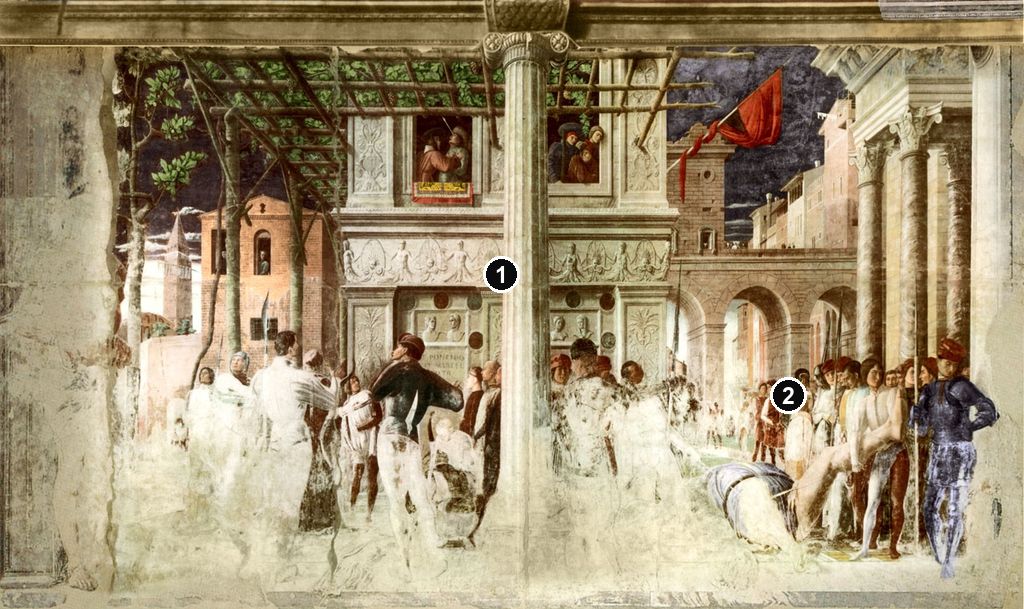
Details from MARTYRDOM AND TRANSPORT OF THE BODY OF SAINT CHRISTOPHER
Choose a detail to enlarge it.
Martyrdom and Transport of the Body of Saint Christopher
Architecture in the centre
The vertical division gives the adjacent episodes a shared architectural setting. Upper windows and ledges set a larger scale than the figures below.
The bearing party
The procession at right is read across the spaces between the figures and columns. The condition of the surface makes the historical state of the image important.
Artworks directory
| Name | Date | Medium and collection |
|---|---|---|
| The Adoration of the Shepherds | Shortly after 1450 | Painting · Metropolitan Museum of Art · 32.130.2 Catalogue. |
| Saint Mark the Evangelist | C. 1448–51 | Painting · Städel Museum · 1046 Catalogue. |
| Saint Jerome Penitent in the Desert | C. 1448–51 | Painting · Museu de Arte de São Paulo · MASP.00015 Catalogue. |
| Martyrdom and Transport of the Body of Saint Christopher | Mid-1450s | Painting · Ovetari Chapel, Padua Catalogue. |
| San Luca Altarpiece | 1453–55 | Painting · Pinacoteca di Brera · 176 Catalogue. |
| The Presentation of Christ at the Temple | 1454 (Berlin dating) | Painting · Gemäldegalerie, Berlin · 29 Catalogue. |
| San Zeno Altarpiece | 1457–59 | Painting · Basilica of San Zeno, Verona Catalogue. |
| The Crucifixion | 1456–59 | Painting · Musée du Louvre · INV 368 Catalogue. |
| The Agony in the Garden (London) | C. 1455–56 | Painting · National Gallery, London · NG1417 Catalogue. |
| The Agony in the Garden (Tours) | 1459 (Tours dating) | Painting · Musée des Beaux-Arts de Tours · 1803-1-24 Catalogue. |
| The Resurrection | 1459 (Tours dating) | Painting · Musée des Beaux-Arts de Tours · 1803-1-25 Catalogue. |
| Saint Sebastian (Vienna) | C. 1457–59 | Painting · Kunsthistorisches Museum · GG 301 Catalogue. |
| Cardinal Ludovico Trevisan | C. 1459–60 (Berlin exhibition dating) | Painting · Gemäldegalerie, Berlin · 9 Catalogue. |
| The Death of the Virgin | C. 1462 | Painting · Museo Nacional del Prado · P000248 Catalogue. |
| Christ with the Soul of the Virgin | C. 1460–64 | Painting · Pinacoteca Nazionale, Ferrara Catalogue only. |
| Portrait of a Young Man (traditionally Francesco Gonzaga) | C. 1461 or 1470, depending on sitter | Painting · Museo di Capodimonte · Q 60 Catalogue. |
| Portrait of a Prelate (Carlo de’ Medici?) | C. 1465–70 | Painting · Uffizi Galleries · 1890 no. 8540 Catalogue. |
| Portrait of a Man | C. 1470 | Painting · National Gallery of Art, Washington · 1952.2.5 Catalogue. |
| Madonna with Sleeping Child (Berlin) | C. 1455–60 | Painting · Gemäldegalerie, Berlin · S.5 Catalogue. |
| Camera degli Sposi (Camera Picta) | 1465–74 | Painting · Palazzo Ducale, Mantua Catalogue. |
| Saint Sebastian (Louvre) | Around 1480 | Painting · Musée du Louvre · RF 1766 Catalogue. |
| Lamentation over the Dead Christ | C. 1483 (Brera dating) | Painting · Pinacoteca di Brera · 352 Catalogue. |
| The Triumphs of Caesar | About 1485–1506 | Painting · Royal Collection · RCIN 403958–403966 Catalogue. |
| Madonna of the Caves | C. 1488–90 | Painting · Uffizi Galleries · 1890 no. 1348 Catalogue. |
| Madonna and Child with a Choir of Cherubim | C. 1485 | Painting · Pinacoteca di Brera · 297 Catalogue. |
| Madonna and Child (Poldi Pezzoli) | Early 1490s (museum dating) | Painting · Museo Poldi Pezzoli · 1595 Catalogue. |
| The Holy Family with Saint Mary Magdalen | C. 1495–1500 | Painting · Metropolitan Museum of Art · 14.40.643 Catalogue. |
| The Virgin and Child with Saint Mary Magdalene and Saint John the Baptist | C. 1490–1505 | Painting · National Gallery, London · NG274 Catalogue. |
| Christ as the Suffering Redeemer | 1485–95 (SMK dating) | Painting · Statens Museum for Kunst · KMSsp69 Catalogue. |
| Ecce Homo | C. 1500 | Painting · Musée Jacquemart-André · MJAP-P 1840 Catalogue. |
| Judith with the Head of Holofernes (Mantegna or follower) | C. 1495–1500 | Painting · National Gallery of Art, Washington · 1942.9.42 Catalogue. |
| Madonna della Vittoria | 1495–96 | Painting · Musée du Louvre · INV 369 Catalogue. |
| Mars and Venus (Parnassus) | C. 1496–97 | Painting · Musée du Louvre · INV 370 Catalogue. |
| The Trivulzio Madonna | 1497 | Painting · Castello Sforzesco, Milan · 0554 Catalogue. |
| The Adoration of the Magi | C. 1495–1505 | Painting · J. Paul Getty Museum · 85.PA.417 Catalogue. |
| Minerva Expelling the Vices from the Garden of Virtue | C. 1502 | Painting · Musée du Louvre · INV 371 Catalogue. |
| The Introduction of the Cult of Cybele at Rome | 1505–06 | Painting · National Gallery, London · NG902 Catalogue. |
| Saint Sebastian (Venice) | Probably c. 1504–06 | Painting · Galleria Giorgio Franchetti alla Ca’ d’Oro · D.11 Catalogue. |
| Samson and Delilah | C. 1500 | Painting · National Gallery, London · NG1145 Catalogue only. |
| A Woman Drinking (probably Sophonisba) | C. 1495–1506 | Painting · National Gallery, London · NG1125.2 Catalogue only. |
| The Vestal Virgin Tuccia with a Sieve | C. 1495–1506 | Painting · National Gallery, London · NG1125.1 Catalogue only. |
| Judith with the Head of Holofernes (Dublin) | C. 1495–1500 | Painting · National Gallery of Ireland · NGI.442 Catalogue only. |
| Battle of the Sea Gods, left half (Met impression) | Before 1481 (Met dating) | Print · Metropolitan Museum of Art · 18.12 Catalogue only. |
| Battle of the Sea Gods, right half (Met impression) | Before 1481 (Met dating) | Print · Metropolitan Museum of Art · 1984.1201.4 Catalogue only. |
| Battle of the Sea Gods, left half (Tokyo impression) | C. 1475 (Tokyo dating) | Print · National Museum of Western Art, Tokyo · G.1981-0002 Catalogue only. |
| Battle of the Sea Gods, left half (Washington impression) | C. 1485–88 (NGA dating) | Print · National Gallery of Art, Washington · 1941.1.6 Catalogue only. |
| The Entombment of Christ, second state of two | Before 1475 (Met dating) | Print · Metropolitan Museum of Art · 37.42.30 Catalogue only. |
| The Entombment of Christ (possibly Zoan Andrea, after Mantegna) | 1460–1549 (Rijksmuseum dating) | Print · Rijksmuseum · RP-P-1924-60 Catalogue only. |
| Four Dancing Muses (Gian Marco Cavalli after Mantegna) | C. 1497 | Print · Metropolitan Museum of Art · 20.5.3 Catalogue only. |
| Bacchanal with Silenus | Before 1475 (Met dating) | Print · Metropolitan Museum of Art · 29.44.15 Catalogue only. |
| Bacchanal with a Wine Vat | Before 1475 (Met dating) | Print · Metropolitan Museum of Art Catalogue only. |
| St James on His Way to Execution | C. 1453–57 | Drawing · British Museum · 1976,0616.1 Catalogue only. |
| Three Studies for a Dead Christ | C. 1455–65 | Drawing · British Museum · 1909,0406.3 Catalogue only. |
| Pietà (Venice) | C. 1456–65 (exhibition datings) | Drawing · Gallerie dell’Accademia, Venice · 115 Catalogue only. |
| Studies for Christ at the Column | 1460–65 | Drawing · The Courtauld · D.1978.PG.345 Catalogue only. |
| Virtus Combusta | C. 1490 (technical study) | Drawing · British Museum · Pp,1.23 Catalogue only. |
| Virtus Combusta (Giovanni Antonio da Brescia after Mantegna) | C. 1495–1506 | Print · Musée du Louvre · 3881 LR/ Recto Catalogue only. |
| The Calumny of Apelles | C. 1504–06 | Drawing · British Museum · 1860,0616.85 Catalogue only. |
Frequently Asked Questions
Mantegna uses a shared architectural setting for the attempted execution and the removal of Christopher’s body. The central column divides the episodes while the pavement and buildings help connect them.
They had been detached from the walls before the 1944 bombing. Photographs and fragments help document other portions of the damaged chapel.
Discussion
Look again at the images and ideas explored in Martyrdom of St Christopher. These editorial prompts invite your observations.
Reader Insights
How does the central column let Mantegna show two moments while keeping both groups in the same square?
What can an Anderson photograph, the Jacquemart-André copy and the detached fresco each tell us about the faint figure at the far left?
Join the Conversation
Share a detail, comparison or question about Martyrdom of St Christopher below.
References
- Fondazione Federico Zeri, Andrea Mantegna, Martirio di san Cristoforo. View source.
- Fondazione Federico Zeri, Andrea Mantegna, Trasporto del corpo di san Cristoforo. View source.
- Treccani, Andrea Mantegna, Dizionario Biografico degli Italiani. View source.
- Comune di Padova, Primo percorso, track 2 on the Church of the Eremitani and Ovetari Chapel. View source.
- Rijksmuseum, Giovanni David, Martelaarschap van de heilige Christoffel. View source.
- Institut national d’histoire de l’art, Trois Scènes de l’histoire de saint Christophe et saint Jacques, Musée Jacquemart-André. View source.
- Francesca Gasperuzzo, XY, ‘Missing’ images: the frescoes by Andrea Mantegna in Padua. View source.
- Complesso Monumentale della Pilotta, Martirio di san Cristoforo, Galleria Nazionale di Parma. View source.
- Pinacoteca di Brera, Polittico di San Luca. View source.
- Palazzo Ducale di Mantova, Camera Picta (Camera degli Sposi). View source.
- Palazzo Reale di Genova, Catalogo generale dei Beni Culturali, Giovanni David, Primo quadro a fresco, rappresentante il Martirio di S. Cristoforo. View source.
- Archivio Veneto degli Edifici Restaurati, Cappella Ovetari, Chiesa degli Eremitani. View source.
- Università degli Studi di Padova, La ricostruzione di Mantegna. View source.
- Alberta De Nicolò Salmazo, Università degli Studi di Padova, I tempi e i modi dell’arredo della cappella Ovetari. View source.
- Istituto Veneto per i Beni Culturali, Restauro della pala d’altare della cappella Ovetari, in La didattica del restauro 2, pp. 135–137. View source.
- Fondazione Federico Zeri, Anderson, Padova – Martirio di S. Cristoforo – Mantegna, negative 10340. View source.
- Fondazione Federico Zeri, Anderson, Padova – Martirio di S. Cristoforo – II parte, negative 10341. View source.
- The Metropolitan Museum of Art, Giovanni David, The Martyrdom of Saint Christopher, 59.570.243. View source.
- The Metropolitan Museum of Art, Giovanni David, The Martyrdom of Saint Christopher, “Secondo Quadro,” 1992.1056. View source.
- Basilica of San Zeno, Verona, San Zeno Altarpiece, View source.
- Royal Collection, The Triumphs of Caesar, View source.
- Musée du Louvre, Madonna della Vittoria, View source.
- National Gallery, London, The Introduction of the Cult of Cybele at Rome, View source.
More MANTEGNA Paintings
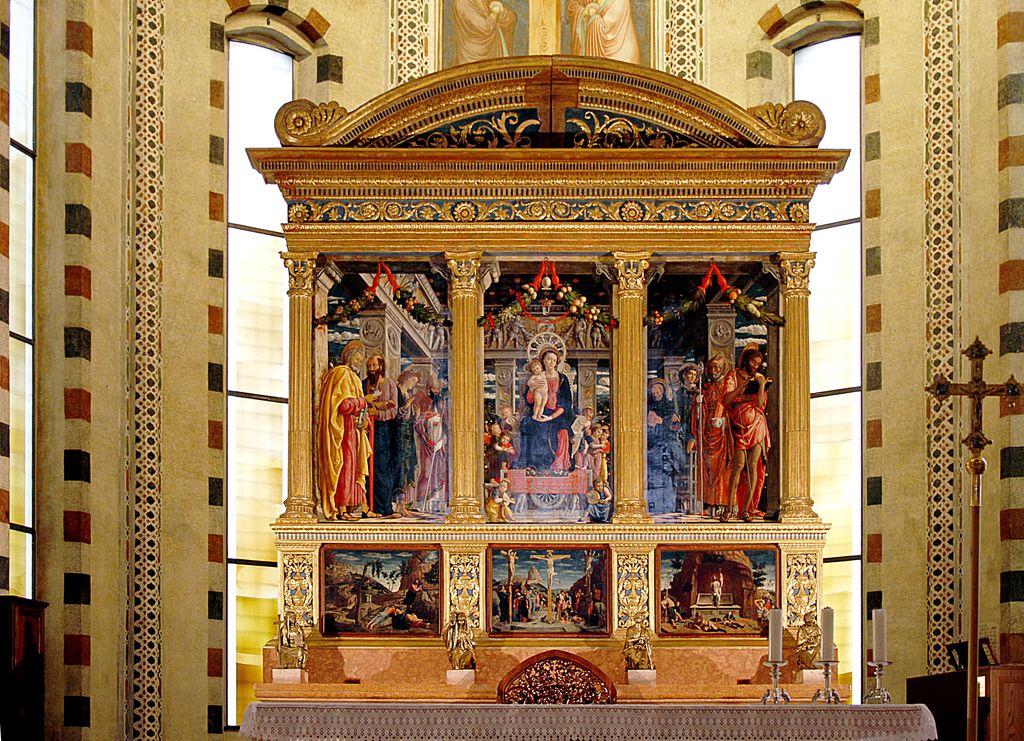
San Zeno Altarpiece
The San Zeno Altarpiece in its frame, Basilica of San Zeno, Verona José Luiz. Image source. CC BY-SA 4.0. Resized from the cited image.