 by Tom Gurney
Tom Gurney BSc (Hons) is an art history expert with over 20 years experience
Published on June 19, 2020 / Updated on November 29, 2026
Email: tomgurney1@gmail.com / Phone: +44 7429 011000
Overview
The rim of a porcelain cup nearly meets the Christ Child’s foot in Andrea Mantegna’s Adoration of the Magi. The oldest king has come close enough to offer the cup with his own hands. Mary supports the child as he raises a hand in blessing. Four more faces fill the little space around them. The J. Paul Getty Museum in Los Angeles dates the painting to about 1495–1505 and catalogues it as distemper on linen, accession 85.PA.417. The painted image is 48.6 by 65.6 centimetres. [1]
At a Glance
- DateAbout 1495–1505
- MediumDistemper on linen
- CollectionThe J. Paul Getty Museum, Los Angeles
- Accession number85.PA.417
- Image dimensions48.6 × 65.6 cm
Andrea Mantegna in context
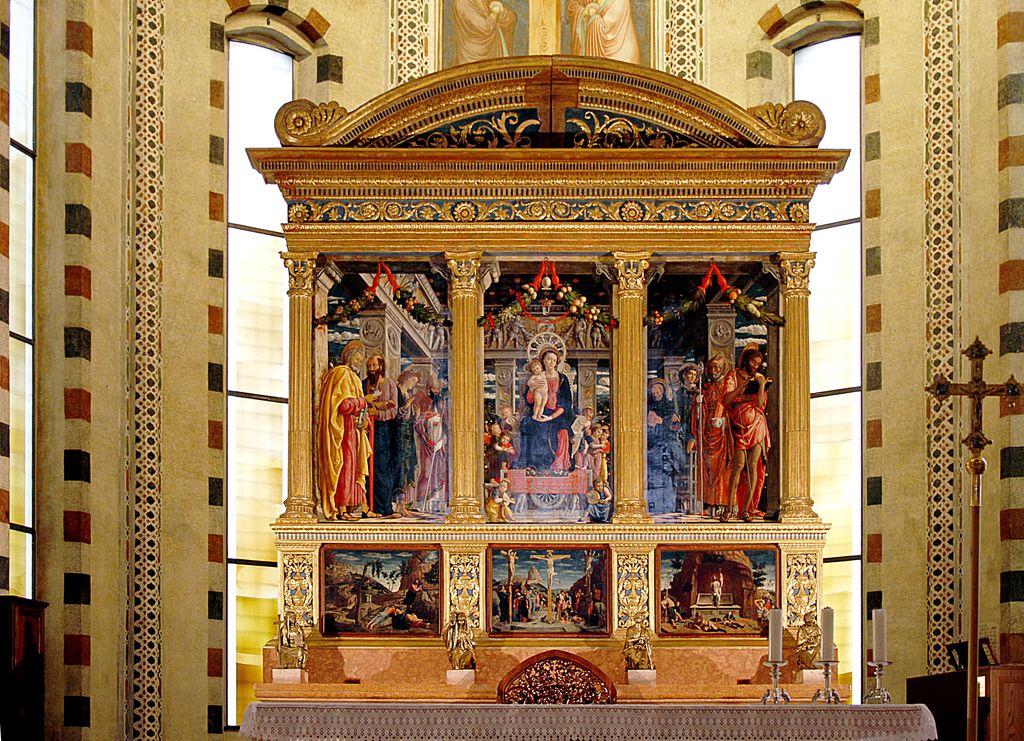
San Zeno Altarpiece
1457–59 [18]The Triumphs of Caesar
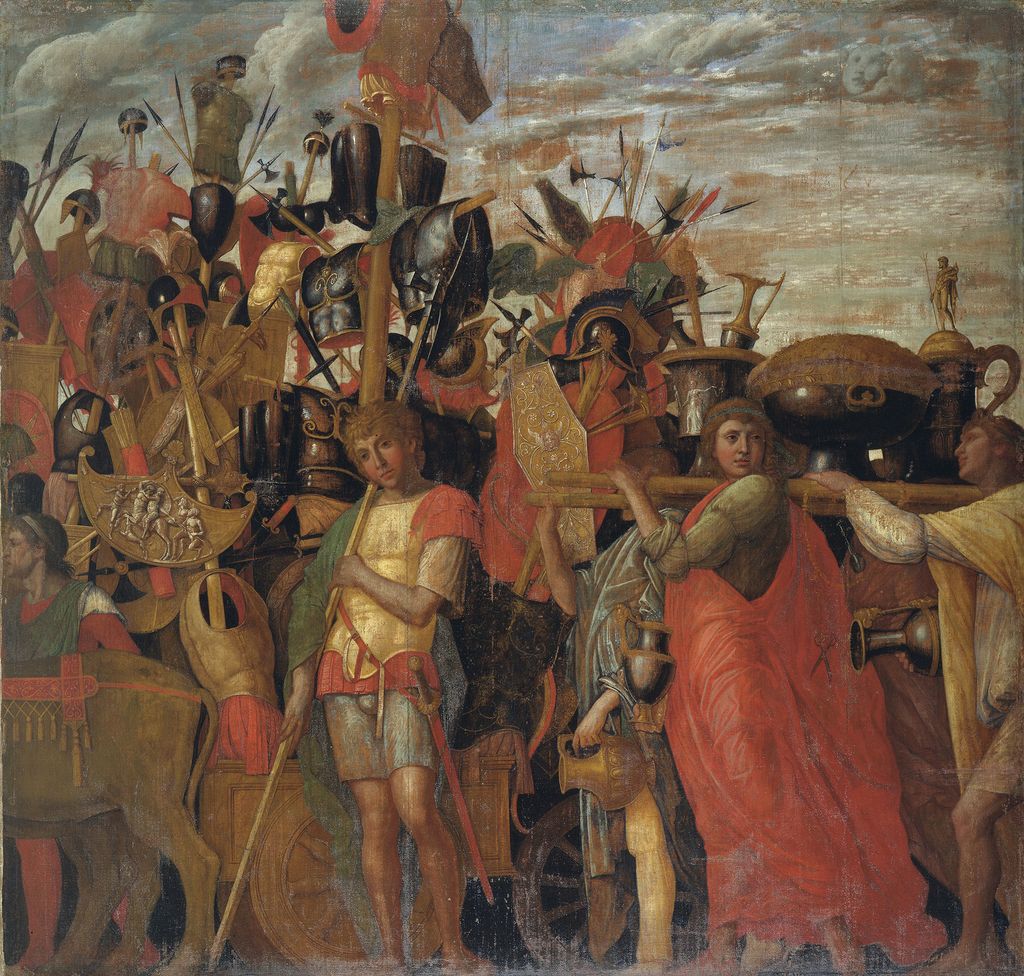
Mid-1480s–before 1506 [20]Madonna della Vittoria
1495–96 [21]The Adoration of the Magi
C. 1495–1505 [4]Six faces at arm’s length
In Matthew’s Gospel, visitors from the East follow a star, find the child with Mary, and open their treasures of gold, frankincense and myrrh. Matthew leaves their number and names unstated. The three kings familiar from later Christian tradition are Caspar, Melchior and Balthazar. Mantegna paints the moment of homage, with the journey over and the gifts already in hand. [2] [3]
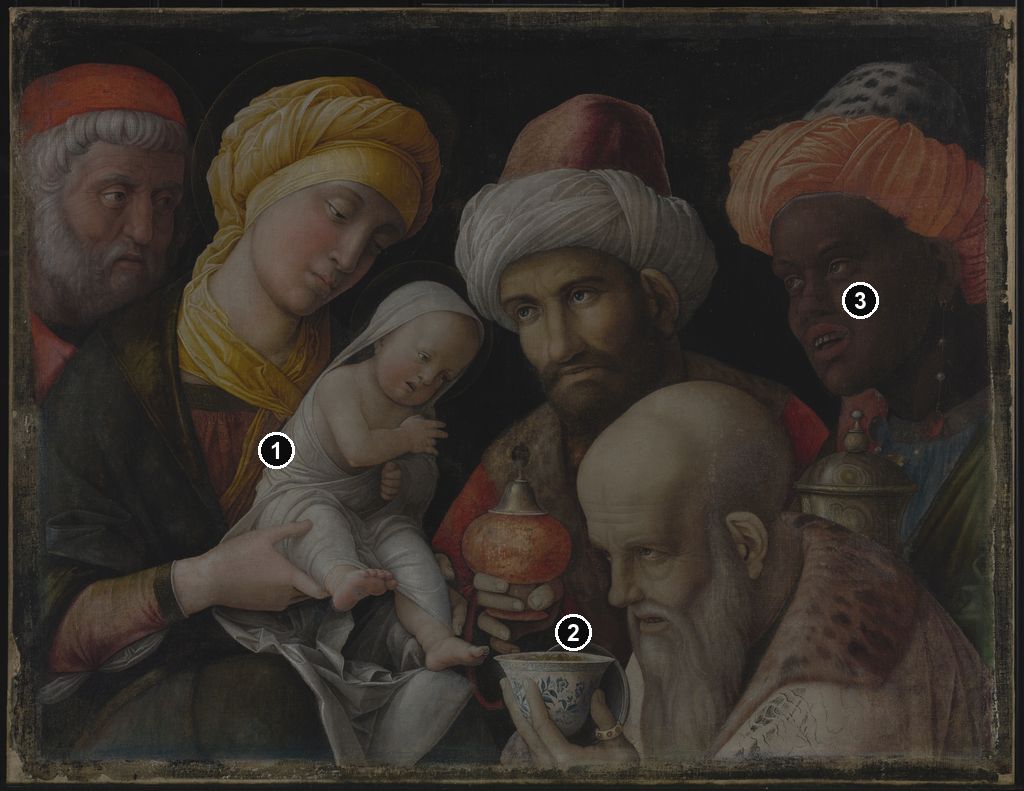
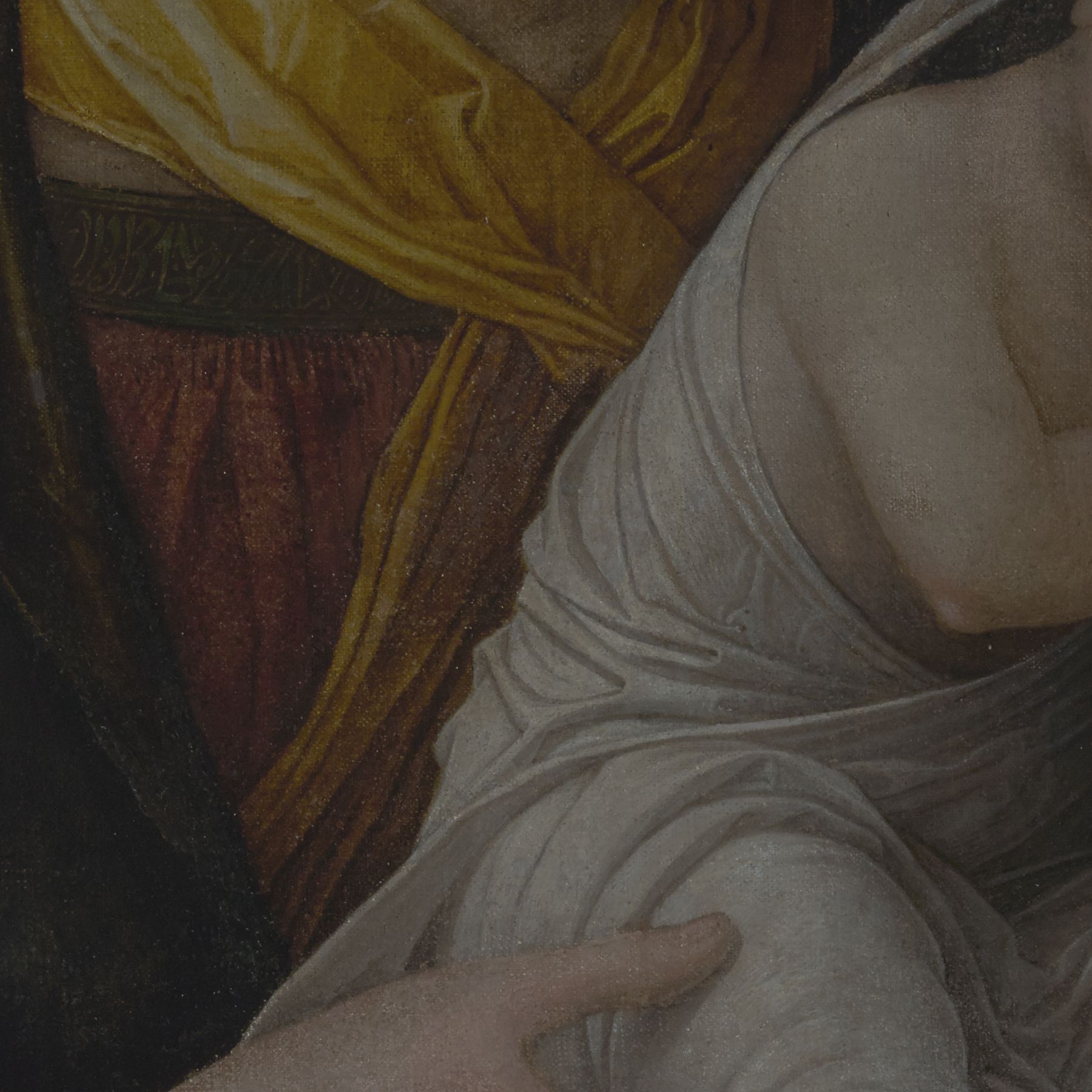
Joseph looks on from the far left, his face partly cut off by the edge. Mary inclines her head, and the child echoes the tilt as he turns towards the visitors. Across from them, Melchior and Balthazar look in towards the child, while Caspar bows low in the foreground. The faint circles of the haloes are easy to miss against the dark ground. The child’s white wrap catches the light and makes his small figure easy to follow from his face and blessing hand down to the two bare feet. Caspar’s broad forehead and long beard occupy the foreground below the standing kings. All three men attend to the smallest figure in the painting. [1]
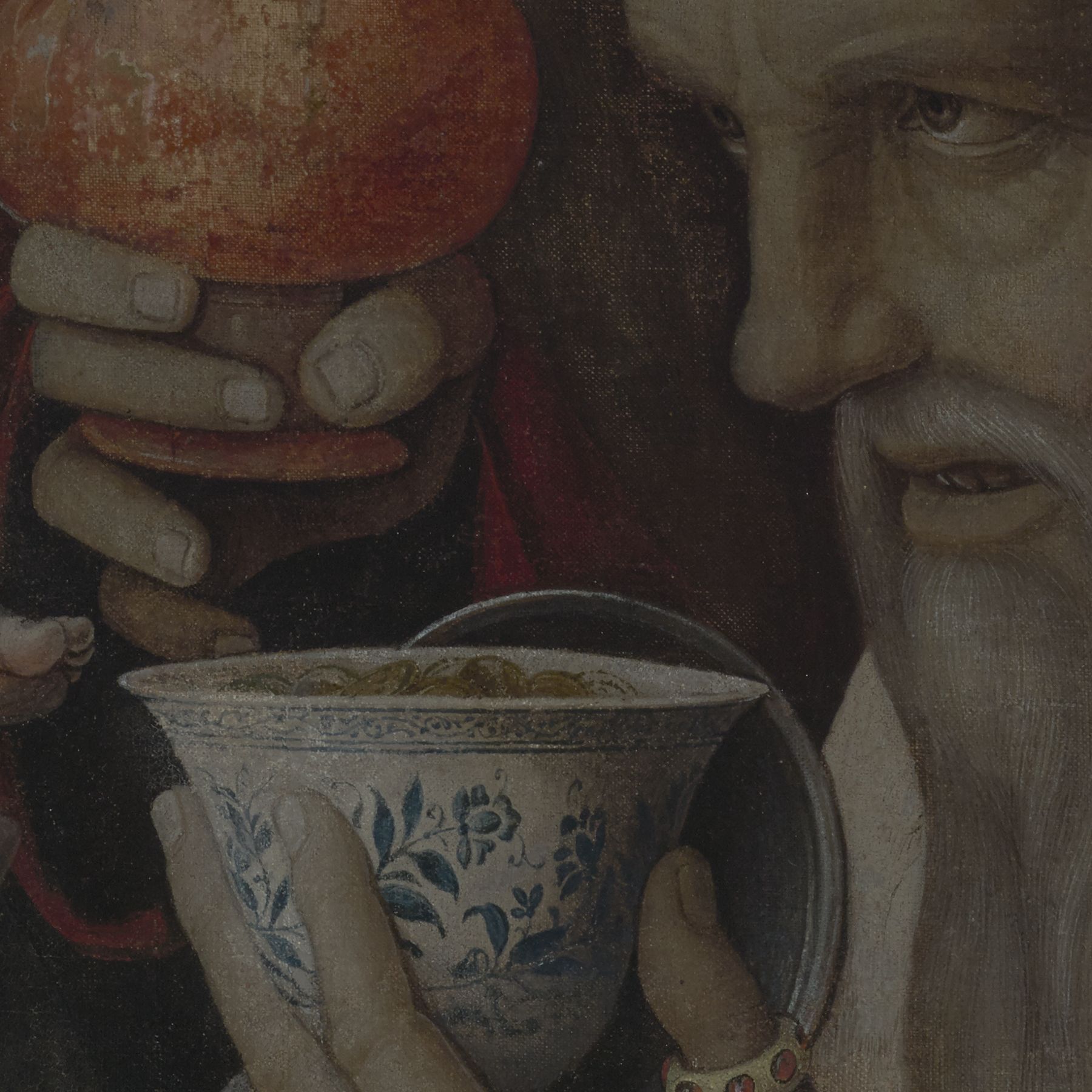
The hands give the scene its depth. Mary’s fingers cross the white cloth at the child’s thigh. His foreshortened leg advances towards the front of the picture, and his other foot comes close to the blue and white cup. Caspar’s fingers grip the vessel from either side, and a ring catches the light just below the rim. Just behind that exchange, Melchior’s fingers curl around the base of his own gift. The overlapping forms give each visitor a turn. Caspar is already within reach. Melchior holds his offering upright in readiness, and Balthazar’s covered vessel is partly screened by Caspar’s shoulder. [1]
Getty’s Cultural Objects Name Authority relates the shallow grouping to Mantegna’s study of ancient Roman reliefs. The comparison is especially apt at Caspar’s shoulder, where one large form cuts across the next and establishes a plane without the help of a receding floor. Art historian Alexander Nagel points to another precedent in the close-framed Virgin and Child of Byzantine icons. That comparison helps explain the formality of Mary’s pose even at such intimate range. She holds her child securely while presenting him to the people gathered before her. [4] [5]
White linen, wound cloth and painted letters
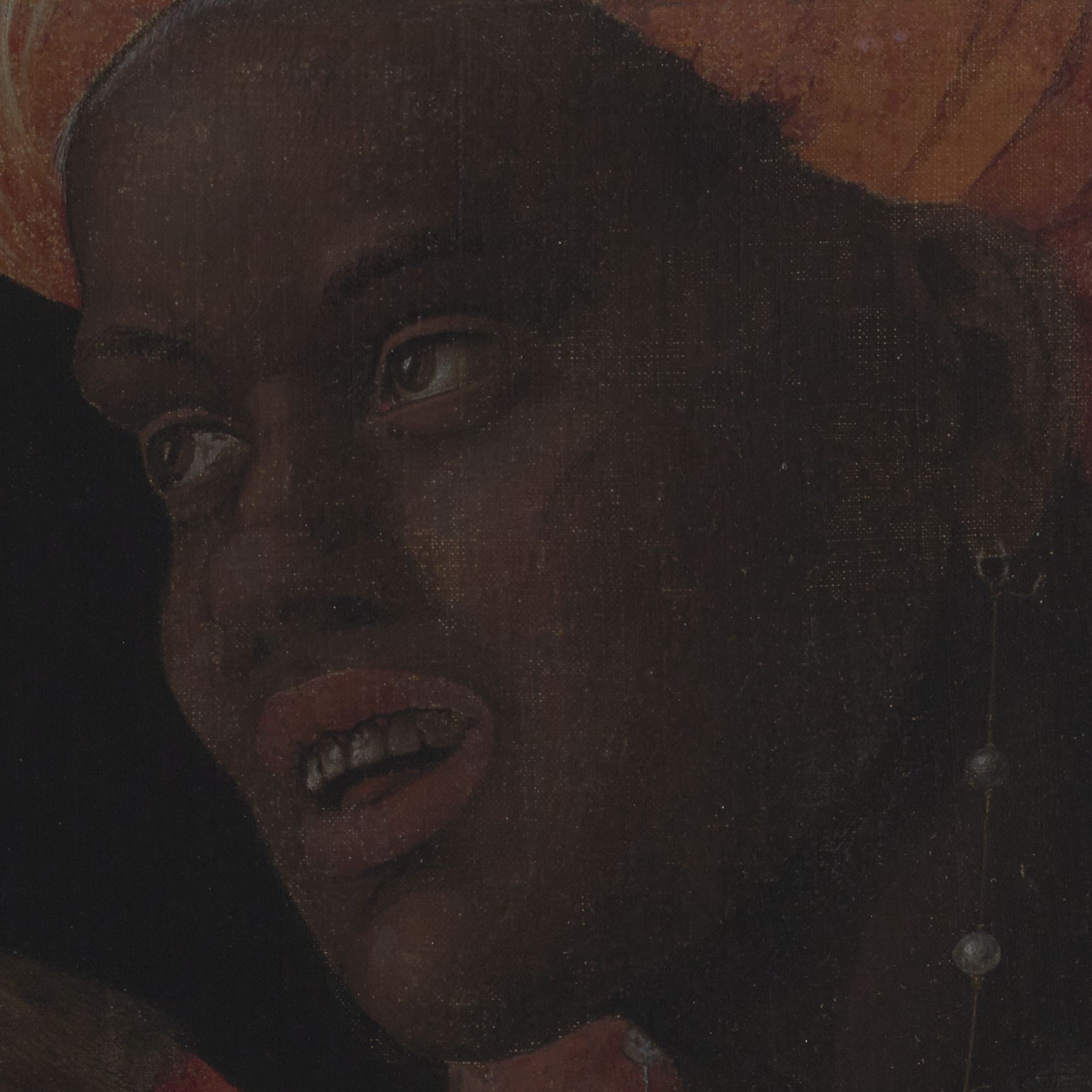
The two standing kings and Mary all wear wrapped headcloths, but the folds distinguish them immediately. Yellow fabric sweeps around Mary’s head and gathers again at her throat. Pale folds run diagonally across Melchior’s raised red cap. Balthazar’s orange wrap leaves a spotted section visible above it. The child’s winding cloth changes character as it descends, from narrow bands against his torso to loose angular folds below his legs. The colour and direction of the folds make each figure legible where their outlines meet. Caspar is bareheaded, but the spotted fur and pale patterned sleeve at the lower right carry the display of sumptuous fabrics into the foreground. [1] [3]
Fine marks on Mary’s neckline and cuff add another register to the clothing. Nagel reads these as an evocation of Syriac writing, comparable to scripts in biblical manuscripts. He notes that Isabella d’Este asked her adviser Paride Ceresara about examples of sacred lettering she had been sent in 1498, including which strokes belonged to the letters and which were flourishes. Her correspondence gives a contemporary setting for the interest in script that Nagel sees in the painting. His reading rests on visual resemblance. The marks are small and worked into the edges of fabric, where a painted suggestion of writing can carry an association with sacred antiquity without offering the viewer a continuous text to read. [5]
The cloth beneath the paint mattered to the appearance of those details. Getty conservator Andrea Rothe reported that analysis identified animal glue as the binder in the distemper. X-radiography also showed where Mantegna revised the faces of Mary and the child. Later varnish altered the surface of the glue-bound paint. The Getty treatment brought it closer to the matte finish associated with the technique. The small differences between flesh, cloth, glazed ceramic and polished stone depend on Mantegna’s modelling of light across each form. [6]
The Getty exhibition locates the work in Mantua, where Mantegna worked for the Gonzaga court. Its documented ownership begins much later. The National Gallery’s loan record traces it to Louisa, Lady Ashburton, by 1871 and to the collection at Castle Ashby in the twentieth century. The Getty acquired it in 1985. Its original owner and setting remain uncertain. [3] [6] [7]
Three vessels and the things they hold
Caspar’s cup is the only vessel whose contents can be seen. The Getty identifies the yellow discs inside as gold coins and the vessel as Chinese porcelain. Its narrow foot and spreading rim are visible between the king’s fingers, and blue sprays curve across the pale sides. Mantegna tilts the mouth just far enough for the coins to register. Their colour is concentrated inside the lip, leaving much of the foreground to the blue decoration and the hands that cradle it. [1]
Two early Ming pieces at the Metropolitan Museum of Art make different aspects of the painted cup easier to recognise. A Yongle-period cup from Jingdezhen, Cup with scholar and attendants in a garden, is only 5.4 centimetres high. It gives a sense of how a small porcelain vessel sits in the hand. Its decoration combines underglaze cobalt blue and coloured enamels. A Jingdezhen bowl of the Xuande period uses underglaze cobalt alone for a design that includes lotus scrolls and pomegranates. Its blue scrollwork offers a closer comparison for the rhythm of the painted ornament. Nagel reproduces a small early Ming bowl with an underglaze-blue lotus motif in the National Palace Museum in Taipei beside a detail of Mantegna’s cup. The exact model for Caspar’s cup remains unidentified. [5] [8] [9]
The other offerings are closed. Getty’s exhibition label identifies Melchior’s orange-red vessel as a Turkish incense burner. The mottled orange body sits between a pale band at the base and a metal-coloured cap. Nagel sees a resemblance to eastern Mediterranean vessels of Mantegna’s time and suggests jasper, tentatively, for the body. The banded vessel that Balthazar carries is described in the gallery text as possibly alabaster or agate, with a form recalling ancient containers for precious oils. Its domed lid and finial are more conspicuous than its body, partly hidden by Caspar’s mantle. In the traditional reading, the two covered containers carry frankincense and myrrh. The lids keep the substances out of sight, leaving their significance to the story and their value to be suggested through the workmanship of the vessels. [1] [3] [5]
Porcelain also passed between courts as a gift. Historian Leah R. Clark documents Mamluk rulers presenting Chinese porcelain as diplomatic gifts to European recipients, including the Venetian doge in 1490. Her research on the 1493 inventory of Eleonora d’Aragona, Duchess of Ferrara and mother of Isabella d’Este, records more than 170 pieces of porcelain. Isabella’s own later inventory includes porcelain vessels fitted with precious metal mounts. Clark links this culture of diplomatic giving and privileged viewing to Mantegna’s close-up. The viewer can inspect a precious object at the very instant it is offered. That sense of access is built into Caspar’s gesture, which turns the cup towards the child while exposing the rim and contents to the viewer. [10]
Balthazar at the edge of the group
Balthazar stands farthest from the child, his face high at the right edge. The orange folds around his forehead and the spotted crown of his headdress mark him out where his shoulder meets the edge. Getty’s exhibition interprets the spotted material as leopard skin and reads it as an association with Africa. Below the wrap, his parted lips and sideways gaze are more animated than Caspar’s. Most of his body falls outside the frame or behind the older king, but Mantegna shows enough of the vessel to establish what he has come to do. [1] [3]
In the Getty’s 2019–20 exhibition Balthazar: A Black African King in Medieval and Renaissance Art, the painting appeared alongside other stages in the development of the figure. In the earlier Adoration of the Magi with Saint Anthony Abbot, a Black page supports a tusk-shaped gift container beside one of the kings. In Georges Trubert’s illumination of about 1480–90, a Black king brings his own offering. Getty’s label reads Trubert’s kings as personifications of Europe, Asia and Africa. The exhibition’s reading of Mantegna puts emphasis on the things the men wear and carry, including Caspar’s Chinese porcelain and Melchior’s eastern Mediterranean costume and vessel. The two images show how variously artists could give geographic meaning to the same cast of three. [3] [11] [12]
Curators Kristen Collins and Bryan C. Keene situated the growing visibility of the Black king alongside the fifteenth-century expansion of European enslavement of Africans. They cite evidence that Isabella d’Este purchased African children, including a boy recorded as Maystro Petro in 1499, during the period when Mantegna worked for the Mantuan court. They raise the possibility that people in the household informed the painter’s portrayal. Balthazar’s features have no securely documented sitter. In a courtly world where Africans could be bought and held in bondage, Mantegna depicts a Black visitor taking part in a sacred act of homage as a ruler with a gift of his own. [12]
From the road to the picture’s edge
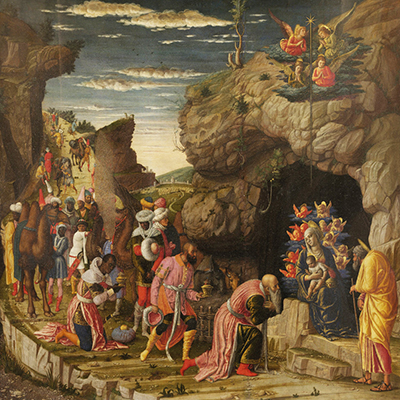
Mantegna had treated the subject decades earlier in the painting now at the centre of the Uffizi’s three panels of the life of Christ, dated 1460–65 by the gallery. The Uffizi connects those panels to the Gonzaga chapel in Mantua’s Castello di San Giorgio and dates their present frame to the nineteenth century. The central panel is concave, which the gallery takes as a clue that it may once have fitted into a curved wall in the chapel. In the earlier tempera on wood, a procession winds through an open, rocky setting before the kings reach the child, who sits on Mary’s lap amid angels. Paul Kaplan, writing for the Uffizi, identifies a Black magus and three other African figures in that retinue. In the Getty painting the visitors’ arrival is told by a few turns of the head and the order in which their vessels come forward. [13] [14]
The Uffizi’s exhibition Gioielli agli Uffizi draws attention to the earlier painting’s goldwork and gems, which carry much of the visual splendour of the offering. In the Getty picture the vessels differ markedly in colour, surface and silhouette. Caspar’s porcelain cup is immediately visible below his beard, the orange burner stands out near the child’s white clothing, and the lidded vessel at the far right partly merges with its surroundings. The later composition differentiates the gifts by how much of each vessel comes into view, while in the Uffizi panel the gold vessels emerge one by one as the procession reaches the foreground. [1] [15]
Mantegna’s Adoration of the Shepherds, in the Metropolitan Museum, painted shortly after 1450, sets another arrival in a landscape of rock, water and distant fields. The angels who announce the birth appear in the distance, and the worn clothes of the shepherds bring the marks of labour into their encounter with the Holy Family. The Getty kings bring the work of potters, metalworkers and textile makers into view in the decoration of their clothes and gifts. Across Mantegna’s paintings, a tighter parallel is the Paris Ecce Homo. Nagel also compares the two works for the script-like marks that enter their narrow fields of view, along Mary’s clothing in the Adoration and in the panels above the figures in Ecce Homo. [5] The Musée Jacquemart-André draws attention to the faces crowded around the bound Christ, where the pressure of the figures conveys hostility. In the Getty painting, the small interval still open between the bowed Caspar, his cup and the child’s foot is where that same compositional pressure becomes a gesture of deference. [16] [17]
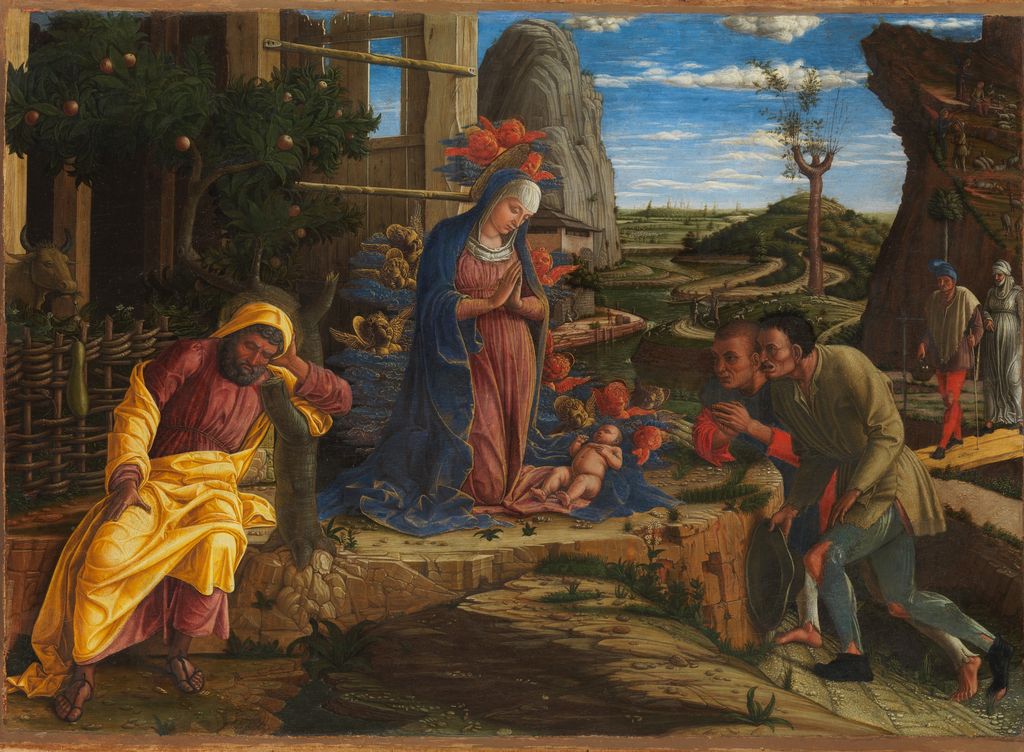
The Adoration of the Shepherds, Metropolitan Museum of Art Image source. Public domain.
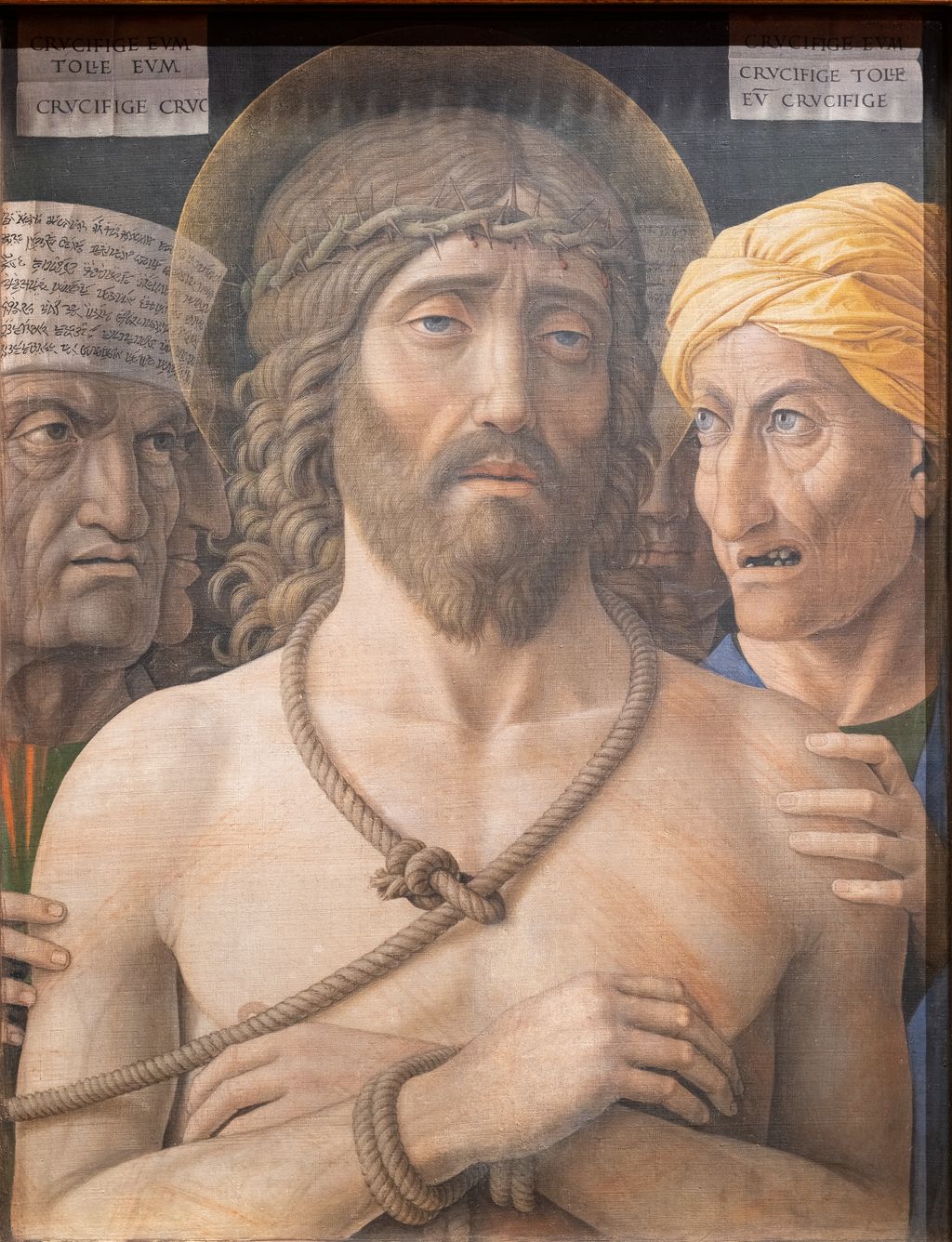
Ecce Homo, Musée Jacquemart-André Matthieu.lett.ube. Image source. CC BY 4.0. Resized from the cited image.
Annotated Details from Adoration of the Magi
The numbered points identify details to look at closely. The detail images below preserve the native scale of the selected crops.
Adoration of the Magi
Details from ADORATION OF THE MAGI
Choose a detail to enlarge it.
Adoration of the Magi
Mary and the child
The child’s pale body stands out beside Mary’s veil. A series of faces directs attention into this small space.
Gifts and hands
The vessels and reaching hands overlap near the lower edge. Their spacing sets the pace of the encounter.
Balthazar’s head covering
The colour and twisting bands of the head covering distinguish Balthazar amid the crowded heads.
Artworks directory
| Name | Date | Medium and collection |
|---|---|---|
| The Adoration of the Shepherds | Shortly after 1450 | Painting · Metropolitan Museum of Art · 32.130.2 Catalogue. |
| Saint Mark the Evangelist | C. 1448–51 | Painting · Städel Museum · 1046 Catalogue. |
| Saint Jerome Penitent in the Desert | C. 1448–51 | Painting · Museu de Arte de São Paulo · MASP.00015 Catalogue. |
| Martyrdom and Transport of the Body of Saint Christopher | Mid-1450s | Painting · Ovetari Chapel, Padua Catalogue. |
| San Luca Altarpiece | 1453–55 | Painting · Pinacoteca di Brera · 176 Catalogue. |
| The Presentation of Christ at the Temple | 1454 (Berlin dating) | Painting · Gemäldegalerie, Berlin · 29 Catalogue. |
| San Zeno Altarpiece | 1457–59 | Painting · Basilica of San Zeno, Verona Catalogue. |
| The Crucifixion | 1456–59 | Painting · Musée du Louvre · INV 368 Catalogue. |
| The Agony in the Garden (London) | C. 1455–56 | Painting · National Gallery, London · NG1417 Catalogue. |
| The Agony in the Garden (Tours) | 1459 (Tours dating) | Painting · Musée des Beaux-Arts de Tours · 1803-1-24 Catalogue. |
| The Resurrection | 1459 (Tours dating) | Painting · Musée des Beaux-Arts de Tours · 1803-1-25 Catalogue. |
| Saint Sebastian (Vienna) | C. 1457–59 | Painting · Kunsthistorisches Museum · GG 301 Catalogue. |
| Cardinal Ludovico Trevisan | C. 1459–60 (Berlin exhibition dating) | Painting · Gemäldegalerie, Berlin · 9 Catalogue. |
| The Death of the Virgin | C. 1462 | Painting · Museo Nacional del Prado · P000248 Catalogue. |
| Christ with the Soul of the Virgin | C. 1460–64 | Painting · Pinacoteca Nazionale, Ferrara Catalogue only. |
| Portrait of a Young Man (traditionally Francesco Gonzaga) | C. 1461 or 1470, depending on sitter | Painting · Museo di Capodimonte · Q 60 Catalogue. |
| Portrait of a Prelate (Carlo de’ Medici?) | C. 1465–70 | Painting · Uffizi Galleries · 1890 no. 8540 Catalogue. |
| Portrait of a Man | C. 1470 | Painting · National Gallery of Art, Washington · 1952.2.5 Catalogue. |
| Madonna with Sleeping Child (Berlin) | C. 1455–60 | Painting · Gemäldegalerie, Berlin · S.5 Catalogue. |
| Camera degli Sposi (Camera Picta) | 1465–74 | Painting · Palazzo Ducale, Mantua Catalogue. |
| Saint Sebastian (Louvre) | Around 1480 | Painting · Musée du Louvre · RF 1766 Catalogue. |
| Lamentation over the Dead Christ | C. 1483 (Brera dating) | Painting · Pinacoteca di Brera · 352 Catalogue. |
| The Triumphs of Caesar | About 1485–1506 | Painting · Royal Collection · RCIN 403958–403966 Catalogue. |
| Madonna of the Caves | C. 1488–90 | Painting · Uffizi Galleries · 1890 no. 1348 Catalogue. |
| Madonna and Child with a Choir of Cherubim | C. 1485 | Painting · Pinacoteca di Brera · 297 Catalogue. |
| Madonna and Child (Poldi Pezzoli) | Early 1490s (museum dating) | Painting · Museo Poldi Pezzoli · 1595 Catalogue. |
| The Holy Family with Saint Mary Magdalen | C. 1495–1500 | Painting · Metropolitan Museum of Art · 14.40.643 Catalogue. |
| The Virgin and Child with Saint Mary Magdalene and Saint John the Baptist | C. 1490–1505 | Painting · National Gallery, London · NG274 Catalogue. |
| Christ as the Suffering Redeemer | 1485–95 (SMK dating) | Painting · Statens Museum for Kunst · KMSsp69 Catalogue. |
| Ecce Homo | C. 1500 | Painting · Musée Jacquemart-André · MJAP-P 1840 Catalogue. |
| Judith with the Head of Holofernes (Mantegna or follower) | C. 1495–1500 | Painting · National Gallery of Art, Washington · 1942.9.42 Catalogue. |
| Madonna della Vittoria | 1495–96 | Painting · Musée du Louvre · INV 369 Catalogue. |
| Mars and Venus (Parnassus) | C. 1496–97 | Painting · Musée du Louvre · INV 370 Catalogue. |
| The Trivulzio Madonna | 1497 | Painting · Castello Sforzesco, Milan · 0554 Catalogue. |
| The Adoration of the Magi | C. 1495–1505 | Painting · J. Paul Getty Museum · 85.PA.417 Catalogue. |
| Minerva Expelling the Vices from the Garden of Virtue | C. 1502 | Painting · Musée du Louvre · INV 371 Catalogue. |
| The Introduction of the Cult of Cybele at Rome | 1505–06 | Painting · National Gallery, London · NG902 Catalogue. |
| Saint Sebastian (Venice) | Probably c. 1504–06 | Painting · Galleria Giorgio Franchetti alla Ca’ d’Oro · D.11 Catalogue. |
| Samson and Delilah | C. 1500 | Painting · National Gallery, London · NG1145 Catalogue only. |
| A Woman Drinking (probably Sophonisba) | C. 1495–1506 | Painting · National Gallery, London · NG1125.2 Catalogue only. |
| The Vestal Virgin Tuccia with a Sieve | C. 1495–1506 | Painting · National Gallery, London · NG1125.1 Catalogue only. |
| Judith with the Head of Holofernes (Dublin) | C. 1495–1500 | Painting · National Gallery of Ireland · NGI.442 Catalogue only. |
| Battle of the Sea Gods, left half (Met impression) | Before 1481 (Met dating) | Print · Metropolitan Museum of Art · 18.12 Catalogue only. |
| Battle of the Sea Gods, right half (Met impression) | Before 1481 (Met dating) | Print · Metropolitan Museum of Art · 1984.1201.4 Catalogue only. |
| Battle of the Sea Gods, left half (Tokyo impression) | C. 1475 (Tokyo dating) | Print · National Museum of Western Art, Tokyo · G.1981-0002 Catalogue only. |
| Battle of the Sea Gods, left half (Washington impression) | C. 1485–88 (NGA dating) | Print · National Gallery of Art, Washington · 1941.1.6 Catalogue only. |
| The Entombment of Christ, second state of two | Before 1475 (Met dating) | Print · Metropolitan Museum of Art · 37.42.30 Catalogue only. |
| The Entombment of Christ (possibly Zoan Andrea, after Mantegna) | 1460–1549 (Rijksmuseum dating) | Print · Rijksmuseum · RP-P-1924-60 Catalogue only. |
| Four Dancing Muses (Gian Marco Cavalli after Mantegna) | C. 1497 | Print · Metropolitan Museum of Art · 20.5.3 Catalogue only. |
| Bacchanal with Silenus | Before 1475 (Met dating) | Print · Metropolitan Museum of Art · 29.44.15 Catalogue only. |
| Bacchanal with a Wine Vat | Before 1475 (Met dating) | Print · Metropolitan Museum of Art Catalogue only. |
| St James on His Way to Execution | C. 1453–57 | Drawing · British Museum · 1976,0616.1 Catalogue only. |
| Three Studies for a Dead Christ | C. 1455–65 | Drawing · British Museum · 1909,0406.3 Catalogue only. |
| Pietà (Venice) | C. 1456–65 (exhibition datings) | Drawing · Gallerie dell’Accademia, Venice · 115 Catalogue only. |
| Studies for Christ at the Column | 1460–65 | Drawing · The Courtauld · D.1978.PG.345 Catalogue only. |
| Virtus Combusta | C. 1490 (technical study) | Drawing · British Museum · Pp,1.23 Catalogue only. |
| Virtus Combusta (Giovanni Antonio da Brescia after Mantegna) | C. 1495–1506 | Print · Musée du Louvre · 3881 LR/ Recto Catalogue only. |
| The Calumny of Apelles | C. 1504–06 | Drawing · British Museum · 1860,0616.85 Catalogue only. |
Frequently Asked Questions
Mantegna brings the six heads, the child and the vessels up to the picture’s edge. The restricted space makes the exchange of attention and gifts easier to follow than a procession in the distance.
The Getty identifies the yellow discs in Caspar’s porcelain cup as gold coins. The other two vessels are closed and their contents are understood through the story.
Discussion
Look again at the images and ideas explored in Adoration of the Magi. These editorial prompts invite your observations.
Reader Insights
How do the overlaps among Mary’s hand, the child’s foot and Caspar’s cup establish who can approach the child first?
How do Balthazar’s headdress, partly hidden vessel and place behind Caspar affect the way you read him as one of the three kings?
Join the Conversation
Share a detail, comparison or question about Adoration of the Magi below.
References
- The J. Paul Getty Museum, Adoration of the Magi, 85.PA.417, museum-contributed object record. View source.
- United States Conference of Catholic Bishops, Matthew 2:1–12, The Visit of the Magi. View source.
- The J. Paul Getty Museum, Balthazar: A Black African King in Medieval and Renaissance Art, gallery text. View source.
- Getty Research Institute, Cultural Objects Name Authority, Adoration of the Magi, record 700002178. View source.
- Alexander Nagel, Some Discoveries of 1492: Eastern Antiquities and Renaissance Europe, pp. 4–9. View source.
- Andrea Rothe, Andrea Mantegna’s Adoration of the Magi, Historical Painting Techniques, Materials, and Studio Practice, pp. 111–115. View source.
- The National Gallery, Mantegna and Bellini, loan and provenance record for The Adoration of the Magi, X9835. View source.
- The Metropolitan Museum of Art, Cup with scholar and attendants in a garden, 18.56.38. View source.
- The Metropolitan Museum of Art, Bowl with pomegranates, lotus scrolls, and chrysanthemum petals, 1991.253.39. View source.
- Leah R. Clark, The peregrinations of porcelain: The collections of Duchess Eleonora d’Aragona of Ferrara. View source.
- The J. Paul Getty Museum, Balthazar: A Black African King in Medieval and Renaissance Art, object checklist, nos. 23–24. View source.
- Kristen Collins and Bryan C. Keene, Exhibition Explores Balthazar, an African King, in Medieval and Renaissance Art. View source.
- Gallerie degli Uffizi, Ascensione di Cristo; Adorazione dei Magi; Presentazione di Gesù al tempio. View source.
- Paul Kaplan, On Being Present, vol. I, section on the Black Magus. View source.
- Gallerie degli Uffizi, Gioielli agli Uffizi, Andrea Mantegna, Adorazione dei Magi, entry 38. View source.
- The Metropolitan Museum of Art, The Adoration of the Shepherds, 32.130.2. View source.
- Musée Jacquemart-André, Ecce Homo, Andrea Mantegna. View source.
- Basilica of San Zeno, Verona, San Zeno Altarpiece, View source.
- Palazzo Ducale, Mantua, Camera degli Sposi (Camera Picta), View source.
- Royal Collection, The Triumphs of Caesar, View source.
- Musée du Louvre, Madonna della Vittoria, View source.
- National Gallery, London, The Introduction of the Cult of Cybele at Rome, View source.
More MANTEGNA Paintings
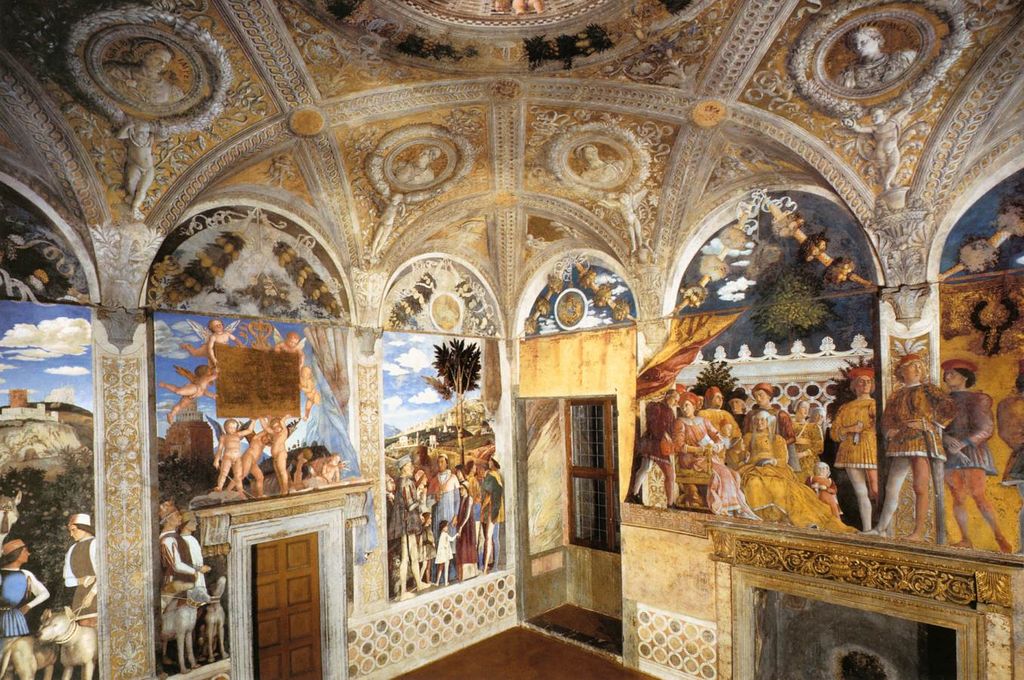
San Zeno Altarpiece
The San Zeno Altarpiece in its frame, Basilica of San Zeno, Verona José Luiz. Image source. CC BY-SA 4.0. Resized from the cited image.