 by Tom Gurney
Tom Gurney BSc (Hons) is an art history expert with over 20 years experience
Published on June 19, 2020 / Updated on November 29, 2026
Email: tomgurney1@gmail.com / Phone: +44 7429 011000
Overview
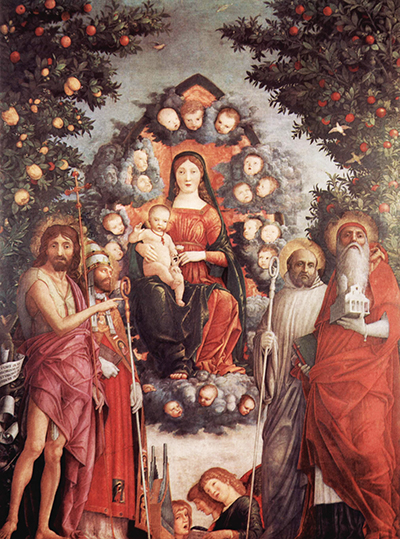
A singing angel at the foot of Andrea Mantegna’s Trivulzio Madonna holds the painter’s signature and the date 15 August 1497. The date falls on the feast of the Assumption, to which the Olivetan Benedictine church of Santa Maria in Organo in Verona was dedicated. Mantegna painted the altarpiece in tempera on canvas for the church’s high altar. At nearly three metres high, it still gives the impression of an encounter staged above the viewer’s head at the Pinacoteca of the Castello Sforzesco in Milan. [1] [2] [3] [4]
At a Glance
- DateSigned and dated 15 August 1497
- MediumTempera on canvas
- Original settingHigh altar of Santa Maria in Organo, Verona
- CollectionPinacoteca del Castello Sforzesco, Milan
- Inventory number0554
Andrea Mantegna in context
San Zeno Altarpiece
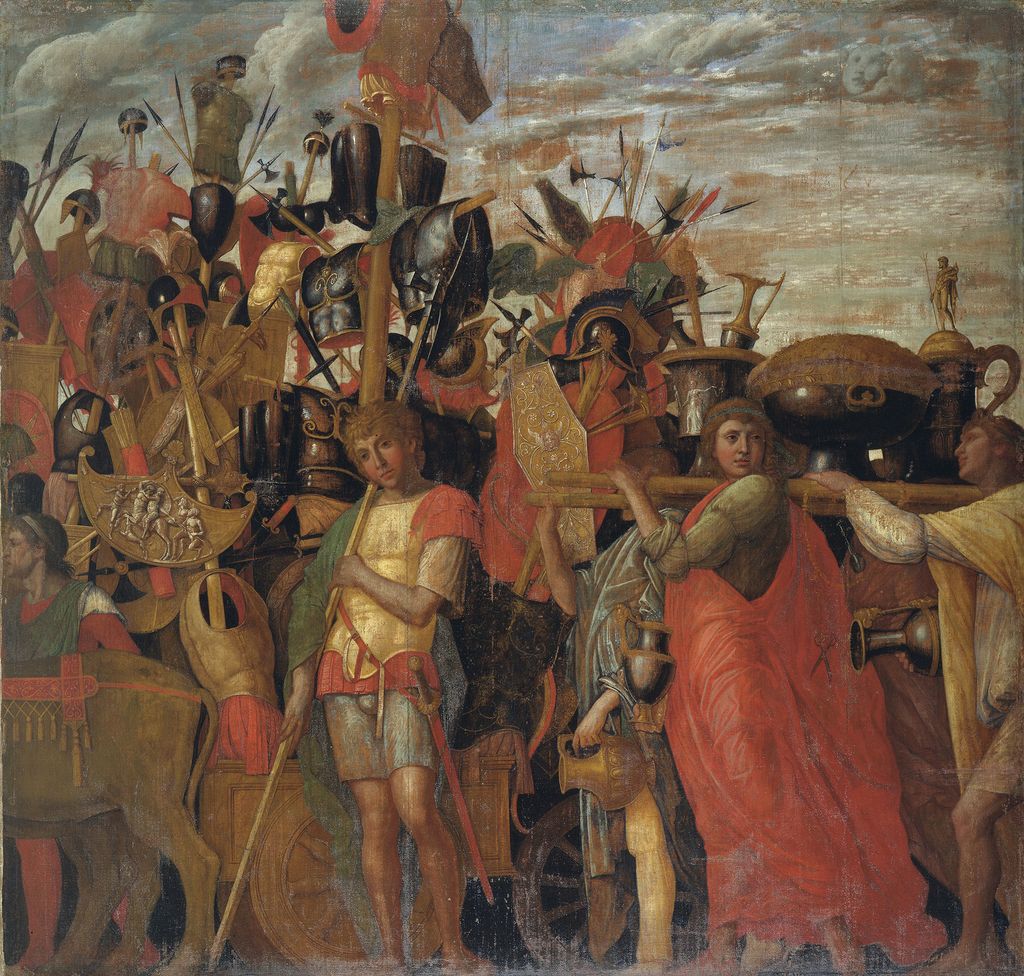
1457–59 [8]The Triumphs of Caesar
Mid-1480s–before 1506 [17]Madonna della Vittoria
1495–96 [10]The Trivulzio Madonna
1497 [2]A feast day written into the picture
The signature is easy to overlook. One of the singers holds a small painted sheet close to the lower edge, where a viewer might expect to see music. The lettering records that Andrea Mantegna painted the work in the year of grace 1497, on 15 August. The national catalogue records the altarpiece’s delivery for the feast. By putting his name and date on a sheet held by an angel, Mantegna gave that occasion a place inside the picture. There is a second inscription on the curling ribbon at the far left, beside John the Baptist, with a separate purpose. [2] [4]
The commission belonged to a period of work on the church’s furnishings. Fra Giovanni da Verona, an Olivetan monk and woodworker, made a carved frame for the painting. Art historian Elena Bugini cites payments documenting work on that frame in December 1493 and February 1494, several years before the date on the canvas. She also traces visits by Fra Giovanni to Mantua, where Mantegna worked, and proposes that the two discussed how to make the altarpiece and the wooden furnishings of the choir work together. The details of those conversations remain conjectural. The choir stalls originally stood in front of the high altar, so the monks who used them would have seen the painted worshippers from within their own place of prayer. [5]
A throne suggested by clouds
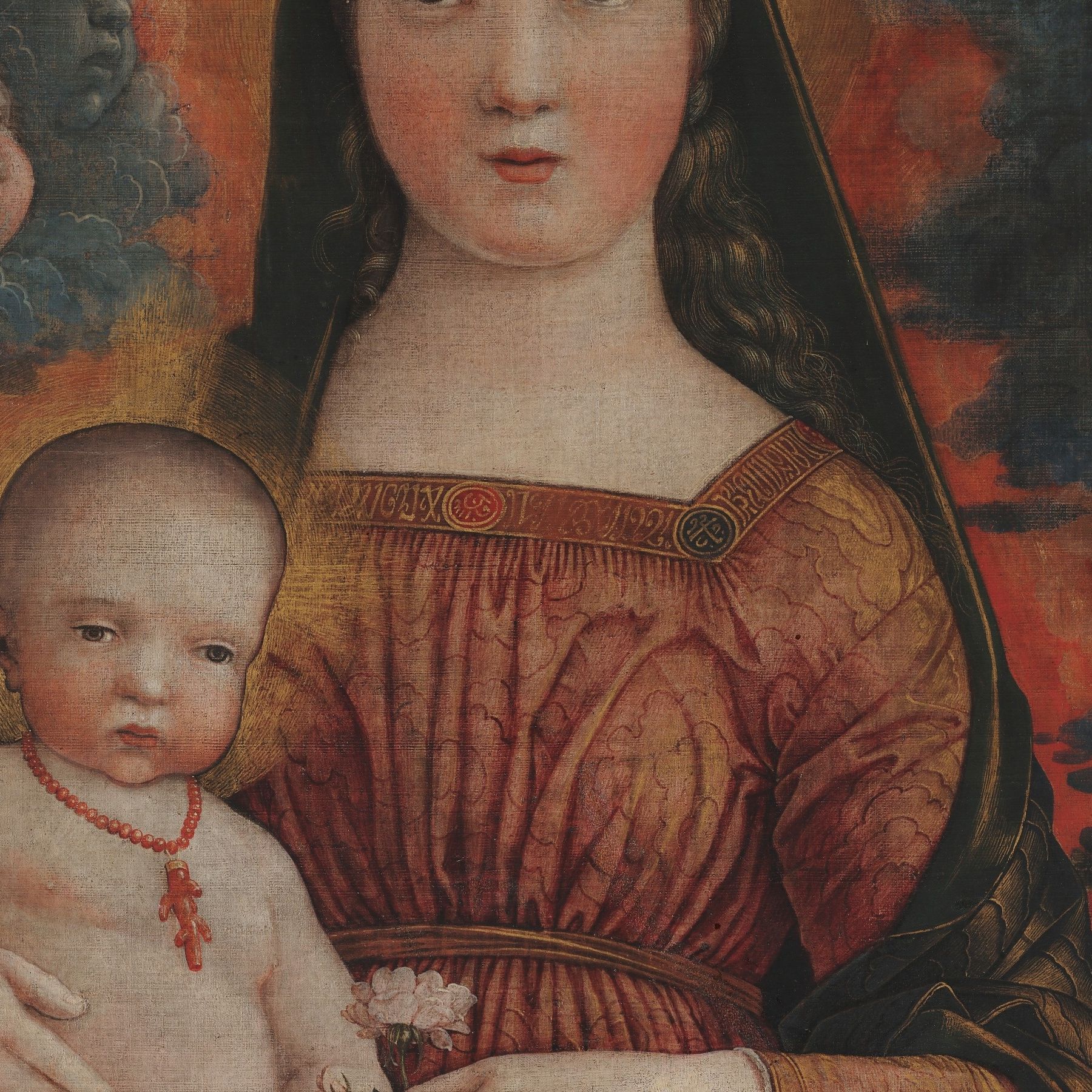
Mary holds the Christ Child at the centre of a mandorla, an almond-shaped field of light. The warm glow behind her head and shoulders is interrupted by bands of blue-grey cloud, from which cherubs’ faces appear at different depths. A few are sharply lit. Elsewhere, the division between a cheek and a cloud is barely perceptible. The bent knees and heavy folds of Mary’s dress suggest a seated body, but there are no clear legs, steps or armrests of a throne. Her bare toes emerge at the edge of a bank of clouds. The national catalogue calls her enthroned within the mandorla, while the Castello emphasizes the absence of a physical throne and interprets her suspension as a reference to the Assumption. The painting gives Mary the posture and authority of an enthroned figure while leaving her support to the heavenly company. [1] [3] [4]
The side trees are laden with lemons and oranges. Their branches reach inward over the saints, leaving a gap of blue above the pointed top of the mandorla. Follow that opening downward and the colour grows warmer behind Mary and the Child, then cools again among the cherubs beneath her feet. The dark foliage makes the small patches of light on fruit and faces count. At the scale of the high altar, the trees also help hold the composition together. Their branches fill the corners as the human figures draw apart below, and the opening between them directs the eye upward without the aid of a painted vault or columns. [1] [3]
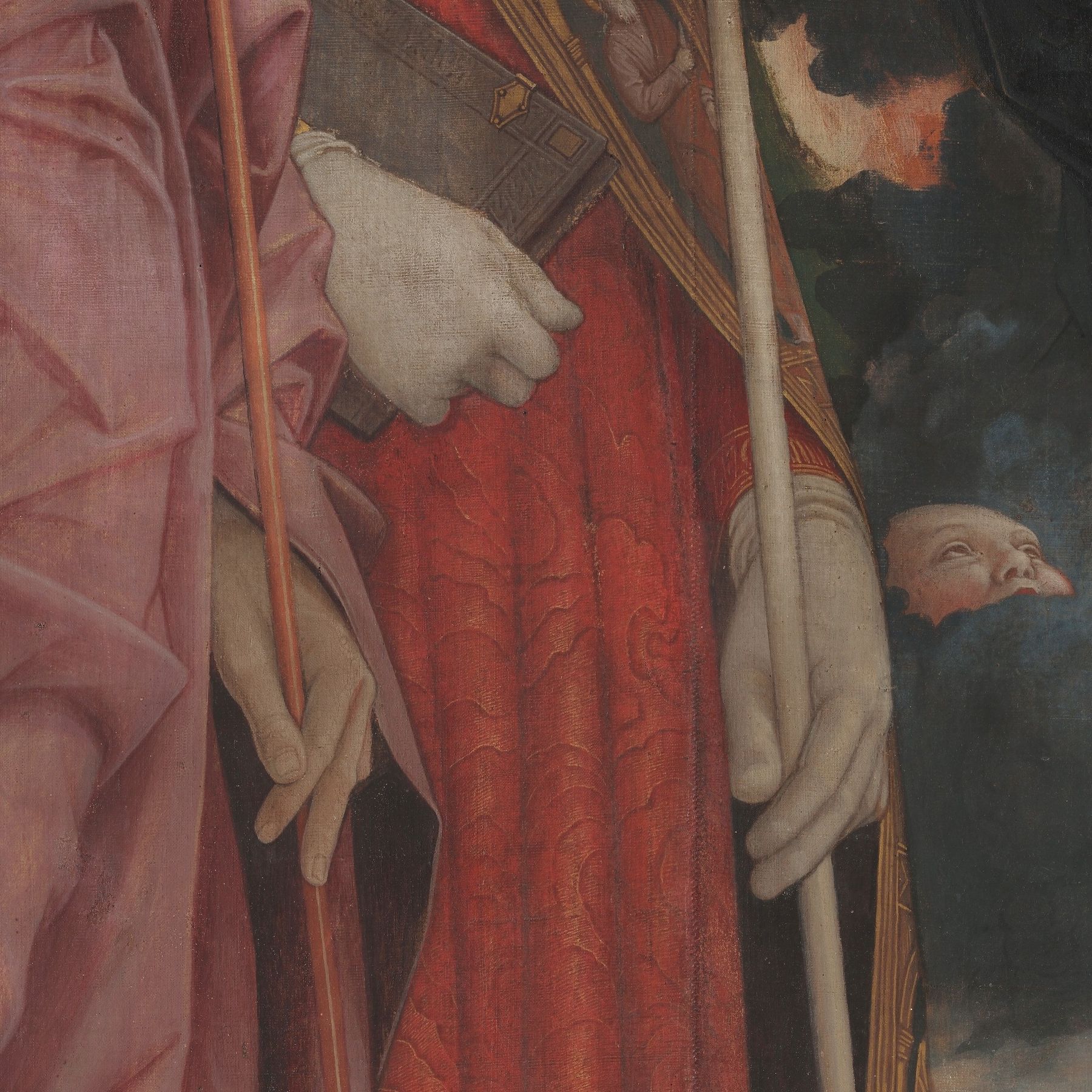
The Castello connects Mantegna’s strong foreshortening with the height of the original installation. The effect is clearest in the saints who stand close to the picture’s edges. The Baptist’s bare legs and Jerome’s red mantle extend almost the full height of the lower half, while the middle opens onto paler sky behind the singers. Seen from below, the company has the scale of figures who might stand at the edge of a real platform. Mary’s compact pose and the ring of small heads give a different measure of distance, allowing her to seem raised above even these imposing figures. [2] [3]
The saints and the choir below
John the Baptist stands at the far left, his bare shoulder and legs visible beneath a rose-coloured mantle. He carries a slender cross and points inward towards the Child. The opening of his ribbon corresponds to the passage in the Gospel of John in which the Baptist comes to bear witness to the light. Behind him, Gregory the Great wears a papal tiara and holds a book. On the right, Benedict’s pale habit sets him apart from Jerome, whose red clothing and long white beard fill the outer edge. Benedict holds a crozier. Jerome carries a book and presents a small church model on his open hand, turning it outward so that its front and side can both be seen. [2] [5] [6]
Benedict gives the Olivetan commission a visible point of reference, and his place in the picture becomes more specific when the altarpiece is considered alongside Fra Giovanni’s choir stalls. Bugini observes that Benedict and Gregory appear both in the painting and among the saints inlaid in the stall backs. In her reading, Gregory looks towards Benedict, Benedict turns towards Jerome, and Jerome faces out towards the choir. She takes the church model to represent Santa Maria in Organo. On that reading, the painted saints acknowledge the community seated before them, and the building that housed the painting appears within it in miniature. The model is readily visible, while the identification of its architecture with a particular phase or design for the church is less secure. [5]
At the foot of the canvas three angels gather beside ranks of organ pipes. The pipes rise sharply from the lower edge, and one singer turns out towards the viewer as the others attend to the sheet. Milan’s museum identifies the organ as an emblem of Santa Maria in Organo. Bugini notes that the singers are shown without anyone playing it and that the image supplies neither keyboard nor bellows. The instrument identifies the church and helps explain the singers’ open mouths. For the Olivetans assembled before the altarpiece, the painted choir could also have recalled their own singing. The stalls were moved behind the altar in the sixteenth century. The surviving woodwork can still help us imagine the original relationship, in which monks seated in the choir could look up and see their own activity echoed at the foot of the painting. [3] [4] [7]
How Mantegna set the scene in Verona and Mantua
Decades earlier, Mantegna had made an altarpiece for another Benedictine choir in Verona, at the basilica of San Zeno. The San Zeno Altarpiece, dated 1457–59 by the Opificio delle Pietre Dure, gathers the Madonna, Child and saints within a painted classical portico. The real frame’s columns divide the panels, but the painted architecture carries the eye across them. The throne fixes the centre of a shared space. Pale stone, coloured marbling and the repeated lines of the architecture give that picture a more sharply articulated setting. At Santa Maria in Organo, the sky and fruit trees connect the figures across one canvas. The colours gather in larger masses, with dark foliage against a luminous centre and the reds of the saints’ robes weighing down the sides. Both altarpieces make the figures imposing from below, but the openings above their central groups lead the eye in different directions, back through a portico at San Zeno and up through a gap in the trees in the Trivulzio Madonna. [3] [5] [8] [9]
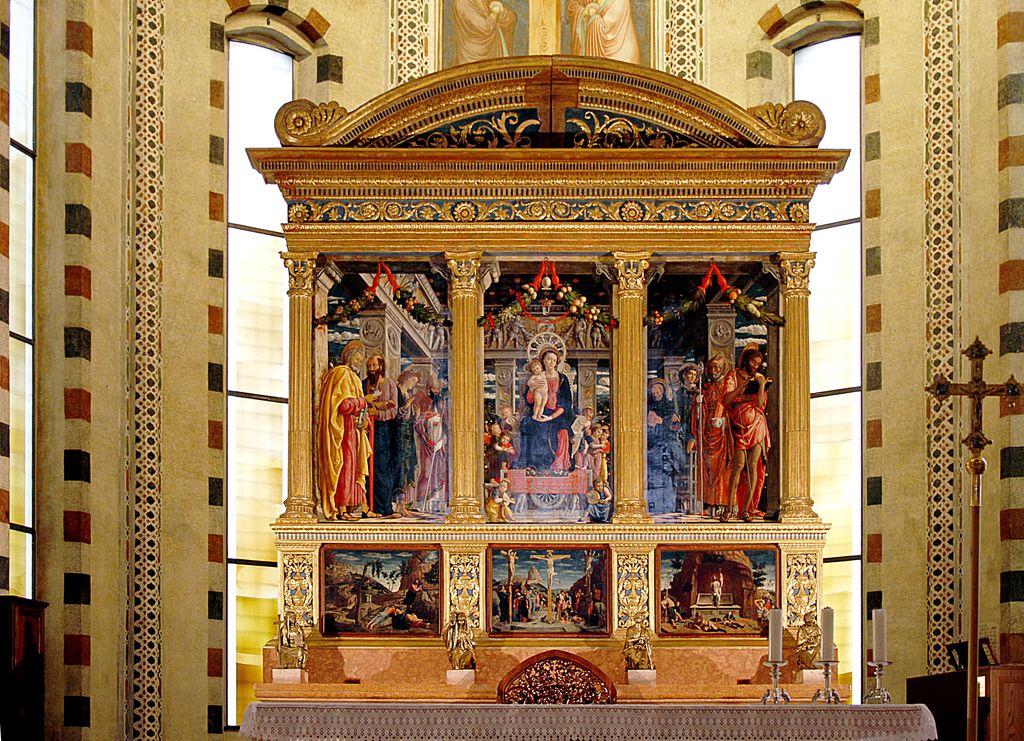
The San Zeno Altarpiece in its frame, Basilica of San Zeno, Verona José Luiz. Image source. CC BY-SA 4.0. Resized from the cited image.
The Madonna della Vittoria, dated 1495–96 by the Louvre, is also in tempera on canvas. Francesco II Gonzaga commissioned the votive painting for Santa Maria della Vittoria in Mantua to commemorate the battle of Fornovo. It too has citrus foliage, but here the branches form a trellis over a marble throne. Figures in armour and a kneeling Francesco give the throne the character of a place of audience. The hard glints on armour and the simulated relief at the throne’s base set off the dense greens. In the Verona painting, the brightest concentration is behind Mary and among the cherubs. The Baptist directs attention to Christ and the pale-robed Benedict makes the monastic setting legible without a kneeling patron in the foreground. [3] [10] [11]
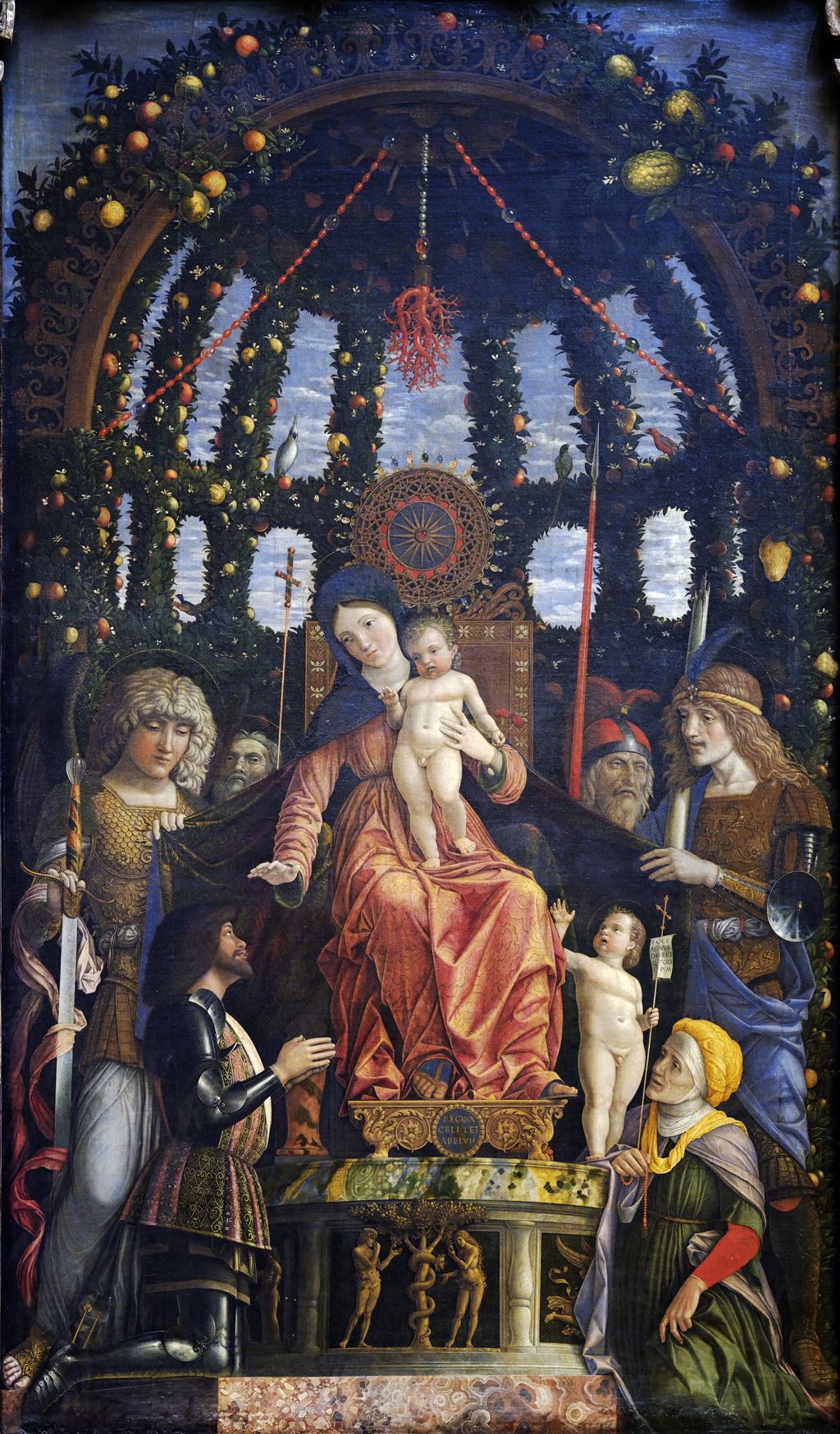
Madonna della Vittoria, Musée du Louvre Image source. Public domain.
The earlier San Luca Altarpiece offers a different comparison among Mantegna’s paintings. Made for the chapel of Saint Luke in Santa Giustina in Padua, it sets figures against gold in separate compartments. Brera draws attention to the foreshortened platform that optically joins the lower figures across those divisions. The shared footing there helps explain how deliberate the open centre of the Verona canvas is. A viewer can read each saint as an individual presence, yet the gap between the two pairs is where Mantegna puts the singers and the rising sequence of clouds. [3] [12]
A smaller contemporary comparison makes the placement of the signature especially clear. Vittore Crivelli’s Madonna and Child with Two Angels, dated about 1481–82 by the Metropolitan Museum of Art, groups fruit and angels around Mary and puts a devotional book on a signed parapet. Its gold surface, small scale and ledge bring such details close to the viewer. Mantegna puts the lettering on a sheet that belongs to a figure within the action, so that reading it means looking down from the apparition to one member of the choir. [4] [13]
From the Verona altar to the Castello
During the Baroque renovation of Santa Maria in Organo, Giacinto Brandi’s Assumption replaced Mantegna’s painting in 1714, according to the national catalogue. The catalogue records the Mantegna passing into the Pertusati collection in Milan in a sale in 1715. By 1791 it was in the Trivulzio collection, where it had passed by inheritance. The family gave the painting its familiar name. Milan bought the canvas from Luigi Alberico Trivulzio in 1935. It entered the civic collections at the Castello Sforzesco, where it is catalogued as inventory number 0554. The painting was moved to Umbria for safekeeping in 1941 and returned to the civic museums in May 1944. [1] [2] [3] [7] [14]
Examination during a late twentieth-century restoration revealed changes that matter when looking at the figures today. The regional catalogue reports that X-rays showed a large cardinal’s hat beneath the surface in the figure of Jerome. They also showed reworking around one of Mary’s eyes and damage to the Baptist’s face. The bold foreshortening is still visible across the composition, but the condition of individual passages can affect how subtly those faces appear modelled today. [2]
The frame made by Fra Giovanni is lost. A later wooden frame came to the Castello with the Trivulzio collection and was removed during the postwar redesign by Studio BBPR, which displayed the canvas in a simpler surround. Dismantled and damaged in storage, the older frame was identified in a warehouse and its recovery began in 2023. Milan unveiled the reunited painting and frame in the Sala Viscontea in February 2025. [5] [15]
At more than five metres high, the restored surround makes the painting part of an architectural display again. Its parts also belong to several different periods. Milan’s structural study assigns its lower section to the last quarter of the nineteenth century, tentatively dates the upper crest to the late sixteenth or early seventeenth century, and places the pilasters possibly in the seventeenth or eighteenth century. Milan’s study attributes the late nineteenth-century configuration to an unidentified collaborator of the Trivulzio household. Its return shows how the family chose to present the painting in Milan, centuries after Mantegna and Fra Giovanni had prepared it for the Olivetans’ high altar. [15]
Annotated Details from The Trivulzio Madonna
The numbered points identify details to look at closely. The detail images below preserve the native scale of the selected crops.
The Trivulzio Madonna
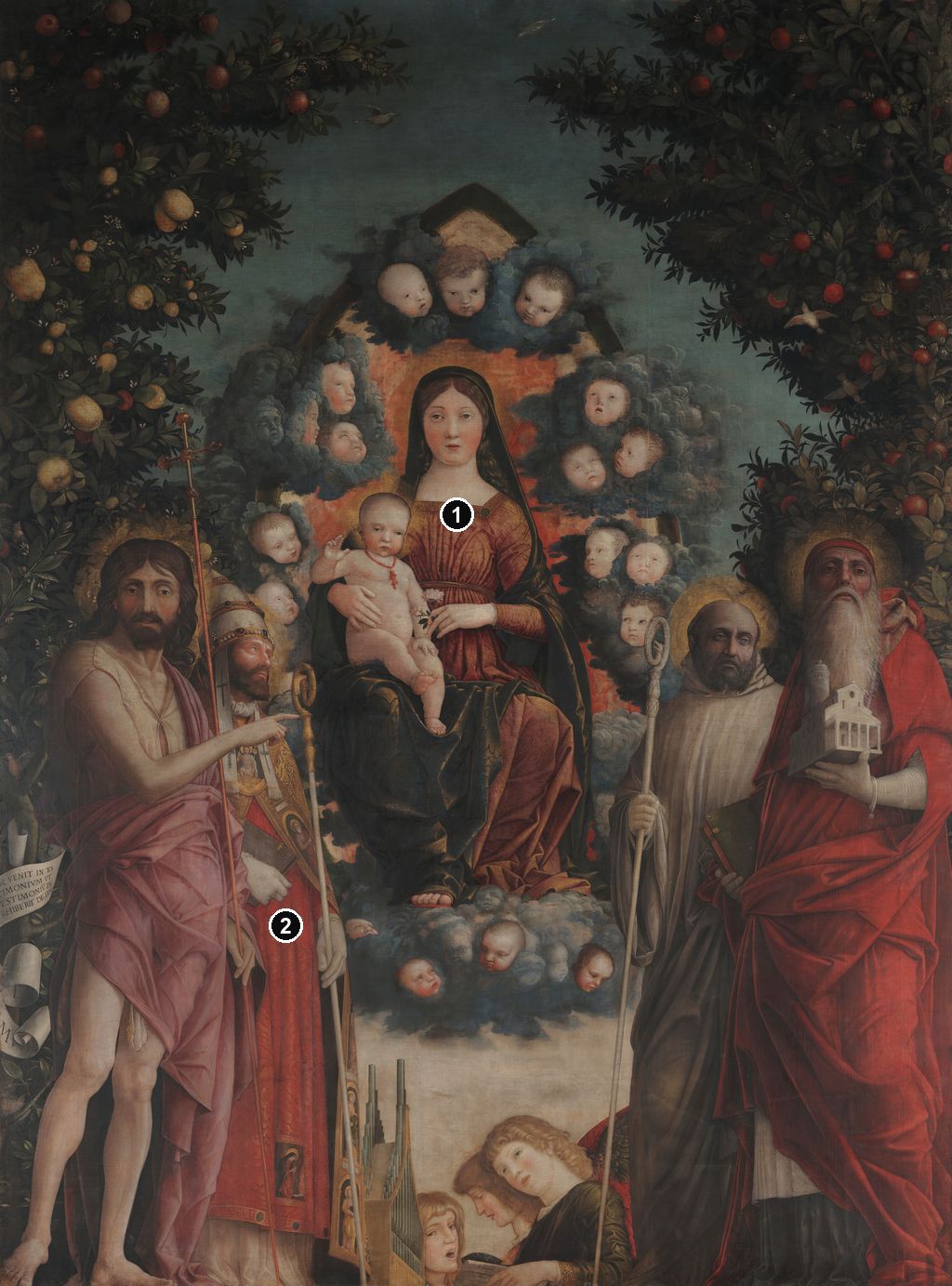
Details from THE TRIVULZIO MADONNA
Choose a detail to enlarge it.
The Trivulzio Madonna
The child above the choir
Heads and wings crowd the opening around the Madonna. Their spacing leaves the central figure unusually clear.
The saints below
The standing figures occupy the lower sides of the panel. Their vertical forms lead back towards the higher central group.
Artworks directory
| Name | Date | Medium and collection |
|---|---|---|
| The Adoration of the Shepherds | Shortly after 1450 | Painting · Metropolitan Museum of Art · 32.130.2 Catalogue. |
| Saint Mark the Evangelist | C. 1448–51 | Painting · Städel Museum · 1046 Catalogue. |
| Saint Jerome Penitent in the Desert | C. 1448–51 | Painting · Museu de Arte de São Paulo · MASP.00015 Catalogue. |
| Martyrdom and Transport of the Body of Saint Christopher | Mid-1450s | Painting · Ovetari Chapel, Padua Catalogue. |
| San Luca Altarpiece | 1453–55 | Painting · Pinacoteca di Brera · 176 Catalogue. |
| The Presentation of Christ at the Temple | 1454 (Berlin dating) | Painting · Gemäldegalerie, Berlin · 29 Catalogue. |
| San Zeno Altarpiece | 1457–59 | Painting · Basilica of San Zeno, Verona Catalogue. |
| The Crucifixion | 1456–59 | Painting · Musée du Louvre · INV 368 Catalogue. |
| The Agony in the Garden (London) | C. 1455–56 | Painting · National Gallery, London · NG1417 Catalogue. |
| The Agony in the Garden (Tours) | 1459 (Tours dating) | Painting · Musée des Beaux-Arts de Tours · 1803-1-24 Catalogue. |
| The Resurrection | 1459 (Tours dating) | Painting · Musée des Beaux-Arts de Tours · 1803-1-25 Catalogue. |
| Saint Sebastian (Vienna) | C. 1457–59 | Painting · Kunsthistorisches Museum · GG 301 Catalogue. |
| Cardinal Ludovico Trevisan | C. 1459–60 (Berlin exhibition dating) | Painting · Gemäldegalerie, Berlin · 9 Catalogue. |
| The Death of the Virgin | C. 1462 | Painting · Museo Nacional del Prado · P000248 Catalogue. |
| Christ with the Soul of the Virgin | C. 1460–64 | Painting · Pinacoteca Nazionale, Ferrara Catalogue only. |
| Portrait of a Young Man (traditionally Francesco Gonzaga) | C. 1461 or 1470, depending on sitter | Painting · Museo di Capodimonte · Q 60 Catalogue. |
| Portrait of a Prelate (Carlo de’ Medici?) | C. 1465–70 | Painting · Uffizi Galleries · 1890 no. 8540 Catalogue. |
| Portrait of a Man | C. 1470 | Painting · National Gallery of Art, Washington · 1952.2.5 Catalogue. |
| Madonna with Sleeping Child (Berlin) | C. 1455–60 | Painting · Gemäldegalerie, Berlin · S.5 Catalogue. |
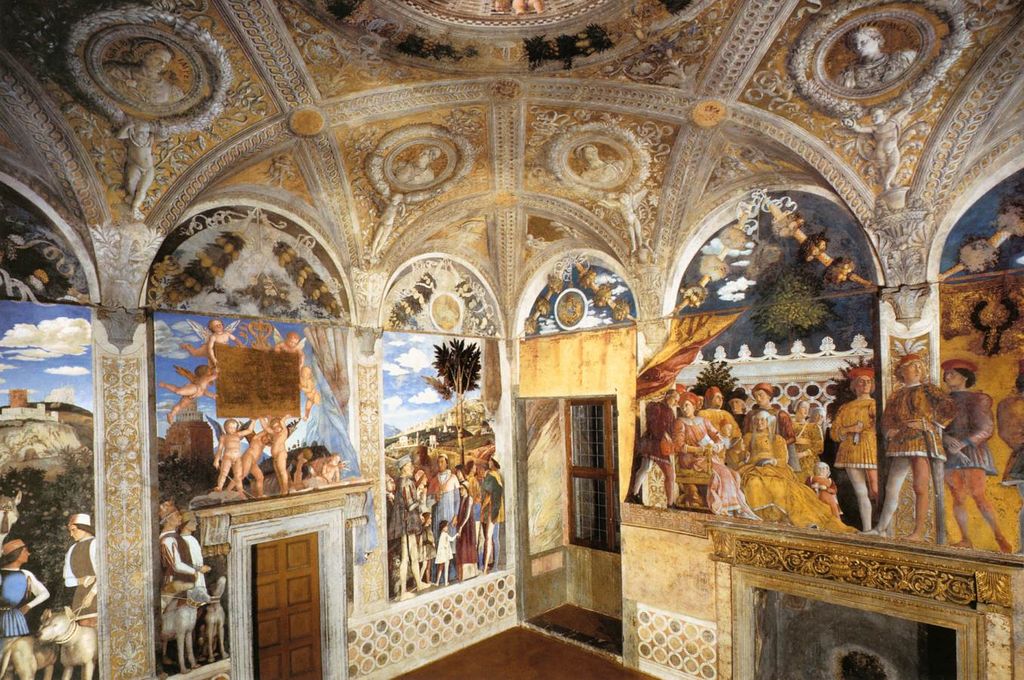
| Camera degli Sposi (Camera Picta) | 1465–74 | Painting · Palazzo Ducale, Mantua Catalogue. |
| Saint Sebastian (Louvre) | Around 1480 | Painting · Musée du Louvre · RF 1766 Catalogue. |
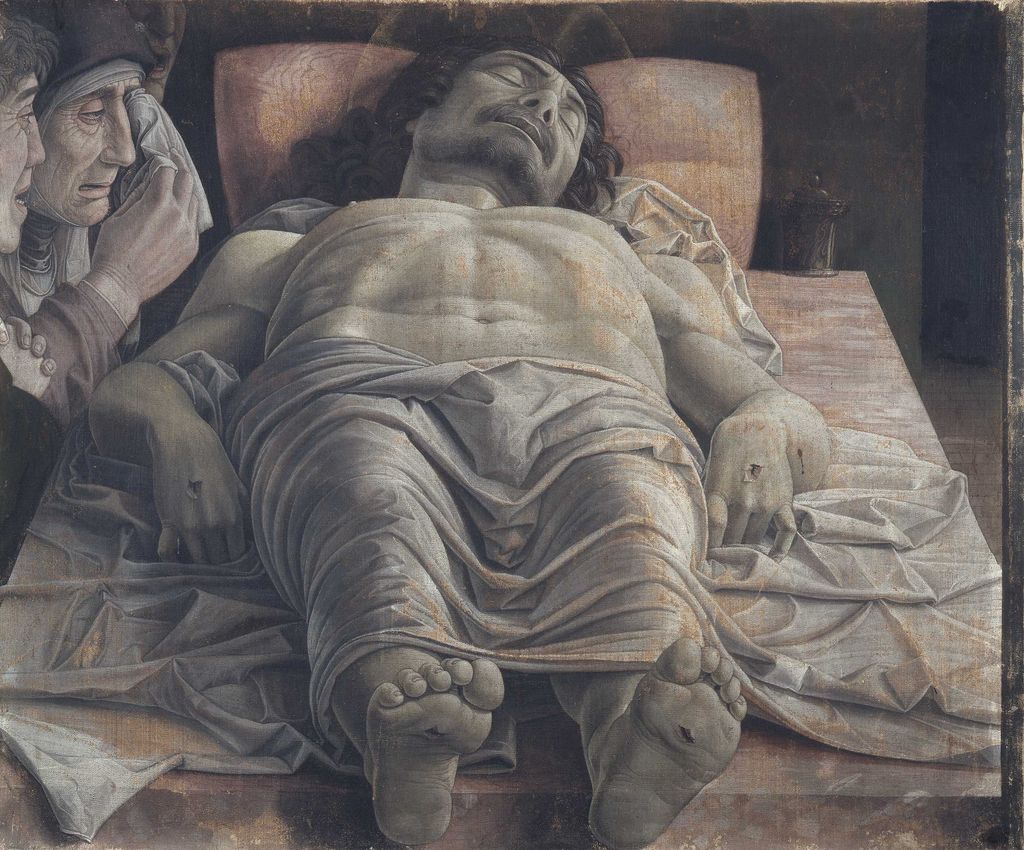
| Lamentation over the Dead Christ | C. 1483 (Brera dating) | Painting · Pinacoteca di Brera · 352 Catalogue. |
| The Triumphs of Caesar | About 1485–1506 | Painting · Royal Collection · RCIN 403958–403966 Catalogue. |
| Madonna of the Caves | C. 1488–90 | Painting · Uffizi Galleries · 1890 no. 1348 Catalogue. |
| Madonna and Child with a Choir of Cherubim | C. 1485 | Painting · Pinacoteca di Brera · 297 Catalogue. |
| Madonna and Child (Poldi Pezzoli) | Early 1490s (museum dating) | Painting · Museo Poldi Pezzoli · 1595 Catalogue. |
| The Holy Family with Saint Mary Magdalen | C. 1495–1500 | Painting · Metropolitan Museum of Art · 14.40.643 Catalogue. |
| The Virgin and Child with Saint Mary Magdalene and Saint John the Baptist | C. 1490–1505 | Painting · National Gallery, London · NG274 Catalogue. |
| Christ as the Suffering Redeemer | 1485–95 (SMK dating) | Painting · Statens Museum for Kunst · KMSsp69 Catalogue. |
| Ecce Homo | C. 1500 | Painting · Musée Jacquemart-André · MJAP-P 1840 Catalogue. |
| Judith with the Head of Holofernes (Mantegna or follower) | C. 1495–1500 | Painting · National Gallery of Art, Washington · 1942.9.42 Catalogue. |
| Madonna della Vittoria | 1495–96 | Painting · Musée du Louvre · INV 369 Catalogue. |
| Mars and Venus (Parnassus) | C. 1496–97 | Painting · Musée du Louvre · INV 370 Catalogue. |
| The Trivulzio Madonna | 1497 | Painting · Castello Sforzesco, Milan · 0554 Catalogue. |
| The Adoration of the Magi | C. 1495–1505 | Painting · J. Paul Getty Museum · 85.PA.417 Catalogue. |
| Minerva Expelling the Vices from the Garden of Virtue | C. 1502 | Painting · Musée du Louvre · INV 371 Catalogue. |
| The Introduction of the Cult of Cybele at Rome | 1505–06 | Painting · National Gallery, London · NG902 Catalogue. |
| Saint Sebastian (Venice) | Probably c. 1504–06 | Painting · Galleria Giorgio Franchetti alla Ca’ d’Oro · D.11 Catalogue. |
| Samson and Delilah | C. 1500 | Painting · National Gallery, London · NG1145 Catalogue only. |
| A Woman Drinking (probably Sophonisba) | C. 1495–1506 | Painting · National Gallery, London · NG1125.2 Catalogue only. |
| The Vestal Virgin Tuccia with a Sieve | C. 1495–1506 | Painting · National Gallery, London · NG1125.1 Catalogue only. |
| Judith with the Head of Holofernes (Dublin) | C. 1495–1500 | Painting · National Gallery of Ireland · NGI.442 Catalogue only. |
| Battle of the Sea Gods, left half (Met impression) | Before 1481 (Met dating) | Print · Metropolitan Museum of Art · 18.12 Catalogue only. |
| Battle of the Sea Gods, right half (Met impression) | Before 1481 (Met dating) | Print · Metropolitan Museum of Art · 1984.1201.4 Catalogue only. |
| Battle of the Sea Gods, left half (Tokyo impression) | C. 1475 (Tokyo dating) | Print · National Museum of Western Art, Tokyo · G.1981-0002 Catalogue only. |
| Battle of the Sea Gods, left half (Washington impression) | C. 1485–88 (NGA dating) | Print · National Gallery of Art, Washington · 1941.1.6 Catalogue only. |
| The Entombment of Christ, second state of two | Before 1475 (Met dating) | Print · Metropolitan Museum of Art · 37.42.30 Catalogue only. |
| The Entombment of Christ (possibly Zoan Andrea, after Mantegna) | 1460–1549 (Rijksmuseum dating) | Print · Rijksmuseum · RP-P-1924-60 Catalogue only. |
| Four Dancing Muses (Gian Marco Cavalli after Mantegna) | C. 1497 | Print · Metropolitan Museum of Art · 20.5.3 Catalogue only. |
| Bacchanal with Silenus | Before 1475 (Met dating) | Print · Metropolitan Museum of Art · 29.44.15 Catalogue only. |
| Bacchanal with a Wine Vat | Before 1475 (Met dating) | Print · Metropolitan Museum of Art Catalogue only. |
| St James on His Way to Execution | C. 1453–57 | Drawing · British Museum · 1976,0616.1 Catalogue only. |
| Three Studies for a Dead Christ | C. 1455–65 | Drawing · British Museum · 1909,0406.3 Catalogue only. |
| Pietà (Venice) | C. 1456–65 (exhibition datings) | Drawing · Gallerie dell’Accademia, Venice · 115 Catalogue only. |
| Studies for Christ at the Column | 1460–65 | Drawing · The Courtauld · D.1978.PG.345 Catalogue only. |
| Virtus Combusta | C. 1490 (technical study) | Drawing · British Museum · Pp,1.23 Catalogue only. |
| Virtus Combusta (Giovanni Antonio da Brescia after Mantegna) | C. 1495–1506 | Print · Musée du Louvre · 3881 LR/ Recto Catalogue only. |
| The Calumny of Apelles | C. 1504–06 | Drawing · British Museum · 1860,0616.85 Catalogue only. |
Frequently Asked Questions
Mantegna signed it and gave the date 15 August 1497. The date is visible on the painted slip in the foreground.
The Castello is its present collection. The canvas was made for the high altar of Santa Maria in Organo in Verona.
Discussion
Look again at the images and ideas explored in Trivulzio Madonna. These editorial prompts invite your observations.
Reader Insights
How do Mary’s seated posture and the clouds under her feet convey the authority of a throne, and how does that effect differ from the setting at San Zeno?
What changes when the organ, singers and Jerome’s church model are viewed from the imagined position of a monk in the original choir?
Join the Conversation
Share a detail, comparison or question about Trivulzio Madonna below.
References
- Ministero della Cultura, Madonna in gloria e santi, Catalogo generale dei Beni Culturali. View source.
- Lombardia Beni Culturali, Madonna in gloria e santi, full SIRBeC catalogue record B0020-00331. View source.
- Castello Sforzesco, Madonna in Glory with Saint John the Baptist, Saint Gregory the Great, Saint Benedict and Saint Jerome. View source.
- Castello Sforzesco, Sforza Castle Museums’ Highlights, Pinacoteca entry 7. View source.
- Elena Bugini, Sull’iconografia musicale di fra Giovanni da Verona. View source.
- United States Conference of Catholic Bishops, John 1:6–8. View source.
- Elena Bugini, In margine alla Pala Trivulzio. View source.
- Opificio delle Pietre Dure, Andrea Mantegna, Pala di San Zeno, 1457–1459, Basilica di San Zeno, Verona. View source.
- Istituto della Enciclopedia Italiana, Andrea Mantegna, Dizionario Biografico degli Italiani. View source.
- Musée du Louvre, La Vierge de la Victoire, INV 369. View source.
- Musée du Louvre, The Madonna della Vittoria and Painted Reliefs. View source.
- Pinacoteca di Brera, Polittico di San Luca. View source.
- The Metropolitan Museum of Art, Madonna and Child with Two Angels by Vittore Crivelli. View source.
- Associazione Giovanni Secco Suardo, Pala Trivulzio, Castello Sforzesco conservation history. View source.
- Comune di Milano, La Pala Trivulzio di Mantegna ritrova la sua cornice storica. View source.
- Palazzo Ducale, Mantua, Camera degli Sposi (Camera Picta), View source.
- Royal Collection, The Triumphs of Caesar, View source.
- National Gallery, London, The Introduction of the Cult of Cybele at Rome, View source.
More MANTEGNA Paintings
San Zeno Altarpiece
The San Zeno Altarpiece in its frame, Basilica of San Zeno, Verona José Luiz. Image source. CC BY-SA 4.0. Resized from the cited image.