 by Tom Gurney
Tom Gurney BSc (Hons) is an art history expert with over 20 years experience
Published on June 19, 2020 / Updated on November 29, 2026
Email: tomgurney1@gmail.com / Phone: +44 7429 011000
Overview
A man in a black cap looks to the left, his forehead, nose and lips outlined against a muted blue field. The National Gallery of Art in Washington catalogues this small Portrait of a Man under Andrea Mantegna and dates it to about 1470. The sitter remains unidentified. Although the picture began as a tempera painting on a wooden panel, the painted layers now rest on hardboard after an intermediate transfer to canvas. It entered the National Gallery of Art in 1952 with the Samuel H. Kress Collection and bears the accession number 1952.2.5. [1]
At a Glance
- DateAbout 1470 (National Gallery of Art)
- SitterUnidentified
- MediumTempera originally on wood panel, transferred to canvas and then to hardboard
- CollectionNational Gallery of Art, Washington, Samuel H. Kress Collection
- Accession number1952.2.5
Andrea Mantegna in context
San Zeno Altarpiece
1457–59 [12]Portrait of a Man
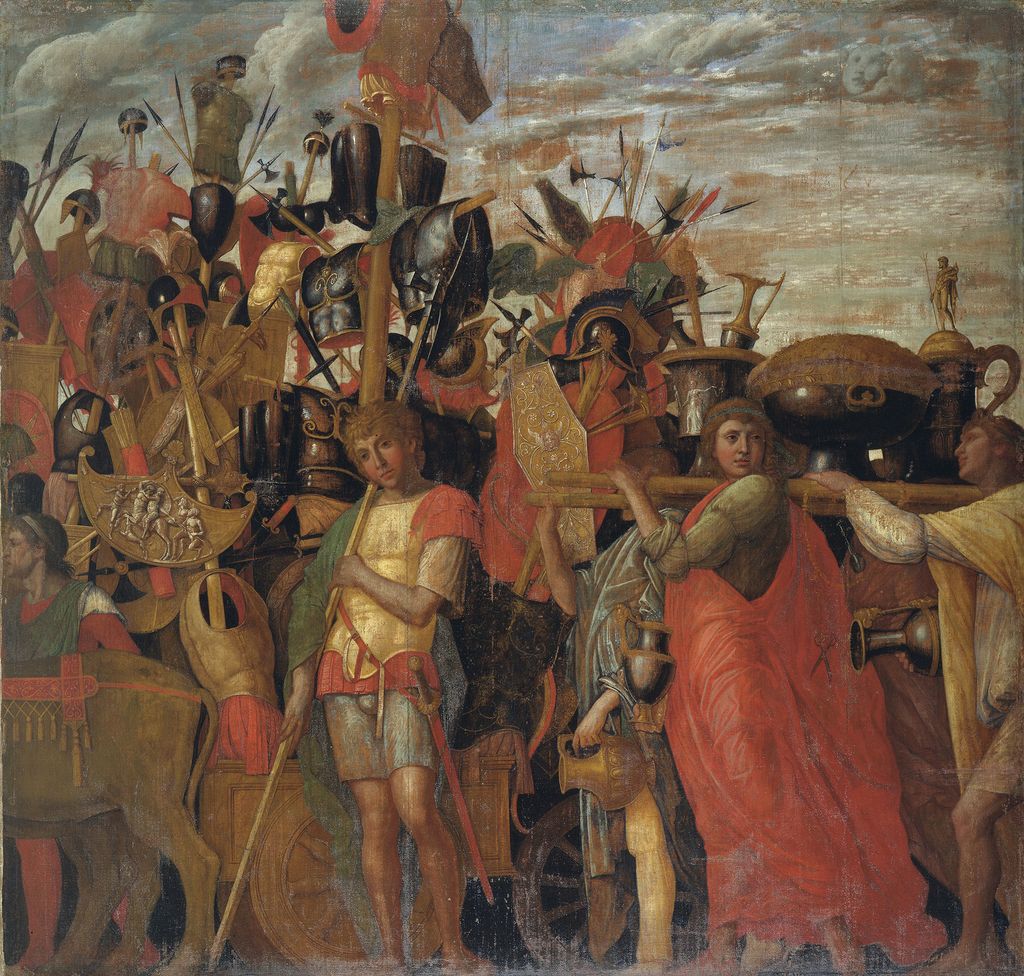
C. 1470 [1]The Triumphs of Caesar
Mid-1480s–before 1506 [14]Madonna della Vittoria
1495–96 [15]The space in front of the face
Follow the face from the brow to the chin. A long, nearly straight nose gives way to the smaller projection of the lips, then to a rounded jaw. The visible eye sits well inside that outer line and keeps the gaze moving left, into the narrow interval between the face and the frame. Behind the head there is a larger, less sharply articulated expanse of blue. The unequal spaces matter. The head occupies a good deal of the picture, yet the little area in front of it gives the sitter somewhere to look. No object in the painting tells us what lies in that direction. [1]
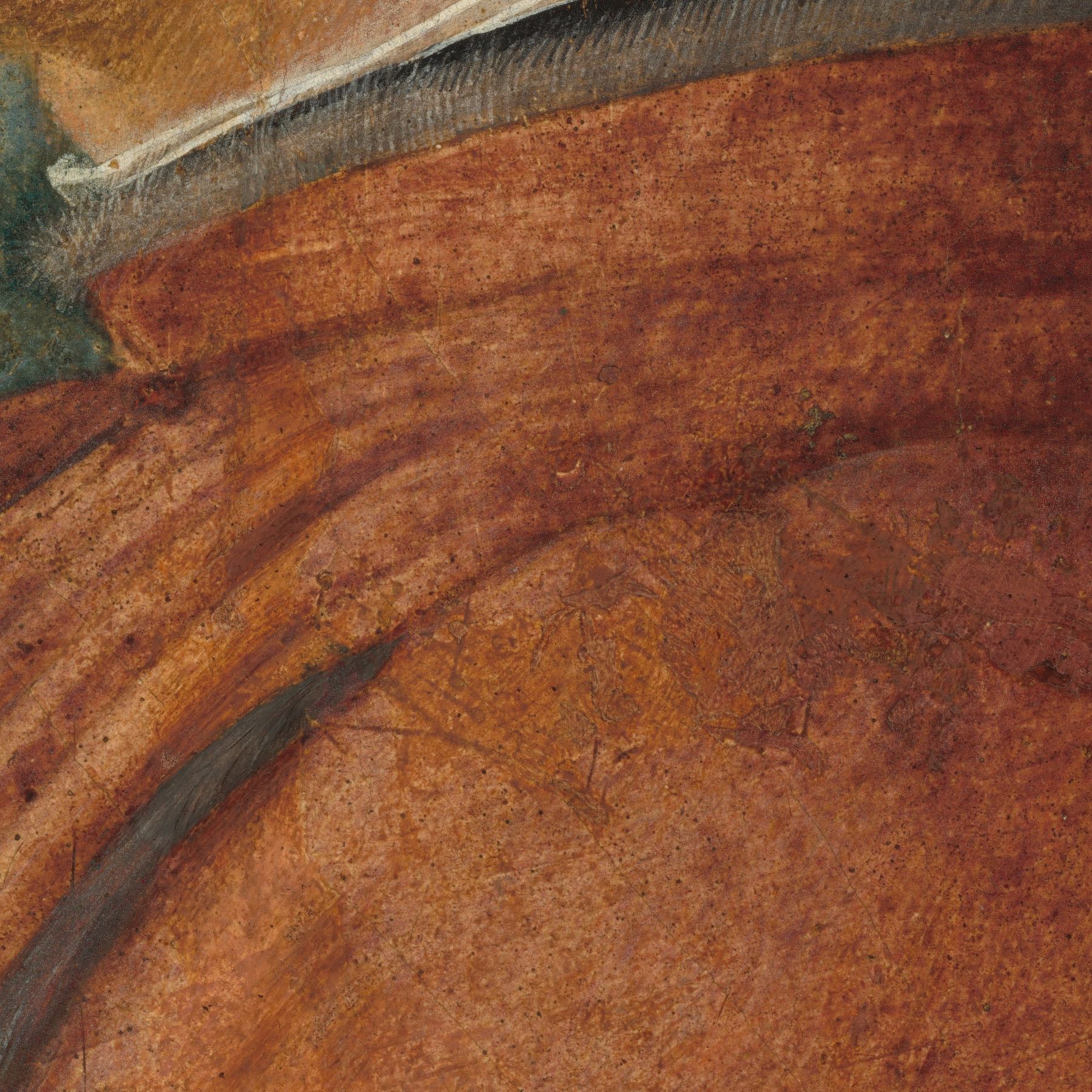
The neck and shoulder provide a second set of contours. A narrow light band rises from beneath the chin towards the nape. Below it, dark lines in the red fabric diverge as they approach the lower edge, opening out from the close fit at the neck. At the crown, the cap brings the profile back towards the blue in a single dark curve. These changes in scale, from the small break between the lips to the sweep of the shoulder, help distinguish cloth from flesh. The blue setting contains no clearly defined architecture or landscape, and the garment runs out of the frame at the bottom. [1]
From wooden panel to hardboard
The picture measures only 24.2 by 19.1 centimetres. At that scale, the rim of the collar and the transition from face to background repay close viewing. Its scale is easy to lose in an enlarged reproduction, which gives the head a presence quite different from the one it has on a surface smaller than a sheet of writing paper. [1]
The museum’s medium line records different stages in the painting’s physical history. Tempera describes the paint, and panel, canvas and hardboard describe successive supports. The canvas was an intermediate backing for paint that had first been applied to wood. The sequence matters when looking closely at the blue field, where the surface appears uneven. Its present appearance alone cannot tell us which irregularities belong to the painter’s handling and which arose later. In the Fondazione Federico Zeri’s photographic archive, the Washington work has several entries, including one explicitly described as showing it after cleaning. The photographs document different recorded views of the same object, while the museum’s medium line establishes the sequence of its supports. [1] [2]
How Mantegna’s name entered the record
Germain Seligman offered the painting to the Kress Foundation in May 1950 under Mantegna’s name, and the National Gallery’s bibliography records it in the Kress exhibition catalogue of 1951, with text by Wilhelm Suida. The museum also lists a later dissent. In 1994 Alessandro Conti published the painting as the work of Giovanni Bellini in his study of Giovanni’s beginnings in Jacopo Bellini’s workshop. The same bibliography points to the object’s entry on pages 432–434 of the National Gallery’s 2003 systematic catalogue, Italian Paintings of the Fifteenth Century, and records Alberta De Nicolò Salmazo’s qualified attribution to Mantegna in 2004. [1]
The Washington museum’s current credit gives Mantegna’s name without a qualifier. The Zeri archive, citing the 1972 census compiled by Burton B. Fredericksen and Federico Zeri, uses a qualified attribution and dates the work to 1460–1470. These records allow readers to distinguish the name under which the museum presents the object from the degree of confidence expressed in individual publications. The profile by itself offers limited grounds for choosing between the names. A clean outer contour tells us as much about the demands of a side-on likeness as it does about the painter’s identity. [1] [2]
A name the sitter once carried
The picture’s recorded modern history begins in Hungary. The National Gallery traces it to Gaál in Balaton Földvár before 1906 and then to Dr Ludwig Keleman in Budapest. Keleman’s widow sold it to Jacques Seligmann & Co. in 1929. It was shown at the 1939 New York World’s Fair and at the Detroit Institute of Arts in 1941 as a presumed portrait of Janus Pannonius. Another exhibition in 1949 used the English form James Pannonius. By the following year the dealer’s offer to the Kress Foundation carried the Pannonius title without the exhibition labels’ qualification. [1]
There is a historical reason for the association. In a study of painters and humanists in fifteenth-century Italy, Giacomo Alberto Calogero discusses the double portrait that Mantegna made in 1458 of the Hungarian humanist Janus Pannonius and Galeotto Marzio. Calogero notes that Pannonius took the painting to Hungary and points to Giovanni Agosti’s discussion of a possible identification of one of its likenesses with the Washington picture. The Hungarian ownership makes the suggestion understandable, but the recorded owners belong to a much later period. The documented double portrait and the surviving single bust remain separate pieces of evidence. The Gallery’s current title leaves the man’s identity open. [1] [3]
An older face in Milan and a profile in bronze
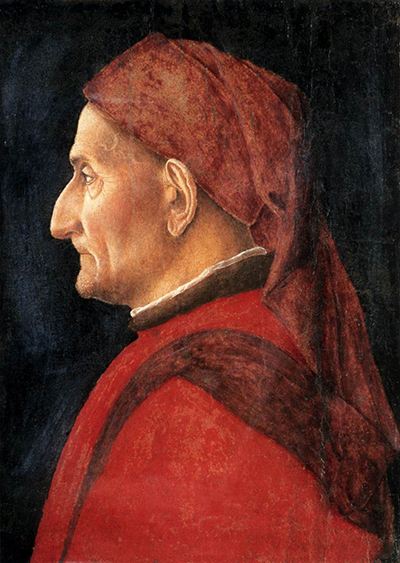
The Museo Poldi Pezzoli’s Ritratto maschile is a different painting of a left-facing man dressed in red. The Milan sitter is older in appearance. The museum draws attention to the stubble on his chin and the vein at his temple, details picked out by light falling across the face. Set against a dark field, the illuminated flesh makes a more abrupt transition to the background than the Washington man’s face makes against blue. The Milan museum describes its own background as originally a brilliant blue made with lapis lazuli. That account belongs to the Milan panel and concerns its colour before the changes visible today. The Milan painting is also larger, at 32.3 by 28.8 centimetres. The museum’s partner record dates it to around 1450. The Zeri archive, which identifies it as the Poldi Pezzoli’s inventory number 1592, gives about 1460 and records past attributions to Cosmè Tura and Francesco Bonsignori as well as Roberto Longhi’s tentative attribution to Mantegna. [4] [5]
The Poldi Pezzoli relates its sitter’s profile to ancient coins, an association that can be tested against Pisanello’s medal of Cecilia Gonzaga, modelled in 1447. The medal sets a crisply outlined head inside a circle, with lettering around the likeness and an allegorical scene on the reverse. On the rectangular Washington painting, the profile is an equally economical way of isolating the face, but the blue continues above and behind the head and the broad red shoulder fills the lower corner. The medal names its sitter through lettering. In the Washington portrait as it survives, colour, clothing and outline carry the likeness without a visible identifying inscription. [1] [4] [6]
Where the figure meets the foreground
In the Berlin portrait of Cardinal Ludovico Trevisan, the turn of the head brings the far side of the face into view. The light can describe the sitter across the breadth of the face, as well as along its edge. Keith Christiansen, writing for the Berlin catalogue, compares the modelling to classical sculpture and singles out the way the red robe shows through the translucent white garment. In Washington the accents of pale cloth and red are concentrated in the shallow band where the collar meets the shoulder. The cardinal himself also appears in profile on a medal by Cristoforo di Geremia, with his name and rank around the rim. The two likenesses show how readily the same sitter could be presented from different angles and how much the format changes what we notice first. [1] [7] [8]
The Uffizi’s Portrait of a Prelate, possibly Carlo de’ Medici, also brings more of the face into view. The turn of the body gives the broad red garment a sense of depth against an even dark ground. The proposed identification in Florence rests on a different kind of evidence from the Washington sitter’s former name. The Uffizi traces the suggestion to a reproduction of the likeness in Martino Rota’s late sixteenth-century Medici family tree. [1] [9]
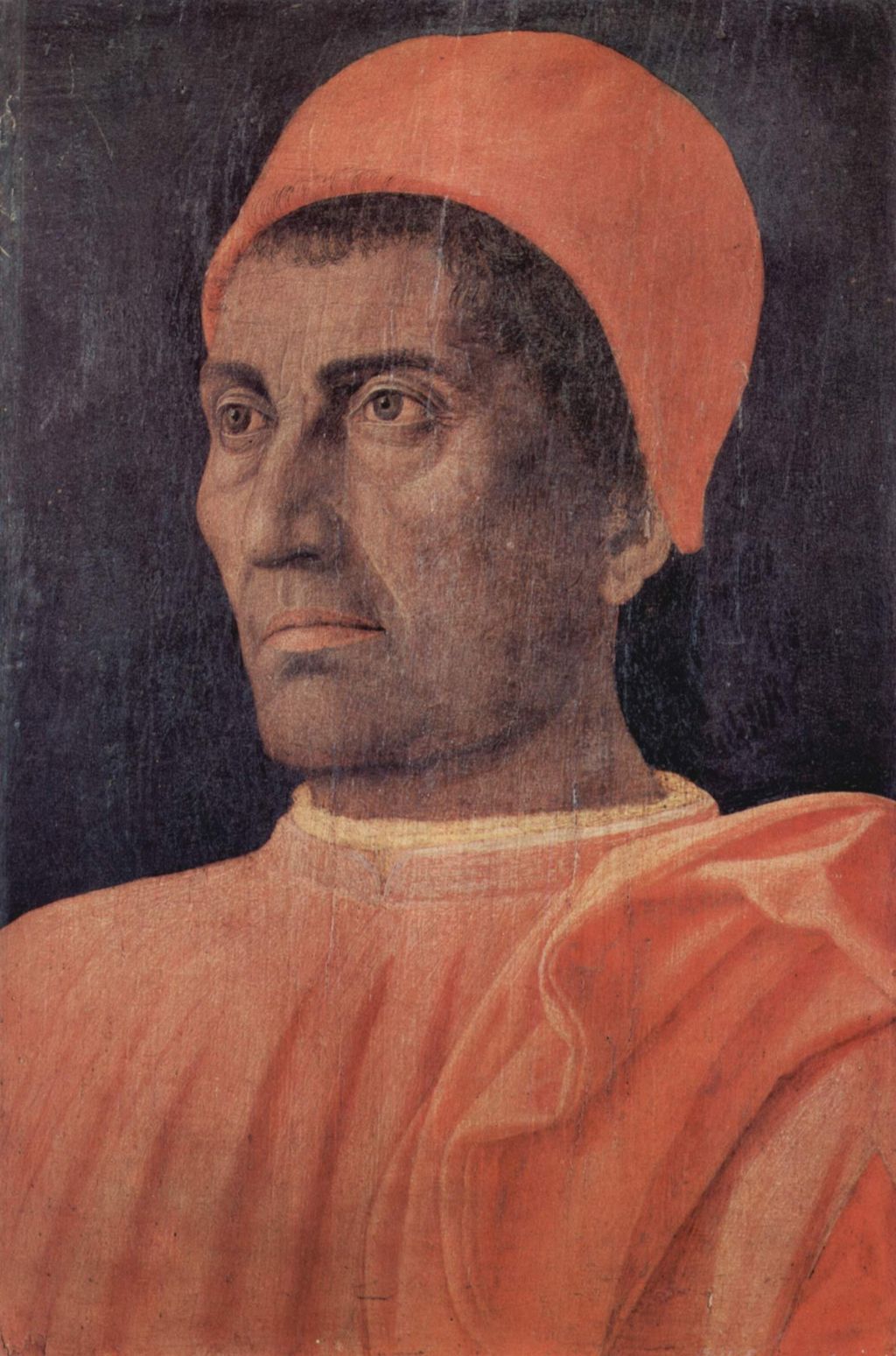
Portrait of a Prelate (Carlo de’ Medici?), Uffizi Image source. Public domain.
The portrait traditionally identified as Francesco Gonzaga in Naples offers a closer comparison for the side-on format. The young sitter’s red garment softens into the dark background, a transition that Capodimonte contrasts with the formality of the pose. The Washington picture sharpens the divide between shoulder and setting with a change from warm red to cool blue. Capodimonte also records a proposal that the young man is Francesco’s younger brother Ludovico, based in part on a comparison with a medal. Here a medal supplies a possible likeness as well as an example of the profile format. [1] [10]
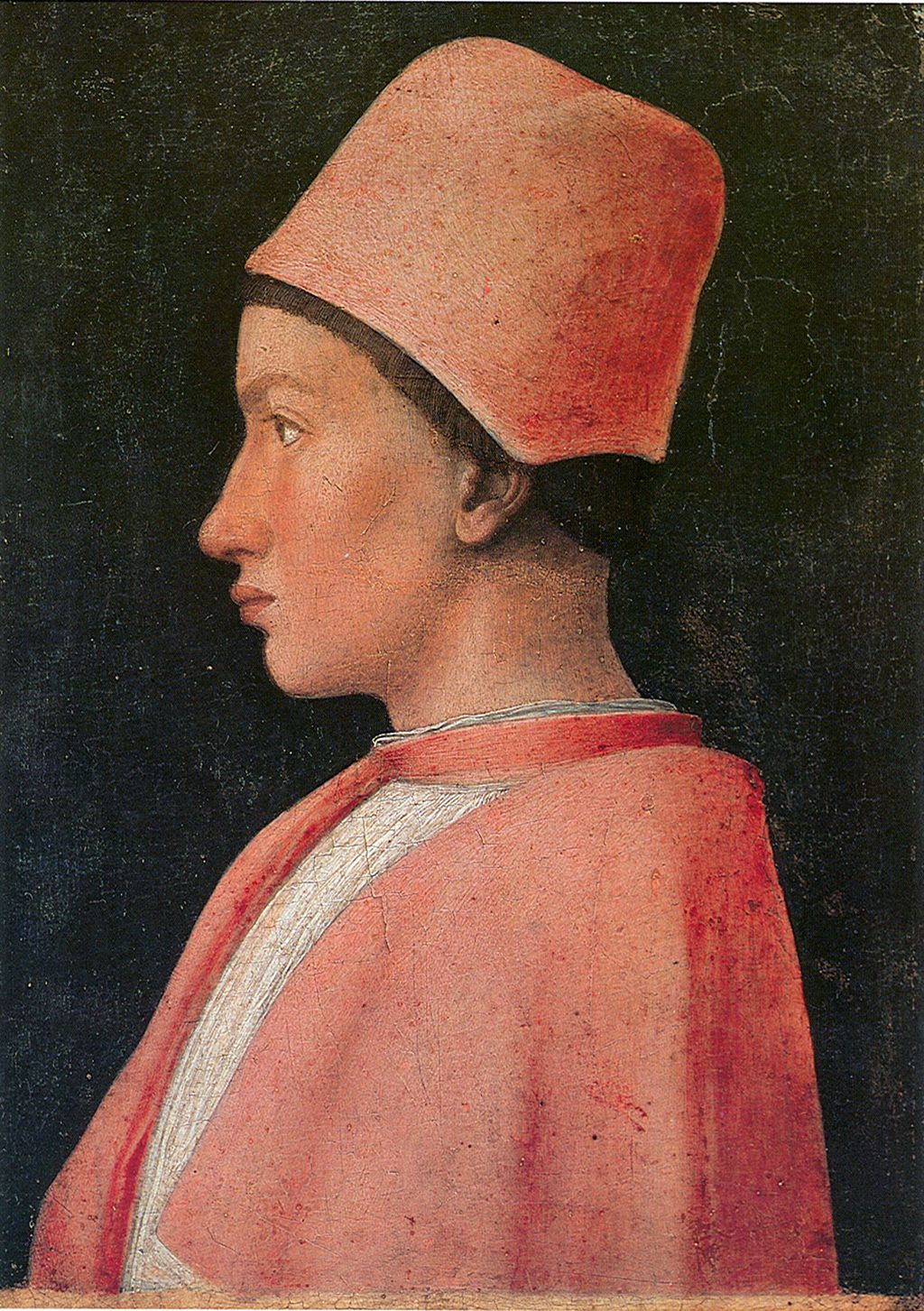
Portrait of Francesco Gonzaga, Museo di Capodimonte Image source. Public domain.
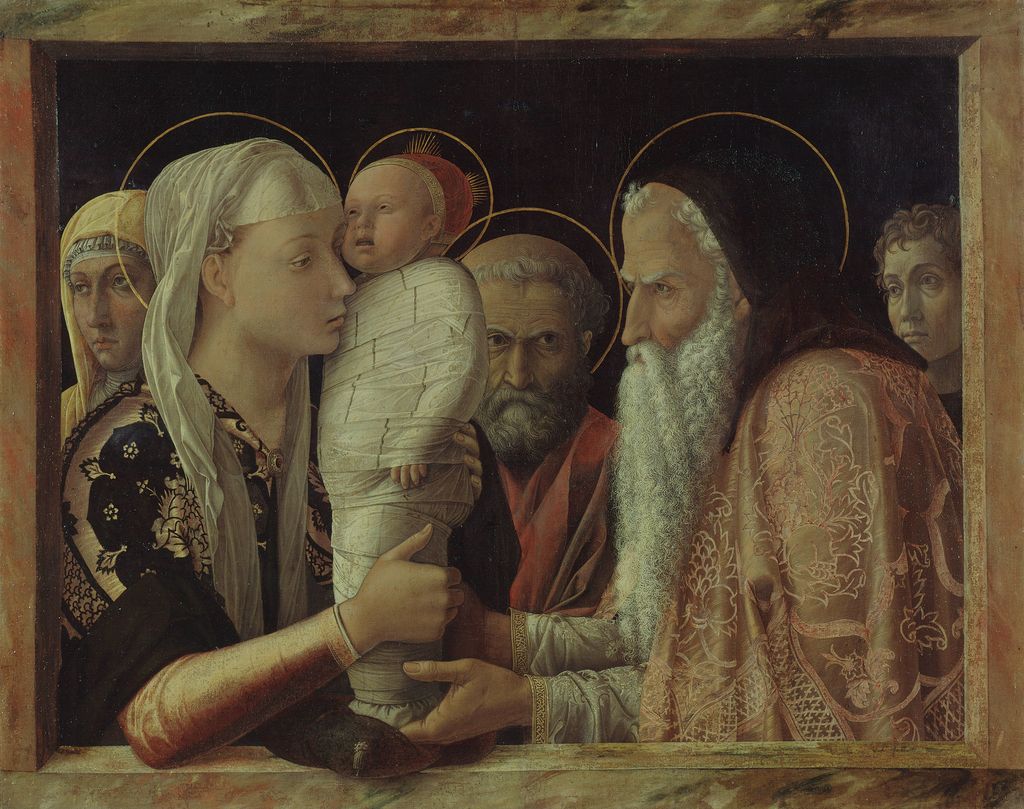
In Mantegna’s Berlin Presentation at the Temple, the profile serves a different purpose. Mary and Simeon turn towards one another, enclosing the swaddled child between their faces. A painted marble surround and ledge define the foreground, and the child and the figures’ arms crowd that boundary. Berlin’s account describes how Giovanni Bellini later took up the composition, exchanging the enclosing marble surround for a simple parapet and adding figures at the sides. In Washington the one visible gaze has no answering figure, and there is no comparable ledge in the painting’s present state. The distance between the nose and the left edge does some of the work the foreground architecture does in Berlin. It makes us conscious of where the figure is, and of how much of the space around him the painter has allowed us to see. [1] [11]
Annotated Details from Portrait of a Man
The numbered points identify details to look at closely. The detail images below preserve the native scale of the selected crops.
Portrait of a Man
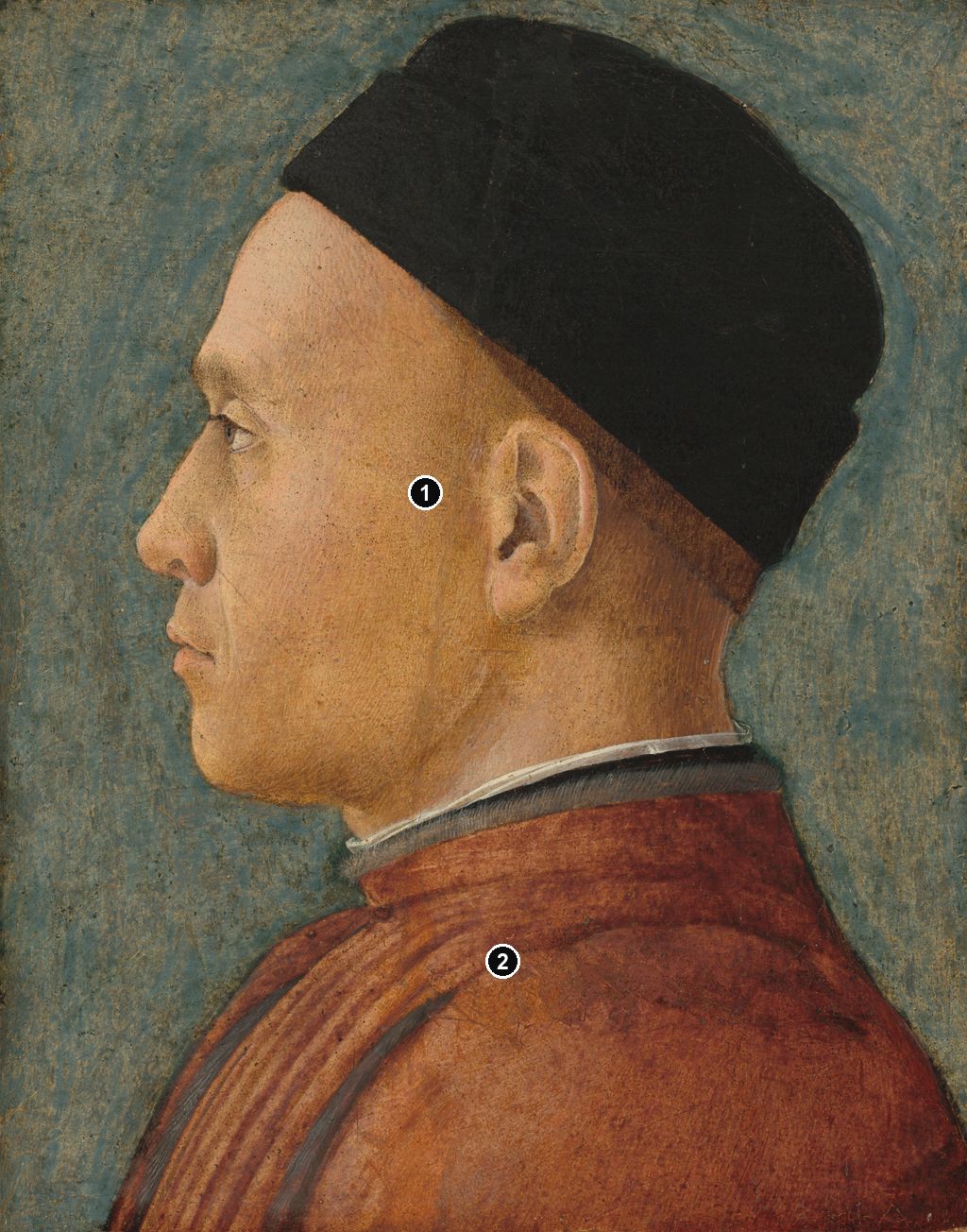
Details from PORTRAIT OF A MAN
Choose a detail to enlarge it.
Portrait of a Man
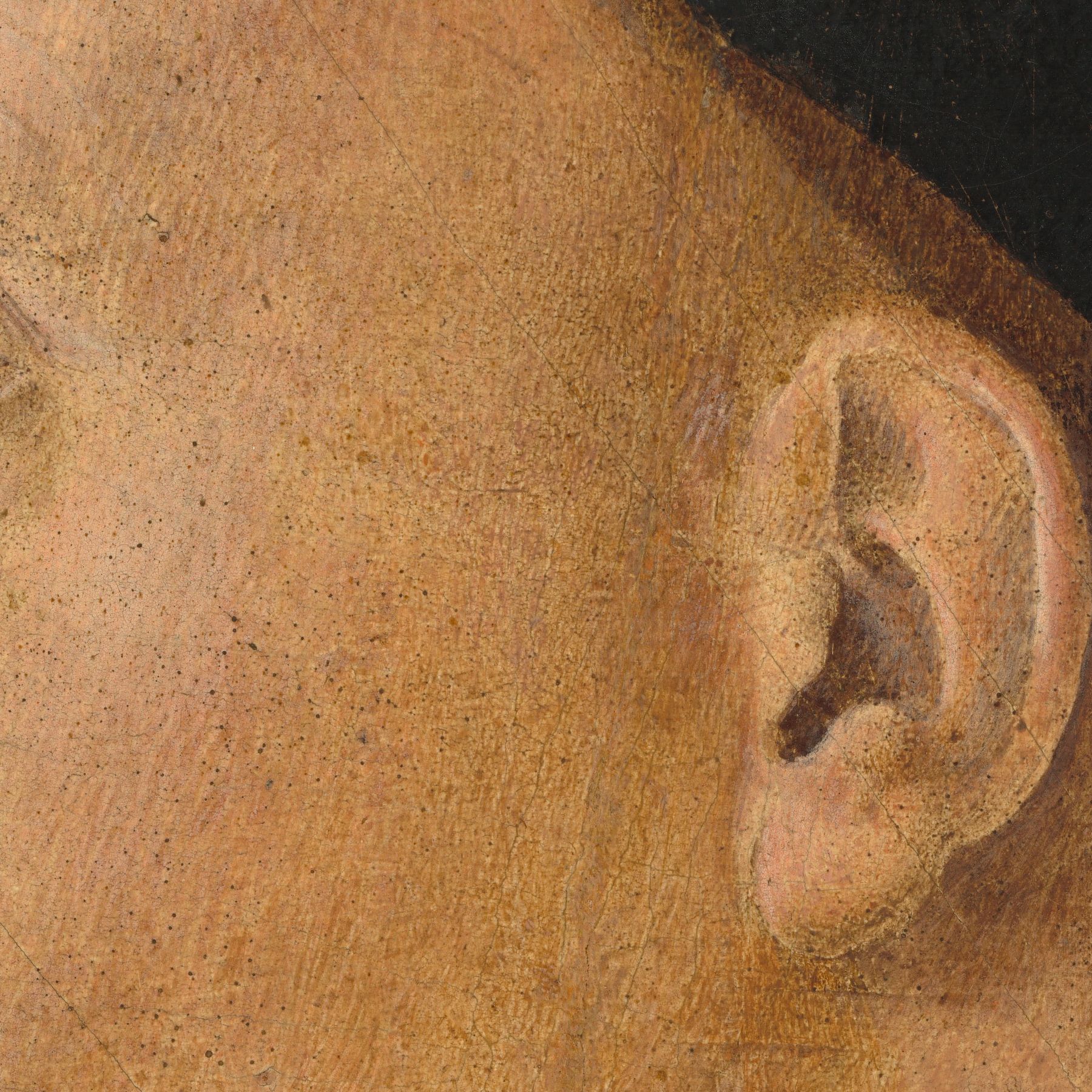
The line of the profile
The flat ground leaves the contour of the sitter’s head remarkably clear. The dark cap extends the silhouette above the face.
Shoulder and collar
The shoulder takes a broad diagonal below the head. A narrow change of colour near the collar gives the garments a separate edge.
Artworks directory
| Name | Date | Medium and collection |
|---|---|---|
| The Adoration of the Shepherds | Shortly after 1450 | Painting · Metropolitan Museum of Art · 32.130.2 Catalogue. |
| Saint Mark the Evangelist | C. 1448–51 | Painting · Städel Museum · 1046 Catalogue. |
| Saint Jerome Penitent in the Desert | C. 1448–51 | Painting · Museu de Arte de São Paulo · MASP.00015 Catalogue. |
| Martyrdom and Transport of the Body of Saint Christopher | Mid-1450s | Painting · Ovetari Chapel, Padua Catalogue. |
| San Luca Altarpiece | 1453–55 | Painting · Pinacoteca di Brera · 176 Catalogue. |
| The Presentation of Christ at the Temple | 1454 (Berlin dating) | Painting · Gemäldegalerie, Berlin · 29 Catalogue. |
| San Zeno Altarpiece | 1457–59 | Painting · Basilica of San Zeno, Verona Catalogue. |
| The Crucifixion | 1456–59 | Painting · Musée du Louvre · INV 368 Catalogue. |
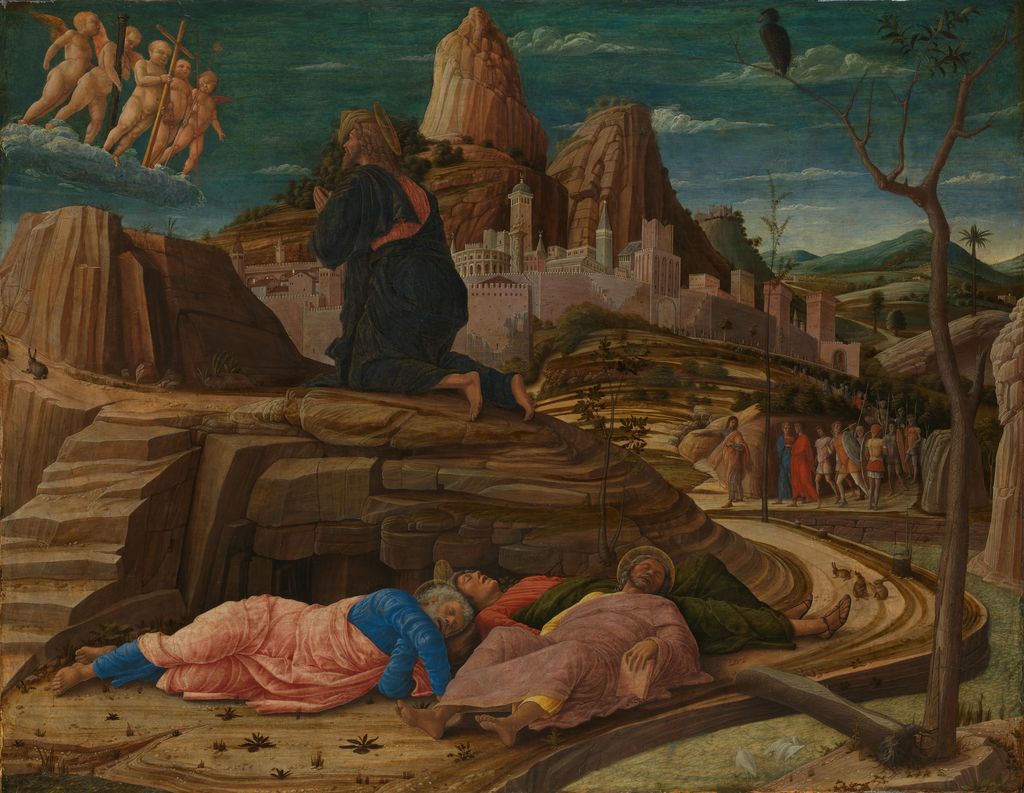
| The Agony in the Garden (London) | C. 1455–56 | Painting · National Gallery, London · NG1417 Catalogue. |
| The Agony in the Garden (Tours) | 1459 (Tours dating) | Painting · Musée des Beaux-Arts de Tours · 1803-1-24 Catalogue. |
| The Resurrection | 1459 (Tours dating) | Painting · Musée des Beaux-Arts de Tours · 1803-1-25 Catalogue. |
| Saint Sebastian (Vienna) | C. 1457–59 | Painting · Kunsthistorisches Museum · GG 301 Catalogue. |
| Cardinal Ludovico Trevisan | C. 1459–60 (Berlin exhibition dating) | Painting · Gemäldegalerie, Berlin · 9 Catalogue. |
| The Death of the Virgin | C. 1462 | Painting · Museo Nacional del Prado · P000248 Catalogue. |
| Christ with the Soul of the Virgin | C. 1460–64 | Painting · Pinacoteca Nazionale, Ferrara Catalogue only. |
| Portrait of a Young Man (traditionally Francesco Gonzaga) | C. 1461 or 1470, depending on sitter | Painting · Museo di Capodimonte · Q 60 Catalogue. |
| Portrait of a Prelate (Carlo de’ Medici?) | C. 1465–70 | Painting · Uffizi Galleries · 1890 no. 8540 Catalogue. |
| Portrait of a Man | C. 1470 | Painting · National Gallery of Art, Washington · 1952.2.5 Catalogue. |
| Madonna with Sleeping Child (Berlin) | C. 1455–60 | Painting · Gemäldegalerie, Berlin · S.5 Catalogue. |
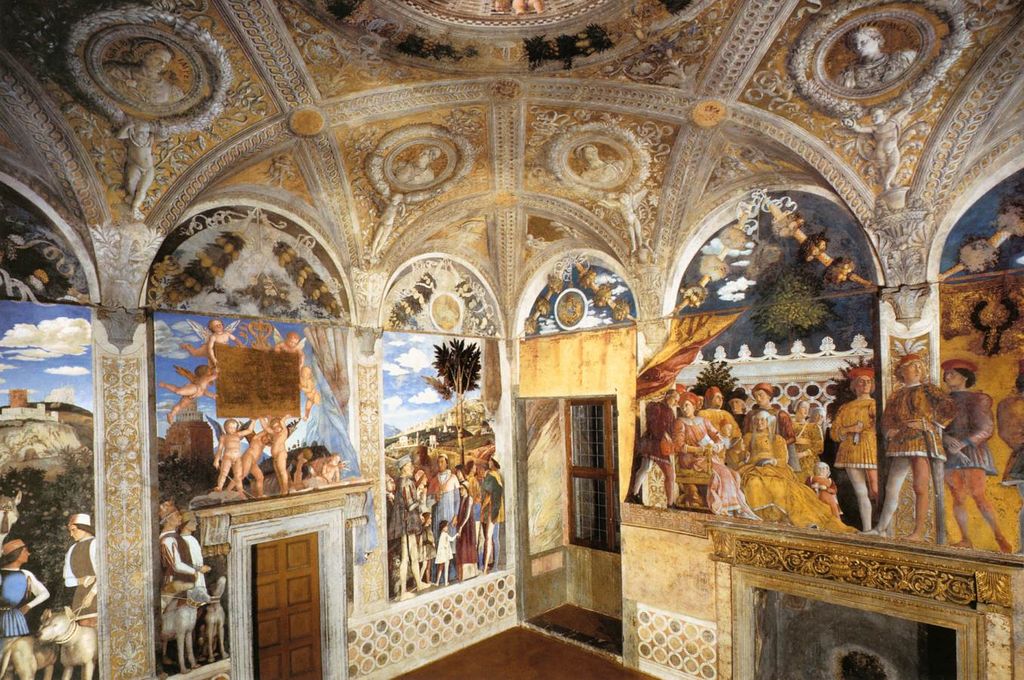
| Camera degli Sposi (Camera Picta) | 1465–74 | Painting · Palazzo Ducale, Mantua Catalogue. |
| Saint Sebastian (Louvre) | Around 1480 | Painting · Musée du Louvre · RF 1766 Catalogue. |
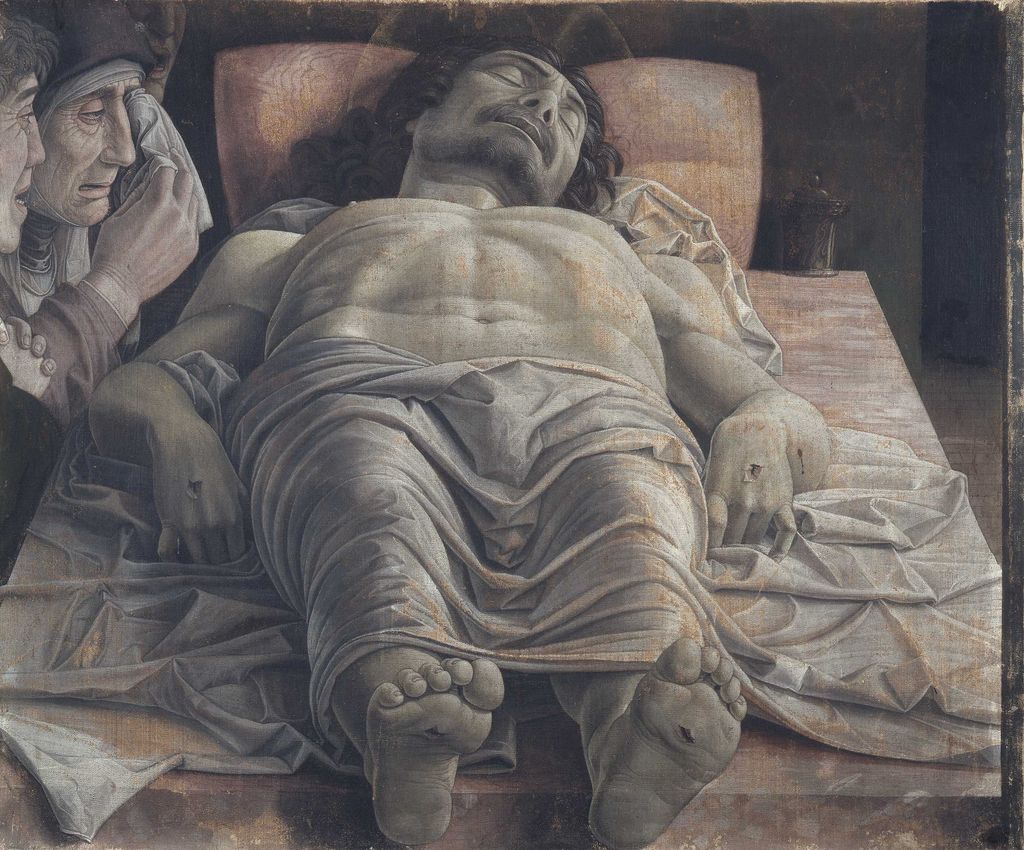
| Lamentation over the Dead Christ | C. 1483 (Brera dating) | Painting · Pinacoteca di Brera · 352 Catalogue. |
| The Triumphs of Caesar | About 1485–1506 | Painting · Royal Collection · RCIN 403958–403966 Catalogue. |
| Madonna of the Caves | C. 1488–90 | Painting · Uffizi Galleries · 1890 no. 1348 Catalogue. |
| Madonna and Child with a Choir of Cherubim | C. 1485 | Painting · Pinacoteca di Brera · 297 Catalogue. |
| Madonna and Child (Poldi Pezzoli) | Early 1490s (museum dating) | Painting · Museo Poldi Pezzoli · 1595 Catalogue. |
| The Holy Family with Saint Mary Magdalen | C. 1495–1500 | Painting · Metropolitan Museum of Art · 14.40.643 Catalogue. |
| The Virgin and Child with Saint Mary Magdalene and Saint John the Baptist | C. 1490–1505 | Painting · National Gallery, London · NG274 Catalogue. |
| Christ as the Suffering Redeemer | 1485–95 (SMK dating) | Painting · Statens Museum for Kunst · KMSsp69 Catalogue. |
| Ecce Homo | C. 1500 | Painting · Musée Jacquemart-André · MJAP-P 1840 Catalogue. |
| Judith with the Head of Holofernes (Mantegna or follower) | C. 1495–1500 | Painting · National Gallery of Art, Washington · 1942.9.42 Catalogue. |
| Madonna della Vittoria | 1495–96 | Painting · Musée du Louvre · INV 369 Catalogue. |
| Mars and Venus (Parnassus) | C. 1496–97 | Painting · Musée du Louvre · INV 370 Catalogue. |
| The Trivulzio Madonna | 1497 | Painting · Castello Sforzesco, Milan · 0554 Catalogue. |
| The Adoration of the Magi | C. 1495–1505 | Painting · J. Paul Getty Museum · 85.PA.417 Catalogue. |
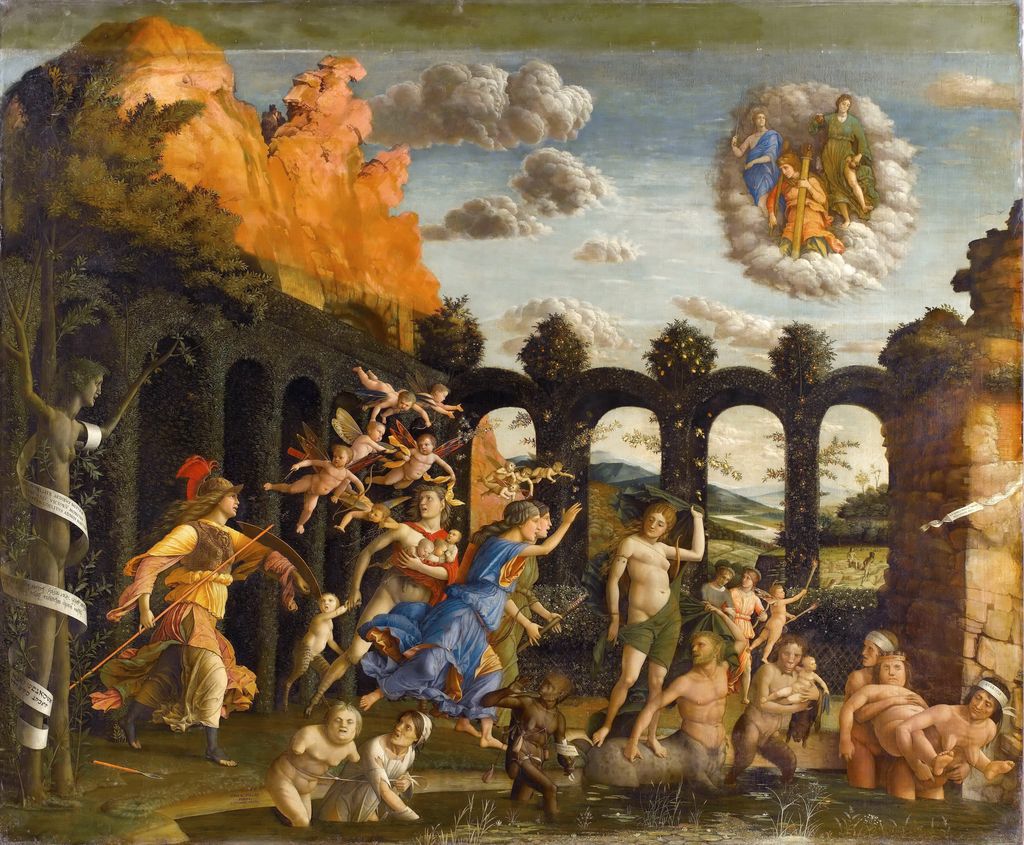
| Minerva Expelling the Vices from the Garden of Virtue | C. 1502 | Painting · Musée du Louvre · INV 371 Catalogue. |
| The Introduction of the Cult of Cybele at Rome | 1505–06 | Painting · National Gallery, London · NG902 Catalogue. |
| Saint Sebastian (Venice) | Probably c. 1504–06 | Painting · Galleria Giorgio Franchetti alla Ca’ d’Oro · D.11 Catalogue. |
| Samson and Delilah | C. 1500 | Painting · National Gallery, London · NG1145 Catalogue only. |
| A Woman Drinking (probably Sophonisba) | C. 1495–1506 | Painting · National Gallery, London · NG1125.2 Catalogue only. |
| The Vestal Virgin Tuccia with a Sieve | C. 1495–1506 | Painting · National Gallery, London · NG1125.1 Catalogue only. |
| Judith with the Head of Holofernes (Dublin) | C. 1495–1500 | Painting · National Gallery of Ireland · NGI.442 Catalogue only. |
| Battle of the Sea Gods, left half (Met impression) | Before 1481 (Met dating) | Print · Metropolitan Museum of Art · 18.12 Catalogue only. |
| Battle of the Sea Gods, right half (Met impression) | Before 1481 (Met dating) | Print · Metropolitan Museum of Art · 1984.1201.4 Catalogue only. |
| Battle of the Sea Gods, left half (Tokyo impression) | C. 1475 (Tokyo dating) | Print · National Museum of Western Art, Tokyo · G.1981-0002 Catalogue only. |
| Battle of the Sea Gods, left half (Washington impression) | C. 1485–88 (NGA dating) | Print · National Gallery of Art, Washington · 1941.1.6 Catalogue only. |
| The Entombment of Christ, second state of two | Before 1475 (Met dating) | Print · Metropolitan Museum of Art · 37.42.30 Catalogue only. |
| The Entombment of Christ (possibly Zoan Andrea, after Mantegna) | 1460–1549 (Rijksmuseum dating) | Print · Rijksmuseum · RP-P-1924-60 Catalogue only. |
| Four Dancing Muses (Gian Marco Cavalli after Mantegna) | C. 1497 | Print · Metropolitan Museum of Art · 20.5.3 Catalogue only. |
| Bacchanal with Silenus | Before 1475 (Met dating) | Print · Metropolitan Museum of Art · 29.44.15 Catalogue only. |
| Bacchanal with a Wine Vat | Before 1475 (Met dating) | Print · Metropolitan Museum of Art Catalogue only. |
| St James on His Way to Execution | C. 1453–57 | Drawing · British Museum · 1976,0616.1 Catalogue only. |
| Three Studies for a Dead Christ | C. 1455–65 | Drawing · British Museum · 1909,0406.3 Catalogue only. |
| Pietà (Venice) | C. 1456–65 (exhibition datings) | Drawing · Gallerie dell’Accademia, Venice · 115 Catalogue only. |
| Studies for Christ at the Column | 1460–65 | Drawing · The Courtauld · D.1978.PG.345 Catalogue only. |
| Virtus Combusta | C. 1490 (technical study) | Drawing · British Museum · Pp,1.23 Catalogue only. |
| Virtus Combusta (Giovanni Antonio da Brescia after Mantegna) | C. 1495–1506 | Print · Musée du Louvre · 3881 LR/ Recto Catalogue only. |
| The Calumny of Apelles | C. 1504–06 | Drawing · British Museum · 1860,0616.85 Catalogue only. |
Frequently Asked Questions
The National Gallery of Art leaves the sitter unidentified. A name once associated with the portrait is discussed in the article as part of its history of identification.
The paint was originally on wood. It was transferred to canvas and then to hardboard, so the object’s present support differs from the original painted panel.
Discussion
Look again at the images and ideas explored in Profile of a Man. These editorial prompts invite your observations.
Reader Insights
How do the blue space in front of the Washington sitter and the painted marble ledge in the Berlin Presentation give a different sense of the figures’ distance from the viewer?
What additional evidence would connect the Washington panel to the documented double portrait of Janus Pannonius and Galeotto Marzio, beyond its later Hungarian provenance?
Join the Conversation
Share a detail, comparison or question about Profile of a Man below.
References
- National Gallery of Art, Portrait of a Man, accession 1952.2.5, with provenance, exhibition history and systematic catalogue citation. View source.
- Fondazione Federico Zeri, Ritratto maschile, National Gallery of Art, inv. 1952.2.5. View source.
- Università di Bologna, Giacomo Alberto Calogero, «Non tanto per el guadagno quanto per l’onore». Marco Zoppo, le corti italiane e gli umanisti. View source.
- Museo Poldi Pezzoli, Ritratto Maschile. View source.
- Fondazione Federico Zeri, Ritratto maschile, Museo Poldi Pezzoli, inv. 1592. View source.
- The Metropolitan Museum of Art, Portrait medal of Cecilia Gonzaga (obverse); Innocence and a Unicorn in a Moonlit Landscape (reverse). View source.
- Staatliche Museen zu Berlin, Kardinal Ludovico Trevisan. View source.
- National Gallery of Art, Cristoforo di Geremia’s medal of Ludovico Trevisan, obverse. View source.
- The Uffizi Galleries, Portrait of a Prelate (Carlo de’ Medici?). View source.
- Museo e Real Bosco di Capodimonte, Una nuova cornice per l’opera di Andrea Mantegna. View source.
- Staatliche Museen zu Berlin, Die Darbringung Christi im Tempel. View source.
- Basilica of San Zeno, Verona, San Zeno Altarpiece, View source.
- Palazzo Ducale, Mantua, Camera degli Sposi (Camera Picta), View source.
- Royal Collection, The Triumphs of Caesar, View source.
- Musée du Louvre, Madonna della Vittoria, View source.
- National Gallery, London, The Introduction of the Cult of Cybele at Rome, View source.
More MANTEGNA Paintings
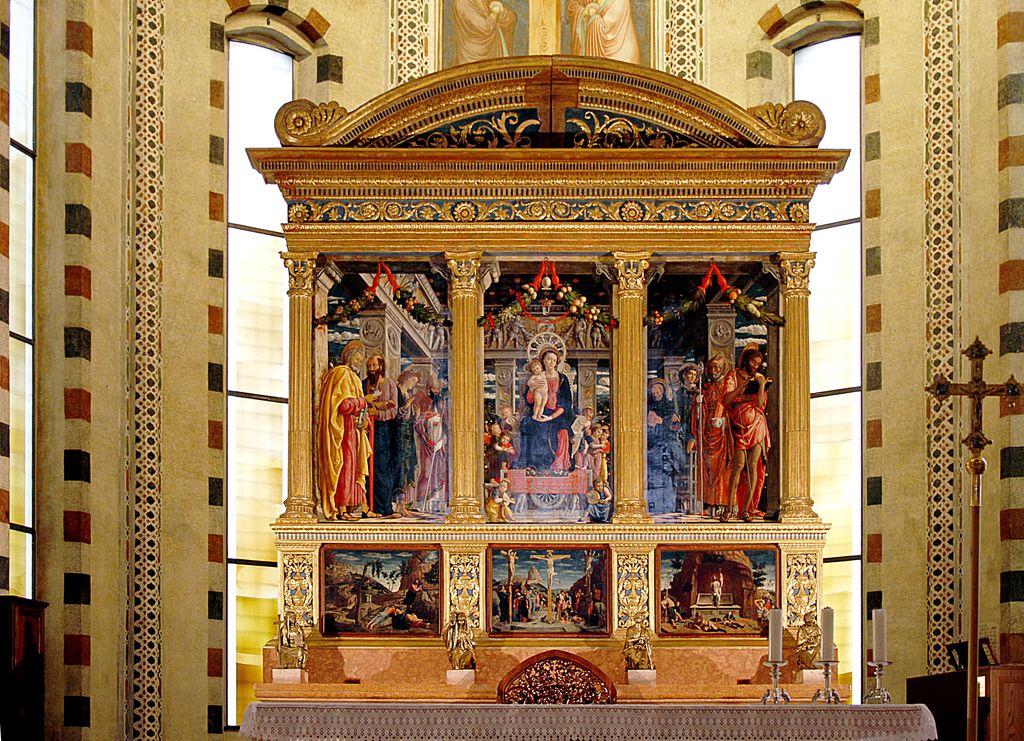
San Zeno Altarpiece
The San Zeno Altarpiece in its frame, Basilica of San Zeno, Verona José Luiz. Image source. CC BY-SA 4.0. Resized from the cited image.