 by Tom Gurney
Tom Gurney BSc (Hons) is an art history expert with over 20 years experience
Email: tomgurney1@gmail.com / Phone: +44 7429 011000
Bellini’s Agony in the Garden
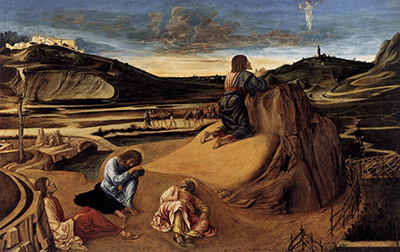
A thin band of pink spreads along the horizon in Giovanni Bellini’s The Agony in the Garden. Christ kneels on a rise, with three sleeping disciples below him and a small angel holding a cup in the sky above. Beyond the river, Judas is already leading soldiers towards the garden. Look first at the bright rim under the clouds, then down to the tiny men on the road. The widening light and their approach make the time left for prayer feel short. [1]
The National Gallery in London dates Bellini’s panel, NG726, to about 1458–60. It measures 80.4 × 127 cm and is painted in egg tempera on wood, probably poplar. The gallery also owns an earlier treatment of the same subject by Andrea Mantegna, Bellini’s brother-in-law. The relationship is visible in the folds of a robe and the position of a sleeping man. It also makes the room Bellini gives to the landscape, and the use he makes of it, easier to see. [1] [2]
At a Glance
- ArtistGiovanni Bellini
- DateAbout 1458–60
- CollectionNational Gallery, London
- Catalogue numberNG726
- MediumEgg tempera on wood
The work in Bellini’s career
The Agony in the Garden
c. 1458–60Presentation at the Temple
c. 1475St. Francis in the Desert
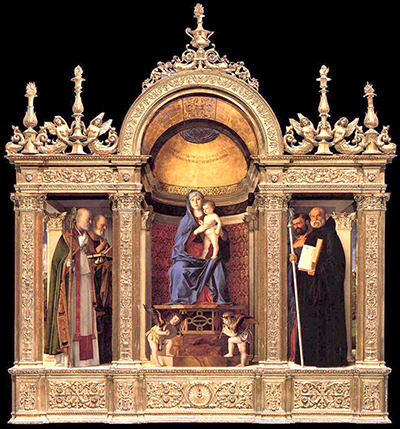
Late 1470sFrari Triptych
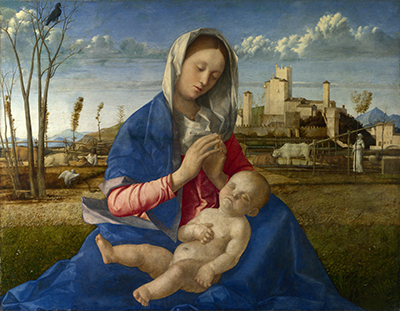
1488Madonna of the Meadow
c. 1500–05Doge Leonardo Loredan
c. 1501–02The Feast of the Gods
Bellini’s signed date 1514The soldiers beyond the river
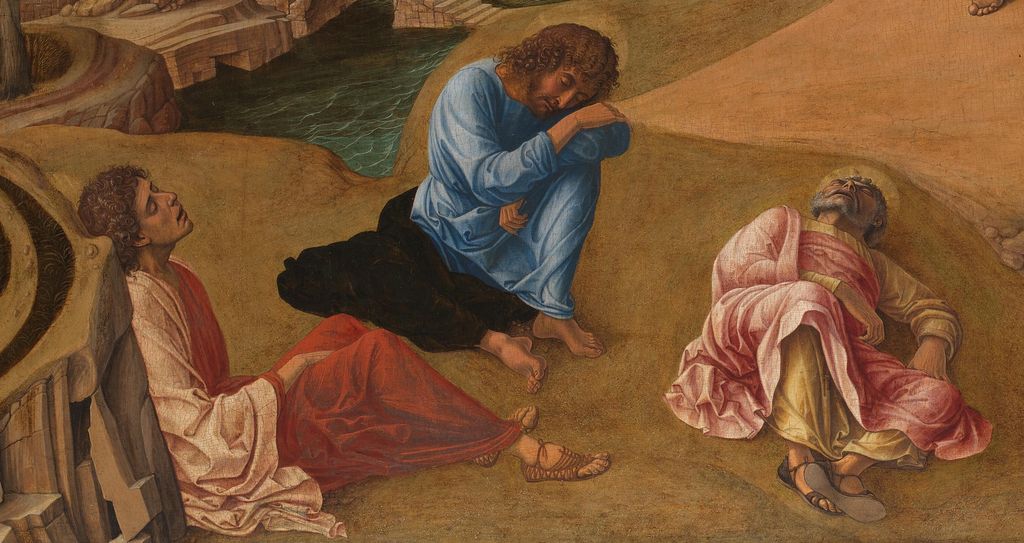
Bellini sets the sleeping disciples close to the lower edge, where their scale and the colours of their clothes draw the eye. The man at left props himself against a projecting stone, his head tipped back. A second curls forward in blue, his head resting on the arm he has laid across a raised knee. The third has slipped backwards, knees bent, his sandalled feet pointing out towards us. The fullness of his pink and yellow clothing makes the little patch of shadow under his sandals especially noticeable. Each man has settled differently on the hard ground. The three heavy bodies make Christ’s upright posture above them look all the more alert. [1]
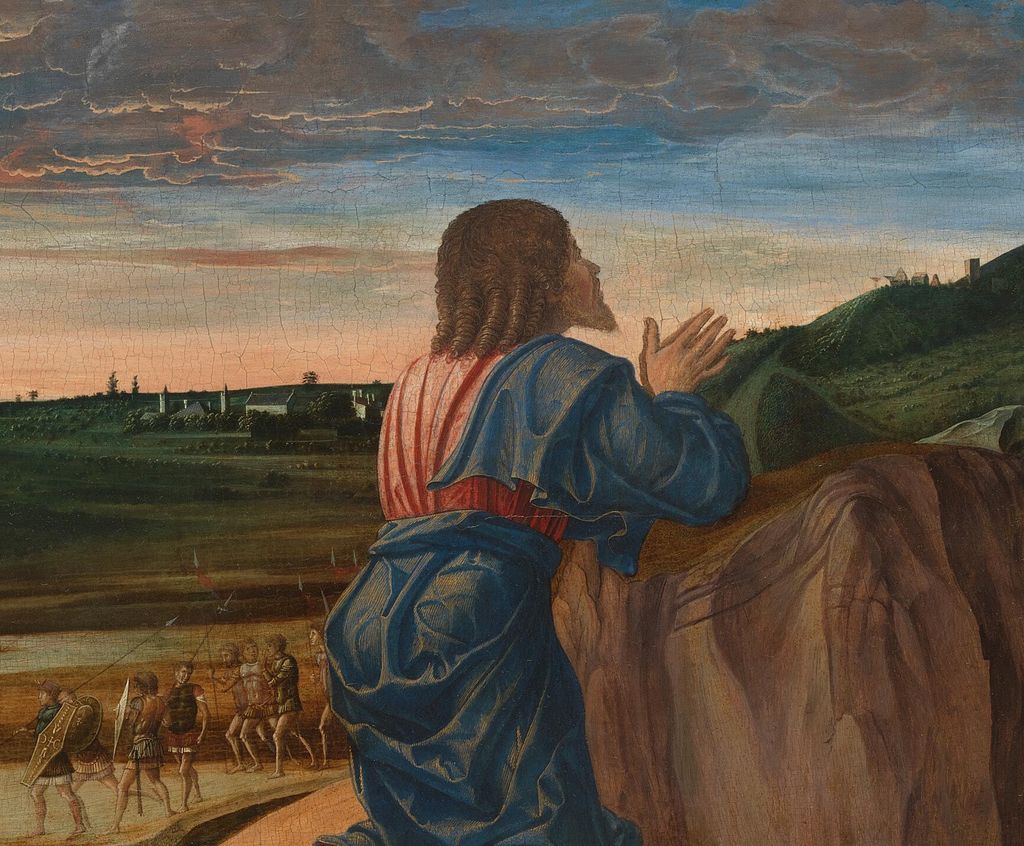
Christ faces partly away from us. His bare feet are visible below the trailing mantle, and his lifted hands break the line of the hill. We are close enough to follow his gaze, but the turn of his shoulders puts much of his expression out of reach. The other men nearby have shut their eyes. Bellini gives the viewer an unobstructed view of what they are missing, both above the rock and behind it. [1]
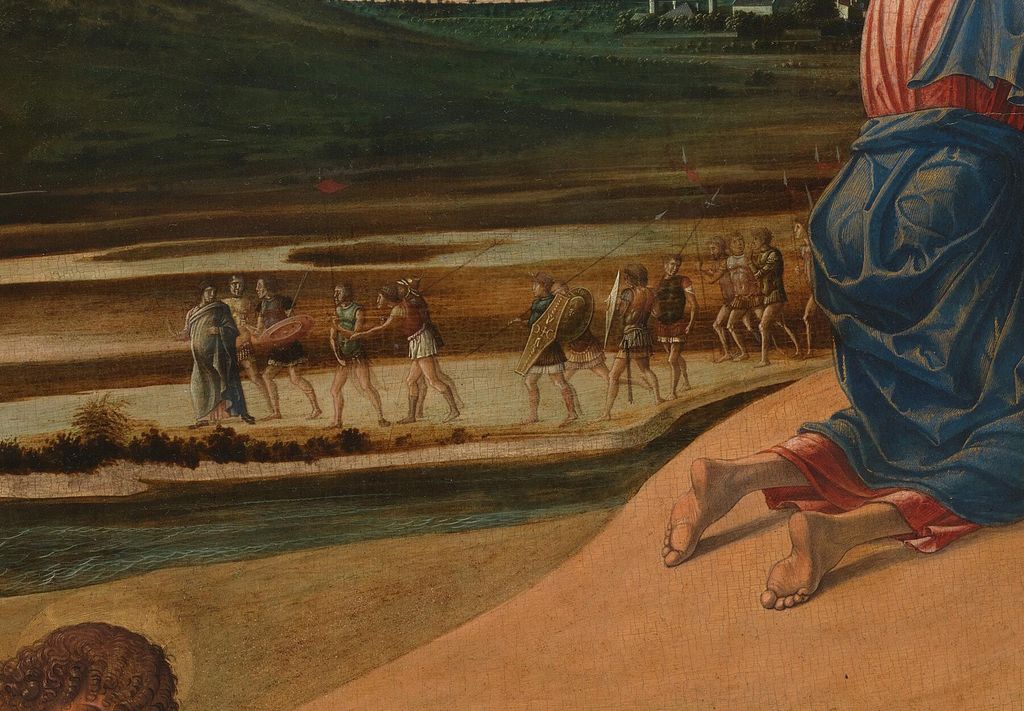
On the river’s far bank, Judas advances with his company along a light strip of road. The figures are small enough to be missed at first glance. Once found, they give a purpose to the bridge at left. Its steps and single masonry arch indicate how the two banks are joined, and its low position makes the distance from the road to the foreground easy to grasp. The dark water cuts off the sleepers visually from the troop for the moment. At the right edge, interlaced branches mark the boundaries of the garden. The river and fence divide the terrain into distinct spaces, but the painting has already shown how close those spaces are. [1]
Farther back, pale tracks cross the darker land. One bends sharply along the exposed face of the left hillside, near the bright fortified settlement the National Gallery identifies as Jerusalem. Across the valley, a tower marks the crest of a second hill. The wide proportion of the panel matters here. Bellini can put the vulnerable group in plain view and still let the approach unfold at a remove across the middle of the picture. The arrest is imminent, yet the time needed to walk down a road and cross the river still belongs to the prayer. [1]
The cup and the rock
The title refers to Christ’s anguish before his arrest. In Matthew’s Gospel he goes to Gethsemane with his disciples and asks three of them to stay awake while he prays. He asks his Father to spare him the cup of suffering if possible, while yielding to his Father’s will. Luke’s account describes an angel from heaven strengthening him. Bellini turns the cup in the prayer into a form the viewer can see, standing out in the outstretched hands of a single winged figure in the upper right. [1] [3]
The angel is small compared with Christ and pale enough for the surrounding blue to remain the dominant colour. The cup has a more definite outline. Follow that small shape down the picture and the spiked branches in the fence come into view. The National Gallery reads the spikes below the chalice as an anticipation of the crown of thorns. It also compares the ledge against which Christ kneels to an altar and connects the cup to the wine of the Eucharist. On this reading, Christ accepts his future suffering at a rock that recalls the place where worshippers would later commemorate his sacrifice. The setting offers that connection through the forms of ordinary things, down to the rough points of the garden fence. [1]
How Bellini paints dawn
The light starts low in the picture, where the blue of the sky gives way to pink and peach above the distant land. The largest clouds are still grey, but fine bright lines catch their lower edges. At the horizon there is just enough light to put a warm colour behind Christ’s face and hands. The pink of his tunic, seen at the shoulder and again near his feet, repeats the warm notes in the sky. His blue mantle carries the cooler colour instead. The folds of the costume participate in the change of light while keeping their own sharp edges and distinct colours. Farther back, the changes in colour are gentler. The green ridge, distant trees and bright sky meet in a narrow band behind Christ. As Fernando Linares and Isaac Mendoza observe in their study of distance in painted landscapes, Bellini helps the eye judge remoteness by softening outlines and reducing contrast. The almost flat line of the horizon then opens a further distance beyond the nearer valley with its sharply cut banks. [1] [4]
Some of the fine highlights on the clothing are made with shell gold. The name refers to powdered gold prepared as a paint. A conservator can identify gold applied this way separately from the coloured strokes that suggest light elsewhere. The National Gallery’s published examination found powdered gold on Bellini’s drapery, and the gallery suggests that the highlights on Christ can evoke his divinity as well as the fall of early light. The bright edges of the clouds do their work at the scale of the entire picture, whereas the fine strokes on the clothing reward a closer view. [1] [5]
Examination has also brought out aspects of the work that would be hard to assess by eye. Infrared reflectography, which can make underlying lines visible through some paint layers, shows particularly careful drawing beneath the angular foreground stones and the sharply folded clothing. The gallery considers the folds likely to have been worked out in detailed studies. A 1977 analysis identified egg binder in a blue sample from the trees, supporting the catalogue’s description of the medium. The gallery’s science team has also discussed the darkening of green malachite in the painting. The present earth colours are therefore a guide to the arrangement of light and dark, with the qualification that some greens have changed since Bellini painted them. [1] [5] [6] [7]
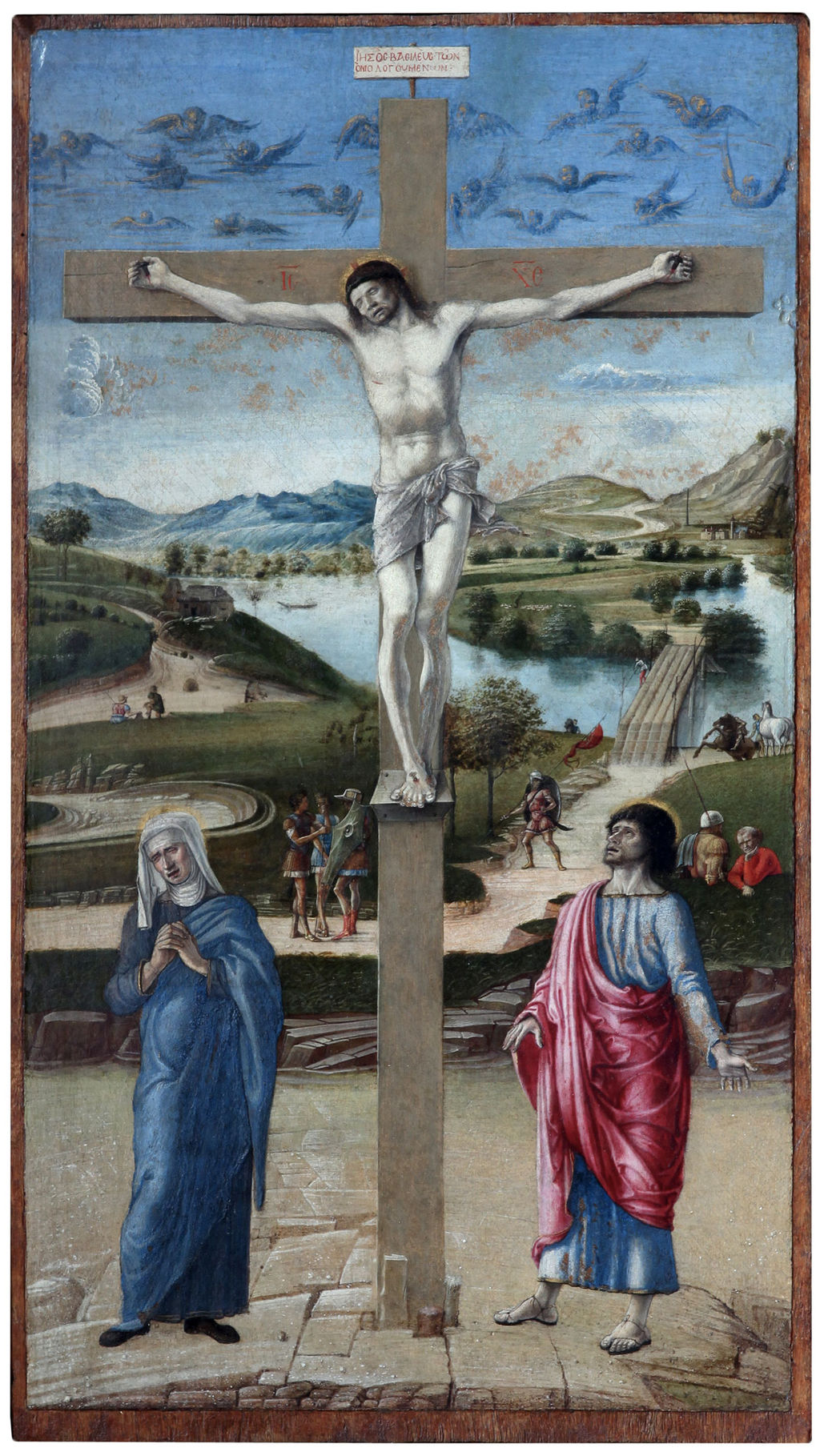
Bellini and Mantegna paint the same prayer
Mantegna’s signed London Agony in the Garden, NG1417, is dated about 1455–56. It too is in egg tempera on wood, but at 62.9 × 80 cm it is considerably narrower. Three disciples sleep below Christ, soldiers leave Jerusalem and a rock makes a raised station for prayer. In the sky, a collection of cherubs carries the instruments of Christ’s suffering and death. Their bodies have the emphatic modelling of small sculptures. Bellini concentrates the apparition on the chalice and sets it high in a span of blue sky. Mantegna also used gold to pick out minute details. The 1978 technical study suggested, on the basis of examination with a hand lens, that the London Mantegna may share Bellini’s use of powdered gold. Both paintings therefore invite very close looking, even though their contrasting visions above the kneeling Christ are legible from across a room. [1] [2] [5]
Look at the sleeper whose feet come towards us. Mantegna shortens the body dramatically along the line of sight, using foreshortening to bring the feet forward. The National Gallery identifies Bellini’s comparable pose as a debt to Mantegna. Both artists give the folds hard crests, but Bellini’s fabrics bunch around the knees and spread in scalloped layers along the ground. The angular stones at the left edge of his panel show a related attention to firm edges. Those passages sit beside the curving roads and rounded rock faces that set the movement of the rest of the composition. [1] [2]
Mantegna married Nicolosia Bellini in 1453. The relationship linked two painters who had access to designs associated with her father, Jacopo. [8] The National Gallery points to a drawing of the subject by Jacopo Bellini, preserved in an album at the British Museum. It offers a precedent for the altar-like rock and for showing Christ turned away towards a distant slope. The gallery sees Giovanni as closer to Jacopo in the rounded shapes and winding lines of the terrain. The Louvre holds another of Jacopo’s drawing books. The two albums help explain how a composition could serve as material to think through and adapt, well beyond a single finished panel. [1] [2] [9] [10]
The two painted cities show how far the artists could go in different directions from related material. Art historian Liya Chechik compares Mantegna’s conspicuous amphitheatre-like building and triumphal column with the more familiar medieval Italian appearance of Bellini’s fortified town. She reads the slender tower across Bellini’s valley as a reference to a place farther east. In his panel, the brightest building fronts catch the eye first, while the remote tower has to be picked out against the sky. [1] [2] [8] [9] [10]
Mantegna also painted the prayer for the predella, the lower strip of scenes, of the San Zeno altarpiece in Verona. That third painting, dated 1457–59 by the Musée des Beaux-Arts de Tours, is now in Tours. It was made to be seen in sequence with the Crucifixion and Resurrection. The Tours museum draws attention to reeds, to reflections on moving water and to the rocks that frame a view towards Jerusalem in its panel. These observations make it possible to appreciate Mantegna’s interest in the look of a landscape as well as the difference between the two London paintings. Bellini is distinctive in the way the light travels across such a broad terrain and makes the passing moment felt during Christ’s prayer. [1] [2] [11]
From private collections to the National Gallery
The early provenance has gaps. The National Gallery lists the British consul Joseph Smith in Venice as an apparent owner and tentatively identifies the painting with a lot in Sir Joshua Reynolds’s sale in 1795. It records the work in the Fonthill sales of William Beckford, in the Edward Harman sale of 1847, and subsequently with the Reverend Walter Davenport Bromley. Bromley lent it to the Art Treasures Exhibition in Manchester in 1857, where it appeared under the title Christ on the Mount of Olives. [1] [12]
A pencil sketch and notes by George Scharf, dated 15 September 1857 and now at the National Portrait Gallery, document his study of the panel at Manchester. He revisited the composition on several pages. The historian Fabio Franz shows that Scharf paid close attention to the space between the angel and the city and went back to study the draperies and skin tones of the sleepers. Giovanni Battista Cavalcaselle also examined the panel there. His notes single out the stone bridge and associate details of it with Jacopo’s manner, an observation about the way the passage was painted that need not imply it came from the British Museum drawing. [10] [12]
The National Gallery acquired the painting from the Davenport Bromley sale in 1863 and bought Mantegna’s London version separately in 1894. Both had been in the Manchester exhibition as loans from different collections. They were paired in the London and Berlin exhibition of 2018–19, where visitors could look from one kneeling figure to the other and see how much the shape of the terrain, the space above Christ and the distance to the soldiers alter the experience of the same event. [1] [2] [10] [12] [13]
Annotated Details from The Agony in the Garden
Numbered overview and cropped details. Photograph National Gallery, London, via Wikimedia Commons. Image source. Public Domain Mark 1.0.
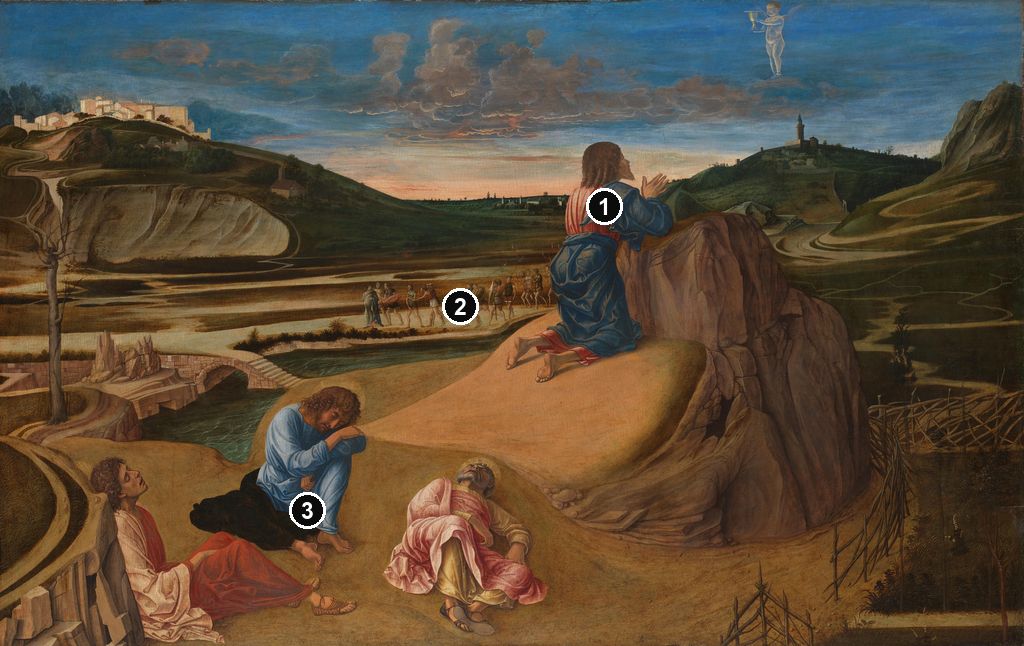
Details from THE AGONY IN THE GARDEN
Notice how the sleeping figures, the distant procession and the kneeling Christ occupy different levels of the landscape.
Christ on the ridge
The kneeling figure is separated from the party approaching through the landscape. The pink of his clothing picks up the light in the sky.
The approaching group
The armed party appears at a much smaller scale, beyond the sleeping disciples. Look for figures rather than a large silhouette at the river crossing.
The sleeping disciples
The figures fill the lower left, close enough for the edges of their drapery and the weight of their resting bodies to register.
Videos on Giovanni Bellini
Explore Bellini’s work through museum talks and close readings.
Giovanni Bellini: A pioneering Venetian artist
The National Gallery introduces Bellini through examples of natural light and landscape.
Watch on YouTubeRelated reading
Artworks directory
Discussion
Look again at the images and ideas explored in The Agony in the Garden by Giovanni Bellini. These editorial prompts invite your observations.
Reader Insights
What role does the light have in the way you read time in Bellini’s scene?
What do the small approaching figures do for the composition?
Where does the route through the landscape become a way of telling time?
Join the Conversation
Share a detail, comparison or question about The Agony in the Garden by Giovanni Bellini below.
References
- The Agony in the Garden by Giovanni Bellini, NG726, The National Gallery View source.
- The Agony in the Garden by Andrea Mantegna, NG1417, The National Gallery View source.
- Matthew 26:36–46, Mark 14:32–42 and Luke 22:39–46, Bible Gateway View source.
- Fernando Linares and Isaac Mendoza, “La distancia en el arte o el arte de la distancia”, diségno 15 View source.
- Allan Braham, Martin Wyld and Joyce Plesters, “Bellini’s ‘The Blood of the Redeemer’”, National Gallery Technical Bulletin 2 View source.
- John Mills and Raymond White, “Analyses of Paint Media”, National Gallery Technical Bulletin 1 View source.
- Colour Stories: Green, The National Gallery View source.
- Liya Chechik, “The Representation of Jerusalem in Early Renaissance Venetian Painting”, State Institute for Art Studies View source.
- La Flagellation by Jacopo Bellini, Musée du Louvre, Département des Arts Graphiques View source.
- Fabio Franz, Reassessing Connoisseurship Before and After the Manchester Art Treasures Exhibition of 1857, University of Warwick, pp. 122–24 View source.
- Mantegna: La prédelle de San Zeno de Vérone, Musée des Beaux-Arts de Tours View source.
- Scharf Sketchbook 47, page 17, National Portrait Gallery View source.
- Mantegna and Bellini, The National Gallery exhibition archive View source.