 by Tom Gurney
Tom Gurney BSc (Hons) is an art history expert with over 20 years experience
Email: tomgurney1@gmail.com / Phone: +44 7429 011000
A kneeling doge before the Virgin
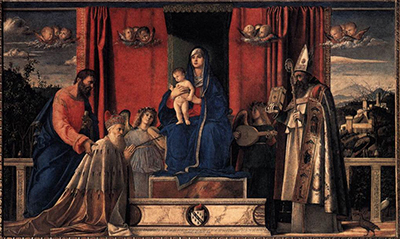
Giovanni Bellini painted the Barbarigo Altarpiece in 1488 for Agostino Barbarigo, the doge of Venice. Barbarigo kneels before the Virgin and Child with his hands joined. Saint Mark puts a hand on his shoulder to present him, while Saint Augustine stands across the throne. The painting is a large oil on canvas, about two metres high and more than three metres wide. It belongs to the church of San Pietro Martire on Murano, although Barbarigo commissioned it during his dogeship and directed in his will that it be installed in another church on the island. [1] [2] [3] [4]
At a Glance
- ArtistGiovanni Bellini
- Date1488
- MediumOil on canvas
- LocationSan Pietro Martire, Murano
The work in Bellini’s career
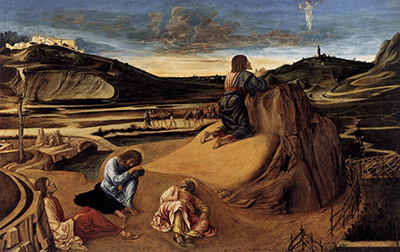
The Agony in the Garden
c. 1458–60Presentation at the Temple
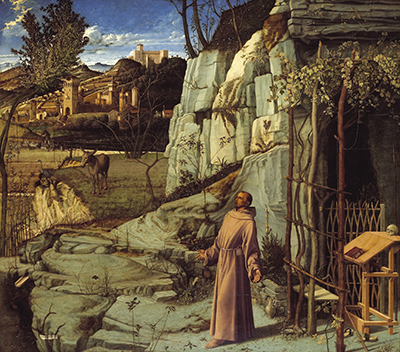
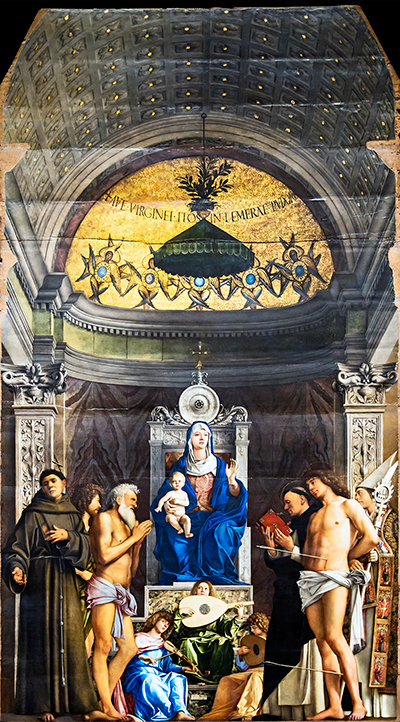
c. 1475St. Francis in the Desert
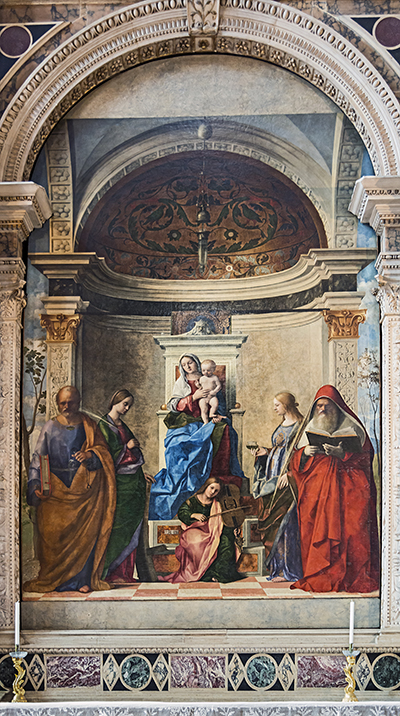
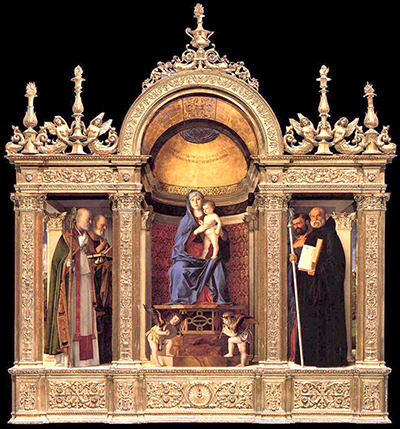
Late 1470sFrari Triptych
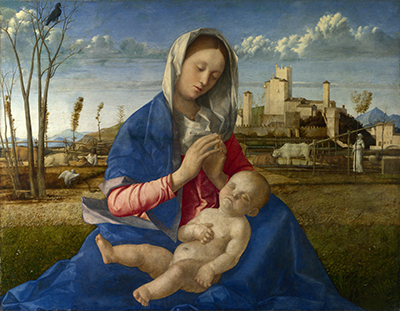
1488Madonna of the Meadow
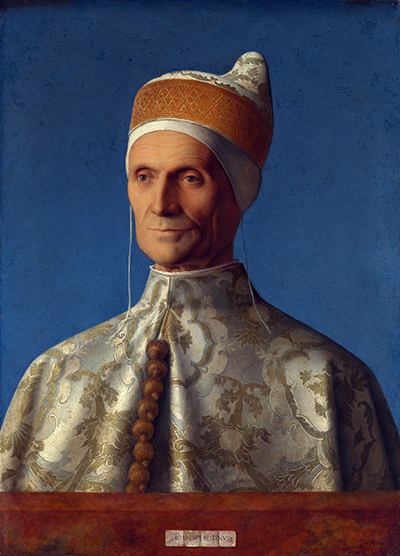
c. 1500–05Doge Leonardo Loredan
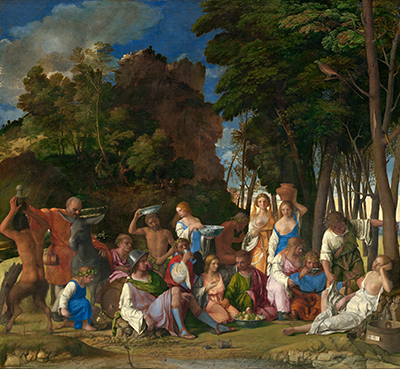
c. 1501–02The Feast of the Gods
Bellini’s signed date 1514How Bellini presents the doge
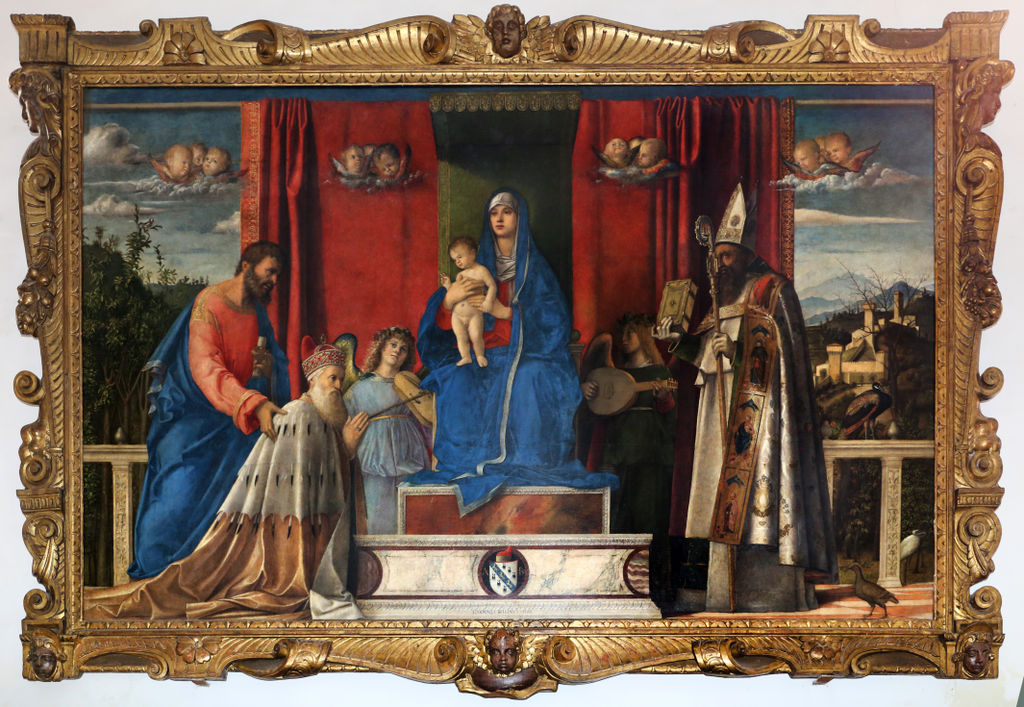
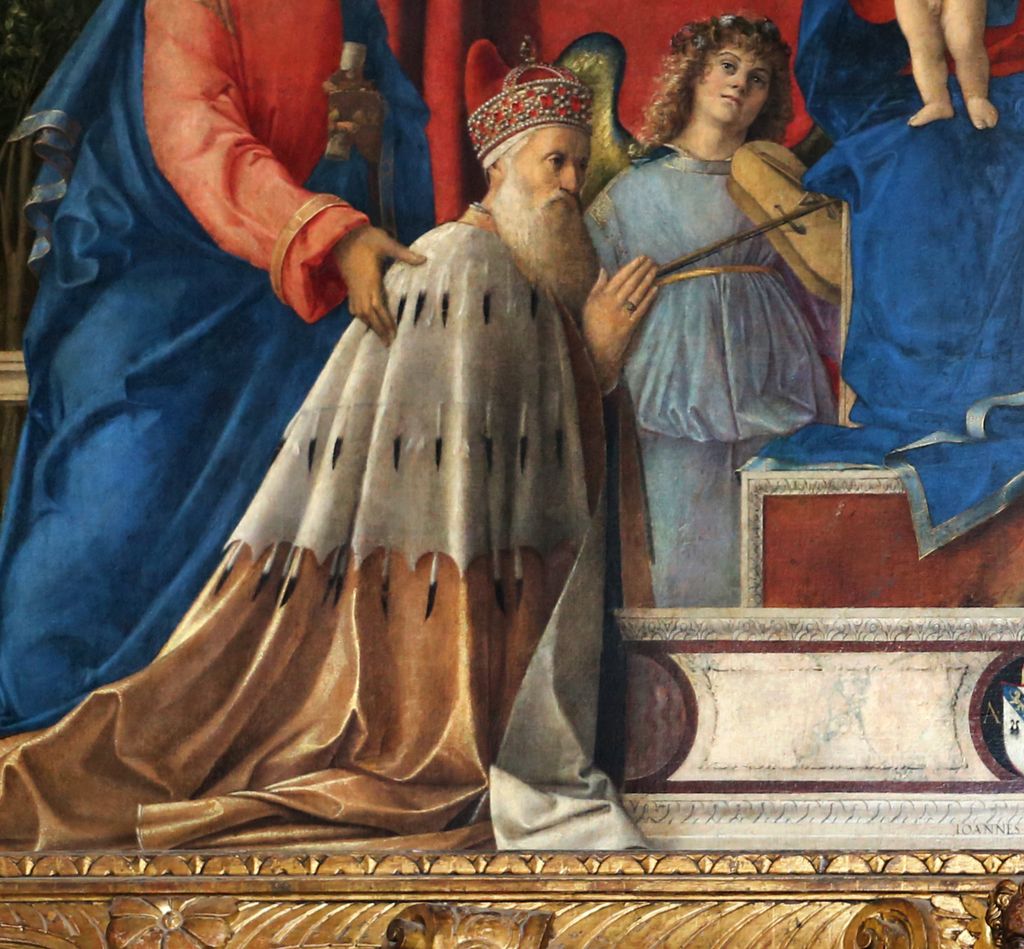
Barbarigo occupies the lower left of the canvas. His white beard, pointed ducal cap and long mantle make him immediately recognisable within the scene. Dark markings in the pale fur lining stand out against the broad folds of his robe, which trail towards the corner. The finery is visible even at a distance, but the level of his head gives the prayer its force. It falls well below the Virgin's face and close to her feet. The elected head of Venice is the only adult kneeling before the throne. [2] [4]
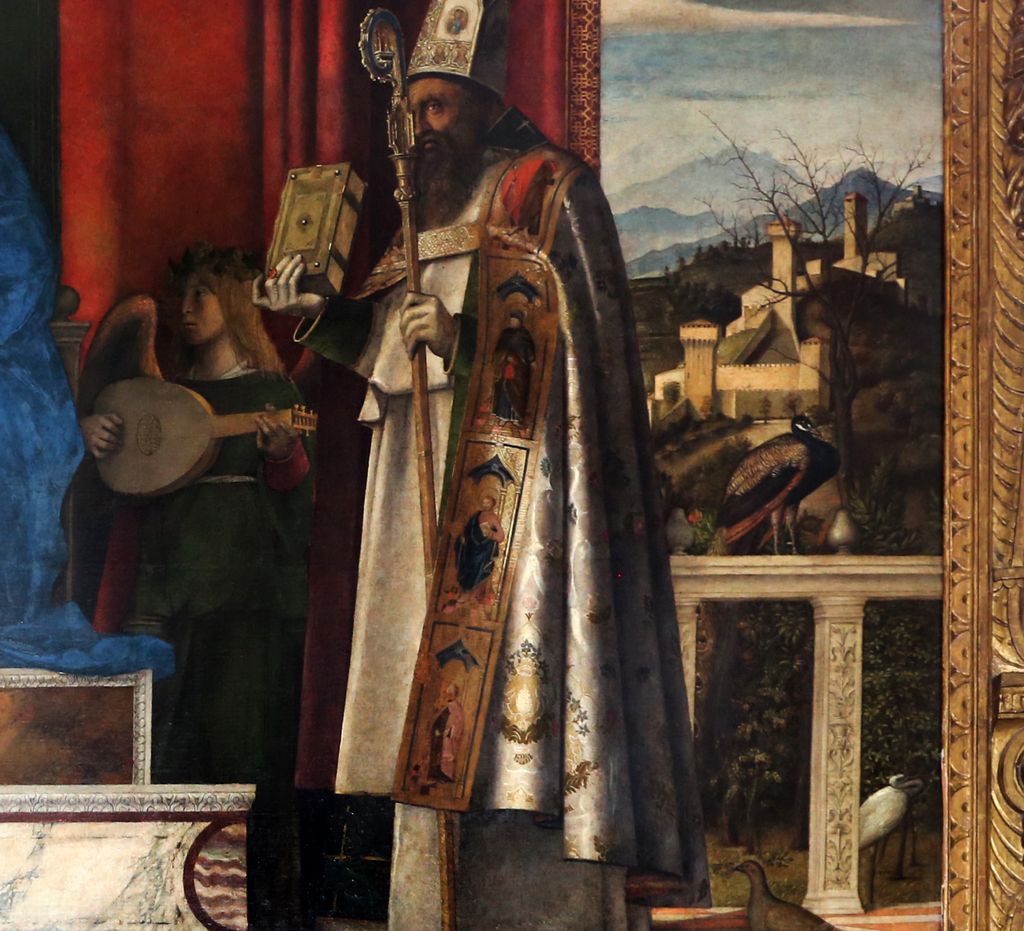
Mark's red sleeve takes the eye down to the hand resting on Barbarigo's shoulder. The figure is Venice's patron saint, so his gesture can be understood as an introduction on behalf of the city as well as an act of intercession for one man. On the right, Augustine wears a bishop's mitre and carries a book and crozier. The saint bears the patron's name in its Italian form, Agostino, and had particular significance for the Augustinian community that later received the painting. His upright figure balances Mark and the kneeling doge, while the act of presentation belongs visibly to Mark. [2] [4] [5]
One further reading turns on the names of the two Barbarigo brothers. Agostino took office in 1486 after the death of his brother Marco. The historian Augusto Gentili argued that in choosing Mark to introduce the doge, the picture also recalls Marco through his namesake saint. That interpretation would give the act of presentation a family and political significance. The painting itself provides the gesture, the ducal costume and the saints. The suggestion that the gesture expresses the late brother's approval belongs to Gentili's reading of the circumstances surrounding Agostino's election. [5] [6]
The throne, music and landscape
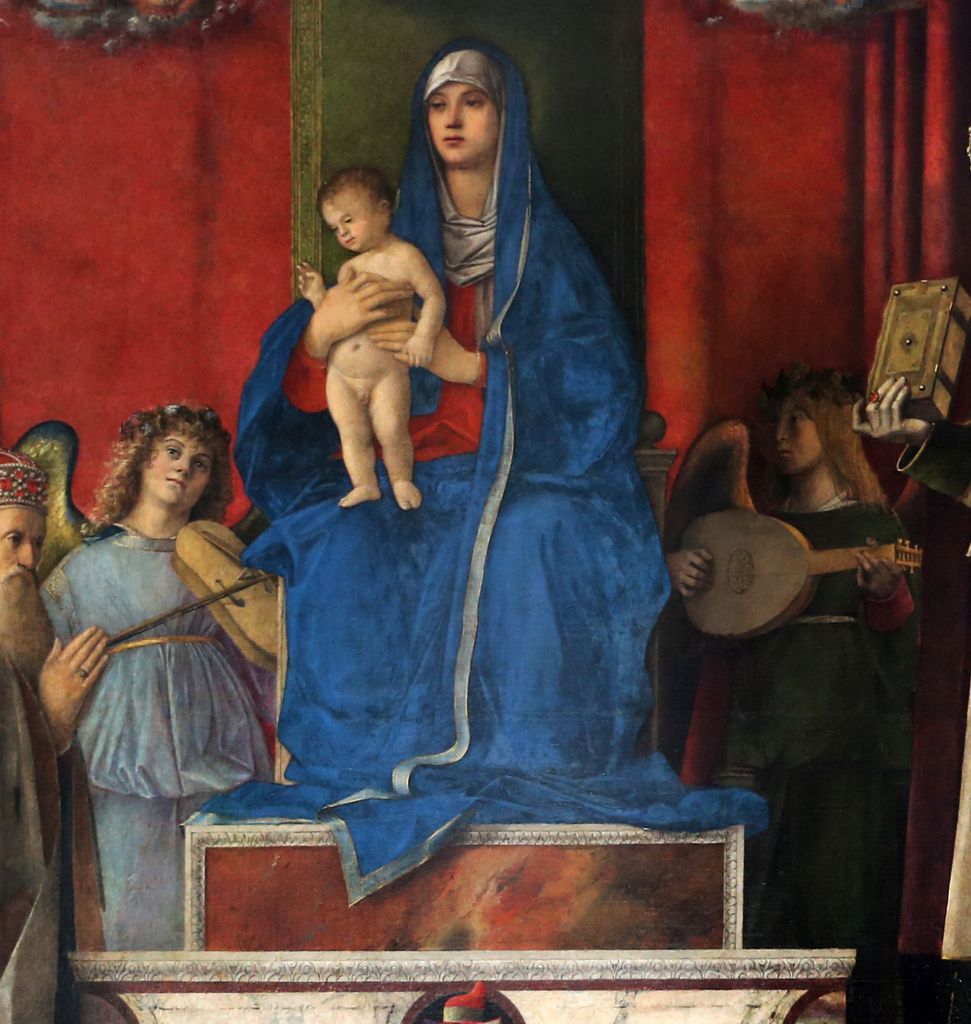
From the donor's clasped hands, the eye rises to the Child. His pale body appears against Mary's blue mantle, and his exposed legs extend towards the step below. An angel plays on either side of the throne. The one partly behind the kneeling doge inclines towards a stringed instrument, while the musician on the right holds a lute with its rounded body turned towards us. Above the group, small winged heads gather in clusters. Some are set against the hanging, others against the sky. Bellini repeats them across the width of the painting so that the heavenly company extends beyond the space beneath the canopy. [2] [3]
The dark cloth directly behind Mary's head makes her pale face and veil easy to find. Deep folds in the red curtains set off this central strip, while the painted canopy marks the Virgin's place of honour. The art historian Juliette Brack includes Bellini's painting among Italian examples of a throne backed by a hanging and covered with a rectangular canopy. Look at the gold trim running down the curtains, then at the band of ornament along the bishop's vestments. Each belongs to a different textile, and the weight and direction of each cloth help define the space it occupies. [2] [7]
A stone balustrade stretches behind the figures. Trees fill much of the opening on the left, while on the right buildings follow the slope of a hill beneath distant blue ridges. The open edges lend a sense of scale to the gathering at the throne. Near Augustine, a peacock perches on the rail and a smaller bird stands close to the foot of the saint's robe. Gentili reads the peacock's traditional association with immortality and resurrection against the bare tree above it. His account also considers competing meanings for the smaller bird he identifies as a partridge. Such readings start with details one can point to in the painting, but their exact relationship to Barbarigo's intentions remains open. [3] [6]
Below Mary, a small shield on the front of the painted throne carries the Barbarigo arms. The small forms around the blue band are beards, a visual play on the family name. The catalogue identifies three lions on the band and the ducal cap above it. Bellini has already shown the real cap on Barbarigo's head, and the device repeats it in miniature at the centre of the scene. The artist's inscription is directly beneath the arms. The Italian national catalogue records the Latin wording as IOANNES BELLINUS 1488 and the Istituto Nazionale di Studi sul Rinascimento locates it on the step at the base of the throne. The date gives a firm point in Bellini's career. The placement also brings two identities into view in a single glance, the patron through his arms and the painter through his name. [1] [3]
A palace commission and a gift to Murano
The title Barbarigo Altarpiece reflects the role the doge wanted the canvas to have after his death. Its first setting has been debated. The Italian national catalogue places it in the main hall of the Barbarigo family palace in the San Polo district. More recent archival scholarship places the commission in the Doge's Palace. Emanuele Castoldi identifies the room as the Sala dello Scudo. The wording of the 1501 will, which refers to the painting as being in a room of the palace and separately forbids its installation in the family's great house, supports the distinction. [1] [4] [6]
Bellini was also engaged on the Great Council chamber during his career. Those official civic obligations provide a context for his work within the palace, while the 1488 canvas shows the individual doge in prayer. Here the extent of the canvas allows Bellini to include a donor, two saints, a canopy and a landscape on one continuous surface. His later portrait of Doge Leonardo Loredan concentrates attention on the cap, robe and face of a single officeholder. The National Gallery's small portrait of a young Marco Barbarigo, attributed to a follower of Jan van Eyck and dated about 1449–50, shows Agostino's brother years before either was doge. [4] [8] [9] [10]
In his 1501 will Agostino directed that the canvas be sent to the monastery of Santa Maria degli Angeli on Murano. Two of his daughters belonged to the community. He reserved the high altar for the painting and explained its suitability through the image of the Virgin with angels, which fit the church's dedication. The will also called for framing to furnish the painting below, above and on either side. Read alongside the broad proportions of the canvas, that provision gives a practical sense of what was involved in adapting a palace picture for an altar. [4] [11]
The gift continued a relationship that predated the dogeship. Castoldi found Agostino acting in 1481 as one of the guarantors for a land deal that enabled the monastery to build its new church. By 1498 the community described him as its protector on earth, alongside the Virgin as its protector in heaven. That language makes the local appeal of Bellini’s image easier to see. The nuns received a picture of their patron in the same act of devotion they could perform before the altar. [4] [5]
Castoldi makes the case for its early installation at the high altar within the church's domed presbytery. The canvas's later placement is documented more directly. An Annunciation commissioned in the 1530s displaced it from the principal position in Castoldi's reconstruction. In 1664 Marco Boschini recorded Bellini's painting above the windows beneath the nuns' choir. Late in the eighteenth century, the Venetian paintings inspector Pietro Edwards still found it at Santa Maria degli Angeli. The inspection record notes areas of flaking and dirt and recommends cleaning, filling losses and securing loose paint. The move to San Pietro Martire came in the nineteenth century. [4] [12]
The canvas at San Pietro Martire
The broad canvas gives a very different shape to sacred company from the tall panels of Bellini's Frari Triptych, made in the same year. Here there are no vertical divisions between the figures. Mark's blue cloak, the pale costume of the musician and Mary's mantle carry related colours through the left half, while the balustrade and the narrow band of floor hold the two sides together. The continuous surface lets Bellini distinguish the doge's lower stance from the higher throne without taking him out of the saints' space. [2] [3] [13]
Gallerie dell'Accademia archive records list correspondence from 1983–84 about the publication on the painting's restoration. Open Care also identifies the canvas as one of seven Bellini works studied in situ with non-invasive methods for a research campaign associated with the 2008–09 exhibition in Rome. Those records concern the 1488 painting. San Pietro Martire is also the home church of the later Virgin in Glory with Eight Saints, for which Venetian Heritage records a separate conservation project. Its Virgin appears in glory above a gathering of eight saints. The doge kneeling on the terrace, the low throne inscription and the musicians beside the Virgin identify the 1488 work at a glance. [3] [14] [15] [16]
Annotated Details from Barbarigo Altarpiece
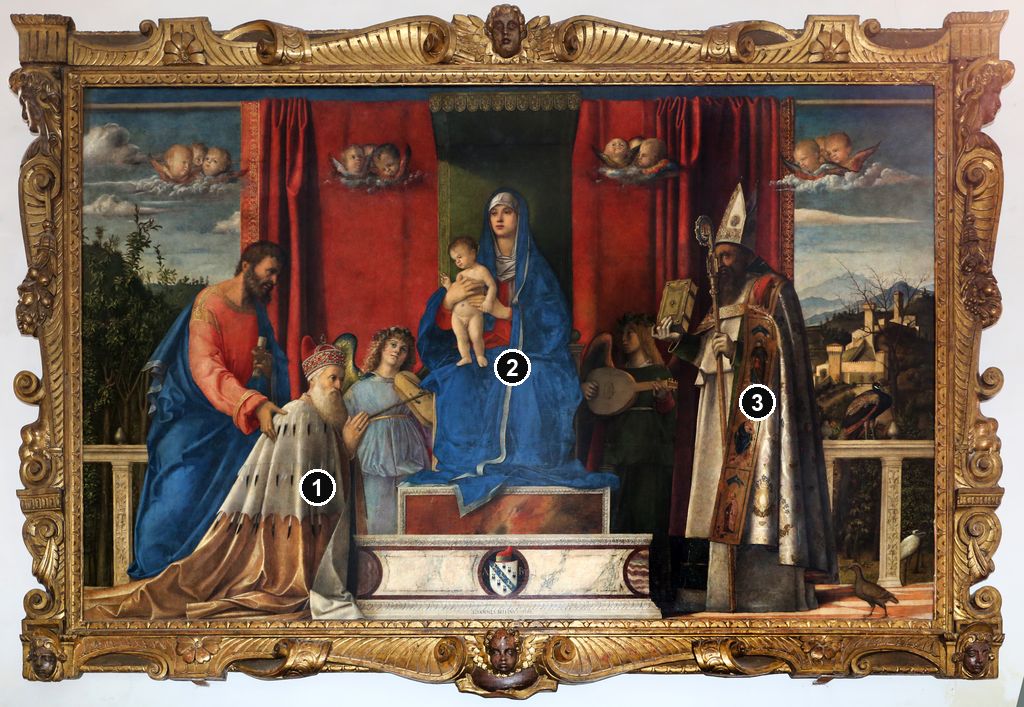
Numbered overview and cropped details. Photograph Sailko via Wikimedia Commons. Image source. CC BY 3.0.
Details from BARBARIGO ALTARPIECE
Compare the kneeling donor, the centre of the throne and the bishop across the picture.
The doge and his patron saint
The doge kneels in light-coloured robes. Saint Mark, behind him, places a hand near his shoulder as he is presented to the Virgin.
The Virgin, Child and seat
The red hanging intensifies the blue of the Virgin’s robe. The throne sets a higher level for the central figures than for the kneeling donor.
The bishop and the view beyond
The figure of Saint Augustine stands beside the throne. His vestments and headgear occupy a space where buildings and open sky are still visible behind him.
Related reading
Artworks directory
Discussion
Look again at the images and ideas explored in Barbarigo Altarpiece by Giovanni Bellini. These editorial prompts invite your observations.
Reader Insights
How do Saint Mark’s gesture and the doge’s posture establish the relationship between them?
What changes when you read the picture in light of the doge’s will?
How do the glimpses of landscape affect the scale and formality of the throne?
Join the Conversation
Share a detail, comparison or question about Barbarigo Altarpiece by Giovanni Bellini below.
References
- Italian national catalogue, historic and artistic property 0500123237, Il doge Barbarigo dinanzi alla Vergine in trono View source.
- Fondazione Federico Zeri, University of Bologna, catalogue record 27431, Barbarigo Altarpiece View source.
- Istituto Nazionale di Studi sul Rinascimento, photographic record of the Barbarigo Altarpiece, with subject, measurements and inscription View source.
- Emanuele Castoldi, ‘Un’inedita “cappella Barbarigo” o del presbiterio di Santa Maria degli Angeli di Murano’, Ateneo Veneto, pp. 39–43, 51 View source.
- Emanuele Castoldi, Santa Maria degli Angeli di Murano: storia, arte, architettura (1400–1537), University of Verona View source.
- Augusto Gentili, ‘Il telero di Giovanni Bellini per Agostino Barbarigo: strategia e funzione’, Prilozi povijesti umjetnosti u Dalmaciji 32, no. 1 (1992), pp. 599–611 View source.
- Juliette Brack, ‘Métaphores et fonctions du dais marial dans le retable florentin’, HiCSA, fig. 3 View source.
- Terisio Pignatti, ‘Bellini, Giovanni, detto Giambellino’, Dizionario Biografico degli Italiani View source.
- The National Gallery, London, Giovanni Bellini, Doge Leonardo Loredan, NG189 View source.
- The National Gallery, London, Follower of Jan van Eyck, Marco Barbarigo, NG696 View source.
- Agostino Barbarigo’s will, 1501, Archivio di Stato di Venezia, Notarile, Testamenti, b. 416, n. 14, transcribed in part by Castoldi, pp. 41–43 View source.
- Andrea Maronese, ‘Gli ispettori alle “pubbliche pitture” della Repubblica di Venezia’, Pietro Edwards’s inspection at Santa Maria degli Angeli, n. 46 View source.
- Basilica dei Frari, Giovanni Bellini’s Frari Triptych View source.
- Gallerie dell’Accademia archival inventory, restoration publication correspondence, b. 18/1, fasc. 18, p. 170 View source.
- Open Care, Bellini a Venezia, in-situ non-invasive studies View source.
- Venetian Heritage, conservation project for the Virgin in Glory with Eight Saints View source.