 by Tom Gurney
Tom Gurney BSc (Hons) is an art history expert with over 20 years experience
Email: tomgurney1@gmail.com / Phone: +44 7429 011000
Bellini’s portrait of the Venetian doge
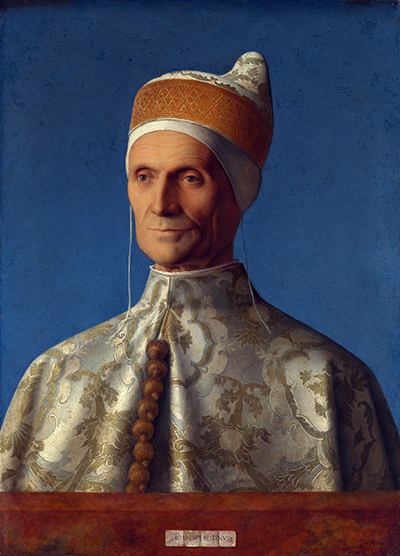
Giovanni Bellini painted Leonardo Loredan around 1501–02, at the beginning of his twenty-year tenure as doge of Venice. Loredan wears a white and gold mantle and a tall ceremonial cap against a blue background. His head turns slightly towards our left, and his eyes look past us. The space between his two shoulders nearly fills the width of the panel. At the bottom, where the fabric meets a painted marble ledge, Bellini has signed his name on what appears to be a strip of paper. The signed oil painting on poplar measures 61.4 × 44.5 cm and is in the National Gallery, London, as NG189. [1]
At a Glance
- ArtistGiovanni Bellini
- DateAbout 1501–02
- CollectionNational Gallery, London
- Catalogue numberNG189
- MediumOil on poplar
The work in Bellini’s career
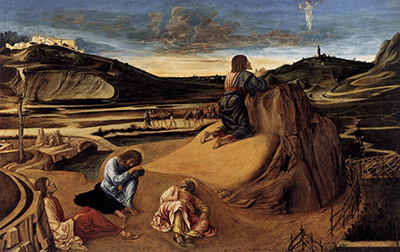
The Agony in the Garden
c. 1458–60Presentation at the Temple
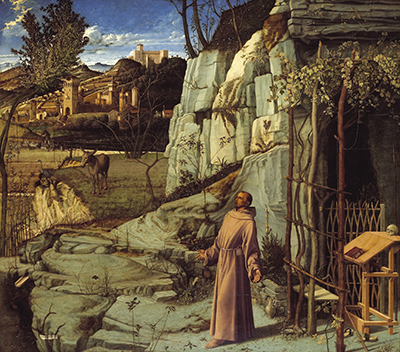
c. 1475St. Francis in the Desert
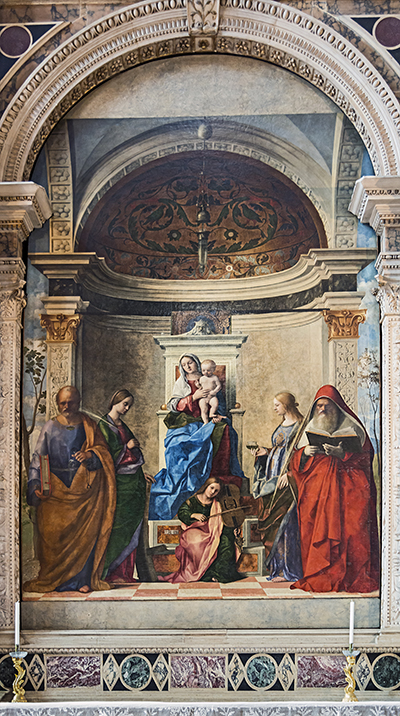
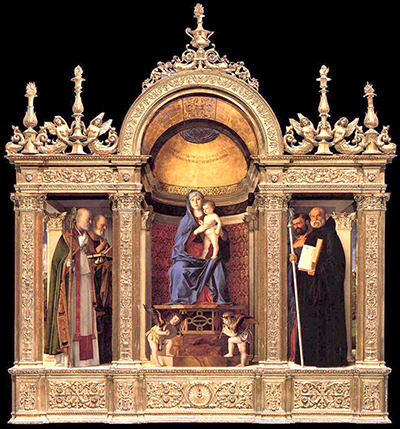
Late 1470sFrari Triptych
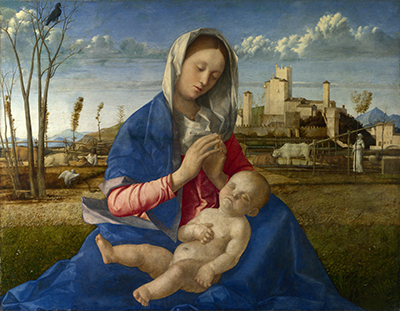
1488Madonna of the Meadow
c. 1500–05Doge Leonardo Loredan
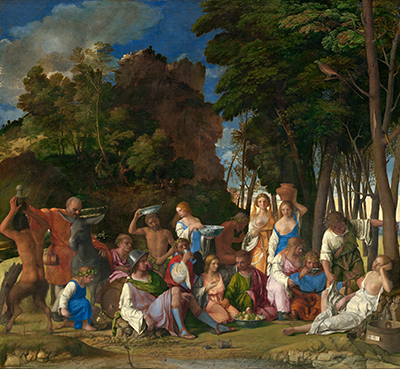
c. 1501–02The Feast of the Gods
Bellini’s signed date 1514How Bellini makes Loredan look imposing
The first impression of symmetry gives way as the eye moves around the figure. The near-frontal shoulders form a broad, steady base, while the fastening of the mantle angles across the chest. Above the stiff collar the face turns towards the light. The peak of the cap rises on the opposite side. The space between Loredan's face and the edge of the painting gives his gaze room to travel. He seems to have something to attend to beyond the panel, even as the viewer has ample time to take in his expression. [1]
Bellini conceals the arms and uses the ledge to cut the figure off at the chest. The National Gallery compares the effect to an antique marble bust of an emperor on a plinth, a form Renaissance sculptors also used for wealthy or powerful sitters. The upper edge of the ledge seems close enough to touch, and its straight line makes the curve of the shoulders above it more pronounced. The blue behind the head has no defining architecture or horizon. It leaves enough space around the silhouette to suggest that the figure has a back and sides we could walk around. [1]
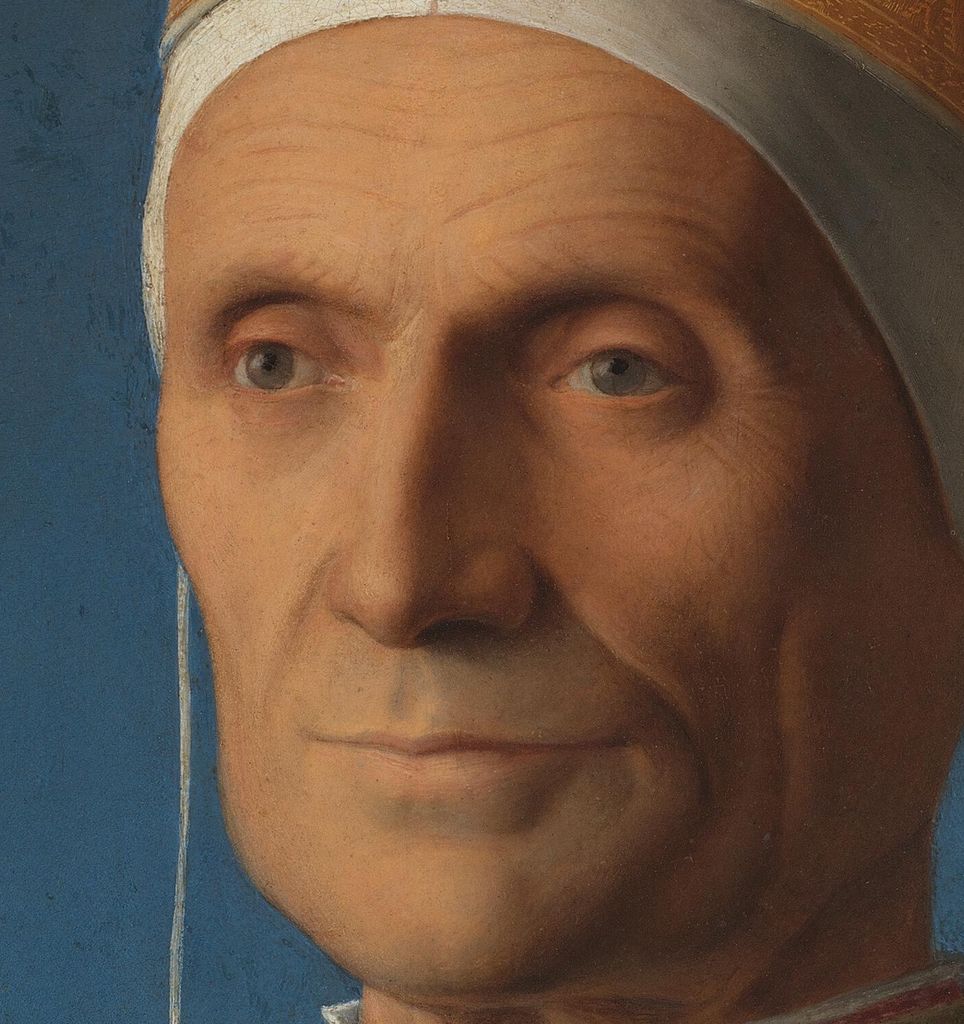
The tilt of the face gives Bellini scope to show changes in expression through small differences in tone. The eye on the lit side is sharply visible beneath a shadowed brow. Across the nose the shadows gather in the farther cheek, softening the edge of the mouth. One corner of the lips almost lifts. As a viewer shifts attention from the lit side to the shaded side, the same face can seem receptive or severe. Those are possibilities in the painting. Accounts by people who knew Loredan belong to a different kind of evidence. The diarist Marin Sanudo, a friend of Loredan's eldest son, described a lean, disciplined man with a quick temper and a respected judgement in government. [1] [2]
The doge's ceremonial clothes
Loredan had been a dogal councillor and a procurator of St Mark before his election as doge on 2 October 1501. He held the latter office until his death in 1521. The horn-shaped cap, or corno ducale, makes that office apparent even without an identifying inscription. A pale cap underneath follows the line of the forehead. Its fine ties descend on either side of the face, with one plainly visible against the blue before it crosses the mantle. The threadlike ties give a sense of scale to the heavy folds and round fastenings below. [1] [2]
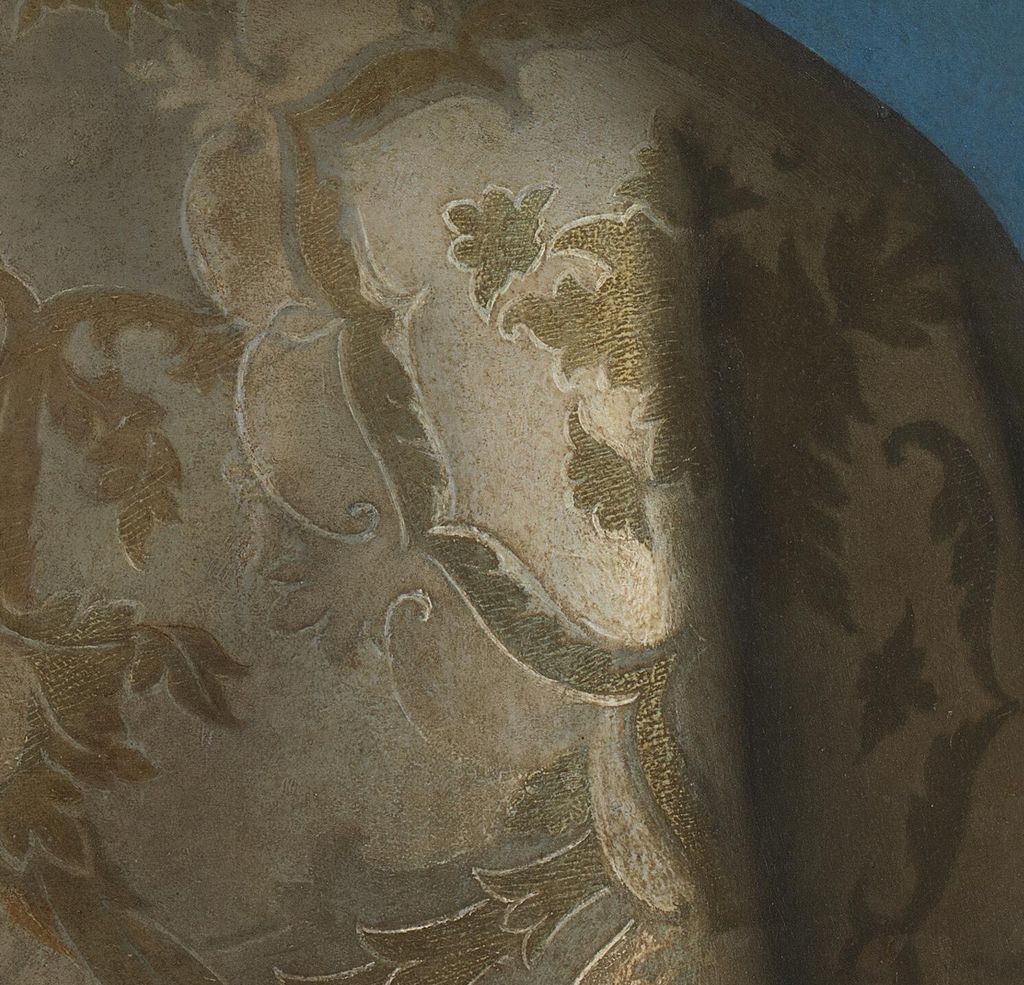
The mantle is made from widths of white silk damask woven with gold and silver threads. The National Gallery notes that Loredan introduced white robes for the processions of Candlemas and the Annunciation. In a procession, the people behind the doge would see the large pomegranate motif the right way up. On the painted front it is inverted. The gallery takes that observation as evidence of Bellini's attention to an actual garment and suggests he may have borrowed it to paint at leisure. The cloth tells us what Loredan wore on some of Venice's most splendid ceremonial occasions. The painting gives no occasion for a particular sitting. [1]
Follow a repeat of the pattern across the chest. The edges catch the light on the raised parts of the cloth and bend where the fabric dips away. The round ornamental buttons, known as campanoni d'oro or ‘golden bells’, cast shadows into the folds beside the fastening. The collar seems stiff enough to keep its shape around the neck. These small effects give the expanse of patterned cloth thickness and weight. The gold appears especially bright where the mantle turns into the light, an effect that depends as much on the adjacent shadow as it does on the colour Bellini uses for the threads. [1]
Oil, ultramarine and the painted signature
Light enters from the viewer's left. The tip and ridge of the nose and the front of the forehead receive it directly, while the far side of the neck falls into shade. The transition down the cheek is gradual enough that it is hard to pick out a line where light ends. In the silk, Bellini can make the touch of the brush much more evident. Small strokes of thicker paint pick out highlights on the metal thread. The difference in handling lets the flesh look yielding, the fabric densely woven and the ornaments hard. The National Gallery draws a comparison with Jan van Eyck and Antonello da Messina, whose portraits similarly use light from one side to give a face volume. [1]
Oil gave Bellini time to blend tones in the flesh and to combine those soft transitions with sharply placed touches. He also used ultramarine mixed with white for the blue behind Loredan. Ultramarine was expensive, and here it covers the largest uninterrupted field of colour. Look at how many different edges meet that field. The narrow ties are delicate, the cap has a clear rising curve and the shadowed side of the face is softer. Without details of a room to attract attention, the blue makes these changes easier to see. [1]
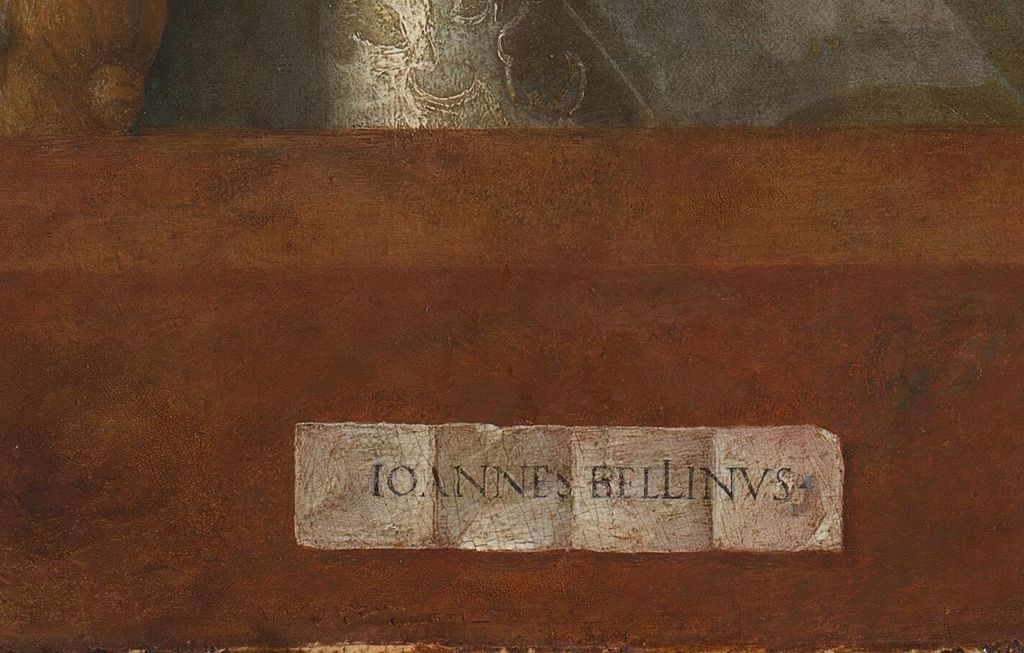
The paper on the ledge is a cartellino, a little label represented in paint. Bellini signs his name in Latinised form, IOANNES BELLINVS. The label lies low and close to the centre of the panel. Pale creases interrupt the lettering, and the edges look as though the strip has been folded and opened. The mottled brown behind it looks dense by comparison. An inscription cut into stone would have shared the weight and permanence of the plinth. This painted label gives the painter a place of his own in the picture and brings another material within the viewer's imagined reach. [1] [3]
Loredan and the tradition of doge portraits
Earlier Venetian doges commonly appeared in strict profile. Gentile Bellini's portrait of Doge Giovanni Mocenigo in Venice's Museo Correr, dated about 1479, shows how much that format can convey. The cap, nose and chin make a continuous silhouette, and the patterned costume enlivens the lower part of a panel close to the London portrait in size. Loredan's three-quarter turn brings a second eye into view and gives Giovanni more of the face through which to show the passage from light into shadow. Gentile himself also used a three-quarter pose for his portrait of Agostino Barbarigo, Loredan's predecessor. The distinction lies in how Giovanni uses the turn in NG189 to hold the viewer's attention. [1] [2] [4]
Gentile was put in charge of the frieze of doges for the council chamber in the Doge's Palace in 1474. Displayed together, the successive rulers recorded the continuity of the office in a room where the patrician Great Council met. The cycle perished in the fire of 1577. The frieze now visible beneath the ceiling belongs to the subsequent decoration. Another London portrait, NG3100, catalogued as after Gentile Bellini, may preserve the design of one image from the lost series. The museum also qualifies the identification of its sitter as Niccolò Marcello. Giovanni's Loredan stands apart from that lost commission. The National Gallery proposes that someone probably commissioned the surviving portrait privately. [1] [5] [6]
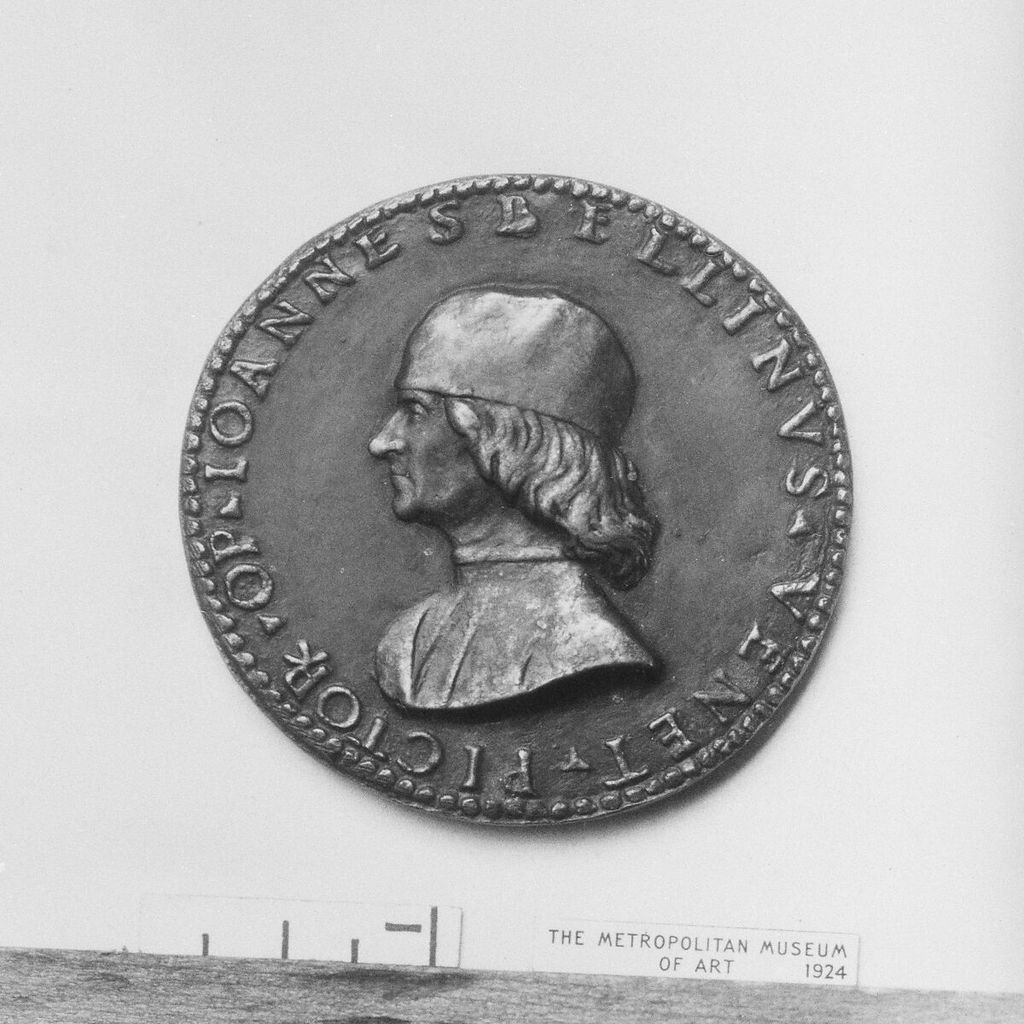
A bronze medal about six centimetres across in the National Gallery of Art in Washington shows the same sitter in profile. The medal is attributed to Vettor Gambello, called Camelio. Its lettering names Loredan as doge of Venice and runs in a circle around his likeness. Bellini places the painter's name on the ledge and lets the cap and the robe identify Loredan's station. Dress could distinguish offices across Venice's ruling class. In Bellini's Portrait of a Procurator in the Tokyo Fuji Art Museum, the figure wears a black cap and dark blue damask, with a red ribbon indicating his position. Loredan himself previously held the office of procurator. The Tokyo museum describes its sitter by office alone. [2] [7] [8]
A poem from the start of Loredan's rule
An early response to Bellini's likeness comes from the poet and jurist Bernardino ‘Lidio’ Catti. He dedicated his Opuscula, printed by Giovanni Tacuino in Venice in June 1502, to the newly elected doge. One of its Latin epigrams celebrates a portrait of Loredan by Bellini. Giulia Zaccariotto transcribes the poem from a manuscript in the Biblioteca Nazionale Marciana, where Marin Sanudo copied it into a collection of antiquarian and literary material. Sanudo's version follows the printed epigram closely. [1] [9] [10]
Catti imagines the likeness and the living man as two Loredans. He then compares Giovanni Bellini with Apelles, the ancient painter celebrated for his portrait of Alexander the Great, and awards Bellini the greater skill. Such praise promoted painter and doge together. Bellini could rival a famous artist of antiquity, while Loredan merited comparison with that artist's most illustrious sitter. The poem places Bellini's portrait in literary circulation within months of the election. It also supplies a date by which the image the poem describes already existed. The National Gallery connects that evidence to the surviving painting. Catti's verses leave the buyer, circumstances of the sitting and first location open. [1] [9] [10]
The later Loredan in Berlin
Berlin's Gemäldegalerie holds another portrait of Loredan, The Doge Leonardo Loredan with Four Companions, catalogued under Giovanni Bellini. The broad 1507 panel, inventory B.79, measures 134.5 × 207.5 cm and is painted in tempera on poplar. Loredan sits at the centre, surrounded by four figures the museum identifies as his sons. The grouping lends the image a family dimension. The upright figure at the centre, flanked by two men on either side, recalls the structure of religious paintings in which attendants gather around a holy figure, a resemblance the Berlin museum notes. Even the painted label occupies a different position, at lower left, where it carries a date as well as the painter's name. Conservation research in Berlin has investigated the group painting's extensive damage and its treatment history. [11] [12]
From Venice to the National Gallery
The National Gallery's ownership record starts much later than the portrait's mention in Catti's poem. It records two unidentified seals on the reverse and traces the panel from the Grimani Palace in Venice to the first Lord Cawdor, who died in 1821. By 1822 it was listed in a catalogue for William Beckford's Fonthill collection. The sale for which that catalogue was prepared fell through. Beckford kept the portrait and the National Gallery bought it from him in 1844. That sequence accounts for the painting's journey to London while leaving the earliest stages of its ownership uncertain. [1]
In the 1840s Anna Jameson drew readers' attention to the portrait in her writing on early Italian painters. Art historian Adele Ernström places that notice in the context of a young National Gallery with few acquisitions of this kind. Jameson could point readers to a painting they could see for themselves. What they could inspect then is still part of its appeal. The elaborate mantle announces the office at a distance. Coming closer brings the fleeting expression, the individual brushmarks in the silk and the pale creases in Bellini's painted paper into view. [1] [13]
Annotated Details from Doge Leonardo Loredan
Numbered overview and cropped details. Photograph National Gallery, London, via Wikimedia Commons. Image source. Public Domain Mark 1.0.
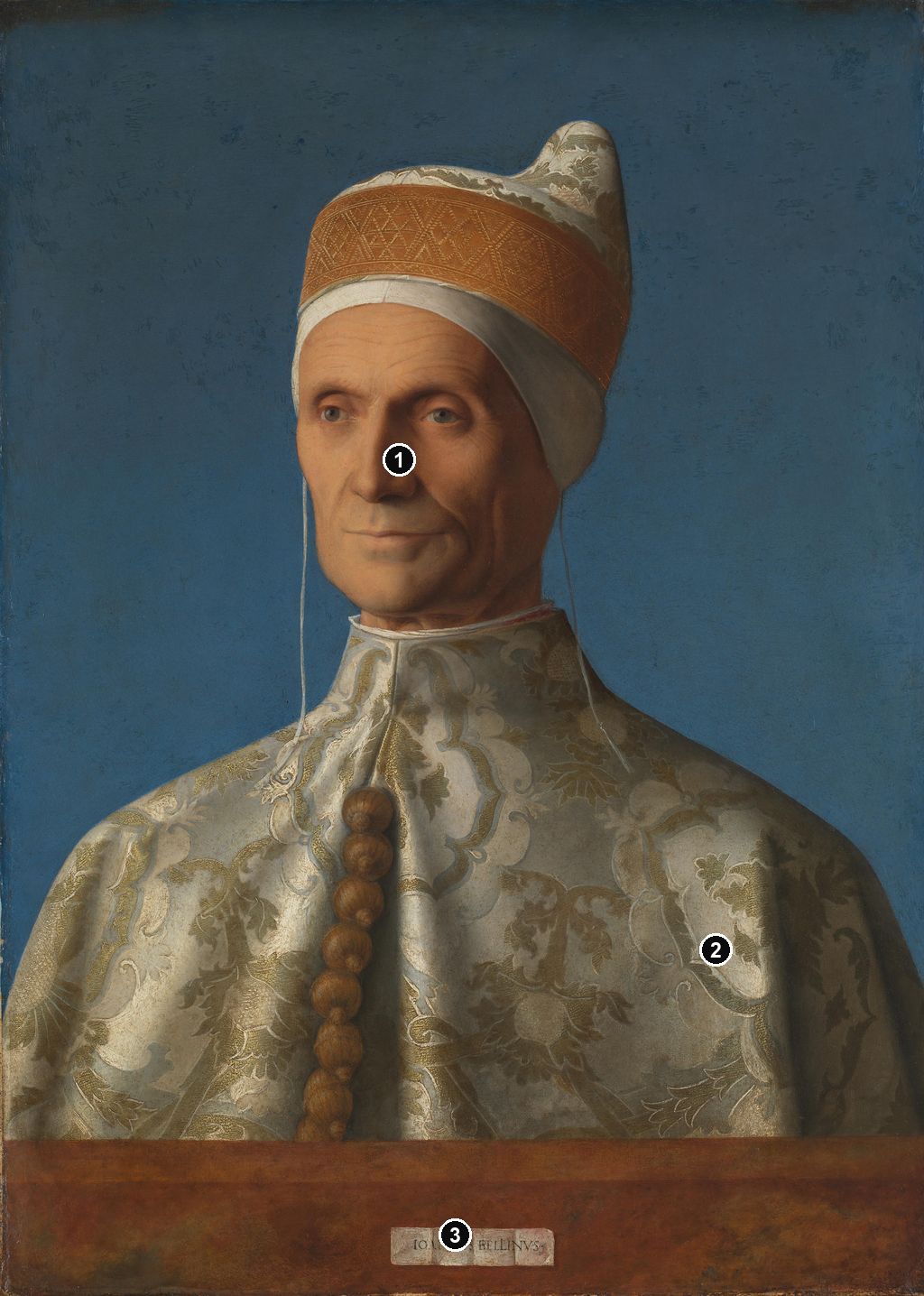
Details from DOGE LEONARDO LOREDAN
Follow the portrait from the sitter's cap and face to the brocade and the small painted label at the bottom.
The sitter’s face
Light catches the ridge of the nose and cheek. The far cheek turns into shade through comparatively small shifts in tone.
The figured robe
Fine highlights interrupt the scrolling gold and silver motifs. Where the garment curves over the shoulder, the decorative pattern bends with it.
The painted signature slip
The slip of paper at the centre of the ledge is part of the painting. Its scale and shadow let it appear to sit on the same surface as the edge in front of the doge.
Related reading
Artworks directory
Discussion
Look again at the images and ideas explored in Portrait of Doge Leonardo Loredan by Giovanni Bellini. These editorial prompts invite your observations.
Reader Insights
How much of Loredan’s authority comes from the costume and pose?
Which marks make the signature slip appear to occupy its own space?
How does the little signature slip change your sense of where the sitter stands?
Join the Conversation
Share a detail, comparison or question about Portrait of Doge Leonardo Loredan by Giovanni Bellini below.
References
- National Gallery, London, Doge Leonardo Loredan, NG189. Collection entry, in-depth essay and provenance. View source.
- Michela Dal Borgo, “Loredan, Leonardo”, Dizionario Biografico degli Italiani, vol. 65. View source.
- National Gallery, CIMA collection image record for NG189. Inscription transcription. View source.
- Fondazione Musei Civici di Venezia, Gentile Bellini, Portrait of Doge Giovanni Mocenigo, Museo Correr. View source.
- National Gallery, London, after Gentile Bellini, Doge Niccolò Marcello, NG3100. View source.
- Palazzo Ducale, Le Sale Istituzionali del 1° piano. The Sala del Maggior Consiglio and its post-fire decoration. View source.
- National Gallery of Art, Washington, attributed to Vettor Gambello, Leonardo Loredan, 1436–1521, Doge of Venice 1501 (obverse). View source.
- Tokyo Fuji Art Museum, Giovanni Bellini, Portrait of a Procurator. View source.
- Giulia Zaccariotto, “Bellini, Giotto e Mantegna: componimenti poetici inediti in un manoscritto di Marin Sanudo”, in La trattatistica d’arte nell’Italia del Cinquecento, pp. 19–22. View source.
- Stefano Cassini, “L’eco tipografica dell’elezione del doge Leonardo Loredan (1501) a partire da una miscellanea roveretana”, Archivio di Stato di Milano, pp. 257–259. View source.
- Gemäldegalerie, Staatliche Museen zu Berlin, Der Doge Leonardo Loredan mit vier Begleitern, B.79. View source.
- Gemäldegalerie, Gemälde von Andrea Mantegna, Giovanni Bellini und Umkreis. Research and conservation summary. View source.
- Adele Ernström, “Anna Jameson's ‘Memoirs of the Early Italian Painters’, German Art History and the National Gallery”, National Gallery, p. 12. View source.