 by Tom Gurney
Tom Gurney BSc (Hons) is an art history expert with over 20 years experience
Email: tomgurney1@gmail.com / Phone: +44 7429 011000
The Coronation and its frame
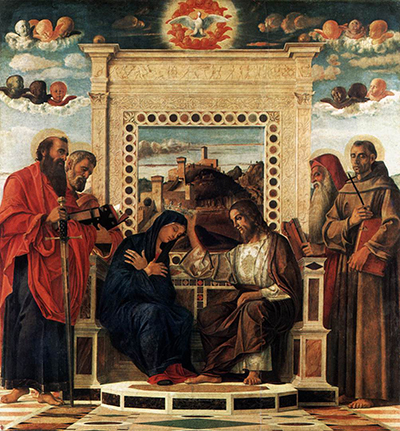
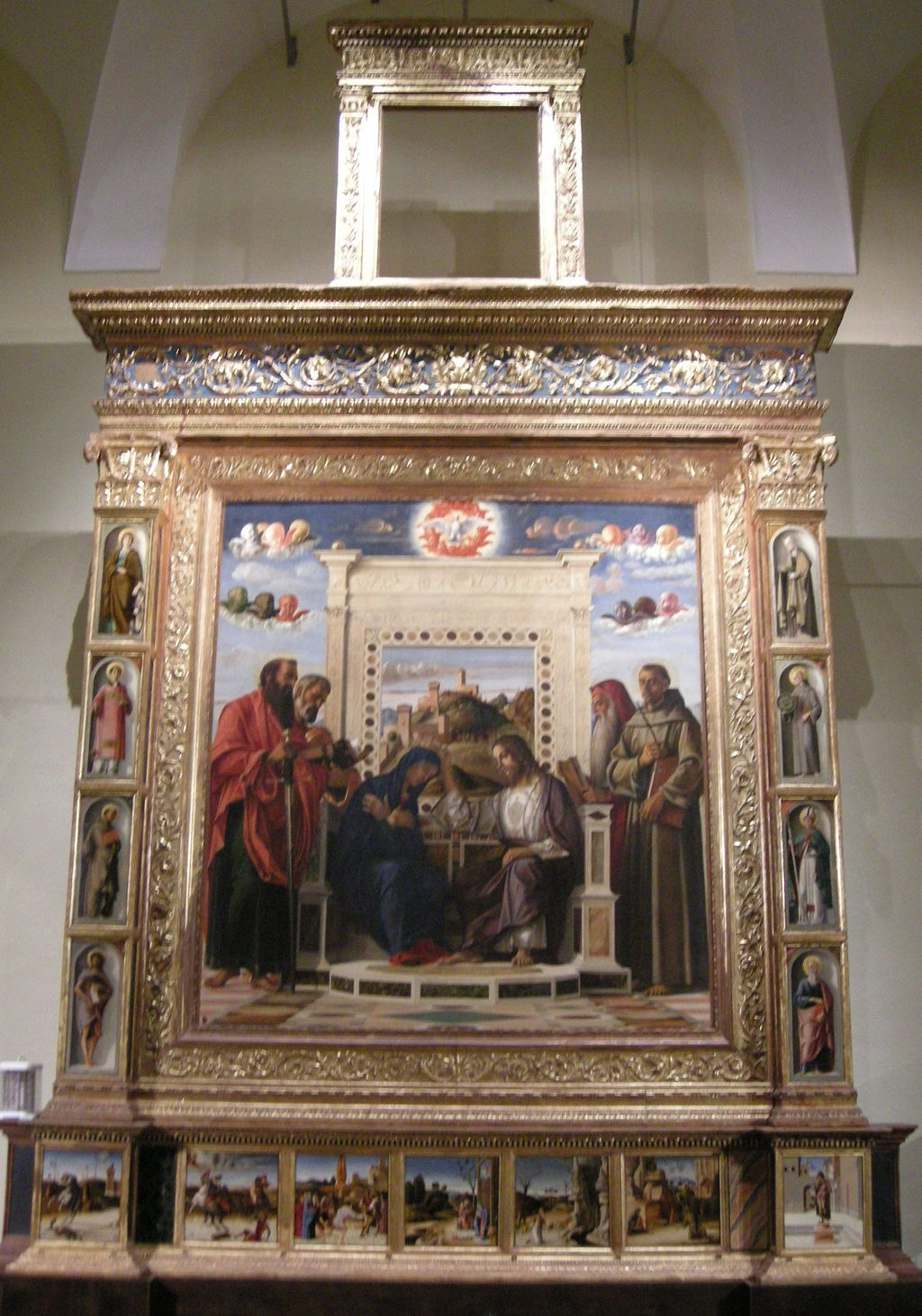
Christ lifts a crown over the Virgin’s bowed head. Behind them, an opening in their marble throne reveals hills and a distant fortress. Both belong to Giovanni Bellini’s Pesaro Altarpiece, made around 1475 for the high altar of San Francesco in Pesaro, now the Santuario della Madonna delle Grazie. The signed Coronation of the Virgin, its carved framework and the surrounding small paintings are at the Musei Civici in Palazzo Mosca. One painting that originally stood above them, the Lamentation over the Dead Christ, belongs to the Vatican Pinacoteca. [1] [2] [3]
At a Glance
- ArtistGiovanni Bellini
- DateProbably the 1470s
- MediumOil on panel
- LocationMusei Civici, Pesaro, with the original top panel in the Vatican
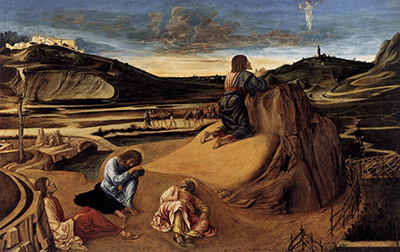
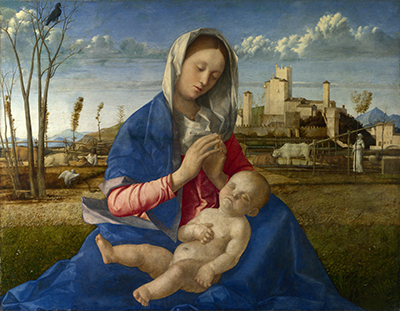
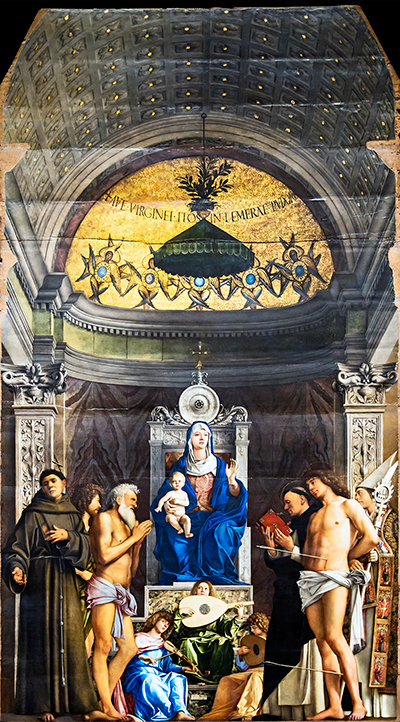
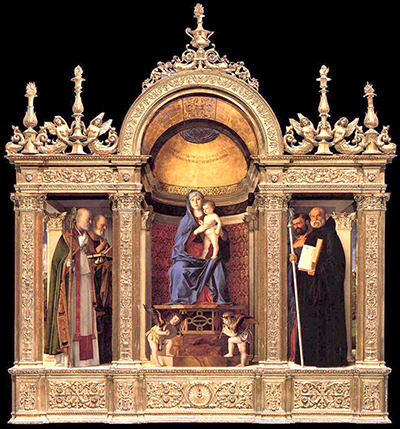
The work in Bellini’s career
The Agony in the Garden
c. 1458–60Presentation at the Temple
c. 1475The Coronation and its frame
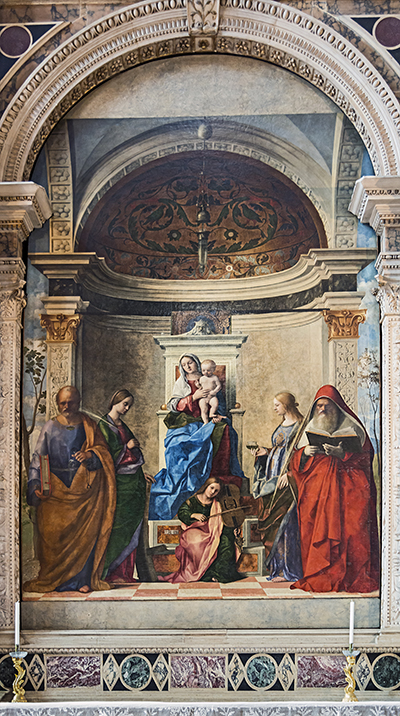
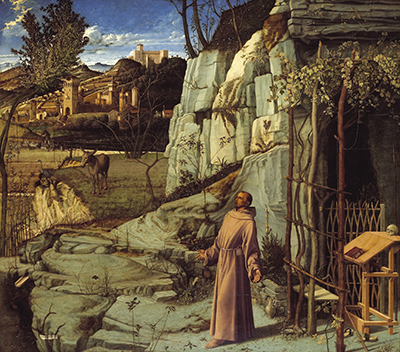
Probably the 1470sSt. Francis in the Desert
Late 1470sFrari Triptych
1488Madonna of the Meadow
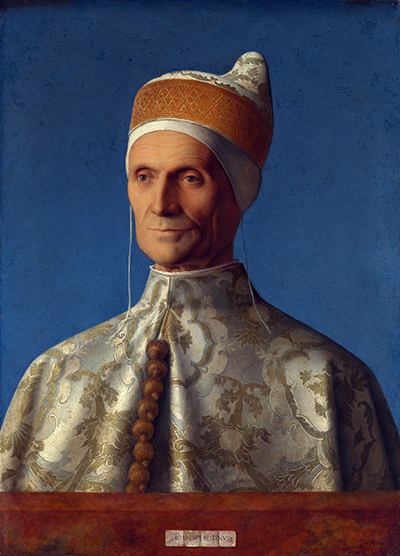
c. 1500–05Doge Leonardo Loredan
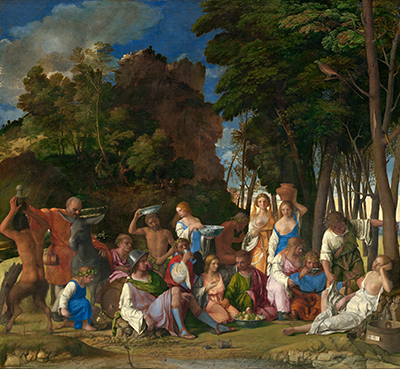
c. 1501–02The Feast of the Gods
Bellini’s signed date 1514The Coronation and the landscape beyond the throne
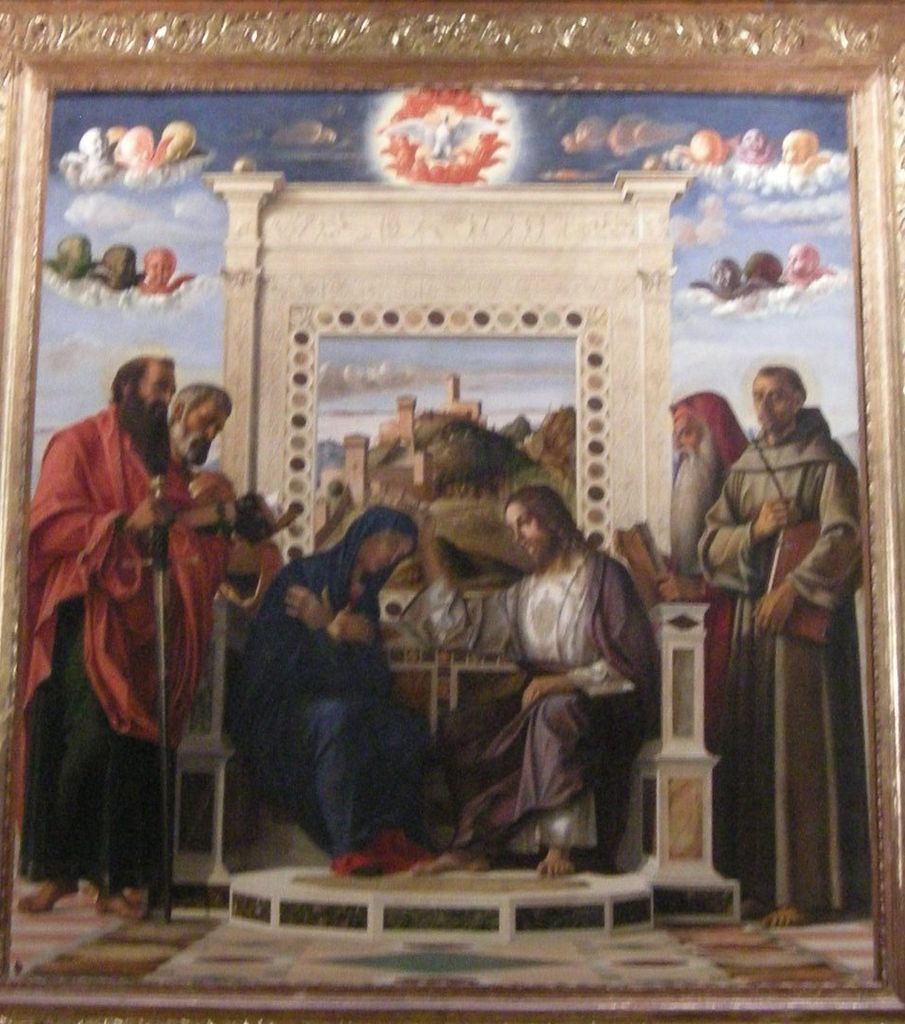
The roughly 262 by 240 centimetre central panel brings six figures together on a single tiled pavement. Mary crosses her hands on her chest and inclines her head to receive the crown. Christ turns towards her, raising his hand clear of the rich pattern of his damask. On the left stand Paul, with his sword, and Peter. Jerome and Francis of Assisi stand on the right. Bellini places the ceremony between the pairs of standing saints, whose figures give a human scale to the width and height of the throne. The painter’s Latin signature, IOANNES BELLINUS, appears below them on the central step. [1] [4] [5]
Follow the lines between the veined tiles and the shallow steps. They lead inwards towards Christ and Mary, then the throne opens onto a view much farther away. Within that opening Bellini reduces walls and towers to pale, sharply lit shapes against the hillside. The fortress is prominent in its own small patch of landscape. In relation to the saints, it is remote enough to make the ground at their feet seem close. The painted throne frames this change of scale, just as the carved wood around the panel frames the entire ceremony. [1] [6]
The landscape reads as an opening and as a little painting complete in itself. Gerd Blum compares its framing to windows in the hanging garden of the Ducal Palace in Urbino and connects it with the longstanding image of Mary as a window of heaven. Those comparisons help explain why the opening matters even if the building in it cannot be named. Above the throne, the dove of the Holy Spirit appears among red cherubim. The surrounding clouds also catch reddish light. Bellini gives a ceremony conventionally set in heaven the atmosphere of a world in which the light changes with the time of day. [6] [7]
The fortress has sometimes been identified with Gradara. The Musei Civici describe a type of fortified building familiar on the Adriatic, while the Marche heritage catalogue favours an allegorical reading as the Heavenly Jerusalem. Art historian Liya Chechik, discussing Anthony F. Janson’s reading, entertains both possibilities at once. A castle familiar to worshippers in Pesaro could evoke the Heavenly Jerusalem or Mount Zion. The claim that it names a particular stronghold carries more weight in the dating debate, where a recognisable site could connect the panel with a local event. The painting’s distant view provides too little to make that identification secure. [1] [8] [9] [18]
The saints in the frame and the stories below
From a distance, the carved and gilded wood gives the altarpiece the shape of an architectural front, with a substantial cornice and upright pilasters. Seen closer, the pilasters resolve into a series of small compartments for standing saints. The base broadens into the predella, a strip of narrative paintings beneath the main scene. The episodes at the feet of the pilasters extend that strip on either side. At the top of the right pilaster is the Blessed Michelina of Pesaro. Her portrait there would later help historians trace the altarpiece through the church. The frame sets different viewing distances for the central figures, the smaller saints and the incidents in their lives. [4] [10] [11] [19]
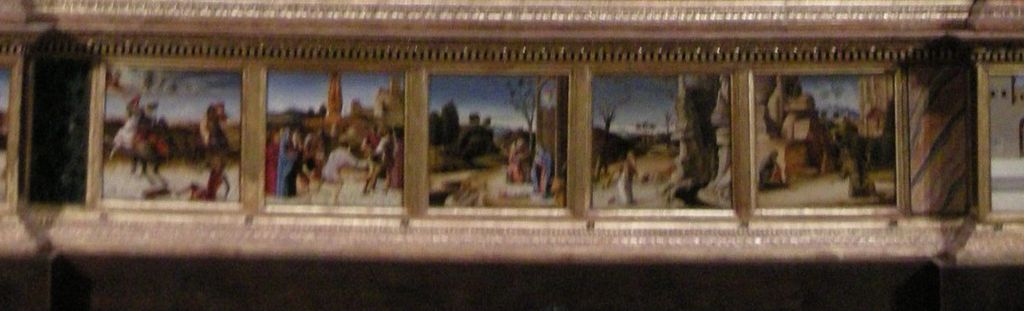
Five scenes occupy the central stretch of the predella. From the viewer’s left they show the Conversion of Paul, the Crucifixion of Peter, the Nativity, Jerome in the wilderness and Francis receiving the stigmata. They place an episode involving each of the Coronation’s four standing saints below the main panel. At the ends, George confronts the dragon on the left, while the armoured figure traditionally identified as Saint Terence holds a model of a fortress on the right. The five central episodes occupy two original boards, according to the conservators. Later cuts allowed three scenes to be hinged open individually. The framed divisions on the front therefore tell only part of the story of how the wood beneath was assembled and altered. [9] [10] [11]
Comparing a predella scene with the Coronation makes Bellini’s shift in pace apparent. In the centre, the movement of Christ’s hand is measured and the saints are still. In the smaller scenes, a fall, a crucifixion or the marks of Christ’s wounds arriving on the body of Francis give the eye an event to follow. Pesaro Musei point out details a contemporary worshipper might have recognised, including the princess’s Flemish-style dress in the scene of Saint George, Paul’s Ottoman-style costume and the apse of the Venetian Frari in the background of the Stigmata. The smaller panels give the devotional figures individual histories and place those histories in settings familiar to Bellini’s own time. [1] [10]
When was it painted, and who paid for it?
Pesaro Musei and the Vatican both place the work around 1475, while the Fondazione Zeri catalogues the Coronation about 1472–75. The signature secures Bellini’s authorship, but it gives no year. Proposals extending into the early 1480s attach more weight to possible references to the Sforza family and its rule over Pesaro. The family is the likely source of the commission in the museum’s account, without a securely documented individual patron. [1] [2] [4] [7] [9]
At the foot of the right pilaster the armoured saint carries a fortress like an offering. Pesaro Musei identify him as the city’s patron, Saint Terence, and his model as Rocca Costanza. Costanzo Sforza commissioned that fortress and work began in 1474. If the model refers to the new building, it gives a reason to place the painting in or after the mid-1470s. On the larger panel the museum also draws attention to the cotogna gambata, a heraldic quince motif it identifies in Christ’s damask, and to the crown’s resemblance to a ducal diadem. Such details help explain how a local viewer might have understood the ceremony as an image of earthly authority as well as heavenly honour. A possible association with the Sforza marriage of 1483 is recorded by the Marche region, alongside its own date of around 1475. [5] [6] [8]
The argument changes if the soldier has been misidentified. Francesco Ambrogiani points out that an established local representation of Terence differs markedly from Bellini’s armoured figure. He proposes Saint Alexander of Bergamo and reads him as a possible reference to Alessandro Sforza, who died in 1473. On that interpretation the small panel would point to a different member of the dynasty and favour an earlier context. Ambrogiani also revives the idea that Bellini’s work might have been intended for San Giovanni Battista, the church associated with Zoppo’s altarpiece. [9]
Carolyn C. Wilson traces the evidence for San Francesco through early accounts, including a friar’s manuscript of about 1620–29 that records the painting’s removal from the high altar. During enquiries into the cult of the Blessed Michelina in the 1730s, witnesses described the altarpiece in the left aisle. They climbed a ladder to inspect her likeness in the upper right pilaster. These accounts support the traditional high altar provenance, even though they were written long after the commission. [19]
How the panel and frame were made
The museum’s project record describes the Coronation as tempera and oil on wood. The main panel consists of six vertical poplar boards joined side by side. Its carved surround is part of a self-supporting wooden structure. Conservators recorded mortise-and-tenon joints in the spruce framework that holds the central panel and dovetail-shaped joinery that once connected the pilasters. The weight of the cornice was meant to bear on designated supports, but damage and earlier alterations changed how its load was distributed. A published diagram of the dismantled structure shows the framework, upper beam, pilasters and base as separate units designed to fit together. [11] [12]
Painted stone appears on the outer structure as well as within the central picture. Conservation work brought attention to small caricatured faces worked into the imitation marble on the sides of the pilasters. They are easy to miss when facing the Coronation directly, where the veined pavement and throne in the large panel dominate. The little profiles reward a sideways glance, just where the fictive stone gives way to the thickness of the real wooden frame. It is uncertain whose hand put them there. [5]
The joined boards also explain why caring for the panel means treating the paint and its support together. Wooden panels respond to changes in humidity. Pesaro Musei report that an earlier system of braces restricted the central panel’s movement and that the paint was lifting in places. In the conservation project begun in 2019 and completed in 2021, specialists secured vulnerable areas of paint and fractures in the panel, dismantled the heavy bracing and fitted a system that allows more movement. They also examined the painting with multispectral imaging before returning it to the frame. [13]
The original top panel in the Vatican
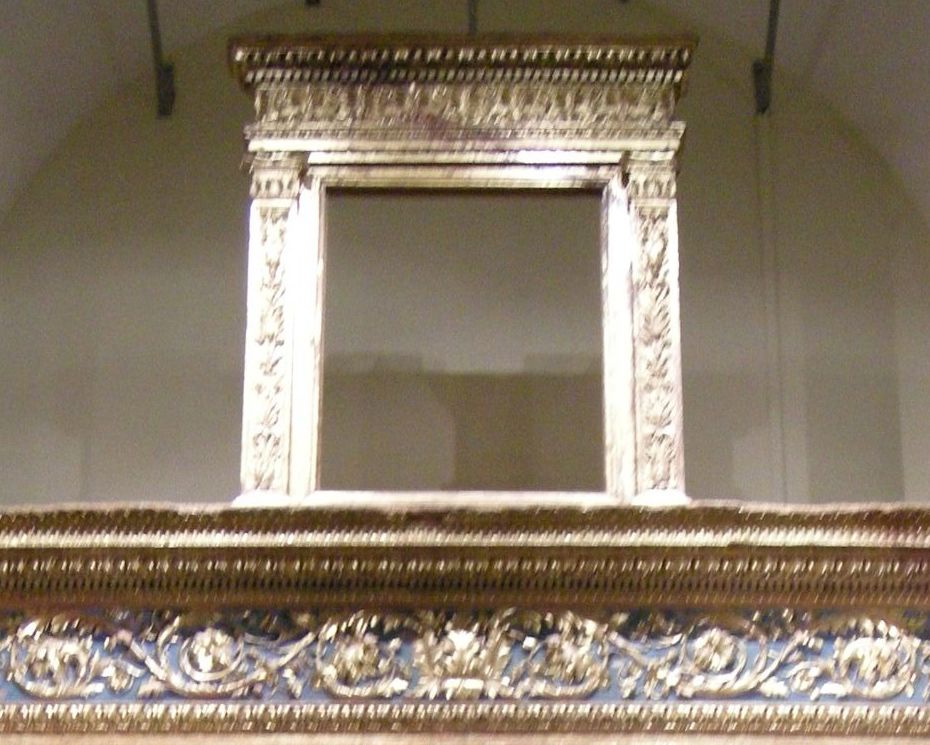
The Lamentation over the Dead Christ, or Compianto sul Cristo morto, formed the cimasa, the uppermost painted element. Its other title, Embalming of Christ, describes the action precisely. Joseph of Arimathea and Nicodemus attend the body after the Crucifixion, and Mary Magdalene anoints Christ’s wounded hand. The Vatican curator traces the preparation for burial to the Gospel of John and singles out the meeting of the two hands. The bodies crowd the edge of the scene and the composition suggests looking up at them, a fitting arrangement for a panel intended to be seen well overhead. [2] [14]
On the altar the Nativity and Lamentation sat on the same vertical axis, with Mary’s Coronation between them. The base showed Christ’s birth on a small scale, the top his dead body at close quarters. Between these registers the large painting presents Christ seated in glory. The Lamentation also gives the small scene of Francis receiving the stigmata a point of reference elsewhere on the same altar. The wound touched by Magdalene belongs to the Passion which, in Francis’s story, is remembered in the marks on the saint’s own body. [1] [2] [5] [10] [14]
The Vatican’s object history records that French forces confiscated the top panel in 1797 and that it was exhibited in the Louvre in 1798. The painting returned to Italy in 1816 through Antonio Canova’s intervention and entered the Vatican Pinacoteca display in 1820. There it was first regarded as a work by Andrea Mantegna. The Vatican credits Joseph Crowe and Giovanni Battista Cavalcaselle with proposing the attribution to Bellini and reconnecting the panel with the Pesaro altar in 1871. The Marche heritage catalogue identifies the Vatican panel by inventory number 290. In 1988 the two museums’ panels were temporarily reunited in the original frame after conservation, making it possible to see the change in scale from the main picture to the Lamentation in the reconstructed arrangement. [8] [14] [20]
Vatican conservator Marco Pratelli describes how Bellini used thin oil layers and glazes to set Christ’s greyish flesh against the warmer colour of Magdalene’s skin. Translucent red lake gives the clotted blood on his hand its colour. Earlier cleaning had abraded paint and stripped away some of those glazes, while protective varnish applied in 1988 had yellowed. In the 2025 treatment the team removed altered varnish and old retouching and reintegrated losses. Imaging also brought the preparatory drawing and traces of pouncing, a method of transferring a design with powdered material, into view. This evidence concerns the upper panel, whose surfaces and conservation history are distinct from those of the Coronation in Pesaro. [14] [15]
Other altarpieces called Pesaro
The Gemäldegalerie in Berlin holds the main panel of Marco Zoppo’s 1471 Pesaro Altarpiece, made for San Giovanni Battista in Pesaro. Zoppo also set four saints around an enthroned Virgin in a continuous space. His subject is the Virgin with the Christ Child, and a floral garland above the throne frames a view Berlin identifies as the church for which the picture was made. Bellini’s aperture is part of the throne itself and opens behind the adult Christ as he crowns Mary. The Berlin record fixes Zoppo’s date. Bellini’s separate ensemble brings its own evidence for dating. [1] [4] [16]
Bellini’s Frari Triptych, dated 1488, is in the sacristy of Santa Maria Gloriosa dei Frari in Venice. The same basilica has Titian’s Madonna di Ca’ Pesaro, painted between 1519 and 1526, which takes its name from the Pesaro family. For Bellini’s Coronation, the place name points to the city on the Adriatic. Start with the central picture and the surviving architecture of the altarpiece at Palazzo Mosca. The Vatican Pinacoteca’s Lamentation supplies the painted scene that once completed it above the cornice. [2] [3] [17]
Annotated Details from Pesaro Altarpiece
Numbered overview and cropped details. Photograph Sailko via Wikimedia Commons. Image source. CC BY 3.0.
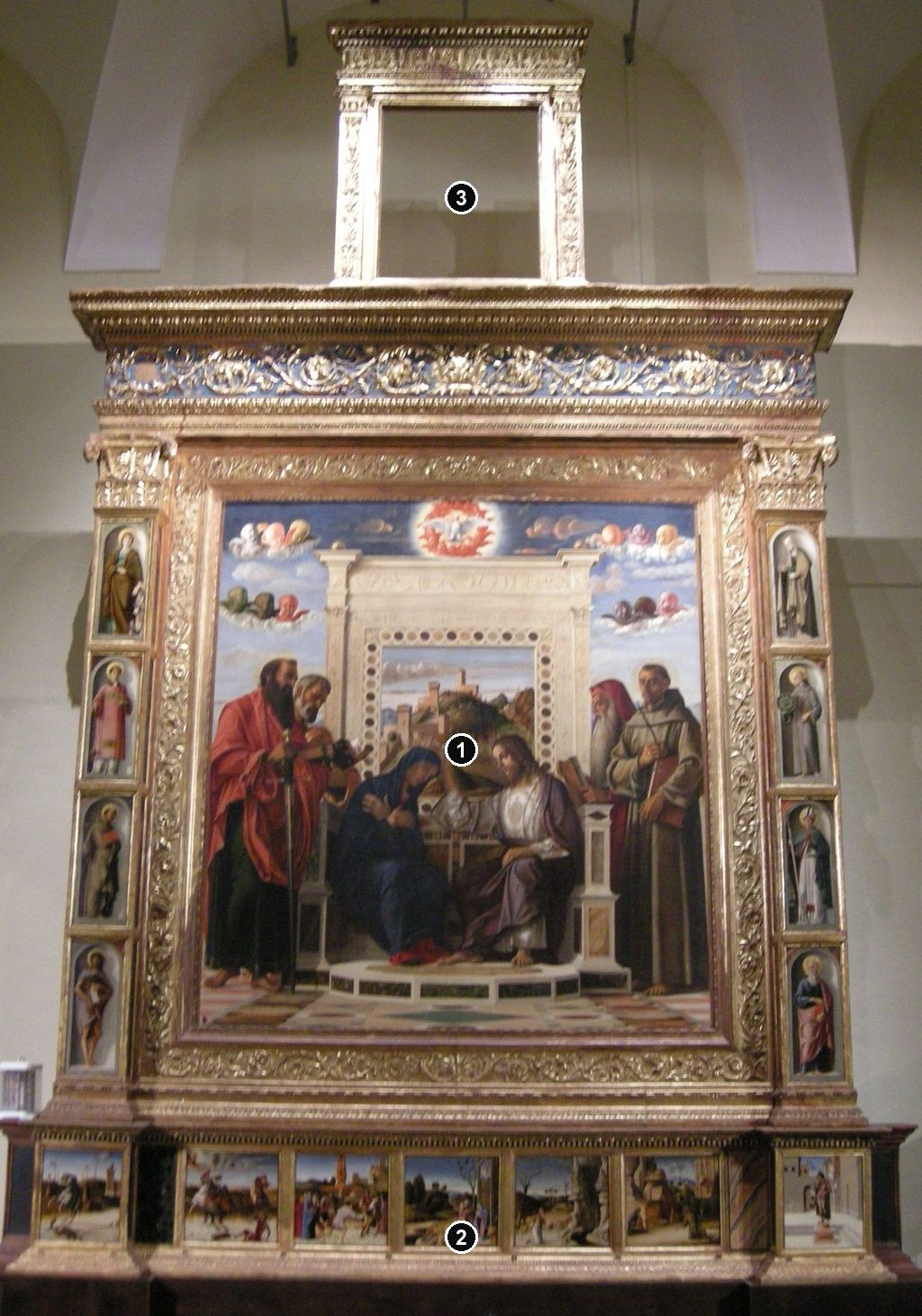
Details from PESARO ALTARPIECE
The view shows how the central scene, small side figures and narrative predella fit the ensemble.
The Coronation and its stone seat
The stone throne establishes the centre of the scene. The opening behind the figures leads the eye out to the distant landscape.
The predella below
The horizontal row below the main field holds small narrative scenes, each set apart by its own frame.
The frame above the Coronation
The open upper rectangle in this view marks the place of the separate Lamentation. Its absence changes the way the assembled frame reads upward.
Related reading
Artworks directory
Discussion
Look again at the images and ideas explored in Pesaro Altarpiece by Giovanni Bellini. These editorial prompts invite your observations.
Reader Insights
Where do the throne and the landscape draw your eye in different directions?
How does the original Lamentation change your reading of the Coronation below?
Which small episodes below the throne are easiest to connect to a saint in the main panel?
Join the Conversation
Share a detail, comparison or question about Pesaro Altarpiece by Giovanni Bellini below.
References
- Pesaro Musei, Incoronazione della Vergine View source.
- Vatican Museums, Pinacoteca Room IX, Compianto sul Cristo morto View source.
- Pesaro Musei, Musei Civici di Palazzo Mosca View source.
- Fondazione Federico Zeri, catalogue entry for the central Coronation of the Virgin View source.
- Regione Marche, Giovanni Bellini – Incoronazione della Vergine View source.
- Pesaro Musei, Incoronazione della Vergine/2 View source.
- Gerd Blum, Fenestra prospectiva (2008), pp. 115–16 and note 134 View source.
- Regione Marche, cultural heritage catalogue record 11-00131502 View source.
- Francesco Ambrogiani, ‘Alessandro Sforza committente delle pale d’altare di Marco Zoppo e Giovanni Bellini per l’Osservanza di Pesaro’, Studi pesaresi 9 (2021), pp. 27–31 View source.
- Fondazione Federico Zeri, catalogue of the components of Bellini’s Pala di Pesaro View source.
- Carla Bertorello and Roberto Saccuman, conservation report on the painted surfaces and woodwork, Kermes 74, pp. 36–43 View source.
- Art Bonus, Musei Civici di Pesaro, technical description and display project View source.
- Pesaro Musei, report on the completed conservation of the Pesaro Altarpiece View source.
- Fabrizio Biferali, Vatican Museums, object dossier for the Lamentation over the Dead Christ View source.
- Marco Pratelli, Vatican Museums, conservation dossier for the Lamentation over the Dead Christ View source.
- Staatliche Museen zu Berlin, Gemäldegalerie, Marco Zoppo’s 1471 Pesaro Altarpiece View source.
- Basilica dei Frari, guide to Bellini’s triptych and Titian’s Madonna di Ca’ Pesaro View source.
- Liya Chechik, ‘The Representation of Jerusalem in Early Renaissance Venetian Painting’, State Institute for Art Studies, pp. 324–25 View source.
- Carolyn C. Wilson, ‘Early Citations of Giovanni Bellini’s Pesaro Altar-Piece’, The Burlington Magazine 131 (1989), pp. 847–49 View source.
- C.B.C. Conservazione Beni Culturali, The Reassembled Altarpiece of Giovanni Bellini, 1988 treatment and temporary reunion View source.